




Policy Significance Statement
Spectrum sharing is one of the most promising paths toward a more efficient spectrum allocation mechanism for regulators and policymakers. In these lines, members of the academia, industry, and government are continuously discussing sharing approaches such as the Citizens Broadcast Radio Services in the United States, the development of cognitive radios and/or software defined radios, and so forth. Despite the importance of these mechanisms, little attention has been brought to a sharing system that has been in place for over 30 years: FCC’s experimental licenses. We firmly believe that a data-based analysis of this successful program can shed some light on the regulatory, usage, and policy details regarding these licenses. Further, this analysis can serve as a base to develop policies towards creating more efficient spectrum sharing systems in other scenarios currently being developed.
Introduction
The definition of a dynamic spectrum access (DSA) system can be interpreted in both, a narrow and a broad manner. From the narrow point of view, a DSA refers to the use of particular technologies (e.g., cognitive radios [CR] and/or software defined radios [SDR]) that enable dynamic use of radio spectrum. Used more broadly, DSA can be defined as the technologies, business models, and policies that enable spectrum resources to be shared more intensively across users, uses and locations (Weiss et al., Reference Weiss, Lehr, Acker and Gomez2015). In the context of this work, we will consider the definition of a DSA system under its broad perspective.
The advanced wireless services-3 (AWS-3) is, without a doubt, one the most discussed Federal initiatives for spectrum sharing. This vision of the Federal Communications Commission (FCC) for AWS-3 was fully developed in 2013. The initiative allows commercial users to coordinate, with federal incumbents, access to spectrum bands historically allocated only to federal agencies. In this work, we explore a less-known, but successful and well-established DSA system: the FCC’s experimental radio service (ERS).
The ERS grants licenses that may be used for purposes of experimentation, product development, and market trials, which are not otherwise permitted under existing service rules. Moreover, these experimental licenses are assigned frequencies in both Federal and non-Federal bands on a shared basis and not for the exclusive use of any one licensee (Federal Communications Commission, 2013a).
The allocation and assignment of licenses for the exploitation of spectrum bands for experimental purposes are not exclusive to the United States. The Australian Communications and Media Authority (ACMA) allows scientific stations to obtain spectrum licenses for research, investigation, and instruction in radio-communications (Australian Communications and Media Authority, 2015). The Office of Communications (Ofcom) in the United Kingdom also has an Innovation and Trial Licensing system to support the research, development, and trialing of innovative uses of the radio spectrum in the United Kingdom (Ofcom). In Canada, the innovation, science, and economic development (ISED) redesigned the developmental license program. The goal of this new program is to help innovators obtain temporary access to the spectrum to test out new technology and services (Innovation, Science and Economic Development Canada (ISED), 2018).
Background
What are the experimental licenses?
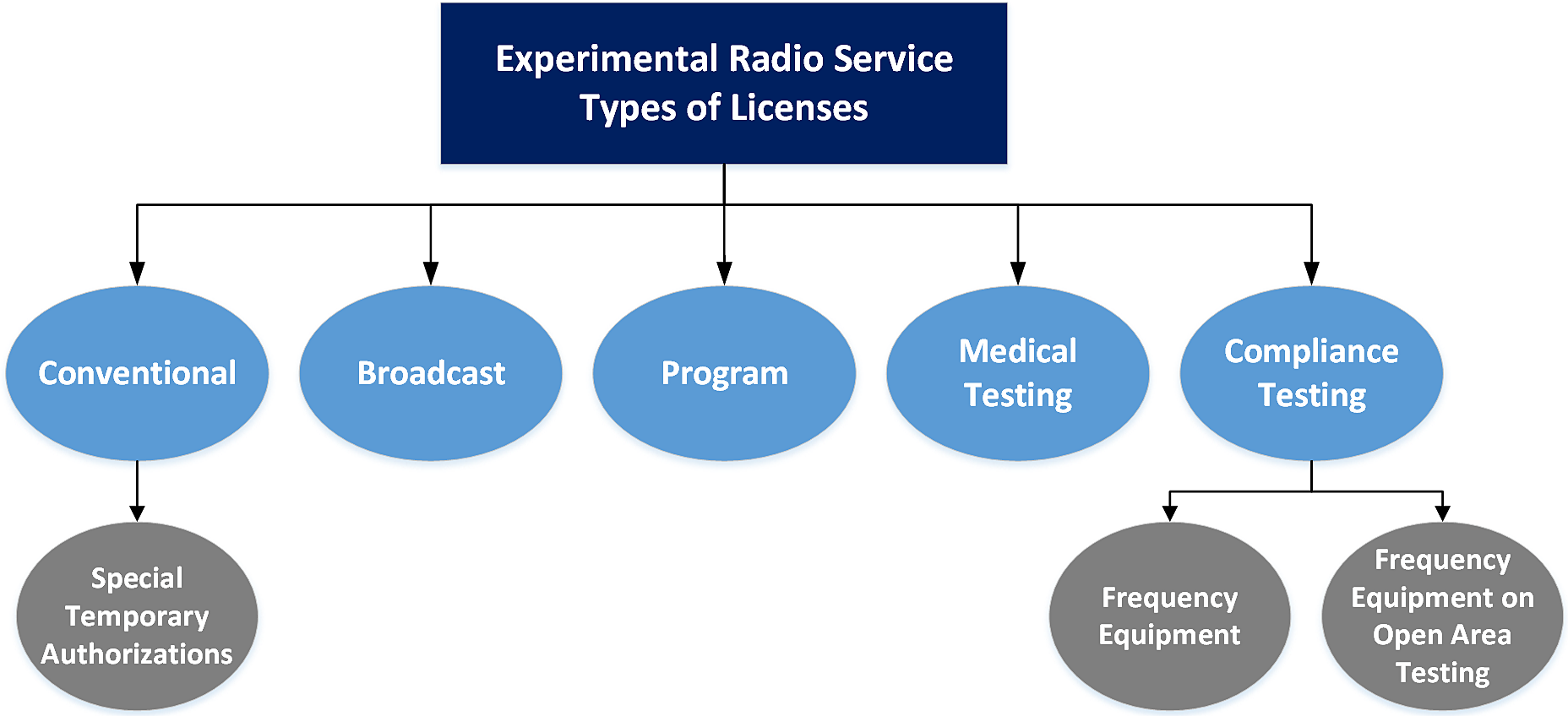
The FCC in the United States is authorized to provide experimental use of frequencies.Footnote 1 To this end, the FCC grants licenses under its ERS. These licenses might be used for purposes of experimentation, product development, and market trials, which are not otherwise permitted under other existing service rules (Federal Communications Commission, 2013a). Experimental licenses are classified into five categories (see Figure 1).Footnote 2 According to the FCC, this new license structure “benefit the development of new technologies, expedite their introduction to the marketplace and unleash the full power of innovators to keep the United States at the forefront of the communications industry” (FCC, 2015).
Experimental radio services (ERS) license classification.
Conventional
These licenses are granted for a specific research or experimentation project or a series of closely related projects for up to 5 years. Nonetheless, if the projects are widely divergent and/or unrelated, experiments must be conducted under separate licenses. Additionally, conventional experimental licenses can also be granted for product development trial and market trials.
Special temporary authorization (STA) is a type of license, which is a subcategory of conventional licenses. When an experiment is expected to last no more than 6 months, its operation is considered to be temporary. Hence, a STA can be issued. An STA also applies to cases where applicants need to operate transmitting equipment in circumstances where it is not possible to wait for a conventional license to be issued.
Broadcast
An authorization granted for projects whose focus and objectives are on the development and advancement of new broadcast technologies. This authorization is limited to utilization by the general public and stations intended for reception only.
Program
Granted to qualified institutions (colleges, universities, research laboratories, manufacturers, and medical research institutions) that integrate radiofrequency equipment into their products to conduct an ongoing program of research and experimentation under a single experimental authorization.
Medical testing
Intended for hospitals and healthcare institutions that demonstrate expertise in testing and operating medical devices using wireless technology in clinical trials.
Compliance testing
This type of license is specific for laboratories recognized by the FCC to perform (a) product testing of radio frequency equipment or (b) testing in an open area test site.
ERS regulation
The ERS is administered by the Office of Engineering and Technology (OET) and its Experimental Licensing Branch. The rules currently in place were adopted after the 2013 Report and Order (FCC 13–15), where the commission included numerous changes to its experimental licensing branch. With this new set of rules, the FCC stated that the ERS would have “a more flexible framework to keep pace with the speed of modern technological change while continuing to provide an environment where creativity can thrive” (Federal Communications Commission, 2013b). All rules, restrictions, and conditions about the ERS licenses are contained in Part 5 of the Code of Federal Regulations, Title 47, 2013 (Federal Communications Commission, 2013a). The main characteristic of the rules is the great flexibility of the authorized parameters:
Allowable frequency
Frequencies are assigned on a shared basis and not for the exclusive use of any one licensee. All applicants shall ensure that transmitted emissions remain within the authorized frequency band and bandwidth. Under normal operating conditions, licensees could be allowed to utilize any Federal or non-Federal frequency, except for those exclusively allocated to passive services (e.g., radio astronomy and space research services).Footnote 3
In the case of broadcast licenses, the assigned frequencies should be the most suitable for the purpose of the experimentation and those which are the least likely to cause interference to established stations. If an experiment cannot be feasibly conducted on frequencies allocated to a broadcasting service, an experimental station may be authorized to operate on other frequencies.
Maximum transmission power
Since ERS licenses are meant to share spectrum, the transmitting radiated power is limited to the minimum practical necessary for the success of the experiment. Nevertheless, it is important to point out that the FCC does not establish a fixed maximum transmission power level for experimental authorizations.
Non-interference criterion
When talking about spectrum sharing, the de-facto question relates to harmful interference, principally to the incumbents of the band.Footnote 4 In the ERS case, the FCC mandates that the operation of an experimental station is permitted only on the condition that harmful interference is not caused to any station using the band for transmission purposes, especially to the incumbent of the band. The FCC requires that if harmful interference occurs, the licensee should cease transmissions immediately upon becoming aware of such interference. The radio operator is not allowed to resume transmissions until it is established by the FCC that further harmful interference will not be caused.
Authorized applicants
Although the rules provide great flexibility regarding technical parameters, authorizations are issued only to entities qualified to conduct the requested experimental operations. In particular, when program, medical and compliance testing licenses are requested. Consequently, no experimental radio transmitter, within the United States, could start operations before a proper authorization has been granted.
License period
For conventional, program, medical, and compliance authorizations, the regular license term assigned by the FCC is 24 months (2 years).Footnote 5 Nevertheless, applicants can request an experimental license under the ERS program for up to 5 years. Furthermore, licenses can be renewed for an additional term, no longer than 5 years, upon the corresponding request.
Numbers Behind 10 Years of ERS Licenses
In the following sections, we present the analysis of the available data of the ERS. First, we introduce an overview of the experimental licenses in the United States. Then, we seek to find, if any, of the elements in an experimental authorization has been more important when requesting such an authorization. As aforementioned the FCC classifies its experimental licenses into five different categories. Nonetheless, licenses for program, medical device testing, and compliance testing were recently introduced in 2013. Further, applications for such types of licenses started to be accepted in 2017 (Knapp, Reference Knapp2017). Consequently, in our analysis, we only consider the most common types of licenses, conventional, including its subcategory STAs.
There is a significant amount of public information regarding ERS licenses; however, this information is contained in multiple repositories within the FCC. Moreover, it is designed for individual inquiries of license requesters rather than bulk queries (Office of Engineering and Technology, 2008). Consequently, our analysis of the experimental licenses is based on the information scrapedFootnote 6 from the OET’s experimental licensing system. Additional information regarding the scraping interface and the results presented in this article can be found in (Bustamante et al., Reference Bustamante, Weiss and Sicker2017).
Since 1987, the FCC has approved 24,950 licenses under its experimental program. The number of granted licenses has continuously grown: approved applications have increased from less than 500 until 1998 to more than 2,000 per year since 2014. However, these licenses are not uniformly distributed over these more than 30 years. We find that 61% of licenses have been granted in the period between 2007 and 2016. This license distribution is the reason why our attention has focused on the experimental licensing activity in this period, where a total of 13,653 experimental authorizations were granted in the United States. In this time, we observe an especially evident increment in the number of STAs, which present the most significant growth. Indeed, the number of approved STAs has increased 15% per year, on average, while other types of licenses have significantly had lower average growth rates.
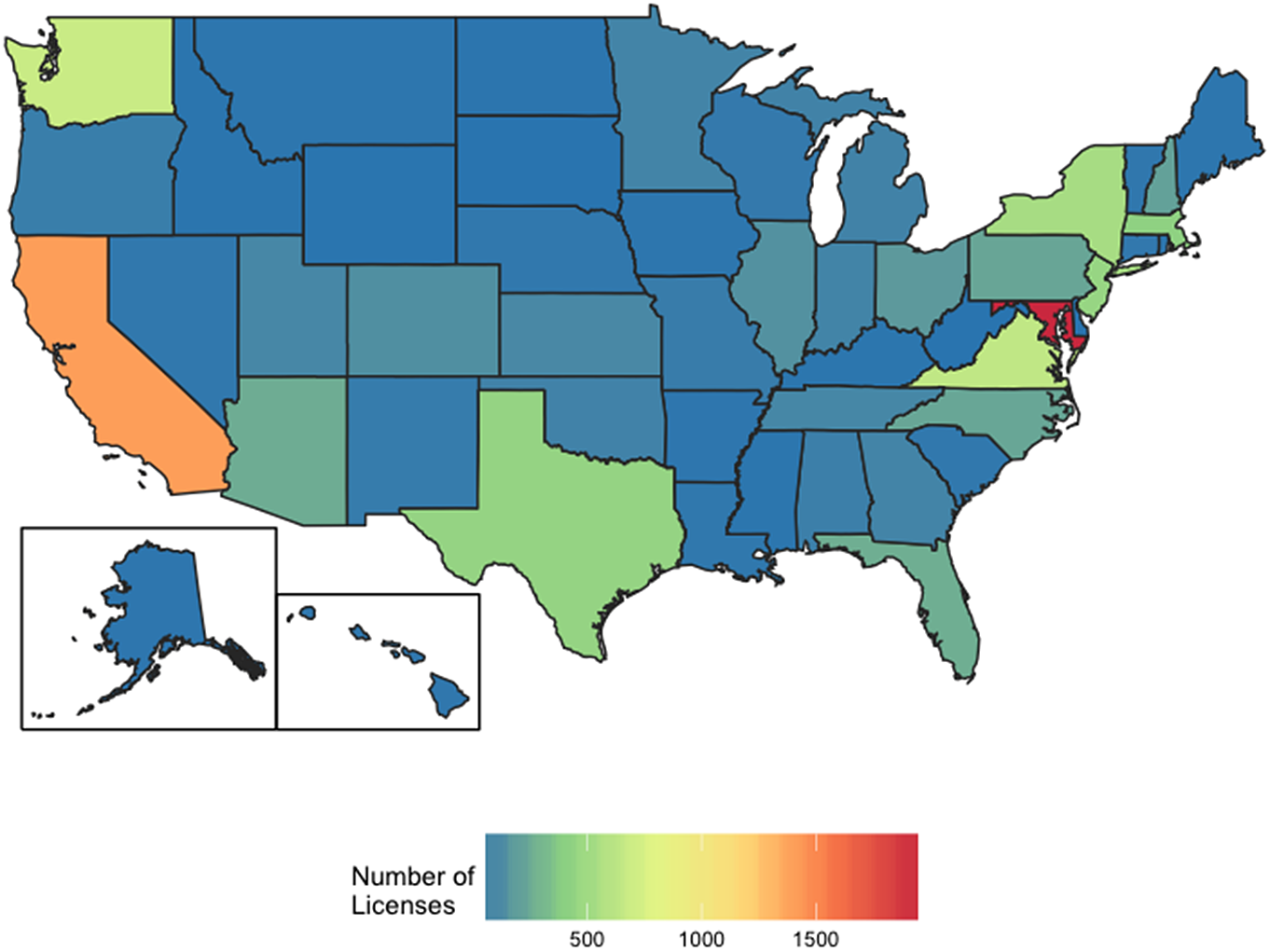
Granted licenses are spread all over the United States. The FCC has authorized the use of experimental spectrum in all 50 states, as it is depicted in the heat map presented in Figure 2. Nevertheless, the distribution of the number of licenses has not been uniform across the United States. Thus, states such as Delaware, Wyoming, or West Virginia have had only a few authorizations (less than five) since 2007. In fact, 68% of all states have had one hundred or fewer applications.
Distribution of licenses by state.
Processing delay
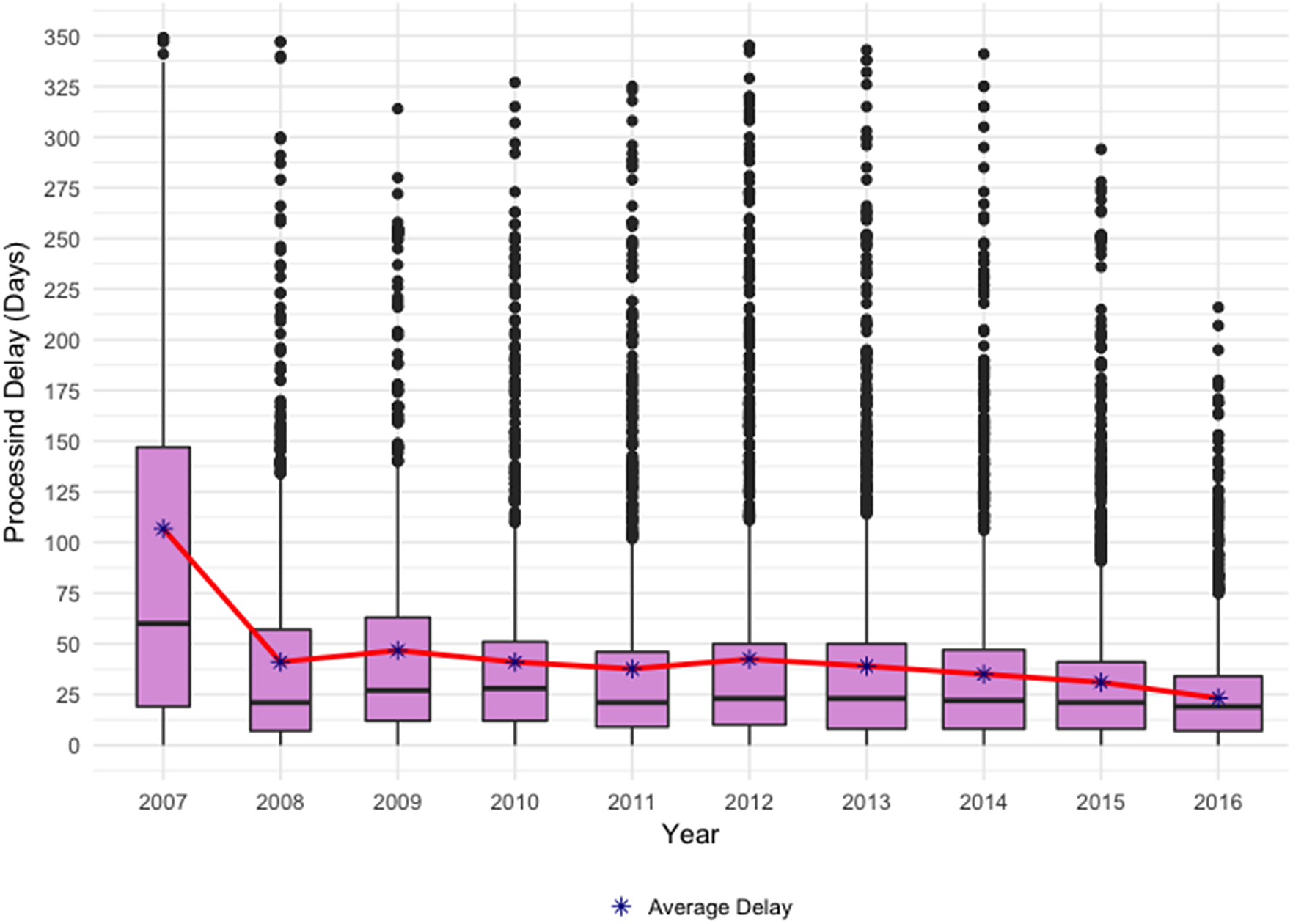
One of the main concerns when obtaining a license is the time burden attached to this process. This is not an exception for requesters of experimental licenses. We refer to this time burden as processing delay, and it is defined as the time elapsed from the date an application was submitted to the date the corresponding license is granted. According to the Report of the Unlicensed Devices and Experimental Licenses Working Group, “[e]xperimental applications that are solely within the FCC’s jurisdiction are usually approved in less than a month” (Federal Communications Commission Spectrum Policy Task Force, 2002). From our gathered historical data, we observe that the average processing time for conventional licenses has, in fact, been reduced from over 100 daysFootnote 7 in 2007 to an average of 23.31 days in 2016.Footnote 8 Another interesting finding is that the variance in the delay distributionFootnote 9 has also been reduced since 2007. This means that most applicants experience similar delays when obtaining licenses (see Figure 3).
Processing delay descriptors.
Licensees
The commission requires all license requesters to identify themselves as part of the application process. Thus, a licensee could be classified as individual, association, partnership, corporation, or other. Our analysis shows that most ERS licenses are granted to corporations, corresponding to 86% of the total licenses, followed by applicants identified as others with 9% of all applications. The latter was introduced by the FCC to allow any license requester to describe what best fits its identity (Office of Engineering and Technology, 2008). In this category, the most commonly utilized descriptors include governmental agencies, colleges, universities, and research laboratories. These results show how experimental licenses involve a sharing process among many different types of licensees.
Technical parameters
At the core of the experimental licenses are the authorized technical parameters. Therefore, in what follows, we complete our analysis by exploring the equipment utilized, frequencies allocated, and maximum allowable power for these authorizations.
Equipment
One of the main components of any ERS application is the list of all radio equipment to be used in the experiment. This list includes the manufacturer, model, and the total amount of units to be utilized. As part of the required information, the FCC also mandates the inclusion of an experimental identification, which differentiates between commercial and research transmission units. Using this information, we were able to determine the amount of de facto experimental equipment being deployed. Our analysis showed that, on average, only 40% of the total equipment is indeed experimental. Hence, we can reasonably conclude that many of the experiments are using off-the-shelf equipment in their trials.
Assigned frequencies
Rules within the ERS mandate that licenses could be allowed to utilize any Federal and non-Federal frequency. Frequencies have been assigned in all radio bands defined by the International Telecommunications Union (ITU) with a total of 76,611 frequencies authorized since 2007. Within this wide range of used frequencies, we can see that the most common bands for conventional licenses are in the ultra-high frequency (UHF) and super-high frequency (SHF) range. Note that, while the distribution itself has changed, most of the authorizations are always concentrated between 10 MHz and 10 GHz as we can observe on the left side of Figure 4.
Frequency distribution: left: conventional licenses and right: special temporary authorizations.
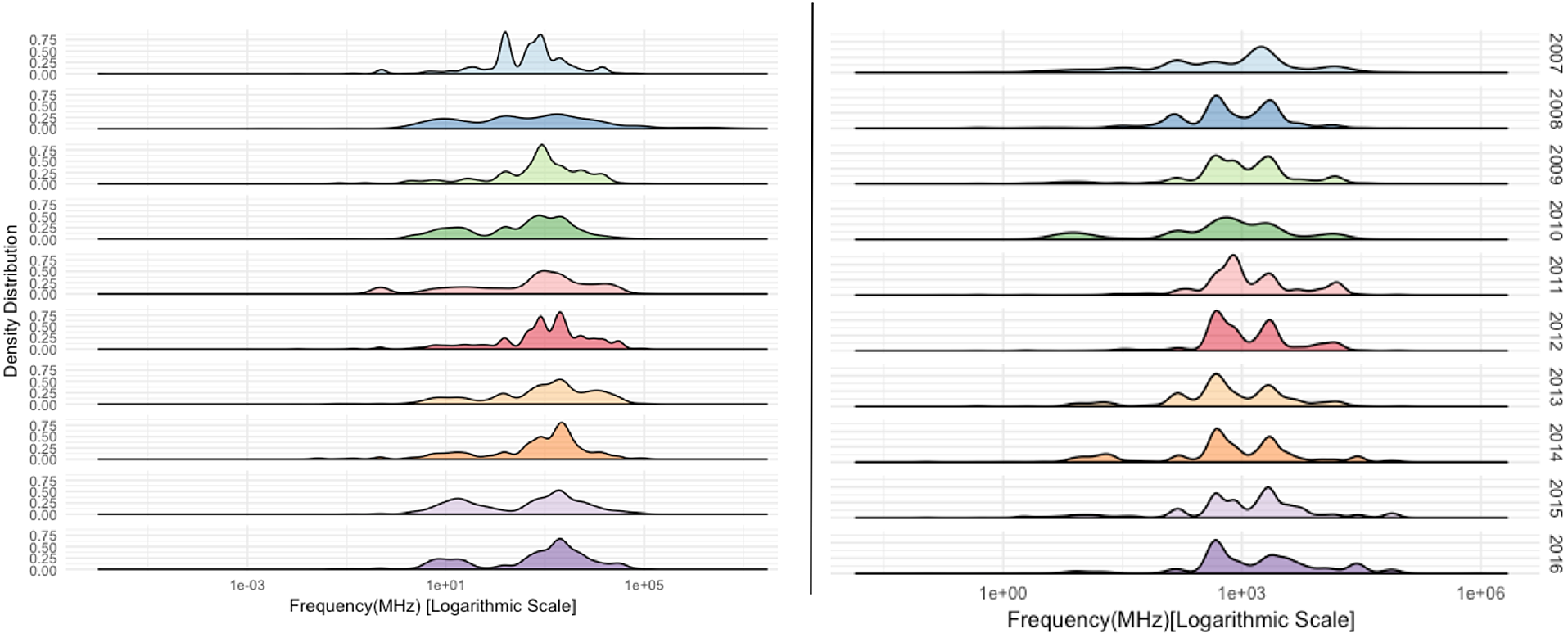
The wireless community has shown increased interest regarding resources in very high-frequency bands. This is also reflected in the evolution of conventional experimental licenses between 2007 and 2016. Indeed, we observe that the exploration of bands over 5 GHz has significantly increased since 2011. Within this trend, the exploration of bands around 35 and 45 GHz shows the most notable increase.
Authorized power
In the same way as allowable frequency, power authorizations are also very flexible. The authorized transmission power varies from very low values, that is, less than 1 uW, to significantly high-power authorizations in the order of gigawatts.
Special temporary authorizations
This special subcategory of conventional licenses applies when the experiment duration is meant to last 6 months or less. STAs are of particular interest because they have had the biggest growth rate in the past 10 years (15%). Temporary licenses have increased from only 281 in 2007 to more than 1,000 by the end of 2016.
License duration
Our analysis indicates that almost half (47%) of STAs were approved to last 1 month or less. This trend is yet more salient since 2013 with an average of 56% licenses granted for that period. Going deeper into the analysis of these short-term licenses, we can observe that 52% of them are being granted for less than a week (7 days). The reason for these short-duration authorizations could be directly tied to the purpose of operation of most STAs, which we explore in the following sections.
Technical parameters
Along the same lines as our conventional license analysis, we now explore the implemented equipment, utilized frequencies and maximum deployed power of STAs.
Assigned frequencies. Temporary authorizations are also characterized by having great flexibility in their frequency allocation. They span across the majority of ITU Bands with a total of 54,764 frequencies. Indeed, the only radio band where zero authorizations have occurred is the ultra-low-frequency band (see the right side of Figure 4). Additionally, it is interesting to note the shift in the distribution towards higher bands for the past 6 years. We observe a significant amount of authorizations in frequencies such as 38 GHz, 48 GHz, and above.
Authorized power. Our analysis shows that the allowable power levels range from very low (less than 1 mW) to very high levels (more than 1 GW). Furthermore, within this distribution, it is important to point out that the highest concentration of power levels is located between 100 mW and 1 KW.
Purpose of operation
A key characteristic in STAs is the experiment specification requirement, which mandates the inclusion of the goal of the proposed experiment as part of the application. It is defined as “[a] detailed explanation of the type of operation that will be performed with the ERS license” (Office of Engineering and Technology, 2008). We can observe a great variety of operational goals. Applications range from very specific deployments and demonstrations for military equipment to large and complex tests of aircraft systems. Nevertheless, most licenses are authorized for the coverage and support of televised events nationwide, with 73% of all STAs. These authorizations are utilized for several activities such as equipment testing, support, and coordination of transmissions, personal communications, and so forth. Most of the covered events are sports-related; however, other types of events such as presidential debates or award ceremonies also rely on STAs for transmission and support activities.
What is Hidden Behind 10 Years of Data?
So far, we have explored some basic features regarding the ERS. In what follows, we switch gears to a deeper analysis of the available information. The goal of this analysis is to find, if any, of the features in an ERS application is considered more important when obtaining an experimental authorization. For this purpose, we analyze two important features of the ERS. We first study the relationship between the time to process an application and the pieces of information within it. Then, we explore both the application process and the licensees, to reveal any trend that might be hidden in a decade of information.Footnote 10
Relationship between processing delay and requested parameters
One of the main concerns when obtaining an ERS license is the time burden of this process. As we have shown, the average processing delay between 2007 and 2016 has been reduced from over 100 days to less than a month. This is good news when requesting experimental authorizations, but we still have some questions to consider: What happens when Federal frequencies are requested? Do requested parameters impact the processing delay? What is the relationship between the type of licensee and the processing delay?
Impact of using Federal bands
When a Federal band is required, coordination between the FCC and the National Telecommunications and Information Agency (NTIA) is necessary before issuing an authorization. Regarding this topic, the Spectrum Policy Task Force explains that “[t]he principal concern of these parties Footnote 11appeared to be the delays involved in obtaining an experimental authorization due to NTIA coordination…” (Federal Communications Commission Spectrum Policy Task Force, 2002). However, in the FCC’s published information, there is no explicit disclosure on whether coordination with the NTIA was necessary for the application processes.
To analyze the impact of NTIA involvement in the processing time, we filtered all federal exclusive allocations between 300 MHz and 3 GHz.Footnote 12 A total of 3,081 applications for conventional licenses were presented for the use of UHF frequencies. From these authorizations, 24% correspond to authorizations that required coordination between the FCC and the NTIA. This allowed us to compare the average and median processing times. We found that when the NTIA is involved, the average and median delays are always higher, almost double, than the rest of applications for experimental licenses. However, it is necessary to point out that these delays have also been considerably reduced from over 200 days in 2007 to an average of 42 days and a median of 35 days by 2016. There is no additional information in the gathered in data that help us explain the reason for this finding besides the fact of additional coordination and authorization steps involved in the process.
Impact of the requested parameters
To measure the impact of the requested parameters on the time to get an experimental license, we have relied on regression models. We start by building simple regression models with the applications’ factors or parameters that we considered the most important when obtaining a license.Footnote 13 Our results show that only the year in which an application was presented holds a significant correlation with the processing delay. Consequently, the only part of an ERS application suitable for simple prediction models is the year of the petition.Footnote 14
For building more complex and complete regression models, we took into account all the parameters regarding the granting process of an experimental license. Our goal was to construct a multiple linear model including licensee details such as requester classification, duration, equipment, type of transmission station, frequency, and so forth. The outcome of the model has very low statistical significance. Hence, the model cannot be utilized for predicting the delay with any confidence, since it only accounts for 10% of the variance in the processing delay.
The results of this analysis are not completely conclusive from a data mining perspective. Nonetheless, from an ERS regulation and policy point of view, these results are very encouraging. They show that the time burden to obtain an experimental license has almost no relationship with any requested, technical or nontechnical, parameter. The only factor influencing the processing delay of an application is the year when it was presented.
Relationship among applicants
Our final task is to find interconnections, if any, among the licensees. We have selected partitional clustering modeling as an appropriate tool for this exploration. The creation of groups allows us to organize similar data instances into clusters.Footnote 15 Further, a k-means model helped us create a fixed number of groups (k) based on a distance function that finds the similarities between distinct applications.
The FCC categorizes the type of licensees into five fixed classes: corporation, association, partnership, individual, and other. Consequently, we created a k = 5 clustering model to seek possible similarities among the members of this categorization scheme. The results of this approach are depicted in Figure 5.Footnote 16 We found that there is no correlation between the applicants’ identification and all their requested characteristics represented in their principal components. Indeed, we can observe that all constructed clusters have at least a small percentage of each of the applicant types determined by the FCC. These results show the diversity of applicants obtaining the Commission’s experimental licenses. This also supports the fact that the specific applicant classes created by the FCC do not have any indication of what the requested characteristics will be. Indeed, license petitioners request different authorizations disregarding their fixed assigned identification.
Licensee clustering result.
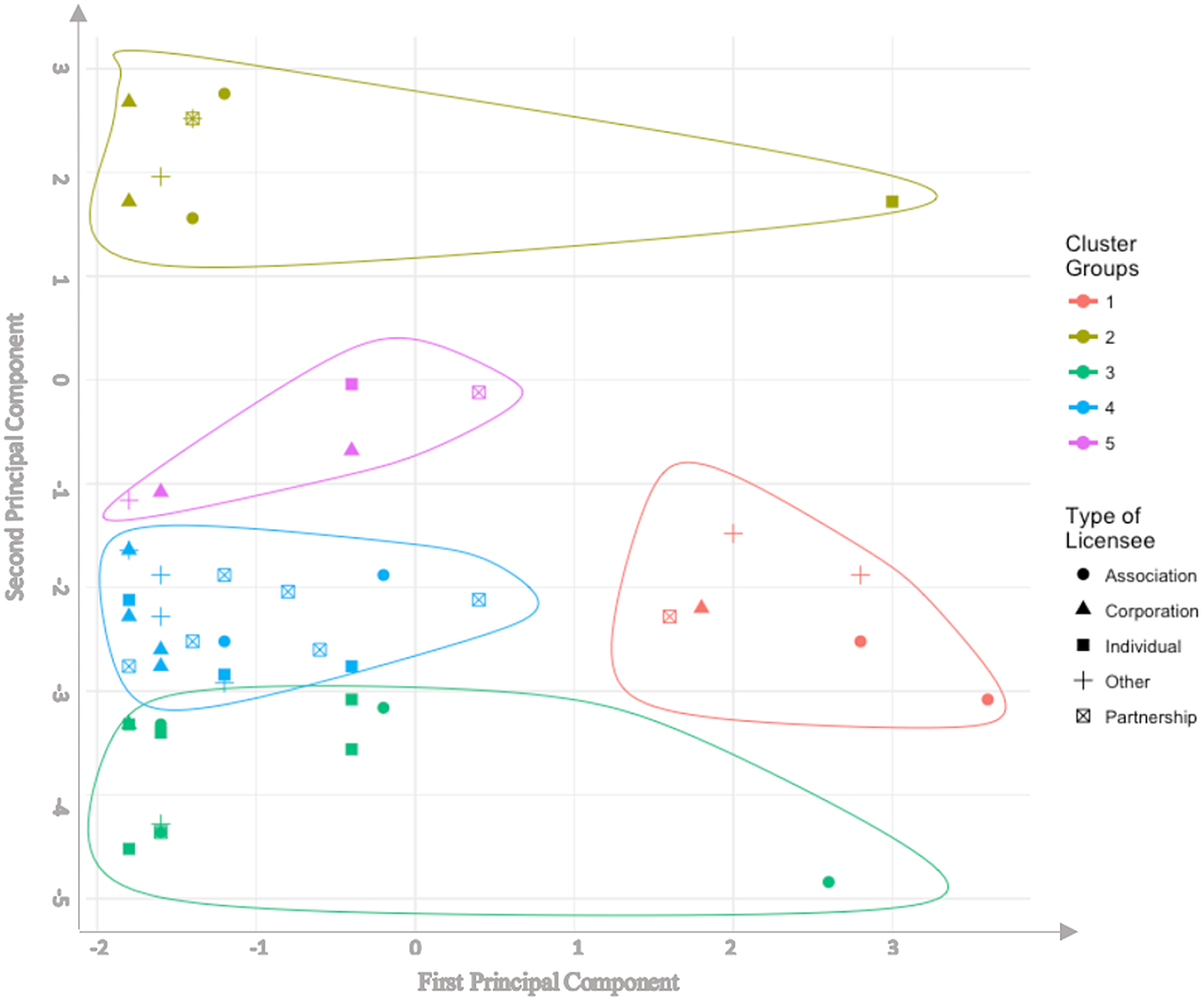
This deeper data exploration has shown important findings regarding the applicants and the application process of the ERS. First, the processing delay is not related to any factor besides the year in which the request was presented and/or requests for Federal frequencies. Results also show that within the application process all the required pieces of information have more or less the same impact in the time to get an authorization. Finally, when talking about applicants, it is shown that the FCC’s classification scheme is not an indicator of common characteristics among the requesters. Thus, based solely on the obtained, technical and nontechnical, parameters, no group distinction can be made. These results are consistent with the purpose and objectives of the ERS licensing system. An explanation for our findings could be traced back to the already shown feature of having no limitations in technical parameter choices within the ERS. Further, we can tie these outcomes to the fact that the FCC utilizes standardized electronic forms and web-based services.
Experimental Licenses and Wireless Technologies
We conclude this article showing how ERS licenses are being used in real-world implementations. We use 5G as the most suitable example to show the ERS flexibility and applicability in the development of wireless technologies.
Nowadays, a very popular topic in the wireless community is this new cellular technology, 5G. This is also true for the ERS where over 100 licenses have been granted for experimentation in this area since 2010. The number of applications has experienced a significant increase in the past 2 years with the greatest number of licenses being granted in 2016. It is interesting to point out that these licenses implement 82% of experimental equipment in their setups for customer demonstrations, market trials, and equipment demonstrations.
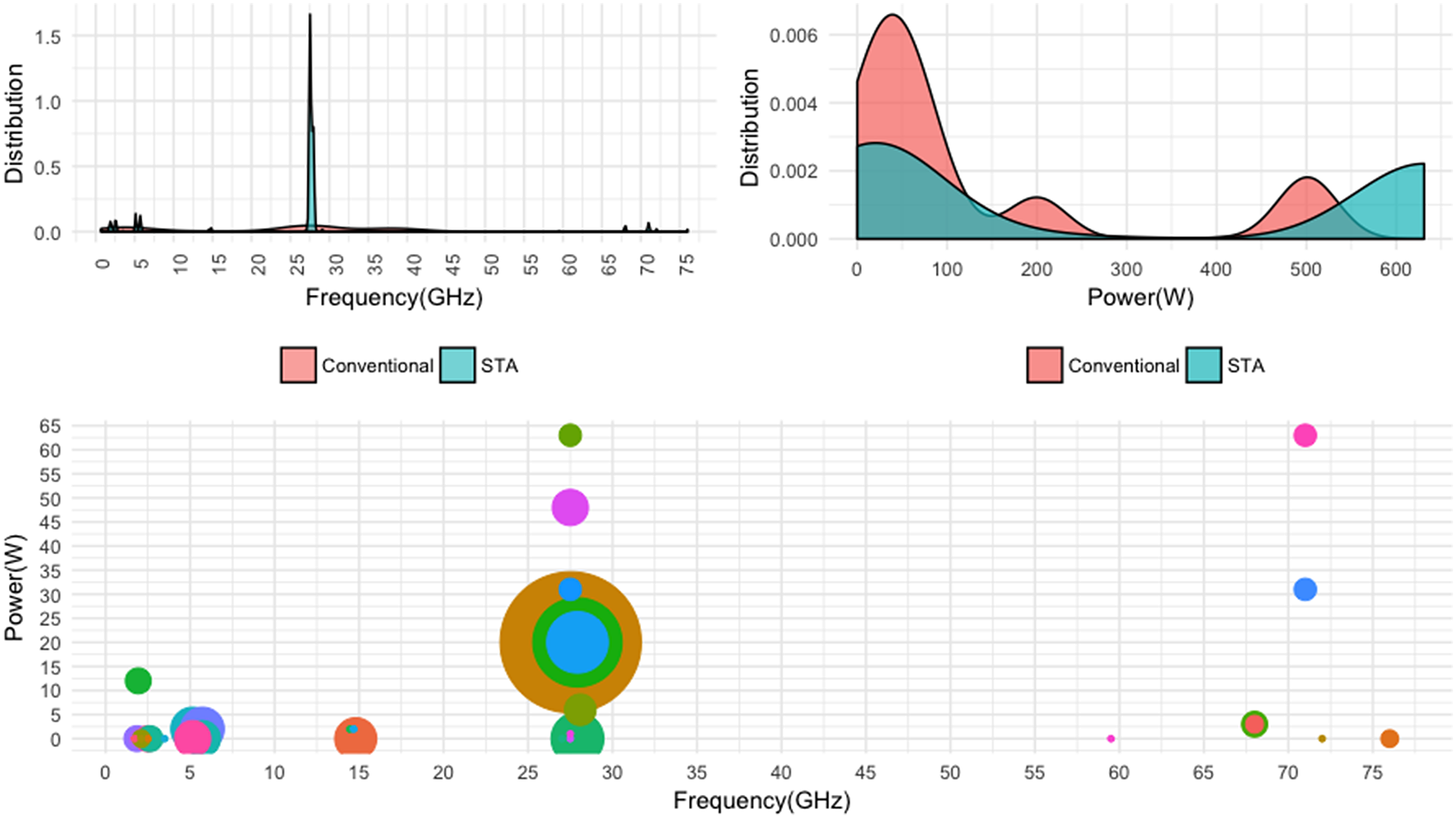
One commonly discussed feature of 5G is the potential frequency allocation. In the case of ERS licenses, frequencies are being used in higher bands, between 20 and 45 GHz (Figure 6 [top-left panel]). Another interesting technical detail to observe is the power distribution. As depicted in Figure 6 [top-right panel], the power distribution is not the same for the special authorizations and conventional licenses. However, there are still some similarities worth mentioning. For instance, most of the transmission stations have been tested with low maximum power levels, that is, less than 100 W. Finally, as demonstrated in Figure 6 [bottom panel] by mapping frequency assignations to maximum allowable power in 5G experimental licenses, we can observe a variety of power arrays being tested in different bands. For instance, in the 28 GHz band, we observe a concentration of experiments between 10 and 30 W; however, all kinds of power levels are also being tested. Hence, we can see how, nowadays, the ERS is being used in a variety of setups.
Experimental licenses in 5G: technical characteristics.
Conclusions
DSA systems are considered the future of spectrum allocation by many authors in the field. When talking about DSA, several examples such as CRs, SDRs, and the AWS-3 initiative come to mind. Nevertheless, as shown in this work, experimental licenses under the ERS are not widely known, but they still represent an interesting example of spectrum sharing.
In this work, we find that conventional experimental licenses have been assigned in all frequency bands.Footnote 17 In the case of STAs, we find that the use of these licenses is not entirely experimental; instead, these licenses are being used for other types of DSA systems. When discussing the granting process in the ERS, our findings suggest that no other factor besides the year of the application and the request of Federal frequencies has a significant impact on the processing delay. Further, the time to get a license has been considerably reduced, from over 100 days to 23 days, in 2016.
As aforementioned, the FCC in the United States is not the only regulatory body providing spectrum access for experimental, scientific, and development tasks. Further, most regulators are seeking more efficient methods for spectrum assignment and allocation such as DSA systems. In this light, we believe that the lessons learned by the FCC and its ERS from a sharing point of view could be easily extrapolated to other sharing schemes being developed outside the United States.
Funding Statement
This work received no specific grant from any funding agency, commercial or not-for-profit sectors.
Competing Interest Statement
Pedro Bustamante, Martin Weiss, Douglas Sicker, and Marcela Gomez declare none.
Data Availability Statement
The data that support the findings of this study are available from the Federal Communications Commission at https://apps.fcc.gov/oetcf/els/reports/GenericSearch.cfm.
Ethical Standards
The research meets all ethical guidelines, including adherence to the legal requirements of the study country.
Authorship Contributions
Conceptualisation, P.J.B., M.W., D.S., and M.M.G.; Data curation, P.J.B. and M.M.G.; Formal analysis, P.J.B., M.W., D.S., and M.M.G.; Methodology, P.J.B.; Writing-review & editing, P.J.B., M.W., D.S., and M.M.G.


 Open access


Comments
No Comments have been published for this article.