

The Chinese Communist Party is building missiles and we’re arguing over gender pronouns. China is laughing at us.
US conservative politician Nikki Haley’s post on X, 28 June 2023Footnote 1
When China is working on Made in China 2025 [a national strategy for manufacturing], Americans are arguing over genders for the bathroom.
A Zhihu post on problems with the baizuo, 8 August 2019Footnote 2
As Vladimir Putin depicts ‘cancel culture’ and ‘reverse racism’ as widespread problems afflicting Western societies,Footnote 3 the Global Times, a newspaper owned by the Chinese Communist Party, presents J. K. Rowling as a victim of ‘the West’s political correctness’.Footnote 4 As men’s rights organisations in India stigmatise feminism as ‘weapons of family destruction’ imported from ‘the West’, ‘memetic alliances’ have emerged in the Farsi manosphere between Iran’s authoritarian ‘digital soldiers’ and alt-right visual cultures.Footnote 5 Studies of the far right have been accused of a persistent Eurocentrism and electoralism,Footnote 6 in that the scholarship is largely focused on electoral politics in Euro-American contexts, and developments elsewhere tend not to be recognised as an integral part of ‘global far-right narratives’.Footnote 7 However, an emerging body of multidisciplinary literature has not only offered rich empirical insights into the resurgence of the right in the Global Easts and South, but also, in various ways, has come to terms with ‘the international as constitutive of far-right politics’.Footnote 8
The global dimensions of right-wing politics have been examined from a variety of perspectives. Some focus on the role of transnational advocacy networks and strategic alliances in the spread of the so-called culture wars across national borders.Footnote 9 Others highlight concurrent developments and transnational affinities in the reinvigoration of ethnonationalist, authoritarian, and social conservative politics across different national settings, which do not necessarily involve the direct influence of established transnational networks.Footnote 10 Finally, perhaps most relevant to International Relations (IR) is the discussion on the relationship between the global right and international orders.Footnote 11 The reinvigoration the right has been examined as reactionary responses to the crises of neoliberal globalisation.Footnote 12 It is viewed as ‘counter-order movements’ that oppose certain aspects of ‘international liberal ordering’Footnote 13 or driven by resentment towards the ‘status hierarchy’ in such ordering.Footnote 14
Building on these insights, this article is concerned with two tasks. First, it aims to contribute to a global understanding of reactionary discursive formations in the present moment, which increasingly coalesce around self-victimising articulations of racism and backlash against social justice struggles. They need to be analysed globally not only because of the transnational circulation of reactionary narratives, tropes, and memes, not least in the digital sphere, but also because international and civilisational imaginaries are integral to their operation. Drawing on insights from feminist and postcolonial scholarship on racial entanglement and masculinism, I argue that raced and gendered imaginations about an emasculated and overly multiracial West and, relatedly, renewed East/West binaries enable reactionary discourses in both the Western world and elsewhere through adaptable mechanisms of channelling between the international and the domestic. While existing research has highlighted these narratives about civilisational decline and crisis in Western far-right discourses, less attention has been paid to how they are produced and employed elsewhere to bolster ethnonationalism and social conservatism in the ‘non-West’. I adopt a global and co-constitutive approach to Occidentalism (and Orientalism) to illuminate the transnational co-production of gendered East/West binaries and how they are invoked to legitimate reactionary discourse from different geopolitical positionings.
Second, I extend an analysis of global racial entanglements and gendered East/West dichotomies to Chinese anti-baizuo discourse, or discursive formations around the neologism that literally translates as ‘white left’ and functions as a rhetorical device similar to ‘social justice warrior’ or ‘woke’.Footnote 15 Examining both online discussions of the baizuo among nationalists and texts of Chinese liberal intellectuals endorsing Trumpism,Footnote 16 I show how, in a seemingly unlikely convergence, both ‘anti-Western’ nationalists and ‘pro-Western’ dissidents reproduce images of a feminised West troubled by immigration, leftist ideologies, and social justice politics in their localised iterations of global reactionary discourses. They are nonetheless underpinned by different ideological orientations and animate different political projects. Nationalists mobilise discontents with Western dominance in the international order to delegitimate certain values and movements as ‘Western’, while reinscribing Eurocentric, racialist, and masculinist logics that posit China as essentially having ‘outwested the West’Footnote 17 in its purported valuing of ethnocultural sameness, competition, and techno-economic progress. For the liberal dissidents, their attraction to US far-right discourse is rooted in the trajectory of Chinese Occidentalism that deploys an idealised image of the white, Christian West to critique domestic conditions.Footnote 18 Taken together, this empirical material offers us a prime example of how global reactionary discourses, taking highly versatile and hybrid forms, operate across and through geopolitical cleavage and the ‘West versus the Rest’ divide.
This article makes several contributions at the intersection between postcolonial IR and critical research on the global politics of reactionary discourses, which increasingly blur the boundary between the mainstream and the far rightFootnote 19 and are often euphemised as ‘populism’. Integrating the conceptual tools of racial entanglements, masculinism, and Occidentalism from feminist and postcolonial scholarship, I argue that the transnational production of East/West binaries in reactionary discourses functions as shifting mechanisms for actors to exploit and negotiate the relationship between domestic politics and the international structure. Chinese anti-baizuo discourse presents a unique opportunity to explore the complex and versatile ways in which reactionary imaginations of the West are invoked to configure global racial hierarchy and animate the translation between the domestic and the international in a ‘non-Western’ context. The analysis also illuminates linkages between misogyny, authoritarianism, and neoliberalism beyond democratic regimes.Footnote 20 Drawing out overlaps and divergence between Chinese and American ‘anti-woke’ narratives sheds light on how culture war discourses intersect with the co-construction of United States–China opposition. Within postcolonial IR, I join the criticisms that question the persistent Eurocentrism in seeming attempts to pluralise the discipline, which nonetheless reify cultural essentialism and dualistic constructs.Footnote 21 By emphasising interconnectedness and adopting a co-productive approach to Occidentalism/Orientalism, my examination of global reactionary discourses through China shows that these world political binaries are constitutively unstable, mutable, and contradictory.
The article proceeds as follows. I start by clarifying my conceptual approaches to reactionary discourse, racial entanglements, and masculinism. This is followed by a discussion of transnational Occidentalism and renewed East/West binaries in global reactionary discourses. I then scrutinise racial representations, masculinist logics, and Occidentalism in Chinese anti-baizuo discourse, looking at both online discussions among nationalists and the writings of dissident intellectuals on Trumpism. I conclude with reflections on potential venues for future research into the global politics of reactionary discourse.
Reactionary discourse, global racial entanglements, and masculinism
Following Hirschman’s classic account of the rhetoric of reaction, we can understand reactionary discourses as historically formulated ‘discourse, arguments, [and] rhetoric’ against proposals for achieving greater equality.Footnote 22 This resonates with the conceptual approaches to conservatisms and the right that view them as ‘historical improvisations’ on a relatively ‘continuous theme’, which is reaction to the extension of freedom and equality.Footnote 23 Reaction therefore involves movements and ideologies that vary widely from one another across time and space, depending on the historically specific forms of progressive politics it opposes. In the context of the development of anti-racist, feminist, and decolonial movements in the past few decades, two intertwined narrative structures around which reactionary discursive formations at the current conjuncture increasingly coalesce are of particular interest to us. The first is self-victimising articulations of racism and racial nationalism,Footnote 24 exemplified by white supremacy, anti-immigration nativism, and Islamophobia. While racism and ethnocentrism have always been a cornerstone of right-wing ideologies, the affective and narrative form they currently take in both the Global North and South is one capitalising on feelings of victimhood among majority ethnic groups.Footnote 25 The second revolves around the rejection or ‘abnormalisation’ of social justice struggles,Footnote 26 which are often delegitimated as ‘elitist’ in Western core contexts or as ‘Western’ in postcolonial spaces in the Global Easts and South. This typically features terms such as ‘culture wars’, ‘political correctness’, ‘woke’, and ‘cultural Marxism’. As Branciforte and McGlazer note, this emergent ethnonationalist cultural politics spells out a change of ‘political style’ on the part of the right,Footnote 27 who present themselves as aggrieved, oppressed by progressive cultural elites, and threatened by demographic changes. The ‘racial’ and ‘cultural’ aspects of reactionary discourse are inherently interconnected, as for the aggrieved right, it is the ‘liberal’ or ‘postmodern’ culture that is failing to protect the boundaries of the ethno-nation and its values.
These grammars of reactionary discourse take highly adaptable and hybrid forms, being incorporated into different or contradictory ideological configurations and locally specific political projects. Some attack ‘wokeness’ from a religious traditionalist perspective while others as ‘classic liberals’; some are anti-feminist while others use gender equality as a marker of difference to justify anti-Muslim racism; some celebrate scientific and technological progress while others are hostile to it. Reactionary discourses are global not only in the sense that ethnonationalist, Islamophobic, misogynistic, and ‘anti-woke’ tropes travel across borders, especially in the digital sphere, but also because they produce and invoke particular international and civilisational imaginaries. Adopting the self-victimising style of ethnonationalist cultural politics enables actors in both core and periphery to act on a malleable interface between international relations and domestic politics. Critics point out that far-right movements in the United States and Western Europe both represent the international as a ‘central source of threat’ and play an instrumental role in the development of ‘the contemporary neoliberal international order’.Footnote 28 As I have argued elsewhere, reactionary movements in the Global Easts and South appropriate the anti-colonial rhetoric and take advantage of the discontents with political, economic, and normative hierarchies in the international order. They nonetheless perpetuate the hierarchical logics by reversing the parameters of value judgement and continuing to reify exclusion based on racial-civilisational categories.Footnote 29 Crucially, both those who identify with the label of ‘the West’ and those who are opposed to Western dominance produce similar images of the West in crisis due to ethnoracial diversity and progressive social movements. Before I zero in on the transnational co-production of these racialised and gendered Occidentalist representations, it is instrumental to draw on the theoretical insights on global racial entanglements and masculinism.
The scholarship from critical race studies on the co-constitutive relationship between globally generated racial meanings and the configuration of racisms in a particular local context is conducive to analysing narratives of racial hierarchy and ethnonationalism in postcolonial spaces.Footnote 30 Christian elucidates the myriad ways in which global whiteness shapes processes of racialisation in postcolonial and ‘non-Western’ states, where racial nationalist identities ‘have the ability to hierarchically position themselves along the field of global whiteness’.Footnote 31 Goldberg’s relational approach to racism calls attention to how racial ideas and exclusionary practices in local or national contexts are always co-constituted by globally ‘circulating, interacting, [and] relational conditions’Footnote 32 that generate racial meanings and representations. The lens of global racial entanglements draws attention to how white supremacist and racist narratives, which play on senses of victimhood and fragility, are transnationally reproduced to stoke gendered demographic anxieties in the reinvigoration of ethnonationalisms across the world.Footnote 33
The concept of masculinism helps us grapple with the gendered nature of reactionary discourses beyond their open attack on feminism, queer rights, or the so-called gender ideology.Footnote 34 Nicholas and Agius conceptualise masculinism as a broader mode of operation ‘beyond individual embodiment of masculinity and femininity’.Footnote 35 Insofar as we understand the naturalisation of inequality as a defining characteristic of the right, it follows that masculinism is a constitutive rather than coincidental feature of reactionary discourse. Masculinist logics naturalise gendered hierarchies, valorising that which is construed as masculine while disparaging what is construed as feminine, and extend them to formulate regulative ideals about social, political, and economic arrangements.Footnote 36 Approaching masculinism as a broader logic of dichotomising, evaluating, and ordering means that it can be operationalised within different ideological orientations – such as traditionalist conservatism, libertarianism, and the neoliberal authoritarian developmentalism examined here through Chinese anti-baizuo discourse. Gendered hierarchies could be naturalised by recourse to diverse categories such as traditional or religious values, competitive individualism, free-market capitalism, and vindicative postcolonial nationalism. For our purpose of examining the transnational production of Occidentalist representations in reactionary discourses, masculinism as an analytical tool allows us to not only spell out the gender dynamics in the reimagination of East/West binaries but also to draw out parallels and linkages between different discursive-ideological formations embedded in varying sociopolitical contexts.
The transnational production of Occidentalism/Orientalism in reactionary discourses
Racialised and gendered narratives about ‘Western civilisation’ and its crisis have become a focal point in global reactionary discourses.Footnote 37 From Geert Wilders and Viktor Orbán to Ben Shapiro and Jordan Peterson, far-right politicians and activists on both sides of the Atlantic present themselves as defenders of a Western civilisation endangered by internal and external threats. Playing on the enduring theme of civilisational decay and clashes in conservative thought, these narratives reaffirm the superiority of a particular idea of the West, evoke a nostalgia for a racially pure and socio-politically masculine West that never was, and lament over its destruction at the hands of those who negate ‘the West’s own values’.Footnote 38 Forms of masculinity associated with the romanticised past are articulated through a range of markers such as classical antiquity, ethnic homogeneity, Christianity, traditional values, and military strength in the mediatised production of far-right nostalgia.Footnote 39This glorious past then is contrasted with an allegedly feminised present undermined by immigration and the social movements of emotional ‘snowflakes’.Footnote 40 In short, the story is that Western civilisation is threatened on the one hand by increased ethnoracial diversity and on the other by a self-destructive political culture, variously designated as ‘cultural Marxism’, ‘postmodernism’, ‘woke’, or baizuo in Chinese cyberspace, which favours racialised minorities and discriminates against white males.
Less attention, however, has been given to how these representations of an emasculated West troubled by immigrants and leftist ideologies are produced, repurposed, and consumed elsewhere in the context of reactionary discourse.Footnote 41 A global, co-constitutive, and strategic approach to Occidentalism/Orientalism is crucial for understanding the transnational production of renewed East/West binaries. The multidisciplinary literature on Occidentalism has developed in part as a response to and critique of Said’s pathbreaking work on Orientalism.Footnote 42 While researchers have used the term in different ways, this scholarship shows that the classical account of Orientalism neglects how representations of the West emanating from Orientalised places play a pivotal role in constructing the idea of the West and East/West difference through articulations of the national self vis-à-vis images of the West. For instance, Bonnett argues that it was the ‘Westernisers’ in Japan and Turkey that invented the idea of the West, as a distinct civilisational site defined by a by-now-familiar set of characteristics such as modern, productive, scientific, and rational, before it became a central subject of debate in Europe or the United States.Footnote 43 Building on this body of work, I use Occidentalism to refer to the representations, imaginations, and discourses of the West that produce ideas of the West as a racial-civilisational and geopolitical category as well as its hierarchical relationship to ‘the Rest’. This includes discourses emanating from both Euro-America and elsewhere, and those that are prima facie ‘positive’ or ‘negative’, as forms of anti-Westernism can also consolidate hegemonic conceptions of the West.
It is important to note that Occidentalism is constitutive of and not a reversal of Orientalism, in that neither should be reduced to an ahistorical ‘inevitable partiality of any representation’Footnote 44 made by one society of another. Both are embedded in the global power structures that emerged out of the economic, political, and epistemic dominance of modern Europe and later the United States. As has been extensively dealt with in the postcolonial literature, postcolonial nationalism tends to both reject and identify with the images of the West it helps produce, which simultaneously embody the desire for the modern and represent imperial forces of domination against which national consciousness needs to be forged.Footnote 45 Furthermore, Occidentalism and self-Orientalisation are historically contingent discursive practices though which actors strategically produce and deploy images of the West and East/West binaries for specific political agendas. In Ahiska’s words, through Occidentalism political elites in postcolonial states ‘consume and reproduce the projection of “the West” to negotiate and consolidate their hegemony in line with their pragmatic interests’.Footnote 46 Discourses about dualistic difference emerging from both East and West serve concrete political goals in the national context and constitute a transnational field of Orientalist/Occidentalist representations that are mutable and dynamic rather than static and timeless.
We might think of the rise of what Berger calls ‘yellow mythologies’,Footnote 47 against the background of the transformation of East Asian economies in the late 20th century, in both Western and East Asian discourses as a precursor to the mythologies of effeminate West and masculine Easts in contemporary reactionary discourse. Both ‘admiring and fearful’, the new Orientalist narratives seek to explain ‘Asian success’ by continuing to resort to essentialist and racialised conceptions of culture. Similarly, Nadal has recently shown that discussions of Asian economic success in the Chicago School of Economics reproduce an ‘Asiatic racial form’ as a ‘proxy for geoeconomic competition’.Footnote 48 Any inquiry into the global trajectory of ‘yellow mythologies’, however, must also take into account the self-Orientalising strategies adopted by political and intellectual elites in Asia, who deploy discourses such as ‘Asian values’ to justify particular political and economic arrangements while characterising ‘the West’ as ‘racially divided and spiritually deprived’.Footnote 49
It is within this historical and transnational context that renewed East/West dualisms in ethnonationalist and ‘culture war’ discourses in both ‘East’ and ‘West’ are situated. Insofar as the idea of the West as defined by whiteness and masculinist understandings of rationality and development is a global idea invested in by nationalist projects beyond the West, these projects may also be aligned with the notion that Western civilisation is being destroyed by ethnoracial diversity and ‘woke ideologies’. Meanwhile, the image of a dangerously diverse and emasculated West is contrasted with fantasies of the adequately masculine ‘Easts’, which are imagined to be ethnically and culturally unitary, unhindered by immigration and social justice movements, or to be sufficiently illiberal.Footnote 50 While these renewed dualistic representations, which seemingly subvert the gender dynamics of traditional Orientalism,Footnote 51 are employed in reactionary discourses in both the Western world and elsewhere, their mechanism for legitimating right-wing politics is different. For actors who identify with the West, these narratives tap into anxieties over Western decline and the ascendance of the Other. For those in the ‘non-West’, they function first of all as a cautionary tale that lends legitimacy and urgency to local articulations of ethnonationalism, authoritarianism, and social conservatism. To borrow Valluvan’s words:Footnote 52
the West is increasingly invoked as a salutary tale about the dangers of being inadequately nationalist, inadequately assertive about one’s cultural cohesion and ethnic integrity, inadequately anti-immigration and/or inadequately assimilationist (emphasis in original).
The West is similarly invoked as a salutary tale about the dangers of feminism and progressive social movements in general. Moreover, the ‘always/already international-ness’ of human rights discourses in postcolonial settings resulting from global power structures means that labelling certain ideas and values as ‘Western’ is a useful strategy for both proponents and opponents of progressive changes.Footnote 53 For opponents, stories about Western decline due to ‘liberal’ or ‘postmodern’ values help generate revanchist nationalist pride and mobilise popular resentment against Western dominance to bolster ethnonationalism and delegitimate social justice struggles. Thus in both core and periphery contexts, gendered and racialised representations of the crisis of the West and the relative invulnerability of the Easts buttress reactionary politics, through different mechanisms, by channelling between international imaginaries and domestic politics.
Race, gender, and Occidentalism in Chinese anti-baizuo discourse
The remainder of this article scrutinises the operation of racial entanglements, masculinism, and gendered East/West binaries in Chinese anti-baizuo discourse. Discursive formations around the neologism baizuo can only be properly analysed as part and parcel of global reactionary discourses, for they engender narratives of global racial hierarchy and vilify social justice struggles through international imaginations. There are several reasons why it provides us with a prime example of how themes of global reactionary discourses develop within and interact with locally specific political vicissitudes in a country that is not only ‘non-Western’ but also figures prominently in Western far-right imaginaries as a major geopolitical and ideological rival.
First, the anti-baizuo discourse exemplifies the transnational circulation of memes, conspiracy theories, narrative tropes, and rhetorical tools that characterises the digital far right. For example, researchers have identified an image of ‘Swedish dystopia’ or ‘dystopian utopia’, which depicts the Nordic country as victimised by violent Muslim immigrants and a leftist culture that does not ‘cherish its white legacy’, in US, UK, and Hungarian far-right discourses.Footnote 54 The same imaginary is also a pervasive trope in Chinese online discussions about Europe’s refugee and immigration problem, which frequently feature misinformation and conspiracy theories generated by the international far right. Meanwhile, after the term baizuo was introduced to English-speaking audiences, the global right soon found it a convenient tool borrowed from ‘the enemy’ to wage culture wars at home. Tucker Carlson of Fox News featured the term to deliver the message ‘even the Chinese are ridiculing the liberals’ multiple times on his show. A host of English-language videos introducing or citing the term, primarily made by alt-right vloggers, have also emerged on YouTube.
Secondly, it offers a unique opportunity to examine how politically and ideologically opposing forces conjuncturally converge in their engagement in reactionary formations, which function to mediate between international and domestic conditions in different ways for different actors narrating the United States–China strategic competition. Both nationalists supportive of the Chinese regime, who are considered anti-Western and anti-democratic, and liberal dissident intellectuals critical of it, who are deemed pro-democratic and pro-Western, have incorporated reactionary discourses and the image of an emasculated, overly tolerant, and overly diverse West into their differing political projects. Within the local context, the nationalist anti-baizuo discourse builds on and overlaps with the surge of digital racism, Islamophobia, and misogyny on Chinese social media in recent years.Footnote 55 While the term baizuo was first employed by Internet users to talk about the crisis and decline of the West, it has also enabled right-wing nationalists to justify racism at home and attack Chinese feminists, LGBTQ activists, and other rights activists as influenced by ‘Western’ baizuo values.Footnote 56 For the dissidents, the appeal of the US far-right discourse is contextualised within the strand of Chinese Occidentalism that has produced an idealised image of ‘the West’ and internalised racial-civilisational hierarchy to criticise domestic political conditions. While the agreement between Chinese nationalists and dissidents on matters of race and the decline of the West at the hands of the baizuo may appear unexpected, researchers have noted a similar pattern among supporters and critics of the Russian regime,Footnote 57 indicating international parallels that warrant further explorations. Table 1 offers an illustrative summary of the overlaps and divergence in dualistic constructions of ‘China’ and ‘the West’ in US far right, Chinese right-wing nationalist, and Chinese right-wing dissident discourses, explicating how anti-baizuo or anti-woke narratives are produced by different forces and create adaptable mechanisms through which to entangle perceptions of the international with domestic politics.Footnote 58
Representations of ‘China’ and ‘the West’ in US far-right, Chinese right-wing nationalist, and Chinese right-wing dissident discourses. The list is illustrative only and not exhaustive. All three categories are heterogeneous and contain hybrid and contradictory elements.

Table 1 Long description
The table is intended to compare how three discourse groups portray China and the West: US far-right, Chinese right-wing nationalist, and Chinese right-wing dissident. However, no table entries, row labels, column headings, or examples are provided in the data supplied here. Because the underlying content is missing, it is not possible to identify key themes, make comparisons across groups, or describe any patterns or contrasts. If you share the table’s rows and columns, I can write that summarizes the main portrayals and notes that the categories are illustrative and may include mixed or contradictory elements.
The analysis below draws on online discussions of baizuo on the community question-answering site Zhihu, which epitomise the nationalist strand, and writings of conservative dissident intellectuals included in two edited volumes, titled respectively Trumpism: Conservative Traditional Values Reshape American Glory and American Order: Trumpism from the Perspective of Chinese Conservatives.Footnote 59 The nationalist discourse is given more analytical focus here for its complexity and extensive elaborations on gendered China/West binaries. The topic (which works like a hashtag and is designated by users) of baizuo is associated with approximately 266,000 ‘discussions’ (taolun) on Zhihu. The topic page features the most upvoted answers (classified as jinghua or best answers) across all question threads attached to the hashtag. My source material includes the 40 most upvoted answers from across the board (Top Answers A)Footnote 60 and the 300 most upvoted answers to the question ‘why do some Chinese people despise the Western baizuo’, one of the most popular questions on this topic with over 1,800 answers.Footnote 61
A brief note on the neologism is in order. While Internet users typically use the term to ridicule progressive liberalism in the West, its key function as a rhetorical device is to allow its user to frame any groups or values they disagree with as elitist, privileged, idealistic, hypocritical, condescending, or manipulative. The referential meaning is unstable and less important than the affective narratives that are brought into being by employing the signifier and denouncing the (often unspecified) signified. These range from blatant racism, Islamophobia, and extremist social Darwinism to more ‘moderate’ expression of authoritarian dispositions that view dissensual politics as detrimental to techno-economic progress. The reference to whiteness here enables the speaker to attribute values, movements, and causes they disapprove of to eliteness and privilege. Unlike, say, the decolonial critique of white feminism that points to its failure to address intersectional oppression, the reactionary invocation of the racial label frames feminism itself as a conspiracy and/or privilege of white elites.
Global racial entanglements
The racial representations in the anti-baizuo discourse demonstrate how globally generated racial meanings interact with configurations of racism in a particular national context, illustrating the myriad forms global white supremacy takes in structuring processes of racialisation in countries and groups known as non-white.Footnote 62 I examine the manifestations of global racial entanglements with respect to three racial constructs in turn: the globally otherised groups, whiteness, and the racialisation of Chinese Muslims, although their respective discursive fields are inevitably intertwined.
Table 2 outlines the major tropes and themes emerging from the representations of globally otherised groups. Transnationally circulating ‘iconic racial meanings’ such as ‘the rabid Muslims’, ‘the black criminal’, and the ‘undeserving migrant’Footnote 63 continue to be reflected in much of the discussion. However, as with the digital far right elsewhere, a major frame in the discussion is that racialised minorities are privileged under the culture of ‘political correctness’, given preferential treatment, excused for their violent crimes, and tolerated without limits by the baizuo elites. One post from Top Answers A refers to Muslims as shenzu (race of gods, likely a reference to the Protoss in StarCraft) to emphasise their supposed untouchable status.Footnote 64 These narratives are buttressed by a transnational flow of misinformation and half-truth that constantly reinforces and feeds back into established framings.
Tropes and themes in representations of globally racialised groups in Top Answers A and Top Answers B. Note that the label ‘refugee’ is largely a code name for Muslims. Numbers refer to occurrences of a code.

Table 2 Long description
The table is intended to count how often different tropes and themes appear in two sets of top answers, labeled A and B, for portrayals of globally racialised groups. Each number would represent the number of times a particular code occurs. However, the table data itself is missing, so there are no categories, counts, or totals to summarize. Because the values are not available, it is not possible to compare Top Answers A versus Top Answers B, identify the most frequent codes, or describe trends across groups. Any interpretation about how groups are represented, including notes about how certain labels may function as proxies, cannot be verified without the underlying counts.
Another prominent trope that has been popularised on Chinese social media, like elsewhere, is that of the hypersexual Muslim male and the victimised white female (Table 2). The stories of refugee sexual crimes are almost always narrated within sexist and misogynistic frames. A post from Top Answers A uses the Chinese slang term ‘silly, white, and sweet’ (shabaitian, a misogynistic phrase to denigrate young women) to portray the female victims of sexual offences as naïve, ‘brainwashed by political correctness’, and keen to have sexual relationship with refugees. It further depicts Sweden as a ‘global exporter of baizuo values’ and connects the theme of Muslim criminality with that of Black violence.Footnote 65 Invoking the image of the ‘Swedish dystopia’ and the trope of ‘Muslim rape’, a central element in global Islamophobia, the Orientalist representation of the hypersexual Muslim man and the Occidentalist imagination of whiteness as victimised ‘by both Islam and liberal feminism’Footnote 66 (epitomised by the baizuo in the Chinese context) are globally reproduced through transnational references and translingual appropriations.
If the representation of the globally otherised groups is straightforwardly dehumanising and inferiorising, the relationality to whiteness articulated in Chinese anti-baizuo discourse is far more complex. Structured by the ‘processes of deep and malleable global whiteness’,Footnote 67 we can see a simultaneous resentment towards and approximating of whiteness from the nationalists, and an unreserved identification with whiteness from conservative dissidents. On the one hand, the appropriation of the narrative of ‘reverse racism’, which is prevalent in both nationalist and dissident intellectual discourse, itself performs a proximity to whiteness. According to one post from Top Answers B, the logic of the baizuo is ‘black people are more noble than white people. Criminals are more noble than victims. Homosexuals are more noble than heterosexuals. Minority is more noble than majority. Refugees are more noble than nationals.’Footnote 68 In a slightly more sophisticated fashion, Cong Riyun, a political theorist and one of the most prolific liberal advocates of Trumpism, argues that under the conditions of postmodernism and new social movements, ‘white people, men, Christians, and blue-collar workers’ have become ‘a target of denunciation’.Footnote 69
On the other hand, another theme in the nationalists’ attack on the baizuo is an apparent critique of white dominance both in Western domestic societies and internationally. In this line of argument, the baizuo culture is an instrument of white supremacy, as their compassion towards disadvantaged groups is self-serving and/or driven by a political agenda to stay in power. However, just like the reactionary capture of the anti-colonial,Footnote 70 the prima facie condemnation of white saviourism often serves as a pretext for legitimising racist, Islamophobic, ethnonationalist, and other conservative positions. One of the most upvoted post in Top Answers B (with over 12,000 upvotes as of writing) distinguishes between the ruling class ‘white left’ who use progressive slogans as political capital and the ‘naïve’ ones who genuinely believe their slogans to ‘fulfil their sense of superiority’. The post goes on to demonstrate their naïvety by drawing essentialist connections between Muslim refugees and terrorism and oppression of women, which according to the user is willingly ignored by the baizuo elites.Footnote 71 In another post from Top Answers B (with 7,479 upvotes), the user criticises the baizuo for believing ‘that all other countries in the world are extremely backward and poor, and all non-white people need their help and charity’. The denunciation of white saviourism is nevertheless preceded by an elaborate text that dehumanises Muslims, the Roma people, and transgender people. They further emphasise that national cohesion can only derive from a ‘common cultural tradition and common faith’ and that ethnic diversity only contributes to social instability.Footnote 72 The resentment and desiring of whiteness are also implicated in the discursive production of Chinese racial identity, positioned hierarchically in proximity to whiteness and in opposition to inferiorised groups.Footnote 73
Lastly, global racial entanglements are manifested in the incorporation of transnational scripts of Islamophobia into the racialisation of Chinese Muslims. While Muslims in China had faced racialised discrimination from the Han majority prior to the recent surge of Islamophobia, it had less to do with Islam or religious identity than a Han supremacism that views Han as superior to ethnic minorities, especially those who are culturally further away and whose inclusion in the Chinese nation is marked by colonial subjugation.Footnote 74 In the wake of the Global War on Terror and the Chinese state’s persecution of Turkic Muslim minorities in the name of counterterrorism, Islamophobia online driven by grassroots muhei (an Internet slang term that literally translates to ‘haters of Muslims’) communities has been on the rise. These narratives merge globally circulating tropes of Islamophobia with locally established patterns of prejudice – such as long-standing racist stereotypes about Uyghurs and historical episodes of Hui rebellion construed as evidence of their intrinsic violence or perpetual otherness.Footnote 75 As Goldberg reminds us, racial ‘ideas and arrangements’ cross borders, ‘shore up existing or prompt new ones as they move between established political institutions’.Footnote 76 Muhei influencers and their audiences localise the scripts of global Islamophobia, which construct racialised Muslim subjects as a homogenised security and civilisational threat across the Global North and South,Footnote 77 portray Muslims as associated with terrorism, religious extremism, and backwardness, and provoke Han anxieties about so-called Islamisation or pan-halalisation (fan qingzhenhua).
While a detailed account of online Islamophobia in China is outside of the scope of this article,Footnote 78 I would like to highlight that the abundant misinformation regarding Muslims ‘elsewhere’ provided by the global far right creates a fertile ground for hatred towards Muslims ‘at home’ to grow. Yang and Fang note that alt-right influencers on Weibo shift frequently between global and local topics in their discussion of issues related to Islam.Footnote 79 By bringing together the ‘Islam problem’ in ‘the West’ and in China under the same argumentative framework, muhei users present Islam and Muslims as a common racialised threat across global sites. The image of the West, especially Europe, functions as both a cautionary tale about the ‘consequences of Islamisation’ and an empirical datapoint to back up observations of a common threat. A post from Top Answers B compares how the ‘benefits and leniency enjoyed by members of a certain religion in the West’ are similar to the situation in China, as well as ‘their indifference to the demographic explosion of a certain group’.Footnote 80 Through these transnational juxtapositions, commenters again identify with the grammar of white supremacy and construct China and ‘the West’ as fellow ‘civilised’ worlds threatened by racialised Muslim subjects represented as backward, barbaric, and susceptible to terrorism.
Masculinism and gendered East/West binaries
As has been touched upon, the anti-baizuo discourse is gendered in multiple ways. Apart from an explicit hostility to feminism and queer activism, it produces and deploys a particular representation of the female body as a resource of a nation/race victimised by and to be protected from the hypersexualised racial other. However, what I would like to elaborate on in further detail here is a broader masculinist ethics threaded through discussions about racial and civilisational competition, social and welfare policies, and techno-economic development. This ethics of masculinism valorises ‘aggression, competition, power, and production as manly and masculine’,Footnote 81 while disparaging compassion, social welfare, restorative justice, and activism in general as feminine, sentimental, irrational, and counterproductive. Similarly, ethnic and cultural homogeneity is masculinised as a source of strength and diversity feminised as weakness. Another keyword in the anti-baizuo discourse community is the slang expression shengmu (literally translated as holy mother), which invokes an image of a female whose ‘excessive compassion’ towards the unfortunate is unrealistic, self-serving, or hypocritical.
The gendered binaries are extended to a range of socioeconomic topics, and, in each case, hierarchical oppositions are assumed between the valorised masculine qualities or institutions and the depreciated feminine ones (Table 3). For example, the feminised welfare state is opposed to competition, efficiency, and hard work. The ‘white left’ are believed to have grown up in a welfare ‘glasshouse’, which makes them ‘lack in consciousness of competition’ and ‘used to see the world in an idealistic way’.Footnote 82 Anti-welfarist views suggest that the welfare state pursued by Western leftists is an ‘exploitation of hard-working people’Footnote 83 and benefits the ‘freeriding lazy people and foreigners’.Footnote 84 These arguments are again interlaced with racist presumptions, as the globally otherised groups are always associated with ‘laziness’ and the Chinese racial identity with diligence and striving for success.Footnote 85 Notably, the anti-welfare rhetoric does not necessarily mean an objection to interventionist economic policy. In line with China’s official discourse that emphasises the ideal of ‘common prosperity’ while warning against ‘egalitarianism’ or ‘welfarism’,Footnote 86 a user states that they do support interventions and poverty eradication policies. However, they are against the welfarism that redistributes ‘hard-earned taxpayer’s money’ to ‘lazy people and foreigners’.Footnote 87 These sentiments are also aligned with what Ling conceptualises as hypermasculine capitalism in East Asia’s developmental state, which recasts capitalist competition as a form of ‘patriotic manhood’ to ‘catch up with the industrialized West’ and recover from collective wounds.Footnote 88
Hierarchical gendered binaries constructed in the anti-baizuo discourse (Top Answers A and Top Answers B).

Table 3 Long description
The table is intended to report hierarchical gendered binaries used in anti-baizuo discourse, comparing two sets of top answers labeled A and B. However, no rows, columns, categories, or values were included in the provided table data. Because the underlying entries are missing, it is not possible to describe what was measured, identify key data points, compare A versus B, or note any trends. Provide the table’s headers and cell values to generate accurate, WCAG-compliant.
The rubric of hypermasculine developmentalism is also seen in the binary opposition constructed between economic development and environmental activism. A large number of posts in Top Answers A are responses to the question‘How to view Greta Thunberg’, who is deemed an archetypical baizuo in this context. Thunberg is again perceived as idealistic, ignorant, and used by a malicious political agenda, with some comments being blatantly misogynistic.Footnote 89 The more substantive arguments in these posts reflect the views of a grassroots ideological formation in China’s digital culture known as the ‘industrial party’ (gongyedang), while also featuring condemnations of Western domination and global inequalities, a central thrust of online nationalism. From this perspective, the global environmental politics led by the baizuo aims to curtail the industrialisation and economic growth of developing countries, which they wish to stay poor to maintain their hegemonic status and fulfil their fetish for nature tourism. In a satirical style, a post from Top Answers A (over 22,000 upvotes) recounts the user’s recent trip to Cambodia and asks sarcastically: ‘If you became developed, where could I enjoy such beautiful nature and primitive sceneries at such a cheap price?’ They then ‘hoped’ that all countries should ‘return to a tribal state of life’ with people living in caves.Footnote 90 A post from Top Answers A (11,000 upvotes) explains:
Our country has taken steps to universalise primary education and promote vocational training in backward frontier regions. They [baizuo activists in China and abroad] are strongly opposed to it, believing that these measures destroy traditional culture and control people’s mind. … They do not understand that the real heart of a Bodhisattva [metaphor for kindness] is to advance modernisation and industrialisation through draconian means, which can ensure fairness for the majority.Footnote 91
The core assumption of the ‘industrial party’ as a form of digital techno-nationalism is that technology and industrialisation determine a society’s position in a linear trajectory of development from primitive to advanced stages. They believe in ‘statism and industrialization above everything else’, venerating ‘scientific and engineer thinking’ as opposed to the ‘sentimentalists’ associated with literature and arts.Footnote 92 It is a popular version of what Gonzalez-Vicente identifies as a ‘radical simplification of development’ in China’s official discourse of development, which rationalises in the ‘name and image of scientific and technological progress’.Footnote 93 The disposition of the ‘industrial party’ is thus reflected in these narratives underpinned by a linear and narrow concept of progress that demands the ‘backward’ be assimilated to the ‘advanced’, views Indigenous cultures as incompatible with modernity, and equates any critique of capitalist growth to a retrogression to the primitive or premodern. As the quote above shows, the evolutionary ideology of industrialisation implicitly or explicitly justifies the erasure of the cultures of minoritised groups – by any means – in the name of a modernising mission. While positioning themselves as opponents to global inequalities and Western domination, the techno-nationalists completely ignore the resistance of Indigenous communities in the Global South to environmental destruction and extractive capitalism involving both the local state and Northern cooperations.
The gendering and hierarchising of academic disciplines is also evident in general discussions about the baizuo: leftists are believed to be ‘concentrated in humanities (wenke)’, which means they ‘live in the ivory tower’ and tend to be sentimental (ganxing);Footnote 94 they ‘live in a glasshouse’ and ‘do not learn science, engineering, biology, or the theory of evolution’.Footnote 95 One user observes that ‘STEM thinking’ (like siwei) has shaped governance in China since Deng, claiming that the prioritising of STEM over humanities produces a ruling class guided by rationalityand ensures that ‘we don’t have so many despicable shengmus’.Footnote 96 All these gendered dichotomies then come to saturate the contrast between a feminised West and an adequately masculine Chinese self. In a lengthy text of over 4,000 words, a post from Top Answers A describes Norway as the ‘global headquarters of baizuos and shengmus’. According to the user, high income, ‘extreme welfare’, and lack of security threat have caused a complete ‘baizuo-isation’ of the country, as the nation has lost the will to fight or ‘a meaning of life’. They claim that the large number of refugees, admitted by shengmu politicians, will soon make ‘non-Western immigrants’ a majority in this country. They then introduce Anders Behring Breivik as an extremist who wanted to prevent the self-destruction of his country at the hands of shengmus by sacrificing himself.Footnote 97 For the anti-baizuo nationalists, the Western nations are being ‘hijacked by beautiful ideals’, restrained by ‘egalitarianism’,Footnote 98 and torn apart by ‘culture wars’ and diversity, whereas China is pragmatically minded, focused on industrialisation and growth, honouring a work ethic unaffected by welfarism, and blessed with a presumed ethnic homogeneity. This dichotomous frame culminates in one user’s comment that ‘when China is working on Made in China 2025, Americans are arguing over genders for the bathroom’.Footnote 99
But there is another layer to the anti-baizuo nationalists’ belittling of the feminised West of the present, which is an admiration of its glorified past. According to the above-mentioned user, before the rise of the baizuo and their ‘love and peace’ agenda, the West had an ambitious nationalism and powerful industries and military forces. Appreciating the aggressiveness of the ‘European white’ in the ‘past’, another user laments that they are now ‘appeasing and tolerating other races (yizu) without limits and afraid of ‘fighting and losing’, which is why the people of colour are now ‘wearing the crown’.Footnote 100 The affective assemblage regarding the Western other and its perceived decline produced here is a complex mixture of Schadenfreude, admiration (for the imaginary of its hypermasculine past), contempt (for the feminised present), and resentment (of its continued domination). However, the qualities of aggression and brute force are not always prioritised, and the valuation of different forms of masculinity is context dependent. Hutchings notes that masculinism operates through both a logic of contrast, which differentiates between good or productive and bad or pathological manliness, and a logic of contradiction which excludes the feminine.Footnote 101 This is exemplified by a meme in Top Answers A (Figure 1) titled ‘men of Huaxia versus Abraham losers (feiwu, good for nothing)’. The terms ‘Huaxia’ (a literary name for China in cultural senses) and ‘Abraham’ both carry cultural-civilisational connotations. Chinese agronomist Yuan Longping, best known for developing the first hybrid rice varieties, is juxtaposed with Thanos, whose mindless destructiveness represents a pathological masculinity. An image of two Chinese men watering a tree under arduous conditions is contrasted with Greta Thunberg, who supposedly symbolises privilege and hypocrisy. This representation of a Chinese masculinity, associated with science, hard work, perseverance, pragmatism, and ‘a doer, not a talker’ (described as ‘straight-man mentality’ by a user), is particularly pronounced in the discussions of Thunberg. The sentiment is that China is making a real contribution to tackling climate change through developing the green industry and government-led interventions, which is nonetheless not recognised globally, whereas activisms supposedly ‘favoured by the West’ are disruptive, attention-seeking, and ineffective.
The “men of Huaxia versus Abraham losers” meme from Top Answers A. Caption above: what to do about demographic explosion? Caption below: what to do about global warming?

Figure 1 Long description
The image is a textual meme with two rows, each containing two images and Chinese text. The top row poses the question 'What to do about demographic explosion?' in larger text, followed by two images. The left image shows two men harvesting crops, labeled 'Huaxia men.' The right image features a fictional villain character, labeled 'Abraham losers.' The bottom row asks 'What to do about global warming?' in larger text, with two images below. The left image shows two men using a watering can, labeled 'Huaxia men.' The right image is a portrait of a girl, labeled 'Abraham losers.' The meme uses a mocking tone, portraying Huaxia men as superior and Abraham losers as inferior. The layout emphasizes the questions with larger text, while the labels under each image are smaller. The fictional character symbolizes power and destruction. Text language: Chinese. English translation: What to do about demographic explosion? Huaxia men Abraham losers What to do about global warming? Huaxia men Abraham losers.
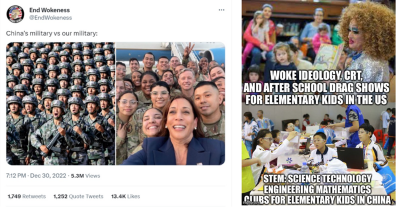
Observers of far-right discourses in Euro-American contexts will find many of the tropes and frames presented here familiar. The narratives about of the West’s ‘loss of will’ to defend its cultures and assumed ethnic homogeneity, due to prosperity and lack of security threat, are for example reminiscent of Marc Jongen’s appropriation of the Greek idea of thymos. A German intellectual affiliated with the Alternative für Deutschland (AfD) party, Jongen argues that Germany has ‘been forgetful about the importance of the military, the police, warrior virtues’, and thymos under the security protection of the United States.Footnote 102 Influencers and audiences on anglophone social media also reproduce gendered East/West binaries resembling the ones seen in the Chinese discourse. American conservative commentator Candace Owens echoed numerous Zhihu posts in saying that ‘there is no society that can survive without strong men. The East knows this’ (X, @RealCandaceO, 14 November 2020). Alt-right memes on social media (Figure 2) not only contrast the ‘woke, emasculated military’ (in the words of Ted Cruz) of the United States to the Chinese military deemed as displaying sufficient mascular masculinity,but also juxtapose the image of a United States obsessed over social justice issues with an imaginary of China guided by supposedly apolitical and productive STEM fields, which is another recurrent theme in the Zhihu discourse.Footnote 103 The fantasising of China as adequately masculine and ‘non-woke’ and the othering of it as a permanent enemy are mutually constitutive – the image of threat and the image of a country unhindered by immigration and ‘wokeism’ feed into one another. The point here is less about the fact that these are radically inaccurate and reductive than what these gendered international imaginaries do for reactionary discourses across the geopolitical divide. Right-wing nationalists on both sides instrumentalise the geopolitical rivalry to legitimate reactionary agendas on one hand and co-produce antagonistic identities through ‘culture war’ narratives on the other. The structural similarity is evident in the fact that whereas the American far right likens race and gender activism to China’s Cultural Revolution, Chinese nationalists stigmatise feminists and rights activists as agents of foreign influence.
‘Anti-woke’ memes fantasising China as adequately masculine and “non-woke” on X (Twitter).

Figure 2 Long description
A screenshot shows two side-by-side items. The first item is a screenshot of a tweet. The account name reads End Wokeness and the handle reads at sign EndWokeness. The tweet text reads: China’s military vs our military. Below the text are two photos placed side by side. One photo shows a large group of uniformed soldiers arranged in rows. The other photo shows a group selfie of several smiling people close to the camera. A timestamp line reads: 7:12 PM comma Dec 30 comma 2022. A view count line reads: 5.3M Views. Below are engagement counts reading: 1,749 Retweets, 1,252 Quote Tweets, 13.4K Likes. The second item is a meme-style collage with two stacked photos and large overlaid text. The top photo shows a group of children seated indoors, with an adult standing near them. The overlaid text reads: WOKE IDEOLOGY comma CRT comma AND AFTER SCHOOL DRAG SHOWS FOR ELEMENTARY KIDS IN THE US. The bottom photo shows children seated at tables in a classroom setting, with an adult at the front. The overlaid text reads: STEM colon SCIENCE TECHNOLOGY ENGINEERING MATHEMATICS CLUBS FOR ELEMENTARY KIDS IN CHINA.
Within the genealogy of Chinese Occidentalism, what is fascinating is that the renewed East/West binaries in the anti-baizuo discourse is a reversal of the dichotomies formulated by Chinese intellectuals in the ‘East–West culture debate’ in the early 20th century. What was designated for ‘the West’ then – including ‘material’, ‘industrial’, ‘rational’, ‘optimistic’; ‘independent’, ‘the present’, ‘pragmatism’, ‘science’, ‘competition’, and ‘human effort’Footnote 104 – is now assigned to China. It reinvents the Occidentalism in Chinese intellectual history, which is produced by and productive of the West’s hegemonic relationship to the world, with China now becoming the new Occident, whose achievement is nevertheless not acknowledged by the old Occident, which continues to write the rules of the international order. To borrow a line from Sylvia Lindner, for the techno-nationalists, China has ‘outwested the west and saved modernity’.Footnote 105
Racism and Occidentalism in conservative dissident discourse
If the nationalist anti-baizuo discourse implies a series of complexities and contradictions in its relationship to white supremacy and ‘the West’, the writings of Chinese dissident intellectuals on Trumpism bear much more affinity to the libertarian and palaeo-conservative traditions in the United States. The arguments presented in the two volumes examined here are largely unoriginal and indistinguishable from the American right. According to the scholars openly embracing Trumpism, which they conceptualise as an ideology and political project transcending the president himself,Footnote 106 the trends of globalisation, secularisation, and postmodernism have caused ‘moral decay’ and given rise to ‘political correctness’, ‘identity politics’, and multiculturalism, which are supported by ‘ethnic minorities, LGBTQ communities, atheists, and cultural elites’ and opposed by the ‘white working class’.Footnote 107 Despite a clear focus on the United States, there are also references to ‘Western civilisation’ in general, which for political theorist Wang Jianxun is defined by the Judeo-Christian tradition, limited government, and capitalism, with the first being the foundation of the other two.Footnote 108 It is proclaimed that culture wars are being fought throughout the Western world between the ‘cultural Marxists’ or ‘postmodernists’ and those who defend the values of Christianity, free market, and nationalism.Footnote 109
Mondon and Winter distinguish between illiberal and liberal articulations of racism with changeable boundaries: the former draws on biological superiority and inferiority, and the latter on cultural essentialism and incompatibility whereby exclusion is justified through the ethnoracial other’s lack of liberal democratic values.Footnote 110 While both illiberal and liberal forms of racism are present in the nationalist discourse, it is unsurprising that pro-Western and pro-democratic intellectuals mainly resort to liberal racism in their objection to multiculturalism and defence of ethnocultural homogeneity. For example, political scientist Bao Gangsheng considers it reasonable to believe that the ‘descendants of Hispanic immigrants in the US are significantly less attached to democratic values’Footnote 111 than the descendants of white Europeans. For Cong Riyun, most Muslims do not identify with ‘Western values’ but ‘postmodernists in the West’, equivalent to the baizuo in the online discourse, ‘tolerate, protect, receive, and even encourage the anti-Western culture of Islam’. The thinly veiled liberal racism easily slides toward a more explicit affirmation of racial hierarchies, when he contends that demographic changes and the rise of heterogeneous cultures would eventually lead to an ‘inferiorisation of civilisation’.Footnote 112 Whereas nationalists recognise and resent white dominance, especially with regard to anti-Chinese racism, in the colour-blind post-racial society depicted by pro-Western dissidents, there is simply no institutionalised racism in the United States, although individual biases exist in any groups. Reiterating the idea of Manifest Destiny, Wang regards slavery as an unfortunate historical episode and necessary compromise, which is inconsistent with the ‘founding spirit’ of the United States.Footnote 113
Commentators have pointed out that Chinese Trumpists’ hostility to left-leaning economic policies and tendency to liken anti-racist and feminist movements to China’s Cultural Revolution are in part driven by the traumatic collective memory of the Maoist economy and class struggles.Footnote 114 From a strategic point of view, Chinese dissidents see practical value in forming alliances with the US far right based on their supposed interest in opposing Chinese communism. However, the theoretical writings show that some of them do take Trumpism as a serious ideological project, and the strategic alliance is at least in part based on ideological affinities. This latest and reactionary form of Chinese Occidentalism converges with the Western far right in their nostalgic longing for a glorious West of the past associated with whiteness, Christianity, ‘traditional values’, free-market capitalism, and colour-blind individualism.
Occidentalism in China saw a revival of the idea of ‘wholesale Westernisation’ (quanpan xihua) in the liberal thought wave (sichao) of the 1980s, which some authors consider liberating in that it formulated a counter-discourse to the authoritarian ruling ideology.Footnote 115 For Barlow, however, Occidentalism in the 1980s enacts a form of ‘self-colonization’, which identifies ‘the West’ as the only authority of modernisation while constructing and vilifying an essentialised Chinese ‘culture’ as a root cause for the nation’s backwardness.Footnote 116 The highly influential documentary River Elegy, an epitome of the thought wave, creates a hierarchical binary between an ‘ocean-based blue civilisation’ that is entrepreneurial, adventurous, and democratic by nature and a ‘land-based yellow civilisation’ trapped by close-mindedness and a stagnant past. The narrator presents that the ships of the ‘blue civilisation’ bring not only colonialism, but also science and democracy to the world.Footnote 117 Even after the decade ended with the brutal crackdown on protests in 1989, resorting to an idealised West and a self-Orientalism that attributes China’s lack of democracy to innate ‘national characters’ is common in public discourse.Footnote 118 While the reactionary ‘turn’ of this lineage of thought is not inevitable, it is also unsurprising when the images of ‘the West’ some Chinese liberals have deployed to debate domestic conditions are based on internalised racial-civilisational hierarchies, justification of colonial violence, and erasure of contemporary structures of intersectional oppression. However, there is also a danger of exceptionalising ‘Chinese liberals’ in some commentaries, which imply that they could not understand the real tenets of liberalism because of the ‘toxin of authoritarian thinking’.Footnote 119 This interpretation denies epistemological agency to the ‘third world’ intellectuals, whose transnational reading of ‘Western theory’ is judged by a Eurocentric assessment of authenticity, and disregards the fact that these conservative backlashes are global – not the least shared by the ‘classic liberals’ of the West.
We can now conclude with the commonalities and divergence between Chinese nationalists’ and dissidents’ iterations of global reactionary discourses, located within different political projects. At the ideological level, the techno-nationalists are anti-democratic and economically aligned with an authoritarian developmentalism fused with neoliberal logics (through competitive individualism and vilification of the welfare state). Right-wing dissidents are pro-democratic and champions of the free market. Both reproduce the narrative that Western civilisation (and white masculinity) is being undermined by immigration and the leftist baizuo culture, thus both incorporating articulations of racism, ethnonationalism, and social conservatism. However, while both rejecting social justice activism, techno-nationalists justify their rejection primarily through social Darwinism, framing it as a distraction from economic development and an instrument of Western influence. Conservative dissidents resort to traditional ‘Western’ values or claim that identity politics betrays liberal individualism. The political priority for nationalists is to defend Chinese interests against a hostile international environment, and for dissidents it is to call for democratisation with the support of Western powers. For the former, therefore, anti-baizuo narratives are interwoven with denunciations of Western dominance in the international system. For the latter, the appeal of American far-right discourse lies in both ideological affinities and the perceived common interest in opposing Chinese communism. Both produce imaginaries of a feminised West of the present against a masculine and racially ‘pure’ West of the past, which for the nationalists is associated with material power and techno-economic progress, while for right-wing dissidents it is associated with Christianity, individualism, and free-market capitalism (Table 1). Both subscribe to essentialised racial-civilisational categories and an evolutionary ideology of modernisation, except that it signifies a ‘radical simplification’ of economic development for the nationalists and ‘political modernisation’ for dissidents. For this reason, the nationalists believe that China has ‘outwested’ the West due to its commitment to making techno-economic progress (even if it is still ‘behind’ in many regards), whereas for conservative dissidents China is yet to become civilised.
Concluding thoughts
This article has attempted to deepen understandings of the global politics of reactionary discourse, which at the current conjuncture is crystallised along self-victimising narratives of racial nationalism and backlashes against social justice struggles, featuring terms such as ‘cultural Marxism’, ‘political correctness’, ‘wokism’, or baizuo. Drawing on feminist and postcolonial scholarship, I highlight the centrality of race and masculinism to reactionary formations, while adopting a global, co-constitutive approach to Occidentalism to argue that the transnational production of gendered East/West binaries functions as shifting mechanisms through which to mediate between domestic and international conditions. In a seeming reversal of gender dynamics in traditional accounts of Orientalism, renewed East/West binaries in global reactionary discourses produce representations of an emasculated and overly multiracial West influenced by leftist ideologies, contrasted with both a racially pure and glorious Western past and fantasies of adequately homogeneous, conservative, and ‘non-woke’ Easts. For actors identified with the West, these essentialist imaginations tap into anxieties over Western decline and Eastern threats; whereas for those in postcolonial spaces, they channel revanchist pride and mobilise opposition to Western hegemony to consolidate racial nationalism and delegitimate domestic social movements.
I present Chinese anti-baizuo discourse from both online nationalists and dissident intellectuals as a prime example of how grammars of global reactionary discourse localise in unique geopolitical circumstances. Through granular analyses of global racial entanglements, masculinism, and gendered East/West binaries in the source material, I demonstrate how reactionary imaginations of the West are instrumental for animating narratives of racial-civilisational hierarchy and masculinist notions of politics and society hostile to egalitarian and emancipatory ideals in a ‘non-Western’ and ‘non-white’ context. Moreover, by highlighting overlaps and divergence in the refashioning of dualistic constructs in US far-right, Chinese nationalist, and Chinese dissident discourses, I offer a perspective on the entanglement between culture war narratives and the co-production of United States–China opposition, a key characteristic of current international orders.
This article therefore contributes to the intersection between postcolonial IR, which emphasises interconnectedness and relationalities, and critical research on the global right, which illuminates the constitutive role of racial hierarchy and gender while underscoring affinities between liberalism and right-wing reaction. It shows that reactionary discourses operate not only across the geopolitical divide, but also through it, invoked by opposing political forces that share ethnonationalist, masculinist, and exclusionary logics in processes of mutual othering to perpetuate antagonistic identities. It hopes to shed light on potential avenues for future investigations into the international politics of the right as globally entangled discursive and ideological formations. This could include, for example, comparing the figure of China and that of Russia in US far-right imaginaries; the use of postcolonial identity in authoritarian conservative projects in the Global Easts and South; and further explorations of transnationality in the digital far right beyond Western contexts.
Acknowledgements
I would like to thank the three anonymous reviewers and editors of RIS for their constructive criticisms and suggestions. My thanks are to Aurelien Mondon, Liam Stanley, David Stroup, Debbie Lisle, Lisa Gaufman, Cian Luddy, Jane Duckett, Catherine Jones, Eviane Leidig, Cas Mudde, Marius Meinhof, Emma Crewe, and Yao Lin for their helpful engagement with previous versions of this paper.



 Open access

