


Introduction
Now housed in the History Museum of Armenia (Yerevan), the Erebuni Museum (Yerevan), the State Hermitage Museum (St Petersburg) and the Pushkin State Museum (Moscow), a group of bronze bowls inscribed in cuneiform and bearing royal names form one of the most substantial metal-based corpora of Urartian writing. Their importance extends beyond regional political history, illuminating how technology, language and authority intersected in Urartu, an Iron Age polity centred in the Armenian Highlands, during the ninth–seventh centuries BCE.
This study presents a comparative analysis of these vessels based on autoptic inspection, high-resolution photography and palaeographic evaluation, isolating measurable features, including sign shapes, ductus, iconography and engraving technique, to reconstruct scribal habits and workshop practices. The aim is to situate these bowls within the broader history of writing as a material and political practice in the ancient Near East while examining how cuneiform was technically adapted for inscription onto bronze vessels.
Materials
All presently known inscribed bronze bowls attributable to Urartian kings from Sarduri, son of Lutipri, to Rusa (late ninth–early seventh centuries BCE) were inspected. Excavations at Karmir-blur in 1949 yielded at least 97 bowls with cuneiform inscriptions from Storeroom 25 (Piotrovskij Reference Piotrovskij1950: 59–60, Reference Piotrovskij1952: 20, 54–64) (Figure 1). A circular inscription is engraved at the centre of the internal surface of each vessel, identifying the ruling monarch (see Seidl Reference Seidl2004: 55–59; Salvini Reference Salvini2012; Dan et al. Reference Dan2024). Additional unpublished bowls were recovered from Room 23 during excavations in 1958, bringing the number of examined bowls to more than 100.
Bronze bowls at the bottom of the karas/storage vessel in Storeroom 25 at Karmir-blur (adapted from Piotrovskij Reference Piotrovskij1970: fig. 62).

Despite their brevity, these inscriptions are crucial for understanding the spread and function of writing in Urartu. The medium suggests they were portable inscriptions intended for elite display, linking metalworking skill with royal prestige.
Method
The study combines direct visual analysis (where museum access permitted), macro-photography and digital tracing of sign forms. Each inscription was examined for sign order and orientation, wedge angle and depth, internal proportions, tool marks indicating engraving technique and associated iconographic elements. These observations were compared across collections to identify consistencies suggesting shared scribal training, workshop practice or chronological development.
Results
The earliest bowls, attributed to Sarduri I, son of Lutipri (c. 840–830 BCE), display sign forms closely aligned with Neo-Assyrian cuneiform, particularly in their elongated wedges (Dan & Bonfanti Reference Dan and Bonfanti2023) (Figure 2). Under Minua (c. 820–785/780 BCE), wedges become more triangular and compact, indicating increasing standardisation and gradual departure from Assyrian models. This development parallels the emergence of a distinct Urartian epigraphic identity visible also in rock inscriptions (Salvini Reference Salvini2018: 83–98). The inscribed ribbed bowl of Sarduri I marks the transformation of an Assyrian vessel type into the classic Urartian plain bowl morphology.
The bowls attributable to Sarduri, son of Lutipri, and their inscriptions (adapted from Dan et al. Reference Dan2024: 76, 78).

Ribbed vessels frequently appear in ninth-century BCE reliefs from Nimrud, particularly in the Northwest Palace of Ashurnasirpal II (accession numbers BM 124535, BM 1849,0502.14, BM 124565). Inscribed gold vessels from the royal tombs of Assyrian queens also attest to the practice of marking royal possessions with dedicatory texts (Hussein Reference Hussein2016: pl. 40) (Figure 3). Urartian rulers adopted and transformed this model. What functioned in Assyria primarily as a prestige object became in Urartu a medium of royal communication linking metalworking skill, divine favour and kingship. Over time, these bowls became instruments of political expression and religious legitimacy, reflecting both advances in bronze engraving and the growing importance of writing in Urartian royal display.
Archaeological and figurative examples of Assyrian bowls: A–C) bowls from Nimrud Tomb II (adapted from Hussein Reference Hussein2016: pl. 40); D) part of a relief panel from the palace of Ashurnasirpal II in Nimrud (adapted from https://www.metmuseum.org/art/collection/search/322611).

The bowls belonging to the reign of Minua (Figure 4A) provide the earliest model for later Urartian inscribed bowls, which replicate their morphology and sometimes their text. Under Argišti I (c. 785/780–756 BCE), metalworkers began adding iconography to inscriptions: initially a square with concave sides and a bird head (Figure 4B), later crystallising into a tower topped by a spear (often interpreted as a susi temple) and a roaring lion’s head. These motifs became standard features of later royal bowls (Figure 5).
A) Bowl inscribed with the name of Minua (adapted from Dan et al. Reference Dan2024: 81); B) bowl inscribed with the name of Argišti (adapted from Dan et al. Reference Dan2024: 88).

Bowls with ‘crystallised’ iconography of the Susi temple and lion head belonging to kings named Sarduri (A–E) and Rusa (F) (adapted from Dan et al. Reference Dan2024).

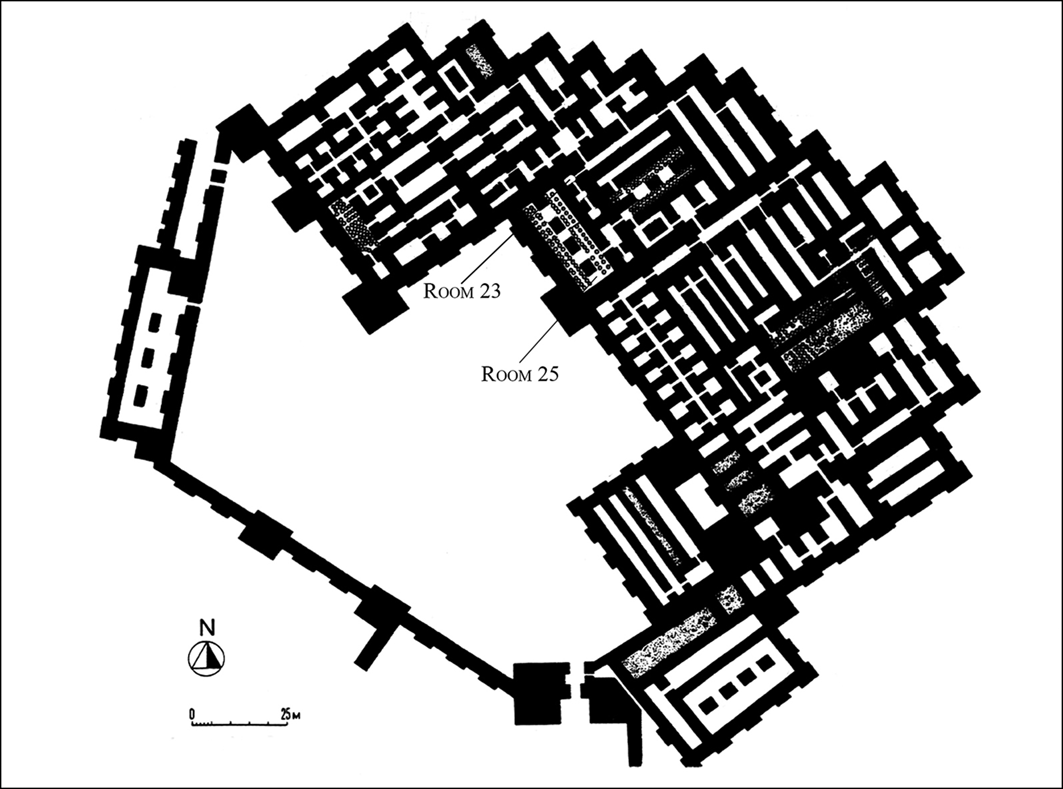
The assemblage of bronze bowls from the palace-fortress Karmir-blur provides important evidence for the final phase of Urartian kingship. Stratigraphic data indicate abandonment prior to destruction, suggesting that the bowls were deliberately deposited by the last Urartian occupants rather than dispersed during conquest (Figure 6). The probable destruction of the site in the mid-sixth century BCE marked the end of this process of deposition. The absence of comparable finds elsewhere suggests that bowls originally distributed across royal fortresses were gathered at Karmir-blur when it functioned as a final royal centre, possibly symbolising dynastic continuity during the kingdom’s last decades.
Plan of the fortress of Karmir-blur with the location of Room 23 and Storeroom 25 highlighted (figure by authors).

Writing, bronze and kingship
The Urartian bronze bowls show that writing functioned not only as communication but also as craft practice. Their inscriptions represent acts of material authorship combining textual authority with metallurgical expertise. The inscribed bowl—simultaneously ritual utensil, prestige object and textual artefact—embodies collaboration between royal ideology and artisanal production.
Comparative palaeography also clarifies broader questions of regional influence. Early Urartian writing drew heavily from Neo-Assyrian models (Salvini Reference Salvini and Geller2014), yet its rapid adaptation to new materials indicates active cultural translation rather than simple borrowing. Urartian scribes appropriated the prestige of cuneiform while reshaping it to express local authority. The bowls therefore provide a microcosm of Urartian state formation: a polity that adopted imperial technologies (writing, architecture and administration) and reworked them into forms suited to the geography and resources of the Armenian Highlands.
Conclusions
The inscribed bronze bowls illuminate broader questions of literacy, technology and cultural transmission in the ancient Near East. Their production coincides with the adaptation of writing to both stone and metal media, revealing a scribal milieu capable of transferring techniques across media while maintaining formal coherence. This versatility suggests the emergence of a distinct Urartian scribal tradition operating within a centralised court environment yet responsive to the physical demands of different materials.
Even a small corpus can yield important insights into the development of Urartian cuneiform practice, its association with a specific medium and iconography and its role as a royal technology. These vessels reveal evolving scribal habits and the adaptation of cuneiform to bronze, illustrating how Urartian kingship materialised authority through both inscription and craft. Writing on bronze required adapting wedge-shaped signs to engraved metal surfaces; this technical adjustment altered sign proportions, engraving techniques and layout, turning writing into a technological experiment that reshaped both objects and political meaning.
Funding statement
This research benefitted from the International Association for Assyriology (IAA) Subsidy for Cuneiform Studies in 2023.



 Open access

