

The type and quantity of European trade goods have traditionally formed the basis for dating postcontact archaeological sites in northeastern North America (Fitzgerald Reference Fitzgerald1990; Garrad Reference Garrad, Pilon and Fox2014; Warrick Reference Warrick2008:116–121). For contact-era Indigenous sites in Ontario, the presence of different types of glass trade beads in varying quantities is routinely used to place archaeological sites into chronological sequence and to date the duration of site occupation (Fitzgerald Reference Fitzgerald1990; Fitzgerald et al. Reference Fitzgerald, Knight and Bain1995; Kenyon and Kenyon Reference Kenyon, Kenyon and F. Hayes1983; Loewen and Chapdelaine Reference Loewen and Chapdelaine2016). Prior to the last decade, radiocarbon dating of contact-era sites in Ontario was not seriously considered because the associated error of radiocarbon dates normally exceeds the short duration of village/town site occupations (20–40 years or fewer; Warrick Reference Warrick1988). However, recent applications of AMS radiocarbon dating combined with Bayesian modeling have allowed archaeologists to date site occupations with far more precision and independently of artifact seriation chronologies and historical documents (Birch Reference Birch2022; Birch et al. Reference Birch, Manning, Sanft and Conger2021). Bayesian-modeled radiocarbon dates have enabled archaeologists to link contact-era sites in Ontario with historical events and places (Manning et al. Reference Manning, Birch, Conger, Dee, Griggs, Hadden and Hogg2018, Reference Manning, Birch, Conger, Dee, Griggs and Hadden2019).
Previous work on contact-era archaeological sites in Iroquoia (see, for example, Manning et al. Reference Manning, Birch, Conger, Dee, Griggs, Hadden and Hogg2018, Reference Manning, Birch, Conger, Dee, Griggs and Hadden2019) has used archaeological and radiocarbon-derived information to construct Bayesian models. Manning and colleagues (Reference Manning, Birch, Conger, Dee, Griggs, Hadden and Hogg2018) report 86 radiocarbon dates for the archaeological site of Warminster, often associated with Samuel de Champlain’s Cahiagué that he visited in AD 1615 and 1616, as well as a cluster of archaeological sites—including Draper, Spang, and Jean-Baptiste Lainé, formerly Mantle—which represent iterations of the same Huron-Wendat community living along West Duffins Creek and are referred to as the Duffins Creek cluster. Radiocarbon dates and Bayesian modeling have yielded a radiocarbon-based age for the Warminster site that is compatible with the presence of Champlain in Wendake in 1615 and 1616 (Manning et al. Reference Manning, Birch, Conger, Dee, Griggs, Hadden and Hogg2018). However, within the precontact site sequence of Draper-Spang-Jean-Baptiste Lainé, thought to date around 1450 to 1550 based on ceramic seriation and the presence/absence of European trade items, Bayesian modeling of radiocarbon dates suggests later dates of 1530 to 1615. Manning and coauthors (Reference Manning, Birch, Conger, Dee, Griggs, Hadden and Hogg2018, Reference Manning, Birch, Conger, Dee, Griggs and Hadden2019) note that the revised dates for the latter sites call into question the utility of European artifact chronologies (e.g., glass beads) for dating sites in the Northeast and have broader implications for understanding contact-era social processes.
Bayesian chronological modeling has also been used to analyze 44 radiocarbon dates from four archaeological sites that represent the Arendarhonon (Rock Nation), one of the allied nations of the Huron-Wendat Confederacy during the contact era. These sites—Benson, Sopher, Ball, and Warminster—are all thought to date between 1550 to 1616 based on artifact seriation. As previously noted, both the archaeological evidence and radiocarbon evidence suggest that Warminster was occupied in 1615 and 1616 and that Benson, Sopher, and Ball all preceded Warminster. The ordering of sites is consistent with earlier suppositions; however, the radiocarbon dates suggest an occupation of Benson as much as 50 years earlier (Manning et al. Reference Manning, Birch, Conger, Dee, Griggs and Hadden2019). Sopher appears earlier than Ball, although there may have been some overlap in their dates of occupation (Manning et al. Reference Manning, Birch, Conger, Dee, Griggs and Hadden2019).
Here we report on AMS 14C dating and Bayesian modeling of a new case, the Ahatsistari site, a contact-era Huron-Wendat town with a possible historical and calendar date association. It has been argued that Ahatsistari (formerly the Allen Tract) matches the geographical location, size, and relative age of the historically referenced Carhagouha (Glencross et al. Reference Glencross, Warrick and Fletcher2021), the principal town of the northern Attignawantan (Bear Nation), the most populous nation of the Huron-Wendat Confederacy (Biggar Reference Biggar1922–1936:3:239–240). Carhagouha is associated with the overwintering residency of Recollet priest Joseph Le Caron, first in 1615 and 1616 and again in 1623, as well as Samuel de Champlain in 1615–1616 (Biggar Reference Biggar1922–1936:3:239–240; Heidenreich Reference Heidenreich2014; Trigger Reference Trigger, Bruce1976; Wrong Reference Wrong1939). Glass bead assemblages from Ahatsistari and Warminster are very similar and characteristic of Glass Bead Period 2 (GBP2)—dominated by blue and white monochrome tubular and oval forms, dating around 1600 to 1625 (Fitzgerald Reference Fitzgerald1990; Fitzgerald et al. Reference Fitzgerald, Knight and Bain1995; Kenyon and Kenyon Reference Kenyon, Kenyon and F. Hayes1983). Confirmation of the contemporaneity of these two sites using radiocarbon dates would add considerable weight to their identification as the historically significant Huron-Wendat towns of Carhagouha and Cahiagué. The objectives of this investigation are to determine whether the radiocarbon dates from Ahatsistari are compatible with the historically documented visits of Le Caron and Champlain and whether these results accord with the relative seriation of glass beads as currently understood.
Historical Background
Important historical sources informing interpretations for the contact era in Ontario include accounts written by Jesuit priests published in the Jesuit Relations; the writings of Gabriel Sagard, a Recollet monk and missionary; and the journals of Samuel de Champlain who, in the spring of 1615 on his seventh voyage to New France, traveled to Wendake, the traditional territory of the Huron-Wendat.
In 1603, Champlain sailed to the Atlantic coast of eastern North America with the aim of broadening established alliances for trade and determining the location for a large French trading factory (Fischer Reference Fischer2008:121–141). In 1604, he returned, seeking locations suitable for a French settlement that was temporarily established on St. Croix Island off the coast of northern Maine. Even though this was considered an ideal location that was naturally fortified and accessible to European ships and allies in the fur trade year-round, the harsh winter led to starvation and disease, with roughly half the settlers dying (Crist and Sorg Reference Crist and Sorg2014; Fischer Reference Fischer2008:166–173). On his third voyage in 1608, Champlain founded a small trading post at what is now known as Quebec City, and between 1608 and 1615 Champlain continued to investigate the St. Lawrence and Ottawa Rivers, searching for passage to the western sea. His exploration of the Ottawa River would eventually lead him to Ontario and Lake Huron in the summer of 1615 (Fischer Reference Fischer2008; Trigger Reference Trigger, Bruce1976).
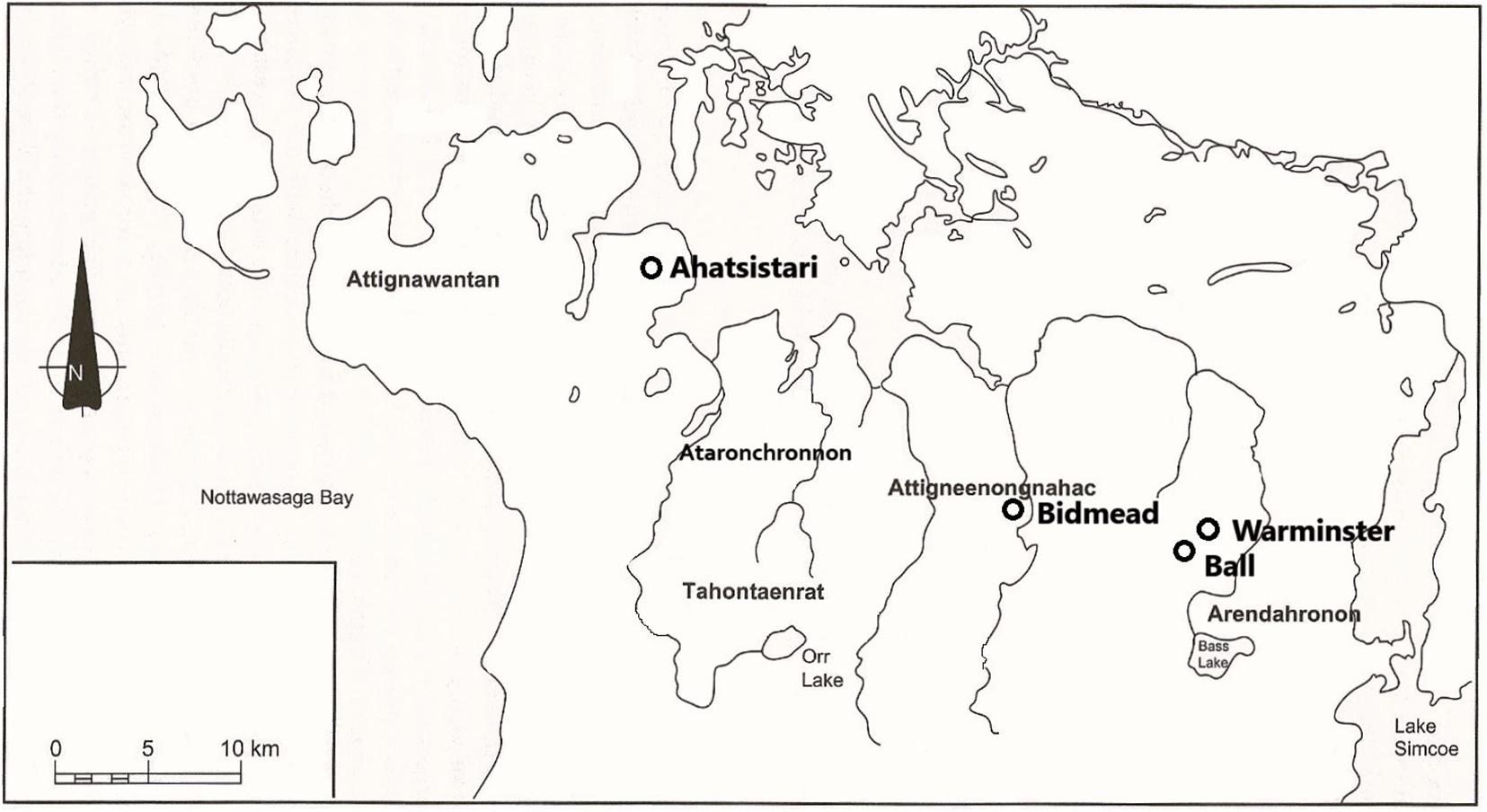
Champlain’s missions required the support of local Indigenous populations and the formation of alliances with the Montagnais, Algonkians, and Huron-Wendat. During the late sixteenth and early seventeenth centuries, the Huron-Wendat Confederacy was formed to defend against a common enemy, the Haudenosaunee (Iroquois) of New York State, and to secure trade relations with Algonkian neighbors to the north and east (Birch et al. Reference Birch, Manning, Sanft and Conger2021; Warrick Reference Warrick2008:204–210). The Huron-Wendat occupied the region between the south shores of Georgian Bay and Lake Simcoe that historically was known as Wendake (Figure 1). Villages of the Attignawantan (Bear Nation) and Ataronchronon (Bog Nation) were clustered in the west, and villages of the Arendarhonon (Rock Nation) marked the eastern limits of Wendake. The remaining nations included the Tahontaenrat (Deer Nation) and the Attigneenongnahac (Cord Nation), with their villages located in southwest and southeast Wendake, respectively (Figure 2; Heidenreich Reference Heidenreich1971:81–86; Trigger Reference Trigger, Bruce1990:20; Williamson Reference Williamson2014). Living in villages that moved every 20–40 years (Warrick Reference Warrick1988), the Huron-Wendat practiced maize-beans-squash agriculture while also hunting, fishing, and collecting wild plants; they were also adept at trade and commerce, claiming to control the trade route leading to Quebec (Trigger Reference Trigger, Bruce1990:46–47).
Map of southern Ontario and Quebec showing the St. Lawrence, Ottawa, and French Rivers with a box surrounding the Wendake study area and Tay Point (modified from GISGeography.com).

Enlargement of study area (Wendake) showing the Wendat Confederacy circa 1634 and locations of Ahatsistari, Ball, Bidmead, and Warminster sites (modified from Warrick Reference Warrick2008).

In the spring of 1615, the Huron-Wendat and Algonkian allies asked Champlain to support them in military actions against the Onondaga and Oneida, who were interfering with the Huron-Wendat’s ability to move from the Great Lakes up the St. Lawrence (Biggar Reference Biggar1922–1936:3:31–32; Fischer Reference Fischer2008:322). Champlain agreed to help, and in July 1615 he arrived in Wendake accompanied by an interpreter, a servant, and 10 Huron-Wendat (Biggar Reference Biggar1922–1936:3:36–46). Several weeks earlier, Recollet priest Joseph Le Caron had journeyed to Wendake in the company of 12 Frenchmen and several Huron-Wendat guides, staying in Carhagouha (Biggar Reference Biggar1922–1936:3:35). In his accounts of the expedition, Champlain identifies and describes Huron-Wendat villages and towns that he visited, notably Carhagouha, the main town of the northern Attignawantan, and Cahiagué, the principal town of the Arendarhonon. Shortly after arriving in Wendake, Champlain went to Carhagouha where Le Caron was residing (Biggar Reference Biggar1922–1936:3:48–49). In late August, Champlain traveled to the southern reaches of Wendake, stopping at Cahiagué to meet the Huron-Wendat warriors and those of allied Algonkian nations before going to Haudenosaunee territory (Biggar Reference Biggar1922–1936:3:53–56; Trigger Reference Trigger, Bruce1976:304–308). During an assault on an Oneida or Onondaga village (Fischer Reference Fischer2008:615–616; Trigger Reference Trigger, Bruce1976:311), Champlain was wounded and retreated with the Huron-Wendat to Wendake; together, they then worked their way back slowly to Cahiagué (Trigger Reference Trigger, Bruce1976:312–319). Champlain would remain in Wendake until the spring of 1616, visiting the Petun (Tionontaté) territory and meeting members of the Neutral (Attawandaron), Ottawa (Odawa), and Nipissing nations (Heidenreich Reference Heidenreich1971:238; Trigger Reference Trigger, Bruce1976:317–326).
Proceeding ahead of Champlain in July 1615, Le Caron made the journey to Wendake with 12 Frenchmen, of whom four or five were armed (Biggar Reference Biggar1922–1936:3:35); they overwintered at Carhagouha from 1615 to 1616, leaving in May 1616 to return to Québec (Trigger Reference Trigger, Bruce1976:326). In the late summer of 1623, Recollet friars Gabriel Sagard, Le Caron, and Nicolas Viel, along with 11 other Frenchmen, traveled to the Huron-Wendat country (Heidenreich Reference Heidenreich1971:242–243; Trigger Reference Trigger, Bruce1976:384). After arriving at the village of Carhagouha and staying briefly in the cabin where he had lived from 1615 to 1616, Le Caron moved to the recently relocated Carhagouha, now called Quieunonascaran, where Sagard and Viel joined him (Heidenreich Reference Heidenreich2014:16–18; Trigger Reference Trigger, Bruce1976:384; Wrong Reference Wrong1939:75–77). Carhagouha was the predecessor to Quieunonascaran, the village that controlled Huron-Wendat trade to the Saguenay and St. Lawrence Rivers in the 1620s (Trigger Reference Trigger, Bruce1976:391).
Glass Trade Bead Chronology in Ontario
In the sixteenth and seventeenth centuries, glass beads were produced in Europe and distributed as trade items to Indigenous populations in the Northeast. Typically, three glass bead periods (GBPs) are recognized: GBP1, which dates from 1580 to 1600; GBP2, which dates from 1600 to 1625/1630; and GBP3, dating from 1625/1630 to 1650 (Fitzgerald Reference Fitzgerald1990; Fitzgerald et al. Reference Fitzgerald, Knight and Bain1995; Kenyon and Kenyon Reference Kenyon, Kenyon and F. Hayes1983). Each period is characterized by distinctive bead types: for example, whereas GBP1 assemblages are diverse in size, shape, and color, GBP2 bead assemblages are dominated by white and blue oval and tubular beads and GBP3 by turquoise round and red round and tubular beads (Kenyon and Kenyon Reference Kenyon, Kenyon and F. Hayes1983). Archaeologists have routinely used glass bead assemblages to determine dates of site occupation and to organize sites into local sequences. For a more detailed discussion on bead types and chronology see Kidd and Kidd (Reference Kidd and Kidd1970) and Kenyon and Kenyon (Reference Kenyon, Kenyon and F. Hayes1983).
A significant amount of research on glass beads recovered from Indigenous and European archaeological sites in the Northeast suggests that specific bead styles began to appear consistently in the first decade of the seventeenth century (Bradley Reference Bradley, James2014). Four types—tubular beads in white (Ia5) and dark blue (Ia19) and oval beads in white (IIa15) and dark blue (IIa57)—generally constitute a large proportion of the assemblages (Fitzgerald Reference Fitzgerald1990; Fitzgerald et al. Reference Fitzgerald, Knight and Bain1995; Kenyon and Kenyon Reference Kenyon, Kenyon and F. Hayes1983), along with a smaller number of robin’s egg blue beads and multicolored multilayered beads. Bradley (Reference Bradley, James2014) reports similar assemblages from multiple European and Indigenous sites in Quebec, Ontario, and New York State. Although Fitzgerald (Reference Fitzgerald1990) has argued that the distribution of these beads reflects the extent of French influence, particularly from 1600 to 1625/1630 in Ontario and Quebec, Bradley (Reference Bradley, James2014) suggests subtle differences, with English traders preferring oval or round beads and French entrepreneurs favoring tubular beads.
It is important to emphasize that, although the glass bead chronology appears to be applicable for European and Indigenous sites in northeastern North America, glass bead assemblages from late sixteenth- and seventeenth-century sites in the mid-Atlantic coast and southeast United States do not display similar relative frequencies of bead types. For example, archaeological investigation of the Jamestown colony (1607–1624) has produced about 4,000 glass beads. According to the historical date of its establishment and initial occupation, Jamestown should date clearly to GBP2, but the majority of the glass bead types there are not the classic GBP2 types found in Ontario. Instead, Jamestown glass trade beads are dominated by turquoise round beads (IIa40, 24%); Nueva Cadiz-like beads (IIIc1, 11%; IIIc3, 12%); and “gooseberry” beads (IIb18, 6%; Derry Reference Derry2019)—types normally associated with GBP1, GBP3, or both in Ontario (Fitzgerald et al. Reference Fitzgerald, Knight and Bain1995; Kenyon and Kenyon Reference Kenyon, Kenyon and F. Hayes1983). At Jamestown, white oval beads make up only 10% of the total trade bead assemblage (Derry Reference Derry2019).
Even within the Northeast, there are some differences in the relative frequency of glass bead types between Indigenous sites in Ontario and those in New York State (Fitzgerald et al. Reference Fitzgerald, Knight and Bain1995; Kenyon and Kenyon Reference Kenyon, Kenyon and F. Hayes1983): these differences are a product of variation in European manufacturers and supply (Venice, Norman, and Dutch glass factories), European trade networks and rivalries (Basque, French, Dutch, English, Spanish), and Indigenous preferences for certain bead colors (blue vs. red for example; Bradley Reference Bradley, James2014; Fitzgerald Reference Fitzgerald1990; Fitzgerald et al. Reference Fitzgerald, Knight and Bain1995; Kenyon Reference Kenyon1984; Kenyon and Kenyon Reference Kenyon, Kenyon and F. Hayes1983). Indeed, recent research (see, for example, Conger Reference Conger2022; Manning et al. Reference Manning, Birch, Conger, Dee, Griggs, Hadden and Hogg2018) has questioned region-wide application of trade good chronologies, given our current understanding that different modes of trade and levels of participation would have caused an uneven distribution of goods, resulting in widely varied trade good assemblages. These variations also underscore the need to establish an “independent high-resolution timeframe” (given the short occupation of contact-era sites in Ontario), using radiocarbon dates and Bayesian modeling (Manning et al. Reference Manning, Birch, Conger, Dee, Griggs, Hadden and Hogg2018). Such a time frame would allow us to better assess the impact of various social, political, and economic processes that may have contributed to the variation among assemblages of European trade goods from different sites.
Sites identified as GBP2 from southern Ontario include Huron-Wendat (Ouendat), Neutral (Attawandaron), Petun (Tionontaté), and Quebec and are listed in Supplementary Table 1. All four archaeological sites discussed in this study—Ahatsistari, Ball, Bidmead, and Warminster—have glass bead assemblages that have been used to estimate dates of site occupation and determine compatibility with the historical record via seriation techniques.
Huron-Wendat Village Sites Dating to GBP2 (ca. 1600–1625)
During his visit to Wendake in 1615 to 1616, Samuel de Champlain documented a total of 18 Huron-Wendat villages, six to eight of which were palisaded (Biggar Reference Biggar1922–1936:3:121–122, 4:301–302). Gabriel Sagard in his visit from 1623 to 1624 (Wrong Reference Wrong1939) recorded 25 villages, but he likely combined Huron-Wendat (18 villages) and Tionontaté (seven villages) settlements in his enumeration (Trigger Reference Trigger1985; Warrick Reference Warrick2008). Efforts have been made to link archaeological village sites dated around 1600–1625 with historically recorded Huron-Wendat villages using details from historical accounts of Champlain and Sagard and later Jesuit maps (Fitzgerald Reference Fitzgerald1986; Fitzgerald et al. Reference Fitzgerald, Knight and Bain1995; Glencross et al. Reference Glencross, Warrick and Fletcher2021; Heidenreich Reference Heidenreich1971, Reference Heidenreich2014; Ugarenko Reference Ugarenko1973; Warrick Reference Warrick2008). For the period from 1615 to 1623, there are 13 archaeological village sites registered in Wendake (Simcoe County; Warrick Reference Warrick2008:210–213). Estimated dates for these sites are based on the relative quantity and diversity of European-manufactured materials that were recovered and of glass bead types. The Ball site bead assemblage contains both GBP1 and GBP2 beads (Fitzgerald et al. Reference Fitzgerald, Knight and Bain1995). Only three other village sites in Ontario (Bidmead, Ahatsistari, and Warminster) have sufficient bead samples to place the sites firmly within GPB 2. Of these GBP2 sites, three—Ball, Ahatsistari, and Warminster—have radiocarbon dates. The frequency of glass bead types for the four sites are displayed in Table 1.
Glass Bead Type Comparison between Ball, Ahatsistari, Warminster, and Bidmead Sites.

Notes: Bead types after Kidd and Kidd (Reference Kidd and Kidd1970). Bead types in bold are typical GBP2 (see Fitzgerald Reference Fitzgerald1990; Fitzgerald et al. Reference Fitzgerald, Knight and Bain1995; Kenyon and Kenyon Reference Kenyon, Kenyon and F. Hayes1983). Bead form(s) are small beads (after Kidd and Kidd Reference Kidd and Kidd1970). The Ball site bead samples include the beads available for study in 1995 (reported in italics in parentheses in the table [data from Fitzgerald et al. Reference Fitzgerald, Knight and Bain1995]) and the total assemblage for the site. Beads were collected with 6.4 mm and 3.2 mm mesh. The Ahatsistari bead sample includes hand excavated no sieves, hand excavated 3.2 mm mesh, and water-screen 1.6 mm mesh (Glencross et al. Reference Glencross, Warrick and Fletcher2021). The Warminster bead sample includes Midden 57 (¼ inch-[6.4 mm] mesh and <¼-inch [3.2 mm and 1.6 mm mesh]; Sykes Reference Sykes1983) and 1960s hand excavated with no sieves (data from Fitzgerald et al. Reference Fitzgerald, Knight and Bain1995). The Bidmead bead sample was collected almost entirely from middens using 6.4 mm mesh (Merritt Reference Merritt2020). For Bidmead bead types, some reporting errors were made by Lisa Merritt (Reference Merritt2020). William Fitzgerald (Reference Fitzgerald1990:179) provided bead types for the Bidmead site and arrived at slightly different type frequencies than did Merritt (Reference Merritt2020). This paper article used the Merritt (Reference Merritt2020) bead type frequencies.
Ball Site (BdGv-3). The Ball site was a large (approximately 3.6 ha) Arendarhonon town located in Simcoe County, Ontario (Figure 2; Knight Reference Knight1987). The site was excavated in its entirety under the direction of Dean Knight over 25 years (1975–1999) of Wilfrid Laurier University archaeological field schools (Knight Reference Knight1987). The village contained 68 longhouses, 33 middens, and two palisades (Michelaki et al. Reference Michelaki, Hancock, Warrick and Knight2013), and it was occupied for about 13 years based on house wall post densities (Warrick Reference Warrick1988). More than a thousand European trade items have been recovered including copper, brass and iron tools, ornaments and scraps, and glass beads (Anselmi Reference Anselmi2004). Fitzgerald and colleagues (Reference Fitzgerald, Knight and Bain1995) determined that the glass bead assemblage is characteristic of both GBP1 (1580–1600) and GBP2 (1600–1625/1630). Although it was assumed that the assemblage originating from the core of the village would contain more GBP1 beads given its extended use and that beads recovered from the expansion area would predominantly be GBP2, both areas of the site show similar proportions of GBP1 and GBP2 beads (Fitzgerald et al. Reference Fitzgerald, Knight and Bain1995).
Bidmead (BeGv-4). Bidmead is a large, approximately 2 ha Attigneenongnahac village site with an associated ossuary (Figure 2; Hunter Reference Hunter1902; Merritt Reference Merritt2020). The village is surrounded by a palisade and contains the remains of at least 13 houses and two middens (Merritt Reference Merritt2020). Site duration is estimated at 13 years based on the density of longhouse wall posts (Warrick Reference Warrick1988). Initially believed by Father Martin to be the historic St-Ignace Jesuit mission (Taenhatentaron), the site became well known and looted extensively throughout the nineteenth and early twentieth centuries (Merritt Reference Merritt2020). Subsequently, Frank Ridley conducted a surface survey and excavated two 1.5 m squares producing a small collection, and in 1984, Roberta O’Brien led a salvage excavation of 3,400 m2, revealing a radial cluster of longhouses, associated middens, and more than 26,000 artifacts, including 150 European-made items—pieces of brass and copper kettles, brass and copper beads, and iron axes, and knives—as well as 26 glass beads. Merritt (Reference Merritt2020) suggests a GBP2 occupation, noting the presence of some GBP1 beads and the absence of GBP3, while also cautioning that there may be sample bias due to the small sample size, the recovery just of two middens, the nonscreening of the plow zone, and the use of 6 mm mesh.
Ahatsistari (BeGx-76). The Attignawantan town of Ahatsistari is in a forested tract of land on Tay Point and covers an area of approximately 2.2 ha (Figure 2; Glencross Reference Glencross2016, Reference Glencross2018). Although this archaeological site has been the subject of excavations by private collectors since the 1960s, it was only identified in 2012 on the basis of surface finds by avocational archaeologist Gary DuBeau and the site shovel test-pit conducted in 2013 under the direction of Alicia Hawkins (Reference Hawkins2014). In consultation with the descendant community, additional archaeological investigations were conducted in 2014, 2016, and 2018 by Wilfrid Laurier University field schools (Glencross Reference Glencross2016, Reference Glencross2018). Emphasis was placed on non- and minimally invasive methods; the limited excavation of 1 m squares (mostly in the backdirt of previously excavated middens) and metal detector survey significantly increased the inventory of European trade items, and a magnetic susceptibility survey and soil chemistry survey were also conducted (Glencross et al. Reference Glencross, Warrick, Eastaugh, Hawkins, Hodgetts and Lesage2017; Warrick et al. Reference Warrick, Glencross and Lesage2021). Archaeological work has determined the village limits and the location of 16 middens (Figure 3) and continues to explore the location and orientation of possible longhouses. The 16 samples submitted for radiocarbon dating are from two undisturbed midden contexts that reflect the local environment during occupation of the village.
Ahatsistari site map showing locations of 16 middens. Short-lived botanical and wood-charcoal samples submitted for radiocarbon dating originate from Midden 8 and Midden 12.

A convincing case has been made by Glencross and coworkers (Reference Glencross, Warrick and Fletcher2021) to identify Ahatsistari (BeGx-76) as the historically documented village of Carhagouha, where Recollet priest Le Caron was residing when Champlain arrived in Wendake in 1615 (Biggar Reference Biggar1922–1936:3:48). The geographical location and size of Ahatsistari, as well as intervillage distances, correspond with historic accounts of Carhagouha. A variety of European-made items were recovered by a private collector (later documented by Glencross and Warrick) and by field school excavations, including fragments of brass and copper kettles, artifacts manufactured from brass and copper scrap, iron trade axes and knives, jetons, a wrought-iron cold chisel, a cross-guard from a seventeenth-century rapier and hilt fragment of a left-handed dagger, and numerous glass beads that point to the influence and likely presence of notable European visitors (Glencross et al. Reference Glencross, Warrick and Fletcher2021). Seriation dating of the glass beads places Ahatsistari in GBP2, dating from 1600 to 1625/1630 (Glencross et al. Reference Glencross, Warrick and Fletcher2021).
If the Ahatsistari site is indeed the remains of Carhagouha, its date of relocation is recorded in historical documents. It appears that Carhagouha was built several years before 1615 and was then abandoned in 1623 and moved to Quieunonascaran, which in turn was abandoned sometime before 1637 and reestablished with the same name as three hamlets with unknown dates of abandonment. The village relocation sequence follows as such: Carhagouha, pre-1615–1623; Quieunonascaran I, 1623–pre-1637; Quieunonascaran II (St. Charles?), pre-1637–unknown (Thwaites Reference Thwaites1896–1901:13:125; Wrong Reference Wrong1939:75–80). This village sequence has archaeological implications—Carhagouha should be a GBP2 site (dating ca. 1600–1623), Quieunonascaran I should be a GBP2/GBP3a site (dating 1623–1637), and Quieunonascaran II should be a GBP3a/b site (dating 1637–1649; Fitzgerald et al. Reference Fitzgerald, Knight and Bain1995; Kenyon and Kenyon Reference Kenyon, Kenyon and F. Hayes1983).
Warminster (BdGv-1). The Warminster site is a contact-era town with two associated ossuaries (Figure 2; Heidenreich Reference Heidenreich2014; Sykes Reference Sykes1983). First identified by Andrew Hunter (Reference Hunter1902), the site was subject to excavations from the 1940s through 1970s (McIlwraith Reference McIlwraith1946; Sykes Reference Sykes1983). It contains the remains of two palisaded settlements, the north one covering 3.4 ha and the south one covering roughly 2.6 ha, separated by 165 m (Sykes Reference Sykes1983). Seven longhouses and portions of an additional 13 longhouses are reported for the north settlement (Sykes Reference Sykes1983). Site duration of Warminster is estimated between 12 and 17 years based, respectively, on soil catchment analysis (Sykes Reference Sykes1980) and the density of wall posts in longhouses (Warrick Reference Warrick1988).
T. F. McIlwraith (Reference McIlwraith1946, Reference McIlWraith1947) was the first to propose an association between the Warminster site (BdGv-1) and the Arendarhonon town of Cahiagué visited by Champlain in the summer and winter of 1615 to 1616. Champlain’s reference to Cahiagué notes that it was “the chief village of the country” containing 200 large lodges (Biggar Reference Biggar1922–1936:3:49). Writing in 1624, Gabriel Sagard suggests that the town visited from 1615 to 1616 by Champlain was abandoned sometime between 1616 and 1623: by then, the residents had used up most of the available wood, and the soils of the agricultural fields associated with the town had been exhausted (Wrong Reference Wrong1939:92). Sagard also discusses the history of Cahiagué, noting that the number of residents decreased and that the town split into two settlements that were rebuilt at another location (Wrong Reference Wrong1939:92).
Based on the inferred association of Warminster with Champlain’s Cahiagué, the European artifacts from Warminster became the basis for European material culture chronologies and the site became a benchmark (Kenyon and Kenyon Reference Kenyon, Kenyon and F. Hayes1983). The Warminster glass bead assemblage is compatible with GBP2 (Fitzgerald et al. Reference Fitzgerald, Knight and Bain1995; Glencross et al. Reference Glencross, Warrick and Fletcher2021; Kenyon and Kenyon Reference Kenyon, Kenyon and F. Hayes1983; Sykes Reference Sykes1983) and is remarkably similar in bead types to those from Ahatsistari. In 2019, Manning and colleagues used AMS radiocarbon dates and Bayesian chronological modeling to establish an independent chronology and determined that Warminster site was likely occupied during 1615 and 1616 and was the best candidate for Cahiagué, whereas the Ball site was occupied earlier. If Cahiagué had been built several years before 1615 and then abandoned sometime between 1616 and 1623, as indicated by historical accounts, this timing would make Cahiagué contemporary with Carhagouha. The expectation is that Warminster and Ahatsistari, as candidates for the respective historic settlements of Carhagouha and Cahiagué, would have similar radiocarbon dates.
Establishing the Date of Ahatsistari
Three independent dates of occupation can be suggested for Ahatsistari based on glass trade bead chronology, manufacturing dates of jetons (counting tokens), and radiocarbon dates.
Glass Trade Beads
The glass trade bead assemblage from the Ahatsistari site is the result of more than four decades of excavation by a private collector (using no sieves) and three Wilfrid Laurier University field schools (using 3 mm and 1.6 mm sieves). The assemblage is quite diverse—there are 42 bead types (Kidd and Kidd Reference Kidd and Kidd1970)—but it does contain an overwhelming majority of classic GBP2 types, including small white tubular (Ia5, 29%), oval (IIa15, 15%), and round/circular beads (IIa11,13,14, 4%); dark blue tubular (Ia19, 4%), oval (IIa49/57, 7.5%), and round/circular beads (IIa55/56, 3%); it has a combined total of 62.5% white and dark blue beads (Supplementary “igure 1), characteristic of other GBP2 Huron-Wendat and Attawandaron (Neutral) and Tionontaté (Petun) sites (Kenyon and Kenyon Reference Kenyon, Kenyon and F. Hayes1983) and Champlain’s Habitation (Phase 2, 1608–1624) in Quebec City (Bradley Reference Bradley, James2014). The Ahatsistari assemblage also contains other GBP2 bead types (Table 2); for example, Dutch polychrome beads 1609–1624, round red with blue and white stripes; IIbb1, 5%; flat red with blue and white stripes, IIbb2, 2%; and tubular star beads, IIIk3, 3% (Supplementary Figure 2; Fitzgerald Reference Fitzgerald1990; Fitzgerald et al. Reference Fitzgerald, Knight and Bain1995; Kenyon and Kenyon Reference Kenyon, Kenyon and F. Hayes1983).
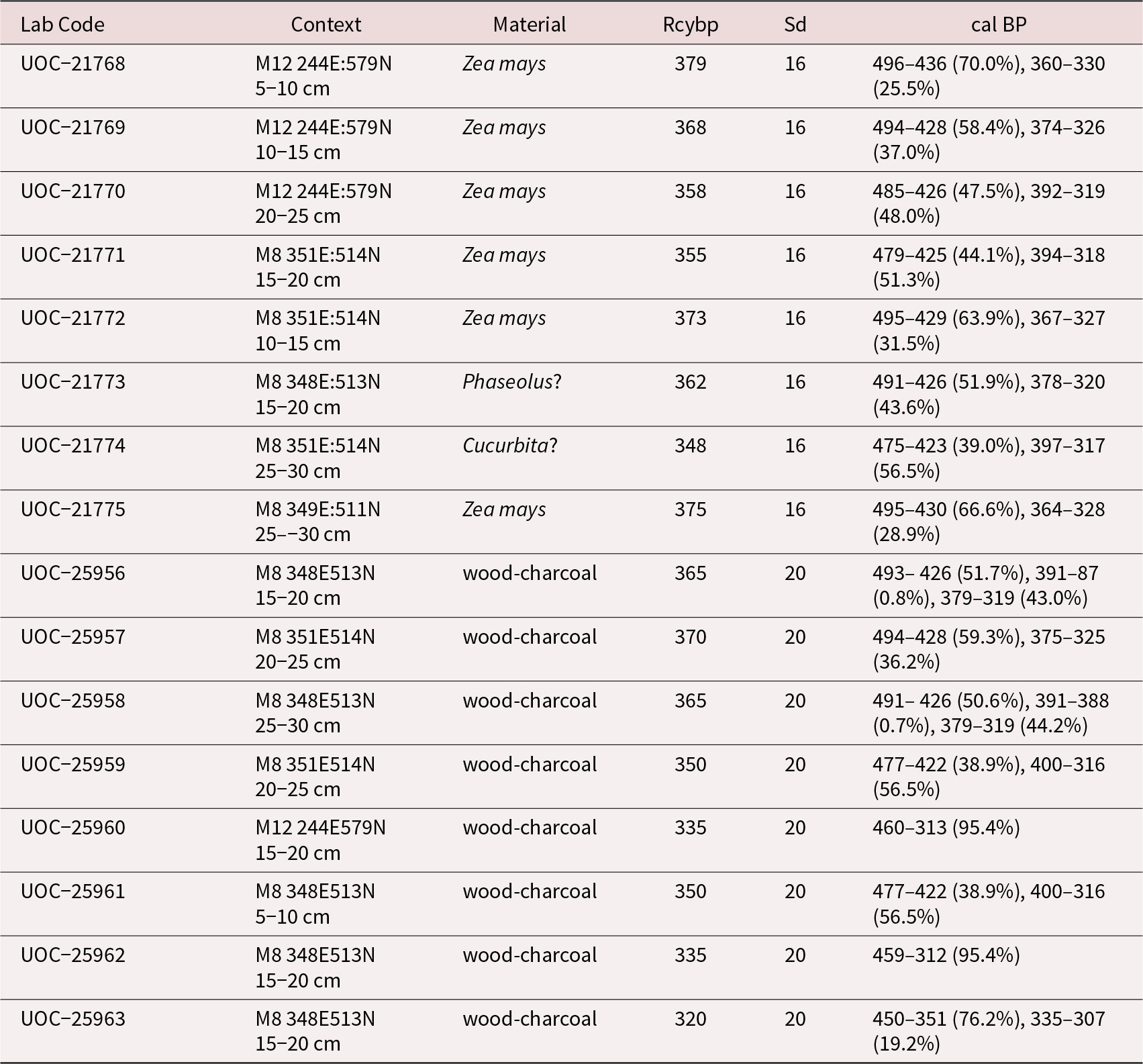
Radiocarbon Dates from Ahatsistari.

Notes: Conventional radiocarbon ages for the short-lived botanicals are rounded to the nearest year, and the wood-charcoal samples are rounded to the nearest five up at the reporting stage by the AMS laboratory following the conventions of Millard (Reference Millard2014). Errors for conventional radiocarbon ages (14C yr BP) are 1σ. Confidence intervals for calibrated ages (cal BP) are within 2σ. Calibration was performed using OxCal v4.4 (Bronk Ramsey Reference Bronk Ramsey2009a) and the IntCal20 calibration curve (Reimer et al. Reference Reimer, Austin, Bard, Bayliss, Blackwell, Ramsey and Butzin2020). The Radiocarbon Laboratory at the National André E. Lalonde AMS Facility in Ottawa does not report δ13C values, but dates are corrected for isotopic fractionation.
Red tubular beads (Ia4) are a trademark type of GBP3 (Fitzgerald Reference Fitzgerald1990; Fitzgerald et al. Reference Fitzgerald, Knight and Bain1995; Kenyon and Kenyon Reference Kenyon, Kenyon and F. Hayes1983). Yet there are two Ia4 beads in the Ahatsistari collection. They could be dismissed as being intrusive or deposited by later Huron-Wendat travelers from the nearby Chew site (Quieunonascaran) dating to GBP3. Yet, there is a strong possibility that they do relate to the occupation of the Ahatsistari site. Red tubular beads were present in New France and traded to Indigenous peoples before 1624 (Kenyon Reference Kenyon1984). Furthermore, red tubular beads were being manufactured in Amsterdam before 1624 (Bradley Reference Bradley, James2014:56). Thus, the presence of red tubular beads at Ahatsistari does not run counter to the relocation of the village reported by Sagard and Le Caron who went to Wendake in 1623 and found French traders living in a cabin at the former village of Carhagouha, now interpreted as Ahatsistari (Heidenreich Reference Heidenreich2014:16; Shea Reference Shea1881:1:205–206). In addition, the Ia4 beads at Ahatsistari support the Kenyon and Kenyon (Reference Kenyon, Kenyon and F. Hayes1983) end date for GBP2 at 1625.
Jetons
Two copper or low-zinc brass jetons (casting counters) were recovered by a private collector when excavating middens at Ahatsistari during the 1960s and 1970s. Both have four holes pierced near the edge, presumably to fasten them to clothing or carrying bags. On the obverse side (Figure 4), both jetons display a central rose surrounded by crowns and the characteristic fleur-de-lis with the maker name of Hans Krauwinckel II, a Nuremberg guild master, with bracket dates of 1586–1635 (Mitchiner et al. Reference Mitchiner, Mortimer and Pollard1987). On the reverse side of one of the jetons, a central orb in a trilobe is surrounded by the text GLUCK BESCHERT IST VNGEWERT, translated into English as “Fortune given is not guaranteed.”
Jetons from Ahatsistari: (top) obverse side showing a central rose surrounded by crowns and the characteristic fleur-de-lis with the maker name of Hans Krauwinckel II; (bottom) reverse side showing a central orb in a trilobe surrounded by the text GLUCK BESCHERT IST VNGEWERT, translated into English as “Fortune given is not guaranteed.”

Jetons were counting tokens, used by merchants to facilitate the calculation of monetary transactions. They were first produced in Nuremberg in the 1480s and reached their height of production and distribution from 1500 to 1700 (Mitchiner et al. Reference Mitchiner, Mortimer and Pollard1987). More than 500 Nuremberg jetons have been recovered from the original fort of the Jamestown colony site (ca. 1607–1610) and were possibly used as copper/brass trade items (Jamestown Rediscovery Foundation Reference Foundation2024; Kelso Reference Kelso2006:104, 178–179). Only three other jetons have been recovered from seventeenth-century Huron-Wendat village sites (Hunter Reference Hunter2008).
Because manufacturer dates are known for these jetons, they can be used as terminus post quem (TPQ) artifacts. In other words, the occupation of Ahatsistari must have ended sometime after 1586. It is noteworthy that copper/low-zinc jetons were no longer made by the Nuremberg manufacturers after 1625 (Mitchiner et al. Reference Mitchiner, Mortimer and Pollard1987:143), so the Ahatsistari jetons would have narrower dates of 1586 to 1625.
Radiocarbon Samples
We sought to establish the absolute chronology of Ahatsistari independently of material culture, avoiding the circular reasoning inherent in dating based on that culture’s perceived diagnostic elements. To achieve this aim, we submitted a sequence of 16 dates for AMS radiocarbon analysis, as presented in Table 2. These included eight short-lived taxa comprising maize cupules, bean, and squash seeds and eight wood-charcoal samples. Recognizing potential biases, particularly with wood-charcoal—and the likelihood of obtaining older dates because of the delay between the tree’s death and its cultural use—we adopted a Bayesian model-driven approach. This approach has been widely validated in similar contexts, including eastern North America (Manning et al. Reference Manning, Birch, Conger, Dee, Griggs and Hadden2019). All work was conducted in OxCal 4.4 (Bronk Ramsey Reference Bronk Ramsey2009a) using IntCal20 Northern Hemisphere (Reimer et al. Reference Reimer, Austin, Bard, Bayliss, Blackwell, Ramsey and Butzin2020)
Samples of carbonized maize, bean, squash, and wood-charcoal recovered from the Ahatsistari site originate from middens excavated and water-screened by Wilfrid Laurier students and members of the Huronia Chapter of the Ontario Archaeological Society during the 2014 field season. The 16 samples are from two undisturbed midden contexts that demarcate the edges of the village. Midden 8 is located at the southeastern extent, and Midden 12 is located along the northwest perimeter of the site (Figure 3). The material comprising each sample and their context are provided in Table 2.
Wood-charcoal samples were purposely selected from heartwood, which is biased toward ages that predate its cutting and use. This provides a temporal constraint or TPQ independent of artifacts to be applied to the short-lived botanicals following Manning and Birch (Reference Birch2022). Application of the wood-charcoal TPQ would help determine the likely correct date range from two or more possible periods of occupation suggested by the short-lived botanical dates. The two possible dates create an ambiguity that is attributed both to the short duration of site phases during the early seventeenth century in Ontario and a reversal or plateau in the 14C calibration curve. Both the short-lived botanicals and wood-charcoal samples from Ahatsistari were submitted to the André Lalonde AMS Laboratory at the University of Ottawa for processing and analysis.
Bayesian Chronological Modeling of Radiocarbon Dates
Model 1: Minimal Priors with All Dates Treated as a Single Phase
Model 1 assumes that all 16 dates belong to a single phase, applying outlier models as outlined by Bronk Ramsey (Reference Bronk Ramsey2009b). Short-lived taxa were assessed using a “General” outlier model, whereas wood-charcoal samples used a “Charcoal” outlier model. Following Manning and Birch (Reference Manning and Birch2022:288), a prior interval constraint was introduced to reflect the likelihood of an occupational duration of around 20 years. To account for the possibility of longer occupations, we modeled the interval prior as a log-normal probability constraint with a μ of log(25) and a σ of log(2). A log-normal spread of uncertainty means that the prior expectation is that the occupational span of Ahatsistari falls roughly within a factor of 2 of 25 years (i.e., most probably between ∼12.5 and ∼50 years) but with a longer tail on the upper end to allow for the possibility of longer durations (see Manning et al. Reference Manning, Birch, Conger, Dee, Griggs and Hadden2019).
We used the OxCal Date query to obtain a posterior probability distribution for the calendar date of the main occupation phase, accounting for the prior constraints imposed by the boundaries. The Interval query was used to obtain the posterior probability of the duration in years between the start and end of the occupation phase.
The first iteration of the model (Model 1a) identified one charcoal sample (UOC-25963, 320 ± 20 BP) as an outlier, with a weak agreement index (A = 56.9%). Despite this outlier, the overall agreement index (Aoverall = 133.9%) demonstrated robustness. Model 1 predicts a date range for Ahatsistari as between 1484 and 1622 at 95.4% probability. In a second iteration (Model 1b), the outlier was removed, yielding a similar date range of 1480–1622 (95.4%). However, both iterations produced bimodal posterior probability distributions (Figure 5), reflecting the challenges posed by the reversal of the calibration curve for 1480–1630. This calibration reversal creates substantial difficulties for dating sites from this period, as discussed by Birch, Manning, and colleagues (Birch et al. Reference Birch, Manning, Sanft and Conger2021; Manning et al. Reference Manning, Birch, Conger, Dee, Griggs and Hadden2019).
Date estimate for Ahatsistari (Model 1b).

Model 2: Incorporating a Temporal Offset in Wood-Charcoal Dates
To address these challenges, Model 2 incorporated an earlier and later phase for Ahatsistari. Our approach aligns with the rationale established by Manning and Birch (Reference Birch2022) in their dating of Jean-Baptiste Lainé. The first phase treated the wood-charcoal dates as a TPQ for the site’s occupation based on two prior probabilities: first, the sampled wood was unlikely to represent the outermost rings and bark—the portions that would date to the time of the tree’s cutting—and second, the wood may have been curated or acquired after the tree’s death. Given this, the wood-charcoal dates can be treated as an earlier phase in a two-phase sequence, with the second phase defined by the short-lived taxa that represent the village’s occupation. The use of boundary conditions between these phases ensured that the occupational phase postdated the wood-charcoal phase.
We ran two versions of this model (2a and 2b), with the former including UOC-25963 and the latter excluding that sample. The same 25-year log-normal interval prior was applied as in Model 1. The results are similar, although Model 2b has the stronger Aoverall agreement index (= 149.6). Introducing the TPQ reduces the area under the fifteenth-century mode to about 5% of the posterior distribution (Figure 6). The later seventeenth-century mode has by far the higher probability and predicts a start date between 1585 and 1615 (88.3%) and an end date between 1601 and 1628 (88.9%), with an estimated date of the occupation within the range 1591–1622 (90.2%). This model is also shown in more detail in Figure 7.
Date estimates for Ahatsistari (Model 2b).

Model 2b phasing and dates.

Abandonment and First Occupation Timing
All models predict the site’s abandonment as occurring in the early seventeenth century between 1614 and 1622 (Table 3). The date of the first occupation remains less certain, with estimates ranging from 1480 to 1601 depending on the assumptions and priors applied. However, the earlier mode in the posterior probability distribution, corresponding to 1480–1512, lacks corroborating evidence from material culture, suggesting there is no earlier occupation phase and that this range occurs only because of the reversal in the calibration curve. Model 2b predicts with very high confidence that the site’s founding occurred after 1591, which is also consistent with the material culture evidence.
Summary of Model Results.

Ahatsistari’s occupation can therefore be confidently radiocarbon dated to within the range 1591–1622. This analysis establishes a robust independently obtained absolute chronology. The phased approach of Model 2, which leverages realistic priors and addresses calibration curve challenges, provides robust and compelling results. Alongside the work of Manning and colleagues (Reference Manning and Birch2020), these findings underscore the value of integrating phased modeling with realistic priors to refine chronological estimates for archaeological sites, particularly those affected by calibration curve reversals.
Discussion
The AMS radiocarbon dating of Ahatsistari combined with Bayesian modeling allows a more precise estimate for the date of occupation that is independent of artifact seriation chronologies and historical records. The Bayesian-modeled radiocarbon dates enabled the linking of this contact-era site with historical events: the visits of Champlain and Le Caron and the historic Wendat town of Carhagouha. In addition, the modeled Ahatsistari radiocarbon date appears consistent with the calendar dates bookending GBP2. The glass bead assemblage highlights the sociopolitical-economic importance of Carhagouha over Cahiagué and supports the observation that, before 1620, the Attignawantan, of all the Wendat nations, were the most involved in the fur trade with the French.
Historical Associations
The calendar date estimate for Ahatsistari site based on the 14C data indicates a likely date range of 1591–1622 (95%), which is compatible with visits from Champlain and Le Caron in 1615 and 1616. In addition, the end date of 1622 closely approaches the ethnohistorical record of abandonment of Carhagouha in 1623 (Thwaites Reference Thwaites1896–1901:13:125; Wrong Reference Wrong1939:75–80). The determined date range alone does not prove that Ahatsistari is Carhagouha, but it is consistent with arguments made by Glencross and coworkers (Reference Glencross, Warrick and Fletcher2021) based on Ahatsistari’s geographical location and size, the material culture recovered, and the historical accounts of Champlain and Sagard. In this instance, there is a plausible historical association, and our 14C data and Bayesian chronological modeling provide a narrow and compatible date range. Still to be confirmed archaeologically are features of Carhagouha that, according to Champlain, include a triple palisade and small cabin apart from the village in which Le Caron resided (Biggar Reference Biggar1922–1936:3:48–49).
The date estimate for Ahatsistari (1591–1622) is also in accordance with the site phase of 1585–1624 determined for Warminster, which is recognized as Champlain’s Cahiagué (Manning et al. Reference Manning, Birch, Conger, Dee, Griggs, Hadden and Hogg2018). If we assume the modeled occupation interval of 20 years and take into consideration the ethnohistoric account that Carhagouha was established at an unknown date several years before 1615 and then relocated in 1623, this suggests a likely occupation date of 1603–1623 for Ahatsistari. If we consider the narrow date range of 1586–1625 established for the Ahatsistari jetons, this would encapsulate the suggested occupation date of 1591–1622, as would the glass bead date of 1600–1625. In all these scenarios, Ahatsistari/Carhagouha is indeed contemporary with Warminster/Cahiagué.
The Ahatsistari Date and Ontario Glass Bead Chronology: Implications for the Culture-Historical Framework and Interpreting Sociopolitical-Economic Interactions
The absolute date for Ahatsistari, when combined with radiocarbon dates for Ball and Warminster, affords an opportunity to examine the relative seriation of glass beads in Ontario, which has implications for understanding contact-era sociopolitical-economic relations. Kenyon and Kenyon (Reference Kenyon, Kenyon and F. Hayes1983) suggest a date of 1580–1600 for GBP1 in Ontario, attributing a single highly successful expedition in 1581 by merchants from St. Malo for ushering in the rapid intensification of the French fur trade in the St. Lawrence Valley. GBP1 is characterized by a wide variety of beads of different sizes, shapes, and colors with frit-core beads considered the “most characteristic bead type, although not the most common” of GBP1 in southern Ontario (Kenyon and Kenyon Reference Kenyon, Kenyon and F. Hayes1983:60). Common to GBP1 are small round turquoise beads (IIa31/40). Because of the small number of sites with substantial bead collections from this period, Kenyon and Kenyon (Reference Kenyon, Kenyon and F. Hayes1983) note that the dates are somewhat “speculative.” GBP2 encompasses the period 1600–1625 and is marked by assemblages comprising predominantly dark blue and white beads, specifically white oval (IIa15), white tubular (Ia5), blue oval (IIa49), and blue tubular (Ia19) beads (Supplementary Figure 1). Also found during this period are some Dutch polychrome beads (Supplementary Figure 2; Ibb, IIbb1, IIbb2, IIb7, IIb9, IIb2, IIbb4). The transition date between GBP2 and GBP3 is contentious. Fitzgerald (Reference Fitzgerald1990) and Fitzgerald and colleagues (Reference Fitzgerald, Knight and Bain1995) date the transition to 1632 based on the absence/presence of red tubular beads, but Kenyon and Kenyon (Reference Kenyon, Kenyon and F. Hayes1983) date it to 1615–1625. Kenyon (Reference Kenyon1984) cites the presence of red tubular beads in New France that were being traded to Indigenous peoples before 1624. Furthermore, Bradley (Reference Bradley, James2014:56) identifies red tubular beads being manufactured in Amsterdam before 1624, supporting the historically reported 1625 end date for GBP2 (Kenyon and Kenyon Reference Kenyon, Kenyon and F. Hayes1983).
Radiocarbon evidence suggests occupation of the Ball site from around 1565 to 1591, with an end date no later than 1598 to 1607 (Manning et al. Reference Manning, Birch, Conger, Dee, Griggs and Hadden2019:702), which covers GBP1 through to the beginning of GBP2. Based on Kidd and Kidd’s (Reference Kidd and Kidd1970) glass trade bead typology, 21 types have been identified in the Ball collection (see Table 2), of which 43% are characteristic of GPB1, including three frit-core beads. Beads typical of GBP2 make up 54% of the total bead assemblage, including blue monochrome and white monochrome tubular (Ia5, Ia19) and oval (IIa15, IIa57) forms. However, the larger number of GBP 1 bead types attest to the earlier beginning of the occupation phase of Ball in relation to Ahatsistari and Warminster. The higher frequency of GBP2 beads is interesting, given the short length of time for GPB2 beads to accumulate at the Ball site if the transition to GBP2 occurred around 1600, as proposed by Kenyon and Kenyon (Reference Kenyon, Kenyon and F. Hayes1983). This high frequency may perhaps be attributed to the appearance of these bead types earlier than previously thought or to intensified trade during the later phases of the site, with the Ball site population having preferential access to European material in the early contact era, as suggested by Pavlish and coauthors (Reference Pavlish, Michelaki, Moreau, Farquhar, Fox, Marie Anselmi and Garrad2018).
Bayesian modeling of the radiocarbon data for contemporaries Ahatsistari and Warminster suggests occupation dates of 1591–1622 and 1585–1624, respectively: they share roughly a decade of occupation during GBP1, with the remainder situated in GBP2. The bead assemblages of Ahatsistari and Warminster (Table 2) have remarkably similar bead types, although the Ahatsistari assemblage has considerably more diversity (Glencross et al. Reference Glencross, Warrick and Fletcher2021). Blue monochrome and white monochrome tubular (Ia5, Ia19) and oval (IIa15, IIa57) forms dominate both glass bead assemblages, constituting 55% of the total beads from Ahatsistari and 85% of the total beads from Warminster. If we include all beads typical of GBP2, the percentage for Ahatsistari increases to 74% and for Warminster to 95%. Based on Kidd and Kidd’s (Reference Kidd and Kidd1970) glass trade bead typology, 40 types have been identified in the Ahatsistari collections (see Table 1) and 18 types in the Warminster assemblage. This difference in the number of bead types will have an obvious influence on the relative percentage of blue and white beads in each collection—that is, the percentage of blue and white beads at Ahatsistari is lower as a direct result of the much higher overall diversity in bead types—but blue and white beads remain dominant in both assemblages. In addition, Dutch polychrome beads comprise 11% of the Ahatsistari bead assemblage and 6% of the Warminster bead collection. Glencross and colleagues (Reference Glencross, Warrick and Fletcher2021) also report differences in bead densities at Ahatsistari and Warminster. During the 2014 field season at Ahatsistari, students excavated some 13 m2 of midden soils. The soils were dry-screened through 3.2 mm mesh and then water-screened using 1.6 mm mesh. The students recovered 172 glass beads, suggesting a density of 13.2 beads per m2. At Warminster, 30 m2 of a single midden (#57) also screened with 3.2 mm mesh yielded 62 glass beads, for a density of 2.1 beads per m2 (Sykes Reference Sykes1983). When considering all excavated midden soils from Warminster—approximately 272 m2 (screened with 6.4, 3.2, and 1.6 mm mesh [Sykes Reference Sykes1983] and hand excavated with no sieves [Fitzgerald et al. Reference Fitzgerald, Knight and Bain1995])—a density of 0.9 beads per m2 is given. The bead density for Ahatsistari is more than six times greater than that calculated for Warminster when using counts from only fine-mesh screening (wet for Ahatsistari and dry for Warminster) of midden soils (Glencross et al. Reference Glencross, Warrick and Fletcher2021). The density and diversity of beads at Ahatsistari may, in part, be the result of recovery bias introduced with water-screening and laboratory processing (Graesch Reference Graesch2009); however, the high densities coupled with the incredible diversity in glass beads from Ahatsistari might also suggest a dominant position for Ahatsistari/Carhagouha in trade relations within Wendake.
Champlain describes the Arendarhonon town of Cahiagué in 1615 as the principal settlement of the Wendat, with more than 200 houses (Biggar Reference Biggar1922–1936:3:49); however, his description may have simply referred to the size of the village and not its political and economic importance (Trigger Reference Trigger, Bruce1976:304). At the time of Champlain’s visit, Cahiagué was the rallying point for the planned Wendat offensive against the Haudenosaunee, attracting warriors from across the nation and inflating its numbers.
While en route to Cahiagué, Champlain traveled through the country of the Attignawantan, the largest and northernmost of the Huron-Wendat nations and so easily accessible from Georgian Bay. Trigger (Reference Trigger, Bruce1976:298) has suggested that, even though the leaders of the northern Attignawantan are described as less prestigious, Champlain met headmen of several villages who promised to cooperate and trade with the French. Importantly, Onorotandi and Auoindaon, who claimed to control the northern Attignawantan trade route to Quebec, likely resided at Carhagouha. With its prime location centered on Tay Point, the community of Carhagouha was ideally situated geographically to receive French visitors traveling the preferred early seventeenth-century trade route from Quebec, along the St. Lawrence, Ottawa, and French River systems to Georgian Bay, as well as to mediate trade among the other Wendat Nations. Thus, it is not surprising that the Ahatsistari site would produce very high frequencies of trade items, particularly glass beads in a large variety of types.
It also seems that the Attignawantan were able to use their influence to bring not only French traders but also Recollet priests to live among them, although a preference for traders was likely, given their use of firearms and secular nature (Trigger Reference Trigger, Bruce1976:367–376). French trader and interpreter Étienne Brûlé and Recollet priest Joseph Le Caron were persuaded to settle not among the Arendarhonon but with the Attignawantan. In fact, Recollet priests only lived with the Attignawantan (Trigger Reference Trigger, Bruce1976:390–393), and Le Caron settled in Carhagouha. The presence of these notable European visitors also speaks to the significant role of Carhagouha in Wendat social, economic, and political life.
Finally, the Bidmead site currently has no radiocarbon dates available, but its occupation is thought to be from 1600 to 1615/1625 based on metal artifacts and the glass bead assemblage (Merritt Reference Merritt2020). Using Kidd and Kidd’s (Reference Kidd and Kidd1970) glass trade bead typology, 15 types were identified in the Bidmead collection that were similar to Warminster (see Table 1). Blue monochrome and white monochrome tubular (Ia5, Ia19) and oval (IIa15, IIa57) forms constitute only 12% of the total beads from Bidmead; however, if we include all beads typical of GBP2, the percentage for Bidmead increases to 58%, which is still lower than the percentages for Ahatsistari and Warminster but does agree with the GBP2 dates. The jump in the percentage of GBP2 beads can be attributed to the high number of Dutch polychrome beads (54%), which are also present at Ahatsistari (11%) and Warminster (6%) but in lesser amounts. Bidmead’s glass bead assemblage is the smallest of the four collections included in this study, and its findings are considered cautiously because of potential recovery bias; however, GBP2 beads seem to dominate the assemblage. Merritt (Reference Merritt2020) notes the absence of red tubular beads, which may suggest an end date before 1624 or the possibility that recovery issues played a role. Merritt (Reference Merritt2020) suggests a close trade relationship between the Attigeenongnahac and the Dutch-supplied Susquehannock, with the Attigeenongnahac acting as middlemen distributing the sought-after red beads to other Wendat and Algonkian peoples.
Conclusions
Three independent dates of occupation can be suggested for Ahatsistari based on glass trade bead chronology (GBP2 1600–1625), manufacturing dates of jetons (1586–1625), and radiocarbon dates (1591–1622) with all three converging in the seventeenth century at the year 1600.
The modeled radiocarbon dates provide an independent timeframe for understanding site phase and sequence, compatibility with historically documented events of a known date, and assessment of socioeconomic and political influences affecting the composition of European trade goods assemblages from GBP2 sites in Ontario. We argue that Ahatsistari is likely Carhagouha, the principal village of the northern Attignawantan, members of the Huron-Wendat Confederacy, and home to Samuel de Champlain and Joseph Le Caron in 1615 and 1616. All three lines of evidence from Ahatsistari are compatible with a visit to Carhagouha by Champlain. In addition, Ahatsistari is contemporary with the archaeological site Warminster, which is believed to be Champlain’s Cahiagué, a contemporary of Carhagouha, and where Champlain traveled to after leaving Carhagouha in August 1615. The archaeological sites Ahatsistari, Warminster, Ball, and Bidmead all were previously identified as dating to GBP2 (1600–1625) based on European glass bead chronologies. Radiocarbon dates from archaeological sites Ahatsistari, Warminster, and Ball appear consistent with these earlier designations. Differences in the composition of the glass trade bead assemblages speak to the influence of and prominent roles played by the Attignawantan and Arendarhonon in trade relations with the French, and the Attigeenongnahac with the Susquehannock of New York State and indirectly the Dutch.
Acknowledgments
We would like to express our gratitude to the Huron-Wendat Nation for permission to conduct fieldwork, particularly Louis Lesage, Simon Picard, and Melanie Vincent, who helped facilitate the Wilfrid Laurier University field school. We would also like to thank Graeme Davis, senior forester, County of Simcoe, who kindly provided permission to conduct work on the property, and Mike Caughey for providing access to the jetons, Grant Ginson for creating the site map, and Debora Foran for translating the abstract and keywords. Finally, we are grateful to Jennifer Birch and two anonymous reviewers who provided helpful comments that improved this article. Permission for fieldwork was granted by the Ministry of Tourism, Culture and Sport, Government of Ontario under license P-377-0001-2014 (Bonnie Glencross, licensee).
Funding Statement
This research received no specific grant funding from any funding agency, commercial, or not-for-profit sectors.
Data Availability Statement
All data used in this article are available from the text and supplementary materials. The radiocarbon dates used are listed in Table 3. The OxCal runfiles for the models are provided as Supplementary Code 1.
Competing Interests
The authors declare none.
Supplementary Material
The supplementary material for this article can be found at https://doi.org/10.1017/aaq.2025.24.
Supplemental Code 1. OxCal runfiles for Model 1a, Model 1b, Model 2a, and Model 2b.
Supplementary Figure 1. Examples of GBP2 trade beads from Ahatsistari: (top row) oval dark blue (IIa49) and oval white (IIa15); (middle and bottom row) tubular white monochrome (Ia5) and tubular dark blue monochrome (Ia19).
Supplementary Figure 2. Examples of GBP2 Dutch polychrome beads from Ahatsistari: (top row) flat red with dark blue and white stripes (IIbb2) and round red with blue and white stripes (IIbb1); (bottom row) tubular red with dark blue and white stripes (Ibb1).
Supplementary Table 1. GBP2 sites from Southern Ontario: Wendat, Neutral (Attawandaron), Petun (Tionontaté) and Quebec (Champlain Era).








 Open access

