





“Valença since 1844.” This is what you see in the logo of the Valença Têxtil, a company located in the city of Valença, in Bahia (Brazil).Footnote 1 The Valença Têxtil is product of a series of transactions that began with the merger of the textile factories Todos os Santos and Nossa Senhora do Amparo, founded in the town in 1844 and 1860, respectively.
The conflation of the founding year of Todos os Santos with the origins of the Valença Têxtil is intentional, and refers to the importance that the factory had for both Valença and the Empire of Brazil. At the national level, Todos os Santos was the largest textile factory in Brazil in the mid-nineteenth century. At the local level, its installation had an impact on different spheres of society, due to the capital invested and the labour force employed. We can see part of this impact in the elevation of the then village of Santíssimo Coração de Jesus de Valença to the category of city—a city that was given a new, industrial name (the Industrial City of Valença) on November 10, 1849, about two years after Todos os Santos started to operate.
It was around the textile factories that the collective memory of Valença was built. Narratives praise what are perceived as policies of social support for the workers (housing, food, and education, for example); the factories’ employment of female workers (seen as an equitable attitude towards gender); and, especially, the supposed exclusive use of free and waged labour in the factory, during the period when slavery in Brazil was still a solid regime.Footnote 2 This narrative was explicitly perpetuated by Valença Têxtil, at least, until 2020. On a timeline present in their website, a text referring to 1888 (the year when slavery was abolished in the Brazilian Empire) stated: “Valença is proud of never having used slave labour in its history.”Footnote 3 In this sense, a causal relationship was established between the supposed exclusive use of free labour at Todos os Santos and the fact that the company was the largest textile factory in Brazil.
Association between free labour and industry, existing in Todos os Santos’s history and memory, can also be seen in Brazilian historiography. Some of the main researchers since the 1940s who tried to understand Brazilian society, despite adopting different analytical perspectives, converged in the assertion that slavery obstructed or at least delayed the development of industry in the country. According to this interpretation, which continues to find support in works on the history of industry in Brazil, it was the Republic and free labour, especially the massive migration of Europeans from the end of the nineteenth century onwards, that boosted the sector.Footnote 4
Since the 2000s, however, there has been an increase in research concerned with analysing the connections between slavery and industrial development or, more widely, slavery and capitalism, taking up and deepening aspects contained in the work of Eric Williams.Footnote 5 These researches show, for instance, how the expansion of capitalism stimulated the strengthening of a “second slavery” in some regions of the American continent; the connections between slavery and the transatlantic slave trade to Cuba and the industrial and financial development of Catalonia, Spain; and the connections between slavery and cotton in the South of the United States and the industrial and financial development of the North of the United States and of England.Footnote 6
These studies, as well as access to previously untapped sources, have allowed a fresh look at Todos os Santos’s history. It has been shown that the company maintained deep ties with the slavery system: its founders were slave traders from Africa to Brazil; part of its production were low-quality fabrics, considered at the time suitable for clothing for enslaved people and packaging bags (such as coffee and sugar) made with the labour of these individuals; and in fact, the factory did simultaneously employ free and enslaved labourers.Footnote 7
This article explores hidden aspects of labour at the Todos os Santos factory in four sections. The first section aims at understanding how the myth about the exclusive employment of free and waged labour in the company was constructed and why it was important to the authorities, as well as the factory owners, to conceal the employment of enslaved people in the institution. The second section provides a brief overview of the workers employed at Todos os Santos, highlighting the presence of both free and enslaved labour. The third analyses elements of the allegedly free workforce: how they were recruited; their age, gender, and colour; and their living and working conditions. It seeks to demonstrate that although legally free, these workers found themselves in a dynamic that was structured in the same form as slavery. Finally, the fourth section discusses the employment of enslaved people in the factory and presents the characteristics of these workers. It shows evidence of how allegedly free and enslaved workers could be subjected to a very similar exploitation.
The study of labour at the Todos os Santos factory contributes to a deeper analysis of the connections between slavery and industry in Brazil. Moreover, since studies on the connection of capitalism and slavery tend to analyse the links between two different regions (e.g., Cuba–Catalonia; southern United States–northern United States; southern United States–England), the case of the Todos os Santos factory helps to understand how capitalism and slavery interacted within the same region.
“Slavery-Free”
Todos os Santos was founded in 1844 by the company Lacerda & Cia., which had been set up by the Brazilians Antonio Francisco de Lacerda and Antonio Pedrozo de Albuquerque and the American John Smith Gillmer. Among other facilities, the complex included a textile factory, a dam that supplied water to the machines, a warehouse for storing goods, a metal foundry, a sawmill, an infirmary, an oratory, a kitchen, a bakery, houses for the workers, and some crops, probably used to feed the workers there.Footnote 8
Three years after Lacerda e Cia. was founded, on 1 November 1847, the textile factory started operating, and its goods were soon advertised in Bahia. On 22 January 1848, for example, an advertisement was published in the newspaper Correio Mercantil. In addition to highlighting the quality of the products, the advertisement emphasised that those were the first of the kind manufactured in Brazil by “braços livres” (“free arms”, i.e., free labour) (Figure 1).Footnote 9 This information appeared recurrently in advertisements in newspapers in Bahia as well as other Brazilian provinces (such as Pernambuco, Rio de Janeiro, and Rio Grande do Sul), which were the main destinations of the goods produced by the factory during the period it was in operation, from 1847 to 1876.Footnote 10
Advertisement of Todos os Santos goods, 1848.

The employment of free labour at Todos os Santos was also a constant theme in its documentation by the authorities, as well as other individuals who visited it, especially in the early years of its operation. In a letter to the president of the Province of Bahia in 1848, a judge from Valença, Manoel José Espinola, stated that the factory employed eighty free workers, both men and women.Footnote 11 In that same year, a report presented to the Junta do Comércio, Agricultura, Fábricas e Navegação do Império do Brasil (Committee of Commerce, Agriculture, Factories, and Navigation of the Brazilian Empire) registered that the factory employed 120 free people, Brazilians, of both sexes.Footnote 12 The following year, the president of Bahia Province, Francisco Gonçalves Martins, visited the complex’s facilities. According to him, at that time, the factory employed more than 150 people, who were free Brazilians of both sexes.Footnote 13
None of these advertisements or records mentions the presence of enslaved workers at Todos os Santos. On the contrary, along with emphasising the employment of free labour, these records also mention the supposed benefits granted by the factory to its workers, such as housing, medical care, education, and leisure activities—information that, as we have seen, is still present in the local collective memory. To understand the emphasis on the factory as a slavery-free company, it is necessary to turn to the socioeconomic situation of the Brazilian Empire and, in particular, of Bahia in the period when the factory was founded.
Since the end of the eighteenth century, there has been an increase in the free and poor population in Bahia. This population did not fit into the structure of the master-enslaved dependency, and in the eyes of the upper classes, it represented a threat to the prevailing social order.Footnote 14 In this sense, the political and economic elite were keen to provide occupation for these individuals. It was believed that occupying them and integrating them, as far as possible, within the logics of slavery, would lead to a decrease, among other things, of begging, vagrancy, and criminality in the streets.Footnote 15 This was noted in the Criminal Code of the Empire of Brazil, promulgated in 1830, which considered vagrancy and begging to be crimes, both punishable by imprisonment with hard labour. In the same year, the imperial government also enacted a law that regulated contract labour, which was carried out by both immigrants and Brazilians, and punished with imprisonment those workers who failed to comply with their contracts of employment.Footnote 16
Concerns about the free, poor, and “unemployed” population became even more intense after the prohibition of the transatlantic slave trade to Brazil in 1831, which led to an increase in the prices of enslaved workers.Footnote 17 Furthermore, starting in the 1850s, part of the enslaved contingent from Bahia was taken to coffee-growing regions in the south-east of Brazil, under the interprovincial slave trade.Footnote 18 Together, these factors led to a decrease in the supply of enslaved labour, or at least of the possibility of acquiring enslaved people.
In the face of this situation, slave owners concentrated their enslaved workers in farming activities, abandoning manufacturing on farms (such as the production of cotton fabrics). This resulted in the increase of external demand for manufactured goods.Footnote 19 In addition, the free and poor population started to be recruited by the provincial government and other organs to work, for example, through the operation of philanthropic institutions that took in minors, aiming to provide them with training for work and integrate them in a way that was considered productive to society.Footnote 20 In this way, the Todos os Santos factory met the demands of the period, both in terms of manufacturing and in terms of use of free and poor labour.
Worries about this group of people and the supposed benefits that their employment at Todos os Santos would bring to society are evident in comments made by Francisco Gonçalves Martins about his visit to the factory in 1849. For him, the experience of Todos os Santos demonstrated the aptitude of the Brazilian people belonging to free and poor classes to work in the manufacturing industry. Besides, in his vision, the young people employed there who had been considered lazy and insubordinate when they entered the establishment, when subjected to a routine of work, learning, and leisure, became as efficient as the best workers from Europe and the United States. Martins also estimated that there were enough people in the region of Valença to be employed in other factories without harming agriculture, “being rather a relief for poor parents, and an asylum for orphans and the helpless.”Footnote 21
A relevant aspect of his speech is the mention of the compatibility of the use of free and poor labour in factories with agricultural production. Agriculture was the main economic activity in Brazil, and the prevailing belief in the period was that the manufacturing industry should develop in line with interests of the agricultural sector.Footnote 22 Many entrepreneurs in the manufacturing sector, such as Antonio Pedrozo de Albuquerque, one of Todos os Santos’s owners, were also sugar planters and slave owners. In the context of the prohibition of the transatlantic slave trade and the increase in prices of enslaved people, along with the interprovincial slave trade to the south-east of the country, it was not desirable for the factories to compete for enslaved labour, especially with the existence of a contingent of free people seen as available for work in the sector.
In the 1850s, the vision of the factory as a space for use of the labour and disciplinarisation of the free and poor people continued to permeate the discourse. In 1857, when the factory went through a period of instability, João Maurício Wanderley, an important Bahian politician, defended the granting of a loan by the imperial government to the factory in the Brazilian Senate. The main argument he presented was the supposed service that the factory rendered to imperial society, by welcoming and educating free individuals of poor origin. According to him, Todos os Santos
is not only a simple textile factory, it is also an industrial education establishment. There are 400 free workers there, almost all Brazilians … both orphans from the seminary of S. Joaquim and orphans from the Santa Casa da Misericórdia, are employed in that factory, which maintains them, gives them education and keeps them in the same establishment; many poor families from the outskirts of the city of Valença have found there an education that has nothing to envy. Gentlemen, it is not an establishment like any other that simply pays wages to the workers.Footnote 23
The constant mention of the employment of free labour in reports and advertisements had the purpose of communicating to the reading public—political authorities, economically favoured sectors, and the upper classes of society in general—the greater compatibility of the factory’s activities with the interests of agriculture (that is, the factory would not compete with agriculture for enslaved labour) and its ability to integrate in a productive and disciplined way the free and poor segment of the population to the slave social order. Thus, in addition to the practical utility of Todos os Santos as a supplier of products (mainly fabrics) for the agricultural sector, its social utility was brought to the fore.
However, hitherto untapped sources bring to light the use of enslaved labour at Todos os Santos. In the following, a closer look is taken at the labour force and the working and living conditions at the factory.
Workers at the Todos os Santos Factory
Since, so far, few internal documents produced by the management of the Todos os Santos factory about its structure or organisation have been found, it is hard to accurately state the number of workers employed there. But alternative sources, such as details from newspapers and reports from authorities, allow us to estimate that the establishment employed at least 400 free and 59 enslaved workers, male and female. The table below (Table 1) collates the available data regarding the number of workers in the factory throughout its existence.
Workers employed at Todos os Santos

Source: This information was compiled from a large array of archival and published sources. For the full reference see: Santos, “Escravidão, tráfico e indústria,” 264.
As can be seen, where data for both categories is present, the total number of free workers present at Todos os Santos was always higher than the total number of enslaved ones. However, the number of enslaved workers there is not insignificant, especially if we consider the discourse built around the factory as a slavery-free place. The data for 1860 and 1861, years for which we have numbers for both free and enslaved workers, indicate that the latter represented between 11.1 per cent and 21.7 per cent of the workforce in the factory. It should be mentioned that the average of enslaved people per owner in Valença in the period was 4.7.Footnote 24 Thus, the large number of people enslaved by the factory compared to the region’s standards was probably one aspect in which Todos os Santos stood out, hardly going unnoticed by contemporaries.
“Free” Workers
There are indications that free people employed at Todos os Santos came from three main places: areas near the factory, in the region of Valença; the Santa Casa de Misericórdia da Bahia (SCMB); and the Casa Pia e Colégio de Órfãos de São Joaquim (CPCOSJ), the last two being philanthropic institutions located in Salvador. Tracing more information about these groups is not an easy task, especially those from the region of Valença, whose pathways to the factory (voluntary or enforced) are still completely unknown.
Nevertheless, in the case of workers from SCMB and the CPCOSJ, there is information available. These philanthropic institutions played an important role in Bahian society in the nineteenth century by taking in and educating children, most of them orphans, mediating their integration into society in a way that was considered productive.Footnote 25 Admission of children into the SCMB and CPCOSJ, as well as their referral to individuals responsible for educating them, involved filling out a series of documents, many of which have survived to the present day, making it possible to know more about those workers.
In Brazil, concerns about the fate of orphans had been latent since the colonial period, with legislation on those both with and without property. In the nineteenth century, the increase in this population generated worries about the social order. In the same period, the decrease in the supply of slave labour made orphans a potential reserve labour army, generating interest in adopting them.Footnote 26
According to Antonio Marcos Chaves, Roberta Tavares de Melo Borrione, and Giovana Reis Mesquita, in the late 1840s, twenty-seven young men and women were sent by the SCMB to Todos os Santos.Footnote 27 Meanwhile, according to Alfredo da Matta, between 1845 and 1865, one hundred young men from the CPCOSJ were employed in the factory.Footnote 28 This is a high number and corresponded to approximately 86.2 per cent of the total number of people from the CPCOSJ employed in factories between 1845 and 1899. It should be noted that, of the total number of orphans sent by the institution to Todos os Santos, seventy entered the establishment between 1845 and 1849.Footnote 29 Many of these were sent even before the textile factory started to operate, indicating that they had been employed there probably as builders during its construction.Footnote 30
Antonio Francisco de Lacerda, Antonio Pedrozo de Albuquerque, and John Smith Gillmer were important businessmen in nineteenth-century Bahia and belonged to elite circles in the province, despite their participation in illegal activities such as the transatlantic slave trade. Antonio Pedrozo de Albuquerque was one of the main slave traders to Brazil in the nineteenth century, being responsible for at least thirty-three slave voyages to the country, six of which were illegal.Footnote 31 John Smith Gillmer was also deeply involved in the slave trade to Brazil. His company, John Smith Gillmer e Cia, was the main supplier of slave ships to the illegal slave trade to Bahia in the 1840s.Footnote 32 Finally, Antonio Francisco de Lacerda participated in at least one illegal slave voyage to Brazil, on the vessel Sociedade Feliz in 1839.Footnote 33 In fact, the participation of these individuals in the transatlantic slave trade to Brazil and the profits obtained from this activity contributed enormously to their enrichment and to the foundation of Todos os Santos.Footnote 34
Lacerda, Pedrozo, and Gillmer were also members of social, economic, and political commissions formed by the Bahia government. Moreover, Lacerda and Albuquerque were associates at the SCMB and Pedrozo was the institution’s administrator in 1837. Meanwhile, John Smith Gillmer was designated the U.S. consul in Bahia in the 1850s.Footnote 35 Thus, the embedding of the factory owners in Bahian society must have contributed to the recruitment of the youngsters to work in those institutions, giving them access to other forms of low-cost labour in addition to slavery.
In the case of the CPCOSJ, Antonio Francisco de Lacerda was responsible for recruiting the youngsters. Sending them as apprentices to companies and individuals was regulated by the statutes of the CPCOSJ, which had education for work as one of its main remits, and therefore this was a legal practice.Footnote 36 The orphans were sent to work in the factory for five years, during which they received no pay. In exchange, in this period, Lacerda & Cia were responsible for clothing, footwear, and taking care of their health. After this period, the young would be incorporated into the factory workforce and possibly start to be paid for their work. As part of the agreements made between Todos os Santos and CPCOSJ, the company was supposed to keep the children as employees until they reached the age of majority, i.e., twenty-one years old.Footnote 37 Information found suggests that it was not possible for these young men or their families breaking these agreements,Footnote 38 which leads one to wonder how “free” they really were.Footnote 39
Along with the availability of child labour and concerns about the fate of legally free orphans in a changing slave society, the labour recruitment model adopted by the factory was probably inspired by practices in other countries. In England, for example, the main form of child labour recruitment was through parish institutions for poor and abandoned minors. In these, the factory owners would hire groups of children to work as apprentices for a certain number of years, as was the case at Todos os Santos.Footnote 40 Samuel Greg, a pioneer of the British textile industry, recruited more than half of his workers between 1784 and 1840 from these kinds of establishments.Footnote 41
The factory owners must have seen the hiring of young people as apprentices as advantageous from an economic point of view. This is because, first, in their home institutions they could receive both formal education and a basic professional qualification. In other words, Todos os Santos was hiring labour with a certain degree of qualification. Second, this labour was not paid for a period of five years. The frequent admission of people from the CPCOSJ at Todos os Santos reinforces the argument that Lacerda e Cia. had an explicit interest in hiring children. Moreover, it indicates that this practice was perpetuated throughout the years of the factory’s existence, both complementing and replenishing the establishment’s labour force with a regular contingent of legally free unpaid workers, maximising profits obtained from the exploitation of these individuals.
The CPSOSJ administrators also looked favourably on sending children to the factory. In a speech aligned with discourses of the time regarding the disciplinary effect of work, they affirmed:
The factory of Valença was the place where it could best be arranged [the conclusion of the education of young people], because [the orphan] finds subjection, fear, and respect from the prudent man who directs it, and, finally, accustomed to the love of work, he becomes a useful citizen to the nation … If other establishments, equally well set up as that one, existed in the province, it would be convenient and useful for sure to employ in them all the orphans, with rare exceptions, who have finished the time they can be in this seminary.Footnote 42
Family members and guardians of orphans, on the other hand, did not have the same perspective on sending them to the factory. According to an administration report of CPCOSJ produced by the Manoel Pedro Moreira de Vasconcellos in 1852, “most of the orphans, or even more relatives, are very disgusted with the factory of Valença … either because it is more difficult to visit them there, or because they are deprived of having them in their possession.”Footnote 43 Still, according to Vasconcellos, the orphans’ relatives considered that they had lost them when they were sent to the factory. We can see, therefore, that relatives and people in charge of the orphans were afraid of sending them to Todos os Santos, due, among other factors, to the distance between Valença, where the factory was located, and Salvador, the place where the orphans came from. We must assume that, distanced from the supervision of relatives and the employees of the CPCOSJ, these minors were subject to all sorts of abuses.
A considerable proportion of the legally free workers employed at Todos os Santos were therefore orphaned minors, coming from philanthropic institutions in the city of Salvador. From the sources, it is possible to identify some information about their social composition (age, gender, and colour), as well as their background. Despite the oscillation in the number of free workers in Todos os Santos, it is likely that the characteristics of the labour force present in the establishment were maintained throughout its existence. According to records of the time, in terms of age, the legally free workers were between ten and twenty-five years old, with a significant number of children employed there.Footnote 44
Of the twenty-seven youngsters sent by the SCMB to the factory in the late 1840s, 44.4 per cent were between ten and thirteen years old and 55.6 per cent were fifteen years old.Footnote 45 As for those coming from the CPCOSJ, it is possible to estimate the age of forty-nine youngsters sent in the period from 1846 to 1866. Of these, nine (18.4 per cent) were admitted to the factory at the age of eleven or twelve, thirty-eight (77.6 per cent) aged between thirteen and fifteen, and two (4.1 per cent) aged, one of them, sixteen and, another, seventeen.Footnote 46 In total, of these seventy-six young people sent to Todos os Santos whose age is known, 97.4 per cent were fifteen years old or less.
With regard to the ratio of the sexes, reports from the time indicate that there was a predominance of females. In February 1848, for example, of the eighty workers registered at the factory, fifty were women and thirty were men.Footnote 47 This pattern seems to have continued in the following years. According to records left by Emperor Pedro II on his visit to the factory in 1860, most of the workers at Todos os Santos were women.Footnote 48
Predominance of women as textile workers was also a feature of the textile industry in England. Over the years, various factors have been pointed out by historiography as reasons for the predominant employment of women and children in the textile industry in the country. Among them are the growth in the population of women and children and, consequently, the availability of this labour force; the belief that they were more easily disciplined in comparison to men; and the belief that they were better suited to new forms of work organisation and new production technologies.Footnote 49 With regard to wage conditions, while some studies highlighted that women and children received lower salaries and experienced worse living and working conditions than men, others argue that they enjoyed the benefits of a high-wage economy.Footnote 50
Although the same gender pattern can be observed, reasons for the preference for female workers among legally free workers at Todos os Santos needs further study. This is because the factory was established in a region where slave labour was predominant and which probably had specific characteristics in relation to areas of legally free labour predominance. Until now, no information was found that made it possible to compare the salaries received by male and female workers in the establishment. Studies from other parts of Brazil suggest that female workers were reserved for the lower ranks, which required less qualification and resulted in lower pay.Footnote 51 It cannot be denied that receiving a salary could represent a certain degree of independence for these women. However, other factors involved in the work dynamics at the Todos os Santos, such as housing provided by the factory and the promotion of marriages between workers, indicate that this independence was limited.
In terms of colour, it is possible to further specify the ratio in the case of forty-seven of the youngsters sent by the CPCOSJ to the factory. Of these, 57.4 per cent were classified as “white” and 42.6 per cent were “Brown” (“pardos”). There was no mention of “Black” orphans being sent.Footnote 52 This is surprising data, since in the second half of the 1840s, 71.9 per cent of the population of the county of Valença was composed of non-white people.Footnote 53 Colour was a determining factor in the classification of individuals in nineteenth-century Bahian society. This also implied in the type of treatment directed at poor minors; “white” and “Brown” children had greater chances than “Black” of being taken in by charitable institutions.Footnote 54 The abundant presence of “white” and “Brown” children probably helped to reinforce the idea of Todos os Santos as a slavery-free place. This is because, at that time in Brazil, being “Black” was associated with slavery, so that the so-called “people of colour” constantly had to prove their condition of freedom. The situation changed only in 1871, with the establishment of the registration of enslaved people, which instituted that all individuals who were not registered would be considered free.Footnote 55
Although classified as orphaned minors, the youngsters sent to Todos os Santos by the CPCOSJ had ties to society, some of which were transposed to the factory space. Most of them (fifty of fifty-one boys whose data is available, or 98 per cent), indeed, had no father alive or present. Nevertheless, as for maternity, thirty-seven (72.5 per cent) had a known and living mother.Footnote 56 These mothers usually were responsible for requesting the admission of their children by the CPCOSJ.
The Bahian Rosa Maria de Bittencourt, for example, widow of Portuguese Francisco Maria de Bittencourt, on two occasions requested admission for her children to the institution; in 1841, she was granted admission for her older son, then eight years old, “Brown” Francisco Maria Bittencourt; the following year, 1842, a younger son, Manuel Baptista Lisboa de Bittencourt, then six years old and “Brown,” was admitted. Francisco remained in the institution until 1846 and Manuel until 1848, when they were sent to work as apprentices in the factory.Footnote 57 These mothers and others responsible for requesting the children to enter the CPCOSJ represented minors’ ties with society and could complain on their behalf against practices considered abusive—for example, sending the children to distant places such as the Todos os Santos factory.
As in the case of Francisco and Manuel, sending brothers to Todos os Santos was not an unusual practice.Footnote 58 Besides the consanguineous bonds, other bonds may have been formed at the CPCOSJ that may have extended to the factory. Before the youngsters were sent to the factory, they had usually been at the institution for between four and eight years.Footnote 59 There, certainly, they formed affections and disaffections. When they left for Valença, in groups of three to ten youths, excited or frightened, far away from the city of Salvador where they had grown up, these youths may have found in the bonds of kinship and sociability a comfort to help compensate for the hard routine of activities to which they were submitted.
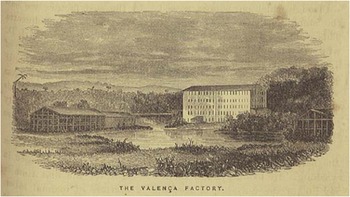
The working day began at sunrise and finished at 7:30 p.m., which during the summer meant more than fourteen hours a day. During this period, workers had twenty minutes for lunch, half an hour for dinner, and half an hour for supper. The main building in the Todos os Santos complex, where the textile factory was located, had five floors in which the different stages of production took place (Figure 2). In 1861, production was organised as follows. In the first room, cotton fibre was cleaned by six machines imported from the United States, capable of processing two thousand pounds of cotton a day. The second room was for carding and stretching, with sixty carding machines from the United States capable of producing 2,600 pounds of carded cotton a day, and twenty-two stretching machines. The third room was the spinning room, with ten spinning machines from England and twelve from the United States. These machines could produce 685 tons of yarns daily, part of which was prepared for sale, while the other part was sent to be woven. The last stages of production took place in the weaving room. Here, there were 135 looms and several sewing machines, used in the production of fabrics and bags.Footnote 60 The structuring of the different stages of textile production in different spaces, as well as the existence of other facilities in the factory complex, e.g., the metal foundry, indicates that there was a division of labour at Todos os Santos.
Todos os Santos factory, ca. 1850.

In addition to textile production, workers were submitted to a strict routine of extra activities, which made their working day even longer. On work days, until after 10 p.m., they received classes in reading, writing, music, and dancing. On Sundays and holy days, there was no work, and it is possible to believe that the workers could have some rest.Footnote 61
The workers also lived in lodgings within the complex. There is evidence that, initially, there was no separation by sex in these, but only by marital status. Unmarried men and women (or rather, boys and girls) lived in the same space, moving on to live separately when they got married.Footnote 62 At some point during the operation of the factory, there began to be a division of housing by sex for single workers. In 1879 there were two dwellings for free workers, separated by sex, and twelve more dwellings for married workers.Footnote 63 In this regard, it is worth noting that marriages between the factory workers were promoted by its owners, with celebrations taking place during the annual Todos os Santos anniversary celebrations.Footnote 64
As concluded by Friedrich Engels, especially in the case of factories installed in rural areas such as Todos os Santos, where there was little or no housing available for the workers, the construction of housing by the entrepreneurs around the factories was another way to obtain both profit (by charging rents) and control over the labour force, contributing to intensify the exploitation of workers.Footnote 65 The work of Tilman Frasch and Terry Wyke, in its turn, shows that workers’ villages put economic considerations above philanthropy and although there was a paternalistic concern, the aim was to provide housing for workers as cheaply as possible. Factory housing also helped to make workers more dependent on their bosses, since losing their jobs also meant losing their housing.Footnote 66
The remuneration for the work done in the factory was according to productivity, with the possibility of workers receiving a higher wage if they exceeded their daily task. Deducted from workers’ wages, costs related to the sustenance of the female workers were estimated at $500rs (five hundred réis) per day.Footnote 67 According to Francisco Gonçalves Martins, in 1849, some of them sought to do extra activities in order to earn more than they needed to sustain themselves, being able to receive more than 8$000rs (eight thousand réis, that is, less than one pound) per month for extra work.Footnote 68 Although Martins states that some female workers were able to obtain higher salaries through surplus production, it is possible to believe that this number was small. The known practices of employment of free workers at this time indicate that the strategies employed by the bosses were aimed at the indebtedness and subjection of the workers, not their independence.Footnote 69
The use of free labour, rather than enslavement, and the provision of wages, education, housing, and leisure activities appear in most of the records of people who were in the establishment and, as mentioned in the introduction of this paper, continue to be remembered to this day. These practices were seen as extremely modern and used in speeches to promote the humanitarian image of the establishment. However, as pointed out by the historiography, contrary to what was propagated, the employment of legally free labour in the Americas, as well as in other regions of the world, during the eighteenth and nineteenth centuries was not presented as radical opposition to enslaved labour. Indeed, free workers enjoyed a certain degree of autonomy and, in theory, had the choice of whether to enter into a labour relationship or contract, which doesn’t seem to have been the case for some of the young people sent to Todos os Santos. However, through social norms and labour contracts, they could be subject to a series of restrictions that created extremely precarious living and working conditions and limited their freedom.Footnote 70
When we look at the employment of unpaid minors, the long working hours, the housing in the workplace, the promotion of marriages among the workers, and the imposition of teaching and leisure activities, the routine imposed on the workers at Todos os Santos, although it certainly presented some advances for the standards of the period, reveals the intention to keep the workers under complete control and with full-time occupation, in what was structurally a slavery dynamic.
Enslaved Workers
Unlike the presence of free workers, the existence of enslaved people at Todos os Santos factory is mentioned only a few times in the records that survived and only indirectly. This reinforces the hypothesis that the factory owners, as well as visitors to the factory, intentionally emphasised the presence of legally free workers and the possible advantages that this could bring to the economy and the Bahian society, in detriment to the use of enslaved labour, which was scarce and was probably being reserved for agricultural production. Although rare, these records show that, contrary to what was widely and deliberately publicised, the factory employed both free and enslaved labour simultaneously.
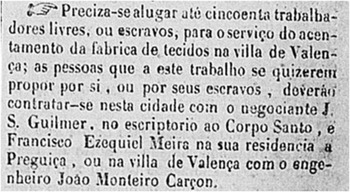
It is likely that from the beginning of the construction of the factory, free and enslaved men and women worked side by side. In 1845, an advertisement published in the newspaper O Mercantil in the city of Salvador announced the need for fifty workers, free or enslaved, to build the Todos os Santos factory (Figure 3).Footnote 71
Todos os Santos worker rental advertisement, 1845.

Despite this, the presence of enslaved workers at Todos os Santos was only made explicit in accounts of the time more than a decade later. In a publication first released in 1857, the American missionaries Daniel Kidder and James Fletcher stated that in the metal foundry of the Todos os Santos complex, where “the most intricate machinery” was manufactured, “the whole operation of modelling, moulding, and finishing, [was] performed by negroes.” According to them, the foundry also had as its foreman a “Brazilian negro.”Footnote 72 Although they were not explicit, further evidence, as presented below, indicates that these workers were enslaved. Kidder and Fletcher’s book was published in Brazil only in 1941, so one can speculate that this information was not widely circulated in Brazilian society.
The following year, the factory, which had been going through a period of instability, was put up for sale. Advertisements published in newspapers, besides describing machinery and the production capacity of the factory, listed fifty-nine enslaved people working in the factory as well as in its facilities, corroborating the information presented by Kidder and Fletcher (Figure 4).Footnote 73
Todos os Santos for sale advertisement, 1858.

In 1860 Antonio Pedrozo de Albuquerque acquired the other two partners’ shares and became sole owner of Todos os Santos. The document of sale contains information regarding fifty-four enslaved people present there at the time: forty-one men (Anacleto, André, Antonio, Caetano, Cesario, Eduardo, Fiel, Francisco, Herculano, Horacio, Isaac, Jacob, Januario, João, Jorge, José, José de Deus, Julião, Justino, Lazaro, Lourenço Lucas, Macario, Marcello, Marcollino, Marcos, Matheus, Miguel, Paulo, Pompeu, Raphael, Raymundo, Romão, Roque, Sabino Primeiro, Sabino Segundo, Salomão, Severiano, and Tito); eleven women (Anastasia, Antonia, Caetana, Catharina, Constance, Delfina, Justina, Lucrecia, Maria, Maria, and Victoria) and two children (Thereza and a baby of unspecified name, both daughters of Delfina).Footnote 74
The report of the National Exhibition held in Brazil in 1861, in which the Todos os Santos factory received a gold medal, indicated that the sixty enslaved people there were employed in field work.Footnote 75 Meanwhile, the sale advertisement of 1858, mentioned above, indicated that the enslaved workers performed activities in the factory and its facilities. In addition, in a visit to Todos os Santos in 1860, Emperor Dom Pedro II registered that in the mechanical workshops of the factory, moulders and foundry workers were enslaved.Footnote 76 Thus, it is likely that the work done by enslaved people included labour in fields—such as the agricultural production, which may be used to feed the workers—but was not limited to it. According to the 1872 census, of the total of 6,471 textile workers in Bahia, 929 (approximately 14 per cent) were enslaved.Footnote 77
The presence of enslaved labour in metallurgy was common in some production sites in Brazil in the period.Footnote 78 According to Mario Danieli Neto, this could be related to previous knowledge acquired in some regions of the African continent, where these activities had been developed for a long time.Footnote 79 With regard to the employment of enslaved labour in a textile complex in the country, although Stanley Stein’s pioneering work on the textile industry mentions the existence of enslaved workers at the Todos os Santos factory, this information has been undervalued in the history and historiography about the factory and the textile industry in the country.Footnote 80 One of the main pieces of research produced about the sector, conducted by Luiz Carlos Soares in relation to the south-east, states that fabric production was one of the few sectors of the industry to employ only free labour.Footnote 81
On 1 August 1876, Todos os Santos was closed and the legally free workers were fired. Three months later, in November, Antonio Pedrozo de Albuquerque authorised Augusto Frederico de Lacerda, former administrator of Todos os Santos and son of Antonio Francisco de Lacerda, to carry out an inventory of the property and manage the labour of the enslaved workers that remained there, whether in activities in the complex or by renting out their services.Footnote 82
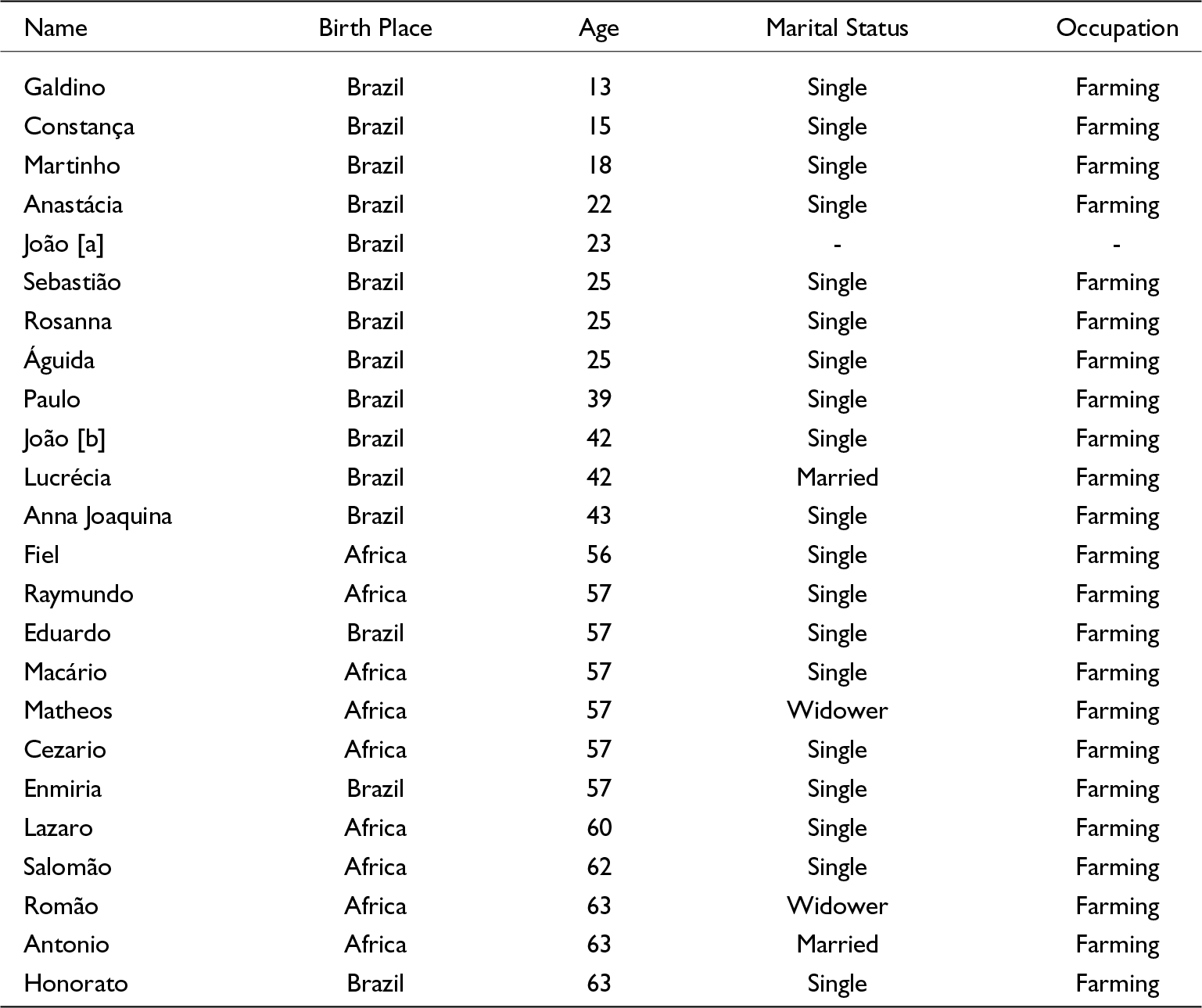
Two years later, in 1878, Antonio Pedrozo de Albuquerque died and the process of evaluation and division of his properties, including the factory, began. Todos os Santos underwent appraisal in 1879 and, at that time, twenty-four enslaved workers in the complex were evaluated. Although this is a small sample compared to the other information about the number of enslaved workers there, it is qualitatively richer and allows us to identify, among other things, place of birth, age, marital status, and occupation of these workers (Table 2).
Enslaved workers at the Todos os Santos complex in 1878–1879
Source: PASB, Judiciária, Inventários, 07/3191A/06, Antonio Pedroso de Albuquerque Inventory of Properties.
By comparing the names and ages of those listed in 1878-1879 to those recorded in 1860, it seems likely that some of them, such as Antonio, Cezario, Fiel, João [b], Lázaro, Lucrécia, Macario, Matheos, Paulo, Raymundo, Romão, and Salomão, had been present there since 1860. The smaller number, in comparison to the records found for previous years, is doubtless related to the closing of Todos os Santos in 1876, which may have led to the sale of some of the enslaved workers, especially those who had some special qualification, like those who worked in the foundry. In turn, it is likely that the remaining enslaved people were directed to work on the crops in the complex or on the property of other masters, through rental service.
An exception, João [a] did not have his marital status and occupation specified. Although he was one of the enslaved people at Todos os Santos when Pedrozo died in 1878, he was not at the factory when the other enslaved people were evaluated in 1879. According to Antonio Pedroso de Albuquerque Junior, Pedroso’s son and only heir, in 1878 João [a] was imprisoned in the house of correction, for having behaved inconveniently in the factory. Soon after Pedroso’s death, João [a] was sold by Pedroso JuniorFootnote 83. No further information was found about the reasons that led to João [a]’s detention. His supposedly inconvenient behaviour may indicate some form of resistance to the rules imposed on these enslaved.
Of the enslaved workers in the factory in 1878-1879, 70.8 per cent were male and 29.2 per cent were female. The predominance of males may be related to the preference of Bahian masters for these workers, due to the belief they were better workers than women,Footnote 84 but it is an aspect that still needs deeper analysis.
As to origin, 15 (62.5 per cent) were born in Brazil and 9 (37.5 per cent) were African. Even if the number of enslaved who were born in Brazil is higher than those born in Africa, the percentage of Africans among the enslaved workers existing in the factory was significantly high, especially if we consider that the transatlantic slave trade to Brazil had been totally forbidden since 1831, forty-eight years before Antonio Pedrozo de Albuquerque’s inventory was drawn up.
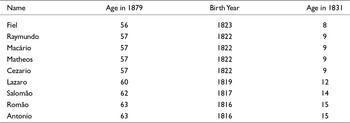
This data is also important because of the factory owners’ involvement in the illegal transatlantic slave trade to Brazil. By comparing the age of the Africans enslaved by the factory to the year in which they were evaluated in the inventory (1879), we can estimate their year of birth. We can therefore also estimate how old they would have been in 1831 when the transatlantic slave trade to Brazil was prohibited, and thus whether they may possibly have entered Brazil during the period of illegality (Table 3).Footnote 85
Estimates of the year of birth of African enslaved by the Todos os Santos in 1879 and their age in 1831

As can be seen, a priori it is possible to conclude that all the Africans enslaved by Todos os Santos in 1879 were of an age compatible with the period when the transatlantic slave trade to Brazil was legal, since the estimates indicate that they were born before 1831. However, it is necessary to take other aspects into consideration. First, some of the individuals enslaved by the factory, such as Fiel, Raymundo, Macario, Matheos, and Cezario, were very young in 1831. That is, although they were of an age compatible with the legal slave trade, it is possible that they were brought to Brazil during the period of illegality. This hypothesis is reinforced by recent studies about the illegal transatlantic slave trade to Brazil that point to the fact that a considerable number of enslaved Africans brought to Brazil during this period were children.Footnote 86 Furthermore, especially after the promulgation of Law no. 2,040 of 28 September 1871, which instituted the general registration of enslaved persons, many owners began to assign to the enslaved an age higher than they really were, trying to camouflage the fact that they came from the illegal transatlantic slave trade.Footnote 87 In this sense, it is noteworthy that Raymundo, Macario, Matheos, and Cezario are listed with the same age (57) and Fiel an age very close to the others (56), a possible indication that their ages may have been falsified.
Second, we should take into consideration the process of prohibition of the transatlantic slave trade to Brazil, which had been gradually taking effect since 1810. The law of 1815, which prohibited the slave trade north of the Equator, for example, significantly affected the slave trade to Bahia, which at the Gulf of Benin included one of the main regions for the purchase of enslaved Africans.Footnote 88 Despite the prohibition, some merchants continued to acquire captives in that region clandestinely. Antonio Pedrozo de Albuquerque himself undertook illegal slave-trading expeditions north of the Equator in the 1820s, such as those carried out by the vessels Príncipe de Guiné (1826), Vênus (1827), and Creoula (1827).Footnote 89
Finally, it is necessary to consider that the region where the factory was built was an important landing site for slave expeditions during the period of illegality.Footnote 90 Thus, this could make it more likely that the Africans enslaved by Todos os Santos were, actually, free men and women illegally enslaved. This is reinforced by the occurrence of baptisms of Africans in the oratory of the Todos os Santos factory, such as the baptism of Januário, which took place in 1852.Footnote 91 Baptism was one of the first important steps towards the inclusion of Africans into the sociocultural logics of the New World and usually took place in the port of arrival.Footnote 92 Baptised in 1852, Januário must have been brought to Brazil shortly before, therefore at a period when the slave trade was illegal.
Like baptism, the promotion of marriage among the enslaved workers was also a practice promoted by the Todos os Santos owners: 17.4 per cent of the enslaved people at the factory listed in Table 2 who had marital status informed were or had been married. Besides these, others, such as Caetano and Caetana who appear in the 1860 listing, were also married. On 10 November 1851, the couple baptised their fifteen-day-old daughter, Joana, in the Todos os Santos oratory.Footnote 93 Even though it was a practice that aimed to integrate the enslaved, African or not, within the Christian sociocultural logic and represented a form of domination, through baptism and marriage enslaved workers could create or strengthen kinship and sociability bonds, while also, at the factory, obtaining the advantage of being allowed to live in separate dwellings. According to the inventory of Antonio Pedrozo de Albuquerque in 1879, there were ten dwellings reserved for married enslaved couples in the factory, in addition to those for enslaved single people.Footnote 94
There are no records of what the routine was like for enslaved workers. It is possible that it was not so different from that of legally free workers: work from sunrise to sunset, with short breaks for food. Despite this separation between single and married people and between enslaved and free labourers in terms of housing, daily life and work probably blurred the boundaries between these individuals.
Concluding Remarks
At the beginning of the nineteenth century, society in Bahia, as well as in other parts of the world, was undergoing great transformations. On the one hand, there were measures to prohibit the transatlantic slave trade and, in parallel, the free and poor population was growing. In this context, institutions such as the Todos os Santos factory emerged, which although they maintained deep links with the slave system, sought to hide these links throughout their trajectory.
The article shows that from its foundation, a discourse was built around Todos os Santos as a pioneering workplace in Brazil for the exclusive use of free, waged labour. This discourse originated mainly from two fronts, the advertisements of the factory’s merchandise in newspapers and the reports produced by political authorities about the establishment. The abundance of records about the use of free labour at the Todos os Santos factory, to the detriment of information about the use of slave labour, perpetuated a narrative that the factory was a place with no ties to the slave system, that is, a place free of slavery. A causal relationship was soon established between the fact that the factory employed free labour and the fact that it was the largest textile industry in Brazil—helping to feed the thesis that industry and slavery were incompatible.
Beyond the facts that Todos os Santos founders were slave traders and that the company produced goods that subsidized the demands of the slave system, we sought to call attention to the very existence of enslaved workers at Todos os Santos, some of whom were probably brought to Brazil through the illegal transatlantic slave trade, after 1831. In addition, by analysing the profile of the free workers employed there, it is possible to see that some aspects of the distinction between legally free and enslaved workers are problematic and blurred, since we see children, orphans, women, working without pay, in exchange for housing, food and medical care; separated from family members; subjected to a long routine of work and extra activities, as well as being encouraged to marry on site.
Although the formal condition of freedom of these individuals cannot be ignored, neither can the extent to which their living and working conditions resembled those of enslaved labourers and were aligned with the dynamics and the demands of the slave system. In a context in which a number of companies and institutions around the world are recognizing their connections to the slave system and are working to adopt reparatory measures in this regard, we are led to reflect why the narrative of the Todos os Santos factory as a place free of slavery was constructed; to what extent historiography has contributed to the erasure of history and memory about the connections between slavery and industry in Brazil; and why this discourse is perpetuated and resists, in different spheres, to this day.
Acknowledgements
I would like to express my gratitude to Melina Teubner and Felix Brahm for the opportunity to participate in the Workshop Hidden Economies of Slavery, whose discussions contributed significantly to the development of this article, as well as for inviting me to contribute to this Issue. I also thank Edilson Nunes dos Santos Junior, along with Melina and Felix, for their careful reading and helpful comments on the original manuscript. Finally, I am grateful to the peer reviewers and proof-readers for their valuable suggestions to improve the text.
Funding statement
This research was partially funded by São Paulo Research Foundation (FAPESP), grant #2021/11054-0.




 Open access

