


Worldwide it is estimated that about two-thirds of the cerebrovascular disease burden and one-half of the coronary disease burden are attributable to non-optimal blood pressure levels(1). Blood pressure lowering based on dietary salt reduction has been identified as a potentially highly cost-effective means of CVD prevention(Reference Murray, Lauer, Hutubessy, Niessen, Tomijima, Rodgers, Lawes and Evans2). Salt substitutes with reduced sodium and added potassium lower blood pressure(Reference Cutler, Follmann and Allender3, Reference Whelton, He, Cutler, Brancati, Appel, Follmann and Klag4), but have been considered to have limited applicability in economically developed countries where most dietary salt comes from processed foods and cannot easily be replaced with a salt substitute at home. This is not the case in developing regions such as rural northern China where salt intake is high(Reference Tian, Guo, Hu, Yu, Sun, Pietinen and Nissinen5), most dietary salt comes from foods cooked at home and the blood pressure reductions achievable with a salt substitute may be large(Reference Nan, Tian, Shao, Hu, Dong, Pietinen and Nissinen6). The China Salt Substitute Study, which tested the effects of a commercially available salt substitute(Reference Karppanen, Tanskanen, Tuomilehto, Puska, Vuori, Jantti and Seppanen7) on blood pressure in high-risk rural northern Chinese populations, showed that a significant and sustained reduction in systolic blood pressure could be achieved(8). To support the widespread uptake of a salt substitute in the region, it is also necessary to have clear evidence about the effects of the intervention on food flavour since such sensory factors are a crucial determinant of food choices(Reference Eertmans, Baeyens and Van den Bergh9, Reference Drewnowski and Gomez-Carneros10). In the case of a salt substitute containing potassium, bitterness may be a barrier to food acceptability, at least initially(Reference Bartoshuk, Rifkin, Marks and Hooper11).
The China Salt Substitute Study included a specific assessment of the impact of the salt substitute on saltiness, flavour and overall acceptability of food flavour, and the results are reported here. Since a reduction in dietary sodium consumption might be expected to produce preferences for lower levels of salt in other foods(Reference Bertino, Beauchamp and Engelman12), assessments were made not only of the usual diet, but also of a standard salty soup administered at intervals throughout the study.
Methods
The design and results of the China Salt Substitute Study have been published(8). In brief, the study was a double-blind, randomised, controlled trial that demonstrated clear blood pressure-lowering effects of a reduced-sodium, high-potassium salt substitute among 608 individuals, at elevated risk of CVD, living in rural China. The study was carried out between May 2004 and August 2005 at thirty-nine sites distributed between six regional coordinating centres in northern China (Heilongjiang, Tianjin, Liaoning, Shanxi and two centres near Beijing). The trial received ethics approvals from the University of Sydney, Sydney, Australia and the Fu Wai Hospital, Beijing, People's Republic of China, and all the participants provided informed consent.
Participants
Individuals were eligible for the study if they had a high risk of future vascular disease based on a doctor's diagnosis of any of the following: (1) coronary, cerebral or peripheral vascular disease; (2) diabetes and aged 55 years or older; (3) a systolic blood pressure >160 mmHg. In addition, all the participants were required to have an estimated daily sodium intake of 260 mmol/d or more and an expectation that at least half of the dietary salt could be replaced with the study salt substitute/salt. This was estimated through an interview with the patient or the individual responsible for daily food preparation (if this was not the patient) using a structured questionnaire at the baseline visit. High-risk individuals were selected for the study as they are the population group likely to attain more benefit from blood pressure lowering. Finally, the participants were required to have no established clear indication for, or contraindication to, the use of the study salt substitute, such as the use of a potassium-sparing medication or significant renal impairment.
Randomisation
Randomisation (assignment of the participants to intervention or control as if by the toss of a coin) was done using a central computerised randomisation service accessed by centre physicians via the study website with a back-up phone and fax service. A computer program performed the randomisation with stratification within each centre by baseline systolic blood pressure (in three strata) and present use of antihypertensive therapy. The service was maintained by the Clinical Trials Research Unit at the University of Auckland, New Zealand. The randomisation service provided a unique number for each individual corresponding to a treatment pack held at the centre. Treatment allocation was blinded to study investigators, participants and centre physicians until the study database was locked.
Study treatment
Study treatment comprised a salt substitute for all the participants who entered the run-in period and either a salt substitute or a normal salt for those participants who were randomised. The salt substitute was 65 % sodium chloride, 25 % potassium chloride and 10 % magnesium sulphate. This formulation was commercially available in China and had been evaluated previously(Reference Karppanen, Tanskanen, Tuomilehto, Puska, Vuori, Jantti and Seppanen7). The normal salt was 100 % sodium chloride. Randomised treatment was delivered in identical 1 kg bags except for a three-digit code corresponding to the randomisation number, with up to 3 kg/month of salt substitute/salt available to each randomised participant to cover all cooking, pickling and other uses within the household. Correct packing and labelling of the study salt and the salt substitute was checked before the commencement of the study by testing the contents of a sample of randomised treatment packages. The participants were instructed to use the study salt for all food preparation throughout the study period. The post-randomisation use of the salt substitute/salt was determined at each visit by asking the study participants what proportion of the household salt used since the last visit, which was provided by the study, and recording a response of ‘all’, ‘nearly all’, ‘half’, ‘less than half’ or ‘none’.
Data collection
Potentially eligible individuals attended a registration visit with the physician at the centre and consent was obtained, a baseline questionnaire was completed, a brief physical examination was performed and a blood sample was collected. Individuals willing to be long-term participants in the trial were entered into the active run-in period and instructed to return for a final eligibility check 4 weeks later. Eligible participants who attended the next scheduled visit were randomised. Food taste data were collected at registration, 1, 6 and 12 months post-randomisation visits. All data were collected on paper forms and then sent to Beijing and entered into a password-protected study website.
Outcome assessments
Three aspects of the taste of home-cooked foods and a standard salty soup(Reference Girgis, Neal, Prescott, Prendergast, Dumbrell, Turner and Woodward13) were recorded using 100 mm visual analogue scales to document saltiness (from the left end marked ‘not at all salty’ to the right end marked ‘very salty’), flavour (from the left end marked ‘very weak’ to the right end marked ‘very strong’) and overall acceptability (from the left end marked ‘dislike extremely’ to the right end marked ‘like extremely’). For the assessment of home-cooked foods, the participants were asked to think about the usual taste of the food that they had eaten in the last month, and specifically about their opinion as to the saltiness, flavour and overall acceptability of their usual food. They were then asked to mark a horizontal visual analogue scale with a vertical line indicating how they think their usual food tasted in regard to each of the three aspects. The distance from the left end of the scale to the vertical line was measured using a ruler and recorded in millimetres. The results for saltiness, flavour and overall acceptability were collected on three separate scales on the same form at each visit. Assessment at follow-up visits was done in an identical manner, with participants blind to their previous results and their randomised allocation.
The same three components of taste were recorded at the same time points for a standard salty soup in an effort to define any change in the preferred level of saltiness over time. The soup provided was a commercially available dried soup mix product purchased in China. For each evaluation, one pack of the dried soup mix was added to a pan and mixed with 500 ml of hot water (60–70°C). The soup was then poured into small paper cups and when it had cooled to an acceptable temperature, the participants were asked to take a mouthful of the soup, to taste it and to swallow it. Their opinions as to the saltiness, flavour and overall acceptability of the soup mix were then recorded on the visual analogue scales. Aside from the provision of the soup, the data collection process was identical to that used for the assessment of home-cooked foods.
Statistics
Statistical analyses were carried out using the SAS for Windows, version 9.1. Mean levels (standard deviations) and proportions (standard errors) were calculated for baseline and follow-up characteristics. The analysis of treatment effects was by intention to treat with between-group comparisons for the outcomes of interest made using SAS Proc Mixed to fit mixed linear models for repeated-measures ANOVA. In the primary analyses, the registration visit and all of the follow-up measures for each of the outcomes were included in the mixed models with an overall estimate of effect, a CI and a P value calculated. The secondary analysis on the overall estimate of effect was conducted with the weighting of each of the data points according to the lengths of the respective follow-up intervals to which the data point applied. The length of the follow-up interval was defined as the period between the present and previous assessment of taste; for example, the weight score of 6 was used for the final 12-month assessment, which was deemed to apply to the 6-month period between the 6-month and the 12-month visit. Possible changing effects of the randomised intervention over time were explored by fitting a visit by the treatment interaction term on the Proc Mixed model. A P value less than 0·05 for the interaction term indicated evidence of a linear decreasing or increasing trend of the effect of the treatment over time. Since missing data were few (less than 5 % for all analyses), no imputation procedures were undertaken. The comparison of adherence to the salt substitute/salt between the randomised groups was conducted using SAS Proc Genmod for generalised estimation equations(Reference Woodward14).
Results
There were 752 participants who registered for the study; 700 (93 %) who commenced run-in and 608 (81 %) who were randomised. The main reason for run-in participants failing to proceed to randomisation was reluctance to continue with the follow-up schedule (n 57). The participants who were randomised reported very good adherence to the study salt substitute/salt, with 99 % indicating that they used the study salt substitute/salt for ‘all’ or ‘nearly all’ of their day-to-day food preparation with no difference between the randomised groups (P = 0·40). Completeness of follow-up was also very high, with the final follow-up visit attended by 96 % of the randomised participants and overall 98 % of all post-randomisation visits completed as scheduled.
The mean age of the randomised participants was 60 years and 56 % of them were females (Table 1). About two-thirds had a baseline history of vascular disease and one-sixth were included on the basis of a diagnosis of diabetes and an age of 55 years or older (Table 1).
Characteristics of the study participants by the randomised groups*

* Number (per cent) unless otherwise indicated.
Baseline mean ratings for saltiness, flavour and overall acceptability for the home-prepared food were directly comparable between the randomised groups (Table 1). The same was also true for the ratings of the standard salty soup. During the follow-up, there were small variations in the ratings assigned to both home-prepared foods and the standard salty soup for each of the three parameters assessed, but the mean values in each randomised group fluctuated by just a few millimetres on the 100 mm scales used (Fig. 1). In general, about three-quarters of individual responses were within 10 mm above or below the mean response for each assessment. For the primary analyses, there were no detectable differences in the ratings between the randomised groups for saltiness, flavour or overall acceptability. This was true for both home-cooked foods and the standard soup (all P>0·08; Table 2). After weighting each of the data points according to the lengths of the respective follow-up intervals, the flavour of both home-cooked foods (mean difference = − 1·8 mm, P = 0·045) and the standard salty soup (mean difference = − 1·9 mm, P = 0·03) was found to be weaker in the salt substitute group (Table 2).
Mean ratings of taste by the randomised groups and follow-up visits (mm) for (a) usual home-prepared foods and (b) a standard salty soup: salt ( ); salt substitute (
 ); Reg, registration. ‘P for trend’ indicates the probability that there is a progressively increasing or decreasing difference between the randomised groups in the ratings over time.

(Mean differences and 95% confidence intervals)

* Negative value means the rating of the salt substitute group was lower than the normal salt group.
† The weighted method was a post hoc analysis on the overall estimate of effect, which was conducted with the weighting of each of the data points according to the lengths of the respective follow-up intervals.
Further exploration of the data showed that none of the individual baseline to follow-up differences in saltiness, flavour or overall acceptability between the randomised groups at separate time points were statistically significant for the evaluations of home-prepared foods (all P>0·05). For the same assessments of the standard salty soup, there was a significant difference between the baseline and the 12-month follow-up only for the perception of flavour that was rated higher in those assigned to the normal salt group (P = 0·011; Table 3). An additional trend analysis suggested that the flavour of the standard salty soup was progressively more favourably perceived in the normal salt group over time (P = 0·03), although there was no corresponding finding for the flavour of home-prepared foods (P = 0·2; Fig. 1).
Baseline to follow-up differences in ratings of saltiness, flavour and acceptability between the randomised groups for home-cooked foods and the standard salty soup at each follow-up assessment (mm)
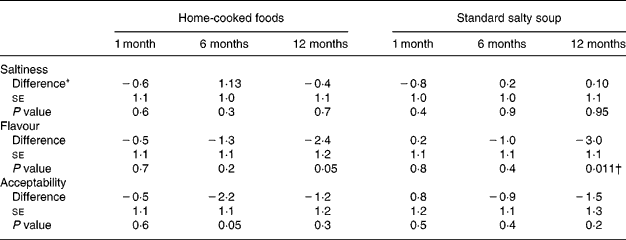
* Difference is the baseline to follow-up differences in ratings between the randomised groups (a negative value means the rating of the salt substitute group was lower than the normal salt group).
† P value < 0·05.
Discussion
The China Salt Substitute Study has shown that replacing usual salt with a salt substitute in rural northern Chinese populations can bring about important reductions in blood pressure without producing a substantial adverse effect on the saltiness, flavour or overall acceptability of food. While the secondary weighted analyses did identify slightly impaired perception of flavour in the salt substitute group, the overall acceptability of food cooked with the salt substitute was not influenced and the vast majority of the participants continued to use the salt substitute throughout the study. This evidence of acceptability of the salt substitute is an important finding for public health because problems with taste are a widely cited reason for not using potassium-based salt substitutes that achieve blood pressure lowering through both the removal of sodium(Reference Cutler, Follmann and Allender3) and the addition of potassium(Reference Whelton, He, Cutler, Brancati, Appel, Follmann and Klag4). These data provide significant support to the notion that advocating widespread use of this type of salt substitute for food preparation in northern China might be widely acceptable among the population.
There is previous evidence indicating that people are able to detect a difference when the taste of a usual food changes and that if the new stimulus added to the taste is unpleasant it will lead to disliking of the food(Reference Koster, Prescott and Koster15). Furthermore, this has been demonstrated even when the test of food taste and liking is done retrospectively(Reference Koster, Prescott and Koster15). It is therefore unlikely that the failure of the present study to detect substantial changes in the saltiness or overall acceptability of food reflects a failure of the study participants to identify or report differences that were present. Likewise, the large size of the study and substantial statistical power to detect even small differences between groups makes it unlikely that the study failed to detect real differences in taste perception. There are, however, several possible reasons why changes in saltiness and acceptability of foods might have been minimal. First, reductions in saltiness of food consequent upon reduced sodium chloride content were likely offset by the addition of potassium chloride because potassium chloride also imparts a salty flavour(Reference Rosett, Wu, Schmidt, Ennis and Klein16). Second, previous studies suggest that the reduction in saltiness caused by reducing sodium to the extent achievable with a salt substitute of this composition would have been only small to moderate(Reference Girgis, Neal, Prescott, Prendergast, Dumbrell, Turner and Woodward13, Reference Adams, Maller and Cardello17). Third, it is possible that other aspects of the food flavour such as umami (savoury taste) and odour were more important to taste than the saltiness component studied here. It is also known that any bitter taste caused by the potassium added at this level of substitution would have been small and would not impact greatly on the overall acceptability of salt substitutes(Reference Karppanen, Tanskanen, Tuomilehto, Puska, Vuori, Jantti and Seppanen7). Indeed, previous short-term studies of salt substitutes with this composition have shown that this combination of sodium, potassium and magnesium salts is well tolerated(Reference Karppanen, Tanskanen, Tuomilehto, Puska, Vuori, Jantti and Seppanen7, Reference Gelejinske18), and this particular mix of sodium chloride, potassium chloride and magnesium sulphate has been widely marketed as a consequence.
The study provided some evidence of adverse changes in flavour, although this was apparent only in the secondary analyses. The magnitude of the observed effect was fairly small, being about 2 mm against a background spread of taste assessments in which three-quarters of the participants marked a response 10 mm above or below the mean. Perhaps more important from a public health perspective, any adverse effect on flavour caused by the salt substitute did not translate into changes in saltiness or overall acceptability of home-cooked foods.
The absence of any significant changes in the saltiness of the standard salty soup administered during the follow-up visits indicates that there was no significant resetting of individuals' taste sensitivity to salt. The individuals' preferred level of saltiness appears to be largely learned and to depend primarily upon the average level of salt consumed over the preceding few weeks. Foods with a saltiness that differs substantially from a person's usual level of exposure are likely to be less preferred whether they be more or less salty(Reference Beauchamp and Engelman19). In the present study, the individuals assigned the salt substitute would have consumed on average about one-third less sodium chloride during the 12 months of the study. As such, it might have been anticipated that these individuals would have experienced a lowering in their preferred level of saltiness and that this would have been reflected in their reporting of the taste of the standard soup. The reason why there was no detectable resetting of the preferred level of saltiness is not clear. It is possible that the potassium chloride with which the sodium chloride was replaced in some way compensated for the reduction in sodium chloride, but in the absence of a clear scientific understanding of the basis for human salt taste it is difficult to be certain. There was evidence that as few as three exposures to an initially disliked salt level in a food can significantly increase the liking while the previously preferred salt level remains unchanged, indicating the possibility of a mere exposure explanation for the changes in liking(Reference Prescott and Khu20).
Key strengths of the present study are the randomised design, the large sample size and the rural community setting that helped minimise both systematic and random errors while ensuring that the result has direct applicability to large Chinese populations. One limitation of the pragmatic design was that it limited the extent of the sensory testing that could be done. So, while the study provides information about the acceptability of the salt substitute that is of direct clinical and public health applicability, it does not provide a good insight into the physiological reasons why the observed results were achieved.
In conclusion, these data show that the acceptability of salt substitution as a strategy for blood pressure control is unlikely to be importantly impacted by adverse effects of the salt substitute on food taste. If other practical aspects of making salt substitution feasible in rural China can be overcome, then it would seem that it is a strategy that would be widely acceptable and very effective. On the basis of the blood pressure-lowering effects achieved, this strategy would appear to have the potential to reduce vascular disease in China by one-fifth(8) at a low cost and in a short time frame(Reference Murray, Lauer, Hutubessy, Niessen, Tomijima, Rodgers, Lawes and Evans2).
Acknowledgements
China Salt Substitute Study Collaborative Group: China, Tianjin, Cardiovascular Disease Research Institute, Hospital of People's Armed Police Forces: Yuming Li, Junxiang Liu, Donglin Song; Liaoning, Department of Clinical Epidemiology, The First Affiliated Hospital of China Medical University: Jingpu Shi, Hailong Wang, Yongqing Yang; Heilongjiang, Mudanjiang Centre for Disease Control and Prevention (The Institute for Medical Science): Jianmin Li, Yanling Zhang; Shanxi, The People's Hospital of Yu Xian: Dongshuang Guo, Shengyin Liang; Beijing, The Community Health Service Center of Yinghai, Daxing District: Jianhua Qi, Rujun Pan; The Community Health Service Center of Fengbo, Shunyi District: Bing Li, Zhigang Yang; Cardiovascular Institute and Fu Wai Hospital: Y. W., X. Y., L. Z., Bailing Chen, Beifan Zhou, Jihong Hu; The George Institute for International Health – China: Rong Han. Australia Sydney, The George Institute for International Health of the University of Sydney: N. L., B. N., F. B., Rachel Huxley, Kathy Jane, Suzanne Ryan; Ourimbah, School of Psychology, University of Newcastle: J. P. New Zealand, Auckland, Clinical Trial Research Unit of The University of Auckland: Anthony Rodgers, Carlene Lawes, Michelle Barlow, John Fa'atui, Amanda Milne, Colleen Ng, Simon Pink, Barry Gray.
The present study received financial support from The George Institute for International Health (Australia), The Clinical Trials Research Unit (New Zealand), The Capital Medical Science Development Fund (China) and the National Health and Medical Research Council of Australia (Grant ID: 358395). Personnel support was provided to N. L. as a scholarship from the National Health and Medical Research Council of Australia and to B. N. as a career development award from the National Heart Foundation of Australia. None of the collaborative group has any conflict to declare in regard to the present work.
The study was designed by B. N., Y. W. and L. Z. with input from J. P. Conduct of the project in China was under the control of Y. W., X. Y. and L. Z. with technical support from Australia and New Zealand provided by N. L. and B. N. Statistical analysis was done by F. B. and N. L. The initial draft of the paper was prepared by N. L., B. N. and J. P., with subsequent comments from all authors incorporated in the final report.



