




Introduction
Artefacts (belongings) and human remains (human ancestors) are embodiments of holistic spiritual, sociocultural, economic, and intellectual systems and exchanges that are specific to a community or society.Footnote 1 This means that the pillage of belongings and human ancestors, especially as enabled by the colonial project, was both an unsanctioned destruction and removal of materials from their communities/societies and lands of origin, and a rupture of the taxonomies, meaning-making frameworks, practices of care, and protocols of use that surrounded them.Footnote 2 The realm of cultural property rights has, for the longest time, been a frustratingly limited and limiting avenue through which communities and societies of origin can seek holistic redress, because this system of ownership and control engages with belongings and human ancestors as objects of (il)legal transactions between natural and/or legal persons.Footnote 3 As a result, the rights and responsibilities attached to cultural property fail to account for the full spectrum of violent destruction and irrevocable loss that accompanied the removal of cultural heritage(s) from their land(s) of origin.Footnote 4
In this article we argue that re-viewing restitution, and the Western legal concepts that underpin this process, through an Indigenous knowledge systems (IKS) lens surfaces the extent of harm and loss from the vantage point of communities and societies of origin and invites a more robust and nuanced framing of the restitutionary work that needs to be undertaken to realize meaningful reconciliation and restoration. Here we define IKS as an analytical frame for seeing the interconnectedness and interrelatedness of all beings to each other and to the landFootnote 5 and as the modes and systems that a community or society uses to create, express, and transfer the intangible significance of material heritage.Footnote 6
We begin with a meditation on the metamorphosis of meaning that “cultural property,” “ownership,” and “return” undergo when observed through an IKS lens, by way of a close reading of four texts that unpack these differences. In so doing we bring to the fore the holistically conceived framework for restitution that has shaped Open Restitution Africa’s exploratory case studies of the restitution process from the perspective and experience of Africans. Then, through two of our case studies, located in Bamendou, West Cameroon and Namibia, we demonstrate how interpreting cultural property, ownership, and return through this lens imbues communities and societies of origin with agency in defining what meaningful reconciliation and restoration looks like to them. Lastly, through a visual comparison of the stakeholders and partner institutions that participated in these two restitution journeys, we highlight how this approach, which we have termed agential restitution,Footnote 7 catalyzes deep procedural reconfiguration – who is involved in facilitating restitutionary work being just one aspect. We conclude with the lesson that Indigenous communities and African societies can participate in agential restitution of their cultural heritage (cultural property) by turning to IKS to determine the holistic value of belongings and human ancestors to them, to identify the pathways that allow them to fully experience that value, and to map the routes of rights and responsibilities in reconnection, repair, reconciliation, and restoration that will move them closer toward that.
A future point of consideration is whether official frameworks have the capacity to hold the dynamism that agential restitution introduces – this being that each community or society of origin would have the capacity to frame and steward their process/es of reconnection, repair, reconciliation, and restoration following a harm or loss. In addition, how can framework developers, such as governments, policymakers, and heritage practitioners, look to IKS to empower communities of origin to realize restitution on their own terms?
A meditation on the meaning of “cultural property,” “ownership,” and “return” for Indigenous communities and African societies
In this section we unpack how IKS – as both a way of seeing and community-specific modes and systems that hold and transmit knowledge about the intangible significance of material heritage – reframe the meaning of “cultural property,” “ownership,” and “return,” and in turn enrich the possibilities of Indigenous communities and African societies’ agency and control over their cultural heritage. We acknowledge here that the application of this lens is somewhat opaque for African societies because of disappeared and dispersed communities of origin,Footnote 8 the often firm adoption of Westernized cultural identities,Footnote 9 and the embeddedness of African nation states in the logistical processes of return.Footnote 10 Nonetheless, where the content of IKSs wanes, the robust and holistic praxis of restitution subsists and functions, as an IKS lens would, to trouble, disrupt, and reframe these terms.Footnote 11
The closely read texts that are featured in this section were selected first for their holistic view of cultural property and their sustained engagement with the bi-directional influence of terminology on practice and practice on terminology. Second, they have been chosen as a purposeful curation of multiple perspectives, offering insights from Indigenous communities in Australia and North America, as well as Africans on the continent and in the diaspora. Last, they have been spotlighted as discursive contributions that coincide with critical moments of intervention or debates in restitution.Footnote 12 The value of reading closely and interpretively, as a pivot away from the exercise of “happily recognizing that [we all] hold the same opinions”Footnote 13 is also resonantly acknowledged.
In 1998 Terri Janke, a Wuthathi, Yadhaigana, and Meriam woman and a nationally and internationally recognized expert on Indigenous cultural and intellectual property, produced a commissioned report titled Our Culture: Our Future – Report on Australian Indigenous Cultural and Intellectual Property Rights. This report sought to identify shortfalls in Australia’s cultural and intellectual property laws and offer recommendations about how these may be addressed to better support Indigenous communities in protecting and realizing their various vested interests in their intellectual and cultural heritage.Footnote 14 Early in the report, she draws a distinction between cultural heritage and cultural property. She first highlights the unique nature and characteristics of Indigenous cultural heritage as “collectively owned” and held in trust by a selected group of custodians or caretakers on behalf of the rest of the clan, holistic, living, and consistently evolving in relation to the generation that inherits itFootnote 15. She further notes that Indigenous cultural heritage is a means of transmitting knowledge about the land, history, kinship, religion and the means of survival,” and that these knowledges “are imparted at specific times and in an organized and managed way” through selected custodians, practices, and ceremoniesFootnote 16. She also draws attention to the disruption that was caused to this relational system of knowing and being in the world, through colonial destruction and/or removal of tangible materialization and intangible manifestations of Indigenous communities’ culture, and how oft it is this which Indigenous communities seek to restore.Footnote 17 Janke groups these Indigenous communities’ entitlements to preserve, maintain, and restore their own existing relation with and through culture and cultural heritage as “Indigenous Heritage Rights.”Footnote 18
On the other hand, she refers to cultural property as a field of negotiation that arises at the intersection of Indigenous communities’ culture and cultural heritage and the marketplace.Footnote 19 This involves Indigenous communities leveraging the same mechanism that Western societies have utilized – namely intellectual and cultural property rights – to assert ownership, control, and protection over tangible materializations and intangible manifestations of their culture and cultural heritage, and the remuneration that flows from other people’s use thereof. In making this distinction, Janke states that an Indigenous community’s assertion of intellectual and cultural property rights, to deter continued exploitation of their culture and cultural heritage, should not replace, diminish, or negate “other Indigenous rights and interests.”Footnote 20 This suggests that cultural property and the rights that accrue thereto are in fact a fraction of what Indigenous communities must consider in preserving, maintaining, restoring, protecting, and controlling their cultural heritage. Janke goes on to list a robust set of rights that Australian legal and policy frameworks would need to consider to allow Indigenous communities to direct the acknowledgement of origin, access to, interpretation and use of, management, development, and sustainability of their intellectual and cultural heritage.Footnote 21 Here, she outlines a system of ownership that extends beyond controlling the use of cultural heritage in the marketplace, and she contemplates a framing that returns agency to Indigenous communities in determining how their cultural heritage holistically participates in their immediate surrounding territory and the world. In her final recommendations Janke notes that a guiding evaluative barometer for legislative and policy frameworks that account for Indigenous communities’ rights as owners of their cultural heritage should ideally be whether Indigenous communities have “autonomy to develop — within the various local, regional and national power structures — mechanisms which maintain and strengthen their cultures and ensure that they have something to pass on to future generations for the benefit of all Australians.”Footnote 22 This formulation of what is ultimately being returned to Indigenous communities is more in-depth than return as an act of legal ownership transfer, control of use in the marketplace, and possession.
In 2006, at a time when African demands for repatriation of stolen belongings were increasingly being visibilized on a global stage,Footnote 23 Prof. Kwame Anthony Appiah, an ethicist, author, lecturer, and New York Times columnist of mixed Ghanaian (Asante) and English ethnicity, residing in the United States, published Cosmopolitanism: Ethics in a World of Strangers. In the chapter Whose Culture Is It, Anyway? Footnote 24 he grapples with the logics and logistics of repatriation - in this instance being the transfer of ownership and physical return of belongings and human ancestors to African nation statesFootnote 25 – and in the process puts forth a similar distinction to Terry Janke, albeit by using the terminology “cultural patrimony” and “cultural property.”
Cultural patrimony, he states, is “the product of a culture: the group from whose conventions the object derives its significance … [where] the objects are understood to belong to a particular group, heirs to a trans-historical identity, whose patrimony they are.”Footnote 26 Appiah decries the idea that cultural patrimony should serve as the motivation for repatriation, on the basis that this approach trumps the value and enrichment that all humankind could derive from engaging with a community’s cultural patrimony in spaces that are, according to him, adequately equipped to make material heritage accessible to everyone.Footnote 27 However, he does acknowledge two things. The first is that the connection a community member experiences to their cultural patrimony differs from an outsider’s experience of that cultural patrimony as an artefact, because it is fueled by identity and an engagement with “a world of meaning created by their ancestors.”Footnote 28 The second is that “if an object is central to the cultural or religious life of the members of a community, there is a human reason for it to find its place back with them.”’Footnote 29
In reflecting on the use of legal instruments to facilitate this process of reconnection and restoration of cultural patrimony to communities of origin, Appiah cast doubt on the realm of cultural property as a productive space for this exercise. He argues that the capitalist logics that underpin property rights will inevitably lead to “a cultural landscape consisting of Disney Inc. and the Coca-Cola company, for sure, but also of Ashanti Inc., Navajo Inc., Norway Inc.: All Rights Reserved.”Footnote 30 He further argues that communities of origin will become embroiled in the exhausting labor of “making countless mine-and-thine distinctions” to police and control the use of tangible materializations and intangible manifestations of their culture and cultural patrimony.Footnote 31 Here Appiah offers a hyperbolic picture of the limitations of legal approaches in matters of restitution to advance his broader argument against what he feels is the overly cumbersome pursuit of repatriation. However, his critique of the possibilities of ownership that are realized through framing cultural patrimony as cultural property are valid, in that this approach does not straightforwardly offer reconnection with an ancestral worldview or guarantee restoration of cultural patrimony to its place within a community.
In 2022, Robin R. Gray, an anthropologist, Indigenous studies scholar, and Ts’msyen from Lax Kw’alaams who belongs to Waap Liyaa’mlaxha, a Gisbutwada House in the Gitaxangiik Tribe, initiated a still ongoing process of rematriation. This concept/term’s meaning is multilayered and evolves in definition based on the context in which it is used.Footnote 32 At its inception it spoke to the restoration of Indigenous women’s position, power, productivity, and sorority, and men’s responsibility to matriarchal authority, through the restoration of Indigenous matrilineal systems that embedded this respect.Footnote 33 Gray argues that this conception of return is inherently and diametrically opposed to patriarchy, colonialism, and repatriation, as the latter further encodes “Euro-Western ideas about nationhood, personhood, property, and ownership … the ‘possessive logics’ that underpin ‘patriarchal white sovereignty’” and the manner in which it forces Indigenous peoples and African societies to continue imagining the futures of their cultural heritage within this realm.Footnote 34 Rematriation has also been adopted across various marginalized groups, and has also come to speak to the restoration of Indigenous people’s sacred relationships to land, culture, and practices, and more popularly and generally to the restoration of humanity’s connection to the sacred Mother, and Mother Earth.Footnote 35 In her work, Gray acknowledges that this is a multilayered term still to be singularly defined and theorized in academia, and she defines it, in mobilized mode, as an “embodied praxis of recovery and return” rooted in the “Indigenous feminist paradigm” with decolonial aims.Footnote 36 Her rematriation work is specifically centered around Laura Boulton’s collection of Ts’msyen cultural heritage (in the form of recordings of songs and oral histories) held at the Center for Ethnomusicology at Columbia University. In her publication, Rematriation: Ts’msyen Law, Rights of Relationality, and Protocols of Return Footnote 37 Gray unpacks how an IKS lens affects the rights and responsibilities attached to ownership and return, based on her involvement in this reclamation work, and in turn how the term “cultural property” limits what is considered or can be realized.
She begins by highlighting that the decolonial aims of rematriation are articulated and embodied through “revitalising the relationship between Indigenous lands, heritage and bodies based on Indigenous values and ways of knowing, being and doing.”Footnote 38 This approach to reclamation work requires an active and intentional refusal or “turn away” from patriarchal colonial or settler ordering systems and a place-based resurgence or “turn toward Indigenous nationhood” that centers the notion of relationality,Footnote 39which underpins Indigenous peoples’ engagement in and with the worldFootnote 40. For Gray, this meant identifying the house, clan, tribe, nation, and land to whom she belongs, and referring to the Ayaawx (the values and spirit of law that is taught through actions and governs what one does or is responsible for as a member of the Ts’msyen Nation) to determine how ownership and return are governed. Through examples of the how Ts’msyen cultural heritage (namely song, dance, and Chilkat weaving) is communicated to the chosen maker, received into the nation, used and circulated among the nation, and used and circulated to other Indigenous peoples, Gray maps a system of ownership, access, and control that is rooted in what she terms “rights of relationality.”Footnote 41 The protocols that are observed when a person or people engages with a tangible materialization or intangible manifestation of cultural heritage signals how that person or people is connected or related to the land and people from whom the cultural heritage originated – that is, what their right/s of relationality are.Footnote 42 What is made visible through one’s protocols of use of cultural heritage is the series of spiritual, environmental, political, and social negotiations and agreements that a people or a nation has entered – over space and time, within and outside of their immediate territory – to ensure the protection and prosperity of their land.Footnote 43 This differs greatly from the language of possession, profit, and policing that is put forth by the Western paradigm of cultural property.
In instances where cultural heritage has been “disinterred, stolen, misappropriated and captured” – in effect bypassing the rights of relationality and violating the responsibilities of relationality – Gray argues that the logics of protocols still apply, albeit drawn from the community-centeredness of IKS.Footnote 44 When Gray first engaged with Columbia University, she had to request access to her own cultural heritage, to which the director of the center acquiesced through digital copies.Footnote 45 The digital recordings were returned first to the tribe of origin in Lax Kw’alaams, where an open-to-all listening gathering was coordinated, according to Ts’msyen oratory protocols, to offer collective access to the songs and oral traditions.Footnote 46 In this listening session, and two others that were held in key Ts’msyen territories, nation members were invited to reconnect, to question, to emote, and to articulate “imagined possibilities of return.”Footnote 47 As barriers to reconnection and reclamation emerged over the years, interventions from within the community, directed by Ayaawx (Ts’msyen values and spirit of law), were devised to address these barriers, which have in turn led to intergenerational reconnection to Ts’msyen cultural heritage – including to language and to fragmented knowledges.Footnote 48 Through a “decolonial, community-based, participatory, collaborative, action-oriented, resurgent and emancipatory” research approach, which has intimately merged with “the recovery, revival, and reconstitution” process, Ts’msyen Nation members have been able to “engender aural resuscitation: the act of breathing life back into [their] captured sonic heritage through place-based listening practices.”Footnote 49
Ironically, the barrier to this rematriation journey that persists outside of the Ts’msyen Nation is rooted in the property rights Columbia University has over the recordings of songs and oral histories, which they are resistant to relinquish, in turn allowing them to continue circulating Ts’msyen cultural heritage in violation of Ts’msyen rights and responsibilities of relationality.Footnote 50 What becomes evident here is that rematriation does not require former colonizers’ or settlers’ laws to organize or dictate the processes or protocols of return. Rather it requires them to also participate in a refusal (turning away) from their systems of governance that enabled, and continue to enable, them to be in possession and control of cultural heritage that is not their own.Footnote 51 It further requires them to support resurgence (turning toward) of Indigenous values and spirits of law by acknowledging their violation of rights and responsibilities of relationality and acting in accordance with the protocols of the communities or societies of origin to remedy this.Footnote 52
South African historian and heritage and museums expert Prof. Ciraj Rassool and biological anthropologist Dr. Victoria E. Gibbon share a similar perspective in their paper titled “Restitution Versus Repatriation: Terminology and Concepts Matter,”Footnote 53 which was published in 2024. In their article they analyze the fault lines of terminology that determine the objective and approach to return that is adopted, and what is (or is not) experienced through the return of cultural property.Footnote 54. In their piece, repatriation – as it has been experienced on the continent – is located within the parameters of cultural property rights and is described as “government transactions involving return across international borders … to the country of origin.”’Footnote 55 This approach, as it has been applied in South Africa, decenters communities of origin and centers the meaning and value of cultural property to the giving or receiving state. It focuses on the “legal, administrative, and logistical matters of returning [cultural property]” and envisions return as the act of reinserting cultural property into a local state governed institution – usually a museum.Footnote 56 They juxtapose this with restitution, which sits within the possibilities of restorative justice and is described as “a process of reconciliation and restoration of something taken, stolen or lost.”Footnote 57 This approach de-objectifies cultural heritage and centers the “restoration or return of power, authority and voice” to the group that has experienced the dispossession, theft, or loss. It seeks to redress “direct and indirect harms” through “acknowledgement, reconciliation, reconnection and forms of closure.” It is stewarded by a “representational care group” composed of community, local, national, and international actors, who undertake “varied combinations of [social], diplomatic, political, and administrative work.” It is realized through linking return to “other social processes of healing such as the work of reparation or repair,” and facilitating return to the proper owner or owner group’s site of choice – covering the full range of possibilities from a national institution to the land of the community of origin.Footnote 58
The description of restitution outlined by Rassool and Gibbon captures an embryonic praxis of restitution at varying levels of development in AfricaFootnote 59 that strives to mirror the holistic view constructed by IKS and the decolonial aims of rematriation, as outlined by Gray.Footnote 60 Where IKS interprets cultural property as embodiments of Indigenous peoples’ connection to their land and the other living and spiritual beings who share the land,Footnote 61 this African praxis of restitution simultaneously interprets cultural property as “painful embodied memories for affected communities and societies” and “embodied pathways to new futures.”Footnote 62 Where rematriation contemplates the governance of ownership through a system of rights and responsibilities of relationality,Footnote 63 this African praxis of restitution contemplates the governance of ownership through a system of rights and responsibilities of reconnection and repair.Footnote 64 Where rematriation insists on processes and protocols of return that are defined and refined by “place-based resurgence and refusal,”Footnote 65 this African praxis of restitution insists on processes and protocols of return that are defined and refined by place-based reconciliation and restoration.Footnote 66
Janke,Footnote 67 Appiah,Footnote 68 Gray,Footnote 69 and Rassool and GibbonFootnote 70 write from different times, different contexts, and toward differing ends. However, what continuously pulsates in and through these works is an unequivocal recognition that tangible materialization and intangible manifestation of a community’s or society’s culture are intricately tied to broader systems – be they of knowing, being, and/or doing. Nomenclature such as “cultural heritage,” “cultural patrimony,” or even our own “belongings” and “human ancestors,” and praxes like rematriation and restitution bring into view the holistic systems of governance, values, beliefs, and practices that tend to be disappeared by the term “cultural property.” They surface the robust spectrum of considerations Indigenous communities and African societies have in mind when contemplating ownership of their cultural property and the spaghetti junction of avenues that they need to navigate, beyond the realm of property rights, to obtain it. This complicates the road to realizing ownership but also diversifies the possibilities of routes to the return thereof. It is within these holistic framings of cultural heritage, ownership and return that we, at Open Restitution Africa, locate our understanding and exploration of restitution processes.
Building Africa-centered case studies on restitution processes
Open Restitution AfricaFootnote 71 is an advocacy, open data, and research initiative that was co-founded and is led by Chao Tayiana Maina (African Digital Heritage]Footnote 72 and Molemo Moiloa (Andani Africa].Footnote 73 The overall objective of the initiative is to address the scarcity of accessible information on the restitution of African material cultural heritage [belongings and human ancestors] and to empower all stakeholders involved to make knowledge-based decisions.
Maina and Moiloa realized that a major blind spot in both the African and global restitution landscape is information around, and insights into, how restitution happens, particularly from an African perspective and experience. In thinking through a research design that would speak to this lacuna, we first considered the place-based nature of restitutionary work, which is shaped by the nuanced past, present, and future-looking dynamics in a region.Footnote 74 Leveraging AbdouMaliq Simone’s notion of people as infrastructure, Footnote 75 we opted to undertake this research through cohorts of researchers who were living in a region, who were embedded in the cultural and heritage network of that region, and who had the capacity to identify and articulate the modes that restitutionary work was taking in relation to the context within which this work was/is happening. We further responded to the context-specificity of restitutionary work by modeling the research into case studies of restitution journeys. Case studies created the room for us to ask how-and-why type questions while taking into consideration how restitutionary work is influenced by the context within which it is situated.Footnote 76 The multisource approach that is engendered by case studies was also particularly helpful in the context of limited Africa-centered theorization and data on these processes.
Our second consideration was the politics of knowledge production that are deeply at play across the restitution knowledge landscape. In her report “Reclaiming Restitution: Centring and Contextualizing the African Narrative,”Footnote 77 Moiloa navigates us through the depths of this issue and the negative impact it has on which voices and concerns are centered in restitution matters. She, however, concludes the report on a hopefully optimistic note, stating the following: “By ensuring Africans are cited and published in academia and that they are referenced and interviewed in the media, and by enabling access to African positionalities and the long history of African narratives on restitution … we are more likely to arrive at a more nuanced and varied approach to restitution … [and] … ensuring restitution plays the role it has always been intended to play – renewing connection, knowledge and selfhood through heritage and culture in Africa.”Footnote 78
Our use of oral history interviews as a preferred mode of primary data collection was both a resistance to power in knowledge production and an implementation of this hopefulness. Oral history is inherently resistant to hegemony by virtue of its foregrounding of the knowledge, experiences, and histories of “ordinary” people and its capacity to deliver new knowledge and to provide challenging insights into academic or “mainstream” forms of knowledge.Footnote 79 Oral histories also encourage a recognition not only of “facts” but also of imagination, impact, and symbolism – in effect, their meaning to the various people connected to them.Footnote 80 In the realm of African restitution, where meaning flows from the people who have been harmed by a dispossession, theft, or loss and toward whom acts of reconciliation and restoration should be directed, oral history becomes a necessary compass to navigate through these subjective-collective perspectives and experiences.
Our final consideration was that African restitution processes have yet to be theorized. This meant that we needed an overarching approach to research that could encompass the flux and pivots in information-gathering methods and findings that inevitably arise when one is recovering and discovering fragmented data across diverse regions and actors in restitution journeys. To credibly, reliably, and validly hold our explorations together, we turned to social constructionism grounded theory, a framing of one’s research that allows one’s methods to evolve in tandem with the discovery of research content.Footnote 81 The limitation (and beauty) of grounded theory lies in its capacity to shift the “centre of conceptual gravity” to the context within which the social phenomenon is occurring,Footnote 82 and this is duly noted. This entangles our data deeply with place, people, and positionality to produce knowledge that could, and often does, change when new variables and contingencies are introduced. Although our context-responsive research may only “operate globally for the few,” the “insights that emerge on their own home-grown terms” also potentially “operate locally for the many.”Footnote 83
Through oral history–led case studies, couched within grounded theory modes of data gathering and analysis, we have been able to document 25 case studies of African restitution journeys, from across 13 African countries, and just over 200 occurrences of restitutionary work across those restitution journeys. Our analysis of this dataset shifts according to the questions being posed. For the purposes of this article, we have selected the 2, out of our 25, case studies that speak directly to the theme of this special issue. The first is the restitution of the Bamendou Tukah mask,Footnote 84 and the second is the return of 23 cultural belongings to Namibia (also referred to as “Confronting Colonial Pasts, Envisioning Creative Futures”).Footnote 85 Through snapshots of these agential restitution processes in progress, the following section demonstrates the activation of agency and visibilizes the gains, complexities, and frustrations that arise through the application of an IKS lens to restitution.
Resurgence, reconnection, repair, reconciliation, and restoration in process
In 1957, the Tukah mask, “the material embodiment of traditional power,” and the central belonging around which cultural and spiritual life is organized in Bamendou, disappeared from the royal palace.Footnote 86 Unbeknownst to the community, Dr. Pierre Harter – a French doctor who had provided medical services to the people of Bamendou – had despoiled the Bamendou Tukah mask without anyone’s permission. Harter returned to his land of origin, luggaged with supposed “gifts” from Cameroonian communities, a symbol of the people’s supposed gratitude for his exceptional show of care.
In 1991, upon his death, Harter’s collections of “gifts” were bequeathed to the Musée de la Porte Dorée. In Bamendou, the circumstance under which the Tukah mask, “the explicit piece of literature that exposes the invisible contours of social organisation and hierarchy, justice, religiosity and the functions of the king and palace dignitaries of Bamendou,” left the palace remained unknown.Footnote 87 However, his absence was felt in the abandonment of cultural identity and activities – there was no longer an authority that unified the people of Bamendou, or a belonging to organize the ngim nu cultural festival around. His absence was felt in economic divestment of community members from their land – there was no longer a deity to offer seeds to and pray to for prosperity in one’s proverbial harvest. His absence was felt in environmental calamities and the sudden deaths of community members – there was no longer a deity to pray to for health and protection.
In France, in 2018, following the publication of Bénédicte Savoy and Felwine Sarr’s commissioned report The Restitution of African Cultural Heritage: Toward a New Relational Ethics, Footnote 88 Naomi Rea penned an article for ArtNet that circulated globally online. The headline read, “A French Museum Director Pushes Back Against a Radical Report Calling on Macron to Return Looted African Art: The head of the Musée du Quai Branly, Stéphane Martin, criticizes the report’s authors for tainting every collection with the "impurity of colonial crime.”Footnote 89
In the article, Stéphane Martin’s defense of the collections that were acquired through “donations to museums from people related to colonization (administrators, doctors, soldiers) and their descendants … [as well as] … everything that was collected by scientific expeditions” was quoted.Footnote 90 The details of his defense of the “pure” colonial collectors and names were summarized in reference to the “works in the collection that were gifts from Cameroonian chiefs to a doctor, Pierre Harter, who treated their families for leprosy in the 1950s and ‘60s.”Footnote 91 In Bamendou, the news landed, and for the first time in 61 years the Bamendou community had an inkling of where their Tukah mask, “the irrefutable proof ancient African writing has several forms, including sculptural forms,” disappeared to and with whomFootnote 92. His Majesty Tsidie Gabriel, king of Bamendou, immediately followed up on the news by writing to the Louvre Museum (the overseeing body of Musée du Quai Branly – Jacques Chirac) to demand he make contact with their Tukah mask. His demand was rejected – museum policy stated that only demands from the Cameroonian state to have access to the Bamendou Tukah mask would be recognized.
In Bamendou, shortly after this rejection, a gathering of political and spiritual leaders, local scholars, and community members was held. During the meeting it was collectively decided that the community should reinstate the Tukah mask, despite his physical absence. Local sculptors were called upon to begin creating a brother mask [replica] who will stand in for his brother who is trapped in Paris. Local government was called upon to support the revival of the ngim nu cultural festival – an event that had, up until 1957, been held every five years. Community members were encouraged to participate in this forgotten celebration, where “the king would gather all the Bamendou nationals in the main square of the palace for a series of cultural activities that enabled the people to get together and show off all the Bamendou heritage” and a rare sighting of the Tukah mask could be experienced.Footnote 93 Local businesses were invited to invest in the festival and to strengthen their economic prospects by setting up stalls and networking with fellow businesspeople. Local scholars were coordinated to share their knowledge on the Bamendou Tukah mask with community members through an academic conference that was to take place during the festival. Local museum curators were invited to support this process of re-membering by creating an inventory of the cultural heritage that was still present in the royal palace. Local media houses were requested to spread the word beyond the immediate community to encourage community members living outside Bamendou to return for the festivities.
From 25 to 30 March 2019, the ngim nu cultural festival was brought back to life. Fellow dignitaries from neighboring chiefdoms attended the event to show their support, through participation and speeches, and the French ambassador to Cameroon was invited to witness the event. Local media were also invited to witness and document this moment of reconnection and rejuvenation. During the festival, the brother Tukah mask was installed in the royal palace, and it appeared that the objective of “calling upon the Tukah Mask [to] restore the dignity of, and pride in, their people’s identity, and [to] rejuvenate cultural, political and economic life in the chiefdom”Footnote 94 had been fulfilled. This, despite some backlash from some community members who perceived “the mask restoration ceremony as a return to fetishism and idolatry.”Footnote 95
Following the festival, two freak occurrences connected to the Bamendou people took place, suggesting that something was amiss. The first was that two weeks after the festival, “a relatively light rainstorm resulted in the great baobab in the palace courtyard – a symbol of the king’s power – losing all its branches.” The second was that “a natural disaster that occurred in the town of Bafoussam, capital of the West region (the region of origin of the Bamendou chieftaincy), left 43 people dead, 32 of them were from Bamendou.”Footnote 96 Consultations with the secret society of Bamendou revealed that the accidents were an expression of wrath by the spirit of the Tukah mask who was still trapped inside his original embodiment in Paris. Another gathering was held, and it was collectively decided that the two Tukah masks needed to meet, for the brother mask to appease the original embodiment of the Tukah mask’s spirit and to request a transfer of powers. However, the prospects of this appeared dim, given the previous rejection and a lack of visibility on the national state’s agenda for restitution in Cameroon.
In 2021, in France, preparations began for the Cameroon Cultural Season, and the Cameroonian network and association of museum professionals, Routes des Chefferies (RDC), was invited to curate the event. Since some of the members had attended the ngim nu cultural festival, had seen the brother Tukah mask, and had been sensitized to the barriers that the Bamendou community had met in contacting the original embodiment of the Tukah mask’s spirit, they extended an invitation to His Majesty Tsidie Gabriel, King of Bamendou, to participate in the event by way of exhibiting the brother Tukah mask. Another gathering was held, and it was decided that this would be an opportune time to bring the two Tukah masks into conversations with each other. With the support of RDC, who had existing connections with the curators at Musée du Quai Branly – Jacques Chirac through their shared professions, representatives of the Bamendou community were able to negotiate a two-day engagement at the museum. The first was an academic conference, the second a ritual ceremony to facilitate the transfer of powers between the two Tukah masks; both were an opportunity to appease wrath, both were an opportunity to reconcile. In the process of coordinating these events, the diasporic community, represented by the Bamendou Association in Europe, contributed their energy to this moment of rejuvenation – an extension of reconnection to their community - by financing “the travel and accommodation of members of the Bamendou community” who would be travelling from Cameroon to Paris.Footnote 97
From 28 to 29 February 2022, a shorter but equally vibrant ngim nu cultural festival was held, reaffirming the Bamendou community’s connection with the Tukah mask, with each other, and with the knowledge and practices that once surrounded their belonging.
On 27 June 2022, the stage was set for the much-anticipated international conference – the first meeting of the directly despoiled and the indirect despoilers. The site was the reading room of the Musée du Quai Branly – Jacques Chirac in Paris. The theme was “Sacred objects in Africa: The case of the Tukah mask from Bamendou.” Some of the actors present included the King of Bamendou, an Afro-French curator, an academic from Cameroon – selected from the bigger group who had participated in the local conference – a ranging hierarchy of staff members from the Musée du Quai Branly, an International Heritage decisionmaker, and members of the Bamendou diaspora. Some of the presentations that were made were as follows:
-
• Understanding the sacred nature of African cultural objects through the Tukah mask of the Bamendou, by Dr Martin DONLEFACK, President of the Organising Committee of the Ngim nu cultural festival of the Bamendou
-
• The Tukah mask: The place of the Tukah in the Bamendou community and the consequences of its despoliation, by His Majesty Gabriel TSIDIE, King of the Bamendou
-
• The Tukah mask as a source of inspiration for contemporary artists, by Cindy OLOHOU, Historian of art
-
• The Tukah mask: a world heritage By Lazare ELOUNDOU, Director of World Heritage at UNESCO.’Footnote 98
In reflecting on the mood, the intentions, and the choices that had to be made to arrive at this moment, Martin Donlefack says the following:
The issue of spoliation is a highly sensitive subject of great importance to Africans. It is therefore advisable to approach it methodically to avoid encouraging resentment and division. The issue must also be approached with an eye to the current and future challenges of managing people’s heritage. These are the reasons that have encouraged the scientific orientation of the conferences and the strong involvement of academics and researchers in their organisation. The aim is to overcome emotions and apprehensions and to use scientific language to enable the Bamendou people and the national and international community to understand a major aspect of colonial pain, namely spoliation, and to find peaceful ways of repairing this wrong done to the black people.Footnote 99
The next day, a ritual ceremony was held at the same venue. The first in-person sighting of the original embodiment of the Tukah mask since its despoilation occurred in the presence of authorities from the museum and dignitaries and community members from Bamendou. The purpose was to reconnect the Tukah mask to his people and to encourage the transfer of powers. Carrying leaves and powders from Bamendou, the spiritual leaders drew a curtain for privacy to bring the two Tukah masks into communication. What was said in the opening and closing incantations and what was communicated through the leaves by the Tukak masks remains sacred.
Upon return to Bamendou, the delegation was advised by their secret society that the transfer of powers had failed “because the rite was carried out in an inappropriate environment. In other words, the anger of the mask is still latent.”Footnote 100 However, the general sentiment surrounding the journey to Paris was one of progress. The warm reception of the diasporic community, their independently motivated initiatives to facilitate platforms for amplification of their community’s story through media, and their active and visible presence over the two days suggested that the project of reconnection had taken root. The willingness of the museum to acknowledge the Bamendou community’s ownership of the Tukah mask and to engage with their chosen mode of restoration opened a possibility for further reconciliatory engagement.
In this ongoing agential restitution, the next negotiation for the Bamendou community will “consist of obtaining a short stay for the mask in Cameroon, specifically in the sacred Bamendou forest, in order to subject it once again to the rite of transferring its powers into the mask of restoration, this time in a cultural and ecological environment that is that of the two masks and their people.”Footnote 101
“What is appropriate for one group, place or time, may not be in another” Footnote 102
The story surrounding the restitution of 23 cultural belongings to Namibia from the Ethnological Museum of Berlin in Germany does not begin with the communities of origin but rather with the birth of the Museums Association of Namibia (MAN), which was established as an independent entity in 1990 to “represent and support Namibia’s cultural heritage sector.”Footnote 103 In 2002, MAN was mandated by the government to, in and among other responsibilities, “seek the return of cultural property expatriated from Namibia … develop a strong network of national industry actors, lobby government for sector support, build cross-border partnerships, provide small grants for regional museum development, create travelling exhibitions, provide training workshops, develop museum education and bolster youth participation.”Footnote 104
This means that Namibian restitutionary work– at least that which is pursued through MAN – is embedded within a holistic present and future-looking positioning of the culture and heritage sector in contemporary Namibian society, and the soft and hard infrastructure that it needs to contribute to the broader development agenda of the country.
The first intervention into realizing the restitution of cultural heritage, as it sits within this broader vision for the culture and heritage sector, within the even broader development agenda for the country, began in 2012. Jeremy Silvester (then director of MAN) and Dr. Akawa (a colleague from the University of Namibia) walked into a Swiss Museum, and encountered an exhibition of Namibian belongings which “had been collected by a Swiss botanist, during a visit to a Finnish missionary, based at Olukonda in northern Namibia.”Footnote 105 They realized that the cultural heritage that contemporary Namibians had never seen, was seen abroad, by others, every day, and that a network of eyes was what was required to begin the process of seeking return.Footnote 106 Their further observation was that although Namibian communities of origin were completely disconnected from their belongings, as Namibians they were able to identify contradictions and falsification in the narratives presented in the Swiss museum, as these had been preserved through other historical documenting technologies in communities in Namibia.Footnote 107 This signaled to them that a return of this kind of cultural heritage could also support the establishment of new community-based museums.Footnote 108 In so doing, MAN could fulfil two or even three of its mandates at once. This planted a seed for further contemplation, which blossomed two years later.
In 2014, through relationships that had been built with African colleagues in the International Council of Museums (ICOM), MAN managed to secure a small grant of 2,440 Euros for the three-year-long >>Africa Accessioned Network<< Project. This large-scale inventory project was undertaken across eight countries, focusing on “the ethnographic collections from four African countries [Botswana, Namibia, Zambia and Zimbabwe] held in museums in four European countries [Finland, Germany, Sweden and the UK].”Footnote 109 This project created the necessary network of eyes in European museums to build a database of Namibian cultural heritage held abroad, enabled partnerships building with holding institutions and the initiation of dialogues around the return of Namibian belongings, and nurtured experiments with the notions of reparatory return, in the form of recontextualized narratives, visual repatriation, and museum skills development.Footnote 110 These activities allowed MAN to progress in the fulfilment of four or five of its mandates; however, the limited funding came to a close, and in turn the restitutionary work was halted.
In 2017, through the network that was built in the >>Africa Accessioned Network<< Project, Silvester was invited to the Ethnological Museums of Berlin to view more than 1,400 Namibian cultural belongings in the collection. Following this visit, a two-year ideation–negotiation–collaboration process was undertaken, 700,000 Euros from the Gerda Henkel Stiftung was secured, and the Confronting Colonial Pasts, Envisioning Creative Futures Project was born. The public relations materials surrounding this five-year project communicated the objectives of the project in two seemingly simple statements: “the returning and reconnecting of belongings with a Namibian public on the one hand and enhancing the Namibian museum sector on the other.”Footnote 111 The implementation of these two objectives over the next five years revealed a thoroughly thought-through process of place-based reconnection, repair, reconciliation, and restoration. A plethora of MAN’s mandates were fulfilled, extending the return of 23 cultural belongings into the realm of reparation, in the form of the establishment of a Museum of Namibian Fashion, upgrades to existing museum infrastructure, employment for artistic and cultural workers, financial support and capacity building in the heritage and research sectors, and community-driven or community-focused events that engendered reconnection through knowledge sharing, network building, and art. However, with the close of the project, restitutionary work has, again, been stalled.
The implications of agential restitution
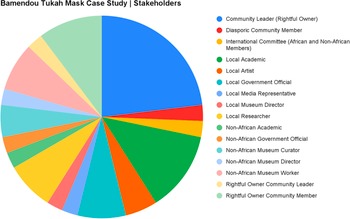
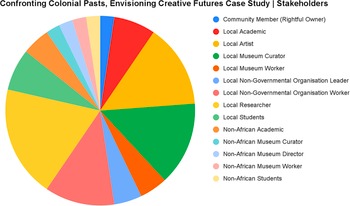
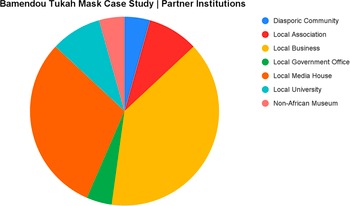
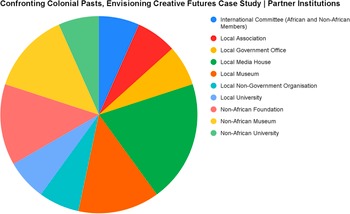
The trajectories of the restitution of the Bamendou Tukah mask case study and that of the Confronting Colonial Pasts, Envisioning Creative Futures ([the return of 23 cultural belongings to Namibia from the Ethnological Museum of Berlin] case study are vastly different. The Bamendou community’s point of departure is an understanding of their cultural heritage, and more specifically their belonging, the Tukah mask, as an embodiment of their Indigenous political, spiritual, economic, sociocultural, and intellectual systems. The Namibian society’s point of departure is an understanding of their cultural heritage as embodiments of building tools for a present and future cultural and heritage sector. When the Bamendou community exercises their rights of reconnection and repair, they are contemplating a reconnection with identity, repair of their ruptured systems and the repercussions thereof, reconciliation with those who caused harm and loss, and restoration of their governing deity’s powers. When the Namibian society exercises their rights to reconnection and repair, they are contemplating a reconnection to a presence of cultural heritage in their immediate environment, repair of their access and own articulation of their cultural heritage as a society, reconciliation with those who have caused harm and loss, reconciliation with their own culture and heritage needs and wants, and restoration of their capacity to realize those needs and wants in relation to the needs and wants of the country. In both these instances, agential restitution has been initiated; however, the pathways that have been taken and the people who have been involved differ starkly. Where the realm of cultural property, and by extension universal official frameworks, dictate a fixed series of steps toward return and a hierarchy of legitimate/d participants in these processes, restitution perceived through an IKS lens necessitates consistent reconfiguration – stakeholders and partner institutions being but only one of those areas. The following comparative visuals (Figures 1–4) reflect how deeply agential restitution reconfigures who is involved, as one exemplar of impact.
Composition of stakeholders in the restitution of the Bamendou Tukah mask case study.Footnote 112
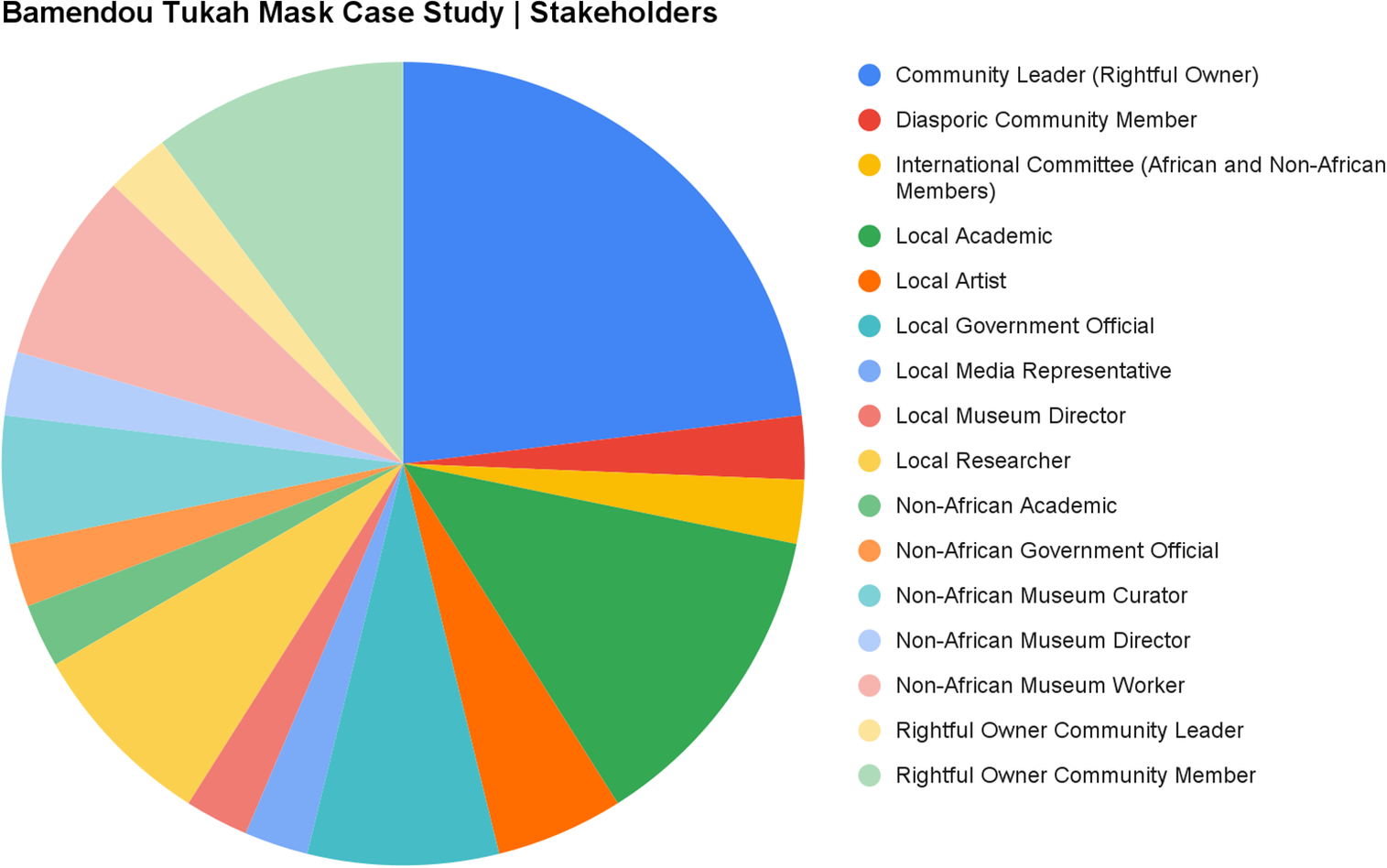
Figure 1. Long description
The legend on the right matches each stakeholder group to its colour. Starting at the top center and moving clockwise, the pie chart segments represent Community Leader (Rightful Owner) in blue, Diasporic Community Member in red, International Committee (African and Non-African Members) in yellow, Local Academic in green, Local Artist in orange, Local Government Official in light blue, Local Media Representative in teal, Local Museum Director in purple, Local Researcher in light green, Non-African Academic in pink, Non-African Government Official in light orange, Non-African Museum Curator in light yellow, Non-African Museum Director in pale green, Non-African Museum Worker in pale blue, Rightful Owner Community Leader in dark blue, and Rightful Owner Community Member in light teal. Community Leader (Rightful Owner) appears as the most prominent stakeholder in this case study.
Composition of stakeholders in the Confronting Colonial Pasts, Envisioning Creative Futures case study.Footnote 113
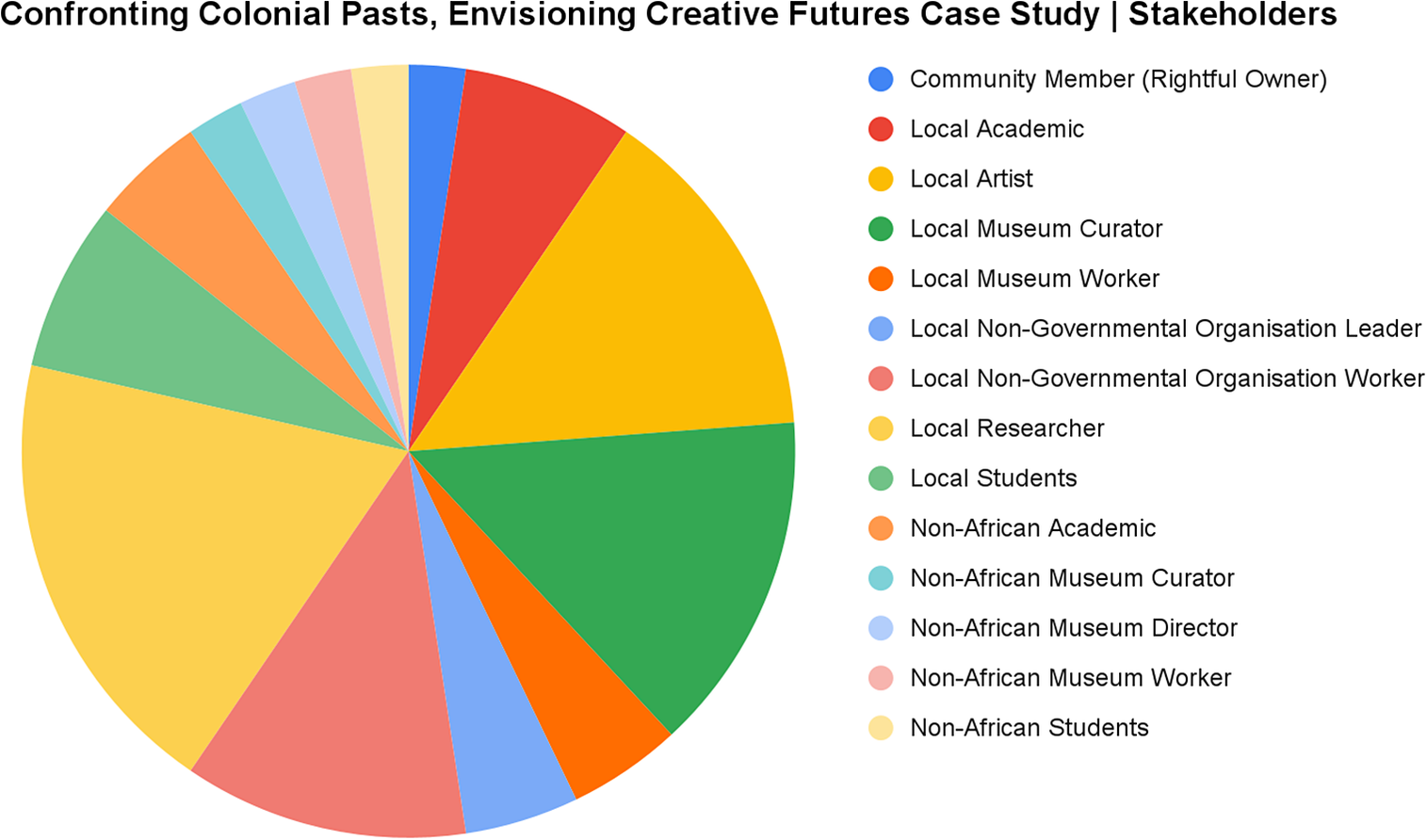
Figure 2. Long description
The legend on the right matches each stakeholder group. Starting from the top and moving clockwise, the pie chart segments represent: Community Member (Rightful Owner) in blue, Local Academic in red, Local Artist in yellow, Local Museum Curator in green, Local Museum Worker in orange, Local Non-Governmental Organisation Leader in light blue, Local Non-Governmental Organisation Worker in pink, Local Researcher in light yellow, Local Students in light green, Non-African Academic in teal, Non-African Museum Curator in light turquoise, Non-African Museum Director in light blue, Non-African Museum Worker in light pink, and Non-African Students in light orange. Local Researcher appears as the most prominent stakeholders in this case study.
Composition of partner institutions in the restitution of the Bamendou Tukah mask case study.Footnote 114
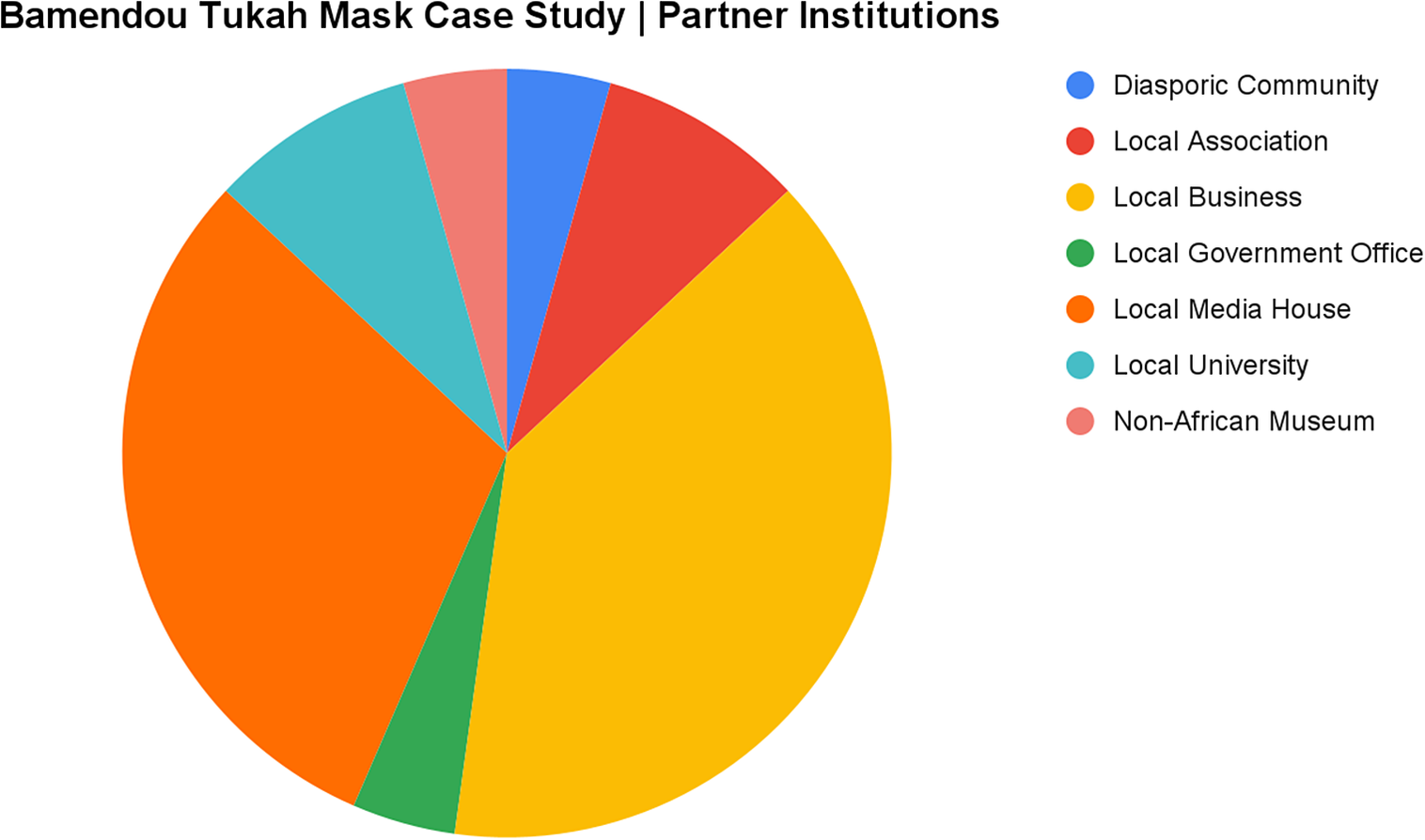
Figure 3. Long description
The legend on the right matches each partner institution group. Starting at the top center and moving clockwise, the pie segments represent: Diasporic Community in blue, Local Association in red, Local Business in yellow, Local Government Office in green, Local Media House in orange , Local University in teal, and Non-African Museum in pink. Local Business appears as the most prominent partner institution in this case study.
Composition of partner institutions in the Confronting Colonial Pasts, Envisioning creative futures case study.Footnote 115
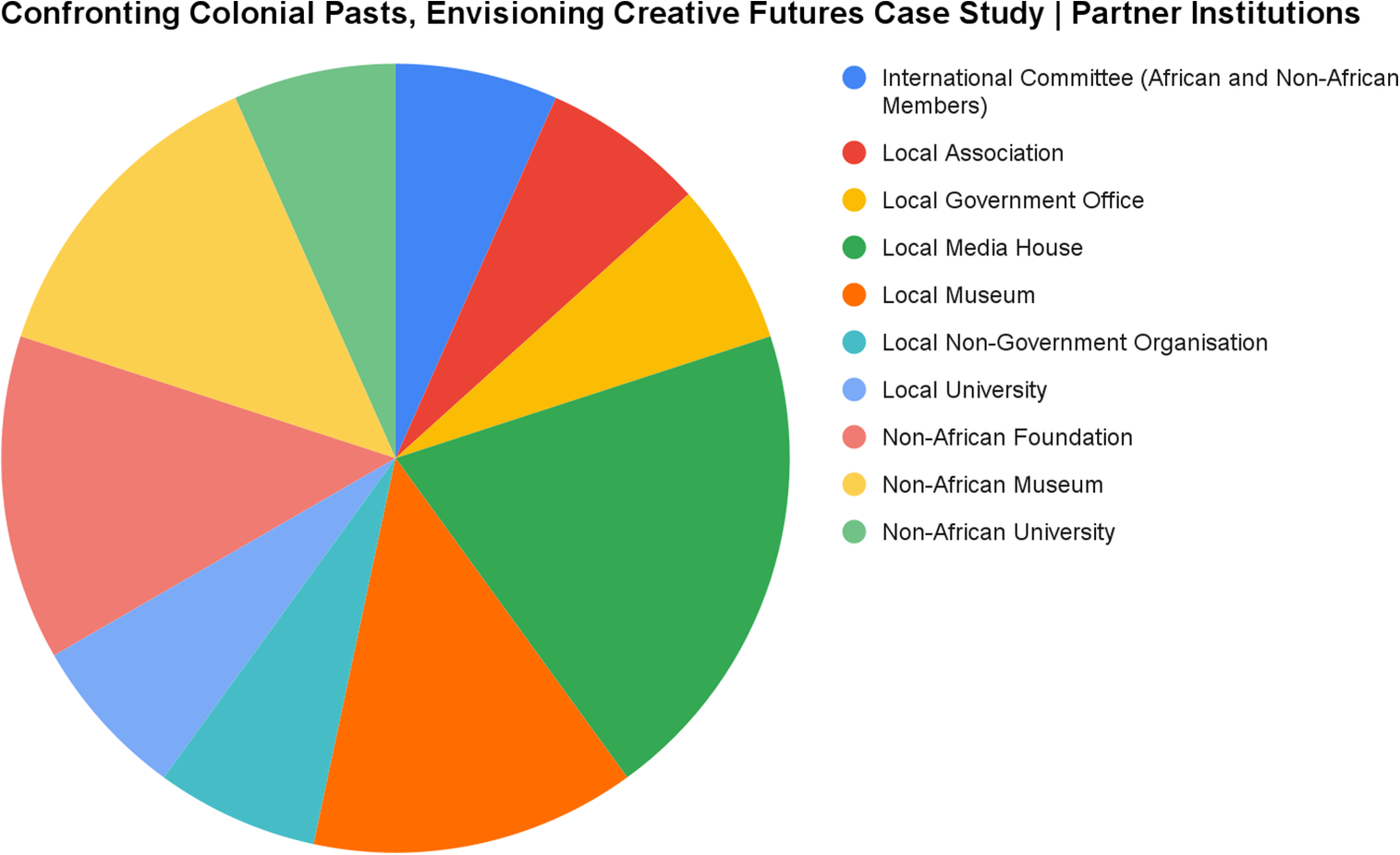
Figure 4. Long description
The legend on the right matches each partner institution group to its colour. Starting at the top centre and moving clockwise, the pie chart segments represent. Blue for International Committee in blue, Local Association in red, Local Government Office in dark yellow, Local Media House in dark green, Local Museum in orange, Local Non-Government Organisation in turquoise, Local University in pale blue, Non-African Foundation in coral, Non-African Museum in pale yellow and Non-African University in pale green. Local Media House appears as the most prominent partner institution in this case study.
Conclusion
This paper began with a meditation on four texts that navigated us toward a reframed understanding of “cultural property,” “ownership,” and “return” through an Indigenous knowledge systems lens. The emergent reframing speaks to cultural property as embodiments of holistic systems or experiences of loss or possibility, ownership as a governance of rights and responsibilities in reconnection and repair, and return as a process of place-based reconciliation and restoration. Through two oral history–led case studies, couched in grounded theory, we demonstrated how agency emerges from this framing and generates idiosyncratic restitution journeys that meet the needs of the community or society of origin that is demanding restitution. We further highlighted how agency reconfigures the group of actors that are involved in restitutionary work; this being just one area of reconfiguration.
Indigenous communities and African societies can engage, and are engaging, in this exercise of reimagining the trajectory of their restitution journey beyond physical return or repatriation. They can and do willingly commit to the ebbs and flows, the slow–slow–quick–quick–slow, that is inevitably experienced through agential restitution. The question remains whether those who caused harm and loss are willing to accept their responsibilities as shaped through an IKS lens. Are they willing to step into the realm of reconnection and repair? Are they willing to engage with whichever form of reconciliation and restoration Indigenous communities and African societies seek to receive? Further, what combination of accountability frameworks could engender this level of agency in restitution? We leave these questions open and invite further research around the ways in which natural and legal persons, who have caused harm or loss, can fulfil their holistic responsibilities, and which realm of frameworks – universal, cultural property, or otherwise - can facilitate this.
Competing interests
The authors declare that they have no known competing financial interests or personal relationships that could have appeared to influence the work reported in this paper.

 Open access

