





1. Introduction
Speakers tend to converge, or align their language use to their interlocutor in dialogue. For instance, when people have more than one word choice to refer to a particular object (e.g., computer vs. laptop), they tend to use the same referential expression as their conversation partner previously used. Such alignment of lexical choices (i.e., lexical alignment) has been argued to be beneficial for effective communication, for it contributes to mutual understanding (Ferreira et al., Reference Ferreira, Kleinman, Kraljic and Siu2012; Stabile & Eigsti, Reference Stabile and Eigsti2022) and fosters rapport between interlocutors (van Baaren et al., Reference van Baaren, Holland, Steenaert and Knippenberg2003; Fusaroli et al., Reference Fusaroli, Bahrami, Olsen, Roepstorff, Rees, Frith and Tylén2012). Despite the increasing interest in its crucial role in communication, little effort has been devoted to addressing how lexical alignment operates in interactions involving second language (L2) speakers, and what factors may affect the magnitude of alignment by L2 speakers (Ivanova et al., Reference Ivanova, Branigan, McLean, Costa and Pickering2021).
Previous research has indicated that lexical alignment among native speakers entails a communicative-goal-directed audience design process, whereby speakers take into account their interlocutors’ linguistic competence and adjust their propensity of lexical alignment accordingly (e.g., Branigan et al., Reference Branigan, Pickering, Pearson, McLean and Brown2011; Cai, Sun, & Zhao, Reference Cai, Sun and Zhao2021; Shen & Wang, Reference Shen and Wang2023). However, there is a paucity of empirical research on the potential effect of the interlocutors’ linguistic competence on L2 speakers’ lexical alignment behavior (Costa, Pickering, & Sorace, Reference Costa, Pickering and Sorace2008; Suffill et al., Reference Suffill, Kutasi, Pickering and Branigan2021; Zhang & Nicol, Reference Zhang and Nicol2022). Although a few pioneering studies have addressed this issue by focusing on the effect of interlocutor nativeness, the findings are mixed and inconclusive (e.g., Suffill et al., Reference Suffill, Kutasi, Pickering and Branigan2021; Zhang & Nicol, Reference Zhang and Nicol2022). Furthermore, L2 speakers, particularly those in foreign language contexts, are more frequently engaged in interactions with L2 peer interlocutors who possess varying proficiency levels compared to interactions with L1 interlocutors (Fernández Dobao, Reference Fernández Dobao2012). In light of this, examining the impact of L2 peer interlocutors’ proficiency on the lexical alignment of L2 speakers has great theoretical and pedagogical implications. Moreover, L2 speakers draw on a still developing L2 system, making the resource-demanding audience design process highly constrained by their own proficiency (Segalowitz & Hulstijn, Reference Segalowitz and Hulstijn2005; Pivneva, Palmer, & Titone, Reference Pivneva, Palmer and Titone2012). Nonetheless, it is seldom considered in the research on L2 lexical alignment, leaving it open how socially modulated lexical alignment may vary across L2 speakers’ proficiency levels. Taken together, exploring the effect of these variables can deepen our understanding of the mechanisms underlying lexical alignment by L2 speakers and its dynamic variations across the L2 learning trajectory. In this article, we examined the modulation of interlocutors’ linguistic competence on L2 speakers’ lexical alignment, and how it interacts with speakers’ L2 proficiency.
1.1. Lexical alignment and the underlying mechanisms
It has been well documented that people converge with their interlocutor at various linguistic levels, such as phonetic and phonological features (Pardo, Jay, & Krauss, Reference Pardo, Jay and Krauss2010; Pardo et al., Reference Pardo, Gibbons, Suppes and Krauss2012), lexical choices (Branigan et al., Reference Branigan, Pickering, Pearson, McLean and Brown2011; Tobar-Henríquez, Rabagliati, & Branigan, Reference Tobar-Henríquez, Rabagliati and Branigan2019), syntactic structures (Branigan, Pickering, & Cleland, Reference Branigan, Pickering and Cleland2000; Cleland & Pickering, Reference Cleland and Pickering2003) and language style (Linnemann & Jucks, Reference Linnemann and Jucks2016). One salient example of such convergence is speakers’ repetitive use of their interlocutors’ word choices (i.e., lexical alignment). For instance, when speakers refer to the same object, they tend to reuse the term previously used by their interlocutor (e.g., bunny), even when a simpler term (e.g., rabbit) is available. It has been observed across communicative contexts, including spoken and text-based interactions (e.g., Branigan et al., Reference Branigan, Pickering, Pearson, McLean and Brown2011; Cai et al., Reference Cai, Sun and Zhao2021), scripted and spontaneous interactions (e.g., Brennan, Reference Brennan1996; Branigan et al., Reference Branigan, Pickering, Pearson, McLean and Brown2011), interpersonal and human–computer interactions (e.g., Koulouri, Lauria, & Macredie, Reference Koulouri, Lauria and Macredie2016; Tobar-Henríquez et al., Reference Tobar-Henríquez, Rabagliati and Branigan2019; Shen & Wang, Reference Shen and Wang2023) and in interactions involving speakers with communication deficits, such as autistic children (Hopkins, Yuill, & Branigan, Reference Hopkins, Yuill and Branigan2017; Stabile & Eigsti, Reference Stabile and Eigsti2022). Lexical alignment helps interlocutors construct a similar representation of the situation model, which can be seen as the basis of successful communication (Pickering & Garrod, Reference Pickering and Garrod2004; Pickering & Garrod, Reference Pickering and Garrod2006). In support of this argument, empirical evidence has shown that the degree of lexical alignment is positively associated with the success of communicative tasks (Reitter & Moore, Reference Reitter and Moore2014; Stabile & Eigsti, Reference Stabile and Eigsti2022).
Different theoretical accounts have been proposed to explain the mechanisms underlying lexical alignment. The automatic priming account posits that the occurrence of alignment is due to the priming of speakers’ linguistic representations (Pickering & Garrod, Reference Pickering and Garrod2004), which is largely resource-free and insusceptible to extralinguistic factors. In this view, speakers reuse their interlocutor’s words because they recently processed them, which automatically facilitates the activation and retrieval of lexical representations (Meyer, Reference Meyer1996). In contrast, the audience design account assumes that alignment is a goal-directed communicative behavior: speakers adapt their language use for the benefit of the conversational partner with a consideration of achieving mutual understanding (Clark, Reference Clark1996). Therefore, the degree of alignment is influenced by speakers’ beliefs about what would be intelligible for the interlocutor. Recent studies have revealed that speakers adjusted their propensity of lexical alignment based on their beliefs about the linguistic competence of the interlocutor, such that they aligned to a larger extent when interacting with a less competent interlocutor, for example, a computer interlocutor (Branigan et al., Reference Branigan, Pickering, Pearson, McLean and Brown2011) and a child interlocutor (Cai et al., Reference Cai, Sun and Zhao2021). Consistent with the audience design account, research in social psychology has also highlighted the impact of social factors (e.g., power relations, desire for social approval and attraction) on alignment and argued that speakers align with their interlocutor for social-integrative purposes (Lakin & Chartrand, Reference Lakin and Chartrand2003; Chartrand & van Baaren, Reference Chartrand and van Baaren2009). According to the Communication Accommodation Theory (CAT), alignment in conversation serves as “social glue”, that helps to enhance the rapport of interaction, shorten social distance and strengthen social bonds between interlocutors (Giles, Coupland, & Coupland, Reference Giles, Coupland, Coupland, Giles, Coupland and Coupland1991; Giles, Reference Giles2016). In support of CAT, empirical studies have demonstrated that alignment is mediated by a range of social factors, such as liking of the interlocutor (Hwang & Chun, Reference Hwang and Chun2018) and concern of the interlocutor’s dignity and prestige (Shen & Wang, Reference Shen and Wang2023). It should be noted that these mechanisms are not mutually exclusive. Speakers’ adaptation of their interlocutors’ word choices may involve the unmediated priming-based components, their consideration of communicative success, their social affective consideration or any combination of the three, and the relative contribution of these components may vary across communicative contexts (Branigan et al., Reference Branigan, Pickering, Pearson and McLean2010; Branigan et al., Reference Branigan, Pickering, Pearson, McLean and Brown2011).
However, the existing research has mainly focused on lexical alignment by native speakers who are fully competent in the language. Given the increasing prevalence of bilingualism, it is often the case that speakers engage in interactions in an L2 with interlocutors who have same or diverse language backgrounds. This gives rise to an important question of how L2 speakers adapt their word use to their interlocutor in interaction and what cognitive and social factors may influence L2 speakers’ lexical alignment behavior. L2 lexical alignment may manifest differently than in an L1 context (Costa et al., Reference Costa, Pickering and Sorace2008; Michel, Appel, & Cipitria, Reference Michel, Appel and Cipitria2022). For instance, the insufficient vocabulary knowledge (Costa et al., Reference Costa, Pickering and Sorace2008; Bylund et al., Reference Bylund, Antfolk, Abrahamsson, Olstad, Norrman and Lehtonen2023) and delayed lexical access (Gollan et al., Reference Gollan, Montoya, Fennema-Notestine and Morris2005; Ivanova & Costa, Reference Ivanova and Costa2008) in L2 speakers may disrupt the occurrence of automatic lexical alignment. In addition, L2 speakers are still in the process of learning a second language. When interacting with a higher-proficiency interlocutor, the asymmetric language abilities between the dyad is likely to constitute a locus of language learning opportunity for L2 speakers (Zhou & Wang, Reference Zhou and Wang2024), making them especially attuned to the linguistic input provided by the interlocutor. Despite the speculation that L2 alignment might involve a conscious and strategic process susceptible to various social factors (Michel & O’Rourke, Reference Michel and O’Rourke2019; Kim & Michel, Reference Kim and Michel2023), there is still a paucity of empirical studies on the social modulation of L2 lexical alignment. In the current study, we attempt to address this issue with a focus on the effect of interlocutors’ linguistic competence on L2 speakers’ lexical alignment and how this effect varies across L2 learning trajectory.
1.2. Effect of interlocutors’ linguistic competence
Among the various factors that potentially affect lexical alignment, the conversational partner’s linguistic competence is an important interlocutor characteristic that speakers take into account when designing referential expressions. In light of the audience design account, when speakers have more than one choice of expressions, they are likely to use the one that they believe is the most intelligible for the interlocutor to maximize the probability of successful communication (Clark & Schaefer, Reference Clark and Schaefer1987; Brennan & Clark, Reference Brennan and Clark1996). Indeed, there is empirical evidence for the effect of speakers’ beliefs about their interlocutors’ linguistic competence on lexical alignment, but mainly from L1 data. For instance, Branigan et al. (Reference Branigan, Pickering, Pearson, McLean and Brown2011) observed stronger lexical alignment when participants believed that their interlocutor was a computer than a human being, and a basic computer than an advanced computer. They attributed the increased lexical alignment to participants’ perception of the limited linguistic competence of their interlocutors. Likewise, in a recent study, Cai et al. (Reference Cai, Sun and Zhao2021) examined more directly the effects of interlocutors’ linguistic competence on the speakers’ lexical alignment by comparing the magnitudes of lexical alignment in interactions with interlocutors of different linguistic competences. They found that speakers aligned to a larger extent in interactions with a child than with an adult interlocutor and with a non-native than with a native interlocutor. These findings uncovered the role of the speakers’ beliefs about their interlocutors’ linguistic competence in influencing their lexical alignment behavior, emphasizing the communicative-goal-driven audience design component of lexical alignment.
However, is L2 speakers’ propensity of lexical alignment impacted by their interlocutors’ linguistic competence? A few recent studies have addressed this issue, but the findings are controversial. In Suffill et al. (Reference Suffill, Kutasi, Pickering and Branigan2021), English native speakers and L2 speakers (with various language backgrounds) carried out a route-giving task with either a native or non-native confederate, wherein participants and the confederate described various landmarks on a map. They observed that both L1 and L2 speakers showed a greater lexical alignment with the non-native than the native confederate, and that such a tendency did not differ between L1 and L2 speakers. These findings indicate that L2 speakers take into consideration the linguistic competence of their interlocutors, in particular their language status (native vs. non-native), and adjust their lexical alignment behavior accordingly, in the same way as L1 speakers do.
However, a recent study presented counter evidence. Zhang and Nicol (Reference Zhang and Nicol2022) conducted three experiments to examine the interlocutor effect on intermediate Chinese English as a Foreign Language (EFL) learners’ lexical alignment. Participants completed a text-based picture-naming and -matching task with an interlocutor believed to be a native speaker of English or a Chinese L2 learner of English. In contrast with the findings from Suffill et al. (Reference Suffill, Kutasi, Pickering and Branigan2021), they observed an overall stronger lexical alignment with the perceived L1 interlocutor than with the perceived L2 peer interlocutor. Zhang and Nicol (Reference Zhang and Nicol2022) provided two explanations to account for L2 speakers’ belief-based adjustment of lexical alignment. The language-learning explanation attributes the greater lexical alignment with the L1 interlocutor to the inequivalence of L2 proficiency of the dyad, which triggers L2 speakers’ adoption of a language-learning mindset. That is, participants may perceive the L1 interlocutor as a reliable source of the target language, and believe that conversing with that interlocutor is an efficient way to improve their L2 vocabulary learning. Hence, they would devote more attention to the word use of that interlocutor and show a greater lexical alignment. Alternatively, the lexicon-disparity explanation suggests that the different magnitudes of lexical alignment in L1 and L2 interlocutor conditions could be due to the disparity between the activation profiles of the interlocutor and the L2 speaker. Specifically, participants regarded the L2 interlocutors as their peers, with whom they could share similar lexical knowledge in English. In contrast, they could have assumed a large disparity between the activation profile of their own and that of the L1 interlocutor. As suggested by Costa et al. (Reference Costa, Pickering and Sorace2008), L1 and L2 speakers’ exposure to language are so different that their activation profiles should be very dissimilar. Consequently, participants aligned to a larger extent with the L1 interlocutor to ensure understanding.
As reviewed, previous research has indicated a potential effect of interlocutors’ linguistic competence on L2 speakers’ lexical alignment behavior, but how this effect manifests seems to be controversial. Therefore, it remains inconclusive how L2 speakers indeed adjust their propensity of lexical alignment when addressing interlocutors with different linguistic competences. Furthermore, although researchers have effectively assumed that L2 speakers take into account their interlocutors’ linguistic competence and design their lexical choices accordingly, it is unclear which specific interlocutor attribute (i.e., the nativeness or the relative L2 proficiency of the interlocutor) holds more significance in driving L2 speakers’ adjustment of lexical alignment. Note that in Zhang and Nicol’s (Reference Zhang and Nicol2022) study, the inequivalence in L2 proficiency between the interlocutor and the speaker (more proficient vs. less proficient) coincides with the dichotomous language status between them (native vs. non-native). Consequently, it remains open what indeed motivates L2 speakers’ adjustment of lexical alignment propensity, that is, their desire to learn L2 words from the interlocutor, or their consideration to achieve communicative success. This issue, however, is crucial for understanding the specific mechanism underlying the lexical alignment by L2 speakers, and how might it differ from that proposed for L1 interactions. The first goal of the current study was to further investigate the effect of interlocutors’ linguistic competence on L2 speakers’ lexical alignment. Specifically, we tested whether L2 speakers adjust their lexical alignment behavior in light of the nativeness and relative L2 proficiency of the interlocutor by comparing the magnitude of their lexical alignment with L1 and L2 interlocutors, and L2 interlocutors with higher or lower proficiency, respectively.
1.3. Effect of L2 speakers’ proficiency
Another critical but underexplored issue regarding L2 lexical alignment is whether social modulation varies with speakers’ own proficiency or competence in the target language. Previous research has suggested that L2 speakers altering the degree of lexical alignment based on their judgments about their interlocutor’s linguistic competence (known as the modeling of a conversational partner) is cognitively taxing, which might induce a high processing load on L2 speakers (Suffill et al., Reference Suffill, Kutasi, Pickering and Branigan2021; Zhang & Nicol, Reference Zhang and Nicol2022). Therefore, it is plausible to assume that this process might be largely dependent on L2 speakers’ own language proficiency. Presumably, more proficient L2 speakers would be more capable of keeping a model of their interlocutor and using that model to tailor their language production, given that they can allocate more cognitive resources for this process (Segalowitz & Hulstijn, Reference Segalowitz and Hulstijn2005; Costa et al., Reference Costa, Pickering and Sorace2008; Pivneva et al., Reference Pivneva, Palmer and Titone2012). In other words, the mediated component of lexical alignment would be more pronounced as L2 speakers’ proficiency grows.
Despite the clear prediction, there is little empirical evidence on the joint influence of interlocutors’ linguistic competence and speakers’ proficiency on L2 speakers’ lexical alignment behavior. Zhang and Nicol (Reference Zhang and Nicol2022) touched upon this issue by comparing the degree of belief-based adjustment of lexical alignment among Chinese EFL speakers with different degrees of self-perceived L2 proficiency (i.e., higher intermediate and lower intermediate levels), but the findings were inconsistent across experiments. In experiments 1 and 3, Zhang and Nicol (Reference Zhang and Nicol2022) observed that L2 speakers who self-perceived as lower intermediate showed more lexical alignment with the native interlocutor than with the non-native interlocutor, whereas L2 speakers who self-perceived as higher intermediate did not alter their degrees of lexical alignment according to their beliefs about the nativeness of the interlocutor. However, in experiment 2, wherein the prime and target were intervened by filler items, they observed an opposite pattern: the interlocutor effect was only significant for L2 speakers with a higher intermediate level of self-perceived proficiency, but negligible for L2 speakers with a lower intermediate level of self-perceived proficiency. The contrasting findings were attributed to the cognitive burden caused by the priming condition with intervening items, wherein L2 speakers with a lower intermediate level of self-perceived proficiency devoted the limited attentional resources to remembering the names used by their interlocutor while sparing little effort to assess the reliability of the interlocutor as a language model. Despite the inconclusive findings, Zhang and Nicol (Reference Zhang and Nicol2022) hinted that L2 speakers’ exertion of cognitive resources for mediated lexical alignment tends to be constrained by their self-perceived L2 proficiency level.
Suffill et al. (Reference Suffill, Kutasi, Pickering and Branigan2021) approached this issue by investigating how interlocutor nativeness and speaker nativeness interact in determining the degree of lexical alignment. As reviewed earlier, they found that both L1 and L2 speakers demonstrated a greater lexical alignment with the non-native than with the native interlocutor. They further revealed that such a tendency did not differ between L1 and L2 speakers, suggesting that speakers’ propensity of lexical alignment is primarily determined by their interlocutors’ language status (i.e., native or non-native), irrespective of whether their own linguistic competence is higher or lower than that of their interlocutors. Notably, the L2 participants in Suffill et al.’s (Reference Suffill, Kutasi, Pickering and Branigan2021) study were highly proficient L2 English speakers who were residing in an English-speaking context such that they might have been confident about their own L2 competence. Consequently, they might not have the same language learning needs or sensitivity to the disparity between their own lexicon profiles and that of their native interlocutors as the L2 participants in Zhang and Nicol (Reference Zhang and Nicol2022). Thus, the divergence in the two studies suggest that L2 speakers’ proficiency might impact the way they lexically align with the interlocutor of various linguistic competences. However, it still awaits to be tested by empirical research.
Taken together, there is still no consensus on the issue of whether and how L2 speakers’ adjustment of lexical alignment propensity is mediated by their own L2 proficiency. Crucially, findings of previous research are primarily based on the comparisons between native speakers and L2 speakers. More research is needed to further illuminate the joint influence of interlocutors’ linguistic competence and L2 speakers’ own proficiency on the degree of L2 lexical alignment. In the current work, we addressed this issue by investigating on a finer-grained level how L2 speakers’ proficiency interacts with their beliefs about the interlocutor’s linguistic competence in shaping their lexical alignment behavior. Hopefully, the findings can cast light on the mechanisms underlying the dynamic variations of L2 speakers’ lexical alignment across communicative contexts and L2 developmental stages.
2. The current study
The goal of the current study was twofold. The first objective was to further examine the modulation of interlocutors’ linguistic competence on L2 speakers’ lexical alignment in regard of interlocutor nativeness and the asymmetric L2 proficiency. To this end, we manipulated the language status of the interlocutor (L1 vs. L2) and the relative L2 proficiency between the speaker and the L2 interlocutor (higher vs. lower than the speaker), respectively. Specifically, we investigated how L2 speakers alter their lexical alignment behavior when addressing interlocutors with hierarchical perceived linguistic competence: an L1 interlocutor, a more proficient L2 interlocutor and a less proficient L2 interlocutor. To clarify the effect of interlocutor nativeness on L2 speakers’ lexical alignment, we compared the magnitudes of L2 speakers’ lexical alignment in conditions involving L1 and L2 interlocutors. To examine the impact of the interlocutor’s relative L2 proficiency on lexical alignment, we compared the degree to which L2 speakers aligned with the interlocutor whose L2 proficiency exceeded their own and those whose L2 proficiency was lower than their own.
RQ1: Is L2 speakers’ lexical alignment behavior affected by their beliefs about the interlocutor’s linguistic competence?
Drawing on the previous research on lexical alignment in L2 interaction context, we predict an effect of interlocutor nativeness: L2 speakers may demonstrate a greater lexical alignment in interactions with an L1 interlocutor than with an L2 interlocutor. As for the effect of L2 interlocutors’ proficiency, different hypotheses are generated. On the basis of language-learning account, we predict that L2 speakers would assume the more proficient L2 interlocutor as a language model, and strengthen lexical alignment for language learning purpose. Based on the lexicon-disparity account, L2 speakers may assume similar activation profiles with their L2 peer interlocutors, be their relative L2 proficiency higher or lower than that of the speaker. Hence, we expect comparable lexical alignment in the two L2 interlocutor conditions. By doing so, our study enables a more nuanced examination of the effect of interlocutors’ linguistic competence, thus pinpointing which interlocutor trait, that is, nativeness or relative L2 proficiency, holds more significance in triggering L2 speakers’ adjustment of lexical alignment behavior.
The second objective was to explore the variation of social modulation on L2 speakers’ lexical alignment across L2 learning trajectory by examining whether and how such an effect varies as a function of L2 speakers’ proficiency levels.
RQ2: Is the effect of interlocutors’ linguistic competence modulated by L2 speakers’ proficiency?
We expect the English proficiency of L2 speakers to modulate the interlocutor effect on lexical alignment given that L2 speakers’ processing resources vary as a function of proficiency and hence impact their ability to engage in mediated language production. Specifically, we predict that L2 speakers may demonstrate a stronger interlocutor effect as their English proficiency advances.
3. Method
3.1. Design
The current study consisted of a proficiency test and a text-based interaction task. Unlike Zhang and Nicol (Reference Zhang and Nicol2022), we adopted an objective proficiency measure for proficiency assessment, which was suggested to be superior to self-ratings in terms of accuracy and consistency (Tomoschuk, Ferreira, & Gollan, Reference Tomoschuk, Ferreira and Gollan2019). Specifically, we used the Lexical Test for Advanced Learners of English (LexTALE, see the Proficiency test section for detailed information) to collect participants’ English proficiency scores. Then, participants were informed to carry out an online text-based collaborative interaction task with an interlocutor, and randomly assigned to one of the three groups. In the L1 interlocutor group, participants were led to believe that their interlocutor was a native American English speaker. In the L2-higher interlocutor group, participants were led to believe that their interlocutor was another Chinese EFL learner who was more proficient in English. While in the L2-lower interlocutor group, participants were told that their interlocutor was another Chinese EFL learner who was less proficient in English.Footnote 1 Unknown to participants, all of the interlocutors were played by a preprogrammed software, so that the responses from these interlocutors were identical throughout the interaction. The dependent variable of this study was the magnitude of participants’ lexical alignment with their interlocutor in the interaction task.
3.2. Participants
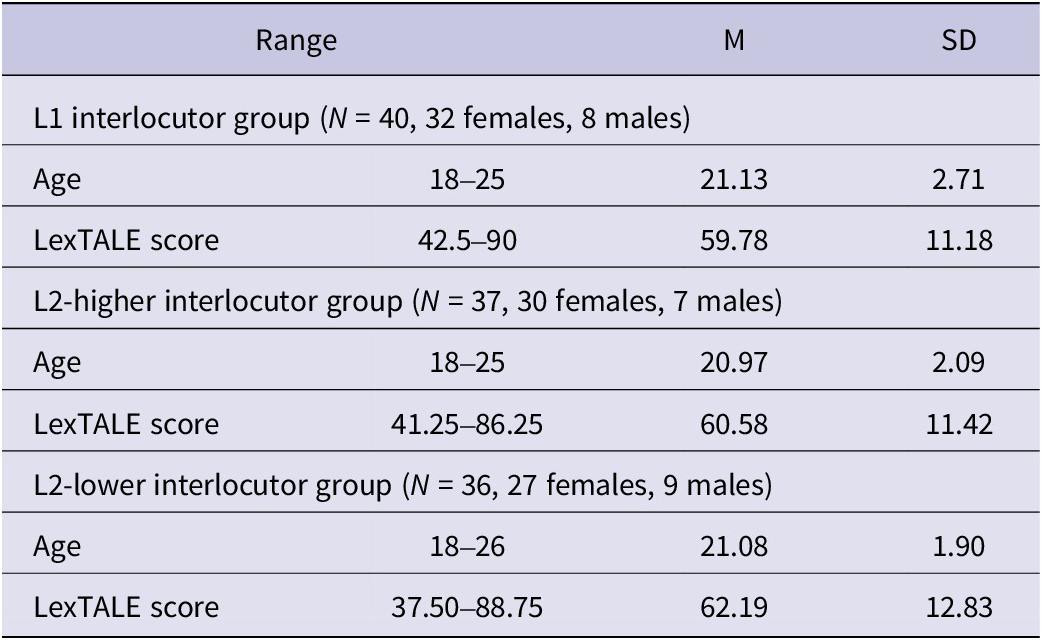
A total of 120 Chinese EFL learners took part in the experiment. All participants were Chinese college students who were enrolled in various majors (e.g., engineering, management and medicine) at three universities in Northwest China. After data screening, we excluded one participant who did not complete the interaction task within the time limit of 90 minutes, one who interacted with their interlocutor in Chinese and five who named the filler pictures rather than the target pictures during the experimental trials in the interaction task. Thus, the final sample consisted of 113 participants (89 females and 24 males), whose ages ranged from 18 to 26 (M = 21.06, SD = 2.24). The overall LexTALE score of the participants ranged from 37.5 to 90, with a mean score of 60.81 (SD = 11, 74), namely that their L2 proficiency ranged from basic to proficient levels (Lemhöfer & Broersma, Reference Lemhöfer and Broersma2012). Table 1 presents the demographic information of participants and a summary of their LexTALE test score for each group. Results of one-way ANOVA indicated that there was no significant difference in the participants’ L2 proficiency scores between the three groups [F (2, 112) = 0.404, p = .668].
Participants’ demographic information and LexTALE scores by group
3.3. Materials and tasks
3.3.1. Proficiency test
We assessed participants’ English proficiency using an online version of the LexTALE, a valid and standardized test of English vocabulary knowledge and general English proficiency for L2 learners (Lemhöfer & Broersma, Reference Lemhöfer and Broersma2012). In the test, participants were required to make a word/nonword decision on 60 letter strings. Participants judged whether each letter string was an English word or not by clicking the ‘word’ or ‘nonword’ options without time limit. Following Lemhöfer and Broersma (Reference Lemhöfer and Broersma2012), we computed each participant’s proficiency score with the following formula: LexTALE score = ((number of words correct/40 × 100) + (number of nonwords correct/20 × 100))/2.
3.3.2. Interaction task
The interaction task was an online text-based picture-naming and -matching task, in which participants and their interlocutor took turns to type the English name of the pictured object and select the matched picture according to a given name.
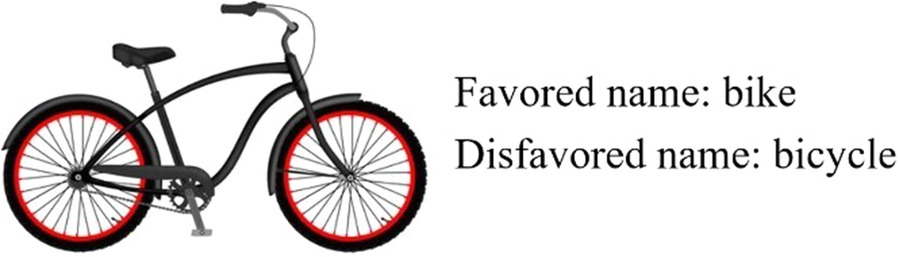
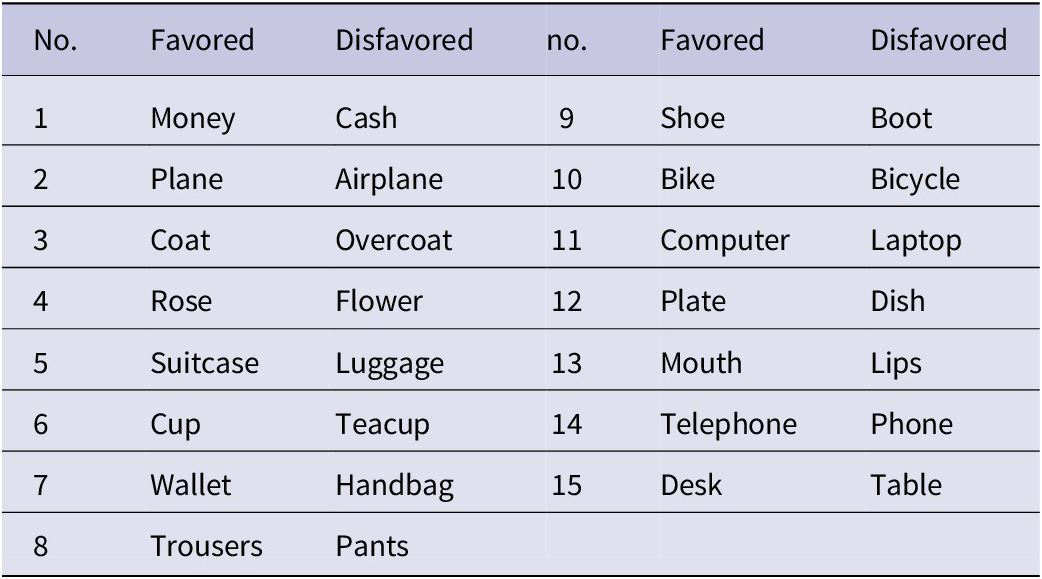
We performed a norming study on a questionnaire platform wenjuanxing (https://www.wjx.cn/) to construct the experimental items. Participants in the norming study were recruited from the same population as those in the main experiment, but none of them participated in the main experiment. We prepared 30 colored pictures that have two English names based on previous studies for experimental item construction (Snodgrass & Vanderwart, Reference Snodgrass and Vanderwart1980; Suffill et al., Reference Suffill, Kutasi, Pickering and Branigan2021; Zhang & Nicol, Reference Zhang and Nicol2022). Following Zhang and Nicol (Reference Zhang and Nicol2022), we adopted three criteria when selecting target pictures. First, the two English names for each picture should be acceptable for participants; this was to rule out the possibility that participants using a particular word because they did not accept the alternative one. We conducted an acceptability judgment questionnaire survey to evaluate participants’ acceptability of the favored and disfavored names for pictures. Twenty-eight participants rated the acceptability of each name for the pictures on a 7-point Likert scale, with “1” being “completely unacceptable” and “7” being “completely acceptable”. We selected pictures whose favored name and disfavored name were both rated above 5 by over 80% of participants. The second criterion was that the name pairs for each picture should be familiar to participants; this was to ensure that participants were able to recognize and spell the names of the target pictures. We conducted a word familiarity survey among another 33 participants. Participants were required to indicate their familiarity with the names on a 7-point Likert scale, with “1” being “completely unfamiliar” and “7” being “completely familiar”. We selected pictures whose names were rated above 5 by at least 80% of participants. Sixteen pictures were selected based on these two steps. The final criterion was that the pictures should have distinct favored and disfavored names. To determine the favored/disfavored name pairs for target pictures, we had additional 27 participants to rate their preference of using each name on the corresponding 10-point Likert scale. We calculated the mean preference scores of the two names for each picture. The name with a higher preference score was the favored name, while the other one was the disfavored name. Target pictures were selected if the relative preference ratio of the disfavored versus favored name was skewed in favor of the favored name. For instance, the mean preference score for the favored name computer was 7.6 and the disfavored name laptop 5.14. The relative preference ratio was 5.14/7.6 = 0.68, which was apparently in favor of the name computer. We deleted one picture whose relative preference ratio of disfavored versus favored names (6.43/6.75) was above 0.9. Fifteen target pictures were ultimately selected for the construction of experimental items (see Figure 1). The overall mean preference score for the favored names was 7.24 (SD = 0.45), and for the disfavored names was 5.73 (SD = 0.41) (see Appendix for the selected favored–disfavored name pairs). Like in previous research, the favored–disfavored name pairs involved a range of relationships, such as lexical expansion (bike-bicycle, plane-airplane and phone-telephone) and subordination (follower-rose). And more than half of the name pairs in our study overlapped with those used in previous studies on L2 speakers’ (e.g., Suffill et al., Reference Suffill, Kutasi, Pickering and Branigan2021; Zhang & Nicol, Reference Zhang and Nicol2022) and native speakers’ lexical alignment (e.g., Tobar-Henríquez et al., Reference Tobar-Henríquez, Rabagliati and Branigan2019). In addition, we collected 114 pictures that had only one name in English as filler pictures for the filler items and practice trials. Specifically, we constructed 21 filler items, 15 for the interaction task and the other 6 for the practice session.
An example of target pictures with the favored–disfavored name pair.
The text-based picture-naming and -matching task consisted of 15 experimental trials, wherein participants and their interlocutor took turns to name and match pictures. As illustrated in Figure 2, each trial initiated with the matching turn of experimental items for participants. After a fixation of 500 ms, a target picture and a distractor picture appeared side by side on the screen. There was also an image of the interlocutor with a national flag, which indicated whether the interlocutor was a native American English speaker or a Chinese learner of English. Participants were informed that their interlocutor would name one of the pictures. After a random interval between 5000 and 10000 ms, the favored or disfavored English name of the target picture appeared underneath the interlocutor image. There was also a ‘left’ and ‘right’ button underneath the target and distractor pictures. Participants were required to match the name with the picture by clicking the corresponding option.
A sample of the experimental trial in the text-based picture naming and matching task.
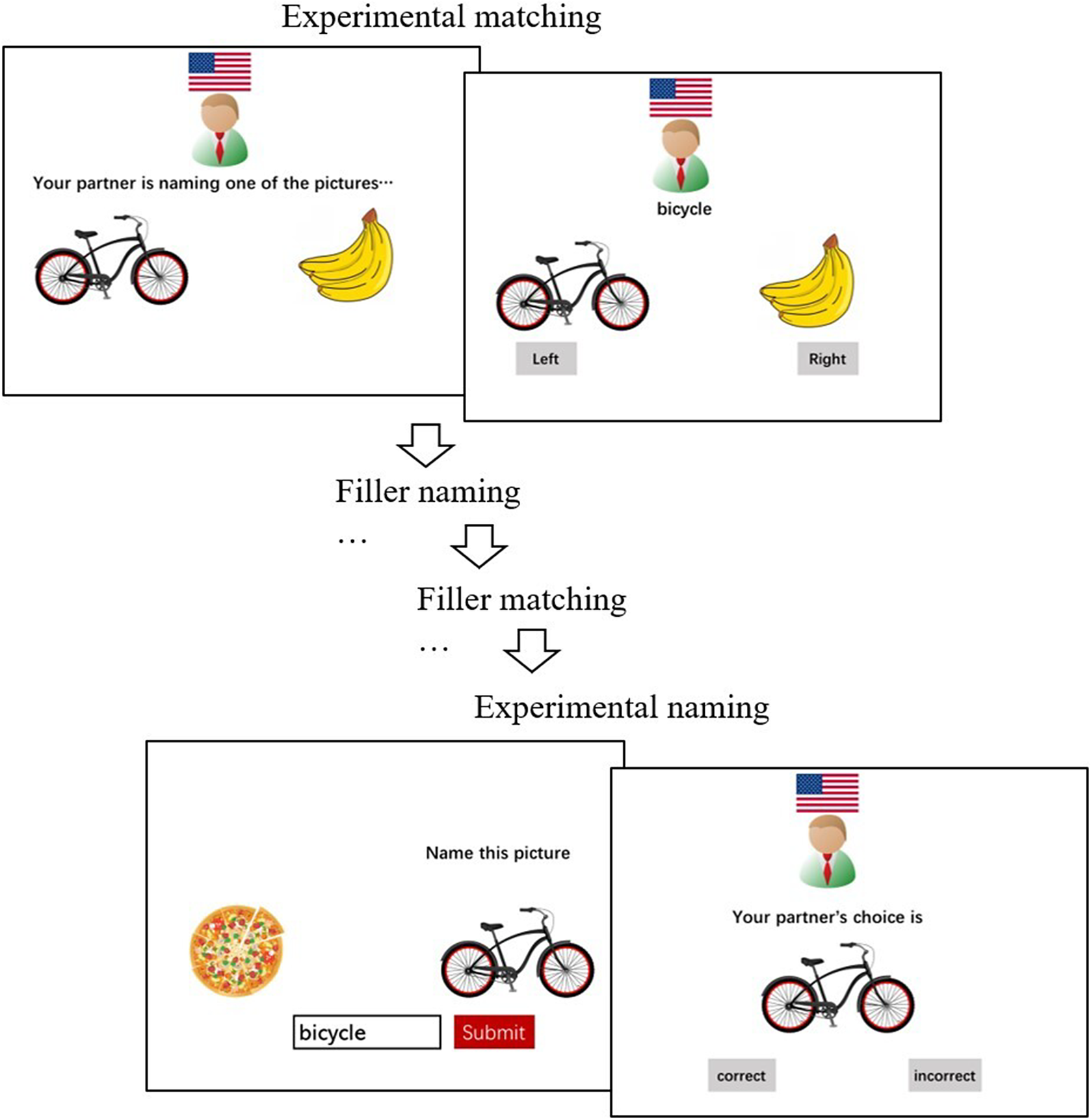
This trial ended up with the naming turn of the experimental item. An identical target picture appeared on the screen together with another distractor picture. There was also a naming request right above the picture to be named, which was always the target picture. Participants were required to type the English name of the target picture into the textbox, and click the submit button to send the name to their interlocutor. They were informed that the interlocutor would choose the matched picture according to the name they submitted. After a random interval between 3000 ms to 6000 ms, the image of the interlocutor was displayed on the screen with a message that the interlocutor had made a choice. The selected picture was shown on the center of the screen, with ‘correct’ and ‘incorrect’ buttons below. Participants were required to judge whether the interlocutor’s choice was correct or incorrect by clicking the corresponding button. Unknown to participants, the picture ‘selected by the interlocutor’ was always the same picture that we required participants to name in the previous naming turn; hence, it followed that the interlocutor always appeared to select the correct picture. As Figure 2 shows, the experimental matching and experimental naming turns were intervened by a filler naming turn and a filler matching turn, wherein participants named and matched the filler pictures. The requirements of the filler items were the same as those experimental items, and each filler picture was used only once.
We created two lists, each containing half target pictures with favored name primes and the other half target pictures with disfavored name primes. Each list also contained 15 filler pictures with one conventional name. Participants were randomly assigned to lists. The sequential order of the experimental trials was individually randomized, but the order of fillers remained the same across lists.
3.4. Procedure
The experiment was conducted online in the Gorilla Experiment Builder (Anwyl-Irvine et al., Reference Anwyl-Irvine, Massonnié, Flitton, Kirkham and Evershed2020). The study received approval from the local research ethics committee. Before the experiment, participants were then assigned a link and a personalized ID, and were required to carry out the experiment independently using their personal computer in a quiet place. Upon clicking the link, they were informed that they would perform an English lexical decision task, and then play an English picture-naming and -matching game with another participant via the internet. After giving their informed consent, the participants filled a demographic questionnaire, followed by the LexTALE.
Then, the text-based picture-naming and -matching task started with a Chinese instruction to ensure that participants would understand the task procedure. Participants were informed that the system would randomly select another participant as their interlocutor to carry out an interaction task online. After 10 s, a message appeared onscreen that they had paired up with one of the following interlocutors: an American English native speaker, a Chinese EFL learner who has a higher English proficiency or a Chinese EFL learner who has a lower English proficiency. There was a practice session for participants to get familiar with the interaction task procedure, then they carried out the main task. During the task, in order to remind participants of the identity of the interlocutor, a cartoon image of a native English speaker or a Chinese EFL learner appeared in the dialogue screen throughout the task.
After the picture-naming and -matching task, participants were redirected to a questionnaire to check whether they followed the instructions and their beliefs about their partner. The questions are as follows: (1) did you use dictionaries in the experiment? (yes or no); (2) who do you think you played with in the interaction task? (an English native speaker, a Chinese college student whose English proficiency is higher than you, a Chinese college student whose English proficiency is lower than you or other) and (3) what do you think is the purpose of the experiment? (open question). No participants reported using dictionaries or suspecting the informed interlocutor identity. The whole procedure lasted for about 30 minutes. After completing the experiment, participants were debriefed and paid 20 yuan as compensation for their participation.
3.5. Data coding
We coded participants’ responses to the experimental naming trials. When a favored name was used, the response was coded as favored; when a disfavored name was used, the response was coded as disfavored. If the name used by the participants was neither the favored nor the disfavored name of a target picture, it was coded as other. The typing errors were ignored as long as the name was clearly identified.
4. Results
4.1. Descriptive statistics
Out of the 1695 observations, we coded 948 as favored responses, 650 as disfavored responses and 97 as other responses. All the other responses were removed from further statistical analyses. Table 2 shows the frequency and proportion of favored and disfavored responses by prime type and interlocutor, and the magnitude of alignment effect for each group. Following Branigan et al. (Reference Branigan, Pickering, Pearson, McLean and Brown2011), Hopkins and Branigan (Reference Hopkins and Branigan2020) and Hopkins, Yuill, and Branigan (Reference Hopkins, Yuill and Branigan2022), we calculated the lexical alignment effect as the difference in the observed probability of producing a disfavored name response after a disfavored name prime versus after a favored name prime.
Frequency and proportion of disfavored and favored responses by prime and interlocutor
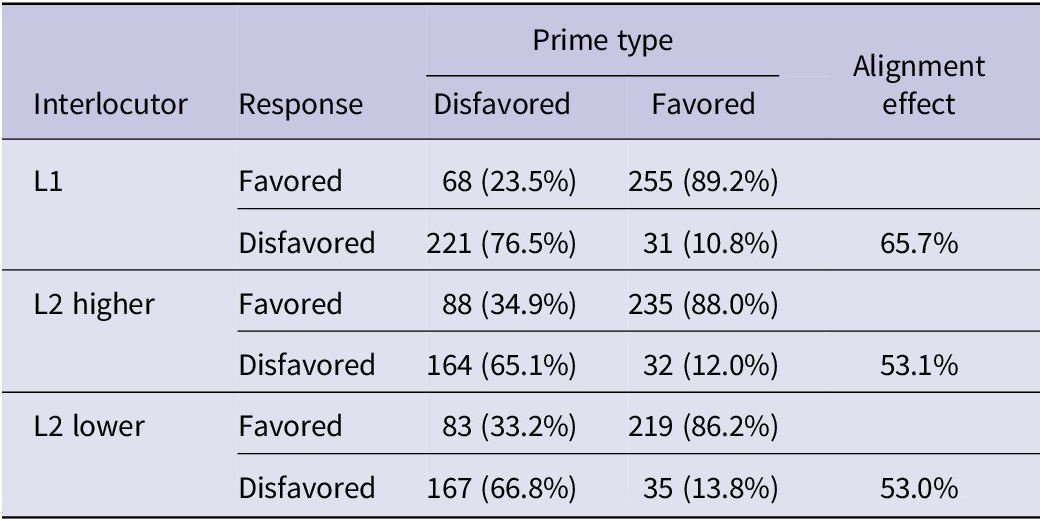
Note: Alignment effect = proportion of disfavored responses in disfavored prime condition – proportion of disfavored responses in favored prime condition.
4.2. Effects of interlocutor linguistic competence
To address RQ1, we used generalized logistic mixed effects (GLME) models to compare participants’ lexical alignment across conditions by implementing the lme4 package in Rstudio software (Bates et al., Reference Bates, Maechler, Bolker and Walker2015). The dependent variable was participants’ responses to each experimental naming trial (disfavored versus favored, disfavored response coded as 1, favored response coded as 0). As for fixed effects, the prime type (favored name prime versus disfavored name prime) and interlocutor type (L1, L2 higher and L2 lower) were entered as interacting predictors. The prime type was sum-coded (favored = −0.5, disfavored = 0.5). As for the interlocutor type, we turned this three-level variable into two contrasts using Helmert-coding method: interlocutor contrast 1 compared L1 versus L2 interlocutors (L1 interlocutor = 2/3, L2-higher interlocutor = −1/3 and L2-lower interlocutor = −1/3) to examine the effect of interlocutor nativeness, while interlocutor contrast 2 compared L2-higher versus L2-lower interlocutors (L1 interlocutor = 0, L2-higher interlocutor = 0.5 and L2-lower interlocutor = −0.5) to test the effect of the L2 interlocutor’s relative proficiency. Following the suggestions of Barr et al. (Reference Barr, Levy, Scheepers and Tily2013), we adopted the maximal random-effect structure justified by the experimental design, which allowed the model to reach convergence. The fit model included random intercepts for participants and items, and a by-item random slope for prime.
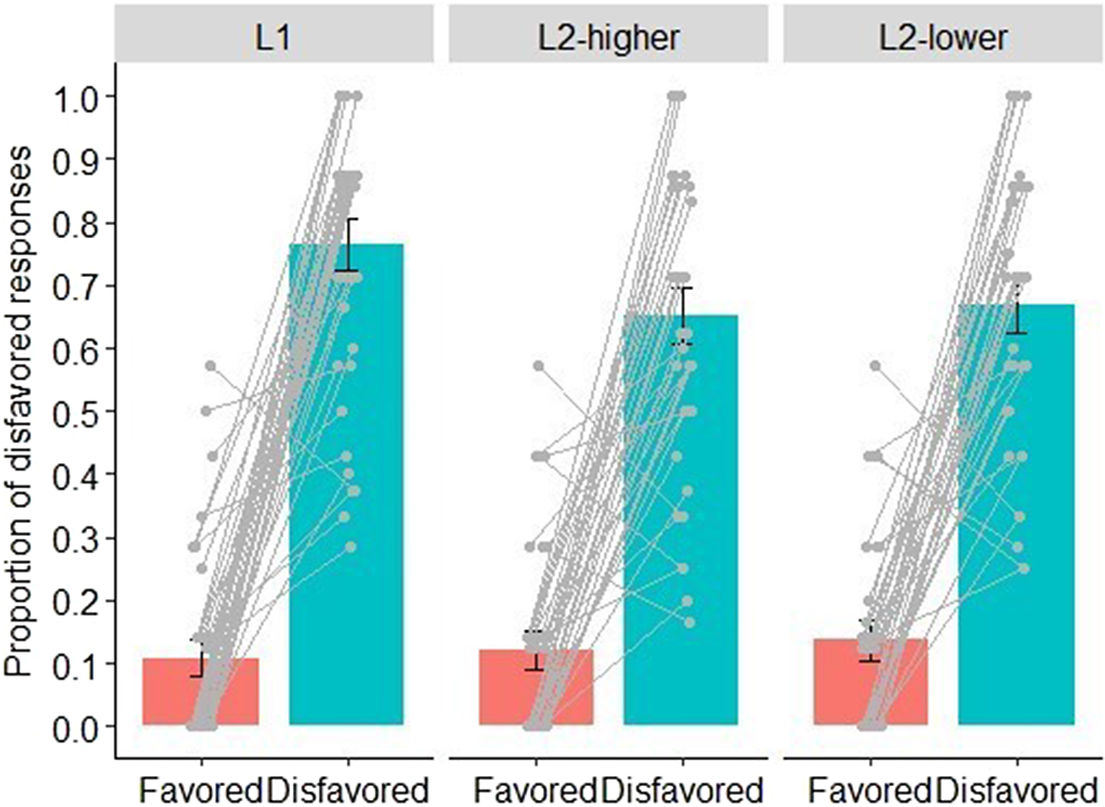
Table 3 shows the results of the fit GLME model. The significant effect of prime shows that participants were more likely to produce a disfavored name response following a disfavored name prime than following a favored name prime (β = 2.850, SE = 0.164, z = 17.406, p < .001), indicating an overall lexical alignment effect across conditions. There was a significant two-way interaction between prime and interlocutor contrast 1 (β = 0.740, SE = 0.287, z = 2.575, p = .010), suggesting that participants showed a stronger lexical alignment effect when they believed they interacted with an L1 interlocutor compared with an L2 interlocutor. In contrast, the interaction between prime and interlocutor contrast 2 was not significant (β = 0.093, SE = 0.325, z = 0.285, p = .776), indicating that participants demonstrated a comparable degree of lexical alignment no matter when they believed the L2 interlocutor was more proficient or less proficient than themselves (see Figure 3).
Summary of the generalized logistic mixed effects model
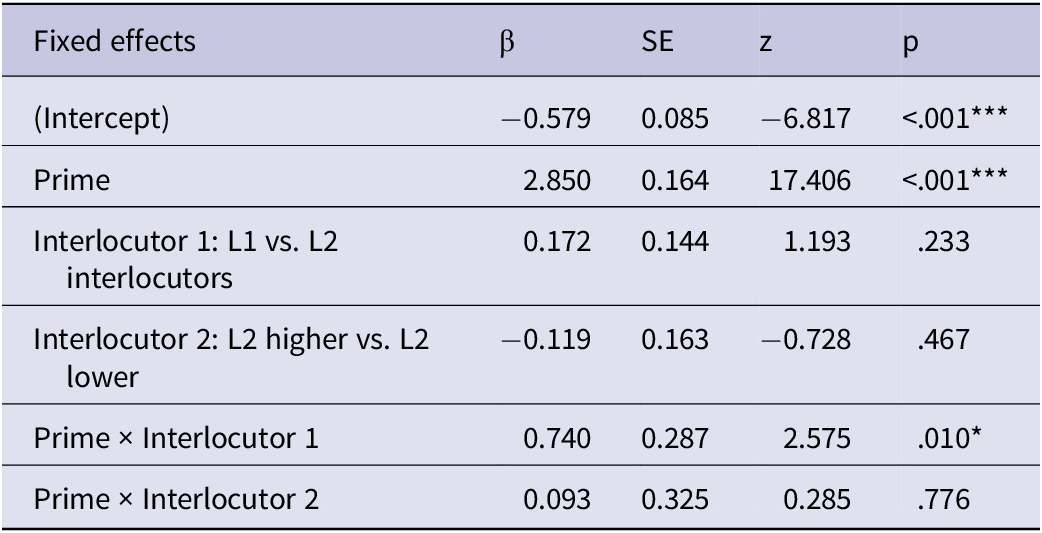
Note: The formula of the fit model for disfavored responses, where “||” indicates a random-effect structure without random correlations: Response ~ Interlocutor × Prime + (1 | Subject) + (1 + Prime || Item).
Proportion of disfavored responses in the interaction task. Mean proportion of disfavored responses as a function of prime type and interlocutor type. Error bars indicate 95% confidence intervals, gray dots individual data points (i.e., each participant’s production of disfavored responses in favored and disfavored prime conditions), and gray lines individual lexical alignment effect (i.e., the difference in each participant’s production of disfavored response in favored versus disfavored prime conditions).
4.3. Effects of L2 speakers’ proficiency
To examine how L2 speakers’ proficiency may modulate their propensity of lexical alignment with different interlocutors, we conducted a group-specific analysis for the data. Three GLME models were constructed to fit the L1 interlocutor, L2-higher interlocutor and L2-lower interlocutor dataset, respectively. The fixed effects of the group-specific models included the prime type and participants’ L2 proficiency scores collected in the LexTALE test. The prime type was contrast-coded (favored = −0.5, disfavored = 0.5), and the participants’ proficiency scores were centered and scaled. The random effects of the fit L1 interlocutor and the fit L2-higher interlocutor model were identical, including only by-subject and by-item random intercepts. The random-effect structure of the fit L2-lower interlocutor model included by-subject and by-item random intercepts, and a by-subject random slope for prime type. Table 4 displays the results of the three group-specific models.
Summary of the group-specific GLME models
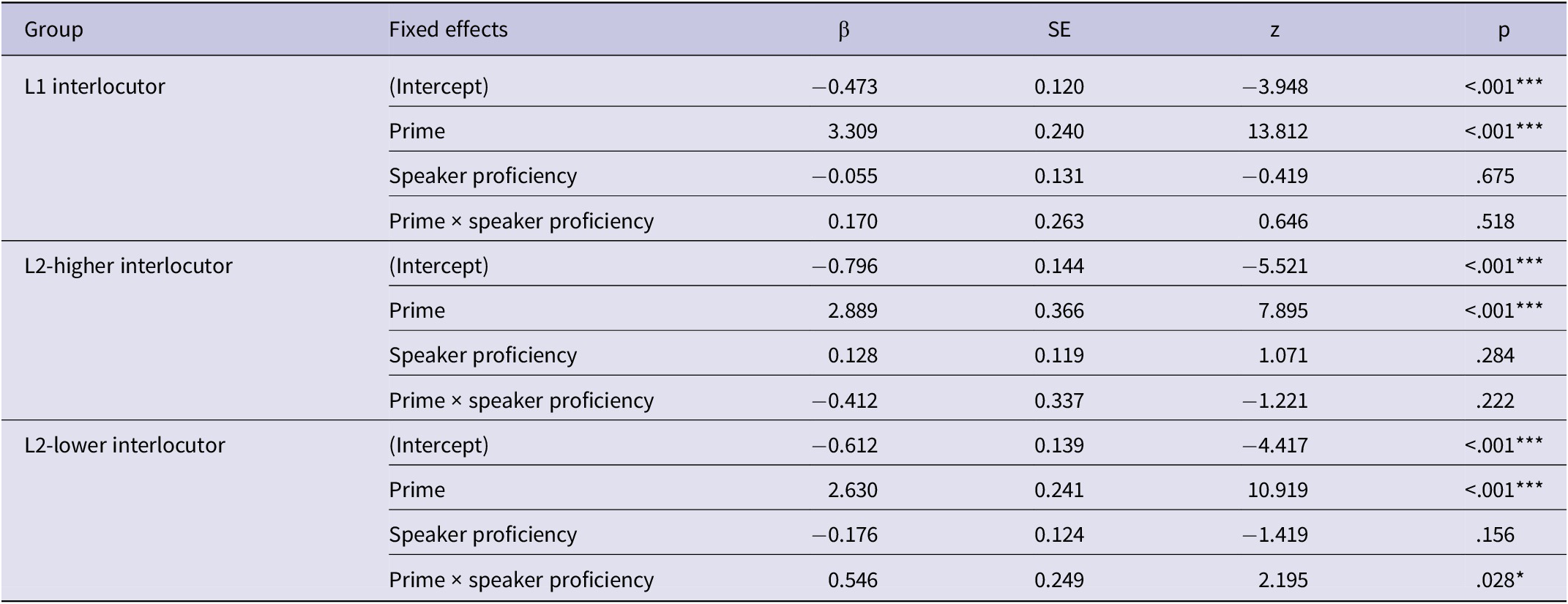
Note: The formula of the fit model for the L1 interlocutor dataset and the L2-higher interlocutor dataset: Response ~ Prime × Speaker proficiency + (1 | Subject) + (1 | Item); for the L2-lower interlocutor dataset: Response ~ Prime × Speaker proficiency + (1 + Prime | Subject) + (1 | Item).
We found a significant effect of prime across interlocutor conditions: the L1 interlocutor condition (β = 3.309, SE = 0.240, z = 13.812, p < .001), the L2-higher interlocutor condition (β = 2.889, SE = 0.366, z = 7.895, p < .001) and the L2-lower interlocutor condition (β = 2.630, SE = 0.241, z = 10.919, p < .001). Participants produced more disfavored names after disfavored name primes than after favored name primes, no matter when they believed they interacted with an L1 interlocutor, a more proficient L2 interlocutor or a less proficient L2 interlocutor.
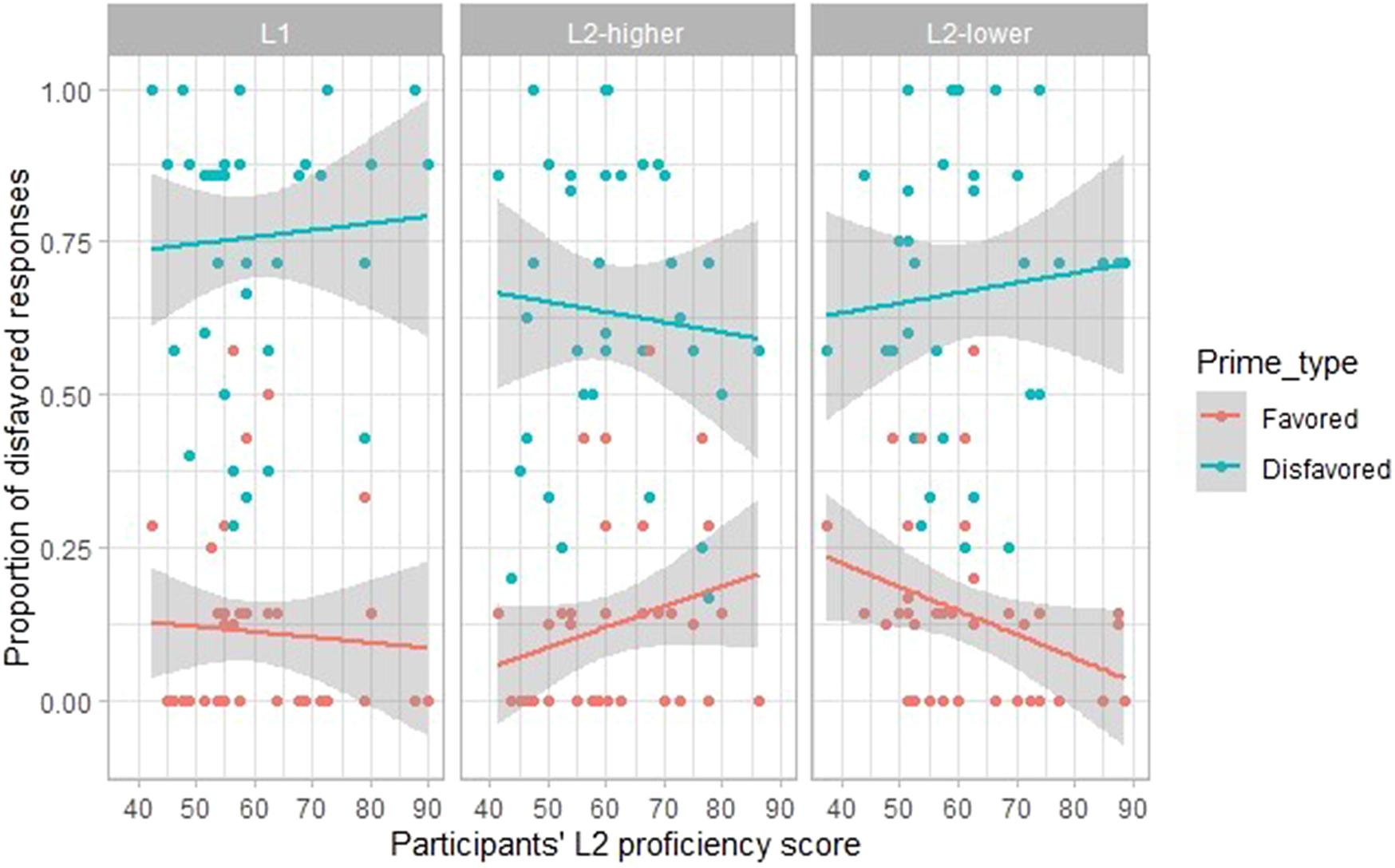
As for the modulating effect of L2 speakers’ proficiency, we observed a significant interaction between prime and participants’ proficiency in the L2-lower interlocutor group (β = 0.546, SE = 0.249, z = 2.195, p = .028), suggesting that L2 speakers demonstrated increased lexical alignment when addressing a less proficient L2 interlocutor as their L2 proficiency grows. As shown in Figure 4, with growing L2 proficiency, participants were more likely to use a disfavored name after the interlocutor had used the disfavored name, and less likely to use a favored name after the interlocutor had used the favored name. In contrast, the interaction between prime and participants’ L2 proficiency was not significant in either the L1 interlocutor (β = 0.170, SE = 0.263, z = 0.646, p = .518) or the L2-higher interlocutor condition (β = −0.412, SE = 0.337, z = −1.221, p = .222), indicating that L2 speakers’ propensity of lexical alignment did not change significantly as their L2 proficiency advances when interacting with an L1 interlocutor or a more proficient L2 interlocutor.
The proportion of disfavored responses as a function of participants’ proficiency (measured by LexTALE) across interlocutor conditions. The dots indicate individual data points, and gray lines indicate 95% confidence intervals.
5. Discussion
The current study investigated whether the lexical alignment by L2 speakers is affected by their beliefs about the interlocutor’s linguistic competence, and whether such an interlocutor effect is modulated by L2 speakers’ own proficiency. We observed a robust lexical alignment effect by L2 speakers in the text-based picture-naming and -matching task across the language status and L2 proficiency of the interlocutor. However, the magnitudes of L2 speakers’ lexical alignment varied with their beliefs about the interlocutor’s nativeness, such that they showed a stronger lexical alignment when they believed they were interacting with an L1 interlocutor versus an L2 interlocutor. However, we did not observe any effect of the relative L2 proficiency between speakers and their L2 interlocutor, since participants showed comparable degrees of lexical alignment in interactions with a more proficient L2 interlocutor versus a less proficient L2 interlocutor. More importantly, we observed a modulating effect of an L2 interlocutor’s linguistic competence on the relationship between L2 speakers’ proficiency and the degree of lexical alignment. With growing proficiency, L2 speakers showed increased lexical alignment when interacting with a less proficient L2 interlocutor, but unchanged lexical alignment when addressing an L1 interlocutor and a more proficient L2 interlocutor.
5.1. Effects of interlocutors’ linguistic competence
First of all, the overall pattern of results adds evidence to the idea that L2 speakers’ lexical alignment behavior is governed by both automatic and mediated processes (Michel & O’Rourke, Reference Michel and O’Rourke2019). On the one hand, the occurrence of lexical alignment in our research is in line with the findings from previous studies (e.g., Michel & O’Rourke, Reference Michel and O’Rourke2019; Suffill et al., Reference Suffill, Kutasi, Pickering and Branigan2021; Zhang & Nicol, Reference Zhang and Nicol2022), lending support to the pervasiveness of L2 speakers’ lexical alignment. These findings indicate that, like L1 speakers, L2 speakers’ reusing of the interlocutor’s lexical choices may also, at least to some extent, draw on an automatic priming process. Interestingly, L2 speakers in our study showed a relatively high rate of lexical alignment (53% in L2 interlocutor conditions and 65% in L1 interlocutor condition). This seems to be greater than the lexical alignment exhibited by L1 speakers reported in previous research using a similar interaction task and the same calculation method of alignment effect (e.g., experiment 1 in Branigan et al., Reference Branigan, Pickering, Pearson, McLean and Brown2011).
On the other hand, our study indicates a mediated process in L2 speakers’ lexical alignment, as evidenced by the significant differences in the magnitude of alignment in L1 and L2 interlocutor conditions. Consistent with the results reported by Zhang and Nicol (Reference Zhang and Nicol2022), we observed a heightened lexical alignment when participants believed they interacted with an L1 interlocutor as opposed to an L2 interlocutor. This also aligns with the findings from Michel and O’Rourke (Reference Michel and O’Rourke2019) who noted that German L2 learners showed more overlapping n-grams in a task-based text chat with a native speaker tutor than with a language learning peer. Corroborated by these findings, our work suggests that L2 speakers incorporate their beliefs about the interlocutor’s language status, to tailor lexical choices, revealing a primary role of mediated components in shaping L2 speakers’ lexical alignment.
We did not, however, find any difference in the magnitudes of L2 speakers’ lexical alignment between the L2-higher and L2-lower interlocutor conditions, implying that the interlocutor effect on L2 speakers’ lexical alignment does not occur across the board. Such a selective modulation of the interlocutors’ linguistic competence seems not to provide consistent evidence for the language-learning hypothesis proposed by Zhang and Nicol (Reference Zhang and Nicol2022). In this account, when L2 learners perceive their interlocutor as a better language model of the target language, they would align more with that interlocutor for the purpose of language learning (Zhang & Nicol, Reference Zhang and Nicol2022). This account could effectively explain the stronger lexical alignment toward the perceived L1 interlocutor, since participants in our study had good reasons to view the L1 interlocutor as an expert language model of English. Following the same logic, we had expected the lexical alignment based on language-learning mindset to be stronger with a more proficient L2 interlocutor than with a less proficient L2 interlocutor. Nonetheless, it turned out that L2 speakers showed comparable lexical alignment (53.1% vs. 53.0%) across L2 interlocutor conditions, manifesting no detectable sensitivity to the relative proficiency of their L2 interlocutors.
Instead, the lexicon-disparity hypothesis seems to offer a consistent explanation for the overall pattern. In this account, the stronger lexical alignment with the perceived L1 interlocutor might arise from the greater perceived disparity of activation profiles between L2 speakers and the perceived L1 interlocutor. To achieve similar activation profiles for successful communication, participants in our study would endeavor to mimic the L1 interlocutor’s word use to a larger extent. Contrarily, they perceived L2 interlocutors as their peers who have similar activation profiles in English, thereby considering it unnecessary to adjust their alignment behavior based on the proficiency levels of L2 interlocutors. Based on these findings, we propose that L2 speakers’ language learning purpose alone might not be sufficiently strong to modulate their propensity of lexical alignment. The conscious, non-automatic lexical alignment observed in our study appears to occur as a result of L2 speakers’ desire to achieve similar activation profiles with their interlocutor, and hence communicative success.
Alternatively, the different degrees of lexical alignment may also be explained from the perspective of the potential power dynamics between L2 speakers and their interlocutors. There has been a long-existing, yet probably mistaken assumption that the linguistic competence of native speakers has a superior status compared with that of non-native speakers, encompassing factors of fluency, range of vocabulary, knowledge of cultural nuance and so forth (Phillipson, Reference Phillipson1992). This perception is especially prevalent among EFL learners (Chun, Reference Chun2014). From a social relational perspective, a power asymmetry is likely to reside in such an assumed imbalanced native versus non-native status (Park, Reference Park2007; Vickers, Reference Vickers2010), which affects how people perceive themselves and their interlocutor, and adjust their language behaviors accordingly. According to Giles et al. (Reference Giles, Coupland, Coupland, Giles, Coupland and Coupland1991), alignment in conversation is indicative of speakers’ social affective attachment to their interlocutor. Previous literature has demonstrated that speakers tended to align more with the interlocutor at a higher power position than with the interlocutor at a lower power position (Danescu-Niculescu-Mizil et al., Reference Danescu-Niculescu-Mizil, Lee, Pang and Kleinberg2012). In this regard, the increased lexical alignment with the perceived L1 interlocutor observed in our study may indicate L2 speakers’ desire to show social affiliation with the interlocutor in a superior power status.
To sum up, it shows that interlocutors’ language status (native vs. non-native) rather than varying proficiency levels in the target language predominantly influences L2 speakers’ lexical alignment behavior. Therefore, it is suggested that L2 speakers may hold different assumptions about the language knowledge and power status to L1 and L2 interlocutors in the process which is known as partner modeling (Brennan, Galati, & Kuhlen, Reference Brennan, Galati, Kuhlen and Ross2010; Cai et al., Reference Cai, Sun and Zhao2021), and adjust their language production accordingly. L2 speakers’ change of lexical alignment propensity in L1 and L2 interlocutor conditions suggests that there appears to be a distinct boundary between native and non-native partner models. In contrast, the comparable lexical alignment in L2 interlocutor conditions seems to indicate a fuzzy boundary between non-native partner models that is insusceptible to their proficiency levels. To the best of our knowledge, this constitutes the first evidence that the modulation of interlocutor linguistic competence on L2 speakers’ lexical alignment is selective. The current work thus deepens our understanding of the mechanisms underlying L2 speakers’ lexical alignment by revealing that language status is a salient interlocutor attribute that L2 speakers routinely model during language production.
5.2. The effect of L2 speakers’ self-proficiency
Another important finding from the current study is that more proficient L2 speakers were more inclined to align with their peer interlocutor whose L2 proficiency was lower than their own. This pattern suggests a dynamic interaction between L2 speakers’ own proficiency and their perception of the L2 interlocutor’s proficiency in shaping L2 lexical alignment behavior. More specifically, to degree to which L2 speakers align lexically with L2 interlocutors of different proficiency levels might fluctuate along their L2 learning trajectory. The increased lexical alignment with the a less proficient interlocutor as the speaker’s L2 proficiency grows is related to the cognitive resources available for the task. According to the audience design account, speakers adapt to their interlocutor’s lexical choices for mutual understanding (Brennan, Reference Brennan1996), which involves a belief-based judgment about what would be the most comprehensible for the interlocutor (Branigan et al., Reference Branigan, Pickering, Pearson, McLean and Brown2011; Shen & Wang, Reference Shen and Wang2023). Arguably, this process per se is cognitively demanding (Roβnagel, Reference Roβnagel2000), and hence imposes a high cognitive load on L2 speakers. As their proficiency grows, L2 speakers presumably have more cognitive resources available for effective audience design (Segalowitz & Hulstijn, Reference Segalowitz and Hulstijn2005; Pivneva et al., Reference Pivneva, Palmer and Titone2012). Specifically, the increasingly available cognitive resources allow L2 speakers to monitor their language use to a greater extent based on their perception of the interlocutor’s linguistic competence. As a result, speakers with higher proficiency would be able to devote more effort to compromising with as a less proficient interlocutor in lexical choices, as indicated by an increase in the mimicry of their interlocutors’ lexical use.
Conversely, when addressing a more proficient L2 interlocutor or an L1 interlocutor, L2 speakers may have a high expectation of the interlocutor’s linguistic competence and predict that successful communication could be achieved without allocating increased attentional resources. As a result, they may deem it unnecessary to strengthen their repetition of the interlocutor’s word use for the purpose of maintaining successful communication, though they have increased cognitive resources to do so. In other words, L2 speakers only seem to adjust their lexical alignment behavior based on their interlocutors’ linguistic competence when they believe it has communicative value. This finding is in line with the claim from previous literature that alignment involves a utility-sensitive mechanism (Ostrand & Ferreira, Reference Ostrand and Ferreira2019). According to this mechanism, speakers assess whether adapting to their interlocutors’ language behaviors affects communicative utility, and only strengthen their alignment propensity when it benefits communication. Taken together, L2 speakers’ lexical alignment propensity may only be adjusted when two conditions are simultaneously met: they have sufficient cognitive resources available and the adjustment is deemed necessary for communicative success. The present study thus highlights that L2 speakers’ internal capacity and communicative utility jointly shape their lexical alignment behavior, providing support for the sociocognitive nature of L2 alignment.
However, the current findings are subject to several limitations. First, the employment of a highly controlled text-based interaction task to assess L2 speakers’ lexical alignment may compromise the generalizability of our findings to speech-based interaction in naturalistic settings. Previous literature has shown that modality affects the extent of linguistic alignment among L2 learners, with structural alignment being stronger in written modality compared to oral modality (Kim, Jung, & Skalicky, Reference Kim, Jung and Skalicky2019; Kim, Skalicky, & Jung, Reference Kim, Skalicky and Jung2020). It is interesting to employ natural interactive dialogue tasks, such as the route-giving task adopted by Suffill et al. (Reference Suffill, Kutasi, Pickering and Branigan2021), to test whether similar findings would be found. Another limitation is that we manipulated L2 interlocutors’ proficiency by informing participants that the interlocutor was at a higher or lower proficiency level with a written label. We did not provide other supporting clues. Although participants did not report any suspicion of the interlocutor’s proficiency in the manipulation check, we could not completely rule out the possibility that the manipulation was not so effective as expected and consequently mitigated the effect of L2 interlocutor proficiency. Therefore, we suggest that future research provide additional supporting evidence (e.g., better/worse L2 accent, shorter/longer response latency) to convince participants of the L2 interlocutor’s proficiency level. A further limitation is our manipulation of the proficiency discrepancy between participants and the L2 interlocutor. In the current study, participants were only informed whether their L2 interlocutors were at a higher or lower proficiency level, instead of the specific differences between their proficiency scores. Future studies may benefit from adopting a finer-grained manipulation of the proficiency discrepancy of the dyad. For instance, researchers can include an equivalent L2 condition, in which participants are informed to interact with an L2 interlocutor at the same proficiency level, to investigate the proficiency-similarity effect on lexical alignment. Moreover, it is also interesting to explore the correlation between the proficiency discrepancy of the dyad and L2 speakers’ degrees of lexical alignment. The last limitation is concerned with the imbalance of gender distribution of the sample in our study, as the female participants took the lion’s share. Since gender may potentially impact the propensity of alignment (e.g., Namy, Nygaard & Sauerteig, Reference Namy, Nygaard and Sauerteig2002; Babel, Reference Babel2012), we suggest that future research test the current findings on a sample with a balanced gender distribution.
6. Conclusion
To conclude, the current study investigated how L2 speakers’ beliefs about their interlocutors’ linguistic competence and their own proficiency affect the degree of lexical alignment. Results show that L2 speakers tended to align their lexical choices with their conversational partner regardless of their beliefs about the language status of the interlocutor; however, the magnitude of L2 lexical alignment was larger when they believed they were interacting with an L1 interlocutor than they believed that they were interacting with an L2 interlocutor. Furthermore, it is revealed that L2 speakers demonstrated comparable degrees of lexical alignment when they believed they were interacting with both more and less proficient L2 interlocutors. These findings suggest that the language status, rather than the relative L2 proficiency, of the interlocutor primarily influences L2 speakers’ adjustment of lexical alignment, highlighting a distinct boundary between L2 speakers’ modeling of L1 and L2 interlocutors. Finally, L2 speakers’ propensity of lexical alignment with interlocutors of different linguistic competences differs as their own L2 proficiency advances. Based on these findings, we conclude that L2 speakers’ lexical alignment involves a socially modulated dynamic process wherein cognitive resources available for the task and the perceived communicative utility work jointly.
Data availability
The stimuli and data of the current study are openly available at https://osf.io/dvnyt/.
Acknowledgments
*This work was supported by the National Social Science Fund of China (Grant NO. 23CYY041).
Competing interest
The authors declare none.
Appendix
Favored–disfavored name pairs for target pictures


 Open access

