


Social media have become an important arena for citizen–politician interactions (Jungherr Reference Jungherr2016; Lane, Do, and Molina-Rogers Reference Lane, Do and Molina-Rogers2021; McGregor Reference McGregor2020; Theocharis et al. Reference Theocharis, Boulianne, Koc-Michalska and Bimber2023). During campaign periods, they offer a platform where parties and politicians can discuss and engage with political issues in a relatively direct fashion; thus, they provide unprecedented opportunities for both sides to be seen and heard. For electoral candidates, being active on social media is associated with success in elections and in political office more generally, as these platforms offer a relatively inexpensive way to personalize campaigns (Guerrero-Solé and Perales-García Reference Guerrero-Solé and Perales-García2021; Hermans and Vergeer Reference Hermans and Vergeer2013; Mechkova and Wilson Reference Mechkova and Wilson2021). At the same time, social media environments have become spaces where politicians are subject to frequent toxicity, emanating both from political competitors and citizens, and ranging from harsh critique to harassment, insults, and psychological violence (Erikson, Håkansson, and Josefsson Reference Erikson, Håkansson and Josefsson2023; Rossini, Sturm-Wikerson, and Johnson Reference Rossini, Sturm-Wikerson and Johnson2021; Southern and Harmer Reference Southern and Harmer2021).
The social media platform X (formerly Twitter) has been identified as the medium in which most toxic behavior against politicians takes place, possibly because of its relatively open structure where everyone can “follow” (i.e., read and react to the tweets of) everyone else and users can act anonymously (Oz, Zheng, and Chen Reference Oz, Zheng and Chen2018). Studies into toxic behavior directed at elites find that between 5% and 15% of tweets mentioning politicians contain uncivil language and that the amount of toxicity to which a political representative is subject depends on temporal, contextual, and individual factors (Rheault, Rayment, and Musulan Reference Rheault, Rayment and Musulan2019; Theocharis et al. Reference Theocharis, Barberá, Fazekas and Popa2020; Ward and McLoughlin Reference Ward and McLoughlin2020).
Although political toxicity certainly is an unpleasant phenomenon, it is not necessarily a threat to an equal, democratic discourse. Toxicity from citizens toward their representatives may be seen as a way to voice legitimate critique against politicians’ actions, to signal dissatisfaction and outrage, and as a reaction to politicians themselves being uncivil in the online sphere (Masullo et al. Reference Masullo Chen and Muddiman2019; Rossini Reference Rossini2021; Sobieraj et al. Reference Sobieraj, Masullo, Cohen and Gillespie2020). Yet, toxicity that unequally targets politicians based on their identity and that contributes to further excluding marginalized groups from politics—thereby threatening political equality and representation— should evoke greater concern (Håkansson Reference Håkansson2023; Rossini, Sturm-Wikerson, and Johnson Reference Rossini, Sturm-Wikerson and Johnson2021). In this article, we ask whether—and how—toxicity unequally targets and affects politicians, comparing variations across their identity, role, and behavior.
Previous research into politicians’ exposure to online toxicity has used both survey and observational data to investigate the extent to which politicians are (unequally) targeted. Generally, a high share of the violence and abuse that politicians experience originates online (Collignon and Rüdig Reference Collignon and Rüdig2020; Erikson, Håkansson, and Josefsson Reference Erikson, Håkansson and Josefsson2023; Håkansson Reference Håkansson2020). Some studies find that women representatives are more exposed than their male colleagues, especially those women who are high up in the political hierarchy (Collignon and Rüdig Reference Collignon and Rüdig2021; Håkansson Reference Håkansson2020; Rheault, Rayment, and Musulan Reference Rheault, Rayment and Musulan2019; Southern and Harmer Reference Southern and Harmer2021), whereas others do not find gender differences in the frequency of exposure (Erikson, Håkansson, and Josefsson Reference Erikson, Håkansson and Josefsson2023; Theocharis et al. Reference Theocharis, Barberá, Fazekas and Popa2020) or indicate that men are attacked more frequently (Ward and McLoughlin Reference Ward and McLoughlin2020; Wendsjö, Bäck, and Kokkonen Reference Wendsjö, Bäck and Kokkonen2025). At the same time, women politicians are more likely to receive comments related to gender and sexuality (Beltran et al. Reference Beltran2021; Erikson, Håkansson, and Josefsson Reference Erikson, Håkansson and Josefsson2023; Kumar, Gruzd, and Mai Reference Kumar, Gruzd and Mai2021; Ncube and Yemurai Reference Ncube, Yemurai, Ndlela and Mano2020; Rossini, Stromer-Galley, and Zhang Reference Rossini, Stromer-Galley and Zhang2021). Likewise, there are indications that younger politicians, as well as those with an immigration background or who belong to ethnic or sexual minorities, are exposed to higher levels and different forms of discrimination both offline and online (Gorrell et al. Reference Gorrell2020; Håkansson and Lajevardi Reference Håkansson and Lajevardi2025; Vegt Reference Vegt2024). However, so far, we know relatively little about the extent to which politicians’ identity generally conditions exposure to online political toxicity and how this compares to the impact of other factors, such as their role, party, tweeting behavior, and the users with whom they interact.
Three main hypotheses emerge from previous research into the topic: the “identity,” the “role,”, and the “behavioral” hypotheses. The first suggests that online toxicity disproportionally and unequally targets individuals belonging to marginalized groups; the second assumes that the main decisive factor is politicians’ role, that is, their visibility; and the third claims that politicians’ exposure to toxicity is primarily conditioned by their own behavior on social media. To test these hypotheses, we draw on the literature about gendered political violence (Bardall, Bjarnegård, and Piscopo Reference Bardall, Bjarnegård and Piscopo2020; Krook Reference Krook2020). Using the three-dimensional framework proposed by Erikson, Håkansson, and Josefsson (Reference Erikson, Håkansson and Josefsson2023), we investigate and compare inequality in the frequency, form, and effects of political elites’ exposure to online toxicity.
We draw on empirical evidence from a European multiparty context. Using a full sample of candidates’ campaign activities on Twitter in the run-up to the 2021 German national election, the article analyzes toxicity in more than 13,000 Twitter conversations (comprising over 800,000 single tweets) between citizens and political candidates.Footnote 1 The main focus is citizen–candidate directed toxicity contained in replies to candidate tweets. We define political toxicity, which has also been called abuse, hostility, incivility, or violence in other studies, as the presence of hostile or offensive language in interactions between citizens and politically active individuals.
Empirically, we apply a context-specific, user-focused, and continuous definition of toxicity, proceeding in two steps. First, we use the Google perspective API to estimate the degree to which a random user would perceive a tweet as toxic. Rather than a dichotomous categorization, this is expressed in a continuous probability score that varies between 0 and 1, acknowledging the ambiguous and subjective nature of the phenomenon we investigate.Footnote 2 In a second step, we examine the directionality of toxicity by distinguishing who or what is addressed by toxic language. We here suggest that political toxicity can take not only the form of personal attacks against the candidate but also can be be directed against their party, a specific policy that they supported, or third parties, groups, or persons. We thereby acknowledge the complexity and subjectivity of the concept both theoretically and empirically, while at the same time making it comparable across individuals by applying the same definition, thereby addressing problems with self-reported exposure (Wirz and Blassnig Reference Wirz and Blassnig2025). Third, we test how political candidates react to receiving high shares of toxic replies during a day within the campaign.
Our findings provide most support for the behavioral hypothesis. First, we find that the frequency in which candidates are exposed to toxic replies does not generally vary by candidates’ group identity in terms of gender, age, immigration background, or sexual orientation nor does it by their role as incumbent or frontbencher. At the same time, politicians running for right-wing parties and those who tweet toxically themselves receive more toxic replies. Based on human coding of all highly toxic replies in the sample, we then show that the form of toxic attack does vary by candidates’ identity and role, albeit not in the direction that we had hypothesized. We find that highly visible candidates are more often personally insulted, whereas candidates belonging to politically marginalized groups and those running for left-wing parties more often receive attacks directed at their party or policy propositions. Finally, we find, again, that ideology and behavior are most relevant for the prediction of consequences of citizen-elite directed toxicity. Although candidates, on average, do not adjust their tweeting behavior when facing toxicity, receiving high shares of toxic replies on one day significantly reduces right-wing and toxically tweeting candidates’ tweet activity on the following day.
The article is among the first to bridge the literatures on online political toxicity in communication research with research into gender aspects of political violence. Our empirical approach provides a high level of detail in measuring the complex and multidimensional concept of online political toxicity through a combination of automated text analysis and qualitative hand-coding. It complements approaches using survey data by relying on a full observational sample of all candidates who actively used Twitter during their campaigns. The article is also among the first to provide a comparative perspective on the determinants for politicians’ exposure to online political toxicity by explicitly estimating the extent to which candidates’ identity, role, and behavior matter for exposure to citizen toxicity in comparison with each other.
In sum, our results do not suggest that online toxicity systematically perpetuates political inequality. Haters gonna hate, and they are disproportionally attacking those who are tweeting angrily themselves. At the same time, we also note that our study only captures public online toxicity and may thus miss threats and harassment sent via private messages or those that are automatically deleted. In addition, toxicity does increase the cost of being politically active online, which may further deter marginalized groups from even entering the online political sphere, particularly at the highest rungs of power.
What Do We Know about Online Political Toxicity?
Effective representation of citizens by politicians is conditional on the latter’s knowledge of people’s interests, preferences, and priorities. As Esaiasson and Wlezien (Reference Esaiasson and Wlezien2017) point out, representation relies on two main processes: listening and explaining. Performing these actions allows parties and politicians to get to know citizens’ policy preferences, respond to them, and make sure that citizens in turn understand (and, ideally, approve) policy outputs.
Listening and explaining have traditionally happened in a relatively distant fashion, with media like TV and newspapers discussing politics and thereby serving as an intermediary between the rulers and the ruled. Social media, in contrast, provide a much more direct channel of communication between individual citizens and politicians (Lane, Do, and Molina-Rogers Reference Lane, Do and Molina-Rogers2021; Schöll, Gallego, and Le Mens Reference Schöll, Gallego and Le Mens2023). Ideally, they allow parties and politicians to sense dissatisfaction earlier (listening) and to respond directly to it (explaining).
Social media then seem like a promising channel of communication for groups of citizens whose voices have been less well represented by traditional media outlets and who may be marginalized politically, economically, or socially. For instance, women representatives in the US context have been shown to communicate about less gendered topics and a wider range of topics when using social media (Russell Reference Russell2021). Women candidates in Sweden appear to value social media to a greater extent and evaluate social media use more positively than male candidates during campaigns (Sandberg and Öhberg Reference Sandberg and Öhberg2017). Generally, members of parliament who participate less in parliamentary debates can use social media to more freely express an opinion that deviates from the party’s position (Silva and Proksch Reference Silva and Proksch2021), and exposure to online political discussions can reduce polarization and expressions of intolerance (Siegel et al. Reference Siegel2021).
Conversely, research has also pointed out the pitfalls of political discussion in online spaces: Representatives may use these spaces to attack opponents rather than to engage in conversations with citizens (Nai, Tresch, and Maier Reference Nai, Tresch and Maier2022): this behavior may further polarize debates, because citizens who witness uncivil dialogue on social media are more likely to engage in uncivil online participation themselves (Antoci et al. Reference Antoci2016; Frischlich et al. Reference Frischlich2021). A recent study has demonstrated negative causal effects of politicians behaving uncivilly on citizens’ trust and satisfaction with democracy (Bøggild and Jensen Reference Bøggild and Jensen2025).
Politicians’ social media activities can also reproduce (gender) stereotypes (Beltran et al. Reference Beltran2021; Guerrero-Solé and Perales-García Reference Guerrero-Solé and Perales-García2021; Mechkova and Carlitz Reference Mechkova and Carlitz2021). For instance, women politicians tend to pursue stereotypical campaigns that emphasize “women’s” and cultural issues and communicate in a kinder manner with their followers than their male colleagues do (Fountaine Reference Fountaine2017; Guerrero-Solé and Perales-García Reference Guerrero-Solé and Perales-García2021; Tsichla et al. Reference Tsichla, Lappas, Kleftodimos and Triantafillidou2021)—and they are rewarded for this behavior by citizens (Schöll, Gallego, and Le Mens Reference Schöll, Gallego and Le Mens2023). Male politicians are, in contrast, more likely to use negative speech in their campaigns, talk more about masculine-coded political topics (Beltran et al. Reference Beltran2021), and be negatively attacked by other politicians (Wendsjö, Bäck, and Kokkonen Reference Wendsjö, Bäck and Kokkonen2025).
Research into citizens’ online political participation has shown that it can exacerbate, rather than reduce, gendered participation gaps, potentially because of gendered perceptions of political toxicity in online spaces (Abendschön and García-Albacete Reference Abendschön and García-Albacete2021; Chen-Xia et al. Reference Chen-Xia2022; Kim Ji and Park Reference Kim Ji and Park2019). So far, we know however relatively little about whether politicians belonging to politically underrepresented groups in terms of gender, sexual identity, age, and immigration background are generally (un)equally exposed to and affected by online political harassment and toxicity (but see Håkansson Reference Håkansson2023; Vegt Reference Vegt2024) and how their identity relates to other factors that may exacerbate exposure, such as politicians’ visibility and online behavior.
Online Toxicity and Political Equality
The literatures on online political incivility and violence against politicians have largely developed in parallel, despite addressing closely related phenomena. Whereas studies of online toxicity primarily debate whether incivility undermines democratic discourse or functions as a form of political expression (Masullo Chen and Lu Reference Masullo Chen and Lu2017; Masullo Chen et al. Reference Masullo Chen and Muddiman2019; Rossini Reference Rossini2020; Sobieraj et al. Reference Sobieraj, Masullo, Cohen and Gillespie2020), research on political harassment focuses more specifically on the “dark side” of online communication between citizens and politicians: threats, psychological violence, and intimidation (Collignon and Rüdig Reference Collignon and Rüdig2020; Erikson, Håkansson, and Josefsson Reference Erikson, Håkansson and Josefsson2023; Håkansson Reference Håkansson2023). Importantly, survey evidence from this strand of research consistently shows that online abuse is the most frequent form of violence reported by politicians (Collignon and Rüdig Reference Collignon and Rüdig2021; Håkansson Reference Håkansson2020; Reference Håkansson2023). In this article, we bridge these literatures to theorize how political conflict unfolds in digital environments and how it affects (inequality in) democratic representation.
We develop our theoretical framework based on Erikson, Håkansson, and Josefsson’s (Reference Erikson, Håkansson and Josefsson2023) model of gendered online abuse, which distinguishes three analytically separable dimensions: the frequency, character, and consequences of harassment. The authors argue that online abuse can be gendered in terms of how often it occurs, the forms it takes, and how it affects its targets. We extend this framework beyond gender to examine how online political toxicity varies more broadly across politicians’ identity, role, and ideology/behavior. In doing so, we conceptualize citizen–elite toxicity as potentially being motivated by three distinct logics: exclusion, critique, and counter-speech. Table 1 summarizes this overarching framework and our specific hypotheses. We describe each in detail in the remainder of this section.
Theoretical Framework and Hypotheses

Table 1 Long description
The table consists of four rows and three columns, anchored by the leftmost column which defines each theoretical dimension. The first row, ‘Dimension determining inequality,’ lists: Identity as ‘Affiliation with marginalized group (female, young, queer, immigration background)'; Role as ‘Visibility (incumbency, frontbencher status)'; Behavior as ‘Ideology and behavior (party affiliation and tweeting behavior)'. The second row, ‘Assumed logic/motive,’ presents: Identity as ‘Exclusion’; Role as ‘Critique’; Behavior as ‘Counter-speech’. The third row, ‘Frequency—amount of toxicity,’ details hypotheses: Identity as ‘H1a: Candidates belonging to marginalized groups will receive more toxic replies.’; Role as ‘H2a: More visible candidates will receive more toxic replies.’; Behavior as ‘H3a: Candidates belonging to parties on the left and right margins of the ideological spectrum and those who tweet toxically themselves will receive more toxic replies.’ The fourth row, ‘Form—target of toxicity,’ specifies: Identity as ‘H1b: Candidates belonging to marginalized groups are more likely to receive personal attacks.’; Role as ‘H2b: More visible candidates are more likely to receive policy attacks.’; Behavior as ‘H3b: Candidates belonging to parties on the left and right margins of the ideological spectrum and those who tweet toxically themselves are more likely to receive party and personal attacks.’ The fifth row, ‘Consequences—reaction to toxicity,’ includes: Identity as ‘H1c: Candidates belonging to marginalized groups will reduce the number of tweets sent when met with high shares of toxic replies.’; Role as ‘H2c: More visible candidates will not reduce the number of tweets sent when met with high shares of toxic replies.’; Behavior as ‘H3c: Candidates belonging to parties on the left and right margins of the ideological spectrum and those who tweet toxically themselves will increase the number of tweets sent when met with high shares of toxic replies.’
Identity Hypothesis
Our first set of hypotheses centers on toxicity targeting politicians because of their identity. A growing number of studies suggest that online hostility disproportionately targets individuals belonging to socially marginalized groups, including women, ethnic minorities, LGBTQ+ individuals, and younger cohorts (Krook Reference Krook2020; Megarry Reference Megarry2014; Sobieraj Reference Sobieraj2018; Vegt Reference Vegt2024). Online toxicity in this perspective is not merely a way to express dissatisfaction but also functions as a tool of symbolic exclusion, aimed at discouraging the political participation of marginalized groups and reinforcing existing power hierarchies (Krook Reference Krook2020; Puwar Reference Puwar2004; Young Reference Young2002).
Indeed, several studies find that female politicians receive significantly higher volumes of online abuse than their male counterparts, particularly when they occupy visible or powerful roles (Håkansson Reference Håkansson2020; Rheault, Rayment, and Musulan Reference Rheault, Rayment and Musulan2019; Southern and Harmer Reference Southern and Harmer2021). Moreover, women and minority politicians are disproportionately exposed to identity-based and sexualized insults (Beltran et al. Reference Beltran2021; Herrick Reference Herrick2019; Southern and Harmer Reference Southern and Harmer2021). Similar patterns emerge for politicians with immigrant backgrounds and LGBTQ+ identities, who are frequently targeted with racist, xenophobic, and homophobic content (Gorrell et al. Reference Gorrell2020; Ncube and Yemurai Reference Ncube, Yemurai, Ndlela and Mano2020; Vegt Reference Vegt2024). Although these groups are arguably very different from each other, they share the characteristic of being underrepresented in (German) politics and generally belong to groups positioned lower in societal hierarchies (Jenichen Reference Jenichen2020). Accordingly, we expect that politicians belonging to marginalized groups will be exposed to higher average levels of toxicity (H1a) and will face a greater likelihood of personal attacks targeting their identity and personal characteristics (H1b).
Beyond frequency and form, identity-based vulnerability is also expected to shape the consequences of toxicity. Research in political psychology and gender studies demonstrates that harassment imposes greater emotional and psychological costs on individuals who already experience structural disadvantage (Berdahl and Moore Reference Berdahl and Moore2006; Håkansson and Lajevardi Reference Håkansson and Lajevardi2025; Krook Reference Krook2020). Indeed, studies show that threat perception varies by group status, with (young) women and minority candidates being more likely to perceive hostile political environments as threatening and discouraging (Eady and Rasmussen Reference Eady and Rasmussen2025; Gubitz Reference Gubitz2022; Håkansson Reference Håkansson2023; Lawless and Fox Reference Lawless and Fox2015; Pedersen, Petersen, and Thau Reference Pedersen, Petersen and Thau2025). These dynamics suggest that marginalized candidates are more likely to respond to toxic feedback by reducing their online activity, potentially because of considerations of self-protection and risk avoidance. We therefore hypothesize that candidates belonging to marginalized groups will decrease their tweeting frequency when confronted with high levels of toxicity (H1c).
Role Hypothesis
A second hypothesis focuses on politicians’ role, particularly their institutional visibility and authority. Here, the primary motivation behind online toxicity is conceptualized as critique. Research consistently shows that political dissatisfaction, grievance, and protest (both online and offline) are disproportionately directed at actors perceived as responsible for political outcomes (Håkansson Reference Håkansson2024; Hobolt and Tilley Reference Hobolt and Tilley2014; Schöll, Gallego, and Le Mens Reference Schöll, Gallego and Le Mens2023). In this perspective, highly visible politicians such as incumbents and frontbenchers who symbolize political power and decision-making authority should be the main targets for expressions of anger, blame, and dissatisfaction.
This logic, too, fits with previous empirical findings. Studies demonstrate that online hostility is systematically directed toward elites occupying prominent political positions: ministers, party leaders, and high-profile legislators receive substantially more abusive messages than backbench representatives (Collignon and Rüdig Reference Collignon and Rüdig2020; Gorrell et al. Reference Gorrell2020; Theocharis et al. Reference Theocharis, Barberá, Fazekas and Popa2020). Accordingly, we expect that more visible politicians will face higher levels of toxicity (H2a). Regarding the form of toxicity, we expect that attacks directed at visible politicians will focus primarily on their policy positions (H2b). This follows the logic described earlier: Because high visibility tends to correlate with being higher up in the power hierarchy, individuals occupying these roles should be perceived as capable of shaping (and being hold accountable for) policy outcomes.
Finally, we expect limited behavioral consequences for visible politicians exposed to toxicity (H2c). Research on political professionalization indicates that experienced elites develop coping mechanisms and emotional resilience, enabling them to withstand hostile feedback without reducing political engagement (Pedersen, Petersen, and Thau Reference Pedersen, Petersen and Thau2025). Moreover, incumbents and frontbenchers have strong strategic incentives to maintain high levels of online activity, because social media constitute key tools for agenda setting, mobilization, and public visibility (Larsson et al. Reference Larsson, Tønnesen, Magin and Skogerbø2025). Therefore, H2c predicts stability rather than withdrawal.
Behavioral Hypothesis
Our third hypothesis posits that online toxicity is shaped by politicians’ ideology and their own communicative behavior. In this perspective, counter-speech constitutes the primary motivation for citizen–elite directed toxicity: hostile replies emerge as reactive responses to elite incivility and ideological extremity, potentially producing loops of escalating toxicity (Antoci et al. Reference Antoci2016; Wendsjö, Bäck, and Kokkonen Reference Wendsjö, Bäck and Kokkonen2025).
Social psychological research demonstrates that exposure to aggressive communication triggers reciprocal hostility (Anderson and Bushman Reference Anderson and Bushman2002; Bail et al. Reference Bail2018; Barlett and Anderson Reference Barlett and Anderson2012). Political incivility in candidate tweets can thus function as a provocation that intensifies emotional engagement and partisan identity activation (Gervais Reference Gervais2015; Reference Gervais2017). Empirical studies show that politicians who employ confrontational rhetoric or adopt extreme ideological positions receive significantly more abusive replies (Theocharis et al. Reference Theocharis, Barberá, Fazekas and Popa2020).
Applying the logic described earlier, ideology and behavior may then indeed be connected: politicians belonging to populist radical right or radical left parties frequently rely on polarizing rhetoric that frames politics as a moral conflict between antagonistic camps (Hameleers, Bos, and de Vreese Reference Hameleers, Bos and de Vreese2017; Müller Reference Müller2016). Such framing could then activate affective polarization, increasing emotional reactions and hostile engagement among supporters and opponents (Iyengar et al. Reference Iyengar2019; Jacobs, Sandberg, and Spierings Reference Jacobs, Sandberg and Spierings2020; Wendsjö, Bäck, and Kokkonen Reference Wendsjö, Bäck and Kokkonen2025). We therefore hypothesize that ideologically extreme and toxically tweeting politicians will receive higher levels of toxic replies (H3a).
Regarding the form of abuse, counter-speech dynamics suggest elevated levels of party-based and personalized attacks. Research on partisan identity shows that political disagreement increasingly manifests as hostility toward opposing political groups, rather than policy critique (Iyengar et al. Reference Iyengar2019; Mason Reference Mason2018). Toxicity in politicians’ tweets can personalize and essentialize conflict (Mjelva et al. Reference Mjelva2025), shifting interactions from substantive debate toward character-based attacks (Sobieraj and Berry Reference Sobieraj and Berry2011). We therefore expect that citizen–elite toxicity motivated by counter-speech should mostly occur in the form of party-focused and personal attacks (H3b).
Finally, we expect that exposure to toxicity will increase, rather than reduce, tweeting activity among ideologically motivated politicians (H3c). This suggestion is motivated by the evidence of toxicity spirals, with studies suggesting that politicians exposed to hostile feedback often intensify their communication efforts and adopt increasingly confrontational rhetorical strategies (Bail et al. Reference Bail2018; Wendsjö, Bäck, and Kokkonen Reference Wendsjö, Bäck and Kokkonen2025).
The German Context
The empirical analyses in this article draw on a full sample of German electoral candidates’ tweeting activities in the run-up to the 2021 national election. The German electoral system is characterized by a mix of proportional representation and first-past-the-post elements. Citizens elect candidates through a two-vote system: one for a candidate in a single-member constituency and the other for a political party (Maaser and Stratmann Reference Maaser and Stratmann2018). We focus on the so-called direct candidates—those who competed for the seats in the plurality tier of the system (about half the parliament)—because they conduct relatively personalized campaigns. In these contexts, social media and citizen–politician conversations tend to play a more important role than for candidates running on closed party lists (Hermans and Vergeer Reference Hermans and Vergeer2013).
The two parties that have been historically dominant in German politics are the Christian Democratic Union (CDU/CSU) and the Social Democratic Party (SPD). However, the landscape is notably pluralistic, featuring parties like the Greens ( Grüne ), the liberal Free Democratic Party (FDP), the Left Party ( Linke ), and the right-wing populist Alternative for Germany (AfD). The 2021 national election campaign revolved around debates on climate change, social welfare, economic recovery post–COVID-19, and Germany’s role in the European Union (Ackermann, Elff, and Giebler Reference Ackermann, Elff and Giebler2023). These topics, especially COVID policies, led to heated debates during the campaign both about the previous decisions of ruling politicians and about their plans for the future; these debates are clearly reflected in our material. CDU and SPD entered the campaign as government parties that had been in a coalition for the past eight years. Chancellor Angela Merkel, who had ruled the country since 2005, did not compete in the election. The election outcome was a narrow victory for the SPD, who later entered a coalition agreement with the Greens and the Liberals for the first time in German history (Faas and Klingelhöfer Reference Faas and Klingelhöfer2022). As Abels et al. (Reference Abels, Arhens and Och2022) point out, the 2021 elections were characterized by comparatively high numbers of female, young, and minority candidates and produced an unusually diverse Bundestag (the German parliament).
The 2021 German federal election offers a valuable case for analyzing citizen–candidate interactions and the use of toxicity on social media. Our study complements accounts of toxicity and political violence that predominantly rely on evidence from the English-speaking world. Analyzing online toxicity in a different linguistic and cultural context provides important nuances to how we should define, understand, and assess inequality in online abuse. Our study also complements previous empirical evidence on online toxicity and violence that predominantly relied on studies of the Anglo-American (Collignon and Rüdig Reference Collignon and Rüdig2020; Kuperberg Reference Kuperberg2018; Ward and McLoughlin Reference Ward and McLoughlin2020) and Scandinavian contexts (Erikson, Håkansson, and Josefsson Reference Erikson, Håkansson and Josefsson2023; Håkansson Reference Håkansson2024).
The German multiparty system creates a more nuanced and complex environment for political discourse than does the US two-party system. Despite increasing political tensions, Germany maintains relatively moderate levels of political polarization, making it possible to examine toxic communication patterns in a less extreme political environment (Hebenstreit Reference Hebenstreit2023; Jungherr Reference Jungherr2015). At the same time, its political culture is less consensus oriented and also characterized by lower levels of political equality and diversity than the Swedish context, for example (Abels et al. Reference Abels, Arhens and Och2022). In general, we would thus expect that inequality in the exposure to online abuse in the context of Germany should be less likely than in the highly polarized and highly unequal US political landscape but more likely than in a Scandinavian country. Importantly, our analysis relies on data collected before the switch from Twitter to X, which was accompanied by significant changes regarding content moderation and guidelines. We discuss next the implications of both the case selection and the change in the social media landscape for the generalizability of our findings more in detail.
Data and Methods
The analysis builds on three main datasets compiled using the Academic Track of Twitter’s Application Programming Interface (API) and the R-package academictwitteR (Barrie and Ho Reference Barrie and Ho2021): the conversation dataset, the toxicity dataset, and the grouped dataset.
We built these three datasets by first compiling information on all 1,697 direct candidates in the 2021 German national elections, including data on their gender, age, (expressed) sexual orientation, whether they have an immigration background, their party affiliation, and incumbency, as well as frontbencher status.Footnote 3 This information was compiled from different sources. Data on age, gender, incumbency, frontbencher status, and party affiliation were collected from the electoral authority and the political parties’ webpages. Because young politicians may be specifically exposed to online toxicity (Erikson and Josefsson Reference Erikson and Josefsson2019), we added an indicator variable for candidates up to the age of 35. Furthermore, to understand how citizen–candidate toxicity varies by candidates’ party ideology, we used German parties’ ideology scores provided by the 2019 Chapel Hill Expert Survey (Jolly et al. Reference Jolly, Bakker, Hooghe, Marks, Polk, Rovny, Steenbergen and Vachudova2022) to assign parties a general left-right score, as well as a GAL-TAN-score (Green/Alternative/ Libertarian-Traditional/Authoritarian/Nationalist dimension).
To identify candidates with an immigration background, we relied on several sources and operationalizations. First, we used the German microcensus definition of “a person who does not have the German citizenship or is born to at least one parent who does not” to arrive at a broad definition of immigration background that includes all candidates with at least one-foreign born parent (including those with European backgrounds).Footnote 4 This definition is widely used to denote “immigrant” background, including in previous studies of politicians’ online experiences (Håkansson and Lajevardi Reference Håkansson and Lajevardi2025). We received this information from a report disseminated by the German think tank “Mediendienst Integration” (Media Service for Integration; Integration 2021) that relies on a broad range of sources, including publicly accessible biographies provided by the German parliament and the political parties.Footnote 5
Recall that our theoretical framing centers around groups being “marginalized” in politics, including both a dimension of descriptive underrepresentation and one of being placed lower in societal hierarchies. Although the first criterion is clearly fulfilled for the broad definition of immigrant background—in general, Germans who are themselves foreign-born or have at least one foreign-born parent are underrepresented in politics (Jenichen Reference Jenichen2020)—arguably not all of them would be perceived to belong to groups lower in societal hierarchies. Following our argument that fully marginalized groups should be most exposed to and affected by citizen–elite toxicity motivated by exclusion, we added an additional variable (narrow immigration background) to identify candidates with a Turkish, Arab, or African migration background, because they may be subjected to more specific forms of racism and harassment than the group included under the broad definition (Gorrell et al. Reference Gorrell2020; Kuperberg Reference Kuperberg2021).
Finally, we added an indicator of whether a politician was openly gay, lesbian, trans, or bisexual. We primarily relied on information provided by the wikipedia portal “Topic Homo-/Bisexuality Politicians.”Footnote 6 Candidates appearing there are coded as LGBTQI*. Importantly, the coding of both immigration background and sexual orientation relies on publicly available information and might thus miss some candidates who keep their parents’ nationality or sexual orientation private. Arguably, if this is private information, it should not affect the way they would be targeted by citizens online who would normally not have intimate knowledge of these parts of candidates’ identity.
Of the candidates, 70% are men and 30% are women, and about two-thirds owned a Twitter account at the time of data collection.Footnote 7 Through the API, we then downloaded all tweets sent by each candidate six weeks before and up until one day before Election Day (September 25, 2021). The period of observation thus comprised 40 days. Next, we excluded from this dataset all tweets that were themselves replies to tweets from others, so that all the candidate tweets included in the final dataset are original tweets sent by the candidates (retweets are included). The reason behind this decision was to identify how citizens behave when candidates spark a conversation and thus “own” it. We then downloaded all replies to these tweets, making use of the “conversation-id” feature that identifies tweets and replies belonging together. In a third step, the datasets were merged to create what we refer to as the conversation dataset in the remainder of the article.
Note that this panel-dataset has a nested structure: our unit of analysis is citizen-replies that are nested in both users (because the same user can send several replies to one or more politicians), original candidate tweets (because there are multiple replies to one tweet sent by a candidate), and candidates (because one candidate often sends multiple tweets during the campaign period). The final conversation dataset contains 875,028 observations—that is, replies—by 99,647 different users to 13,607 tweets sent by 579 different candidates over a period of 40 days. The summary statistics in table A.1 in appendix A provide information about all the key variables used in the analysis and their coding and distribution.
Our dependent variables rely on the toxicity score of the replies. Toxicity scores were generated by use of Google’s perspective API and the accompanying R-package, peRspective (Votta Reference Votta2022). The API uses machine learning (large language models) and artificial intelligence to score the perceived impact a comment might have on a conversation. The documentation accompanying the API defines a toxic comment as being “a rude, disrespectful, or unreasonable comment that is likely to make a user leave a discussion or give up on sharing their perspective” (https://favstats.github.io/peRspective/). The toxicity score calculated on the replies is a probability score between 0 and 1, indicating the likelihood that a random user would perceive the text as toxic. The language models were trained by Google based on the procedure described on the Perspective API webpageFootnote 8:
We train each model on millions of comments from a variety of sources, including comments from online forums such as Wikipedia and The New York Times, across a range of languages. For each comment 3–10 raters who speak the relevant language annotate whether or not a comment contains an attribute (e.g. TOXICITY) following specific instructions [see table B.1, Rater Instructions]. We then post-process the annotations to obtain labels by calculating the ratio of raters who tagged a comment as each attribute. As a result, if 3 out of 10 raters tagged a comment as toxic, we train the API models to provide a score of 0.3 to this and similar comments.
The models were then validated by extensive human coding (governed by Google; see the detailed description in appendix B.2) and performed well, achieving 94% accuracy for the toxicity scores in the German language.
This way of measuring toxicity has both advantages and limitations. On the positive side, the API applies a consistent set of criteria across all comments, making it possible to compare toxicity scores across candidates and contexts. It also provides a continuous, rather than binary, measure to acknowledge the subjective element and the uncertainty necessarily attached to any interpretation and understanding of human spoken interaction. By applying a user-focused definition of toxicity, rather than relying on an a priori definition of what constitutes problematic or toxic behavior, we followed the most recent methodological advances made in the field (Rasmussen et al. Reference Rasmussen, Bor, Osmundsen and Petersen2024).
One main shortcoming of these toxicity scores is that they cannot assess the severity of a comment or the extent to which it is perceived as abusive by the person it targets. Recall that a comment with a toxicity score of 0.9 is not necessarily more toxic than a comment with a score of 0.7. Instead, it is more likely to be perceived as toxic by more readers. To give some examples of how the perspective-API works, see the following reply to a tweet that received the average toxicity score in the sample, 0.29. Recall that this means, on average, 29% of people would perceive such a comment as disrespectful and rude:“But no one says anything about compulsory vaccination against measles. As if that were anything different than Corona. And if nobody cares about measles, why about Corona?” In contrast, a reply with a toxicity score of 0.75 reads as follows: “You bring criminals to Germany. Child molesters and thugs, Islamists. Pooh!”
As a second step, and to test our hypotheses about the form of toxicity that candidates are subjected to, we focused on a subset of the main dataset that we refer to as the toxicity dataset in the remainder of this article: it only includes replies with toxicity scores of 0.75 or higher. In total, 6% (54,415) of all replies fulfilled this criterion. Although we acknowledge that cut-off points are always somewhat arbitrary, the chosen threshold is based on two main considerations. First, three-quarters of users would, on average, perceive a comment as toxic, which is a high enough threshold to exclude milder forms of toxicity. Second, it ensures the capture of problematic toxicity, which may indeed be considered a form of psychological violence. The Google perspective webpage also recommends that researchers use a threshold between 0.7 and 0.8 when studying online harassment. Although this threshold means that we may occasionally miss replies that are subjectively perceived as toxic by the targeted politician, it allows us to come as close as possible to a comparable measure of citizen–elite directed toxicity.
To focus specifically on toxicity directed against the political candidate, we then excluded replies that did not in fact address the original candidate tweet but reacted to other users’ replies. This left us with 53,184 tweets. In the next step, these replies were hand-coded by one of the authors (who is a German native speaker) to classify the target and forms of toxicity/attack that they contain. Human coding allows us to consider the context in which toxic remarks are made and thus to go beyond toxicity in the tone of a reply. First, we classified whether the toxicity did in fact target the candidate, rather than a third person or a group. Most of the groups that were targeted were the chancellor candidates of the same or of other parties, political adversaries, or politicians in general. Interestingly, less than half of toxic replies (about 48% or 25,469 tweets) contained toxicity that was in fact aimed at the candidate in question.
We then proceeded with a second round of hand-coding to determine the form of attack directed at the respective candidate: Did the reply contain a personal attack, an attack on the party of the candidate, or an attack on a specific policy? Note that these categories are not mutually exclusive: one tweet can arguably include one, two, or all such forms simultaneously. This is reflected in our coding system: each tweet receives a separate indicator variable (0/1) for each of the different forms of attack. A reply was coded as containing personal attacks when it contained direct insults, threats, or harassment of the candidate in question. A party attack was defined as negative statements about the party of the candidate, whereas policy attacks had to express dissatisfaction with a specific policy. A detailed codebook used to classify the different types of toxicity can be found in appendix E.Footnote 9
The reason for the decision to restrict hand-coding only to replies that were addressed to the original candidate tweet and that targeted the candidate directly, rather than third persons or groups, was to focus our analysis on the direct exchange between citizens and candidates, rather than examining all toxicity in the surrounding conversation. Accordingly, we only focus on the specific subset of 25,469 toxic replies when estimating variation by the form of toxicity and to test hypotheses H1b, H2b, and H3b. This allows us to assess specifically whether and how the forms of attacks targeting candidates directly vary by their identity, role, or behavior. In contrast, when we estimated the average frequency and the consequences (using the conversation dataset and the grouped dataset), testing H1a–H3a and H1c–H3c, we used the full dataset of 874,760 tweets (grouped into 22,932 candidate-day observations). This decision was motivated by the fact that candidates may react (and potentially adjust their tweeting activity) in response to the general toxicity present in their Twitter conversations, even if they are not directly targeted. Measuring exposure in this broader way is also in line with previous studies’ approaches to analyzing online abuse on Twitter, thereby making our results comparable (Gorrell et al. Reference Gorrell2020; Theocharis et al. Reference Theocharis, Barberá, Fazekas and Popa2020).
We then used linear models with multiple clustered standard errors (in the R package fixest) to estimate variation in the degree and the forms of reply toxicity depending on the candidates’ identity, role, and behavior. In the first analysis, to test our hypotheses about the frequency of exposure (H1a–H3a), we regressed the average reply toxicity that a tweet-candidate observation receives on candidates’ characteristics regarding their identity, their role, and tweeting behavior/party affiliation. In all models, we controlled for candidates’ overall tweet activity and their general social media visibility by including the (standardized) number of tweets sent by the candidate and the (standardized) average number of replies by tweet they received. We also included a control for the day of the campaign to adjust for general time trends in reply toxicity. All models furthermore accounted for the multiple nesting of observations by including standard errors that are clustered by respondent ids, tweet ids, and candidate ids (Cameron, Gelbach, and Miller Reference Cameron, Gelbach and Miller2011). Furthermore, we acknowledge that the average degree of reply toxicity may not accurately capture the problem of receiving any toxic replies at all (consider a death threat received on social media that may have an impact independent of the total (nontoxic) number of replies that a candidate receives). Therefore, as a main robustness test, we also estimated generalized linear models that take the likelihood to receive a toxic reply (0/1)—defined as having a toxicity score of 0.75 or higher—as the dependent variable.
Our second analysis focuses on the forms of attacks directed at politicians. To test our hypotheses about whether candidates are targeted by different types of attacks depending on their identity, role, and behavior (H1b–H3b), we estimated the likelihood that a toxic reply contains personal, party-directed, or policy-related attacks. As pointed out earlier, these forms can occur simultaneously. Therefore, we used generalized linear models to estimate the likelihood for each form of attack (binary, 0/1), using the same controls and specifications as described earlier.
Finally, to estimate effects of online political toxicity on candidates’ tweeting behavior, we used a third, aggregated version of the original data that groups observations on the candidate-day-level: the grouped dataset. This dataset had the following additional variables: number of tweets (per candidate per day), the number of total replies (per candidate per day), the share of toxic replies received (defined with the threshold of 0.75, as explained earlier), and the average toxicity score of the tweets that a candidate sent within a given day. To investigate if and how candidates reacted to being exposed to high degrees of political toxicity and to test hypotheses H1c, H2c, and H3c, we estimated two-way-fixed effect (TWFE) or “within” models (with fixed effects for candidate and day) using the R package plm (Croissant Reference Croissant, Millo and Croissant2018). The goal here was to investigate how receiving a high share of toxic replies affects tweeting activity on the following day “within” a given candidate. The main dependent variable was the number of tweets sent per day. Again, we analyzed whether and how reactions vary by candidates’ identity, role, and behavior.
Descriptives
Before presenting the results of the multivariate analyses, this paragraph provides a descriptive overview of the conversation dataset. As shown in the summary statistics in table A.1, the majority of observations (69%) are replies to tweets from candidates of the two large German parties, the SPD and the CDU. Together with the allied CSU, these parties entered the campaign as government parties, whereas the other parties were opposition parties. Incumbent candidates, defined as those who held office in the previous legislature, are overrepresented in the conversations (78% of observations) and frontbenchers even more so (80% of observations). In terms of identity, 20% of the replies went to female candidates, 10% to those with an immigration background broadly defined, and 10% to openly LGBTQI* candidates.
Figure 1 (see appendix F for similar figures by other characteristics) focuses on gender differences regarding candidates’ tweeting behavior and average reactions. It illustrates patterns found regarding other identity groups. Male (straight, white) candidates tend to tweet more and receive more replies and likes to their tweets than women (LGBTQ* and immigration background candidates). The same pattern is also present among incumbent versus non-incumbent candidates (figure F.1).
Reactions to Tweets by Candidate Gender
Note: Plots show tweet activity and the number of replies/likes/retweets by candidate gender. N = 13,161.

Figure 1 Long description
The figure consists of four panels arranged in a two-by-two grid. Each panel features a box plot with the x-axis labeled candidate gender, showing two categories: f for female and m for male.
Top-left panel: nr. of tweets. The y-axis ranges from 0 to 2000. Both genders show low medians, but the male category has a higher upper quartile and more extreme outliers, reaching nearly 2000.
Top-right panel: nr. of replies. The y-axis ranges from 0 to 3000. The male category shows a significantly larger interquartile range and higher outliers compared to the female category, which is concentrated near zero.
Bottom-left panel: nr. of likes. The y-axis ranges from 0 to 30000. Both categories have very low medians, but the male category has a denser cluster of high-value outliers, with one extreme outlier for each gender exceeding 30000.
Bottom-right panel: nr. of retweets. The y-axis ranges from 0 to 6000. The distributions are similar for both genders, with medians near zero, though the female category has a single extreme outlier near 7000, while the male category has a higher density of outliers between 1000 and 3000.
As mentioned, the average reply toxicity in the sample was 0.29, and 6% of tweets containing toxicity scored 0.75 or higher. At first glance, there are few gender differences both regarding the toxicity of tweets sent and replies received, as shown in figure 2. Again, these patterns are similar regarding incumbency status, immigration background, and revealed sexual identity (figures F.3, F.8, and F.9). On average, throughout the sample, toxicity levels in replies are slightly higher than in the original tweets sent by the candidates.
Toxicity of Tweets and Replies by Candidate Gender
Note: Plots show the toxicity scores of tweets sent by female and male candidates, as well as the average reply toxicity by tweet and candidate gender. N= 874,760.

Figure 2 Long description
The left panel is titled toxicity of candidate tweet and displays boxplots for candidate gender f and m along the x axis, with toxicity scores from 0.00 to 1.00 on the y axis. The median toxicity for female candidates is higher than for male candidates, with the interquartile range and whiskers extending further for females. Outliers are present above 0.75 for both genders, more densely for males. The right panel is titled toxicity of reply and shows boxplots for replies to female and male candidates. Both genders have similar median toxicity and interquartile ranges, with whiskers and outliers extending to the maximum score of 1.00. The overall distribution of reply toxicity is similar for both genders, with slightly higher medians than candidate tweet toxicity.
Results
Frequency of Exposure to Online Political Toxicity
In a first step, we measured and compared the impact of candidates’ identity, role, and behavior on our first dependent variable, the frequency of exposure to online political toxicity. We assessed the average toxicity contained in citizen replies to a tweet sent by a candidate to test hypotheses H1a, H2a, and H3a. Recall that these analyses were performed on the full dataset, meaning that we measured candidates’ general exposure to any toxicity contained in replies to their tweets. Table 2 shows the results.
Linear Models: Average Reply Toxicity by Candidate Identity, Role, and Behavior
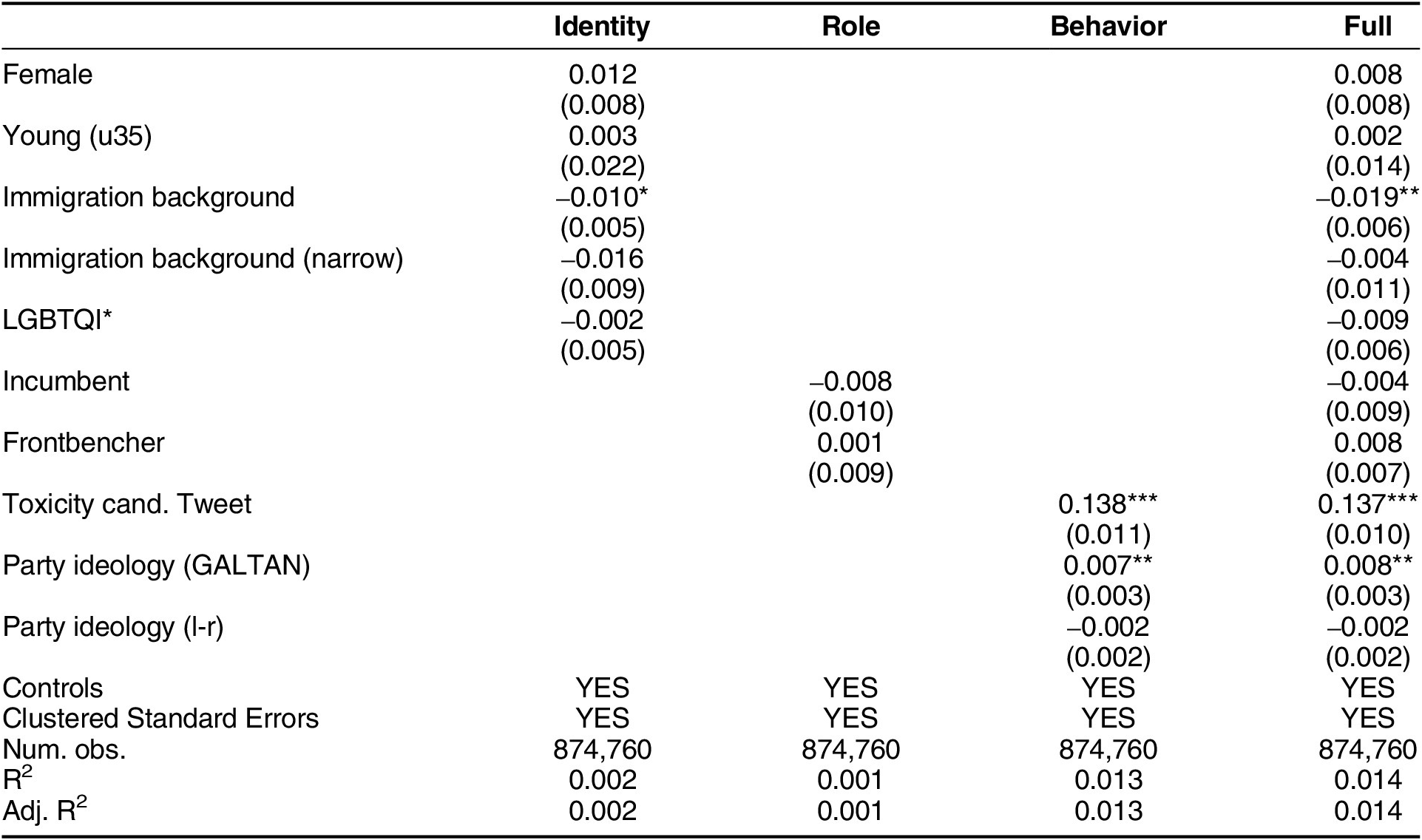
Table 2 Long description
The table presents linear model results for average reply toxicity, organized by four columns: Identity, Role, Behavior, and Full. Each row lists a candidate attribute or model feature, with coefficient and standard error values. For Identity: Female has coefficients 0.012 (standard error 0.008) in Identity and 0.008 (0.008) in Full; Young (u35) is 0.003 (0.022) in Identity and 0.002 (0.014) in Full; Immigration background is negative 0.010 (0.005) in Identity and negative 0.019 (0.006) in Full, both significant at p less than 0.05 and p less than 0.01 respectively; Immigration background (narrow) is negative 0.016 (0.009) in Identity and negative 0.004 (0.011) in Full; L G B T Q I is negative 0.002 (0.005) in Identity and negative 0.009 (0.006) in Full. For Role: Incumbent is negative 0.008 (0.010) in Role and negative 0.004 (0.009) in Full; Frontbencher is 0.001 (0.009) in Role and 0.008 (0.007) in Full. For Behavior: Toxicity candidate Tweet is 0.138 (0.011) in Behavior and 0.137 (0.010) in Full, both significant at p less than 0.001. Party ideology (GALTAN) is 0.007 (0.003) in Behavior and 0.008 (0.003) in Full, both significant at p less than 0.01. Party ideology (l-r) is negative 0.002 (0.002) in both Behavior and Full. Controls and clustered standard errors are included in all models. Number of observations is 874,760 for all columns. R squared and adjusted R squared values are 0.002 for Identity, 0.001 for Role, 0.013 for Behavior, and 0.014 for Full.
*** p < 0.001; ** p < 0.01; * p < 0.05
Note: Estimates are based on linear models with standard errors clustered on the level of the respondent id, the original tweet, and the candidate id. Controls include the (standardized) number of replies and tweets on the candidate level and the day of the campaign the reply was received. The dependent variable in all models is the average reply toxicity received by a tweet-candidate observation.
As can be seen, various dimensions of candidates’ identity seem to make little difference in the average level of reply toxicity (H1a). The coefficients in the “identity” model suggest that there is no systematic variation in general reply toxicity based on the candidates’ gender, age, or sexual orientation. Interestingly, candidates with an immigration background appeared to receive less toxic replies on average. The effect is present for both operationalizations of immigration background but is only significant for the broad definition. This can be an effect of sample size, because more candidates fall under the broad definition than the narrow one. Or, it might be the case that citizens show more respect toward candidates with immigration backgrounds, aligning with insights from experimental studies showing that people are more likely to perceive negative comments as problematic when they are directed against women or minorities (Eady and Rasmussen Reference Eady and Rasmussen2025; Pedersen, Petersen, and Thau Reference Pedersen, Petersen and Thau2025; Wirz and Blassnig Reference Wirz and Blassnig2025). In sum, the data do not support H1a.
Our second hypothesis H2a suggested that more visible candidates should be more frequently exposed to online toxicity, but this does not seem to be the case either – both the coefficients for the incumbency variable and the frontbencher indicator are small and statistically insignificant throughout specifications. In contrast, candidates’ behavior and ideology appear to be more important for general exposure to toxic replies. As suggested in H3a, politicians tweeting more toxically also receive more toxic replies on average. The same goes for candidates belonging to culturally right-wing parties. Both effects are substantial and significant throughout specifications. Figures 3 and 4 illustrate the predicted average reply toxicity based on parties’ GALTAN-score (where higher values indicate more traditional-authoritarian-nationalist orientation) and the toxicity of the original candidate tweet sparking the conversation.
Predicted Reply Toxicity by Parties’ GAL-TAN Score
Note: Plot shows the predicted reply toxicity based on parties’ GALTAN-score with a 95% confidence interval. Based on estimates from model 4.

Predicted Reply Toxicity by Toxicity of Original Tweet
Note: Plot shows the predicted reply toxicity by the toxicity score of the original tweet sent by the candidate with a 95% confidence interval. Based on estimates from model 4.

One main critique of this narrative may be that the average level of reply toxicity is not what should be measured to assess inequality in the frequency of exposure. Arguably, when thinking of violence in an offline arena, one severe incident (vs. none) might be what we would want to measure, rather than the relative frequency of violent versus nonviolent interactions. Therefore, we also estimated how candidates’ likelihood to receive a toxic reply to any of their tweets varies by identity, role, and behavior. We here estimate the likelihood to receive a toxic reply based on the 0.75 defined cut-off (binary: 0/1) as explained earlier. As can be seen in table D.1 in the appendix, results are relatively similar. However, in this specification, the model additionally predicts that frontbenchers are significantly more likely than less visible candidates to receive a toxic reply to any sent tweet, lending some more support to H2a.
Forms of Online Political Toxicity
Next, we tested whether the form of attack that candidates are being exposed to varies by either their identity, role, or ideology/behavior, as suggested in hypotheses H1b, H2b, and H3b. To do so, we focused the analysis on the toxicity dataset, which includes all the replies qualified as highly toxic (toxicity score of at least 0.75). Table A.2 contains the summary statistics for this dataset. Less than half of all highly toxic replies were directly targeting the respective candidate, with the rest targeting persons other than the candidate sending the tweet—for instance, the chancellor candidate of the respective party—or other groups (like political adversaries, minorities, etc.), or general, unspecific toxicity against (all) politicians. This is an important finding in itself, considering that many studies of online toxicity explicitly or implicitly assume that toxic tweets mentioning the Twitter handle of a politician do in fact target this politician.
Subsequently, the toxicity included in the replies directed against the candidate was classified regarding its character: whether it contained personal insults, attacks against the candidate’s party, or policy attacks.Footnote 10 As displayed in table A.2, personal insults had the highest frequency across the sample, with 59% of replies containing this form of toxicity. In contrast, party-related insults and offensive policy-related attacks were only recorded for about one-fourth and one-fifth of the sample, respectively. This is not a finding on its own, because personal attacks have a higher baseline of likelihood to be flagged by the perspective algorithm. It does, however, allow us to estimate whether and how the type(s) of toxicity contained in replies vary by candidate characteristics.
Recall that we had expected that candidates belonging to a marginalized group (identity) would be more likely to receive personal attacks, that the most visible candidates (role) would be more subjected to policy attacks, and that candidates behaving toxically and belonging to ideologically extreme parties (ideology/behavior) would be most likely to receive party and personal attacks. To test these suggestions, we conducted a series of generalized linear models to estimate how likely a toxic reply was to include the respective forms of toxicity.Footnote 11 Again, all models include the same control variables as in the previous analysis and are estimated with multiple clustered standard errors. Figure 5 displays all coefficients throughout the full models. As can be seen, compared to general exposure to toxicity, there is some more variation depending on candidates’ identity and role when we look at the form of toxicity to which they are exposed.
Type of Attack by Candidate Identity, Role, and Behavior
Note: The plot visualizes coefficients across three full models (based on tables in appendix C). Significant coefficients are highlighted. Bandwidths indicate 95% confidence intervals.

Figure 5 Long description
The plot displays three models—party attack (purple), personal attack (teal), and policy attack (yellow)—with coefficient estimates on the x axis from negative 0.2 to positive 0.2. The y axis lists, from top to bottom: female, young, immigration background, immigration background (narrow), l g b t q i asterisk, incumbent, frontbencher, toxicity cand. tweet, left–right score party, and G A L dash T A N score party. Each row has up to three dots, one per model, with horizontal lines indicating 95 percent confidence intervals. Significant coefficients are shown with filled, larger dots. For example, immigration background shows a significant positive coefficient for policy attack (yellow) and party attack (purple), while frontbencher has a significant negative coefficient for party attack (purple). The legend at right identifies the color for each model. The vertical dashed line at zero marks the reference for coefficient estimates.
The first model (green lines) estimates the likelihood that a toxic reply contains a personal attack against the candidate’s person, identity, appearance, and so on. Importantly, the specific content of the attacks does seem responsive to who the candidate is. Although “you dick” or “you idiot” is a very common personal insult, there are also more sophisticated attacks targeting politicians as women (“go raise your kids”), as members of a left- or right-wing party (“fucking communist” / “filthy nazi”), as overweight (“Shut up you big fat socialist”), or referring to their minority background (“go back to your country”) or sexual orientation (“you gay pig”). When taken together, native German candidates who are straight and who are among the frontbencher candidates (current or former ministers or party leadership personnel) have the highest likelihood to receive a toxic reply of this type. This contradicts our expectations in H1b: rather than being associated with higher exposure to personal attacks, some identity markers for marginalized groups are correlated with less exposure to this form of toxicity.
The second form of toxicity that we investigated are policy-related attacks (yellow lines) that express citizens’ dissatisfaction with specific policy decisions, proposals, or positions. Examples include tweets stating that “there shouldn’t be shitty mini-jobs needed to survive,” relating to labor-market policy, or “Let us finally stop this idiotic operation. Mali should solve its own problems, not our problem,” related to foreign policy. There is little systematic variation in candidates’ propensity to receive this type of attack, potentially also because this is the rarest form of toxicity in our sample.
Again, our expectations formulated in H2b are not supported. Although we had expected that more visible candidates (incumbents and frontbenchers) would be more likely to receive such attacks, this does not seem to be the case. In contrast, there is some variation by candidates’ immigration background and ideology. Although those falling under the broad definition of immigration background are less likely than native German candidates to receive toxicity aimed at their policy positions, those who have a more visible immigration background (being of Turkish, Arab, or African origin) are more likely to receive such attacks. One explanation for this seemingly contradictory finding could be the fact that parties tend to place candidates with a visible immigration background as spokespersons for immigration policy, which is known to create heated debates in German politics (Hebenstreit Reference Hebenstreit2023). In terms of ideology, candidates running for parties on the green-alternative-libertarian side of the GAL-TAN scale (i.e., lower values on this scale) appear slightly more likely to be attacked regarding their policies than those on the right TAN-side.
The final model (purple lines) estimates which candidates are more likely to receive attacks directed against their party. Examples of this type of attack include not only derogatory hashtags such as “NeverAgainCDUCSU” or “fuspd” but also replies accusing candidates’ parties of hypocrisy regarding their policy positions. Some examples for this reply type are “FDP, the data protection party, is already turning to the surveillance state because of a moderate flu,” or “The so-called Greens seem to not care about German forests,” or “Division… you’re the world champions at that! Disgusting party” (referring to the AfD).
As the model shows, candidates of all parties have a similar likelihood to receive such attacks. They do not vary by candidates’ tweeting behavior, which again contradicts our suggestions in H3b. At the same time, women, candidates with an immigration background (broadly defined), LGBTQI*-, and non-frontbencher candidates are more likely to receive replies attacking their party. Considering that personal and party attacks seem to mirror each other—when a groups is more exposed to one form, it tends to be less exposed to the other—this could be an effect of citizens attacking candidates who are less well known via their parties rather than via personal insults.
Consequences of Online Political Toxicity
In the final step of our analysis, we are interested in how candidates react when faced with a high share of toxic replies. Does that affect their tweeting behavior? We here draw on our third dataset that groups observations on the candidate-day level as explained in the data and methods section. Table A.3 in the appendix provides the summary statistics for this dataset.
Our empirical strategy was as follows. We estimated several linear models with fixed effects for candidate and day that show how the share of toxic replies received on t - 1 (lag 1) affects the number of tweets sent by a candidate on the day after (t + 0). We first estimated a baseline model and then investigated interaction effects by candidates’ identity, role, and ideology/behavior. In addition to the fixed effects, we included the lagged number of tweets sent on t - 1 to control for autocorrelation and the average toxicity of tweets sent by the candidate. This allowed us to test our hypotheses H1c, H2c, and H3c that predict variation of reactions by candidates identity, role, and ideology/behavior. Recall that we had expected candidates from marginalized groups to reduce the number of tweets sent when faced with many toxic replies, that very visible candidates would show no reaction, and that ideologically extreme and toxically tweeting candidates would increase the number of tweets sent when faced with toxicity.
As can be seen in table 3 (baseline model), there is no average effect of receiving many toxic replies on daily tweet activity. Furthermore, reactions do not appear to vary by candidates identity, thereby not supporting H1c. In contrast, the lack of reaction of very visible candidates (role-model) supports our suggestions from H2c. Third, we find a surprising effect regarding the ideology/behavior model. Although we had hypothesized that receiving many toxic replies during one day would increase the number of tweets sent by candidates who belong to ideologically extreme parties or who tweet toxically themselves (H3c), the opposite seems to be the case. Indeed, among such candidates, receiving high shares of toxic replies during one day significantly reduces the number of tweets sent the following day. The effects are significant and substantial. Considering that the average number of tweets sent per day is 0.59, culturally right-wing candidates (right side of the GALTAN-score) reduce tweeting by about 40% (sending 0.2 tweets less the following day). The effect is even larger (minus 1.2 tweets on t + 0) for candidates who tweet very toxically. In contrast, when accounting for the behavior of toxically tweeting and right-wing candidates, the model shows that civically tweeting candidates may even increase their tweeting when faced with toxicity (by 0.4 tweets). These results can be interpreted positively as the occurrence and result of counter-speech but should be investigated more extensively in future studies.
Consequences: Effects of Share of Toxic Replies on Tweet Activity per Day
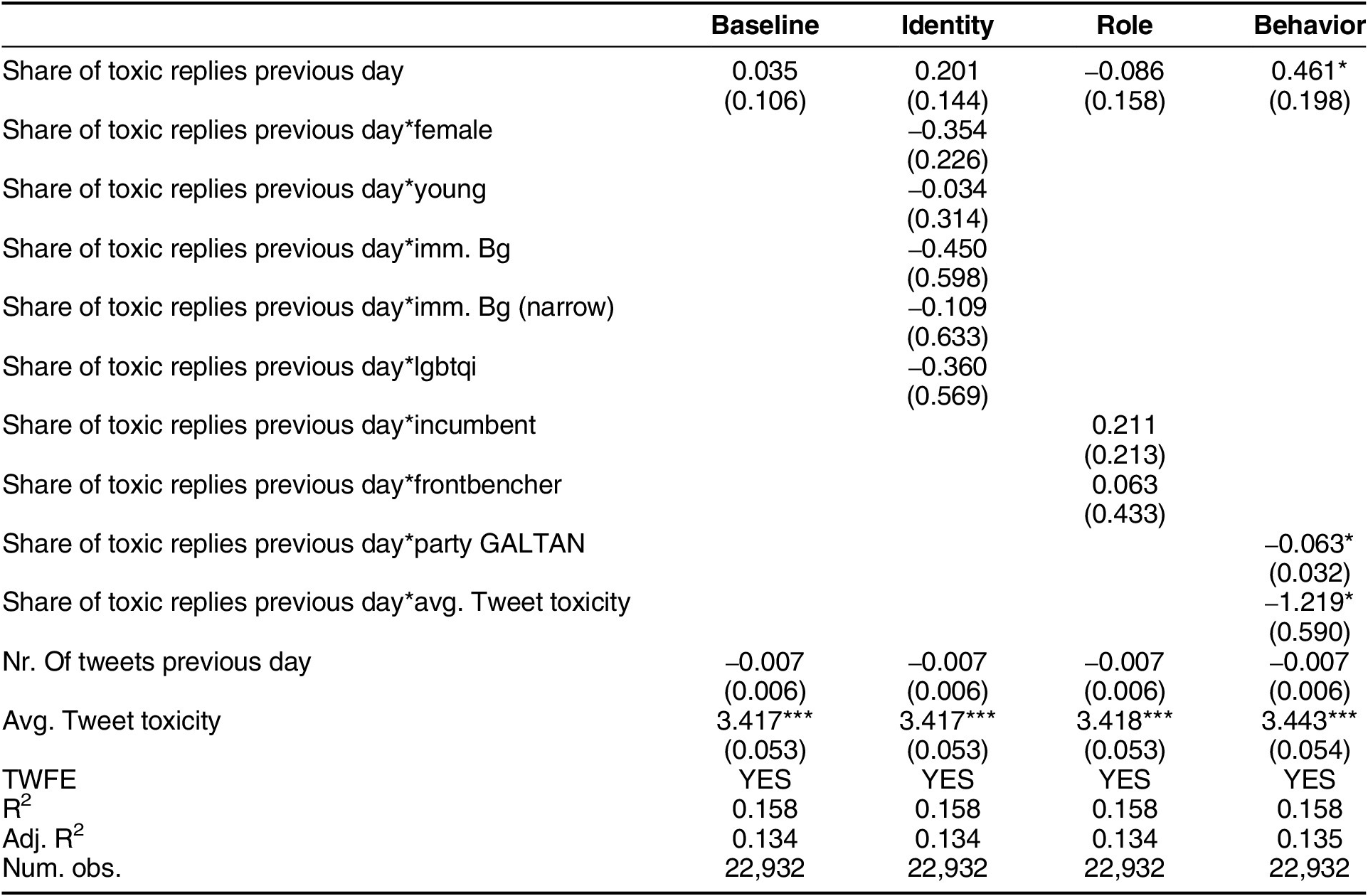
Table 3 Long description
Beginning at the top row, the table lists variables in the first column and their coefficients and standard errors across four models: Baseline, Identity, Role, and Behavior. For ‘Share of toxic replies previous day’, coefficients are 0.035 (Baseline), 0.201 (Identity), negative 0.086 (Role), and 0.461 asterisk (Behavior), with standard errors in parentheses. Interaction terms such as ‘Share of toxic replies previous day times female’ show negative 0.354 (Identity) with standard error 0.226. Other interactions include young, immigrant background, immigrant background narrow, lgbtqi, incumbent, frontbencher, party GALTAN, and average tweet toxicity, each with their respective coefficients and standard errors. ‘Nr. Of tweets previous day’ has negative 0.007 across all models with standard error 0.006. ‘Avg. Tweet toxicity’ is 3.417 triple asterisk (Baseline and Identity), 3.418 triple asterisk (Role), and 3.443 triple asterisk (Behavior), with standard errors around 0.053 to 0.054. TWFE is YES for all models. R squared is 0.158 and adjusted R squared is about 0.134 to 0.135. Number of observations is 22,932 for each model. Asterisks denote significance: triple for p less than 0.001, double for p less than 0.01, single for p less than 0.05.
***p < 0.001; ** p < 0.01; * p < 0.05
Discussion and Conclusion
This article has bridged the political communication literature on online toxicity and the emerging research agenda on violence against politicians. Relying mostly on surveys, studies in the latter field find that the online environment is one where many violent experiences, harassment, and threats against politicians originate. At the same time, it is unclear to what extent online abuse perpetuates patterns of political inequality and whether such inequality might arise from candidates’ identity, their role and visibility, or their ideology and online behavior.
In this article, we set out to test and compare the frequency, forms, and consequences of online attacks against politicians depending on their identity, role, and ideology/behavior. Our empirical approach is novel in several regards. First, our data provide a high level of detail in measuring the complex and multidimensional concept of online political toxicity because of its combination of automated text analysis and hand-coding. Rather than focusing on toxicity in tweets simply mentioning a politician, we analyzed toxicity in citizens’ replies to political candidates. Furthermore, we differentiated between the specific targets or forms of the attack, acknowledging that not all toxicity personally targets the politician. Finally, we connected the different degrees of exposure to toxicity to its respective effects, thereby investigating potential inequalities in a comprehensive fashion.
We showed that, in a highly polarized electoral campaign in the wake of COVID-19 and in a European multiparty context, there is little indication that citizen–elite toxicity exacerbates identity-based political inequalities. There are good reasons to assume that citizen–elite directed abuse could be motivated by the wish to exclude illegitimate intruders from spaces of power and thus that marginalized outsiders should be targeted more frequently and viciously. This tends to be found empirically in several studies using survey data and thus measuring self-reported exposure (e.g. Collignon and Rüdig Reference Collignon and Rüdig2021; Håkansson Reference Håkansson2020; Håkansson and Lajevardi Reference Håkansson and Lajevardi2025). Aligning with the results of other observational studies (e.g., Gorrell et al. Reference Gorrell2020; Theocharis et al. Reference Theocharis, Barberá, Fazekas and Popa2020), we could not confirm such patterns: the overall frequency of candidates’ exposure to citizen toxicity did not vary by their identity. In addition, although the form of toxicity that candidates are being exposed to does vary by identity markers, candidates with an immigration background (broadly defined) and queer candidates are less likely than white and straight politicians to be attacked personally. In contrast, attacks against marginalized groups appear to focus more on their parties (for women, LGBTQI*, and candidates with an immigration background broadly defined) and on their policy positions (for candidates visibly having an Arab, African, or Turkish immigration background). Although all types of toxicity are unpleasant, party- and policy-directed attacks are arguably closer to what communication research understands as legitimate critique against powerholders (Bormann Reference Bormann2022; Masullo Chen et al. Reference Masullo Chen and Muddiman2019). Our results regarding the reactions to receiving high shares of toxic replies are also reassuring: at least those candidates from marginalized groups who made it to become a candidate for national elections did not react more negatively than others to being faced with high shares of online toxicity.
Second, in sum we could only find weak evidence for the suggestion that citizen–elite directed toxicity would be primarily motivated by substantial critique toward the powerful, as suggested in our role hypotheses. Interestingly, and contrary to other studies (e.g., Gorrell et al. Reference Gorrell2020; Theocharis et al. Reference Theocharis, Barberá, Fazekas and Popa2020), we did not find that incumbent or frontbencher candidates were generally exposed to more average toxicity—although they did have a higher likelihood of receiving any toxic reply to their tweets. Even though they did receive more personal insults, citizens were not more likely to critique their policy propositions. As expected, however, these very high-ranking candidates did not specifically react to the toxicity they received.
Third, we found most support for our behavioral hypotheses and some evidence for citizen–elite toxicity functioning as counter-speech. Both ideologically right-wing candidates and those who tweeted toxically themselves received more toxic replies. This aligns well with findings of spirals of incivility being triggered by ideologically more extreme politicians (Antoci et al. Reference Antoci2016; Gervais Reference Gervais2015; Reference Gervais2017). At the same time, rather than reinforcing feedback loops, we found that counter-speech had another effect: the culturally right-wing and toxically tweeting candidates are the ones who are most likely to reduce the number of tweets sent when faced with (counter-)toxicity by citizens.
Our findings need to be seen in the light of several limitations. First, we analyzed a specific set of citizen–candidate conversations: citizens’ public replies to candidate tweets. Although we thus missed toxicity that is, for instance, sent via private messages or automatically deleted by moderating algorithms, this allowed us to understand public and “legal” toxicity. The latter is arguably more important when we want to understand toxicity and its effects on public, political discourses. Second, the number of candidates belonging to marginalized groups in our sample was limited. Although we could not find indications that they are disproportionally targeted by toxicity or react differently to it, this finding would ideally need to be replicated, potentially by observing politicians over longer time periods and in contexts where enough members of those groups attain the high levels of visibility that make politicians most exposed.
Our analysis also comes with some limitations in terms of external validity. The focus on one election and one online platform meant that we could not exclude that online abuse has changed over time, that it looks differently in other countries, or that it takes a different shape on platforms other than Twitter/X. It is also important to note that the data were collected before Twitter became X, which was accompanied by a significant change of rules regarding content moderation. Arguably, the scope of public toxicity would be larger today than back in 2021.
Although we acknowledge these limitations, we believe that our findings can serve as a baseline for understanding how online abuse may evolve. Future studies could build on this foundation by examining subsequent elections to identify trends and shifts in online toxicity. Furthermore, these insights can inform broader discussions about online toxicity in European democratic societies where the relation between the right to “free speech” and politicians’ right to be protected from abuse tends to be looked at differently than in the United States, the context that most previous studies have examined. The focus on Twitter/X highlights a significant platform where political discourse (still) occurs. Although other platforms may exhibit different patterns of interaction, the mechanisms of online toxicity such as anonymity, audience engagement, and algorithmic amplification are increasingly prevalent across social media, especially considering the most recent political developments in the United States.
At the same time, our study has a high degree of internal validity, and we consider it complementary to the many studies relying on surveys to explore online abuse against politicians. Very importantly, the most visible politicians on the national level—ministers, top candidates, and party leaders—seldom participate in surveys. The same tends to be true for candidates and representatives of far-right parties. Furthermore, our approach complements surveys’ assessment of politicians’ perception of exposure, which may significantly vary across individuals (Wirz and Blassnig Reference Wirz and Blassnig2025), with observational evidence that applies similar measurements to all citizen–elite interactions. Finally, by using observational techniques, we were able to collect information on politicians’ behavior that would not easily be available via surveys and that, as we showed, matters importantly for the toxicity that representatives confront. Importantly, the data collected for the purpose of this article will be made publicly available and can thus serve as a starting point for further investigations of political toxicity.
Supplementary material
To view supplementary material for this article, please visit http://doi.org/10.1017/S1537592726104976.
Acknowledgments
Earlier versions of this article were presented at the 2023 ECPR Joint Sessions in Toulouse and the 2023 EPSA Annual Meeting in Glasgow. We would like to thank the participants of these meetings for their valuable feedback. Special thanks go to Vera Tröger, Stefanie Bailer, and Anne Rasmussen. The article is part of the research project “The Cost of Doing Politics: Gender Aspects of Political Violence,” which is financed by the Norwegian Research Council under grant agreement no. 300618. Jana Belschner wishes to additionally acknowledge funding provided by the Trond Mohn Foundation under grant no. TMS20245TG02.

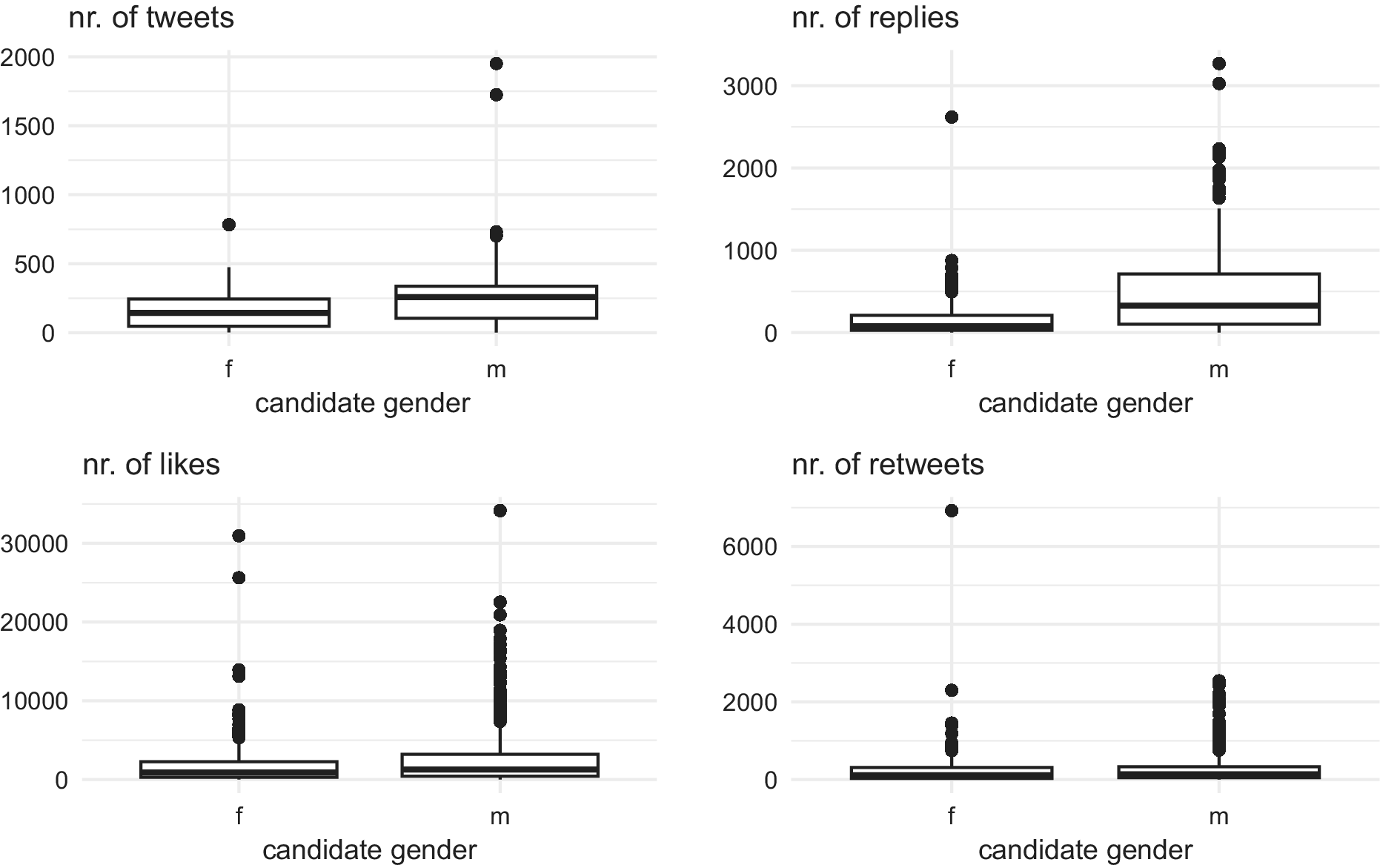
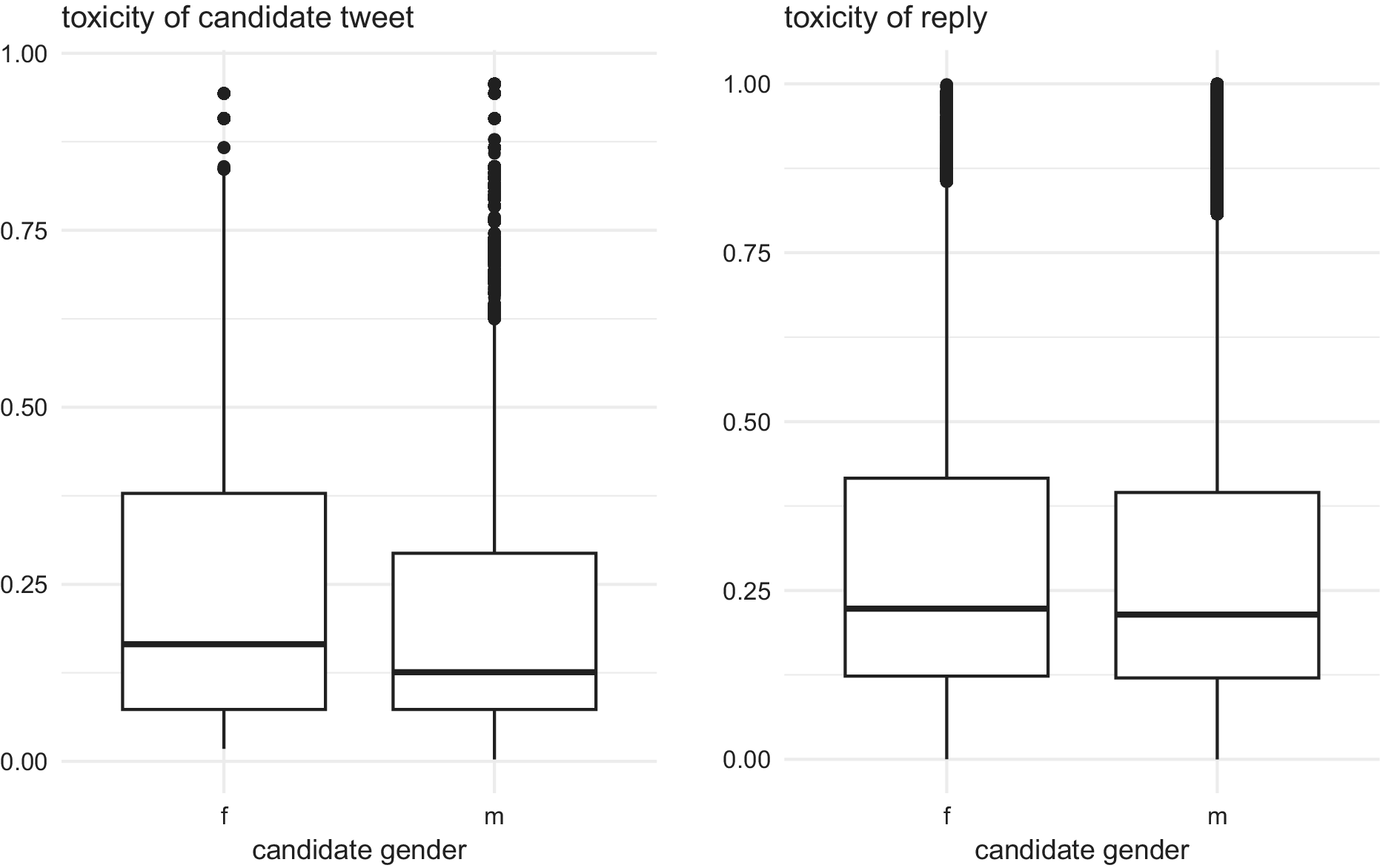
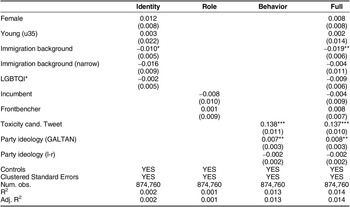
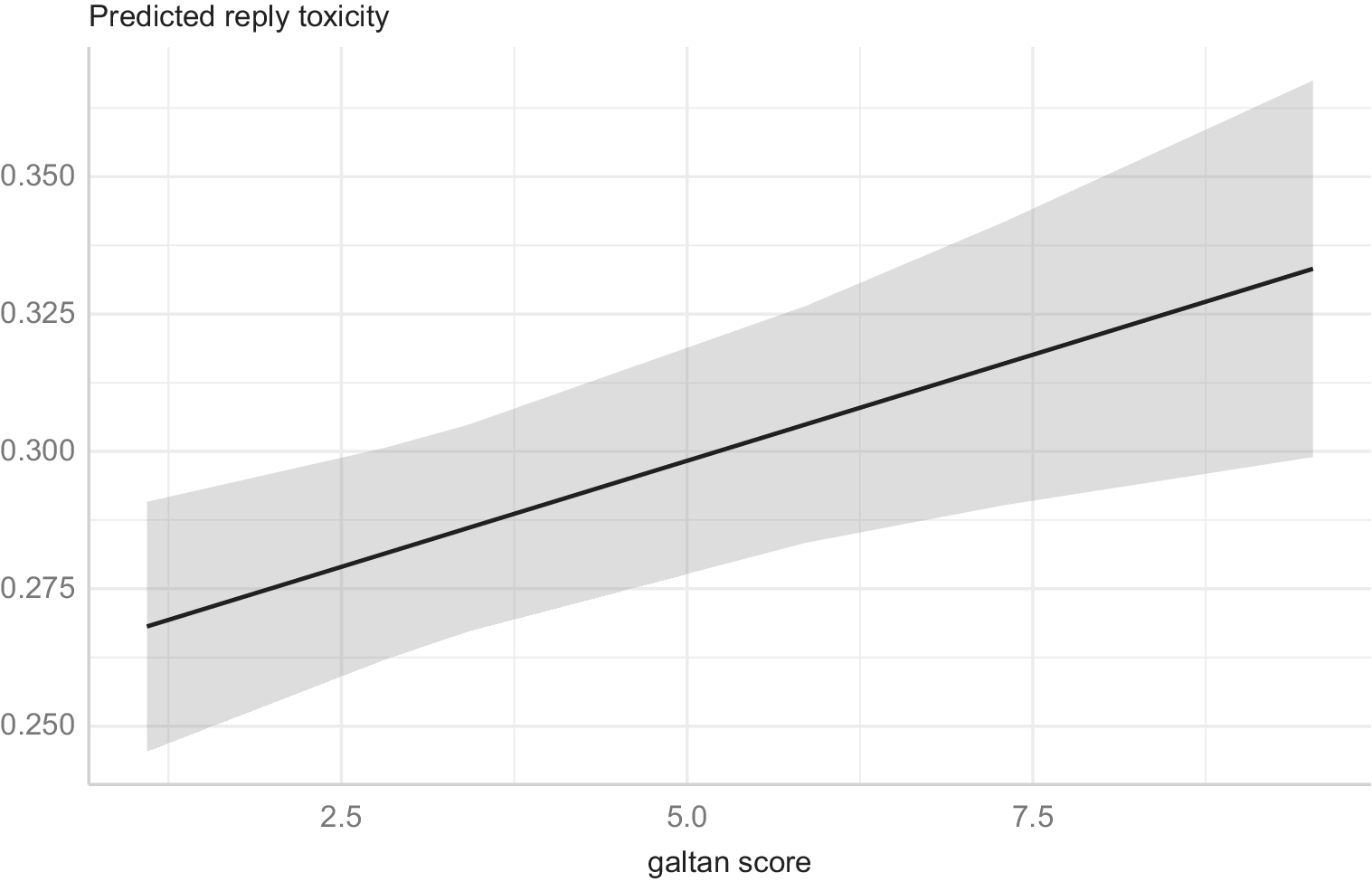
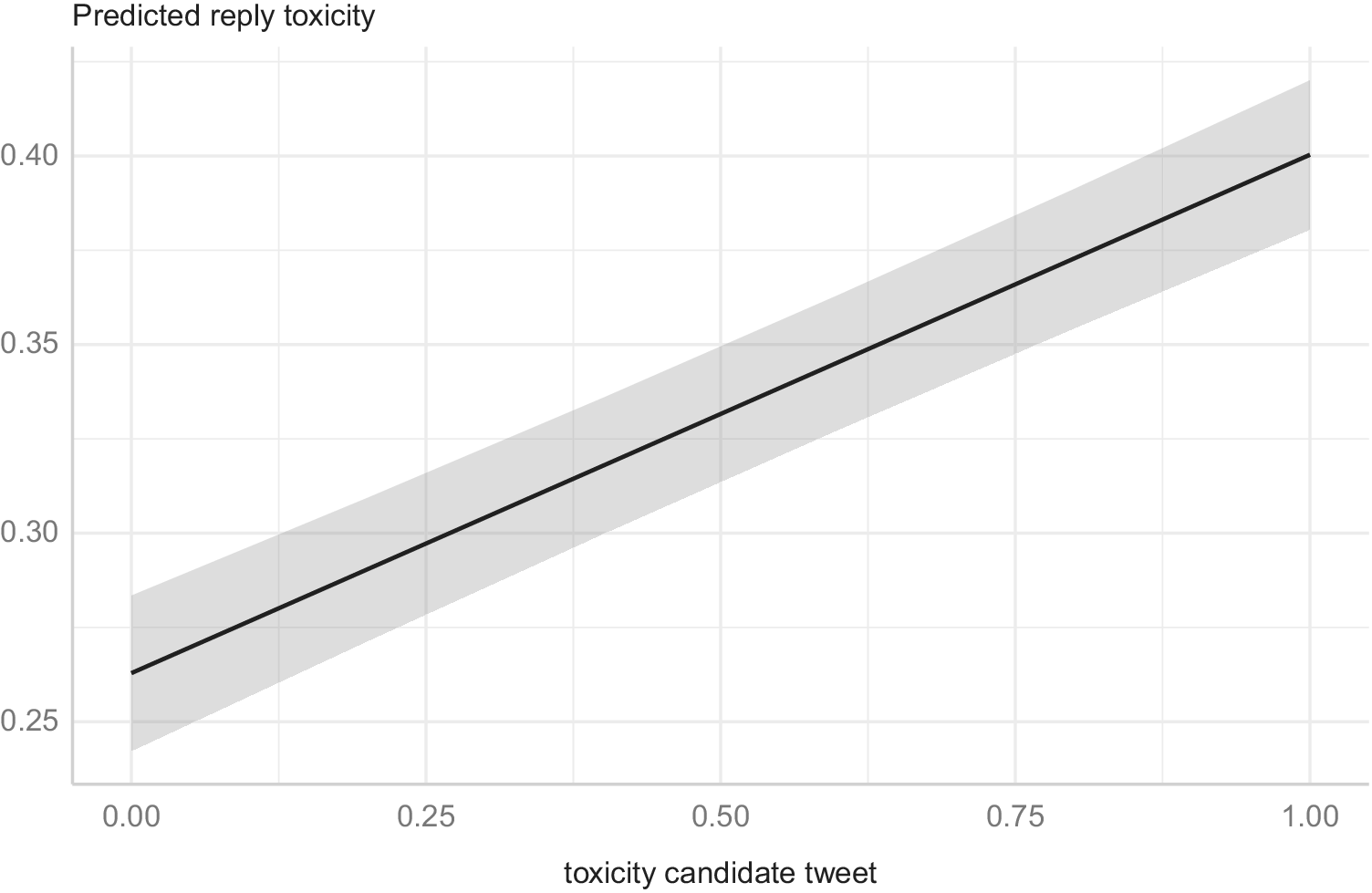
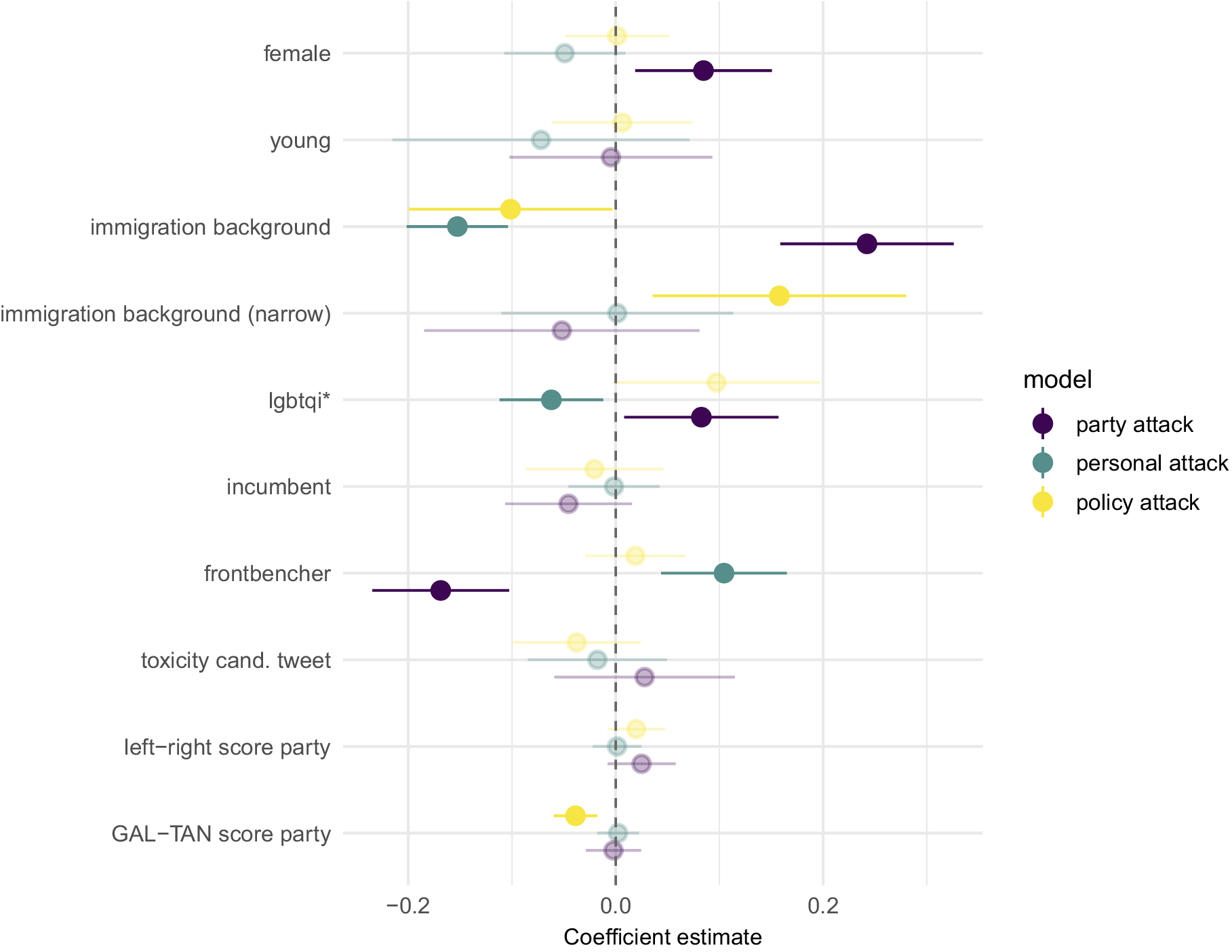
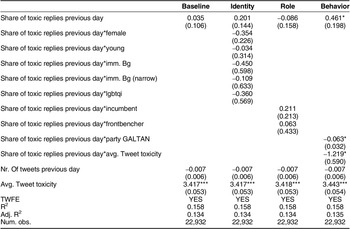


 Open access

