




1. Introduction
Prosody concerns the melodic and rhythmic features of language, reflected predominantly in the use of pitch, intensity and duration in speech production and comprehension. On the utterance level, speakers use prosody for a variety of structural and communicative purposes, for example in the expression of syntactic constituency, illocutionary force, information structure, pragmatic intent, and affective meaning (Cutler et al., Reference Cutler, Dahan and Van Donselaar1997; Speer & Ito, Reference Speer and Ito2009; Cole, Reference Cole2015). The present study concerns the use of prosody for grouping words together into prosodic units, which are in turn combined to form larger prosodic units. It has been argued that utterances are structured in this way into a prosodic hierarchy, consisting of specific levels, each of which acts as a domain to which certain phonological or prosodic rules apply (e.g., Beckman & Pierrehumbert, Reference Beckman and Pierrehumbert1986; Nespor & Vogel, Reference Nespor and Vogel1986; Selkirk, Reference Selkirk1986). A number of different theoretical proposals for prosodic hierarchies have been put forward in the literature. Although these proposals vary in the number and types of assumed constituent levels, one major level that is recognized consistently between these theoretical accounts is the intonational phrase (IP). This constituent is generally considered the largest prosodic unit within an utterance and can be defined as the domain of a coherent intonational contour (Shattuck-Hufnagel & Turk, Reference Shattuck-Hufnagel and Turk1996).
Utterances may consist of multiple IPs, with the placement of boundaries between these IPs being heavily influenced by the syntactic structure of the utterance (Watson & Gibson, Reference Watson and Gibson2004; Kentner & Féry, Reference Kentner and Féry2013; Kentner & Kremers, Reference Kentner and Kremers2020). Major constituent boundaries, such as clause endings, tend to align with IP boundaries, marking the constituent as an intonational domain (Selkirk, Reference Selkirk, Goldsmith, Riggle and Yu2011). However, certain smaller syntactic constituents can also align with IPs, such as parenthetical phrases, sentential adverbials and vocatives, as in (1a, b).

Another instance where IP boundaries mark smaller syntactic constituents involves globally ambiguous structures, for example in prepositional phrase- and relative clause-attachment ambiguities (for a review, see Carlson, Reference Carlson2009). In these cases, an IP boundary preceding the prepositional phrase or relative clause discourages syntactic attachment across the boundary. In (2a) for example, the prepositional phrase from Alabama attaches to either the noun friend or the verb phoned. Noun attachment is disfavored when an IP boundary (indicated by ‘/’ below) precedes the prepositional phrase from Alabama. A similar effect can be observed in ambiguous sequences of coordinated nouns. For example, (2b) can be interpreted as either [Bella and Demi and Vera] or [Bella and Demi] [and Vera]. Which one of these interpretations is intended can be expressed prosodically by inserting an IP boundary after the second name or treating the entire sequence as a single IP instead.

Regardless of the function of an IP boundary, it is expressed prosodically by means of three types of cues: pitch change, final lengthening, and pause (see for example Wagner & Watson, Reference Wagner and Watson2010, for a review). Pitch change refers to pitch events that indicate the closure of an IP. Typically, sentence-final or utterance-final IP boundaries of declarative sentences are indicated by a falling pitch contour, while utterance-medial IP boundaries are marked with a continuation rise: a high or rising pitch contour that indicates continuation of the utterance and leads to discontinuation of pitch declination (e.g., Chen, Reference Chen2007). Final lengthening refers to the increased duration of syllables preceding a prosodic boundary. Turk and Shattuck-Hufnagel (Reference Turk and Shattuck-Hufnagel2007) argued that across languages, lengthening effects can extend to the pre-boundary main stressed syllable. Crucially, although these cues appear across languages, the use of each cue in signaling an IP boundary differs between languages. For example, speakers of British English, Dutch and German employ different rising pitch contours to mark utterance-medial boundaries, and show distinct preferences for these language-specific contours in boundary perception (Chen, Reference Chen2007). Furthermore, the weighting of cues, i.e. the relative importance of each cue as a boundary marker, varies across languages. Zhang (Reference Zhang2012) investigated cue weighting in the production of prosodic boundaries in syntactically ambiguous complex noun phrases (e.g. [turkey salad] [and coffee] vs. [turkey], [salad], [and coffee]) in both Mandarin Chinese and American English. It was found that pause was the most consistently used cue for indicating IP boundaries in both languages, followed by final lengthening and pitch change. In contrast, a German corpus study by Peters et al. (Reference Peters, Kohler, Wesener, Kohler, Kleber and Peters2005) found that pause was infrequently used by speakers of German (in only 38.3% of the examined boundaries), suggesting that pause is largely optional as a boundary marker. Pitch change on the other hand was the most commonly used cue (74%), suggesting it is a more important cue, with final lengthening holding an intermediate position. These findings in German align with those of Holzgrefe-Lang et al. (Reference Holzgrefe-Lang, Wellmann, Petrone, Räling, Truckenbrodt, Höhle and Wartenburger2016), who investigated the processing of IP boundaries in coordinated name structures, such as (2b), in German. Their results showed that pause was not necessary for the perception of IP boundaries when both pitch change and final lengthening were present.
However, research on the production and weighting of prosodic boundary cues in Dutch is both scarce and fragmented. Although past perception studies suggested a major role for pause as a boundary cue in Dutch (Cambier-Langeveld, Reference Cambier-Langeveld1997; de Pijper & Sanderman, Reference de Pijper and Sanderman1994; Johnson & Seidl, Reference Johnson and Seidl2008; Swerts, Reference Swerts1997), none of these studies included all three types of boundary cues, limiting the scope of their conclusions. For example, de Pijper and Sanderman (Reference de Pijper and Sanderman1994) found that perception of melodic boundary cues in Dutch was associated with weaker perceived boundary strength (i.e. hierarchically lower boundaries), compared to perception of pauses. This could in turn suggest that in Dutch pause might weigh heavier as a boundary cue than pitch change. However, De Pijper and Sanderman (Reference de Pijper and Sanderman1994) did not include final lengthening in their analysis, making it impossible to compare cue weighting of pauses, pitch cues and lengthening in boundary perception in Dutch. Therefore, it remains to be investigated how dominant the pause cue is relative to the other cue types in the production of major prosodic boundaries in Dutch.
In addition, it is unclear whether the acoustic realizations of IP boundary cues are consistent across different syntactic contexts. Most studies on IP boundary perception and production focus on one type of syntactic configuration, under the assumption that prosodic markings of IP boundaries will not vary across contexts. So far, no study has compared the acoustic realisation of prosodic boundary cues across different syntactic contexts, such as disambiguating vs. clause-end-marking IP boundaries, while controlling for lexical and segmental content. However, it is important to assess the extent to which findings on cues for prosodic boundaries are generalizable within a language, in order to draw conclusions about differences in the weighting of cues across languages.
This study aimed to investigate first which prosodic boundary cues are used in the production of Dutch IP boundaries (RQ1) and second, how the cues are weighted in production of IP boundaries in Dutch (RQ2). These questions were addressed by investigating the production of utterance-medial IP boundaries in two types of syntactic contexts: sequences of coordinated names, and compound sentences. By looking at different syntactic constructions, we can evaluate the consistency of cue realizations across different linguistic contexts. Within these two contexts, maximum pitch of the pre-boundary syllable, pause following the IP boundary and the duration of both the penultimate and the final syllable were measured. In each context, we compared the cues between utterances with an IP boundary (boundary condition), versus their lexically identical counterparts without such a boundary (no-boundary condition).
Regarding RQ1, limited research suggested the use of pitch change, final lengthening and pause in marking major prosodic boundaries in Dutch (de Pijper & Sanderman, Reference de Pijper and Sanderman1994; Cambier-Langeveld, Reference Cambier-Langeveld1997). Further, the prosodic boundaries in each syntactic context were of the same hierarchical level, i.e. IP. Differences in prosodic boundary cues arguably only occur between boundaries of different levels (e.g. Wagner & Watson, Reference Wagner and Watson2010), but not within the same level. We thus hypothesized that native speakers of Dutch will use pitch change, final lengthening and pause to mark IP boundaries in the same manner across different syntactic constructions (H1). We predicted a higher maximum pitch at the pre-boundary syllable in the boundary condition, compared to the same syllable in the no-boundary condition, as a result of a deviation from the pitch declination pattern that occurs in the absence of a boundary. Furthermore, we predicted the pre-boundary syllable to be realized with a longer duration in the boundary condition, compared to the no-boundary condition. However, since lengthening of the penultimate syllable has been observed in Dutch only when the final vowel is a schwa (Cambier-Langeveld, Reference Cambier-Langeveld1997), and none of the target pre-boundary words in the current study contained a schwa, we expected no lengthening of the penultimate syllable. Regarding pause, we predicted to observe a longer pause in the boundary condition, compared to the no-boundary condition.
Regarding RQ2, since previous perception research suggested a major role for pause in Dutch prosodic phrasing (de Pijper & Sanderman, Reference de Pijper and Sanderman1994; Swerts, Reference Swerts1997; Johnson & Seidl, Reference Johnson and Seidl2008), we hypothesized that pause will be the most prominent cue in marking IP boundaries (H2). As such, we predicted that pause will be the most consistently used cue in marking the presence of an IP boundary in both syntactic constructions.
2. Methodology
To examine how prosodic boundary cues are realized and weighted in Dutch, we conducted a language production experiment with native speakers of Dutch. In this experiment, the participants were shown a series of pictures accompanied by questions specifically designed to elicit either a coordinated name sequence or a compound sentence, with or without an utterance-medial IP boundary.
2.1 Participants
Sixteen monolingually raised adult native speakers of Dutch participated in the production experiment (age range: 18–29 years; mean age: 20 years; 12 female; four male). The participants were students at Utrecht University at the time of testing and were reimbursed for participation. Informed consent was obtained from the participants prior to the experiment. The experiment was approved by the Humanities Ethics Assessment Committee of Utrecht University (22-145-02).
2.2 Materials
The target stimuli consisted of name sequences like (3a, b) and compound sentences like (4a, b).
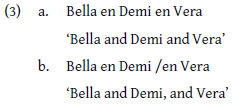
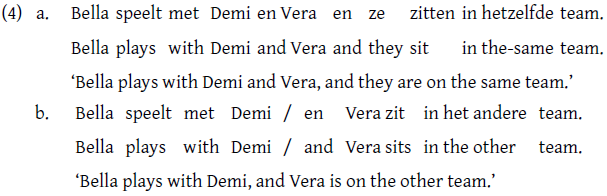
Name sequences (3a) and (3b) were lexically identical, consisting of three names coordinated by the Dutch conjunction en (‘and’). In (3a), the entire sequence was treated as a single IP, with the three names grouped together as a single unit. In contrast, (3b) consisted of two IPs, with an IP boundary inserted directly after the second name (Demi). In this case, the first two names were grouped together, without the third name (Vera). Like the name sequences, the compound sentences (4a) and (4b) were lexically identical up until the third name (Vera). In sentence (4a), the second and third name (Demi and Bella) formed the direct object of the first clause, and the conjunction en (‘and’) coordinated both nouns. In sentence (4b) however, an IP boundary marked the end of the first clause directly after the second name (Demi), indicating that the conjunction en connected two clauses instead of the two nouns, and that the third name (Vera) belonged to the second clause as its subject. Importantly, both in the coordinated name sequences and in the compound sentences, the same word sequence Demi en Vera is used, with and without an intervening IP boundary.
Each name in the target stimuli was a bisyllabic word in which the first syllable was stressed and the first phoneme was either a voiced plosive or fricative. Following Petrone et al. (Reference Petrone, Truckenbrodt, Wellmann, Holzgrefe-Lang, Wartenburger and Höhle2017), two sets of three names were used. In addition to the names Bella, Demi and Vera, the names Dora, Hanna and Zita were adopted. Each set of names was permuted to create six orders of names. Each target stimulus was elicited once without an IP boundary after the second name (i.e., no-boundary condition, cf. 3a and 4a) and once with an IP boundary after the second name (i.e., boundary condition, cf. 3b and 4b). For each syntactic context, this procedure resulted in 24 experimental items (six orders × two name sets × two conditions). These 24 experimental items were combined with 24 fillers into a pseudo-randomized list of 48 test items, in which no more than two experimental items occurred after each other and identical name orders did not occur consecutively. In case of the name sequences, the filler items consisted of a single name, for example, Bella. In case of the compound sentences, the fillers consisted of a short sentence containing one name as the subject, for example Bella draagt een rood shirt, ‘Bella wears a red shirt’. The name sequences and the compound sentences made up two separate lists, which were presented one after another, with a short break between them. The order of presentation of the two lists was counterbalanced between participants.
2.3 Procedure
Audio recordings were made in a sound attenuated booth of the phonetics lab at the Utrecht University Institute for Language Sciences, using a Sennheiser ME-64 microphone at 16 bit/48 kHz. We used ZEP experiment control software for recording and stimulus display (Veenker, Reference Veenker2024). Each testing session lasted approximately 20 minutes. The participants were seated in front of a computer screen. They received written instructions on the screen and practiced several trials before the test began.
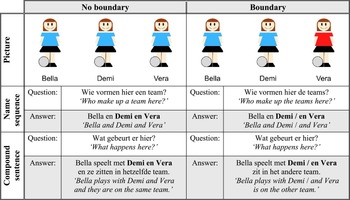
Overview of experimental item elicitation for Dutch name sequences and compound sentences in boundary and no-boundary conditions. The bold text represents the critical region in the target utterance that was identical across conditions and syntactic context, and that contained the IP boundary in the boundary condition. Note that in addition to these three names, the names Hanna, Zita and Dora were used. In both three-name-sets, the names were presented in all possible orders.
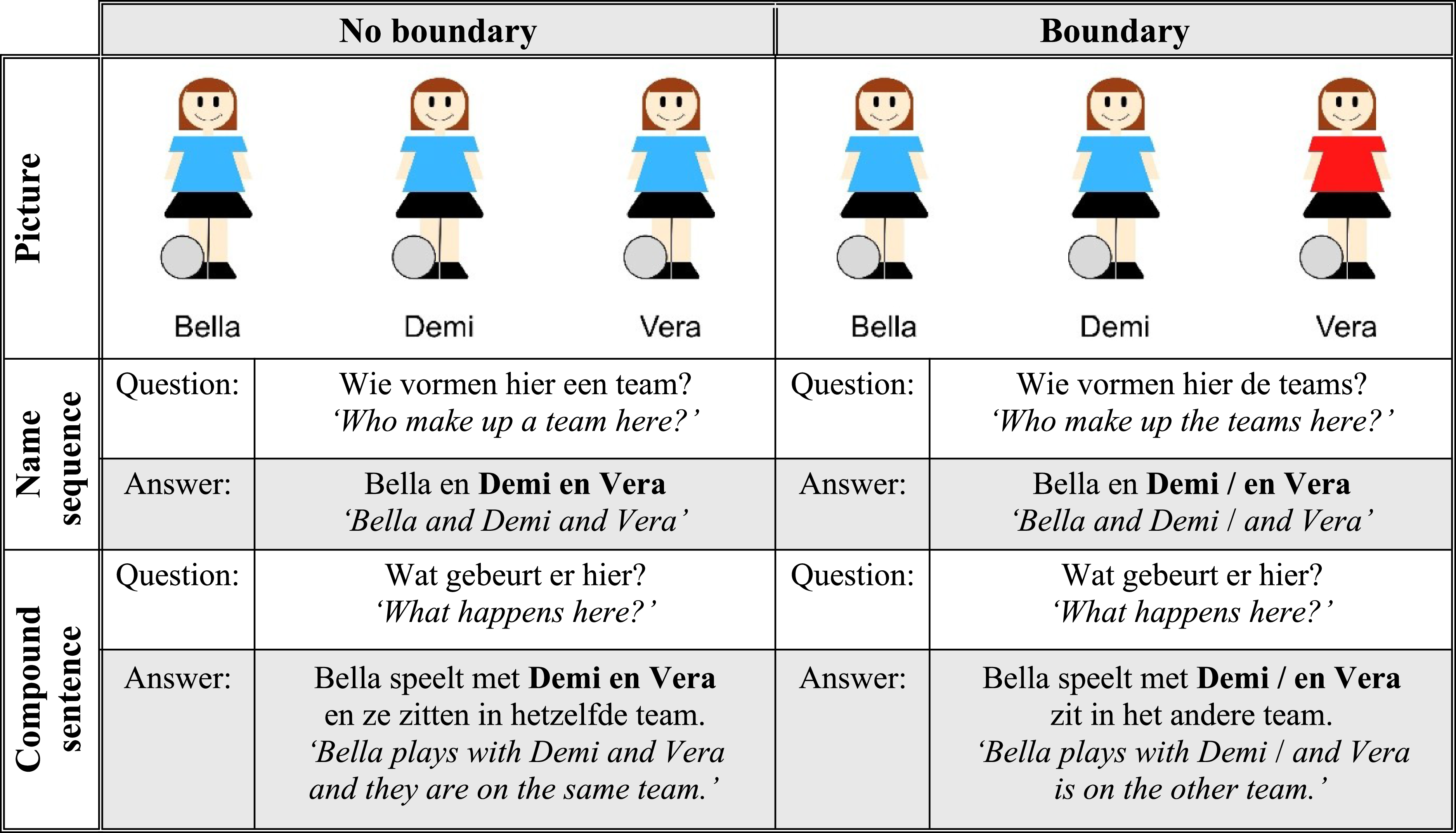
Figure 1 Long description
A table with four rows and three columns comparing Dutch name sequences and compound sentences in boundary and no-boundary conditions. The table includes pictures of three characters: Bella, Demi, and Vera. In the no-boundary condition, all three characters are shown together without any separation. In the boundary condition, Bella and Demi are shown together, and Vera is shown separately. The table includes questions and answers in Dutch, focusing on team formation and actions. The questions and answers differ based on whether there is a boundary or not. The bold text in the answers represents the critical region in the target utterance.
Target name sequences were elicited in the following way. The participants were shown a picture depicting three girls, with a name printed below each person (see row 1 of Figure 1). These girls represented triplets playing a fictitious game called ‘teamball’, which was played in changing teams that could consist of one, two or three persons. Each team was represented by a different shirt colour (red or blue). If all three girls wore shirts of the same (blue) colour, they all belonged to the same team. If the third girl wore a shirt that was coloured differently (red instead of blue), the first two girls formed one team and the third girl another one (see Figure 1). Via a text displayed above the image, the participants were asked who made up a team. They were instructed to respond aloud using specific answer templates (5) and (6): template (5) was used when the girls belonged to the same team, while template (6) was used when the first two girls formed one team and the third girl belonged to another team. Specifically, the participants were asked to pronounce each team as a unit when using template (6).
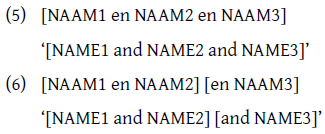
The participants were presented with these templates including bracket notation, and they were instructed to memorize these templates before the experiment started. On each trial, the picture showing the three girls with their names printed below was displayed, along with the question who made up a team (see Figure 1). Prompted by the image, the participants produced the name sequences either without an intervening IP boundary in the no-boundary condition, or with an intervening IP boundary in the boundary condition.
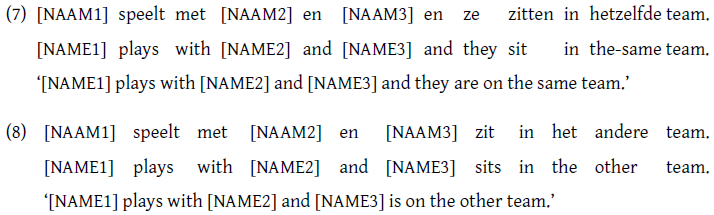
Regarding the target compound sentences, the participants received the same instructions as described above. Similar to the name sequences, the participants were asked to answer the question ‘what is happening here?’ by using a template. For the no-boundary condition, the participants were instructed to use template (7), and for the boundary condition template (8). They were encouraged to memorize templates (7) and (8) as they had done in the name sequences part of the experiment. However, for the compound sentences only, they were also provided with a reference sheet containing the sentence templates as an optional reminder. Importantly, all templates were provided in written format and did not contain commas as an orthographic representation of prosodic boundaries.
2.4 Data segmentation and annotation
The recorded utterances were segmented and annotated using Praat (Boersma & Weenink, Reference Boersma and Weenink2024). In each experimental item, the second name (i.e., the pre-boundary word) was manually segmented and annotated on the syllable level. If present, the pause between the offset of the pre-boundary syllable and the onset of the post-boundary syllable was also segmented and annotated. A pause was defined as a silent interval of at least 20 milliseconds, following Petrone et al. (Reference Petrone, Truckenbrodt, Wellmann, Holzgrefe-Lang, Wartenburger and Höhle2017).
Segmentation relied primarily on changes in the acoustic waveform and formant transitions, following guidelines provided by Turk et al. (Reference Turk, Nakai, Sugahara and Sudhoff2006). Syllables with a voiced plosive onset were segmented at the burst onset in all conditions. The consonants [l] and [n] in the names Bella and Hanna may be considered to be ambisyllabic (Van Der Hulst, Reference Van Der Hulst, Bennis and Beukema1985), which raises questions about the placement of the syllable boundary. For the sake of consistency across different target stimuli, the syllable boundary was placed at the onset of these consonants.
Acoustic values of each boundary cue were extracted from the annotated fragments using ProsodyPro (Xu, Reference Xu2013). Pitch values were manually checked for tracking errors and corrected where necessary. We measured maximum pitch of the second syllable of the second name, that is, the pre-boundary syllable. Pitch values were expressed in semitones, relative to a reference value of 1 Hz (e.g. Böttcher & Zellers, Reference Böttcher and Zellers2024; Crochiquia et al., Reference Crochiquia, Eriksson, Barbosa and Madureira2022; Genette et al., Reference Genette, Verhoeven and Gillis2023; Tulchynska et al., Reference Tulchynska, Job, Witzlack-Makarevich and Zellers2024). Differences in maximum pitch between boundary and no-boundary conditions were taken as evidence for a deviation from the pitch declination pattern that occurs in the absence of a boundary (i.e. pitch change). For final lengthening, the duration of the final syllable and duration of the penultimate syllable in milliseconds were extracted. Finally, pause duration was measured in milliseconds. Pause was treated as a continuous variable instead of a categorical variable, since pause duration has been shown to vary as a function of prosodic boundary strength in Dutch (Swerts, Reference Swerts1997), and there is no consensus in the literature on how to determine pauses categorically using a threshold (e.g. Romøren & Chen, Reference Romøren and Chen2015).
2.5 Boundary perception check
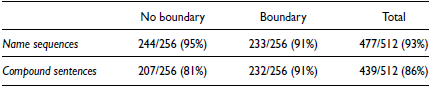
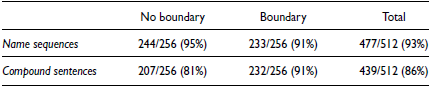
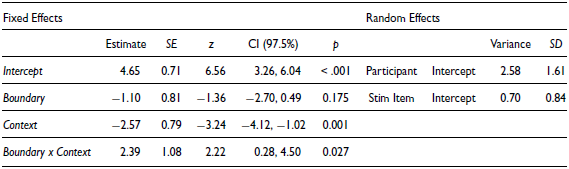
In order to assess how well the speakers in the production experiment realized the IP boundaries across syntactic contexts, we conducted a small-scale online perception experiment using a sample of the production recordings. This perception experiment was designed as a two-alternative forced-choice task in which participants listened to a series of recorded utterances, and for each utterance selected the matching picture from two presented options, i.e. the same pictures shown to the speakers in the production experiment. We predicted that if the speakers realized the IP boundaries sufficiently, the participants should perform above chance level in selecting the correct picture. Sixteen native speakers of Dutch participated in this experiment (age range: 18–69 years; mean age: 33 years; nine female; six male; one non-binary). Overall accuracy was 93% for the name sequences (91% boundary condition; 95% no-boundary condition) and 86% for the compound sentences (91% boundary condition; 81% no-boundary condition). A mixed effects logistic regression analysis showed a significant interaction between syntactic context and boundary presence (β = 2.39, SE = 1.08, z = 2.22, p = .027). Post hoc comparisons of syntactic contexts within each boundary condition showed a significant performance difference between name sequences and compound sentences in the no-boundary condition (β = 2.57, SE = 0.79, z = 3.24, p = .001). Together, these results show that the speakers accurately produced the utterances as required in their respective condition, although their use of prosody in target utterances without an IP boundary was slightly more consistent in the name sequences than in the compound sentences. We thus decided to include all utterances elicited in the production experiment for analysis on the realization of IP boundaries. Further details on this experiment are reported in Appendix A.
3. Statistical analyses and results
We divided the statistical analysis into two parts. In the first part, we assessed the effects of boundary and no-boundary conditions on the three prosodic cues across different syntactic contexts by running separate linear mixed effects regression models for each of the cues. In the second part, we investigated boundary cue weighting by conducting logistic mixed effects regression with Relative Weight Analysis, following Zhang (Reference Zhang2012), who carried out a similar analysis for boundary cues in Mandarin and English. In the following subsections, we report these two analysis parts consecutively, starting with the linear mixed-effects models.
3.1 Linear mixed effects modeling of boundary cues
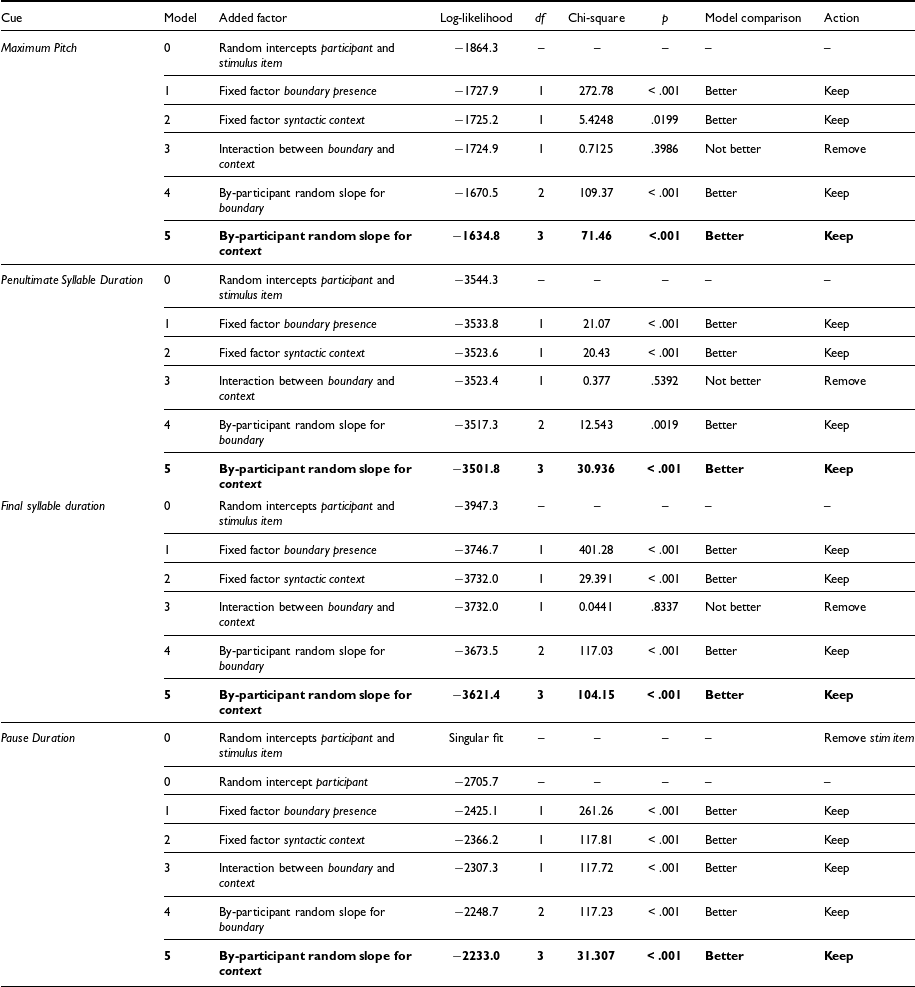
Linear mixed effects models were fitted using the packages lme4 (Bates et al., Reference Bates, Mächler, Bolker and Walker2015) and lmerTest (Kuznetsova et al., Reference Kuznetsova, Brockhoff and Christensen2017) in R (Version 4.2.3, R Core Team, 2023). The fixed factors included boundary presence (IP boundary vs. no IP boundary) and syntactic context (name sequences vs. compound sentences). Treatment coding was applied to the fixed factors with ‘no IP boundary’ as reference level for boundary presence and name sequences as reference level for syntactic context. The random effects structure included intercepts for factors participant and stimulus and by-participant random slopes for boundary presence and syntactic context. For each prosodic cue, model fit was assessed in a stepwise manner by means of likelihood ratio tests, keeping only factors that improved model fit (p < .05). Our baseline model, containing only random intercepts, was extended by adding fixed factors in the following order: first boundary presence, then syntactic context, and finally the interaction between boundary presence and syntactic context. Consecutively, by-participant random slopes for boundary presence and syntactic context were added. In case of significant interactions, effects of boundary presence for each syntactic context were examined using pairwise comparisons. In the next subsections, only significant fixed effects from the best-fit models are reported for each cue. An overview of model comparisons and summaries of complete models are presented in Appendix B.
3.1.1 Maximum pitch
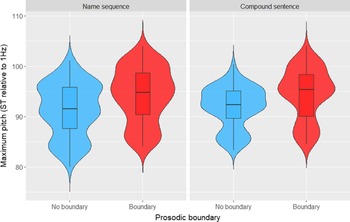
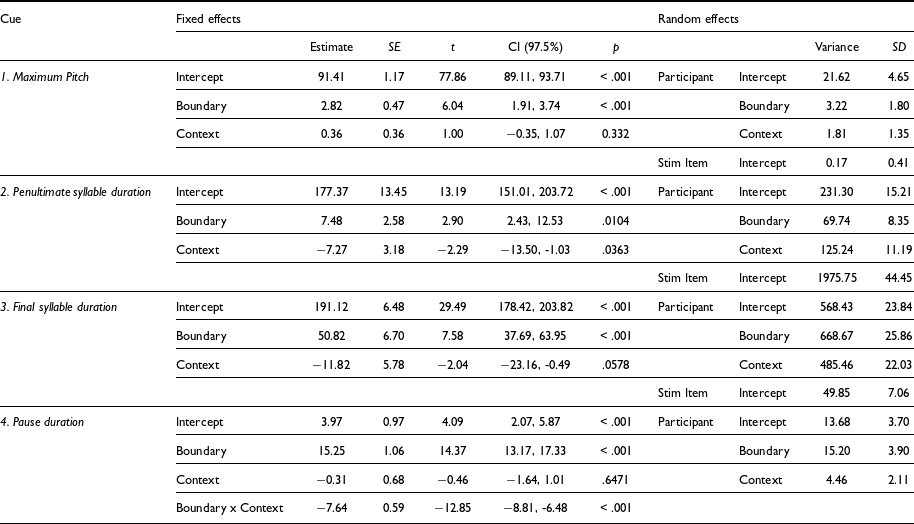
Boundary presence led to a significant increase in maximum pitch (β = 2.82, SE = 0.47, t = 6.04, p < .001). This effect was consistent across syntactic contexts: maximum pitch was higher when the syllable preceded a boundary than when it did not, regardless of whether it appeared in a name sequence (M = 94.3 ST vs. M = 91.3 ST, respectively) or at a clause boundary (M = 94.5 ST vs. M = 91.8 ST), as shown in Figure 2.
Violin plots of maximum pitch of the second name in semitones relative to 1 Hz, in the absence (‘No boundary’) and presence (‘Boundary’) of an IP boundary, in name sequences and compound sentences, respectively.
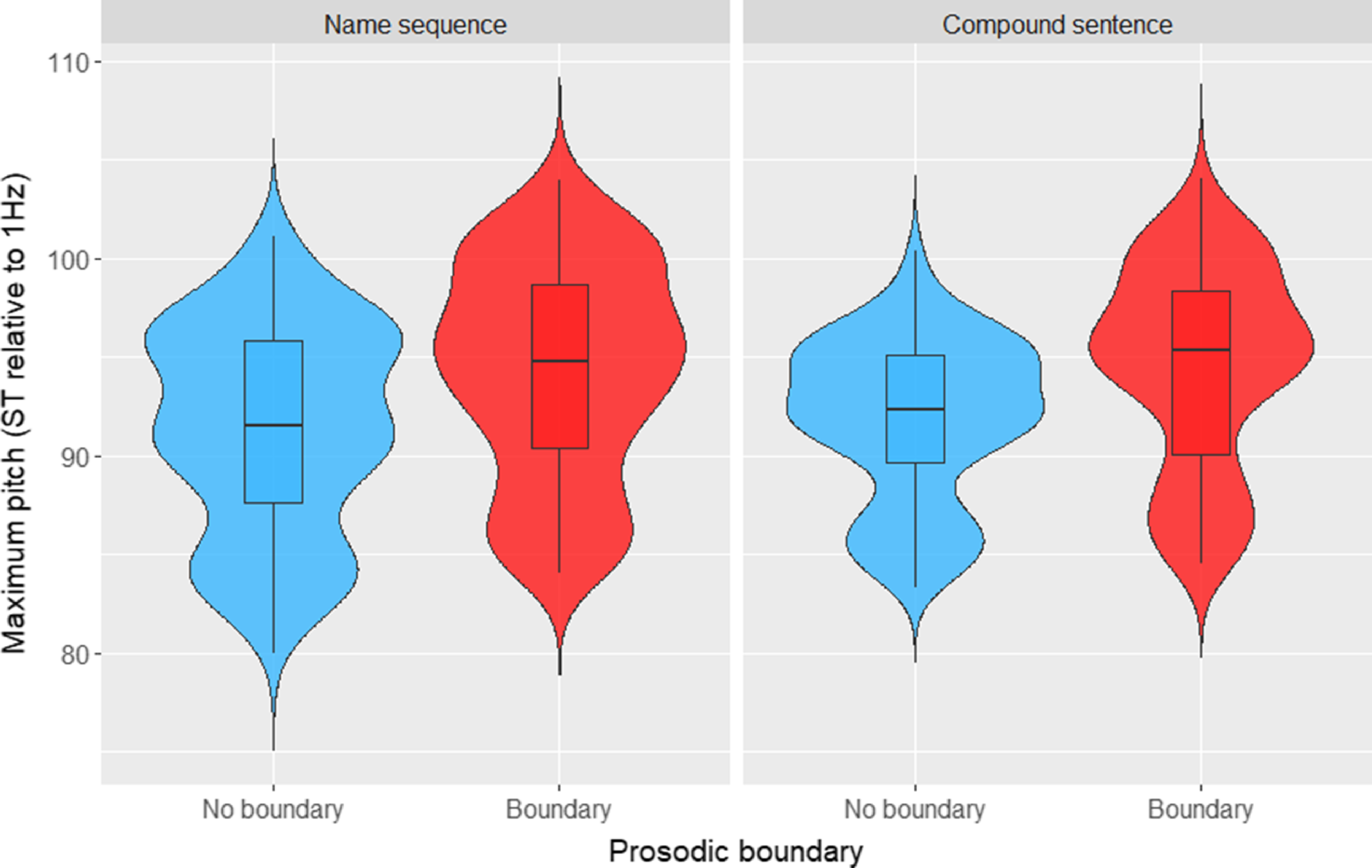
Figure 2 Long description
The image presents two sets of violin plots comparing the maximum pitch in semitones relative to 1 Hz for name sequences and compound sentences, both in the absence and presence of an intonational phrase (IP) boundary. The x-axis represents the prosodic boundary conditions: No boundary and Boundary. The y-axis measures the maximum pitch in semitones, ranging from 80 to 110. Each set of violin plots includes two conditions: No boundary and Boundary. The left set of plots corresponds to name sequences, while the right set corresponds to compound sentences. Each violin plot displays the distribution of maximum pitch values, with the inner box plot indicating the interquartile range, median, and potential outliers. The blue-colored plots represent the No boundary condition, and the red-colored plots represent the Boundary condition. The plots show that the presence of an IP boundary generally results in higher maximum pitch values compared to the absence of a boundary. All values are approximated.
3.1.2 (Pre)final syllable durations
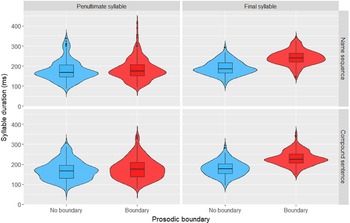
Boundary presence significantly affected the duration of the penultimate syllable (β = 7.48, SE = 2.58, t = 2.90, p = .0104). Specifically, the penultimate syllable was significantly longer when it preceded an IP boundary than when it did not, both in name sequences (M = 184.4 ms vs. M = 177.9 ms, respectively) and in compound sentences (M = 178.1 ms vs. M = 169.6 ms). In addition, the penultimate syllable was slightly shorter in compound sentences (M = 173.8 ms) compared to name sequences (M = 181.1 ms) regardless of boundary presence (β = -7.27, SE = 3.18, t = 2.29, p = .0363), possibly due to effects of utterance length on stressed syllable duration. The final syllable was also significantly longer when it preceded a boundary than when it did not (β = 50.82, SE = 6.70, t = 7.58, p < .001), both in name sequences (M = 242.2 ms vs. M = 190.9 ms) and compound sentences (M = 229.9 ms vs. M = 179.5 ms). These effects are illustrated in Figure 3.
Violin plots of syllable durations in the absence (‘No boundary’) and presence (‘Boundary’) of an IP boundary for penultimate and final syllabes, respectively. Top row: for name sequences; Bottom row: for compound sequences.
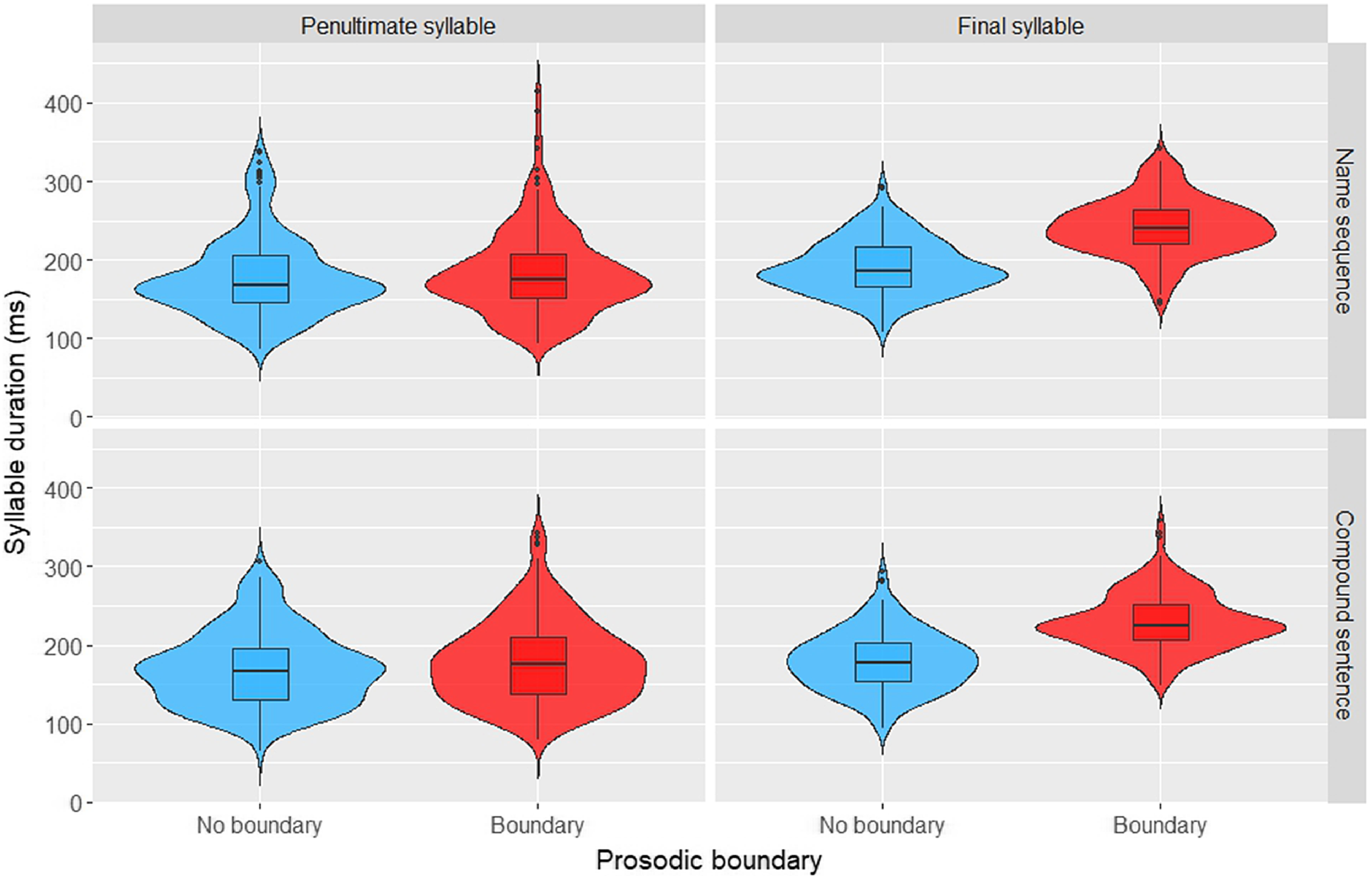
Figure 3 Long description
The image presents four violin plots comparing syllable durations in the absence and presence of an intonational phrase (IP) boundary. The plots are divided into two rows: the top row represents name sequences, while the bottom row represents compound sequences. Each row contains two violin plots: one for the penultimate syllable and one for the final syllable. The x-axis indicates the presence or absence of a prosodic boundary, labeled as 'No boundary' and 'Boundary'. The y-axis measures syllable duration in milliseconds, ranging from 0 to 400 milliseconds. Each violin plot shows the distribution of syllable durations, with a box plot inside indicating the median, lower quartile, and upper quartile. The plots reveal that syllable durations tend to be longer in the presence of a prosodic boundary compared to when no boundary is present. This pattern is consistent across both name and compound sequences for both penultimate and final syllables. The violin plots also display the density of data points, showing a wider spread in durations for syllables with a boundary. All values are approximated.
3.1.3 Pause duration
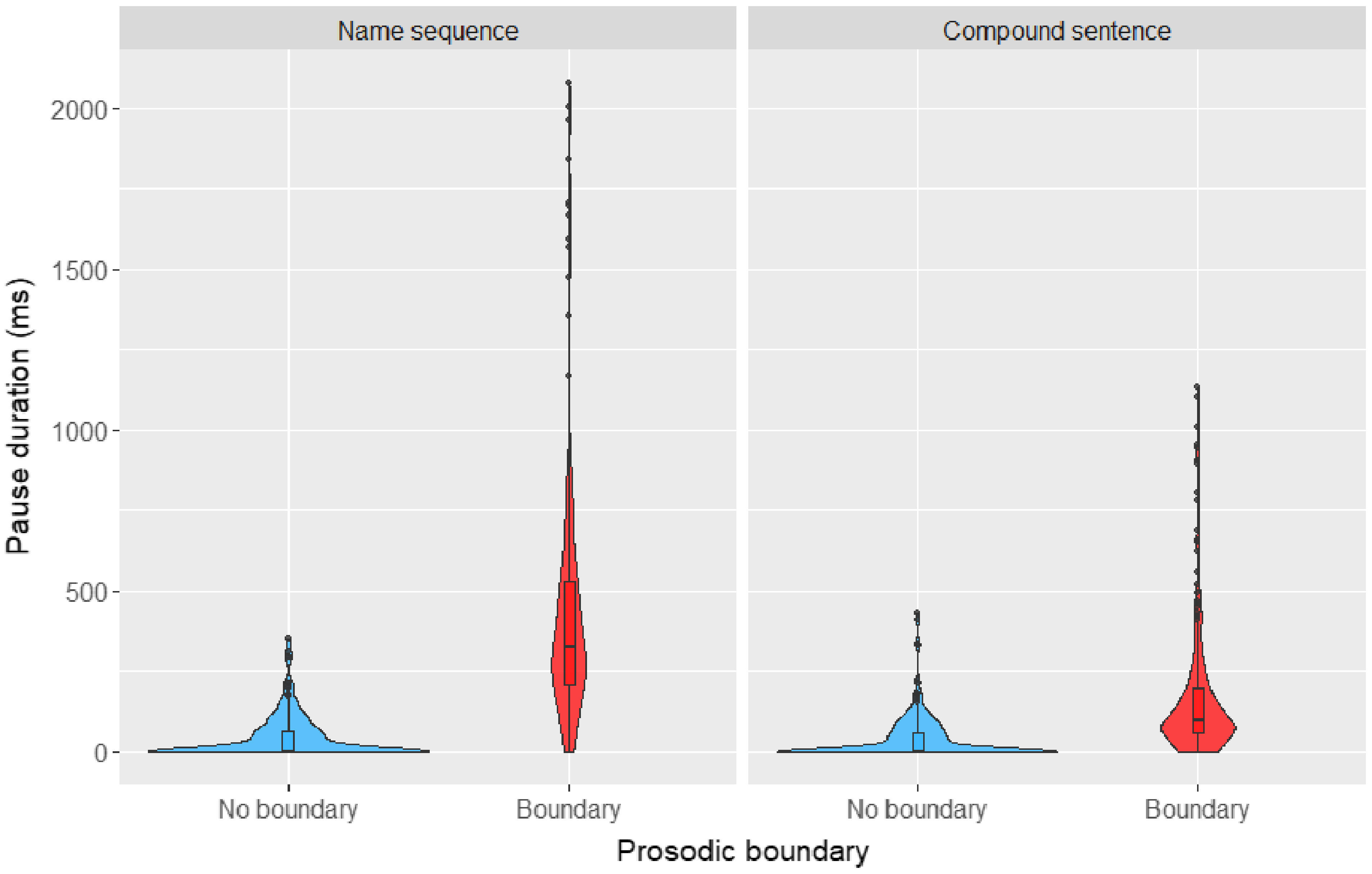
Because pause duration residuals were non-normally distributed, analyses were run with square root transformed data (Osborne, Reference Osborne2002). A significant interaction between boundary presence and syntactic context on pause duration was found (β = -7.64, SE = 0.59, t = -12.85, p < .001). To interpret this interaction, Bonferroni-adjusted pairwise comparisons were conducted using the emmeans package in R (Lenth, Reference Lenth2024) to investigate effects of boundary presence in each syntactic context. In name sequences, (transformed) pause duration increased significantly in the presence of an IP boundary (β = -15.25, SE = 1.09, t = -13.95, p < .001). Pause duration also increased at IP boundaries in compound sentences, but the effect was weaker (β = -7.61, SE = 1.09, t = -6.97, p < .001). So, pause duration was increased in the presence of an IP boundary in both utterance types, but this increase was larger at boundaries in name sequences (M = 439.0 ms vs. M = 40.6 ms) than at clausal boundaries (M = 178.8 ms vs. M = 38.3 ms), as shown in Figure 4.
3.2 Logistic mixed effects regression with Relative Weight Analysis
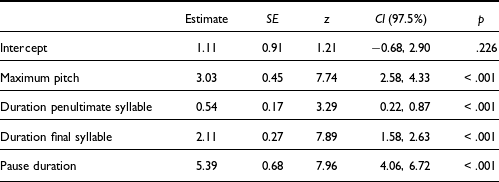
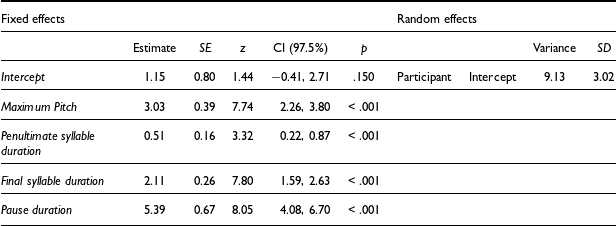
Having established that boundary presence affected each acoustic measure, we investigated the predictive value of each boundary cue using logistic mixed effects regression, following Zhang (Reference Zhang2012). In this regression model, IP boundary presence was treated as the categorical dependent variable. All acoustic values were rescaled into z-scores and included as fixed predictors: maximum pitch, duration of the penultimate syllable, duration of the final syllable, and pause duration. The random effects structure included a by-participant random intercept (see Appendix B for the full model summary). As can be seen in Table 1, all boundary cues were significant in predicting IP boundary presence.
Summary of mixed-effects logistic regression model testing the effects of four boundary cues as predictors for prosodic boundary presence
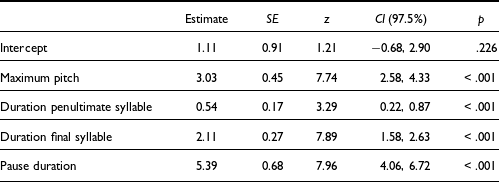
Table 1 Long description
The table presents the results of a mixed-effects logistic regression model that tests the predictive value of four boundary cues on prosodic boundary presence. The table includes five rows and five columns. The columns are labeled Estimate, SE, z, CI (97.5%), and p. The rows are labeled Intercept, Maximum pitch, Duration penultimate syllable, Duration final syllable, and Pause duration. Each row provides the estimate, standard error, z-value, confidence interval, and p-value for each boundary cue. All boundary cues, including maximum pitch, duration of the penultimate syllable, duration of the final syllable, and pause duration, are significant predictors of prosodic boundary presence, with p-values less than 0.001. The intercept has an estimate of 1.11, a standard error of 0.91, a z-value of 1.21, a confidence interval ranging from 0.68 to 2.90, and a p-value of 0.226. Maximum pitch has an estimate of 3.03, a standard error of 0.45, a z-value of 7.74, a confidence interval ranging from 2.58 to 4.33, and a p-value of less than 0.001. Duration of the penultimate syllable has an estimate of 0.54, a standard error of 0.17, a z-value of 3.29, a confidence interval ranging from 0.22 to 0.87, and a p-value of less than 0.001. Duration of the final syllable has an estimate of 2.11, a standard error of 0.27, a z-value of 7.89, a confidence interval ranging from 1.58 to 2.63, and a p-value of less than 0.001. Pause duration has an estimate of 5.39, a standard error of 0.68, a z-value of 7.96, a confidence interval ranging from 4.06 to 6.72, and a p-value of less than 0.001.
Violin plots of pause duration in the absence (‘No boundary’) and presence (‘Boundary’) of an IP boundary, in name sequences and compound sequences, respectively.
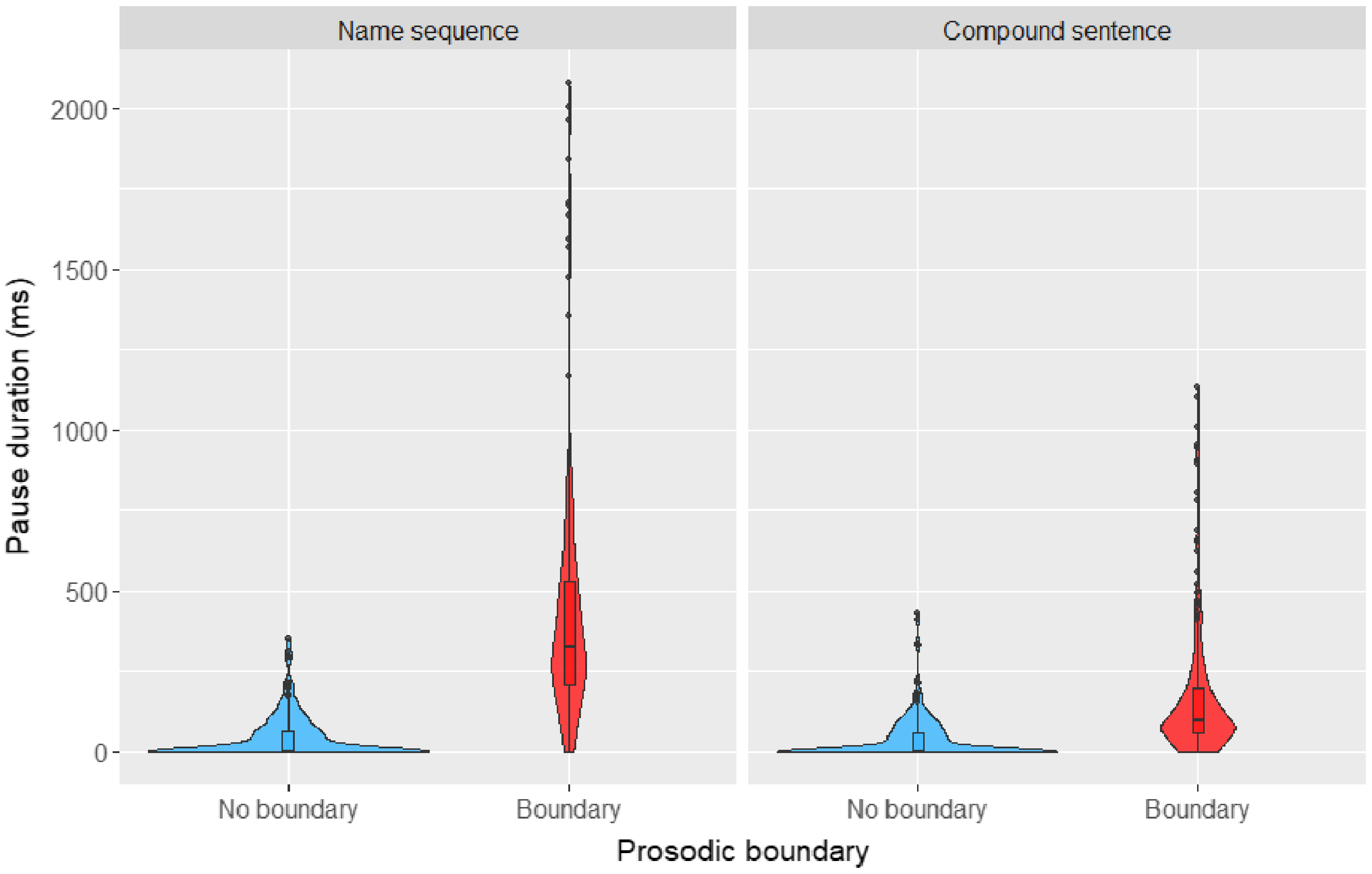
Figure 4 Long description
The image contains two sets of violin plots comparing pause duration in milliseconds with and without prosodic boundaries. The left plot represents name sequences, while the right plot represents compound sentences. Each set has two conditions: No boundary and Boundary. The x-axis indicates the prosodic boundary condition, and the y-axis shows pause duration in milliseconds. The violin plots display the distribution of pause durations, with wider sections indicating more common durations and narrower sections indicating less common durations. The plots show that pause durations are generally longer in the presence of a prosodic boundary compared to the absence of a boundary. The data is presented in a violin plot format, which combines aspects of a box plot and a kernel density plot, providing a detailed view of the data distribution.
The positive coefficients indicated a positive correlation with boundary presence, since an increase in the value of each boundary cue corresponded to an increase in the odds of an expressed IP boundary.
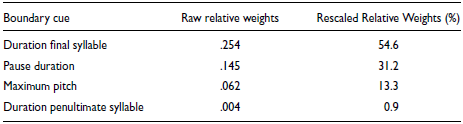
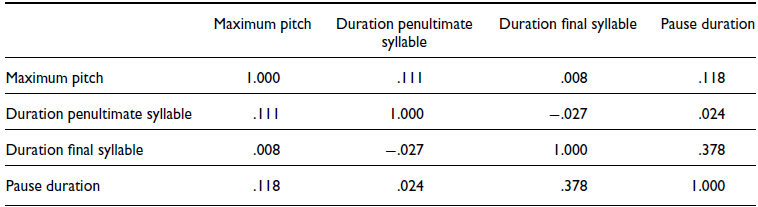
To establish the relative importance of each boundary cue collapsed across syntactic contexts, Relative Weight Analysis was adopted, using the rwa package in R (Chan, Reference Chan2020). This analysis can be applied to a logistic regression model to break down the variance explained by the model into weights representing the individual contribution of each predictor (Johnson, Reference Johnson2000; Tonidandel & LeBreton, Reference Tonidandel and LeBreton2015). It is widely acknowledged that partitioning variance across multiple predictors is problematic in case of multicollinearity. However, there are two reasons why collinearity is not an issue in the current analysis. First, if the predictor variables are collinear, their correlation coefficients should be high (e.g. >.5). However, the correlations between the predictors in our logistic regression model were low: the maximal correlation between two predictors in the correlation matrix was .38 (see Appendix C). Moreover, we calculated Variance Inflation Factor (VIF) values to assess multicollinearity among the predictors, using the car package in R (Fox & Weisberg, Reference Fox and Weisberg2019). Generally, a VIF value exceeding 5 is considered to indicate moderate multicollinearity, and values above 10 suggest high multicollinearity, which may impact the stability and interpretation of the model estimates (Midi et al., Reference Midi, Sarkar and Rana2010). The VIF values for our predictors ranged between 1.10 and 1.22, indicating that there was no significant multicollinearity in our model. Second, Relative Weight Analysis (RWA) is a robust method for dealing with multicollinearity. In fact, the analysis technique is developed specifically for partitioning variance across multiple correlated predictors (Johnson, Reference Johnson2000). In RWA, variables are transformed to a new set of predictors that are maximally related to the original predictors but are orthogonal to one another, thus eliminating collinearity problems (Tonidandel & LeBreton, Reference Tonidandel and LeBreton2015).
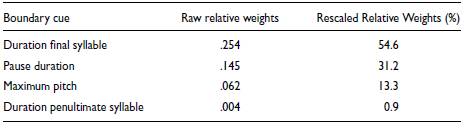
The results of the RWA are reported in Table 2. The analysis indicated that the highest weighted cue in predicting boundary presence in our data was duration of the final syllable, accounting for 54.6% of explained variance, followed by pause duration (31.2%) and maximum pitch (13.3%). Although it was a significant predictor of boundary presence, duration of the penultimate syllable was the weakest cue, accounting for 0.9% of the explained variance.
Relative Weight Analysis of prosodic cues in the production of IP boundaries in Dutch
4. Discussion
The present study aimed to examine the production of utterance-medial intonational phrase (IP) boundaries in Dutch, focusing on the use and weighting of three types of prosodic boundary cues: pitch change, final lengthening, and pause. Specifically, it addressed two research questions: (RQ1) Which prosodic cues are used by Dutch speakers to mark utterance-medial IP boundaries? and (RQ2) How are these cues weighted in the production of IP boundaries? We hypothesized that Dutch speakers will consistently employ all three types of prosodic cues to signal IP boundaries, regardless of syntactic context (H1), and that pause will carry the greatest relative weight among the cues (H2). To test our hypotheses, the prosodic realizations of lexical targets in the presence of an IP boundary were compared with those of identical targets in the absence of such a boundary, in two different syntactic contexts: coordinated name sequences and compound sentences.
In both of these contexts, we found that all prosodic parameters of interest differed significantly between the no-boundary and boundary conditions, indicating that Dutch speakers use all three types of boundary cues to mark IP boundaries (i.e., longer final syllable duration, higher pitch, longer pause in the presence of an IP boundary than in its absence). The higher maximum pitch at the IP boundary suggests that Dutch speakers generally use a continuation rise to mark the boundary. Given the absence of an interaction between boundary presence and syntactic context for final lengthening and pitch change, Dutch speakers appear to use these two cues consistently to mark IP boundaries, either resolving global syntactic ambiguities or aligning with clause boundaries.
Interestingly, we found that speakers apply lengthening not only to the final syllable, but also to the penultimate syllable. This finding contradicts Cambier-Langeveld (Reference Cambier-Langeveld1997), who argues that in Dutch final lengthening applies to the penultimate syllable only when the final vowel is a schwa, since this vowel is too short to be lengthened sufficiently. Our results indicate that in Dutch, penultimate syllable lengthening can also take place in syllables containing non-schwa vowels, at least in bisyllabic trochaic words as used in our study.
Furthermore, we observed differences in the effect of boundary presence on the use of pause in different syntactic contexts. Our speakers produced longer pauses in the presence of a prosodic boundary than in its absence, but this pause difference was larger in coordinated name sequences than in compound sentences. One factor that could contribute to this difference is utterance length. Since the name sequences are shorter than the compound sentences, both before and after the prosodic boundary, speakers may extend the pause in the name sequences, whereas speakers may restrict pause duration in the longer compound sentences. However, previous research on the relationship between pause duration and utterance length in English read speech found exactly the opposite effect: short utterances are associated with short pauses and long utterances with long pauses (Zvonik & Cummins, Reference Zvonik and Cummins2003; Krivokapić, Reference Krivokapić2007). Moreover, we observed no effect of utterance length on final syllable duration. If pause duration is inversely proportional to utterance length in Dutch, it is unclear why this does not apply to final syllable duration.
One other factor that may account for the observed difference in pause duration is the role of prosody in both linguistic contexts. The coordinated name sequences are globally ambiguous syntactic structures, which can be disambiguated in spoken language only by means of prosodic phrasing, while the compound sentences are only locally ambiguous syntactic structures whose parsing can be aided by prosodic phrasing. It may be the case that, at least in Dutch, pause is a more pronounced boundary cue in globally ambiguous contexts in which prosody serves as the only disambiguating linguistic means. This view aligns with a listener-driven approach to prosodic cue realization (Krivokapić, Reference Krivokapić2007), which takes into account the listener’s processing demands and entails adjustment to the prosodic cues accordingly, provided that the speaker is aware of the potential ambiguity. In the compound sentences, prosodic phrasing is not indispensable for the listener to parse the intended structure, since the local ambiguity can resolve lexically over the course of the utterance. Therefore, a shorter pause suffices in these contexts.
In conclusion, our hypothesis (H1) regarding the use of prosodic cues was partially borne out. Indeed, Dutch speakers used all three types of prosodic cues to mark IP boundaries. Across different syntactic constructions, final lengthening and pitch change were used in a consistent manner. In contrast, the use of pause duration differed between different syntactic contexts, with a more pronounced use of pause as a boundary-marking cue in name sequences, than in compound sentences.
Regarding cue weighting, we found that lengthening of the final syllable was the most consistently used cue in marking IP boundaries, followed by pause, pitch change, and penultimate syllable lengthening. Thus, our hypothesis (H2) that pause acts as the most prominent prosodic cue in marking IP boundaries in Dutch was not supported. However, additional predictors may exist that were not included in our analysis. For example, our modeling treated each prosodic cue independently, but the co-occurrence of certain cues might influence cue weighting. Moreover, segmental cues to prosodic boundaries such as domain-initial strengthening (Cho, Reference Cho2016) and phrase-final glottalization (Redi & Shattuck-Hufnagel, Reference Redi and Shattuck-Hufnagel2001) could also play a role in Dutch.
Still, while our results indicate that pause serves as a significant cue for marking IP boundaries in Dutch, the prominence of final lengthening is remarkable considering the emphasis on pause in previous perception research on Dutch prosodic phrasing (de Pijper & Sanderman, Reference de Pijper and Sanderman1994; Swerts, Reference Swerts1997). One possible explanation for this discrepancy is that cue weightings may differ between perception and production of prosodic boundaries. For example, Zhang (Reference Zhang2012) found that speakers of Mandarin Chinese mostly relied on pitch change in their perception of prosodic boundaries, while pause was the most consistently used cue in their production of prosodic boundaries, although different results have been observed in Mandarin Chinese speakers by Yang et al. (Reference Yang, Shen, Li and Yang2014). Similarly, speakers of Dutch may rely on pause in their perception of prosodic boundaries, while using lengthening of the final syllable as the most consistently used cue in their boundary production.
While speakers varied the duration of pauses and the duration of IP-final syllables in a gradual manner to indicate the presence or absence of an IP boundary, there was less overlap in the most frequently produced durations between boundary and no-boundary conditions in the IP-final syllable, compared to the pauses (compare Figures 3 versus 4). In other words, the most frequently produced IP-final syllable durations were more distinct between boundary conditions than the most frequently produced pause durations, especially in the compound sentences. This can in turn be explained by the fact that the compound sentences lack global ambiguity and are thus less dependent on marking of prosodic boundaries using pause. Therefore, final syllable duration was better positioned to distinguish between utterances with and without an IP boundary in our logistic mixed-effects modeling, possibly leading to a higher relative cue-weighting compared to pause duration.
Future research using similar materials and methodologies is needed to further clarify (crosslinguistic) differences in weightings of prosodic boundary cues, including interaction effects of pitch change, final lengthening and pause, and the role of segmental cues to prosodic phrasing. Such research will also provide more insight into the relationship between boundary cue realizations on the one hand and the perception and real-time processing of prosodic boundaries on the other hand. In addition, the observed cue weightings raise questions about the acquisition of Dutch prosodic phrasing. For instance, if pause is not the most accurate cue in the production of IP boundaries, how can we explain why Dutch-learning six-month-olds rely heavily on the pause cue to perceive clausal boundaries (Johnson & Seidl, Reference Johnson and Seidl2008) whereas English- and German-learning peers rely more on pitch change and the combination of pitch change and final lengthening respectively to discriminate a sequence of words with or without an intervening IP boundary (Seidl, Reference Seidl2007; Wellmann et al., Reference Wellmann, Holzgrefe, Truckenbrodt, Wartenburger and Höhle2012; Holzgrefe-Lang et al., Reference Holzgrefe-Lang, Wellmann, Höhle and Wartenburger2018)? This contrast may partially be explained by differences in the prosodic characteristics of infant directed speech compared to adult directed speech (see Cristia, Reference Cristia2013, for a review). It may be the case that cue weightings are different between these registers, too. Future production studies are needed to examine the realization of prosodic boundaries in infant-directed speech.
Finally, while the focus of this study is on local prosodic cues at the IP boundary, previous research on coordinated constructions in American English and German showed that there are also non-local prosodic effects of IP boundaries (Wagner, Reference Wagner2005; Kentner & Féry, Reference Kentner and Féry2013; Huttenlauch et al., Reference Huttenlauch, de Beer, Hanne and Wartenburger2021; Hansen et al., Reference Hansen, Huttenlauch, de Beer, Wartenburger and Hanne2023). Specifically, it has been demonstrated that pitch is lowered and duration is shortened in the first of two grouped elements within coordinated sequences. In an additional exploratory analysis, we examined whether these effects occur on the first word in the aforementioned Dutch name sequences and compound sentences. In short, we found that in the coordinated name sequences, both shortening and pitch lowering occur in phrase-initial syllables, similar to observations in English and German. However, in compound sentences, shortening occurs in the phrase-initial syllables too, but pitch lowering does not. This suggests that, at least in Dutch, these non-local pitch effects cannot be generalized across IPs in different syntactic contexts. Further details of this analysis are reported in Appendix D.
5. Conclusions
This study investigated the production and weighting of prosodic cues – pitch change, final lengthening, and pause – at intonational phrase (IP) boundaries in Dutch, in two different syntactic contexts. Our results have demonstrated that Dutch speakers consistently use all three types of cues to signal IP boundaries, but pause is used as a boundary-marking cue in a more pronounced manner when the IP boundary involves resolution of a global ambiguity than when it marks the end of a syntactic clause. In past work on prosodic boundary perception, it has been suggested that pause is the most important cue in marking Dutch intonational phrase boundaries. We have found that while pause is a salient indicator of intonational phrase boundaries in Dutch, final lengthening serves as the most consistently used cue in production. Further research is needed to understand the relationship between these findings and perception and processing of prosodic boundaries.
Acknowledgements
We thank the Institute for Language Sciences labs at Utrecht University for technical support and in particular Ben Bonfils for his help in implementing the experiment. We also thank Eva Scheerder for designing the experimental pictures and Iris Leliveld for assistance in data acquisition. Finally, we thank members of the Prosody and Language Learning Group and members of the Language Acquisition and Processing Disorders Group at Utrecht University for their valuable feedback.
Data availability statement
Data and materials are available on request through the Yoda data repository: https://doi.org/10.24416/UU01-K39IB4
Funding
The author(s) disclosed receipt of the following financial support for the research, authorship, and/or publication of this article: This research was supported by a VICI grant from the Dutch Research Council (NWO) awarded to Aoju Chen [grant number VI.C.201.109].
Appendix A Boundary perception check
Participants
Sixteen monolingually raised adult native speakers of Dutch participated in the perception experiment (age range: 18–69 years; mean age: 33 years; nine female; six male; one non-binary). These participants had no knowledge of the production experiment.
Materials
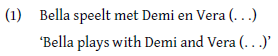
For this experiment, a subset of the production recordings was used. From all speakers, the recordings of name sequences and compound sentences containing the names Bella, Demi, and Vera (in that order) were selected. For each syntactic context, both the recording with a boundary and the recording without a boundary were included. Thus, 64 recordings were selected in total, based on 16 speakers × two syntactic contexts × two boundary conditions, all using the same names in the same order. The recordings of the compound sentences were clipped immediately after the third name (see, e.g. (1)), leaving the syntactic status of the third name (Vera) ambiguous between direct object of the first clause or subject of the second. Importantly, disambiguation of both the clipped compound sentences and the globally ambiguous coordinated name sequences depended on the production of a prosodic boundary.
Procedure
To assess the production of IP boundaries in the selected recordings, the participants filled in an online survey using Qualtrics software (Qualtrics, 2025). This survey consisted of two parts. In the first part, the participants were instructed that they would listen to recordings from a previous experiment, in which the speakers were shown one of the pictures displaying three figures in one of two possible team formations (see Figure 1), and that each speaker indicated the appropriate team formation by using a coordinated name sequence. Next, the participants were instructed to listen to each audio fragment using headphones. For each fragment, they were asked to indicate which of the two team formations the speaker was referring to by selecting the corresponding picture from two presented options. These were the same pictures shown to the speakers in the production experiment (see Figure 1). Following these instructions, the participants assessed all name sequence recordings in a random order. After assessing the coordinated name sequences, the participants received similar instructions for the second part of the survey. That is, the speakers in the recordings indicated the teams by means of a full sentence and the recordings of these sentences were clipped, e.g. (1). Next, they were instructed to listen to each clipped recording and indicate which of the two team formations the speaker was referring to by selecting the matching picture, identically to the first part of the survey. Again, following these instructions, the participants assessed all clipped compound sentence recordings in a random order.
Thus, the participants received similar instructions and performed the same task for items across syntactic contexts. In both cases, they were required to resolve an ambiguous utterance. Since disambiguating lexical information was either absent (in name sequences) or deliberately removed (in compound sentences), the participants had to rely on phonetic, specifically prosodic, cues to distinguish the intended meanings.
Statistical analysis
To assess whether participants performed above chance level in distinguishing utterances in boundary and no-boundary conditions by selecting the corresponding pictures, we fitted a logistic mixed effects regression model, using the lme4 package (Bates et al., Reference Bates, Mächler, Bolker and Walker2015) in R (Version 4.2.3, R Core Team, 2023). The binary outcome indicating whether each answer was correct was used as the categorical dependent variable. To examine whether the syntactic context (name sequences vs. compound sentences) and boundary condition (boundary vs. no-boundary) affected the participants’ performance, the context was included as a fixed effect, with name sequences and no-boundary as reference levels. The random effects structure included by-participant and by-stimulus-item random intercepts. In case of a significant interaction, post hoc Bonferroni-adjusted pairwise comparisons were conducted, using the emmeans package in R (Lenth, Reference Lenth2024).
Results
Table A1 summarizes the number of correct responses per boundary condition in both syntactic contexts. Across contexts and boundary conditions, the participants performed well above chance level (i.e. 50%) in selecting the correct picture.
Number of correct responses (with percentage of correct responses in parentheses) in the perception experiment across boundary conditions and syntactic contexts
Summary of mixed-effects logistic regression model testing participant accuracy in distinguishing utterances with an IP boundary and without an IP boundary across contexts
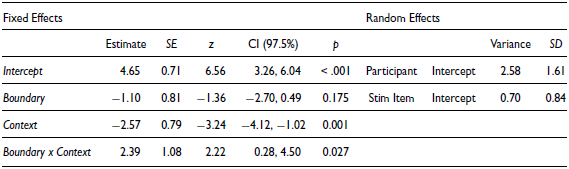
Table A2 Long description
The table presents a summary of a mixed-effects logistic regression model used to test participant accuracy in distinguishing utterances with an IP boundary and without an IP boundary across different contexts. The table is divided into two main sections: Fixed Effects and Random Effects. The Fixed Effects section includes estimates, standard errors, z-values, confidence intervals, and p-values for the intercept, boundary, context, and boundary by context interaction. The Random Effects section lists the variance and standard deviation for participant and stimulus item intercepts. Notable findings include a significant effect of context and a significant interaction between boundary and context, indicating that participant accuracy varies depending on the context and the presence of an IP boundary.
A significant interaction between syntactic context and boundary condition was found (β = 2.39, SE = 1.08, z = 2.22, p = .027). Post hoc pairwise comparisons showed that accuracy differed significantly between name sequences and compound sentences in the no-boundary condition (β = 2.57, SE = 0.79, z = 3.24, p = .001). See table A2 for the full model summary.
Appendix B: Statistical model comparisons and summaries of complete models
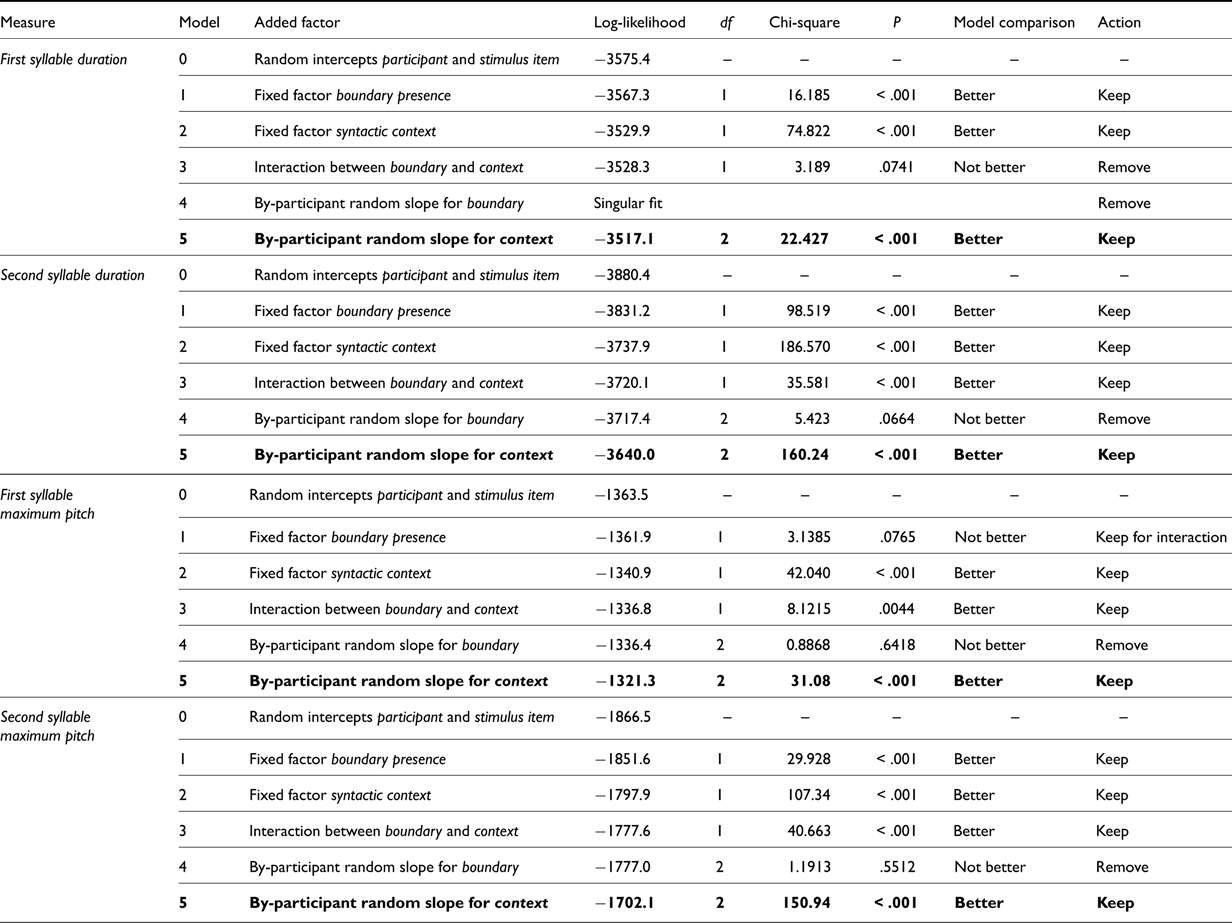
Overview of model comparisons for each prosodic cue. Each line describes the assessment of model fit improvement after adding a single factor. Best-fit models are indicated in bold
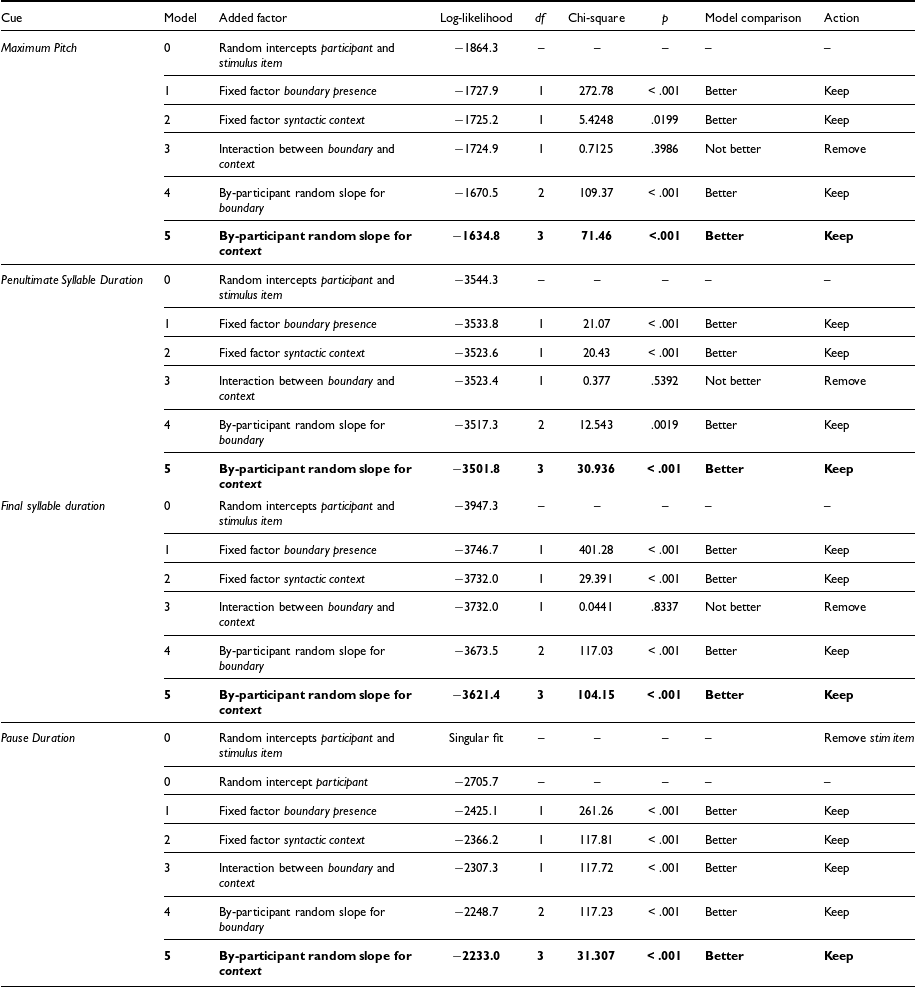
Table B1 Long description
The table presents an overview of model comparisons for various prosodic cues. It includes columns for model number, added factor, log-likelihood, degrees of freedom, chi-square value, p-value, model comparison, and action. The table is divided into four sections based on the prosodic cues: Maximum Pitch, Penultimate Syllable Duration, Final Syllable Duration, and Pause Duration. Each section lists different models with added factors and their respective statistical values. The best-fit models are indicated in bold. For Maximum Pitch, the best-fit models include fixed factors for boundary presence and syntactic context, as well as by-participant random slopes for boundary and context. For Penultimate Syllable Duration, the best-fit models include fixed factors for boundary presence and syntactic context, as well as by-participant random slopes for boundary and context. For Final Syllable Duration, the best-fit models include fixed factors for boundary presence and syntactic context, as well as by-participant random slopes for boundary and context. For Pause Duration, the best-fit models include fixed factors for boundary presence and syntactic context, as well as by-participant random slopes for boundary and context.
Summary of mixed-effects models testing the effects of boundary presence and syntactic context on maximum pitch, syllable duration and pause duration
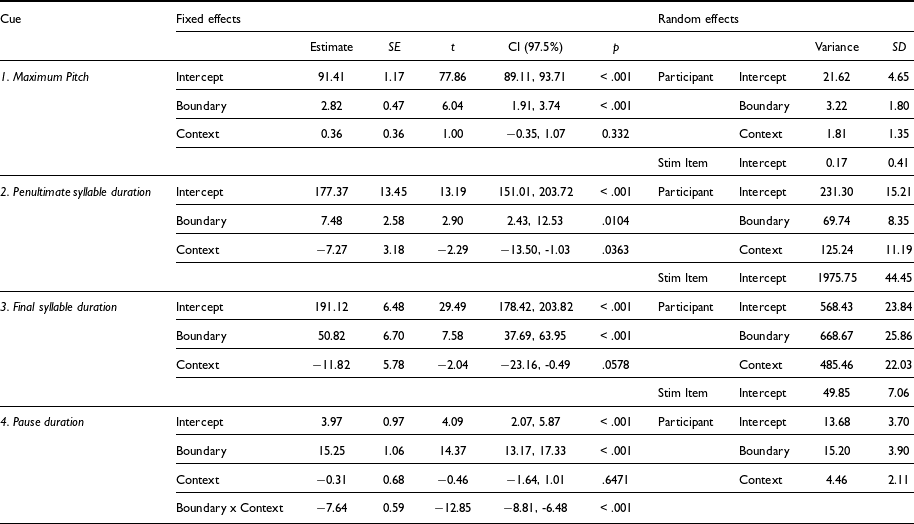
Table B2 Long description
The table presents a summary of mixed-effects models testing the effects of boundary presence and syntactic context on maximum pitch, syllable duration, and pause duration. It includes fixed effects and random effects with estimates, standard errors, t-values, confidence intervals, p-values, variances, and standard deviations. The table is divided into four main cues: maximum pitch, penultimate syllable duration, final syllable duration, and pause duration. Each cue has intercept, boundary, and context values. For maximum pitch, the intercept estimate is 91.41 with a significant p-value of less than 0.001. The boundary effect is 2.82, also significant. The context effect is 0.36, not significant. Random effects include participant and stimulus item variances. For penultimate syllable duration, the intercept estimate is 177.37, significant with a p-value of less than 0.001. The boundary effect is 7.48, significant, while the context effect is -7.27, also significant. Random effects include participant and stimulus item variances. For final syllable duration, the intercept estimate is 191.12, significant. The boundary effect is 50.82, significant, while the context effect is -11.82, not significant. Random effects include participant and stimulus item variances. For pause duration, the intercept estimate is 3.97, significant. The boundary effect is 15.25, significant, while the context effect is -0.31, not significant. The interaction of boundary and context is -7.64, significant. Random effects include participant and stimulus item variances.
Summary of Bonferroni-adjusted pairwise comparisons examining the effects of boundary presence on square-root transformed pause duration across syntactic contexts

Table B3 Long description
The table presents a summary of Bonferroni-adjusted pairwise comparisons examining the effects of boundary presence on square-root transformed pause duration across different syntactic contexts. It consists of two rows and five columns. The columns are labeled Cue, Syntactic Context, Contrast, Estimate, SE, t, and p. The first row shows data for Name sequences with a contrast of No boundary - boundary, an estimate of 15.25, SE of 1.09, t value of 13.95, and p value of less than .001. The second row shows data for Compound sentences with a contrast of No boundary - boundary, an estimate of 7.61, SE of 1.09, t value of 6.96, and p value of less than .001.
Summary of mixed-effects logistic regression model testing the effects of four boundary cues as predictors for prosodic boundary presence
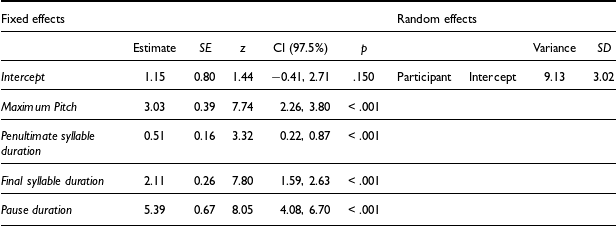
Table B4 Long description
The table presents a summary of a mixed-effects logistic regression model that tests the effects of four boundary cues as predictors for prosodic boundary presence. The table is divided into two main sections: Fixed effects and Random effects. The Fixed effects section includes columns for Estimate, Standard Error (SE), z-score, Confidence Interval (CI) at 97.5%, and p-value. The Random effects section includes columns for Variance and Standard Deviation (SD). The Fixed effects section lists the Intercept with an estimate of 1.15, SE of 0.80, z-score of 1.44, CI ranging from -0.41 to 2.71, and a p-value of 0.150. The boundary cues include Maximum Pitch with an estimate of 3.03, SE of 0.39, z-score of 7.74, CI ranging from 2.26 to 3.80, and a p-value of less than 0.001. Penultimate syllable duration has an estimate of 0.51, SE of 0.16, z-score of 3.32, CI ranging from 0.22 to 0.87, and a p-value of less than 0.001. Final syllable duration has an estimate of 2.11, SE of 0.26, z-score of 7.80, CI ranging from 1.59 to 2.63, and a p-value of less than 0.001. Pause duration has an estimate of 5.39, SE of 0.67, z-score of 8.05, CI ranging from 4.08 to 6.70, and a p-value of less than 0.001. The Random effects section lists the Participant Intercept with a variance of 9.13 and an SD of 3.02.
Appendix C Correlation matrix of mixed-effects logistic regression model predictors
Correlation matrix of predictors in mixed-effects logistic regression model
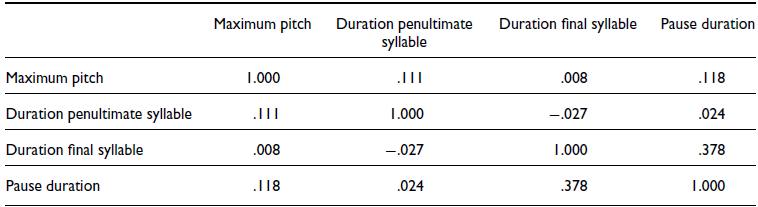
Table C1 Long description
A table with four rows and four columns displaying the correlation matrix of predictors in a mixed-effects logistic regression model. The table includes the following variables: Maximum pitch, Duration penultimate syllable, Duration final syllable, and Pause duration. Each cell shows the correlation coefficient between pairs of variables. Notable correlations include a strong positive correlation between Duration final syllable and Pause duration at 0.378, and moderate correlations between Maximum pitch and Pause duration at 0.118. Other correlations are relatively low, indicating weaker relationships between the variables.
Appendix D Non-local prosodic effects of IP boundaries
Previous research on American English and German has demonstrated that prosodic grouping of coordinated nouns is reflected not only by prosodic cues preceding the boundary, but also by phrase-initial prosodic cues (Wagner, Reference Wagner2005; Huttenlauch et al., Reference Huttenlauch, de Beer, Hanne and Wartenburger2021; Hansen et al., Reference Hansen, Huttenlauch, de Beer, Wartenburger and Hanne2023). Specifically, in sequences such as [X and Y][and Z], the first element X is marked by decreased pitch and duration, compared to the same sequence without an intervening prosodic boundary, i.e. [X and Y and Z]. This prosodic ‘weakening’ effect has been interpreted in the context of the (Anti-)Proximity/Similarity model by Kentner and Féry (Reference Kentner and Féry2013). Hansen et al. (Reference Hansen, Huttenlauch, de Beer, Wartenburger and Hanne2023) investigated the effects of this phrase-initial prosodic weakening on boundary perception in a gating paradigm experiment. The authors found that overall, participants did not perform above chance level in a two-alternative forced-choice task when presented with only the first name in a coordinated name sequence. Only a subgroup managed to do so, while others required local (‘late’) cues to identify the prosodic boundary. This suggests that the non-local weakening effects may support prosodic grouping, but only to a limited extent, compared to the more widely recognized late boundary cues. Moreover, these effects have only been demonstrated in sequences of nouns, coordinated by conjunctions such as and and or, but not in other kinds of syntactic configurations. This raises the question whether this initial prosodic weakening effect can be considered a general cue for IP boundaries. Despite the lack of evidence for perceptual relevance of prosodic weakening, we addressed this question in an exploratory analysis of boundary effects on pitch and duration in the first word (i.e. the first name) in both syntactic structures.
Overview of model comparisons for each prosodic cue. Each line describes the assessment of model fit improvement after adding a single factor. Best-fit models are indicated in bold
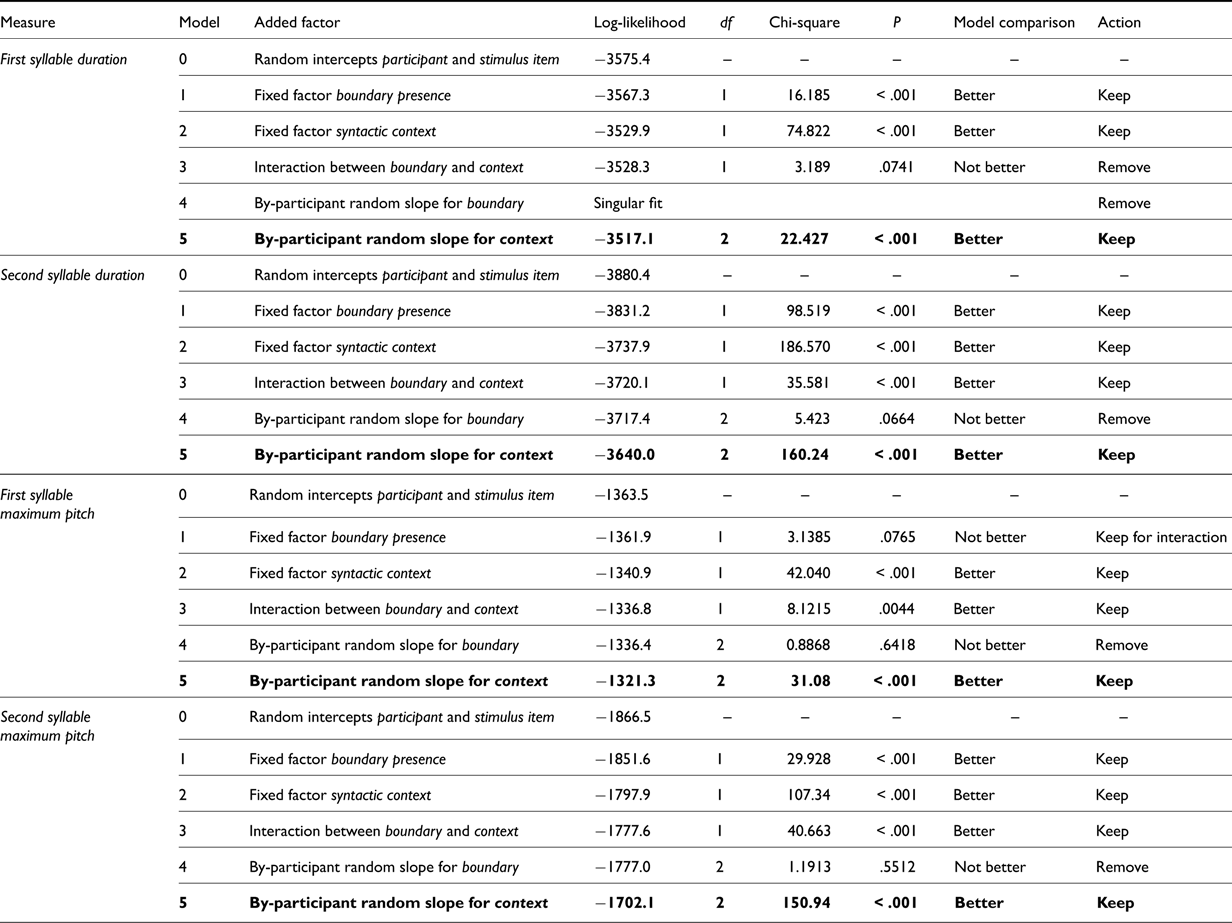
Table D1 Long description
A table comparing model fit improvements for prosodic cues in first and second syllable duration and maximum pitch. The table has 20 rows and 8 columns. The columns are labeled Measure, Model, Added factor, Log-likelihood, df, Chi-square, P, Model comparison, and Action. The rows are labeled with different models and added factors such as Random intercepts participant and stimulus item, Fixed factor boundary presence, Fixed factor syntactic context, Interaction between boundary and context, By-participant random slope for boundary, and By-participant random slope for context. The table shows the log-likelihood, degrees of freedom, chi-square values, and p-values for each model comparison. Best-fit models are indicated in bold. Notable trends include significant improvements in model fit for fixed factor boundary presence and syntactic context across all measures, with chi-square values indicating better model fit. Interactions between boundary and context show mixed results, with some models being removed due to lack of improvement. By-participant random slopes for context generally show significant improvements, while slopes for boundary are often removed due to singular fits or lack of improvement.
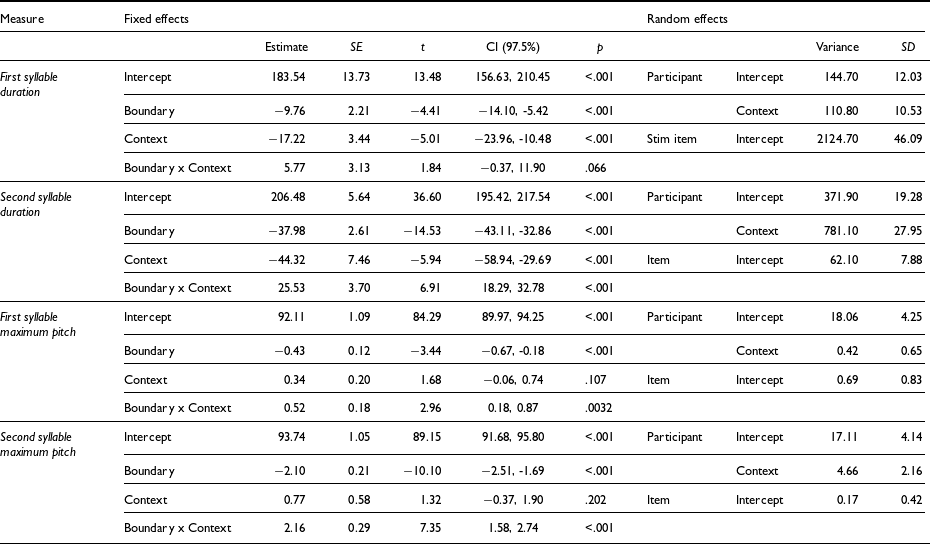
First, the first word of each recorded utterance was manually segmented and annotated on the syllable level using Praat (Boersma & Weenink, Reference Boersma and Weenink2024). Duration and maximum pitch values of both syllables in both boundary and no-boundary conditions were extracted from the annotated utterances using ProsodyPro (Xu, Reference Xu2013). Second, similar to the main analysis, differences in the acoustic measures between boundary and no-boundary conditions were assessed in linear mixed-effects models, using the packages lme4 (Bates et al., Reference Bates, Mächler, Bolker and Walker2015) and lmerTest (Kuznetsova et al., Reference Kuznetsova, Brockhoff and Christensen2017) in R (Version 4.2.3, R Core Team, 2023). Maximum pitch (in ST relative to 1 Hz) and duration of each syllable in the first name of our target stimuli were used as outcome variable in separate models. In each model, boundary presence (boundary vs. no boundary) and linguistic context (name sequences vs. compound sentences) were adopted as two-level fixed factors. The random effects structure included random intercepts for the factors participant, stimulus item and trial number, and by-participant random slopes for boundary presence and linguistic context. Treatment coding was applied to the fixed factors with ‘no IP boundary’ and name sequences as reference levels. For each prosodic cue, model fit was assessed in a stepwise manner by means of likelihood ratio tests, keeping only factors that improved model fit (p < .05). Our baseline model, containing only random intercepts, was extended by adding fixed factors in the following order: first boundary presence, then syntactic context, and finally the interaction between boundary presence and syntactic context. Consecutively, by-participant random slopes for boundary presence and syntactic context were added. In case of significant interactions, the effects of boundary presence for each linguistic context were examined by means of pairwise comparisons, using the emmeans package in R (Lenth, Reference Lenth2024). An overview of model comparisons, summaries of complete models and details of the pairwise comparisons are presented in Tables D1–3 below.
Summary of mixed-effects models testing the effects of boundary presence and syntactic context on phrase-initial syllable duration and maximum pitch
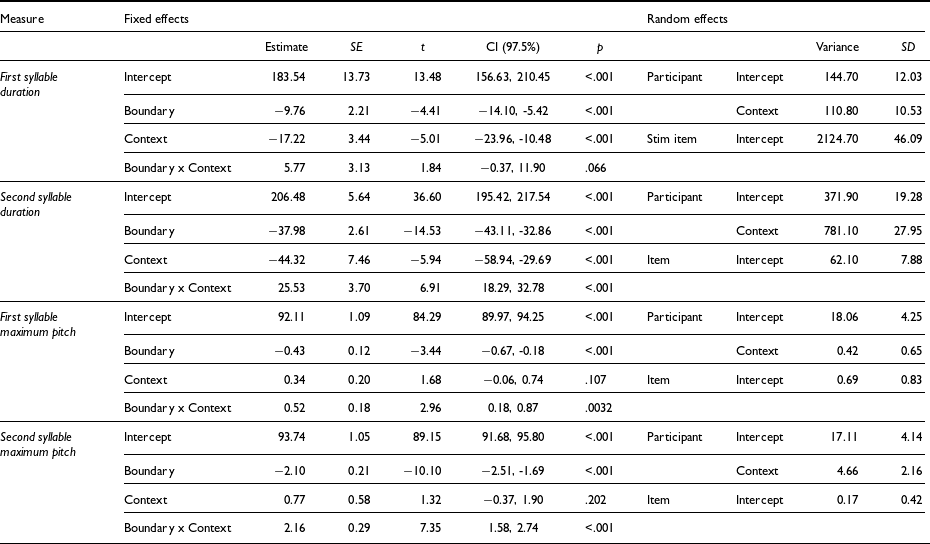
Table D2 Long description
The table presents the results of mixed-effects models analyzing the effects of boundary presence and syntactic context on phrase-initial syllable duration and maximum pitch. It includes fixed effects such as intercept, boundary, context, and boundary x context, along with their estimates, standard errors, t-values, confidence intervals, and p-values. Random effects include participant, context, and stimulus item with their respective variances and standard deviations. The table is divided into four measures: first syllable duration, second syllable duration, first syllable maximum pitch, and second syllable maximum pitch. Each measure has its own set of fixed and random effects. Notable trends include significant effects of boundary presence and context on syllable duration and maximum pitch, with varying interactions between boundary presence and syntactic context.
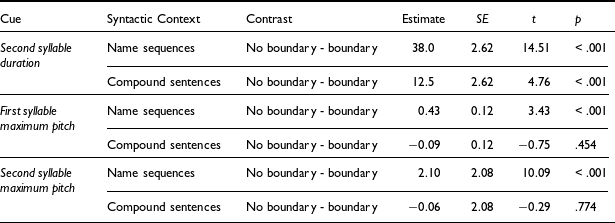
Summary of Bonferroni-adjusted pairwise comparisons examining the effects of boundary presence on each prosodic cue at different levels of syntactic context
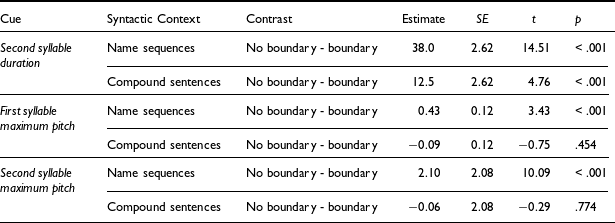
Table D3 Long description
The table presents a summary of Bonferroni-adjusted pairwise comparisons examining the effects of boundary presence on various prosodic cues at different levels of syntactic context. It includes four main cues: second syllable duration, first syllable maximum pitch, and second syllable maximum pitch, each analyzed within name sequences and compound sentences. The table is structured with columns for syntactic context, contrast, estimate, standard error, t-value, and p-value. For second syllable duration in name sequences, the estimate is 38.0 with a p-value of less than 0.001, indicating a significant difference between no boundary and boundary conditions. In compound sentences, the estimate is 12.5 with a similar p-value. For first syllable maximum pitch in name sequences, the estimate is 0.43 with a p-value of less than 0.001, while in compound sentences, the estimate is 0.09 with a p-value of 0.454, indicating no significant difference. For second syllable maximum pitch in name sequences, the estimate is 2.10 with a p-value of less than 0.001, while in compound sentences, the estimate is 0.06 with a p-value of 0.774, again indicating no significant difference. The table provides a detailed comparison of how boundary presence affects prosodic cues in different syntactic contexts, highlighting significant and non-significant differences.
Results: Syllable durations
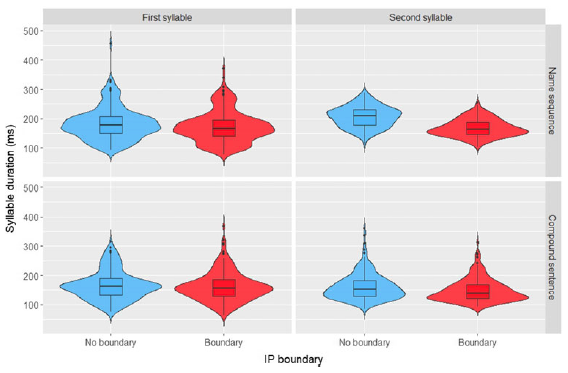
The first syllable of the first name was significantly shorter in the boundary condition, compared to the no-boundary condition (β = -9.76, SE = 2.21, t = -4.41, p < .001), both in name sequences (M = 174 ms vs. M = 184 ms, respectively) and in compound sentences (M = 162 ms vs. M = 166 ms). In addition, the first syllable was shorter in compound sentences (M = 164 ms) compared to name sequences (M = 179 ms), regardless of boundary presence (β = -117.22, SE = 3.44, t = -5.01, p < .001). This effect is possibly due to effects of utterance length on stressed syllable duration, comparable to penultimate syllable duration across syntactic contexts in our main analysis. For the duration of the second syllable, a significant interaction between boundary presence and syntactic context was found (β = 25.53, SE = 3.70, t = 6.91, p < .001). To interpret this interaction, Bonferroni-adjusted pairwise comparisons were conducted to investigate effects of boundary presence in each syntactic context. In name sequences, second syllable duration was significantly longer in the absence of an IP boundary (β = 38.0, SE = 2.62, t = 14.51, p < .001). This was also the case for second syllable duration in compound sentences, but the effect was weaker (β = 12.5, SE = 2.62, t = 7.76, p < .001). The effects of boundary presence on syllable duration are illustrated in Figure D1.
Violin plots of phrase-initial syllable duration in the absence (‘No boundary’) and presence (‘Boundary’) of an IP boundary, in name sequences and compound sequences, respectively.
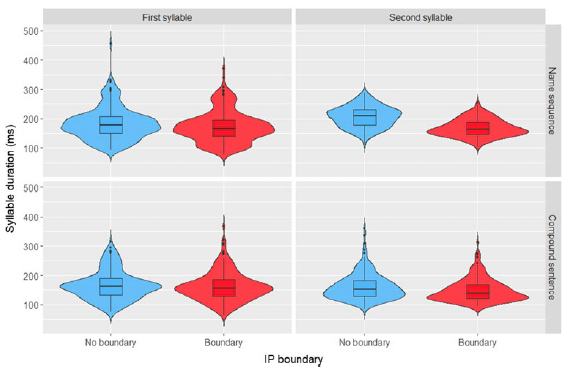
Figure D1 Long description
The box-and-whisker plot displays syllable duration in milliseconds for the first and second syllables, comparing conditions with and without IP boundaries in name sequences and compound sentences. The plot is divided into four sections: first syllable with no boundary, first syllable with boundary, second syllable with no boundary, and second syllable with boundary. Each section contains two box plots, one for name sequences and one for compound sentences. The x-axis represents the IP boundary condition, while the y-axis represents syllable duration in milliseconds. The box plots show the median, lower quartile, upper quartile, and whiskers indicating the range of data. Outliers are also present. The name sequences and compound sentences are color-coded in blue and red, respectively. The plot reveals differences in syllable duration based on the presence of IP boundaries and the type of sequence.
In short, both the first and second syllable of the phrase-initial word were shorter in the presence of an IP boundary, compared to a baseline without an IP boundary, suggesting that the syllables were prosodically weakened. This weakening effect occurred both in name sequences and in compound sentences, although the effect on the second syllable duration was more pronounced in name sequences (M = 168 ms vs. M = 206 ms) than in compound sentences (M = 150 ms vs. M = 162 ms). This enhanced effect in name sequences is comparable to the effect of boundary presence on pause duration in our main analysis, which was also larger in the case of name sequences. Here too, the difference may be caused by the disambiguating function of the IP boundary, emphasizing prosodic cues to guide the listener towards the intended interpretation of the ambiguous name sequences.
Results: Maximum pitch
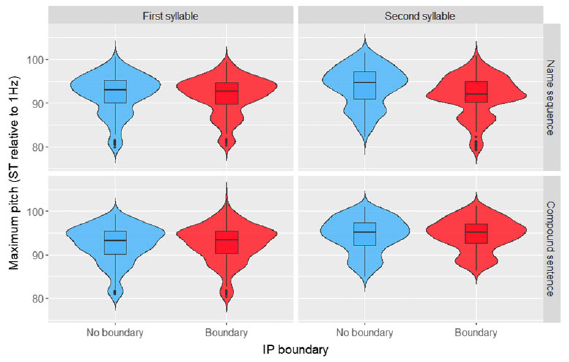
A significant interaction between boundary presence and syntactic context was found both in the first syllable of the first name (β = 0.52, SE = 0.18, t = 2.96, p = .0032) and in its second syllable (β = 2.16, SE = 0.29, t = 7.35, p < .001). The effects of boundary presence was examined in each syntactic context for each syllable using Bonferroni-adjusted pairwise comparisons. Maximum pitch in the first syllable was significantly higher in the absence of an IP boundary in the name sequences (β = 0.43, SE = 0.12, t = 3.43, p < .001), but not in the compound sentences (β = -0.09, SE = 0.12, t = -0.75, p = .454). Maximum pitch in the second syllable was also significantly higher in the absence of an IP boundary in the name sequence (β = 2.10, SE = 0.21, t = 10.09, p < .001), but not in the compound sentences (β = -0.06, SE = 0.21, t = -0.29, p = .774). The effects of boundary presence on pitch realization in the first two syllables are illustrated in Figure D2.
Violin plots of maximum pitch (in ST relative to 1 Hz) in the absence (‘No boundary’) and presence (‘Boundary’) of an IP boundary, in the first and second syllable of the first word, respectively. Top row: for name sequences; Bottom row: for compound sequences.
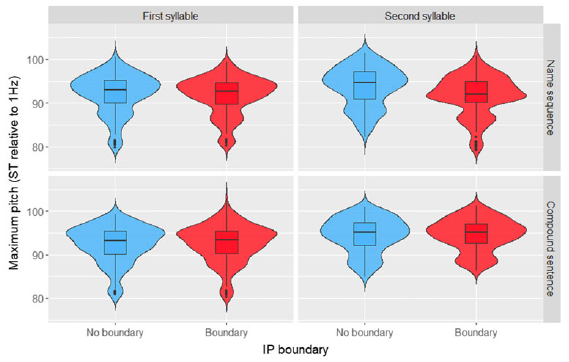
Figure D2 Long description
The image presents four violin plots comparing maximum pitch (in semitones relative to 1 Hz) in the absence and presence of an intonational phrase (IP) boundary. The plots are divided into two rows: the top row for name sequences and the bottom row for compound sequences. Each row contains two violin plots: one for the first syllable and one for the second syllable of the first word. The x-axis represents the presence or absence of an IP boundary, labeled as 'No boundary' and 'Boundary'. The y-axis represents the maximum pitch, ranging from 80 to 100 semitones. Each violin plot shows the distribution of maximum pitch values, with a box plot inside indicating the median, lower quartile, and upper quartile. The plots reveal differences in pitch distribution based on the presence of an IP boundary and the type of sequence. All values are approximated.
In summary, in the name sequences, pitch was lowered in the presence of an IP boundary compared to a baseline without such a boundary, both in the first syllable of the phrase-initial word (M = 92.11 vs. M = 91.69 ST) and in the second syllable (M = 93.74 vs. M = 91.64 ST). However, pitch was not lowered in the compound sentences in the presence of an IP boundary, neither in the first syllable (M = 92.45 vs. M = 92.55 ST) nor in the second (M = 94.50 vs. M = 94.56 ST). This result suggests that, at least in Dutch, prosodic weakening in terms of pitch takes place only in ambiguous coordinate structures, but not in regular sentences in which the IP boundary aligns with the boundary of a syntactic clause.
Discussion
While we found significant differences between boundary and no-boundary conditions in the duration and pitch of phrase-initial syllables, these early prosodic effects don’t appear to play a major role in signaling IP boundaries overall and shouldn’t be considered general boundary cues. First, pitch lowering doesn’t consistently occur beyond IP boundaries in coordinate structures, limiting how broadly this effect can signal boundaries. Additionally, although phrase-initial syllables tend to be slightly shorter in the presence of an IP boundary, this effect is minimal – especially in compound sentences, where the difference averages less than 13 milliseconds, just passing the Just Noticeable Difference threshold for duration in acoustic stimuli (Koffi, Reference Koffi2018). Even when listeners are explicitly asked to identify boundaries, these early prosodic effects are only sufficient for a subset of listeners to predict IP boundaries (Hansen et al., Reference Hansen, Huttenlauch, de Beer, Wartenburger and Hanne2023). Overall, local boundary cues, such as pitch change, final lengthening, and pause, are perceptually more salient and provide more reliable evidence for prosodic boundaries than these subtle non-local prosodic effects.


 Open access

