


Nutrition and health claims on food packaging are used by the food and drink industry to inform consumers of a health benefit that a product may have. Claims such as ‘this will boost your immune system’ or ‘lowers cholesterol’ or even very simple claims such as ‘this product is low in fat’ are widespread on supermarket shelves. Roe et al.(Reference Roe, Levy and Derby1) examined perceptions of the healthfulness of functional foods and found that prior judgement about a food product tends to override any claim information provided on the label. In general, consumers see products that are intrinsically healthy, such as yoghurt, cereals, bread and juice, as credible carriers of functional messages(Reference Siró, Kapolna, Kapolna and Lugasi2). Traditionally these sorts of statements were found on food groups such as yoghurts or breakfast cereals, primarily because they are considered inherently healthy(Reference Siegrist, Stampfli and Kastenholtz3).
In recent times, however, the existence of nutrition and health claims on packs has been spread across a much wider range of food groups. Limited data exist about new products within the market, but it was estimated that 305 products were launched in the functional food sector in Germany between 1999 and 2000, with soft drinks, confectionery, dairy and bakery representing the four largest categories of functional food innovation during that period(Reference Menrad4). While there can be professional scepticism(Reference Lee, Georgiou and Raab5) about the role of these products in the marketplace, it cannot be denied that the consumer is showing increasing interest in the purchase of products which could provide solutions to dietary problems or go some way towards preventing problems before they arise(Reference McNally6). It is therefore becoming increasingly important that the use of these functional foods on the marketplace is controlled to ensure that false or ambiguous claims are not made and that consumers are not being misled.
In order to address this responsibility, wide-ranging regulations on the use of nutrition and health claims have recently been introduced in Europe. Regulation (EC) No. 1924/2006 of the European Parliament and of the Council on nutrition and health claims(7) was published in late December 2006 and categorises claims as either ‘nutrition claims’ or ‘health claims’. A nutrition claim is one which states that a food has particular beneficial nutritional composition, e.g. ‘high in fibre’ or ‘low fat’. The Annex of this Regulation provides a list of nutrition claims and the conditions applicable to them; for example, a product with a ‘low fat’ claim may only be made where the product contains less than 3 g fat/100 g solid food or 1·5 ml fat/100 ml liquid. Health claims, on the other hand, are those which suggest that a relationship exists between a food and health. Several different categories of health claims are described in the Regulation; these are outlined in Table 1.
Types of health claims as categorised in accordance with EU Regulation 1924/2006 on nutrition and health claims(7)

The scope of EU Regulation 1924/2006 is very wide, so that the use of wording and symbols (including trademarks) which imply that a food provides a particular nutrition or health benefit are all included as claims and subject to the new rules. The primary aim of the Regulation is to protect consumers against being misled and to facilitate consumer choice by ensuring that they receive accurate information about the overall nutritional composition of the food bearing a claim. Claims made on foods must be clear and understandable by the average consumer and claims lacking adequate scientific substantiation are not permitted.
This Regulation has established a procedure for the review and assessment of claims by the European Food Safety Authority (EFSA). By 31 January 2010, based on advice issued by EFSA and input from the Commission and Member States, a list of permitted Article 13 claims (function, psychological and behavioural, and slimming or weight control claims only) and all necessary conditions for their use will be published. For the first time there will be harmonisation across the EU and, with the publication of the Regulation, claims will be approved for use in all twenty-seven Member States. To date, EFSA has published opinions on forty-one different Article 14 health claims, the majority of which are claims that pertain to children’s development and health. EFSA has given a positive opinion on only eight of these claims. The others received unfavourable opinions mostly on the grounds that no cause-and-effect relationship had been established between the consumption of the product and the claim(8).
Prior to the introduction of Regulation 1924/2006, it was prohibited to make any claim or reference to reducing the risk of a disease with a food. Directive 2000/13/EC(9) on the labelling of foodstuffs declared that ‘labels must not attribute to any foodstuff the property of preventing, treating or curing a human disease’. Despite being prohibited, however, claims relating to diseases began to slowly creep onto the marketplace. As far back as 1998 and long before Regulation 1924/2006, Hilliam identified a growing range of products with claims, including yoghurts and other dairy products, soft drinks, bakery and cereal products, and spreads(Reference Hilliam10). In addition, a ‘grey area’ emerged whereby a claim may not make specific reference to a disease but a biomarker or a specific risk factor may be used, e.g. ‘lowers cholesterol’. Some may class this as a general health claim but given that for those with high cholesterol, reduction in the level would reduce their risk of developing CVD(11), it could also be classed as a disease risk reduction claim. In addition, ‘contains antioxidants’ could arguably be either a nutrition claim or, due their functionality, a health claim. However, to have a claim classed as a nutrition claim, rather than a health claim, is preferable from a food industry perspective. Given the breakdown of categories of claims and their different authorisation procedures provided for in EU Regulation 1924/2006, getting authorisation for a general health claim that has been on the market for many years is a much simpler process than getting authorisation for a disease risk reduction claim. A claim such as ‘contains antioxidants’ could be categorised as a nutrition or health claim. These types of claims are known as ‘borderline claims’ and their categorisation is likely to remain subject to debate.
The publication of this Regulation will mean that the food and drink industry will have to match nutrition and health claims to available scientific evidence and not the other way round. It will raise the level of consumer protection with respect to food labelling, but will also enable free movement of goods and prevent unequal conditions of competition within the internal EU market. This Regulation also has the potential to tackle key public health issues by encouraging reformulation of foods which can contribute to dietary and health improvements provided they are based on sound science. Article 27 of EU Regulation 1924/2006 requires that the evolution of the market in foods in respect of which nutrition or health claims are made must be reported on. The purpose of the present study was to examine commonly eaten packaged foods on the Irish market for nutrition and health claims. The project aimed to ascertain which categories of foods carried high numbers of claims and the types of claims being made on these foods, and therefore to provide baseline data enabling the implementation of Article 27 in Ireland.
Methods
In September and October 2007 a survey was conducted of the labels on packaged foods sold in supermarkets in Dublin, Ireland. The survey was conducted by three researchers in four major retailers in Dublin. Permission was sought from the supermarket manager before the data were collected and because the information was freely available in the public domain, it was deemed unnecessary to obtain ethical approval for the study.
A convenience sample was used in the study and the foodstuffs to be included were selected on the basis that they were foods that are most commonly eaten. Conducted in 2001, the Irish Universities Nutrition Alliance food consumption study demonstrated that eight food groups account for 74 % of energy intake: i.e. meats (16 %), breads (14 %), potatoes (11 %), milk and yoghurt (9 %), cakes and biscuits (9 %), breakfast cereals (4 %), spreads (6 %) and vegetables (4 %)(12). Given that these foods are eaten most commonly, they were to form the basis for the study. However, as per a similar survey conducted in Australia by Williams et al. in 2006(Reference Williams, Yeatman, Ridges, Houston, Rafferty, Ridges, Roesler, Sobierajski and Spratt13), only packaged foods were included, so the quantitative data cannot be taken to represent all the foods available in Ireland. It was decided that the food categories to be studied are those outlined in Table 2, which reflected those that were packaged and most commonly eaten.
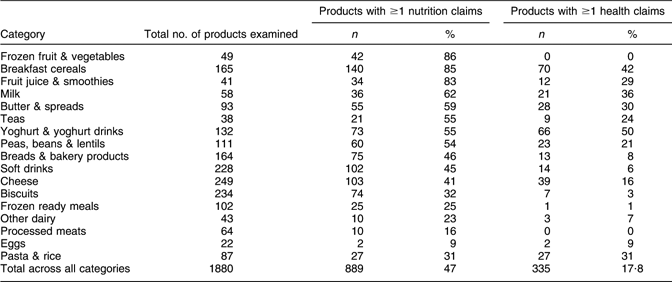
The number and proportion of nutrition and health claims identified in commonly eaten packaged foods examined on the Irish market in 2007
The following information was recorded for each product:
1. Food category;
2. Name/brand of product;
3. Manufacturer;
4. Presence/absence of a claim;
5. When present, the number of claims being made;
6. Type of claim (see Table 1);
7. The exact text of each claim observed.
The claims were categorised in accordance with the legislation and the guidance on the implementation of the Regulation published by the European Commission in December 2007(14).
Data analysis
The food labels were examined by hand and the information recorded on a form designed for this purpose. The information was recorded as outlined above and a database was designed to store this information, using Microsoft® Access 2003 (Microsoft Corp., Redmond, WA, USA). Frequencies of claims in all categories were calculated.
Results
The labels of a total of 1880 commonly eaten packaged food products were examined. The food category with the greatest percentage of nutrition claims was Frozen fruit & vegetables (86 %), while the highest percentage of health claims was in the Yoghurt & yoghurt drinks category (50 %). All categories of foodstuffs included at least one product with at least one nutrition claim, but neither Processed meats nor Frozen fruit & vegetables included any products making a health claim. Of the total products analysed, 47·3 % carried one or more nutrition claim and 17·8 % carried one or more health claim (Table 2).
Breakfast cereals was the category with the most number of both nutrition and health claims (see Table 3). From the 165 products examined, there were 302 nutrition claims made on Breakfast cereals. Thirty-six per cent of the products had one claim and 17 % and 13 % had two and three claims respectively, with 1 % of this food category displaying seven different nutrition claims. Within this food category, the claim that was made most frequently was a ‘wholegrain’ claim, and ‘fibre’ and ‘folic acid’ claims were also common. Breakfast cereals carried a significant number of health claims (see Table 4). One in five health claims observed related to ‘cholesterol’ and 15 % carried a ‘slimming’ claim.
Categories of commonly eaten food products with the most nutrition claims identified on the Irish market in 2007; those categories with fewer claims are referred to in the text and not shown in the table

The most frequently identified health claims found in categories of the most commonly eaten packaged foods on the Irish market in 2007; results are presented as the proportion of health claims in each food categoryFootnote *,Footnote †

* The categories Frozen ready meals, Processed meats and Frozen fruits & vegetables were not included as no health claims were observed in these categories.
† Only the most frequently observed general health claims are given in each food category. There were additional claims observed for some food categories which, for clarity reasons, are not listed. The total for each food category therefore does not equal 100.
Peas, beans & lentils scored highly on the nutrition claim survey. A total of 111 products were examined and 181 nutrition claims were made in this food category, the most common of which referred to ‘fat (including saturated fat)’ (fifty-five claims) followed by ‘fibre’ (forty-three claims). Health claims were also common in this category and 47 % of health claims were ‘low GI’ (glycaemic index; see Table 4).
Cheese scored the next highest in the survey with 166 nutrition claims from 249 products. The most common claim referred to ‘minerals’ (including calcium) content while ‘fat (including saturated fat)’ was the second most common claim in this category (Table 3). In the health claims survey, 46 % of health claims made on Cheese were in the children’s development and health category and 34 % were general health claims, referring to ‘healthy bones/hair/skin/teeth’ (Table 4).
There were ninety-three products examined from the Butter & spreads category, from which 150 nutrition claims were observed. Within this food category a very high number of nutrition claims were made in relation to ‘fat (including saturated fat)’ (forty-five claims) and the use of ‘hydrogenated oil’ (thirty-five claims). A claim on ‘vitamins’ content (e.g. ‘source of vitamins’ or ‘with added vitamins’) was also quite common (twenty-three claims) in this category (Table 3). A high percentage (45 %) of health claims made in this category referred to ‘cholesterol’, with ‘healthy heart’ claims at 42 % (Table 4).
Two hundred and twenty-eight products were examined in the Soft drinks category, which demonstrated the highest number of nutrition claims about ‘sugar’ (sixty-eight; 53 % of nutrition claims made). Thirty-five nutrition claims were also made on ‘energy’ content (Table 3), e.g. ‘low calorie’ and ‘light’. Twenty-two per cent of all health claims made on Soft drinks referred to ‘digestive system/metabolism’, while 17 % referred to ‘concentration/brain function’ (Table 4).
Yoghurt & yoghurt drinks was the next category, with a total of 122 nutrition claims from 132 products examined. Of this 122, forty-six referred to ‘fat (including saturated fat)’ content, thirty-three to ‘minerals’ and fourteen to ‘sugar’ content (Table 3). Apart from Breakfast cereals, the Yoghurt & yoghurt drinks category had the broadest range of nutrition claims across all nutrients. This was the food category with the highest percentage of health claims. Fifty per cent of all Yoghurt & yoghurt drinks examined had a health claim (see Table 2). Of all health claims made in this category, 32 % referred to digestion and the maintenance of a healthy digestive system (Table 4).
Milk and Other dairy categories had eighty-four (from fifty-eight products) and fifteen (from forty-three products) nutrition claims, respectively. In both of these categories most of these claims referred to ‘minerals’, ‘vitamins’ and ‘fat (including saturated fat)’ content (Table 3). Most of the health claims in milk were ‘healthy bones/hair/skin/teeth’ whereas for the Other dairy category, the highest category of health claim was for ‘slimming’ (Table 4).
One hundred and sixty-four Bread & bakery products were examined. A high number of nutrition claims – 127 in total – were recorded. The majority of these claims were for ‘fat (including saturated fat)’ (forty claims), while twenty-five claims were made for ‘fibre’ content (Table 3). Twenty-eight per cent of all health claims made on Bread & bakery products were in the function claims category, specifically ‘healthy bones/hair/skin/teeth’ (Table 4).
Frozen fruit & vegetables (forty-nine products examined) and Fruit juice & smoothies (forty-one products examined) were the only two categories where a ‘1 of your 5 a day’ claim was made. In Frozen fruit & vegetables, twenty-nine of the sixty-nine claims made referred to ‘1 of your 5 a day’ and in the Fruit juice & smoothies category, of the forty-one products analysed, twelve products made this claim. A ‘vitamin’ claim was very common in both categories, while claims pertaining to ‘sugar’ content were also common for Fruit juices & smoothies (Table 3). There were no health claims made on any Frozen fruit & vegetables products surveyed; in the Fruit juice & smoothies category, the health claims were spread across ‘immunity’, ‘healthy heart’ and ‘healthy bones/hair/skin/teeth’ (Table 4).
Biscuits had a broad range of nutrition claims. Among the seventy-four products (from 234 examined) in this category, thirty-five nutrition claims were for ‘fat (including saturated fat)’ and twenty nutrition claims were made for ‘fibre’. In the health claims category, most claims observed were ‘slimming’ claims (60 % of all health claims on biscuits).
Pasta & rice had twenty-seven products (out of eighty-seven examined) carrying a total of sixty-five nutrition claims and most of these were for ‘fat (including saturated fat)’. With the exception of Processed meats, Pasta & rice was the only category of foodstuffs with a nutrition claim for ‘carbohydrate’ (Table 3). In the health claim survey, 58 % of those made in this category were for ‘low GI’.
In the Frozen ready meals category, twenty-five out of 102 products examined had nutrition claims. Most of these were for ‘hydrogenated fat’ and ‘salt/sodium’; no health claims were made in this category.
Teas, Processed Meats and Eggs had the smallest number of nutrition claims: twenty-one, fifteen and two, respectively. For Teas, most of these claims were for ‘antioxidants’ and for Processed meats most of the claims were for ‘fat (including saturated fat)’. The only nutrition claims made for Eggs were for ‘omega 3’ content. There were no health claims observed in this survey for Processed meats and the only health claim in the Eggs category was in relation to ‘immunity’. There were nineteen different health claims observed in the Teas category, the highest percentage of which referred to ‘digestive system/metabolism’ or ‘protect body from damage caused by free radicals’ (Table 4).
Borderline claims observed in this study were, for example, ‘lowers/reduces cholesterol’ and ‘regulates your blood pressure’. These claims are currently regulated as Article 13 (general health claims) but should it be deemed that they are in fact Article 14, disease risk reduction claims, then they would have to be assessed and authorised by EFSA and not freely placed on the market as is currently the case.
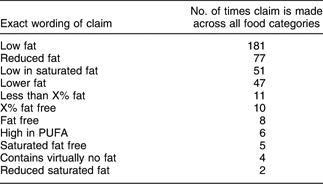
Across all food categories, the most frequently occurring nutrition claim concerned ‘fat (including saturated fat)’, with ‘vitamins’ and ‘sugar’ also scoring highly. A breakdown of the exact text observed within the ‘fat (including saturated fat)’ claim was recorded (see Table 5). ‘Low fat’ is the nutrition claim most frequently observed with ‘reduced fat’ and ‘low in saturated fat’ also scoring highly. In the health claims study, disease risk reduction claims appeared infrequently, with the highest percentage of only 5 % in the Butter & spreads category (n 28). Table 4 demonstrates that the most frequently occurring health claims are ‘digestive system/metabolism’ claims, ‘cholesterol’ claims, claims pertaining to ‘healthy bones/hair/skin/teeth’ and ‘slimming’ claims.
Exact wording observed in nutrition claims made pertaining to ‘fat (including saturated fat)’ identified in categories of the most commonly eaten packaged foods on the Irish market in 2007; the number of times each claim is made across all food categories is given
Discussion
The present study demonstrates that the use of nutrition and health claims on packaged foods commonly eaten in Ireland is widespread and varied across different food categories. Although the data collection was concentrated in one region in Dublin, given that the retailers that were surveyed are available nationwide and that the major brands in each category were included in the survey, it is reasonable to assume that these results represent the national situation. Of all the foods surveyed, 47·3 % carried a nutrition claim and 17·8 % carried a health claim. Similar, but not identical, surveys were carried out in Australia in 2005(Reference Williams, Yeatman, Ridges, Houston, Rafferty, Ridges, Roesler, Sobierajski and Spratt13) and the USA in 2000(Reference LeGault, Brandt, McCabe, Adler, Brown and Brecher15). The nutrition claim figure of 47·3 % is much higher than that observed in the Australian survey (where 14 % of products surveyed carried some sort of claim) but was similar to that identified in the US survey (where 49·7 % of all products surveyed carried a nutrient content claim). The US study also identified that 4·4 % of products surveyed carried a health claim and 6·2 % a structure/function claim, whereas the present study identified 17·8 % of products with a health claim. The category in our survey with the largest number of health claims was Yoghurt & yoghurt drinks (50 %); this segment of the market has seen a lot of growth in Europe in recent years(Reference Stanton, Gardiner, Meehan, Collins, Fitzgerald, Lynch and Ross16) and may explain the discrepancy between the current survey and that conducted in the USA in 2000.
In our survey, the nutrient about which the greatest number of nutrition claims was made is ‘fat (including saturated fat)’ with a total of 384 claims observed. As outlined in Table 5, the claim most frequently made was ‘low fat’. A similar study conducted in Australia in 2003(Reference Williams, Yeatman, Zakrzewski, Aboozaid, Henshaw, Ingram, Rankine, Walcott and Ghani17) identified that ‘%Fat free’ was the most commonly used ‘fat’ claim but since the publication of EU Regulation 1924/2006, the use of this claim in Europe has been prohibited. Low-fat products were initially introduced on the market to serve specific dietary and slimming needs. They were originally developed for diabetics and individuals with specific medical problems such as obesity and heart disease(Reference Sandrou and Arvanitoyannis18). Nowadays, these products have a much wider appeal and industry has developed products for consumers attempting to lose or stabilise their weight and to work within the framework of a healthier diet. The concept of a product low in fat is one that is relatively easy to convey and understand. It is much easier to gain consumer acceptance for a functional food that is amended or enriched with compounds that are well-known for their health benefits, e.g. calcium or reduced fat, than it is for compounds that are practically unknown to the general public, e.g. selenium or xylitol(Reference Jew, Vanstone, Antoine and Jones19). The combination of public health messages and media coverage of obesity and overweight probably contributes considerably to the demand for and subsequent wide availability of ‘low fat’ products.
The largest proportion of health claims observed in the present survey was in the general health claims category. Of those observed, claims referring to the digestive system were the most common. This finding is similar to that identified by a study in Japan which found that while some popular ‘health’ foods address serious problems in the Japanese diet such as inadequate calcium and fibre consumption, the best-selling ingredients for these foods, comprising the vast majority of sales, are designed to improve digestion, not reduce the risk of serious chronic diseases(20). According to surveys, concerns among consumers relate to CVD, stress, high blood pressure, malignant tumour diseases of the digestive system, arthritis and obesity(Reference Jew, Vanstone, Antoine and Jones19). The prevention of heart disease/CVD, prevention of stomach/intestine cancer, lowering cholesterol and lowering blood pressure were listed as the disease/health aspect consumers would most prefer functional foods to influence(Reference Bech-Larsen and Grunert21). Naturally, a synergistic relationship between consumer needs and demands and the industry offerings would be beneficial for all. The concept of a system whereby the needs of consumer health are met by product development in the food industry should be explored.
Most of the claims observed in the current study complied with the requirements of EU Regulation 1924/2006. Examples of nutrition claims that did not comply were ‘X % fat free’ and ‘high in omega 3’. Article 8 of this legislation provides for the amendment of the Annex for nutrition claims and in cases where it is reasonable and valid, this should be reviewed and amendments made. Health claims currently on the marketplace are acceptable only until a permitted list is published by the European Commission. Given that this legislation is relatively new and requirements sometimes take time to reach the marketplace, the survey should be repeated and a detailed assessment of compliance with the legislation conducted. It would also be very useful, when repeating the present study, to conduct it in parallel with other EU Member States in order to put the Irish market in context with other international markets.
Nutrition and health claims on foods encourage reformulation in the food and drink industry, reward the industry for making only truthful and substantiated claims, and with the publication of EU Regulation 1924/2006, the legal framework now exists to protect consumers and provide them with accurate information. A close evaluation of this Regulation’s success or failure will be crucial for the long-term existence of health claims and their presence on the marketplace.
Acknowledgements
This research received no specific grant from any funding agency in the public, commercial or non-for-profit sectors. There are no conflicts of interest. F.L. and J.K. were responsible for study and database design and data analysis. The manuscript was written by F.L. and edited by P.G.W., J.K. and M.A.T.F. We also thank Aisling Nolan who assisted with data collection.



