





1 Introduction
1.1 The role of (co)limits in the literature
Given a diagram $K\colon {\mathcal {J}}\to {\mathcal {C}}$
, the property for an object
$K\colon {\mathcal {J}}\to {\mathcal {C}}$
, the property for an object $\ell $
of
$\ell $
of ${\mathcal {C}}$
to be a (weighted/(op)lax/pseudo/conical) limit of K can be summarized by saying that
${\mathcal {C}}$
to be a (weighted/(op)lax/pseudo/conical) limit of K can be summarized by saying that $\ell $
comes with a (weighted/(op)lax/pseudo/conical) cone over the diagram K and is universal with this property. The notion of limit has been considered in a variety of contexts: for diagrams between strict n-categories – either in a strict or homotopical sense – as well as between
$\ell $
comes with a (weighted/(op)lax/pseudo/conical) cone over the diagram K and is universal with this property. The notion of limit has been considered in a variety of contexts: for diagrams between strict n-categories – either in a strict or homotopical sense – as well as between $(\infty ,n)$
-categories for all
$(\infty ,n)$
-categories for all $n>0$
, and the various variances succeed at capturing many concepts of relevance. In order to motivate the study of limits in all their flavors, we list here various situations where limits play a crucial role.
$n>0$
, and the various variances succeed at capturing many concepts of relevance. In order to motivate the study of limits in all their flavors, we list here various situations where limits play a crucial role.
As a first series of examples, we recall several constructions of interest whose universal property is that of an appropriate (co)limit:
-
» Given a ring (spectrum) R and an element p of R, the localization $R[p^{-1}]$
of R at p is the colimit (resp.
$(\infty ,1)$
-colimit) of the diagram
${\mathbb {N}}\to {\mathcal {R}} ng$
(resp.
$(\infty ,1)$
-diagram
${\mathbb {N}}\to {\mathcal {R}} ng({\mathcal {S}} p)$
) given by
$R[p^{-1}]$
of R at p is the colimit (resp.
$(\infty ,1)$
-colimit) of the diagram
${\mathbb {N}}\to {\mathcal {R}} ng$
(resp.
$(\infty ,1)$
-diagram
${\mathbb {N}}\to {\mathcal {R}} ng({\mathcal {S}} p)$
) given by -
» The
$(\infty ,1)$
-category
${\mathcal {S}} p$
of spectra is the
$(\infty ,1)$
-colimit of the
$(\infty ,1)$
-diagram
${{\mathbb {N}}\to \infty {\mathcal {C}}\!\textit {at}}$
given by where
${\mathcal {S}}_*$
denotes the
$(\infty ,1)$
-category of pointed spaces and
$\Sigma $
is the suspension
$\infty $
-functor. -
» Given a prime number p, the ring of p-adic integers
${\mathbb {Z}}_{(p)}$
is the limit of the diagram
${\mathbb {N}}^{\operatorname {\mathrm {op}}}\to {\mathcal {R}} ng$
given by
$$\begin{align*}\dots\to{\mathbb{Z}}/p^n\to {\mathbb{Z}}/p^{n-1}\to\dots\to{\mathbb{Z}}/p. \end{align*}$$
-
» Given a finite group G and a G-space
$X\curvearrowleft G$
, the space of homotopy fixed points
$X^{G}$
of X (resp. homotopy orbit space ) is the
$(\infty ,1)$
-limit (resp.
$(\infty ,1)$
-colimit) of the
$(\infty ,1)$
-diagram
$BG\to {\mathcal {S}}$
encoding the action of G on X. -
» Let
${\mathbb {T}}$
be a type theory and
${\mathcal {C}}_{\mathbb {T}}$
the category associated with the type theory
${\mathbb {T}}$
(see [Reference JohnstoneJoh02, Section D4]). Given a morphism of types
$f\colon Y \to X$
in
${\mathbb {T}}$
and a proposition
$x:X \vdash P[x]$
dependent on the type X, the substitution
$y:Y \vdash P[ f(y) / x] $
dependent on the type Y is the limit of the diagram
$[\bullet \rightarrow \bullet \leftarrow \bullet ]\to {\mathcal {C}}_{\mathbb {T}}$
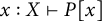
, that is, the pullback, given by where
denotes the object of
${\mathcal {C}}_{\mathbb {T}}$
associated with a given type X. As a result, these kinds of limits are a fundamental building block of categorical logic. An example of categories arising from type theories is topoi, which as part of their definition assume the existence of pullbacks (see [Reference JohnstoneJoh02, Definition A2.1.1]).





 ) is the





 denotes the object of
Further, there are several constructions whose universal property is that of an appropriate lax or oplax (co)limit, or, more generally, a (co)limit that is weighted by a certain functor:
-
» Given an (
$\infty $
-)monad T, the Eilenberg–Moore (
$\infty $
-)category
${\mathcal {A}} lg(T)$
of (
$\infty $
-)algebras over T is a lax
$2$
-limit (resp. lax
$(\infty ,2)$
-limit) of the
$2$
-diagram (resp.
$(\infty ,2)$
-diagram)
$\widetilde T\colon {\mathcal {M}} nd\to {\mathcal {C}}\!\textit {at}$
(resp.
$\widetilde {T}\colon {\mathcal {M}} nd\to \infty {\mathcal {C}}\!\textit {at}$
) represented by T, as described in [Reference Riehl and VerityRV16, Section 6.1]. Similarly, the Kleisli (
$\infty $
-)category
${\mathcal {K}} l(T)$
of T is an oplax
$2$
-colimit (resp. oplax
$(\infty ,2)$
-colimit) of
$\widetilde T$
. -
» The
$\infty $
-category of global spaces [Reference SchwedeSch18], a central object in equivariant homotopy theory, can be computed as the partially lax
$(\infty ,2)$
-limit of an
$(\infty ,2)$
-diagram
${\mathcal {G}} lo^{\operatorname {\mathrm {op}}} \to \infty {\mathcal {C}}\!\textit {at}$
, as described in [Reference Linskens, Nardin and PolLNP25, Theorem 6.18]. -
» Given a presheaf
$F\colon {\mathcal {J}}^{\operatorname {\mathrm {op}}}\to {\mathcal {C}}\!\textit {at}$
(resp.
$F\colon {\mathcal {J}}^{\operatorname {\mathrm {op}}}\to \infty {\mathcal {C}}\!\textit {at}$
), the Grothendieck construction
$\int _{\mathcal {J}} F$
of F is the lax
$2$
-colimit (resp. lax
$(\infty ,2)$
-colimit) of F, as described in [Reference StreetStr76, Section 5] (resp. [Reference Gepner, Haugseng and NikolausGHN17, Theorem 1.1] or [Reference BermanBer24, Theorem 4.4]). -
» Given a Reedy category
$\Theta $
and a presheaf
$F\colon \Theta ^{\operatorname {\mathrm {op}}}\to {\mathcal {C}}$
, the m-th latching object
$L_nF$
(resp. matching object
$M_nF$
) of F is a certain weighted (co)limit of the diagram
$F\colon \Theta ^{\operatorname {\mathrm {op}}}\to {\mathcal {C}}$
as described in [Reference Riehl and VerityRV14, Observation 3.15]. -
» Given a
$2$
-topos
${\mathcal {E}}$
in the sense of [Reference WeberWeb07] (which conjecturally encodes a directed type theory), one of its requirements is that, for any finite computad
${\mathcal {G}}$
(in the sense of [Reference StreetStr76, Section 2]), the
$2$
-limit of a
$2$
-diagram
$F\colon {\mathcal {G}} \to {\mathcal {E}}$
exists.











Finally, (co)limits are used in various contexts to express how global information can be recovered from local information conditions, as in the following examples:
-
» Let
$({\mathcal {C}},{\mathcal {J}})$
be a site and
${\mathcal {D}}$
a category (resp.
$(\infty ,1)$
-,
$2$
-,
$(\infty ,2)$
-category). Given a sheaf (resp.
$\infty $
-sheaf, stack,
$\infty $
-stack)
$F\colon {\mathcal {C}}^{\operatorname {\mathrm {op}}}\to {\mathcal {D}}$
, its defining property is that, given a covering sieve
$S=\{U_i \to U\}$
in
${\mathcal {J}}(U)$
, the value
$F(U)$
of F at U is the limit (resp.
$(\infty ,1)$
-,
$2$
-,
$(\infty ,2)$
-limit) of the diagram (resp.
$(\infty ,1)$
-,
$2$
-,
$(\infty ,2)$
-diagram) where
${\mathcal {C}}^S_{/U}$
denotes the full subcategory of
${\mathcal {C}}_{/U}$
spanned by those objects that are in the covering sieve S (see [Reference LurieLur09, Section 6.2.2]). -
» Given a good
$\infty $
-functor
$F\colon {\mathcal {M}} fld^{\,\operatorname {\mathrm {op}}}\to {\mathcal {C}}$
, its defining property is that, given any increasing sequence
$\{U_i\}_{i=0}^{\infty }$
in the
$(\infty ,1)$
-category of manifolds, the value of F at
$\cup _{i=0}^{\infty }U_i$
is the
$(\infty ,1)$
-limit of the
$(\infty ,1)$
-diagram (see [Reference de Brito and WeissBdBW13, Section 7]).
-
» Let
$n\geq 0$
and
${\mathcal {A}}\colon {\mathcal {D}} isk_n\to {\mathcal {C}}$
be an
${\mathbb {E}}_n$
-algebra in an
$(\infty ,1)$
-category
${\mathcal {C}}$
. Given an n-manifold M, the factorization homology
$\int _{M}{\mathcal {A}}$
of M with coefficients in
${\mathcal {A}}$
is the
$(\infty ,1)$
-colimit of the
$(\infty ,1)$
-diagram (see [Reference Ayala and FrancisAF20, Section 3]). More generally, for an arbitrary
$(\infty ,n)$
-category
${\mathcal {C}}$
and a framed n-manifold M, we can define its factorization homology as a left Kan extension (see [Reference Ayala, Francis and RozenblyumAFR18] for more details).











The natural progression of these examples, as well as more recent conjectural advances, suggests the need for a proper theory of $(\infty ,n)$
-(co)limits and
$(\infty ,n)$
-(co)limits and $(\infty ,n)$
-Kan extensions. For example, even the definition of
$(\infty ,n)$
-Kan extensions. For example, even the definition of $(\infty ,n)$
-sheaves requires a definition of
$(\infty ,n)$
-sheaves requires a definition of $(\infty ,n)$
-limits. However, beyond that, in the case of
$(\infty ,n)$
-limits. However, beyond that, in the case of $(\infty ,1)$
-categories, we can leverage a whole theory of
$(\infty ,1)$
-categories, we can leverage a whole theory of $(\infty ,1)$
-limits to establish Giraud’s theorem to classify all
$(\infty ,1)$
-limits to establish Giraud’s theorem to classify all $(\infty ,1)$
-categorical sheaves [Reference LurieLur09]. While recent advances in the theory of
$(\infty ,1)$
-categorical sheaves [Reference LurieLur09]. While recent advances in the theory of $(\infty ,2)$
-limits have made an
$(\infty ,2)$
-limits have made an $(\infty ,2)$
-categorical Giraud’s theorem possible [Reference Abellán and MartiniAM24], generalizations thereof are beyond our current capabilities and require
$(\infty ,2)$
-categorical Giraud’s theorem possible [Reference Abellán and MartiniAM24], generalizations thereof are beyond our current capabilities and require $(\infty ,n)$
-limits.
$(\infty ,n)$
-limits.
Similarly, the generalization of factorization homology to $(\infty ,n)$
-categories [Reference Ayala, Francis and RozenblyumAFR18] discussed above, by definition, relies on an
$(\infty ,n)$
-categories [Reference Ayala, Francis and RozenblyumAFR18] discussed above, by definition, relies on an $(\infty ,1)$
-categorical Kan extension. However,
$(\infty ,1)$
-categorical Kan extension. However, $(\infty ,n)$
-categories naturally assemble into an
$(\infty ,n)$
-categories naturally assemble into an $(\infty ,n+1)$
-category, which suggest the possibility of stronger functoriality in this setting, meaning the existence of an
$(\infty ,n+1)$
-category, which suggest the possibility of stronger functoriality in this setting, meaning the existence of an ${(\infty ,n+1)}$
-functors. Again, even analyzing such a question requires a proper theory of
${(\infty ,n+1)}$
-functors. Again, even analyzing such a question requires a proper theory of $(\infty ,n+1)$
-Kan extensions.
$(\infty ,n+1)$
-Kan extensions.
Beyond those examples, we are currently observing the growing importance of presentable $(\infty ,n)$
-categories in the Langlands program and the study of motives [Reference ScholzeSch24]. Currently, these methods rely on a recent development of presentable
$(\infty ,n)$
-categories in the Langlands program and the study of motives [Reference ScholzeSch24]. Currently, these methods rely on a recent development of presentable $(\infty ,n)$
-category [Reference StefanichSte20] as a theory of modules. While this comes with certain benefits (it permits an inductive definition), in the
$(\infty ,n)$
-category [Reference StefanichSte20] as a theory of modules. While this comes with certain benefits (it permits an inductive definition), in the $(\infty ,1)$
-categorical case, we have many equivalent characterizations of presentability, each one of which plays their own role in the theory and applications [Reference LurieLur09, Chapter 5]. These equivalent characterizations fundamentally require a careful study of
$(\infty ,1)$
-categorical case, we have many equivalent characterizations of presentability, each one of which plays their own role in the theory and applications [Reference LurieLur09, Chapter 5]. These equivalent characterizations fundamentally require a careful study of $(\infty ,1)$
-limits and
$(\infty ,1)$
-limits and $(\infty ,1)$
-Kan extensions, for example, if we want to prove that presentable
$(\infty ,1)$
-Kan extensions, for example, if we want to prove that presentable $(\infty ,1)$
-categories are
$(\infty ,1)$
-categories are $(\infty ,1)$
-cocomplete. A similar advancement in the theory of presentable
$(\infty ,1)$
-cocomplete. A similar advancement in the theory of presentable $(\infty ,n)$
-categories, for example, trying to show that presentable
$(\infty ,n)$
-categories, for example, trying to show that presentable $(\infty ,n)$
-categories in the sense of [Reference StefanichSte20] are
$(\infty ,n)$
-categories in the sense of [Reference StefanichSte20] are $(\infty ,n)$
-cocomplete, requires a suitable theory of
$(\infty ,n)$
-cocomplete, requires a suitable theory of $(\infty ,n)$
-limits.
$(\infty ,n)$
-limits.
In addition to these cases, we have recently seen a growing interest in a theory of stability for $(\infty ,2)$
-categories [Reference Bottman and CarmeliBC21]. While, as the references suggest, there has been some success studying stable
$(\infty ,2)$
-categories [Reference Bottman and CarmeliBC21]. While, as the references suggest, there has been some success studying stable $(\infty ,2)$
-categorical phenomena directly, it is well-established that, in the
$(\infty ,2)$
-categorical phenomena directly, it is well-established that, in the $(\infty ,1)$
-categorical setting,
$(\infty ,1)$
-categorical setting, $(\infty ,1)$
-(co)limits are essential for the study of stability. For example, we can characterize stable
$(\infty ,1)$
-(co)limits are essential for the study of stability. For example, we can characterize stable $(\infty ,1)$
-categories via the property that finite limits and colimits commute. Hence, a proper advancement of stable
$(\infty ,1)$
-categories via the property that finite limits and colimits commute. Hence, a proper advancement of stable $(\infty ,n)$
-categories similarly needs a functioning theory of
$(\infty ,n)$
-categories similarly needs a functioning theory of $(\infty ,n)$
-(co)limits.
$(\infty ,n)$
-(co)limits.
Finally, while we already have $(\infty ,n)$
-categories of spans [Reference HaugsengHau18] or
$(\infty ,n)$
-categories of spans [Reference HaugsengHau18] or $(\infty ,n)$
-categories of
$(\infty ,n)$
-categories of $\mathbb {E}_n$
-algebras [Reference HaugsengHau17], the construction and properties of their (co)limits have only been analyzed in the
$\mathbb {E}_n$
-algebras [Reference HaugsengHau17], the construction and properties of their (co)limits have only been analyzed in the $(\infty ,1)$
-categorical setting [Reference LurieLur17, Reference HarpazHar20].
$(\infty ,1)$
-categorical setting [Reference LurieLur17, Reference HarpazHar20].
The goal of this article is to define a notion of $(\infty ,n)$
-limit in the model of
$(\infty ,n)$
-limit in the model of $(\infty ,n)$
-categories given by complete Segal objects in
$(\infty ,n)$
-categories given by complete Segal objects in $(\infty ,n-1)$
-categories, which is well-behaved and usable in practice. We further show that this definition recovers the theory of homotopy
$(\infty ,n-1)$
-categories, which is well-behaved and usable in practice. We further show that this definition recovers the theory of homotopy $2$
-limits for strict
$2$
-limits for strict $2$
-categories and the established notion of
$2$
-categories and the established notion of $(\infty ,1)$
-limit for
$(\infty ,1)$
-limit for $(\infty ,1)$
-categories. For ease of exposition, we will focus on the treatment of limits and leave the dual treatment of colimits to the interested reader. In a follow-up paper [Reference MoserMRR24], we compare this new definition to the definition of
$(\infty ,1)$
-categories. For ease of exposition, we will focus on the treatment of limits and leave the dual treatment of colimits to the interested reader. In a follow-up paper [Reference MoserMRR24], we compare this new definition to the definition of $(\infty ,n)$
-limits in the model of
$(\infty ,n)$
-limits in the model of $(\infty ,n)$
-categories given by categories strictly enriched over
$(\infty ,n)$
-categories given by categories strictly enriched over $(\infty ,n-1)$
-categories, which ultimately validates the consistency of the perspectives across different models.
$(\infty ,n-1)$
-categories, which ultimately validates the consistency of the perspectives across different models.
While we primarily focus on conical limits, our framework can in fact accommodate weights. Indeed, in our follow-up paper [Reference MoserMRR24], we generalize our work and introduce weighted limits in the context of complete Segal objects in $(\infty ,n-1)$
-categories and prove it coincides with the established notion of weighted limits in the context of categories enriched in
$(\infty ,n-1)$
-categories and prove it coincides with the established notion of weighted limits in the context of categories enriched in $(\infty ,n-1)$
-categories.
$(\infty ,n-1)$
-categories.
1.2 Limits in terms of categories of cones
Aiming at introducing a definition of $(\infty ,n)$
-limit, we first review the notion of limit in the strict context, emphasizing a fibrational viewpoint. Going back to the notion of limit in the context of ordinary categories, one can recognize a limit object of a diagram
$(\infty ,n)$
-limit, we first review the notion of limit in the strict context, emphasizing a fibrational viewpoint. Going back to the notion of limit in the context of ordinary categories, one can recognize a limit object of a diagram $K\colon {\mathcal {J}}\to {\mathcal {C}}$
essentially as the terminal object in the category
$K\colon {\mathcal {J}}\to {\mathcal {C}}$
essentially as the terminal object in the category ${\mathcal {C}}\mathrm {one}_{{\mathcal {J}}}K$
of cones over K. This can be expressed in terms of its slice
${\mathcal {C}}\mathrm {one}_{{\mathcal {J}}}K$
of cones over K. This can be expressed in terms of its slice  at a given cone $(\ell ,\lambda )$
(see [Reference RiehlRie16, Definition 3.1.6], with ideas originated in [Reference GrothendieckGro71, Reference StreetStr74]), as follows.
$(\ell ,\lambda )$
(see [Reference RiehlRie16, Definition 3.1.6], with ideas originated in [Reference GrothendieckGro71, Reference StreetStr74]), as follows.
Proposition (Folklore)
Given a diagram $K\colon {\mathcal {J}}\to {\mathcal {C}}$
between categories, an object
$K\colon {\mathcal {J}}\to {\mathcal {C}}$
between categories, an object $\ell $
of
$\ell $
of ${\mathcal {C}}$
is a limit object of K if and only if there is an object
${\mathcal {C}}$
is a limit object of K if and only if there is an object $(\ell ,\lambda )$
in
$(\ell ,\lambda )$
in ${\mathcal {C}}\mathrm {one}_{{\mathcal {J}}}K$
such that the canonical projection induces an isomorphism of categories
${\mathcal {C}}\mathrm {one}_{{\mathcal {J}}}K$
such that the canonical projection induces an isomorphism of categories

When trying to formulate an analogous statement for general n, and focusing first on the case $n=2$
, Clingman and the first author proved in [Reference Clingman and MosercM22a] that
$n=2$
, Clingman and the first author proved in [Reference Clingman and MosercM22a] that $2$
-limits do not correspond to
$2$
-limits do not correspond to $2$
-terminal objects in any
$2$
-terminal objects in any $2$
-category of cones. This negative answer implies that the world of n-categories is insufficient to formulate such a theorem, and instead one needs to pass to a larger framework. This is achieved by regarding each n-category as an internal category to
$2$
-category of cones. This negative answer implies that the world of n-categories is insufficient to formulate such a theorem, and instead one needs to pass to a larger framework. This is achieved by regarding each n-category as an internal category to $(n-1)$
-categories, a.k.a. a double
$(n-1)$
-categories, a.k.a. a double $(n-1)$
-category, via the canonical embedding
$(n-1)$
-category, via the canonical embedding ${\mathbb {H}}$
, and make the appropriate adjustments: the n-category of cones should be replaced with an appropriate double
${\mathbb {H}}$
, and make the appropriate adjustments: the n-category of cones should be replaced with an appropriate double $(n-1)$
-category
$(n-1)$
-category ${\mathbb {C}}\mathrm {one}_{{\mathbb {H}} {\mathcal {J}}}({\mathbb {H}} K)$
of cones over
${\mathbb {C}}\mathrm {one}_{{\mathbb {H}} {\mathcal {J}}}({\mathbb {H}} K)$
of cones over ${\mathbb {H}} K$
, and the slice
${\mathbb {H}} K$
, and the slice  should be computed in the category of double $(n-1)$
-categories, as opposed to n-categories.
$(n-1)$
-categories, as opposed to n-categories.
We review some of these constructions in Section 3. With these adjustments, the desired statement was proven in [Reference Grandis and ParéGP99, Section 4.2(c)] for $n=2$
and in [Reference RasekhMSV23a, Corollary 8.22] for general n.
$n=2$
and in [Reference RasekhMSV23a, Corollary 8.22] for general n.
Theorem (Grandis–Paré and Moser–Sarazola–Verdugo)
Given a diagram $K\colon {\mathcal {J}}\to {\mathcal {C}}$
between n-categories, an object
$K\colon {\mathcal {J}}\to {\mathcal {C}}$
between n-categories, an object $\ell $
of
$\ell $
of ${\mathcal {C}}$
is an n-limit object of K if and only if there is an object
${\mathcal {C}}$
is an n-limit object of K if and only if there is an object $(\ell ,\lambda )$
in
$(\ell ,\lambda )$
in ${\mathbb {C}}\mathrm {one}_{{\mathbb {H}}{\mathcal {J}}}({\mathbb {H}} K)$
such that the canonical projection induces an isomorphism of double
${\mathbb {C}}\mathrm {one}_{{\mathbb {H}}{\mathcal {J}}}({\mathbb {H}} K)$
such that the canonical projection induces an isomorphism of double $(n-1)$
-categories
$(n-1)$
-categories

This result was also proven as [Reference Clingman and MosercM22b, Corollary 7.23] in the context of the homotopy theory of $2$
-categories and homotopy
$2$
-categories and homotopy $2$
-limits in the following form (and in this article, we also give a variant using a more homotopical version of
$2$
-limits in the following form (and in this article, we also give a variant using a more homotopical version of ${\mathbb {H}}$
as Theorem 4.19).
${\mathbb {H}}$
as Theorem 4.19).
Theorem (Clingman–Moser)
Given a diagram $K\colon {\mathcal {J}}\to {\mathcal {C}}$
between
$K\colon {\mathcal {J}}\to {\mathcal {C}}$
between $2$
-categories, an object
$2$
-categories, an object $\ell $
of
$\ell $
of ${\mathcal {C}}$
is a homotopy
${\mathcal {C}}$
is a homotopy $2$
-limit object of K if and only if there is an object
$2$
-limit object of K if and only if there is an object $(\ell ,\lambda )$
in
$(\ell ,\lambda )$
in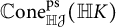 ${\mathbb {C}}\mathrm {one}^{\mathrm {ps}}_{{\mathbb {H}} {\mathcal {J}}}({\mathbb {H}} K)$
such that the canonical projection is an equivalence of double categories
${\mathbb {C}}\mathrm {one}^{\mathrm {ps}}_{{\mathbb {H}} {\mathcal {J}}}({\mathbb {H}} K)$
such that the canonical projection is an equivalence of double categories

Here, the main adjustments consist of defining appropriate versions of the double category of cones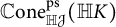 ${\mathbb {C}}\mathrm {one}^{\mathrm {ps}}_{{\mathbb {H}} {\mathcal {J}}}({\mathbb {H}} K)$
and its slice which are based on the pseudo Gray tensor product from [Reference BöhmBöh20] and the internal pseudo-hom for double categories, rather than the ordinary Cartesian product and internal hom (see Section 3 for more details).
${\mathbb {C}}\mathrm {one}^{\mathrm {ps}}_{{\mathbb {H}} {\mathcal {J}}}({\mathbb {H}} K)$
and its slice which are based on the pseudo Gray tensor product from [Reference BöhmBöh20] and the internal pseudo-hom for double categories, rather than the ordinary Cartesian product and internal hom (see Section 3 for more details).
Motivated by the evidence that we just described, we are led to introduce, as Definition 2.12, the following notion of $(\infty ,n)$
-limit for an
$(\infty ,n)$
-limit for an $(\infty ,n)$
-diagram between
$(\infty ,n)$
-diagram between $(\infty ,n)$
-categories. For the purpose of this article, we define
$(\infty ,n)$
-categories. For the purpose of this article, we define $(\infty ,n)$
-categories as complete Segal objects in
$(\infty ,n)$
-categories as complete Segal objects in $(\infty ,n-1)$
-categories. This definition is convenient because it admits a canonical inclusion into double
$(\infty ,n-1)$
-categories. This definition is convenient because it admits a canonical inclusion into double $(\infty ,n-1)$
-categories, which are Segal objects in
$(\infty ,n-1)$
-categories, which are Segal objects in $(\infty ,n-1)$
-categories. In particular, it allows for a simple construction for the double
$(\infty ,n-1)$
-categories. In particular, it allows for a simple construction for the double $(\infty ,n-1)$
-category of cones
$(\infty ,n-1)$
-category of cones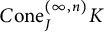 $C\mathrm {one}^{(\infty ,n)}_{J}K$
and its slice
$C\mathrm {one}^{(\infty ,n)}_{J}K$
and its slice  . Furthermore, when $n=1$
, this definition retrieves the definition of
$n=1$
, this definition retrieves the definition of $(\infty ,1)$
-limits in the context of
$(\infty ,1)$
-limits in the context of $(\infty ,1)$
-categories regarded as complete Segal spaces, as in (the dual of) [Reference RasekhRas23, Section 5.2].
$(\infty ,1)$
-categories regarded as complete Segal spaces, as in (the dual of) [Reference RasekhRas23, Section 5.2].
Definition 1 Given a diagram $K\colon J\to C$
between
$K\colon J\to C$
between $(\infty ,n)$
-categories, we say that an object
$(\infty ,n)$
-categories, we say that an object $\ell $
of C is an
$\ell $
of C is an $(\infty ,n)$
-limit object of K if there is an object
$(\infty ,n)$
-limit object of K if there is an object $(\ell ,\lambda )$
in
$(\ell ,\lambda )$
in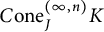 $C\mathrm {one}^{(\infty ,n)}_{J}K$
such that the canonical projection is an equivalence of double
$C\mathrm {one}^{(\infty ,n)}_{J}K$
such that the canonical projection is an equivalence of double $(\infty ,n-1)$
-categories
$(\infty ,n-1)$
-categories

After introducing the definition, we prove consistency results and provide proofs of concept for the correctness of this notion.
1.3 Overview of article’s results
In this article, we provide the first evidence that the proposed definition of $(\infty ,n)$
-limit is meaningful.
$(\infty ,n)$
-limit is meaningful.
First, if $I_n$
denotes the embedding of
$I_n$
denotes the embedding of $(\infty ,n-1)$
-categories into
$(\infty ,n-1)$
-categories into $(\infty ,n)$
-categories, and we prove, as Theorem 2.20, that the definition is self-consistent across different values of n. In particular, when
$(\infty ,n)$
-categories, and we prove, as Theorem 2.20, that the definition is self-consistent across different values of n. In particular, when $n>1,$
this entails that our notion of
$n>1,$
this entails that our notion of $(\infty ,n)$
-limit is compatible with the established notions of
$(\infty ,n)$
-limit is compatible with the established notions of $(\infty ,1)$
-limits for
$(\infty ,1)$
-limits for $(\infty ,1)$
-categories.
$(\infty ,1)$
-categories.
Theorem A An object $\ell $
of an
$\ell $
of an $(\infty ,n-1)$
-category C is an
$(\infty ,n-1)$
-category C is an $(\infty ,n-1)$
-limit object of a diagram of
$(\infty ,n-1)$
-limit object of a diagram of $(\infty ,n-1)$
-categories
$(\infty ,n-1)$
-categories $K\colon J\to C$
if and only if the object
$K\colon J\to C$
if and only if the object $\ell $
is an
$\ell $
is an $(\infty ,n)$
-limit object of the diagram of
$(\infty ,n)$
-limit object of the diagram of $(\infty ,n)$
-categories
$(\infty ,n)$
-categories $ I_nK\colon I_n J\to I_n C$
.
$ I_nK\colon I_n J\to I_n C$
.
Second, we consider an appropriate embedding ${{\mathbb {N}}}\widetilde {{\mathbb {H}}} $
of the homotopy theory of strict
${{\mathbb {N}}}\widetilde {{\mathbb {H}}} $
of the homotopy theory of strict $2$
-categories into that of
$2$
-categories into that of $(\infty ,2)$
-categories constructed in [Reference MoserMos20, Section 6], and we prove, as Theorem 3.14, the consistency of the definition of limit between the contexts of
$(\infty ,2)$
-categories constructed in [Reference MoserMos20, Section 6], and we prove, as Theorem 3.14, the consistency of the definition of limit between the contexts of $(\infty ,2)$
-categories and of strict
$(\infty ,2)$
-categories and of strict $2$
-categories.
$2$
-categories.
Theorem B An object $\ell $
of a
$\ell $
of a $2$
-category
$2$
-category ${\mathcal {C}}$
is a homotopy
${\mathcal {C}}$
is a homotopy $2$
-limit object of a diagram of
$2$
-limit object of a diagram of $2$
-categories
$2$
-categories ${K\colon {\mathcal {J}}\to {\mathcal {C}}}$
if and only if the object
${K\colon {\mathcal {J}}\to {\mathcal {C}}}$
if and only if the object $\ell $
is an
$\ell $
is an $(\infty ,2)$
-limit object of the diagram of
$(\infty ,2)$
-limit object of the diagram of $(\infty ,2)$
-categories
$(\infty ,2)$
-categories ${{\mathbb {N}}}\widetilde {{\mathbb {H}}} K\colon {{\mathbb {N}}}\widetilde {\mathbb {H}} {\mathcal {J}}\to {{\mathbb {N}}}\widetilde {\mathbb {H}} {\mathcal {C}}$
.
${{\mathbb {N}}}\widetilde {{\mathbb {H}}} K\colon {{\mathbb {N}}}\widetilde {\mathbb {H}} {\mathcal {J}}\to {{\mathbb {N}}}\widetilde {\mathbb {H}} {\mathcal {C}}$
.
These results guarantee that the theory is strong enough to recover two rather orthogonal and nontrivial theories: that of homotopy $2$
-limits and that of
$2$
-limits and that of $(\infty ,1)$
-limits, and even more generally
$(\infty ,1)$
-limits, and even more generally $(\infty ,n-1)$
-limits.
$(\infty ,n-1)$
-limits.
Given the importance of $(\infty ,n)$
-limits in a variety of settings, it is unsurprising that there have been other efforts in this direction. Notable examples include
$(\infty ,n)$
-limits in a variety of settings, it is unsurprising that there have been other efforts in this direction. Notable examples include $(\infty ,2)$
-limits in [Reference Gagna, Harpaz and LanariGHL20, Section 5], using an
$(\infty ,2)$
-limits in [Reference Gagna, Harpaz and LanariGHL20, Section 5], using an $(\infty ,2)$
-categorical Gray tensor product, and
$(\infty ,2)$
-categorical Gray tensor product, and $(\infty ,n)$
-limits in [Reference LoubatonLou23, Section 6.2.3], using a representable approach via the Yoneda lemma.
$(\infty ,n)$
-limits in [Reference LoubatonLou23, Section 6.2.3], using a representable approach via the Yoneda lemma.
While every approach has their own merit, the crucial advantage of our result is the centrality of an elegant theory of fibrations in the study of $(\infty ,n)$
-limits, which distinguishes itself from the aforementioned advancements, but is much closer to the original development of
$(\infty ,n)$
-limits, which distinguishes itself from the aforementioned advancements, but is much closer to the original development of $(\infty ,1)$
-limits. Indeed, in the
$(\infty ,1)$
-limits. Indeed, in the $(\infty ,1)$
-categorical setting, it is standard practice to construct explicit (right or Cartesian) fibrations that bundle coherence data of interest, this includes the study of
$(\infty ,1)$
-categorical setting, it is standard practice to construct explicit (right or Cartesian) fibrations that bundle coherence data of interest, this includes the study of $(\infty ,1)$
-limits, but also, for example,
$(\infty ,1)$
-limits, but also, for example, $(\infty ,1)$
-operads and
$(\infty ,1)$
-operads and $(\infty ,1)$
-monoidal structure [Reference LurieLur09, Reference LurieLur17]. These computational settings benefit from the existence of a model structure for right fibrations, which makes certain proofs computationally accessible (an elegant example includes the analysis of
$(\infty ,1)$
-monoidal structure [Reference LurieLur09, Reference LurieLur17]. These computational settings benefit from the existence of a model structure for right fibrations, which makes certain proofs computationally accessible (an elegant example includes the analysis of $(\infty ,1)$
-cofinality [Reference LurieLur09, Section 4.1]).
$(\infty ,1)$
-cofinality [Reference LurieLur09, Section 4.1]).
Double $(\infty ,n-1)$
-categories of cones can be realized as fibrant objects in a model structure [Reference RasekhRas21], meaning we can use very analogous techniques already developed in the
$(\infty ,n-1)$
-categories of cones can be realized as fibrant objects in a model structure [Reference RasekhRas21], meaning we can use very analogous techniques already developed in the $(\infty ,1)$
-categorical framework. This is in stark contrast to other approaches, which rely on more complicated tools (Gray tensor product) or simply do not provide particular additional methods (the Yoneda approach).
$(\infty ,1)$
-categorical framework. This is in stark contrast to other approaches, which rely on more complicated tools (Gray tensor product) or simply do not provide particular additional methods (the Yoneda approach).
1.4 ArXiv version
For the convenience of the interested reader, we note here that a previous version of this article, containing the same results, but more detailed and explicit arguments, can be found on the arXiv [Reference Moser, Rasekh and RovelliMRR23].
2 Limits in an
$(\infty ,n)$
-category

In this section, we introduce the notion of $(\infty ,n)$
-limit in Section 2.1 and prove that it is self-consistent across different values of n in Section 2.2.
$(\infty ,n)$
-limit in Section 2.1 and prove that it is self-consistent across different values of n in Section 2.2.
2.1 Limits in an
$(\infty ,n)$
-category

We start by introducing the definitions of double $(\infty ,n-1)$
-categories and
$(\infty ,n-1)$
-categories and $(\infty ,n)$
-categories that we will work with throughout the article. For this, recall the following.
$(\infty ,n)$
-categories that we will work with throughout the article. For this, recall the following.
Notation 2.1 Let $Cat_{(\infty ,n-1)}$
denote the
$Cat_{(\infty ,n-1)}$
denote the $\infty $
-category of
$\infty $
-category of $(\infty ,n-1)$
-categories in the sense of [Reference Barwick and Schommer-PriesBSP21, Definition 7.2].
$(\infty ,n-1)$
-categories in the sense of [Reference Barwick and Schommer-PriesBSP21, Definition 7.2].
By [Reference Barwick and Schommer-PriesBSP21, Axiom C.3], the $\infty $
-category
$\infty $
-category $Cat_{(\infty ,n-1)}$
is Cartesian closed. Moreover, since
$Cat_{(\infty ,n-1)}$
is Cartesian closed. Moreover, since $Cat_{(\infty ,n-1)}$
is presentable, there is a canonical inclusion
$Cat_{(\infty ,n-1)}$
is presentable, there is a canonical inclusion $\mathcal S\hookrightarrow Cat_{(\infty ,n-1)}$
from the
$\mathcal S\hookrightarrow Cat_{(\infty ,n-1)}$
from the $\infty $
-category of spaces, sending the point to the terminal
$\infty $
-category of spaces, sending the point to the terminal $(\infty ,n-1)$
-category.
$(\infty ,n-1)$
-category.
Definition 2.2 A simplicial $(\infty ,n-1)$
-category is a functor
$(\infty ,n-1)$
-category is a functor $X\colon \Delta ^{\operatorname {\mathrm {op}}}\to Cat_{(\infty ,n-1)}$
, where
$X\colon \Delta ^{\operatorname {\mathrm {op}}}\to Cat_{(\infty ,n-1)}$
, where $\Delta $
is the simplex category. We denote by
$\Delta $
is the simplex category. We denote by $Fun(\Delta ^{\operatorname {\mathrm {op}}},Cat_{(\infty ,n-1)})$
the
$Fun(\Delta ^{\operatorname {\mathrm {op}}},Cat_{(\infty ,n-1)})$
the $\infty $
-category of simplicial
$\infty $
-category of simplicial $(\infty ,n-1)$
-categories and their maps.
$(\infty ,n-1)$
-categories and their maps.
Since the $\infty $
-category of
$\infty $
-category of $(\infty ,n-1)$
-categories is Cartesian closed, the
$(\infty ,n-1)$
-categories is Cartesian closed, the $\infty $
-category of simplicial
$\infty $
-category of simplicial ${(\infty ,n-1)}$
-categories is also Cartesian closed. Given simplicial
${(\infty ,n-1)}$
-categories is also Cartesian closed. Given simplicial $(\infty ,n-1)$
-categories X and
$(\infty ,n-1)$
-categories X and $X'$
, we denote by
$X'$
, we denote by $[X,X']$
the internal hom in
$[X,X']$
the internal hom in $Fun(\Delta ^{\operatorname {\mathrm {op}}},Cat_{(\infty ,n-1)})$
.
$Fun(\Delta ^{\operatorname {\mathrm {op}}},Cat_{(\infty ,n-1)})$
.
Definition 2.3 A simplicial $(\infty ,n-1)$
-category D is a double
$(\infty ,n-1)$
-category D is a double $(\infty ,n-1)$
-category if it is a Segal object in
$(\infty ,n-1)$
-category if it is a Segal object in ${Cat_{(\infty ,n-1)}}$
. That is, for all
${Cat_{(\infty ,n-1)}}$
. That is, for all $m\geq 2$
, the Segal map
$m\geq 2$
, the Segal map
 $$\begin{align*}D_m\to D_1\times_{D_0} \dots \times_{D_0}D_1 \end{align*}$$
is an equivalence of $(\infty ,n-1)$
-categories. We denote by
$(\infty ,n-1)$
-categories. We denote by $DblCat_{(\infty ,n-1)}$
the full reflective subcategory of
$DblCat_{(\infty ,n-1)}$
the full reflective subcategory of $Fun(\Delta ^{\operatorname {\mathrm {op}}},Cat_{(\infty ,n-1)})$
spanned by the double
$Fun(\Delta ^{\operatorname {\mathrm {op}}},Cat_{(\infty ,n-1)})$
spanned by the double $(\infty ,n-1)$
-categories.
$(\infty ,n-1)$
-categories.
Remark 2.4 Given a simplicial $(\infty ,n-1)$
-category J and a double
$(\infty ,n-1)$
-category J and a double $(\infty ,n-1)$
-category D, the internal hom
$(\infty ,n-1)$
-category D, the internal hom $[J,D]$
in
$[J,D]$
in $Fun(\Delta ^{\operatorname {\mathrm {op}}},Cat_{(\infty ,n-1)})$
is a double
$Fun(\Delta ^{\operatorname {\mathrm {op}}},Cat_{(\infty ,n-1)})$
is a double ${(\infty ,n-1)}$
-category. This follows from the argument, including the computation, in [Reference RezkRez10, Section 6], there articulated using model categorical terminology for this fact.
${(\infty ,n-1)}$
-category. This follows from the argument, including the computation, in [Reference RezkRez10, Section 6], there articulated using model categorical terminology for this fact.
Definition 2.5 A simplicial $(\infty ,n-1)$
-category C is an
$(\infty ,n-1)$
-category C is an $(\infty ,n)$
-category if it is a complete Segal object in
$(\infty ,n)$
-category if it is a complete Segal object in $Cat_{(\infty ,n-1)}$
and
$Cat_{(\infty ,n-1)}$
and $C_0$
is a space. In other words, an
$C_0$
is a space. In other words, an $(\infty ,n)$
-category C is a double
$(\infty ,n)$
-category C is a double $(\infty ,n-1)$
-category such that the completeness map
$(\infty ,n-1)$
-category such that the completeness map $C_0\to C_0\times _{C_1} C_3\times _{C_1} C_0$
is an equivalence of
$C_0\to C_0\times _{C_1} C_3\times _{C_1} C_0$
is an equivalence of $(\infty ,n-1)$
-categories and the
$(\infty ,n-1)$
-categories and the $(\infty ,n-1)$
-category
$(\infty ,n-1)$
-category $C_0$
is in the essential image of the canonical inclusion
$C_0$
is in the essential image of the canonical inclusion ${\mathcal S\hookrightarrow Cat_{(\infty ,n-1)}}$
.
${\mathcal S\hookrightarrow Cat_{(\infty ,n-1)}}$
.
Remark 2.6 Given a simplicial $(\infty ,n-1)$
-category J and an
$(\infty ,n-1)$
-category J and an $(\infty ,n)$
-category C, the internal hom
$(\infty ,n)$
-category C, the internal hom $[J,C]$
in
$[J,C]$
in $Fun(\Delta ^{\operatorname {\mathrm {op}}},Cat_{(\infty ,n-1)})$
is not necessarily an
$Fun(\Delta ^{\operatorname {\mathrm {op}}},Cat_{(\infty ,n-1)})$
is not necessarily an $(\infty ,n)$
-category, since the condition that level
$(\infty ,n)$
-category, since the condition that level $0$
is a space is not preserved. However, by Remark 2.4, the internal hom
$0$
is a space is not preserved. However, by Remark 2.4, the internal hom $[J,C]$
is a double
$[J,C]$
is a double $(\infty ,n-1)$
-category.
$(\infty ,n-1)$
-category.
We are now ready to introduce the main definition of this article, namely, the notion of limit in an $(\infty ,n)$
-category. With the following definition, we want to emphasize that the source of the diagram of which we want to take the limit does not need to be an
$(\infty ,n)$
-category. With the following definition, we want to emphasize that the source of the diagram of which we want to take the limit does not need to be an $(\infty ,n)$
-category but can in fact be any simplicial
$(\infty ,n)$
-category but can in fact be any simplicial $(\infty ,n-1)$
-category. This makes the theory of
$(\infty ,n-1)$
-category. This makes the theory of $(\infty ,n)$
-limits more general and will give a very natural way of formulating weighted
$(\infty ,n)$
-limits more general and will give a very natural way of formulating weighted $(\infty ,n)$
-limits in the follow-up paper [Reference MoserMRR24].
$(\infty ,n)$
-limits in the follow-up paper [Reference MoserMRR24].
Definition 2.7 An $(\infty ,n)$
-diagram is a map of simplicial
$(\infty ,n)$
-diagram is a map of simplicial $(\infty ,n-1)$
-categories
$(\infty ,n-1)$
-categories $K\colon J\to C$
with C an
$K\colon J\to C$
with C an $(\infty ,n)$
-category.
$(\infty ,n)$
-category.
Notation 2.8 For $m\geq 0$
, we also denote by
$m\geq 0$
, we also denote by $[m]$
the image of the object
$[m]$
the image of the object ${[m]\in \Delta }$
under the canonical inclusion
${[m]\in \Delta }$
under the canonical inclusion $\Delta \hookrightarrow Fun(\Delta ^{\operatorname {\mathrm {op}}},\mathcal S)\hookrightarrow Fun(\Delta ^{\operatorname {\mathrm {op}}},Cat_{(\infty ,n-1)})$
, where the first map is Yoneda. Heuristically, the object
$\Delta \hookrightarrow Fun(\Delta ^{\operatorname {\mathrm {op}}},\mathcal S)\hookrightarrow Fun(\Delta ^{\operatorname {\mathrm {op}}},Cat_{(\infty ,n-1)})$
, where the first map is Yoneda. Heuristically, the object $[m]\in Fun(\Delta ^{\operatorname {\mathrm {op}}},Cat_{(\infty ,n-1)})$
represents the
$[m]\in Fun(\Delta ^{\operatorname {\mathrm {op}}},Cat_{(\infty ,n-1)})$
represents the $(\infty ,n)$
-category free on the diagram
$(\infty ,n)$
-category free on the diagram
 $$\begin{align*}0\to 1\to \ldots \to m-1\to m. \end{align*}$$
Notation 2.9 Given a simplicial $(\infty ,n-1)$
-category J and an
$(\infty ,n-1)$
-category J and an $(\infty ,n)$
-category C, we denote by
$(\infty ,n)$
-category C, we denote by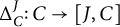 $\Delta _{C}^{J}\colon C\to [J,C]$
the diagonal map in
$\Delta _{C}^{J}\colon C\to [J,C]$
the diagonal map in $DblCat_{(\infty ,n-1)}$
induced by the unique map
$DblCat_{(\infty ,n-1)}$
induced by the unique map $J\to [0]$
.
$J\to [0]$
.
Notation 2.10 Given an $(\infty ,n)$
-diagram
$(\infty ,n)$
-diagram $K\colon J\to C$
, the double
$K\colon J\to C$
, the double $(\infty ,n-1)$
-category of cones
$(\infty ,n-1)$
-category of cones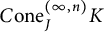 $C\mathrm {one}^{(\infty ,n)}_{J}K$
is the following pullback in the
$C\mathrm {one}^{(\infty ,n)}_{J}K$
is the following pullback in the $\infty $
-category
$\infty $
-category $DblCat_{(\infty ,n-1)}$
:
$DblCat_{(\infty ,n-1)}$
:

Notation 2.11 Given a double $(\infty ,n-1)$
-category D and an object d of D, the slice double
$(\infty ,n-1)$
-category D and an object d of D, the slice double $(\infty ,n-1)$
-category
$(\infty ,n-1)$
-category  of D over d is the following pullback in the $\infty $
-category
$\infty $
-category $DblCat_{(\infty ,n-1)}$
:
$DblCat_{(\infty ,n-1)}$
:

The following definition generalizes the viewpoint for the case $n=1$
from [Reference JoyalJoy02, Section 4], [Reference LurieLur09, Section 4], and [Reference RasekhRas23, Section 5.2].
$n=1$
from [Reference JoyalJoy02, Section 4], [Reference LurieLur09, Section 4], and [Reference RasekhRas23, Section 5.2].
Definition 2.12 Given an $(\infty ,n)$
-diagram
$(\infty ,n)$
-diagram $K\colon J\to C$
, an object
$K\colon J\to C$
, an object $\ell $
of C is an
$\ell $
of C is an $(\infty ,n)$
-limit object of K if there is an object
$(\infty ,n)$
-limit object of K if there is an object $(\ell ,\lambda )$
in
$(\ell ,\lambda )$
in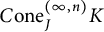 $C\mathrm {one}^{(\infty ,n)}_{J}K$
such that the canonical projection is an equivalence of double
$C\mathrm {one}^{(\infty ,n)}_{J}K$
such that the canonical projection is an equivalence of double $(\infty ,n-1)$
-categories
$(\infty ,n-1)$
-categories

2.2 Self-consistency with respect to varying n
We show that our definition is consistent with respect to the established notion of limits in the context of $(\infty ,1)$
-categories. More generally, we show as Theorem 2.20 how, for
$(\infty ,1)$
-categories. More generally, we show as Theorem 2.20 how, for $n>1$
, it is consistent across increasing values of n.
$n>1$
, it is consistent across increasing values of n.
Remark 2.13 By combining [Reference Barwick and Schommer-PriesBSP21, Theorem 13.15] and [Reference Bergner and RezkBR20, Corollary 7.1], the $\infty $
-category
$\infty $
-category $Cat_{(\infty ,n-1)}$
is equivalent to the full reflective subcategory of
$Cat_{(\infty ,n-1)}$
is equivalent to the full reflective subcategory of $Fun(\Delta ^{\operatorname {\mathrm {op}}},Cat_{(\infty ,n-2)})$
spanned by the complete Segal objects in
$Fun(\Delta ^{\operatorname {\mathrm {op}}},Cat_{(\infty ,n-2)})$
spanned by the complete Segal objects in $Cat_{(\infty ,n-2)}$
whose level
$Cat_{(\infty ,n-2)}$
whose level $0$
is a space.
$0$
is a space.
Construction 2.14 We construct an inclusion $\iota _{n-1}\colon Cat_{(\infty ,n-2)}\hookrightarrow Cat_{(\infty ,n-1)}$
by induction that
$\iota _{n-1}\colon Cat_{(\infty ,n-2)}\hookrightarrow Cat_{(\infty ,n-1)}$
by induction that
-
(1) commutes with the canonical inclusions from
$\mathcal S$
; -
(2) is a right adjoint; in particular, it preserves limits;
-
(3) is fully faithful.

-
• When
$n=1$
, we set
$\iota _0\colon {\mathcal {S}}\to Cat_{(\infty ,1)}$
to be the canonical inclusion of the
$\infty $
-category of spaces into the
$\infty $
-category of
$(\infty ,1)$
-categories, which satisfies (1)–(3). -
• When
$n>0$
, we define
$\iota _{n-1}\colon Cat_{(\infty ,n-2)}\hookrightarrow Cat_{(\infty ,n-1)}$
to be the restriction to full reflective subcategories (using Remark 2.13) of the functor induced by postcomposing with
$\iota _{n-2}$
: This can be seen to restrict appropriately using (1) and (2) for
$\iota _{n-2}$
. Moreover, (2) and (3) then hold for
$\iota _{n-1}$
as they hold for
$\iota _{n-2}$
. The fact that (1) holds for
$\iota _{n-1}$
follows from the fact that the following square of functors commutes and (2) for
$\iota _{n-2}$
:







Proposition 2.15 The left adjoint of $\iota _{n-1}\colon Cat_{(\infty ,n-2)}\hookrightarrow Cat_{(\infty ,n-1)}$
preserves products.
$\iota _{n-1}\colon Cat_{(\infty ,n-2)}\hookrightarrow Cat_{(\infty ,n-1)}$
preserves products.
Proof We prove this by induction on $n\geq 1$
. When
$n\geq 1$
. When $n=1$
, this is clear.
$n=1$
, this is clear.
So, let $n> 1$
. Let
$n> 1$
. Let $CS(Cat_{(\infty ,n-2)})$
be the full reflective subcategory of
$CS(Cat_{(\infty ,n-2)})$
be the full reflective subcategory of $Fun(\Delta ^{\operatorname {\mathrm {op}}},Cat_{(\infty ,n-2)})$
spanned by the complete Segal objects in
$Fun(\Delta ^{\operatorname {\mathrm {op}}},Cat_{(\infty ,n-2)})$
spanned by the complete Segal objects in $Cat_{(\infty ,n-2)}$
, and denote by
$Cat_{(\infty ,n-2)}$
, and denote by $L_{CS}$
the left adjoint of the inclusion. As a first step, we show that if X is a simplicial object in
$L_{CS}$
the left adjoint of the inclusion. As a first step, we show that if X is a simplicial object in $Cat_{(\infty ,n-2)}$
such that
$Cat_{(\infty ,n-2)}$
such that $X_0$
is a space, then
$X_0$
is a space, then $(L_{CS}X)_0$
is a space as well.
$(L_{CS}X)_0$
is a space as well.
Define $P(Cat_{(\infty ,n-2)})$
to be the full reflective subcategory of
$P(Cat_{(\infty ,n-2)})$
to be the full reflective subcategory of $Fun(\Delta ^{\operatorname {\mathrm {op}}},Cat_{(\infty ,n-2)})$
spanned by those
$Fun(\Delta ^{\operatorname {\mathrm {op}}},Cat_{(\infty ,n-2)})$
spanned by those $X\colon \Delta ^{\operatorname {\mathrm {op}}}\to Cat_{(\infty ,n-2)}$
such that
$X\colon \Delta ^{\operatorname {\mathrm {op}}}\to Cat_{(\infty ,n-2)}$
such that $X_0$
is a space. We then have the following adjunctions:
$X_0$
is a space. We then have the following adjunctions:

The left adjoints of the inclusions are given by the corresponding localization functors, and the right adjoint $R\colon Fun(\Delta ^{\operatorname {\mathrm {op}}},Cat_{(\infty ,n-2)})\to P(Cat_{(\infty ,n-2)})$
of the inclusion sends a simplicial object
$R\colon Fun(\Delta ^{\operatorname {\mathrm {op}}},Cat_{(\infty ,n-2)})\to P(Cat_{(\infty ,n-2)})$
of the inclusion sends a simplicial object $X\colon \Delta ^{\operatorname {\mathrm {op}}}\to Cat_{(\infty ,n-2)}$
to the pullback
$X\colon \Delta ^{\operatorname {\mathrm {op}}}\to Cat_{(\infty ,n-2)}$
to the pullback

where $\mathrm {cosk}\colon Cat_{(\infty ,n-2)}\to Fun(\Delta ^{\operatorname {\mathrm {op}}},Cat_{(\infty ,n-2)})$
is the right adjoint of the evaluation at
$\mathrm {cosk}\colon Cat_{(\infty ,n-2)}\to Fun(\Delta ^{\operatorname {\mathrm {op}}},Cat_{(\infty ,n-2)})$
is the right adjoint of the evaluation at $0$
functor
$0$
functor ${(-)_0\colon Fun(\Delta ^{\operatorname {\mathrm {op}}},Cat_{(\infty ,n-2)})\to Cat_{(\infty ,n-2)}}$
and
${(-)_0\colon Fun(\Delta ^{\operatorname {\mathrm {op}}},Cat_{(\infty ,n-2)})\to Cat_{(\infty ,n-2)}}$
and ${(-)^\simeq \colon Cat_{(\infty ,n-2)}\to {\mathcal {S}}}$
is the right adjoint of the canonical inclusion
${(-)^\simeq \colon Cat_{(\infty ,n-2)}\to {\mathcal {S}}}$
is the right adjoint of the canonical inclusion ${\mathcal {S}}\hookrightarrow Cat_{(\infty ,n-2)}$
. In particular, since it preserves complete Segal objects and
${\mathcal {S}}\hookrightarrow Cat_{(\infty ,n-2)}$
. In particular, since it preserves complete Segal objects and $Cat_{(\infty ,n-1)}$
is the full subcategory of
$Cat_{(\infty ,n-1)}$
is the full subcategory of $P(Cat_{(\infty ,n-2)})$
spanned by the complete Segal objects, it restricts to a right adjoint
$P(Cat_{(\infty ,n-2)})$
spanned by the complete Segal objects, it restricts to a right adjoint $R'\colon CS(Cat_{(\infty ,n-2)})\to Cat_{(\infty ,n-1)}$
of the inclusion. Since R and
$R'\colon CS(Cat_{(\infty ,n-2)})\to Cat_{(\infty ,n-1)}$
of the inclusion. Since R and $R'$
commute with the inclusions, the corresponding left adjoints commute. Hence, for
$R'$
commute with the inclusions, the corresponding left adjoints commute. Hence, for $X\in P(Cat_{(\infty ,n-2)})$
, there is an equivalence
$X\in P(Cat_{(\infty ,n-2)})$
, there is an equivalence $L_{CS}X\simeq L^{\prime }_{CS}X$
in
$L_{CS}X\simeq L^{\prime }_{CS}X$
in $CS(Cat_{(\infty ,n-2)})$
, showing that
$CS(Cat_{(\infty ,n-2)})$
, showing that $(L_{CS} X)_0$
is a space.
$(L_{CS} X)_0$
is a space.
Now consider the following diagram of adjunctions:

By induction, the left adjoint
 $$\begin{align*}(L_{n-2})_*\colon Fun(\Delta^{\operatorname{\mathrm{op}}},Cat_{(\infty,n-2)})\to Fun(\Delta^{\operatorname{\mathrm{op}}},Cat_{(\infty,n-3)}) \end{align*}$$
preserves products. By [Reference Bergner and RezkBR20, Proposition 5.9], the localization functor
 $$\begin{align*}L_{CS}\colon Fun(\Delta^{\operatorname{\mathrm{op}}},Cat_{(\infty,n-2)})\to CS(Cat_{(\infty,n-2)}) \end{align*}$$
preserves products, and so the left adjoint
 $$\begin{align*}L_{CS}(L_{n-2})_*\colon CS(Cat_{(\infty,n-2)})\to CS(Cat_{(\infty,n-3)}) \end{align*}$$
also preserves products. Finally, since $L_{CS}$
and
$L_{CS}$
and $(L_{n-2})_*$
preserve the property that level
$(L_{n-2})_*$
preserve the property that level $0$
is a space, the left adjoint
$0$
is a space, the left adjoint $L_{n-1}\colon Cat_{(\infty ,n-1)}\to Cat_{(\infty ,n-2)}$
coincides with the restriction of
$L_{n-1}\colon Cat_{(\infty ,n-1)}\to Cat_{(\infty ,n-2)}$
coincides with the restriction of $L_{CS}(L_{n-2})_*$
to full reflective subcategories, and so it preserves products.
$L_{CS}(L_{n-2})_*$
to full reflective subcategories, and so it preserves products.
The inclusion $\iota _{n-1}$
induces by postcomposition an inclusion
$\iota _{n-1}$
induces by postcomposition an inclusion
 $$\begin{align*}(\iota_{n-1})_*\colon Fun(\Delta^{\operatorname{\mathrm{op}}},Cat_{(\infty,n-2)})\hookrightarrow Fun(\Delta^{\operatorname{\mathrm{op}}},Cat_{(\infty,n-1)}). \end{align*}$$
Since $\iota _{n-1}$
preserves limits, it preserves Segal objects, and so
$\iota _{n-1}$
preserves limits, it preserves Segal objects, and so $(\iota _{n-1})_*$
restricts to an inclusion
$(\iota _{n-1})_*$
restricts to an inclusion
 $$\begin{align*}I_n\colon DblCat_{(\infty,n-2)}\to DblCat_{(\infty,n-1)}. \end{align*}$$
We list the properties of this inclusion that we will need below.
Proposition 2.16 The inclusion $I_n\colon DblCat_{(\infty ,n-2)}\to DblCat_{(\infty ,n-1)}$
-
(1) sends
$(\infty ,n-1)$
-categories to
$(\infty ,n)$
-categories; -
(2) is fully faithful; in particular, it is conservative;
-
(3) is a right adjoint; in particular, it preserves limits.


Moreover, we also have that
-
(4) the left adjoint of
$I_n$
preserves products.

Moreover, the inclusion $I_n$
is compatible with the internal hom as follows.
$I_n$
is compatible with the internal hom as follows.
Proposition 2.17 Given a simplicial $(\infty ,n-2)$
-category J and a double
$(\infty ,n-2)$
-category J and a double $(\infty ,n-2)$
-category D, there is an equivalence of double
$(\infty ,n-2)$
-category D, there is an equivalence of double $(\infty ,n-1)$
-categories
$(\infty ,n-1)$
-categories
 $$\begin{align*}[I_n J,I_n D]\stackrel{\simeq}\longrightarrow I_n[J,D], \end{align*}$$
natural in J and D.
Proof This follows directly from Proposition 2.16(4).
With these, we can show that the inclusion $I_n$
preserves cone and slice constructions.
$I_n$
preserves cone and slice constructions.
Lemma 2.18 Given an $(\infty ,n-1)$
-diagram
$(\infty ,n-1)$
-diagram $K\colon J\to C$
, there is an equivalence of double
$K\colon J\to C$
, there is an equivalence of double $(\infty ,n-1)$
-categories
$(\infty ,n-1)$
-categories
 $$\begin{align*}C\mathrm{one}^{(\infty,n)}_{ I_n J}( I_nK)\stackrel\simeq\longrightarrow I_n(C\mathrm{one}^{(\infty,n-1)}_{J}K).\end{align*}$$
Proof By definition, we have a pullback in $ DblCat_{(\infty ,n-2)}$

Hence, by Proposition 2.16(3), we also have a pullback in $ DblCat_{(\infty ,n-1)}$

On the other hand, we have, by definition, a pullback in $DblCat_{(\infty ,n-1)}$

Using Proposition 2.17 and the fact that $I_n [1]\simeq [1]$
, there is a natural comparison map between the two cospans defining the above pullbacks in
$I_n [1]\simeq [1]$
, there is a natural comparison map between the two cospans defining the above pullbacks in $DblCat_{(\infty ,n-1)}$
, which is pointwise an equivalence of double
$DblCat_{(\infty ,n-1)}$
, which is pointwise an equivalence of double $(\infty ,n-1)$
-categories. Hence, this induces a unique map between the two double
$(\infty ,n-1)$
-categories. Hence, this induces a unique map between the two double $(\infty ,n-1)$
-categories presenting the pullback
$(\infty ,n-1)$
-categories presenting the pullback
 $$\begin{align*}C\mathrm{one}^{(\infty,n)}_{ I_n J}( I_nK)\longrightarrow I_n(C\mathrm{one}^{(\infty,n-1)}_{J}K) ,\end{align*}$$
and this map is an equivalence of double $(\infty ,n-1)$
-categories, as desired.
$(\infty ,n-1)$
-categories, as desired.
Lemma 2.19 Given a double $(\infty ,n-2)$
-category D and an object d of D, there is an equivalence of double
$(\infty ,n-2)$
-category D and an object d of D, there is an equivalence of double $(\infty ,n-1)$
-categories over
$(\infty ,n-1)$
-categories over $I_nD$

Proof The proof follows the same steps as the one of Lemma 2.18.
We can now prove the main result.
Theorem 2.20 Given an $(\infty ,n-1)$
-diagram
$(\infty ,n-1)$
-diagram $K\colon J\to C$
, an object
$K\colon J\to C$
, an object $\ell $
of C is an
$\ell $
of C is an $(\infty ,n-1)$
-limit object of the
$(\infty ,n-1)$
-limit object of the $(\infty ,n-1)$
-diagram K if and only if the object
$(\infty ,n-1)$
-diagram K if and only if the object $\ell $
is an
$\ell $
is an $(\infty ,n)$
-limit object of the
$(\infty ,n)$
-limit object of the $(\infty ,n)$
-diagram
$(\infty ,n)$
-diagram $ I_nK\colon I_n J\to I_n C$
.
$ I_nK\colon I_n J\to I_n C$
.
Proof We have that an object $\ell $
of C is an
$\ell $
of C is an $(\infty ,n-1)$
-limit object of the
$(\infty ,n-1)$
-limit object of the ${(\infty ,n-1)}$
-diagram
${(\infty ,n-1)}$
-diagram $K\colon J\to C$
if and only if, by definition, there is an object
$K\colon J\to C$
if and only if, by definition, there is an object $(\ell ,\lambda )$
in
$(\ell ,\lambda )$
in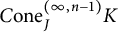 $C\mathrm {one}^{(\infty ,n-1)}_JK$
such that the canonical projection is an equivalence of double
$C\mathrm {one}^{(\infty ,n-1)}_JK$
such that the canonical projection is an equivalence of double ${(\infty ,n-2)}$
-categories
${(\infty ,n-2)}$
-categories

if and only if, by Proposition 2.16(2), its image under $I_n$
is an equivalence of double
$I_n$
is an equivalence of double $(\infty ,n-1)$
-categories
$(\infty ,n-1)$
-categories

if and only if, by Lemma 2.19, the canonical projection is an equivalence of double $(\infty ,n-1)$
-categories
$(\infty ,n-1)$
-categories

if and only if, by Lemma 2.18, the canonical projection is an equivalence of double $(\infty ,n-1)$
-categories
$(\infty ,n-1)$
-categories

if and only if, by definition, the object $\ell $
of C is an
$\ell $
of C is an $(\infty ,n)$
-limit object of the induced
$(\infty ,n)$
-limit object of the induced $(\infty ,n)$
-diagram
$(\infty ,n)$
-diagram $ I_nK\colon I_n J\to I_n C$
, as desired.
$ I_nK\colon I_n J\to I_n C$
, as desired.
3 Homotopy limits in a
$2$
-category

We revisit, in Section 3.1, the notion of homotopy $2$
-limit presenting an alternative viewpoint that makes use of double categories as a richer and larger environment to study
$2$
-limit presenting an alternative viewpoint that makes use of double categories as a richer and larger environment to study $2$
-categories. Then, in Theorem 3.14, we prove that our notion of
$2$
-categories. Then, in Theorem 3.14, we prove that our notion of $(\infty ,2)$
-limit is compatible with the notion of homotopy
$(\infty ,2)$
-limit is compatible with the notion of homotopy $2$
-limit.
$2$
-limit.
3.1 Homotopy limits in a
$2$
-category

In this section, we state a characterization of homotopy $2$
-limits in a double categorical language. This result will be proven in Section 4.2. We start by recalling the definition of a homotopy
$2$
-limits in a double categorical language. This result will be proven in Section 4.2. We start by recalling the definition of a homotopy $2$
-limit.
$2$
-limit.
Definition 3.1 A $2$
-diagram is a
$2$
-diagram is a $2$
-functor
$2$
-functor $K\colon {\mathcal {J}}\to {\mathcal {C}}$
.
$K\colon {\mathcal {J}}\to {\mathcal {C}}$
.
Given two $2$
-categories
$2$
-categories ${\mathcal {J}}$
and
${\mathcal {J}}$
and ${\mathcal {C}}$
, we denote by
${\mathcal {C}}$
, we denote by $[{\mathcal {J}},{\mathcal {C}}]^{\mathrm {ps}}$
the
$[{\mathcal {J}},{\mathcal {C}}]^{\mathrm {ps}}$
the $2$
-category of
$2$
-category of $2$
-functors
$2$
-functors ${\mathcal {J}}\to {\mathcal {C}}$
, pseudo-natural transformations, and modifications.
${\mathcal {J}}\to {\mathcal {C}}$
, pseudo-natural transformations, and modifications.
Definition 3.2 Given a $2$
-diagram
$2$
-diagram $K\colon {\mathcal {J}}\to {\mathcal {C}}$
, an object
$K\colon {\mathcal {J}}\to {\mathcal {C}}$
, an object $\ell $
of
$\ell $
of ${\mathcal {C}}$
is a homotopy
${\mathcal {C}}$
is a homotopy $2$
-limit object of K if there is a pseudo-cone
$2$
-limit object of K if there is a pseudo-cone $\lambda \colon \Delta \ell \Rightarrow K$
that induces, for every object c of
$\lambda \colon \Delta \ell \Rightarrow K$
that induces, for every object c of ${\mathcal {C}}$
, an equivalence of categories
${\mathcal {C}}$
, an equivalence of categories
 $$\begin{align*}\lambda^*\colon {\mathcal{C}}(c,\ell)\stackrel\simeq\longrightarrow [{\mathcal{J}},{\mathcal{C}}]^{\mathrm{ps}}(\Delta c,K).\end{align*}$$
Remark 3.3 The notion of homotopy $2$
-limit above is sometimes referred to as pseudo-bilimit. It corresponds to the notion of homotopy limit in the canonical model structure on
$2$
-limit above is sometimes referred to as pseudo-bilimit. It corresponds to the notion of homotopy limit in the canonical model structure on $2Cat$
from [Reference LackLac02] using the definition from [Reference ShulmanShu06].
$2Cat$
from [Reference LackLac02] using the definition from [Reference ShulmanShu06].
To state the desired characterization, we first recall the notion of a double category.
Definition 3.4 A double category is a category internal to – that is, a strict Segal object in – the category ${\mathcal {C}}\!\textit {at}$
, and a double functor is an internal functor. We denote by
${\mathcal {C}}\!\textit {at}$
, and a double functor is an internal functor. We denote by $Dbl{\mathcal {C}}\!\textit {at}$
the category of double categories and double functors.
$Dbl{\mathcal {C}}\!\textit {at}$
the category of double categories and double functors.
Notation 3.5 We denote by $[DblCat]_\infty $
the underlying
$[DblCat]_\infty $
the underlying $\infty $
-category (in the sense of [Reference BergnerBer09, Theorem 6.2]) of the model structure on
$\infty $
-category (in the sense of [Reference BergnerBer09, Theorem 6.2]) of the model structure on $DblCat$
from [Reference RasekhMSV23b, Theorem 3.26] (see Section 4.1 for further details).
$DblCat$
from [Reference RasekhMSV23b, Theorem 3.26] (see Section 4.1 for further details).
Every $2$
-category
$2$
-category ${\mathcal {C}}$
can be seen as a double category
${\mathcal {C}}$
can be seen as a double category $\widetilde {{\mathbb {H}}}{\mathcal {C}}$
in
$\widetilde {{\mathbb {H}}}{\mathcal {C}}$
in $[DblCat]_\infty $
and this assignment extends to
$[DblCat]_\infty $
and this assignment extends to $2$
-functors (see Construction 4.7).
$2$
-functors (see Construction 4.7).
The $\infty $
-category
$\infty $
-category $[DblCat]_\infty $
is Cartesian closed, as we prove in Corollary 4.13. Given two double categories
$[DblCat]_\infty $
is Cartesian closed, as we prove in Corollary 4.13. Given two double categories ${\mathbb {D}}$
and
${\mathbb {D}}$
and ${\mathbb {D}}'$
in
${\mathbb {D}}'$
in $[DblCat]_\infty $
, we denote by
$[DblCat]_\infty $
, we denote by  the internal hom in $[DblCat]_\infty $
.
$[DblCat]_\infty $
.
Notation 3.6 Given a $2$
-diagram
$2$
-diagram $K\colon {\mathcal {J}}\to {\mathcal {C}}$
, the double category
$K\colon {\mathcal {J}}\to {\mathcal {C}}$
, the double category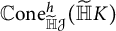 ${\mathbb {C}}\mathrm {one}^h_{\widetilde {{\mathbb {H}}}{\mathcal {J}}}(\widetilde {{\mathbb {H}}} K)$
of cones over K is the following pullback in
${\mathbb {C}}\mathrm {one}^h_{\widetilde {{\mathbb {H}}}{\mathcal {J}}}(\widetilde {{\mathbb {H}}} K)$
of cones over K is the following pullback in $[Dbl{\mathcal {C}}\!\textit {at}]_\infty $
:
$[Dbl{\mathcal {C}}\!\textit {at}]_\infty $
:

Notation 3.7 Given a double category ${\mathbb {D}}$
in
${\mathbb {D}}$
in $[DblCat]_\infty $
and an object d of
$[DblCat]_\infty $
and an object d of ${\mathbb {D}}$
, the slice double category
${\mathbb {D}}$
, the slice double category  of
of ${\mathbb {D}}$
over d is the following pullback in
${\mathbb {D}}$
over d is the following pullback in $[Dbl{\mathcal {C}}\!\textit {at}]_\infty $
:
$[Dbl{\mathcal {C}}\!\textit {at}]_\infty $
:

We prove the following as Theorem 4.19.
Theorem 3.8 Given a $2$
-diagram
$2$
-diagram $K\colon {\mathcal {J}}\to {\mathcal {C}}$
, an object
$K\colon {\mathcal {J}}\to {\mathcal {C}}$
, an object $\ell $
of
$\ell $
of ${\mathcal {C}}$
is a homotopy
${\mathcal {C}}$
is a homotopy $2$
-limit object of K if and only if there is an object
$2$
-limit object of K if and only if there is an object $(\ell ,\lambda )$
in
$(\ell ,\lambda )$
in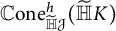 ${\mathbb {C}}\mathrm {one}^h_{\widetilde {{\mathbb {H}}} {\mathcal {J}}}(\widetilde {{\mathbb {H}}} K)$
such that the canonical projection is an equivalence in
${\mathbb {C}}\mathrm {one}^h_{\widetilde {{\mathbb {H}}} {\mathcal {J}}}(\widetilde {{\mathbb {H}}} K)$
such that the canonical projection is an equivalence in $[DblCat]_\infty $

3.2 Consistency with respect to strict context
In this section, we show as Theorem 3.14 how, for $n=2$
, the new notion of
$n=2$
, the new notion of $(\infty ,2)$
-limit is consistent with the strict context. We focus here on the main result and postpone the technical details to Section 4.3.
$(\infty ,2)$
-limit is consistent with the strict context. We focus here on the main result and postpone the technical details to Section 4.3.
Notation 3.9 We denote by
 $$\begin{align*}{\mathbb{N}}\colon [Dbl{\mathcal{C}}\!\textit{at}]_\infty \to Dbl{\mathcal{C}}\!\textit{at}_{(\infty,1)}\end{align*}$$
the functor induced by the nerve functor constructed in [Reference MoserMos20, Section 5.1] (see Section 4.3 for further details).
We collect here the properties of ${\mathbb {N}}$
needed for the main result.
${\mathbb {N}}$
needed for the main result.
Proposition 3.10 The functor ${\mathbb {N}}\colon [DblCat]_\infty \to DblCat_{(\infty ,1)}$
-
(1) sends
$2$
-categories to
$(\infty ,2)$
-categories, that is, for every
$2$
-category
$\mathcal C$
, the double
$(\infty ,1)$
-category
${\mathbb {N}}\widetilde {{\mathbb {H}}}\mathcal C$
is an
$(\infty ,2)$
-category; -
(2) is fully faithful; in particular, it is conservative;
-
(3) is a right adjoint; in particular, it preserves limits.


Moreover, we have that
-
(4) the left adjoint of
${\mathbb {N}}$
preserves products.

Proof First, note that (1) is a direct consequence of Theorem 4.36(3), while (2) and (3) follow from the fact that ${\mathbb {N}}\colon [DblCat]_\infty \to DblCat_{(\infty ,1)}$
has a left adjoint and the counit of this adjunction is an equivalence in
${\mathbb {N}}\colon [DblCat]_\infty \to DblCat_{(\infty ,1)}$
has a left adjoint and the counit of this adjunction is an equivalence in $[DblCat]_\infty $
by Theorem 4.36(1) and (2). Finally, (4) is proven in Corollary 4.44.
$[DblCat]_\infty $
by Theorem 4.36(1) and (2). Finally, (4) is proven in Corollary 4.44.
Proposition 3.11 Given a $2$
-category
$2$
-category ${\mathcal {J}}$
and a double category
${\mathcal {J}}$
and a double category ${\mathbb {D}}$
in
${\mathbb {D}}$
in $[DblCat]_\infty $
, there is an equivalence of double
$[DblCat]_\infty $
, there is an equivalence of double $(\infty ,1)$
-categories
$(\infty ,1)$
-categories

Proof This follows directly from Proposition 3.10(4).
With these, we can show that the nerve ${\mathbb {N}}$
preserves cone and slice constructions.
${\mathbb {N}}$
preserves cone and slice constructions.
Lemma 3.12 Given a $2$
-diagram
$2$
-diagram $K\colon {\mathcal {J}}\to {\mathcal {C}}$
, there is an equivalence of double
$K\colon {\mathcal {J}}\to {\mathcal {C}}$
, there is an equivalence of double $(\infty ,1)$
-categories
$(\infty ,1)$
-categories
 $$\begin{align*}{\mathbb{N}}({\mathbb{C}}\mathrm{one}^{h}_{\widetilde{{\mathbb{H}}} {\mathcal{J}}}(\widetilde{{\mathbb{H}}} K))\stackrel{\simeq}{\longrightarrow}C\mathrm{one}^{(\infty,2)}_{{\mathbb{N}}\widetilde{{\mathbb{H}}} {\mathcal{J}}}({\mathbb{N}}\widetilde{{\mathbb{H}}} K).\end{align*}$$
Proof By definition, we have a pullback in $[Dbl{\mathcal {C}}\!\textit {at}]_{\infty }$

Hence, by Proposition 3.10(3), we also have a pullback in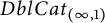 $DblCat_{(\infty ,1)}$

On the other hand, we have, by definition, a pullback in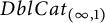 $ DblCat_{(\infty ,1)}$

Using Proposition 3.11 and the fact that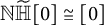 ${\mathbb {N}}\widetilde {{\mathbb {H}}} [0]\cong [0]$
and
${\mathbb {N}}\widetilde {{\mathbb {H}}} [0]\cong [0]$
and ${\mathbb {N}}\widetilde {{\mathbb {H}}} [1]\cong [1]$
, there is a natural comparison map between the two cospans defining the above pullbacks in
${\mathbb {N}}\widetilde {{\mathbb {H}}} [1]\cong [1]$
, there is a natural comparison map between the two cospans defining the above pullbacks in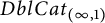 $ DblCat_{(\infty ,1)}$
, which is pointwise an equivalence of double
$ DblCat_{(\infty ,1)}$
, which is pointwise an equivalence of double $(\infty ,1)$
-categories. Hence, this induces a unique map between the two double
$(\infty ,1)$
-categories. Hence, this induces a unique map between the two double $(\infty ,1)$
-categories presenting the pullback
$(\infty ,1)$
-categories presenting the pullback
 $$\begin{align*}{\mathbb{N}}({\mathbb{C}}\mathrm{one}^{h}_{\widetilde{{\mathbb{H}}} {\mathcal{J}}}(\widetilde{{\mathbb{H}}} K))\longrightarrow C\mathrm{one}^{(\infty,2)}_{{\mathbb{N}}\widetilde{{\mathbb{H}}} {\mathcal{J}}}({\mathbb{N}}\widetilde{{\mathbb{H}}} K),\end{align*}$$
and this map is an equivalence of double $(\infty ,1)$
-categories, as desired.
$(\infty ,1)$
-categories, as desired.
Lemma 3.13 Given a double category ${\mathbb {D}}$
in
${\mathbb {D}}$
in $[DblCat]_\infty $
and an object d of
$[DblCat]_\infty $
and an object d of ${\mathbb {D}}$
, there is an equivalence of double
${\mathbb {D}}$
, there is an equivalence of double $(\infty ,1)$
-categories over
$(\infty ,1)$
-categories over ${\mathbb {N}}{\mathbb {D}}$

Proof The proof follows the same steps as the one of Lemma 3.12.
We can now prove the main result.
Theorem 3.14 Given a $2$
-diagram
$2$
-diagram $K\colon {\mathcal {J}}\to {\mathcal {C}}$
, an object
$K\colon {\mathcal {J}}\to {\mathcal {C}}$
, an object $\ell $
of
$\ell $
of ${\mathcal {C}}$
is a homotopy
${\mathcal {C}}$
is a homotopy $2$
-limit object of the
$2$
-limit object of the $2$
-diagram
$2$
-diagram $K\colon {\mathcal {J}}\to {\mathcal {C}}$
if and only if the object
$K\colon {\mathcal {J}}\to {\mathcal {C}}$
if and only if the object $\ell $
is an
$\ell $
is an $(\infty ,2)$
-limit object of the
$(\infty ,2)$
-limit object of the $(\infty ,2)$
-diagram
$(\infty ,2)$
-diagram ${\mathbb {N}}\widetilde {{\mathbb {H}}} K\colon {\mathbb {N}}\widetilde {{\mathbb {H}}} {\mathcal {J}}\to {\mathbb {N}}\widetilde {{\mathbb {H}}} {\mathcal {C}}$
.
${\mathbb {N}}\widetilde {{\mathbb {H}}} K\colon {\mathbb {N}}\widetilde {{\mathbb {H}}} {\mathcal {J}}\to {\mathbb {N}}\widetilde {{\mathbb {H}}} {\mathcal {C}}$
.
Proof We have that an object $\ell $
of
$\ell $
of ${\mathcal {C}}$
is a homotopy
${\mathcal {C}}$
is a homotopy $2$
-limit object of the
$2$
-limit object of the $2$
-diagram
$2$
-diagram $K\colon {\mathcal {J}}\to {\mathcal {C}}$
if and only if, by Theorem 4.19, there is an object
$K\colon {\mathcal {J}}\to {\mathcal {C}}$
if and only if, by Theorem 4.19, there is an object $(\ell ,\lambda )$
in
$(\ell ,\lambda )$
in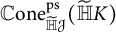 ${\mathbb {C}}\mathrm {one}^{\mathrm {ps}}_{\widetilde {{\mathbb {H}}} {\mathcal {J}}}(\widetilde {{\mathbb {H}}} K)$
such that the canonical projection is an equivalence in
${\mathbb {C}}\mathrm {one}^{\mathrm {ps}}_{\widetilde {{\mathbb {H}}} {\mathcal {J}}}(\widetilde {{\mathbb {H}}} K)$
such that the canonical projection is an equivalence in $[DblCat]_\infty $

if and only if, by Proposition 3.10(2), its image under ${\mathbb {N}}$
is an equivalence of double
${\mathbb {N}}$
is an equivalence of double $(\infty ,1)$
-categories
$(\infty ,1)$
-categories

if and only if, using $2$
-out-of-
$2$
-out-of- $3$
and Lemma 3.13, the canonical projection is an equivalence of double
$3$
and Lemma 3.13, the canonical projection is an equivalence of double $(\infty ,1)$
-categories
$(\infty ,1)$
-categories

if and only if, by Lemma 3.12, the canonical projection is an equivalence of double $(\infty ,1)$
-categories
$(\infty ,1)$
-categories

if and only if, by definition, the object $\ell $
of
$\ell $
of ${\mathcal {C}}$
is an
${\mathcal {C}}$
is an $(\infty ,2)$
-limit object of the induced
$(\infty ,2)$
-limit object of the induced $(\infty ,2)$
-diagram
$(\infty ,2)$
-diagram ${\mathbb {N}}\widetilde {{\mathbb {H}}} K\colon {\mathbb {N}}\widetilde {{\mathbb {H}}} {\mathcal {J}}\to {\mathbb {N}}\widetilde {{\mathbb {H}}} {\mathcal {C}}$
, as desired.
${\mathbb {N}}\widetilde {{\mathbb {H}}} K\colon {\mathbb {N}}\widetilde {{\mathbb {H}}} {\mathcal {J}}\to {\mathbb {N}}\widetilde {{\mathbb {H}}} {\mathcal {C}}$
, as desired.
4 Auxiliary results
In this last section, we prove the technical details needed in Section 3. First, in Section 4.1, we recall the main features of the model structure on $DblCat$
for weakly horizontally invariant double categories from [Reference RasekhMSV23b], needed to define the
$DblCat$
for weakly horizontally invariant double categories from [Reference RasekhMSV23b], needed to define the $\infty $
-category
$\infty $
-category $[DblCat]_\infty $
. Moreover, we prove that
$[DblCat]_\infty $
. Moreover, we prove that $[DblCat]_\infty $
is Cartesian closed and provide tools to compute double categories of cones and slice double categories in
$[DblCat]_\infty $
is Cartesian closed and provide tools to compute double categories of cones and slice double categories in $[DblCat]_\infty $
. Then, in Section 4.2, we prove the double categorical characterization of homotopy
$[DblCat]_\infty $
. Then, in Section 4.2, we prove the double categorical characterization of homotopy $2$
-limits stated in Theorem 3.8.
$2$
-limits stated in Theorem 3.8.
Finally, in Section 4.3, we recall the nerve construction from double categories to double $(\infty ,1)$
-categories from [Reference MoserMos20] and prove the properties of the nerve stated in Proposition 3.10.
$(\infty ,1)$
-categories from [Reference MoserMos20] and prove the properties of the nerve stated in Proposition 3.10.
4.1 Model structure for weakly horizontally invariant double categories
In this section, we recall from [Reference RasekhMSV23b] the main definitions and facts about the homotopy theory of weakly horizontally invariant double categories up to double biequivalence.
When unpacking the definition of a double category, one sees that a double category ${\mathbb {D}}$
consists of a category
${\mathbb {D}}$
consists of a category ${\mathbb {D}}_0$
of objects and a category
${\mathbb {D}}_0$
of objects and a category ${\mathbb {D}}_1$
of morphisms, together with appropriate domain and codomain maps, composition and identity maps. We refer to
${\mathbb {D}}_1$
of morphisms, together with appropriate domain and codomain maps, composition and identity maps. We refer to ${\mathbb {D}}_0$
as the category of objects and vertical morphisms and to
${\mathbb {D}}_0$
as the category of objects and vertical morphisms and to ${\mathbb {D}}_1$
as the category of horizontal morphisms and squares. A double functor is an assignment that preserves strictly the whole structure.
${\mathbb {D}}_1$
as the category of horizontal morphisms and squares. A double functor is an assignment that preserves strictly the whole structure.
Construction 4.1 There is a canonical fully faithful functor
 $$\begin{align*}{\mathbb{H}}\colon 2{\mathcal{C}}\!\textit{at}\to Dbl{\mathcal{C}}\!\textit{at,} \end{align*}$$
which assigns to a $2$
-category
$2$
-category ${\mathcal {C}}$
the double category
${\mathcal {C}}$
the double category ${\mathbb {H}}{\mathcal {C}}$
whose objects are the objects of
${\mathbb {H}}{\mathcal {C}}$
whose objects are the objects of ${\mathcal {C}}$
, whose horizontal morphisms are the morphisms of
${\mathcal {C}}$
, whose horizontal morphisms are the morphisms of ${\mathcal {C}}$
, whose vertical morphisms are all trivial, and whose squares are the
${\mathcal {C}}$
, whose vertical morphisms are all trivial, and whose squares are the $2$
-morphisms in
$2$
-morphisms in ${\mathcal {C}}$
.
${\mathcal {C}}$
.
The functor ${\mathbb {H}} \colon 2{\mathcal {C}}\!\textit {at}\to Dbl{\mathcal {C}}\!\textit {at}$
admits a right adjoint
${\mathbb {H}} \colon 2{\mathcal {C}}\!\textit {at}\to Dbl{\mathcal {C}}\!\textit {at}$
admits a right adjoint ${\textbf {H}} \colon Dbl{\mathcal {C}}\!\textit {at}\to 2{\mathcal {C}}\!\textit {at}$
, which sends a double category
${\textbf {H}} \colon Dbl{\mathcal {C}}\!\textit {at}\to 2{\mathcal {C}}\!\textit {at}$
, which sends a double category ${\mathbb {D}}$
to its underlying horizontal
${\mathbb {D}}$
to its underlying horizontal $2$
-category
$2$
-category ${\textbf {H}} {\mathbb {D}}$
, essentially obtained by forgetting the vertical morphisms of
${\textbf {H}} {\mathbb {D}}$
, essentially obtained by forgetting the vertical morphisms of ${\mathbb {D}}$
.
${\mathbb {D}}$
.
There is a canonical inclusion ${\mathbb {V}}\colon {\mathcal {C}}\!\textit {at}\to Dbl{\mathcal {C}}\!\textit {at,}$
which sends a category
${\mathbb {V}}\colon {\mathcal {C}}\!\textit {at}\to Dbl{\mathcal {C}}\!\textit {at,}$
which sends a category ${\mathcal {A}}$
to the double category
${\mathcal {A}}$
to the double category ${\mathbb {V}}{\mathcal {A}}$
whose objects are the objects of
${\mathbb {V}}{\mathcal {A}}$
whose objects are the objects of ${\mathcal {A}}$
and whose vertical morphisms are the morphisms of
${\mathcal {A}}$
and whose vertical morphisms are the morphisms of ${\mathcal {A}}$
; the horizontal morphisms and squares in
${\mathcal {A}}$
; the horizontal morphisms and squares in ${\mathbb {V}} {\mathcal {A}}$
are all trivial.
${\mathbb {V}} {\mathcal {A}}$
are all trivial.
Moreover, the category $DblCat$
is Cartesian closed. Given double categories
$DblCat$
is Cartesian closed. Given double categories ${\mathbb {X}}$
and
${\mathbb {X}}$
and ${\mathbb {X}}'$
, we denote by
${\mathbb {X}}'$
, we denote by  the internal hom in $DblCat$
.
$DblCat$
.
Definition 4.2 [Reference RasekhMSV23b, Definition 2.9] and [Reference Moser, Sarazola and VerdugoMSV22, Proposition 3.11]
A double functor $F\colon {\mathbb {D}}\to {\mathbb {D}}'$
is a double biequivalence if F induces biequivalences of
$F\colon {\mathbb {D}}\to {\mathbb {D}}'$
is a double biequivalence if F induces biequivalences of $2$
-categories
$2$
-categories

Definition 4.3 A companion pair in a double category ${\mathbb {D}}$
is a tuple
${\mathbb {D}}$
is a tuple $(f,u,\varphi ,\psi )$
consisting of a horizontal morphism
$(f,u,\varphi ,\psi )$
consisting of a horizontal morphism $f\colon c\to d$
, a vertical morphism
$f\colon c\to d$
, a vertical morphism $u\colon c \nrightarrow d$
, and two squares
$u\colon c \nrightarrow d$
, and two squares

satisfying the following pasting equalities:

We say that a horizontal morphism f (resp. a vertical morphism u) has a vertical (resp. horizontal) companion if there is a companion pair $(f,u,\varphi ,\psi )$
.
$(f,u,\varphi ,\psi )$
.
Definition 4.4 [Reference RasekhMSV23b, Definition 2.10] and [Reference Guetta, Moser, Sarazola and VerdugoGMSV23, Proposition 5.6]
A double category ${\mathbb {D}}$
is weakly horizontally invariant if every horizontal equivalence in
${\mathbb {D}}$
is weakly horizontally invariant if every horizontal equivalence in ${\mathbb {D}}$
, that is, an equivalence in
${\mathbb {D}}$
, that is, an equivalence in ${\textbf {H}}{\mathbb {D}}$
, has a vertical companion.
${\textbf {H}}{\mathbb {D}}$
, has a vertical companion.
The homotopy theory of weakly horizontally invariant double categories and double biequivalences is supported by a model structure.
Theorem 4.5 [Reference RasekhMSV23b, Theorem 3.26] and [Reference Guetta, Moser, Sarazola and VerdugoGMSV23, Theorem 5.10]
There is a model structure on the category $Dbl{\mathcal {C}}\!\textit {at}$
in which
$Dbl{\mathcal {C}}\!\textit {at}$
in which
-
• the fibrant objects are the weakly horizontally invariant double categories;
-
• the trivial fibrations are the double functors that are surjective on objects, full on horizontal and vertical morphisms, and fully faithful on squares;
-
• the weak equivalences between fibrant objects are precisely the double biequivalences.
We denote this model structure by $Dbl{\mathcal {C}}\!\textit {at}_{\mathrm {whi}}$
.
$Dbl{\mathcal {C}}\!\textit {at}_{\mathrm {whi}}$
.
Recall that the $\infty $
-category
$\infty $
-category $[DblCat]_\infty $
from Notation 3.5 is, by definition, the underlying
$[DblCat]_\infty $
from Notation 3.5 is, by definition, the underlying $\infty $
-category of the model structure
$\infty $
-category of the model structure $DblCat_{\mathrm {whi}}$
, in the sense of [Reference BergnerBer09, Theorem 6.2].
$DblCat_{\mathrm {whi}}$
, in the sense of [Reference BergnerBer09, Theorem 6.2].
Remark 4.6 The weakly horizontal invariance is a sort of Reedy fibrancy condition, which naturally appears when trying to build a model structure on $DblCat$
, compatible with the canonical model structure on
$DblCat$
, compatible with the canonical model structure on $2Cat$
and with “symmetric” trivial fibrations as described in Theorem 4.5. Indeed, by [Reference Guetta, Moser, Sarazola and VerdugoGMSV23, Proposition 5.6], a double category
$2Cat$
and with “symmetric” trivial fibrations as described in Theorem 4.5. Indeed, by [Reference Guetta, Moser, Sarazola and VerdugoGMSV23, Proposition 5.6], a double category ${\mathbb {D}}$
is weakly horizontally invariant if and only if the
${\mathbb {D}}$
is weakly horizontally invariant if and only if the $2$
-functor
$2$
-functor

is a fibration of $2$
-categories. Moreover, by [Reference MoserMos20, Theorem 5.30], this is a necessary and sufficient condition for the nerve
$2$
-categories. Moreover, by [Reference MoserMos20, Theorem 5.30], this is a necessary and sufficient condition for the nerve ${\mathbb {N}}{\mathbb {D}}$
of a double category
${\mathbb {N}}{\mathbb {D}}$
of a double category ${\mathbb {D}}$
to be Reedy fibrant.
${\mathbb {D}}$
to be Reedy fibrant.
Given a $2$
-category
$2$
-category ${\mathcal {C}}$
, the double category
${\mathcal {C}}$
, the double category ${\mathbb {H}} {\mathcal {C}}$
is generally not weakly horizontally invariant. Hence, in order to recover
${\mathbb {H}} {\mathcal {C}}$
is generally not weakly horizontally invariant. Hence, in order to recover $2$
-categories as weakly horizontally invariant double categories, we shall consider the following refined construction.
$2$
-categories as weakly horizontally invariant double categories, we shall consider the following refined construction.
Construction 4.7 We denote by
 $$\begin{align*}\widetilde{{\mathbb{H}}} \colon 2{\mathcal{C}}\!\textit{at}\to Dbl{\mathcal{C}}\!\textit{at}, \end{align*}$$
the functor from [Reference RasekhMSV23b, Definition 2.13]. The functor $\widetilde {{\mathbb {H}}}$
assigns to a
$\widetilde {{\mathbb {H}}}$
assigns to a $2$
-category
$2$
-category ${\mathcal {C}}$
the double category
${\mathcal {C}}$
the double category $\widetilde {{\mathbb {H}}} {\mathcal {C}}$
whose objects are the objects of
$\widetilde {{\mathbb {H}}} {\mathcal {C}}$
whose objects are the objects of ${\mathcal {C}}$
, whose horizontal morphisms are the morphisms of
${\mathcal {C}}$
, whose horizontal morphisms are the morphisms of ${\mathcal {C}}$
, whose vertical morphisms are the adjoint equivalence data in
${\mathcal {C}}$
, whose vertical morphisms are the adjoint equivalence data in ${\mathcal {C}}$
, and whose squares are the
${\mathcal {C}}$
, and whose squares are the $2$
-morphisms in
$2$
-morphisms in ${\mathcal {C}}$
of the form
${\mathcal {C}}$
of the form

Remark 4.8 As every identity is an equivalence, for any $2$
-category
$2$
-category ${\mathcal {C}}$
, there is a canonical inclusion
${\mathcal {C}}$
, there is a canonical inclusion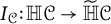 $I_{\mathcal {C}}\colon {\mathbb {H}} {\mathcal {C}}\to \widetilde {{\mathbb {H}}} {\mathcal {C}}$
. If
$I_{\mathcal {C}}\colon {\mathbb {H}} {\mathcal {C}}\to \widetilde {{\mathbb {H}}} {\mathcal {C}}$
. If ${\mathcal {C}}$
has no non-identity equivalence, this inclusion is an isomorphism
${\mathcal {C}}$
has no non-identity equivalence, this inclusion is an isomorphism ${\mathbb {H}} {\mathcal {C}}\cong \widetilde {{\mathbb {H}}} {\mathcal {C}}$
in
${\mathbb {H}} {\mathcal {C}}\cong \widetilde {{\mathbb {H}}} {\mathcal {C}}$
in $Dbl{\mathcal {C}}\!\textit {at}$
. In particular, we have isomorphisms in
$Dbl{\mathcal {C}}\!\textit {at}$
. In particular, we have isomorphisms in $Dbl{\mathcal {C}}\!\textit {at}$
 $$\begin{align*}{\mathbb{H}} [0]\cong \widetilde{{\mathbb{H}}} [0]\quad\text{ and }\quad{\mathbb{H}} [1]\cong\widetilde{{\mathbb{H}}} [1].\end{align*}$$
Proposition 4.9 [Reference RasekhMSV23b, Theorem 6.5]
Given a $2$
-category
$2$
-category ${\mathcal {C}}$
, the double category
${\mathcal {C}}$
, the double category $\widetilde {{\mathbb {H}}} {\mathcal {C}}$
is weakly horizontally invariant, and the canonical inclusion
$\widetilde {{\mathbb {H}}} {\mathcal {C}}$
is weakly horizontally invariant, and the canonical inclusion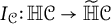 $I_{\mathcal {C}}\colon {\mathbb {H}} {\mathcal {C}}\to \widetilde {{\mathbb {H}}} {\mathcal {C}}$
is a double biequivalence.
$I_{\mathcal {C}}\colon {\mathbb {H}} {\mathcal {C}}\to \widetilde {{\mathbb {H}}} {\mathcal {C}}$
is a double biequivalence.
Remark 4.10 Given a $2$
-category
$2$
-category ${\mathcal {C}}$
, for each equivalence
${\mathcal {C}}$
, for each equivalence $f\colon c\to d$
in
$f\colon c\to d$
in ${\mathcal {C}}$
, the corresponding horizontal morphism
${\mathcal {C}}$
, the corresponding horizontal morphism $f\colon c\to d$
and vertical morphism
$f\colon c\to d$
and vertical morphism $f\colon c \nrightarrow d$
form a companion pair in
$f\colon c \nrightarrow d$
form a companion pair in $\widetilde {{\mathbb {H}}}{\mathcal {C}}$
with squares induced by the identity
$\widetilde {{\mathbb {H}}}{\mathcal {C}}$
with squares induced by the identity $2$
-morphism at f.
$2$
-morphism at f.
While the category $DblCat$
is Cartesian closed, the model structure
$DblCat$
is Cartesian closed, the model structure $DblCat_{\mathrm {whi}}$
is not compatible with the Cartesian product (see [Reference Moser, Sarazola and VerdugoMSV22, Remark 5.1]). Instead, one needs to refine it and consider the double categorical analog of the pseudo Gray tensor product
$DblCat_{\mathrm {whi}}$
is not compatible with the Cartesian product (see [Reference Moser, Sarazola and VerdugoMSV22, Remark 5.1]). Instead, one needs to refine it and consider the double categorical analog of the pseudo Gray tensor product $\boxtimes ^{\mathrm {ps}}\colon Dbl{\mathcal {C}}\!\textit {at}\times Dbl{\mathcal {C}}\!\textit {at}\to Dbl{\mathcal {C}}\!\textit {at}$
introduced in [Reference BöhmBöh20, Section 3].
$\boxtimes ^{\mathrm {ps}}\colon Dbl{\mathcal {C}}\!\textit {at}\times Dbl{\mathcal {C}}\!\textit {at}\to Dbl{\mathcal {C}}\!\textit {at}$
introduced in [Reference BöhmBöh20, Section 3].
Theorem 4.11 [Reference RasekhMSV23b, Theorem 7.8]
The model category $Dbl{\mathcal {C}}\!\textit {at}_{\mathrm {whi}}$
is a closed monoidal model category with respect to the pseudo Gray tensor product
$Dbl{\mathcal {C}}\!\textit {at}_{\mathrm {whi}}$
is a closed monoidal model category with respect to the pseudo Gray tensor product $\boxtimes ^{\mathrm {ps}}$
.
$\boxtimes ^{\mathrm {ps}}$
.
Lemma 4.12 [Reference RasekhMSV23b, Lemma 7.3]
Given double categories ${\mathbb {J}}$
and
${\mathbb {J}}$
and ${\mathbb {J}}'$
, there is a canonical trivial fibration
${\mathbb {J}}'$
, there is a canonical trivial fibration
 $$\begin{align*}{\mathbb{J}}\boxtimes^{\mathrm{ps}}{\mathbb{J}}'\to {\mathbb{J}}\times {\mathbb{J}}' \end{align*}$$
natural in ${\mathbb {J}}$
and
${\mathbb {J}}$
and ${\mathbb {J}}'$
.
${\mathbb {J}}'$
.
By putting the above results together, we get the following corollary.
Corollary 4.13 The $\infty $
-category
$\infty $
-category $[DblCat]_\infty $
is Cartesian closed.
$[DblCat]_\infty $
is Cartesian closed.
Proof By Theorem 4.11, the $\infty $
-category
$\infty $
-category $[DblCat]_\infty $
has a closed monoidal structure induced by the pseudo Gray tensor product
$[DblCat]_\infty $
has a closed monoidal structure induced by the pseudo Gray tensor product $\boxtimes ^{\mathrm {ps}}$
, and by Lemma 4.12, this monoidal structure is equivalent to the one induced by the Cartesian product.
$\boxtimes ^{\mathrm {ps}}$
, and by Lemma 4.12, this monoidal structure is equivalent to the one induced by the Cartesian product.
Given double categories ${\mathbb {J}}$
and
${\mathbb {J}}$
and ${\mathbb {D}}$
, we denote by
${\mathbb {D}}$
, we denote by  the internal pseudo-hom associated with the pseudo Gray tensor product on $DblCat$
.
$DblCat$
.
Remark 4.14 Given double categories ${\mathbb {J}}$
and
${\mathbb {J}}$
and ${\mathbb {D}}$
, we provide a short description of the double category given by the internal pseudo-hom
${\mathbb {D}}$
, we provide a short description of the double category given by the internal pseudo-hom  . An object in
  is a double functor ${\mathbb {J}}\to {\mathbb {D}}$
. A horizontal morphism in
${\mathbb {J}}\to {\mathbb {D}}$
. A horizontal morphism in  between double functors $F,G\colon {\mathbb {J}}\to {\mathbb {D}}$
is a pseudo-natural horizontal transformation
$F,G\colon {\mathbb {J}}\to {\mathbb {D}}$
is a pseudo-natural horizontal transformation $\varphi \colon F\Rightarrow G$
, consisting of
$\varphi \colon F\Rightarrow G$
, consisting of
-
• for each object j in
${\mathbb {J}}$
, a horizontal morphism
$\varphi _j\colon Fj\to Gj$
in
${\mathbb {D}}$
, -
• for each vertical morphism
$u\colon j \nrightarrow j'$
in
${\mathbb {J}}$
, a square
$\varphi _u$
in
${\mathbb {D}}$
of the form -
• for each horizontal morphism
$f\colon j\to k$
in
${\mathbb {J}}$
, a vertically invertible square
$\varphi _f$
in
${\mathbb {D}}$
of the form


such that the components $\varphi _u$
are functorial in u, the components
$\varphi _u$
are functorial in u, the components $\varphi _f$
are functorial in f, and together they are natural with respect to squares in
$\varphi _f$
are functorial in f, and together they are natural with respect to squares in ${\mathbb {J}}$
. Similarly, the vertical morphisms in
${\mathbb {J}}$
. Similarly, the vertical morphisms in  are the pseudo-natural vertical transformations obtained by interchanging the roles of the horizontal and vertical morphisms. Finally, a square $\alpha $
in
$\alpha $
in  as depicted below left is a modification consisting of, for each object j in ${\mathbb {J}}$
, a square
${\mathbb {J}}$
, a square $\alpha _j$
in
$\alpha _j$
in ${\mathbb {D}}$
as depicted below right,
${\mathbb {D}}$
as depicted below right,

such that the components $\alpha _j$
are appropriately compatible with the data of the horizontal and vertical transformations.
$\alpha _j$
are appropriately compatible with the data of the horizontal and vertical transformations.
Understanding these internal homs and fibrancy conditions is of utmost importance when studying the $\infty $
-category
$\infty $
-category $[DblCat]_\infty $
. Indeed, in general, there is no easy way to compute the internal hom between two arbitrary objects in the underlying Cartesian closed
$[DblCat]_\infty $
. Indeed, in general, there is no easy way to compute the internal hom between two arbitrary objects in the underlying Cartesian closed $\infty $
-category of a model category, as even simple mapping spaces are generally described via Hammock localization (see [Reference BergnerBer09, Definition 3.4]). However, in our case, as the model structure
$\infty $
-category of a model category, as even simple mapping spaces are generally described via Hammock localization (see [Reference BergnerBer09, Definition 3.4]). However, in our case, as the model structure $Dbl{\mathcal {C}}\!\textit {at}_{\mathrm {whi}}$
is closed monoidal with respect to the pseudo Gray tensor product, we get from the argument in [Reference HoveyHov99, Section 5.6], that, for a cofibrant double category
$Dbl{\mathcal {C}}\!\textit {at}_{\mathrm {whi}}$
is closed monoidal with respect to the pseudo Gray tensor product, we get from the argument in [Reference HoveyHov99, Section 5.6], that, for a cofibrant double category ${\mathbb {J}}$
and a fibrant double category
${\mathbb {J}}$
and a fibrant double category ${\mathbb {D}}$
, that is, a weakly horizontally invariant one, the
${\mathbb {D}}$
, that is, a weakly horizontally invariant one, the $\infty $
-categorical internal hom
$\infty $
-categorical internal hom  is equivalent to the internal pseudo-hom
  . Hence, for a cofibrant double category ${\mathbb {J}}$
and a weakly horizontally invariant double category
${\mathbb {J}}$
and a weakly horizontally invariant double category ${\mathbb {D}}$
, the internal hom in the
${\mathbb {D}}$
, the internal hom in the $\infty $
-category
$\infty $
-category $[DblCat]_\infty $
is given by
$[DblCat]_\infty $
is given by  .
.
The next technical lemma gives us access to the $\infty $
-categorical internal hom in a broader range of situations.
$\infty $
-categorical internal hom in a broader range of situations.
Lemma 4.15 Let ${\mathbb {D}}$
be a double category. Then the functor
${\mathbb {D}}$
be a double category. Then the functor

takes biequivalences to weak equivalences in the model structure $DblCat_{\mathrm {whi}}$
.
$DblCat_{\mathrm {whi}}$
.
Proof Let $F\colon {\mathcal {J}}'\to {\mathcal {J}}$
be a biequivalence of
$F\colon {\mathcal {J}}'\to {\mathcal {J}}$
be a biequivalence of $2$
-categories. Then F admits a pseudo-inverse, that is, there is a pseudo-functor
$2$
-categories. Then F admits a pseudo-inverse, that is, there is a pseudo-functor $G\colon {\mathcal {J}}\to {\mathcal {J}}'$
together with pseudo-natural equivalences
$G\colon {\mathcal {J}}\to {\mathcal {J}}'$
together with pseudo-natural equivalences $\eta \colon \operatorname {\mathrm {id}}_{\mathcal {J}}\simeq F\circ G$
and
$\eta \colon \operatorname {\mathrm {id}}_{\mathcal {J}}\simeq F\circ G$
and $\varepsilon \colon G\circ F\simeq \operatorname {\mathrm {id}}_{{\mathcal {J}}'}$
. In particular, this induces a double biequivalence
$\varepsilon \colon G\circ F\simeq \operatorname {\mathrm {id}}_{{\mathcal {J}}'}$
. In particular, this induces a double biequivalence $\widetilde {{\mathbb {H}}}F\colon \widetilde {{\mathbb {H}}}{\mathcal {J}}'\to \widetilde {{\mathbb {H}}}{\mathcal {J}}$
that admits a horizontal pseudo-inverse given by the data of the induced double pseudo-functor
$\widetilde {{\mathbb {H}}}F\colon \widetilde {{\mathbb {H}}}{\mathcal {J}}'\to \widetilde {{\mathbb {H}}}{\mathcal {J}}$
that admits a horizontal pseudo-inverse given by the data of the induced double pseudo-functor $\widetilde {{\mathbb {H}}}G\colon \widetilde {{\mathbb {H}}}{\mathcal {J}}\to \widetilde {{\mathbb {H}}}{\mathcal {J}}'$
and the induced horizontal pseudo-natural equivalences
$\widetilde {{\mathbb {H}}}G\colon \widetilde {{\mathbb {H}}}{\mathcal {J}}\to \widetilde {{\mathbb {H}}}{\mathcal {J}}'$
and the induced horizontal pseudo-natural equivalences $\widetilde {{\mathbb {H}}}\eta \colon \operatorname {\mathrm {id}}_{\widetilde {{\mathbb {H}}}{\mathcal {J}}}\simeq \widetilde {{\mathbb {H}}}F\circ \widetilde {{\mathbb {H}}}G$
and
$\widetilde {{\mathbb {H}}}\eta \colon \operatorname {\mathrm {id}}_{\widetilde {{\mathbb {H}}}{\mathcal {J}}}\simeq \widetilde {{\mathbb {H}}}F\circ \widetilde {{\mathbb {H}}}G$
and $\widetilde {{\mathbb {H}}}\varepsilon \colon \widetilde {{\mathbb {H}}}G\circ \widetilde {{\mathbb {H}}}F\simeq \operatorname {\mathrm {id}}_{\widetilde {{\mathbb {H}}}{\mathcal {J}}'}$
. This in turn implies that, for every double category
$\widetilde {{\mathbb {H}}}\varepsilon \colon \widetilde {{\mathbb {H}}}G\circ \widetilde {{\mathbb {H}}}F\simeq \operatorname {\mathrm {id}}_{\widetilde {{\mathbb {H}}}{\mathcal {J}}'}$
. This in turn implies that, for every double category ${\mathbb {D}}$
, the induced double functor
${\mathbb {D}}$
, the induced double functor  has a horizontal pseudo-inverse given by the data $((\widetilde {{\mathbb {H}}}G)^*,(\widetilde {{\mathbb {H}}}\eta )^*,(\widetilde {{\mathbb {H}}}\varepsilon )^*)$
. Hence, it is a horizontal biequivalence in the sense of [Reference RasekhMSV23b, Definition 8.8]. Then it is a double biequivalence by [Reference RasekhMSV23b, Proposition 8.11], and so a weak equivalence in the model structure
$((\widetilde {{\mathbb {H}}}G)^*,(\widetilde {{\mathbb {H}}}\eta )^*,(\widetilde {{\mathbb {H}}}\varepsilon )^*)$
. Hence, it is a horizontal biequivalence in the sense of [Reference RasekhMSV23b, Definition 8.8]. Then it is a double biequivalence by [Reference RasekhMSV23b, Proposition 8.11], and so a weak equivalence in the model structure $DblCat_{\mathrm {whi}}$
by [Reference RasekhMSV23b, Proposition 3.25].
$DblCat_{\mathrm {whi}}$
by [Reference RasekhMSV23b, Proposition 3.25].
Remark 4.16 Let ${\mathcal {J}}$
be a
${\mathcal {J}}$
be a $2$
-category, and
$2$
-category, and $\widehat {{\mathcal {J}}} \to {\mathcal {J}}$
be a cofibrant replacement. Notice that both cofibrant
$\widehat {{\mathcal {J}}} \to {\mathcal {J}}$
be a cofibrant replacement. Notice that both cofibrant $2$
-categories and double categories are those for which the underlying categories are free (for the case of
$2$
-categories and double categories are those for which the underlying categories are free (for the case of $2$
-categories, see [Reference LackLac02, Theorem 4.8] and the case of double categories, see [Reference RasekhMSV23b, Corollary 3.13]). By construction, this property is preserved by
$2$
-categories, see [Reference LackLac02, Theorem 4.8] and the case of double categories, see [Reference RasekhMSV23b, Corollary 3.13]). By construction, this property is preserved by $\widetilde {{\mathbb {H}}}$
, meaning
$\widetilde {{\mathbb {H}}}$
, meaning $\widetilde {{\mathbb {H}}}\widehat {{\mathcal {J}}}$
is cofibrant. Moreover, for a weakly horizontally invariant double category
$\widetilde {{\mathbb {H}}}\widehat {{\mathcal {J}}}$
is cofibrant. Moreover, for a weakly horizontally invariant double category ${\mathbb {D}}$
, we have the following chain of equivalences in
${\mathbb {D}}$
, we have the following chain of equivalences in $[DblCat]_\infty $
:
$[DblCat]_\infty $
:

where the last equivalence follows from Lemma 4.15. Hence, for ${\mathcal {J}}$
a
${\mathcal {J}}$
a $2$
-category and
$2$
-category and ${\mathbb {D}}$
a weakly horizontally invariant double category, the
${\mathbb {D}}$
a weakly horizontally invariant double category, the $\infty $
-categorical internal hom
$\infty $
-categorical internal hom  is already equivalent to the internal pseudo-hom
  .
.
Hence, throughout we always consider internal pseudo-homs with domain of the form $\widetilde {{\mathbb {H}}}{\mathcal {J}}$
, for
$\widetilde {{\mathbb {H}}}{\mathcal {J}}$
, for ${\mathcal {J}}$
a
${\mathcal {J}}$
a $2$
-category, and codomain a weakly horizontally invariant double category.
$2$
-category, and codomain a weakly horizontally invariant double category.
Remark 4.17 Let $K\colon {\mathcal {J}}\to {\mathcal {C}}$
be a
$K\colon {\mathcal {J}}\to {\mathcal {C}}$
be a $2$
-diagram. The double category
$2$
-diagram. The double category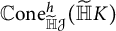 ${\mathbb {C}}\mathrm {one}^{h}_{\widetilde {{\mathbb {H}}} {\mathcal {J}}}(\widetilde {{\mathbb {H}}} K)$
in
${\mathbb {C}}\mathrm {one}^{h}_{\widetilde {{\mathbb {H}}} {\mathcal {J}}}(\widetilde {{\mathbb {H}}} K)$
in $[DblCat]_\infty $
from Notation 3.6 is equivalent to the double category
$[DblCat]_\infty $
from Notation 3.6 is equivalent to the double category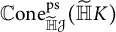 ${\mathbb {C}}\mathrm {one}^{\mathrm {ps}}_{\widetilde {{\mathbb {H}}} {\mathcal {J}}}(\widetilde {{\mathbb {H}}} K)$
of pseudo-cones over
${\mathbb {C}}\mathrm {one}^{\mathrm {ps}}_{\widetilde {{\mathbb {H}}} {\mathcal {J}}}(\widetilde {{\mathbb {H}}} K)$
of pseudo-cones over $\widetilde {{\mathbb {H}}} K$
, given by the strict pullback in
$\widetilde {{\mathbb {H}}} K$
, given by the strict pullback in $DblCat$
(which is a homotopy pullback in
$DblCat$
(which is a homotopy pullback in $DblCat_{\mathrm {whi}}$
)
$DblCat_{\mathrm {whi}}$
)

In particular, if ${\mathcal {J}}$
is a
${\mathcal {J}}$
is a $2$
-category with no equivalences (which is usually the case of the diagrams we like to consider), the double category
$2$
-category with no equivalences (which is usually the case of the diagrams we like to consider), the double category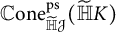 ${\mathbb {C}}\mathrm {one}^{\mathrm {ps}}_{\widetilde {{\mathbb {H}}} {\mathcal {J}}}(\widetilde {{\mathbb {H}}} K)$
can be described as follows:
${\mathbb {C}}\mathrm {one}^{\mathrm {ps}}_{\widetilde {{\mathbb {H}}} {\mathcal {J}}}(\widetilde {{\mathbb {H}}} K)$
can be described as follows:
-
• its objects are pairs
$(c,\kappa )$
of an object
$c\in {\mathcal {C}}$
and a pseudo-cone
$\kappa \colon \Delta c\Rightarrow K$
; -
• its vertical morphisms
$(c,\kappa )\to (c',\kappa ')$
are pairs
$(u,\mu )$
of an equivalence in
${\mathcal {C}}$
and a modification
$\mu \colon \kappa \to \kappa ' \circ \Delta u$
; -
• its horizontal morphisms
$(c,\kappa )\to (d,\lambda )$
are pairs
$(f,\varphi )$
of a morphism
${f\colon c\to d}$
in
${\mathcal {C}}$
and an invertible modification ; -
• its squares
are
$2$
-morphisms
$\alpha \colon vf\Rightarrow f'u$
in
${\mathcal {C}}$
making the following diagram of modifications commute:




 in
in 




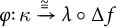 ;
;

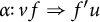


Remark 4.18 Let ${\mathbb {D}}$
be a weakly horizontally invariant double category and d in
${\mathbb {D}}$
be a weakly horizontally invariant double category and d in ${\mathbb {D}}$
be an object. The double category
${\mathbb {D}}$
be an object. The double category  in
in $[DblCat]_\infty $
from Notation 3.7 is equivalent to the strict pullback in
$[DblCat]_\infty $
from Notation 3.7 is equivalent to the strict pullback in $DblCat$
(which is a homotopy pullback in
$DblCat$
(which is a homotopy pullback in $DblCat_{\mathrm {whi}}$
)
$DblCat_{\mathrm {whi}}$
)

In particular, the double category  can be described as follows:
-
• its objects are pairs
$(c,\kappa )$
of an object
$c\in {\mathbb {D}}$
and a horizontal morphism
$\kappa \colon c\to d$
; -
• its vertical morphisms
$(c,\kappa )\to (c',\kappa ')$
are pairs
$(u,\mu )$
of a vertical morphism
$u\colon c\to c'$
in
${\mathbb {D}}$
and a square
$\mu $
in
${\mathbb {D}}$
of the form -
• its horizontal morphisms
$(c,\kappa )\to (e,\lambda )$
are pairs
$(f,\varphi )$
of a horizontal morphism
$f\colon c\to e$
in
${\mathbb {D}}$
and a vertically invertible square
$\varphi $
in
${\mathbb {D}}$
of the form -
• its squares as below right
are squares
$\alpha $
in
${\mathbb {D}}$
as above right satisfying the following pasting equality:








4.2 Characterization of homotopy
$2$
-limits

The goal of this section is to prove the characterization of homotopy $2$
-limits stated in Theorem 3.8. For this, we first reformulate the statement in the model categorical language.
$2$
-limits stated in Theorem 3.8. For this, we first reformulate the statement in the model categorical language.
Theorem 4.19 Given a $2$
-diagram
$2$
-diagram $K\colon {\mathcal {J}}\to {\mathcal {C}}$
, an object
$K\colon {\mathcal {J}}\to {\mathcal {C}}$
, an object $\ell $
of
$\ell $
of ${\mathcal {C}}$
is a homotopy
${\mathcal {C}}$
is a homotopy $2$
-limit object of K if and only if there is an object
$2$
-limit object of K if and only if there is an object $(\ell ,\lambda )$
in
$(\ell ,\lambda )$
in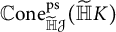 ${\mathbb {C}}\mathrm {one}^{\mathrm {ps}}_{\widetilde {{\mathbb {H}}} {\mathcal {J}}}(\widetilde {{\mathbb {H}}} K)$
such that the canonical projection defines a double biequivalence
${\mathbb {C}}\mathrm {one}^{\mathrm {ps}}_{\widetilde {{\mathbb {H}}} {\mathcal {J}}}(\widetilde {{\mathbb {H}}} K)$
such that the canonical projection defines a double biequivalence

There is an analogous construction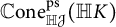 ${\mathbb {C}}\mathrm {one}^{\mathrm {ps}}_{{\mathbb {H}} {\mathcal {J}}}({\mathbb {H}} K)$
obtained by replacing all instances of
${\mathbb {C}}\mathrm {one}^{\mathrm {ps}}_{{\mathbb {H}} {\mathcal {J}}}({\mathbb {H}} K)$
obtained by replacing all instances of $\widetilde {\mathbb {H}} $
with
$\widetilde {\mathbb {H}} $
with ${\mathbb {H}} $
, and together with the construction
${\mathbb {H}} $
, and together with the construction  , they are fruitful to detect homotopy $2$
-limits.
$2$
-limits.
Theorem 4.20 [Reference Clingman and MosercM22b, Corollary 7.22]
Given a $2$
-diagram
$2$
-diagram $K\colon {\mathcal {J}}\to {\mathcal {C}}$
, an object
$K\colon {\mathcal {J}}\to {\mathcal {C}}$
, an object $\ell $
of
$\ell $
of ${\mathcal {C}}$
is a homotopy
${\mathcal {C}}$
is a homotopy $2$
-limit object of K if and only if there is an object
$2$
-limit object of K if and only if there is an object $(\ell ,\lambda )$
in
$(\ell ,\lambda )$
in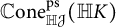 ${\mathbb {C}}\mathrm {one}^{\mathrm {ps}}_{{{\mathbb {H}}}{\mathcal {J}}}({{\mathbb {H}}}K)$
such that the canonical projection defines a double biequivalence
${\mathbb {C}}\mathrm {one}^{\mathrm {ps}}_{{{\mathbb {H}}}{\mathcal {J}}}({{\mathbb {H}}}K)$
such that the canonical projection defines a double biequivalence

To prove Theorem 4.19, we will use the characterization from Theorem 4.20 and show that, given a $2$
-diagram
$2$
-diagram $K\colon {\mathcal {J}}\to {\mathcal {C}}$
, an object
$K\colon {\mathcal {J}}\to {\mathcal {C}}$
, an object $\ell $
of
$\ell $
of ${\mathcal {C}}$
, and a pseudo-cone
${\mathcal {C}}$
, and a pseudo-cone $\lambda $
with summit
$\lambda $
with summit $\ell $
over K, there is a zig-zag of double biequivalences connecting the canonical projection
$\ell $
over K, there is a zig-zag of double biequivalences connecting the canonical projection

and the canonical projection

We first collect some homotopical facts about the pseudo-hom that are not formal.
Lemma 4.21 Given a double category ${\mathbb {J}}$
and a
${\mathbb {J}}$
and a $2$
-category
$2$
-category ${\mathcal {C}}$
, the double category
${\mathcal {C}}$
, the double category  is weakly horizontally invariant.
Proof Given a horizontal pseudo-natural equivalence  , we construct a vertical pseudo-natural transformation $\beta \colon F\Rightarrow G$
as follows:
$\beta \colon F\Rightarrow G$
as follows:
-
• for an object i in
${\mathbb {J}}$
, set to be the component of
$\alpha $
at the object i, which is an equivalence and hence a vertical morphism in
$\widetilde {{\mathbb {H}}} {\mathcal {C}}$
; -
• for a horizontal morphism
$f\colon i\to j$
in
${\mathbb {J}}$
, set to be the pseudo-naturality constraint of
$\alpha $
; -
• for a vertical morphism
$u\colon i\to j$
in
${\mathbb {J}}$
, set to be the component on vertical morphism of
$\alpha $
, which is an invertible
$2$
-morphism by [Reference MoserMos20, Lemma A.2.3] as
$\alpha _u$
is a weakly horizontally invertible square.

 to be the component of


 to be the pseudo-naturality constraint of


 to be the component on vertical morphism of


The horizontal pseudo-naturality of $\alpha $
then implies the vertical pseudo-naturality of
$\alpha $
then implies the vertical pseudo-naturality of $\beta $
. Moreover, it is not hard to see that
$\beta $
. Moreover, it is not hard to see that $(\alpha ,\beta )$
forms a companion pair.
$(\alpha ,\beta )$
forms a companion pair.
Lemma 4.22 Let $F\colon {\mathbb {J}}\to {\mathbb {J}}'$
be a trivial fibration in
$F\colon {\mathbb {J}}\to {\mathbb {J}}'$
be a trivial fibration in $Dbl{\mathcal {C}}\!\textit {at}_{\mathrm {whi}}$
and
$Dbl{\mathcal {C}}\!\textit {at}_{\mathrm {whi}}$
and ${\mathbb {D}}$
be a double category. Then the induced double functor
${\mathbb {D}}$
be a double category. Then the induced double functor

is a double biequivalence.
Proof Since F is surjective on objects, full on horizontal and vertical morphisms, and fully faithful on squares, one can construct a normal pseudo double functor $G\colon {\mathbb {J}}'\to {\mathbb {J}}$
such that
$G\colon {\mathbb {J}}'\to {\mathbb {J}}$
such that $FG=\operatorname {\mathrm {id}}_{{\mathbb {J}}'}$
and a horizontal pseudo-natural equivalence
$FG=\operatorname {\mathrm {id}}_{{\mathbb {J}}'}$
and a horizontal pseudo-natural equivalence $\eta \colon \operatorname {\mathrm {id}}_{\mathbb {J}}\simeq GF$
. Applying the functor
$\eta \colon \operatorname {\mathrm {id}}_{\mathbb {J}}\simeq GF$
. Applying the functor  , this induces data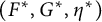 $(F^*,G^*,\eta ^*)$
with
$(F^*,G^*,\eta ^*)$
with  a double functor,
  a normal pseudo double functor such that
  , and
, and  a horizontal pseudo-natural transformation. This shows that $F^*$
is a horizontal biequivalence in the sense of [Reference RasekhMSV23b, Definition 8.8], and so a double biequivalence by [Reference RasekhMSV23b, Proposition 8.11].
$F^*$
is a horizontal biequivalence in the sense of [Reference RasekhMSV23b, Definition 8.8], and so a double biequivalence by [Reference RasekhMSV23b, Proposition 8.11].
Lemma 4.23 Given $2$
-categories
$2$
-categories ${\mathcal {J}}$
and
${\mathcal {J}}$
and ${\mathcal {C}}$
, the double functor
${\mathcal {C}}$
, the double functor

induced by the canonical inclusion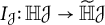 $I_{\mathcal {J}}\colon {{\mathbb {H}}}{\mathcal {J}}\to \widetilde {{\mathbb {H}}} {\mathcal {J}}$
is a double biequivalence.
$I_{\mathcal {J}}\colon {{\mathbb {H}}}{\mathcal {J}}\to \widetilde {{\mathbb {H}}} {\mathcal {J}}$
is a double biequivalence.
Proof Recall from Proposition 4.9 that the inclusion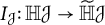 $I_{\mathcal {J}}\colon {{\mathbb {H}}}{\mathcal {J}}\to \widetilde {{\mathbb {H}}} {\mathcal {J}}$
is a double biequivalence. We factor
$I_{\mathcal {J}}\colon {{\mathbb {H}}}{\mathcal {J}}\to \widetilde {{\mathbb {H}}} {\mathcal {J}}$
is a double biequivalence. We factor $I_{\mathcal {J}}$
as a trivial cofibration followed by a trivial fibration in
$I_{\mathcal {J}}$
as a trivial cofibration followed by a trivial fibration in $Dbl{\mathcal {C}}\!\textit {at}_{\mathrm {whi}}$

By applying the functor  , we get a factorization of $I_{\mathcal {J}}^*$

where the left-hand double functor is a trivial fibration in $Dbl{\mathcal {C}}\!\textit {at}_{\mathrm {whi}}$
by Theorem 4.11, and the right-hand one is a double biequivalence by Lemma 4.22. This shows that
$Dbl{\mathcal {C}}\!\textit {at}_{\mathrm {whi}}$
by Theorem 4.11, and the right-hand one is a double biequivalence by Lemma 4.22. This shows that $I_{\mathcal {J}}^*$
is a weak equivalence in
$I_{\mathcal {J}}^*$
is a weak equivalence in $Dbl{\mathcal {C}}\!\textit {at}_{\mathrm {whi}}$
and so a double biequivalence as all objects involved are weakly horizontally invariant by Lemma 4.21.
$Dbl{\mathcal {C}}\!\textit {at}_{\mathrm {whi}}$
and so a double biequivalence as all objects involved are weakly horizontally invariant by Lemma 4.21.
We now turn to the proof of Theorem 4.19. For this, we start by studying the cone constructions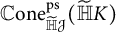 ${\mathbb {C}}\mathrm {one}^{\mathrm {ps}}_{\widetilde {{\mathbb {H}}} {\mathcal {J}}}(\widetilde {{\mathbb {H}}} K)$
and
${\mathbb {C}}\mathrm {one}^{\mathrm {ps}}_{\widetilde {{\mathbb {H}}} {\mathcal {J}}}(\widetilde {{\mathbb {H}}} K)$
and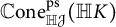 ${\mathbb {C}}\mathrm {one}^{\mathrm {ps}}_{{\mathbb {H}} {\mathcal {J}}}({\mathbb {H}} K)$
and see how they are related. First, we modify
${\mathbb {C}}\mathrm {one}^{\mathrm {ps}}_{{\mathbb {H}} {\mathcal {J}}}({\mathbb {H}} K)$
and see how they are related. First, we modify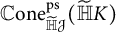 ${\mathbb {C}}\mathrm {one}^{\mathrm {ps}}_{\widetilde {{\mathbb {H}}} {\mathcal {J}}}(\widetilde {{\mathbb {H}}} K)$
by precomposing the diagram
${\mathbb {C}}\mathrm {one}^{\mathrm {ps}}_{\widetilde {{\mathbb {H}}} {\mathcal {J}}}(\widetilde {{\mathbb {H}}} K)$
by precomposing the diagram $\widetilde {{\mathbb {H}}} K$
with the canonical inclusion
$\widetilde {{\mathbb {H}}} K$
with the canonical inclusion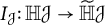 $I_{\mathcal {J}}\colon {\mathbb {H}} {\mathcal {J}}\to \widetilde {{\mathbb {H}}} {\mathcal {J}}$
.
$I_{\mathcal {J}}\colon {\mathbb {H}} {\mathcal {J}}\to \widetilde {{\mathbb {H}}} {\mathcal {J}}$
.
Notation 4.24 Given a double functor $K\colon {\mathbb {J}}\to {\mathbb {D}}$
, let
$K\colon {\mathbb {J}}\to {\mathbb {D}}$
, let ${\mathbb {C}}\mathrm {one}^{\mathrm {ps}}_{{\mathbb {J}}}(K)$
denote the pullback in
${\mathbb {C}}\mathrm {one}^{\mathrm {ps}}_{{\mathbb {J}}}(K)$
denote the pullback in $Dbl{\mathcal {C}}\!\textit {at}$

Proposition 4.25 Given a $2$
-diagram
$2$
-diagram $K\colon {\mathcal {J}}\to {\mathcal {C}}$
, the double functor
$K\colon {\mathcal {J}}\to {\mathcal {C}}$
, the double functor
 $$\begin{align*}{\mathbb{C}}\mathrm{one}^{\mathrm{ps}}_{\widetilde{{\mathbb{H}}} {\mathcal{J}}}(\widetilde{{\mathbb{H}}} K)\longrightarrow {\mathbb{C}}\mathrm{one}^{\mathrm{ps}}_{{\mathbb{H}} {\mathcal{J}}}(\widetilde{{\mathbb{H}}} K\circ I_{\mathcal{J}}) \end{align*}$$
induced by the canonical inclusion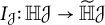 $I_{\mathcal {J}}\colon {{\mathbb {H}}}{\mathcal {J}}\to \widetilde {{\mathbb {H}}} {\mathcal {J}}$
is a double biequivalence between weakly horizontally invariant double categories.
$I_{\mathcal {J}}\colon {{\mathbb {H}}}{\mathcal {J}}\to \widetilde {{\mathbb {H}}} {\mathcal {J}}$
is a double biequivalence between weakly horizontally invariant double categories.
Proof We have, by definition, a pullback in the model category $Dbl{\mathcal {C}}\!\textit {at}_{\mathrm {whi}}$

On the other hand, using Lemma 4.21, we have, by definition, a pullback in the model category $Dbl{\mathcal {C}}\!\textit {at}_{\mathrm {whi}}$

Using Lemma 4.23, there is a natural comparison map between the two cospans defining the above pullbacks in $Dbl{\mathcal {C}}\!\textit {at}_{\mathrm {whi}}$
, which is levelwise a double biequivalence. Hence, it induces a unique map between the two weakly horizontally invariant double categories presenting the pullback
$Dbl{\mathcal {C}}\!\textit {at}_{\mathrm {whi}}$
, which is levelwise a double biequivalence. Hence, it induces a unique map between the two weakly horizontally invariant double categories presenting the pullback
 $$\begin{align*}{\mathbb{C}}\mathrm{one}^{\mathrm{ps}}_{\widetilde{{\mathbb{H}}} {\mathcal{J}}}(\widetilde{{\mathbb{H}}} K)\longrightarrow {\mathbb{C}}\mathrm{one}^{\mathrm{ps}}_{{\mathbb{H}} {\mathcal{J}}}(\widetilde{{\mathbb{H}}} K\circ I_{\mathcal{J}}) \end{align*}$$
and this double functor is a double biequivalence, as desired.
Next, we modify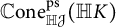 ${\mathbb {C}}\mathrm {one}^{\mathrm {ps}}_{{\mathbb {H}} {\mathcal {J}}}({{\mathbb {H}}} K)$
by postcomposing the diagram
${\mathbb {C}}\mathrm {one}^{\mathrm {ps}}_{{\mathbb {H}} {\mathcal {J}}}({{\mathbb {H}}} K)$
by postcomposing the diagram ${\mathbb {H}} K$
with the canonical inclusion
${\mathbb {H}} K$
with the canonical inclusion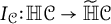 $I_{\mathcal {C}}\colon {\mathbb {H}} {\mathcal {C}}\to \widetilde {{\mathbb {H}}} {\mathcal {C}}$
. First, notice the following link with the preceding result.
$I_{\mathcal {C}}\colon {\mathbb {H}} {\mathcal {C}}\to \widetilde {{\mathbb {H}}} {\mathcal {C}}$
. First, notice the following link with the preceding result.
Remark 4.26 Given a $2$
-diagram
$2$
-diagram $K\colon {\mathcal {J}}\to {\mathcal {C}}$
, we have the relation
$K\colon {\mathcal {J}}\to {\mathcal {C}}$
, we have the relation
 $$\begin{align*}\widetilde{{\mathbb{H}}} K\circ I_{\mathcal{J}}=I_{\mathcal{C}}\circ {{\mathbb{H}}} K, \end{align*}$$
where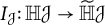 $I_{\mathcal {J}}\colon {\mathbb {H}} {\mathcal {J}}\to \widetilde {{\mathbb {H}}} {\mathcal {J}}$
and
$I_{\mathcal {J}}\colon {\mathbb {H}} {\mathcal {J}}\to \widetilde {{\mathbb {H}}} {\mathcal {J}}$
and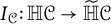 $I_{\mathcal {C}}\colon {\mathbb {H}} {\mathcal {C}}\to \widetilde {{\mathbb {H}}} {\mathcal {C}}$
denote the canonical inclusions. In particular, we have that
$I_{\mathcal {C}}\colon {\mathbb {H}} {\mathcal {C}}\to \widetilde {{\mathbb {H}}} {\mathcal {C}}$
denote the canonical inclusions. In particular, we have that
 $$\begin{align*}{\mathbb{C}}\mathrm{one}^{\mathrm{ps}}_{{\mathbb{H}} {\mathcal{J}}}(\widetilde{{\mathbb{H}}} K\circ I_{\mathcal{J}})={\mathbb{C}}\mathrm{one}^{\mathrm{ps}}_{{{\mathbb{H}}}{\mathcal{J}}}(I_{\mathcal{C}}\circ {{\mathbb{H}}} K). \end{align*}$$
Proposition 4.27 Given a $2$
-diagram
$2$
-diagram $K\colon {\mathcal {J}}\to {\mathcal {C}}$
, the double functor
$K\colon {\mathcal {J}}\to {\mathcal {C}}$
, the double functor
 $$\begin{align*}{\mathbb{C}}\mathrm{one}^{\mathrm{ps}}_{{\mathbb{H}} {\mathcal{J}}}({{\mathbb{H}}} K)\longrightarrow {\mathbb{C}}\mathrm{one}^{\mathrm{ps}}_{{{\mathbb{H}}}{\mathcal{J}}}(I_{\mathcal{C}}\circ {{\mathbb{H}}} K) \end{align*}$$
induced by the canonical inclusion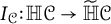 $I_{\mathcal {C}}\colon {{\mathbb {H}}}{\mathcal {C}}\to \widetilde {{\mathbb {H}}} {\mathcal {C}}$
is a double biequivalence.
$I_{\mathcal {C}}\colon {{\mathbb {H}}}{\mathcal {C}}\to \widetilde {{\mathbb {H}}} {\mathcal {C}}$
is a double biequivalence.
This result is less formal as the double category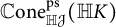 ${\mathbb {C}}\mathrm {one}^{\mathrm {ps}}_{{\mathbb {H}} {\mathcal {J}}}({{\mathbb {H}}} K)$
is not necessarily weakly horizontally invariant. Hence, to show this result, we first prove some auxiliary lemmas. We start by introducing a
${\mathbb {C}}\mathrm {one}^{\mathrm {ps}}_{{\mathbb {H}} {\mathcal {J}}}({{\mathbb {H}}} K)$
is not necessarily weakly horizontally invariant. Hence, to show this result, we first prove some auxiliary lemmas. We start by introducing a $2$
-categorical analog of the cone construction.
$2$
-categorical analog of the cone construction.
Notation 4.28 Given a $2$
-functor
$2$
-functor $K\colon {\mathcal {J}}\to {\mathcal {C}}$
, the
$K\colon {\mathcal {J}}\to {\mathcal {C}}$
, the $2$
-category
$2$
-category ${\mathcal {C}}\mathrm {one}^{\mathrm {ps}}_{{\mathcal {J}}}(K)$
of pseudo-cones over K is the following pullback in
${\mathcal {C}}\mathrm {one}^{\mathrm {ps}}_{{\mathcal {J}}}(K)$
of pseudo-cones over K is the following pullback in $2{\mathcal {C}}\!\textit {at}$
:
$2{\mathcal {C}}\!\textit {at}$
:

Next, we study the compatibility of the functors  with the cone constructions.
Lemma 4.29 Given a $2$
-category
$2$
-category ${\mathcal {J}}$
and a double functor
${\mathcal {J}}$
and a double functor $K\colon {\mathbb {H}} {\mathcal {J}}\to {\mathbb {D}}$
, there is a
$K\colon {\mathbb {H}} {\mathcal {J}}\to {\mathbb {D}}$
, there is a $2$
-isomorphism
$2$
-isomorphism
 $$\begin{align*}{\boldsymbol{\rm{H}}} {\mathbb{C}}\mathrm{one}^{\mathrm{ps}}_{{\mathbb{H}} {\mathcal{J}}} K\cong {\mathcal{C}}\mathrm{one}^{\mathrm{ps}}_{{\mathcal{J}}}(K^\sharp), \end{align*}$$
where $K^\sharp \colon {\mathcal {J}}\to {\textbf {H}} {\mathbb {D}}$
is the
$K^\sharp \colon {\mathcal {J}}\to {\textbf {H}} {\mathbb {D}}$
is the $2$
-functor corresponding to K under the adjunction
$2$
-functor corresponding to K under the adjunction ${\mathbb {H}} \dashv {\textbf {H}} $
.
${\mathbb {H}} \dashv {\textbf {H}} $
.
Proof By applying the limit-preserving functor ${\textbf {H}} $
to the pullback in
${\textbf {H}} $
to the pullback in $Dbl{\mathcal {C}}\!\textit {at}$
from Notation 4.24 applied to
$Dbl{\mathcal {C}}\!\textit {at}$
from Notation 4.24 applied to $K\colon {\mathbb {H}} {\mathcal {J}}\to {\mathbb {D}}$
, we get the following pullback diagram in
$K\colon {\mathbb {H}} {\mathcal {J}}\to {\mathbb {D}}$
, we get the following pullback diagram in $2{\mathcal {C}}\!\textit {at}$
:
$2{\mathcal {C}}\!\textit {at}$
:

We can then compute the top and bottom right-hand $2$
-categories as follows. By [Reference Moser, Sarazola and VerdugoMSV22, Lemma 2.14], there is a natural
$2$
-categories as follows. By [Reference Moser, Sarazola and VerdugoMSV22, Lemma 2.14], there is a natural $2$
-isomorphism
$2$
-isomorphism

Next, there are also natural $2$
-isomorphisms
$2$
-isomorphisms

Hence, the above pullback square in $2{\mathcal {C}}\!\textit {at}$
becomes
$2{\mathcal {C}}\!\textit {at}$
becomes

But, by Notation 4.28, this pullback is exactly ${\mathcal {C}}\mathrm {one}^{\mathrm {ps}}_{{\mathcal {J}}}(K^\sharp )$
.
${\mathcal {C}}\mathrm {one}^{\mathrm {ps}}_{{\mathcal {J}}}(K^\sharp )$
.
Lemma 4.30 Given a $2$
-category
$2$
-category ${\mathcal {J}}$
and a double functor
${\mathcal {J}}$
and a double functor $K\colon {\mathbb {H}} {\mathcal {J}}\to {\mathbb {D}}$
, there is a
$K\colon {\mathbb {H}} {\mathcal {J}}\to {\mathbb {D}}$
, there is a $2$
-isomorphism
$2$
-isomorphism

where  is the double functor induced by the unique map ${\mathbb {V}}[1]\to [0]$
.
${\mathbb {V}}[1]\to [0]$
.
Proof By applying the limit-preserving functor  to the pullback in $Dbl{\mathcal {C}}\!\textit {at}$
from Notation 4.24 applied to
$Dbl{\mathcal {C}}\!\textit {at}$
from Notation 4.24 applied to $K\colon {\mathbb {H}} {\mathcal {J}}\to {\mathbb {D}}$
, we get the following pullback diagram in
$K\colon {\mathbb {H}} {\mathcal {J}}\to {\mathbb {D}}$
, we get the following pullback diagram in $2{\mathcal {C}}\!\textit {at}$
:
$2{\mathcal {C}}\!\textit {at}$
:

where $e_K$
denotes the vertical identity at K. We can then compute the top and bottom right-hand
$e_K$
denotes the vertical identity at K. We can then compute the top and bottom right-hand $2$
-categories as follows. By [Reference Moser, Sarazola and VerdugoMSV22, Lemma 2.14], there is a natural
$2$
-categories as follows. By [Reference Moser, Sarazola and VerdugoMSV22, Lemma 2.14], there is a natural $2$
-isomorphism
$2$
-isomorphism

and we also have natural $2$
-isomorphisms
$2$
-isomorphisms

Hence, the above pullback square in $2{\mathcal {C}}\!\textit {at}$
becomes
$2{\mathcal {C}}\!\textit {at}$
becomes

But, by Notation 4.28, this pullback is exactly ${\mathcal {C}}\mathrm {one}^{\mathrm {ps}}_{{\mathcal {J}}}({\textbf {H}} E_{\mathbb {D}}\circ K^\sharp )$
.
${\mathcal {C}}\mathrm {one}^{\mathrm {ps}}_{{\mathcal {J}}}({\textbf {H}} E_{\mathbb {D}}\circ K^\sharp )$
.
We can now prove the proposition.
Proof of Proposition 4.27
We need to show that applying the functors ${\textbf {H}} $
and
${\textbf {H}} $
and  to the double functor
 $$\begin{align*}{\mathbb{C}}\mathrm{one}^{\mathrm{ps}}_{{\mathbb{H}} {\mathcal{J}}}({{\mathbb{H}}} K)\to {\mathbb{C}}\mathrm{one}^{\mathrm{ps}}_{{{\mathbb{H}}}{\mathcal{J}}}(I_{\mathcal{C}}\circ {{\mathbb{H}}} K) \end{align*}$$
yield two biequivalences.
First, note that ${\textbf {H}} {\mathbb {H}} {\mathcal {C}}={\mathcal {C}}={\textbf {H}} \widetilde {{\mathbb {H}}} {\mathcal {C}}$
so that we have
${\textbf {H}} {\mathbb {H}} {\mathcal {C}}={\mathcal {C}}={\textbf {H}} \widetilde {{\mathbb {H}}} {\mathcal {C}}$
so that we have
 $$\begin{align*}({\mathbb{H}} K)^\sharp=K=(I_{\mathcal{C}}\circ {\mathbb{H}} K)^\sharp.\end{align*}$$
Hence, by Lemma 4.29, we have $2$
-isomorphisms
$2$
-isomorphisms
 $$\begin{align*}{\boldsymbol{\rm{H}}} {\mathbb{C}}\mathrm{one}^{\mathrm{ps}}_{{\mathbb{H}} {\mathcal{J}}}({{\mathbb{H}}} K)\cong {\mathcal{C}}\mathrm{one}^{\mathrm{ps}}_{{\mathcal{J}}}(K)\cong {\boldsymbol{\rm{H}}} {\mathbb{C}}\mathrm{one}^{\mathrm{ps}}_{{{\mathbb{H}}}{\mathcal{J}}}(I_{\mathcal{C}}\circ {{\mathbb{H}}} K) \end{align*}$$
and so the $2$
-functor
$2$
-functor ${\textbf {H}} {\mathbb {C}}\mathrm {one}^{\mathrm {ps}}_{{\mathbb {H}} {\mathcal {J}}}({{\mathbb {H}}} K)\to {\textbf {H}} {\mathbb {C}}\mathrm {one}^{\mathrm {ps}}_{{{\mathbb {H}}}{\mathcal {J}}}(I_{\mathcal {C}}\circ {{\mathbb {H}}} K)$
is a
${\textbf {H}} {\mathbb {C}}\mathrm {one}^{\mathrm {ps}}_{{\mathbb {H}} {\mathcal {J}}}({{\mathbb {H}}} K)\to {\textbf {H}} {\mathbb {C}}\mathrm {one}^{\mathrm {ps}}_{{{\mathbb {H}}}{\mathcal {J}}}(I_{\mathcal {C}}\circ {{\mathbb {H}}} K)$
is a $2$
-isomorphism and hence a biequivalence.
$2$
-isomorphism and hence a biequivalence.
Now, by Lemma 4.30, we have that the $2$
-functor
$2$
-functor

is given by the $2$
-functor
$2$
-functor
 $$\begin{align*}{\mathcal{C}}\mathrm{one}^{\mathrm{ps}}_{{\mathcal{J}}}({\boldsymbol{\rm{H}}} E_{{\mathbb{H}} {\mathcal{C}}} \circ K)\to {\mathcal{C}}\mathrm{one}^{\mathrm{ps}}_{{\mathcal{J}}}({\boldsymbol{\rm{H}}} E_{\widetilde{{\mathbb{H}}} {\mathcal{C}}}\circ K). \end{align*}$$
Since ${\textbf {H}} E_{\widetilde {{\mathbb {H}}} {\mathcal {C}}}$
can be seen as the composite of
${\textbf {H}} E_{\widetilde {{\mathbb {H}}} {\mathcal {C}}}$
can be seen as the composite of $2$
-functors
$2$
-functors

the above $2$
-functor corresponds to the
$2$
-functor corresponds to the $2$
-functor
$2$
-functor

induced by  . As
. As $I_{\mathcal {C}}$
is a double biequivalence by Proposition 4.9,
$I_{\mathcal {C}}$
is a double biequivalence by Proposition 4.9,  is a biequivalence. Hence,

is a biequivalence since the two spans defining these pullbacks are levelwise equivalent, and the pullbacks are in fact homotopy pullbacks as every $2$
-category is fibrant.
$2$
-category is fibrant.
We now study the slice constructions of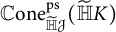 ${\mathbb {C}}\mathrm {one}^{\mathrm {ps}}_{\widetilde {{\mathbb {H}}} {\mathcal {J}}}(\widetilde {{\mathbb {H}}} K)$
and
${\mathbb {C}}\mathrm {one}^{\mathrm {ps}}_{\widetilde {{\mathbb {H}}} {\mathcal {J}}}(\widetilde {{\mathbb {H}}} K)$
and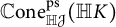 ${\mathbb {C}}\mathrm {one}^{\mathrm {ps}}_{{\mathbb {H}} {\mathcal {J}}}({\mathbb {H}} K)$
over an object
${\mathbb {C}}\mathrm {one}^{\mathrm {ps}}_{{\mathbb {H}} {\mathcal {J}}}({\mathbb {H}} K)$
over an object $(\ell ,\lambda )$
. We first modify
$(\ell ,\lambda )$
. We first modify  as before.
Proposition 4.31 Given a $2$
-diagram
$2$
-diagram $K\colon {\mathcal {J}}\to {\mathcal {C}}$
, the double functor between slices over
$K\colon {\mathcal {J}}\to {\mathcal {C}}$
, the double functor between slices over $(\ell ,\lambda )$
induced by the double functor from Proposition 4.25 is a double biequivalence, and fits into a commutative diagram of the following form:
$(\ell ,\lambda )$
induced by the double functor from Proposition 4.25 is a double biequivalence, and fits into a commutative diagram of the following form:

Proof This follows from Proposition 4.25.
Next, we modify  as before.
Proposition 4.32 Given a $2$
-diagram
$2$
-diagram $K\colon {\mathcal {J}}\to {\mathcal {C}}$
, the double functor between slices over
$K\colon {\mathcal {J}}\to {\mathcal {C}}$
, the double functor between slices over $(\ell ,\lambda )$
induced by the double functor from Proposition 4.27 is a double biequivalence, and fits into a commutative diagram of the following form:
$(\ell ,\lambda )$
induced by the double functor from Proposition 4.27 is a double biequivalence, and fits into a commutative diagram of the following form:

This result is again less formal as the double category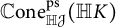 ${\mathbb {C}}\mathrm {one}^{\mathrm {ps}}_{{\mathbb {H}} {\mathcal {J}}}({\mathbb {H}} K)$
is not necessarily weakly horizontally invariant. As before, we start by introducing a
${\mathbb {C}}\mathrm {one}^{\mathrm {ps}}_{{\mathbb {H}} {\mathcal {J}}}({\mathbb {H}} K)$
is not necessarily weakly horizontally invariant. As before, we start by introducing a $2$
-categorical analog of the slice construction.
$2$
-categorical analog of the slice construction.
Notation 4.33 Given a $2$
-category
$2$
-category ${\mathcal {C}}$
and an object c of
${\mathcal {C}}$
and an object c of ${\mathcal {C}}$
, the pseudo-slice
${\mathcal {C}}$
, the pseudo-slice $2$
-category
$2$
-category  of
of ${\mathcal {C}}$
over c is the following pullback in
${\mathcal {C}}$
over c is the following pullback in $2{\mathcal {C}}\!\textit {at}$
:
$2{\mathcal {C}}\!\textit {at}$
:

Next, we study the compatibility of the functors  with the slice constructions.
Lemma 4.34 Given a double category ${\mathbb {D}}$
and an object d of
${\mathbb {D}}$
and an object d of ${\mathbb {D}}$
, there are
${\mathbb {D}}$
, there are $2$
-isomorphism
$2$
-isomorphism

where $e_d$
denotes the vertical identity at d.
$e_d$
denotes the vertical identity at d.
Proof Note that, by considering an object d of a double category ${\mathbb {D}}$
as a diagram
${\mathbb {D}}$
as a diagram $d\colon {\mathbb {H}} [0]\to {\mathbb {D}}$
, we have an isomorphism in
$d\colon {\mathbb {H}} [0]\to {\mathbb {D}}$
, we have an isomorphism in $Dbl{\mathcal {C}}\!\textit {at}$

and, by considering an object c of ${\mathcal {C}}$
as a
${\mathcal {C}}$
as a $2$
-diagram
$2$
-diagram $c\colon [0]\to {\mathcal {C}}$
, we have a
$c\colon [0]\to {\mathcal {C}}$
, we have a $2$
-isomorphism
$2$
-isomorphism

The result is then obtained by specializing Lemmas 4.29 and 4.30 to the case ${K=d\colon {\mathbb {H}} [0]\to {\mathbb {D}}}$
.
${K=d\colon {\mathbb {H}} [0]\to {\mathbb {D}}}$
.
We can now prove the proposition.
Proof of Proposition 4.32
We need to show that applying the functors ${\textbf {H}} $
and
${\textbf {H}} $
and  to the double functor

yields two biequivalences.
First, by Lemma 4.34, we have that the $2$
-functor
$2$
-functor

is given by the $2$
-functor
$2$
-functor

Since the $2$
-functor
$2$
-functor ${\textbf {H}} {\mathbb {C}}\mathrm {one}^{\mathrm {ps}}_{{\mathbb {H}} {\mathcal {J}}}({{\mathbb {H}}} K)\to {\textbf {H}} {\mathbb {C}}\mathrm {one}^{\mathrm {ps}}_{{{\mathbb {H}}}{\mathcal {J}}}(I_{\mathcal {C}}\circ {{\mathbb {H}}} K)$
is a biequivalence by Proposition 4.27, so is the above
${\textbf {H}} {\mathbb {C}}\mathrm {one}^{\mathrm {ps}}_{{\mathbb {H}} {\mathcal {J}}}({{\mathbb {H}}} K)\to {\textbf {H}} {\mathbb {C}}\mathrm {one}^{\mathrm {ps}}_{{{\mathbb {H}}}{\mathcal {J}}}(I_{\mathcal {C}}\circ {{\mathbb {H}}} K)$
is a biequivalence by Proposition 4.27, so is the above $2$
-functor between slices.
$2$
-functor between slices.
Now, by Lemma 4.34, we have that the $2$
-functor
$2$
-functor

is given by the $2$
-functor
$2$
-functor

Since the $2$
-functor
$2$
-functor  is a biequivalence by Proposition 4.27, so is the above $2$
-functor between slices.
$2$
-functor between slices.
We can now prove the desired characterization of homotopy $2$
-limits.
$2$
-limits.
Proof of Theorem 4.19
Combining Propositions 4.31 and 4.32, there are zig-zags of double biequivalences fitting into a commutative diagram of the following form:

where $F=I_{\mathcal {C}}\circ {{\mathbb {H}}} K=\widetilde {{\mathbb {H}}} K\circ I_{\mathcal {J}}\colon {\mathbb {H}} {\mathcal {J}}\to \widetilde {{\mathbb {H}}} {\mathcal {C}}$
using Remark 4.26. Hence, by
$F=I_{\mathcal {C}}\circ {{\mathbb {H}}} K=\widetilde {{\mathbb {H}}} K\circ I_{\mathcal {J}}\colon {\mathbb {H}} {\mathcal {J}}\to \widetilde {{\mathbb {H}}} {\mathcal {C}}$
using Remark 4.26. Hence, by $2$
-out-of-
$2$
-out-of- $3$
, the double functor
$3$
, the double functor

is a double biequivalence if and only if the double functor

is a double biequivalence. Hence, the desired result follows from Theorem 4.20.
4.3 Properties of double
$(\infty ,1)$
-nerve of double categories

In this section, we provide proofs for the properties of the nerve
 $$\begin{align*}{\mathbb{N}}\colon [Dbl{\mathcal{C}}\!\textit{at}]_\infty\to DblCat_{(\infty,1)} \end{align*}$$
stated in Proposition 3.10. Consider the adjunction
 $$\begin{align*}{\mathbb{C}}\colon \textit{s}{\mathcal{S}}\!\textit{et}^{\Delta^{\operatorname{\mathrm{op}}}\times\Delta^{\operatorname{\mathrm{op}}}} \rightleftarrows Dbl{\mathcal{C}}\!\textit{at} \colon{\mathbb{N}}\end{align*}$$
constructed in [Reference MoserMos20, Section 5.1].
Notation 4.35 We denote by $\textit {s}{\mathcal {S}}\!\textit {et}^{\Delta ^{\operatorname {\mathrm {op}}}\times \Delta ^{\operatorname {\mathrm {op}}}}_{\mathrm {dbl}(\infty ,1)}$
the model structure on the category
$\textit {s}{\mathcal {S}}\!\textit {et}^{\Delta ^{\operatorname {\mathrm {op}}}\times \Delta ^{\operatorname {\mathrm {op}}}}_{\mathrm {dbl}(\infty ,1)}$
the model structure on the category $\textit {s}{\mathcal {S}}\!\textit {et}^{\Delta ^{\operatorname {\mathrm {op}}}\times \Delta ^{\operatorname {\mathrm {op}}}}$
for Segal objects in complete Segal spaces. It follows from [Reference Barwick and Schommer-PriesBSP21, Theorem 13.15] and the definition of
$\textit {s}{\mathcal {S}}\!\textit {et}^{\Delta ^{\operatorname {\mathrm {op}}}\times \Delta ^{\operatorname {\mathrm {op}}}}$
for Segal objects in complete Segal spaces. It follows from [Reference Barwick and Schommer-PriesBSP21, Theorem 13.15] and the definition of $Dbl{\mathcal {C}}\!\textit {at}_{(\infty ,1)}$
as the
$Dbl{\mathcal {C}}\!\textit {at}_{(\infty ,1)}$
as the $\infty $
-category of Segal objects in
$\infty $
-category of Segal objects in $Cat_{(\infty ,1)}$
that there is an equivalence between the underlying
$Cat_{(\infty ,1)}$
that there is an equivalence between the underlying $\infty $
-category of
$\infty $
-category of $\textit {s}{\mathcal {S}}\!\textit {et}^{\Delta ^{\operatorname {\mathrm {op}}}\times \Delta ^{\operatorname {\mathrm {op}}}}_{\mathrm {dbl}(\infty ,1)}$
and
$\textit {s}{\mathcal {S}}\!\textit {et}^{\Delta ^{\operatorname {\mathrm {op}}}\times \Delta ^{\operatorname {\mathrm {op}}}}_{\mathrm {dbl}(\infty ,1)}$
and $Dbl{\mathcal {C}}\!\textit {at}_{(\infty ,1)}$
.
$Dbl{\mathcal {C}}\!\textit {at}_{(\infty ,1)}$
.
The adjunction ${\mathbb {C}}\dashv {\mathbb {N}}$
has the following homotopical properties.
${\mathbb {C}}\dashv {\mathbb {N}}$
has the following homotopical properties.
Theorem 4.36 [Reference MoserMos20, Theorems 5.2.8, 5.3.1, and 6.6.1]
The adjunction
 $$\begin{align*}{\mathbb{C}}\colon \textit{s}{\mathcal{S}}\!\textit{et}^{\Delta^{\operatorname{\mathrm{op}}}\times\Delta^{\operatorname{\mathrm{op}}}}_{\mathrm{dbl}(\infty,1)}\rightleftarrows Dbl{\mathcal{C}}\!\textit{at}_{\mathrm{whi}}\colon{\mathbb{N}}\end{align*}$$
-
(1) is a Quillen pair;
-
(2) is a Quillen localization pair, that is, the derived counit is a weak equivalence in
$Dbl{\mathcal {C}}\!\textit {at}_{\mathrm {whi}}$
.

Moreover, we have that
-
(3) for every
$2$
-category
${\mathcal {C}}$
, the nerve
${\mathbb {N}}\widetilde {{\mathbb {H}}}{\mathcal {C}}$
is a two-fold complete Segal space, that is, an
$(\infty ,2)$
-category.


Recall that the nerve ${\mathbb {N}}\colon [Dbl{\mathcal {C}}\!\textit {at}]_\infty \to Dbl{\mathcal {C}}\!\textit {at}_{(\infty ,1)}$
from Notation 3.9 is, by definition, the composite of the induced functor between underlying
${\mathbb {N}}\colon [Dbl{\mathcal {C}}\!\textit {at}]_\infty \to Dbl{\mathcal {C}}\!\textit {at}_{(\infty ,1)}$
from Notation 3.9 is, by definition, the composite of the induced functor between underlying $\infty $
-categories by
$\infty $
-categories by ${\mathbb {N}}\colon Dbl{\mathcal {C}}\!\textit {at}_{\mathrm {whi}}\to \textit {s}{\mathcal {S}}\!\textit {et}^{\Delta ^{\operatorname {\mathrm {op}}}\times \Delta ^{\operatorname {\mathrm {op}}}}_{\mathrm {dbl}(\infty ,1)}$
followed by the equivalence of the underlying
${\mathbb {N}}\colon Dbl{\mathcal {C}}\!\textit {at}_{\mathrm {whi}}\to \textit {s}{\mathcal {S}}\!\textit {et}^{\Delta ^{\operatorname {\mathrm {op}}}\times \Delta ^{\operatorname {\mathrm {op}}}}_{\mathrm {dbl}(\infty ,1)}$
followed by the equivalence of the underlying $\infty $
-category of
$\infty $
-category of $\textit {s}{\mathcal {S}}\!\textit {et}^{\Delta ^{\operatorname {\mathrm {op}}}\times \Delta ^{\operatorname {\mathrm {op}}}}_{\mathrm {dbl}(\infty ,1)}$
and
$\textit {s}{\mathcal {S}}\!\textit {et}^{\Delta ^{\operatorname {\mathrm {op}}}\times \Delta ^{\operatorname {\mathrm {op}}}}_{\mathrm {dbl}(\infty ,1)}$
and $Dbl{\mathcal {C}}\!\textit {at}_{(\infty ,1)}$
. Hence, the results (1)–(3) of Proposition 3.10 are now formal consequences of the above result.
$Dbl{\mathcal {C}}\!\textit {at}_{(\infty ,1)}$
. Hence, the results (1)–(3) of Proposition 3.10 are now formal consequences of the above result.
It remains to show (4) of Proposition 3.10. For this, we first study the compatibility of the functor
 $$\begin{align*}{\mathbb{C}}\colon \textit{s}{\mathcal{S}}\!\textit{et}^{\Delta^{\operatorname{\mathrm{op}}}\times\Delta^{\operatorname{\mathrm{op}}}}_{\mathrm{dbl}(\infty,1)}\longrightarrow Dbl{\mathcal{C}}\!\textit{at}_{\mathrm{whi}} \end{align*}$$
with the monoidal structures on both sides. We can restrict the verification to objects in the image of the canonical inclusion ${\mathcal {S}}\!\textit {et}^{\Delta ^{\operatorname {\mathrm {op}}}\times \Delta ^{\operatorname {\mathrm {op}}}}\hookrightarrow \textit {s}{\mathcal {S}}\!\textit {et}^{\Delta ^{\operatorname {\mathrm {op}}}\times \Delta ^{\operatorname {\mathrm {op}}}}$
since the functor
${\mathcal {S}}\!\textit {et}^{\Delta ^{\operatorname {\mathrm {op}}}\times \Delta ^{\operatorname {\mathrm {op}}}}\hookrightarrow \textit {s}{\mathcal {S}}\!\textit {et}^{\Delta ^{\operatorname {\mathrm {op}}}\times \Delta ^{\operatorname {\mathrm {op}}}}$
since the functor ${\mathbb {C}}\colon \textit {s}{\mathcal {S}}\!\textit {et}^{\Delta ^{\operatorname {\mathrm {op}}}\times \Delta ^{\operatorname {\mathrm {op}}}}\to Dbl{\mathcal {C}}\!\textit {at}$
is a simplicial left Kan extension, where
${\mathbb {C}}\colon \textit {s}{\mathcal {S}}\!\textit {et}^{\Delta ^{\operatorname {\mathrm {op}}}\times \Delta ^{\operatorname {\mathrm {op}}}}\to Dbl{\mathcal {C}}\!\textit {at}$
is a simplicial left Kan extension, where $Dbl{\mathcal {C}}\!\textit {at}$
is tensored over
$Dbl{\mathcal {C}}\!\textit {at}$
is tensored over $\textit {s}{\mathcal {S}}\!\textit {et}$
via the functor
$\textit {s}{\mathcal {S}}\!\textit {et}$
via the functor $-\boxtimes ^{\mathrm {ps}} {\mathbb {C}} K$
, for every
$-\boxtimes ^{\mathrm {ps}} {\mathbb {C}} K$
, for every $K\in \textit {s}{\mathcal {S}}\!\textit {et}$
, seen as a bisimplicial space through the canonical inclusion
$K\in \textit {s}{\mathcal {S}}\!\textit {et}$
, seen as a bisimplicial space through the canonical inclusion $\textit {s}{\mathcal {S}}\!\textit {et}\hookrightarrow \textit {s}{\mathcal {S}}\!\textit {et}^{\Delta ^{\operatorname {\mathrm {op}}}\times \Delta ^{\operatorname {\mathrm {op}}}}$
.
$\textit {s}{\mathcal {S}}\!\textit {et}\hookrightarrow \textit {s}{\mathcal {S}}\!\textit {et}^{\Delta ^{\operatorname {\mathrm {op}}}\times \Delta ^{\operatorname {\mathrm {op}}}}$
.
Hence, given bisimplicial sets X and Y, that is, objects in ${\mathcal {S}}\!\textit {et}^{\Delta ^{\operatorname {\mathrm {op}}}\times \Delta ^{\operatorname {\mathrm {op}}}}$
regarded as bisimplicial spaces through the canonical inclusion
${\mathcal {S}}\!\textit {et}^{\Delta ^{\operatorname {\mathrm {op}}}\times \Delta ^{\operatorname {\mathrm {op}}}}$
regarded as bisimplicial spaces through the canonical inclusion ${\mathcal {S}}\!\textit {et}^{\Delta ^{\operatorname {\mathrm {op}}}\times \Delta ^{\operatorname {\mathrm {op}}}}\hookrightarrow \textit {s}{\mathcal {S}}\!\textit {et}^{\Delta ^{\operatorname {\mathrm {op}}}\times \Delta ^{\operatorname {\mathrm {op}}}}$
, we construct in Proposition 4.41 a double functor
${\mathcal {S}}\!\textit {et}^{\Delta ^{\operatorname {\mathrm {op}}}\times \Delta ^{\operatorname {\mathrm {op}}}}\hookrightarrow \textit {s}{\mathcal {S}}\!\textit {et}^{\Delta ^{\operatorname {\mathrm {op}}}\times \Delta ^{\operatorname {\mathrm {op}}}}$
, we construct in Proposition 4.41 a double functor
 $$\begin{align*}{\mathbb{C}}( X\times Y)\to {\mathbb{C}} X\boxtimes^{\mathrm{ps}} {\mathbb{C}} Y \end{align*}$$
natural in X and Y, and then show as Theorem 4.43 that it is a weak equivalence in $Dbl{\mathcal {C}}\!\textit {at}_{\mathrm {whi}}$
.
$Dbl{\mathcal {C}}\!\textit {at}_{\mathrm {whi}}$
.
Notation 4.37 Given $m,t\geq 0$
, we denote by
$m,t\geq 0$
, we denote by $[m,t]$
the double category
$[m,t]$
the double category ${\mathbb {H}} [m]\times {\mathbb {V}}[t]$
and we denote by
${\mathbb {H}} [m]\times {\mathbb {V}}[t]$
and we denote by $F[m,t]$
the representable in
$F[m,t]$
the representable in $\textit {s}{\mathcal {S}}\!\textit {et}^{\Delta ^{\operatorname {\mathrm {op}}}\times \Delta ^{\operatorname {\mathrm {op}}}}$
at the object
$\textit {s}{\mathcal {S}}\!\textit {et}^{\Delta ^{\operatorname {\mathrm {op}}}\times \Delta ^{\operatorname {\mathrm {op}}}}$
at the object $([m],[t])\in \Delta \times \Delta $
. We have an identification
$([m],[t])\in \Delta \times \Delta $
. We have an identification ${\mathbb {N}} [m,t]\cong F[m,t]$
.
${\mathbb {N}} [m,t]\cong F[m,t]$
.
We start by constructing a double functor
 $$\begin{align*}{\mathbb{C}}(F[m,t]\times F[m',t'])\to {\mathbb{C}} F[m,t]\boxtimes^{\mathrm{ps}} {\mathbb{C}} F[m',t'] \end{align*}$$
natural in $m,t,m',t'\geq 0$
.
$m,t,m',t'\geq 0$
.
By the universal property of the product, for all $m,t,m',t'\geq 0$
, there are natural double functors
$m,t,m',t'\geq 0$
, there are natural double functors
 $$\begin{align*}{\mathbb{C}}(F[m,t]\times F[m',t'])\to {\mathbb{C}} F[m,t]\times {\mathbb{C}} F[m',t'] \end{align*}$$
that assemble into a natural transformation of functors $\Delta ^{\times 4}\to Dbl{\mathcal {C}}\!\textit {at}$
 $$\begin{align*}{\mathbb{C}}(F[-,-]\times F[-,-])\Rightarrow {\mathbb{C}} F[-,-]\times {\mathbb{C}} F[-,-]. \end{align*}$$
Moreover, for all $m,t,m',t'\geq 0$
, there are natural projection double functors
$m,t,m',t'\geq 0$
, there are natural projection double functors
 $$\begin{align*}{\mathbb{C}} F[m,t]\boxtimes^{\mathrm{ps}} {\mathbb{C}} F[m',t']\to {\mathbb{C}} F[m,t]\times {\mathbb{C}} F[m',t'] \end{align*}$$
that assemble into a natural transformation of functors $\Delta ^{\times 4}\to Dbl{\mathcal {C}}\!\textit {at}$
 $$\begin{align*}{\mathbb{C}} F[-,-]\boxtimes^{\mathrm{ps}} {\mathbb{C}} F[-,-]\Rightarrow {\mathbb{C}} F[-,-]\times {\mathbb{C}} F[-,-]. \end{align*}$$
Moreover, these projection double functors are all trivial fibrations in $Dbl{\mathcal {C}}\!\textit {at}_{\mathrm {whi}}$
by Lemma 4.12, and so the resulting natural transformation is levelwise a trivial fibration in
$Dbl{\mathcal {C}}\!\textit {at}_{\mathrm {whi}}$
by Lemma 4.12, and so the resulting natural transformation is levelwise a trivial fibration in $Dbl{\mathcal {C}}\!\textit {at}_{\mathrm {whi}}$
.
$Dbl{\mathcal {C}}\!\textit {at}_{\mathrm {whi}}$
.
We want to find a lift in the following diagram in the projective model structure on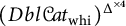 $(Dbl{\mathcal {C}}\!\textit {at}_{\mathrm {whi}})^{\Delta ^{\times 4}}$
:
$(Dbl{\mathcal {C}}\!\textit {at}_{\mathrm {whi}})^{\Delta ^{\times 4}}$
:

For this, it is sufficient to show that ${\mathbb {C}}(F[-,-]\times F[-,-])\colon \Delta ^{\times 4}\to Dbl{\mathcal {C}}\!\textit {at}_{\mathrm {whi}}$
is projectively cofibrant.
${\mathbb {C}}(F[-,-]\times F[-,-])\colon \Delta ^{\times 4}\to Dbl{\mathcal {C}}\!\textit {at}_{\mathrm {whi}}$
is projectively cofibrant.
Lemma 4.38 The functor $F[-,-]\times F[-,-]\colon \Delta ^{\times 4}\to \textit {s}{\mathcal {S}}\!\textit {et}^{\Delta ^{\operatorname {\mathrm {op}}}\times \Delta ^{\operatorname {\mathrm {op}}}}_{\mathrm {dbl}(\infty ,1)}$
given at
$F[-,-]\times F[-,-]\colon \Delta ^{\times 4}\to \textit {s}{\mathcal {S}}\!\textit {et}^{\Delta ^{\operatorname {\mathrm {op}}}\times \Delta ^{\operatorname {\mathrm {op}}}}_{\mathrm {dbl}(\infty ,1)}$
given at ${m,t,m',t'\geq 0}$
by the product
${m,t,m',t'\geq 0}$
by the product $F[m,t]\times F[m',t']$
is projectively cofibrant.
$F[m,t]\times F[m',t']$
is projectively cofibrant.
Proof First, recall that $F[-,-]\colon \Delta ^{\times 2}\to \textit {s}{\mathcal {S}}\!\textit {et}^{\Delta ^{\operatorname {\mathrm {op}}}\times \Delta ^{\operatorname {\mathrm {op}}}}_{\mathrm {dbl}(\infty ,1)}$
given at
$F[-,-]\colon \Delta ^{\times 2}\to \textit {s}{\mathcal {S}}\!\textit {et}^{\Delta ^{\operatorname {\mathrm {op}}}\times \Delta ^{\operatorname {\mathrm {op}}}}_{\mathrm {dbl}(\infty ,1)}$
given at $m,t\geq 0$
by the representable
$m,t\geq 0$
by the representable $F[m,t]$
is projectively cofibrant. As the projection
$F[m,t]$
is projectively cofibrant. As the projection $\pi _{1,2}\colon \Delta ^{\times 4}\to \Delta ^{\times 2}$
onto the first two components is left adjoint to the inclusion
$\pi _{1,2}\colon \Delta ^{\times 4}\to \Delta ^{\times 2}$
onto the first two components is left adjoint to the inclusion $\Delta ^{\times 2}\to \Delta ^{\times 4}$
given at
$\Delta ^{\times 2}\to \Delta ^{\times 4}$
given at $m,t\geq 0$
by
$m,t\geq 0$
by $([m],[t],[0],[0])$
, it induces by pre-composition a left Quillen functor between projective model structures
$([m],[t],[0],[0])$
, it induces by pre-composition a left Quillen functor between projective model structures
 $$\begin{align*}\pi_{1,2}^*\colon (\textit{s}{\mathcal{S}}\!\textit{et}^{\Delta^{\operatorname{\mathrm{op}}}\times \Delta^{\operatorname{\mathrm{op}}}}_{\mathrm{dbl}(\infty,1)})^{\Delta^{\times 2}}\to (\textit{s}{\mathcal{S}}\!\textit{et}^{\Delta^{\operatorname{\mathrm{op}}}\times \Delta^{\operatorname{\mathrm{op}}}}_{\mathrm{dbl}(\infty,1)})^{\Delta^{\times 4}}. \end{align*}$$
In particular, this left Quillen functor preserves cofibrant objects and so the functor ${F[-,-]\colon \Delta ^{\times 4}\to \textit {s}{\mathcal {S}}\!\textit {et}^{\Delta ^{\operatorname {\mathrm {op}}}\times \Delta ^{\operatorname {\mathrm {op}}}}_{\mathrm {dbl}(\infty ,1)}}$
given at
${F[-,-]\colon \Delta ^{\times 4}\to \textit {s}{\mathcal {S}}\!\textit {et}^{\Delta ^{\operatorname {\mathrm {op}}}\times \Delta ^{\operatorname {\mathrm {op}}}}_{\mathrm {dbl}(\infty ,1)}}$
given at $m,t,m',t'\geq 0$
by the representable
$m,t,m',t'\geq 0$
by the representable $F[m,t]$
is also projectively cofibrant. Similarly, the functor
$F[m,t]$
is also projectively cofibrant. Similarly, the functor $F[-,-]\colon \Delta ^{\times 4}\to \textit {s}{\mathcal {S}}\!\textit {et}^{\Delta ^{\operatorname {\mathrm {op}}}\times \Delta ^{\operatorname {\mathrm {op}}}}_{\mathrm {dbl}(\infty ,1)}$
given at
$F[-,-]\colon \Delta ^{\times 4}\to \textit {s}{\mathcal {S}}\!\textit {et}^{\Delta ^{\operatorname {\mathrm {op}}}\times \Delta ^{\operatorname {\mathrm {op}}}}_{\mathrm {dbl}(\infty ,1)}$
given at $m,t,m',t'\geq 0$
by the representable
$m,t,m',t'\geq 0$
by the representable $F[m',t']$
is projectively cofibrant.
$F[m',t']$
is projectively cofibrant.
Next, since the product $-\times -\colon \textit {s}{\mathcal {S}}\!\textit {et}^{\Delta ^{\operatorname {\mathrm {op}}}\times \Delta ^{\operatorname {\mathrm {op}}}}_{\mathrm {dbl}(\infty ,1)}\times \textit {s}{\mathcal {S}}\!\textit {et}^{\Delta ^{\operatorname {\mathrm {op}}}\times \Delta ^{\operatorname {\mathrm {op}}}}_{\mathrm {dbl}(\infty ,1)}\to \textit {s}{\mathcal {S}}\!\textit {et}^{\Delta ^{\operatorname {\mathrm {op}}}\times \Delta ^{\operatorname {\mathrm {op}}}}_{\mathrm {dbl}(\infty ,1)}$
is a left Quillen bifunctor, it is also a left Quillen functor as all objects are cofibrant in
$-\times -\colon \textit {s}{\mathcal {S}}\!\textit {et}^{\Delta ^{\operatorname {\mathrm {op}}}\times \Delta ^{\operatorname {\mathrm {op}}}}_{\mathrm {dbl}(\infty ,1)}\times \textit {s}{\mathcal {S}}\!\textit {et}^{\Delta ^{\operatorname {\mathrm {op}}}\times \Delta ^{\operatorname {\mathrm {op}}}}_{\mathrm {dbl}(\infty ,1)}\to \textit {s}{\mathcal {S}}\!\textit {et}^{\Delta ^{\operatorname {\mathrm {op}}}\times \Delta ^{\operatorname {\mathrm {op}}}}_{\mathrm {dbl}(\infty ,1)}$
is a left Quillen bifunctor, it is also a left Quillen functor as all objects are cofibrant in $\textit {s}{\mathcal {S}}\!\textit {et}^{\Delta ^{\operatorname {\mathrm {op}}}\times \Delta ^{\operatorname {\mathrm {op}}}}_{\mathrm {dbl}(\infty ,1)}$
. Therefore, it induces by postcomposition a left Quillen functor between projective model structures
$\textit {s}{\mathcal {S}}\!\textit {et}^{\Delta ^{\operatorname {\mathrm {op}}}\times \Delta ^{\operatorname {\mathrm {op}}}}_{\mathrm {dbl}(\infty ,1)}$
. Therefore, it induces by postcomposition a left Quillen functor between projective model structures

In particular, this left Quillen functor preserves cofibrant objects and so the functor ${F[-,-]\times F[-,-]\colon \Delta ^{\times 4}\to \textit {s}{\mathcal {S}}\!\textit {et}^{\Delta ^{\operatorname {\mathrm {op}}}\times \Delta ^{\operatorname {\mathrm {op}}}}_{\mathrm {dbl}(\infty ,1)}}$
given at
${F[-,-]\times F[-,-]\colon \Delta ^{\times 4}\to \textit {s}{\mathcal {S}}\!\textit {et}^{\Delta ^{\operatorname {\mathrm {op}}}\times \Delta ^{\operatorname {\mathrm {op}}}}_{\mathrm {dbl}(\infty ,1)}}$
given at $m,t,m',t'\geq 0$
by the product
$m,t,m',t'\geq 0$
by the product $F[m,t]\times F[m',t']$
is also projectively cofibrant.
$F[m,t]\times F[m',t']$
is also projectively cofibrant.
Corollary 4.39 The functor ${\mathbb {C}}(F[-,-]\times F[-,-])\colon \Delta ^{\times 4}\to Dbl{\mathcal {C}}\!\textit {at}_{\mathrm {whi}}$
given at
${\mathbb {C}}(F[-,-]\times F[-,-])\colon \Delta ^{\times 4}\to Dbl{\mathcal {C}}\!\textit {at}_{\mathrm {whi}}$
given at $m,t,m',t'\geq 0$
by the double category
$m,t,m',t'\geq 0$
by the double category ${\mathbb {C}}(F[m,t]\times F[m',t'])$
is projectively cofibrant.
${\mathbb {C}}(F[m,t]\times F[m',t'])$
is projectively cofibrant.
Proof This follows directly from Lemma 4.38 and the fact that
 $$\begin{align*}{\mathbb{C}}\colon \textit{s}{\mathcal{S}}\!\textit{et}^{\Delta^{\operatorname{\mathrm{op}}}\times \Delta^{\operatorname{\mathrm{op}}}}_{\mathrm{dbl}(\infty,1)}\to Dbl{\mathcal{C}}\!\textit{at}_{\mathrm{whi}} \end{align*}$$
is left Quillen.
Lemma 4.40 For $m,t,m',t'\geq 0$
, there is a double functor
$m,t,m',t'\geq 0$
, there is a double functor
 $$\begin{align*}{\mathbb{C}}(F[m,t]\times F[m',t'])\to {\mathbb{C}} F[m,t]\boxtimes^{\mathrm{ps}} {\mathbb{C}} F[m',t']\end{align*}$$
natural in $m,t,m',t'\geq 0$
, which provides a lift in (4.1).
$m,t,m',t'\geq 0$
, which provides a lift in (4.1).
Proof This natural map is obtained as a lift in the following diagram in the projective model structure on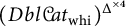 $(Dbl{\mathcal {C}}\!\textit {at}_{\mathrm {whi}})^{\Delta ^{\times 4}}$
:
$(Dbl{\mathcal {C}}\!\textit {at}_{\mathrm {whi}})^{\Delta ^{\times 4}}$
:

using Corollary 4.39 and the fact that the right-hand natural transformation is levelwise a trivial fibration in $Dbl{\mathcal {C}}\!\textit {at}_{\mathrm {whi}}$
by Lemma 4.12.
$Dbl{\mathcal {C}}\!\textit {at}_{\mathrm {whi}}$
by Lemma 4.12.
As a consequence, we obtain the desired map.
Proposition 4.41 Given bisimplicial sets X and Y, there is a double functor
 $$\begin{align*}{\mathbb{C}}( X\times Y)\to {\mathbb{C}} X\boxtimes^{\mathrm{ps}} {\mathbb{C}} Y \end{align*}$$
natural in X and Y.
Proof We write
 $$\begin{align*}X\cong \operatorname{\mathrm{colim}}_{F[m,t]\to X} F[m,t]\quad\text{and} \quad Y\cong \operatorname{\mathrm{colim}}_{F[m',t']\to Y} F[m',t']. \end{align*}$$
Then there are natural isomorphisms in $Dbl{\mathcal {C}}\!\textit {at}$
 $$ \begin{align*} {\mathbb{C}}( X\times Y) &\cong {\mathbb{C}}((\operatorname{\mathrm{colim}}_{F[m,t]\to X} F[m,t])\times (\operatorname{\mathrm{colim}}_{F[m',t']\to Y} F[m',t'])) & \\ &\cong {\mathbb{C}}(\operatorname{\mathrm{colim}}_{F[m,t]\to X}\operatorname{\mathrm{colim}}_{F[m',t']\to Y} (F[m,t]\times F[m',t'])) & \\ & \cong\operatorname{\mathrm{colim}}_{F[m,t]\to X}\operatorname{\mathrm{colim}}_{F[m',t']\to Y} {\mathbb{C}}(F[m,t]\times F[m',t']) & \end{align*} $$
using that $\times $
and
$\times $
and ${\mathbb {C}}$
preserve colimits. Moreover, there are natural isomorphisms in
${\mathbb {C}}$
preserve colimits. Moreover, there are natural isomorphisms in $Dbl{\mathcal {C}}\!\textit {at}$
 $$ \begin{align*} {\mathbb{C}} X\boxtimes^{\mathrm{ps}} {\mathbb{C}} Y &\cong {\mathbb{C}}(\operatorname{\mathrm{colim}}_{F[m,t]\to X} F[m,t])\boxtimes^{\mathrm{ps}} {\mathbb{C}}(\operatorname{\mathrm{colim}}_{F[m',t']\to Y} F[m',t']) & \\ &\cong (\operatorname{\mathrm{colim}}_{F[m,t]\to X} {\mathbb{C}} F[m,t])\boxtimes^{\mathrm{ps}} (\operatorname{\mathrm{colim}}_{F[m',t']\to Y}{\mathbb{C}} F[m',t']) & \\ & \cong\operatorname{\mathrm{colim}}_{F[m,t]\to X}\operatorname{\mathrm{colim}}_{F[m',t']\to Y} ({\mathbb{C}} F[m,t]\boxtimes^{\mathrm{ps}} {\mathbb{C}} F[m',t']) & \end{align*} $$
using that ${\mathbb {C}}$
and
${\mathbb {C}}$
and $\boxtimes ^{\mathrm {ps}}$
preserve colimits. Then the double functor
$\boxtimes ^{\mathrm {ps}}$
preserve colimits. Then the double functor
 $$\begin{align*}{\mathbb{C}}(F[m,t]\times F[m',t'])\to {\mathbb{C}} F[m,t]\boxtimes^{\mathrm{ps}} {\mathbb{C}} F[m',t'] \end{align*}$$
from Lemma 4.40, which is natural in $m,t,m',t'$
, induces a double functor between colimits
$m,t,m',t'$
, induces a double functor between colimits
 $$\begin{align*}{\mathbb{C}}( X\times Y)\to {\mathbb{C}} X\boxtimes^{\mathrm{ps}} {\mathbb{C}} Y. \end{align*}$$
Naturality in X and Y follows from the naturality in the indexing shapes of the colimits.
Given bisimplicial sets X and Y, we now aim to show that the double functor
 $$\begin{align*}{\mathbb{C}}( X\times Y)\to {\mathbb{C}} X\boxtimes^{\mathrm{ps}} {\mathbb{C}} Y \end{align*}$$
is a weak equivalence in $Dbl{\mathcal {C}}\!\textit {at}_{\mathrm {whi}}$
. Again, we start with the case where
$Dbl{\mathcal {C}}\!\textit {at}_{\mathrm {whi}}$
. Again, we start with the case where $X=F[m,t]$
and
$X=F[m,t]$
and $Y=F[m',t']$
are representables.
$Y=F[m',t']$
are representables.
Lemma 4.42 Given $m,t,m',t'\geq 0$
, the double functor from Lemma 4.40 is a double biequivalence
$m,t,m',t'\geq 0$
, the double functor from Lemma 4.40 is a double biequivalence
 $$\begin{align*}{\mathbb{C}}( F[m,t]\times F[m',t'])\stackrel{\simeq}{\longrightarrow} {\mathbb{C}} F[m,t]\boxtimes^{\mathrm{ps}} {\mathbb{C}} F[m',t'].\end{align*}$$
Proof First recall from Theorem 4.36(2) that the components of the counit
 $$\begin{align*}\varepsilon_{[m,t]} \colon {\mathbb{C}} F[m,t]\cong {\mathbb{C}}{\mathbb{N}}[m,t]\stackrel\simeq\longrightarrow [m,t] \end{align*}$$
and
 $$\begin{align*}\varepsilon_{[m,t]\times [m',t']}\colon {\mathbb{C}}(F[m,t]\times F[m',t'])\cong {\mathbb{C}}{\mathbb{N}}([m,t]\times [m',t'])\to [m,t]\times [m',t'] \end{align*}$$
are double biequivalences. Hence, by [Reference RasekhMSV23b, Remark 7.5], so is the product
 $$\begin{align*}\varepsilon_{[m,t]}\times \varepsilon_{[m',t']}\colon {\mathbb{C}} F[m,t]\times {\mathbb{C}} F[m',t'] \stackrel\simeq\longrightarrow [m,t]\times [m',t']. \end{align*}$$
Moreover, recall from [Reference RasekhMSV23b, Lemma 7.3] that the natural projection double functor
 $$\begin{align*}{\mathbb{C}} F[m,t]\boxtimes^{\mathrm{ps}} {\mathbb{C}} F[m',t']\stackrel\simeq\longrightarrow {\mathbb{C}} F[m,t]\times {\mathbb{C}} F[m',t'] \end{align*}$$
is also a double biequivalence.
Hence, we have the following commutative diagram in $Dbl{\mathcal {C}}\!\textit {at}_{\mathrm {whi}}$
:
$Dbl{\mathcal {C}}\!\textit {at}_{\mathrm {whi}}$
:

Note that the diagram indeed commutes by naturality of the counit and by construction of the double functor from Lemma 4.40. So the result follows by $2$
-out-of-
$2$
-out-of- $3$
.
$3$
.
We can finally prove that the desired double functor is also a weak equivalence in $Dbl{\mathcal {C}}\!\textit {at}_{\mathrm {whi}}$
.
$Dbl{\mathcal {C}}\!\textit {at}_{\mathrm {whi}}$
.
Theorem 4.43 Given bisimplicial sets X and Y, the map from Proposition 4.41 is a weak equivalence in the model structure $Dbl{\mathcal {C}}\!\textit {at}_{\mathrm {whi}}$
 $$\begin{align*}{\mathbb{C}}( X\times Y)\stackrel{\simeq}{\longrightarrow}{\mathbb{C}} X\boxtimes^{\mathrm{ps}}{\mathbb{C}} Y. \end{align*}$$
Proof Given $m,t\geq 0$
, we first show that the double functor from Proposition 4.41 is a weak equivalence in the model structure
$m,t\geq 0$
, we first show that the double functor from Proposition 4.41 is a weak equivalence in the model structure $Dbl{\mathcal {C}}\!\textit {at}_{\mathrm {whi}}$
 $$ \begin{align} {\mathbb{C}}(F[m,t]\times Y)\stackrel{\simeq}{\longrightarrow}{\mathbb{C}} F[m,t]\boxtimes^{\mathrm{ps}}{\mathbb{C}} Y, \end{align} $$
for all bisimplicial sets Y. By Theorems 4.11 and 4.36(1) and Remark 2.4, the functors
 $$\begin{align*}{\mathbb{C}}(F[m,t]\times-),~{\mathbb{C}} F[m,t]\boxtimes^{\mathrm{ps}}{\mathbb{C}}(-)\colon DblCat_{(\infty,1)}\to Dbl{\mathcal{C}}\!\textit{at}_{\mathrm{whi}}\end{align*}$$
are left Quillen, so the set of $(\Delta \times \Delta )$
-sets Y for which the double functor (4.2) is a weak equivalence in
$(\Delta \times \Delta )$
-sets Y for which the double functor (4.2) is a weak equivalence in $Dbl{\mathcal {C}}\!\textit {at}_{\mathrm {whi}}$
is saturated by monomorphisms in the sense of [Reference CisinskiCis19, Definition 1.3.9]. Furthermore, by Lemma 4.42, this holds when
$Dbl{\mathcal {C}}\!\textit {at}_{\mathrm {whi}}$
is saturated by monomorphisms in the sense of [Reference CisinskiCis19, Definition 1.3.9]. Furthermore, by Lemma 4.42, this holds when $Y=F[m',t']$
is a representable in
$Y=F[m',t']$
is a representable in ${\mathcal {S}}\!\textit {et}^{\Delta ^{\operatorname {\mathrm {op}}}\times \Delta ^{\operatorname {\mathrm {op}}}}$
. Hence, by [Reference CisinskiCis19, Corollary 1.3.10], we obtain that the double functor (4.2) is a weak equivalence in
${\mathcal {S}}\!\textit {et}^{\Delta ^{\operatorname {\mathrm {op}}}\times \Delta ^{\operatorname {\mathrm {op}}}}$
. Hence, by [Reference CisinskiCis19, Corollary 1.3.10], we obtain that the double functor (4.2) is a weak equivalence in $Dbl{\mathcal {C}}\!\textit {at}_{\mathrm {whi}}$
for all bisimplicial sets Y.
$Dbl{\mathcal {C}}\!\textit {at}_{\mathrm {whi}}$
for all bisimplicial sets Y.
Now, given a bisimplicial set Y, a similar argument using the above result shows that the double functor from Proposition 4.41 is a weak equivalence in the model structure $Dbl{\mathcal {C}}\!\textit {at}_{\mathrm {whi}}$
 $$\begin{align*}{\mathbb{C}}(X\times Y)\stackrel{\simeq}{\longrightarrow}{\mathbb{C}} X\boxtimes^{\mathrm{ps}}{\mathbb{C}} Y, \end{align*}$$
for all bisimplicial sets X, as desired.
By putting this result with Lemma 4.12 together, we get the following corollary.
Corollary 4.44 The left adjoint of ${\mathbb {N}}\colon [DblCat]_\infty \to DblCat_{(\infty ,1)}$
preserves products.
${\mathbb {N}}\colon [DblCat]_\infty \to DblCat_{(\infty ,1)}$
preserves products.
Proof By Theorem 4.43, we have that the left adjoint of ${\mathbb {N}}$
sends Cartesian products to pseudo Gray tensor products. Then, by Lemma 4.12, the monoidal structure induced by the pseudo Gray tensor product in
${\mathbb {N}}$
sends Cartesian products to pseudo Gray tensor products. Then, by Lemma 4.12, the monoidal structure induced by the pseudo Gray tensor product in $[DblCat]_\infty $
is equivalent to the one given by the Cartesian product. Hence, the left adjoint of
$[DblCat]_\infty $
is equivalent to the one given by the Cartesian product. Hence, the left adjoint of ${\mathbb {N}}$
preserves products.
${\mathbb {N}}$
preserves products.
Acknowledgements
We are grateful to the referee for valuable feedback on this article.
Funding Statement
The third author is grateful for support from the National Science Foundation under Grant No. DMS-2203915. During the realization of this work, the first author was a member of the Collaborative Research Centre “SFB 1085: Higher Invariants” funded by the Deutsche Forschungsgemeinschaft (DFG). The second author is grateful to Max Planck Institute for Mathematics in Bonn for its hospitality and financial support.


 Open access

