


The rise and success of interstate policy networks, like the American Legislative Exchange Council (ALEC) and State Innovation Exchange (SiX), raises important questions about how legislators and policy advocates converge on the policy ideas that catalyze policy diffusion across the United States. Legislatures, as socially constructed institutions, develop roles and norms that structure conflict and constrain legislator behavior (Bernick and Wiggins Reference Bernick and Wiggins1983). These roles and norms create a sense of appropriateness that undergirds the policy-making behavior of individuals seeking success within the institution (March and Olsen Reference March and Olsen1989; Reference March, Olsen, Moran, Rein and Goodin2006). Interstate policy networks, however, develop their own norms, roles, and structures to socialize elites—legislators, advocates, bureaucrats, and industry allies—across institutions, leading to commonly accepted ideas of what makes good public policy among members of the network. The socialization of legislators into policy networks can affect policy-making behavior within and across legislatures and thus patterns of policy diffusion across the states.
Emerging research on ALEC (Collingwood, El-Khatib, and Gonzalez O’Brien Reference Collingwood, El-Khatib and O’Brien2019; DeMora, Collingwood, and Ninci Reference DeMora, Collingwood and Ninci2019; Garrett and Jansa Reference Garrett and Jansa2015; Hertel-Fernandez Reference Hertel-Fernandez2019; Jansa and Mallinson Reference Jansa and Mallinson2025), the Uniform Law Commission (ULC; Jansa and Mallinson Reference Jansa and Mallinson2025), and the Tenth Amendment Center (Kroeger, Karch, and Callaghan Reference Kroeger, Karch and Callaghan2022) has yielded important insights into the operation and success of policy networks in seeding diffusion. But scholars have not coalesced around a clear explanation for why these groups are successful at driving diffusion. Hertel-Fernandez’s (Reference Hertel-Fernandez2019) deep dive into ALEC focuses on the network’s organizational structure and relationship-building prowess but does not incorporate insights on the strategic interaction of states as established by the policy diffusion literature. Others are more focused on how interstate policy networks shape the diffusion process but do not come to a clear answer as to whether a network’s impact can be explained by existing theoretical mechanisms of diffusionFootnote 1 (Jansa, Hansen, and Gray Reference Jansa, Hansen and Gray2019) or by a new and unique diffusion mechanism (e.g., Collingwood, El-Khatib, and Gonzalez O’Brien Reference Collingwood, El-Khatib and O’Brien2019). This burgeoning and important literature can be clarified by building on the least developed and tested diffusion mechanism—elite socialization—and incorporating it more fully and clearly into scholarship on policy diffusion in the American federal system.
This article provides a testable theoretical foundation for elite socialization diffusion. Importantly, we distinguish socialization from emulation (a mechanism that bluntly masks important differences between social contagion and elite socialization) and learning (a mechanism that suggests a more proactive information search on the part of lawmakers than typically occurs during elite socialization). In doing so, we bring together insights on the influence of policy networks (Collingwood, El-Khatib, and Gonzalez O’Brien Reference Collingwood, El-Khatib and O’Brien2019) and on socialization from the international policy transfer literature (Porto de Oliveira et al. Reference de Oliveira, Osmany, Volden, Karch and Weible2023) to identify a research agenda from which scholars can build knowledge about the influence of policy networks in policy diffusion. Although it is not fully tested herein, the article discusses an empirical strategy for testing this causal mechanism, which we argue has been more important than yet recognized for understanding consequential policy innovations in the United States that have shaped citizens’ voting, reproductive, health, education, and due process rights.
Thus, we speak to the growing scholarly and popular interest in policy innovations: policy ideas that are new to the jurisdiction (Walker Reference Walker1969). The well-established diffusion literature has rapidly expanded with new scholarship, which has brought with it a shift in focus from the general correlates of sequential policy adoption (Berry and Berry Reference Berry and Berry1990) to specifically defined causal mechanisms (Shipan and Volden Reference Shipan and Volden2008). This reflects the fact that even though institutional action—the adoption of a policy innovation by a legislature—is most often operationalized at the state level using event history modeling (Berry and Berry Reference Berry and Berry1990), it is really the result of legislator behavior at the microlevel (Egeberg Reference Egeberg1994). For instance, legislators and staff learn lessons from the policy and political experiences of their peers in other states (Karch Reference Karch2007): the learning mechanism. State legislators act out of concern for maintaining comparative advantages in attracting resources (Dye Reference Dye1990): the competition mechanism. Elites pay attention to federal action and respond to federal incentives to innovate (Welch and Thompson Reference Welch and Thompson1980): the coercion mechanism. Elected officials listen to the emerging demands of constituents who are influenced by friends, family, and media from other states (Pacheco Reference Pacheco2012): the social contagion mechanism. Finally, individual legislators conform to norms that delineate the appropriateness of new policy ideas for their constituency: the socialization mechanism.
Individual behavior underlies each of these causal mechanisms. Modeling policy adoption using macro-level event history models thus makes it difficult for researchers to confidently identify micro-level causal processes (Butler et al. Reference Butler, Volden, Dynes and Shor2017), because such models are only able to address easily observable correlates of micro-level behavior. This makes it difficult to settle controversies over the number, types, and presence of causal mechanisms. And of the five causal mechanisms listed earlier, socialization is the least theoretically developed, least tested, and most difficult to identify using macro-level indicators in isolation. This is a serious deficit, given that socialization diffusion may be one of the most important mechanisms for understanding why some policies diffuse rapidly and whether persistent diffusion networks exist among the states (Boushey Reference Boushey2010; Desmarais, Harden, and Boehmke Reference Desmarais, Harden and Boehmke2015). Such a lacuna is of even greater concern, given our emerging understanding of the influence of ideological policy networks like ALEC on policy diffusion (Garrett and Jansa Reference Garrett and Jansa2015). In fact, the socialization mechanism, which operates via connections between state legislators and policy innovators, offers an alternative explanation for cases where adoptions appear to occur independently of each other (Volden, Ting, and Carpenter Reference Volden, Ting and Carpenter2008).
This reflection progresses as follows. First, we review the literature on diffusion mechanisms with an eye toward the conceptual slippage of emulation, imitation, and socialization. We then distinguish elite socialization from other mechanisms and present core and peripheral assumptions for socialization diffusion. We use the spread of strict voter ID laws promoted by ALEC and organ donation laws promoted by ULC as illustrative, though not definitive, examinations of these assumptions in the real world. Importantly, the first case addresses partisan/ideological elite socialization, whereas the second demonstrates nonpartisan socialization. Finally, we present a research agenda explaining how scholars can use multiple prevailing and emerging methodologies to test this mechanism. This reflection does not claim to fully test the socialization mechanism but establishes a testable framework that encourages a progressive development of diffusion theory (Lakatos Reference Lakatos, Lakatos and Musgrave1970).
Policy Diffusion Causal Mechanisms
Diffusion scholars have endeavored to clarify the vast literature by identifying and describing causal mechanisms. Of utmost priority have been agreeing to a set of mechanisms and defining and measuring them consistently. Maggetti and Gilardi (Reference Maggetti and Gilardi2016) rightly demonstrate that consistency in conceptual definitions and measurement is vital for producing meaningful results. But in limiting their choice of mechanisms to learning, emulation, and competition, they preclude two mechanisms—coercion and social contagion—that have importance, especially in the context of American federalism. Although they argue that coercion is inappropriate given the lack of a central coordinator in transnational diffusion, the US federal government does play a coercive role vis-à-vis the states (e.g., Richardson and Houston Reference Richardson and Houston2008). Additionally, Pacheco’s (Reference Pacheco2012) work on social contagion is relevant for subnational diffusion where state borders cross major media markets and at a time when citizens have easy access to policy information via the internet (LaCombe, Tolbert, and Mossberger Reference LaCombe, Tolbert and Mossberger2022).
More commonly, scholars identify four mechanisms: coercion, learning, competition, and emulation (Gilardi and Wasserfallen Reference Gilardi and Wasserfallen2019; Mooney Reference Mooney2021). Perhaps the most unclear aspect of the diffusion mechanisms literature is how to label and describe the normative pressures that can cause diffusion. Many consider normative pressure one of the micro-level foundations of the emulation mechanism, which is sometimes also referred to as imitation. As Mooney (Reference Mooney2021) describes, the development of shared social norms and the pressure to conform with those norms can lead states to emulate one another’s policies. The micro-level behavior driving policy emulation, then, is legislators’ desire to keep up with predominant trends and standards (Braun and Gilardi Reference Braun and Gilardi2006; Shipan and Volden Reference Shipan and Volden2012). Indeed, the notion that policy experts and activists develop and communicate policy standards, which legislators may adopt in their states, dates to Walker (Reference Walker, Tropman, Dluhy and Lind1981). Legislators can come to understand and internalize these standards through repeated interaction and socialization with experts and activists (Braun and Gilardi Reference Braun and Gilardi2006).
But as Mooney (Reference Mooney2021) submits, emulation also serves as an ambiguous catch-all mechanism that describes the outcome—copying policies from place to place—more than the causal process driving diffusion. The rapid adoption of legislation by direct copying is not a new phenomenon. Walker’s (Reference Walker1969) early diffusion work noted that some policies spread so quickly and were replicated so exactly that they included typographical errors from the original legislation. Alas, the terms used to describe such behavior—imitation and emulation—are often treated interchangeably (e.g., Meseguer Reference Meseguer2005), which leads to conceptual slippage and conflicting empirical results (Maggetti and Gilardi Reference Maggetti and Gilardi2016). Whereas the theoretical development of emulation is rooted in normative pressure on legislators, scholars suggest that imitation occurs for a host of reasons in addition to normative pressure (Gilardi and Wasserfallen Reference Gilardi and Wasserfallen2019), including a desire to mimic states with shared characteristics (Karch Reference Karch2007) and because some policies simply catch on (Boushey Reference Boushey2010). Graham, Shipan, and Volden (Reference Graham, Shipan and Volden2013, 690) note their own internal debates about the role of imitation either as a distinct mechanism or as a “combination of socialization and learning.” After all, the act of directly copying or closely mimicking could be either a response to normative pressure (i.e., socialization) or the result of observing a successful policy in another jurisdiction (i.e., learning). We suggest that copying is more a response to the former than the latter, but that is an empirical question about policy characteristics.
Karch (Reference Karch2007) provides a useful starting point for clarifying mechanisms because his delineations rest on the motivations of legislators. In the case of emulation, legislators seek to solve a policy problem and thus copy policies from other states that demonstrate success. Emulation in this case is akin to learning because legislators are seeking information from their peers to solve a social problem in their own state. Imitation, in contrast, results from legislators acting because the policy was adopted by another state that is close to them in geography, ideology, culture, or other characteristics. Imitation in this case stems from motivations of conformity, acceptance, appropriateness, or all of them.
Research on international policy diffusion terms this phenomenon “socialization,” thereby eschewing the confusing imitation and emulation labels. In the international system, norms transference and preference alteration lead to policy change (Cao Reference Cao2010; Greenhill Reference Greenhill2010). Namely, countries that participate in international organizations adopt the norms of those groups, which subsequently paves the way for new innovations to spread via pressure to conform with norms of appropriateness. Unfortunately, even though policy diffusion scholarship within the American context served as the genesis for the socialization mechanism (Walker Reference Walker1969), it has received little contemporary theoretical or empirical attention (Graham, Shipan, and Volden Reference Graham, Shipan and Volden2013).
Outside the American policy diffusion context, scholars have begun to replace emulation and imitation with socialization, which they seek to bring into greater relief. Porto de Oliveira et al. (Reference de Oliveira, Osmany, Volden, Karch and Weible2023) distinguish socialization from learning—with learning being fundamentally a process of rational information searching and, often, reinvention of policy to achieve a policy or political goal—and they develop socialization as a mechanism by borrowing key insights from the international policy transfer literature.
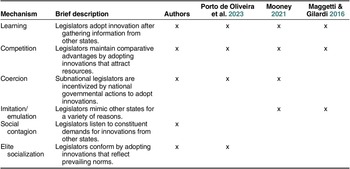
We follow this approach and argue that abandoning the terms of emulation and imitation for terms that are descriptive of the behaviors that produce diffusion—like learning and socialization—better aligns the underlying mechanisms with their labels. Importantly, although imitation is more a description of whether an adopted policy is very similar to what other jurisdictions have adopted than a description of the influences on legislative behavior that led to its adoption, it can be a clue that socialization is happening, much as policy reinvention is considered evidence that learning is at play (Berry and Berry Reference Berry, Berry, Weible and Sabatier2018). Table 1 describes how we conceptualize the five mechanisms of diffusion compared to others. Importantly, we argue that the five mechanisms we identify are the ideal categorization for the American context, given the current state of knowledge about diffusion in the US federal system.
Categorizing Mechanisms of Diffusion

Table 1 Long description
From top to bottom, the table lists mechanisms: Learning, Competition, Coercion, Imitation or emulation, Social contagion, and Elite socialization. Each row begins with the mechanism name, followed by a brief description. The next columns show author attributions: Porto de Oliveira et al. 2023, Mooney 2021, Maggetti and Gilardi 2016, and a general ‘Authors’ column. Checkmarks indicate which authors reference each mechanism. Learning, Competition, and Coercion are referenced by all authors except Maggetti and Gilardi for Coercion. Imitation or emulation is referenced by Mooney and Maggetti and Gilardi. Social contagion and Elite socialization are referenced only in the ‘Authors’ and Porto de Oliveira columns. Descriptions specify how legislators adopt innovations: Learning involves information gathering, Competition focuses on comparative advantage, Coercion is driven by national incentives, Imitation or emulation involves mimicking, Social contagion responds to constituent demands, and Elite socialization reflects prevailing norms.
Although Porto de Oliveira et al. (Reference de Oliveira, Osmany, Volden, Karch and Weible2023) and others have made progress in refining the emulation/imitation mechanism as being fundamentally about socialization, the mechanism remains mostly unadapted and unapplied to the phenomenon of interstate policy networks in the American context. Mooney (Reference Mooney2021) suggests there is fertile ground here, arguing that interstate associations, of which legislators can be members, promulgate policy ideas, apply normative pressure to adopt innovations, foster relationships with peers in other legislatures, facilitate information flow, and set the policy agenda by helping define problems (see also Walker Reference Walker, Tropman, Dluhy and Lind1981). Further, unlike the other mechanisms, there are currently no explicit tests of the theory within the United States presented as evidence of its existence.
Taken together, we propose separating the characteristics of policy diffusion—that is, the speed of policy adoptions and the similarities of adoptions—from influences on legislator behavior to disentangle and clarify diffusion mechanisms. Although variations in observable characteristics can be used as clues to which mechanism is at play, they should not be used to describe the mechanism itself. Instead, we propose that policy diffusion mechanisms can best be understood from the perspective of the key actors—legislators—and be sorted along two dimensions that shape their decisions: (1) the level of interaction and (2) the direction (i.e., push or pull) of policy movement.
First Dimension: Level of Interaction (Bottom-up or Top-down)
The level of interaction refers to whether the mechanism is a force operating on all states (i.e., at the macro-level or top-down) or across individuals within the states (i.e., at the micro-level or bottom-up). The argument is not that legislation occurs at a macro- or micro-level. In all cases, legislators are the ones who introduce and pass policies, regardless of the mechanism at play. But the level of interaction or the force driving legislators differs across mechanisms. For instance, coercion and competition pressures are top-down because the force driving adoption is exogenous to the state and has a broad impact on all the states. In the case of coercion, the federal government makes incentives available to all states. Although each state’s response to this stimulus is conditional on its ecological capacity and characteristics (Goggin et al. Reference Goggin, Bowman, Lester and O’Toole1990), the pressure is applied across all the states. In the case of competition, states are increasingly competing not only with their neighbors but also with every other state because of the mobility of capital. For example, states far afield from California (e.g., North Carolina) offer film tax credits aimed at drawing the movie industry from its home state (Sewordor and Sjoquist Reference Sewordor and Sjoquist2016).
In contrast, learning and social contagion forces are bottom-up, being exercised through connections among individuals. For instance, elites seeking to solve a problem search for effective and politically beneficial policies from peers in other states who share their preferences (Grossback, Nicholson-Crotty, and Peterson Reference Grossback, Nicholson-Crotty and David2004; Hill and Klarner Reference Hill and Klarner2002). Legislators may find this information not only through staff research but also through discussions at professional organizations (Balla Reference Balla2001).
Elite socialization is also characterized by bottom-up interactions in which the key actors developing and spreading policy ideas are networks of policy and legislative elites that operate across states. These networks help disseminate ideas and accompanying norms of appropriateness to seed policy adoption and diffusion. Learning involves a search for policy information, and the key actors are the legislator and their staff. Whereas social contagion involves grassroots communication of information and preferences to legislators, socialization is distinguished by the development of shared norms and the dissemination of normative justifications alongside policy information among legislators and networked policy elites.
Second Dimension: Direction of Policy Movement (Push vs. Pull)
The second dimension centers on whether innovations are pushed on legislators or legislators pull the innovations into their state. Haider-Markel (Reference Haider-Markel2001) suggests this notion of push/pull in his study of same-sex marriage bans in which a coordinated national campaign sought to leverage legislator’s norms of appropriateness for the purpose of pushing its policy into receptive states. In fact, his explanation of how national campaigns expand the geographical span of conflict rings close to socialization. The socialization mechanism is characterized by push forces whereby interstate networks transmit both norms and policy innovations to member legislators. The push force can also be observed under the social contagion mechanism as citizens push ideas into other states by sharing information within their social networks that cross state lines (Pacheco Reference Pacheco2012). Federal incentives, socialization, and social contagion push ideas into states. The pull mechanism is more clearly identifiable for competition—which encourages legislators to pull new ideas into their state insofar as they wish to gain a competitive advantage or risk losing a competitive advantage (Baybeck, Berry, and Siegel Reference Baybeck, Berry and Siegel2011)—and for learning, which is fundamentally an approach of pulling new ideas into a state to solve (policy or political) problems.
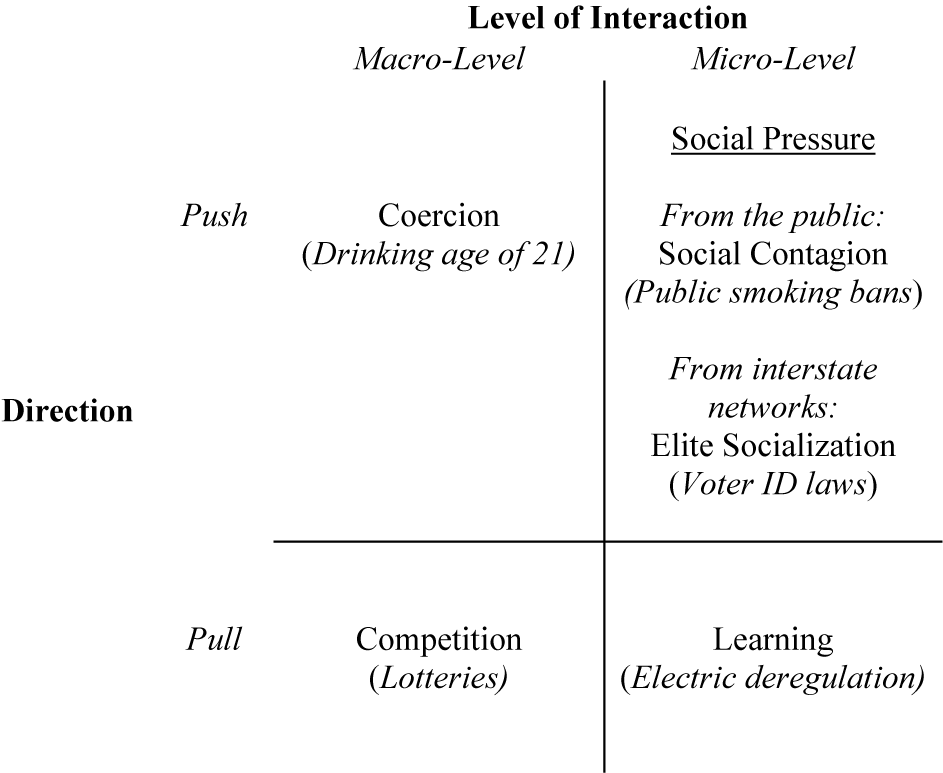
Figure 1 provides a visual representation of the two dimensions and how the mechanisms of diffusion sort along them; it also shows policy examples for each mechanism. The categorization is flexible enough that as additional mechanisms are identified or continue to be refined, they can be sorted in a meaningful way that distinguishes them from other mechanisms.
Categorization of diffusion mechanisms by level of interaction and direction of policy idea movement

Figure 1 Long description
The matrix is divided by a vertical and horizontal line. The vertical axis on the left is labeled Direction with Push at the top and Pull at the bottom. The horizontal axis at the top is labeled Level of Interaction with Macro-Level on the left and Micro-Level on the right. Top left quadrant (Push, Macro-Level) contains Coercion with the example Drinking age of 21 in italics. Top right quadrant (Push, Micro-Level) is titled Social Pressure and is subdivided: From the public contains Social Contagion with the example Public smoking bans in italics; From interstate networks contains Elite Socialization with the example Voter I D laws in italics. Bottom left quadrant (Pull, Macro-Level) contains Competition with the example Lotteries in italics. Bottom right quadrant (Pull, Micro-Level) contains Learning with the example Electric deregulation in italics.
Of the five mechanisms, two share the micro/push quadrant: social contagion and elite socialization. Social pressure is a key component of the elite socialization mechanism—the development and acceptance of new norms among elites and pressure to adopt policies that reflect new norms—and in the social contagion mechanism, through which the public is attracted to new ideas and pressures lawmakers to act. Both stand alone as distinct descriptions of causal pathways, however, because their source of pressure is distinct. Pressure emerges via elite policy networks in one instance and via the public’s interstate networks in the other. Each is supported by theoretical and empirical developments in distinct literatures. Knowledge of public opinion and grassroots activism undergirds social contagion, whereas ideas about policy networks and norms transference provide the basis for socialization.Footnote 2 We maintain these are distinct diffusion mechanisms but label them as related by social pressure in figure 1.
Socialization Diffusion
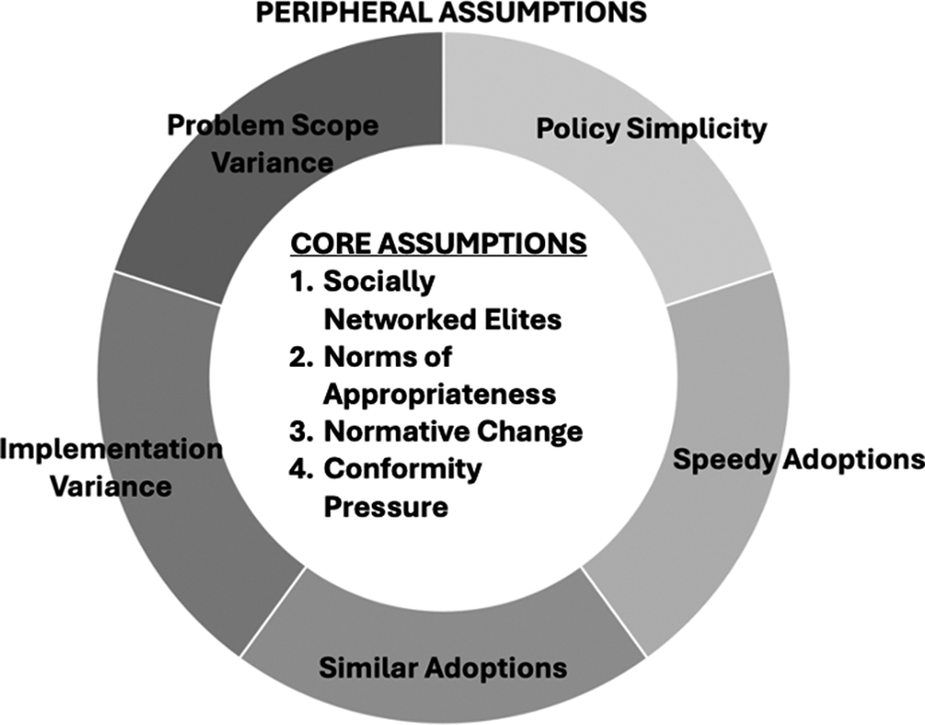
Having mapped five diffusion mechanisms along two conceptual dimensions, we turn now to developing the elite socialization mechanism theoretically. The following core and peripheral assumptions of the theory of socialization diffusion draw from research on the logic of appropriateness, social networks, legislative behavior, and social conformity. The purpose is to establish a testable theoretical foundation that distinguishes socialization from the other four causal mechanisms. Figure 2 depicts the core and peripheral assumptions of the socialization mechanism.
Core and Peripheral Assumptions of the Elite Socialization Diffusion Mechanism

Core Assumption 1: Social Networks
The first core assumption is that legislators are members of both intra- and interstate social networks that provide them with political benefits. It is through building intraorganizational social ties that legislators achieve their policy goals (Kirkland Reference Kirkland2011; Sarbaugh-Thompson, Thompson, and Elder Reference Sarbaugh-Thompson, Thompson and Elder2013). Social ties in legislatures enhance efficiency and productivity (Tam Cho and Fowler Reference Cho, Wendy and Fowler2010). This is not different from socialization diffusion. What is different, however, is the role that norms play in legitimizing innovations and their sources. Therein lies the role of legislators’ interstate networks. Transnationally, organizations like the European Union and the United Nations play a role in diffusing norms of appropriate behavior (Elgström Reference Elgström2000; Finnemore Reference Finnemore1993).
Within the US context, groups like ALEC, SiX, ULC, and others connect their members—state legislators—to one another and to the prevailing norms of the group. Each legitimizes innovations for members and facilitates the spread of both innovations and norms of behavior (Balla Reference Balla2001). For example, ALEC was an important communication channel for spreading strict voter identification, stand-your-ground, right to work, and anti-sanctuary policies (Collingwood, El-Khatib, and Gonzalez O’Brien Reference Collingwood, El-Khatib and O’Brien2019; Fischer Reference Fischer2015; Lichtblau Reference Lichtblau2012; Weiser and Norden Reference Weiser and Norden2011). Its network is the primary selective benefit that ALEC provides its corporate sponsors that provide financial support to the organization (Hertel-Fernandez Reference Hertel-Fernandez2019). Furthermore, ALEC relies on the power of weak ties through legislators’ own collaborative networks within their states. In fact, ALEC (2016) claims that its members are more collaborative and successful than nonmember legislators. SiX casts itself as the progressive alternative to ALEC, and ULC brings together legislators from both parties and lawyers to create model uniform policies for adoption across the states. Other networks are organized around a tight core of related issues, such as the Democracy Policy Network. These organizations are predicated on the assumption that they can spread their bills through networks of state legislators by acting as a centralized policy entrepreneur (Hertel-Fernandez Reference Hertel-Fernandez2019).
Core Assumption 2: Norms of Appropriateness
The second core assumption is that norms of appropriateness are communicated within these networks, and these norms serve as heuristic cues for innovations emerging in the states (March and Olsen Reference March and Olsen1989). Such norms distinguish socialization from learning. Policy information travels through legislator social networks, but norms of appropriateness facilitate socialization-driven adoption (Greenhill Reference Greenhill2010). If legislators only seek and receive policy information from their peers, then they are conducting an information search for the purpose of finding a solution to a particular problem using a logic of consequentiality. However, when innovations are attached to a norm of appropriateness, the motivation for adoption is not to solve a problem but to maintain one’s reputation in the network by behaving appropriately (Jordana, Levi-Faur, and i Marín Reference Jordana, Levi-Faur and Marín2011; Strang and Chang Reference Strang and Chang1993).
Although interstate networks exist to push policy ideas and norms, they do so mostly to allied legislators who are inclined to favor the network’s goals and who have internalized its norms of appropriateness. For example, Sargent, Wynn, and Madhani (Reference Sargent, Wynn and Madhani2019) found that legislators reported routinely being approached by formal interstate networks pushing policy ideas and hosting conferences to socialize them into shared normative frameworks and that lawmakers searched for policy ideas online, finding model proposals and normative justifications readily available from interstate networks. Thus, legislators can be willing receptors of policy ideas from networks, because fully developed proposals and justifications serve as a legislative subsidy to time- and resource-constrained legislators (e.g., Garrett and Jansa Reference Garrett and Jansa2015). Indeed, contact between legislators and advocates in interstate networks involves the development of a shared understanding of norms of appropriateness and the subsidization of legislators’ efforts to shape policy to conform with norms.
Core Assumption 3: Norm Change
The third core assumption is that norms among state legislators change because of broader societal changes and influences from legislative peers, and thus legislator behavior is subject to social conformity pressure. The logic of appropriateness is shaped by the norms and rules of institutions, which evolve over time. Experts help socially construct norms of appropriateness in state politics (Zhou Reference Zhou1993). Furthermore, as norms change through a process of innovation legitimation and diffusion, related policies can spread rapidly (Delmestri and Wezel Reference Delmestri and Wezel2011; Rossman Reference Rossman2015). Put another way, the degree of divergence in local norms conditions the likelihood that a unit will take up an innovation, until the norms themselves have changed or the innovation is reframed to fit the existing norms (Delmestri and Wezel Reference Delmestri and Wezel2011). Interstate networks like ALEC or ULC help facilitate changes in norms of appropriateness over time.
Core Assumption 4: Conformity Pressure
Social psychological studies of human conformity demonstrate the human proclivity to conform when faced with social pressure from peers (Asch Reference Asch1955; Crutchfield Reference Crutchfield1955; Sherif et al. 1954/Reference Sherif, Harvey, White, Hood and Sherif1961; Strickland and Crowne Reference Strickland and Crowne1962). Social identification with a group induces conformity (Abrams and Hogg Reference Abrams and Hogg1990), even if humans may or may not change their private beliefs (Mallinson and Hatemi Reference Mallinson and Hatemi2018). These motivations also appear in norm diffusion through information cascades to which political elites conform either because they think it is the right thing to do (Bikhchandani, Hirshleifer, and Welch Reference Bikhchandani, Hirshleifer and Welch1992; Reference Bikhchandani, Hirshleifer and Welch1998) or because they want to maintain or achieve a positive reputation among the group (Kuran Reference Kuran1998; Kuran and Sunstein Reference Kuran and Sunstein1999).
Importantly, electoral pressure is not a necessary condition for inducing conformity within interstate policy networks. Although legislators’ electoral motivations are paramount (Fenno Reference Fenno1978; Mayhew Reference Mayhew1974), evidence from outside the US context demonstrates that policy diffusion can occur via socialization of lawmakers into transnational policy networks that have little to no ability to apply electoral pressure. In a study of the adoption of national science agencies, Finnemore (Reference Finnemore1993) finds that the United Nations, using language like “should” rather than facts and data, dispatched scientists and consultants to convey a new norm of science as a national priority and pressure local lawmakers to take action to keep up with new standards. In education policy, Shahjahan (Reference Shahjahan, Smart and Paulsen2012) observes that lawmakers are socialized in a “discursive policy space” that includes legislators, higher education institutions, and international organizations. In the policy space, international organizations appeal for conformity through expert guidance and peer pressure. As Foli, Béland, and Fenwick (Reference Foli, Béland and Fenwick2018) observe, transnational networks host policy conferences, workshops, and summits to convey normative language and resources that encourage conformity with prevailing norms. None of these efforts are directly connected to the localized electoral motivations of legislators.
Although ALEC, the most prominent interstate policy network in the US context, worked with Americans for Prosperity (AFP) to apply electoral pressure during high-salience efforts to limit collective bargaining and prevent the expansion of Medicaid (Hertel-Fernandez Reference Hertel-Fernandez2019), this is not the only mechanism that ALEC uses to apply conformity pressure. Indeed, ALEC’s modus operandi is to facilitate diffusion by building conformity pressure in a similar manner to transnational networks. Based on his interview research, Hertel-Fernandez (Reference Hertel-Fernandez2019, 88) argues, “Still, there is good reason to think that [ALEC] events regularly achieve their intended goals. As one state legislator and ALEC attendee reported, … most ALEC members [may not start out as] true believers but go and participate in the group for the free food, free drinks, free trips, and connections—and then wind up becoming more committed to the group over time with each passing meeting.”
ALEC’s approach is particularly effective, and the framework provided here provides additional depth to our understanding of its effectiveness. ALEC invites legislators looking for help writing policy to join the network and applies social pressure within the network, leading legislators to adopt the model bills connected to prevailing norms of appropriateness. Legislators have noted the sense of pressure in their statehouses. John Nichols, a journalist for The Nation who reported extensively on ALEC, said in 2014, “And across the country—[I] heard a tremendous number of complaints, often from liberal legislators and Democrats, but also from some conservatives, who say, “Look, it used to be that we could come here and have a real dialogue…. But now there’s a rigidity to it. There’s these model pieces of legislation. There’s sort of a pressure to fit into a playbook” (Rehm Reference Rehm2014),
In sum, the application of pressure—whether rooted in electoral motivations or the tendency toward social conformity with peers—is a key facet of the socialization mechanism. Elites, as humans, are susceptible to pressure within the networks they belong to.
Peripheral Assumptions
Several peripheral assumptions accompany the socialization mechanism: policy simplicity, policy similarity, speed of adoption, problem scope, and implementation variance. These peripheral assumptions are not necessary conditions but may be more easily testable with the kind of data available to policy scholars.
It is likely that policies diffusing through socialization tend to be simple in nature. For example, policies spread by information cascades are often faddish and may even be totally symbolic. Technically complex policies are more likely to follow an incremental learning pattern as legislators and their staff wrestle with their details (Karch Reference Karch2007). Furthermore, technically simple policies tend to have faster adoption rates than complex policies (Mallinson Reference Mallinson2016a; Nicholson-Crotty Reference Nicholson-Crotty2009) and are more likely to be copied word for word and to be copied more quickly (Hansen and Jansa Reference Hansen and Jansa2021). Indeed, the reinvention of policy language—for example, by adding provisions and changing the wording—as it diffuses is characteristic of a deliberate learning process in the legislature (e.g., Dorrell and Jansa Reference Dorrell and Jansa2022). Conversely, copied policies— those that are provisionally or textually very similar to previous adoptions—tend to be the result of pushed policies accompanied by norms of appropriateness. Norms of appropriateness pave the way for rapid uptake and adoption (Rossman Reference Rossman2015).
Given that norms of appropriateness raise the likelihood that states may adopt policies when they do not face a pressing public problem, there can be an observable disconnect between the scope of a problem in a state and its willingness to adopt a solution. For example, Tolbert and Zucker (Reference Tolbert and Zucker1983) demonstrated that civil service reforms diffused first to cities that needed them, but growing legitimization of the practice drove later adoptions by smaller cities for which these reforms were a sub-optimal outcome. Similarly, countries adopting new scientific bureaucracies when pressured to do so exhibited varying levels of need for a coordinated national science policy (Finnemore Reference Finnemore1993). This breeds the classic case of a solution seeking a problem (Kingdon Reference Kingdon2011). The gap between problem scale and solution may result in implementation failures among states that lack resources. Much like the international spread of social welfare reforms (Strang and Chang Reference Strang and Chang1993), states that have neither the need nor capacity to implement an innovation will likely fail to do so effectively.
Although theories of policy diffusion should focus on the forces shaping legislator behavior—that is, the core assumptions—scholars may only be able to measure the peripheral assumptions associated with a given mechanism, such as the event history of adoptions (Berry and Berry Reference Berry and Berry1990); the speed (Mallinson Reference Mallinson2016b; Menon and Mallinson Reference Menon and Mallinson2022), similarity (Jansa, Hansen, and Gray Reference Jansa, Hansen and Gray2019), or complexity of policy adoptions (Makse and Volden Reference Makse and Volden2011); or even the policy’s effectiveness (Dorrell and Jansa Reference Dorrell and Jansa2022). Scholars can use the core and peripheral assumptions of diffusion mechanisms, however, to make informed predictions of measurable outcomes.
Partisan Case Study in Socialization: Strict Voter ID Diffusion
The diffusion of strict voter ID laws serves as a useful illustration of the challenges and opportunities of using socialization as an explanation for the phenomenon of interstate networks seeding policy diffusion. First, although the laws originated in the states and developed from less strict antecedent requirements, their spread was facilitated by ALEC, an organization made up of hundreds of state legislators. Moreover, voter ID laws demonstrate how ALEC’s normal predilection for pro–free-market policies was punctuated by social policies whose spread benefited from the legislator network cultivated over its 40-year history. The diffusion of seemingly tangential policies like strict photo voter ID and stand-your-ground occurred via norms of appropriateness, not from a demonstrated need to solve a problem. To illustrate the presence of socialization diffusion, we first show how voter ID relates to the two dimensions in figure 1 and then to the theory’s core and peripheral assumptions.
The Two Dimensions
The federal government has incentivized actions related to voting registration and photo identification. The Help America Vote Act (HAVA) of 2002 set minimum standards for identification required for initial voter registration. Congress then passed the REAL ID Act of 2005, which prompted states to adopt uniform security components for photo identification (though many resisted, see Regan and Deering [Reference Regan and Deering2009]). Although the federal government is forcing implementation of REAL ID through its regulations for air travel identification, it has not yet applied the same coercive pressure to promote strict photo identification in elections. There is, however, ample evidence of ALEC’s role in using its legislator network to expand strict voter ID (Hertel-Fernandez Reference Hertel-Fernandez2019), indicating a bottom-up phenomenon with push pressure.
Several indicators also suggest that strict voter ID laws did not spread via policy learning. First, contiguous neighbors had little to no effect on the introduction and subsequent passage of these bills (Hicks et al. Reference Hicks, McKee, Sellers and Smith2015). Second, there is a dearth of evidence supporting widespread voter fraud in the United States (Minnite Reference Minnite2010). Thus, it is unclear whether legislators are learning about policy successes in other states to solve a real problem in their states. Thus, we are left with the possibility that strict voter identification laws spread through the socialization pathway or perhaps another unknown path. Although this is not a strict test of this hypothesis, it is possible to assess whether the core and peripheral assumptions of the theory presented earlier hold in the case of this policy, thereby suggesting that socialization is plausible.
Core Assumptions
The diffusion of voter identification laws fulfills all four core assumptions of socialization. First, a social network of state legislators fostered by ALEC is the conduit through which the policy spread. In the case of strict photo voter ID, many, but not all, of the primary sponsors were ALEC members (Magoc Reference Magoc2012b). Notably, a high degree of collaboration between members and nonmembers within state legislatures is a vital component of ALEC’s ability to facilitate the diffusion of its model legislation.
Identifying prevailing and changing norms of appropriateness is a more difficult task from the outside, but some important observations are available. It is not enough to assume that such norms exist simply because ALEC is the core of a cross-state diffusion network (see Garrett and Jansa Reference Garrett and Jansa2015). However, it is evident that its norms of appropriateness with regard to legislation have shifted over time and that ALEC has promoted strict voter ID among its membership. When ALEC was founded in 1973, it focused on social issues, including abortion. Yet, the organization shifted to free-market policies during its early years, as it sought a consistent revenue stream through corporate backing (Hertel-Fernandez Reference Hertel-Fernandez2019). Although most members were Republicans, some Democratic legislators joined, and Democratic-controlled legislatures passed ALEC-written market-based reforms in education and healthcare (Hertel-Fernandez Reference Hertel-Fernandez2019).
As ALEC grew and became increasingly successful in the 1990s and early 2000s, it experienced mission creep: it drew back from several nonmarket issues with less appeal across party lines, such as voter identification and firearms policy. National attention and backlash resulted after ALEC’s stand-your-ground legislation was connected to the shooting of Trayvon Martin in 2012. In the face of public rebuke and the loss of several major corporate sponsors, ALEC disbanded its Public Safety and Elections Task Force, the source of both stand-your-ground and strict voter ID policies. In its public statement regarding this reorganization, ALEC (2012) committed to refocusing on “free-market, limited government and pro-growth principles.” The norms guiding the bounds of appropriateness for ALEC members changed over time, however, and it later became normatively acceptable to introduce and adopt voter identification laws at about the time they were being introduced and adopted across the American states.
Finally, there is substantial pressure on legislators to promote ALEC legislation. Part of the conformity pressure applied on legislators within the network stems from the norms that legislators face as members of the organization. But ALEC also applied pressure in the political arena by working in tandem with two other organizations: AFP and the State Policy Network (SPN). ALEC provides model legislation and accompanying normative framing around the models, SPN offers supportive policy research, and AFP tries to build additional pressure via political advertisements. This triumvirate of organizations exerts substantial pressure on reluctant legislators (Hertel-Fernandez Reference Hertel-Fernandez2019).
Peripheral Assumptions
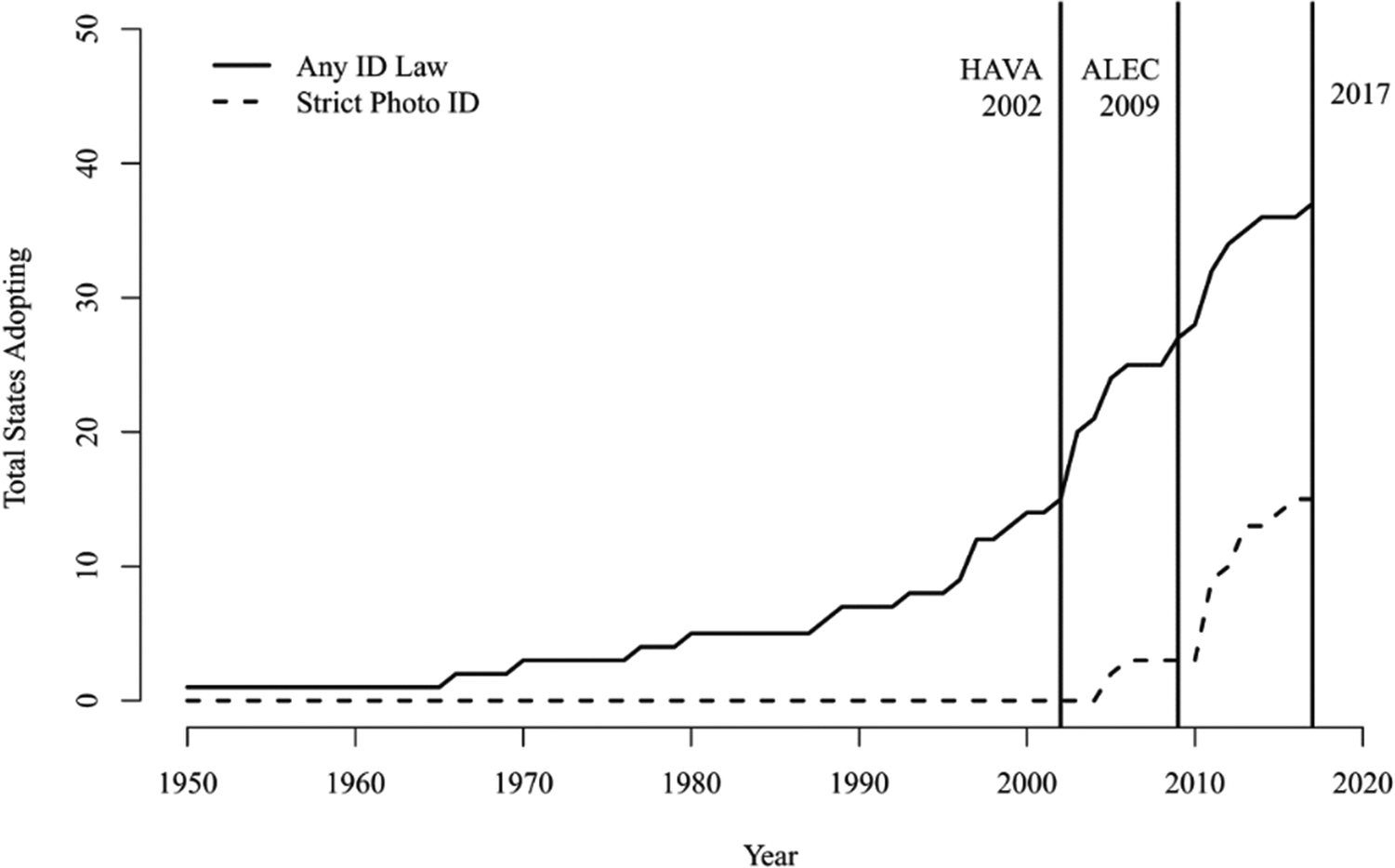
The diffusion of strict voter identification laws also captures the five peripheral assumptions of policy simplicity, similarity, adoption speed, problem scope, and implementation variance. Election regulation has been classified previously as a low-complexity, yet highly salient, issue area (Gormley Reference Gormley1986) that would be prone to rapid diffusion (Nicholson-Crotty Reference Nicholson-Crotty2009). Figure 3 illustrates how quickly strict photo ID laws spread and the apparent role that the social network of lawmakers played in increasing adoptions. The solid line represents the spread of any voter identification law since the first one was adopted by South Carolina in 1950.Footnote 3 States gradually adopted voter ID bills between 1950 and the passage of the Help America Vote Act (HAVA) in 2002 (Biggers and Hanmer Reference Biggers and Hanmer2017; Hicks et al. Reference Hicks, McKee, Sellers and Smith2015). There is a distinct jump, however, in strict photo identification laws (dashed line) after ALEC adapted Florida’s legislation into model legislation in 2009.Footnote 4 Whereas previous voter ID laws paved the way for the introduction of stricter laws in many states (Hicks et al. Reference Hicks, McKee, Sellers and Smith2015), the diffusion of strict voter ID policies similar to ALEC’s model has driven the overall adoption of any voter ID laws after 2009. This pattern of rapid diffusion after promotion within networks of lawmakers is common (Garrett and Jansa Reference Garrett and Jansa2015).
Cumulative Adoptions of All Voter ID and Strict Voter ID Laws

Figure 3 Long description
The line graph plots total states adopting voter I D laws on the y-axis, ranging from 0 to 50, against years on the x-axis from 1950 to 2020. The solid line represents any I D law, and the dashed line represents strict photo I D. Both lines remain near zero until the late 1990s. The solid line rises gradually, then sharply increases after 2002, reaching about 35 states by 2017. The dashed line begins to rise after 2002, with a steeper increase after 2009, reaching about 10 states by 2017. Three vertical lines mark key years: H A V A 2002, A L E C 2009, and 2017.
As for problem scope, there is scant evidence that voter fraud is a serious concern across the states (Minnite Reference Minnite2010). Finally, implementation variation was evident during the 2016 presidential primaries. Some states with strict voter ID laws experienced smoother implementations than others, particularly in the first year (Fischer, Garrett, and Whitaker Reference Fischer, Garrett and Whitaker2016). Furthermore, several states, like Pennsylvania, had their strict photo ID laws struck down by their state courts, thus preventing their implementation.
Nonpartisan Case Study in Socialization: ULC Model Policy Diffusion
The case of the diffusion of strict voter ID laws provides evidence supporting the core and peripheral assumptions of elite socialization diffusion. However, this evidence cannot eliminate the possibility that strict voter ID is driven by partisan motivation alone. As Highton (Reference Highton2017, 152) notes in his review of the voter ID literature, there is an “intensely partisan nature of the adoption of voter identification laws.” Although partisanship alone cannot explain the patterns we observe in the peripheral assumptions, such as the rapidity of diffusion, it is the case that strict voter ID laws were only passed by unified Republican legislatures (Highton Reference Highton2017). Thus, even though there is distinct pressure emerging from the ALEC network around free-market norms and associated model policies and the resulting patterns of diffusion differ from what we would expect from purely partisan efforts, the significant overlap in the case of voter identification makes it difficult to fully disentangle the two.
Thus, we provide a second illustration of elite socialization using a nonpartisan example: the diffusion of the Anatomical Gift Act (AGA). The AGA was first promulgated by the Uniform Law Commission (ULC) in 1968, with updates proffered in 1987 and 2006. The AGA specifies the process by which human organs and tissue are donated, including methods for registering as an organ donor, protections for individual organ donors, and rules and regulations for healthcare providers in harvesting organs and tissue.
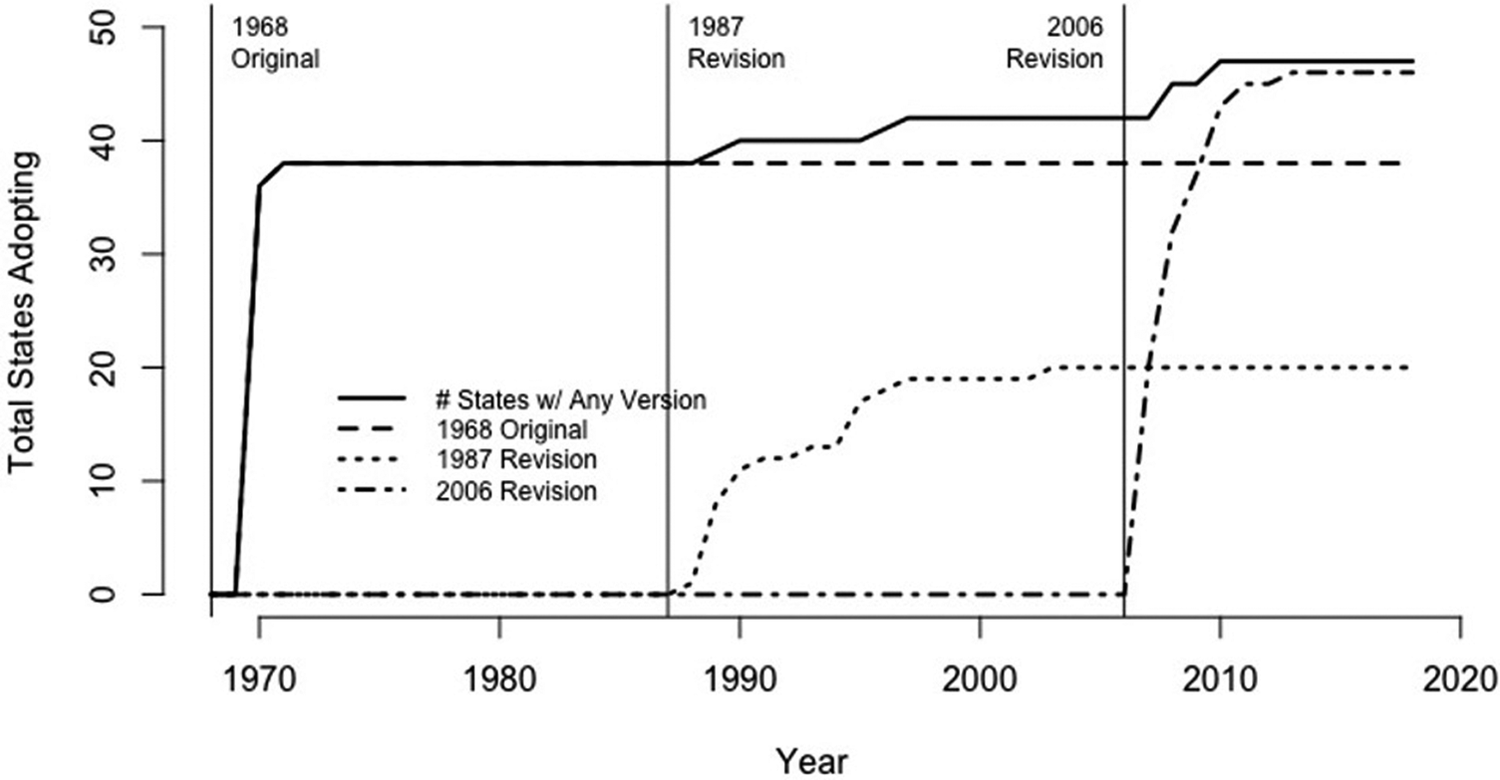
ULC delegates wrote the model AGA policy from scratch in the wake of the first successful organ transplant in 1967. The original version was rapidly adopted by 38 states thereafter. To date, only three states—Delaware, New York, and Pennsylvania—have not adopted any version of the AGA. Figure 4 shows the pattern of cumulative adoptions for the AGA. The adoptions follow a clear pattern of spikes following the introduction of each new version of the model bill from ULC, adding to the cumulative total of states with a version of the law over time.
Cumulative Adoptions of Anatomical Gift Acts

Figure 4 Long description
The x axis is labeled Year, ranging from 1970 to 2020. The y axis is labeled Total States Adopting, ranging from 0 to 50. Four lines are shown: a solid line for number of states with any version, a long dashed line for 1968 Original, a dotted line for 1987 Revision, and a dash-dot line for 2006 Revision. The solid line rises steeply to about 40 by 1970, then gradually increases to 50 by 2010. The 1968 Original line rises rapidly to about 40 by 1970 and remains flat. The 1987 Revision line starts rising around 1987, reaching about 20 by 2000, then flattens. The 2006 Revision line starts rising sharply after 2006, reaching about 45 by 2010, then flattens. Vertical lines mark the years 1968, 1987, and 2006, corresponding to each revision. The legend at left identifies each line style.
Core Assumptions
The spread of AGA policy adoptions fits the core assumptions associated with socialization diffusion. First, the AGA policy spread through an identifiable network of elites. The ULC is a nonpartisan interstate organization that offers model bills aimed at bringing uniformity to state law. It comprises delegations of lawyers and legislators from each of the 50 states who form committees to draft, study, and promote model bills.
The ULC network incentivized adoption of the AGA by substantially lowering the costs of policy making for legislators. It provided “enactment kits” to accompany the model bill, which provided a normative justification for adoption. Legislators could adopt the model whole cloth to both increase the availability of organs and tissue for those in need and to create uniformity across the states. The policy network also brought medical professional organizations together with ULC members and legislators. The American Association of Tissue Banks, Association of Organ Procurement Organizations, the Cornea Society, Eye Bank Association of America, and National Kidney Foundation all endorsed the 2006 revised version of the AGA.
Second, there were strong norms of appropriateness that accompanied the dissemination of the AGA. In the enactment kit for the 2006 AGA revision, ULC (2024) issued this normative call to action:
Every hour another person dies waiting for an organ transplant. Despite significant technological improvements and numerous publicity campaigns over the past several decades, the substantial shortage for organs, tissues and eyes for life-saving or life-improving transplants continues. [We have] promulgated the Uniform Anatomical Gift Act (2006) to further improve the system for allocating organs to transplant recipients.
From the extended network, medical professional organizations extolled the reasons why states should adopt the AGA. For example, Dr. Michael X. Repka (Reference Repka2006) of the American Academy of Ophthalmology stated that the AGA would “greatly enhance the opportunity for donation and transplantation of precious life giving and life enhancing anatomical gifts.… Uniformity among the states is critical to ensure that a donor’s wishes will be honored to the greatest possible extent.” The calls for action from medical and legal professionals represented conformity pressure on lawmakers to stay in step with other elites.
From the advent of the AGA, proponents made the case for uniformity, or else legislators would be out of step with the times. Writing in the Journal of the American Medical Association, legal and medical proponents highlighted the normative movement happening among elites in the policy network: “The legal profession has reached a consensus on this highly complex area…. The medical community is progressing towards a similar consensus…. It now remains for…both professions to support the adoptions of the Uniform Anatomical Gift Act in their respective states” (Sadler, Sadler, and Stason Reference Sadler, Sadler and Stason1968, 2504). The authors devoted a substantial portion of their article to the lack of uniformity across the states and noting that even the most up-to-date state laws lacked the comprehensiveness of the AGA’s 13 policy provisions.
That norm change over time is also evident in this case. As ULC (2025) described in its 50-year retrospective on the AGA, “[The AGA] stipulated for the first time, that an individual, upon death, could donate his or her organs for medical purposes by signing a simple document before witnesses…. [This] represented a departure from centuries of common-law precedent, which held that a body immediately after death became the property of the next-of-kin.” In contrast, opponents of the policy highlighted the rapid norm change advocated by medical and legal proponents. Writing soon after its introduction, Groll and Kerwin (Reference Groll and Kerwin1971) noted how the AGA departed from English common law, American case law, and accepted norms of decent burial such as expediency, keeping the body intact, and honoring the wishes of the deceased. The authors criticized the law as silent-by-design on affirming a right to a decent burial, instead arguing it transferred decision-making authority to the next-of-kin even if there was no clear statement from the deceased regarding organ donation. Lamenting the rapid norm change, Groll and Kerwin (300) wrote colorfully, “Firm, loyal precepts … have been precipitously and shrewdly cast to the winds, to fall upon the fields of pre-transplant oblivion. And hardly anyone is the wiser.”
Peripheral Assumptions
The spread of the AGA exhibits several markers consistent with the peripheral assumptions of elite socialization diffusion. First, the policy spread quite quickly. As figure 4 shows, 38 states adopted the initial version of the AGA within four years of its introduction. After the ULC issued each update, states moved to adopt the new version quickly. Other scholarship notes the speediness of AGA uptake, with speed scores for both the 1968 original and 2006 update being in the top 20 of more than 600 policies scored (Menon and Mallinson Reference Menon and Mallinson2022). And Savage (Reference Savage1985) called the original AGA a textbook example of rapid policy diffusion.
Second, state versions of the AGA are worded similarly to the ULC model bill and to one another, indicating the copying that is characteristic of diffusion by socialization, rather than a more deliberate learning and reinvention process. In their examination of the textual similarity of state laws, Hansen and Jansa (Reference Hansen and Jansa2021) found that, of the 18 policies they studied, state AGAs were the most like one another.
Third, even with similarly worded statutes, there is wide implementation variance across the states. Writing about the 2006 update, Kurtz and Woodward Strong (Reference Kurtz and Strong2007, 45) noted,
Anatomical gift laws are hardly uniform…. Many states…enacted unique versions, touching upon diverse issues as donor-card signatures, death-record reviews, medical-examiner cooperation, tax incentives, and drivers’ license donor registries. Non-uniformity is exacerbated by the fact that many states’ anatomical gift acts fail to resolve choice-of-law and conflicts issues, such as how to deal with a document of gift drafted in a state other than the one in which the donor dies.
Variation in states’ customization of the law creates the potential for differences in implementation, which can be measured by the effectiveness of the policy in registering organ donors. Dorrell and Jansa (Reference Dorrell and Jansa2022) find that states whose AGA was more customized were more successful at registering organ donors, whereas states whose AGA were less customized were less successful. In these cases, lawmakers likely followed emerging norms and imported a one-sized-fits-all solution designed for uniformity, rather than effectiveness. Finally, a peripheral assumption that is only partially met is policy simplicity. Using automated text analysis to measure policy complexity, Hansen and Jansa (Reference Hansen and Jansa2021) find state AGA laws are, on average, less complex than many others (ranked twelfth of 18 policies) but still register at a college-graduate reading level.
Overall, the diffusion of AGA fits with the dynamics we expect to see when policies spread by elite socialization diffusion. The policy was pushed by a network of legal and medical professionals seeking to create uniformity and increase the availability of organs and tissues for transplantation. Former and current lawmakers from all 50 states were part of this network, and the change in norms—that adopting the law was appropriate to keep up with the times—led to the rapid adoption of versions of the AGA across the states. Although individual actors were key in creating and disseminating the innovation, and policy spread happened within the network, the policy actors were influenced by an exogenous shock: the advent of organ transplant technology. Having provided two illustrative examples of socialization diffusion, we now turn to offering a research program for further testing this mechanism.
A Research Agenda
Novel research questions emerge from the theory of elite socialization diffusion we presented. Although our lists of questions are not exhaustive, they can provide a way forward in studying socialization diffusion. The core and peripheral assumptions raise several interesting and novel questions that have yet to be answered by researchers. The first set of unanswered questions concerns policy diffusion generally:
-
1. What is the structure of policy networks among state legislators?
-
2. Do those networks include, as either strong or weak ties, peers from other states?
-
3. To what extent do legislators’ networks influence their search for information?
-
4. Are states more likely to adopt policies promoted by the networks to which their members belong than similar policies that emerge from other sources?
-
5. What are the consequences of elite socialization for policy implementation? Are there implementation problems with policies that spread rapidly or that are copied, especially among resource-poor states?
-
6. Are there states adopting solutions to problems they do not have or have to a much smaller degree than other states? Is this due to elite socialization?
-
7. How do norms of appropriateness emerge within policy networks and how do they permeate state legislatures?
-
8. Is elite socialization dependent on legislators being members of the network? If not, how do norms of appropriateness travel from members to nonmembers?
-
9. Is legislative behavior (e.g., sponsorship activity) more similar among network members across states than it is between members and nonmembers in the same state?
An additional set of unanswered questions may be asked about prominent policy networks in the US federal system:
-
1. How has polarization affected weak ties with members of the opposition party? And absent weak ties among legislators, are stronger ties being formed with likeminded legislators across states within ideological policy networks like ALEC or SiX?
-
2. Is the influence of ideological policy networks like ALEC dependent on party control of state government in a way that of other organizations is not (e.g., the ULC)?
-
3. Are non-ideological policy networks, like ULC, more effective because they are not dependent on party control? Using ALEC as an example, are its bills likely to be copied quickly but only among a narrower set of states?
-
4. When lawmakers are members of multiple, overlapping interstate policy networks, how do they respond to conformity pressures that may be reinforcing or cross-cutting?
-
5. Do the core and peripheral assumptions of elite socialization diffusion hold in the context of identity-based policy networks, such as the National Black Caucus of State Legislators (NBCSL) or the National Hispanic Caucus of State Legislators (NHCSL).
Researchers have not been silent on all these questions, but their work has not been explicitly tied to the diffusion process.
Answering these questions will require a substantially different approach to studying policy diffusion. Following Berry and Berry (Reference Berry and Berry1990), much of the research on policy diffusion in the United States uses macro-level Event History Analysis. This approach is valuable because it allows for the testing of additional policies and theoretical advancements; however it has significant limits in terms of generalizability and replication of new findings (Boehmke Reference Boehmke2009a; Mallinson Reference Mallinson2021). Other prevailing methodologies, like measures of adoption speed, pooled EHA, and dyadic EHA (Boehmke Reference Boehmke2009a; Reference Boehmke2009b; Mallinson Reference Mallinson2016a; Menon and Mallinson Reference Menon and Mallinson2022; Nicholson-Crotty Reference Nicholson-Crotty2009; Volden Reference Volden2006), can provide answers to some of our questions. Many of these methods, however, only test macro-level observable implications, some of which may be tied to peripheral assumptions. Advancements in measuring policy similarity and complexity may also provide some insights but again only test macro-level observable implications.
If diffusion is ultimately a social process, as broader theory assumes (Rogers Reference Rogers2003), then policy diffusion researchers must use a variety of other approaches to fully understand its dynamics in a complicated federal system. First, understanding the causal process requires analyzing both macro-level indicators (e.g., the order and speed of adoptions by states) and the locus of interaction between policy actors (e.g., connections between legislators). Accomplishing this task requires a mixture of qualitative and quantitative methods. A great deal more research must be done, for example, on the networks themselves. Ethnography is necessary to understand how the organization works; that is, its norms, and how relationships are built among legislators and corporate members. Additional interview and survey research conducted on state legislators willing to speak about the networks to which they belong could also be useful for understanding the development and dissemination of norms as leveraged into policy outcomes. Here, Kingdon’s (Reference Kingdon2011) work on agenda setting provides a basis for understanding how social interactions matter and how norms may be transferred via social connections. Furthermore, Ayoub (Reference Ayoub2014) demonstrates that the combination of quantitative country-level analysis and deeper qualitative interviewing proved powerful in explicating socialization forces among members of the European Union.
It is also important for diffusion research to corroborate ALEC’s and other organizations’ claims regarding their effectiveness in influencing state policy. Hertel-Fernandez and coauthors provide an excellent starting point, but much of their work speaks to the interest group literature, particularly how ALEC is a tool for pro-business lobbying (Hertel-Fernandez Reference Hertel-Fernandez2019; Hertel-Fernandez, Skocpol, and Lynch Reference Hertel-Fernandez, Skocpol and Lynch2016). Diffusion scholars should uncover the effect that ALEC has had on policy diffusion and address the question of how its centralized role in disseminating policy, particularly as the states became increasingly polarized, affects our basic assumptions about policy diffusion over the past 40 years (Yingling and Mallinson Reference Yingling and Mallinson2024). The emergence, disappearance, and reemergence of social issues on ALEC’s agenda could provide one means of testing the organization’s influence on policy adoption. Studying how state adoption patterns changed after ALEC’s production of model language, particularly as it increasingly took on issues diverging from its promotion of free markets (e.g., voter ID), would provide insight into its effect on policy diffusion more broadly.
Although our article is motivated by the critically important rise in interstate policy networks like ALEC, we note that it is not a core assumption of elite socialization that networks are ideological in nature. Indeed, some of the most influential networks may be identity-based or organized around other shared goals. The ULC provides information online that could provide a wealth of data for scholars looking to better understand the elite socialization mechanism and wanting to apply the theory beyond ALEC. One can find ULC’s (2023a, 2023b) values and goals, membership, model bill texts, and introductions of those bills across the states on their website.
The emerging application of network analysis to policy diffusion research is also promising for understanding socialization diffusion. These methods are presently applied at the macro level by examining state-to-state networks (Desmarais, Harden, and Boehmke Reference Desmarais, Harden and Boehmke2015; Garrett and Jansa Reference Garrett and Jansa2015). Once again, however, such methods could be applied to individual members to understand how ALEC, SiX, and other networks affect the spread of policy information, political information, and norms. However, reliance on observational research makes it difficult to untangle whether or how social pressure independently affects behaviors and whether changes in behavior are due to compliance or private acceptance. Indeed, social conformity is a difficult concept to measure without live interaction (Mallinson and Hatemi Reference Mallinson and Hatemi2018). Although much has been gained through observational research, even when causal models are specified, causal relationships are assumed, and the specific causal influence of social conformity often remains unknown.
Experiments provide another means for understanding the effects of norms and conformity pressures on elites (Butler Reference Butler2018; Butler, De Vries, and Solaz Reference Butler, De Vries and Solaz2019; Butler and Pereira Reference Butler and Pereira2018; Butler et al. Reference Butler, Volden, Dynes and Shor2017). Although challenging to design in a way that provides enough control to isolate the causal mechanism, field experiments have been successfully conducted to differentiate the effects of policy success versus ideology on policy learning (Butler et al. Reference Butler, Volden, Dynes and Shor2017) and the informational cues of party labels (Butler and Pereira Reference Butler and Pereira2018). There is also emerging research that directly engages political elites, namely state legislators, as participants in laboratory research. Butler and Kousser (Reference Butler and Kousser2015) worked with the Council of State Governments for their experiment on public goods provision, but this could also be done with a group like the National Conference of State Legislatures. An alternative approach to directly studying elites is to perform a series of experiments that flesh out the expected causal mechanism driving elite behavior to (1) better understand the mechanism and (2) develop externally observable behaviors that typify the underlying causal mechanism. Broader experiments on social conformity in politics are useful for understanding the micro-process underlying conformity and identifying observable indictors of conformity behavior (Mallinson and Hatemi Reference Mallinson and Hatemi2018). Researchers can then test these expectations by observing elite behavior, or even through elite interviews, to draw more reliable inferences from their actions. Granted, caution is necessary given that experiments conducted with students may not yield the same results as those with elites (Butler and Kousser Reference Butler and Kousser2015).
Finally, text analysis is emerging as a powerful tool for conducting diffusion research (Jansa, Hansen, and Gray Reference Jansa, Hansen and Gray2019; Linder et al. Reference Linder, Desmarais, Burgess and Giraudy2020). Even Walker (Reference Walker1969) used the copying of typos from bill to bill as a means of illustrating the diffusion of innovations. Text analysis can help diffusion scholars identify who is copying what from whom, including the extent to which model legislation is being copied (Burgess et al. Reference Burgess, Giraudy, Katz-Samuels, Walsh, Willis, Haynes and Ghani2016).
Conclusion
Everett Rogers (Reference Rogers2003, 6) suggested that “diffusion is a kind of social change, defined as the process by which alteration occurs in the structure and function of a social system.” In other words, innovation diffusion is an inherently social process, regardless of whether it is spontaneous or planned. However, given that most studies of policy diffusion are conducted using macro-level adoption data only, the extant research misses the dynamics occurring between legislators (Butler, De Vries, and Solaz Reference Butler, De Vries and Solaz2019). Indeed, within each mechanism there are legislators deciding whether to respond to policy experiments in other states, interstate competition, federal incentives, changes in public opinion, and normative pressure from their networked peers. Thus, the diversity in findings across the large body of single-policy diffusion studies that use the state-year as their unit of analysis (Mallinson Reference Mallinson2021) likely comes from differences in the variegated causal mechanisms that operate at the micro level.
This article offers a theoretical structure for differentiating five mechanisms of policy diffusion based on the level of interaction between legislators and the source of innovation and whether innovations are pushed on or pulled into states by relevant interests. It further establishes a theoretical foundation for explaining socialization diffusion occurring within the American federal system. Finally, it sets forth a research agenda including testable research questions and methods for testing socialization diffusion beyond those widely used by diffusion researchers. Given revelations about ALEC’s success in the states over the past 40 years, this mechanism is important for understanding diffusion and will become increasingly so as state governments become the locus of policy making across a range of domains in the US federal system.
One need only observe what is happening with transgender athlete legislation and restrictive voting bills introduced and adopted in many states since the 2020 election to understand the importance of this mechanism. Both are cases of rapidly spreading policy solutions seeking a problem for which there is little evidence in either case. Further, ALEC has been involved in the proliferation of voting restrictions. Understanding how organizations create, maintain, and leverage their networks of elites is important for understanding how they shape the diffusion of innovations across the states. There is a fundamental good governance assumption that underlies diffusion by social learning, with legislators seeking to find the best solutions to social problems. Differentiating socialization will help scholars of policy diffusion and legislative behavior better understand when good governance motivates elites to enact policies and when they are motivated by alternative concerns.
Acknowledgments
The authors would like to thank the participants of Oklahoma State University’s Public Policy Analysis seminar for invaluable feedback.

 Open access

