

Introduction
In recent decades, non-fiction comics have emerged as powerful forms of witnessing, documentation, and critique. From Spiegelman’s Maus (Reference Spiegelman1987) and Satrapi’s Persepolis (Reference Satrapi2000) to Sacco’s Palestine (Reference Sacco1996) and Safe Area Goražde (Reference Sacco2000), the comics medium has proven its capacity to convey historical trauma, political conflict, and multiple forms of memory through visual narration. Following Kuhn (Reference Kuhn2010), memory is understood as a dynamic process and performative activity: it is socially and culturally mediated, constructed through narrative, ritual, and material culture, and always situated at the intersection of the personal, the private, and the collective. In this sense, comics function as memory texts, where fragmentation, montage, and visual metaphor enact the structure of remembering rather than simply recounting historical events. Memory in this context can be conceptualized as personal (individual recollection), collective (shared social narratives), political (contested or ideologically mediated histories), and embodied (trauma or experience inscribed in the body and affect). These works have established the comics form as a legitimate mode of historical and autobiographical inquiry (Chute Reference Chute2016; Gardner Reference Gardner2020). Maus combines visual metaphor and narrative fragmentation to explore intergenerational trauma caused by the Holocaust. Persepolis documents personal and political memory of Iran during the Islamic Revolution, through a blend of diary-like reflection and historical contextualization. Sacco’s reportage works render firsthand experiences of conflict, merging journalistic observation with sequential art to convey both factual and emotional truths.
While much has been written about the role of literature, film, journalism, and comics in preserving marginalized histories and challenging authoritarian regimes (Neria and Aspinwall Reference Neria and Aspinwall2016; George and Liew Reference George and Liew2021; Dragomir Reference Dragomir and Moy2023; Coby, J. and Davis-McElligatt Reference Coby and Davis-McElligatt2024), less attention has been given to comics-making itself and how it engages with urgency. Whether through rapid response or reflective storytelling, the potential of comics-making as a process and site of resistance remains underexplored, particularly in how urgency shapes aesthetic, narrative, and mnemonic strategies of artists.
Comics can capture the ambiguity between individual and collective memory, which Halbwachs (Reference Halbwachs1992) suggests is rooted in intersubjective remembering where histories are not only documented but also reconstructed and reframed, actively shaping collective consciousness, a dynamic that, in comics, unfolds through visual storytelling. In this sense, comics-making shares key characteristics with another form of artistic resistance: the essay, which operates at the intersection of personal reflection and collective historical context (Arthur Reference Arthur2003). Its hybrid nature, which merges knowledge and art (Adorno et al. Reference Adorno, Hullot-Kentor and Will1984), along with its exploratory approach, makes it particularly suited for revisiting and reinterpreting lived experiences, much like how comics layer past and present through visual storytelling. Film critic Paul Arthur observes that the essay form in film has been used by women and artists of colour as an instrument of creative struggle (Arthur, cited in Rascaroli Reference Rascaroli2008). This parallel provides a foundation for understanding how comics-making can embody the essayistic tradition of resistance that merges introspection, critique, and reimagination of dominant narratives (Magnussen et al. Reference Magnussen, Cour and Platz Cortsen2015). A growing body of scholarship has identified essayistic tendencies in both comics-making and the ways comics are discussed (Hatfield Reference Hatfield2009; Fischer Reference Fischer2010; Wilde Reference Wilde2023).
Craig Fischer (Reference Fischer2010) identifies three dominant modes of writing about comics, namely, fan appreciation, essayistic criticism, and academic criticism. For Fischer, the essayistic criticism occupies a middle ground between the enthusiasm of fan writing and the theoretical rigour of academic analysis. It combines personal reflection with critical evaluation, often adopting the tone of personal essay to engage both affectively and intellectually with comics as a medium. Charles Hatfield traces the rise of alternative and autobiographical comics in the North American post-underground scene as a reaction against commercial superhero genres, emphasizing their embrace of realism, reflexivity, and cultural critique. While he does not define the ‘essay comic’ as a distinct form, his observation that post-underground comics often ‘refuse fiction altogether, favouring history, reportage, the essay, and the memoir’ (Reference Hatfield2009, 11) anticipates later notions of essayistic comics as reflective, discursive practices grounded in lived experience and social engagement. He similarly reads Maus as an essay, highlighting its self-reflexive engagement with history, memory, and representation (Reference Hatfield2009, 139).
While the notion of the essayistic has entered both critical and creative discussions of comics, its conceptual boundaries remain unsettled. Johannes Schmid (Reference Schmid2021) references essayistic comics alongside autobiographical and documentary works, yet the discussion remains illustrative rather than definitional. Elizabeth Woock (Reference Woock2023) invokes the notion of the essayistic when describing the tone and the scope of research comics but does not offer a systematic account of what constitutes the essayistic approach. Instead, she focuses on the researcher’s embodiment in comics-based academic communication and explores how the author-artist might appear as narrator, character, or visual presence on the page. Similarly, in Japan, Yoshiko Okuyama (Reference Okuyama2022) identifies tōjisha manga , autobiographical comics recounting experiences of mental or neurological conditions, as a form of essay manga. She defines essayistic comics as works that blend narrative and reflection through the interplay of image and text to convey personal insights and humanize experiences, particularly those marginalized in society. While Schmid, Woock, and Okuyama foreground content-specific qualities of essayistic comics, highlighting reflexivity, self-inscription, and engagement with personal or marginalized experiences, Lukas Wilde (Reference Wilde2023) complements this view by focusing on the formal and semiotic dimensions of the medium. Rather than asking what essayistic comics contain, Wilde interrogates how they work: coherence emerges not from diegetic continuity or stable storyworlds but from discursive reflection, thematic juxtaposition, and verbal-visual argumentation. Wilde demonstrates how authorial subjectivity, rhetorical play, and diagrammatic visualization can replace story-driven logic.
Building on these frameworks, our research extends the notion of the essayistic beyond its semiotic or narratological features, and towards understanding essayistic comics-making as a methodological approach that operates at the intersection of practice-led and practice-based inquiry. In doing so, we acknowledge and mobilize the distinction between these two research paradigms. Our work is practice-led insofar as the creative process, the iterative acts of drawing, reflecting, and revising, serves as the primary mode of inquiry through which new understandings of practice emerge. At the same time, it is practice-based in that the completed comics themselves function as research outputs, embodying knowledge in their visual and narrative forms. As several authors have noted, the terminology surrounding artistic research, particularly the distinctions between practice-based, practice-led, and practice-as-research, remains fluid and contested. Rather than treating these categories as fixed, our approach mobilizes them heuristically to articulate how essayistic comics-making operates simultaneously as a site of inquiry and as a form in which knowledge is materially embodied (Borgdorff Reference Borgdorff2006; Candy Reference Candy2006; Cerezo Reference Cerezo2016). Within this integrated framework, we introduce the concept of urgency to articulate the specific conditions under which such practice unfolds. Urgency allows us to account for the political-ethical, epistemic, and aesthetic pressures that shape artistic decision-making in real time, transforming immediacy into sustained inquiry. The essayistic mode, in this sense, enables the artist to hold together multiple temporalities, perspectives, and narrative possibilities, accommodating uncertainty, contradiction, and layered meanings.
Essayistic practice as research
This project adopts a practice-led and practice-based essayistic approach, where comics-making is not merely a creative act but a method of research and knowledge production. Understanding emerges through doing, reflecting, and iterating, with the act of drawing itself shaping perception and thought. Through sequential art, the research engages with complex social, political, and personal phenomena, embracing ambiguity, dialogic reflection, and open-ended experimentation as essential components of the process.
While this approach resonates with the broader field of comics-based research (CBR), which explores the communicative, semiotic, and narrative affordances of comics across disciplines (Kuttner et al. Reference Kuttner, Weaver-Hightower and Sousanis2021), our approach departs from the instrumental use of comics as a representational tool. Instead, drawing, sketching, and sequencing are treated as epistemic practices, forms of thinking-in-action through which understanding emerges. This distinction aligns with the essayistic mode, which privileges exploration over conclusion and invites the artist-researcher to engage critically and emotionally with the world they study (Caduff Reference Caduff2014). In this sense, comics-making becomes both a site and method of research, where creation itself constitutes argument.
Practice-led research acknowledges that sketches, drafts, visual experiments, and narrative decisions function simultaneously as expressive artefacts and research data (Ingold Reference Ingold2013; Kuttner et al. Reference Kuttner, Sousanis, Weaver-Hightower and Leavy2017; Leavy Reference Leavy2020; Radanović et al. Reference Radanović, Vansieleghem and Vande Winkel2025). Drawing has long been recognized as a fundamental mode of thinking and inquiry. Lynda Barry emphasizes that drawing is one of our oldest ways of ‘working things out’ (Reference Barry2010, 223), allowing ideas to emerge through the act itself rather than solely through language. Similarly, Nick Sousanis reflects on his creative process, noting that in rough sketches, a hybrid of notes and drawings, ideas begin to take shape (Kuttner, Sousanis and Weaver-Hightower Reference Kuttner, Sousanis, Weaver-Hightower and Leavy2017). In these visual experiments, the act of drawing enables him to perceive connections and patterns that might otherwise remain unseen, and the direction of his inquiry is guided by the drawings themselves rather than predetermined outcomes. In this sense, drawing functions as both a reflective and generative tool, allowing the researcher to think through, rather than merely represent, complex ideas. Building on this, the essayistic attitude introduces an epistemic openness that privileges process over polished output. Sketches, annotations, and sequential drafts serve not only as a preparatory work but as moments of discursive reflection and spaces where the artist negotiates between observation and interpretation. This resonates with Ingold’s (Reference Ingold2007, Reference Ingold2013) notion of ‘taking the line for a walk’ and Klee’s (Reference Klee and Moholy-Nagy1953) idea of a line developing freely, without predetermined endpoints. The structural affordances of comics, sequencing, framing, layout, and the interplay of image and text enable the construction of visual arguments, allowing knowledge to emerge from the interplay of practice, reflection, and representation (Lefèvre Reference Lefèvre2011; Chute Reference Chute, Bray, Gibbons and McHale2012; Kuttner et al. Reference Kuttner, Sousanis, Weaver-Hightower and Leavy2017).
Data emerge through multiple interrelated forms: primary materials (sketches, storyboards, drafts, final comics pages) document decision-making and the evolution of the work; secondary materials (historical accounts, media reports, scholarly texts) provide contextual grounding and inform narrative framing; and reflexive notes (research diaries, annotations) capture ongoing processes, choices, and reflections. The research procedure is cyclical and reflexive: conceptualization defines the guiding questions, visual experimentation explores narrative and formal strategies, drafting and peer feedback iteratively refine both artwork and argument, and reflexive annotation captures emergent insights and shifting perspectives (Newbigging Reference Newbigging2017; Radanović et al. Reference Radanović, Vansieleghem and Vande Winkel2025).
Analysis is thus inseparable from creation, emphasizing reflection and emergent understanding rather than purely post hoc evaluation. Strategies include the following: visual and narrative analysis, which examines how sequences, panels, and text–image relationships convey argument, emotion, or insight (McCloud Reference McCloud1993; Chute Reference Chute, Bray, Gibbons and McHale2012, Reference Chute2016; Szép Reference Szép2020); thematic mapping, identifying recurring motifs, conceptual juxtapositions, or reflective interventions across iterations (Radanović et al. Reference Radanović, Vansieleghem and Vande Winkel2025); and processual insight, considering how iterative drafting and revision shape understanding and allow emergent knowledge to guide the work (Ingold Reference Ingold2013; Kuttner et al. Reference Kuttner, Sousanis, Weaver-Hightower and Leavy2017, Reference Kuttner, Weaver-Hightower and Sousanis2021). This approach reframes production as a form of reasoning, as an ongoing negotiation between knowledge, affect, and material practice. As Berger (Reference Berger1976) reminds us, to draw is to ‘look’, to engage ethically with the world, and to notice what might otherwise go unseen. Such attentiveness constitutes a critical mode of research, one that acknowledges that artistic choices are never neutral but are shaped by moral, intellectual, and aesthetic pressures.
Moments of immediacy and responsiveness naturally arise, as the artist-researcher navigates both ethical and conceptual stakes of the work. These moments reveal that creative decisions are not neutral but often guided by pressing concerns and demand attention and action in the moment of making. It is from this dynamic interplay between reflection and responsiveness that the concept of an ecology of urgency emerges. Political-ethical, epistemic, and aesthetic pressures shape not only the content of the work but also the manner, intention, and engagement of the audience. Essayistic comics-making can thus be understood as a manifestation of this ecology of urgency, where immediacy, reflection, and material experimentation co-exist.
While the visual-textual affordances of comics enable the layering of personal and collective memories, narrative, and reflection, their critical or resistant potential is not inherent to the medium. Rather, these capacities are activated through situated practice, iterative decision-making, and the ethical and political commitments of the artist-researcher. In other words, comics do not automatically resist hegemonic narratives or convey counter-memory; their transformative power emerges through the interplay of formal experimentation, reflective practice, and contextually informed artistic choices. Seen in this light, practice-based inquiry in comics highlights the inseparability of medium, method, and context: the act of making is simultaneously an epistemic, ethical, and political engagement.
It is important to note that the medium itself is politically malleable and equally capable of serving hegemonic ends, as evidenced by the Bal Narendra comic series in India, which mythologized Prime Minister Narendra Modi’s childhood to cultivate a nationalist persona. From wartime propaganda comics to commercial advertising, the persuasive power of the form is ideologically neutral (Murray Reference Murray2011). The works of Satrapi, Spiegelman, and Sacco are powerful not because of any innate property of the comics medium but because of the specific artistic, ethical, and political commitments they embody. A sharper analysis must, therefore, distinguish between the potential of the medium’s formal features, its capacity to juxtapose, layer, and subjectivize, and the actual political work achieved by particular comics within their contexts. Recognizing this tension is essential to move beyond romanticism and towards a more rigorous understanding of how artistic practices can sustain resistance in the face of co-option and simplification.
Ecology of urgency
In our practice, urgency unfolds as a dynamic process, emerging with our engagement with crises, knowledge, and material form. Rather than proposing a unified or exhaustive taxonomy, we frame urgency as a series of relational and iterative dimensions that shape how we act, think, and draw. These dimensions, political-ethical, epistemic, and aesthetic, reflect patterns we have recognized in our own artistic practices, rather than discrete or universally applicable categories. They are phases or modes of responsiveness that emerge in relation to context, reflection, and form-making. Each dimension draws on distinct intellectual lineages such as rhetorical theory (Bitzer Reference Bitzer1968; Hatfield Reference Hatfield2010), moral philosophy (Porter Reference Porter2024), and sociological and phenomenological accounts of temporality (Rosa Reference Rosa2018; Wolf and Weber Reference Wolf and Weber2023), and it reflects a particular mode of responsiveness to crises, knowledge, or lived experience.
Through our artistic practices, we noticed that urgency is not a singular concept but manifests through multiple, entangled forms of responsiveness. Essayistic approaches to comics-making provide a material site, where these heterogeneous urgencies converge, overlap, and become visible through practice. Operating between reflection and immediacy, the essayistic mode allows artists to linger in tension, contradiction, and incompleteness and enable them to respond to crises ethically and reflectively without subsuming lived complexity under fixed meaning. Political-ethical urgency often emerges first in response to social, environmental, or political crises. It manifests as a call to act that is situated within contested ethical and political terrains and prompts conscientious engagement rather than purely reactive action. Drawing on Hatfield’s (Reference Hatfield2010) engagement with Bitzer’s (Reference Bitzer1968) notion of exigence, we understand urgency as a rhetorical and ethical construct, a perceived rather than an intrinsic condition that calls for creative and responsible response. Translated into the field of comics and visual research, this sense of urgency becomes palpable in how artists navigate witnessing, testimony, and advocacy, balancing the imperative to speak with the responsibility to reflect.
The cinematic essay, which became a key form of responding to the urgency of the post-war period and within the Third Cinema Movement, was described by Solanas and Getino as a ‘militant form of expression’ enabling ‘discovery through transformation’ (Alter and Corrigan Reference Alter and Corrigan2017, 11). Similarly, the essay comic can be a potent tool for imagining more nuanced ways of engaging with the most pressing urgencies of our times.
Examples of politically and ethically urgent comics include Indian cartoonists like Manjul and Rohan Chakravarty (Green Humour), who critique authoritarianism, environmental degradation, and caste-based and other forms of inequality, and Serbian cartoonists such as Dušan Petričić, Marko Somborac, and Predrag Koraksić (Corax), who expose political corruption and media manipulation. Beyond satire, Orijit Sen’s River of Stories (Reference Sen2019), supported by NGO Kalpavriksh, pioneered comics as a unique space for critical engagement (Sedgwick Reference Sedgwick2003; Chute Reference Chute2020; Laing Reference Laing2020), while initiatives like the People’s Archive of Rural India (PARI) use comics to address ecological justice and self-governance. Graphic novels such as Durgabai Vyam and Subhash Vyam’s Bhimyana (Reference Vyam, Vyam, Natarajan and Anand2011) and Srividya Natarajan and Aparajita Ninan’s A Gardner in the Wasteland (Reference Natarajan and Ninan2022) dismantle dominant caste histories, myths, and ideologies from an anti-caste perspective. Bhimyana not only tells the story of Dr. Ambedkar, the anti-caste leader and architect of the Indian Constitution, but reclaims it through the indigenous Gond art form, integrating narrative and the aesthetic intervention (Patil and Kesur Reference Patil and Kesur2025). Rachita Taneja’s webcomics Sanitary Panels critiques socio-political issues through stick-figure comics, gaining viral attention and legal backlash, while Sharad Sharma’s Grassroots Comics equip marginalized communities to tell their own stories in local languages, amplifying subaltern voices from villages to protest sites (Packalen and Sharma Reference Packalen and Sharma2008; Manivannan Reference Manivannan2025).
In Serbia and the region, works like Vratiti svoje vr(ij)eme (Reference Kalamujić and Jevđović2021) expose gendered labour inequalities, while associations such as Stripotetke (2020) foster feminist and socially engaged comics across the Balkans. Valentina Talijan’s project Umetnost Cveta (2025) blends comics, music, and video to raise awareness of species endangered by lithium mining in Serbia’s Jadar Valley. Sanja Djordjević’s List and Kist (2025) initially focused on positive stories but now address environmental and political crises through socially conscious comics. Political-ethical urgencies foreground the demand to act or intervene, but they inevitably raise questions about how and what can be known under such conditions, leading naturally into the epistemic dimension of urgency.
Epistemic urgency arises from the need to understand, interpret, and testify amidst uncertainty. Following the initial trigger of political-ethical concerns, the artist engages in iterative, reflective practices of sketching, annotating, and redrawing that transform the rush to know into a practice of thinking through drawing. In this process, the drawing implements itself becoming a transducer, translating bodily gestures and attention into material traces on the page so that thought and hand co-emerge in the act of drawing (Ingold Reference Ingold2013, 128). As Barry reminds us, ‘drawing is something that has to come out of your body’, emphasizing that it is not only the mind but also the body that thinks and knows through the hand (Reference Barry2019). Additionally, Barry emphasizes that creative thinking unfolds in the body: by allowing oneself to stand in uncertainty, stories, and images can gradually take shape under the hands, highlighting the embodied and exploratory nature of cognition. Porter (Reference Porter2024) conceptualizes urgency as a meta-normative demand that pre-empts deliberation: in urgent situations, individuals are expected to act decisively, and further reflection on less urgent considerations is not only unnecessary but inappropriate. Even when one does the ‘right thing’, excessive deliberation can constitute a failure to respond properly, a phenomenon Porter describes as doing the right thing in the wrong way. In contrast, essayistic approaches to comics-making reconfigure this dynamic by embedding reflection within action itself. Drawing on Bolt’s and Barrett’s conception of artistic practice as ‘the production of knowledge or philosophy in action’ (Reference Bolt and Barrett2014, 1), knowledge in this context is generated through doing and through the senses, a form of thinking-in-action that positions practice as both generative and reflective. As they argue, such practice-led inquiry constitutes a ‘new species of research, a generative enquiry’ (Reference Bolt and Barrett2014, 1), in which knowledge emerges reflexively from material engagement. Each mark, sequence, and page turn becomes a negotiation between immediacy and reflective thinking, allowing the artist-researcher to respond to aesthetic urgency iteratively while cultivating epistemic and ethical attentiveness.
Aesthetic urgency emerges through the temporal, material, and sensory dimensions of comics-making and shapes how reflection and action are embodied in form. Following epistemic engagement, attention to panel composition, visual pacing, and iterative drawing cultivate resonant relations with the world (Rosa Reference Rosa2018), a mode of engagements that sustains attention, care, and embodied awareness. Philosophical accounts of existential urgency (Wolf and Weber Reference Wolf and Weber2023) reinforce this stance, describing urgency not as a demand for instant action but as an ethical provocation to think otherwise, an embodied impulse to respond to pressure with care and deliberation.
In our artistic practice, these dimensions form part of an ecology of urgency, where political-ethical triggers, epistemic reflection, and aesthetic embodiment are dynamically entangled, while acknowledging that other dimensions may also emerge in different contexts or practices. Rather than forming a hierarchy or a linear sequence, they operate in a mutually interdependent manner: ethical engagement, reflective knowledge-making, and material realization unfold simultaneously and continuously, shaping one another. Essayistic comics-making provides the space in which this interplay manifests, allowing immediacy and reflection to coexist. Urgency thus becomes a lived, iterative, and reflective condition, where artists stay with crises long enough to think, feel, and draw through it. This reasoning resonates with Donna Haraway’s notion of ‘staying with the trouble’, a method of engaging with complex and urgent realities while also rebuilding spaces of quiet attention and care (Reference Haraway2016). The process of essay comics-making embodies what Haraway calls ‘tentacular thinking’: an embrace of complexity, interconnectedness, and the blurring of boundaries. This approach, which stands in opposition to hierarchical structures, mirrors the tactile, exploratory nature of essay comics-making. Together, they exemplify the essay form as defined by Georg Lukács and later theorists: a mode of ‘criticism as art’ that operates between knowledge and creative practice (Adorno et al. Reference Adorno, Hullot-Kentor and Will1984). By transgressing generic, formal, and aesthetic boundaries (Rascaroli Reference Rascaroli2008; Alter Reference Alter2018), the essayistic comic becomes a fluid and dynamic medium. It resists rigid categorization, creating a space where urgency is not only captured in the moment of drawing but continuously mediated through a reflective engagement between personal, collective, and political memories and the ethics of representation.
To explore how these intertwined urgencies unfold in practice, we draw on our own comics-making as case studies, examining how reflection, action, and material experimentation are continuously negotiated.
Ecology of urgency in our practices
When we first met, Dragana Radanović and Poorva Goel, we noticed striking parallels in our comics-making, despite coming from different political and cultural contexts, namely, Serbia and India. In both cases, comics became a medium for responding to political repression, ecological destruction, and media suppression. Our works exemplify the ecology of urgency described above: political-ethical crises trigger creative action, epistemic reflection shapes understanding and testimony, and aesthetic attention to form enacts that knowledge through drawing. Our practices range from expressive, real-time reactions to slow, research-intensive explorations of personal and collective memories and political circumstances and pressures, demonstrating that urgency in comics can be embodied in both immediacy and methodical, reflective processes.
Now both of us based in Belgium, we reflect on our home countries’ struggles from a comparative vantage point, which provides both critical distance and a safer space for addressing these crises. Our work focuses on ‘urgent stories’, narratives that demand immediate attention yet are often silenced or overlooked. In the context of rising authoritarianism, ecological exploitation, and media suppression, comics become tools for both immediate artistic interventions and sustained counter-narratives to the official discourse. The artistic choices we make illustrate how urgency can be navigated ethically, epistemically, and aesthetically.
Artistic practice of Dragana Radanović
For Radanović, urgency manifests across two interrelated temporal and aesthetic registers: the immediacy of reactive, short-form comics, and the reflective, essayistic slowness of long-form graphic exploration. Her digitally drawn short comics respond directly to Serbia’s ongoing political crises, functioning as acts of civic witnessing that demonstrate how political-ethical urgency translates into an aesthetic economy of immediacy. Created swiftly in response to recent events such as the collapse of a train station canopy that killed 16 people in Novi Sad in 2024 or the imprisonments of activists, these works exemplify political-ethical urgency by making visible and mobilizing public attention. Using simple digital tools and a reduced colour palette, Radanović communicates quickly and makes comics widely accessible. Their rapid online circulation embodies the interconnection of political-ethical and epistemic urgency, showing how immediacy can enable awareness and collective reflection (Figure 1).
Radanović’s cartoon: The cartoon critiques the government’s orchestration of violence to distract from public outrage over the deaths of 14 (soon to be 15 and then 16) individuals, who perished under the rubble of a collapsed canopy, a direct consequence of corruption and negligence (translated from Serbian for this article) (2024).

While these fast, digital interventions exemplify responsiveness, Radanović’s long-form narrative (2024), developed as part of her PhD research, partly operates in a contrasting register of aesthetic and epistemic urgency through essayistic practice. Rather than reacting to the deterioration of democratic values in Serbia in real-time, this graphic novel about childhood during the 1999 bombing of Serbia reconstructs memory through a slow, reiterating practice of drawing, layering, and collage. Fragments of personal and collective memory, archival material, and personal reflection are assembled and reassembled in an open-ended search for meaning (Figure 2). Background grids evoke the squared math paper and schoolwork, while cut-out drawings and collaged textbook fragments emphasize the layered, constructed, and mediated nature of memory. Veiled layers of gesso lend a dream-like, foggy quality, suggesting the drift of remembered details, as if suspended in the artist’s mind rather than ordered on a page. These tactile gestures transform the act of remembering into an embodied epistemic process, where drawing functions as both mnemonic and epistemic tool. In this sense, the work resonates with Maheen Ahmed’s (Reference Ahmed2020) concept of media memories, which describes how images, tropes, and material traces travel across media and time, carrying affective and cultural residues. The grids, collaged fragments, and layered surfaces can thus be read as mnemonic layers, visual echoes of cultural memory that reveal how personal recollection intertwines with the materials and forms through which we learn, see, and remember.
Spreads from Radanović’s graphic novel What Should We Tell Them? (2024). Pages show layered composition of drawing, collage, and archival fragments.
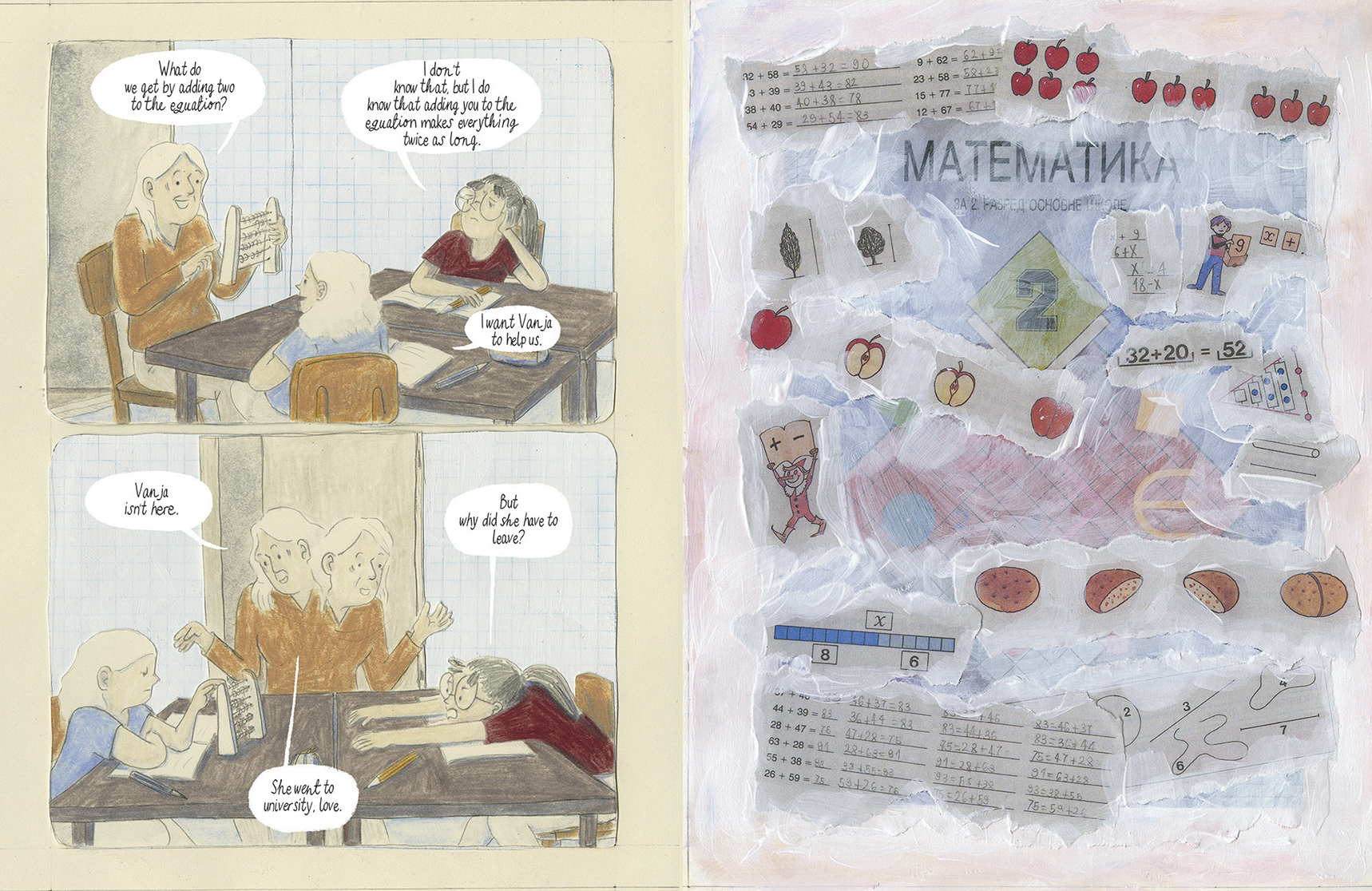
Figure 2. Long description
The left page contains two comic panels. In the top panel, a teacher holds an abacus while talking to two students at a desk. The teacher asks, What do we get by adding two to the equation? A student replies, I don’t know that, but I do know that adding you to the equation makes everything twice as long. Another student says, I want Vanja to help us. In the bottom panel, the teacher appears blurred or doubled as if moving. A student says, Vanja isn’t here. The teacher explains, She went to university, love. The other student, slumped on the desk, asks, But why did she have to leave?
The right page is a collage titled MATEMATIKA for the second grade of primary school. It features torn scraps of paper with mathematical equations, illustrations of apples, a child holding a number block, and geometric diagrams. Key elements include:
* Top left: A table of addition equations such as 32 plus 58 equals 90.
* Top right: Groups of red apples used for counting.
* Center: A large number 2 inside a diamond shape.
* Middle right: An equation 32 plus 20 equals 52.
* Bottom left: A blue bar diagram with segments labeled x, 8, and 6.
* Bottom right: A topographical-style diagram with numbered regions 2, 3, 4, 6, and 7.
* Background: Scraps of paper with long lists of addition problems are layered at the bottom.
Through such strategies, Radanović demonstrates how aesthetic form mediates urgency. Her practice complicates the expectation of speed by replacing instantaneous reaction with layered reflection. Urgency, here, accumulates through attention, density, and duration rather than immediacy, inviting the reader to experience the persistence of crises and the idea that the past continues to press upon the present.
Sequences such as a border-crossing scene (Figure 3) stretch moments across full spreads, turning bureaucratic inspection into a reflection on precarity and mobility. As the scene escalates and Radanović’s character is asked to leave the bus, a diagonal panel sequence shows her sinking into the ground from shame, each frame a subtle shift in her collapse. Collaged passport pages follow, layered and overpainted, evoking the psychological weight of navigating mobility laws as a Serbian citizen. These formal strategies embody both aesthetic and epistemic urgency, demanding sustained attention while mediating understanding of systemic pressures.
The border-crossing sequence from Radanović’s graphic novel What Should We Tell Them? (2024).
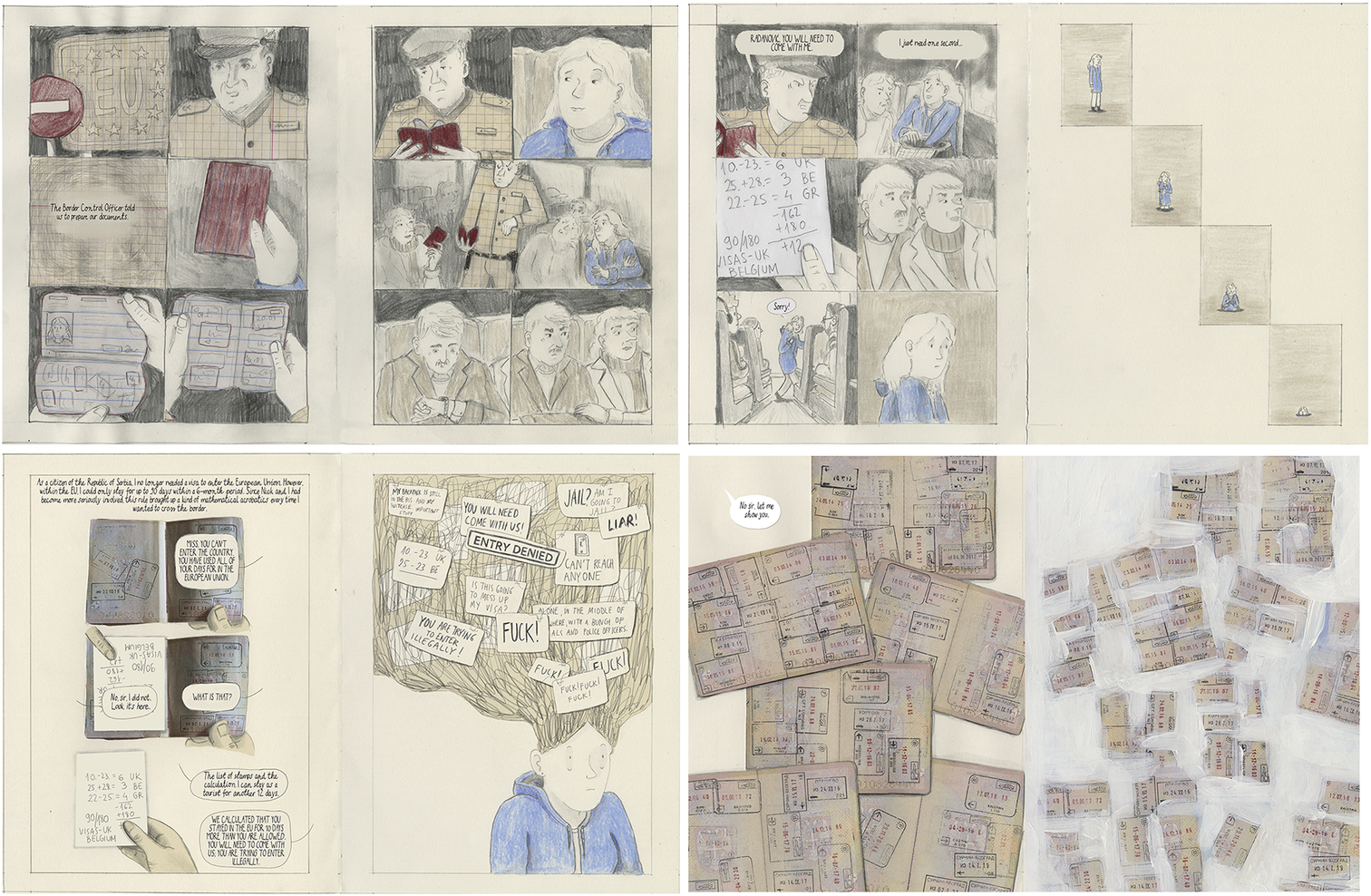
Figure 3. Long description
This graphic novel sequence is organized into four main sections.
* Top-Left Section. Twelve panels show a border control officer in a tan uniform and cap examining a red passport. A caption box states that the officer told them to produce their documents. Close-up panels show the interior of the passport with various stamps and a hand holding the document.
* Top-Right Section. Ten panels continue the narrative. The officer tells Radanovic to come with him. The protagonist asks for a second while holding a slip of paper with handwritten calculations of days spent in the U K, B E, and G R, totaling 90 out of 180. On the right side of this section, four panels show the protagonist shrinking in scale as they descend diagonally toward the bottom right.
* Bottom-Left Section. Two large panels. The left panel features a hand holding a passport and a calculation note. Text describes the difficulty of tracking days allowed in the E U for a citizen of the Republic of Serbia. The right panel shows the protagonist from the chest up. Their hair transforms into a large, dark cloud filled with frantic speech bubbles containing phrases like ENTRY DENIED, JAIL, LIAR, YOU ARE TRYING TO ENTER ILLEGALLY, and repeated profanity.
* Bottom-Right Section. A collage of passport pages and individual stamps. The left side shows several overlapping passport pages filled with rectangular entry and exit stamps. The right side shows these stamps becoming more fragmented and isolated against a white background, appearing like a scattered collection of bureaucratic markers.
Radanović’s work articulates urgency as a sustained, accumulative condition. Childhood memories of the 1999 bombing of Serbia and the political aftermath of the Yugoslav conflicts are rendered through the juxtaposition of playful moments against the backdrop of conflict, complicating simplistic narratives of victimhood and creating a space for ethical and reflective engagement. Rather than offering a neatly resolved historical account, her comics foreground the act of meaning-making itself, acknowledging the fluid and constructed nature of both personal and collective histories.
From the opening, Radanović establishes essayistic reflectivity, where the main character engages the reader directly in a self-aware monologue. The first spread shows the artist’s desk surrounded by notes, and the next places her at the drawing table, breaking the fourth wall with a playful, introspective remark: ‘Oh, you are already here! You caught me in the middle of work’. This self-referential narration does not simply introduce the story; it highlights the very process of storytelling, framing drawing as a mode of thinking. The character-artist continues to ruminate about ‘lines as threads of connection’, visually literalizing the idea by balancing on one leg while holding a line that extends from her unfinished foot, visually performing the philosophical reflection on how lines (and lives) are continuously made and remade (Figure 4).
Opening sequence from Radanović’s graphic novel What Should We Tell Them? (2024).

Figure 4. Long description
The spread consists of two panels separated by a central gutter.
In the left panel, a character wearing a beanie, sweater, and boots stands while holding a long, thin string or line that loops around their body. Two speech bubbles appear above them. The top bubble reads, Yesterday, I read a book that said lines are not just lines. They are threads of connection, weaving together the fabric of existence itself. I know it sounds like bullshit. The second bubble, pointing to the character, reads, But, hey, I am made of lines too.
In the right panel, the same character is bent over, searching through a box of art supplies on the floor. A brush is shown flying through the air behind them as if tossed aside. A large speech bubble above them continues the philosophical thought, The book also tells us that the lines we draw are not just marks on the paper. They are reflections of our very selves, the paths we choose to take, and the ones we choose to leave behind. The writer’s words, not mine. I do agree, though. A smaller bubble directly above the character’s head reads, Where did I put that nice pencil? To the right of the character are various art materials including a canvas, stacks of books, and jars.
This meditation on lines extends into a cartographic reflection on borders and belonging (Figure 5). Mapping Europe, the artist marks some borders as solid, others dashed, some easy, some difficult to cross; a dotted line between Serbia and Kosovo is labelled: ‘Needs a whole other book to explain’. She reflects, ‘From my birth until now, I’ve lived in four different countries, yet I’ve never moved out of my hometown. It is strange to belong to a generation that has travelled without moving. Born in one country, raised in several’. The map becomes both geographical and existential, embodying lived instability and situated knowledge drawn from within rather than observed from afar.
Cartographic sequence mapping Europe through differentiated border lines, combining geographical representation with personal reflection from Radanović’s graphic novel What Should We Tell Them? (2024).

Figure 5. Long description
Left page features a map of Europe on grid paper. A person with dark hair and a light sweater is on hands and knees, drawing a border line near Scandinavia. A speech bubble at the top left states: We draw maps and borders, thin lines and thick lines. Easy to cross, difficult to cross. Lines that are not equal for everyone. A legend on the far left defines symbols. A light brown square represents E U at the time. A dark brown square represents Europe the continent. A solid thick line represents Lines hard to cross. A dashed line represents Needs a whole other book to explain. The right page shows the map extending into Eastern Europe and Russia. The person is depicted again, drawing a line further east. A speech bubble at the top right states: These lines are also not carved in stone. They are, in fact, quite susceptible to change. From my birth until now, I’ve lived in four different countries, yet I’ve never moved out of my hometown. It is strange to belong to a generation that has travelled without moving. Born in one country, raised in several. An inset map in the bottom right corner, drawn on blue-lined paper, shows the Balkan region. Labeled countries include Hungary, Croatia, Bosnia and Hercegovina, Montenegro, Serbia, Romania, Bulgaria, North Macedonia, Albania, and Greece. Thick and thin lines delineate the borders between these nations.
Radanović’s artistic traces, such as construction lines, margin notes, and unfinished sketches, make her iterative mark-making a mode of trying to understand her own reality visible on the page. Such gestures enact an essayistic way of creating in which knowledge remains provisional and self-critical, constantly reworked in the process of making (Figure 6).
Spread from Radanović’s graphic novel What Should We Tell Them? (2024).

Figure 6. Long description
The left page consists of a white, textured background layered with numerous small, rectangular slips of paper that appear to be receipts or tickets with printed dates and numbers. Centered on this page is the handwritten phrase, Maths is important dot. The right page contains two panels set against a cream background with visible grid lines and marginalia. The top panel, labeled Serbia 1999 dot, shows a snowy street with blue-toned trees, three large black dumpsters, and the front of a red car. A speech bubble contains the text, I don’t want to say that you need maths to understand this story, though I needed a lot of maths to calculate the borders of these pages dot. Marginal notes include keep it away, Winter, and red. The bottom panel shows a wooden gate structure over a snowy road surrounded by trees and a road sign. A marginal note at the bottom left reads 2 cm.
By comparing her personal memories of war with current conflicts, Radanović’s responds to the political-ethical urgency of contemporary crises. At the same time, the dialogue between past and present renders epistemic urgency legible, and it shows that understanding of the world depends on how histories of violence and care are represented and that this knowledge continues to shape the present.
In Figure 7, this interconnectedness is explicit: one page combines hand-drawn memories, factual annotations of military technology, and sardonic self-insert. At the bottom, Radanović draws herself leaning against an imaginary wall, arms crossed, saying with sarcasm: ‘Invisible bomber, cluster bombs, not cowardly at all’. Her drawn self serves as a critical voice within the narrative, blending testimony with direct socio-political critique and insisting on situated knowledge production, where meaning emerges through personal engagement, memory, and reflection.
Spread combining hand-drawn memories, factual annotations, and a self-reflexive authorial presence from Radanović’s graphic novel What Should We Tell Them? (2024).

Figure 7. Long description
The left page is organized into a grid of hand-drawn panels. The top row includes a text box about seeking shelter, followed by three panels showing two children lying awake in bed, a woman crying into a cloth, and children drawing together. The middle row contains two technical diagrams. One shows an F dash 1 1 7 stealth bomber and another shows the internal structure of a cluster bomb filled with explosive bomblets. Text accompanying these diagrams discusses the use of these weapons by NATO. At the bottom right of the page, a girl leans against a wall with a caption about the nature of these bombs.
The right page features a large black and white photograph of a thick, billowing smoke plume rising from an oil refinery, with a tall metal tower in the foreground. A text box at the bottom describes the NATO bombing of the refinery in April 1999. Overlaid on the right side of the photograph are hand-drawn elements including a man standing and several speech bubbles. The bubbles contrast modern environmentalism with the destructive ecological impacts of war, such as soil degradation and loss of biodiversity. A small figure at the bottom right is shown shouting the words, CEASE THE BLOODY FIRE! The page is dated 8 dot Feb 2024 dot at the bottom right corner.
The facing page juxtaposes a collaged photo of a bombed oil refinery with Radanović’s drawn self, bridging personal memory and environmental catastrophe. The caption recalls: ‘That night, NATO bombed the oil refinery. The sky was black for ages…’ Reframed through contemporary environmental consciousness, the sequence extends urgency to encompass environmental and intergenerational consequences of war, integrating political, ethical, and aesthetic registers.
In the final panel, the artist’s drawn self appears visibly agitated, clenching her fists and shouting, ‘CEASE THE BLOODY FIRE’. While the comic’s narrative focus remains on the 1999 bombing of Serbia and the political aftermath of the Yugoslav conflicts, the page was drawn amid the unfolding violence in Gaza. Dated February 8, 2024, the moment when reports of atrocities there became unbearable for Radanović, the panel registers how the contemporary crisis directly shaped the act of drawing. In this way, reflections on past conflicts in Serbia are shaped by the present moment of their articulation, connecting past wars with contemporary crises and challenging the notion of history as closed, while emphasizing war’s persistent and unresolved nature that continues to demand urgent intervention.
Instead of focusing solely on the finalized page, attention to Radanović’s iterative process reveals the essayistic and epistemically urgent dimensions of her practice. The date was initially absent from her sketches, and she experimented with multiple versions, one of which depicted her character holding a slice of watermelon, later choosing an angry pose with clenched fists. She feared that the metaphor and the now widely recognised symbol of Palestinian struggle might be unclear and would seem to reference only one of many ongoing conflicts at the time. The hesitations and revisions make visible how meaning is negotiated through drawing, illustrating the complexities of representing political-ethical urgency and solidarity in global context. By foregrounding this process, the work becomes a process and site of inquiry and reflection, challenging dominant narratives and first impressions.
Artistic practice of Poorva Goel
For Goel, the tension between fast and slow registers of comics-making is central to her artistic evolution. As violence against marginalized groups and nature intensified under India’s Hindu nationalist regime, Goel’s cartoons shifted from everyday life to political-ethical engagement (Figure 8). This political-ethical urgency materialized in quick drawings, usually without colour or elaborate drawing styles. In response to the ethical urgency to bear witness responsibly and question her role as both observer and participant, she adopted the graphic reportage approach, in the tradition of Joe Sacco while retaining her rapid mark-making.
Goel’s cartoon: They’re fighting over me! (2017).

Her graphic novel Objects in the Mirror Are Closer Than They Appear (2024) developed as part of her Master’s year is a part-reportage, part-autobiographical account of a young Hindu woman confronting the rise of Hindu Nationalism in India. One chapter depicts the celebration of a Hindu temple built atop the Babri Mosque that was demolished by Hindu right-wing mobs (Figure 9). Here, Goel interrogates whether rapid ink-brush strokes might compromise an ‘ethical encounter’ with the pain of others (in this case: Indian Muslims), probing how urgency can be rendered in visual form in comics.
Scenes from the temple celebration in the market. Pages from Goel Master’s graduation graphic novel Objects in the Mirror Are Closer Than They Appear (2024).

Figure 9. Long description
Page one, top panel. A crowded street scene with several taxis and motorcycles. A speech bubble from a driver says, IF I DROP YOU HERE, YOU WILL WANT TO GRAB ANOTHER TAXI RIGHT AWAY! Above the panel, text reads, THE MORE QUESTIONS I ASKED, THE MORE I RECOGNISED THE CONTRADICTIONS IN WHAT HE SAID. THIS IS HOW CONVERSATIONS WITH MOST PEOPLE GO THESE DAYS.
Page one, bottom panel. A dense crowd of people in front of a booth labeled D J SHUBH. Text between panels says, ALL THE HATEFUL RHETORIC ONE LEARNS THROUGH PROPAGANDA FALLS FLAT WHEN IT IS FACED WITH SIMPLE QUESTIONS. Narrative boxes at the bottom state, THAT IS WHY ONE IS NO LONGER ALLOWED TO ASK QUESTIONS. and THE LOGICAL AND CRITICAL THINKING PARTS OF OUR BRAINS HAVE BEEN NUMBED WITH ENDLESS PROPAGANDA AND NEWSPEAK.
Page two, top panel. A scene of people dancing under stage lights. Text at the top says, ALCOHOL WAS NOT THE ONLY INTOXICANT AROUND. THE HEART THUMPING TUNES SENT THE CROWD INTO A TRANCE. A speech bubble provides a translation of the music stating, HERE IS A TRANSLATION, IT IS HIGH TIME HINDUS AWAKEN. THERE IS NO TIME TO SLEEP.
Page two, bottom panel. A close-up of a person with a microphone amidst a crowd. Three speech bubbles contain the lyrics, THERE WILL BE ONLY ONE SLOGAN ON ALL INDIAN SOIL., EVERY KID IN MY INDIA WILL SAY JAI SHRI RAM., and WE HINDUS ARE BRAVE LIONS. IF WE MAKE UP OUR MINDS WE CAN DESTROY EVERYONE. A final narrative box at the bottom right reads, THESE LYRICS SUNG IN A SWEET FEMININE VOICE ARE STRANGELY PARADOXICAL.
Goel examines how the shift from rough storyboards to final pages materializes a tension between communicative mark-making and technically refined ‘good’ drawings, tracing how temporal, aesthetic, and ethical urgency manifest visually.
Aesthetic urgency surfaces in the first marks made to tell a story, which are often quick, raw, and intuitive, and carry the emotional residue of the artist’s immediate encounter with events. These initial drawings embody what Goel describes as a certain ‘aliveness’, ‘tension’, and ‘dynamism’ which stem from the internal affect of the artist, translated directly onto paper. Temporal urgency, meanwhile, manifests in the speed of execution, because first sketches must capture ideas before they fade, functioning as traces of thought-in-motion. This temporal pressure produces an immediacy that resists the stillness of finished images. Yet, as she observes, this embodied urgency tends to dissipate in the process of redrawing, when time stretches and gestures are reinterpreted rather than relived.
Finally, an ethical urgency underlies the author’s dilemma: how to preserve the integrity of lived experience while refining it into communicable form. In revisiting and redrawing her pages, she confronts the risk that reiteration may aestheticize suffering or dilute its emotional truth. Her concern echoes Susan Sontag’s (Reference Sontag2003) reflections on representation and suffering, and relates directly to the ethics of witnessing in visual storytelling. This tension leads Goel to reflect on the sensory and bodily dimensions of drawing. Esther Szép (Reference Szép2020), expanding on Sousanis’ notion of ‘the drawn line’, argues that the viewer understands a line’s movement by comparing it to their own bodily experiences, such as the movements they make when they draw. Building on Szép’s theory that the haptic texture of Sacco’s painstakingly cross-hatched drawings guides viewers to submerge themselves in his subjects’ graveness, Goel wonders whether certain textures can instead evoke a felt urgency. In her work, this aesthetic urgency becomes epistemic, whether the immediacy of a mark can embody not just emotion but the politics of attention.
Essayistic self-awareness emerges explicitly in the prologue of Goel’s graphic novel, where the artist-character appears as a carpenter (Figures 10 and 11). While establishing the book’s purpose of ‘putting up a mirror’ metaphorically, the carpenter-character simultaneously nails a mirror to the wall in the panels. Here, in the process of putting up a mirror to the state of affairs in the country, the author (I) also comes face to face with her reflection in that mirror. Becoming both the one who looks and the one who is looked at, Goel transforms the mirror she mounts into a recursive surface, inviting both artist and reader to question their own gaze. The comic thus performs what Adorno et al. (Reference Adorno, Ziermann and Walker2017) called the ‘movement of the concept’, an active, unfinished process of thinking that resists reduction and instead values the provisional, the fragmentary, and the self-critical.
Pages from the prologue of Goel’s graphic novel Objects in the Mirror Are Closer Than They Appear (2024).

Figure 10. Long description
The spread consists of two pages with multiple panels and floating text.
Left Page:
* Top-left: A person climbs a wooden ladder. Text reads, ‘This book is a visual essay. The word essay come from the French word essayer which means to try.’
* Top-right: A person with multiple arms stands atop a ladder holding a hammer. Text reads, ‘I have tried to combine drawing and text to reflect on the state of affairs in my country.’
* Middle-left: A person sits on a ladder holding a hammer. Text reads, ‘By asking myself the question: "Has India changed?", I’ve arrived at more questions.’
* Middle-center: A person with wavy, flame-like hair sits on a stool.
* Middle-right: A person stands on a stool with arms outstretched.
* Bottom-left: A close-up of a person looking through a measuring tool.
* Bottom-right: A person stands on a tall ladder measuring a vertical line. Text reads, ‘Using my personal experiences in India and Belgium*, and experiences of people I had interviewed for this work, I have tried to put together a portrait of the country I was born in.’ A footnote at the bottom reads, ‘*Where I was living at the time of making this book.’
Right Page:
* Top-left: A person looks up at a hammer hitting a nail. Text reads, ‘Because criticising the government has become synonymous with hating the country.’
* Top-center: A person looks distressed. Text reads, ‘I’m afraid that this will be seen as my hatred for my country.’
* Top-right: Only the legs of a person standing on a stool are visible.
* Middle-left: A person with multiple arms swings several hammers.
* Middle-right: A person holds a small flower. Text reads, ‘But instead, it is love. A love letter if you will? Too cheesy?’
* Bottom: Three ladders are shown. One person climbs the left ladder, one person crouches at the base of the middle ladder, and one person hammers a nail into the top of the right ladder.
Pages from the prologue of Goel’s graphic novel Objects in the Mirror Are Closer Than They Appear (2024).

Figure 11. Long description
The comic is divided into two columns.
Left column, top panel: A person hammers a pedestal. Text reads, PUTTING ONE’S LOVER ON A PEDESTAL IS THE SORT OF THING ONE DOES AS A TEENAGER.
Left column, middle panel: The same person continues hammering. Text reads, OKAY, I ALSO DID IT IN MY TWENTIES.
Left column, bottom panel: The person looks at the pedestal and says, I LOVE YOU BUT YOU COULD USE SOME RUST SPRAY. Text above reads, BUT NOW.
Right column, top panel: Two storks fly over mountains carrying babies in bundles. One stork says, INDIA IS THAT WAY. The other stork replies, THANKS. Text above reads, BUT IT IS TRUE THAT I LOVE IT. NOT BECAUSE I THINK IT IS ABOVE OR BETTER THAN THE REST. BUT SIMPLY BECAUSE I WAS BORN HERE.
Right column, bottom panel: A person holds up a large mirror to another person who has their arms crossed. The person with the mirror has a hammer tucked behind their ear and says, I TRIED. Text reads, WHEN YOU LOVE SOMEONE YOU HAVE TO DO THE UNCOMFORTABLE TASK OF PUTTING UP A MIRROR TO THEM FROM TIME TO TIME. YOU KNOW THEY MIGHT NOT LIKE WHAT THEY SEE BUT YOU DO IT ANYWAY BECAUSE YOU CARE.
Her reflexivity also shifts from representing urgency to reflecting through urgency. Goel’s work, rooted in a personal confrontation with Hindu nationalism, positions her, a young caste-Hindu woman, as both observer and participant. This dual position echoes the structure of the essayistic as an ongoing negotiation between inside and outside, knowing and not knowing. Like Krug (Reference Krug2019), Goel’s narrative interlaces autobiography and historical reflection, revealing how self-reflection can become an ethical and epistemological tool. Rather than claiming a stable position of critique, Goel’s comic reveals how understanding itself is contingent, situated, and evolving.
With the normalization of hate against minorities, Goel felt a growing dissonance between her childhood memories of India and its present state, urging her to re-examine artefacts of a more tolerant past, like her school’s secular prayer book and Bollywood. These recollections are not presented as nostalgia but as provisional moments of inquiry. Her explorations extend across geographies, contrasting Goel’s experiences as an outsider in Brussels with her majority identity in India. This double perspective defines the essayistic structure of her work. Rather than seeking resolution, her comics stage an ongoing negotiation between different selves and cultural contexts. She visualizes this through compositional juxtapositions, placing scenes from Brussels and India in dialogue to frame the tensions between nostalgia, privilege, and political realities.
In a striking sequence, Goel depicts a Muslim neighbourhood in Brussels that feels like home to her, creating a direct irony with the Hindu nationalist narrative that disowns Islamic heritage as ‘outsider’. In the following scene, she listens to her dorm mates’ describing the same neighbourhood as ‘filthy’, ‘unsafe’, and ‘does not feel like Europe’ (Figures 12 and 13).
Spreads reflecting on the Muslim neighbourhood, belonging and otherness; in Goel’s graphic novel Objects in the Mirror Are Closer Than They Appear (2024).

Figure 12. Long description
The graphic novel spread consists of three distinct panels.
Top Panel: A busy street scene in a largely Islamic neighborhood. On the left, two women in hijabs stand behind a stall labeled T A P I S B A I N 2 Euro. In the center, a large pot is labeled K O C A N M I S I R, and a hookah sits on a crate. On the right, a stylized figure walks through the crowd. Their internal anatomy is visible, showing a brain with floral patterns and a stomach with the word tickle written twice. A speech bubble from the figure’s head says HOME. Text at the top reads, IT IS A LARGELY ISLAMIC NEIGHBOURHOOD, and text at the bottom reads, IT WAS THE ONLY PART OF THE CITY THAT FELT FAMILIAR EVEN THOUGH I AM A HINDU.
Bottom Left Panel: A diagram of a samosa inside a decorative border. Text at the top reads, SOME OF THE MOST INDIAN THINGS OR WORDS HAVE ROOTS OUTSIDE OF INDIA. The word SAMOSA is written in English and Hindi. Arrows point to different parts of the samosa with explanatory text: Influenced from a pastry from Egypt; The potato inside did not grow in India until the Portuguese brought them from South America; Same for chillies they too came from South America along with tomatoes etc.; It is even called Batata in some Indian languages, which is the Portuguese word for potato. Bottom text asks, SO WHAT IS AUTHENTIC INDIAN CULTURE?
Bottom Right Panel: A nine-frame sequence showing a person eating. The frames are accompanied by text reflecting on identity: I am an insider in India, whereas the Hindu right sees Muslims as outsiders. And in Brussels, I am the outsider, but so are the Muslims. So the us and them in us versus them keeps changing? Muslims are hated in both places? But here I am part of them.
Pages with the dorm mates; from Goel’s graphic novel Objects in the Mirror Are Closer Than They Appear (2024).

Figure 13. Long description
Panel 1 at the top-left shows three people sitting at a long table littered with plates and cups. They make disparaging remarks about a nearby immigrant neighborhood. Speech bubbles read SO FILTHY!, WALKING ALONE AT NIGHT? GOOD LUCK!, DOESN’T FEEL LIKE EUROPE., SMELLS WEIRD., and NOT AGAIN. At the right end of the table, a person with dark hair looks down, clutching a heart shape. Narrative text explains that the street reminds them of India, making the criticism feel personal.
Panel 2 at the top-right shows the central character standing on a chair with multiple arms raised in a series of expressive gestures. Narrative text states I WANT TO SAY. Speech bubbles contain social critiques: WE LIVE IN AN UNEQUAL SOCIETY. WHY ARE WE MORE DISGUSTED BY POOR PEOPLE THAN BY POVERTY ITSELF?, ALL THESE EMPTY OFFICES AND YET THEY SAY WE CAN’T HOUSE REFUGEES., and I HAVE FELT MORE UNSAFE AT THE CITY CENTRE.
Panel 3 at the bottom-left shows the character walking toward the bottom-left corner, looking distressed. Behind them, the dorm mates at the table are hunched over, laughing hysterically. Large text reads HAH HAH HAH. Overlapping circular bubbles trailing behind the character contain the words NON EUROPEAN, DIRTY, SMELLY, and I AM.
Panel 4 at the bottom-right shows the character sitting back at the table with their head bowed. A long, thick tongue-like shape extends from their mouth across the table. The dorm mates continue to talk and gesture in the background. Narrative text at the top and bottom reads INSTEAD, I SIT THERE IN SHAME. FOLLOWED BY MORE SHAME FOR FEELING SHAME.
Crystallizing the tension between belonging and otherness, the narration shifts inward to show her internalizing these judgements. If the place that reminds her most of home is considered dirty, unsafe, and non-European, does that mean she is seen the same way? The visual storytelling deepens this emotional impact: rather than explicitly countering their statements, Goel is rendered caught between wanting to voice her thoughts and feeling the weight of shame. The audience sees that she remains silent, her tongue twisted, and her heart jumping out of her chest. This sequence makes visible the process of realization and self-questioning to show how, sometimes, self-awareness manifests as internal conflict and emotional labour and does not always translate into immediate resistance or resolution.
Goel’s graphic novel navigates the intersections of autobiography and journalism. The non-linear graphic narrative ties together memory, religion, and politics suspended in India’s collective history since Independence. One segment of the narrative traces Goel’s Hindu grandfather enduring a 70-year friendship with Ansariji, a Muslim, which prompts Goel to question the paradox: how does her family foster affection for an individual while simultaneously harbouring xenophobic sentiments towards the community? Goel juxtaposes intimate, warm scenes of life with Ansariji and her family against anti-Muslim sentiment voiced by family members, highlighting how nationalist narratives can overwrite personal histories of coexistence (Figure 14).
Pages reflecting on shifting attitudes; Goel’s graphic novel Objects in the Mirror Are Closer Than They Appear (2024).

Figure 14. Long description
* The left page features two sections. The top section shows a line drawing of ten simple human figures holding hands in a circle. Text above reads BABA’S AND ANSARIJI’S CHILDREN GREW UP TOGETHER.
* The bottom section displays various bowls and plates of food. Text above reads WE DO ANNUAL EID PARTIES TOGETHER. Labels identify dishes as THEIR FAVOURITE MUTTON CURRY, DATES TO BREAK THE FAST, and SOME VEGGIE CURRY FOR US.
* The right page begins with text at the top. HAVING GROWN UP SO INTIMATELY WITH A MUSLIM FAMILY, HOW IS IT THAT MY PARENTS, AUNTS AND SOME OF MY COUSINS HAVE BECOME SO ISLAMOPHOBIC?
* Below this, a section titled BEFORE shows three women from the chest up with pleasant, smiling expressions. Speech bubbles from left to right read REMEMBER HOW ANSARIJI’S KIDS WOULD COME OVER ALL THE TIME?, AND WE’D JUMP OFF THE ROOFS!, and THOSE WERE THE DAYS!
* The final section at the bottom is titled NOW. It depicts the same three women but with angry, aggressive facial expressions and bared teeth. Speech bubbles read FOR SO LONG, MUSLIMS HAVE TRIED TO BULLY US. and THE SUPREME LEADER WILL SHOW THEM!
Additionally, at 86, Ansariji is older than independent India, offering a unique perspective on its transformation. Interviews with him and others from Goel’s hometown reveal the contrast between India’s founding socialist ideals and its present state.
The transition between modes of storytelling, time, space, and sources of information is made visible through the distinct styles and visual strategies used to render each section. For instance, Goel employs a more realistic drawing style to depict historical events like the Babri Mosque demolition (Figure 15). In contrast (Figure 16), a cartoon-like aesthetic retells a folk tale about a monkey unfairly dividing bread as an allegory for the British ‘divide and rule’ strategy and current Hindu–Muslim politics. Goel frames her critique through the concept of an ‘ecological niche’, using a Cat-monkey folk tale to illustrate how the removal of one oppressive force simply allows another to take its place.
Demolition scenes from Goel’s graphic novel Objects in the Mirror Are Closer Than They Appear (2024).

Figure 15. Long description
Detailed breakdown of the six panels.
* Panel 1 at the top-left shows a group of men holding hammers and pickaxes aloft. Text at the top reads AFTER CENTURIES OF WAITING OUR RAM HAS ARRIVED…
* Panel 2 at the top-right features a man straining while pulling a dark beam. Text at the top reads AND UNCOUNTABLE MARTYRDOM AND PENANCE,…
* Panel 3 at the middle-left depicts a dense crowd swarming over a large structure.
* Panel 4 at the middle-right shows two tractors in a dusty field. Text at the top reads SACRIFICES AND MEDITATION.
* Panel 5 at the bottom-left shows men dismantling a stone wall behind a fence. Text at the bottom reads AFTER CENTURIES OF UNPRECEDENTED PATIENCE…
* Panel 6 at the bottom-right shows a landscape of rubble with a small structure on a distant hill. Text at the top reads OUR LORD RAM HAS ARRIVED.
Indian folk tale from Goel’s graphic novel Objects in the Mirror Are Closer Than They Appear (2024).

Figure 16. Long description
* Panel 1. Titled THE ORIGINAL VERSION. At the top, text reads THE CLASSIC TALE OF THE MONKEY AND THE CATS, BUT WORSE. Below, two cats sit before a monkey wearing a top hat with a Union Jack pattern. The monkey holds a large piece of bread and says LET ME DIVIDE THIS EQUALLY BETWEEN YOU TWO. In the middle section, the monkey breaks the bread and takes a large bite, saying OH NO, THIS ONE IS BIGGER. LET ME TAKE A BITE OUT OF IT TO MAKE THEM EQUAL. Below this, the monkey continues eating from alternating pieces, saying SEE, NOW THIS ONE IS BIGGER and NOW THIS ONE. At the bottom, the bread is gone. Text reads UNTIL NONE WAS LEFT. The monkey burps and says WITHOUT ME YOU SAVAGES WOULD STILL BE FIGHTING.
* Panel 2. Titled THEIR VERSION. At the top, the monkey, now wearing a striped scarf, points at one cat and tells the other HE TOOK YOUR BREAD. In the middle, the two cats are locked in a violent struggle inside a dust cloud. At the bottom, the monkey and a pig-like creature walk away carrying a large sack overflowing with bread.
* Bottom Text. A caption across the base of the second panel reads IN ECOLOGY, THE CONCEPT OF AN ECOLOGICAL NICHE EXPLAINS THAT IF A PREDATOR IS REMOVED FROM THE ECOSYSTEM, ANOTHER PREDATOR IS BOUND TO TAKE ITS PLACE AS LONG AS THE SYTEM REMAINS THE SAME.
In reflective segments, Goel depicts herself as a floating head, omitting backgrounds to centre her reflections on her subject and her engagement with it through the comics-making process. This act models what Corrigan (Reference Corrigan2011) describes as the essay-film gesture, ‘thinking out loud’, translated into sequential art. For reportage segments like the temple celebration (Figure 9), she shifts to comics journalism-like detailed backgrounds, creating a drawn record of a specific time and place. These strategic shifts in visual style highlight the importance of comics as an essayistic practice, where meaning emerges through the process of artistic inquiry itself. Through a hybridized approach that combines personal anecdotes, historical reflection, interviews, and analytical commentary, her work explores the rise of Hindu nationalism and personal identity in a way that reveals connections between the ‘personal-autobiographical’, the ‘concrete-particular’, and the ‘abstract-universal’ (Huxley Reference Huxley1971).
Comparing artistic practices: Convergences and drifts
The case studies of Radanović and Goel demonstrate how essayistic comics-making mediates the interplay of political-ethical, epistemic, and aesthetic urgency, through reflexive artistic practice. Despite divergent cultural, political, and temporal contexts, Serbia and India, both practices exemplify how urgency not only triggers creative response but also shapes processes of reflection and knowledge production. Their comparison reveals methodological affinities and context-specific divergences, offering insight into both the potential and the epistemic limits of essayistic comics as a research practice. In both cases, political-ethical urgency functions as the initial catalyst for creative action. For Radanović, this manifests in rapid-response digital cartoons addressing Serbia’s political crises, such as civic unrest or infrastructural neglect. These works enact immediacy as a mode of civic witnessing and articulate the artist-researcher’s ethical imperative to respond publicly. Yet, as Radanović’s work also suggests, the persuasive capacity of comics is not inherently emancipatory: used in another manner, it could reinforce dominant narratives. The ethical and political significance of these interventions, therefore, resides in the author’s deliberate positionality, not in the medium itself.
Similarly, Goel’s engagement with the rise of Hindu nationalism in India situates her within an environment of systemic violence and contested representation. Here, political-ethical urgency demands a careful negotiation between responsible witnessing and communicative effectiveness. The resulting tension, between affective immediacy and ethical restraint, shapes both her mark-making and narrative strategies. These cases underscore that essayistic reflection alone does not guarantee criticality; rather, resistance to hegemonic discourse emerges through sustained attention, iterative evaluation, and self-critical representation within the artistic process itself.
While both artists respond to political-ethical provocation, their contexts differ in scope and temporality. Serbia’s crises are acute, event-driven, and locally mediated, whereas India’s shifts are embedded in long-term structural and ideological transformations. This contrast highlights how urgency is historically and geographically contingent: its manifestations depend on the temporal rhythms of crises and the infrastructures of visibility that frame artistic response. For the purposes of this discussion, we focus on these particular configurations while acknowledging that such distinctions are not absolute.
In responding to political-ethical pressures to depict events, both artists confront an epistemic urgency: the demand to make knowledge visible through drawing. This epistemic dimension involves iterative reflection that links archives, personal memory, and dominant narratives. Radanović’s graphic novel transforms autobiographical and archival material into an essayistic reconstruction of the past, generating new insights through the act of drawing itself. Goel, by integrating reportage with reflective narration, similarly aligns testimonial and analytical registers. In both practices, drawing operates as a cognitive tool, a means of thinking-in-action that negotiates immediacy and deliberation, and mediates between observation, and reflection.
Differences emerge in temporal registers, Radanović’s work exemplifies slow, accumulative reflection over historical memory, while Goel balances near-immediate political reporting with essayistic exploration. This highlights a methodological insight: epistemic urgency is not monolithic, and it adapts to temporal, social, and personal contexts, demonstrating flexibility in essayistic practice. A limitation is that these examples may not account for forms of epistemic urgency in collaborative or large-scale participatory comics-making, which could diversify the ways knowledge is negotiated.
Aesthetic urgency seen in attention to material form, pacing, and sequentiality mediates both political-ethical and epistemic urgencies. Radanović’s collages, layered spreads, and tactile interventions render memory and crises as an embodied, visual argument, whereas Goel’s juxtaposition of cartoonlike and realistic styles negotiates immediacy and reflection. In both cases, aesthetic choices are inseparable from ethical and epistemic considerations, reinforcing the framework that urgency in essayistic comics is multidimensional and relational.
Finally, reflexivity functions as a central mechanism through which both artists negotiate uncertainty, ethical responsibility, and positionality. In Radanović’s work, visible construction lines, annotations, and direct address foreground the process of research and situate the artist within her own inquiry. Goel’s self-reflexive prologue and alternating perspectives similarly enact a dialogue between insider and outsider viewpoints, foregrounding the instability of perspective as an ethical and epistemological condition. These cases thus demonstrate that reflexivity is not merely descriptive but constitutive: it shapes both the content and the form of the knowledge produced. However, the highly situated nature of these reflexive engagements also constrains their generalizability, suggesting that insights into urgency and reflexivity remain context-bound and contingent, an intrinsic feature of essayistic research itself.
Conclusion
This article has explored how the concept of urgency can illuminate the epistemic and methodological dimensions of essayistic comics-making. Through a comparative study of the practices of Radanović and Goel, we have examined how political-ethical, epistemic, and aesthetic urgencies intersect to shape artistic decision-making, reflexive engagement, and knowledge production. The analysis suggests that urgency functions not merely as an external condition that compels artistic response but as an internal principle of inquiry, informing how artists think, feel, and construct meaning through the act of drawing.
The framework of political-ethical, epistemic, and aesthetic urgency proposed here is not exhaustive, but is shared across the two artistic practices analysed here. These dimensions emerge through our situated reflections and are shaped by specific contexts of production and resistance. Other dimensions may well appear in different practices or collaborative constellations, further enriching this ecology of urgency. What remains consistent, however, is the essayistic commitment to sustained reflection within and through making and an ongoing negotiation between action and thought.
A traditional analytical lens often falls short in accounting for these complexities. It risks treating the practices of Radanović and Goel as distinct realities, shaped by separate systems, and thus as isolated phenomena. Yet, such separation obscures the connective tissue of shared urgency, reflection, and resistance that animates both. The critical question, therefore, is not how to quantify the discrete effects of a single comic, but how to collect and connect artistic practices that embody resistance, how to make them visible, trace their recurrent strategies, and multiply their transformative potential. Future research could extend this inquiry through additional case studies, identifying further patterns in how essayistic approaches and urgencies are negotiated across diverse comics-making contexts.
By situating essayistic comics within traditions of non-fiction and practice-based research, this study contributes to ongoing discussions about how artistic methods generate knowledge through means not reducible to purely textual or discursive forms. The essayistic mode, understood here as a reflective, exploratory, and iterative process, offers a framework for understanding how artists work through complexity, contradiction, and doubt by making these visible on the page. Rather than presenting finished statements or stable truths, essayistic comics foreground the practice-led thinking-in-process, revealing how understanding evolves through visual, affective, and material experimentation. Within this framework, urgency functions as both impetus and method: it propels the artist into action while structuring the temporal, ethical, and aesthetic conditions of that action.
Across both case studies, urgency emerges as a multi-scalar phenomenon. At the political-ethical level, it motivates acts of witnessing, protest, and care, transforming comics into processes and sites of civic and moral engagement. At the epistemic level, it manifests in iterative reflection, through drawing, revising, and layering, as artists grapple with how to represent histories of violence, loss, and resistance. At the aesthetic level, urgency is materialized in the textures, rhythms, and compositional tensions of the page, revealing how form and ethics are mutually constitutive. These overlapping registers demonstrate that urgency is not simply an affective state but a structuring condition of knowledge production within artistic research.
While these three dimensions, political-ethical, epistemic, and aesthetic, emerged as central within our respective practices, they do not represent an exhaustive framework. Rather, they are shared and dialogically developed through our own engagement with essayistic comics-making. It is entirely possible, and indeed desirable, that other dimensions of urgency might surface through different practices, contexts, or collaborative modes of inquiry. This openness reflects the situated, evolving character of artistic research itself, where categories are not fixed but responsive to process, context, and encounter.
The comparison between Radanović and Goel’s practices also underscores the situatedness of urgency. While both respond to crises of democracy and representation, their modes of engagement are shaped by distinct temporalities and infrastructures: Serbia’s cycles of acute local crises and India’s long histories of systemic oppression. These differences reveal how essayistic comics adapt to specific socio-political contexts, making visible the ways in which global concerns, such as authoritarianism, violence, or ecological destruction, are refracted through personal experience and local histories. The transnational dimension of both artists’ practices, working from Belgium yet reflecting on their other homelands, further complicates notions of distance, belonging, and solidarity, suggesting that urgency can also operate through displacement and diasporic reflection.
One of the central contributions of this article is to conceptualize essayistic comics-making as a research method in its own right. Rather than treating comics as an illustration of thought, this approach understands the process of making as a form of embodied reasoning, a way of thinking through and with images. The iterative, self-critical nature of the essayistic mode transforms drawing into a space of negotiation between knowledge and its limits. As both case studies show, reflexivity is not simply a stylistic device but a methodological principle that sustains ethical awareness and epistemic openness. The visible traces of process – construction lines, revisions, and annotations – serve as evidence of this thinking-in-action, positioning comics as sites where theory, method, and emotion converge.
At the same time, the analysis highlights the limitations and tensions of this mode. Urgency can generate both insight and instability: the need to respond quickly may conflict with the demands of careful reflection, and the impulse to bear witness can risk aestheticizing suffering. These tensions do not undermine the validity of essayistic practice but rather constitute its epistemic value. The awareness of contradiction between immediacy and contemplation, self and other, and art and activism is what enables the essayistic mode to remain ethically responsive and intellectually generative. The reflexive negotiation of these tensions transforms urgency from a condition of crises into a condition of critical inquiry.
Looking forward, the framework of urgency developed here opens pathways for further research into comics as essayistic practice. Future studies might extend this analysis to collective or participatory forms of comics-making, where urgency is negotiated not by a single author but through collaborative processes and shared publics. Similarly, applying this framework to other contexts, such as climate activism, feminist movements, or migration narratives, could reveal how urgency operates across different scales of action and affect.
Ultimately, this article argues that essayistic comics-making, when understood through the lens of urgency, exemplifies a distinctive mode of artistic knowledge production. It unites the ethical demand to respond with the intellectual need to understand and the aesthetic impulse to make with the reflexive capacity to think. The dimensions of urgency identified here are, therefore, not definitive but provisional and generative, offering one situated articulation among many possible constellations that may emerge through other practices and contexts. Operating within the condition of urgency, as artists we not only document the world but actively intervene in it, producing knowledge that is at once critical, affective, and situated. The act of drawing reminds us that to think is also to act, and that making itself can be an urgent way and form of knowing.
Data availability statement
No new data were generated or analysed during this study. All relevant information is contained within the article and its cited sources. The materials (e.g. images of comics) that support the findings of this study are available from the corresponding author upon reasonable request. Some materials may be subject to copyright or ethical restrictions.
Acknowledgements
The authors wish to thank their respective research communities and everyone who helped this article. They are especially grateful to Gabri Molist for valuable discussions that enriched the initial research for this article and to editors who helped clarify the focus of the article as well as its academic rigour. They are immensely grateful for KU Leuven’s and LUCA School of Art’s support in facilitating these collaborations.
Author contribution
The article is based on Dragana Radanović’s and Poorva Goel’s research and artistic practice. Dragana Radanović and Poorva Goel made an equal intellectual contribution to the conception and design of the study as well as to the analysis and interpretation of research data. They made an equal contribution to the drafting of the manuscript. Both authors made an equal contribution to its critical revision.
Funding statement
This work is part of Radanović’s postdoctoral research project Drawing Lines: Unveiling the Scholarly Potential of Visual Storytelling, funded by the Bijzonder Onderzoeksfonds, under the Postdoctorale Mandaten (PDM) programme, reference PDMT2/24/014. The funder had no role in study design, data collection and analysis, decision to publish, or preparation of the manuscript. Additional institutional support was provided by KU Leuven and LUCA School of Arts.
Competing interests
The authors declare no competing interests.
Dragana Radanović (KU Leuven & LUCA School of Arts) is a postdoctoral researcher exploring the intersection of comics-making, visual storytelling, and artistic research. Her project expands the understanding of drawing as both a narrative tool and a critical research methodology, contributing to the growing field of comics-based research.
Poorva Goel (KU Leuven & LUCA School of Arts) is a PhD candidate exploring essay comics as tools for storytelling, memory, and resistance. Her practice-based research investigates the aesthetics of urgency, combining theory and visual practice to examine how comics respond to socio-political and ecological challenges.

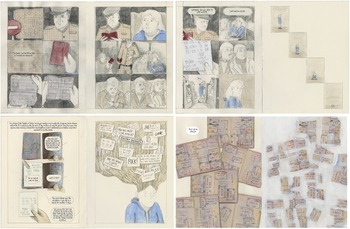
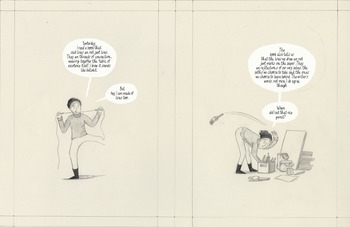


 Open access

