


Introduction
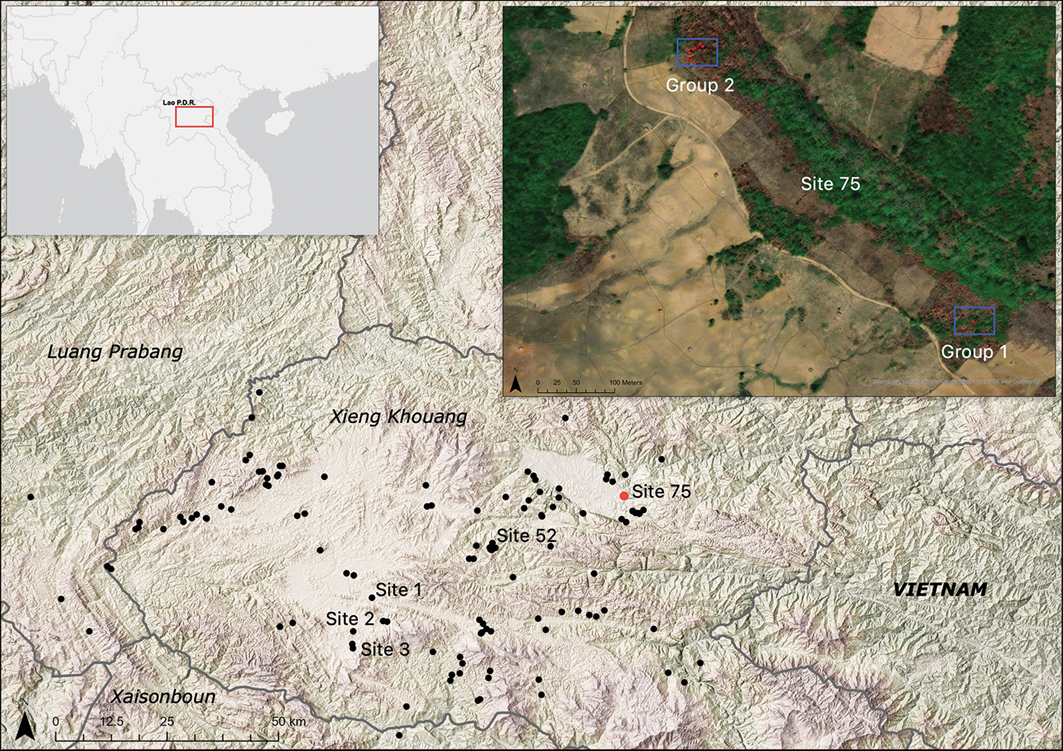
The Plain of Jars, a megalithic landscape on the Xieng Khouang Plateau in Laos, remains one of Southeast Asia’s most enigmatic archaeological locations (Figure 1). Characterised by hundreds of large, hollowed stone jars across more than 120 known sites, the region has intrigued researchers since it was surveyed by French archaeologist Madeleine Colani in the 1930s (Colani Reference Colani1935). Although many scholars propose a mortuary function for the jars, definitive evidence is elusive and key questions regarding their purpose, age and makers remain unresolved.
Location of Site 75 in the Xieng Khouang Province of Lao People’s Democratic Republic (figure by authors).

Documented sites typically feature jars of varying sizes and composition, often accompanied by carved stone discs and boulders (Skopal et al. Reference Skopal2020, Reference Skopal2023). Associated artefacts, including earthenware, glass and stone beads, spindle whorls, metal knives and items of adornment (some copper based), suggest a complex society engaged in diverse cultural, economic and ritual activities (Colani Reference Colani1935; O’Reilly et al. Reference O’Reilly2018; Skopal et al. Reference Skopal2024). Chronometric and relative dating place the various sites between the late second millennium BC and the thirteenth century AD (Colani Reference Colani1935; Shewan et al. Reference Shewan2021); although the chronology of the megalithic tradition itself remains poorly defined.
The jars’ function is a perennial research focus. Early hypotheses proposed that they were storage containers for food or water (Raquez Reference Raquez1902), but subsequent interpretations favoured a funerary role (Colani Reference Colani1935; Nitta Reference Nitta1996; Sayavongkhamdy & Bellwood Reference Sayavongkhamdy and Bellwood2000; O’Reilly et al. Reference O’Reilly2019). Current scholarship maintains that the jars served a mortuary purpose, either as symbolic monuments or as containers for the deceased (Nitta Reference Nitta1996; O’Reilly et al. Reference O’Reilly2019, Reference O’Reilly2022a, Reference O’Reilly2023). This assessment is supported by the presence of secondary pit burials, ceramic jar burials and primary interments around the jars at Site 1 and of fragments of largely burnt bone and teeth within several jars at Sites 1, 3 and 67 (Colani Reference Colani1935; Nitta Reference Nitta1996; O’Reilly et al. Reference O’Reilly2019, Reference O’Reilly2022a). Given that research has largely been restricted to Sites 1, 2, 3 and 52, there remains the possibility that mortuary practices across the Plain of Jars varied both regionally and temporally.
This article presents new findings from the complete excavation of a large stone jar (Jar 1) at Site 75 and its surrounding context over three field seasons (2022–2024). Inside the jar, the skeletal remains of at least 37 individuals appear to form part of a collective mortuary assemblage of secondary internments, accompanied by cultural materials such as iron tools, earthenware, a copper-based bell and glass beads. These findings refine our understanding of the jars’ antiquity and mortuary function, and of the sociocultural networks of their makers.
Method
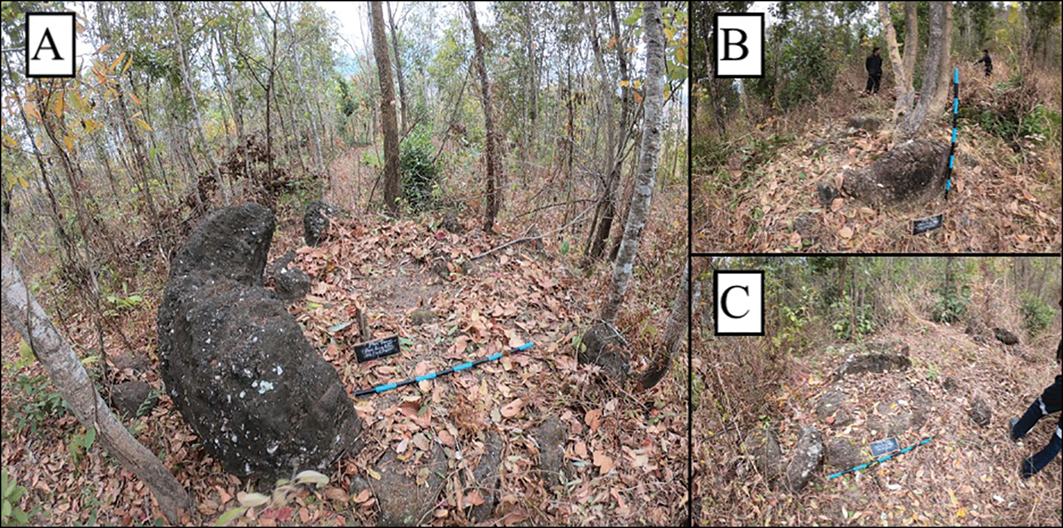
Site 75 is located approximately 70km north-east of Phonsavan and is the most north-eastern jar site excavated to date (Figure 1). The site comprises two distinct groups. Group 1 features a single, large conglomerate jar (Jar 1) with a base diameter of 2.05m and a preserved height of 1.30m (Figure 2). The jar is in poor condition, although it retains an intact base and partially intact sides that preserve in-situ sediment deposits, providing a rare opportunity to study the original contents. Excavations during the first field season revealed fragmented human remains and material culture indicative of secondary burial practices (Skopal et al. Reference Skopal2024). Group 2, located approximately 500m west of group 1, consists of seven smaller stone jars, including Jar 2, also in poor condition (Figure 2). Excavations conducted at group 2 will be reported elsewhere.
Site 75 jars prior to excavation: A) group 1, Jar 1; B) group 2, Jar 2; C) group 2, Jars 3 and 4 (figure by authors).

Excavation of the contents of Jar 1 proceeded in arbitrary 0.10m spits until skeletal remains were encountered, after which the process followed the depositional sequence of the bones. Each level of human remains was recorded with photogrammetry. As a result, every archaeological object was documented in three dimensions and assigned a unique identification number. Human remains were excavated using brushes and wooden implements. Sediment from the south-east quadrant and other selected areas were processed through bucket flotation. Light residue was captured in a 200µm flot bag and the heavy residue was wet-sieved through a 2mm screen.
During the third field season, trench 1 was opened to the north-east of Jar 1. A 2 × 2m unit was initially excavated, centred on a flat area adjacent to the jar. The unit was later extended to 3m in a westerly direction. Features uncovered in each 0.10m spit were labelled sequentially.
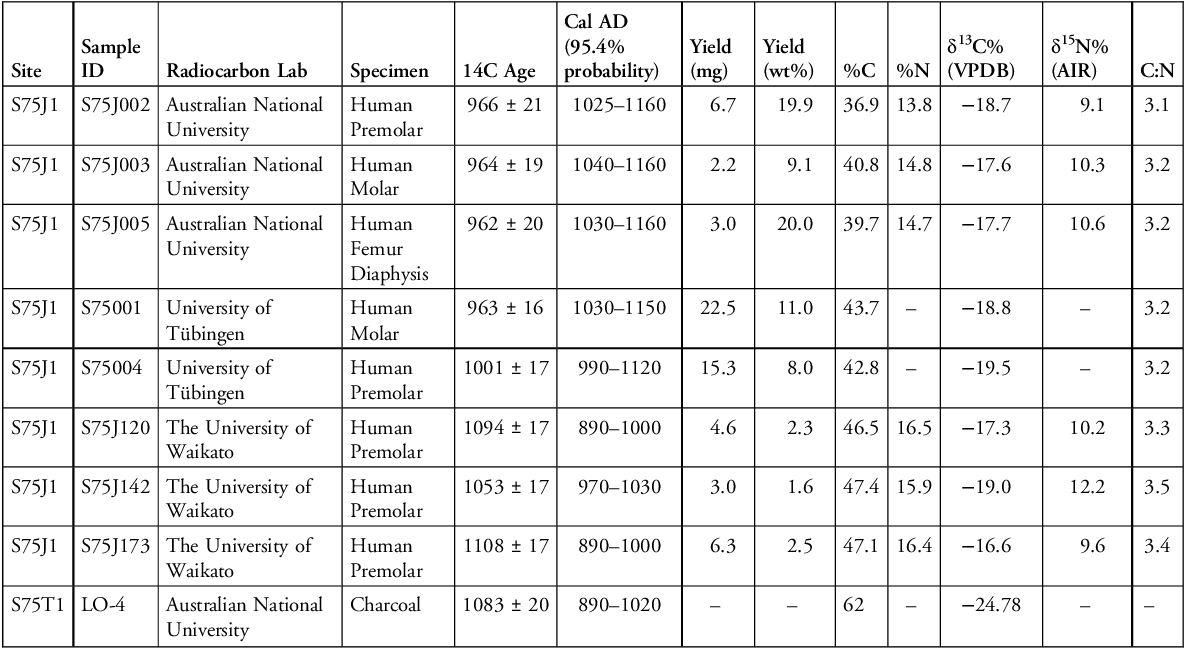
The charcoal sample from trench 1 was taken for radiocarbon analysis by the Australian National University (Fallon et al. Reference Fallon2010; Wood et al. Reference Wood2023). Seven teeth found in Jar 1 were sampled for radiocarbon dating, two by the University of Tübingen, three by the University of Waikato and two by the Australian National University, which also included a fragment of a femoral shaft. Collagen was purified through ultrafiltration and the dates were calibrated using the IntCal20 and SHCal20 calibration curves and modelled in OxCal v.4.4 (Bronk Ramsey Reference Bronk Ramsey2009; Hogg et al. Reference Hogg2020; Reimer et al. Reference Reimer2020). Additionally, sediment samples were taken from beneath the jar for radiocarbon analysis at the University of Waikato. Glass beads were analysed at the Elemental Analysis Facility at the Chicago Field Museum with a Thermo ICAP Q inductively coupled plasma mass spectrometer (ICP-MS) attached to an Elemental Scientific Lasers NW213 laser ablation (LA) system. See Dussubieux (Reference Dussubieux2022) for further information on instrumentation settings used for analysis at the Elemental Analysis Facility.
Results
Jar 1 excavation
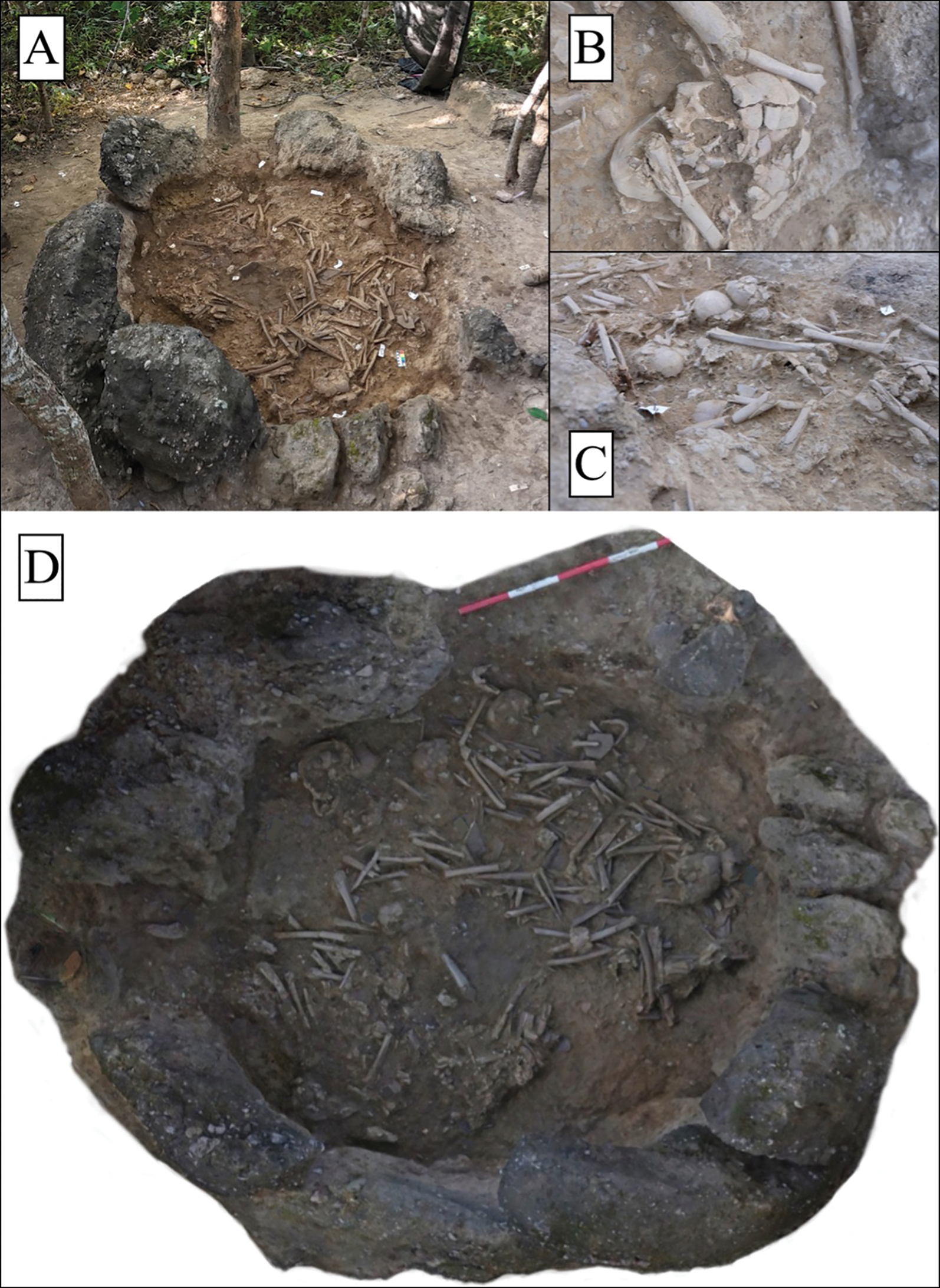
Excavation of the contents of Jar 1 revealed a substantial volume of human bone, both disarticulated and closely associated (Figure 3). The bones were densely packed without apparent vertical structure. The concentration of craniofacial elements, particularly around the jar edges, and bundles of long bones suggests deliberate grouping. Skeletal elements show differing representativeness; estimates for the minimum number of individuals (MNI) present vary from 14 (left humerus) to 19 (right femur and skull), with the dentition providing the highest estimate of 37. Close association between skulls and mandibles in four instances could indicate that some individuals were deposited shortly after death, when these elements were still articulated.
Jar 1 during excavation: A) aerial photograph of bones within the jar; B) a skull displaying evidence of association from the west side of Jar 1; C) skull fragments exposed after a large jar fragment was lifted from the west side; D) photogrammetry model (figure by authors).

Ritual modification in the form of tooth ablation was observed: in at least one case this involved the removal of both the upper lateral incisors, in another case both the lower central incisors were removed, a pattern documented in mainland Southeast Asia (e.g. Domett et al. Reference Domett2013; Palefsky Reference Palefsky2019; Oxenham et al. Reference Oxenham2021; Zhang et al. Reference Zhang2025). The prevalence of carious lesions observed among the assemblage—5.3% (25 teeth out of 469 observed)—is consistent with broader patterns of dental health in mainland Southeast Asia during the late prehistoric period (c. 1000 BC–AD 500) (Douglas Reference Douglas, Oxenham and Tayles2006; Newton et al. Reference Newton2013; Willis Reference Willis2015). Preliminary demographic assessment indicates that all ages from approximately 1.5 years to adulthood are represented in the Jar 1 assemblage. The [0] age class is missing, but detailed osteological analysis is still underway.
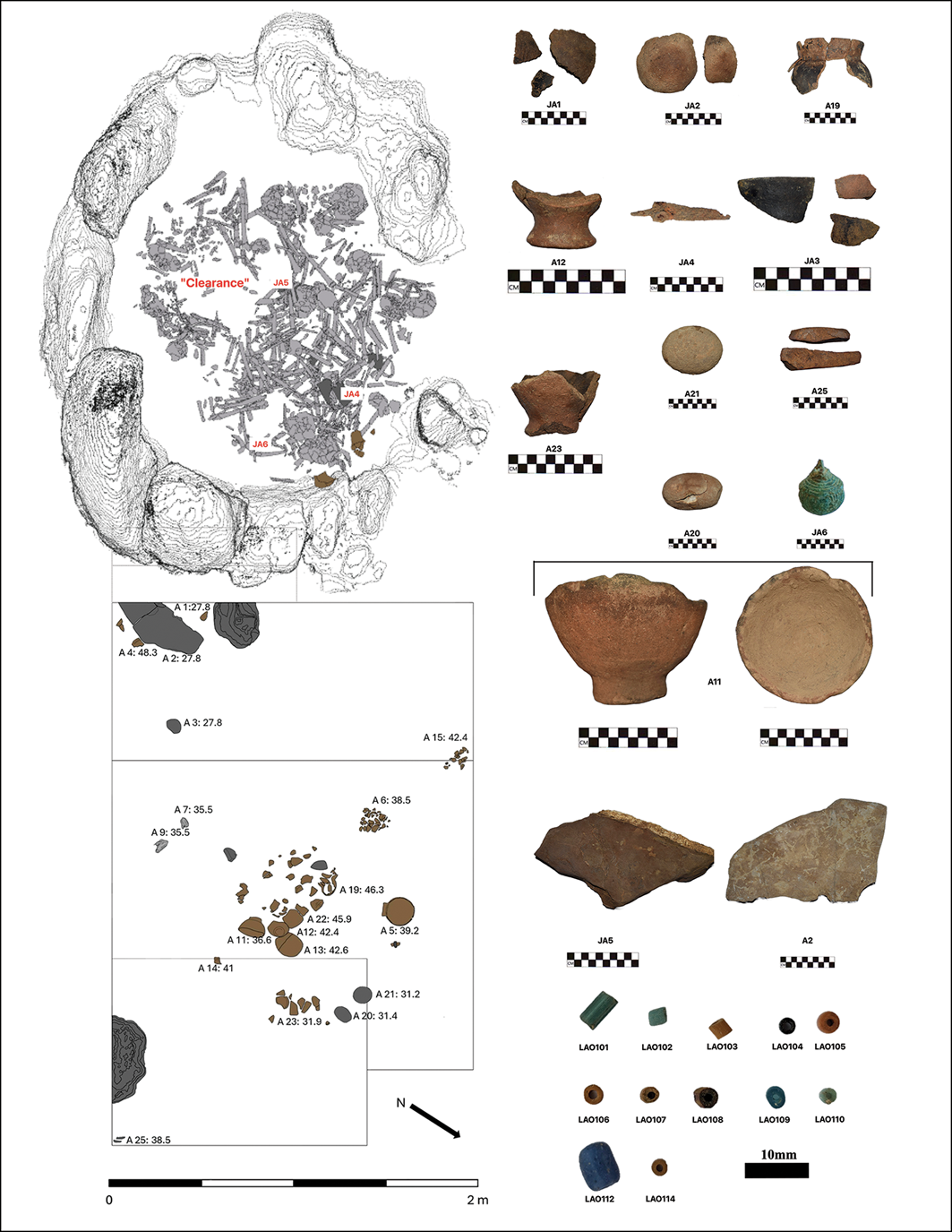
In addition to the human remains, earthenware sherds, an iron knife, a small copper-based bell, 20 glass beads and five stone slabs were also recovered from within Jar 1 (Figure 4). Several sherds could be reconstructed (Figure 4: JA2, JA3), revealing the presence of a globular pot with everted rim, similar in form to the ‘cremation pots’ found at Site 1 and Site 2 (Colani Reference Colani1935).
Aerial views of Jar 1 (A) and trench 1 (B) identifying the location of artefacts recovered from the site; C & D) selected artefacts from Jar 1 (JA) and trench 1 (A). All beads were recovered from wet sieving of jar sediments (figure by authors).

Trench 1 excavation
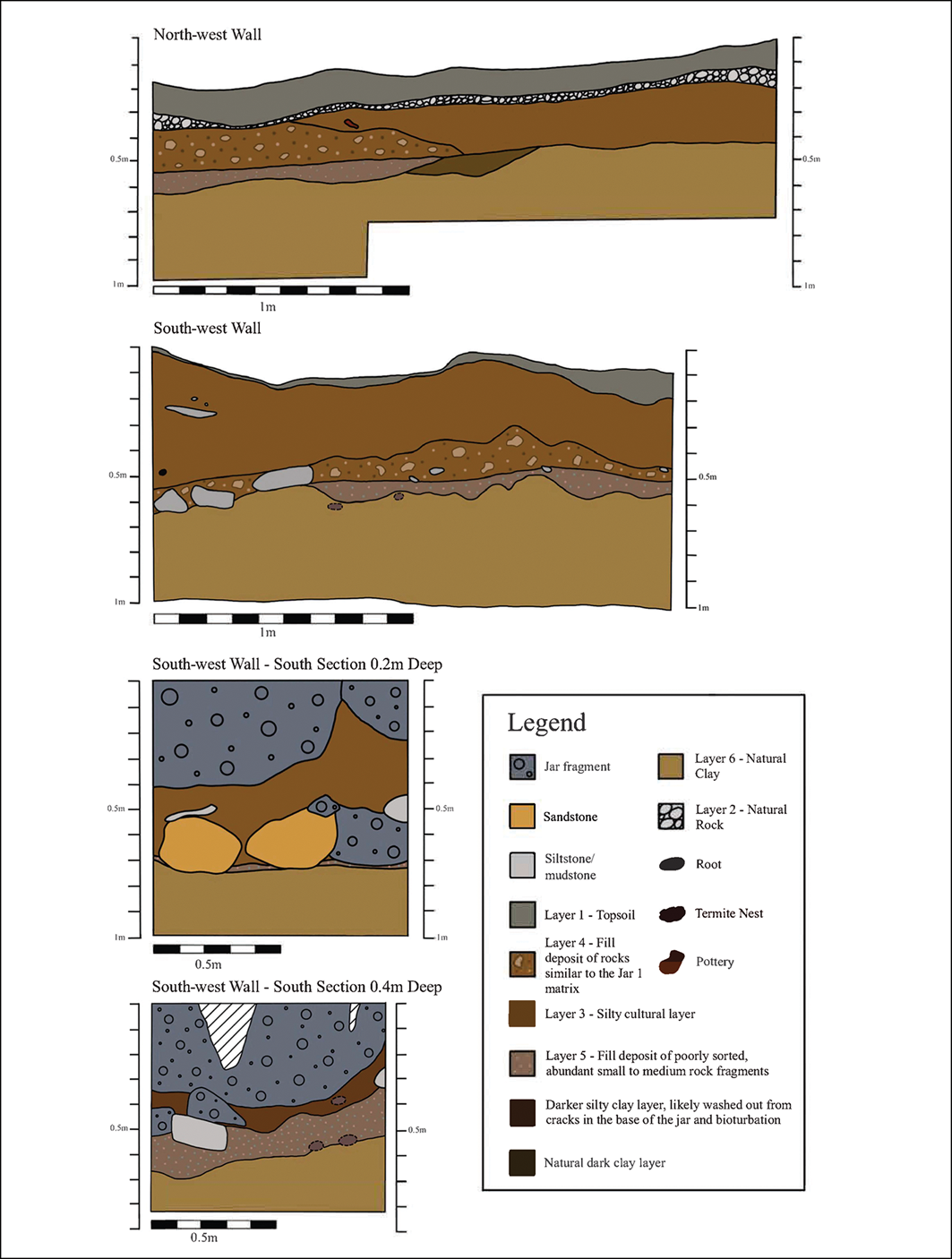
Trench 1 revealed a sequence of natural and cultural deposition (Figure 5) that suggests the landscape was purposefully altered and levelled in preparation for the placement of Jar 1. Layer 5 is a fill deposit forming a platform that extends beneath the vessel. Layer 4 is a deliberate levelling fill composed of jar-carving debris and several large stones that sit along the jar’s south-west side (Figure 5). This layer thickens upslope toward Jar 1, which was likely partially carved in situ and supported by this material (see Devantier-Thomas Reference Devantier-Thomas2021 for further examples of the jar-carving process).
Stratigraphy of the north-west and south-west walls of trench 1. On the southern section of the south-west wall, excavation extended beneath Jar 1 to a depth of 0.40m (figure by authors).

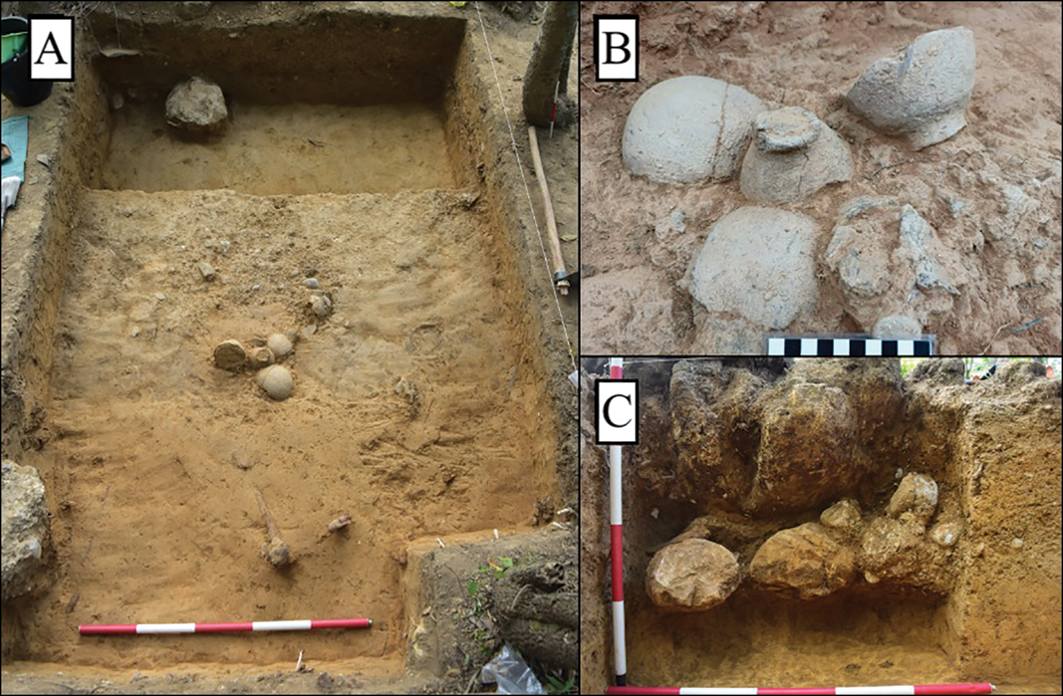
All cultural material was recovered from depths shallower than 0.70m, with most, including two features, corresponding to layer 3. Feature 1 consists of a large mudstone slab broken into two pieces, measuring approximately 0.45 × 0.17m, and a heavily fragmented earthenware vessel. Feature 2 includes at least six intact or partially complete earthenware vessels and scattered earthenware sherds (Figure 6). The feature 2 assemblage consists of two ware types: thick-walled footed bowls and thin-walled globular pots (Figure 4). Two of the bowls feature a flanged foot about 60mm in diameter (Figure 4: A22, A23) and one bowl has a cylindrical foot about 70mm in diameter (Figure 4: A11). One footed bowl found at the western side of the trench extension was accompanied by a hammerstone and another large stone (Figure 4: A20, A21). Three to four fragmented globular pots were present, at least one with an everted rim and black slip (Figure 4: A19) akin to those found at Site 1 (O’Reilly et al. Reference O’Reilly2023). This type of slip has been termed both a ‘glaze’ (O’Reilly et al. Reference O’Reilly2023) and a ‘lacquer’ (Nitta Reference Nitta1996). Further analysis is required to determine its composition and mode of application. There is also evidence of other surface treatments probably exclusive to the globular pots, including incised and impressed decoration. Three large ungulate teeth were also uncovered in layer 3 (Figure 4: A7–A9). A hammerstone (Figure 4: A3) measuring 80 × 65mm was recovered from layer 2. No artefacts were recovered from layer 1. A further 0.30m was excavated into the sterile natural clay (layer 6), confirming the absence of deeper cultural deposits.
A) Aerial photograph of trench 1 showing feature 2 in the centre; B) close-up of feature 2; C) west wall showing the Jar 1 wall and base, stratigraphy 0.20m (see Figure 5) (figure by authors).

Beads analysis
Twelve of the 20 recovered beads were selected for compositional analysis (Figure 4): five orange in colour, four turquoise-blue, one dark blue, one black and one orange-over-red. The remaining eight beads were excluded to avoid redundancy as they are visually identical to the five orange beads submitted for analysis. All beads were manufactured using the drawn technique, in which a tube of glass is formed by pulling a molten mass containing an air bubble and then cut into short segments. The sharp edges of these segments are subsequently fire-polished by stirring them in a heated pan.
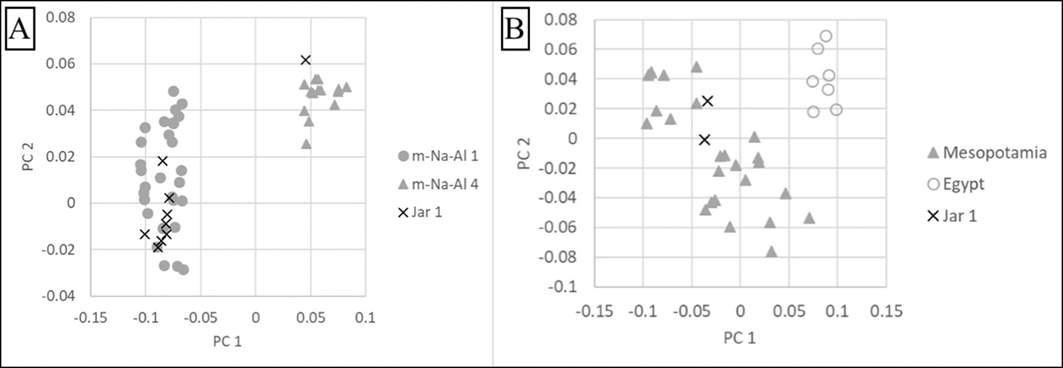
Four different compositional groups were identified for the 12 beads (Figure 7). The largest group includes nine beads with a mineral soda-high alumina (m-Na-Al) composition consistent with beads produced in South Asia. Two subgroups, m-Na-Al 1 and m-Na-Al 4, were defined through principal component analysis (PCA) (Figure 7a; Dussubieux et al. Reference Dussubieux2010, Reference Dussubieux2025).
PCA plots of element concentrations in A) mineral soda-high alumina glass samples from Jar 1 compared with South Asian glass fragments found in Sumatra (Dussubieux Reference Dussubieux, Perret and Surachman2009); and B) soda plant-ash glasses from Sasanian and post-Sasanian Kish, Iraq (labelled Mesopotamia) (Dussubieux Reference Dussubieux, Wilson and Bekken2023), fourteenth-century AD glass from Egypt (Dussubieux Reference Dussubieux, Wolf and de Pury-Gysel2017) and glass beads from Jar 1 (figure by authors).

The larger subgroup (m-Na-Al 1 signature) is formed of the five orange beads, one turquoise-blue bead and the red-over-orange and black specimens. This composition type was manufactured in eastern south India and diffused widely throughout South and Southeast Asia from the end of the first millennium BC to the eleventh century AD (e.g. Carter Reference Carter2015; Dussubieux Reference Dussubieux, Kanungo and Dussubieux2021). One translucent turquoise-blue bead with a m-Na-Al 4 signature was also likely manufactured in India, although the precise region is unknown (Dussubieux Reference Dussubieux, Perret and Surachman2009). Beads of this type date from the eleventh to the seventeenth centuries AD and have been found across Southeast Asia, including sites in Sumatra (fifteenth–sixteenth centuries AD), the Philippines (late fifteenth–early sixteenth centuries AD), Brunei (fifteenth–sixteenth centuries AD), Malaysia (eleventh–fourteenth centuries AD) and Cambodia (twelfth–seventeenth centuries AD), including Angkor Thom (twelfth–fourteenth centuries AD).
Two beads from Jar 1 have a soda plant-ash composition. This bead type began to appear in Southeast Asia at the end of the first millennium AD when trade with the Islamic world intensified. Sites that date from the eighth/ninth to eleventh centuries AD generally yield a soda plant-ash glass from Mesopotamia, while later sites typically have a soda plant-ash glass from Egypt (Dussubieux & Soedewo Reference Dussubieux and Soedewo2018; Dussubieux et al. Reference Dussubieux2025). The composition of the soda plant-ash beads from Jar 1 more closely aligns with those from Mesopotamia, suggesting they date earlier than the twelfth century AD. Obtaining a more precise timeframe for the deposition in Jar 1 is difficult. Sasanian glass was produced earlier but shares a similar chemical composition to later glasses manufactured across Mesopotamia and the two are not easily distinguished. The dark-blue bead (LAO112) has a potash-rich composition with higher alumina and lower lime concentrations. Its origin is uncertain, but the most likely locations are south-eastern China or northern Vietnam. This composition type is commonly found in Southeast Asia, occurring mostly between 300 BC and AD 300 (Dussubieux Reference Dussubieux and Gan2016).
Chronometric and relative dating
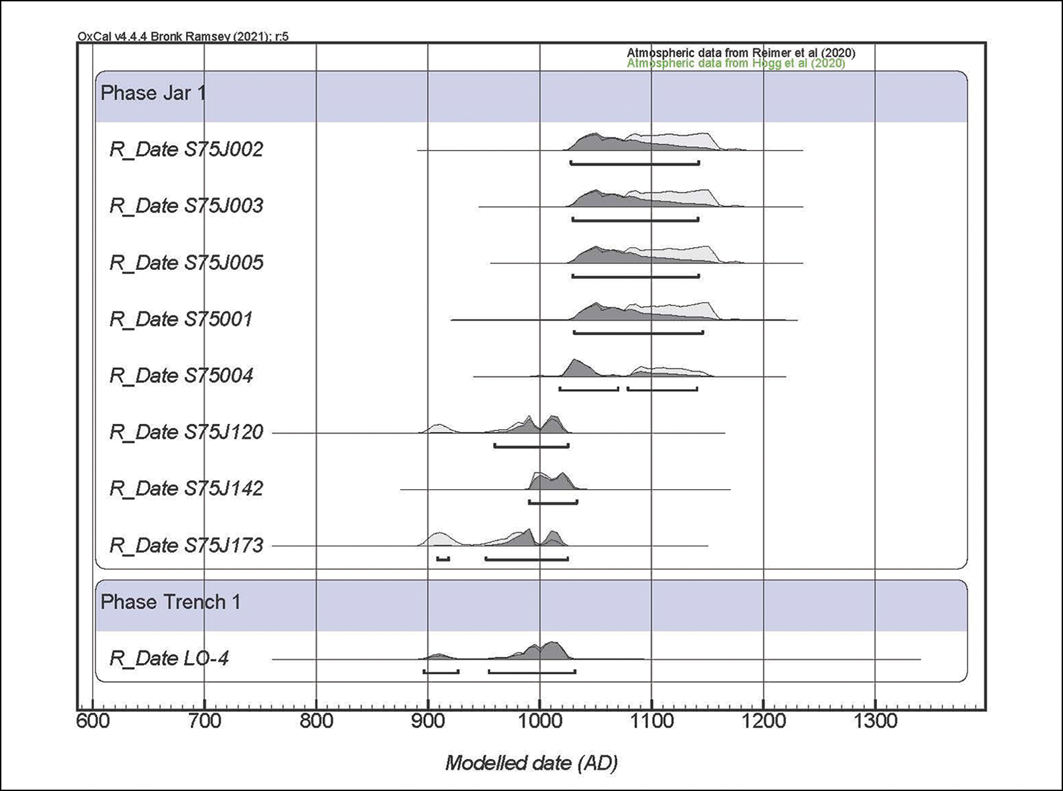
A total of eight human bone/teeth samples from inside Jar 1 have been directly radiocarbon dated (Figure 8, Table 1). This includes three previously published determinations (Skopal et al. Reference Skopal2024) and potentially samples earlier and later phases of use. A further charcoal sample from trench 1 (LO-4) was recovered from the pots in feature 2 and yielded a date of c. cal AD 890–1020. Taken together, the radiocarbon results indicate that Jar 1 may have been used over an extended period of time, with the dates ranging from cal AD 890–1160. Further dating is required to provide a more precise period of interment.
Radiocarbon results and Bayesian modelling from Site 75, Jar 1 and trench 1; (–) represents instances where data were not provided by the radiocarbon lab (figure by authors).

Radiocarbon results from Site 75, Jar 1 and trench 1.

Most of the glass beads are consistent with manufacture c. AD 900–1200. The presence of the potash-rich bead type, typically dated to 300 BC–AD 300, is plausibly the result of curation and reuse. The translucent turquoise-blue bead with a m-Na-Al 4 signature (more commonly associated with the fourteenth–sixteenth centuries AD) may indicate that the jar continued to be used in later periods, although deposition at the earlier end of the known age range for this glass composition could still be consistent with the main burial phase.
Discussion
The excavation of Jar 1 at Site 75 provides new insights into the function of stone jars as mortuary receptacles. Arrangement of the skeletal remains seems to suggest that Jar 1 may have functioned as an ossuary for the collection of secondary burials. Clustering of long bones around the jar edges and the reduced presence of smaller, more fragile skeletal elements suggest that individuals were deposited after body decomposition had occurred elsewhere. Further, the general lack of articulated bones and the mingling of elements inside the jar suggest a phased funerary sequence rather than a single event. The chronological range of the skeletal remains suggests the site may have been used over an extended period, possibly up to 270 years.
The presence of closely associated skull-and-mandible sets marks a departure from the general disarticulation of remains. These elements may have been part of the secondary burial process and were potentially rearticulated and placed with greater care. However, their positioning also raises the possibility of limited primary interment within the jar or the deposition of partly decomposed individuals. Additional evidence for complete primary interment is absent, however: there is a lack of skeletal articulation even at the highly ligamentous joints that are typically the last to decompose, including the sacroiliac joint of the pelvis and the intervertebral joints of the spine. The absence of sediment clearly separating the skeletal remains suggests the jar was empty at the time of deposition, thus the displacement of bones due to gravity and subsequent disturbance, whether by humans or animals, could explain the absence of primary articulation. The presence of a fourteenth–sixteenth-century m-Na-Al 4 glass bead could suggest that the jar continued to be used as a mortuary container and locus of ancestral rites even longer than suggested by the radiocarbon dates.
Remains may also have been selectively removed from within Jar 1, as indicated by the discrepancy in the MNI derived from dental remains versus cranial and postcranial elements. There is currently no evidence that human remains were relocated around Jar 1; however, the mudstone slab found adjacent to Jar 1 and the stone slabs found inside the jar are comparable in size and form to limestone slabs that act as markers for secondary bundle burials at Sites 1, 2 and 52 (O’Reilly et al. Reference O’Reilly2023). No human remains were recovered from Site 2, but its slab features and associated artefact assemblage closely parallel those at Sites 1 and 52, and the absence of preserved remains is attributed to unfavourable soil conditions. This interpretation could be applied at Site 75, although this remains tentative. The remains may instead have been transported to a different location, such as the habitation site of the deceased or their family. Such practices are well-documented in burial traditions across Asia, particularly during the Iron Age (c. 500 BC–AD 500) and Historical periods (c. AD 500 onwards), where secondary processing and the relocation of human remains formed integral components of broader funerary customs. Comparable traditions of secondary processing and relocation either to other mortuary sites, places of worship or habitation areas, occur in north-east India (Mitri Reference Mitri2022; Jamir et al. Reference Jamir2023), Myanmar (Pradier Reference Pradier2022), Thailand (Kanjanajuntorn Reference Kanjanajuntorn, Klokke and Degroot2013) and Vietnam (Dzung Reference Dzung and Manguin2011).
The practices of secondary burial and tooth ablation, together with the radiocarbon dates and associated material culture suggest a strong connection with the broader Plain of Jars cultural sphere, particularly with Site 1. The secondary burials recorded at Site 1 are contemporaneous with those at Site 75, dating to the ninth–twelfth centuries AD (O’Reilly et al. Reference O’Reilly2023). One jar at Site 1 also reportedly contained the fragmented cremated remains from up to three individuals (Colani Reference Colani1935) and tooth ablation practices are observed in other individuals from the site (O’Reilly et al. Reference O’Reilly2023), and among prehistoric populations in Thailand, Vietnam, Cambodia and China (Domett et al. Reference Domett2013; Newton & Domett Reference Newton and Domett2017; Palefsky Reference Palefsky2019; de Saint-Aubert et al. Reference de Saint-Aubert2023; Zhang Reference Zhang2025). The material culture assemblage from Site 75 has parallels at other sites in the Plain of Jars. The footed bowls are analogous to Colani’s ‘cremation cups’ (1935: fig. 151), while the globular bowls with everted rims are similar to ‘cremation pots’ recovered from several locations at Site 1 (Colani Reference Colani1935: fig. 152; O’Reilly et al. Reference O’Reilly2023: 115) and Site 2 (O’Reilly Reference O’Reilly2022b: fig. 13). The iron knife and copper-based bell are artefact types that also occur at Sites 1, 2 and 3, in association with mortuary contexts. Glass beads are commonly associated with the stone jars and are frequently found both inside and around their bases, likely as part of burial offerings or adornments for the dead (Colani Reference Colani1935; O’Reilly et al. Reference O’Reilly2019).
The compositions of the glass beads found inside Jar 1 suggest that the community associated with Site 75 participated in an extensive and far-reaching trade network that connected Southeast Asia to the Middle East and South Asia as well as an intra-regional network that included Cambodia and peninsular Malaysia. This points to a dynamic engagement with regional and inter-regional trade spheres. The presence of South and West Asian glass inside Jar 1 suggests that these networks extended into the Lao highlands, with jars possibly strategically positioned at nodal points along overland routes connecting East and Southeast Asia, well beyond the lowland centres typically associated with first-millennium AD trade.
Jar 1 at Site 75 is currently the only megalithic jar in Laos to contain a multigenerational secondary burial of this scale, standing in clear contrast to all other Plain of Jars sites. As Jar 1 is also among the largest jars recorded and has a form that is not observed elsewhere (Skopal et al. Reference Skopal2023), this could represent a distinct, locally specific tradition (O’Reilly et al. Reference O’Reilly2019). The volume of largely undisturbed material could also be due to the remote location of Jar 1 compared with other larger and more accessible jar sites that have been extensively looted over time (Colani Reference Colani1935).
If Jar 1 can be taken as broadly representative of the wider mortuary tradition associated with the stone jars, it could be hypothesised that smaller jars served as primary containers for the initial decomposition of bodies. Following decomposition, skeletal remains may then have been transferred into larger stone jars (secondary deposition) and later removed for reinterment elsewhere. At Site 75, the smaller group 2 jars, which do not contain human remains, could represent primary containers (Skopal et al. Reference Skopal2025). Earthenware associated with these small jars is consistent with the ceramic assemblage found near Jar 1 (Skopal et al. Reference Skopal2025), suggesting that the use of both locations was contemporaneous and the people using the sites had similar ideas about how to treat the body after death. A common sequence of mortuary processing involving the movement of human remains into and out of stone jars could explain why most stone jars are devoid of human remains. Such a view should, however, be treated with caution as stone jars are widely distributed across northern Laos and regional variations in mortuary traditions are likely to exist.
Radiocarbon dates from human remains and associated archaeological contexts indicate activity at Site 75 between the ninth and twelfth centuries AD. Some scholars (e.g. Sayavongkhamdy & Bellwood Reference Sayavongkhamdy and Bellwood2000; O’Reilly et al. Reference O’Reilly2019) have proposed that the stone jars at various sites were constructed by an earlier population and later reused by subsequent groups. The current inability to directly date the jars helps sustain this notion, but the evidence presented here points to a predominantly historical-period timeframe for the use of Jar 1 at Site 75. Although further data are required to securely establish a chronology of use, contemporaneity with burials at Site 1, along with the relative dating of comparable material culture at several other jar sites, suggests that the use of stone jars in mortuary activity flourished during this period. The late-first to early-second-millennium timeframe also aligns with a broader period of increasing trans-Asian connectivity marked by the commercial expansion of the Song Dynasty (AD 960–1279) in China, the rise of the Dali Kingdom (AD 937–1253) in Yunnan (which extended into parts of northern Laos), the Đại Việt (AD 968–1804) and Champa kingdoms (AD 192–1832) in Vietnam, the Dvaravati (AD 600–1000) in central Thailand and the influence of the Pagan Kingdom (AD 849–1297) in Myanmar. The Khmer Empire (AD 802–1431) was also at its height during this period. These states were deeply embedded in expansive overland and maritime trade networks, facilitating the circulation of goods, technologies and cultural practices across vast parts of Asia (Stark Reference Stark and Smith2014). Activity at the jar sites, therefore, appears to have occurred within a dynamic and interconnected landscape of regional exchange.
Conclusion
The excavation of Jar 1 in Site 75 significantly improves our understanding of the antiquity of megalithic jars in Southeast Asia and the complex mortuary behaviour associated with their use. Some stone jars were clearly used to hold human remains, though jar interment may have been only one stage in the mortuary process rather than the final resting place (Skopal et al. Reference Skopal2023). New radiocarbon dates derived from the skeletal material held inside Jar 1 indicate an extended period of use from the end of the first millennium AD to the beginning of the second millennium, coinciding with a period of socioeconomic efflorescence in the region. Broad contemporaneity of activity at Site 75 and at other sites in the Plain of Jars suggests a shared mortuary tradition that persisted in this region for several centuries.
Ongoing bioarchaeological analyses will provide information on the 37 individuals found within Jar 1, about their origins, health, lifeways and possible relationships. Given the number of individuals represented, it seems probable that jars were the property of families or extended family groups and were places that were returned to, where ancestral rites were observed over generations. Why stone-jar production eventually ceased remains uncertain, but changing mortuary customs may reflect new religious influences or broader shifts in regional sociopolitical and economic conditions. Additional analysis of Jar 1 and further excavations at other undisturbed sites will be essential for refining these interpretations and for illuminating how the mortuary practices associated with stone jars relate to wider regional networks of belief and exchange.
Acknowledgements
Thank you to Phakhanxay Sikhanxay and Thonglith Luangkhoth for their ongoing support.
Funding statement
This research received no specific grant from any funding agency or from commercial and not-for-profit sectors.
Online supplementary material (OSM)
To view supplementary material for this article, please visit https://doi.org/10.15184/aqy.2026.10352 and select the supplementary materials tab.
Author contributions: CRediT categories
Nicholas Skopal: Conceptualization-Lead, Data curation-Equal, Formal analysis-Lead, Investigation-Lead, Methodology-Equal, Project administration-Lead, Writing - original draft-Lead, Writing - review & editing-Equal. Baptiste Pradier: Data curation-Equal, Formal analysis-Lead, Investigation-Equal, Methodology-Equal, Writing - original draft-Equal. Souliya Bounxayhip: Conceptualization-Equal, Formal analysis-Equal, Investigation-Equal. Charlie Cooper: Formal analysis-Supporting, Investigation-Supporting, Writing - original draft-Supporting, Writing - review & editing-Equal. Laure Dussubieux: Formal analysis-Lead, Investigation-Lead, Writing - original draft-Equal. Tate Gregory Devantier-Thomas: Formal analysis-Equal, Investigation-Equal, Visualization-Equal, Writing - original draft-Equal, Writing - review & editing-Equal. Tracey Pilgrim: Formal analysis-Equal, Writing - original draft-Equal, Writing - review & editing-Equal; Steph Van Berkel: Investigation-Equal, Writing - review & editing-Equal. David Demko: Investigation-Equal. Frederique Valentin: Formal analysis-Supporting, Writing - review & editing-Equal. Jazmin Skopal: Investigation-Equal, Project administration-Equal, Writing - review & editing-Supporting. Daniel Baker: Investigation-Supporting, Visualization-Supporting. S. Anna Florin: Formal analysis-Supporting, Methodology-Supporting. Cosimo Posth: Formal analysis-Supporting. Geoffrey Clark: Methodology-Equal, Writing - original draft-Supporting, Writing - review & editing-Equal.


 Open access

