

1. Introduction
Is the individuals’ level of interest and knowledge about trade policy important when forming preferences based on the information provided by political elites? In other words, does limited prior knowledge, and therefore interest, hinder people from forming informed trade preferences? This survey, conducted in early 2020 regarding the US–Japan Trade Agreement, found that new information significantly impacted individuals opinions regarding trade, but these effects were highly dependent on existing knowledge and level of interest. Traditional trade policy literature emphasizes that when individuals’ economic self-interests change, their preferences toward trade agreements also change. When explaining individual preferences on trade policies, most scholars of Open Economy Politics (OEP), who focus on the international political economy, have explored various factors closely aligned with individuals’ economic motivations, such as their level of income, education, skills, occupational characteristics, and industry (Beaulieu et al., Reference Beaulieu, Ravindra and Wei2005; Scheve and Slaughter, Reference Scheve and Slaughter2001). Based on this view, individuals who once supported the US trade agreement with Canada and Mexico might later oppose it if they no longer perceive the trade agreement as positively serving their economic interests. More recent studies question the assumption that individuals’ opinions on trade policies are based on their economic self-interests. Such findings indicate that material self-interests and other sociotropic factors, such as altruism and nationalism, also shape trade preferences (Mansfield and Mutz, Reference Mansfield and Mutz2009; Rho and Tomz, Reference Rho and Tomz2017). Therefore, based on these studies, people may revise their views on trade for non-material reasons, even when their jobs and incomes remain unchanged.
Further, empirical evidence demonstrates that individuals change their trade agreement preferences based on their political position and the information provided by their favored political figure. An example is former US President Trump shifting Republicans’ opinions about free trade agreements (FTAs) during the 2016 election campaign. During this period, support for FTAs among Republicans and Republican leaners dropped to 29%, representing a 24% decrease from 2015 (Pew Research Center, 2018). However, support for FTAs among Democrats and Democratic leaners remained nearly stable, from 58% in 2015 to 59% in 2016, demonstrating only a 1% increase during the 2016 presidential election campaign when Trump proposed renegotiation and withdrawal of previously signed FTAs (Pew Research Center, 2018). During this short period, only Republicans changed their opinions on FTAs, indicating the party's or party politicians' potential influence during the election campaign.
Although the literature demonstrates that people build their trade policy opinions based on their economic statuses, the above example demonstrates that political motivation can change people’s trade preferences. A distinct and emerging literature, including Kim et al. (Reference Kim, Park, Rhee and Yang2023), Kim and Margalit (Reference Kim and Margalit2017), and Spilker et al. (Reference Spilker, Nguyen and Bernauer2020), also examined how exposure to new information can lead to shifts in trade attitudes. Why do some individuals succumb to political motivations regarding economic issues such as trade policies while others remain unaffected? Who is more susceptible to such influence? In other words, why then are some individuals more susceptible to politically supplied information about trade than others? This study argues that issue-specific knowledge and issue-specific interest condition susceptibility to elite information on trade. The study examines how variation in knowledge and interest relates to pre- and post-changes in stated preferences, thereby explaining who is more likely to be influenced and when.
Exploring the impact of a lack of interest in and limited knowledge of trade policies is crucial, as it constitutes theoretical and empirical challenges recurring in international political economies. Scholars argue that people have minimum interest in and knowledge of trade policy issues, which negatively influences the credibility of public survey results on trade in politics (Guisinger, Reference Guisinger2009; Urbatsch, Reference Urbatsch2013). For example, individuals lacking interest in trade policies will tend to answer questions related to trade policies with less care, as they tend to pay little attention to the content or context of the questions. While this low-salience problem does not necessarily render survey data unreliable for studying trade policies,Footnote 1 it poses a challenge for policymakers formulating effective trade policies using public survey results. When survey participants lack interest in or knowledge about trade policies, the importance of acquiring information on these policies diminishes, leading to a recurring lack of understanding of the issues. This vicious cycle potentially weakens the impact of public opinions on a politician’s decisions regarding trade policies.
To address the persistent challenge posed by trade policies’ low salience, a survey was conducted focusing on individuals’ opinions on trade policies during an election campaign. The survey, conducted in 2017, revealed that trade agreements are not merely peripheral concerns for the public, especially when they intersect with individuals’ job anxieties.Footnote 2 Furthermore, the salience of this issue tends to amplify during election campaigns. The findings from our survey, as depicted in Table 1, clearly indicate that while people exhibit less interest in trade policies than politics, the disparity between the levels of interest in politics and trade policies diminishes during election periods. This suggests a heightened salience of trade policy issues amid election campaigns.
Interest in politics and trade policy issues

Table 1 Long description
The table measures interest levels in political and trade policy issues among respondents. A majority, 59.1%, are interested in most political issues, compared to 44.2% for trade policy issues. Interest during election periods is higher for trade policy at 33.6% than for political issues at 23.1%. Only 12.2% are not interested in political issues, while 18.2% are not interested in trade policy issues. Overall, political issues garner more consistent interest, but trade policy sees a significant increase in interest during election periods.
The following section presents a brief literature survey on the issues related to low salience and ignorance regarding trade policies, followed by a theoretical argument distinguishing knowledge from interest and hypotheses, and finally gives a detailed description of the experimental design. Subsequent sections report results and robustness checks, and the conclusion discusses the implications of the findings.
2. Theory
Trade salience has varied significantly over time in US history. During certain periods, such as economic downturns, elections, and international trade agreement negotiations, trade issues receive more attention from the public (Nguyen, Reference Nguyen2019). However, existing literature expresses concern regarding low salience and high levels of ignorance on trade policy issues in the US. For instance, Guisinger (Reference Guisinger2009) argues that, compared to other policy issues such as social security, healthcare, education, and taxes, trade policy remains a low-salience political issue in the US. In fact, the US public is widely perceived as having little interest in and knowledge of trade policies.
Against this background, one might ask which trade policies become more salient than others. Trade policies with more significant welfare effects and complexity are reported to be more salient than others (Taylor, Reference Taylor2015). In fact, understanding a trade agreement's complexity and welfare implications can be challenging for the public. The public often require access to trustworthy sources of informational intermediaries, such as coworkers, politicians, or labor unions to understand the implications of policies that suit their self-interest. They then align their preferences with their material interests, such as industry of jobs and income (Dür and Schlipphak, Reference Dür and Schlipphak2021; Fordham and Kleinberg, Reference Fordham and Kleinberg2012; Kim et al., Reference Kim, Park, Rhee and Yang2023; Margalit, Reference Margalit2011; Naoi and Urata, Reference Naoi and Urata2013). Moreover, responses to subjective inquiries are contingent upon individual economic and social contexts and personal experiences. Given this, one might ask, is a trade agreement between the US and Korea less complex than that between the US and Japan? Does the trade agreement with Korea produce fewer welfare effects than that with Japan? What proportion of the public can decide whether to support or oppose these agreements based on the answers to the above two questions?
When exploring individual preferences on trade policy, this study argues that, beyond the complexities and size of the welfare effects themselves, the ability of individuals to discern the complexity and welfare implications of trade agreements through the acceptance of external information is an important factor to consider. In other words, susceptibility to elite-provided information depends on individuals’ issue-specific knowledge and issue-specific interest. People vary in both the ability (knowledge) and the motivation/attention (interest) to receive, evaluate, and integrate political information. Therefore, focusing on political elites as the external source of information providers, given their significant in role in shaping discourse on trade policy, the study examines how knowledge and interest condition policy preferences.
Existing literature supports the notion that low levels of knowledge can reduce citizens’ capacity to link information to policy preferences by showing that if individuals are ill-informed about trade policy, their ability to connect either the country’s or individual economic and political interests with their trade opinions may be compromised (Guisinger, Reference Guisinger2009; Lewis-Beck and Stegmaier, Reference Lewis-Beck and Stegmaier2000; Mutz, Reference Mutz1994; Sears and Funk, Reference Sears and Funk1990; Sears et al., Reference Sears, Lau, Tyler and Allen1980). Guisinger (Reference Guisinger2009) also questions voter-inclusive models of trade policy, citing the need for more salience of trade policy among voters and their limited knowledge, including knowledge of their politicians’ positions on trade.
These concerns motivate a theoretical and empirical distinction between knowledge and interest and a set of expectations about their moderating roles. It is worth examining how these two variables are differentiated and what does a discrepancy between knowledge and interest imply. Initially, when formulating the relative research question, the effects of these variables on trade preference were considered entirely separately. An individual who is highly interested in trade policy may not necessarily have extensive knowledge. In other words, even if one lacks knowledge about trade policy, one may still be interested in the topic for various other reasons.
However, in trying to understand these two variables in depth, it becomes apparent that differentiating between these aspects is challenging. Perhaps, it is the ‘combination of low-knowledge and high-interest that is symptomatic of those who accept information without much reflection’. Section 3 of this paper addresses this challenge by regressing these two variables separately and examining their interaction to discern a more nuanced effect on trade preference change among people. While these two variables interact with each other, they are not identical; nor do they necessarily correlate as knowledge is the issue-specific collection of facts and principles that enables counter-arguing while interest is self-salience and attentiveness that heightens exposure to information and the motivation to process it.
Are people with more knowledge about trade policy more likely to change their preferences on issues based on new information provided by the political elite? The effect of knowledge on susceptibility to new information can be positive, negative, or nil: individuals with greater knowledge about trade policy may be more likely to change their preferences as they gain a better understanding of the issue due to new information, or they may be more resistant to change based on the existing knowledge they have on the matter.
Hypothesis 1: When new information is provided, the level of knowledge individuals possess regarding a trade policy influences the susceptibility of their preference changes on trade agreements.
A vast number of studies in the literature reveals that education is strongly and positively correlated with support for free trade (Stiller et al., Reference Stiller, Dür and Huber2022; Hainmueller and Hiscox, Reference Hainmueller and Hiscox2006; Mansfield and Mutz, Reference Mansfield and Mutz2009). Considering the correlation between education and political knowledge, it is important to clarify how this relationship relates to the hypothesis and findings of this study in which education and issue-specific knowledge on trade policy are viewed as distinct and only partly overlap. Education may be a broad and upstream attribute that predicts the baseline level of trade preferences, but hypothesis 1 typically posits that citizens are highly susceptible to elite information because of a lack of time or information to form independent opinions on complex issues. Consistent with the literature, education is associated with higher baseline support, but in this research the attempt is to understand how far individuals move from this baseline, depending on the level of their issue-specific knowledge, instead of the level of their baseline. Education thus helps explain who supports trade and by how much, but knowledge helps explain who is more persuadable and susceptible to new information.
The effect of low interest in trade policy on an individual’s susceptibility to new information can be positive, negative, or neutral. For example, people interested in a trade policy might be more active in seeking and accepting information and, thus, be more likely to form preferences based on what they have learnt from such information. In contrast, people with little interest in trade agreements might be influenced when they receive new information on trade policy because they have not had any prior preferences on the issue. In fact, according to Zaller’s (Reference Zaller1992) findings, people with prior preferences are less likely to be affected by new information.
This research posits that individuals’ interest or little interest in the topic can affect their responsiveness to information provided by political elites and affect their willingness to accept and digest such information. A lack of interest in trade policy issues may also determine the extent to which people actively seek information on these issues, although that is not the question addressed in this research. Consequently, the accessibility of related information and individuals’ willingness to put effort into understanding the information affect their ability to form preference on a trade policy. In addition to hypothesis 1, the following hypothesis is also tested:
Hypothesis 2: When provided with new information, people’s level of interest in trade policy influences their susceptibility to preference changes on trade agreements.
The survey confirms that most people do not perceive international trade as an important policy issue.Footnote 3 The graph on the left side of Figure 1 illustrates the survey results of participants asked to choose three policy issues personally meaningful to them. The graph on the right illustrates the results after they were asked to choose three important policy issues for the country. Among the 12 national policy issues, international trade ranked second to last for personal importance and third to last for the country.
How important is trade policy?

Figure 1 Long description
The left graph shows survey results on policy issues important to individuals, with healthcare at 51.6 percent, economic growth at 39.2 percent and social security at 33.9 percent. Other issues include environment at 31.9 percent, education at 27.6 percent, immigration at 21.8 percent, budget deficit at 19.6 percent, military at 18.7 percent, reducing crime at 12.7 percent, international trade at 6.6 percent and transportation at 4.9 percent. The right graph shows policy issues important for the country, with economic growth at 54.6 percent, healthcare at 44.3 percent and budget deficit at 30.8 percent. Other issues include immigration at 29.8 percent, environment at 23.4 percent, terrorism at 23.3 percent, social security at 21.8 percent, education at 16.7 percent, military at 14.7 percent, international trade at 14.0 percent, reducing crime at 11.3 percent and transportation at 3.3 percent.
Thus, the survey’s results affirm that trade policy issues have low salience relative to other policy matters. People perceive the importance of trade policy more for the country than for themselves. This finding has implications for the debate surrounding factors influencing individual trade preferences. When forming opinions on trade policy, they inevitably consider national consequences than individual ones. The literature on US politics shows that elite cues structure mass attitudes by shaping which considerations are received and accepted (Zaller, Reference Zaller1992) and by linking voters’ evaluations to the signals of elite positions and performance (Lenz, Reference Lenz2012). The literature on international political economy also emphasizes the role of information in trade opinion formation by explaining how framing information would alter perceived self- and/or sociotropic consequences of the trade policy (Guisinger, Reference Guisinger2009; Guisinger and Saunders, Reference Guisinger and Saunders2017; Kim and Margalit, Reference Kim and Margalit2017; Rho and Tomz, Reference Rho and Tomz2017). The area of trade is typically low-salience and complex; hence, it may be a particularly conducive domain for elite influence due to the informational asymmetries in which elites can curate both the direction of preference through elite cues and the density of the preference through framing for public evaluation.
Recent work in international political economy directly examines preference change following exposure to new trade information (Kim et al., Reference Kim, Park, Rhee and Yang2023; Spilker et al., Reference Spilker, Nguyen and Bernauer2020). This study builds on this emerging literature by focusing on who is more persuadable by focusing on individuals’ traits in terms of their issue-specific knowledge and interest level. The theoretical framework in this research thus distinguishes issue-specific knowledge and issue-specific interest as moderators of elite-provided information and situates these claims within the broader elite-cue tradition in US politics literature while speaking more directly to trade specific dynamics of policy preferences under low salience. In other words, this study examines whether individuals’ knowledge of, and interest in, trade policy affect their susceptibility to new information provided by political elites on trade agreements.
3. Empirical Analysis
The survey aimed to test whether people who are more knowledgeable about trade policy are more or less likely to change their preferences when exposed to new information provided by the political elite than their less knowledgeable counterparts when exposed to the same information. A questionnaire was administered to a sample of 1,068 US adults via the Macromill Group, a global online research company, from 21 to 26 February 2020, during the early phase of the 2020 presidential election, when people’s interest in trade policy was relatively high in comparison to non-campaign periods. In addition, this timing of the survey was chosen because the names of potential presidential candidates were available to the public during this period; for the experimental survey, respondents were asked who they supported as their presidential candidate for the 2020 elections. All participants provided informed consent, and the Institutional Review Board (IRB) approved the study.Footnote 4 Specifically, the sample includes 547 females and 521 males, distributed across various regions: 186 from the Northeast, 216 from the Midwest, 258 from the West, and 408 from the South. Among the participants, 307 individuals were aged between 18 and 29, 258 between 30 and 39, 243 between 40 and 49, and 260 were 50 and above.Footnote 5 Among 1068 respondents, except 3 people who refused to answer, 563 had college or postgraduate degrees, and 502 held no college or postgraduate degree. Data were balanced between Republicans and Republican leaners (406) and Democrats and Democratic leaners (458), with 147 independents, 8 supporting other parties, and 49 who refused to reveal the party they supported.
For the experiment, the survey participants were first asked whether they supported the new trade agreement with Japan (USJTA), which was enacted a month prior to when the survey was conducted. After recording baseline support for the USJTA, respondents then read a randomized elite messageFootnote 6 about the agreement attributed to their favored presidential candidate.Footnote 7 The hypothetical message from their favored elite was assigned by prior position. For respondents with clear priorities, the elite stance countered their baseline (USJTA supporters read an opposing message, while opponents read a supporting message). Respondents who answered that they are unsure about their support for the USJTA were randomized to either an endorsement or an opposition message. After reading the elite message, all respondents reported their post-treatment position, allowing for observation on whether their stated preference changed or remained unchanged.
Content in the newspaper-style vignette of the elite message was also varied to test whether the effects of issue-specific knowledge and issue-specific interest differed. One type of message provided a brief neutral, factual description of the agreement without justifying the elites’ stance (control). The other versions offered additional information on the rationales grounded in self-interest, national economic consequences, or national security for the elites’ opinions on USJTA. This design allowed for assessing whether respondents with higher trade policy knowledge or interest were differentially susceptible to a particular frame, especially the self-interest frame. Not all respondents will take vignettes at face value; hence, treatment validity was documented by asking respondents to identify the candidate’s position immediately after reading the message Of the respondents, 187 (17.5%) answered incorrectly about their favored candidates’ position on USJTA after reading the elite message. These respondents were those who did not understand the vignette elite messages correctly or believe the message. The mean preference change percentage of these respondents is around 11.23%Footnote 8, which is much smaller than the result of the pooled respondents, which is 38.1%.
To make a realistic hypothetical scenario for the experiment. respondents were asked their opinions on the USJTA rather than about a general agreement. This was done to avoid bias that would be created if they were asked about preferences on a general trade agreement, wherein each person may imagine different partner countries instead of a specific agreement, such as the USJTA. More importantly, the USJTA was chosen because it was the most recent trade agreement the US had signed before the survey and it had recently been covered in the media, which made it familiar to the public and left them with fewer pre-existing biased views on it. Also the USJTA was a deliberate choice as it has been characterized as a low-heat, low-polarization case unlike US–China trade relations, where prior attitudes, partisan identities, and media saturation have likely swamped the participants’ perceptions. USJTA is familiar to the public because it is relatively recent and, Japan is considered an important US trading and investment partner as it is one of the leading countries in the world economy. Hence, the effect of the trade agreement with Japan is of significant importance to the public, allowing for clearer identification of top–down elite influence without severe pre-treatment. Admittedly, the USJTA choice limits generalizability to highly politicized environments. Accordingly, the findings are treated as evidence about who is persuadable and susceptible to new information provided by political elites under low-salience conditions, which is a more real-world situation, and the scope conditions are discussed in the conclusion.
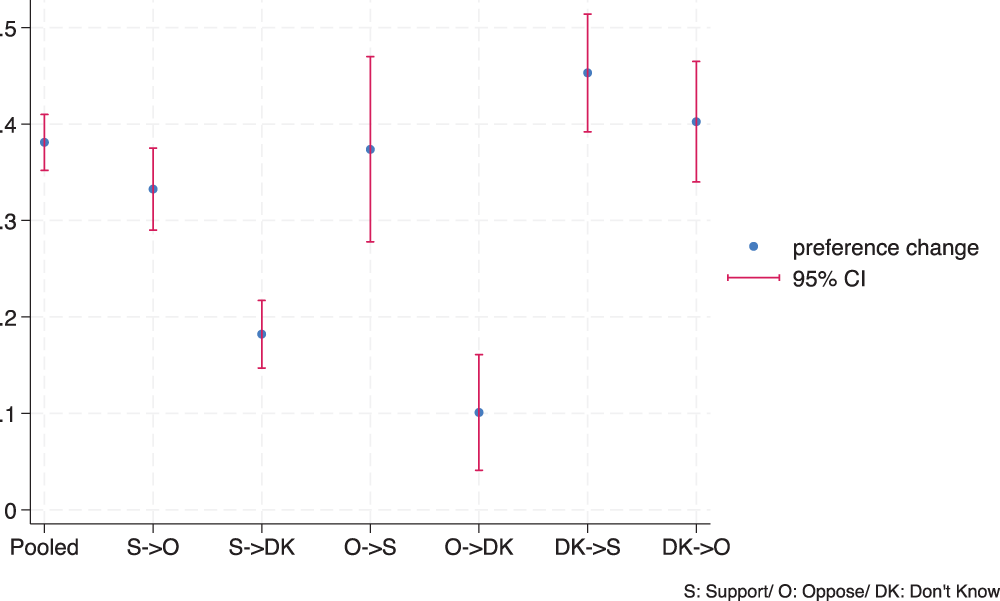
In response to the basic question of whether the respondents support or oppose the USJTA, respondents indicated their positions on the USJTA, without any elite messaging, using three categories: support, oppose, or ‘I do not know’. Measuring the preference change (‘swaying support’), a binary directional switch indicator was marked as 1 if a respondent changed position following an elite stance (which also includes moves from ‘I do not know’ to ‘support/oppose’), and as 0 if otherwise. Of the 1,068 participants, 472 said they supported the USJTA before reading the treatment elite message, 99 said they opposed the USJTA, and 497 respondents said they were unsure of their opinion about USTJA. From this baseline support level, (a) respondents who originally answered that they supported the agreement received a message allegedly opposing the agreement from the elite, (b) respondents who initially responded that they opposed the agreement received a message from the elite supporting the agreement, and (c) respondents who answered they were unsure, received randomized messages of either endorsement or opposition. (1) In the group initially supporting the agreement (472), 157 switched to opposing the agreement and 86 switched to being unsure. (2) In the group opposing the agreement (99), 37 switched to supporting the agreement and 10 switched to being unsure. (3) Of the 479 who were unsure initially, 116 of 256 who received supporting message changed their unsure opinion to supporting the agreement, and 98 of 241 who received an opposing message changed their opinion to opposing the agreement. How elite messages affect shifts in opinion among these subgroups is shown in Figure 2, which shows the mean preference change with a 95% confidence interval for pooled respondents and the subgroups of those who previously supported, opposed, or remained unsure.
Elite messages’ effect on opinion changes by subgroups.

Figure 2 Long description
The graph shows preference change with 95 percent confidence intervals for various opinion shifts. The x-axis labels are Pooled, S right arrow O, S right arrow DK, O right arrow S, O right arrow DK, DK right arrow S and DK right arrow O. The y-axis represents preference change, with values ranging from 0 to 0.5. Each point on the graph is marked with a dot representing preference change, accompanied by a vertical line indicating the 95 percent confidence interval. The legend indicates that the dots represent preference change and the lines represent the 95 percent confidence interval. The labels S, O and DK stand for Support, Oppose and Don't Know, respectively.
It can be observed that the largest effect of an elite message is on respondents who were initially unsure about their preference regarding USJTA, for both directions (DK–>S and DK–>O) as they show the biggest average preference changes among the different subgroups. In contrast, moves from a firm view to ‘Don’t Know’ in either direction (from support to ‘Don’t Know’ or from opposed to ‘Don’t Know,’) are the smallest (S–>DK and O–>DK). Direct flips of preference after reading the elite message (S–>O and O–>S) are close to the pooled mean; hence, differences by direction are minimal.
To replicate real-world political dynamics as far as possible, various types of information were included in scenario news articles. Each survey participant was randomly assigned one of four scenarios: (1) an economic self-interest rationale for the participant, (2) a national economic rationale for the candidate’s position, (3) a national security rationale, and (4) no rationale. The participants receiving the scenario with no rationale constituted the control group, demonstrating the effect of an elite cue effect devoid of specific messaging with information on the trade agreement. The treatment group comprised participants receiving one of the three informative messages from political elites.
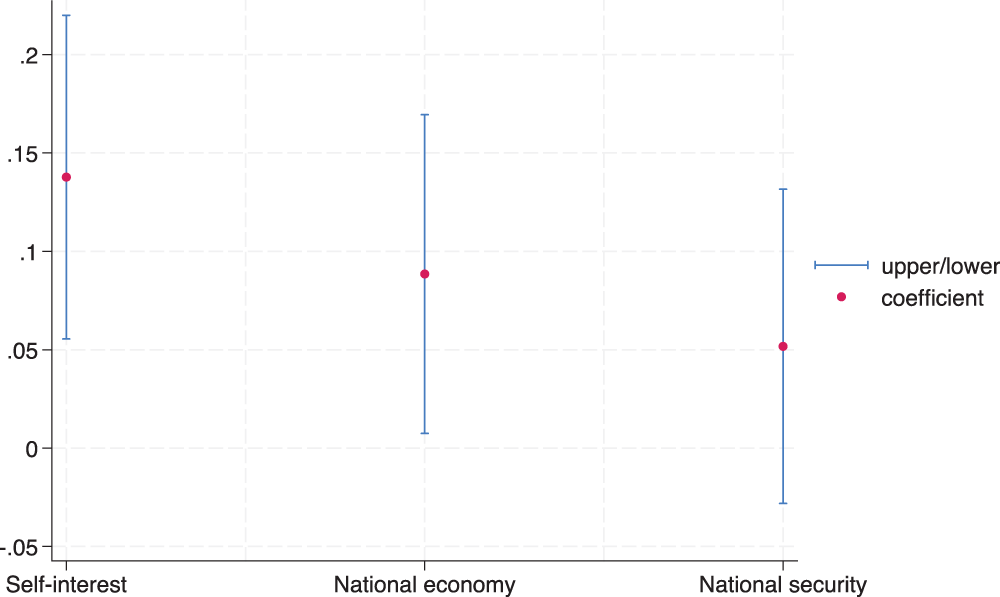
Figure 3 demonstrates that individuals are positively influenced by all three types of information – self-interest, national economy, and national security. As anticipated, the survey data suggest that self-interest holds the most significant sway. Based on self-interest-related information, the respondents’ opinions on the USJTA are 13.77% more swayed compared to scenarios where such information is absent. In numerical terms, out of 260 individuals presented with scenarios featuring elite support for the agreement alongside self-economic information, 117 altered their opinions to align with the favored candidate’s stance, wherein 45% accounted for those exposed to information serving their self-interest in terms of the economy. At the same time, although less effective, the respondents’ opinions on the USJTA are 8.85% more likely to be swayed if the information is framed in terms of the national economy than when no such information is provided, and 5.17% more likely to be swayed when it is framed in terms of national security.
Treatment effect of elites’ messages regarding USJTA.

Figure 3 Long description
The graph displays three categories on the x-axis: Self-interest, National economy and National security. Each category has a plotted coefficient represented by a dot, with error bars indicating upper and lower limits. The y-axis ranges from negative 0.05 to 0.2. The coefficient for Self-interest is approximately 0.15, for National economy around 0.1 and for National security close to 0.05. The error bars show variability in each category's coefficient measurement.
In numerical terms, among the 267 individuals presented with scenarios featuring elite support for the agreement alongside national economic information and the 272 individuals presented with scenarios featuring elite support for the agreement alongside national security information, 107 and 99 individuals, respectively, changed their opinions to align with the favored candidate’s stance. This means that of those exposed to national economic and security information, 40.07% and 36.40%, respectively, altered their opinions to follow the political elite’s position. However, because the survey divides a sample of just over 1,000 respondents into eight treatment groups, some groups are relatively small. As a result, while the main overall findings appear robust, more detailed subgroup results should be interpreted with caution..Footnote 9
3.1 Empirical Analysis of the Effect of Knowledge on Trade Policy
The initial test investigated whether individuals with more issue-specific knowledge and issue-specific interest are differentially susceptible to elite information. To connect theory and measurement, issue-specific knowledge and issue-specific interest in trade are conceptualized as related, but distinct, variables. As discussed in the theory section, knowledge equips respondents with counterarguments while interest raises attention and motivations to process the trade-related information provided by the political elite. In this sub-section, the effects of the knowledge are explained. A simple method was devised to assess the extent of knowledge that participants had about trade agreements in the US, by presenting six countries (Australia, Canada, China, the Dominican Republic, Israel, and the Republic of Korea) and asking the respondents whether the US had established a free trade agreement with each of these countries. Participants were given one point for each correct response, allowing for a total gain of six points if they got them all right. This small test on the FTAs was used to index issue-specific trade knowledge. To limit random guessing, the instrument included an explicit ‘don’t know’ option – the results mentioning ‘don’t know’ are treated as incorrect.
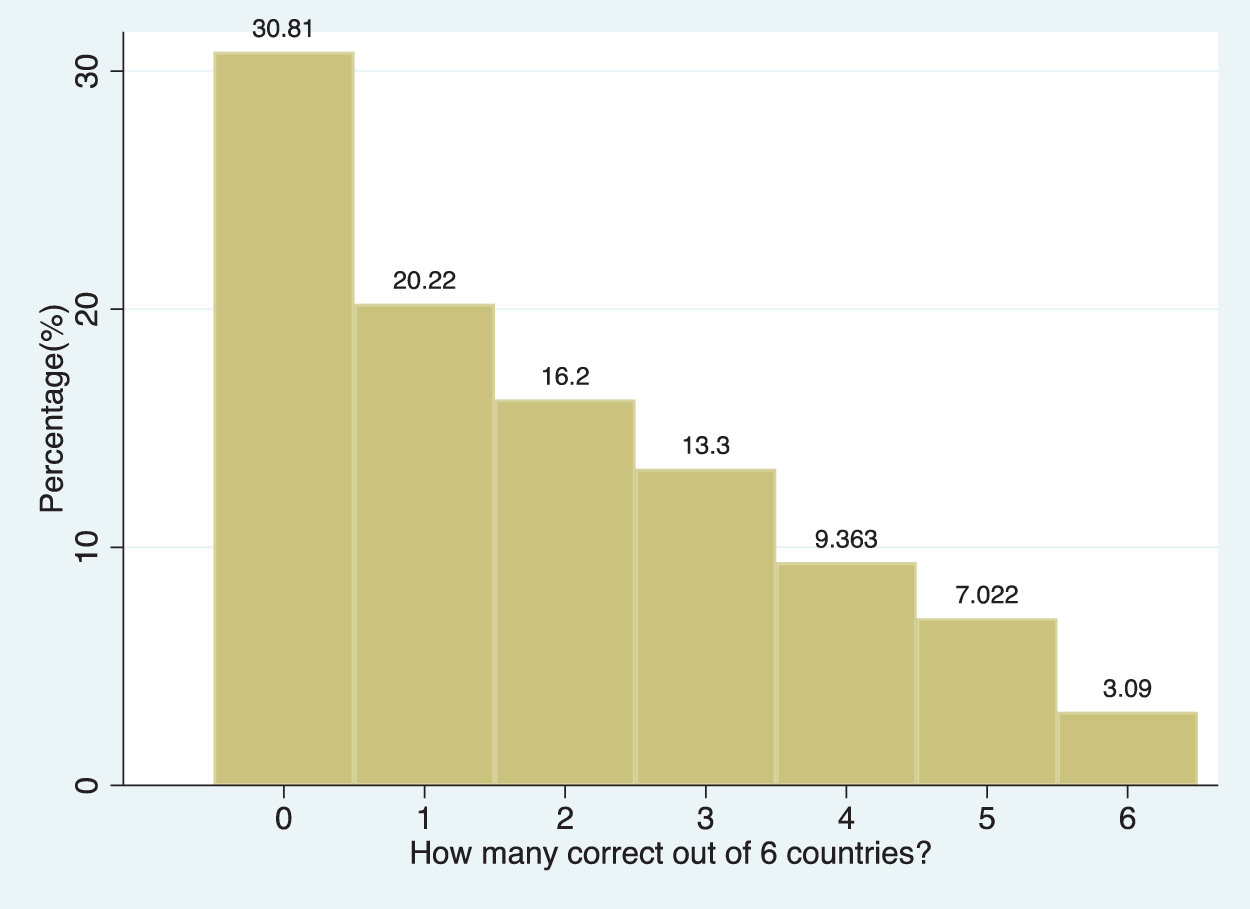
Figure 4 illustrates that most of those surveyed got none of the questions correct, while a minority answered all six questions correctly. The mean score for the survey sample was 1.84, indicating that, on average, participants got one or two questions right. This also highlights the public’s ignorance regarding international trade agreements. The survey participants had the option of selecting ‘do not know’; the aim was to eliminate the probability of people merely guessing the answer. Figure 4 reveals that the distribution of the survey participants’ knowledge about US trade agreements was left-skewed, with 30.81% of them providing incorrect answers on whether the six countries had established FTAs with the US; only 3.09% of the survey participants answered correctly for all six countries. As Figure 4 shows, knowledge is left-skewed with many respondents scoring low on trade knowledge. However, this pattern reflects the broader US public, which can be interpreted as a realistic feature of public opinion on trade. The findings are most applicable to settings where detailed knowledge is limited and framed for low-to-moderate knowledge environments that characterize most trade policy situations, and caution is exerted about extrapolating the results from this very small high-knowledge tail analysis.
Knowledge of US trade agreements.

Figure 4 Long description
A bar graph showing the percentage of survey participants who answered correctly about trade agreements with six countries. The x-axis is labeled 'How many correct out of 6 countries?' and the y-axis is labeled 'Percentage (percent)'. The bars represent the following percentages: 0 correct answers at 30.81 percent, 1 correct at 20.22 percent, 2 correct at 16.2 percent, 3 correct at 13.3 percent, 4 correct at 9.363 percent, 5 correct at 7.022 percent and 6 correct at 3.09 percent. The graph illustrates a left-skewed distribution, indicating most participants scored low on trade knowledge.
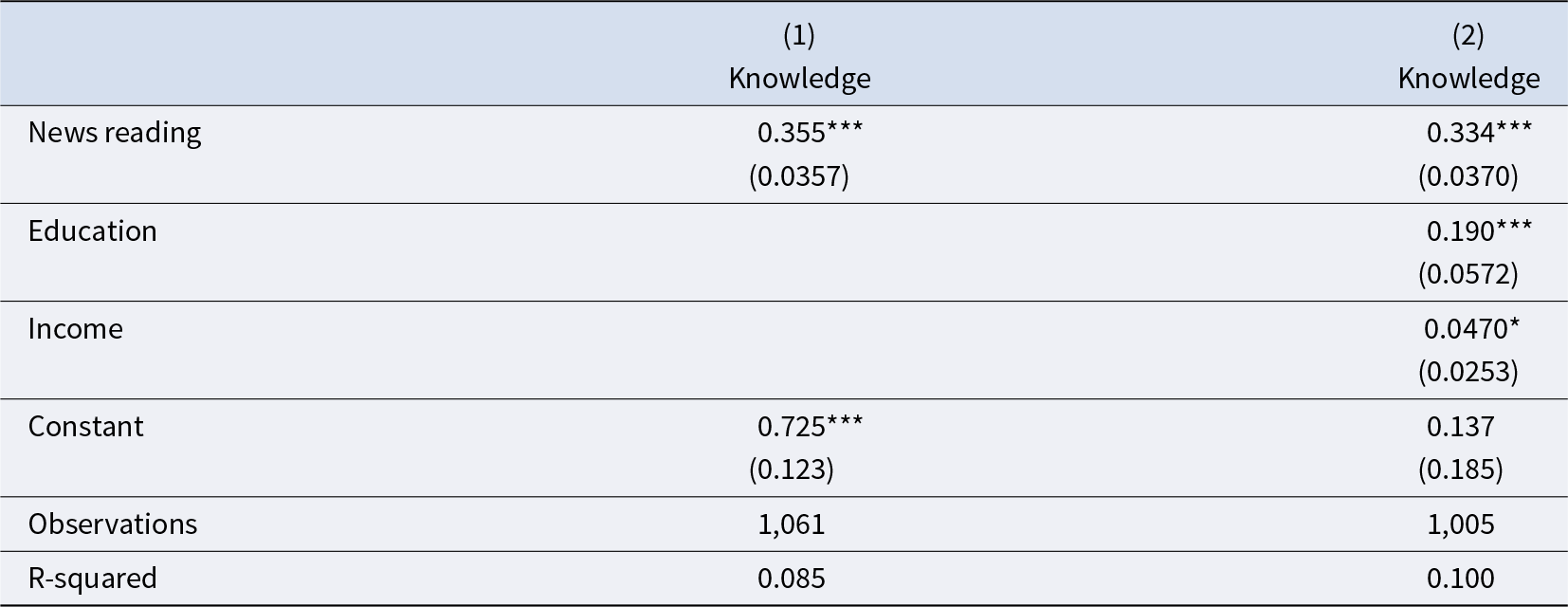
To measure participants’ knowledge about general political issues, they were asked how much time they spent reading newspapers, watching television news, and/or reading news on a website.Footnote 10 The assumption was that people who spend more time reading newspapers and watching television news are more likely to be knowledgeable about trade policy issues than those who spend relatively less time on these activities. To ensure the accuracy of this variable, a regression analysis was conducted, depicting individuals' knowledge of trade policy. This analysis examined the relationship between this variable, which gauged the time individuals spent reading newspapers and watching television news, and the measure of knowledge about US trade policy, as illustrated in Table 2.
Regression analysis results of knowledge about US trade agreements

Table 2 Long description
The table presents regression analysis results examining factors influencing knowledge about US trade agreements. In both models, news reading is a significant predictor, with coefficients of 0.355 and 0.334, indicating a strong positive relationship. Model 2 includes additional variables, showing that education and income also positively affect knowledge, with coefficients of 0.190 and 0.047, respectively. The constant term is significant in model 1 but not in model 2. Model 2 explains slightly more variance in knowledge, with an R-squared value of 0.100 compared to 0.085 in model 1. The number of observations is slightly lower in model 2, with 1,005 compared to 1,061 in model 1. These results suggest that both media consumption and socioeconomic factors contribute to understanding trade agreements.
Note:***p < 0.01, **p < 0.05, *p < 0.1.
From Table 2, clearly participants who spent more time reading newspapers and watching television news were more likely to answer questions on the trade agreement correctly. A similar result is observed with education and income variables as controls. Further, the knowledge of politics correlating to education and income levels is well documented (Bennett, Reference Bennett1988; Jerit et al., Reference Jerit, Barabas and Bolsen2006). In this preliminary study, multiple variables were used to test a new variable that measures the level of people’s knowledge of trade policy. This new measure was used as an independent variable to test whether people more knowledgeable about trade policy are more/less likely to be persuaded by the information provided by their favored presidential candidates than those less knowledgeable, as shown in Table 3.
Regression analysis results: effect of lack of knowledge of and interest in trade policy on individual preference change a

Table 3 Long description
The table presents regression analysis results examining how knowledge, trade interest, political interest, gender, income, education, party affiliation, and employment affect individual preference changes. Gender has a consistently significant positive effect across all models, indicating a strong influence on preference change. Political interest significantly impacts preference change in models 3, 5, and 6. Knowledge and trade interest show varying effects, with knowledge having a negative impact in some models and trade interest showing mixed results. The interaction terms, such as knowledge with trade interest and treatment, are only significant in specific models. The R-squared values suggest that the models explain a small portion of the variance in preference change, indicating other factors may also be influential.
Notes:
a The ‘don’t know’ response indicating no change in preference.
*** p < 0.01, **p < 0.05, *p < 0.1.
Conceptually, news consumption is treated as an exposure-based pathway to knowledge because people who routinely follow the news are more likely to encounter concrete facts about trade agreements. While a direct measure of economic literacy or asking how trade works would more squarely capture the level of individuals’ knowledge on the issue, in this framework, the result from the FTA fact test is the primary indicator of trade knowledge, and news reading serves as a convergent check that higher exposure is associated with greater factual recall.
The empirical results in Table 3 suggest a negative relationship between trade policy knowledge and individuals’ preference change regarding trade agreements. Although the effect is not statistically significant in most models, individuals with greater knowledge about trade policy may be less likely to change their preference based on elite messaging regarding trade agreements. This regression result is based on a dependent variable categorized as ‘0’ for individuals who either did not change their preferences or changed them to ‘do not know’, rather than following their favored political elites’ opinions.
However, Table 4 presents the results of the dependent variable, which includes both fully compliant individuals (those who changed their preferences to align exactly with the elite’s opinion) and partially compliant individuals (those who did not fully adopt the elite’s opinion but chose ‘do not know’). These are marked as ‘1’. The distinction between Tables 3 and 4 lies in whether individuals replying ‘do not know’ are classified as having not changed or have changed their preferences. The intended dependent variable assesses how likely individuals are to change their preferences regarding trade agreements. Thus, Table 4 better illustrates the argument presented in this study, while also demonstrating a negative relationship between individuals’ level of trade policy knowledge and the likelihood of changing preferences regarding trade agreements, which is statistically significant. Therefore, this analysis of survey data implies that individuals with deeper knowledge about trade policy are less likely to change their preference regarding trade agreements.
Regression analysis results: effect of lack of knowledge of and interest in trade policy on individual preference change a

Table 4 Long description
The table presents regression analysis results examining how knowledge, trade interest, and other factors influence individual preference change. Knowledge consistently shows a negative effect on preference change, with significant results in models one, four, five, and six. Trade interest also negatively impacts preference change, significantly in models two, four, five, and six. Gender has a positive and significant effect across all models. Employment status negatively affects preference change, with significance in all models. The interaction between trade interest and treatment is significant in model six. The R-squared values indicate that the models explain between 5.6% and 10.3% of the variance in preference change. The analysis suggests that both knowledge and trade interest are important factors in understanding preference changes, with gender and employment also playing significant roles.
Note:
a The ‘don’t know’ response indicated a change in preference.
*** p < 0.01, **p < 0.05, *p < 0.1.
3.2 Empirical Analysis of the Effect of Interest on Trade Policy
The second hypothesis was tested to examine whether individuals with greater interest in trade policy are more/less inclined to alter their preferences regarding trade agreements. Addressing the issue of low salience in US trade politics, Table 1 indicates that people exhibit lower interest in trade policy than in general politics. The disparity between these interests is approximately 15%, with nearly 60% of survey participants expressing interest in most political issues, whereas only 44% express interest in trade policy issues. However, this gap narrows during elections, with a 10% increase in interest in trade policy observed solely during such times. Utilizing the data from Table 1, which highlights individuals’ interest levels in trade policy, these observations were employed as independent variables to investigate whether those more engrossed in trade policy are predisposed to changing their preferences concerning trade agreements.
Similarly, Tables 3 and 4 depict the impact of interest in trade policy on individuals’ shifts in preference regarding trade agreements. Table 3 presents findings on whether individuals with greater interest in trade policy are more inclined to alter their preferences when they realize that their favored political figures hold opposing views on the agreement. The impact of interest in trade policy appears to be nuanced, whereas the impact of interest in politics demonstrates a positive and statistically significant association based on Table 3. The variable of political interest in general is added to absorb variance due to general attention to politics that is not specific to trade. This helps isolate whether trade-specific knowledge and interests, which are different from simply being politically attentive, influence individuals’ susceptibility and responsiveness to elite information.
However, Table 4, which better illustrates the argument presented in this study, indicates that participants more invested in trade policy are less prone to modifying their opinions based on new information provided by their favored candidates. This effect remains consistent both statistically and in terms of magnitude across various models incorporating control variables. Moreover, this effect persists when the interaction term of trade interest and treatment is introduced. The interactive effect of trade interest and treatment is statistically significant, indicating that the impact of trade policy interest on individuals’ preference change varies based on their susceptibility to elite messages.
4. Conclusion
In exploring the theoretical and empirical challenges related to low salience and limited knowledge in US trade opinion, this study addressed two research questions: First, does issue-specific trade knowledge condition how citizens update their preferences when exposed to new information by elite messages about a trade agreement? Second, does issue-specific trade interest condition how citizens update their preferences when exposed to new elite messages?Through a survey data analysis, both questions were affirmed, with a negative effect direction in both cases. Individuals possessing more knowledge about trade policy and those displaying a higher interest in trade policy issues were less susceptible to the influence of new information provided by political elites, thus demonstrating a reduced likelihood of altering their original preferences. In other words, these findings speak to how political information matters in public trade opinion. Under low-salience conditions, people are persuadable, but this depends on individual knowledge and their interest in the issue of trade policy. In light of broader literature, many self- and sociotropic interests, often based on education and income, help to explain baseline pro-trade levels, whereas issue-specific knowledge and interest help to explain the updates on their preferences through responsiveness to new messages.
However, a claim is not made that policymakers ought to raise public interest in trade per se. Instead, the evidence provided in this research identifies who is more or less likely to update under new information. It does not evaluate the feasibility, desirability, or welfare effects of cultivating interest and knowledge as a policy objective, but a more appropriate implication would be about which environment’s opinion can be moved by elite messaging under the condition of the low salience of trade policy in US politics. Future research can take this as appoint of departure to assess whether alternative public communications, such as transparency about distributional effects or concrete local consequences, can change the composition of who updates preferences based on new elite information.
It is crucial to identify this study’s limitations. First, salience and knowledge regarding trade policies are endogenous in that these policies are simply based on many social, economic, and political variables related to individuals’ trade preferences. An effort was made to control for these factors so that the effect found through the empirical analysis would represent the real impact of salience and knowledge on trade policy preferences by controlling social and economic variables, such as gender, income, education, party, and employment. However, a potential bias that has been deeply rooted in the variables of knowledge and salience cannot be adequately treated with controlling efforts and could persist in the empirical results.
Second, the sources of information provided in the survey were limited to presidential candidates that participants supported for consistency within the survey. Although political leaders are an important and easily accessible source from whom individuals receive information about trade policies, additional sources may influence opinions on trade policies. Thus, it is worth exploring how different sources of information, such as experts, international institutions (like the World Trade Organization), and other trade-related institutions and neighbors, uniquely influence the relationship between individuals’ intelligence and salience of trade policies and their preferences.
Supplementary material
The supplementary material for this article can be found at https://doi.org/10.1017/S1474745626101505.
Data availability statement
The data supporting this study's findings are available from: Park, Ji Yeon, 2026, ‘Replication Data for: The Impact of Information Provided by Political Elites on Individual Trade Policy Preferences: A Result of Political Knowledge or Interest?’, https://doi.org/10.7910/DVN/9RA28O, Harvard Dataverse.
Acknowledgements
The author would like to express gratitude to Mark Busch, Michael Bailey, and Stephen Weymouth for their valuable feedback and suggestions.
Funding
This work received support from Hitotsubashi University under Grants to Support the Increase in International Achievement (国際業績増加支援経費助成).
Competing interests statement
The authors declare that they have no competing interests to disclose.
Ethics statement
All study participants provided informed consent, and the study design received approval from the Institutional Review Board of Georgetown University (IRB No. MOD00002176) prior to conducting the survey.




 Open access

