


Introduction
Payments for environmental services (PES) programmes, which provide funding from beneficiaries and users of ecosystems to those who ensure conservation, have rapidly expanded in size and scope since the 1990s (Wunder et al., Reference Wunder, Brouwer, Engel, Ezzine-de-Blas, Muradian and Pascual2018). Empirical studies on the effectiveness of PES in achieving goals, from stopping deforestation to alleviating poverty, have also increased (Salzman et al., Reference Salzman, Bennett, Carroll, Goldstein and Jenkins2018). However, there remain gaps in our knowledge regarding gender and PES (Cruz-Garcia et al., Reference Cruz-Garcia, Sachet, Blundo-Canto, Venegas and Quintero2017). Although there have been arguments in favour of paying attention to women's participation in PES on the basis of equity and inclusion (Pascual et al., Reference Pascual, Phelps, Garmendia, Brown, Corbera and Martin2014; Phạm & Brockhaus, Reference Phạm and Brockhaus2015), there has been less empirical research on how gender roles and responsibilities affect PES implementation and outcomes for conservation, as well as how PES programmes could affect men and women in different ways (Boyd, Reference Boyd2002; Kariuki & Birner, Reference Kariuki and Birner2015; Schwartz, Reference Schwartz2017; Vardhan & Catacutan, Reference Vardhan, Catacutan, Namirembe, Leimona, van Noordwijk and Minang2017; Andeltová et al., Reference Andeltová, Catacutan, Wunscher and Holm-Müller2018; Bee, Reference Bee2019; Benjamin et al., Reference Benjamin, Ola and Buchenrieder2018).
The existing, although limited, literature on gender and PES has identified several important areas of research, which we briefly review here. Although there has been considerable work on how gender has influenced other conservation approaches, such as community-based natural resource management (Rocheleau et al., Reference Rocheleau, Thomas-Slayter and Wangari1996; Resurrection & Elmhirst, Reference Resurrection and Elmhirst2008), we focus here on PES as a relatively new approach using financial incentives. We argue there is a need to have greater knowledge of the gender implications of the mechanisms of PES so as to improve outcomes.
Existing studies suggest that projects to promote conservation behaviours, such as PES, may have different impacts on men and women simply because they use and value resources differently (Fortnam et al., Reference Fortnam, Brown, Chaigneau, Crona, Daw and Gonçalves2019). Women often value, prioritize, collect, grow or otherwise use ecosystem services producing energy, food, water and medicine more than men (Walter & Wannitikul, Reference Walter and Wannitikul2002; Sunderland et al., Reference Sunderland, Achdiawan, Angelsen, Babigumira, Ickowitz and Paumgarten2014; Calvet-Mir et al., Reference Calvet-Mir, March, Corbacho-Monné, Gómez-Baggethun and Reyes-García2016; Yang et al., Reference Yang, Passarelli, Lovell and Ringler2018; Cruz-Garcia et al., Reference Cruz-Garcia, Cubillos, Torres-Vitolas, Harvey, Shackleton and Schreckenberg2019; Pearson et al., Reference Pearson, McNamara and Nunn2019). As a result, restrictions on use of natural resources may have a disproportionate effect on women's well-being (Agarwal, Reference Agarwal1997a; Kerr, Reference Kerr2002; Larson et al., Reference Larson, Solis, Duchelle, Atmadja, Resosudarmo and Dokken2018), and if this is not compensated for by sufficient or targeted payments, PES could lead to declines in women's income and livelihood options, as well as decrease their willingness to participate (Kerr, Reference Kerr2002; Daw et al., Reference Daw, Brown, Rosendo and Pomeroy2011).
Participation is a key aspect of PES that can be influenced by gender dynamics, both in programme design and in making payments (Boyd, Reference Boyd2002; Corbera et al., Reference Corbera, Brown and Adger2007). There are numerous examples of women being excluded from meetings about PES (vonHedemann & Osborne, Reference vonHedemann and Osborne2016) or accessing them at lower rates than men, often because of discrimination or time constraints (Khadka et al., Reference Khadka, Karki, Karky, Kotru and Darjee2014; Samndong & Kjosavik, Reference Samndong and Kjosavik2017; Bee, Reference Bee2019). Women may also not have input into or control over assets (namely land) that are required to participate in PES programmes (Kariuki & Birner, Reference Kariuki and Birner2015), or PES activities may not be available to women or not compensated at the same rates because of gender norms about male and female roles (Boyd, Reference Boyd2002; Caro-Borrero et al., Reference Caro-Borrero, Corbera, Neitzel and Almeida-Leñero2015; Ishihara et al., Reference Ishihara, Pascual and Hodge2017; Vardhan & Catacutan, Reference Vardhan, Catacutan, Namirembe, Leimona, van Noordwijk and Minang2017; Andeltová et al., Reference Andeltová, Catacutan, Wunscher and Holm-Müller2018). To combat these problems, some PES programmes have explicit requirements on minimal numbers of women at PES meetings or numbers of female-headed households receiving payments. However, this can lead to so-called tokenism, such as in Mexico, where women have been nominated as leaders to get points in PES applications without their real involvement (Bee, Reference Bee2019) and, despite the formal quotas, participation of women still lags behind men (Corbera, Reference Corbera, Tacconi, Mahanty and Suich2010).
Many studies of household payments for environmental services have looked primarily at opportunity costs and poverty impacts from these investments (Tacconi et al., Reference Tacconi, Mahanty and Suich2013); however, treating the household as a unified whole can ignore intra-household dynamics (Agarwal, Reference Agarwal1997b). For example, if men receive payments, they may spend it differently than women (e.g. on large purchases and recreation), whereas women tend to use benefits for pressing household needs (e.g. school fees or food; Walter & Wannitikul, Reference Walter and Wannitikul2002; Caplow et al., Reference Caplow, Jagger, Lawlor and Sills2011). Schwartz (Reference Schwartz2017) also found increased inequality in decision-making in PES-participating households compared to non-participants in Costa Rica. Women in some studies have expressed support for individual PES accounts, rather than household or community payments, because of exclusion from decision-making at both scales (Martin et al., Reference Martin, Gross-Camp, Kebede and McGuire2014; Kariuki & Birner, Reference Kariuki and Birner2015).
The conservation impact of PES in relation to gender is the least well-studied dynamic (Andeltová et al., Reference Andeltová, Catacutan, Wunscher and Holm-Müller2018), as there is little reported effect of increased female participation on improved conservation outcomes. However, lessons could be drawn from community forestry, where improved conservation has been reported when women are more involved in decision-making and authority (Agrawal et al., Reference Agrawal, Yadama, Andrade and Bhattacharya2004; Agarwal, Reference Agarwal2009a,Reference Agarwalb).
A case study of payments for environmental services in Viet Nam
Since 2010, Viet Nam has implemented a national policy that charges fees on hydropower plants, domestic water suppliers, and a few other industries, and transfers this money to upland areas for forest protection (McElwee, Reference McElwee2012; Phạm et al., Reference Phạm, Bennett, Vũ, Brunner, Lê and Nguyễn2013). Approximately USD 100 million per year is paid to c. 500,000 participating households living in > 5 million ha of eligible watershed forest (c. 40% of the country's total forest area). The payment rates vary depending on watershed and province, from as low as VND 2,000 (USD 0.09) per ha to VND 1,300,000 (USD 55) per ha or more (Nguyễn & Vương, Reference Nguyễn and Vương2016).
To date, there has been little research on the gender impacts or outcomes of the PES programme, with a major impediment being lack of data: statistics kept by the national PES-coordinating office do not include information on whether any female-headed households participate or how many women benefit from the programme. Few women work in leadership in PES roles or offices (McElwee & Nguyễn, Reference McElwee and Nguyễn2015). There is also no formal guidance from authorities on gender mainstreaming for PES (Phạm & Brockhaus, Reference Phạm and Brockhaus2015). In some areas, the local Women's Union helps disseminate information to attract women applicants, or disburse funds, but this is ad hoc and not widespread (Phạm et al., Reference Phạm, Campbell, Garnett and Aslin2010).
Previous research has indicated that gender does have important effects on resource use in Viet Nam, including differential valuation of ecosystem services between men and women (Tien et al., Reference Tien, Kaida, Yoshino, Nguyễn, Nguyễn and Bui2018). Participation in PES by women has not been the subject of systematic studies, but reported barriers include inability to access information (Phạm & Brockhaus, Reference Phạm and Brockhaus2015; Loft et al., Reference Loft, Lê, Phạm, Yang, Tjajadi and Wong2017), exclusion from meetings (Tuijnman et al., Reference Tuijnman, Bayrak, Pham and Bui2020), and gender discrimination within households (Phạm et al., Reference Phạm, Bennett, Vũ, Brunner, Lê and Nguyễn2013). Some voluntary PES schemes outside the national programme have tried to include community benefits for women, such as microcredit, as part of payments (Do et al., Reference Do, Vũ, Van and Catacutan2018), but the government system does not have any formal gender-differentiated benefits.
Methods
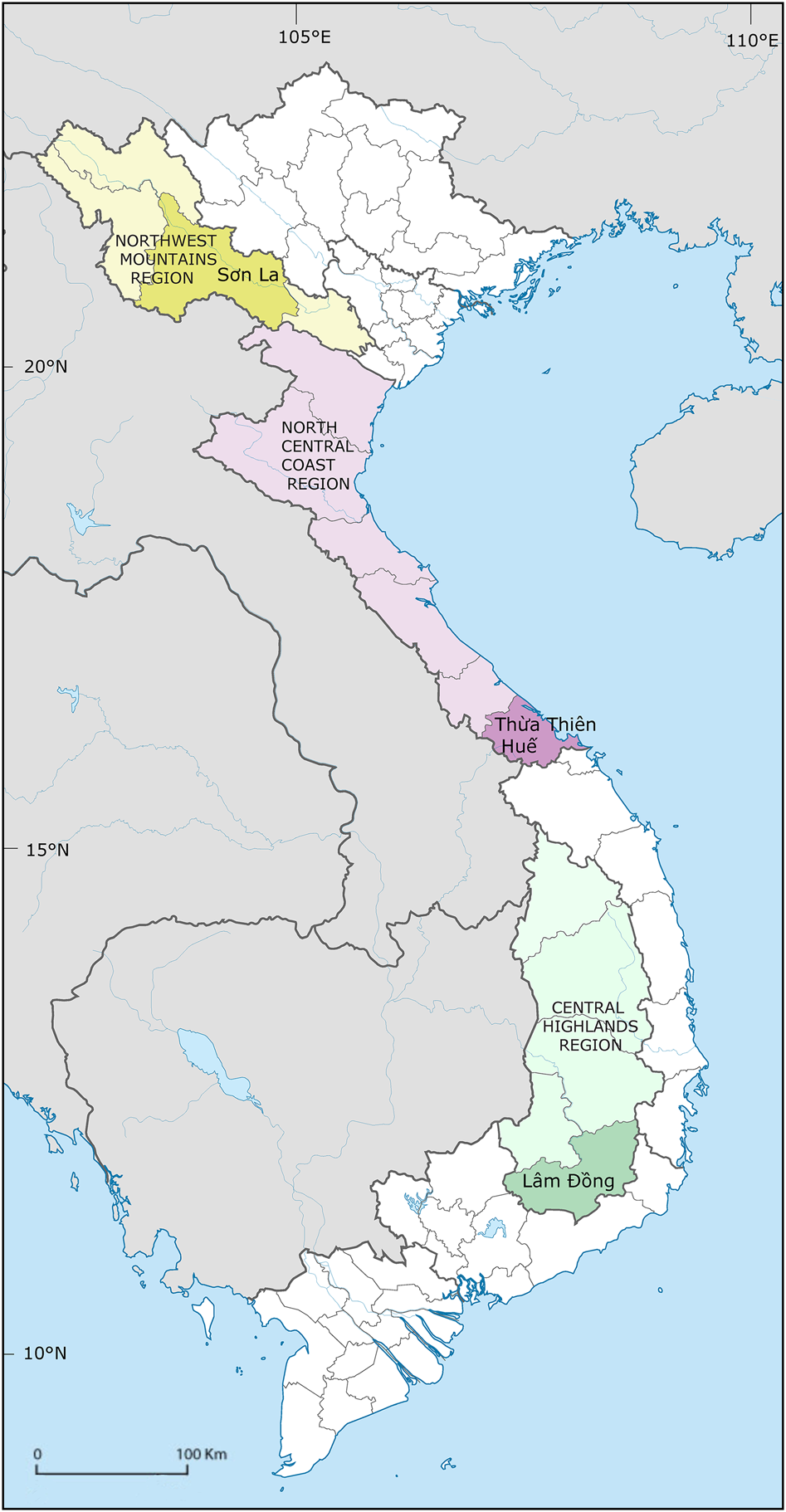
A multi-year research project to learn about the development and impact of PES over time began in late 2011 in three provinces, representing south, central and northern Viet Nam respectively (Lâm Đồng, Thừa Thiên Huế and Sơn La provinces; Fig. 1), which were chosen because of their significant forest cover and participation in PES. For each study province, five villages in two districts were selected for in-depth research (villages in these areas typically have 200–500 households).
The three provinces of Viet Nam in which fieldwork took place (Lâm Đồng, Sơn La and Thừa Thiên Huế).
In each village, a random sample of 15–16 households was drawn so that a target of 75 households per province could be interviewed. Included in the sample were households who had received payments for environmental services and those who had not. The survey was piloted in summer 2011 before being used in fall/winter 2011. The survey questions assessed local livelihoods, labour, ethnicity, income and expenditures, land holdings, natural resource use, impacts of climate hazards, and participation in forest projects, including PES. We followed up in spring and summer 2015 with another round of interviews with the same households in only two provinces (Lâm Đồng and Sơn La), as there was a delay in implementing PES in Thừa Thiên Huế. The final database comprised 227 cases (households) in 2011 measured on 602 variables (indicators), and the second survey in 2015 comprised 133 cases on the same variables. The surveys were carried out by both male and female surveyors, including the authors and several students who were trained by us.
Although we did not deliberately stratify our sample to include them, 45 female-headed households were interviewed in 2011 (20% of the sample) and 31 were re-interviewed in 2015 (23% of the sample). The reasons for female headship varied: in Lâm Đồng province, ethnic Koho communities have traditionally followed matrilocal inheritance, so women are often listed as household heads, even when the husband is still present. In the other sites, female-headed households were more commonly women who had been widowed, divorced or whose husband was away as a migrant worker.
Focus groups were also organized in each research village in 2011, 2012 and 2014, with one specifically female focus group in each province, led by Vietnamese women researchers, whereas the other focus groups were mixed. Activities in the women's focus groups included discussing time management activities, gendered natural resources use, and risk-mapping. Interviews with government officials and policymakers in each field site (> 50 total) also took place in 2011, 2012 and 2014; gender issues were one of the many topics discussed.
Results
Sixty-seven per cent of households surveyed in 2011 received some cash income from forest production, collection or conservation, across categories such as fuelwood, timber, non-timber forest products (NTFPs) and PES (Table 1). These activities contributed 20% of household incomes in Lâm Đồng, 10% in Thừa Thiên Huế and 3% in Sơn La in 2011. In 2015, forest income had increased to 31% of total household incomes in Lâm Đồng (primarily a result of PES) and 6% in Sơn La.
Mean household income (VND 23,000 = USD 1) reported from forestry-related activities across the three study provinces (Fig. 1) in 2011 and 2015.
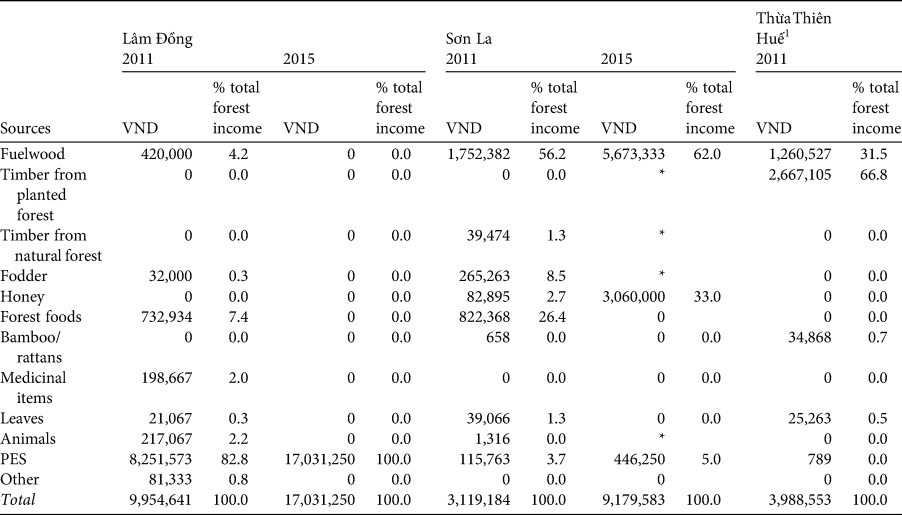
*Only one household reported income from this category.
1 There were no interviews in 2015 as there was a delay in implementing PES.
Use of forests
There were gendered differences in forest use, as a women's focus group in Lâm Đồng noted: in particular, women were in charge of water provisioning, biomass (fuelwood), food, and NTFPs, whereas men's work included pest control, marketing of goods, and finding timber for house repair. Non-timber forest products were recorded as important for women across all sites in 2011: in Lâm Đồng, forest mushrooms and medicinal plants were collected; in Sơn La, food such as tubers and roots were consumed; and in Thừa Thiên Huế, rattans and bamboos were sold. However, by 2015, we saw a considerable drop in income from NTFPs to zero in Lâm Đồng, with its complete replacement by PES income, and in Sơn La (which had low payments for environmental services), income from fuelwood and honey had increased in value (Table 1).
Women were responsible for household energy supplies, and the majority of survey households (79%) reported using fuelwood in 2011, with many households reporting shortages and increasing lengths of time to collect it in Lâm Đồng and Sơn La (Table 2), whereas in Thừa Thiên Huế, households reported having improved access to fuelwood as a result of tree plantations. By 2015, a major change occurred in Lâm Đồng: all households reported no fuelwood use, a result of having purchased liquid petroleum gas stoves and/or electric rice cookers.
Per cent of households reporting changes in access to and use of fuelwood across the three study provinces in 2011 and 2015.

1 There were no interviews in 2015 as there was a delay in implementing PES.
Are women participating in PES?
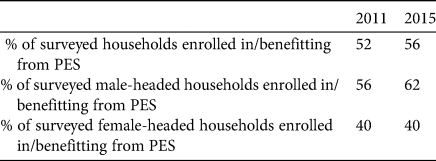
We examined how household structure influenced participation in PES by comparing male-headed households in the survey with female-headed households (Table 3). Male-headed households had higher enrolment in PES (56% of all male-headed households surveyed were enrolled in the programme, whereas only 40% of surveyed female-headed households were), and over time more male-headed households joined PES, whereas in female-headed households enrolment did not increase.
Enrolment in the PES programme among surveyed households and by household head types in 2011 and 2015, in all three study provinces combined.
We also examined participation within households. In 2011, more men than women did PES-related activities (e.g. attending meetings, patrolling forests) in all three sites (Table 4). According to respondents, forest protection is considered a man's job, as it is physically demanding and requires work away from the home. Women stated they were less involved because of the perception that forest monitoring was potentially dangerous (e.g. encountering poachers), but that women would do such patrols if men were unavailable. Women also reported being too busy with housework to participate in PES, or feeling that their attendance and participation was unnecessary or unwanted. However, by 2015, with several years' experience, more gender-equitable participation was reported: in both Lâm Đồng and Sơn La, the per cent of households reporting that both husbands and wives participated equally in PES rose, with a striking increase in Sơn La.
Household member participation in PES meetings and activities across the three study provinces in 2011 and 2015.
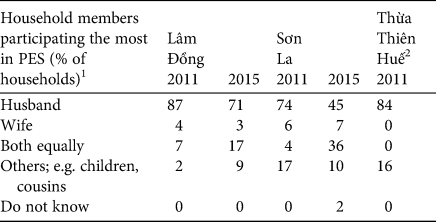
1 Columns do not necessarily sum to 100% because of rounding.
2 There were no interviews in 2015 as there was a delay in implementing PES.
Do women and men use payments differently?
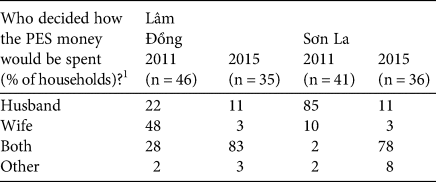
In nearly all cases, men in the household physically received the payment, which was usually paid in cash by government officials. Respondents were asked, ‘Who decided how the PES money would be spent?’ (Table 5), and the results revealed cultural differences across sites (Thừa Thiên Huế is not in this analysis as few payments had been made at the time of the survey). In 2011 in Sơn La, where the dominant ethnic group, the Thai, has traditional patriarchal norms, the husband decided how to use the money (85% of households). In Lâm Đồng in 2011, the wives decided in 48% of households, reflecting matriarchal norms among the Koho ethnic group. But by 2015, both sites had converged: 83% of respondents in Lâm Đồng and 78% of in Sơn La reported joint decision-making. A female village head in Lâm Đồng told us that women's power in the household was now shared with men more than in the past, attributed to men having received payments for environmental services.
Household decision-making on payments for environmental services across two of the three study provinces in 2011 and 2015. Variation in the number reporting reflects households who reported having received a payment in the previous year.
1 Columns do not necessarily sum to 100% because of rounding.
Participants in a women's focus group in Lâm Đồng stated they preferred to receive payments, rather than the men doing so, as they had certain livelihood activities they were already in charge of and were familiar with family budget needs. Women in a focus group in Sơn La stated that the lack of wives' names on land tenure certificates was probably the reason men were paid the PES money. Although women did not report major arguments between husbands and wives over how to spend the payments, some stated they believed men had wasted some of the PES money on alcohol or tobacco; for example, some women were confused about the exact payment rates they should expect to see, and believed that money had not been returned fully to the household.
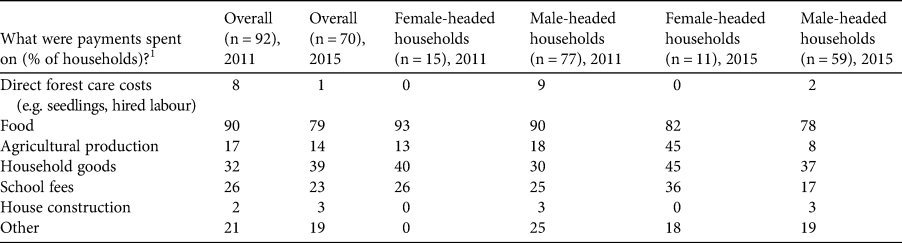
We also surveyed households about how payments were used. In 2011, PES money was primarily spent on food, household goods, and schooling fees and expenses for children (Table 6). Only a small number of households reported they used part of the protection money PES funds on direct forest activities, such as purchase of tree seedlings or hiring labour for forest work, and the results in 2015 were largely the same. We saw some differences in expenditures between male- and female-headed households in a few categories: in 2011, male-headed households spent less of their PES money on household goods, more on house construction, and considerably more on other expenses, a category for non-essential expenses that was left open for respondents to specify, and which usually included recreation, cigarettes or travel. Female-headed households in 2011 spent nothing on other expenses, whereas 25% of male-headed households mentioned this category. By 2015 women-headed households had increased their spending in the non-essential category, which could be a result of more disposable income, as well as a realization that use of PES money is not monitored (women may have been more reluctant to spend the income on non-essential items in the initial years of the programme).
Use of PES money within households and across household head types in 2011 and 2015. Variation in the number reporting reflects households who reported having received a payment in the previous year.
1 Multiple categories could be chosen and therefore columns do not necessarily sum to 100%.
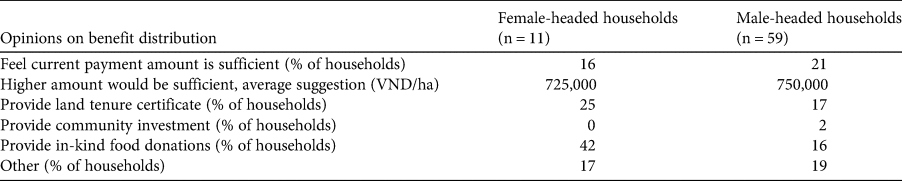
Participating PES households were also asked about their opinions on the benefit distribution system (Table 7). Most households wanted a higher payment per ha, and both female- and male-headed households had largely similar suggestions (asking for 725,000–750,000 VND/ha on average, or slightly more than double what was paid per ha in Lâm Đồng, and seven times higher than the payments in Sơn La). More female-headed households were also interested in food supplies in lieu of cash payments, and men requested additional subsidies of fuel (for motorbikes for forest patrolling) and uniforms. Additionally, in several areas of Sơn La, payments were made to collective organizations in addition to individuals, and the Women's Union was one such beneficiary. These small sums of money were used to fund the association's activities, such as support for ill members, and this collective benefit was strongly supported by women in focus groups.
Opinions on benefit distribution across household types in Lâm Đồng and Sơn La combined in 2015.
Does PES induce different conservation activities between households?
A comparison between female- and male-headed households participating in PES showed that the former spent more labour days on PES work in 2015: the 12 female-headed households in the sample with PES contracts reported spending on average 40 days/year on PES activities (including both meetings and patrolling), whereas 64 male-headed households with PES contracts reported spending 31 days/year. This was despite the fact that the women had less land to protect in their contracts (25.6 ha on average for female-headed households vs 30.7 ha for male male-headed households ).
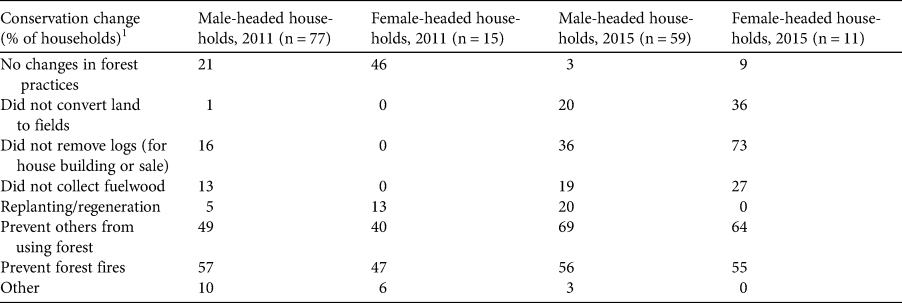
There were also differences between female- and male-headed households in terms of changing their land use practices after receiving payments for environmental services (Table 8). In particular, 46% of female-headed households who had received payments in 2011 reported they had done nothing differently after receiving them, confirming low conditionality in early implementation (McElwee et al., Reference McElwee, Nghiem, Le, Vu and Tran2014); in other words, female-headed households went to PES meetings and on patrols, but still may have used lands as they did previously, such as for firewood collection. Yet by 2015, the women reported more behaviour change than male-headed households, including higher self-reporting that they did not participate in logging or had reduced their fuelwood collection.
Conservation changes made after receiving payments for environmental services, by household type, in 2011 and 2015. Variation in the number reporting reflects households who reported having received a payment in the previous year.
1 Multiple categories could be chosen and therefore columns do not necessarily sum to 100%.
Discussion
Our unique panel data gives us some indicative findings regarding the impacts of PES on gender issues over time. Although there are other issues that can affect conservation actions, our focus on gender has allowed us to highlight where PES projects may need to pay attention in the future. In all sites, natural resource use varied between men and women, and PES activities resulted in restrictions on forest use, particularly around fuelwood and NTFP collection, disproportionately the realm of women. Yet the large payments at one site (Lâm Đồng) had allowed women to make up for a loss of fuelwood by the purchase of gas cookers, which had also freed up women's time and was viewed positively. However, in another site (Sơn La), payments were not high enough to provide income and energy substitutes, and income from collection of fuelwood had increased.
Rates of participation in PES activities were lower both for female-headed households and for women within male-headed households, confirming global trends. In particular, the per cent of female-headed households enrolling in PES was lower overall and did not increase over time, a sign that quotas in PES policy could be useful for these households. At the same time, female-headed households reported expending more yearly effort on PES contracts when they did have them, so additional support for these households (who may be labour constrained, depending on circumstance) may also be warranted, such as through higher payment rates or other subsidies.
Despite women lagging behind in participation, the overall trend has been towards more equality between husbands and wives (Tables 4 & 5). Initially gender perceptions regarding the types of work required for PES limited women's involvement, but this appears to have changed towards more equal participation of women within male-headed households within just a few years, despite a lack of formal quotas or guidance. We speculate this is probably a result of more familiarity with PES over time and a recognition that women can do the tasks necessary for payments (e.g. patrolling or forest restoration activities). This is in contrast to the case in Costa Rica where inequality in participation between men and women increased over time, perhaps reflecting cultural patterns rather than the structure of the PES system (Schwartz, Reference Schwartz2017). However, regardless of our finding that over time more equitable participation has been achieved at the family level, we cannot yet conclude there is improved women's empowerment at the community level through participation in PES. This will require further study.
Trends in the use of PES money within the household have also changed over time, with significant differences between sites, reflecting cultural norms. Initially in Lâm Đồng, with cultural histories of matriarchal households, women were the main decision-makers on payments, but within a few years that had changed towards joint decision-making. In Sơn La, where initially men were the primary decision-makers, this site also showed higher joint participation within a few years. Thus, in matriarchal societies, there has been an increased role for men, whereas in patriarchal ones there has been a shift to increased roles for women. As others have pointed out, gender is not the only factor influencing involvement in PES, as class, ethnicity, and other factors may be as important (Yang et al., Reference Yang, Passarelli, Lovell and Ringler2018).
Would conservation in PES be different or more successful with more gender-specific policies? We are not yet able to conclude this definitively based on our data, although they do indicate positive trends. Payments for environmental services over time have increased conservation efforts for most households, particularly in reducing collection of forest products and fuelwood in areas where payments were larger. Female-headed households receiving payments also reported being more active in forest protection activities after a few years of incentives than they were at the beginning, when they lagged behind men. This may be an argument for avoiding short-term projects and ensuring there is sufficient time for female-headed households to secure the benefits of both payments and overall forest conservation.
Based on our findings, we conclude with a few suggestions for building attention to gender into PES projects. Firstly, where PES restrictions fall more heavily on women (e.g. fuelwood collection), additional in-kind investment, such as in alternative cooking fuels, could be beneficial. Secondly, increased involvement of civil society organizations (either local women's organizations or NGOs) in PES could improve women's ability to be seen and included, particularly for female-headed households; additionally, NGOs could fund training for male staff members of PES institutions, or collect data on women's participation in PES, which is not being done by the government system. Thirdly, including women's names on land titles has been shown to lead to lower poverty incidence and higher education attainment (Menon et al., Reference Menon, van der Meulen Rodgers and Kennedy2017); explicit inclusion of women's names on PES contracts could be expected to have similar positive outcomes.
Finally, we highlight several areas of research where attention to gender remains insufficient. Firstly, more attention should be paid to how PES income affects households in different settings in terms of decision-making, benefit-sharing and land management, as our data shows PES can change behaviours (Caro-Borrero et al., Reference Caro-Borrero, Corbera, Neitzel and Almeida-Leñero2015). Secondly, despite growing attention to cultural ecosystem services and social justice in PES, there has been little explicit attention to gender in this regard, and this could be improved (Jackson & Palmer, Reference Jackson and Palmer2014; Singh, Reference Singh2015). Finally, more studies that explicitly compare PES with other conditional cash transfer programmes for social welfare (for which gender is a strong component of research) would improve understanding of the unique dynamics of PES (Rodríguez et al., Reference Rodríguez, Pascual, Muradian, Pazmino and Whitten2011). Attention to these issues will help reduce the amount of gender blind approaches in PES and has the potential to improve sustainability and conservation outcomes as well.
Acknowledgements
We thank our funders: grant 1061862 from the National Science Foundation's Division for Geography and Regional Science to PM and a Partnerships in Enhanced Engagement in Research grant #AID-OAA-A-11-00012 to HTVL, TPN, HDV and NHT. We thank Diệp Xuân Tuấn, Hà Thị Trang, Hà Thị Oanh, Lê Văn Sơn, Đinh Bá Kha, Lê Quang Minh and Trương Quang Cường for assistance with surveys, two anonymous reviewers for helpful comments, and Martin Fisher and Helen Anthem for their useful suggestions.
Author contributions
Research design: PM; research: PM, TPN, HTVL, HDV, NHT; writing: PM; revision: TPN, HTVL, HDV, NHT.
Conflicts of interest
None.
Ethical standards
Research with human subjects was approved by Rutgers Institutional Review Board (11-606 M; originally approved 25 April 2011 and renewed annually). A statement about the research was read to each interviewee verbally, and signed consent forms (for survey respondents and focus group attendees) or verbal consent (for stakeholder interviews) was obtained from all people interviewed. This research otherwise abided by the Oryx guidelines on ethical standards.


 Open access

