


INTRODUCTION
The notion that office-seeking candidates position themselves differently in different electoral systems—specifically, closer to the median voter in majoritarian systems—underpins decades of theoretical development in political science. It has helped explain outcomes as diverse as democratic and government stability (e.g., Powell Reference Powell1982; Sartori Reference Sartori1976), representation and inclusiveness (e.g., Iversen and Rosenbluth Reference Iversen and Rosenbluth2010; Dalton Reference Dalton2008), turnout (e.g., Norris Reference Norris2004), consumer prices (Rogowski and Kayser Reference Rogowski and Kayser2002), banking regulation (e.g., Rosenbluth and Schaap Reference Rosenbluth and Schaap2003), and even troop contributions to the Iraq War (Baum Reference Baum2013). Despite this plethora of work, few studies have examined the empirical validity of this proposition in the real world, and those that have report conflicting results. While work by Dow (Reference Dow2011, Reference Dow2001) finds that parties adopt more ideologically “compact” positions in majoritarian and less-proportional systems than in moderate and highly proportional ones, work by Ezrow (Reference Ezrow2008) finds no evidence of this. Other work casting doubt on the proposition that actors position themselves close to the median voter in majoritarian systems include Poole and Rosenthal (Reference Poole and Rosenthal1984); Alvarez, Nagler, and Bowler (Reference Alvarez, Nagler and Bowler2000); Karp and Banducci (Reference Karp and Banducci2002); and Schofield and Sened (Reference Schofield and Sened2006). The lack of evidence for convergence where convergence is due has led to charges that spatial theories are of limited value in understanding politics in the real world (e.g., Green and Shapiro Reference Green and Shapiro1996).
In this article, we reexamine the relationship between electoral systems and candidate positioning. We use a quantitative scaling model to estimate the ideological positions adopted in 7,497 Japanese-language election manifestos produced by almost all the candidates who competed in the eight elections to Japan’s House of Representatives (HOR) on either side of its 1994 electoral reform. After validating our estimates with the positions candidates reported in surveys, the relative locations of the average candidate of each party, and the substantive meaning of the scale upon which candidates were located, we use them to test two propositions: one, that candidates converge on their opponents in single-member districts (SMDs) and diverge in multimember districts (MMDs) (e.g., Cox Reference Cox1990; Merrill and Adams Reference Merrill and Adams2002; Magar, Rosenblum, and Samuels Reference Magar, Rosenblum and Samuels1998; Downs Reference Downs1957); and two, that candidates converge on their copartisans in electoral systems with no intraparty competition and diverge from their copartisans in election systems with intraparty competition (e.g., Carey and Shugart Reference Carey and Shugart1995). Leveraging variation across Japan’s two electoral systems and within each system, we find support for both propositions.
Our study helps to resolve two debates in the Japanese politics literature, both of which speak to broader debates in political science. The first is whether candidates of Japan’s two majority-seeking parties, who have made up the bulk of candidates contesting and winning elections since 1994, are converging after electoral reform. Studies suggesting they are include Reed, Scheiner, and Thies (Reference Reed, Scheiner and Thies2012), who found that their support bases began to converge after 2005 and valence considerations such as competence became important determinants of electoral victory; Scheiner (Reference Scheiner2012), who found that they discussed more of the same issues in 2009 than in 2003; and Dalton and Tanaka (Reference Dalton and Tanaka2007), who found that voters perceived them to be closer in 2004 than in 1996. Indirect evidence is also found in the absence of conspicuous policy changes following the Democratic Party of Japan’s (DPJ’s) landslide victory in 2009 (e.g., Lipscy and Scheiner Reference Lipscy and Scheiner2012; Hughes Reference Hughes2012). Studies implying divergence, however, include Sasada, Fujimura, and Machidori (Reference Sasada, Fujimura and Machidori2013), who document polarization in their roll-call votes after 2000; Taniguchi (Reference Taniguchi2006), who finds considerable differences in their policy preferences; Shinoda (Reference Shinoda2009), who finds evidence of pre-election parliamentary confrontation between them; and Winkler (Reference Winkler, Pekkanen, Reed and Scheiner2013), who finds that candidates of the Liberal Democratic Party (LDP) shifted to the ideological right in recent years. Our findings come down firmly on the side of convergence. Two implications are that polarized behavior in the Diet after reform is due to something other than their campaign promises, and while differences exist among candidates on the issues asked about in surveys, their campaigns are characterized by proximity on the main dimension of competition.
The second debate is whether the elimination of intraparty competition that accompanied Japan’s electoral reform made parties more unified. When candidates face no intraparty competition and have incentives to create and run on a party label (Carey and Shugart Reference Carey and Shugart1995), governments tend to be less corrupt (Chang and Golden Reference Chang and Golden2007), policy outcomes tend to be more programmatic (e.g., Bagashka Reference Bagashka2012; Rosenbluth and Thies Reference Rosenbluth and Thies2010; Estevez-Abe Reference Estevez-Abe2008), and policymaking tends to be more “efficient” (Cox Reference Cox1987). Japan’s electoral reform was supposed to bring about unified parties, which were expected to tilt policy away from the interests of organized groups toward the interests of the median voter. In line with these expectations, postreform governments increased spending on programmatic goods such as science, technology, social welfare, and public order (Noble Reference Noble2010), pursued a more active security policy (Hughes Reference Hughes2009), imposed consumer-friendly regulations on banks (Rosenbluth and Thies Reference Rosenbluth and Thies2010), and curbed some of the protection offered farmers (Horiuchi and Saito Reference Horiuchi and Saito2010; Davis and Oh Reference Davis and Oh2007). Evidence that parties became more unified after reform, however, has not been forthcoming. Pempel (Reference Pempel2010, 254) characterizes parties as “internally divided” after reform, and Scheiner (Reference Scheiner2012) suggests that the new system permits variation within parties because it discourages candidates from sorting themselves into parties with their like-minded peers. We show that parties became more unified after reform and were less unified before reform because of intraparty competition. This not only confirms that the effects of electoral systems extend to the cohesiveness of parties, but it also reinforces the relationship between Japan’s 1994 electoral reform and these shifts in policy.
Our empirical strategy offers several advantages over existing studies. Sacrificing cross-national variation for cross-temporal variation within a single country enables us to minimize the effects of variables such as constitutional structure, preexisting social cleavages, and demographic changes. It also allows us to examine the positions of some of the same candidates over time and obtain estimates of positions that can be more easily compared across candidate and system. Furthermore, the effective number of parties in the Japanese electorate was similar under both electoral systems,Footnote 1 the same party was in power under both systems,Footnote 2 and primaries, which influence candidate positioning in the U.S., were not used for DPJ candidates until 2000 nor LDP candidates until a 2004 by-election (Smith and Tsutsumi Reference Smith and Tsutsumi2014). It is therefore unlikely that any observed changes in candidate positioning will be due to such factors.
A further advantage of our study is that we use material produced by candidates for the explicit purpose of communicating their policy views to voters during election campaigns. Studying candidates in districts enables us to conduct a more nuanced test of our theoretical expectations than has previously been attempted. We can be confident that this material—candidate election manifestos—is representative of candidates’ broader campaign strategies, thus yielding reliable estimates of their ideological positions, for two reasons: One, because local electoral commissions are required to distribute the material to all registered voters at least two days before the election; and two, because heavy campaign restrictions prohibited candidates from using other means of communication, such as television or radio advertisements, during election campaigns (McElwain Reference McElwain2008; Curtis Reference Curtis1971). With this material, we can study how individual candidates positioned themselves over time relative to their same-district opponents and copartisans. To our knowledge, our study is the first to use candidate-generated election material to estimate and analyze candidate ideological positions, and the first to examine the relationship between candidate positioning and electoral system outside of the United States.
CANDIDATE POSITIONING IN DISTRICTS AND PARTIES
The first hypothesis we test concerns the relationship between ideological competition and district magnitude (M). Cox (Reference Cox1990) demonstrates that ideological competition in MMDs, which combine plurality rule with a single vote per voter and M greater than one, will be centrifugal, with candidates adopting positions that are dispersed across the ideological spectrum. The intuition behind this is that a larger M relative to number of votes per voter will produce more competitors, who will avoid bunching together because of the disadvantages this confers on candidates at the center of the bunch. In SMDs, on the other hand, which combine plurality rule with a single vote per voter and an M of one, competition tends to be winnowed down to two serious candidates. Ideological competition between those candidates will be centripetal, with both converging on a centrally located position. This is a vote-maximizing strategy in an SMD because it enables both candidates to capture the universe of votes on their respective sides of the spectrum (see also Downs Reference Downs1957; Duverger Reference Duverger1963; Merrill and Adams Reference Merrill and Adams2002; Magar, Rosenblum, and Samuels Reference Magar, Rosenblum and Samuels1998). To summarize:
-
• Hypothesis 1: Candidate positions converge on their opponents in single member districts and diverge in multimember districts.
The second hypothesis concerns the relationship between intraparty competition and ideological congruence among candidates of the same party. In systems where voters are asked to choose between candidates of the same party, candidates gain little from cultivating and relying on a party label and must come up with alternative reasons why voters should vote for them over their same-district copartisan(s). In contrast, when voters are not asked to choose between candidates of the same party, candidates have greater incentives to cultivate and rely on a party label (e.g., Carey and Shugart Reference Carey and Shugart1995). Party labels can provide credible signals of the policies candidates will provide after reaching office and can help candidates overcome the challenges of communicating those policies to voters during campaigns (e.g., Cox Reference Cox1997; Sndyer and Ting Reference Sndyer and Ting2002). To summarize:
-
• Hypothesis 2: Candidate positions converge on their copartisans when there is no intraparty competition and diverge when there is.
Since 1947, Japan has used two electoral systems to select members of its HOR. From 1947 until 1994, it used single nontransferable vote in MMDs to elect between 467 and 512 members of the HOR in between 118 and 131 electoral districts. Under this system, voters cast a single vote for a candidate in a district that elected between two and six representatives, with most districts electing between three and five. Being a parliamentary system, parties need to capture a majority of seats to form a government. To capture this majority, parties had to win, on average, two seats per district. After its formation in 1955, Japan’s party system was dominated by the LDP, which won enough seats to form every government between 1958 and 1993. Several smaller opposition parties contested these elections, but they soon stopped running (or never ran) enough candidates to qualify as majority-seeking.
Electoral reform was placed on the agenda by media coverage of, and public anger about, large-scale corruption scandals in 1988 and 1992. Politicians were allegedly forced into corruption because intraparty competition prevented them from running on their party labels and required them to source massive amounts of personal campaign funds. In July 1993, the opposition parties submitted a motion of no confidence over the LDP government’s failure to enact electoral reform, which passed when a group of LDP politicians did not oppose it. This group then left the party, depriving the government of its majority. In the ensuing election, all parties, including three new ones, campaigned on the need for reform. After the election, a seven-party coalition government was formed, which reformed the electoral system in early 1994. In June 1994, the LDP returned to power in a coalition with the Japan Socialist Party (JSP) (Curtis Reference Curtis1999).
Since 1994, Japan has used mixed-member majoritarian. It is comprised of two tiers: in the first tier 295 members are elected in SMDs, and in the second tier 180 members are elected from closed party lists in 11 regional blocs according to proportional representation (PR).Footnote 3 Each bloc elects between 6 and 29 members. The allocation of seats in the tiers is independent, meaning that the seats a party wins in one tier are added to those it wins in the other tier. Majority-seeking parties thus have to win seats in both tiers. Because competition in SMDs tends to be between two serious competitors and competition in MMDs tends to be between multiple competitors, scholars expected that competition in the SMD tier would be dominated by candidates of two majority-seeking parties, while competition in the PR tier would be between those parties plus a raft of other, nonmajority-seeking parties (e.g., Reed and Thies Reference Reed, Thies, Shugart and Wattenberg2001; Scheiner Reference Scheiner2012).
After electoral reform, the Democratic Party of Japan (DPJ) and the New Frontier Party (NFP) were formed. Both fielded large numbers of candidates in the SMD tier in the 1996 election. In 1998, the NFP disintegrated, leaving the DPJ as the second majority-seeking party. Since then, competition in most SMDs has been between an LDP and DPJ candidate (Reed Reference Reed2007). While both parties permit their candidates to be dual-listed in both tiers, they make their candidates’ chances of being resurrected in PR dependent upon how closely they lost their SMD. That their chances of entering parliament depend entirely on their SMD performance means we can assume all LDP and DPJ candidates are trying to maximize their SMD vote shares (Bawn and Thies Reference Bawn and Thies2003; McKean and Scheiner Reference McKean and Scheiner2000).
SMDs also contain candidates of nonmajority-seeking parties, which capture the bulk of their seats in PR. Because most of these candidates have next to no chance of winning their SMD, their candidacies are thought to provide a “human face” for their party to increase its PR vote share (Cox and Schoppa Reference Cox and Schoppa2002; Mizusaki and Mori Reference Mizusaki and Mori1998). Some of these small-party candidates, however, are running in SMDs because their leaders have formed an electoral alliance with a large party. In our period of study, three small parties formed such alliances: the Komeito (with the LDP since 2000), the Social Democratic Party (SDP) (with the DPJ in 2009), and the People’s New Party (PNP) (with the DPJ in 2009). In principle, these involved the large party agreeing not to run candidates in certain districts and asking their supporters in those districts to vote for the candidate fielded by their small-party ally. In return, the small-party ally would agree to run candidates only in the districts “ceded” to them by the large party and ask their supporters in other districts to vote for the candidate of their large-party ally. While these agreements were not always successful (Reed and Shimizu Reference Reed, Shimizu, Shimizu, Reed and McElwain2009; Reed Reference Reed, Kushida and Lipscy2013), for our purposes they mean that candidates of allied small parties will be trying to maximize their SMD vote share, not boost their party’s PR vote share.
Under Japan’s new system, parties no longer need to run candidates against each other, which gives candidates incentives to cultivate and rely on a party label (Rosenbluth and Thies Reference Rosenbluth and Thies2010; Carey and Shugart Reference Carey and Shugart1995). A well-designed party label can help candidates from large parties and allied small parties capture the much-larger vote share required to win an SMD. It can help candidates from all parties increase their party’s PR vote share, which increases their own odds of snaring one of those seats.
To test Hypothesis 1, we compare how dispersed candidate positions were in districts prior to electoral reform with how dispersed they are in districts after electoral reform using all candidates prior to reform and candidates from majority-seeking parties after reform. We expect that their positions will be less dispersed after reform. We also leverage the different incentives faced by different categories of candidate after reform to conduct a within-electoral system test. We calculate the dispersion in candidate positions in districts after reform using three categories of candidates: candidates from majority-seeking parties, candidates from majority-seeking parties plus their small-party allies, and candidates from all parties presenting lists in the PR tier. We expect that dispersion will be lower when calculated using the first two categories than when calculated using the latter category because the latter category contains candidates who are using their SMD campaigns to boost their party’s PR vote share.Footnote 4
To test Hypothesis 2, we compare how dispersed positions were among candidates of the same party for all parties prior to electoral reform with how dispersed they are among candidates of the same party for all parties after reform. We expect that parties will be less dispersed after reform. We also leverage variation in the intensity of intraparty competition within the LDP prior to reform to conduct a within-electoral system test. We create an index capturing the number of LDP candidates in a district relative to the number of seats available, and examine its relationship with the level of dispersion in LDP candidate positions in that district. We expect that districts with more intense intraparty competition will have more dispersion in LDP candidate positions.
We expect change to be apparent from the first election under the new system. The flurry of activity that accompanied the reform, as politicians created new parties and determined who would receive the party’s nomination in each district, suggest they had some understanding of what was required of them (Reed Reference Reed1995). Studies of the effects of Japan’s electoral reform on campaigning (e.g., Hirano Reference Hirano2006; Horiuchi and Saito Reference Horiuchi and Saito2010; Catalinac Reference Catalinac2016a), the assigning of ministerial and party posts (e.g., Krauss, Pekkanen, and Nyblade Reference Krauss, Pekkanen and Nyblade2006; Pekkanen, Nyblade, and Krauss Reference Pekkanen, Nyblade and Krauss2014), relationships with interest groups (e.g., Hamamoto Reference Hamamoto2007), and policy outcomes (e.g., Catalinac Reference Catalinac2016b; Horiuchi and Saito Reference Horiuchi and Saito2003; Estevez-Abe Reference Estevez-Abe2008; Rosenbluth and Thies Reference Rosenbluth and Thies2010) also found effects soon after the reform.
ESTIMATING CANDIDATE POSITIONS
We used Wordfish (Slapin and Proksch Reference Slapin and Proksch2008) to estimate the ideological positions of 7,497 Japanese-language election manifestos produced by the universe of nonfrivolous candidates who competed in the eight HOR elections between 1986 and 2009. By nonfrivolous candidates, we mean those who captured at least 10,000 votes in their districts or who were endorsed by one of the major parties fielding candidates in these eight elections.Footnote 5 A method of unsupervised scaling, Wordfish treats all documents in a corpus as residing somewhere on a unidimensional scale, with their relative locations determining the choice of words contained therein. Developed to estimate the over-time ideological positioning of parties in Germany (Proksch and Slapin Reference Proksch and Slapin2010), Wordfish has since been applied to a diverse set of documents in a range of languages and has uncovered substantively different dimensions of competition. Using Wordfish, Proksch and Slapin (Reference Proksch and Slapin2010) modeled ideological competition in English, French, and German European parliamentary speeches and Proksch, Slapin, and Thies (Reference Proksch, Slapin and Thies2011) modeled it in Japanese party leader statements. Kluver (Reference Kluver2009) used it to model where interest groups stood on a pro- versus anti-environmental control dimension and Grimmer and Stewart (Reference Grimmer and Stewart2013) used it to model where senators stood on a credit claiming-promises of pork dimension.
To use Wordfish to estimate ideological positions, one must have good reason to believe that ideological competition is occurring, can be summarized in a single dimension, and will be reflected in the documents chosen for analysis. Studies of Japanese politics leave no room for doubt that a fundamental ideological divide existed between the LDP on the right and the JSP and Japan Communist Party (JCP) on the left, respectively (e.g., Curtis Reference Curtis1971; Thayer Reference Thayer1969; Curtis Reference Curtis1999). Evidence that this divide governed how parties competed and can be summarized in a single dimension is found in Laver and Benoit (Reference Laver and Benoit2005), who asked experts to locate parties on a single left-right dimension, as well as six other policy dimensions. They found that locations of the six parties in 2003 lined up in the same way across five of the six policy dimensions, which led them to conclude that “party competition in Japan is inherently one dimensional” (Laver and Benoit Reference Laver and Benoit2005, 202). Further evidence is found in Proksch, Slapin, and Thies (Reference Proksch, Slapin and Thies2011), who used Wordfish to model ideological competition between Japanese parties using statements made by party leaders. While there is less evidence that this divide governed competition between LDP candidates, studies documenting ideology-infused policy disagreements over national security (Vogel Reference Vogel1984), constitutional revision (Samuels and Boyd Reference Samuels and Boyd2005), China policy (Langdon Reference Langdon1968), and political reform (Otake Reference Otake1996), as well as characterizations of the LDP as a “diverse party in terms of ideology and policy” (Krauss and Pekkanen Reference Krauss and Pekkanen2010, 231) suggest that it may have done so. The absence of conclusive evidence that LDP candidates in the same district differentiated themselves with pork raises the possibility that differentiation may have occurred on other, possibly ideological grounds (Krauss and Pekkanen Reference Krauss and Pekkanen2010; McCubbins and Rosenbluth Reference McCubbins, Rosenbluth, Cowhey and McCubbins1995).
It is likely that the candidate manifesto will represent the “totality of the author’s policy positions,” a requirement for extracting a left-right dimension (Slapin and Proksch Reference Slapin and Proksch2008, 712). The manifesto is a form of about 22” x 8”. Candidates can use the space on the form however they wish, so the number of words in a manifesto varies. The number of words in the average manifesto in our corpus, after punctuation and numbers were removed, was 385. Manifestos usually include the candidate’s name, headshot, party affiliation, policy promises (under headings such as “Promises,” “Policies,” or “Public Pledges”), background information (under headings such as “Profile,” “Biography,” or “My Journey”), and occasionally, accomplishments and endorsements. Remarkably, the manifesto was one of only six means candidates were allowed to use to communicate their policy views to voters during election campaigns.Footnote 6 The requirement that it be distributed to all registered voters in the district at least two days before an election means that it was one of only two means accessible to all voters. Postelection surveys suggest that these restrictions did not reflect a lack of interest in the candidate or the candidate’s views: on average, 43% of respondents across the 12 HOR elections between 1972 and 2005 named “a candidate who thinks about the nation’s politics as a whole” as factors governing their vote, and 42% reported seeing the manifestos of candidates in their district (Catalinac Reference Catalinac2016a). It is therefore likely that candidates took their manifestos seriously and used them to summarize the positions they were advertising in their broader campaigns.
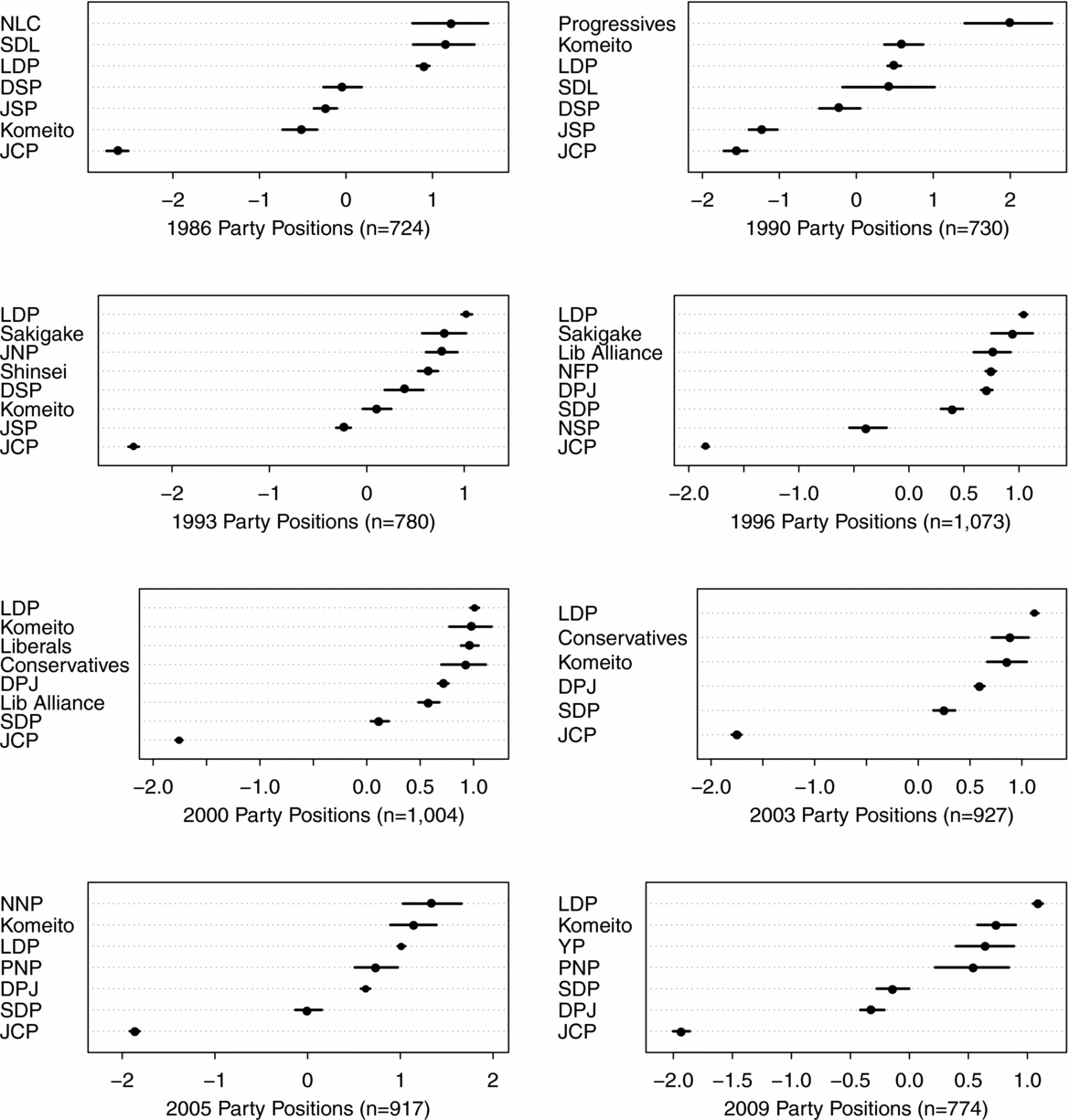
We estimated the positions separately for each election because it is reasonable to assume that the issues upon which competition occurred varied slightly across elections. Online Appendix B describes how we cleaned, tokenized (inserted spaces between words), and pre-processed the Japanese-language manifestos, ran Wordfish, and decided which end of the dimension represented the ideological right and left, respectively. The remainder of this section explains how we validated the positions recovered. We used three strategies. First, we examined the position of the average candidate of each party. Figure 1 plots these averages, sorted from most ideologically left (smallest), to most ideologically right (largest), with the lines around the dots representing 95% confidence intervals. Several aspects of this figure suggest that the model recovered substantively meaningful positions. The average JCP candidate is located to the left of all other parties in all elections. The average LDP candidate is located to the right of the average socialist candidate in all elections, where socialist candidates ran from the JSP in 1986, 1990, and 1993, from the SDP and New Socialist Party (NSP) in 1996, and from the SDP thereafter. The average LDP candidate is located to the right of the average DPJ candidate in all elections in which both parties ran. The confidence intervals around the average LDP and NLC position overlap in 1986 and a difference-in-means test confirmed that their means were indistinguishable. These parties merged a month after the election. Strikingly, the ordering of parties in 2003 exactly matches their ordering in a 2003 survey in which experts were asked to locate them on a left-right dimension (Laver and Benoit Reference Laver and Benoit2005).
Locations of the average candidate of each party on a left-right ideological dimension in elections to Japan’s HOR, 1986–2009. The lines around the dots represent 95% confidence intervals. The left is represented by smaller numbers.
Second, we examined the correlation between our estimates and those obtained from other data. The University of Tokyo and one of Japan’s largest newspapers, the Asahi Shimbun, have conducted several waves of the Asahi-Todai Elite Survey, which asks candidates contesting HOR elections their positions on a battery of policy issues. In the 2003 and 2005 HOR elections, candidates were asked to locate themselves on a 10-point ideological scale, in which they were told 1 represented the most “progressive” (left) position and 10 represented the most “conservative” (right). These surveys boast high response rates: 95% in 2003 (1,104 of 1,159 candidates) and 91% in 2005 (1,034 of 1,131 candidates). In both elections, the correlation between our estimates and these self-reported positions was positive and highly significant. In 2003, Pearson’s r = .81 (n = 904), while in 2005, Pearson’s r = .80 (n = 853).Footnote 7
Third, we read manifestos located at the left and right to evaluate whether the meaning of the dimension coheres with work on the nature of ideological competition in Japan. This has drawn two main conclusions. First, Curtis (Reference Curtis1999, 29-30) describes how “violent ideological conflict” between conservatives committed to overturning the postwar order and progressives committed to furthering democratization gave way to a less-polarized system in the 1970s in which conservatives became “committed to a policy of making cautious, incremental adjustments in the status quo” and progressives remained committed to reorganizing Japan’s political and economic system but had abandoned their most-extreme positions. Second, Proksch, Slapin, and Thies (Reference Proksch, Slapin and Thies2011) and Laver and Benoit (Reference Laver and Benoit2005) show that conservatives and progressives differ little on economics, but substantially on social, foreign, and environmental policy. Consistent with both, we found that the dimension was support versus opposition to the establishment, and the issues distinguishing the ends tended to concern social and foreign policy, not economics.
Manifestos on the right spoke of traditional values, the hometown, the family unit, established career paths, mainstream life choices, the agencies of the state, law and order, and the status quo in foreign policy. For example, candidates extolled the virtues of working together as a group and lamented the disappearance of warm, local communities were everyone had a role to play and respected others. They promised to pursue freedom in moderation, restore Japan’s spiritual backbone, realize a proud society built on deep bonds between people, encourage young people to remain in the hometown, encourage the buying and selling of locally made products, increase the health of youngsters through physical sports such as baseball and soccer, and further strengthen the U.S.-Japan alliance. In contrast, manifestos on the left spoke of challenging the establishment, protecting the rights of the individual, and upending the status quo, including in foreign policy. For example, candidates promised to get rid of discrimination, realize a gender-equal society, safeguard human rights, emphasize exams less and the development of children more, stop building nuclear power plants, stop wasteful spending on public works, give rural areas the right to govern and fund themselves, correct unfairness in the tax system, abolish the U.S-Japan alliance, get rid of U.S bases in Japan, and pursue an independent foreign policy. This also suggests that the dimension is substantively meaningful.
RESULTS
We merged our validated estimates of candidate positions with candidate election data (Reed and Smith Reference Reed and Smith2009) and conducted the following tests.
Dispersion in Districts
To examine Hypothesis 1, we calculated the dispersion in candidate positions in all districts in all elections using all candidates prior to electoral reform and candidates from majority-seeking parties after reform. Our estimates were created using the universe of 2,520 candidates who ran in the last three elections under the old system and the 2,862 candidates who ran from the three large parties—the LDP, NFP, and DPJ—in the first five elections under the new system. Following Ezrow (Reference Ezrow2007), we use variance to measure dispersion, defined as the mean of each position’s squared difference from the mean position. The mean within-district dispersion was 2.45 in 1986 (n = 129 districts), 1.89 in 1990 (n = 129), 1.87 in 1993 (n = 129), 0.14 in 1996 (n = 254), 0.16 in 2000 (n = 225), 0.27 in 2003 (n = 246), 0.24 in 2005 (n = 280), and 1.43 in 2009 (n = 263). While the decline between 1993 and 1996 suggests that electoral reform had the negative impact on within-district dispersion we had anticipated, mean dispersion also declined between 1986 and 1993 and increased in 2009. To distinguish any possible effect of electoral reform from an effect of the passage of time, we ran the following regression, which tests for the presence of a structural break at the time of reform and controls for other differences between districts:
 $$\begin{eqnarray*}
&&\text{{\bf dispersion}}_{it} = \beta_0 + \beta_{1}{\text{{\bf electoralreform}}}_{{\it t}} + \beta_{2}{\text{{\bf {\it t}}}}\\
&&\quad + \beta_{3}(\text{{\bf electoralreform}}_{t}\times \text{{\bf {\it t}}}) + \text{{\bf Z}}_{it} + \epsilon_{it},
\end{eqnarray*}$$
$$\begin{eqnarray*}
&&\text{{\bf dispersion}}_{it} = \beta_0 + \beta_{1}{\text{{\bf electoralreform}}}_{{\it t}} + \beta_{2}{\text{{\bf {\it t}}}}\\
&&\quad + \beta_{3}(\text{{\bf electoralreform}}_{t}\times \text{{\bf {\it t}}}) + \text{{\bf Z}}_{it} + \epsilon_{it},
\end{eqnarray*}$$
where the outcome variable, dispersion it , is variance in candidate positions in district i in election t = 1, 2, . . .7, 8 (pertaining to the 1986 . . . 2009 HOR elections), electoralreform t is a dummy variable indicating whether the observation is in the postreform period (i.e., if t ≥ 4), Z it are control variables pertaining to district i in election t, and ε it is the error term. Z it contains fixed effects for prefecture, electoral district, and the 2009 election. For reasons we elaborate upon below, 2009 was unusual. Our results hold with and without the 2009 dummy but including it increases model fit. In this regression, a significant coefficient on electoralreform indicates that the reform had an impact on dispersion even when the passage of time and other differences between districts are controlled for. A significant coefficient on electoralreform × t indicates that the passage of time had different effects on dispersion before and after the reform.
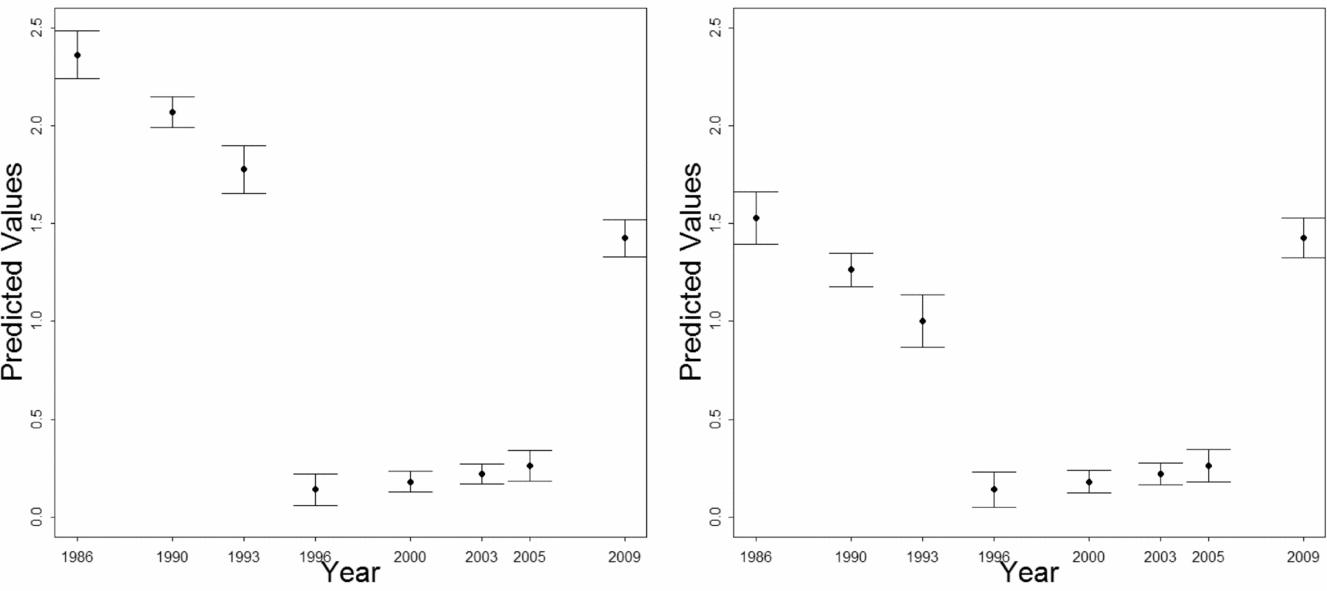
The first two columns of Table 1 present the results of this regression, with and without the controls, with standard errors clustered by electoral system-specific district. The coefficients on electoralreform and electoralreform × t are significant in both models. As expected, electoral reform had a statistically significant negative impact on the dispersion of positions among candidates in a district, even when the passage of time and other district-level differences are controlled for. The results also show that increases in time were associated with lower levels of within-district dispersion under the old system and higher levels under the new. The left-hand side of Figure 2 plots predicted values of within-district dispersion over time with their 95% confidence intervals.Footnote 8 In a regression of within-district dispersion on time, a Chow (Reference Chow1960) test also returned a statistically significant result for a structural break at the time of reform (the p value on the Chow test statistic was <0.01).
Predicted values of within-district dispersion across the eight HOR elections with 95% confidence intervals. Electoral reform is associated with lower dispersion.
District-level dispersion, 1986–2009, is regressed on time, electoral reform, and an interaction between time and electoral reform, with and without controls. Electoral reform is associated with less dispersion when dispersion is calculated with all candidates prior to reform (columns 1 and 2) and competitive candidates prior to reform (columns 3 and 4).
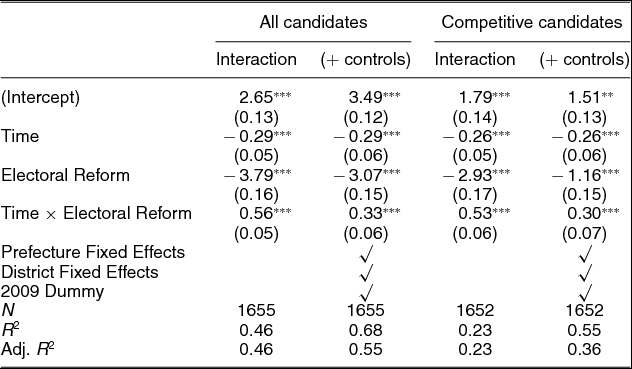
Standard errors clustered by district are in parentheses.
† significant at p < .10; *p < .05; **p < .01; ***p < .001
Next, we checked whether the greater within-district dispersion under the old system is solely attributable to candidates with little chance of winning a seat running and articulating extreme positions. Our theory expects that all candidates would have been more dispersed under the old system, not just those with little chance of winning. Given that votes tend to concentrate on the most competitive M + 1 candidates in a district (Reed Reference Reed1991), we recalculated the dispersion in positions among candidates in a district in the three elections under the old system using only candidates who had been one of the top M + 1 vote-getters in the same district in the previous election. Of the 2,520 candidates who ran in the 1986, 1990, and 1993 elections, 1,590 fit this definition of “competitive.”Footnote 9
We found that mean within-district dispersion was lower when recalculated using competitive candidates, but still higher than within-district dispersion in the first four elections under the new system. It was 1.40 in 1986 (n = 129 districts, compared to 2.45 when calculated with all candidates); 1.52 in 1990 (n = 127 districts, compared to 1.89 with all candidates), and 0.87 in 1993 (n = 128, compared to 1.87 with all candidates). The second two columns of Table 1 present the results of the same regressions we ran with the full sample, with and without controls, with standard errors clustered by electoral system-specific district. Just as before, both electoralreform and electoralreform × t are significant in both models. The right-hand side of Figure 2 plots predicted values of within-district dispersion over time with their 95% confidence intervals.Footnote 10 A Chow test also returned a statistically significant result for a structural break at the time of reform (the p value on the Chow test statistic was <0.01). We can thus rule out the concern that the higher dispersion under the old system is due to the inclusion of noncompetitive candidates.
These tests used variance to measure dispersion.Footnote 11 Online Appendix C presents two alternative tests using absolute distances between the positions of pairs of candidates running in the same district. In a regression, M is found to exert a positive, statistically significant impact on the absolute distances between the highest and second-highest vote getter in a district and the Mth and M + 1 vote-getter in a district, respectively. We also found that the variance in absolute distances between the highest and second-highest vote getter in a district is greater under the old system, when M varied across district, than it is under the new, when it is constant across districts.
Finally, we leveraged variation in the incentives of different categories of candidate after electoral reform to conduct a within-electoral system test. We calculated the dispersion in candidate positions in all districts in all elections under the new system using three categories: the 2,862 candidates running from the three large parties (the subject of the previous analysis); the 2,947 candidates running from either a large party or a small party allied to a large party; and the 4,672 candidates running from all parties presenting lists in the PR tier. Table 2 reports the mean dispersion in a district in each election under the new system using each category. There were no electoral alliances in 1996, so the values in the second and third columns in 1996 are identical.
Within-district dispersion calculated using three categories of candidates. The first column contains candidates with incentives to diverge and the latter two contain candidates with incentives to converge. Dispersion is always higher in the first column relative to the latter two and statistically indistinguishable in the latter two.
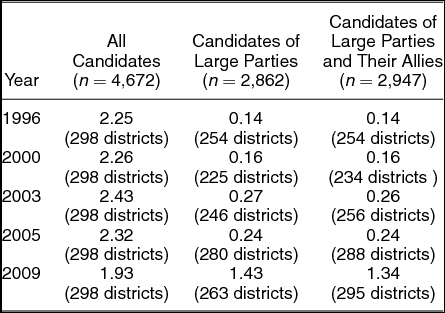
There are two findings. First, dispersion is always highest when it is calculated with candidates from all parties presenting a list in PR (the first column) than when it is calculated with candidates from the three large parties (the second column) or candidates from the three large parties and allied small parties (the third column). In each election, differences-in-means tests revealed statistically significant differences in mean dispersion between the first and second columns (p value of <0.01) and the first and third columns (for elections since 2000) (p value of <0.01), respectively. Second, dispersion is almost identical when it is calculated using candidates from the three large parties (the second column) and candidates from those parties plus their allies (the third column). In each election since 2000, differences-in-means tests showed no statistically significant difference in mean dispersion between the second and third columns. This supports our claim that candidates in the latter two categories are trying to win their districts, so converge. The former category contains candidates with incentives to diverge because they are really campaigning in PR, which explains why dispersion is larger when it includes these candidates.
Dispersion in Parties
To examine Hypothesis 2, we calculated the dispersion in positions among candidates of the same party for almost all the parties fielding candidates in these eight elections.Footnote 12 We continued to use variance to measure dispersion. We found that the mean within-party dispersion was 0.54 in 1986 (n = 7 parties), 0.81 in 1990 (n = 7), 0.28 in 1993 (n = 9), 0.13 in 1996 (n = 7), 0.14 in 2000 (n = 7), 0.13 in 2003 (n = 6), 0.16 in 2005 (n = 7), and 0.25 in 2009 (n = 7). While the decline between 1993 and 1996 suggests that electoral reform had the negative impact on within-party dispersion we had anticipated, these means also show that within-party dispersion varied under the old electoral system. To distinguish any possible effect of electoral reform from an effect of the passage of time and control for other differences between parties, we ran the same regression as above, where the outcome variable, dispersion it , is variance in positions among candidates in party i in election t = 1, 2, . . .7, 8 (pertaining to 1986 . . . 2009), electoralreform t is a dummy variable indicating whether the observation is in the postelectoral reform period (i.e., if t ≥ 4), Z it are control variables pertaining to party i in election t, and ε it is the error term. Z it contains party fixed effects.
We ran two regressions, with and without controls, with standard errors clustered by party.Footnote 13 The coefficients on electoralreform and electoralreform × t are significant in both models. As expected, electoral reform had a statistically significant negative impact on the dispersion of positions among candidates of the same party, even after the passage of time and other party-level differences are controlled for. The results also show that increases in time were associated with lower levels of within-party dispersion under the old system and higher levels under the new.Footnote 14 Figure 3 plots predicted values of within-party dispersion over time with their 95% confidence intervals to illustrate the difference between the two systems.Footnote 15 In a regression of within-party dispersion on time, a Chow test returned a statistically significant result for a structural break at the time of electoral reform (the p value on the Chow test statistic was <0.01).
Predicted values of within-party dispersion across the eight HOR elections with their 95% confidence intervals. It fluctuates under the old system and is lower under the new.
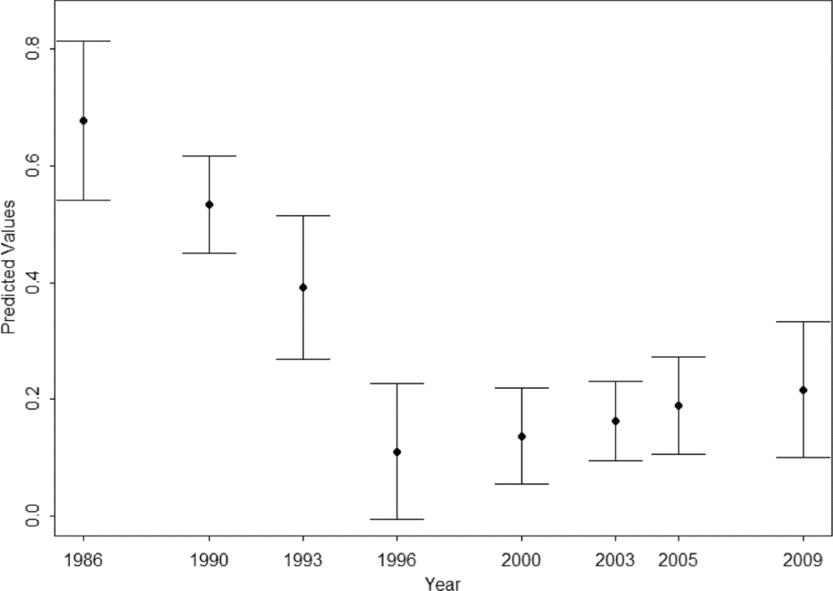
Next, we checked whether the lower levels of within-party dispersion under the new system are solely attributable to new parties. It would be stronger evidence of the power of electoral rules if parties that had competed under both systems became more unified under the new. To evaluate this, we examined dispersion within the LDP. We found that dispersion in LDP candidate positions was 0.45 in 1986 (n = 323 candidates), 0.67 in 1990 (n = 334), 0.22 in 1993 (n = 284), 0.09 in 1996 (n = 287), 0.11 in 2000 (n = 271), 0.10 in 2003 (n = 277), 0.12 in 2005 (n = 290), and 0.13 in 2009 (n = 289). While dispersion in LDP candidate positions fluctuated in elections under the old system, with 1993 exhibiting markedly less dispersion than 1986 or 1990, it is lower and more constant under the new.Footnote 16 This suggests that the lower dispersion after reform is not solely the product of new parties.
We then checked whether the lower levels of within-LDP dispersion under the new system are solely attributable to new LDP candidates or whether LDP candidates who had competed under both sets of rules became more similar to their copartisans under the new. We identified the 64 LDP candidate pairs who had fought against each other in the same district in 1993 and who also fought in 1996, necessarily in different districts.Footnote 17 If most of these pairs positioned themselves closer to each other in 1996 than in 1993, an election in which within-LDP dispersion was already lower than it had been previously, then we can conclude that the decline in within-LDP dispersion is not solely attributable to new candidates. For each of these 64 LDP candidate pairs, we calculated the absolute distances between their positions in the 1993 and 1996 elections, respectively. Seventy-three percent (or 47) of these pairs positioned themselves closer together in 1996 than in 1993. A difference-in-means test revealed a statistically significant difference in mean absolute distance between their positions in 1993 (0.51, n = 64 candidate pairs) and their positions in 1996 (0.28, n = 64) (p value <0.001). This suggests that the lower dispersion after reform is not solely the product of new LDP candidates.
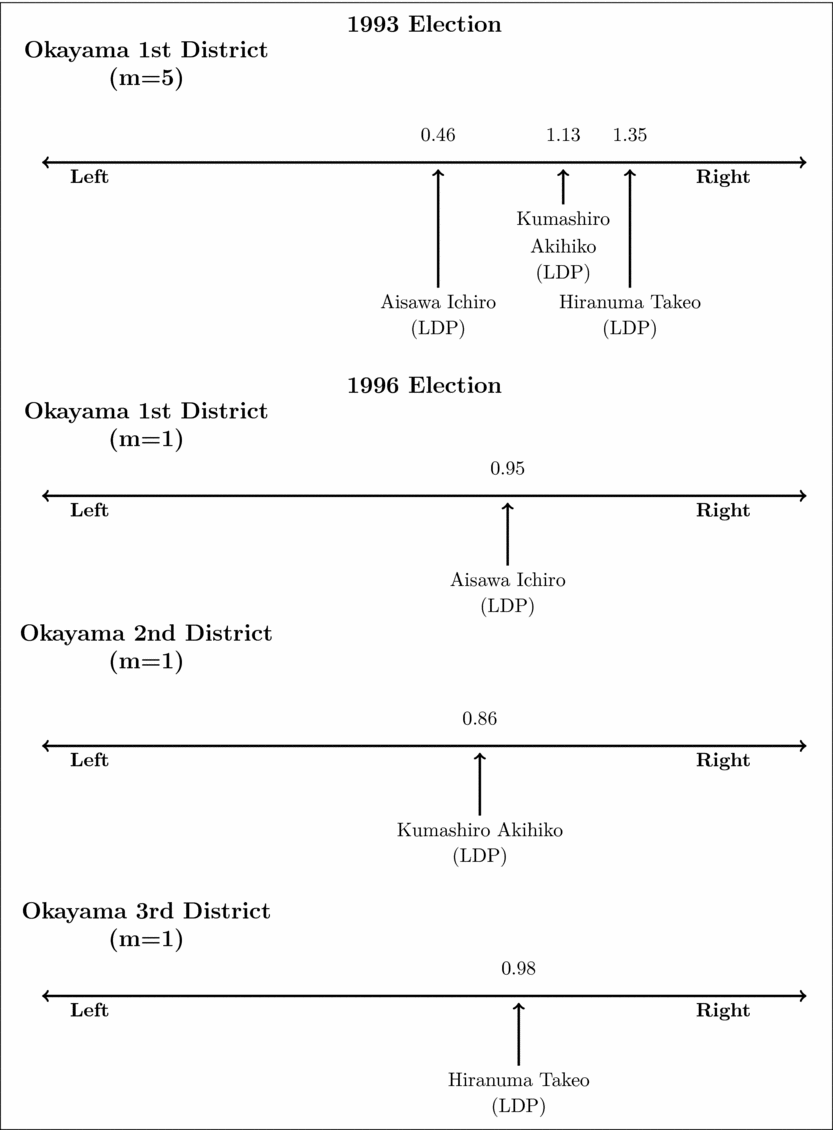
As an illustration of how this decline played out in one prefecture, we focus on the three LDP candidates who ran in Okayama 1st in 1993: Aisawa Ichiro, Hiranuma Takeo, and Kumashiro Akihiko. This district had an M of five. All three LDP candidates won a seat: Aisawa placed second, Hiranuma placed third, and Kumashiro placed fifth. The uppermost section of Figure 4 draws the location of the positions adopted by these candidates in 1993. The absolute distance between the positions of Hiranuma (1.35) and Aisawa (0.46) was 0.89, that between the positions of Hiranuma and Kumashiro (1.14) was 0.21, and that between the positions of Aisawa and Kumashiro was 0.68. In 1994, the boundaries of Okayama 1st and 2nd districts were redrawn to create five new SMDs. In 1996, Aisawa received the LDP nomination in Okayama 1st, Kumashiro received it in Okayama 2nd, and Hiranuma received it in Okayama 3rd. All three candidates won again in 1996. Aisawa and Hiranuma ran against candidates from the NFP and the JCP, respectively, while Kumashiro fought against candidates from the DPJ and JCP. The lower three sections of Figure 4 draw the location of the positions adopted by these candidates in 1996. The decline in absolute distances is apparent. The distance between the positions of Hiranuma (0.98) and Aisawa (0.95) was 0.03, the distance between the positions of Hiranuma and Kumashiro (0.86) was 0.12, and the distance between the positions of Aisawa and Kumashiro was 0.08. All three candidate pairs positioned themselves closer together in 1996 than in 1993.
Locations of the three LDP candidates who ran in Okayama 1st (M = 5) in 1993 (uppermost section) and locations of the same candidates who ran in Okayama 1st, 2nd, and 3rd districts (M = 1, respectively) in 1996 (lower three sections). Their positions are closer in 1996 than in 1993.
Finally, we can test whether within-party dispersion is larger under the old system because of intraparty competition by examining the relationship between dispersion in the positions of LDP candidates in a district and the intensity of intraparty competition in that district. We calculated the dispersion in LDP candidate positions in the 339 district-years in which more than one LDP candidate ran in the three elections under the old system, and regressed this on an index capturing the number of LDP candidates in that district relative to M, the number of seats available. This index ranges from a low of 0.33 (for districts with an M of six with two LDP candidates running) to a high of 1 (for districts in which the number of LDP candidates matched the number of seats available). Table 3 presents the results, with and without fixed effects for prefecture and district. The first column shows that increases in intraparty competition have a positive, significant effect on dispersion in LDP candidate positions in a district. The second column shows that even when prefecture- and district-level differences are controlled for, the coefficient on intraparty competition retains its significance at the 0.10 level. That districts with more LDP candidates relative to seats available had more dispersion in LDP candidate positions is evidence that parties were more ideologically divided under the old system because of intraparty competition.Footnote 18
A regression of dispersion in LDP candidate positions in a district on the intensity of intraparty competition in that district for elections to Japan’s HOR, 1986–1993. Intraparty competition has a significant positive impact on dispersion. When prefecture- and district-level differences are controlled for, the coefficient is significant at the 0.1 level.
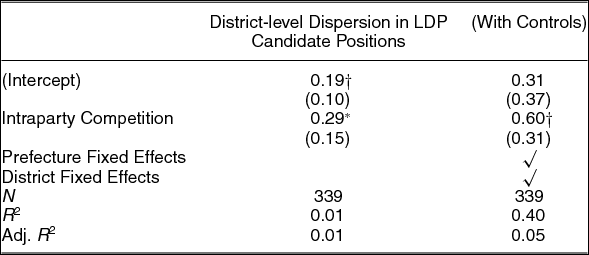
Standard errors in parentheses
†Significant at p < .10; *p < .05; **p < .01; ***p < .001
As a substantive example, we turn to Kagoshima 1st in 1990. In this district, four candidates contested two seats. Two candidates were from the LDP (resulting in an intraparty competition score of 1), one was from the JSP, and one was from the JCP. The LDP’s Nikaido Susumu wrote a manifesto that located him at 0.44, close to the median LDP position. He told voters that while education needed to pass on Japan’s traditions and culture, it also needed to cherish the individual personalities of each child and ensure that Japanese children were internationalized. He spoke of the need to improve conditions for working women by setting up more day cares, and of the need for political reform, including of money and factional politics. Nikaido placed first by about 20,000 votes. At 2.94, the LDP’s Yamanaka Sadanori’s manifesto was located on the extreme right. It emphasized his role in obtaining things for the district, including roads, schools, airports, resorts, a depopulation law, and customs infrastructure so Shibushi Bay could become an entry point to Japan. The message was that, if elected, Yamanaka would do more of the same. Yamanaka ended up placing third, 28 votes behind the JSP’s Arikawa Seiji. Arikawa’s manifesto was located left of center, at −0.94. He told voters the time had come to entrust governance to the opposition, which had demonstrated its lawmaking ability after capturing a majority in the 1989 Upper House election. He called for an end to LDP rule and the money and graft that had gone along with it, and promised to abolish the consumption tax. JCP candidate Shibatate Toshiaki was a distant fourth. At −0.40, his manifesto was located between the center and Arikawa’s position. Whereas Shibatate shared Arikawa’s promise to abolish the consumption tax, he told voters that the defeat of the consumption tax bill in the Upper House meant that politics had started to reflect the will of the people and he would make sure that continued. He promised to cut military spending, restrain political donations, and remedy government policies that were negatively impacting the prefecture.
The 2009 DPJ Landslide
Our analysis revealed that within-district and within-party dispersion were higher in 2009 relative to the previous elections under the new system. The 2009 election resulted in a landslide victory for the DPJ. It won 308 seats to the LDP’s 119. While the LDP had temporarily lost control of government when it fell 33 seats short of a majority in 1993, 2009 was the first election since 1958 in which it failed to capture a plurality. Heralded as the “most significant political transformation since the LDP’s formation and assumption of power in 1955” (Kushida and Lipscy Reference Kushida, Lipscy, Kushida and Lipscy2013, 3), it was brought about by reform-minded voters becoming disenchanted with successive LDP governments for prioritizing the “wrong” issues and disillusioned with the party’s role in the loss of millions of pension records (Rosenbluth and Thies Reference Rosenbluth and Thies2010). Even though it was a “motley collection” of politicians with radically different views on issues such as the necessity of U.S. bases in Japan (e.g., Yomiuri Shimbun 2009a, 2009b), the DPJ was able to capitalize on voter mood by adopting a “liberal manifesto” that highlighted its differences from the governing LDP (Sawa Reference Sawa2013).
While Hypothesis 1 expects that candidates trying to win their SMDs will converge on their opponents, it is reasonable to expect that candidates anticipating relatively easy electoral victories will be under less pressure to do so, unless convergence happens to locate them closer to their “real” preferences. Poll and election results in the months before the 2009 election, which would have been available to candidates well in advance of writing their manifestos, would have left little room for doubt that the DPJ was about to emerge victorious.Footnote 19 We posit that a likely explanation for the increase in within-district dispersion in 2009 is that DPJ candidates who were confident of victory and who held left-leaning preferences located themselves further to the left of their LDP opponents. A likely explanation for the increase in within-party dispersion in 2009 is an increase in within-DPJ dispersion, as these DPJ candidates located themselves on the left while their less-confident, right-leaning colleagues did not. The remainder of this section presents evidence in support of this claim.
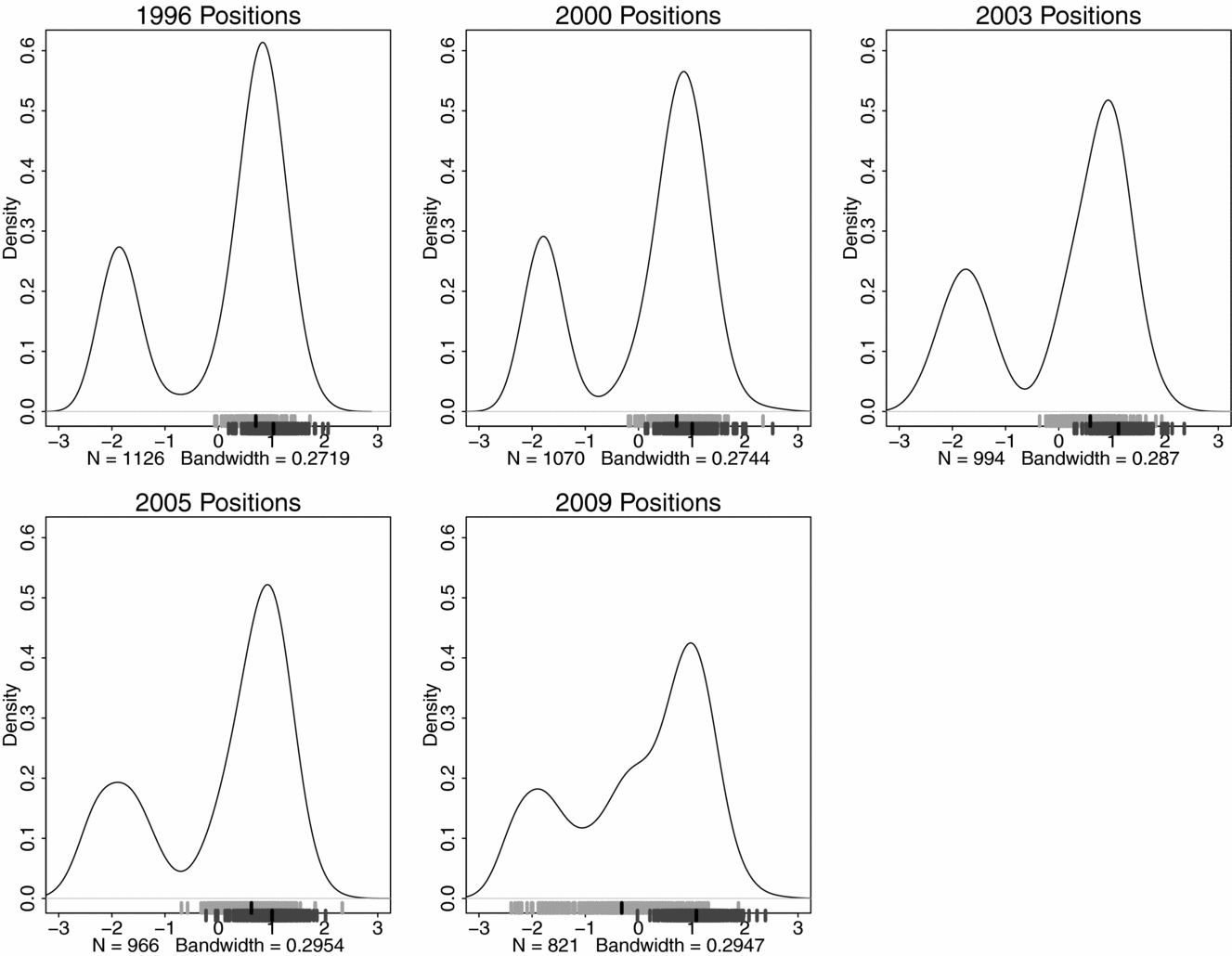
Figure 5 plots the positions of all 4,977 candidates who ran in the five elections after electoral reform. Lower numbers indicate the ideological left. The light (dark) gray rugs at the bottom of each plot identify the location of DPJ (LDP) candidates, with the black bands indicating the mean DPJ (LDP) candidate position. The figure reveals that LDP and DPJ candidates positioned themselves closer together and had within-party variances that were more similar until 2009, when they were further apart and DPJ candidate positions exhibited larger variance. Juxtaposing their positions against the distribution of candidate positions enables us to see that the relative location of LDP candidates is similar in all five elections, but the relative location of DPJ candidates is different in 2009. Whereas both parties occupied the center-right in the first four elections, with the mean DPJ position to the immediate left of the mean LDP position, in 2009 the LDP remained in that position whereas the DPJ located itself further to the left.
The distribution of candidate positions in HOR elections, 1986-2009. Lower numbers indicate the ideological left. The light (dark) gray rugs at the bottom of each plot identify the location of DPJ (LDP) candidates, with the black bands indicating the mean DPJ (LDP) candidate position. DPJ candidates were located further on the left in 2009 and had larger variance relative to previous elections.
That the increase in within-party dispersion in 2009 is solely attributable to an increase in DPJ candidate dispersion becomes clear when we examine dispersion in other parties. Six other parties contested the 2009 election. The variance in DPJ candidate positions (0.74, n = 271 candidates) was an order of magnitude larger than the variance in the LDP (0.13, n = 289 candidates), JCP (0.20, n = 152), SDP (0.15, n = 31), Komeito (0.06, n = 8), Your Party (0.22, n = 14), and PNP (0.23, n = 9). It was also an order of magnitude larger than the variance in all other parties that had contested an election under the new system, including itself in previous elections. Altogether there are 34 observations of within-party dispersion under the new system. Excluding the DPJ in 2009, within-party dispersion ranged from a low of 0.06 for Komeito candidates in 2009 (n = 8 candidates) to a high of 0.27 for NSP candidates in 1996 (n = 36). At 0.74, the dispersion in DPJ candidate positions in 2009 was almost three times larger than the party with the next-largest dispersion. It was also larger than its own dispersion in previous elections, which was 0.10 in 1996 (n = 143 candidates), 0.16 in 2000 (n = 242), 0.16 in 2003 (n = 267), and 0.19 in 2005 (n = 290).
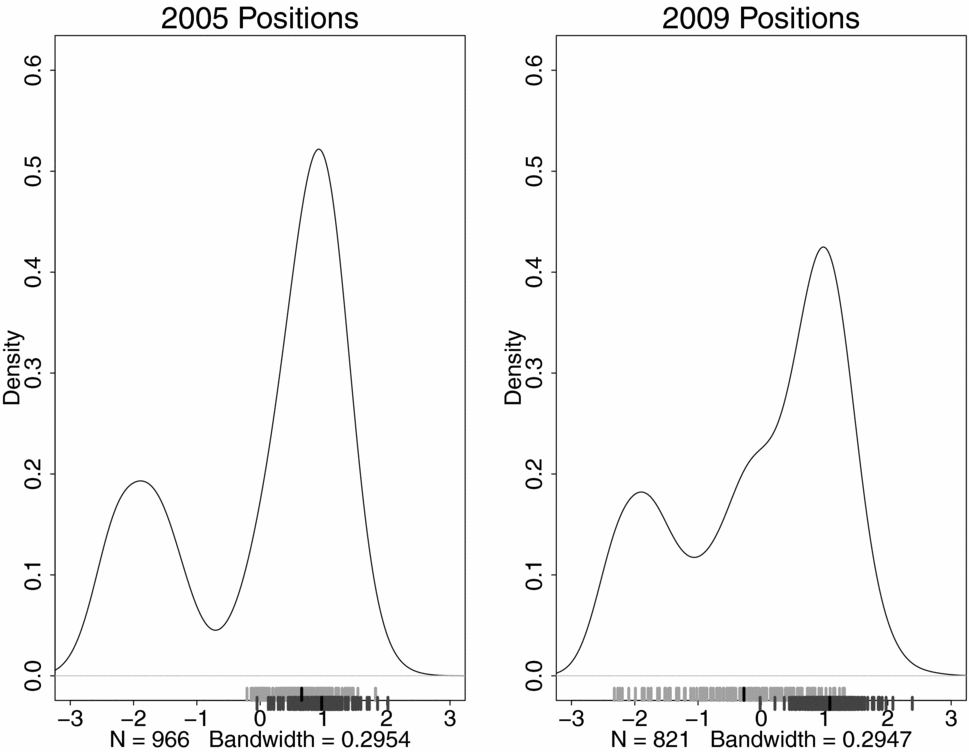
To distinguish our claim that the anticipation of a relatively easy victory changed the behavior of some DPJ candidates from a alternative claim that it led party leaders to nominate different candidates, who behaved differently, we analyzed the 178 DPJ candidates who ran in the same district in 2005 and 2009. The variance in their positions also increased from 0.19 in 2005 to 0.72 in 2009, which was statistically indistinguishable from the variance in all 271 DPJ candidate positions in 2009 (0.74). Of these 178 DPJ candidates, 142 fought against the same LDP opponent in both elections. The mean absolute distance between the candidates in these 142 pairs was 0.5 in 2005 and 1.39 in 2009, which was statistically indistinguishable from the mean absolute distance between the candidates in all 263 LDP-DPJ candidate pairs in 2009 (1.43). This means that even though the DPJ nominated 74 new candidates in 2009, neither the increase in within-DPJ dispersion nor the increase in within-district dispersion is attributable to these candidates. The changed behavior of these 142 DPJ candidates is discernible in Figure 6, which plots the positions of all 1,787 candidates who competed in 2005 and 2009. The light (dark) gray rugs at the bottom of each plot identify the location of these 142 DPJ (LDP) candidates, with the black bands indicating the mean DPJ (LDP) candidate position. The same DPJ candidates positioned themselves further away from their copartisans and further to the left of their same-district LDP opponents in 2009.
The distribution of candidate positions in 2005 and 2009. Lower numbers indicate the left. The light (dark) gray rugs at the bottom of each plot identify the location of the 142 DPJ (LDP) candidates who competed against the same LDP (DPJ) opponent in the same district in both elections, with the black bands indicating the mean DPJ (LDP) position. The same DPJ candidates exhibited larger variance and greater distance from their LDP opponents in 2009
We regressed the absolute distances between the positions of all 263 DPJ candidates and their same-district LDP opponents in 2009 on the number of elections the DPJ candidate had contested, whether one’s 2009 LDP opponent was competitive (defined as having won the district in 2003 and 2005), and an interaction between these variables. We included variables stipulating whether the DPJ candidate had formerly run as a socialist, LDP, or Liberal Party candidate, the DPJ candidate’s gender and age, the urbanness of the district, and the prefecture in which the district was located. The results, presented in Online Appendix E, reveal that being less certain of one’s victory (facing a competitive LDP candidate without any election experience) is associated with less distance from one’s LDP opponent, while having left-leaning preferences (being a former socialist) is associated with more. Running in Iwate and Fukushima prefectures, where the DPJ was widely expected to (and did) win all SMDs, was also associated with more distance from one’s opponent. Given that these distances are also a function of LDP candidate decisions about where to locate themselves, which we cannot control for, that we still observe a relationship between electoral security, ideological leaning, and distance from one’s LDP opponent increases our confidence that it exists.
As a substantive example, the DPJ candidate located closest to her same-district LDP opponent in 2009 was Nakanowatari Noriko (located at 1.13), a young woman running in Aomori 2nd for the first time against a competitive LDP candidate, Eto Akinori (located at 1.15). She told voters that she would create a world in which children would grow up glad to have been born in Japan and glad to be Japanese. She promised to enhance food safety, ensure that children ate healthy food, increase self-sufficiency to reduce Japan’s reliance on imports, require food to be stamped with its place of origin, ensure the health of the agriculture industry from the perspective of consumers, farmers, and fishermen, reduce the need for small businesses to pay health insurance fees, and off-load some of the central government’s tasks onto localities. In contrast, the DPJ candidate at the median of the distribution of DPJ positions in 2009 was Nakano Jo, a young man running for the third time in Saitama 14th. Nakano was located at −0.20. Nakano also faced a competitive LDP candidate. Nakano concentrated on promises that the DPJ would implement, which included a child allowance, support for pregnant women, a better pension system, the abolishing of the latter-stage elderly health care system, the restructuring of health care, rules banning political donations from businesses, and a reduction in number of members of parliament. Like Nakanowatari, he discussed agriculture, but with a focus on “agriculture for the cities.” On balance, this suggests that the expectation of a relatively easy electoral victory changed the behavior of some DPJ candidates, which explains the unusual observations.
ALTERNATIVE EXPLANATIONS
In the seven years between the coming down of the Berlin Wall and the first election under the new system, Japan experienced an economic recession, new security threats, and changes in its party system. Could the convergence of candidates in districts and parties be a product of such variables? While our main results depend upon a before-and-after-electoral-reform comparison, which is vulnerable to charges that another variable may be responsible, our analysis also included two within-electoral system tests. It is unlikely that a variable that changed around the time of electoral reform could account for variation in the dispersion of LDP candidate positions across districts under the old system, or variation in the dispersion of positions across different categories of candidates under the new system, yet our theory can.
Results obtained from a before-and-after comparison are actually less vulnerable than they first appear. While variables such as new security threats might be sufficient to push candidates closer together if those candidates were already competing under the new electoral system, it is unlikely they would have this effect under the old. A plausible alternative explanation for the convergence of large party candidates is a convergence in the preferences of large-party supporters. The problem with this is that two of the three large parties were not formed until after electoral reform, which requires us to tell a more-complicated story in which voters became unhappy with the existing parties and sought a second large party that would resemble the LDP. Insofar as voter unhappiness can be measured in vote shares, however, we must conclude that voters had been “unhappy” with Japan’s opposition parties for years. While new parties occasionally formed under the old system, they never ran enough candidates to qualify as alternatives to the LDP (Curtis Reference Curtis1988). The main reason for this was the low vote shares required to win seats under this system, which discouraged parties from joining forces (e.g., Kohno Reference Kohno1997). The 1993 election neatly illustrates these constraints: the JSP lost almost half its members of parliament and the LDP suffered defections. Yet none of the opposition parties that formed ran enough candidates to qualify as an alternative to the LDP. It is unlikely that voter preferences for a second large party would have been sufficient to produce one without electoral reform.
A plausible alternative explanation for the convergence of candidates on their copartisans, on the other hand, is a homogenization of the preferences of party supporters. It is unlikely that this would have been sufficient to push candidates closer to their copartisans under the old system because those candidates would still have needed ways to differentiate themselves. According to Myerson (Reference Myerson1993, 856), candidates facing intraparty competition will “create favored minorities, even in situations where all voters are initially the same.” It is more likely that candidates in this situation would attempt to carve out new shades of disagreement in those preferences. For evidence, we can again turn to 1993, when the entire electorate appeared to favor political reform. Reflecting their incentives to differentiate, right- and left-leaning LDP candidates defined the problem differently and proposed different solutions. LDP candidates on the left, for example, told voters that seasoned politicians had destroyed politics in their pursuit of special interests and proposed solutions such as stripping politicians convicted of wrongdoing of the right to run again, allowing the government to seize their assets, introducing term limits to prevent power accumulation, and reforming the electoral system. LDP candidates on the right, on the other hand, told voters that the problem was one of declining trust in politics and electoral reform was not the solution and merely introduced new problems. They spoke of the need for politicians to regret what they had done, engage in self-reform, remember the need to act ethically, and always put their country and hometown above themselves. It is unlikely that a homogenization of party supporter preferences would have been sufficient to push copartisans closer together in the absence of electoral reform.Footnote 20
CONCLUSION
We have at least three findings of interest to political scientists. Our first finding is that candidates converge in SMDs and diverge in MMDs. We obtained this result by leveraging variation in M across the two electoral systems Japan used over the course of this study and within the mixed-member system it has used since 1994. We found that under Japan’s old system, candidates positioned themselves relatively far from opponents in the district. Under the new system, large-party candidates and their small-party allies, who have incentives to try to win their districts, position themselves close together, while candidates of unallied small parties, who have incentives to use their SMD campaigns to increase their party’s PR vote share, position themselves further apart. An important takeaway is that evidence of nonconvergence where convergence is due should not be grounds for dismissing the validity of spatial theories. Whereas it might look like candidates in SMDs are adopting different stances on the pertinent issues of the day, their stances would likely be further apart if they were competing in MMDs.
Our second finding is that candidates converge on copartisans in systems without intraparty competition and diverge in systems with intraparty competition. We obtained this result by leveraging variation in intraparty competition across Japan’s two electoral systems and variation in the intensity of intraparty competition faced by LDP candidates under Japan’s old electoral system. We found that candidates locate themselves closer to copartisans after electoral reform than before, and LDP candidates who faced more intense intraparty competition under the old system located themselves further from their same-district copartisans relative to their peers who faced less intense intraparty competition. This is evidence that electoral systems and, specifically, the presence or absence of intraparty competition, affects the ideological cohesion of parties. It is also the first evidence to date that LDP candidates in the same district under the old electoral system used ideology to differentiate themselves. Given that previous studies found some evidence of differentiation in their committee memberships (e.g., McCubbins and Rosenbluth Reference McCubbins, Rosenbluth, Cowhey and McCubbins1995; Krauss and Pekkanen Reference Krauss and Pekkanen2010), we suggest that LDP candidates likely employed some combination of differentiation with ideology and pork. We leave this for future research.
Our third finding is that candidates behaved differently in the 2009 election, which produced a landslide victory for the DPJ. We posited that the pressure to converge is alleviated in elections expected to produce landslides. We found preliminary evidence that DPJ candidates who were confident of victory and had left-leaning preferences located themselves further to the left of their LDP opponents, while their colleagues who were less confident and held right-leaning preferences did not. As a result, the average DPJ candidate was located further from her LDP opponent in 2009 and further from copartisans. For Japan scholars, this means that the government formed after the 2009 election was based on a lack of ideological consensus relative to those formed after previous elections under this system. This provides a hypothesis for why the legislative record of the first non-LDP government in 16 years fell short of expectations, a legacy that has consequences for the party today. More generally, that the anticipation of an easy electoral victory could lead to such changes in positioning raises the possibility that it may also influence other aspects of candidate and party behavior. Scholars seeking to test general theories about electoral competition with a single election would do well to remember this.
Future research should focus on several questions. First, while we have concentrated on the dispersion in candidate positions, future research should examine the locations of those positions. Examining how candidate locations may or may not have changed over time would enable us to empirically evaluate claims that Japanese politicians have shifted to the ideological right in recent years (e.g., Winkler Reference Winkler, Pekkanen, Reed and Scheiner2013). If such a shift was found, then we could tease out the relative effects of Japan’s electoral reform, which some scholarship suggests should incline governments to the ideological right (Iversen and Soskice Reference Iversen and Soskice2006), from exogenous shocks such as the rise of China and economic recession. Second, because the vast majority of candidates contesting elections under the new system are from large parties, we may conclude that Japan’s electoral reform had the effect of narrowing the ideological gap between those parties. Scholars interested in polarization should use the case of Japan to examine whether this decline in ideological polarization has been associated with changes in, for example, the importance of valence considerations such as integrity and competence (e.g., Clark and Leiter Reference Clark and Leiter2013), voter attitudes toward parties, politics, or issues (e.g., Hetherington Reference Hetherington2001), and the diversity of views represented in the news media (e.g., Baum Reference Baum2013). Finally, future research should also examine the relationship between the positions of candidates and parties and the voters they represent. While surveys have found that candidates are more extreme than both voters and party supporters (Taniguchi Reference Taniguchi2006), whether this holds when positions are estimated with material generated for the purpose of winning an election should be examined.
SUPPLEMENTARY MATERIAL
To view supplementary material for this article, please visit https://doi.org/10.1017/S0003055417000399.
Replication material can be found on Dataverse at https://doi.org/10.7910/DVN/PENDX4.




Comments
No Comments have been published for this article.