


The World Health Organization (WHO) defines obesity as a ‘global epidemic’1. It is now estimated that there are more than 100 million obese individuals worldwideReference Shetty, Shetty and Gopalan2. Gopinath et al. estimated the obesity prevalence in an adult urban population of Delhi at 27.8%Reference Gopinath, Chadha, Jain, Shekhawat and Tandon3. A recent study in the UK showed that more than 55% of adults are overweight (body mass index (BMI) >25 kg m− 2), while 20% are obese (BMI>30 kg m− 2)4. A study conducted by the Nutrition Foundation of India among the urban upper middle class segment in Delhi showed obesity in 32.2% of males and 50.0% of femalesReference Krishnaswamy5. In another study based on BMI, Misra et al. showed that obesity was more prevalent in females (15.6%; 95% confidence interval (CI) 10.7–22.3) than in males (13.3%; 95% CI 8.5–19.5)Reference Misra, Pandey, Devi, Sharma, Vikram and Khanna6.
The two most important factors that contribute to a sudden increase in incidence of obesity are changes in dietary practices and urbanisation. Presently, there is inclusion of more fats and oils, more sugar and less fibre in the diets of peopleReference Krishnaswamy5. Convenience foods and fast foods have found increasing acceptance. Apart from dietary changes, changes in occupational activity, sedentary lifestyles and a lack of adequate physical activity have also been observed, which in turn have contributed to the increased incidence of obesity. Occupations that involve heavy manual labour are increasingly being replaced by sedentary jobs.
Obesity is associated with several risk factors for heart disease and other chronic diseases in adult life, including hyperlipidaemia, hyperinsulinaemia, hypertension and early atherosclerosisReference Berenson, Srinivasan, Bao, Newman, Tracy and Wattigney7. It is an important factor contributing to the morbidity and mortality due to chronic non-communicable diseases.
The pace of developmental transition in Third World countries has been particularly marked in recent times, and has led to the ‘double burden’ of undernutrition and obesity in developing countries. It is therefore imperative that the rising incidence of obesity is controlled before it emerges as the single most important public health problem in India.
The global prevalence of childhood obesity is also increasing very rapidly1. The number of seriously overweight children and adolescents has more than doubled in the last three decades8. In developed countries, obesity in children and adolescents is widely prevalent. It is estimated that almost 30% of children and teenagers are overweight and the numbers appear to be rising. An overweight adolescent has a 70% chance of becoming an obese adult, and obesity can lead to a higher risk of life-threatening health problems. In other words, adolescent obesity significantly increases the odds of the adult co-morbidities8.
Childhood obesity is associated with increased risk of gallbladder disease, osteoarthritis, hypertension, dyslipidaemias and sleep apnoea. In adolescence, obesity is likely to be associated with various psychological consequences. Apart from the physical risks, overweight children can exhibit emotional ramifications secondary to ridicule and labelling by their peers, including lower levels of self-esteem.
Common causes of weight gain are eating large portions of food (more than the recommended intake for a particular age and sex based on the nature of work), frequent consumption of food, eating fried and junk foods, using chocolate etc. as a reward and eating while viewing television, which affects the physical activity of children. Usually, fast foods are high in cholesterol, sugar, sodium, additives and preservatives, which cause chronic degenerative disorders. They have very low contents of fibre, minerals, vitamins and antioxidants, thereby increasing the vulnerability to heart attacks, cancer and diabetes.
Childhood obesity is not confined to industrialised countries, as high rates are already evident in some developing nations1. In India, it has been reported that childhood obesity is more common in Delhi and PunjabReference Agarwal and Agarwal9. A study carried out in a school in Chandigarh, where the children came from an affluent background, showed that 52% of boys and 44% of girls were obeseReference Agarwal and Agarwal9. In Australia, the prevalence of overweight and obesity in childhood is approximately 25%Reference Booth, Wake, Armstrong, Chey, Hesketh and Mathur10. In the USA, one child in every five is overweight11 and the recent NHANES (National Health Examination Survey) study showed that 12–14% of children are obese12. It has been observed that family size is inversely related to childhood obesity12. In a meticulous analysis of children who were followed from birth through their early adulthood, researchers found that heavy mothers give birth to bigger babies who later become obese adults13.
The present study was carried out among children and adolescents belonging to upper socio-economic groups in the state of Delhi. The objectives of the study were to:
● assess the anthropometric status of children and adolescents aged 4–17 years in a public school catering to children from the upper socio-economic strata of Indian society;
● compare the growth patterns of these children with those of the US National Center for Health Statistics (NCHS) reference population and Indian National Nutrition Monitoring Bureau (NNMB) data, which largely captures rural children belonging to lower socio-economic strata in India;
● assess the prevalence of obesity in the affluent children;
● find the prevalence of low birth weight among the affluent children; and
● study the relationship, if any, between birth weight and subsequent growth performance.
Methods and subjects
The present cross-sectional study was carried out in a Delhi school catering to the upper strata of Indian society. The duration of the study was 3 years. The total sample size was over 4000 children in the age group 4–17 years. Efforts were made to collect information on equal numbers of boys and girls in each age group calculated at the difference of one year (Table 1). Almost all children were from affluent sections of society. Of the total number of subjects, only 0.5% lived in joint families (with grandparents).
Distribution of the study subjects according to age

In total 4399 children were covered in the study, of whom 56.7% were boys and 43.3% were girls in various age groups ranging from 4 to 17 years. Efforts were made to cover the maximum possible number of students in each grade.
A proforma was designed to collect information on family background, birth weight and anthropometric measurements, including standing height, weight, mid upper-arm circumference (MUAC) and triceps skinfold thickness (TSF). The study team included both male and female trained workers.
Anthropometry
Anthropometric measurements were taken using standard techniques and instrumentsReference Jelliffe, Jelliffe, Zerfas and Neumann14: a Microtoise anthropometer for height (to the nearest mm), a Seca solar digital balance for weight (to the nearest 100 g), a fibreglass tape for MUAC (to the nearest mm) and Harpenden callipers for TSF (to the nearest mm). Standard precautions were taken to ensure instrument validity, and calibration and quantification of intra- and inter-person errors were performed from time to time.
The median heights and weights of subjects in the present study were compared with datasets from the NCHS15 and NNMB16. TSF data of the present study were compared with NNMB (4–17 years) and NCHS (9–17 years) data. MUAC data of the present study were compared with NNMB (4–17 years) data only, as the NCHS does not have MUAC standards for the age group studied.
After careful examination of available worldwide data, a WHO expert working group constituted to advise upon the use of anthropometric indicators of nutritional status recommended that the NCHS data are best suited for use as an international reference, since they meet most of the criteria necessary for this purpose. The NCHS data are based on growth measurements of a large number of American children and are currently used widely for reference purposes in many countries, including India.
The Indian Council of Medical Research established the NNMB in seven Indian states. The NNMB carries out diet and nutrition surveys in these seven states (100–200 villages in each state). Thus, in total, about 60 500 individuals (13 500 households) are covered in the NNMB dataset.
Birth weight
The birth weight of all of the children was obtained from the parents. This was based on their recollection and, if required, the parents checked the birth weight against the birth record.
Data analysis
The data were analysed to determine median values of anthropometry of boys and girls in 1-year age groups, and compared with the median values of NCHS and NNMB datasets. BMI was calculated for each child from measured from weight and height, and the frequencies of normal weight, overweight and obesity were determined in the total sample and in boys and girls separately for different age groups. The distribution of boys and girls in different birth weight categories according to present BMI was obtained. Correlation coefficients were calculated to investigate the association between subjects' birth weight and present BMI. The software package SPSS version 10.0 (SPSS Inc.) was used for statistical analyses.
Results
Weight and height
The median weights and heights of boys and girls in the present study are compared with corresponding NCHS and NNMB data for different ages in Figs 1–4.
Comparison of the weight of affluent boys in the present study with the US National Center for Health Statistics (NCHS) reference and Indian National Nutrition Monitoring Bureau (NNMB) data

Comparison of the weight of affluent girls in the present study with the US National Center for Health Statistics (NCHS) reference and Indian National Nutrition Monitoring Bureau (NNMB) data

Comparison of the height of affluent boys in the present study with the US National Center for Health Statistics (NCHS) reference and Indian National Nutrition Monitoring Bureau (NNMB) data

Comparison of the height of affluent girls in the present study with the US National Center for Health Statistics (NCHS) reference and Indian National Nutrition Monitoring Bureau (NNMB) data

Both boys and girls in the present study were much heavier and taller compared with corresponding median figures from the NNMB dataset (rural children). At 17 years, the difference in weight between children in the present study and rural children was over 17 kg for boys and approximately 12 kg for girls; the corresponding difference in height was about 10 cm in boys and 8 cm in girls.
Generally, both boys and girls in the present study were also heavier and taller compared with NCHS data for corresponding age groups. In boys, the difference in weight increased steadily to reach a maximum at age of 10 years, then the difference narrowed, and by the age of 17 years the NCHS reference population was heavier than the present one. Similarly, in girls, the maximum difference was observed at the age of 11 years, then the difference narrowed, and from 12 years onwards the NCHS weight values were higher than the present ones. Towards the end of the teenage years, a levelling off of weight could be seen in both boys and girls.
In the case of height, the data of the present study were comparable to those of the NCHS in both boys and girls. Boys in the present study were taller than those of the NCHS reference population until age 13 years. The difference between the two values increased steadily until 10 years and then declined, so that the NCHS values were higher after 14 years. Similarly, among girls, the NCHS values overtook the present values from age 12 years onwards.
The difference in height (between NCHS and the present study) was not as large as the difference in weight. However, for height also there was a levelling off in both boys and girls at 16–17 years in all the three studies.
The present study reveals that the growth performance of affluent Indian children mainly corresponds to NCHS data and in fact even exceeds it at some points.
Sitting height, MUAC and TSF
Figures 5–8 show the median sitting height, MUAC and TSF values of the present study and the comparison with NCHS and NNMB data where applicable.
Comparison of the sitting height of affluent boys and girls in the present study

Comparison of the mid upper-arm circumference (MUAC) of affluent boys and girls in the present study with Indian National Nutrition Monitoring Bureau (NNMB) data

Comparison of the triceps skinfold thickness (TSF) of affluent boys in the present study with the US National Center for Health Statistics (NCHS) reference and Indian National Nutrition Monitoring Bureau (NNMB) data

Comparison of the triceps skinfold thickness (TSF) of affluent girls in the present study with the US National Center for Health Statistics (NCHS) reference and Indian National Nutrition Monitoring Bureau (NNMB) data

The median sitting height of boys was greater than that of the girls in almost all age groups. In the category 10–12 years, girls showed a slight increase compared with boys. From the age of 14 years, the difference between sitting height values of boys and girls was significant and showed a steady increase until 17 years (Fig. 5).
MUAC values among girls aged 6, 8 and 9 years were marginally higher than for boys; in all other age groups, boys showed higher values than girls. The difference between the data of boys and girls showed variability, which was greater from age 12 years onwards (Fig. 6). Comparing the present study with the Indian NNMB data, the maximum difference (7 cm) in the MUAC values was found among boys at 12 and 14 years. This difference in girls was found to be about 6 cm at 11 years of age. Among all age groups, MUAC values from the present study were higher than corresponding values of the Indian NNMB.
In the present study, TSF values were higher in girls than in boys for all age groups. Boys and girls in the present study had higher TSF values than the Indian NNMB data for all age groups. In the NCHS dataset, TSF values are given only for the age group 9–17 years (Figs 7 and 8). Comparison of the present study data with the corresponding NCHS data showed TSF values to be higher among boys in all age groups in the present study, whereas among girls at ages of 16 and 17 years, the NCHS values were marginally higher.
BMI
Data on the BMI of all subjects are presented in Table 2. The cut-off points for overweight and obesity recommended by Cole et al.Reference Cole, Bellizzi, Flegal and Dietz17 were used in the present study.
Distribution of the study subjects according to weight status based on body mass index

Approximately 22% of the study children were overweight and 6.4% were obese. In all age groups, boys were more overweight or obese than girls. In this cross-sectional study, overweight rates were highest in the age group 9–11 years for girls and 12–14 years for boys.
Birth weight
Only 6% of the subjects were of low birth weight ( < 2.5 kg) in the present socio-economic group, compared with 33% in the lower socio-economic groupReference Gopalan18, Reference Gupta and Ahmad19. One possible explanation could be that the diets of poor pregnant women are deficient in a variety of nutrients such as n–3 fatty acids, iron and zinc. Other factors could be low energy intake, which can lead to low weight gain during pregnancy, infections and smoking.
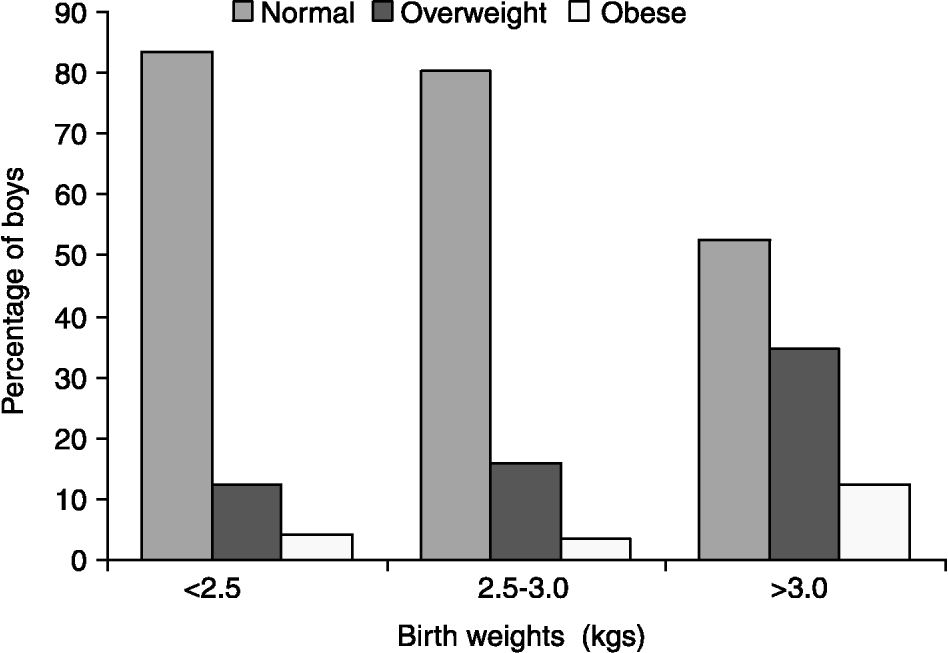
The majority of children (both boys and girls) with normal BMI had birth weight either < 2.5 kg or 2.5–3.0 kg (Figs 9 and 10). The percentage of overweight/obese children increased with increasing birth weight. Subsequent statistical analyses revealed that growth performance was positively correlated with the birth weight of the subject (P = 0.01, Table 3). Most overweight/obese children had birth weight ≥ 3.0 kg. This trend was found to be more prevalent in boys than in the girls. It was observed that the low birth weight percentage was lower in boys (5.1%) than in girls (7.2%). This confirms the prevalence of overweight/obesity being higher in boys than in girls.
Percentage of affluent boys in the present study in different categories of birth weight according to current weight status
Percentage of affluent girls in the present study in different categories of birth weight according to current weight status

Correlation between birth weight and present body mass index of the study subjects

** Correlation is significant at the 0.01 level (two-tailed).
Discussion
Obesity is becoming an increasingly important public health problem affecting all age groups and both sexes. The present study of 4–17-year-olds belonging to the affluent section of Indian society revealed these children/adolescents to have a high prevalence of overweight/obesity. Of the total, 22% were overweight and 6.4% were obese. Other studies support our findings related to overweight/obesity among children and adolescentsReference De Onis and Blossner20, Reference Vijaylakshmi, Reddy, Krishna and Krishnaswamy21. The environmental factors contributing to this are rapid urbanisation and changes in dietary patterns and lifestyles.
More boys were overweight/obese than girls. In both boys and girls, the majority of children with higher BMI were from the middle of the age range; thereafter overweight/obesity rates showed a declining trend with age, which is not normally found. This could be because there was trend for weight to decline and linear growth to level off right after the middle years in this population (as shown by the results of the present study). The decline in weight gain could occur because the children/adolescents become more conscious about their looks with increasing age and restrict their dietary intake, whereas the growth plateau among the NCHS subjects starts at a later age. Hence, the Indians are shorter than their corresponding American counterparts.
Most anthropometric parameters (weight, height, sitting height and MUAC) were higher in boys than in girls for almost all age groups, whereas TSF was found to be higher in girls in all age groups. Of the total (4399) children, only 6% had low birth weight ( < 2.5 kg). The birth weight of these subjects was positively correlated to their present BMI. Children with birth weight >3.0 kg were found to have a higher BMI than those who had either low birth weight or birth weight in the category 2.5–3.0 kg.
Thus there is a need to raise awareness not only among children but also parents to reduce the epidemic of high BMI (overweight/obesity), because this is associated with increased cholesterol and blood sugar levels and dyslipidaemias. Dietary excesses should be counteracted with dietary modifications, as even small additions to the diet can increase overall food intake. An earlier study on nutrition and physical exercise education in schools was able to show improvement in indices of fitness and body fat levelsReference Epstein22, supporting the proposal that physical activity must be stressed in the school environmentReference Shetty23. This will help in inculcating healthy lifestyles and beneficial dietary habits among children at an early age. This will not only keep them in good shape but will also prevent them carrying health problems into adult life and reduce their likelihood of developing diseases like diabetes, cancer and cardiovascular disease.
Acknowledgements
We are grateful to Dr C Gopalan, President of the Nutrition Foundation of India, for suggesting this study and for his constant guidance during the study. We are also thankful to the principal, teachers and students of the public school for their cooperation throughout the data collection period.



