





Highlights
-
• The left SPL is crucial in Chinese L2 syntactic processing.
-
• Chinese L2 syntactic processing relies on the pivotal frontoparietal network.
-
• The linguistic distance and L2 proficiency can modulate the frontoparietal network.
-
• Current findings support the Shallow Structure Hypothesis.
1. Introduction
The faculty of language (FL) in the narrow sense relies on Merge, a basic syntactic computation unique to the human species (Hauser et al., Reference Hauser, Chomsky and Fitch2002). Briefly speaking, Merge is the process of combining two syntactic objects (e.g., “the” and “apple”) into a larger structure (i.e., “the apple” [a determiner phrase]) (Chomsky, Reference Chomsky1995). The realization of Merge requires the identification/labeling of the syntactic categories of the syntactic objects as well as the merged constituents. Thus, the processing of complex syntactic structures through multi-level Merge can reflect the hierarchical nature of the human language faculty (Hauser et al., Reference Hauser, Chomsky and Fitch2002).
How about Merge in the second language (L2) processing? Clahsen and Felser (Reference Clahsen and Felser2006a, Reference Clahsen and Felser2006b, Reference Clahsen and Felser2006c) proposed the Shallow Structure Hypothesis (SSH), which suggested that the syntactic representations of L2 speakers are not as deep and detailed as those of native speakers (L1) but rather shallower and more ambiguous. We chose the SSH as one of the prominent hypotheses to begin with because it was specifically proposed based on the difficulties faced by L2 learners in online processing of ambiguous relative clauses. It pointed out that the automation level of complex syntactic processing in L2 learners was limited, relying on shallow information, such as lexical, semantic, discourse and pragmatic cues, which fundamentally differed from the processing mechanisms of native speakers. Researchers found that even high-level L2 learners still have difficulty in constructing abstract syntactic representations in real time, both at the sentence level (e.g., relative-clause ambiguities and filler-gap dependencies, Clahsen & Felser, Reference Clahsen and Felser2006a, Reference Clahsen and Felser2006c) and at the microscopic level of morphological features (e.g., inflectional and derivative affixes, Kirkici & Clahsen, Reference Kirkici and Clahsen2013). These studies mostly used natural materials to explore whether L2 learners underuse syntactic information. However, processing differences between L1 and L2 often showed up only where the manipulation of abstract grammatical representations was required (Clahsen & Felser, Reference Clahsen and Felser2018). Therefore, it remains to be specified whether the core syntactic computation of hierarchical structures (i.e., Merge) could be predicted by SSH during the pure L2 syntactic processing as well.
Moreover, SSH has extended itself to the level of the time course differences of processing different information types. Studies employing eye movements or event-related potentials (ERP) techniques (see review in Clahsen & Felser, Reference Clahsen and Felser2018) found that the processing strategies for syntactic information in L2 might differ from those in L1. For instance, Guo et al. (Reference Guo, Guo, Yan, Jiang and Peng2009) observed that Chinese-native English L2 learners elicited N400, rather than P600 in English native speakers, when processing sentences with verb sub-categorization violations. This suggested that native speakers primarily relied on syntactic information, whereas L2 learners depended more on semantic information. Similarly, Zhang’s (Reference Zhang2019) ERP study pointed out that, unlike L1, Chinese L2 learners did not report P600 after syntactically violated verbs, reflecting L2’s greater reliance on lexical and pragmatic knowledge. In contrast, a stream of studies has shown that advanced L2 learners could exhibit ERP patterns similar to those of native speakers in syntactic violation paradigms (Bowden et al., Reference Bowden, Steinhauer, Sanz and Ullman2013; Rossi et al., Reference Rossi, Gugler, Friederici and Hahne2006; Steinhauer et al., Reference Steinhauer, White and Drury2009). For example, Steinhauer et al. (Reference Steinhauer, White and Drury2009) reported that highly proficient French and Chinese native speakers learning English exhibited a biphasic LAN/P600 pattern consistent with that of native English speakers when processing syntactic category violations. These two ERP components were interpreted as reflecting the early disruption of relatively automated syntactic processing (LAN) and subsequent reanalysis and repair of sentence structure (P600). In line with these studies, Chen et al. (Reference Chen, Yang, Gao, Fang, Wang and Feng2023a) also identified a similar ERP pattern of the high-level Chinese L2 learners with that of the Chinese native speakers. Moreover, in artificial grammar paradigms involving (morpho) syntactic violations, highly proficient learners also demonstrated a (LAN-) P600 pattern (Friederici et al., Reference Friederici, Steinhauer and Pfeifer2002; Grey et al., Reference Grey, Sanz, Morgan-Short and Ullman2018; Morgan-Short et al., Reference Morgan-Short, Sanz, Steinhauer and Ullman2010, Reference Morgan-Short, Finger, Grey, Ullman and Stamatakis2012a, Reference Morgan-Short, Steinhauer, Sanz and Ullman2012b). Hence, it is still disputed to what extent the time-course differences might or might not support SSH. More crucially, differences in the spatial dimension, that is, the brain activation differences between L1 and L2 syntactic processing, are largely unspecified.
Although SSH lacks a specific assumption in the spatial dimension, existing bilingual studies have reported that even though L1 and L2 share activated brain regions partially, L2 processing still maintains its own activation patterns (Scherer et al., Reference Scherer, Fonseca, Amiri, Adrover-Roig, Marcotte, Giroux, Senhadji, Benali, Lesage and Ansaldo2012; Suh et al., Reference Suh, Yoon, Lee, Chung, Cho and Park2007). Suh et al. (Reference Suh, Yoon, Lee, Chung, Cho and Park2007) reported significant L1–L2 overlapping activations of the left IFG, the bilateral inferior parietal and occipital lobes. However, in L1, embedded sentences resulted in stronger activation of the IFG compared to conjoined sentences, whereas no such difference was observed in L2. Similarly, Scherer et al. (Reference Scherer, Fonseca, Amiri, Adrover-Roig, Marcotte, Giroux, Senhadji, Benali, Lesage and Ansaldo2012) found significant L1–L2 overlapping activation in left frontal regions during syntactic processing, suggesting a common pattern of brain activity in highly proficient bilinguals. While the study further revealed that L2 recruited more temporal areas but fewer frontal areas compared to L1, suggesting L2 processing was more demanding and less automatic.
Such differences might be attributed to the L2 learner factors, as previous studies have concluded that the experience of learning and using L2 can have a pervasive impact on the structure and function of the cerebral cortex (Kovelman et al., Reference Kovelman, Baker and Petitto2008; Mechelli et al., Reference Mechelli, Crinion, Noppeney, O’Doherty, Ashburner, Frackowiak and Price2004). For example, functionally, compared with native speakers, L2 learners increased the signal intensity of the left IFG during an L2 grammatical judgment task (Kovelman et al., Reference Kovelman, Baker and Petitto2008). And these effects were moderated primarily by learner factors such as native language backgrounds and L2 proficiency. A recent meta-analysis by Cargnelutti et al. (Reference Cargnelutti, Tomasino and Fabbro2022) indicated that L2 proficiency and linguistic distance between L1 and L2 worked together in L2-related neural networks, but the researchers also pointed out that empirical studies quantifying linguistic distance were relatively lacking. Given the variability in individual L2 proficiency and the differences in proficiency across structures influenced by linguistic distance (Steinhauer et al., Reference Steinhauer, White and Drury2009), researchers have emphasized the need to account for individual variation when investigating L2 processing. They suggested treating individual difference variables as continuous rather than categorical variables to enable a more nuanced and detailed understanding of the L2 factors (Hell, Reference Hell2023). Therefore, how learner factors would modulate the neural basis of L2 syntactic processing still awaited to be specified.
It is noteworthy that SSH as well as the related aforementioned studies on L2 syntactic processing concentrated on the morphosyntactic information within the scope of Indo-European languages. As for Chinese, an isolated language lacking morphosyntactic information, function words play a critical role in conveying syntactic relations as a distinct feature of Chinese syntax (Huang & Liao, Reference Huang and Liao2011; Tang, Reference Tang2019). Based on the function words, we can better understand the neurobiology of L2 syntactic processing with prominent Chinese features.
Previous investigations on Chinese L2 syntactic processing have predominantly adopted natural language materials (see Zhao, Reference Zhao2018 for a review), which are prone to interference from semantic processing. As complex structures can be constructed based on abstract syntactic information (such as inflectional morphemes and function words), several syntactic processing studies adopted the jabberwocky paradigm (Matchin et al. Reference Matchin, Hammerly and Lau2017; Ohta et al., Reference Ohta, Fukui and Sakai2013; Pallier et al., Reference Pallier, Devauchelle and Dehaene2011), replacing content words with pseudowords, which is able to not only better control the interference of the confounding factors but also to investigate the natural syntactic rules in an ecological way by keeping the real syntactic structures intact (see a recent review by Maran et al., Reference Maran, Friederici and Zaccarella2022). Inspired by these studies, a previous study developed a Chinese function-word-based syntactic processing paradigm deprived of conceptual-semantic information (Chen et al., Reference Chen, Gao, Li, Zaccarella, Friederici and Feng2023b). The experimental materials of complex structures were generated by real Chinese function words and pseudo-content-words following real Chinese syntactic rules, and participants were asked to label the jabberwocky sequences with the corresponding syntactic categories (e.g., noun and verb phrases). They found that Chinese L1 speakers recruited a language-general frontotemporal syntactic network dominant in the left hemisphere, including both the posterior IFG (esp., Broca’s area) as well as the posterior temporal lobe (pTL), consistent with previous findings conducted on inflecting language (e.g., Matchin et al., Reference Matchin, Hammerly and Lau2017; Pallier et al., Reference Pallier, Devauchelle and Dehaene2011; Zaccarella et al., Reference Zaccarella, Meyer, Makuuchi and Friederici2017). Therefore, whether and to what extent Chinese L2 learners share the same neural basis as L1 speakers during syntactic processing based on Chinese function words to evidence SSH should be substantially scrutinized.
Thus, we adopted the well-established Chinese function-word-based jabberwocky sentence reading paradigm and recruited relatively proficient Korean native speakers to explore the neurobiology of Chinese L2 syntactic processing. The participants needed to identify the syntactic category of the holistic structure through merging the syntactic elements according to the function words. Besides, Chinese L2 learner factors, such as linguistic distance and L2 proficiency, were measured as continuous variables.
To sum up, our research questions are as follows:
-
(1) What is the neural basis of Chinese L2 hierarchical syntactic processing based on the function words?
-
(2) Will and how the learner factors (esp., L2 proficiency and linguistic distance) modulate Chinese L2 syntactic processing at the neurobiological level?
We expected that: Chinese L2 learners may share core brain regions such as the left posterior IFG with native speakers during syntactic processing, but the activated brain regions and connectivity networks were modulated by L2 learner factors so that differed from the frontotemporal network.
2. Materials and methods
2.1. Participants
Twenty native Korean speakers at advanced Chinese level were recruited (male: 10, age: M = 25.55 years, SD = 2.48 years). They started learning Chinese at about 16.40 ± 4.66 years old and were classified as late L2 learners. Rationales of the recruitment of Korean native speakers were explained in Section 1.1 of the Supplementary Material.
Advanced Chinese L2 learners were chosen because they already had basic knowledge of Chinese function words, which enabled us to better investigate the process of syntactic processing rather than learning. The screening criteria were as follows: (1) Participants who had passed the HSK Level 5 and Level 6 from the Korean students studying in Beijing; (2) Using the Chinese L2 proficiency rapid test paper compiled by Feng et al. (Reference Feng, Feng, Bai and Wu2020). Participants with scores above 18 were included in the experiment (full score is 30). The average score in this experiment is 26.6 ± 2.97 points, and each participant’s score would be used as a quantitative indicator for evaluating his/her Chinese L2 proficiency.
All participants were right-handed, had normal or corrected-to-normal vision, and had no visual impairments, no dyslexia, and no history of psychiatric or neurological diseases. Because the visual materials included Japanese Katakana and the Chinese Phonetic Alphabet (i.e., the Taiwanese Bopomofo, Zhuyin), none of the participants had experience in learning Japanese and the Chinese Phonetic alphabet, and they did not major in linguistics, psychology or neuroscience. All participants signed the “Experiment Informed Consent” and received remuneration afterwards. Participants’ data were analyzed according to the criteria of head motion artifacts (< 2 mm in translation and < 2° in rotation). This study was approved by the local ethics committee of Beijing Normal University, Beijing, China.
2.2. Materials
The details of the experimental materials and procedures of this study were consistent with the previous Chinese L1 study (Chen et al., Reference Chen, Gao, Li, Zaccarella, Friederici and Feng2023b), except for the part involving L2 learners as well as the L2 learner factors. For a brief description of the stimuli and procedures, see also below.
The materials consisted of Chinese function words and pseudo-content-words (Figure 1A). These function words are highly abstract without concrete meanings (Huang & Liao, Reference Huang and Liao2011; Tang, Reference Tang2019), but they can combine with other pseudo-content-words (Figure 1A) to generate well-formed structures (Figure 1B). According to the “Chinese Proficiency Grading Standards for International Chinese Language Education” (Ministry of Education of the People’s Republic of China, 2021), we controlled the difficulty of these function words at the elementary to intermediate level to reduce vocabulary difficulties.
Experimental materials. (A) word categories and the corresponding tokens, including real-function-words and pseudo-content-words. Below pseudo-content-words were semantic relating mean scores with their 95% confidence intervals. (B) experimental sequences, including structures and word lists. The structure condition contained grammatical structures (noun phrases, NP and verb phrases, VP) with natural language examples provided and ungrammatical structures (marked by “※”). The word list condition contained normal lists (artificial word lists “A” and Chinese word lists “C”) and violated lists (also marked by “※”). The grey shadow marked the word category violation in the examples and the dashed curve denoted truncation of the violated part while keeping the rest of the elements still mergeable. Abbreviations: dyn-Aux.: dynamic auxiliary; str-Aux’.: structural auxiliary (for verb modifiers); str-Aux.: structural auxiliary (for noun modifiers); Prep.: preposition; Q: quantifier; V: verb; N: noun; Adj.: adjective; Num.: number; Adv.: adverb. P: phrase (e.g., VP: verb phrase, NP: noun phrase,); A: artificial word list; C: Chinese word list; ※: structure/word-list violation.

Pseudo-content-words were generated by using unfamiliar Chinese-character-like symbols, including Japanese Katakana and Taiwanese Bopomofo (Zhuyin), which were similar to Chinese orthography, but unpronounceable and semantic-free for the participants (Figure 1A). These symbols were arbitrarily assigned syntactic categories. The semantic strategy to relate the pseudo-words to the real words for each pseudo-content-word was also controlled (see Section 1.2 of the Supplementary Material and Figure 1A).
The “complex structures” were built, including 24 noun phrases and 24 verb phrases (Figure 1B), where each structure consists of three function and four pseudo-content words. See also Section 1.2 of the Supplementary Material for more details. Furthermore, in case participants could identify the phrase category by focusing only on certain function words or their combinations without processing the whole structure, 24 “Ungrammatical structures” were designed, in which the category of a content word violated the syntactic rules (see the example of “※” in Figure 1B). To avoid edge effect, the word category violations only appeared at the second or third pseudoword position. We balanced the frequency of different pseudo-content-word tokens within the same word category, the proportion of grammatical and ungrammatical trials, and the number of trials violated at different positions so as to avoid eliciting judgment preferences for participants.
To isolate the hierarchical syntactic processing effect, word lists without syntactic hierarchies were generated as a control condition (Figure 1B). The words in this condition were the same as the materials under the Structure condition to ensure that low-level lexical features would be subtracted under the contrast of “structure > word list.” Using the words from the same category to avoid the possibility of syntactic merge (Zaccarella et al., Reference Zaccarella, Meyer, Makuuchi and Friederici2017), we developed two types of “mono-word-category word lists”: 24 lists consisting of class-specific pseudo-content word tokens, and 24 lists composed of real function words (Figure 1B). Random occurrences of “#” were set at the third to sixth positions in the rest of the 24 word list to form violations (Figure 1B), consistent with the positions where word category violations occurred in the Structure condition. The trial number of word lists and structures remained constant at 72 each, as did the length of trials, which were both 7-word sequences. Materials were pseudo-randomized and visually presented by E-prime 2.0 (Psychology Software Tools, Inc., Pittsburgh, PA, USA).
To test the linguistic distance between Korean (L1) and Chinese (L2), we used a five-point Likert scale to develop the Chinese-Korean structure similarity scale (see Section 1.3 of the Supplementary Material). This experience/feeling-based rating approach might reflect the psychological distance at the syntactic facet and thus reflect the “structure similarity” under the psycholinguistic perspective.
2.3. Procedures
The experimental procedures were illustrated in Figure 2. Participants received the pseudo-content word list three days before the experiment and needed to memorize the category of each pseudoword. They were then required to accomplish a time-limited pseudoword category test by Sojump (https://www.wjx.cn). Only participants who scored above 90 (out of 100) were allowed to enter the formal experiment.
Experimental procedure. (A) Behavioral adaptation session. Participants first passed the vocabulary category identification test by the accuracy of the 2-successive-block reached 90% (20 trials per block). Then, they underwent the “basic-structure phase” to complete the grammatical judgment task (8 blocks, 8 trials per block, totaling 64 trials) and the category identification task (6 blocks, 8 trials per block, totaling 48 trials) of the basic structures. Last, in the “complex-structure phase”, participants completed the similar grammaticality judgment (16 blocks, 6 trials per block, totaling 96 trials) and category identification tasks (only two blocks of the practice section, with 6 trials each block) for the complex structure. (B) fMRI scanning session. The scanning experiment was divided into 3 runs, and 8 blocks (4 structure condition blocks and 4-word list condition blocks) were arranged in a pseudo-random manner within each run. Each block contained 6 trials and each trial was presented for 9 s, so each block lasted for 54 s. One run and the presentation of the trials with the timing parameters were shown.

Before fMRI scanning, the participants underwent a behavioral adaptation phase (Figure 2A), including three sessions. Firstly, a vocabulary test, identical to the online test conducted earlier, was carried out. Participants were provided with the pseudo-content words and their corresponding syntactic categories (predefined before the experiment), and were required to map these symbols to the target syntactic categories. Only participants whose two-successive-block-accuracy reached 90% were able to pass. After that, in the basic structure phase, they needed to complete the grammatical judgment task and the category identification task for 3-words simple structures. Finally, in the complex structure phase, participants completed the similar grammatical judgment task and the category identification task for 7-words complex structures. The presentation times and trial numbers were shown in Figure 2A.
During fMRI scanning, we employed the category identification task of complex structures under the structure condition. The experiment used a blocked-design (similar to Matchin et al., Reference Matchin, Hammerly and Lau2017) for a comparatively higher detection power, in which the structure condition and the word list condition were mixed in blocks, with different colored “#######” in the 30 s interval of the block to indicate the next task: A red one denoted the structure condition, while a blue one indicated the word list condition. The trial numbers and the presentation time(s) were shown in Figure 2B. The whole scanning phase lasted for about 1 hour. After scanning, participants were required to complete the Chinese-Korean structure similarity test and to have a post-test interview.
2.4. Behavioral data analyses
Behavioral data were collected during scanning. One-sample t-tests were conducted to examine whether the accuracy rates of both the structure condition and word list condition significantly exceeded the chance level (i.e., 50%). As word category violations were set in the materials, if participants used task-irrelevant strategies, the accuracy rates of word category violation trials would be at random levels. Therefore, we further analyzed the accuracy rates of violated trials under the two conditions, using one-sample t-tests against the chance level to ensure participants’ compliance with the tasks.
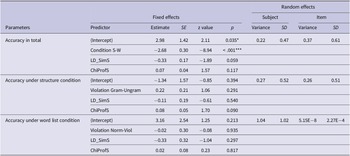
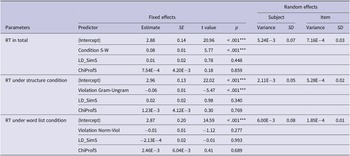
The effects between structure and word list (i.e., Condition) in accuracy were analyzed using a generalized linear mixed model with Accuracy as a dependent variable, Condition as a predictor, Chinese L2 proficiency scores (ChiProfS) and the linguistic distance scores measured by the Chinese-Korean structure similarity scale (LD_SimS) as covariates to purify the main effect of Condition and Subject and Item as random variables. As for the condition effects in reaction times (RT), the linear mixed-effect model was employed that included the log-transformed RT as the dependent variable, Condition as a predictor, ChiProfS and LD_SimS as covariates and Subject and Item as random variables. Furthermore, considering the design of the violated trials, we proceeded to employ consistent statistical analysis within each condition. Statistical models were implemented using a restricted maximum likelihood technique, following backward model-selection procedures. For instance, when constructing a generalized linear mixed model to examine the condition effect between structure and word list (SW_condition), the initial step involves building the most complex full model with random intercepts for subjects and items, with fixed effects of independent variable (i.e., SW_condition) and the covariate (i.e., ChiProfS and LD_SimS). The full model was ACC~SW_Condition + LD_SimS + ChiProfS + (1 + SW_Condition | subject) + (1 | item). As SW_condition was a within-subject variable, it could be potentially added as a random slope and the viability was tested using anova function. If the full model failed to fit adequately, the model was progressively simplified by reducing random slopes until a best-fitted model was achieved. These analyses were conducted in R 4.2.2 using the package lme4 (Bates et al., Reference Bates, Mächler, Bolker and Walker2015) and lmerTest (Kuznetsova et al., Reference Kuznetsova, Brockhoff and Christensen2017).
Moreover, exploratory Pearson correlation analyses were employed to explore the relationship between accuracy, RT, ChiProfS and LD_SimS. The multiple-comparison results were corrected via “false discovery rate” (FDR) correction.
These t-tests and correlation analyses were performed with SPSS 26 and jamovi 1.6.
2.5. Imaging data acquisition
The MR imaging data were acquired via a 3.0-Tesla Siemens PRISMA magnetic resonance scanner (Siemens AG, Erlangen, Germany) using a 64-radiofrequency-channel head coil.
For functional data acquisition, a T2*-weighted gradient echo planar imaging (EPI) sequence was adopted with the following parameters: repetition time (TR) = 2000 ms; echo time (TE) = 30 ms; flip angle (FA) = 90°; field of view (FOV) = 208 × 208 mm2; base resolution = 104 × 104 mm2; in-plane resolution = 2 × 2 mm2; slice thickness = 2 mm; number of slices = 64; gap = 0 mm; alignment to AC-PC plane. Signals from different slices were acquired by the multi-band scanning technique (multi-band factor = 2) to efficiently minimize slice-timing effects.
Parameters for high-resolution anatomical T1-weighted images for co-registration were listed as following: TR = 2530 ms; TE = 2.27 ms; FA = 7°; FOV = 256 × 256 mm2; base resolution = 256 × 256 mm2; in-plane resolution = 1 × 1 mm2; slice thickness = 1 mm; number of slices = 208.
2.6. Imaging data preprocessing
The imaging data were preprocessed by DPARSF 5.1 Advanced Edition (Yan et al., Reference Yan, Wang, Zuo and Zang2016), implemented in the environment of MATLAB R2020b. The preprocessing steps included: (a) Removing the first 4 volumes to reduce the magnetic saturation effect; (b) Slice time correction; (c) Field mapping; (d) Spatial realignment; (e) Co-registration; (f) Segmentation (New segment + DARTEL); (g) Nuisance covariates regression (polynomial trend: 1, linear detrending), also including head motion regression by using the Friston-24 model; (h) Normalization of the images to the echo planar imaging (EPI) template based on Montreal Neurological Institute (MNI) stereotactic space to minimize cerebral differences between participants, and resampled the images into 2 × 2 × 2 mm3; (i) Smoothing the images with a 3D Gaussian kernel with full-width at half-maximum (FWHM) of 4 mm.
2.7. Whole-brain level analyses
The whole-brain level analyses were conducted using SPM 12 (https://www.fil.ion.ucl.ac.uk/spm/). At the first level, a general linear model (GLM) was established for each participant by including the structure and the word list conditions as two regressors of interest, with the onset and duration (54 s) of each block modulated as a boxcar function convolved with a canonical hemodynamic response function. The data were further high-pass filtered at 128 Hz to eliminate low-frequency drifts. The “structure > word list” contrast results of each participant were then entered into the second-level analysis.
At the second-level group analysis, we performed a one-sample t-test to examine whether there was a significant difference between the structure and word list conditions. Each individual’s mean FD (framewise displacement) Jenkinson value accounted for head motion artifacts, accuracy, reaction times, ChiProfS and LD_SimS were included as covariates and regressed out. The results of the whole-brain analysis were reported using a FWE (family-wise error)-corrected threshold of p < .05, cluster size (KE) ≥ 20. Furthermore, we detected activation under each condition separately (p uncorrected < .00001, KE ≥ 50) in contrast to the implicit baseline (i.e., 0) to ensure normal processing in both conditions following Chen et al. (Reference Chen, Gao, Li, Zaccarella, Friederici and Feng2023b).
2.8. Region of interest (ROI) analyses
Consistent with the previous study (Chen et al., Reference Chen, Gao, Li, Zaccarella, Friederici and Feng2023b), we utilized a functional left-hemispheric language atlas based on 220 participants, developed by Fedorenko et al. (Reference Fedorenko, Hsieh, Nieto-Castañón, Whitfield-Gabrieli and Kanwisher2010) (http://web.mit.edu/evlab//funcloc/), to investigate the activation differences under the “structure > word list” contrast within the language network. This atlas was employed as the language mask for small volume correction (SVC) to identify peak activity coordinates (cluster-level p FWE < .05, using the cluster defining threshold at p uncorrected < .001, KE ≥ 30).
The percentage of signal change was measured within each region of interest (ROI) based on the original BOLD (Blood Oxygenation Level Dependent) signal, without regressing out the behavioral indices (i.e., accuracy, RT, ChiProfS and LD_SimS). The correlations between the percentage of signal change and the behavioral indices were further examined.
2.9. Effective connectivity analysis
To further investigate the information transfer among the ROIs, we employed the unified structural equation modeling (uSEM) approach for the effective connectivity analysis (Gates et al., Reference Gates, Molenaar, Hillary and Slobounov2011) following Chen et al. (Reference Chen, Gao, Li, Zaccarella, Friederici and Feng2023b). The original signal from each ROI under the structure condition were extracted, without regressing out the behavioral indices. These signals were then included in Group Iterative Multiple Model Estimation (a MATLAB-compatible toolkit, GIMME, Gates et al., Reference Gates, Molenaar, Hillary and Slobounov2011) for model specification. GIMME estimates the optimal models from the group-level to the individual-level using Lagrange multiplier tests. If a connection significantly improved the model fit (≥75% of the sample), it was added to the model for re-estimation. This uSEM approach can provide more detailed time information, including lagged effects (i.e., effects from a previous time point to the current one), and contemporaneous effects (i.e., effects at the same time point) (Gates et al., Reference Gates, Molenaar, Hillary and Slobounov2011).
Subsequently, we extracted the effective connectivity strength of each connection between the ROIs and then performed the exploratory Pearson correlation tests between each connectivity strength and the behavioral indices to evaluate the modulative impact of learner factors.
3. Results
3.1. Behavioral results
The descriptive behavioral results are shown in Table 1. The accuracy rate of the structure condition was significantly higher than the chance level (t(19) = 4.52, p < .001, d = 1.01) and did not differ statistically from 65% (t(19) = −.68, p = .51), indicating that the participants were compliant with the experiment task (with standard of 65%, referring to Iwabuchi & Makuuchi, Reference Iwabuchi and Makuuchi2021). Additionally, the accuracy rate of ungrammatical trials also surpassed the chance level (t(19) = 4.12, p < .001, d = .92), suggesting that participants processed without relying on task-unrelated strategies. The word list condition showed a similar pattern, with accuracy rate significantly above chance levels (ts(19) ≥ 21.5, ps < .001, ds ≥ 4.81).
Behavioral results

Abbreviations: Gram.: Grammatical structure; Ungram.: Ungrammatical structure; SD: standard deviation; CI: confidence intervals.
The results for accuracy and reaction times analyses using statistical models were shown in Tables 2 and 3. To note, as the full models fitted best, all the subsequent analyses were conducted using full models, as detailed in the footnotes in Tables 2 and 3. The structure condition had lower accuracy than the word list condition (Estimate = −2.68, SE = .30, z = −8.94, p < .001), along with longer RT (Estimate =.08, SE = .01, t = 5.77, p < .001). These findings indicated that the structure condition posed a greater processing challenge than the word list condition. Therefore, both accuracy and RT were included as covariance in defining the group-level design matrix.
The generalized linear mixed model results for accuracy

The generalized linear mixed models were as follows:
ACC~SW_Condition + LD_SimS + ChiProfS + (1 + SW_Condition | subject) + (1 | item);
ACC~ Gram-Ungram_Condition + LD_SimS + ChiProfS + (1 + Gram-Ungram_Condition | subject) + (1 | item);
ACC~ Norm-Viol_Condition + LD_SimS + ChiProfS + (1 + Norm-Viol_Condition | subject) + (1 | item).
Abbreviations: Condition S-W: The condition effects of comparing structure conditions and word list conditions; ChiProfS: Chinese L2 proficiency scores; LD_SimS: linguistic distance indexed by the similarity scores of the structures; Violation Gram-Ungram: The violation effects of comparing grammatical and ungrammatical structures; Violation Norm-Viol: The violation effects of comparing normal and violated word lists. Significance levels: * = p < .05; ** = p < .01; *** = p < .001.
The linear mixed-effect model results for reaction times (logRT)

The linear mixed-effect models were as follows:
RT ~ SW_Condition + LD_SimS + ChiProfS + (1 + SW_Condition | subject) + (1 | item);
RT ~ Gram-Ungram_Condition + LD_SimS + ChiProfS + (1 + Gram-Ungram_Condition | subject) + (1 | item);
RT ~ Norm-Viol_Condition + LD_SimS + ChiProfS + (1 + Norm-Viol_Condition | subject) + (1 | item).
Abbreviations: Condition S-W: The condition effects of comparing structure conditions and word list conditions; ChiProfS: Chinese L2 proficiency scores; LD_SimS: linguistic distance indexed by the similarity scores of the structures; Violation Gram-Ungram: The violation effects of comparing grammatical and ungrammatical structures; Violation Norm-Viol: The violation effects of comparing normal and violated word lists. Significance levels: *p < .05; **p < .01; ***p < .001.
Further analysis under structure condition revealed no statistical difference in accuracy between the grammatical and the ungrammatical structures (Estimate = .22, SE = .21, z = 1.06, p = .291), suggesting that both types of structures were processed effectively without resorting to task-irrelevant strategies. Moreover, participants took significantly longer to process grammatical structures (Estimate = −.06, SE = .01, t = -5.47, p < .001). This could be due to the fact that grammatical structures need to be processed to the very end so as to merge the whole structures, whereas ungrammatical structures can be detected immediately upon word category violation.
The analysis under the word list condition also yielded similar results. No accuracy differences between the normal and violated word lists were reported (Estimate = −.02, SE = .30, z = −.08, p = .935). However, there were no significant differences in RT between the normal and violated word lists either (Estimate = −.01, SE = .01, t = −1.12, p = .277). This may be due to distinct processing strategies: in the normal word list condition, hierarchical processing was not required, resulting in similar detection times for normal and violated trials.
As for the L2 learner factors, the Pearson correlation analyses showed that ChiProfS significantly correlated with the accuracy of the structure condition (r = .52, p = .02). Further linear regression analysis revealed that ChiProfS accounted for 26.8% of its variation (R2 = .268). The regression model was significant (F(1, 18) = 6.60, p = .02), with ChiProfS emerging as a significant predictor (β = .52, t = 2.57, p = .02). However, the accuracy under the word list condition was not significantly correlated with ChiProfS (r = .36, p = .12). And LD_SimS (M = 2.86, SD = 0.77; CI: [2.49, 3.23]) were not significantly correlated with the accuracy in either condition (rs ≥ − .25, ps > .05).
3.2. Whole-brain level results
Each condition showed reliable activation when compared with the implicit baseline, guaranteeing that both structure and word list conditions were normally processed (Table 4 and Figure 3A). Under the single structure condition, a large cluster containing the left MFG and IFG was detected. While under the contrast “structure > word list” condition, the significant activity of the superior parietal lobule (SPL) was found (Table 4 and Figure 3B1).
Whole-brain level and ROI-level results

Abbreviations: RCerebellum exterior: right cerebellum exterior; LSPL: left superior parietal lobule; LThalamus Proper: left thalamus proper; LMFG: left middle frontal gyrus; IFG: inferior frontal gyrus; LSMC: left supplementary motor cortex; RPHG: right parahippocampal gyrus; RSOG: right superior occipital gyrus; LCaudate: left caudate; LCalc: left calcarine cortex; RIOG: right inferior occipital gyrus; LIOG: left inferior occipital gyrus; LPreCG: left precentral gyrus; LpIFG: left posterior inferior frontal gyrus. KE: cluster size.
Imaging results. (A) The whole-brain level result for each condition. (B) “structure > word list” results: B1: at the whole-brain level; B2: the small volume correction result at the ROI level (2 regions of interest were identified). (C) Effective connectivity modeling results via uSEM. Group-mean connectivity strength (i.e., beta value) was also presented for each connection. Abbreviations: SPL: superior parietal lobule; PreCG: precentral gyrus; pIFG: posterior inferior frontal gyrus. KE: cluster size.

3.3. ROI analyses results
By employing the functional language atlas under the “structure > word list” contrast, the SVC results identified two peak-activity coordinates located in the left pIFG (−56, 26, 16) and the left precentral gyrus (PreCG; −48, 4, 46) (see Table 4 and Figure 3B2). A semantic deactivation pattern was also detected within the language atlas, see Section 2 of the Supplementary Material. Since the significantly activated SPL is not included in the functional language atlas, we incorporated SPL into our ROI analyses.
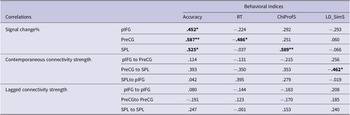
We extracted the percentage of signal change for three ROIs (pIFG, PreCG and SPL) and conducted separate Pearson correlation tests between the signal intensity and behavioral indices to explore their neuro-cognitive relationships for each ROI (thus with p-value uncorrected). The results, as shown in Table 5 and Figure 4, revealed significant positive correlations between the signal change percentages of all three ROIs and accuracy under the structure condition (rs ≥ .45, ps uncorrected ≤ .05). Furthermore, the signal intensity of SPL showed a significant positive correlation with ChiProfS (r = .59, p = .01), whereas the signal intensity of PreCG exhibited a significant negative correlation with reaction times under the structure condition (r = − .49, p = .03).
Correlation tests between the signal intensity, the connectivity strength and the behavioral indices

Abbreviations: pIFG: the left posterior inferior frontal gyrus; PreCG: precentral gyrus; SPL: the left superior parietal lobule; accuracy: the accuracy rate under the structure condition; RT: reaction times under the structure condition; ChiProfS: Chinese L2 proficiency scores; LD_SimS: linguistic distance indexed by the similarity scores of the structures; *: p uncorrected < .05, **: p uncorrected < .01;Statistically significant values were bolded.
Correlation results. Correlation results between the signal intensity (or the connectivity strength) and the behavioral indices. Abbreviations: SPL: the left superior parietal lobule; pIFG: the left posterior inferior frontal gyrus; PreCG: precentral gyrus; Accuracy: accuracy rate under the structure condition; RT: reaction times under the structure condition; ChiProfS: Chinese L2 proficiency scores; LD_SimS: linguistic distance indexed by the similarity scores of the structures; PreCG → SPL: contemporaneous connectivity strength of PreCG-to-SPL; *: p uncorrected < .05, **: p uncorrected < .01.

3.4. Effective connectivity modeling results
Model fit indices indicated that the group-level effective connectivity model was reliably estimated (CFI = 1.00, NNFI = 1.00) (see also Chen et al., Reference Chen, Gao, Li, Zaccarella, Friederici and Feng2023b; Gates et al., Reference Gates, Molenaar, Hillary and Slobounov2011). The uSEM results revealed a neural circuit, in which (a) the left pIFG projected a contemporaneous connection to the left PreCG; (b) the PreCG further projected contemporaneous connections to the left SPL and (c) the SPL transferred the information back to pIFG via a contemporaneous connection. All these results were shown in Figure 3C.
Regarding Pearson correlation tests between each connectivity strength and the behavioral indices, the results indicated that (Table 5 and Figure 4) the strength of the contemporaneous PreCG-to-SPL connection exhibited a significant negative correlation with LD_SimS (r = −.46, p uncorrected < .05).
4. Discussion
The present fMRI study aimed to investigate the neural mechanisms underlying Chinese L2 syntactic processing. Significant activation in the left SPL at the whole-brain level was revealed, as well as in the left pIFG and PreCG within the language network. Based on these ROIs, we localized a frontoparietal network that might play a crucial role in Chinese L2 syntactic processing. Regarding the L2 learner factors, we found a significant correlation between ChiProfS and both behavioral accuracy and the activation intensity of the SPL, respectively. Moreover, LD_SimS showed a significant correlation with the strength of contemporaneous connectivity from PreCG to the SPL. Thus, these findings indicated that Chinese L2 syntactic processing shared the core neural basis in the frontal cortex (pIFG and PreCG) regardless of language typological differences and learner characteristics and, more importantly, recruited a crucial frontoparietal network which was modulated by L2 learner factors. Therefore, the present study provided further neurobiological evidence for certain second language processing hypothesis, such as the SSH.
4.1. SPL: the critical region for L2 syntactic processing
Significant involvement of the SPL in L2 learning was previously reported (Lee et al., Reference Lee, Devlin, Shakeshaft, Stewart, Brennan, Glensman, Pitcher, Crinion, Mechelli, Frackowiak, Green and Price2007; Mechelli et al., Reference Mechelli, Crinion, Noppeney, O’Doherty, Ashburner, Frackowiak and Price2004; Xiang et al., Reference Xiang, Dediu, Roberts, Oort, Norris and Hagoort2012). For instance, Mechelli et al. (Reference Mechelli, Crinion, Noppeney, O’Doherty, Ashburner, Frackowiak and Price2004) found that bilinguals had significantly higher gray matter density in the left parietal cortex, including the SPL, compared to monolinguals, and that gray matter density was correlated with L2 proficiency positively. Consistently, the intensity of SPL was positively correlated with both ChiProfS and accuracy in complex syntactic processing in this study, reflecting the intimate relationship between SPL and L2 learning.
Gray matter density in the SPL was strongly and positively associated with lexical learning and semantic integration (Lee et al., Reference Lee, Devlin, Shakeshaft, Stewart, Brennan, Glensman, Pitcher, Crinion, Mechelli, Frackowiak, Green and Price2007). Xiang et al. (Reference Xiang, Dediu, Roberts, Oort, Norris and Hagoort2012) revealed that the pathway connecting SPL and frontal lobes was linked to rapid vocabulary acquisition. The SPL was assumed to support explicit learning strategies that facilitated the association of novel words with concepts. However, in this study, semantic information was diminished, and the significant activation was found only in the SPL of L2 learners compared to L1 speakers (Chen et al., Reference Chen, Gao, Li, Zaccarella, Friederici and Feng2023b). This indicated that the SPL also contributed to L2 syntactic processing, expanding our understanding of its functional involvement.
It is worth noting that Xiang et al. (Reference Xiang, Dediu, Roberts, Oort, Norris and Hagoort2012) discussed the relationship between the SPL and explicit learning strategies. Yang and Li (Reference Yang and Li2012) utilized an artificial grammar learning paradigm to investigate the neural differences between explicit and implicit learning. The learning process was completed before fMRI scanning. The results revealed that only the explicit learning group significantly activated the SPL. This is in line with the notion that the SPL might be involved in the process of explicit representation of syntactic rules (Seger et al., Reference Seger, Prabhakaran and Poldrack2000). Therefore, it seemed that Chinese L2 learners had utilized explicit Chinese syntactic rules to complete the syntactic tasks, thereby activating the SPL in this study.
Nevertheless, backing up L2 syntactic processing, by no means, inferred that SPL is an L2 syntax-specific region, but rather SPL has been proposed to be a key region within the multiple demand (MD) network (Blank & Fedorenko, Reference Blank and Fedorenko2017; Chen et al., Reference Chen, Goucha, Männel, Friederici and Zaccarella2021; Diachek et al., Reference Diachek, Blank, Siegelman, Affourtit and Fedorenko2020; Fedorenko, Reference Fedorenko2014; MacGregor et al., Reference MacGregor, Gilbert, Balewski, Mitchell, Erzinçlioğlu, Rodd, Duncan, Fedorenko and Davis2022). A large-scale fMRI investigation showed that in contrast with the language-selective frontotemporal network, the domain-general MD network, including bilateral frontoparietal areas, exhibited a stronger response in experiments with explicit tasks than in passive reading/listening paradigms (Diachek et al., Reference Diachek, Blank, Siegelman, Affourtit and Fedorenko2020). This suggested that the engagement of the MD network during language processing reflected cognitive effort associated with extraneous task demands. SPL might house the general cognitive abilities, such as attention, working memory and spatial processing including spatial attention.
On the one hand, the use of explicit rules largely relied on consciousness and attention control. Previous research had indicated that the activation in the left superior parietal region (including the SPL) was associated with enhanced attention during high-level language monitoring (Geva, Reference Geva, Schneider, Khan, Lorca-Puls, Gajardo-Vidal, Hope, Green and Price2023). Therefore, this study found significant activation in the SPL indicating that L2 learners might allocate more attention resources in performing complex syntactic processing tasks. On the other hand, L2 syntactic processing might rely more on basic cognitive processes such as working memory, resulting in greater working memory demands (Hou et al., Reference Hou, Li, Gao, Ou and Xu2024; McDonald, Reference McDonald2006). Friederici (Reference Friederici2017: 47–Reference MacGregor, Gilbert, Balewski, Mitchell, Erzinçlioğlu, Rodd, Duncan, Fedorenko and Davis49) proposed that complex language processing might also involve the non-syntactic-specific verbal working memory from the parietal lobe. Moreover, Koenigs et al. (Reference Koenigs, Barbey, Postle and Grafman2009) found that patients with the SPL damage exhibited deficits in manipulating and rearranging information in working memory. Nęcka et al. (Reference Nęcka, Gruszka, Hampshire, Sarzyńska-Wawer, Anicai, Orzechowski, Nowak, Wójcik, Sandrone and Soreq2021) further reported that working memory training enhanced the correlation between task performance accuracy and activation of the SPL subserving working memory. These findings suggested that the SPL might play a crucial role in working memory.
Furthermore, in addition to verbal working memory, research has highlighted the important role of the SPL in spatial processing, including spatial attention (Greenberg et al., Reference Greenberg, Esterman, Wilson, Serences and Yantis2010; Ritz & Shenhav, Reference Ritz and Shenhav2024; Szczepanski et al., Reference Szczepanski, Konen and Kastner2010). For instance, Greenberg et al. (Reference Greenberg, Esterman, Wilson, Serences and Yantis2010), using a visual attention task involving the shifting of stimulus position and color, found that both spatial shifts of attention and (nonspatial) color shifts elicited significant activation in the medial SPL. This indicated that the medial SPL served as a cortical hub for initiating attention and task shifts across multiple domains. Similarly, in studies on letter string and word processing during reading, researchers also reported significant SPL activation (Lobier et al., Reference Lobier, Peyrin, Le Bas and Valdois2012; Seger et al., Reference Seger, Prabhakaran and Poldrack2000; Sun et al., Reference Sun, Yang, Desroches, Liu and Peng2011; Wu et al., Reference Wu, Ho and Chen2012), suggesting that attentional mechanisms supported by the SPL were involved in visual word recognition. For instance, Seger et al. (Reference Seger, Prabhakaran and Poldrack2000) observed enhanced SPL activation when the surface structure of the strings changed in an artificial grammar judgment task. This shift involved forming a mapping between the original letter set and the transferred letter set, reflecting not only the explicit syntactic rule processing discussed earlier but also the SPL’s role in spatial reasoning. In the present study, given that both the structure and word-list conditions contained the same visual symbols, the contrast of “structure > word list” was expected to mitigate the effects from lower-level processing of spatial features. However, as a key node in the multi-demand network, SPL detected in the present study might also be multi-functional; that is, it is hard to completely exclude the differences in the amount of spatial attention and executive control (Osaka et al., Reference Osaka, Osaka, Kondo, Morishita, Fukuyama and Shibasaki2004; Shomstein, Reference Shomstein2012; Sulpizio et al., Reference Sulpizio, Fattori, Pitzalis and Galletti2023) allocated to different sequence conditions. Nevertheless, the activation of SPL demonstrated that L2 syntactic processing might recruit more general cognitive brain regions beyond the scope of the language network (Hou et al., Reference Hou, Li, Gao, Ou and Xu2024). The SPL activation identified in this study could be associated with higher memory load, attention demands, or other executive control cognitive abilities in L2 learners for coping with the challenging syntactic processing task. Future studies may design a comparable spatial processing task to compare with the language (esp., syntactic) tasks to specify the functional role of SPL.
4.2. The crucial frontoparietal network for L2 syntactic processing
The ROI analyses of the present study indicated that the left posterior inferior frontal gyrus (pIFG) and the left precentral gyrus (PreCG) together with the left SPL formed a functional network. We further performed the uSEM to analyze the effective connectivity between these regions, which pointed toward the existence of a functional neural circuit that may back up the L2 syntactic processes.
The left posterior inferior frontal gyrus (pIFG), which roughly corresponded to the Broca’s area, served as a core brain region for syntactic processing. As Zaccarella et al. (Reference Zaccarella, Meyer, Makuuchi and Friederici2017) pointed that, Brodmann Area 44 in the pIFG functioned as a Merge engine to support hierarchical syntactic processing. It also played a crucial role in second language learning and processing (Friederici, Reference Friederici2017; Sakai et al., Reference Sakai, Miura, Narafu and Muraishi2004). Additionally, the study utilizing transcranial direct current stimulation (tDCS) had demonstrated the causal role of this region with the activation of this area being causally related to L2 learning outcomes (de Vries et al., Reference de Vries, Barth, Maiworm, Knecht, Zwitserlood and Flöel2010). This study found a positive correlation between the activation intensity of pIFG and the accuracy under complex syntactic processing, confirming the significant role of pIFG in Chinese L2 syntactic processing and indicating shared neural foundations with Chinese L1 syntactic processing (Chen et al., Reference Chen, Gao, Li, Zaccarella, Friederici and Feng2023b).
PreCG, as a component of the “phonological loop” with the IFG, played a crucial role in inner speech rehearsal (Kaestner et al., Reference Kaestner, Wu, Friedman, Dugan, Devinsky, Carlson, Doyle, Thesen and Halgren2022; Wheat et al., Reference Wheat, Cornelissen, Frost and Hansen2010). Wheat et al. (Reference Wheat, Cornelissen, Frost and Hansen2010), using MEG in a pseudohomophone priming task, observed stronger responses to pseudohomophone priming compared to orthographic priming of visually presented words within 100 ms of target word onset. These responses were localized to a cluster that included the left IFG and PreCG, confirming the role of the PreCG in the early phonological processing of visual word recognition. Furthermore, Kaestner et al. (Reference Kaestner, Wu, Friedman, Dugan, Devinsky, Carlson, Doyle, Thesen and Halgren2022), employing cortical electrophysiology, highlighted the role of the PreCG in transducing visual orthographic information into auditory phonological codes during silent reading. Here, the present study revealed a positive correlation between the activation intensity of PreCG and accuracy, and a negative correlation with RT, suggesting that the stronger the activation of PreCG, the better the behavioral performance of L2. Bernal and Ardila (Reference Bernal and Ardila2009) pointed out the connection between the PreCG and the Broca’s area (BA 44) via the arcuate fasciculus (AF), which played an important role in speech encoding, providing a structural basis for language imitation and serving as the first step in language learning and acquisition. In our behavioral adaptation stages prior to fMRI scanning, we also observed that some L2 learners engaged in subvocal reading of materials. As visual information could be transformed into inner language for phonological encoding (Ye & Liu, Reference Ye and Liu2008) and the PreCG (part of middle frontal gyrus, MFG) had been found to respond to verbal working memory tasks (Fedorenko et al., Reference Fedorenko, Behr and Kanwisher2011), particularly in representing and maintaining the complex structures (see also Hickok & Poeppel, Reference Hickok and Poeppel2007), the connection from the pIFG to the PreCG in the present study might be able to assist L2 learners in maintaining complex syntactic representations through inner speech encoding, which aligned with the role of this connection in Chinese L1 syntactic processing as also detected in Chen et al. (Reference Chen, Gao, Li, Zaccarella, Friederici and Feng2023b).
The activation pattern of the frontoparietal network was also observed in previous AGL studies (Fletcher et al., Reference Fletcher, Büchel, Josephs, Friston and Dolan1999; Seger et al., Reference Seger, Prabhakaran and Poldrack2000). For example, Fletcher et al. (Reference Fletcher, Büchel, Josephs, Friston and Dolan1999) found that the connectivity between the left frontal and parietal regions gradually strengthened during the learning process of finite-state grammar. Seger et al. (Reference Seger, Prabhakaran and Poldrack2000) also observed the frontoparietal activation patterns during the artificial grammar judgment task. They suggested that this frontoparietal activation pattern was associated with working memory and argued that grammar judgment tasks required the involvement of working memory resources, with the parietal region playing a crucial role in storing and retrieving language information (Smith & Jonides, Reference Smith and Jonides1997). In the present study, the negative correlation between LD_SimS and the contemporaneous PreCG -to- SPL connectivity strength suggested that higher syntactic similarity between Korean (L1) and Chinese (L2) accompanied with lower demands for storing L2 structures, as reflected by the weakened PreCG -to- SPL connectivity strength. This interconnected relationship between the syntactic similarity across languages, the working memory load for syntactic processing and the PreCG -to- SPL connectivity strength reflected the impact of syntactic similarity on L2 processing at the neural level, hence further providing neurobiological evidence supporting the reliance on L2 syntactic processing on the working memory system (McDonald, Reference McDonald2006).
Therefore, we assumed that the frontoparietal connectivity in L2 learners was closely related to the storage and retrieval of L2 syntactic information. Based on the prominent neurobiological models of language processing (Friederici, Reference Friederici2017; Skeide & Friederici, Reference Skeide and Friederici2016; Xiang et al., Reference Xiang, Fonteijn, Norris and Hagoort2010), which hypothesized the information flow direction from frontal regions to the posterior regions (including the posterior temporal lobe as well as the parietal regions), we postulated that there might be a frontoparietal pathway wherein pIFG sends the merged constituents to SPL for storage. Previous studies on syntactic processing also consistently validated the role of pIFG as the starting point (e.g., Chen et al., Reference Chen, Goucha, Männel, Friederici and Zaccarella2021; den Ouden et al., Reference den Ouden, Saur, Mader, Schelter, Lukic, Wali, Timmer and Thompson2012; Xu et al., Reference Xu, Wu and Duann2020; Wu et al., Reference Wu, Zaccarella and Friederici2019). Subsequently, PreCG was assumed to be related to linearize the hierarchical structures generated by the pIFG into syntactic frames or templates as phonological representations (Fedorenko et al., Reference Fedorenko, Behr and Kanwisher2011; Hickok and Poeppel Reference Hickok and Poeppel2007; Kaestner et al., Reference Kaestner, Wu, Friedman, Dugan, Devinsky, Carlson, Doyle, Thesen and Halgren2022; Wheat et al., Reference Wheat, Cornelissen, Frost and Hansen2010). And these linear sequences would be sent to SPL for storage. As a memory component, SPL would activate and retrieve the lexical information as well as the linear syntactic templates stored within it for subsequent syntactic processes (Koenigs et al., Reference Koenigs, Barbey, Postle and Grafman2009; Nęcka et al., Reference Nęcka, Gruszka, Hampshire, Sarzyńska-Wawer, Anicai, Orzechowski, Nowak, Wójcik, Sandrone and Soreq2021). Moreover, spatial features/attention and the cognitive control demand might also affect SPL to manipulate the syntactic information. In brief, the pIFG transferred processed syntactic information to the PreCG through internal language encoding. The PreCG linearized hierarchical structures into syntactic frames as phonological representations and transmitted them to the SPL for further storage. The SPL retrieved stored syntactic information and explicit syntactic knowledge from its own storage, transferring them back to the pIFG for subsequent syntactic operations, thus establishing a neural circuit that functionally organizes the dynamic interaction between language and multiple demand networks.
However, as the uSEM approach did not report the site receiving the driving inputs, the possibility of considering SPL as the source region should not be excluded. In this case, participants might extract the stored lexical or constituent information from SPL, and then send this information to pIFG for Merge. The newly merged syntactic objects would then be sent back to SPL for storage, inter-mediated by PreCG.
In summary, the neural circuit underlying Chinese L2 syntactic processing was centered around the SPL as the crucial region potentially for multiple general cognitive functions such as the working memory capacity. In terms of the learner factors, ChiProfS was positively correlated with the strength of SPL activation and LD_SimS was negatively correlated with the PreCG-SPL connectivity strength, indicating that L2 learners were inclined to rely more on explicit syntactic knowledge and general cognitive abilities during syntactic processing. This neural foundation should back up the complex hierarchical syntactic processing of Chinese L2 learners.
4.3. Differences between the neural correlates of Chinese L1 and L2 syntactic processing
To explore how L2 learners perform in syntactic processing, previous studies often utilized natural materials, yielding mixed findings. Some studies suggested that L2 syntactic processing could reach native-speaker levels (Bowden et al., Reference Bowden, Steinhauer, Sanz and Ullman2013; Friederici et al., Reference Friederici, Steinhauer and Pfeifer2002; Grey et al., Reference Grey, Sanz, Morgan-Short and Ullman2018; Morgan-Short et al., Reference Morgan-Short, Sanz, Steinhauer and Ullman2010, Reference Morgan-Short, Finger, Grey, Ullman and Stamatakis2012a, Reference Morgan-Short, Steinhauer, Sanz and Ullman2012b; Rossi et al., Reference Rossi, Gugler, Friederici and Hahne2006; Steinhauer et al., Reference Steinhauer, White and Drury2009). However, other research indicated that L2 learners’ performance varied with the complexity of syntactic structures, with notable differences emerging primarily during the processing of abstract syntactic representations (Clahsen & Felser, Reference Clahsen and Felser2018). For example, L2 learners struggled with parsing complex dependency structures, relying on direct lexical associations to establish long-distance filler-gap dependencies rather than employing structure-based gap filling (Clahsen & Felser, Reference Clahsen and Felser2006a; Clahsen et al., Reference Clahsen, Felser, Neubauer, Sato and Silva2010). In this study, we constructed semantically deprived jabberwocky sentences based on authentic Chinese grammatical rules and designed diverse syntactic structures to cover a range of hierarchical embedding depths and dependency lengths. Behavioral results revealed that even highly proficient L2 learners experience difficulties in processing complex hierarchical structures based on Chinese function words. These findings underscore L2 processing limitations at the level of abstract syntactic representation, providing further evidence in support of the SSH.
At the neural level, this study identified distinct activation networks differentiating L2 processing from native language processing. While comparing the L2-specific neural network with the L1 frontotemporal language-general network as reported in our previous studies (Chen et al., Reference Chen, Gao, Li, Zaccarella, Friederici and Feng2023b), we found that L2 learners lacked significant activation in the temporal lobe as well as the significant connectivity between the frontal and temporal regions. Previous research had indicated the crucial role of the posterior superior temporal gyrus/superior temporal sulcus (pSTG/STS) in integrating syntactic and semantic information during the processing of complex syntactic structures (Bornkessel et al., Reference Bornkessel, Zysset, Friederici, von Cramon and Schlesewsky2005), particularly when the syntactic elements were complex or difficult to integrate into the structures (Constable et al., Reference Constable, Pugh, Berroya, Mencl, Westerveld and Ni2004). However, the lack of significant left posterior temporal lobe activation might reflect a deficiency in representing the whole structures with their syntactic categories during processing in Chinese L2 learners, reflecting the limited processing depth of syntactic representation in L2 learners.
As assumed in SSH, L1 speakers and L2 learners employed different processing strategies for syntactic information (Clahsen & Felser, Reference Clahsen and Felser2018). L2 learners relied more on the memory system for syntactic comprehension, rather than engaging in syntactic parsing like L1 speakers (Cunnings, Reference Cunnings2017a). To be specific, assuming language processing involved cue-based memory retrieval, L2 exhibited less use of abstract syntactic cues when compared with L1. Cunnings (Reference Cunnings2017b) indicated that the L2 processing relies more on whole-word storage of complex words and less on morphological parsing, resulting in shallower morphological processing in the L2 than in the L1. Previous ERP studies provided neural evidence supporting this distinction, showing that L2 learners often exhibited response patterns to syntactic violations that differed from those of native speakers (Guo et al., Reference Guo, Guo, Yan, Jiang and Peng2009; Hahne, Reference Hahne2001; Hahne & Friederici, Reference Hahne and Friederici2001; Pakulak & Neville, Reference Pakulak and Neville2011; Zhang, Reference Zhang2019). For instance, highly proficient L2 learners displayed delayed or absent LAN effects, indicating weaker automatic syntactic processing (Hahne & Friederici, Reference Hahne and Friederici2001; Weber-Fox & Neville, Reference Weber-Fox and Neville1996). Even when L2 learners transferred certain syntactic rules from their native language, they still failed to achieve native-like automatic processing of syntactic relations which was reflected in P600 that were often diminished in amplitude and delayed in latency (Hahne, Reference Hahne2001; Pakulak & Neville, Reference Pakulak and Neville2011). In this study, we found that L2 processing differed from L1 processing, particularly in the lack of activation in the pTL responsible for the integration of complex structures. Instead, L2 processing relied more on the SPL, which was associated with memory storage. This reliance on memory systems highlighted a distinct processing mechanism for L2, providing spatially neural evidence aligning with the SSH. It is also worth noting that these previous studies found shallower processing of syntactic cues mainly in morphologically rich languages. As Chinese lacked morphological information changes, syntactic processing based on Chinese function words advanced the development of L2 processing theories, extended findings originally derived from Indo-European languages and emphasized the shared characteristics of L2 processing.
In addition to the prominent SSH we began with in the present study, the findings of this study could also be extended to support other important models/hypotheses in the field of L2 acquisition, which are complementary rather than contradictory. For instance, our current finding could provide further evidence to Ullman’s declarative/procedural (DP) model. According to Ullman (Reference Ullman2001a, Reference Ullman2001b, Reference Ullman2006, Reference Ullman, Hickock and Small2016, Reference Ullman, van Patten and Williams2020), language processing primarily relied on two distinct memory systems: the declarative memory system, which handled idiosyncratic knowledge such as vocabulary, irregular morphological forms, prefabricated phrases and idioms, and the procedural memory system, responsible for rule-based combinations like regular morphology and structural processing. While both native speakers and L2 learners utilized these memory systems, L2 learners often relied more heavily on the declarative memory system to compensate for limited automatic processing abilities (Ullman, Reference Ullman2001b). This strategy allowed them to process structures that would typically be handled by the procedural memory system, as retrieving information directly from declarative memory was safer, more efficient, and less effortful. Accordingly, a neuroanatomical meta-analysis of grammatical learning reported activations in the IFG and the SPL (Tagarelli et al., Reference Tagarelli, Shattuck, Turkeltaub and Ullman2019). As the IFG was linked to declarative memory (Ullman, Reference Ullman2004, Reference Ullman, Hickock and Small2016) and the SPL was associated with encoding and retrieving information stored in declarative memory (Wagner et al., Reference Wagner, Shannon, Kahn and Buckner2005), these activations aligned with the declarative memory system’s involvement in L2 grammar processing, as proposed in the DP model. In this study, significant activations of the pIFG and SPL in L2 learners were observed. The activation of this frontoparietal network highlighted L2 learners’ greater reliance on the declarative memory system during online syntactic processing, thus providing robust evidence to support the DP model from Chinese L2 perspective.
Therefore, the recruitment of the frontoparietal network which supported working memory maintenance and other related general cognitive capacities, instead of the general frontotemporal network for language (esp., syntactic) processing, provided neural evidence for the reliance of L2 syntactic processing on more strategies, thus in support of the SSH. The present findings could also provide further evidence to other related theories of L2 processing, such as the DP model, in a complementary fashion.
5. Limitations
Since the known definitive measurements of language distance were calculated primarily on the features of words (Cargnelutti et al., Reference Cargnelutti, Tomasino and Fabbro2022), they were not suitable for measuring the bilingual syntactic structure similarity particularly at the above-lexicon level. This study employed a Likert 5-point scale to quantify linguistic similarity by asking Korean participants to rate their subjective perceptions of how similar the experimental Chinese L2 syntactic structures were to the corresponding structures in Korean. These ratings of psychological distance were used as quantitative data for linguistic similarity. Although this method is inevitably subjective and indirect, the psychological distance toward different structures varies among individuals, making it necessary to adopt a language-experience perspective and incorporate such bilingual experiences as regressors in the statistical design (Hell, Reference Hell2023). Here we deemed the “linguistic similarity” as a potential confounder and regressed out it as a covariate to further purify the imaging results in a relatively conservative way. Future research could consider utilizing large language models to compute structure similarity, providing a more precise quantification of the influence of L2 factors.
Building on these methodological considerations, this study further explored the effective connectivity network underlying syntactic processing in L2 learners. Given that the uSEM approach did not report the site receiving the driving inputs, it was challenging to determine the starting region within the effective connectivity network. However, based on neurobiological models (Skeide & Friederici, Reference Skeide and Friederici2016; Xiang et al., Reference Xiang, Fonteijn, Norris and Hagoort2010) and neuroimaging studies investigating syntactic merge processing (Chen et al., Reference Chen, Goucha, Männel, Friederici and Zaccarella2021; den Ouden et al., Reference den Ouden, Saur, Mader, Schelter, Lukic, Wali, Timmer and Thompson2012; Xu et al., Reference Xu, Wu and Duann2020; Wu et al., Reference Wu, Zaccarella and Friederici2019), this study primarily identified the pIFG as the starting point of the frontoparietal network. At the same time, we acknowledged the alternative possibility of information flow originating in the parietal regions and progressing from posterior to frontal areas, further highlighting the complexity of syntactic processing in L2 learners.
As a result of these investigations, a distinct frontoparietal network for Chinese L2 at the neural level was identified, which differed from the frontotemporal network observed in previous studies on Chinese native syntactic processing (Chen et al., Reference Chen, Gao, Li, Zaccarella, Friederici and Feng2023b), highlighting the unique characteristics of L2. To deepen our understanding of these distinctions, future research could focus on L2 learners with varying proficiency levels or adopt longitudinal designs to track neural changes over time, thereby scrutinizing systematic neural changes in syntactic processing and exploring how specific learner variables influence language acquisition (Hell, Reference Hell2023).
6. Conclusion
This fMRI study employed the jabberwocky sentence processing paradigm based on real Chinese function words to investigate the neural basis of Chinese L2 syntactic processing. The results showed that, similar to Chinese L1 native speakers, the frontal regions including pIFG and PreCG in the language network were consistently activated, while the activation of SPL and the frontoparietal network revealed the interaction between language and multiple demand networks for fostering Chinese L2 syntactic processing. By comparing the behavioral performance and neural mechanisms between Chinese L2 learners and L1 speakers, this study provided reliable neurobiological evidence from the spatial dimension for the SSH as well as other related models especially by considering the case of Chinese L2 syntactic processing.
Supplementary material
The supplementary material for this article can be found at http://doi.org/10.1017/S1366728925100138.
Data availability statement
Anonymized data will be made available upon reasonable requests and collaborative agreement addressed to the coauthors. Researchers wishing to obtain the data must contact the Max Planck Partner Group, College of Chinese Language and Culture, Beijing Normal University, to sign a formal data sharing agreement. The Matlab toolboxes used for the imaging data analyses are freely available online: (a) DPARSF 5.1 Advanced Edition: http://www.rfmri.org/DPARSF; (b) SPM12: https://www.fil.ion.ucl.ac.uk/spm/ and (c) GIMME: https://gimme.web.unc.edu/.
Acknowledgements
The authors wish to thank the two anonymous reviewers for their insightful and valuable comments and all participants who took part in this study. Special thanks are extended to Yang Liu, Siying Lin, Keyi Kang, Luping Wang, Yi Song and Lu Li for their support in the behavioral and fMRI data collection. The authors also thank Junjie Wu, Siyuan Zhou, Xingfang Qu and other colleagues for their constructive input.
Author contribution
C.G. and J.G. (co-first-authors): Conceptualization, Data curation, Formal analysis, Methodology, Software, Visualization, and Writing – original draft. L.Z.: Data curation, Validation, and Writing – review and editing. Z.L.: Data curation and Writing – review and editing. L.C. and L.F. (co-corresponding-authors): Conceptualization, Data curation, Formal analysis, Funding acquisition, Methodology, Project administration, Supervision, Validation, and Writing – review and editing.
Funding statement
This work was supported by the 2022 International Chinese Language Education Research Project (No. 22YH08A) from the Center for Language Education and Cooperation, Ministry of Education of the People’s Republic of China and by the National Social Science Foundation of China (No. 22CYY017). It was also funded by the STI 2030—Major Projects + 2021ZD0200500 and the National Key R&D Program of China (2019YFA0709503).
Competing interests
The authors declare no competing interests.






 Open access

