


Many countries have experienced large-scale disasters in recent years.Footnote 1 Wildfires in the United States and Australia have scorched millions of hectares and ruined livelihoods, floods in Germany and Libya have destroyed homes and taken thousands of lives, and earthquakes in Morocco, Syria, and Turkey have killed tens of thousands and displaced millions. Politicians’ reactions to large-scale disasters, which are occurring increasingly frequently due to anthropogenic climate change, can threaten the tenure of even the longest-standing or seemingly secure leaders. British prime minister Harold Macmillan famously remarked that “events, dear boy, events” were the greatest challenge for any statesman. This is especially true for autocrats (Flores and Smith Reference Flores and Smith2013). Even China’s Xi Jinping faced protests against his regime’s zero-COVID policy, including some explicit calls for the removal of the Chinese Communist Party regime and for Xi himself to step down (Wintour Reference Wintour2022).
Yet, many autocrats survive large-scale disasters. Xi ultimately steered his regime through the COVID-19 pandemic, North Korea’s Kim Jong Il survived a devastating famine in the 1990s (Wilson Center 2002), and Turkey’s Recep Tayyip Erdoğan managed to take his tenure into a third decade following the earthquakes in February 2023, despite significant anger directed against his rule due to his government’s poor response (Hubbard Reference Hubbard2023). Autocrats have an extensive survival toolkit that they can draw from to try to boost their popularity and stabilize their regime following large-scale disasters. They can unleash repression (Wood and Wright Reference Wood and Wright2016), increase the provision of public goods (Springborg Reference Springborg2011), or try to dissuade people from protesting by engaging in blame shifting, where they attempt to direct people’s anger toward a target other than the autocrat (Aytaç Reference Aytaç2021; Weaver Reference Weaver1986). This last tactic is frequently used by dictators, especially following large-scale disasters, but there is little evidence of whether it works. We therefore ask: how does blame shifting following a large-scale disaster affect an autocrat’s popular approval?
We set out competing preregistered arguments about the effects of blame shifting on autocratic leader approval following large-scale disasters. These are drawn from various subfields, but especially the public management literature on blame avoidance. We focus on (part of) Christopher Hood’s (Reference Hood2007, 200) notion of “presentational” blame avoidance to define blame shifting as an attempt to pass blame to another actor or phenomenon through “spin, timing, stage-management and argument by offering plausible excuses.”Footnote 2 In the context of authoritarian systems, our conceptualization entails using propaganda to manipulate public opinion and pass blame onto another actor or phenomenon to protect the autocrat’s position (Baekkeskov and Rubin Reference Baekkeskov and Rubin2017, 428). Blame shifting may positively affect autocratic leader approval through the mechanisms of (1) obfuscating clarity of responsibility among citizens, or (2) by generating sympathy for the autocrat by highlighting the role of supposedly obstructionist actors. Alternatively, blame shifting may have negative effects if (1) citizens perceive that the autocrat is lying, or (2) they deem the autocrat to be politicizing an issue, which should be “above politics,” for instrumental purposes. We also argue that individual-level characteristics—specifically, an individual’s ability to consume alternative information and being an unaffiliated voter—reduces their likelihood of being susceptible to blame shifting.
We test these arguments in Turkey following the earthquakes of February 2023, which left over fifty thousand people dead, 3.3 million displaced, and a $150 million reduction in monthly labor income (ILO 2023).Footnote 3 Turkey is a typical electoral autocracy; democratic institutions officially exist, but the playing field is tilted “in the incumbent’s favour to the extent that it is no longer a democracy, typically through restricting media freedom and the space for civil society, and repressing the opposition” (Maerz et al. Reference Maerz, Lührmann, Hellmeier, Grahn and Lindberg2020, 912). While the proximity of the May 2023 election may narrow the broader applicability of our findings—a point we return to in the conclusion—the regime’s strong, but not monopolistic, control over information flows is typical of many electoral autocracies.Footnote 4 However, the ubiquity of awareness about the earthquakes meant that Erdoğan could not employ commonly used propaganda tactics intended to distract the public or censor the earthquakes from public discourse (Roberts Reference Roberts2018). Instead, Erdoğan engaged in blame shifting designed to protect his public approval. This included blaming the devastation of the earthquakes on there being a natural disaster that was impossible to prepare for (a force majeure), the opposition’s control of local governance in certain regions, and private construction companies.
We employ a mixed-methods approach to explore the effects of these blame-shifting strategies, and one additional tactic (a hypothetical scenario of Erdoğan firing a minister), on Erdoğan’s approval. This first entails an online survey experiment fielded to 3,839 adults in April and May 2023, which primed respondents with a randomly assigned blame-shifting strategy and then measured their approval of Erdoğan. We complemented this in July 2023 with three follow-up focus groups of participants who were supporters of Erdoğan, the opposition, or unaffiliated voters. The experiment identified the effects of the various types of blame-shifting politics on people’s approval of Erdoğan, while the focus groups helped to elucidate the reasons underlying people’s responses to blame-shifting politics (i.e., the causal mechanisms).
We find that blame-shifting politics not only tend to be ineffective on average but can also spark a backlash. Specifically, priming respondents with Erdoğan’s efforts to blame the earthquakes’ effects on a force majeure or the opposition led to eight and six percentage-point decreases in his approval, respectively. We also find that these effects were moderated by an individual’s ability to consume alternative sources of information: Erdoğan attempting to shift blame to a force majeure or the opposition led to a greater backlash among those with a higher level of education or a higher income. Contrary to our expectation, partisanship does not modify these effects. The focus groups reveal that these backlash effects are driven by voters’ dismay at electoral opportunism and the incumbent’s use of polarizing language following a large-scale disaster. Regardless of partisan affiliation, respondents expressed strong revulsion against blame shifting that points to the supposedly unavoidable nature of large-scale disasters, and they disapproved of tactics that instrumentalize the earthquakes for political gain, especially when politicians use polarizing language.
Our study contributes to various bodies of literature that examine blame shifting. Blame shifting interests scholars in numerous subfields, including comparative authoritarianism (Cai Reference Cai2008; Chaisty, Gerry, and Whitefield Reference Chaisty, Gerry and Whitefield2022; Li, Ni, and Wang Reference Li, Ni and Wang2021; Sirotkina and Zavadskaya Reference Sirotkina and Zavadskaya2020), the European Union (Heinkelmann-Wild and Zangl Reference Heinkelmann-Wild and Zangl2020; Heinkelmann-Wild et al. Reference Heinkelmann-Wild, Zangl, Rittberger and Kriegmair2023; Kriegmair et al. Reference Kriegmair, Rittberger, Zangl and Heinkelmann-Wild2022; Schlipphak and Treib Reference Schlipphak and Treib2017; Schlipphak et al. Reference Schlipphak, Meiners, Treib and Schäfer2023; Traber, Schoonvelde, and Schumacher Reference Traber, Schoonvelde and Schumacher2020), international relations (Kim Reference Kim2024; Verbeek Reference Verbeek2024), and public management (Baekkeskov and Rubin Reference Baekkeskov and Rubin2017; Hansson Reference Hansson2024; Windsor, Dowell, and Graesser Reference Windsor, Dowell and Graesser2014). However, despite the prominence of blame shifting across these diverse subfields—an indicator of its perceived importance—evidence on the effects of blame shifting on executive approval remains minimal and, where it does exist, findings are somewhat contradictory.Footnote 5 Moreover, evidence on the effects of blame shifting in the wake of large-scale disasters is nonexistent (Hood Reference Hood2007, 200).Footnote 6 By filling this specific gap, our work contributes more broadly to research on blame shifting across these diverse bodies of research.
The article proceeds as follows. We first extract theoretically motivated arguments from literature on public management and authoritarian propaganda to describe why blame shifting in autocracies following a large-scale disaster may affect a leader’s approval positively or negatively. We then introduce the empirical setting of Turkey in 2023. Next, we describe our mixed-methods research design of a survey experiment supplemented by focus groups. This entails discussing participant recruitment, the intervention, the outcome variable, the preregistered hypotheses, focus group procedures, and ethical considerations. We then present the results, before concluding by considering the findings’ implications, the study’s limitations, and avenues for future work.
Autocratic Leader Approval, Crises, and Blame Shifting
Despite dictators facing little or no danger of losing power at the ballot box, recent scholarship on comparative authoritarianism emphasizes the importance of popular approval for autocratic stability (Carter and Carter Reference Carter and Carter2023; Kendall-Taylor and Frantz Reference Kendall-Taylor and Frantz2014). The traditional view in the contemporary study of autocracy is that a leader’s standing among elites in the regime is the most important factor in determining their survival. Since World War II, dictators have been more likely to lose power at the hands of a coup than any other method (Svolik Reference Svolik2012, 4–5). However, their standing among the people matters. Dictators can, and increasingly do, also fall to threats from the people (Carter and Carter Reference Carter and Carter2023; Kendall-Taylor and Frantz Reference Kendall-Taylor and Frantz2014). Popular unrest can also precipitate challenges by insiders who, wary that the people may seek to overturn the regime’s entire autocratic structure, remove the leader in an attempt to becalm the population (Casper and Tyson Reference Casper and Tyson2014). Popular approval is thus extremely important in shaping autocratic leader survival in the short term, but is also something that many dictators consider in the long term as they seek legitimacy to stabilize their regime (Gerschewski Reference Gerschewski, Croissant, Kailitz, Koellner and Wurster2015).
At the same time, political leaders are closely attuned to crises because these can harm their popular approval if the leader is blamed for the event itself, or for how they handle its aftermath (Cole, Healy, and Werker Reference Cole, Healy and Werker2012). This is especially true for autocrats because they are more susceptible than democratic leaders to the negative effects of large-scale disasters, which increase protests and undermine their tenure (Flores and Smith Reference Flores and Smith2013). Disasters including earthquakes, floods, and wildfires can “threaten the political status quo, since people often make policy demands of their [autocratic] leaders in the aftermath to alleviate their suffering” (Windsor, Dowell, and Graesser Reference Windsor, Dowell and Graesser2014, 449). Large-scale disasters can thus be thought of as critical junctures, which provide an opportunity for the political status quo to be renegotiated (Collier and Munck Reference Collier and Munck2022). Autocrats are therefore often proactive in trying to protect their popular approval in the wake of large-scale disasters.
Dictators have various options available to protect their approval following a large-scale disaster. They can attempt to shift the agenda to another issue that is more favorable to them (Aytaç Reference Aytaç2021), they can provide policy concessions (Windsor, Dowell, and Graesser Reference Windsor, Dowell and Graesser2014, 452), or they can try to shift blame (Weaver Reference Weaver1986). In an autocracy, the concentration of power around the leader or in a small ruling coalition should make it harder for autocrats to credibly shift blame (Weaver Reference Weaver1986). However, several scholars have documented that autocrats do attempt to do this (Cai Reference Cai2008; Williamson Reference Williamson2024), including in the wake of large-scale disasters (Windsor, Dowell, and Graesser Reference Windsor, Dowell and Graesser2014). While it is by no means the only strategy that autocrats employ, presentational blame shifting is especially appealing to autocrats at this time. Autocrats cannot use other propaganda tactics like censorship, for instance; such a tactic would lack credibility and be ineffective due to widespread knowledge among citizens of the disaster’s effects (Roberts Reference Roberts2018; Rozenas and Stukal Reference Rozenas and Stukal2019). However, despite autocrats frequently employing blame shifting after disasters, it is unclear whether such efforts are effective (Hood Reference Hood2007, 200).
Still, the frequent use of postdisaster blame shifting in autocracies suggests that autocrats believe the tactic is in some way effective (Hood Reference Hood2007, 200).Footnote 7 Indeed, autocrats in regimes including China (Baekkeskov and Rubin Reference Baekkeskov and Rubin2017), Egypt (Windsor, Dowell, and Graesser Reference Windsor, Dowell and Graesser2014), and Russia (Chaisty, Gerry, and Whitefield Reference Chaisty, Gerry and Whitefield2022) have all employed blame-shifting strategies after large-scale disasters. Research on clarity of responsibility in voting behavior suggests that blame shifting may be effective if it creates uncertainty among citizens, including those in autocracies, about who is responsible for negative circumstances (Hobolt, Tilley, and Banducci Reference Hobolt, Tilley and Banducci2013; Lewis-Beck Reference Lewis-Beck1997). The use of this tactic can muddy the waters to cast doubt in people’s minds about whether the autocrat is responsible for how the aftermath of a large-scale disaster is handled. This can protect the autocrat’s standing among the people at this critical time. Blame shifting may also provide benefits beyond just protecting an autocrat’s popular approval; it may also improve it by generating sympathy among the people for the autocrat. In this way, an autocrat can imply through blame shifting that they would be able to govern more effectively on the people’s behalf if only they were not being obstructed by unfortunate circumstances or by actors with nefarious intentions (Weaver Reference Weaver2018, 260–61).
Blame shifting by autocrats following a large-scale disaster may therefore be effective if it ensures that an autocrat’s popular approval does not decrease as much as it would have done in the absence of a blame-shifting strategy, or if it helps to increase it. While there is a dearth of systematic evidence on whether blame-shifting strategies have this effect (Hood Reference Hood2007, 200), there is some suggestive evidence that these positive effects are possible. For example, in Russia, Vladimir Putin responded to the COVID-19 pandemic in 2020 in part through a “presentational” blame-shifting strategy.Footnote 8 Putin blamed regional leaders for the negative economic consequences of their strategies to deal with the pandemic, even replacing several regional governors (Vladimir Ilyukhin in Kamchatka, Sergey Gaplikov in Komi, and Igor Orlov in Arkhangel’sk). While Putin did not entirely escape criticism from the Russian people for the government’s response to the pandemic, his blame-shifting strategy was somewhat successful as greater blame was targeted at regional authorities (Chaisty, Gerry, and Whitefield Reference Chaisty, Gerry and Whitefield2022, 368, 372–73). Beyond electoral autocracies, Schlipphak and colleagues (Reference Schlipphak, Meiners, Treib and Schäfer2023) show that aspiring autocrats in backsliding countries can weaken support for external sanctions by framing them as an illegitimate interference in domestic affairs, effectively shifting the blame for sanctions and their consequences.
Nevertheless, despite autocrats’ frequent use of blame shifting following large-scale disasters, there are several plausible reasons why such strategies may fail to have a positive effect or even lead to a backlash and diminish support for the autocrat. First, if an autocrat’s attempts to shift blame are not perceived as credible by the people, then such attempts are unlikely to improve their attitudes toward the autocrat, and could even worsen opinions of him (Gläßel and Paula Reference Gläßel and Paula2020).Footnote 9 For example, Rosenfeld (Reference Rosenfeld2018) shows that messaging about economic conditions in electoral autocracies becomes less credible when it diverges from citizens’ direct experiences. “Hard” propaganda, which contains crude and heavy-handed messages, can worsen citizens’ opinions of an autocratic regime (Huang Reference Huang2018). Thus, if citizens believe an autocrat is lying about who is responsible for the aftermath of a large-scale disaster, it may diminish their approval of the autocrat. In electoral systems, outright lying is politically risky and can undermine trust in the leader (Gaber and Fisher Reference Gaber and Fisher2022, 460). Perceived dishonesty in politics can invoke strong negative reactions, especially among the highly educated (Weitz-Shapiro and Winters Reference Weitz-Shapiro and Winters2017). In Turkey, Erdoğan’s claim that the opposition was to blame for the February 2023 earthquakes, for instance, could have been perceived as a “common-knowledge” lie since most areas affected by the earthquakes were controlled by ruling-party mayors (aside from the southern province of Hatay).Footnote 10
Second, an autocrat’s blame-shifting strategies may be especially likely to illicit a backlash when they are used following a large-scale disaster. At this time, voters expect politicians to attend to the lives and outlooks of ordinary people (Valgarðsson et al. Reference Valgarðsson, Clarke, Jennings and Stoker2021, 858). Specifically, voters expect politicians to be more “human” (Clarke et al. Reference Clarke, Jennings, Moss and Stoker2018; Garzia Reference Garzia2011), “normal,” or “in touch” with ordinary people (Valgarðsson et al. Reference Valgarðsson, Clarke, Jennings and Stoker2021, 859). During hard times, many citizens expect unity from their politicians, rather than blaming others, and expect them to provide empathetic and practical leadership to help people navigate the aftermath of such a traumatic event (Shogan Reference Shogan2009). In some cases, citizens perceive these issues as being “above politics,” especially when many have lost their livelihoods, friends, and family. Employing blame shifting, thereby politicizing a large-scale disaster for instrumental purposes rather than providing the empathetic leadership that citizens are looking for at this time, may therefore anger voters and decrease the autocrat’s approval.
One example of the negative effects of blame shifting, albeit from a democratic context, is US president Donald Trump’s actions during the COVID-19 pandemic. Trump sought to blame the pandemic on ethnic out-groups by repeatedly using phrases like “Chinese virus” and “kung flu.” Rather than protecting him from blame or boosting his approval, Trump’s blame shifting led him to receive greater blame for failings in his administration’s response, especially among conservatives (Porumbescu et al. Reference Porumbescu, Moynihan, Anastasopoulos and Olsen2023). In autocracies, Aytaç (Reference Aytaç2021) finds that Erdoğan does not suffer any negative effects for shifting blame for economic woes in Turkey, but he does find that it is ineffective at boosting approval for Erdoğan’s economic policies.
Thus, there are compelling theoretical reasons to suggest that blame shifting after a large-scale disaster affects an autocrat’s approval. These effects could also be conditional on individual-level characteristics—a point we return to in the Research Design section—or other systematic factors. For instance, blame shifting following a disaster could precipitate a boost or downturn in an autocrat’s approval depending on the target to which the autocrat apportions blame. Blaming actors or institutions outside the polity may be more likely to boost a leader’s approval through a rally-around-the-flag effect (Schlipphak and Treib Reference Schlipphak and Treib2017; Schlipphak et al. Reference Schlipphak, Meiners, Treib and Schäfer2023; Sirotkina and Zavadskaya Reference Sirotkina and Zavadskaya2020; cf. Porumbescu et al. Reference Porumbescu, Moynihan, Anastasopoulos and Olsen2023); conversely, blaming domestic actors, such as the opposition, could be divisive and thus more likely to precipitate backlash.Footnote 11 It seems likely, though, that any average or heterogeneous effects of blaming a particular target are contextual, depending on how credibly the target for blame shifting can be tied to the phenomenon that precipitates the autocrat’s attempt to shift blame.
Overall, whether and how blame-shifting politics following a large-scale disaster affect autocratic leader approval is unclear.Footnote 12 We therefore explore this question in the context of Turkey, which is an instructive case to study this question since it recently experienced two major earthquakes in February 2023, after which its leader Recep Tayyip Erdoğan employed several blame-shifting strategies. Turkey also has an institutional setup typical of most electoral autocracies. In testing our hypotheses, we focus on domestic targets for blame, since these are what were targeted by Erdoğan. Although our blame-shifting treatments and the reactions they induce are specific to Turkey, our study offers broader clues to understand the impact of blame-shifting politics following large-scale disasters in other autocracies, since similar tactics are also used by incumbent and aspiring autocrats elsewhere.
The Empirical Setting: Turkey
Electoral Autocratic Politics
Turkey is a typical electoral autocracy; it regularly holds elections for the chief executive and national legislative assembly, but they are neither free nor fair (Morse Reference Morse2012; see also Apaydin et al. Reference Apaydin, Öngel, Schmid and Ülker2022; Çalışkan Reference Çalışkan2018). Erdoğan, of the Justice and Development Party (Adalet ve Kalkınma Partisi, AKP), has been in power since 2003, first as prime minister, and then as president since 2014. While Erdoğan and the opposition view elections as the only legitimate path to power, Erdoğan’s position is relatively comfortable due to an increasing concentration of power in the hands of the executive (Bermeo Reference Bermeo2016). A coup attempt in 2016 briefly threatened Erdoğan’s tenure, but subsequent purges of the military and a broader crackdown on civil society strengthened his position (Esen and Gumuscu Reference Esen and Gumuscu2017). Since 2003, Erdoğan’s tenure has been characterized by a gradual and then quickening erosion of democratic norms (Bermeo Reference Bermeo2016, 11; Tansel Reference Tansel2018).
Erdoğan’s hold on power has been grounded in two pillars. First, for most of his tenure his net approval rating has been positive (MetroPOLL Araştırma 2020). This initial popularity was driven by economic achievements (Pope Reference Pope2011, 54–55), before largely resting on Islamism as a political ideology (Yilmaz and Bashirov Reference Yilmaz and Bashirov2018). Second, Erdoğan’s grip on power has also depended on autocratic governance, including how elections are run. The media landscape is biased in Erdoğan’s favor, the judiciary is politicized, and rules governing election campaigns favor the AKP (Bermeo Reference Bermeo2016, 10–11; Esen and Gumuscu Reference Esen and Gumuscu2016, 1586–87).
However, the election initially scheduled for spring 2023 was set to be different. Turkey was experiencing economic problems, which had been exacerbated by the COVID-19 pandemic (Reuters 2023). Also, after seemingly learning from previous elections, the opposition united behind a single candidate (Kemal Kılıçdaroğlu, leader of the opposition Republican People’s Party [Cumhuriyet Halk Partisi, CHP]). Elections in electoral autocracies are neither free nor fair, but incumbents can be defeated through a united opposition and innovative electoral strategies (Bunce and Wolchik Reference Bunce and Wolchik2010). Thus, heading into 2023, Erdoğan’s position was genuinely uncertain.
The February 2023 Earthquakes and Blame-Shifting Politics
On February 6, 2023, two earthquakes that measured 7.8 and 7.5 on the Richter scale shook the southeastern provinces of Turkey, as well as neighboring Syrian provinces. The earthquakes compounded Turkey’s economic problems, as well as leading to fifty thousand deaths and the displacement of 3.3 million people (ILO 2023).
The earthquakes also further challenged Erdoğan, who was already facing arguably the toughest fight of his political career, as these events provided the opportunity for the political status quo to be renegotiated (Collier and Munck Reference Collier and Munck2022). In particular, growing corruption under the AKP and declining accountability in public sector management made it challenging for Erdoğan to convince voters to support his reelection bid (Cifuentes-Faura Reference Cifuentes-Faura2025; Ertas Reference Ertas2024). Perceptions of how Erdoğan handled the earthquakes’ aftermath would be pivotal to his prospects of retaining power.Footnote 13 As noted, the ubiquity of awareness about the earthquakes prohibited Erdoğan from employing propaganda to distract or conceal the earthquakes from public discourse (Roberts Reference Roberts2018). One of Erdoğan’s main strategies was therefore to blame the devastation caused by the earthquakes on other actors or circumstances. He did not have just one target for this, instead blaming numerous targets at different times for various aspects of the earthquakes’ consequences.
First, Erdoğan sought to shift blame by framing the event as a force majeure. This refers to an act of nature that no one can be held accountable for (also called an “act of God”); this is a common tactic among democratic and autocratic leaders across the world, including in Turkey (Yilmaz, Albayrak, and Erturk Reference Yilmaz, Albayrak and Erturk2022). Specifically, Erdoğan said that “[w]hat happens, happens, this is part of fate’s plan,” and that “[i]t’s not possible to be ready for a disaster like this” (quoted in Michaelson Reference Michaelson2023). This is a questionable claim in Turkey, not least because Turkey lies in a seismic hazard zone. Indeed, Erdoğan’s and the AKP’s rise to power was in part facilitated by two massive earthquakes in western Turkey in 1999, which killed thousands of people (Cagaptay Reference Cagaptay2011).
Second, Erdoğan blamed private construction companies for so many buildings collapsing. More than 130 people were investigated in the immediate aftermath of the earthquakes for alleged involvement in shoddy and illegal construction (Associated Press 2023). The plausibility of this attempt to shift blame was also dubious, since after the earthquakes footage from 2019 emerged of Erdoğan praising some of the housing projects that collapsed, as well as the construction amnesties that allegedly permitted contractors to ignore safety codes that were specifically designed to make buildings more earthquake resistant— amnesties that he took credit for at the time (Kenyon Reference Kenyon2023).
Third, Erdoğan blamed the opposition for hindering the urban transformation that he claimed Turkey needed in the wake of the earthquakes. When visiting the earthquake-affected southern province of Osmaniye, Erdoğan criticized Kılıçdaroğlu for being “immoral and dishonest” due to the latter’s criticism of how postearthquake aid was being managed. Erdoğan also defended urban transformation projects and claimed that a prominent figure in the opposition CHP was against such measures (Gercek News 2023).
These blame-shifting strategies may have been effective, despite their seeming implausibility when viewed dispassionately by academic observers, because of the AKP’s heavy influence over Turkey’s media environment. To test the impact of these tactics on Erdoğan’s approval, we combine a survey experiment with subsequent focus groups to measure the size of their effects and unpack the causal mechanisms at work.
Research Design
We examine the effects of blame-shifting politics following the earthquakes in Turkey on Erdoğan’s approval through a mixed-methods research design. This first entails an online survey experiment, fielded in April–May 2023 (Goldring et al. Reference Goldring, Willibald Schmid and Apaydin2025).Footnote 14 We then conducted three focus groups in July 2023 to explore the reasons underlying participants’ survey responses. Thus, the experiment identifies the average and heterogeneous treatment effects of various blame-shifting strategies, while the focus groups examine the mechanisms behind these effects.
Recruitment
We recruited 3,839 adults (aged 18 and above) through a professional survey company, TGM Research (hereafter TGM).Footnote 15 TGM conduct opt-in incentive-based internet survey panels in more than 85 countries. They recruit participants via a combination of organic growth, affiliation websites, and paid adverts.Footnote 16 The sample is nationally representative in terms of age and gender, although it overrepresented people with a higher level of education and people from the Marmara region (which contains Istanbul), and underrepresented Muslim individuals.Footnote 17 Online appendix C provides a power analysis, which shows that this sample size permits detection of small but substantively meaningful treatment effects; null results would therefore be informative as they would suggest that blame shifting does not have a meaningful effect on an autocrat’s approval.
Intervention
The intervention entailed an article about the devastation following the earthquakes. We randomized whether participants read an article that only described the devastation, or also included an actual statement from Erdoğan blaming the aftermath of the earthquakes on a force majeure, the opposition, or private construction companies.Footnote 18 We also included one additional treatment of Erdoğan blaming a minister for failing to adequately prepare the country for an earthquake because dictators often purge ministers when they shift blame to protect their position during a crisis (Williamson Reference Williamson2024). There was some noise following the earthquakes about intragovernment blame shifting, but since Erdoğan had not purged anyone at the time that we fielded the survey, we presented this as a hypothetical scenario to avoid deception.
More specifically, respondents in the control group read the following article (in Turkish):
The powerful 7.8 magnitude earthquake that rattled the southern province of Kahramanmaraş on February 6 at 4:17 a.m. claimed the lives of over 50,000 people. After multiple large and small tremors, another 7.5 magnitude earthquake occurred in Kahramanmaraş at 1:26 p.m. Many buildings damaged in the first major earthquake collapsed under the impact of the second major earthquake. The earthquake also rocked the neighboring provinces of Gaziantep, Şanlıurfa, Diyarbakır, Adana, Adıyaman, Malatya, Osmaniye, Hatay, and Kilis.
The style of this factually accurate article was modeled on the Turkish media outlet Hürriyet, a mainstream media outlet with a conservative outlook. The article’s prose replicates how pro-government media in Turkey, and other autocracies, cover news expected to be unpopular. The article therefore captures the style and tone of media that participants regularly encounter. However, to avoid legal concerns, the article does not include any branding that suggests that it comes from Hürriyet or any other publication, and it is illustrated with a generic public-domain image of buildings damaged in the earthquake.Footnote 19
For treatment group respondents, this article was supplemented with additional text in which Erdoğan blamed another actor or the circumstances for the devastation that followed the earthquakes. Using the treatment relating to private construction companies as an example, the above article was supplemented with the following:
President Erdoğan says private construction companies are to blame. President Erdoğan’s government vowed to investigate anyone suspected of responsibility for the collapse of buildings. In the six days after the first earthquake, the government detained or issued arrest warrants for 130 people allegedly involved in shoddy and illegal construction.
The treatments relating to force majeure, the opposition, and a government minister included similar statements from Erdoğan attempting to blame them (see figure 1).Footnote 20
English Translations of Treatment Articles
Notes: Treatment texts were not in bold in the original treatments. The original Turkish versions of control and treatment articles are in online appendix D.

To be clear, Erdoğan acknowledged the scale of the crisis as he reported on the number of the injured, dead, and displaced in early press conferences. In formulating the control text, we followed a similar framing and included information on the magnitude of the earthquakes, the number of people affected, and the regions that were most affected. However, since these factual statements by the president were almost always juxtaposed with an attempt to blame nature or fate, the opposition, or private contractors, the treatment texts therefore combine the factual statement with blame shifting. In that sense, the treatments accurately reflect Erdoğan’s behavior during the early days in the earthquakes’ aftermath.Footnote 21
Within each treatment group, we also randomly assigned participants to a strong or weak version of each treatment, which we call “primed” or “unprimed,” respectively. For respondents who received a primed treatment, between receiving the treatment and answering the outcome question about their view of Erdoğan they were also asked to what degree they agreed with a statement about the culpability of the actor or group that Erdoğan was blaming. For example, in the case of private construction companies, respondents were asked to what extent they agreed with the following statement:
The president has essentially taken the right measures to ensure safe construction. But greedy construction companies violated the regulations and disregarded these efforts for the love of profit and therefore are responsible for the scope of destruction.
Asking respondents this question prior to the outcome question primed respondents to focus on the potential culpability of the actor associated with their treatment group. Respondents who received an unprimed treatment were not asked this question until they had already responded to the outcome question about their view of Erdoğan.Footnote 22 Respondents receiving an unprimed treatment were therefore not primed to focus on an actor’s potential culpability prior to answering the outcome question.
Outcome Variable and Pretreatment Covariates
The main outcome variable is approval of Recep Tayyip Erdoğan. While executive approval has been studied extensively in democracies, especially the US (Edwards, Mitchell, and Welch Reference Edwards, Mitchell and Welch1995), we know less about executive approval in autocracies (Guriev and Treisman Reference Guriev and Treisman2020). Yet even in more extreme autocratic contexts than Turkey, leader approval matters. It can shape policy outcomes, and even precipitate coups by regime insiders fearful that they may lose their privileged positions if the people revolt and overthrow the polity’s autocratic institutions (Johnson and Thyne Reference Johnson and Thyne2018; Miller Reference Miller2015). Improved understanding of the determinants of autocratic popular approval therefore contributes to knowledge about political and economic outcomes in autocracies.
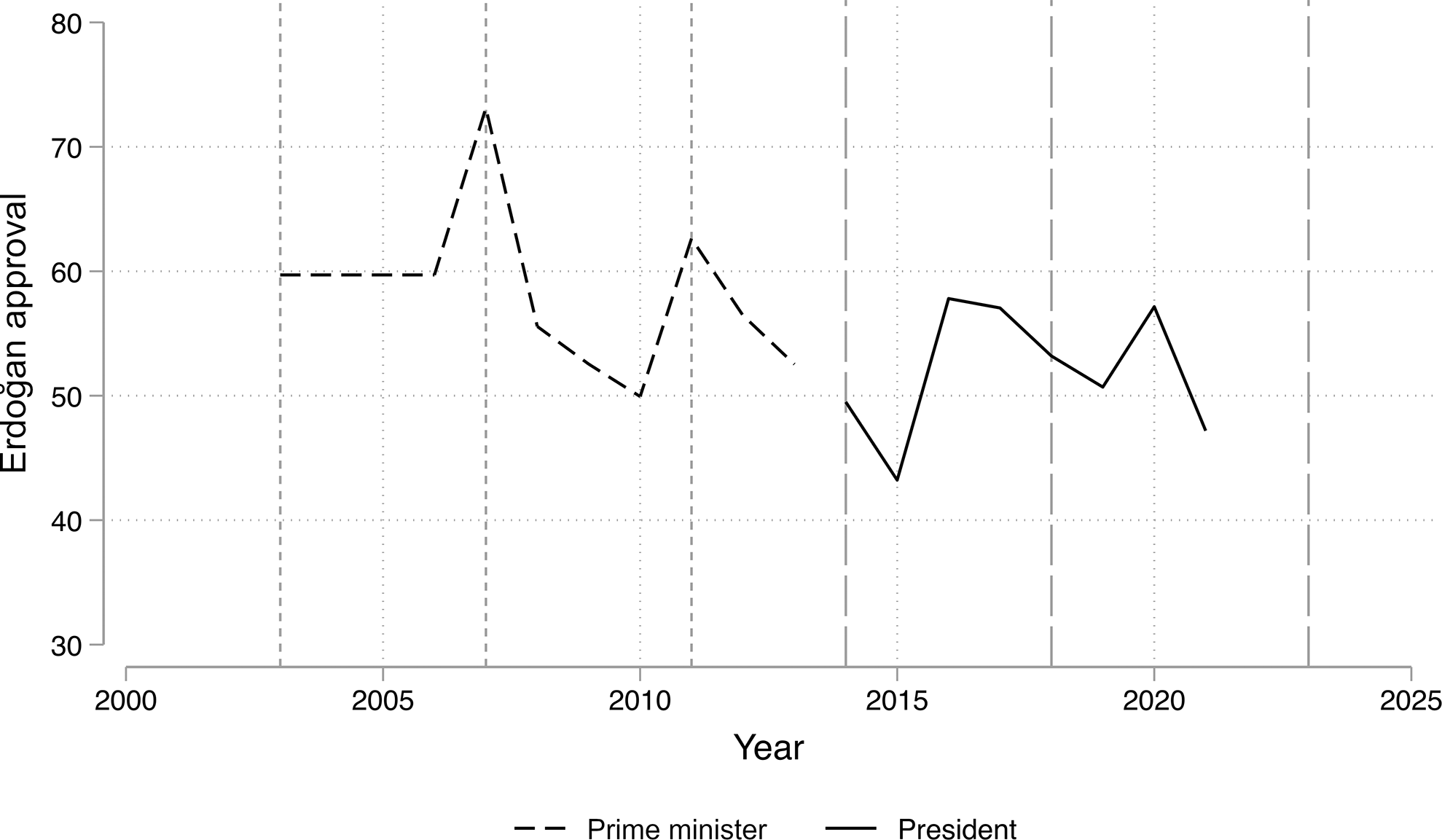
We measure approval of Erdoğan by asking respondents how much they “approve of Recep Tayyip Erdoğan’s way of carrying out his duties as the president” (strongly disapprove; somewhat disapprove; neither approve nor disapprove; somewhat approve; strongly approve; or don’t know). Responses were standardized to aid interpretation of the results; this creates Erdoğan approval, which ranges between zero and one, where higher values correspond to higher approval of Erdoğan.Footnote 23 The average level of approval for control group respondents was 43%. Although our sample is not representative in terms of education, region, and religion, comparing the baseline level of approval for Erdoğan in our sample to data from the Executive Approval Project suggests that our sample is reasonably reflective of public sentiment, at least in terms of presidential approval. Figure 2 shows that, according to the Executive Approval Project, Erdoğan’s approval was 48% in 2021 (Carlin et al. Reference Carlin, Hartlyn, Hellwig, Horne, Love, Martinez-Gallardo, Singer, Cruces and Sert2025). However, this was two years before our survey, which followed several years of high inflation and the government’s delayed response to the 2023 earthquakes.
Approval of Recep Tayyip Erdoğan, 2003–21
Note: Erdoğan became prime minister in 2003 following a by-election and led the AKP to victories in the Grand National Assembly in 2007 and 2011, as indicated by the short-dashed lines; he was then elected to the presidency in 2014, winning reelection in 2018 and 2023, as indicated by the long-dashed lines.

Regarding pretreatment covariates, we control for whether a respondent is female, their age, their level of education, whether they are a public sector employee, their income, and the province that they live in.Footnote 24 We include these covariates in our analysis to increase statistical precision (Imbens and Rubin Reference Imbens and Rubin2015).
Hypotheses
Based on the earlier theoretical discussion, we set out two competing preregistered hypotheses about the relationship between blame-shifting politics and people’s approval of Erdoğan.Footnote 25 Exposure to blame-shifting treatments may increase approval of Erdoğan, if these tactics have their intended effects, but they may also be viewed by people for what they are—a blatant attempt to avoid culpability by Erdoğan, who holds at least some responsibility—and diminish his standing:Footnote 26
H1a: effective talk hypothesis. Approval of Erdoğan will be higher among respondents receiving any of the blame-shifting treatments than among respondents in the control group.
H1b: backlash hypothesis. Approval of Erdoğan will be lower among respondents receiving any of the blame-shifting treatments than among respondents in the control group.
Next, recall that there are two versions of each treatment: a primed version and an unprimed version, which were randomly assigned. In the primed version, respondents received a treatment (e.g., one that blames private construction companies for the devastation following the earthquakes); they are then asked a question that prompts them to consider the culpability of the actor involved in the treatment they received (private construction companies, in the example given above), before being asked for their approval of Erdoğan. In the unprimed version, the order of the questions that prompt respondents to think about culpability and assess their approval of Erdoğan is reversed. Just as Chaudoin, Gaines, and Livny (Reference Chaudoin, Gaines and Livny2021) show that the order of questions for mediation analysis can affect results, we expect that those receiving the primed treatment will respond more strongly to blame shifting than those receiving the unprimed treatment:
H2: priming hypothesis. The effects of the blame-shifting treatments on approval of Erdoğan, whether positive or negative, will be greater among respondents receiving the primed treatments than among respondents receiving the unprimed treatments.
Blame-shifting politics are unlikely, however, to have the same effects among all people. First, the treatment effects should be moderated by whether respondents can critically evaluate information. Respondents who are able to do this should be less susceptible to blame-shifting politics influencing their approval of Erdoğan. One indicator of this is their level of education. While education in nondemocracies can aid indoctrination for the regime’s benefit (Lott Reference Lott1999), there is significant evidence consistent with the idea that it leads individuals to access alternative sources of information and aids critical thinking (Yanagizawa-Drott Reference Yanagizawa-Drott2014; Zaller Reference Zaller1992). Indeed, education has long been thought of as a means to help individuals develop their political sophistication (Lipset Reference Lipset1959). Another indicator of whether respondents can critically evaluate information is income. Income is positively associated with political participation, even while controlling for education (Testa Reference Testa2018). Greater involvement in politics should make an individual more adept at “reading between the lines” of the regime’s propaganda. Hence, richer individuals should be more able to objectively analyze blame-shifting messaging. We therefore expect that blame-shifting politics will be less likely to positively influence approval of Erdoğan among better-educated and richer individuals:
H3: socioeconomic status (SES) hypothesis. Any positive effects of the blame-shifting treatments on approval of Erdoğan will be higher among respondents who have a lower level of education (or are poorer) than respondents who have a higher level of education (or are richer).
Blame-shifting politics may also have different effects on respondents’ approval of Erdoğan depending on their existing views of him. Affective polarization—the notion that animosity will increase between opposing political groups—affects attitudes and behaviors within (and beyond) the political sphere (Iyengar et al. Reference Iyengar, Lelkes, Levendusky, Malhotra and Westwood2019). Attachment and opposition to political parties and actors influences how individuals interpret information, including who citizens hold responsible for policy outcomes (Healy, Kuo, and Malhotra Reference Healy, Kuo and Malhotra2014; Maestas et al. Reference Maestas, Atkeson, Croom and Bryant2008; Tilley and Hobolt Reference Tilley and Hobolt2011; Zaller Reference Zaller1992). Partisanship conditions how people consume information not just in democracies, but also in autocracies, including Turkey (Laebens and Öztürk Reference Laebens and Öztürk2021; see also Gläßel and Paula Reference Gläßel and Paula2020; Peisakhin and Rozenas Reference Peisakhin and Rozenas2018).
Experimental work has shown that cues from in-party leaders do not always persuade that party’s supporters (Brader, Tucker, and Duell Reference Brader, Tucker and Duell2013; Nicholson Reference Nicholson2012). Blame shifting may have little effect on Erdoğan’s dedicated supporters if they already hold very positive views of him. Alternatively, opposition supporters may have negative views of Erdoğan that are firmly entrenched and cannot be influenced by blame shifting (Aytaç Reference Aytaç2021, 1521). Any positive effect of blame-shifting politics should therefore be especially visible among respondents who are neither strong supporters nor strong opponents of Erdoğan (Aytaç Reference Aytaç2021, 1522; Geddes and Zaller Reference Geddes and Zaller1989):
H4: politics-in-the-middle hypothesis. Any positive effects of the blame-shifting treatments on approval of Erdoğan will be higher among unaffiliated respondents than among supporters of Erdoğan or the opposition.
Focus Group Procedures
To our knowledge, this study is one of the first to combine a survey experiment with focus groups to unpack causal mechanisms behind authoritarian approval. The experiment provides a robust foundation for the identification of causal patterns on a broader scale, while the focus groups help to reveal the reasons behind citizens’ reactions to blame shifting by assessing their experiences, beliefs, and opinions (Cyr Reference Cyr2017). Unlike alternative qualitative methods, such as interviews, the social nature of focus groups also allows us to observe how citizens’ individual views are shaped by collective discussions, reflecting the interactive dynamics of opinion formation (Nyumba et al. Reference Nyumba, Wilson, Derrick and Mukherjee2018, 28).
The focus groups also help to address a potential issue in the experimental design: pretreatment exposure (Druckman and Leeper Reference Druckman and Leeper2012). Basing the treatments on actual presidential statements enhances the experiment’s external validity by making the treatments realistic; respondents may have heard these statements before the experiment. Pretreatment exposure does not threaten the identification of treatment effects since pretreated respondents should be equally distributed across experimental groups, but the experiment may capture only the marginal effects of additional exposure to blame shifting or the effect of priming respondents to consider Erdoğan’s role in the disaster. Focus groups further help to mitigate this concern by assessing whether the experimental effects that we observe reflect more than mere reactions to additional exposure to familiar narratives.
Participant Selection
At the end of the survey, participants were asked whether they would participate in a follow-up focus group; about 60 responded positively. Participants were then recruited into a focus group based on their self-declared voting intention.Footnote 27 The three groups correspond to whether respondents said they intended to vote for the incumbent, opposition, or were uncertain. Basing groups on participants with similar political preferences allowed us to more fully probe individuals’ reasons for their responses to blame shifting, since participants could more comfortably explain themselves in front of others with similar views. Dividing participants in this way also helped us to avoid disagreement or conflict, given the high level of political polarization before the election. Regarding covariates, we composed each group in a way that maximized variation on gender, age, education, income, and location. If multiple respondents within the pool of 60 respondents had similar socioeconomic backgrounds, we randomly chose one participant for inclusion.Footnote 28 The exposure of the respondents to the survey treatments was heterogeneous: that is, participants in each group had been randomly exposed to different treatments. The sessions were designed to create an environment conducive to candid discussion, allowing us to examine respondents’ thought processes.
Following the composition of each group, we emailed each participant with the details of the study. We received eight to nine confirmations from each group; attrition led to each group consisting of five to six participants.Footnote 29 The online meetings each lasted for an hour and occurred in July 2023. The sessions were recorded, transcribed, and translated into English.
Focus Group Questions
We unpack the underlying motivations and cognitive processes influencing respondents’ perceptions of blame shifting through open-ended questions on respondents’ opinions of all four types of blame shifting. The questions were semistructured, ensuring broad consistency across groups but allowing us to respond to interesting points as necessary.Footnote 30 Following introductory questions, the moderator reminded participants of the content of the treatments that they were exposed to, and then asked follow-up questions based on their responses. For example, to get more detailed information on the impact of the treatment on the construction companies, the moderator reminded participants about the president’s statements where he explicitly shifted blame to construction companies for the magnitude of the destruction. Respondents were then asked about their thoughts and feelings in response to this information. During the natural course of the conversation, the moderator reminded the participants of additional treatments and asked follow-up questions to unpack the logic behind the participants’ responses.
Ethics
There are ethical risks to conducting research after large-scale disasters. Surveying or interviewing people about a disaster in its immediate aftermath contains risks, including retraumatization. We considered these ethical questions seriously, assessing whether the project’s risks could be alleviated, irrespective of any benefits, through discussions with Turkish academics, gaining ethical approval from an institutional ethics committee, and assessing the risks against the American Political Science Association’s ethical principles for research involving human subjects (see online appendix A). Overall, we concluded that the ubiquitous presence of the earthquakes in Turkish media combined with the dispassionate nature of our treatments meant that the risk of retraumatization was low. The focus groups were also led by a moderator using an objective and dispassionate tone, focusing on treatments that respondents had already been exposed to in the survey. Beyond these considerations, we felt that the importance of understanding the effects of blame-shifting politics in the wake of large-scale disasters provided motivation to pursue the research.
Results
We find that Erdoğan’s efforts to blame the aftermath of the earthquakes on a force majeure or the opposition led to a backlash, reducing his approval, especially among richer and better-educated individuals. The focus group findings confirm this and reveal that voters were particularly upset by perceived electoral opportunism and the president’s polarizing language following the disaster.
Experimental Evidence
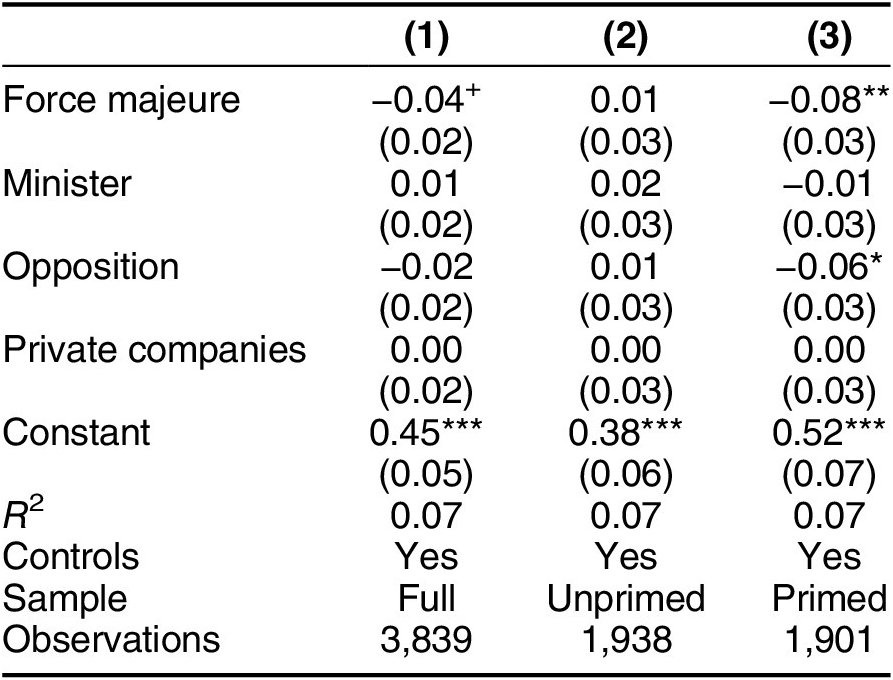
The average treatment effects are summarized in table 1.Footnote 31 Table 1 displays results from the full sample in model 1, and the subsamples of when the treatment was not preceded by the blame-assignment prompt questions (unprimed treatment; model 2), and when the treatment was preceded by these questions (primed treatment; model 3).
Summary of Average Treatment Effects on Approval for Erdoğan

Notes: Standard errors in parentheses. + p < 0.10; * p < 0.05; ** p < 0.01; *** p < 0.001.
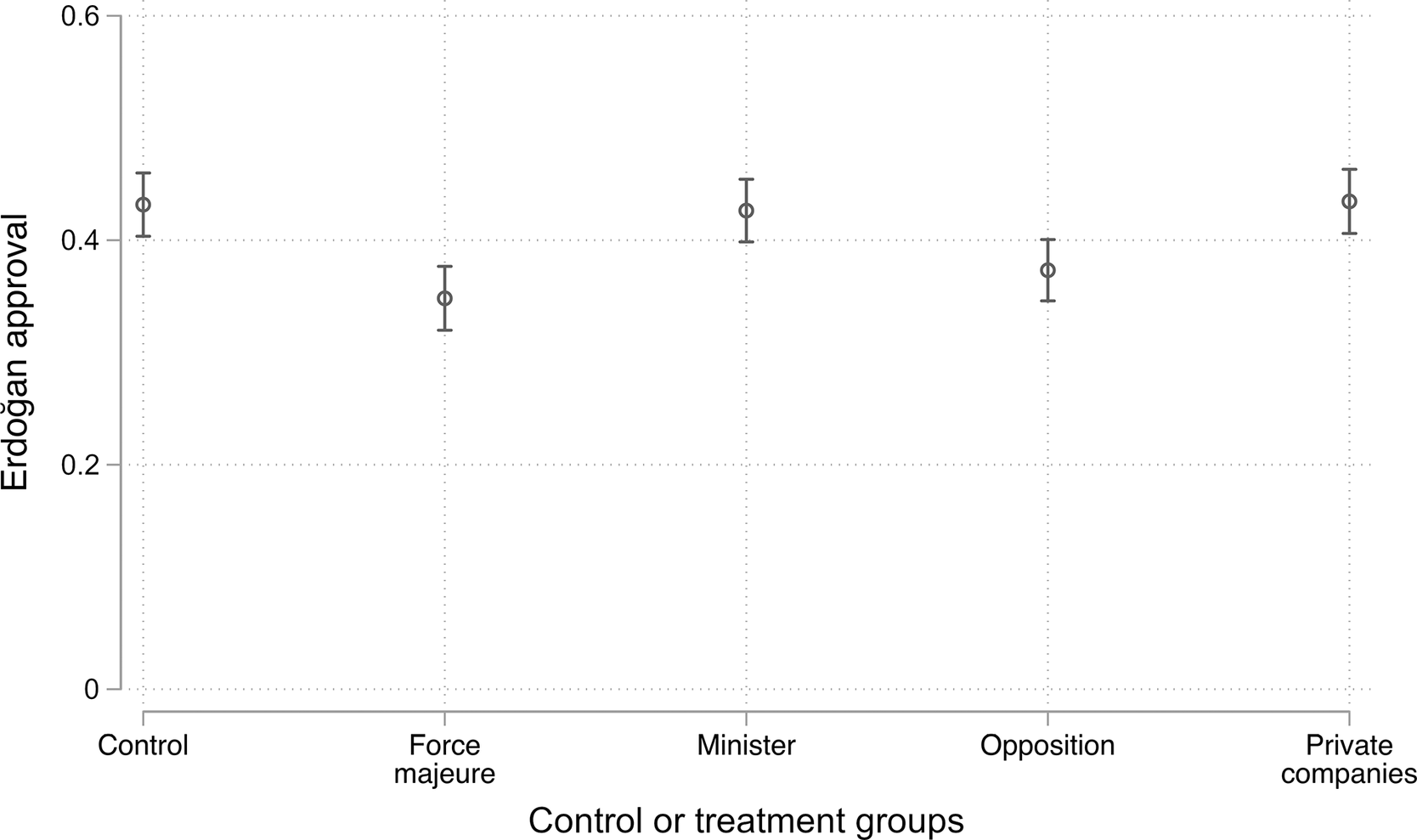
The evidence provides qualified support for the backlash hypothesis (H1b), specifically for two treatments: when Erdoğan blamed the earthquakes on a force majeure or the opposition. We find no evidence of significant average treatment effects for the treatments that scapegoat the minister and private construction companies.Footnote 32 These findings are largely based on the results from the subsample using the primed treatment (model 3). No coefficients for any of the treatments reached conventional levels of statistical significance in the full sample or the subsample with the unprimed treatment. In terms of our hypotheses, then, we find evidence to support the backlash hypothesis for the force majeure and opposition treatments, but only with the primed treatment, which therefore also shows support for the priming hypothesis (H2). The predictive margins for the primed treatments—using 84% confidence intervals, the graphical equivalent to p < 0.05 (Goldstein and Healy Reference Goldstein and Michael1995, 175)—are visualized in figure 3. The force majeure treatment reduces approval of Erdoğan by eight percentage points (43% to 35%), relative to control, while the opposition treatment reduces approval by six percentage points (43% to 37%).
Predictive Margins for the Primed Treatment

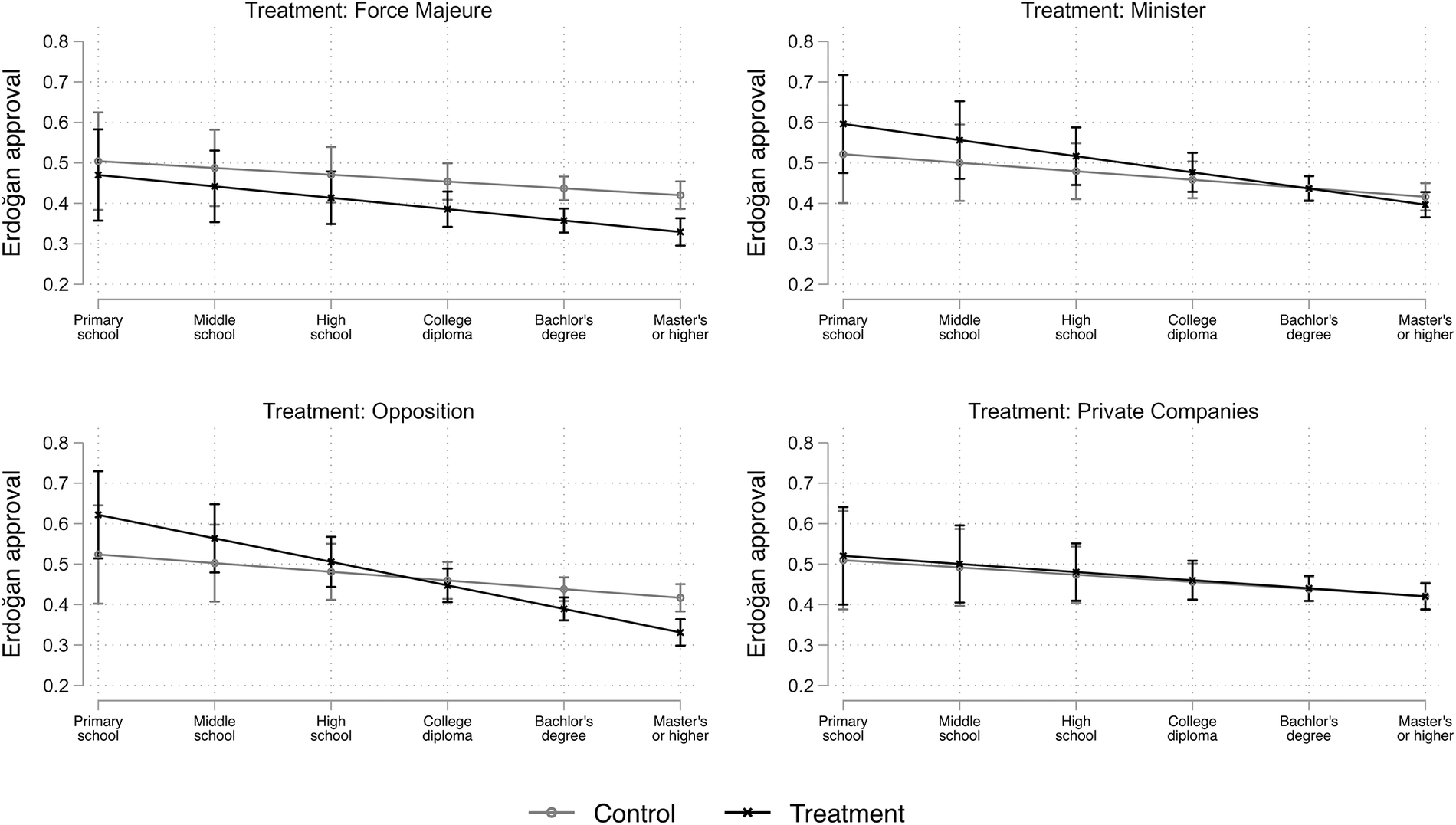
We next assess whether there is support for the SES hypothesis (H3), which is that people more able to consume alternative sources of information are more likely to be skeptical of the government’s messaging around blame shifting. We first examine the effects of the treatments—we use the primed treatments since these were the only significant average treatment effects that we found (see table 1)—conditional on a respondent’s level of education. The inclusion of the interaction term means that hypothesis testing is best conducted visually (Brambor, Clark, and Golder Reference Brambor, Clark and Golder2006); the results are shown in figure 4.Footnote 33 Again, we find that only the effects of the force majeure and opposition treatments are moderated by an individual’s level of education. The force majeure treatment has a greater backlash effect on approval for Erdoğan when respondents are more educated (bachelor’s degree of higher). We find a similar effect for the opposition treatment (albeit only for respondents with a master’s degree or higher). Approval of Erdoğan among participants who were subjected to the force majeure or opposition treatments is nine percentage points lower, relative to control, if respondents had a master’s degree or a higher level of education.
Primed Treatment Effects Conditional on Education

We find similar heterogeneous treatment effects based on variation in a respondent’s level of income.Footnote 34 As shown in figure 5, the force majeure and opposition treatments lead to an increasing backlash effect on approval for Erdoğan among richer respondents. Approval of Erdoğan among participants who were exposed to the force majeure or opposition treatments is 10 and nine percentage points lower, respectively, when participants earn at least 25,000 Turkish lira per month (about $1,300 when the survey was fielded).Footnote 35
Primed Treatment Effects Conditional on Income

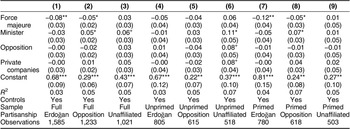
Finally, we did not find comprehensive evidence to support the politics-in-the-middle hypothesis (H4).Footnote 36 These results are summarized in table 2.Footnote 37 Most of the coefficients for unaffiliated participants are positive, as expected, but the majority are not statistically significant. The one exception is the minister treatment, which has a positive effect on Erdoğan’s approval for unaffiliated voters, as well as opposition supporters, suggesting that purging a minister could have helped Erdoğan to increase his approval among the supporters whose minds he most needed to change. This may be because this specific treatment, although involving the spin of presentational blame shifting, comes closest to agency-based blame shifting, which involves shifting responsibility (in advance) onto another individual or officeholder.
Summary of Treatment Effects Conditional on Partisanship

Notes: Standard errors in parentheses. + p < 0.10; * p < 0.05; ** p < 0.01; *** p < 0.001.
Some additional findings in table 2 may seem surprising. First, Erdoğan’s supporters respond negatively to the force majeure treatment; opposition supporters also respond negatively, but the treatment had a larger effect on Erdoğan’s supporters. There may be a backlash to blaming events on a force majeure across partisan lines, since voters appreciate politicians who take responsibility, while the larger effect among AKP supporters may be because AKP supporters have faith in Erdoğan, so therefore dislike him attributing problems to events beyond his control. Second, opposition supporters do not lower their approval of Erdoğan in response to Erdoğan blaming the opposition. This could be because opposition supporters are accustomed to Erdoğan blaming the opposition, so this tactic has little effect on them.
Overall, despite high affective polarization in Turkey (Orhan Reference Orhan2022, 722), blame shifting does not have systematically different effects on government and opposition supporters.Footnote 38 It is possible that severe shocks, such as large-scale disasters, disrupt the usual consequences of affective polarization, prompting citizens to set aside their political biases when assessing postdisaster incumbent performance. Even in highly polarized societies, major disasters may weaken stable partisan support for leaders. On the other hand, as Erdoğan’s various attempts to shift blame after the earthquakes show, citizens are inundated with new information following a large-scale disaster, as politicians seek to shape narratives to their benefit. The ability to critically evaluate information—which we suggest is higher for better-educated and richer people—is therefore key in shaping how attempts to shift blame affect people’s views. The focus groups further address these possibilities.
Focus Group Evidence
The focus groups reveal that, in all three groups, respondents perceived Erdoğan’s blame shifting as electoral opportunism and they were “turned off” by polarizing language during a time of crisis. Voters expected the government to hold responsible individuals or organizations accountable; instead, they were confronted by implausible efforts at shifting the blame. Figure 6 summarizes how these dynamics reduced voters’ approval of the incumbent, although voting behavior did not significantly change (see table I4 in online appendix I).
Mechanism at Work

In all focus groups, participants were reminded of the treatment vignettes, followed by a series of questions that probed how the vignettes affected their opinion of the incumbent. Participants were less interested in discussing the treatments involving the minister and construction companies. In line with the survey findings, conversations became more detailed when the moderator reminded participants of the treatments in which Erdoğan blames the opposition or a force majeure. We suspect this is because the opposition and force majeure treatments induced stronger emotional reactions, with focus group participants’ similar emotive reactions then reinforcing their collective interest in discussing these treatments. Overall, three salient themes emerged to account for the backlash to the treatments involving Erdoğan blaming the opposition or a force majeure. First, all respondents, regardless of their partisan leaning, were repelled by the instrumentalization of the earthquakes for political gain. In particular, AKP supporters were disenchanted by both sides’ attempts to exploit tragic deaths for political advantage. The manipulation of sensitive episodes for political gain was perceived by AKP loyalists as distasteful opportunism. While AKP supporters also criticized the opposition for doing the same, Erdoğan’s inclination to blame the opposition and invoke notions of fate further alienated pro-AKP voters. In response to a follow-up question on their opinion of the treatment in which Erdoğan shifts blame to the opposition, one incumbent-supporting participant said, “There was an election ahead of us … [and they are saying] ‘Here is the election coming up, let’s get votes. … Here we are providing this aid, but don’t forget this, we are [the ones who are] with you.’ … In other words, nothing was done for the people, nothing was done to heal our wounds, there was no unity, but only, ‘Let’s get a vote, let’s [do the best for our] interest.’ … It was more like an [opportunistic] relationship.”
Participants supporting the opposition were similarly disappointed with how political interests shifted attention away from a discussion over recovery and aid efforts to help ordinary individuals. In response to a follow-up question about the same treatment that blames the opposition, one pro-opposition participant said, “To be honest, I saw that both sides were not completely focused on the earthquake. … I expected both sides to be united. … I saw that political interests were still at the forefront. There was an election recently … in order to get votes, so I find both sides guilty … they did not unite.” In that sense, political leadership was perceived to be out of touch with the hardship that victims were experiencing, and their inability to demonstrate human connection frustrated voters.
Trying to strategically blame political rivals also alienated those who were unaffiliated before the elections. Just like AKP followers and opposition supporters, unaffiliated voters yearned for leadership that prioritized empathy, unity, and a commitment to addressing the root causes of immediate challenges rather than engaging in blame games for short-term political advantage in the approaching elections. In response to a question about their opinion of the treatment in which Erdoğan shifts blame to a force majeure, one unaffiliated participant expressed disappointment with the ensuing public debate between the incumbent and the opposition, stating that “instead of … [forming] a great unity in the country, [the opposition] responded in their own way to the ridiculous things the other side did. … What they should have done was to say, ‘Brother, today is the day of unity, we will leave politics aside, we will heal the wounds of this country as brothers and sisters.’ Unfortunately, they failed to do this.” Reflecting the lack of a significant finding in the experiment for blame shifting for unaffiliated participants, this reaction may indicate that these citizens were not disengaged with political events, but they were disappointed with the rhetoric from both sides of the political aisle.
A second salient theme behind the backlash to blame shifting is the distaste of politically polarizing language by both pro-AKP and opposition media commentators and politicians, especially in the context of a large-scale disaster. When faced with the devastating impact of such calamities, participants of all partisan leanings expected political leaders to rise above partisan divides and prioritize collective well-being rather than shifting the blame onto nature, the opposition, or private construction companies. Divisive rhetoric in the aftermath of disasters disappointed AKP supporters, who expected the incumbent to focus on cooperative solutions when confronting the challenges the earthquakes posed to the country. In response to a question regarding their opinion on the general tone of the debate in the immediate aftermath of the earthquakes, one incumbent-supporting participant said that “everything is exaggerated a lot in our country. After a while an event happens and after a few days it gets completely out of hand and [manipulation occurs]. … There is a constant smear campaign or excessive praise, so it is completely biased. We cannot be impartial in any way. … They make such annoying comments; they constantly praise one side or denigrate another, so this is not right.” Thus, while voters are aware that politicians and pundits distort facts by way of exaggeration, polarizing language invokes anger and disappointment. Opposition-supporting participants reacted similarly to this question, with one participant saying that “the election process has really blinded both the government and the opposition. … Maybe the proximity of the election has caused so much hatred [and] polarization.” Inflammatory language following the earthquakes prompted a sense of disillusionment among those who desired a more unifying approach from their political leaders during moments of national hardship.
Third, all voters, regardless of partisan preference, expected a degree of accountability for failings in response to the earthquakes. Respondents disagreed with blaming fate for the large-scale disaster. The delayed government response and lack of accountability in the face of acute shortcomings by authorities responsible for disaster management (e.g., Türk Kızılay, the Turkish Red Crescent) left a lingering sense of frustration among the participants across all three groups. This sentiment is particularly pronounced among AKP supporters, including those directly affected by the earthquakes, who were most sensitive to the perceived lack of punishment for officials involved. Nearly all participants in the focus group composed of incumbent supporters disagreed with Erdoğan’s attempts to blame the earthquakes on a force of nature. When reminded of the relevant treatment text and asked about their opinion, one incumbent-supporting participant said, “So many people lost their lives, we can’t get away with calling it fate.” This reaction was not exclusive to incumbent supporters. An opposition-supporting participant echoed this aversion, saying that “we are an earthquake country, we cannot [dismiss it] as fate.”
These accounts further illuminate why only the force majeure and opposition treatments caused a backlash among respondents. The force majeure treatment implies a clear refusal to accept accountability, and the opposition treatment includes the polarizing language and electoral opportunism criticized by the participants, but these traits are less pronounced in the minister and private sector treatments. While these latter treatments shift blame away from Erdoğan, they are not as politically polarizing to the extent that voters do not begin to question where the leader’s priorities lie as a result of the framing. This is likely because the statements in the treatments concerning the minister and private construction companies can be characterized as a “special-access lie,” which involves “deliberately false statements based on facts about which the speaker is thought to have special access” regarding their veracity (Hahl, Kim, and Zuckerman Sivan Reference Hahl, Kim and Sivan2018, 4). Because the voters do not have alternative sources of information or the level of expertise needed to assess whether the minister or the contractors are indeed responsible, shifting the blame to these actors does not generate a similar backlash effect. In that sense, the minister and private sector treatments are more credible to respondents, as there was in fact negligence on the part of government officials and private construction companies.
Conclusion
Our study shows the limitations of autocratic presentational blame shifting, particularly when it is perceived as an attempt to absolve the incumbent in an implausible manner or an attempt to instrumentalize suffering for political gain. Blame shifting may be a common tactic to deflect responsibility and maintain political stability in authoritarian regimes (Baekkeskov and Rubin Reference Baekkeskov and Rubin2017; Cai Reference Cai2008; Chaisty, Gerry, and Whitefield Reference Chaisty, Gerry and Whitefield2022; Li, Ni, and Wang Reference Li, Ni and Wang2021; Sirotkina and Zavadskaya Reference Sirotkina and Zavadskaya2020; Windsor, Dowell, and Graesser Reference Windsor, Dowell and Graesser2014), but in the context of a large-scale disaster it risks alienating the population, including those who support the incumbent. Blame shifting, especially when directed toward supposedly uncontrollable circumstances or political rivals, may not be as effective as autocrats seem to believe, given the frequency with which they use it. The backlash observed in the experiment and the results of the focus groups indicate that citizens, in the emotionally charged aftermath of large-scale disasters, expect leaders to take responsibility for relief efforts and to act in a unifying manner instead of engaging in politically motivated blame games.Footnote 39 Dictators’ attempts to shift blame clash with such expectations, particularly when they are perceived to lack credibility. In these circumstances, voters perceive such rhetoric as an indicator of dishonesty, which reduces the approval of the autocrat as voters expect nonpartisan cooperation to aid recovery efforts. Within this context, resorting to political opportunism or using polarizing language makes the incumbent less credible in the eyes of citizens and decreases his approval.
The findings have important theoretical and policy implications that extend beyond Turkey. First, the results suggest that there are limits to the use of presentational blame shifting. Even though incumbents in electoral autocracies exercise great control over information channels, this does not enable them to unconditionally shape how citizens perceive the government in the context of large-scale disasters and does not guarantee support. The content and framing of messages matter. Narratives that lack plausibility and contradict citizens’ expectations or experiences may trigger a backlash and erode, rather than strengthen, the leader’s approval.
This insight may also help to explain the advantages of agency-based approaches to blame shifting. Autocrats can successfully deflect blame by diffusing political power and responsibility (Beazer and Reuter Reference Beazer and Reuter2019; Hood Reference Hood2011; Williamson Reference Williamson2024). When such structures exist before a disaster, they may prove more effective in insulating autocrats from blame. Since agency-based approaches shape citizens’ perceptions of political responsibility and involve actual shifts in governance, they do not rely as heavily on presentational blame shifting. As a result, they are more credible, less likely to be seen as politicizing a crisis, and reduce the risk of backlash. However, agency-based approaches are costlier than presentational blame shifting since they need to be implemented before a disaster. Using them successfully requires long-term planning, and they are thus of limited use to autocrats who want to shift blame immediately after a large-scale disaster.
The results further speak to the broader literature on autocratic survival strategies in the wake of large-scale disasters. The limits of blame shifting, combined with the challenges to effectively censor information about ubiquitous crises (Rozenas and Stukal Reference Rozenas and Stukal2019), suggest that it is difficult for autocrats to maintain legitimacy following such events. Autocrats have to compensate for losses in one of their sources of stability by increasing others (Gerschewski Reference Gerschewski, Croissant, Kailitz, Koellner and Wurster2015). The findings may therefore help to explain why autocrats often ramp up repression in the aftermath of disasters (Wood and Wright Reference Wood and Wright2016).
Finally, the study has implications for international relations scholarship on blame shifting and disaster responses by international organizations. National leaders can sometimes successfully shift blame to international organizations (Heinkelmann-Wild et al. Reference Heinkelmann-Wild, Zangl, Rittberger and Kriegmair2023; Schlipphak et al. Reference Schlipphak, Meiners, Treib and Schäfer2023). However, our findings suggest that such attempts are less likely to succeed and may even backfire after large-scale disasters. For international organizations involved in disaster relief, this implies that to avoid a backlash against their work that could benefit authoritarian incumbents, they should steer clear of postdisaster blame games. If citizens respond negatively to incumbents’ blame shifting, the best approach is likely to be to ignore these efforts and focus on relief operations.
The study is not without limitations. Conducting the survey shortly before the May 2023 election may limit whether the findings apply to other (electoral) autocratic contexts. Views of an incumbent may harden before an election; indeed, vote choice tends to be “locked in” one month in advance (Blais Reference Blais2004). However, this possibility should, if anything, downplay substantive effects, suggesting that the findings should apply to autocratic contexts beyond the time shortly preceding a national-level election.
Nonetheless, this points to the first of several areas for further research. First, replicating the study outside an election campaign would provide greater insights into the broader effects of blame shifting in autocracies. Second, exploring the effectiveness of blame shifting in autocracies’ presentational blame-shifting strategies outside a large-scale disaster would indicate whether the emotionally charged atmosphere in the wake of a disaster conditions the findings. Third, replicating the study in other autocracies with different institutional settings and demographics would further probe the scope conditions of the effectiveness (or limitations) of presentational blame shifting. We expect that the results generalize to electoral autocracies similar to Turkey’s, but additional research is required to confirm this. While our empirical focus is electoral autocracies, studying the link between blame shifting and incumbent approval in other types of autocracies would also contribute to a broader understanding of the effectiveness of survival tactics used by autocrats (Aytaç Reference Aytaç2021; Williamson Reference Williamson2024). The findings regarding the SES hypothesis, for instance, indicate that backlash is more likely when citizens recognize blame shifting as implausible. This suggests that a backlash against blame shifting is less likely in autocracies where the government maintains tighter control over information and where the population is less educated and wealthy. Conversely, we expect a stronger backlash to blame shifting in less repressive autocracies and in those with more educated and wealthier populations. Relatedly, the availability of plausible blame-shifting narratives is likely to be an important scope condition. For example, autocrats who have invested in agency-based blame shifting and have thereby credibly delegated responsibility for disaster prevention and relief, or nascent regimes that can credibly blame poor disaster prevention on previous governments, should be more capable of shifting blame while avoiding backlash. Last, further exploration of the cognitive processes that underpin the backlash effect could offer additional clues about whether and how leaders recover from the negative repercussions observed in this study. In particular, the incongruity between reduced approval rates for leaders who employ blame shifting after a large-scale disaster and voting behavior begs further inquiry. This would help us understand why people continue to vote for an incumbent even when they lower their approval for that regime following a major disaster.
Supplementary material
To view supplementary material for this article, please visit http://doi.org/10.1017/S1537592725102120.
Acknowledgments
We thank Carl Henrik Knutsen, Philipp Lutscher, Gareth Nellis, Nico Ravanilla, Davide Morisi, Shelley Liu, Henrikas Bartusevičius, and participants at the 2023 European Political Science Association annual conference, the 2023 Western Political Science Association annual conference, the University of York’s Workshop on Quantitative Political Research, the 2024 Norwegian National Conference, the Peace Research Institute Oslo Brown Bag seminar, the Jornada de Comportament i Opinió Pública de Catalunya VII (JCPOP) 2024 Conference, and the Tuesday seminar at the University of Oslo’s Department of Political Science for helpful feedback. René Rejón provided excellent research assistance. This project has received funding from the European Research Council under the European Union’s Horizon 2020 research and innovation program (grant agreement no. 863486), and Project DEMCOOP (project code 101097437). Procedures involving human participants were approved by the University of York’s Economics, Law, Management, Politics, and Sociology Ethics Committee (approval no. 522223). We are grateful to the University of Oslo and the University of York for funding.
Data replication
Data replication sets are available in Harvard Dataverse at: https://doi.org/10.7910/DVN/DIBX7S





 Open access


.jpg)