




1. Introduction
Let X be a complex smooth prime Fano threefold, that is, a smooth proper threefold such that
 \begin{equation*}\mathrm{Pic}(X) = {\mathbb{Z}} \cdot K_X\end{equation*}
and $-K_X$
is ample. The discrete invariant of X is given by the genus
$-K_X$
is ample. The discrete invariant of X is given by the genus ${\mathrm{g}}(X)$
, defined by the equality
${\mathrm{g}}(X)$
, defined by the equality
 \begin{equation*}(-K_X)^3 = 2{\mathrm{g}}(X)-2\quad \text{or}\quad h^0(X,{\mathcal{O}}_X(-K_X)) = {\mathrm{g}}(X) + 2;\end{equation*}
and by Iskovskikh’s fundamental result (see [Reference Iskovskikh and ProkhorovIP99, Theorem 4.3.3]), $g = {\mathrm{g}}(X)$
satisfies
$g = {\mathrm{g}}(X)$
satisfies
 \begin{equation}2 \le g \le 12,\quad g \neq 11.\end{equation}
Following Fano’s ideas, Iskovskikh also gave a birational description of all prime Fano threefolds.
1.1 Mukai’s theorems
If $g \le 5$
, the image of the anticanonical morphism
$g \le 5$
, the image of the anticanonical morphism $X \to {\mathbb{P}}^{g + 1}$
has small codimension, which one can use to describe X as a complete intersection in a weighted projective space (see [Reference Iskovskikh and ProkhorovIP99, § 12.2]). For
$X \to {\mathbb{P}}^{g + 1}$
has small codimension, which one can use to describe X as a complete intersection in a weighted projective space (see [Reference Iskovskikh and ProkhorovIP99, § 12.2]). For $g \ge 6$
, the image of the anticanonical morphism is no longer a complete intersection, and an alternative method for the biregular classification of X was needed. This was provided by Mukai (see § 1.5 for a brief account of the development of his ideas), and the main result of our paper is a complete proof of his theorem.
$g \ge 6$
, the image of the anticanonical morphism is no longer a complete intersection, and an alternative method for the biregular classification of X was needed. This was provided by Mukai (see § 1.5 for a brief account of the development of his ideas), and the main result of our paper is a complete proof of his theorem.
Theorem 1.1.
Let ${\Bbbk}$
be an algebraically closed field of characteristic zero. Let X be a smooth prime Fano threefold over
${\Bbbk}$
be an algebraically closed field of characteristic zero. Let X be a smooth prime Fano threefold over ${\Bbbk}$
of genus
${\Bbbk}$
of genus ${\mathrm{g}}(X) = r \cdot s\geq 6$
, for integers
${\mathrm{g}}(X) = r \cdot s\geq 6$
, for integers $r,s \ge 2$
. Then there exists a unique vector bundle
$r,s \ge 2$
. Then there exists a unique vector bundle ${\mathcal{U}}_r$
on X such that
${\mathcal{U}}_r$
on X such that
 \begin{equation*}\mathrm{rk}({\mathcal{U}}_r) = r,\quad {\mathrm{c}}_1({\mathcal{U}}_r) = K_X,\quad {\mathrm{H}}^\bullet(X,{\mathcal{U}}_r) = 0,\quad \mathrm{Ext}^\bullet({\mathcal{U}}_r,{\mathcal{U}}_r) = {\Bbbk},\end{equation*}
and ${\mathcal{U}}_r^\vee$
is globally generated with
${\mathcal{U}}_r^\vee$
is globally generated with $\dim {\mathrm{H}}^0(X, {\mathcal{U}}_r^\vee) = r + s$
and
$\dim {\mathrm{H}}^0(X, {\mathcal{U}}_r^\vee) = r + s$
and ${\mathrm{H}}^{\gt 0}(X, {\mathcal{U}}_r^\vee)=0$
.
${\mathrm{H}}^{\gt 0}(X, {\mathcal{U}}_r^\vee)=0$
.
We also prove a more general result (Theorem 5.3 and Corollary 5.9) saying that any prime Fano threefold X with factorial terminal singularities of genus ${\mathrm{g}}(X) = r \cdot s$
with
${\mathrm{g}}(X) = r \cdot s$
with $r,s \ge 2$
carries a maximal Cohen–Macaulay Mukai sheaf
$r,s \ge 2$
carries a maximal Cohen–Macaulay Mukai sheaf ${\mathcal{U}}_X$
(see Definition 5.1), which is unique if
${\mathcal{U}}_X$
(see Definition 5.1), which is unique if ${\mathrm{g}}(X) \ge 6$
. If, moreover,
${\mathrm{g}}(X) \ge 6$
. If, moreover, ${\mathcal{U}}_X$
is locally free (which is automatic for smooth X) and
${\mathcal{U}}_X$
is locally free (which is automatic for smooth X) and ${\mathrm{g}}(X) \ge 6$
, it satisfies all the properties of Theorem 1.1. In the follow-up paper [Reference Bayer, Kuznetsov and MacrìBKM25] we prove that the Mukai sheaf
${\mathrm{g}}(X) \ge 6$
, it satisfies all the properties of Theorem 1.1. In the follow-up paper [Reference Bayer, Kuznetsov and MacrìBKM25] we prove that the Mukai sheaf ${\mathcal{U}}_X$
is locally free, thus deducing Theorem 1.1 for all prime Fano threefolds with factorial terminal singularities.
${\mathcal{U}}_X$
is locally free, thus deducing Theorem 1.1 for all prime Fano threefolds with factorial terminal singularities.
Since ${\mathcal{U}}_r^\vee$
is globally generated, the anticanonical morphism of X factors, up to a linear projection, through a morphism
${\mathcal{U}}_r^\vee$
is globally generated, the anticanonical morphism of X factors, up to a linear projection, through a morphism
 \begin{equation*}X \to \mathrm{Gr}(r, r + s),\end{equation*}
to the Grassmannian of r-dimensional subspaces in a vector space of dimension $r + s$
. Using the decompositions
$r + s$
. Using the decompositions $g = 2 \cdot s$
for
$g = 2 \cdot s$
for $g \in \{6,8,10\}$
and
$g \in \{6,8,10\}$
and $g = 3 \cdot s$
for
$g = 3 \cdot s$
for $g \in \{9, 12\}$
and studying this morphism, Mukai found an explicit description of any prime Fano threefold X of genus
$g \in \{9, 12\}$
and studying this morphism, Mukai found an explicit description of any prime Fano threefold X of genus $g \ge 6$
.
$g \ge 6$
.
Theorem 1.2.
Let ${\Bbbk}$
be an algebraically closed field of characteristic zero and let X be a smooth prime Fano threefold over
${\Bbbk}$
be an algebraically closed field of characteristic zero and let X be a smooth prime Fano threefold over ${\Bbbk}$
of genus
${\Bbbk}$
of genus $g \ge 6$
.
$g \ge 6$
.
-
– If $g = 6 $
then X is a complete intersection of a quadric and three hyperplanes in the cone in
${\mathbb{P}}^{10}$
over
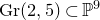
$\mathrm{Gr}(2,5) \subset {\mathbb{P}}^9$
.
$g = 6 $
then X is a complete intersection of a quadric and three hyperplanes in the cone in
${\mathbb{P}}^{10}$
over
$\mathrm{Gr}(2,5) \subset {\mathbb{P}}^9$
. -
– If
$g = 7$
then X is a dimensionally transverse linear section of
$\mathrm{OGr}_+(5,10) \subset {\mathbb{P}}^{15}$
, the connected component of the Grassmannian of isotropic five-dimensional subspaces in a ten-dimensional vector space endowed with a non-degenerate symmetric bilinear form. -
– If
$g = 8$
then X is a dimensionally transverse linear section of
$\mathrm{Gr}(2,6) \subset {\mathbb{P}}^{14}$
. -
– If
$g = 9$
then X is a dimensionally transverse linear section of
$\mathrm{LGr}(3,6) \subset {\mathbb{P}}^{13}$
, the Grassmannian of isotropic three-dimensional subspaces in a six-dimensional vector space endowed with a non-degenerate skew-symmetric bilinear form. -
– If
$g = 10$
then X is a dimensionally transverse linear section in
${\mathbb{P}}^{13}$
of a five-dimensional homogeneous variety of the simple algebraic group of Dynkin type
$\mathbf{G}_2$
. -
– If
$g = 12$
then X is the subvariety in
$\mathrm{Gr}(3,7) \subset {\mathbb{P}}^{34}$
, parameterizing three-dimensional subspaces isotropic for three skew-symmetric bilinear forms.











In [Reference Bayer, Kuznetsov and MacrìBKM25, Theorem 1.1] we prove this theorem for all prime Fano threefolds X with factorial terminal singularities of genus ${\mathrm{g}}(X) \ge 6$
. We also generalize Theorems 1.1 and 1.2 to Fano varieties of dimension
${\mathrm{g}}(X) \ge 6$
. We also generalize Theorems 1.1 and 1.2 to Fano varieties of dimension $n \ge 4$
with
$n \ge 4$
with $\mathrm{Pic}(X) = {\mathbb{Z}} \cdot H$
and
$\mathrm{Pic}(X) = {\mathbb{Z}} \cdot H$
and $K_X = -(n-2) H$
.
$K_X = -(n-2) H$
.
The significance of Mukai’s results for the study of Fano threefolds and K3 surfaces is hard to overestimate. They have applications ranging from computing quantum periods (e.g., [Reference Coates, Corti, Galkin and KasprzykCCG+16]), the classification of 2-Fano manifolds (e.g., [Reference Araujo and CastravetAC13]), and Picard groups of moduli spaces of K3 surfaces (e.g., [Reference Greer, Li and TianGLT15]), to the study of curves (e.g., [Reference Chen, Farkas and MorrisonCFM13, Reference Cukierman and UlmerCU93]) and automorphism groups (e.g., [Reference Kuznetsov, Prokhorov and ShramovKPS18]). They were also used to define interesting semiorthogonal decompositions of derived categories of Fano threefolds (see [Reference KuznetsovKuz09]).
However, to the best of our knowledge, a complete direct proof of these results still cannot be found in the literature (see § 1.5 for a detailed discussion). Thus, our main goal is to fill this gap by giving a complete proof of Theorem 1.1 along with the generalizations discussed above in this paper, and of Theorem 1.2 along with generalizations also to higher dimension in [Reference Bayer, Kuznetsov and MacrìBKM25].
1.2 Lazarsfeld bundles on K3 surfaces
Our proof of Theorem 1.1 uses ideas of Mukai and two extra ingredients: Lazarsfeld’s fundamental observation in [Reference LazarsfeldLaz86] that Brill–Noether properties of line bundles on a divisor are naturally encoded by its associated vector bundle on the ambient variety (perhaps first constructed in [Reference MaruyamaMar73]), and Brill–Noether and Petri generality properties of K3 surfaces and curves (see § 2 for a review of what is relevant for us).
In particular, given a curve C with an embedding $j \colon C \hookrightarrow S$
into a K3 surface S, and a globally generated line bundle
$j \colon C \hookrightarrow S$
into a K3 surface S, and a globally generated line bundle $\xi$
on C, the vector bundle
$\xi$
on C, the vector bundle ${\mathbf{L}}_S(\xi)$
on S is defined by the exact sequence
${\mathbf{L}}_S(\xi)$
on S is defined by the exact sequence
 \begin{equation*}0 \to {\mathbf{L}}_S(\xi) \to {\mathrm{H}}^0(C, \xi) \otimes {\mathcal{O}}_S \to j_*\xi \to 0.\end{equation*}
We apply this construction when C is a smooth Brill–Noether–Petri general curve and $\xi$
satisfies
$\xi$
satisfies
 \begin{equation}\deg(\xi) = (r - 1)(s + 1)\quad \text{and}\quad h^0(\xi) = r,\quad \text{hence}\quad h^1(\xi) = s,\end{equation}
where ${\mathrm{g}}(C) = r \cdot s$
is a fixed factorization. (The existence of such
${\mathrm{g}}(C) = r \cdot s$
is a fixed factorization. (The existence of such $\xi$
follows from the Brill–Noether generality of C; however,
$\xi$
follows from the Brill–Noether generality of C; however, $\xi$
is not unique (see Remark 2.4).) The vector bundle
$\xi$
is not unique (see Remark 2.4).) The vector bundle ${\mathbf{L}}_S(\xi)$
has the same invariants as the restriction of a Mukai bundle from an ambient Fano threefold, and we show that Petri generality of C implies that
${\mathbf{L}}_S(\xi)$
has the same invariants as the restriction of a Mukai bundle from an ambient Fano threefold, and we show that Petri generality of C implies that ${\mathbf{L}}_S(\xi)$
is simple and rigid, that is to say, spherical.
${\mathbf{L}}_S(\xi)$
is simple and rigid, that is to say, spherical.
It is easy to see that ${\mathbf{L}}_S(\xi)$
is stable if
${\mathbf{L}}_S(\xi)$
is stable if $\mathrm{Pic}(S)$
is generated by the class of C. The first important step in our proof of Theorem 1.1 is the following general stability criterion for
$\mathrm{Pic}(S)$
is generated by the class of C. The first important step in our proof of Theorem 1.1 is the following general stability criterion for ${\mathbf{L}}_S(\xi)$
in terms of an extension of the class
${\mathbf{L}}_S(\xi)$
in terms of an extension of the class $\xi$
to
$\xi$
to $\mathrm{Pic}(S)$
.
$\mathrm{Pic}(S)$
.
Theorem 1.3
(Cf. Theorem 3.4). Let ${\mathbf{L}}_S(\xi)$
be the spherical vector bundle associated to a smooth Brill–Noether–Petri general curve C on a K3 surface S and a globally generated line bundle
${\mathbf{L}}_S(\xi)$
be the spherical vector bundle associated to a smooth Brill–Noether–Petri general curve C on a K3 surface S and a globally generated line bundle $\xi$
on C satisfying (2), where
$\xi$
on C satisfying (2), where $r \in \{2,3\}$
and
$r \in \{2,3\}$
and $r \cdot s = {\mathrm{g}}(C)$
. Let H be the class of C in
$r \cdot s = {\mathrm{g}}(C)$
. Let H be the class of C in $\mathrm{Pic}(S)$
. If
$\mathrm{Pic}(S)$
. If ${\mathbf{L}}_S(\xi)$
is not H-Gieseker stable then
${\mathbf{L}}_S(\xi)$
is not H-Gieseker stable then $\xi$
extends to S. More precisely, there is a base-point-free divisor class
$\xi$
extends to S. More precisely, there is a base-point-free divisor class $\Xi \in \mathrm{Pic}(S)$
such that
$\Xi \in \mathrm{Pic}(S)$
such that ${\mathcal{O}}_S(\Xi)\vert_C \cong \xi$
and
${\mathcal{O}}_S(\Xi)\vert_C \cong \xi$
and
 \begin{equation}H \cdot \Xi = (r - 1)(s + 1),\quad h^0({\mathcal{O}}_S(\Xi)) = r,\quad \text{and}\quad h^1({\mathcal{O}}_S(\Xi)) = h^2({\mathcal{O}}_S(\Xi)) = 0.\end{equation}
Moreover, if $\mathrm{Pic}(S)$
does not have a class
$\mathrm{Pic}(S)$
does not have a class $\Xi$
satisfying (3) then
$\Xi$
satisfying (3) then ${\mathbf{L}}_S(\xi)$
does not depend on C or
${\mathbf{L}}_S(\xi)$
does not depend on C or $\xi$
.
$\xi$
.
We call divisor classes $\Xi$
satisfying (3) special Mukai classes of type (r,s). In addition to
$\Xi$
satisfying (3) special Mukai classes of type (r,s). In addition to $\Xi$
being an extension of
$\Xi$
being an extension of $\xi$
from C to S, with both
$\xi$
from C to S, with both $\xi$
and
$\xi$
and $\Xi$
being extremal in the sense of the Brill–Noether theory for C and S, respectively, the significance of
$\Xi$
being extremal in the sense of the Brill–Noether theory for C and S, respectively, the significance of $\Xi$
is that the analogue
$\Xi$
is that the analogue ${\mathbf{L}}_X(\Xi)$
on X of the Lazarsfeld construction
${\mathbf{L}}_X(\Xi)$
on X of the Lazarsfeld construction ${\mathbf{L}}_S(\xi)$
on S will produce our sought-after Mukai bundle on X.
${\mathbf{L}}_S(\xi)$
on S will produce our sought-after Mukai bundle on X.
The next result characterizes the restriction of Lazarsfeld bundles ${\mathbf{L}}_S(\xi)$
back to the curve C.
${\mathbf{L}}_S(\xi)$
back to the curve C.
Theorem 1.4
(Cf. Theorem 4.13). Let ${\mathbf{L}}_S(\xi)$
be the spherical vector bundle associated to a Brill–Noether–Petri general curve C on a K3 surface S and a globally generated line bundle
${\mathbf{L}}_S(\xi)$
be the spherical vector bundle associated to a Brill–Noether–Petri general curve C on a K3 surface S and a globally generated line bundle $\xi$
on C satisfying (2), where
$\xi$
on C satisfying (2), where $r \cdot s = {\mathrm{g}}(C)$
. Then there is an exact sequence
$r \cdot s = {\mathrm{g}}(C)$
. Then there is an exact sequence
 \begin{equation}0 \to \big( {\mathrm{H}}^0(C,\xi)^\vee \otimes {\mathcal{O}}_C \big) / \xi^{-1} \to {\mathbf{L}}_S(\xi)^{\vee}\vert_C \to \xi^{-1}(K_C) \to 0.\end{equation}
Moreover, if $\mathrm{Pic}(S) = {\mathbb{Z}} \cdot [C]$
and
$\mathrm{Pic}(S) = {\mathbb{Z}} \cdot [C]$
and $r \in \{2,3\}$
, the extension class of (4) is uniquely determined by the property that the connecting homomorphism
$r \in \{2,3\}$
, the extension class of (4) is uniquely determined by the property that the connecting homomorphism
 \begin{equation*}{\mathrm{H}}^0(C, \xi^{-1}(K_C)) \to {\mathrm{H}}^1(C, ({\mathrm{H}}^0(C,\xi)^\vee \otimes {\mathcal{O}}_C) / \xi^{-1})\end{equation*}
in the cohomology exact sequence of (4) is zero.
Theorems 1.3 and 1.4 form the technical core of our paper. We prove them for $r \in \{2,3\}$
(but for arbitrary g), but we expect these results to be true for any r and g.
$r \in \{2,3\}$
(but for arbitrary g), but we expect these results to be true for any r and g.
Theorem 1.4 is a variation on a long-running theme. When one assumes additionally that the extension class (4) produces a slope-semistable vector bundle on C, it fits into a series of results that stable vector bundles on C with large number of sections are restrictions of vector bundles on S (see, for example, [Reference MukaiMuk01, § 10], [Reference Arbarello, Bruno and SernesiABS14, Reference FeyzbakhshFey20]). Closest to our case is [Reference FeyzbakhshFey22], as it covers the case of spherical vector bundles; it treats the case when $g \gg 0$
(see [Reference FeyzbakhshFey22, Remark 4.3] for the precise list of conditions). Our proof is more elementary, but its idea is motivated by Feyzbakhsh’s approach.
$g \gg 0$
(see [Reference FeyzbakhshFey22, Remark 4.3] for the precise list of conditions). Our proof is more elementary, but its idea is motivated by Feyzbakhsh’s approach.
Even closer are the results of [Reference VoisinVoi92, § 3]: the rank 2 case of Theorem 1.4 follows from Voisin’s results in the case where S is general. Indeed, Lemma 3.18 of [Reference VoisinVoi92] shows the uniqueness of the extension under assumption 3.1(i) in [Reference VoisinVoi92]. Moreover, by the proof of [Reference VoisinVoi92, Proposition 4.1], this assumption holds when C is a general curve on a general K3 surface with $\mathrm{Pic}(S) = {\mathbb{Z}}\cdot [C]$
.
$\mathrm{Pic}(S) = {\mathbb{Z}}\cdot [C]$
.
Meanwhile, Theorem 1.3 is reminiscent of results on the Donagi–Morrison conjecture (see, for example, [Reference Lelli-ChiesaLC15, Reference Auel and HaburcakAH25, Reference HaburcakHab24]). Often, such results show that line bundles on C with negative Brill–Noether number are, after adding an effective divisor, obtained by restriction of a line bundle on S, and take advantage of the fact that the associated Lazarsfeld bundle is not simple. In our case, the line bundle on C has Brill–Noether number zero, the Lazarsfeld bundle is simple but unstable, and we take advantage of instability to obtain its precise extension to a line bundle on S.
1.3 Our argument for Theorem 1.1
We use Theorems 1.3 and 1.4 to prove Theorems 1.1 and 5.3 as follows. Let X be a prime Fano threefold of genus $g \ge 6$
and let
$g \ge 6$
and let $S \subset X$
be a smooth hyperplane section such that
$S \subset X$
be a smooth hyperplane section such that
 \begin{equation}\mathrm{Pic}(S) = {\mathbb{Z}} \cdot H_S,\end{equation}
where $H_S$
stands for the restriction of
$H_S$
stands for the restriction of $H \mathrel{:=} -K_X$
to S. First, we apply [Reference LazarsfeldLaz86, Theorem] to find a Brill–Noether–Petri general curve
$H \mathrel{:=} -K_X$
to S. First, we apply [Reference LazarsfeldLaz86, Theorem] to find a Brill–Noether–Petri general curve $C \subset S$
in the linear system
$C \subset S$
in the linear system $|H_S|$
such that the pencil
$|H_S|$
such that the pencil $\{S_t\}_{t \in {\mathbb{P}}^1}$
of anticanonical divisors of X through C is a Lefschetz pencil. This pencil contains S, hence
$\{S_t\}_{t \in {\mathbb{P}}^1}$
of anticanonical divisors of X through C is a Lefschetz pencil. This pencil contains S, hence $\mathrm{Pic}(S_t) \cong {\mathbb{Z}} \cdot H_{S_t}$
for very general t.
$\mathrm{Pic}(S_t) \cong {\mathbb{Z}} \cdot H_{S_t}$
for very general t.
Next, we consider the blow-up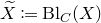 ${\widetilde{X}} \mathrel{:=} \mathrm{Bl}_C(X)$
as a family of K3 surfaces over
${\widetilde{X}} \mathrel{:=} \mathrm{Bl}_C(X)$
as a family of K3 surfaces over ${\mathbb{P}}^1$
, containing the fixed curve C as the exceptional divisor
${\mathbb{P}}^1$
, containing the fixed curve C as the exceptional divisor $E = C \times {\mathbb{P}}^1$
. We choose a globally generated line bundle
$E = C \times {\mathbb{P}}^1$
. We choose a globally generated line bundle $\xi \in \mathrm{Pic}(C)$
satisfying (2), where
$\xi \in \mathrm{Pic}(C)$
satisfying (2), where $r \cdot s = {\mathrm{g}}(C)$
, and apply a relative version of the Lazarsfeld construction to the line bundle
$r \cdot s = {\mathrm{g}}(C)$
, and apply a relative version of the Lazarsfeld construction to the line bundle $\xi \boxtimes {\mathcal{O}}_{{\mathbb{P}}^1}$
on E. As
$\xi \boxtimes {\mathcal{O}}_{{\mathbb{P}}^1}$
on E. As $\mathrm{Pic}(S_t) = {\mathbb{Z}} \cdot H_{S_t}$
for very general
$\mathrm{Pic}(S_t) = {\mathbb{Z}} \cdot H_{S_t}$
for very general $t \in {\mathbb{P}}^1$
, the restriction
$t \in {\mathbb{P}}^1$
, the restriction ${\mathbf{L}}_{{\widetilde{X}}/{\mathbb{P}}^1}(\xi \boxtimes {\mathcal{O}})\vert_{S_t}$
of the Lazarsfeld bundle
${\mathbf{L}}_{{\widetilde{X}}/{\mathbb{P}}^1}(\xi \boxtimes {\mathcal{O}})\vert_{S_t}$
of the Lazarsfeld bundle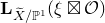 ${\mathbf{L}}_{{\widetilde{X}}/{\mathbb{P}}^1}(\xi \boxtimes {\mathcal{O}})$
on
${\mathbf{L}}_{{\widetilde{X}}/{\mathbb{P}}^1}(\xi \boxtimes {\mathcal{O}})$
on ${\widetilde{X}}$
is stable in this case. Then Theorem 1.4 implies that the extension classes of the sequences (4) associated with the restrictions
${\widetilde{X}}$
is stable in this case. Then Theorem 1.4 implies that the extension classes of the sequences (4) associated with the restrictions
 \begin{equation*}({\mathbf{L}}_{{\widetilde{X}}/{\mathbb{P}}^1}(\xi \boxtimes {\mathcal{O}})\vert_{S_t}) \vert_C \cong ({\mathbf{L}}_{S_t}(\xi)) \vert_C\end{equation*}
are all proportional to a fixed class. It follows that this extension class vanishes for some $t_0 \in {\mathbb{P}}^1$
, hence the Lazarsfeld bundle
$t_0 \in {\mathbb{P}}^1$
, hence the Lazarsfeld bundle ${\mathbf{L}}_{{\widetilde{X}}/{\mathbb{P}}^1}(\xi \boxtimes {\mathcal{O}})\vert_{S_{t_0}}$
is not stable and, by Theorem 1.3, that the surface
${\mathbf{L}}_{{\widetilde{X}}/{\mathbb{P}}^1}(\xi \boxtimes {\mathcal{O}})\vert_{S_{t_0}}$
is not stable and, by Theorem 1.3, that the surface $S_{t_0}$
has a special Mukai class
$S_{t_0}$
has a special Mukai class $\Xi$
of type (r,s). More precisely, since
$\Xi$
of type (r,s). More precisely, since $S_{t_0}$
may be singular, we consider the minimal resolution
$S_{t_0}$
may be singular, we consider the minimal resolution $\sigma \colon {\widetilde{S}}_{t_0} \to S_{t_0}$
and apply Theorem 3.4, a more precise version of Theorem 1.3, to deduce the existence of the divisor class
$\sigma \colon {\widetilde{S}}_{t_0} \to S_{t_0}$
and apply Theorem 3.4, a more precise version of Theorem 1.3, to deduce the existence of the divisor class $\Xi$
on the minimal resolution
$\Xi$
on the minimal resolution ${\widetilde{S}}_{t_0}$
of
${\widetilde{S}}_{t_0}$
of $S_{t_0}$
.
$S_{t_0}$
.
Finally, we apply the Lazarsfeld construction to the sheaf $\sigma_*{\mathcal{O}}_{S_{t_0}}(\Xi)$
to obtain a maximal Cohen–Macaulay sheaf
$\sigma_*{\mathcal{O}}_{S_{t_0}}(\Xi)$
to obtain a maximal Cohen–Macaulay sheaf ${\mathbf{L}}_X(\Xi)$
on X, and check that, if
${\mathbf{L}}_X(\Xi)$
on X, and check that, if $g \ge 6$
, it satisfies the requirements of Theorem 1.1 (see Corollaries 5.6 and 5.9 for details). To prove exceptionality (and uniqueness) of
$g \ge 6$
, it satisfies the requirements of Theorem 1.1 (see Corollaries 5.6 and 5.9 for details). To prove exceptionality (and uniqueness) of ${\mathbf{L}}_X(\Xi)$
we use an extra cohomology vanishing for the Lazarsfeld bundle on S proved in Proposition 4.2.
${\mathbf{L}}_X(\Xi)$
we use an extra cohomology vanishing for the Lazarsfeld bundle on S proved in Proposition 4.2.
1.4 Further generalizations
It would be interesting and useful to extend our argument (and thus Theorem 1.1, its extension to the factorial terminal case in Theorem 5.3, as well as Theorem 1.2 and the more general version proved in [Reference Bayer, Kuznetsov and MacrìBKM25]) to more general situations.
First, Mukai claims that Theorem 1.1 (and even Theorem 1.2) extends to Brill–Noether general Fano threefolds (see [Reference MukaiMuk02, Definition 6.4 and Theorem 6.5]). Moreover, similar results hold for some smooth Fano threefolds which are not Brill–Noether general: one can construct Mukai bundles on some Fano threefolds of higher Picard rank (see [Reference KuznetsovKuz25, Propositions 7.7 and 7.12]) and ‘almost Mukai’ bundles (i.e., vector bundles that satisfy all the properties of Theorem 1.1 except possibly for the global generation of the dual) on some non-factorial one-nodal Fano threefolds (see [Reference Kuznetsov and ShinderKS25, Proposition 3.3 and Remark 3.5]). This suggests that Theorem 1.1 can be generalized even further. However, Theorem 1.2 fails for some non-factorial threefolds (see [Reference MukaiMuk22]).
The second possible direction of generalization is to positive characteristic.
In both cases the most problematic step of our argument is the existence of a smooth anticanonical divisor $S \subset X$
satisfying (5). The existence of such S is used twice in the proof: first to apply [Reference LazarsfeldLaz86] and conclude that X contains a Brill–Noether–Petri general curve C; and second to prove the uniqueness of the extension class of the sequence (4) in Theorem 4.13. Condition (5) cannot be satisfied over
$S \subset X$
satisfying (5). The existence of such S is used twice in the proof: first to apply [Reference LazarsfeldLaz86] and conclude that X contains a Brill–Noether–Petri general curve C; and second to prove the uniqueness of the extension class of the sequence (4) in Theorem 4.13. Condition (5) cannot be satisfied over $\bar{\mathbb{F}}_p$
with
$\bar{\mathbb{F}}_p$
with $p \ne 2$
(because in this case the Picard number of a K3 surface is even; see, for example, [Reference HuybrechtsHuy16, Corollary 17.2.9]), nor for non-factorial X (because the Picard number of an anticanonical divisor of X is greater than or equal to the rank of the class group of X). However, we hope that (5) can be replaced by Brill–Noether generality of S.
$p \ne 2$
(because in this case the Picard number of a K3 surface is even; see, for example, [Reference HuybrechtsHuy16, Corollary 17.2.9]), nor for non-factorial X (because the Picard number of an anticanonical divisor of X is greater than or equal to the rank of the class group of X). However, we hope that (5) can be replaced by Brill–Noether generality of S.
Another interesting question is the following. Theorems 1.3 and 1.4 are concerned with special vector bundles on K3 surfaces and curves and do not involve a Fano threefold. Therefore, they make sense for any value of g, not only for the Fano range (1), and consequently it is interesting to ask if the corresponding results (Theorems 3.4 and 4.13) remain true for $r \gt 3$
. Again, we currently have no approach towards proofs in this generality.
$r \gt 3$
. Again, we currently have no approach towards proofs in this generality.
1.5 History of Theorem 1.1
Theorem 1.1 was first announced by Mukai in [Reference MukaiMuk89]. The argument sketched there, expanded upon in [Reference Iskovskikh and ProkhorovIP99, 5.2], relies on Fujita’s extension theorem in [Reference FujitaFuj81] for sheaves ${\mathcal{F}}$
on an ample divisor D to the ambient variety X. However, Fujita’s theorem does not apply when D is a surface, as it relies on the vanishing of
${\mathcal{F}}$
on an ample divisor D to the ambient variety X. However, Fujita’s theorem does not apply when D is a surface, as it relies on the vanishing of ${\mathrm{H}}^2(D, \mathcal{E}\mathit{nd}({\mathcal{F}})\otimes {\mathcal{O}}_X(-nD)\vert_D)$
for
${\mathrm{H}}^2(D, \mathcal{E}\mathit{nd}({\mathcal{F}})\otimes {\mathcal{O}}_X(-nD)\vert_D)$
for $n \ge 1$
.
$n \ge 1$
.
We are also aware of a sketch of an argument written by Mukai in [Reference MukaiMuk02] below Theorem 6.5, which relies on the analogue [Reference MukaiMuk02, Theorem 4.7] of Theorem 1.2 for K3 surfaces, the proof of which in turn is also only given as a sketch.
An attempt at a different proof was given in [Reference Bayer, Lahoz, Macrì and StellariBLM+23, Theorem 6.2]. However, the proof given there is also incomplete at best. It claims that for a K3 surface $S \subset X$
, there is a stable bundle
$S \subset X$
, there is a stable bundle ${\mathcal{U}}$
of the right invariants; for higher Picard rank of S, this is not clear a priori. More crucially, it claims that as S varies in a pencil, the restriction of
${\mathcal{U}}$
of the right invariants; for higher Picard rank of S, this is not clear a priori. More crucially, it claims that as S varies in a pencil, the restriction of ${\mathcal{U}}$
to the base locus remains constant; again, this statement is correct (as it can be deduced from Theorem 4.13), but the deformation argument sketched in [Reference Bayer, Lahoz, Macrì and StellariBLM+23] does not work.
${\mathcal{U}}$
to the base locus remains constant; again, this statement is correct (as it can be deduced from Theorem 4.13), but the deformation argument sketched in [Reference Bayer, Lahoz, Macrì and StellariBLM+23] does not work.
Finally, in the cases where $g \in \{6,8\}$
, Theorem 1.1 (and even Theorem 1.2) was deduced by Gushel’ in [Reference Gushel’Gus82, Reference Gushel’Gus92] from the existence of special elliptic curves on smooth hyperplane sections
$g \in \{6,8\}$
, Theorem 1.1 (and even Theorem 1.2) was deduced by Gushel’ in [Reference Gushel’Gus82, Reference Gushel’Gus92] from the existence of special elliptic curves on smooth hyperplane sections $S \subset X$
(these elliptic curves are precisely special Mukai classes of types (2,3) and (2,4), respectively). The existence of elliptic curves on other Fano threefolds of even genus and a proof of Theorem 1.1 for
$S \subset X$
(these elliptic curves are precisely special Mukai classes of types (2,3) and (2,4), respectively). The existence of elliptic curves on other Fano threefolds of even genus and a proof of Theorem 1.1 for $r = 2$
were recently given in [Reference Ciliberto, Flamini and KnutsenCFK23]. This argument seems to be independent of Mukai’s classification results. It is more indirect, as it relies on the irreducibility of the moduli space of Fano threefolds, proved in [Reference Ciliberto, Lopez and MirandaCLM93, Theorem 7].
$r = 2$
were recently given in [Reference Ciliberto, Flamini and KnutsenCFK23]. This argument seems to be independent of Mukai’s classification results. It is more indirect, as it relies on the irreducibility of the moduli space of Fano threefolds, proved in [Reference Ciliberto, Lopez and MirandaCLM93, Theorem 7].
1.6 Notation and conventions
We work over an algebraically closed field ${\Bbbk}$
of characteristic zero; all schemes and morphisms are assumed to be
${\Bbbk}$
of characteristic zero; all schemes and morphisms are assumed to be ${\Bbbk}$
-linear. Given a morphism f, we let
${\Bbbk}$
-linear. Given a morphism f, we let $f_*$
and
$f_*$
and $f^*$
denote the underived pushforward and pullback functors; the corresponding derived functors are denoted by
$f^*$
denote the underived pushforward and pullback functors; the corresponding derived functors are denoted by ${\mathrm{R}} f_*$
and
${\mathrm{R}} f_*$
and ${\mathrm{L}} f^*$
, respectively. We write [1] for the shift functor in the derived category.
${\mathrm{L}} f^*$
, respectively. We write [1] for the shift functor in the derived category.
For a coherent sheaf ${\mathcal{F}}$
on a scheme S we write
${\mathcal{F}}$
on a scheme S we write
 \begin{equation*}h^i({\mathcal{F}}) \mathrel{:=} \dim {\mathrm{H}}^i(S, {\mathcal{F}}).\end{equation*}
Furthermore, we write
 \begin{equation*}\chi({\mathcal{F}}) \mathrel{:=} \sum (-1)^i h^i({\mathcal{F}})\quad \text{and}\quad \chi({\mathcal{F}}_1, {\mathcal{F}}_2) \mathrel{:=} \sum (-1)^i \dim \mathrm{Ext}^i({\mathcal{F}}_1, {\mathcal{F}}_2)\end{equation*}
for the Euler characteristic of a sheaf ${\mathcal{F}}$
and the Euler bilinear form, respectively.
${\mathcal{F}}$
and the Euler bilinear form, respectively.
For a sheaf ${\mathcal{F}}$
of finite projective dimension on a K3 surface S with du Val singularities we write
${\mathcal{F}}$
of finite projective dimension on a K3 surface S with du Val singularities we write
 \begin{equation*} \upsilon({\mathcal{F}}) \mathrel{:=} (\mathrm{rk}({\mathcal{F}}), {\mathrm{c}}_1({\mathcal{F}}), \mathrm{ch}_2({\mathcal{F}}) + \mathrm{rk}({\mathcal{F}})) \in {\mathbb{Z}} \oplus \mathrm{Pic}(S) \oplus {\mathbb{Z}}\end{equation*}
for the Mukai vector of ${\mathcal{F}}$
. The Mukai pairing on
${\mathcal{F}}$
. The Mukai pairing on ${\mathbb{Z}} \oplus \mathrm{Pic}(S) \oplus {\mathbb{Z}}$
is given by
${\mathbb{Z}} \oplus \mathrm{Pic}(S) \oplus {\mathbb{Z}}$
is given by
 \begin{equation*} \langle (r_1,D_1,s_1), (r_2,D_2,s_2) \rangle \mathrel{:=} -r_1s_2 + D_1\cdot D_2 - s_1r_2.\end{equation*}
The Riemann–Roch theorem translates then into the equality
 \[\chi({\mathcal{F}}_1,{\mathcal{F}}_2) = -\langle \upsilon({\mathcal{F}}_1), \upsilon({\mathcal{F}}_2) \rangle. \]
In particular, since $\upsilon({\mathcal{O}}_S) = (1, 0 , 1)$
, for
$\upsilon({\mathcal{O}}_S) = (1, 0 , 1)$
, for $\upsilon({\mathcal{F}}) = (r, D, s)$
we obtain
$\upsilon({\mathcal{F}}) = (r, D, s)$
we obtain
 \begin{equation}\chi({\mathcal{F}}) = r + s,\quad \chi({\mathcal{F}}, {\mathcal{F}}) = 2rs - D^2.\end{equation}
Finally, given an ample divisor A on S, we define the slope and the reduced Euler characteristic of ${\mathcal{F}}$
as follows:
${\mathcal{F}}$
as follows:
 \begin{equation}\mu_A({\mathcal{F}}) \mathrel{:=} \frac{A \cdot {\mathrm{c}}_1({\mathcal{F}})}{\mathrm{rk}({\mathcal{F}})},\quad \delta({\mathcal{F}})\mathrel{:=} \frac{\chi({\mathcal{F}})}{\mathrm{rk}({\mathcal{F}})}.\end{equation}
2. Brill–Noether theory
In this section we recall some facts from Brill–Noether theory for curves and K3 surfaces and introduce Mukai special classes that play an important role in the rest of the paper.
2.1 Curves
We refer to [Reference Arbarello, Cornalba, Griffiths and HarrisACG+85, Chapters IV--V] for a general treatment of Brill–Noether theory for curves.
Let C be a smooth proper curve of genus g. For $1 \le d \le 2g-3$
and
$1 \le d \le 2g-3$
and $r \ge 0$
, the Brill–Noether locus
$r \ge 0$
, the Brill–Noether locus ${\mathrm{W}}_{d}^r(C) \subset \mathrm{Pic}^d(C)$
is defined as
${\mathrm{W}}_{d}^r(C) \subset \mathrm{Pic}^d(C)$
is defined as
 \begin{equation*}{\mathrm{W}}_d^r(C) \mathrel{:=} \{ {\mathcal{L}} \in \mathrm{Pic}^d(C) \mid h^0({\mathcal{L}}) \ge r + 1,\ h^1({\mathcal{L}}) \ge 1 \}.\end{equation*}
If a line bundle ${\mathcal{L}}$
corresponds to a point of
${\mathcal{L}}$
corresponds to a point of ${\mathrm{W}}_d^r(C) \setminus {\mathrm{W}}_d^{r+1}(C)$
the cotangent space to
${\mathrm{W}}_d^r(C) \setminus {\mathrm{W}}_d^{r+1}(C)$
the cotangent space to ${\mathrm{W}}_d^r(C)$
at this point is equal to the cokernel of the Petri map
${\mathrm{W}}_d^r(C)$
at this point is equal to the cokernel of the Petri map
 \begin{equation*}{\mathrm{H}}^0(C,{\mathcal{L}}) \otimes {\mathrm{H}}^0(C, {\mathcal{L}}^{-1}(K_C)) \to {\mathrm{H}}^0(C, {\mathcal{O}}_C(K_C)).\end{equation*}
It is well known (see, for example, [Reference Arbarello, Cornalba, Griffiths and HarrisACG+85, Theorem V.1.1]) that for $r \ge d - g$
one has
$r \ge d - g$
one has
 \begin{equation*}\dim {\mathrm{W}}_d^r(C) \ge g - (r + 1)(g - d + r),\end{equation*}
and that if the right-hand side (the expected dimension of ${\mathrm{W}}_d^r(C)$
) is non-negative,
${\mathrm{W}}_d^r(C)$
) is non-negative, ${\mathrm{W}}_d^r(C) \ne \varnothing$
.
${\mathrm{W}}_d^r(C) \ne \varnothing$
.
Definition 2.1. A smooth proper curve C is Brill–Noether general (BN-general) if the locus ${\mathrm{W}}_d^r(C)$
is non-empty if and only if
${\mathrm{W}}_d^r(C)$
is non-empty if and only if $(r + 1)(g - d + r) \le g$
; in other words,
$(r + 1)(g - d + r) \le g$
; in other words,
 \begin{equation*}h^0({\mathcal{L}}) \cdot h^1({\mathcal{L}}) \le g\end{equation*}
for any line bundle ${\mathcal{L}}$
on C. Furthermore, we will say that C is Brill–Noether–Petri general (BNP-general) if it is BN-general and the Petri map is injective for any line bundle
${\mathcal{L}}$
on C. Furthermore, we will say that C is Brill–Noether–Petri general (BNP-general) if it is BN-general and the Petri map is injective for any line bundle ${\mathcal{L}}$
on C.
${\mathcal{L}}$
on C.
A general curve of genus g is known to be BNP-general (see [Reference GiesekerGie82] and [Reference LazarsfeldLaz86]). For BNP-general curves the locus ${\mathrm{W}}_d^r(C) \setminus {\mathrm{W}}_d^{r+1}(C)$
is smooth and non-empty of dimension
${\mathrm{W}}_d^r(C) \setminus {\mathrm{W}}_d^{r+1}(C)$
is smooth and non-empty of dimension $g - (r + 1)(g - d + r)$
whenever this number is non-negative ([Reference Arbarello, Cornalba, Griffiths and HarrisACG+85, Proposition IV.4.2 and Theorem V.1.7]).
$g - (r + 1)(g - d + r)$
whenever this number is non-negative ([Reference Arbarello, Cornalba, Griffiths and HarrisACG+85, Proposition IV.4.2 and Theorem V.1.7]).
The following definition axiomatizes the situation studied in [Reference MukaiMuk93, 3].
Definition 2.2. A pair of line bundles $(\xi,\eta)$
on a curve C of genus
$(\xi,\eta)$
on a curve C of genus $g = r \cdot s$
is a Mukai pair of type (r,s) if
$g = r \cdot s$
is a Mukai pair of type (r,s) if $\xi \otimes \eta \cong {\mathcal{O}}_C(K_C)$
,
$\xi \otimes \eta \cong {\mathcal{O}}_C(K_C)$
,
 \begin{equation}\deg(\xi) = (r - 1)(s + 1),\quad h^0(\xi) = r,\quad \text{hence}\quad h^1(\xi) = s,\end{equation}
and both $\xi$
and
$\xi$
and $\eta$
are globally generated.
$\eta$
are globally generated.
If $(\xi,\eta)$
is a Mukai pair of type (r,s) then Serre duality implies
$(\xi,\eta)$
is a Mukai pair of type (r,s) then Serre duality implies
 \begin{equation*}\deg(\eta) = (r + 1)(s - 1),\quad h^0(\eta) = s,\quad \text{and}\quad h^1(\eta) = r,\end{equation*}
and $(\eta,\xi)$
is a Mukai pair of type (s,r). Thus, the definition is symmetric.
$(\eta,\xi)$
is a Mukai pair of type (s,r). Thus, the definition is symmetric.
The following lemma deduces the existence of Mukai pairs from Brill–Noether theory.
Lemma 2.3. If C is a BN-general curve of genus $g = r \cdot s$
and a line bundle
$g = r \cdot s$
and a line bundle $\xi \in \mathrm{Pic}(C)$
satisfies
$\xi \in \mathrm{Pic}(C)$
satisfies $\deg(\xi) = (r - 1)(s + 1)$
and
$\deg(\xi) = (r - 1)(s + 1)$
and $h^0(\xi) \ge r$
then
$h^0(\xi) \ge r$
then $(\xi,\xi^{-1}(K_C))$
is a Mukai pair of type (r,s). In particular, any BN-general curve of genus
$(\xi,\xi^{-1}(K_C))$
is a Mukai pair of type (r,s). In particular, any BN-general curve of genus $g = r \cdot s$
has a Mukai pair of type (r,s).
$g = r \cdot s$
has a Mukai pair of type (r,s).
If C is BNP-general and $(\xi,\eta)$
is a Mukai pair, then the Petri maps for
$(\xi,\eta)$
is a Mukai pair, then the Petri maps for $\xi$
and
$\xi$
and $\eta$
are isomorphisms.
$\eta$
are isomorphisms.
Proof. If $\deg(\xi) = (r - 1)(s + 1)$
then
$\deg(\xi) = (r - 1)(s + 1)$
then $\chi(\xi) = (r - 1)(s + 1) + 1 - rs = r - s$
by Riemann–Roch. So, if
$\chi(\xi) = (r - 1)(s + 1) + 1 - rs = r - s$
by Riemann–Roch. So, if $h^0(\xi) \gt r$
then
$h^0(\xi) \gt r$
then $h^1(\xi) \gt s$
, which contradicts the BN-generality of C, hence
$h^1(\xi) \gt s$
, which contradicts the BN-generality of C, hence $h^0(\xi) = r$
and
$h^0(\xi) = r$
and $h^1(\xi) = s$
. Similarly, if
$h^1(\xi) = s$
. Similarly, if $\xi$
is not globally generated at a point P then
$\xi$
is not globally generated at a point P then $\xi(-P)$
violates the BN property. Therefore,
$\xi(-P)$
violates the BN property. Therefore, $\xi$
is globally generated, and by the symmetry of the definition the same holds for
$\xi$
is globally generated, and by the symmetry of the definition the same holds for $\eta \mathrel{:=} \xi^{-1}(K_C)$
. Thus,
$\eta \mathrel{:=} \xi^{-1}(K_C)$
. Thus, $(\xi,\eta)$
is a Mukai pair of type (r,s).
$(\xi,\eta)$
is a Mukai pair of type (r,s).
Since $r \cdot s = g$
, the expected dimension of
$r \cdot s = g$
, the expected dimension of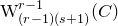 ${\mathrm{W}}_{(r-1)(s+1)}^{r-1}(C)$
is zero, hence
${\mathrm{W}}_{(r-1)(s+1)}^{r-1}(C)$
is zero, hence ${\mathrm{W}}_{(r-1)(s+1)}^{r-1}(C) \ne \varnothing$
by [Reference Arbarello, Cornalba, Griffiths and HarrisACG+85, Theorem V.1.1]. This means that there is a line bundle
${\mathrm{W}}_{(r-1)(s+1)}^{r-1}(C) \ne \varnothing$
by [Reference Arbarello, Cornalba, Griffiths and HarrisACG+85, Theorem V.1.1]. This means that there is a line bundle $\xi$
of degree
$\xi$
of degree $(r-1)(s+1)$
with
$(r-1)(s+1)$
with $h^0(\xi) \ge r$
, hence
$h^0(\xi) \ge r$
, hence $(\xi,\xi^{-1}(K_C))$
is a Mukai pair of type (r,s).
$(\xi,\xi^{-1}(K_C))$
is a Mukai pair of type (r,s).
Finally, if C is BNP-general, the Petri map for $\xi$
is injective, and as the dimensions of its source and target are the same, it is an isomorphism; again, the same property for
$\xi$
is injective, and as the dimensions of its source and target are the same, it is an isomorphism; again, the same property for $\eta$
follows.
$\eta$
follows.
Remark 2.4. If C is BNP-general, then the Brill–Noether locus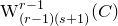 ${\mathrm{W}}^{r-1}_{(r-1)(s+1)}(C)$
is reduced and zero-dimensional of length equal to
${\mathrm{W}}^{r-1}_{(r-1)(s+1)}(C)$
is reduced and zero-dimensional of length equal to
 \begin{equation*}{\mathrm{N}}(r,s) \mathrel{:=}(rs)! \, \frac{\prod\nolimits_{i=1}^{r-1} i! \prod\nolimits_{i=1}^{s-1} i!}{ \prod\nolimits_{i=1}^{r+s-1} i!},\end{equation*}
the degree of the Grassmannian $\mathrm{Gr}(r,r+s)$
(see [Reference Eisenbud and HarrisEH87, Theorem 1]). Therefore, this degree is exactly the number of Mukai pairs of type (r,s) on a BNP-general curve.
$\mathrm{Gr}(r,r+s)$
(see [Reference Eisenbud and HarrisEH87, Theorem 1]). Therefore, this degree is exactly the number of Mukai pairs of type (r,s) on a BNP-general curve.
The following proposition will be important for the study of Lazarsfeld bundles. Part (a), for any r, is attributed to Castelnuovo in [Reference CilibertoCil83, Theorem 1.11].
Proposition 2.5. Let C be a BNP-general curve of genus $g = r \cdot s$
with
$g = r \cdot s$
with $s \ge r$
and
$s \ge r$
and $r \in \{2, 3\}$
.
$r \in \{2, 3\}$
.
-
(a) If
$(\xi, \eta)$
is a Mukai pair on C of type (r,s) then the natural morphism is surjective.
\begin{equation*}{\mathrm{H}}^0(C,\xi) \otimes {\mathrm{H}}^0(C, {\mathcal{O}}_C(K_C)) \to {\mathrm{H}}^0(C, \xi(K_C))\end{equation*}
-
(b) If
$(\xi_1, \eta_1)$
and
$(\xi_2, \eta_2)$
are Mukai pairs of type (r,s) with
$\xi_1 \not\cong \eta_2$
then the natural morphism is surjective.
\begin{equation*}{\mathrm{H}}^0(C, \xi_1) \otimes {\mathrm{H}}^0(C, \eta_2(K_C)) \to {\mathrm{H}}^0(C, \xi_1 \otimes \eta_2(K_C))\end{equation*}


Proof. (a) First, assume $r = 2$
. As
$r = 2$
. As $\xi$
is globally generated by definition, we have an exact sequence
$\xi$
is globally generated by definition, we have an exact sequence
 \begin{equation*}0 \to \xi^{-1} \to {\mathrm{H}}^0(C, \xi) \otimes {\mathcal{O}}_C \to \xi \to 0.\end{equation*}
Twisting this by $K_C$
, we obtain
$K_C$
, we obtain
 \begin{equation*}0 \to \eta \to {\mathrm{H}}^0(C, \xi) \otimes {\mathcal{O}}_C(K_C) \to \xi(K_C) \to 0.\end{equation*}
As $h^1(\eta) = h^0(\xi) = h^1({\mathrm{H}}^0(C, \xi) \otimes {\mathcal{O}}_C(K_C))$
by Serre duality and
$h^1(\eta) = h^0(\xi) = h^1({\mathrm{H}}^0(C, \xi) \otimes {\mathcal{O}}_C(K_C))$
by Serre duality and $h^1(\xi(K_C)) = 0$
because the degree of
$h^1(\xi(K_C)) = 0$
because the degree of $\xi$
is positive, this exact sequence induces a surjection of global sections, which is our claim.
$\xi$
is positive, this exact sequence induces a surjection of global sections, which is our claim.
Now assume $r = 3$
, and let
$r = 3$
, and let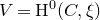 $V = {\mathrm{H}}^0(C, \xi)$
. Since
$V = {\mathrm{H}}^0(C, \xi)$
. Since $\xi$
is globally generated, it induces a morphism
$\xi$
is globally generated, it induces a morphism $C \to {\mathbb{P}}^2 = {\mathbb{P}}(V^{\vee})$
. The pullback of the Koszul complex on
$C \to {\mathbb{P}}^2 = {\mathbb{P}}(V^{\vee})$
. The pullback of the Koszul complex on ${\mathbb{P}}^2$
is an exact sequence
${\mathbb{P}}^2$
is an exact sequence
 \begin{equation*}0 \to \wedge^3 V \otimes \xi^{-3} \to \wedge^2 V \otimes \xi^{-2} \to V \otimes \xi^{-1} \to {\mathcal{O}}_C \to 0.\end{equation*}
Twisting this by $\xi(K_C)$
, we obtain an exact sequence
$\xi(K_C)$
, we obtain an exact sequence
 \begin{equation*}0 \to \wedge^3 V \otimes \xi^{-2}(K_C) \to \wedge^2 V \otimes \xi^{-1}(K_C) \to V \otimes {\mathcal{O}}_C(K_C) \to \xi(K_C) \to 0.\end{equation*}
The ${\mathbf{E}}_1$
page of its hypercohomology spectral sequence has the form
${\mathbf{E}}_1$
page of its hypercohomology spectral sequence has the form

Since it converges to zero, surjectivity of the last arrow in the lower row is equivalent to the dashed arrow in the ${\mathbf{E}}_2$
page being zero. To show this, it is enough to check that the upper row is exact in the second term. Tensoring it with
${\mathbf{E}}_2$
page being zero. To show this, it is enough to check that the upper row is exact in the second term. Tensoring it with $\wedge^3 V^\vee$
, using the natural identifications
$\wedge^3 V^\vee$
, using the natural identifications $V \otimes \wedge^3 V^\vee = \wedge^2 V^\vee$
and
$V \otimes \wedge^3 V^\vee = \wedge^2 V^\vee$
and $\wedge^2 V \otimes \wedge^3 V^\vee = V^\vee$
, and dualizing it afterwards, we obtain the sequence
$\wedge^2 V \otimes \wedge^3 V^\vee = V^\vee$
, and dualizing it afterwards, we obtain the sequence
 \begin{equation*}\wedge^2 V \to V \otimes V \to {\mathrm{H}}^0(C,\xi^2),\end{equation*}
where the first arrow is the natural embedding. Therefore, it is enough to check that the natural map $\mathrm{Sym}^2V = \mathrm{Sym}^2{\mathrm{H}}^0(C,\xi) \to {\mathrm{H}}^0(C,\xi^2)$
is injective. But if it is not injective, the image of the map
$\mathrm{Sym}^2V = \mathrm{Sym}^2{\mathrm{H}}^0(C,\xi) \to {\mathrm{H}}^0(C,\xi^2)$
is injective. But if it is not injective, the image of the map $C \to {\mathbb{P}}^2$
given by
$C \to {\mathbb{P}}^2$
given by $\xi$
is contained in a conic in
$\xi$
is contained in a conic in ${\mathbb{P}}^2$
, hence this map factors through a map
${\mathbb{P}}^2$
, hence this map factors through a map $C \to {\mathbb{P}}^1$
of degree
$C \to {\mathbb{P}}^1$
of degree $1/2\deg(\xi) = 1/2(r - 1)(s + 1) = s + 1$
, hence
$1/2\deg(\xi) = 1/2(r - 1)(s + 1) = s + 1$
, hence ${\mathrm{W}}_{s + 1}^1(C) \ne \varnothing$
, which contradicts the BN-generality of the curve C as
${\mathrm{W}}_{s + 1}^1(C) \ne \varnothing$
, which contradicts the BN-generality of the curve C as $g - 2 (g - s) = 2s - g < 0$
.
$g - 2 (g - s) = 2s - g < 0$
.
(b) As before, consider the morphism $C \to {\mathbb{P}}({\mathrm{H}}^0(C, \xi_1)^\vee)$
and the pullback of the Koszul complex
$C \to {\mathbb{P}}({\mathrm{H}}^0(C, \xi_1)^\vee)$
and the pullback of the Koszul complex
 \begin{equation*}\dots \to \wedge^2{\mathrm{H}}^0(C, \xi_1) \otimes \xi_1^{-2} \to {\mathrm{H}}^0(C, \xi_1) \otimes \xi_1^{-1} \to {\mathcal{O}}_C \to 0.\end{equation*}
Tensoring this by $\xi_1 \otimes \eta_2(K_C)$
, we obtain an exact sequence
$\xi_1 \otimes \eta_2(K_C)$
, we obtain an exact sequence
 \begin{equation*}\dots \to \wedge^2{\mathrm{H}}^0(C, \xi_1) \otimes \xi_1^{-1} \otimes \eta_2(K_C) \to {\mathrm{H}}^0(C, \xi_1) \otimes \eta_2(K_C) \to \xi_1 \otimes \eta_2(K_C) \to 0.\end{equation*}
Now note that $\deg(\xi_1) = r \le s = \deg(\eta_2)$
, and if this is an equality,
$\deg(\xi_1) = r \le s = \deg(\eta_2)$
, and if this is an equality, $\xi_1^{-1} \otimes \eta_2$
is a non-trivial (by the assumption
$\xi_1^{-1} \otimes \eta_2$
is a non-trivial (by the assumption $\xi_1 \not\cong \eta_2$
) line bundle of degree zero, hence
$\xi_1 \not\cong \eta_2$
) line bundle of degree zero, hence ${\mathrm{H}}^1(C, \xi_1^{-1} \otimes \eta_2(K_C)) = 0$
. Therefore, the hypercohomology spectral sequence proves the surjectivity of the required map.
${\mathrm{H}}^1(C, \xi_1^{-1} \otimes \eta_2(K_C)) = 0$
. Therefore, the hypercohomology spectral sequence proves the surjectivity of the required map.
2.2 Quasipolarized K3 surfaces
In § 5 we will have to deal with polarized K3 surfaces with du Val singularities; these will appear as special members of generic pencils of hyperplane sections of terminal Fano threefolds. A minimal resolution of such a surface is a smooth quasipolarized K3 surface. In this subsection we explain this relation and prove a few useful results. For readers only interested in the case where X is smooth, it is enough to consider the case of K3 surfaces that have at most one ordinary double point, since in this case a generic pencil is a Lefschetz pencil.
So, let $(\bar{S},\bar{H})$
be a K3 surface with du Val singularities and an ample class
$(\bar{S},\bar{H})$
be a K3 surface with du Val singularities and an ample class $\bar{H} \in \mathrm{Pic}(\bar{S})$
. Let
$\bar{H} \in \mathrm{Pic}(\bar{S})$
. Let
 \begin{equation*}\sigma \colon S \to \bar{S},\quad H \mathrel{:=} \sigma^*(\bar{H})\end{equation*}
be the minimal resolution of singularities and the pullback of the ample class. Then S is a smooth K3 surface and $H \in \mathrm{Pic}(S)$
is a quasipolarization, that is, a big and nef divisor class. The exceptional locus of
$H \in \mathrm{Pic}(S)$
is a quasipolarization, that is, a big and nef divisor class. The exceptional locus of $\sigma$
is formed by a finite number of smooth rational curves
$\sigma$
is formed by a finite number of smooth rational curves $R_i \subset S$
that are characterized by the condition
$R_i \subset S$
that are characterized by the condition $H \cdot R_i = 0$
and form an ADE configuration that we denote by
$H \cdot R_i = 0$
and form an ADE configuration that we denote by ${\mathfrak{R}}(S,H)$
.
${\mathfrak{R}}(S,H)$
.
Conversely, if (S,H) is a quasipolarized K3 surface, all irreducible curves orthogonal to H are smooth and rational and they form an ADE configuration ${\mathfrak{R}}(S,H)$
(see [Reference Saint-DonatSD74, (4.2)]); moreover, a multiple of H defines a proper birational morphism
${\mathfrak{R}}(S,H)$
(see [Reference Saint-DonatSD74, (4.2)]); moreover, a multiple of H defines a proper birational morphism $\sigma \colon S \to \bar{S}$
onto a K3 surface
$\sigma \colon S \to \bar{S}$
onto a K3 surface $\bar{S}$
with du Val singularities contracting the configuration
$\bar{S}$
with du Val singularities contracting the configuration ${\mathfrak{R}}(S,H)$
so that H is the pullback of an ample class
${\mathfrak{R}}(S,H)$
so that H is the pullback of an ample class $\bar{H} \in \mathrm{Pic}(\bar{S})$
. The morphism
$\bar{H} \in \mathrm{Pic}(\bar{S})$
. The morphism $\sigma$
will be referred to as the contraction of
$\sigma$
will be referred to as the contraction of ${\mathfrak{R}}(S,H)$
.
${\mathfrak{R}}(S,H)$
.
The two above constructions are mutually inverse, so the language of polarized du Val K3 surfaces is equivalent to the language of quasipolarized smooth K3 surfaces. Below we use the language that is more convenient, depending on the situation.
If H is a quasipolarization of a smooth (or a polarization of a du Val) K3 surface S then
 \begin{equation}H^2 = 2g - 2,\quad h^0({\mathcal{O}}_S(H)) = g + 1,\quad \text{and}\quad h^1({\mathcal{O}}_S(H)) = h^2({\mathcal{O}}_S(H)) = 0,\end{equation}
where $g \ge 2$
is an integer called the genus of (S,H). The line bundle
$g \ge 2$
is an integer called the genus of (S,H). The line bundle ${\mathcal{O}}_S(H)$
is globally generated if and only if the linear system
${\mathcal{O}}_S(H)$
is globally generated if and only if the linear system $|H|$
contains a smooth connected curve
$|H|$
contains a smooth connected curve $C \subset S$
of genus g; one direction follows from Bertini’s theorem and [Reference Saint-DonatSD74, Proposition 2.6], the other is [Reference Saint-DonatSD74, Theorem 3.1].
$C \subset S$
of genus g; one direction follows from Bertini’s theorem and [Reference Saint-DonatSD74, Proposition 2.6], the other is [Reference Saint-DonatSD74, Theorem 3.1].
If (S,H) is a quasipolarized smooth K3 surface, the irreducible curves $R_i$
that form the ADE configuration
$R_i$
that form the ADE configuration ${\mathfrak{R}}(S,H)$
are called the simple roots; they satisfy
${\mathfrak{R}}(S,H)$
are called the simple roots; they satisfy $R_i^2 = -2$
and generate a root system in
$R_i^2 = -2$
and generate a root system in $H^\perp \subset \mathrm{Pic}(S) \otimes {\mathbb{R}}$
. Its positive roots are non-negative linear combinations
$H^\perp \subset \mathrm{Pic}(S) \otimes {\mathbb{R}}$
. Its positive roots are non-negative linear combinations $R = \sum a_i R_i$
such that
$R = \sum a_i R_i$
such that $R^2 = -2$
, and the reflections in
$R^2 = -2$
, and the reflections in $R_i$
generate an action of the corresponding Weyl group.
$R_i$
generate an action of the corresponding Weyl group.
A basic fact about Weyl groups (see, for example, Corollary 2 to Proposition IV.17 in [Reference BourbakiBou02]) tells us that for any non-simple positive root R there is a simple root $R_j$
such that
$R_j$
such that $R \cdot R_j = -1$
. Then
$R \cdot R_j = -1$
. Then $R' = R - R_j$
is also a positive root and
$R' = R - R_j$
is also a positive root and $R' \cdot R_j = 1$
. Therefore, considering R and R’ as Cartier divisors on S, we obtain exact sequences
$R' \cdot R_j = 1$
. Therefore, considering R and R’ as Cartier divisors on S, we obtain exact sequences
 \begin{equation}0 \to {\mathcal{O}}_{R_j}(-1) \to {\mathcal{O}}_R \to {\mathcal{O}}_{R'} \to 0\end{equation}
and
 \begin{equation}0 \to {\mathcal{O}}_{R'}(-R_j) \to {\mathcal{O}}_R \to {\mathcal{O}}_{R_j} \to 0.\end{equation}
These sequences are useful for inductive arguments about positive roots.
Lemma 2.6. If $D \in \mathrm{Pic}(S)$
and
$D \in \mathrm{Pic}(S)$
and $R = \sum a_iR_i$
is a positive root in
$R = \sum a_iR_i$
is a positive root in ${\mathfrak{R}}(S,H)$
then
${\mathfrak{R}}(S,H)$
then
 \begin{equation*}\chi({\mathcal{O}}_R(D)) = 1 + D \cdot R.\end{equation*}
Moreover, if $D \cdot R_i \le 0$
for all
$D \cdot R_i \le 0$
for all $R_i$
with
$R_i$
with $a_i \gt 0$
and
$a_i \gt 0$
and $D \cdot R < 0$
then
$D \cdot R < 0$
then $h^0({\mathcal{O}}_R(D)) = 0$
.
$h^0({\mathcal{O}}_R(D)) = 0$
.
Proof. The formula for $\chi({\mathcal{O}}_R(D))$
follows immediately from the Riemann–Roch theorem.
$\chi({\mathcal{O}}_R(D))$
follows immediately from the Riemann–Roch theorem.
The second statement is clear if R is a simple root. Otherwise, we consider exact sequences (10) and (11), where $R_j$
is a simple root such that
$R_j$
is a simple root such that $R \cdot R_j = -1$
and
$R \cdot R_j = -1$
and $R' = R- R_j$
, so that
$R' = R- R_j$
, so that $R' \cdot R_j = 1$
. Since R’ is a positive root, we have
$R' \cdot R_j = 1$
. Since R’ is a positive root, we have $a_j \gt 0$
, hence
$a_j \gt 0$
, hence $D \cdot R_j \le 0$
by the hypothesis of the lemma.
$D \cdot R_j \le 0$
by the hypothesis of the lemma.
If $D \cdot R' < 0$
, twisting (10) by D and noting that
$D \cdot R' < 0$
, twisting (10) by D and noting that $h^0({\mathcal{O}}_{R_j}(D \cdot R_j - 1)) = 0$
because
$h^0({\mathcal{O}}_{R_j}(D \cdot R_j - 1)) = 0$
because $D \cdot R_j \le 0$
, we see that
$D \cdot R_j \le 0$
, we see that $h^0({\mathcal{O}}_R(D)) \le h^0({\mathcal{O}}_{R'}(D))$
, which is zero by induction, hence
$h^0({\mathcal{O}}_R(D)) \le h^0({\mathcal{O}}_{R'}(D))$
, which is zero by induction, hence $h^0({\mathcal{O}}_R(D)) = 0$
.
$h^0({\mathcal{O}}_R(D)) = 0$
.
On the other hand, the hypotheses of the lemma imply that $D \cdot R' = \sum_i (a_i - \delta_{i,j}) D \cdot R_i \le 0$
, so if
$D \cdot R' = \sum_i (a_i - \delta_{i,j}) D \cdot R_i \le 0$
, so if $D \cdot R' \ge 0$
, it follows that
$D \cdot R' \ge 0$
, it follows that $D \cdot R' = 0$
and
$D \cdot R' = 0$
and $D \cdot R_j < 0$
, hence
$D \cdot R_j < 0$
, hence $h^0({\mathcal{O}}_{R_j}(D)) = 0$
. It also follows that
$h^0({\mathcal{O}}_{R_j}(D)) = 0$
. It also follows that $a_j = 1$
; therefore, twisting (11) by D, we obtain
$a_j = 1$
; therefore, twisting (11) by D, we obtain $h^0({\mathcal{O}}_R(D)) = h^0({\mathcal{O}}_{R'}(D - R_j))$
, and since
$h^0({\mathcal{O}}_R(D)) = h^0({\mathcal{O}}_{R'}(D - R_j))$
, and since $(D - R_j) \cdot R' = -R' \cdot R_j = -1$
, this is zero, again by induction.
$(D - R_j) \cdot R' = -R' \cdot R_j = -1$
, this is zero, again by induction.
Using further the terminology of Weyl groups, we will say that a divisor class D on a quasipolarized K3 surface (S,H) is minuscule if
 \begin{equation*}D \cdot R \in \{-1,0,1\}\end{equation*}
for any positive root R in the ADE configuration ${\mathfrak{R}}(S,H)$
.
${\mathfrak{R}}(S,H)$
.
If D is minuscule, by [Reference BourbakiBou02, Exercises 23, 24 to Chapter VI.2] there is a sequence of minuscule divisor classes $D_0 = D, D_1, \dots, D_n$
such that for each
$D_0 = D, D_1, \dots, D_n$
such that for each $1 \le k \le n$
the difference
$1 \le k \le n$
the difference $R_{i_k} \mathrel{:=} D_{k-1} - D_{k}$
is a simple root satisfying
$R_{i_k} \mathrel{:=} D_{k-1} - D_{k}$
is a simple root satisfying $D_k \cdot R_{i_k} = - D_{k-1} \cdot R_{i_k} = 1$
, so that there are exact sequences
$D_k \cdot R_{i_k} = - D_{k-1} \cdot R_{i_k} = 1$
, so that there are exact sequences
 \begin{equation}0 \to {\mathcal{O}}_S(D_k) \to {\mathcal{O}}_S(D_{k-1}) \to {\mathcal{O}}_{R_{i_k}}(-1) \to 0,\end{equation}
and $D_n \cdot R \in \{0,1\}$
for all positive roots R in
$D_n \cdot R \in \{0,1\}$
for all positive roots R in ${\mathfrak{R}}(S,H)$
; in other words,
${\mathfrak{R}}(S,H)$
; in other words, $D_n$
is nef over the contraction
$D_n$
is nef over the contraction $\bar{S}$
of
$\bar{S}$
of ${\mathfrak{R}}(S,H)$
. The sequence
${\mathfrak{R}}(S,H)$
. The sequence $\{D_k\}$
as above is not unique, but the last element
$\{D_k\}$
as above is not unique, but the last element $D_n$
is unique; we will call it the dominant replacement for D and denote it by
$D_n$
is unique; we will call it the dominant replacement for D and denote it by $D_+$
. Note that
$D_+$
. Note that
 \begin{equation}D_+^2 = D^2,\quad H \cdot D_+ = H \cdot D,\quad \text{and}\quad {\mathrm{H}}^\bullet(S, {\mathcal{O}}_S(D_+)) \cong {\mathrm{H}}^\bullet(S, {\mathcal{O}}_S(D)).\end{equation}
Moreover, if $\sigma \colon S \to \bar{S}$
is the contraction of
$\sigma \colon S \to \bar{S}$
is the contraction of ${\mathfrak{R}}(S,H)$
then
${\mathfrak{R}}(S,H)$
then
 \begin{equation}{\mathrm{R}}\sigma_*{\mathcal{O}}_S(D) \cong {\mathrm{R}}\sigma_*{\mathcal{O}}_S(D_+).\end{equation}
Indeed, both (13) and (14) follow from the definition and sequences (12) by induction.
Recall that a coherent sheaf ${\mathcal{F}}$
on a scheme X is maximal Cohen–Macaulay if
${\mathcal{F}}$
on a scheme X is maximal Cohen–Macaulay if $\mathcal{E}\!\mathit{xt}^i({\mathcal{F}}, {\mathcal{O}}_X) = 0$
for all
$\mathcal{E}\!\mathit{xt}^i({\mathcal{F}}, {\mathcal{O}}_X) = 0$
for all $i \ge 1$
(see [Reference BuchweitzBuc21, Definition 4.2.1]); in other words, if the derived dual of
$i \ge 1$
(see [Reference BuchweitzBuc21, Definition 4.2.1]); in other words, if the derived dual of ${\mathcal{F}}$
is a pure sheaf. We refer to [Reference BuchweitzBuc21] for the basic properties of maximal Cohen–Macaulay sheaves.
${\mathcal{F}}$
is a pure sheaf. We refer to [Reference BuchweitzBuc21] for the basic properties of maximal Cohen–Macaulay sheaves.
Lemma 2.7. Let (S,H) be a quasipolarized K3 surface of genus $g = r \cdot s$
. Let
$g = r \cdot s$
. Let $\sigma \colon S \to \bar{S}$
be the contraction of the ADE configuration
$\sigma \colon S \to \bar{S}$
be the contraction of the ADE configuration ${\mathfrak{R}}(S,H)$
. If
${\mathfrak{R}}(S,H)$
. If $D \in \mathrm{Pic}(S)$
is a minuscule divisor class on S then
$D \in \mathrm{Pic}(S)$
is a minuscule divisor class on S then ${\mathrm{R}}^1\sigma_*{\mathcal{O}}_S(D) = 0$
and
${\mathrm{R}}^1\sigma_*{\mathcal{O}}_S(D) = 0$
and
 \begin{equation}(\sigma_*{\mathcal{O}}_S(D))^\vee \cong \sigma_*{\mathcal{O}}_S(-D).\end{equation}
In particular, $\sigma_*{\mathcal{O}}_S(D)$
is a maximal Cohen–Macaulay sheaf on
$\sigma_*{\mathcal{O}}_S(D)$
is a maximal Cohen–Macaulay sheaf on $\bar{S}$
. If, moreover, the dominant replacement
$\bar{S}$
. If, moreover, the dominant replacement $D_+$
is globally generated, then so is the sheaf
$D_+$
is globally generated, then so is the sheaf $\sigma_*{\mathcal{O}}_S(D)$
.
$\sigma_*{\mathcal{O}}_S(D)$
.
Proof. The dominant replacement $D_+$
for D is nef over
$D_+$
for D is nef over $\bar{S}$
; hence, we have
$\bar{S}$
; hence, we have ${\mathrm{R}}^1\sigma_*{\mathcal{O}}_S(D_+) = 0$
by the Kawamata–Viehweg vanishing theorem. Applying (14), we obtain
${\mathrm{R}}^1\sigma_*{\mathcal{O}}_S(D_+) = 0$
by the Kawamata–Viehweg vanishing theorem. Applying (14), we obtain ${\mathrm{R}}^1\sigma_*{\mathcal{O}}_S(D) = 0$
. Furthermore,
${\mathrm{R}}^1\sigma_*{\mathcal{O}}_S(D) = 0$
. Furthermore,
 \begin{equation*}\mathrm{R}\mathcal{H}\mathit{om}(\sigma_*{\mathcal{O}}_{S}(D), {\mathcal{O}}_{\bar{S}}) \cong {\mathrm{R}}\sigma_*\mathrm{R}\mathcal{H}\mathit{om}({\mathcal{O}}_{S}(D), \sigma^!{\mathcal{O}}_{\bar{S}}) \cong {\mathrm{R}}\sigma_*\mathrm{R}\mathcal{H}\mathit{om}({\mathcal{O}}_{S}(D), {\mathcal{O}}_{S}) \cong {\mathrm{R}}\sigma_*{\mathcal{O}}_{S}(-D)\end{equation*}
(where the first isomorphism is the Grothendieck duality and the second is the crepancy of $\sigma$
). Clearly, the divisor
$\sigma$
). Clearly, the divisor $-D$
is also minuscule, hence the right-hand side is a pure sheaf, hence
$-D$
is also minuscule, hence the right-hand side is a pure sheaf, hence $\sigma_*{\mathcal{O}}_{S}(D)$
is a maximal Cohen–Macaulay sheaf and (15) holds.
$\sigma_*{\mathcal{O}}_{S}(D)$
is a maximal Cohen–Macaulay sheaf and (15) holds.
If D is minuscule and $D_+$
is globally generated then the zero locus of a general pair of global sections of
$D_+$
is globally generated then the zero locus of a general pair of global sections of ${\mathcal{O}}_S(D_+)$
is a zero-dimensional subscheme of S, disjoint from the union
${\mathcal{O}}_S(D_+)$
is a zero-dimensional subscheme of S, disjoint from the union $\cup R_i$
of all simple roots in
$\cup R_i$
of all simple roots in ${\mathfrak{R}}(S,H)$
. Therefore, the corresponding Koszul complex
${\mathfrak{R}}(S,H)$
. Therefore, the corresponding Koszul complex
 \begin{equation*}0 \to {\mathcal{O}}_S(-D_+) \to {\mathcal{O}}_S \oplus {\mathcal{O}}_S \to {\mathcal{O}}_S(D_+) \to 0\end{equation*}
is exact in a neighbourhood of $\cup R_i$
. Pushing it forward to
$\cup R_i$
. Pushing it forward to $\bar{S}$
and taking into account that
$\bar{S}$
and taking into account that $-D_+$
is also minuscule, and hence
$-D_+$
is also minuscule, and hence ${\mathrm{R}}^1\sigma_*{\mathcal{O}}_S(-D_+) = 0$
, we see that
${\mathrm{R}}^1\sigma_*{\mathcal{O}}_S(-D_+) = 0$
, we see that $\sigma_*{\mathcal{O}}_S(D_+)$
is globally generated in a neighbourhood of
$\sigma_*{\mathcal{O}}_S(D_+)$
is globally generated in a neighbourhood of $\mathrm{Sing}(\bar{S})$
. On the other hand, over the complement of
$\mathrm{Sing}(\bar{S})$
. On the other hand, over the complement of $\mathrm{Sing}(\bar{S})$
the morphism
$\mathrm{Sing}(\bar{S})$
the morphism $\sigma$
is an isomorphism, hence
$\sigma$
is an isomorphism, hence $\sigma_*{\mathcal{O}}_S(D_+)$
is globally generated away from
$\sigma_*{\mathcal{O}}_S(D_+)$
is globally generated away from $\mathrm{Sing}(\bar{S})$
, hence everywhere. Since
$\mathrm{Sing}(\bar{S})$
, hence everywhere. Since $\sigma_*{\mathcal{O}}_S(D) \cong \sigma_*{\mathcal{O}}_S(D_+)$
by (14), it is also globally generated.
$\sigma_*{\mathcal{O}}_S(D) \cong \sigma_*{\mathcal{O}}_S(D_+)$
by (14), it is also globally generated.
2.3 Brill–Noether theory for K3 surfaces
The following definition was introduced in [Reference MukaiMuk02, Definition 3.8] for polarized K3 surfaces; we generalize it to the case of quasipolarizations.
Definition 2.8. A quasipolarized K3 surface (S,H) is called Brill–Noether general (BN-general) if
 \begin{equation*}h^0({\mathcal{O}}_S(D)) \cdot h^0({\mathcal{O}}_S(H - D)) < h^0({\mathcal{O}}_S(H)) = g + 1\end{equation*}
for all $D \not\in \{0,H\}$
, where g is the genus of (S,H) (see (9)).
$D \not\in \{0,H\}$
, where g is the genus of (S,H) (see (9)).
Remark 2.9. In general, a quasipolarization H may have base points, but if (S,H) is BN-general, it is base-point-free. Indeed, if H is not base-point-free, then by [Reference Saint-DonatSD74, Corollary 3.2] the linear system $|H|$
has a fixed component D. In particular,
$|H|$
has a fixed component D. In particular, $h^0({\mathcal{O}}_S(H-D)) = h^0({\mathcal{O}}_S(H)) = g+1$
and
$h^0({\mathcal{O}}_S(H-D)) = h^0({\mathcal{O}}_S(H)) = g+1$
and
 \begin{equation*}h^0({\mathcal{O}}_S(D)) \cdot h^0({\mathcal{O}}_S(H-D)) = 1 \cdot (g+1) = g+1,\end{equation*}
contradicting the assumption that (S, H) is BN-general.
The following theorem relates Brill–Noether properties of curves and K3 surfaces.
Theorem 2.10. Let (S,H) be a quasipolarized K3 surface of genus $g \ge 2$
.
$g \ge 2$
.
-
(a) If
$|H|$
contains a smooth connected BN-general curve
$C \subset S$
then (S,H) is BN-general. -
(b) If every curve in
$|H|$
is reduced and irreducible then a general curve in
$|H|$
is BNP-general.


Proof. Part (b) is easy. Assume $h^0({\mathcal{O}}_S(D)) \cdot h^0({\mathcal{O}}_S(C-D)) \ge g + 1$
. Using the exact sequence
$h^0({\mathcal{O}}_S(D)) \cdot h^0({\mathcal{O}}_S(C-D)) \ge g + 1$
. Using the exact sequence
 \begin{equation*}0 \to {\mathcal{O}}_S(D - C) \to {\mathcal{O}}_S(D) \to {\mathcal{O}}_C(D\vert_C) \to 0\end{equation*}
and effectivity and non-triviality of $C - D$
, we obtain
$C - D$
, we obtain $h^0({\mathcal{O}}_C(D\vert_C)) \ge h^0({\mathcal{O}}_S(D))$
. Using the similar inequality for
$h^0({\mathcal{O}}_C(D\vert_C)) \ge h^0({\mathcal{O}}_S(D))$
. Using the similar inequality for $C - D$
, we obtain
$C - D$
, we obtain
 \begin{equation*}h^0({\mathcal{O}}_C(D\vert_C)) \cdot h^0({\mathcal{O}}_C((C-D)\vert_C)) \ge g + 1\end{equation*}
which contradicts the BN-generality of C.
Part (b) is much harder; it is proved in [Reference LazarsfeldLaz86].
Remark 2.11. Part (b) has been partially extended in [Reference HaburcakHab24, Theorem 1] to BN-general K3 surfaces of genus $g \le 19$
, showing that in these cases a smooth curve in
$g \le 19$
, showing that in these cases a smooth curve in $|C|$
is BN-general.
$|C|$
is BN-general.
The following definition is analogous to Definition 2.2 of a Mukai pair on a curve; it plays an important role in the rest of the paper.
Definition 2.12. Let $r, s \ge 2$
. A special Mukai class of type (r,s) on a quasipolarized smooth K3 surface (S,H) of genus
$r, s \ge 2$
. A special Mukai class of type (r,s) on a quasipolarized smooth K3 surface (S,H) of genus $g = r\cdot s$
is a globally generated class
$g = r\cdot s$
is a globally generated class $\Xi \in \mathrm{Pic}(S)$
such that
$\Xi \in \mathrm{Pic}(S)$
such that
 \begin{equation}\Xi \cdot H = (r - 1)(s + 1),\quad h^0({\mathcal{O}}_S(\Xi)) = r,\quad \text{and}\quad h^1({\mathcal{O}}_S(\Xi)) = h^2({\mathcal{O}}_S(\Xi)) = 0.\end{equation}
Recall from § 2.2 the definition of minuscule divisor classes.
Lemma 2.13. If $\Xi$
is a special Mukai class of type (r,s) on a BN-general quasipolarized K3 surface (S,H) of genus
$\Xi$
is a special Mukai class of type (r,s) on a BN-general quasipolarized K3 surface (S,H) of genus $g = r \cdot s$
then
$g = r \cdot s$
then
 \begin{equation*}(H - \Xi) \cdot H = (r + 1)(s - 1),\quad h^0({\mathcal{O}}_S(H - \Xi)) = s,\!\quad \text{and}\quad \!h^1({\mathcal{O}}_S(H - \Xi)) = h^2({\mathcal{O}}_S(H - \Xi)) = 0.\end{equation*}
Moreover, $\Xi$
and
$\Xi$
and $H - \Xi$
are minuscule.
$H - \Xi$
are minuscule.
Proof. We have $H \cdot (H - \Xi) = 2rs - 2 - (r - 1)(s + 1) = (r + 1)(s - 1) \gt 0$
, hence
$H \cdot (H - \Xi) = 2rs - 2 - (r - 1)(s + 1) = (r + 1)(s - 1) \gt 0$
, hence $h^0({\mathcal{O}}_S(\Xi - H)) = 0$
and the natural exact sequence
$h^0({\mathcal{O}}_S(\Xi - H)) = 0$
and the natural exact sequence
 \begin{equation*}0 \to {\mathcal{O}}_S(\Xi - H) \to {\mathcal{O}}_S(\Xi) \to {\mathcal{O}}_C(\Xi\vert_C) \to 0\end{equation*}
shows that $h^0({\mathcal{O}}_C(\Xi\vert_C)) \ge h^0({\mathcal{O}}_S(\Xi)) = r$
. Since, on the other hand,
$h^0({\mathcal{O}}_C(\Xi\vert_C)) \ge h^0({\mathcal{O}}_S(\Xi)) = r$
. Since, on the other hand, $\deg({\mathcal{O}}_S(\Xi)\vert_C) = (r - 1)$ $(s + 1)$
, it follows that
$(s + 1)$
, it follows that $h^1({\mathcal{O}}_C(\Xi\vert_C)) \ge s$
, and then the above exact sequence implies that
$h^1({\mathcal{O}}_C(\Xi\vert_C)) \ge s$
, and then the above exact sequence implies that
 \begin{equation*}h^0({\mathcal{O}}_S(H - \Xi)) = h^2({\mathcal{O}}_S(\Xi - H)) = h^1({\mathcal{O}}_C(\Xi\vert_C)) \ge s.\end{equation*}
By BN-generality of S, this must be an equality, and then, using Riemann–Roch and taking the vanishing $h^2({\mathcal{O}}_S(H - \Xi)) = h^0({\mathcal{O}}_S(\Xi - H))$
into account, we deduce the first part of the lemma.
$h^2({\mathcal{O}}_S(H - \Xi)) = h^0({\mathcal{O}}_S(\Xi - H))$
into account, we deduce the first part of the lemma.
For the second part, since $(H - \Xi) \cdot R = - \Xi \cdot R$
, it is enough to show that
$(H - \Xi) \cdot R = - \Xi \cdot R$
, it is enough to show that $\Xi$
is minuscule. So, let R be a positive root. We have
$\Xi$
is minuscule. So, let R be a positive root. We have $\Xi \cdot R \ge 0$
because
$\Xi \cdot R \ge 0$
because $\Xi$
is globally generated, hence nef, and R is effective, and it remains to show that
$\Xi$
is globally generated, hence nef, and R is effective, and it remains to show that $\Xi \cdot R \le 1$
. So, assume
$\Xi \cdot R \le 1$
. So, assume $\Xi \cdot R \ge 2$
. Then
$\Xi \cdot R \ge 2$
. Then $(\Xi + R) \cdot R \ge 0$
, hence
$(\Xi + R) \cdot R \ge 0$
, hence $\chi({\mathcal{O}}_R(\Xi + R)) \gt 0$
by Lemma 2.6, hence
$\chi({\mathcal{O}}_R(\Xi + R)) \gt 0$
by Lemma 2.6, hence $h^0({\mathcal{O}}_R(\Xi + R)) \gt 0$
, and the exact sequence
$h^0({\mathcal{O}}_R(\Xi + R)) \gt 0$
, and the exact sequence
 \begin{equation*}0 \to {\mathcal{O}}_S(\Xi) \to {\mathcal{O}}_S(\Xi + R) \to {\mathcal{O}}_R(\Xi + R) \to 0\end{equation*}
implies that $h^0({\mathcal{O}}_S(\Xi + R)) \gt h^0({\mathcal{O}}_S(\Xi)) = r$
.
$h^0({\mathcal{O}}_S(\Xi + R)) \gt h^0({\mathcal{O}}_S(\Xi)) = r$
.
On the other hand, $(H - \Xi) \cdot R_i = - \Xi \cdot R_i \le 0$
for any simple root
$(H - \Xi) \cdot R_i = - \Xi \cdot R_i \le 0$
for any simple root $R_i$
, because
$R_i$
, because $\Xi$
is nef, and
$\Xi$
is nef, and $(H - \Xi) \cdot R = - \Xi \cdot R\le -2$
, hence we have
$(H - \Xi) \cdot R = - \Xi \cdot R\le -2$
, hence we have $h^0({\mathcal{O}}_R(H - \Xi)) = 0$
, again by Lemma 2.6. Now the exact sequence
$h^0({\mathcal{O}}_R(H - \Xi)) = 0$
, again by Lemma 2.6. Now the exact sequence
 \begin{equation*}0 \to {\mathcal{O}}_S(H - \Xi - R) \to {\mathcal{O}}_S(H - \Xi) \to {\mathcal{O}}_R(H - \Xi) \to 0\end{equation*}
implies that $h^0({\mathcal{O}}_S(H - \Xi - R)) = h^0({\mathcal{O}}_S(H - \Xi)) = s$
. We conclude that
$h^0({\mathcal{O}}_S(H - \Xi - R)) = h^0({\mathcal{O}}_S(H - \Xi)) = s$
. We conclude that
 \begin{equation*}h^0({\mathcal{O}}_S(\Xi + R)) \cdot h^0({\mathcal{O}}_S(H - \Xi - R)) \gt rs = g,\end{equation*}
contradicting Brill–Noether generality of (S,H). Thus, $\Xi$
is minuscule.
$\Xi$
is minuscule.
The next result gives a precise relation between special Mukai classes and Mukai pairs. Recall from § 2.2 the definition of the dominant replacement $D_+$
of a minuscule divisor class D.
$D_+$
of a minuscule divisor class D.
Proposition 2.14. Let $\Xi$
be a special Mukai class of type (r,s) on a BN-general quasipolarized K3 surface (S,H) of genus
$\Xi$
be a special Mukai class of type (r,s) on a BN-general quasipolarized K3 surface (S,H) of genus $g =r \cdot s \ge 4$
. If (S,H) contains a BNP-general curve
$g =r \cdot s \ge 4$
. If (S,H) contains a BNP-general curve $C \in |H|$
then
$C \in |H|$
then $(H - \Xi)_+$
is a special Mukai class of type (s,r) and
$(H - \Xi)_+$
is a special Mukai class of type (s,r) and $({\mathcal{O}}_S(\Xi)\vert_C, {\mathcal{O}}_S(H - \Xi)\vert_C)$
is a Mukai pair.
$({\mathcal{O}}_S(\Xi)\vert_C, {\mathcal{O}}_S(H - \Xi)\vert_C)$
is a Mukai pair.
Proof. Using Lemma 2.13 and (13), we see that $(H - \Xi)_+$
satisfies conditions (16) (where the roles of r and s are swapped); in particular, Riemann–Roch implies that
$(H - \Xi)_+$
satisfies conditions (16) (where the roles of r and s are swapped); in particular, Riemann–Roch implies that $(H - \Xi)_+^2 = 2s - 4$
. So it remains to show that it is globally generated.
$(H - \Xi)_+^2 = 2s - 4$
. So it remains to show that it is globally generated.
Assume to the contrary that $(H - \Xi)_+$
is not globally generated. We saw in the proof of Lemma 2.13 that
$(H - \Xi)_+$
is not globally generated. We saw in the proof of Lemma 2.13 that $h^0({\mathcal{O}}_C(\Xi\vert_C)) \ge r$
. Since C is BN-general,
$h^0({\mathcal{O}}_C(\Xi\vert_C)) \ge r$
. Since C is BN-general, $({\mathcal{O}}_S(\Xi)\vert_C, {\mathcal{O}}_S(H - \Xi)\vert_C)$
is a Mukai pair by Lemma 2.3, and in particular
$({\mathcal{O}}_S(\Xi)\vert_C, {\mathcal{O}}_S(H - \Xi)\vert_C)$
is a Mukai pair by Lemma 2.3, and in particular ${\mathcal{O}}_C((H - \Xi)_+\vert_C) \cong {\mathcal{O}}_C((H - \Xi)\vert_C)$
is globally generated. Since
${\mathcal{O}}_C((H - \Xi)_+\vert_C) \cong {\mathcal{O}}_C((H - \Xi)\vert_C)$
is globally generated. Since $h^1({\mathcal{O}}_S(-\Xi)) = 0$
, the restriction morphism
$h^1({\mathcal{O}}_S(-\Xi)) = 0$
, the restriction morphism ${\mathrm{H}}^0(S, {\mathcal{O}}_S((H - \Xi))) \to {\mathrm{H}}^0(C, {\mathcal{O}}_C((H - \Xi)\vert_C))$
is surjective, and then (13) implies that
${\mathrm{H}}^0(S, {\mathcal{O}}_S((H - \Xi))) \to {\mathrm{H}}^0(C, {\mathcal{O}}_C((H - \Xi)\vert_C))$
is surjective, and then (13) implies that ${\mathrm{H}}^0(S, {\mathcal{O}}_S((H - \Xi)_{+})) \to {\mathrm{H}}^0(C, {\mathcal{O}}_C((H - \Xi)_{+}\vert_C))$
is surjective as well, hence
${\mathrm{H}}^0(S, {\mathcal{O}}_S((H - \Xi)_{+})) \to {\mathrm{H}}^0(C, {\mathcal{O}}_C((H - \Xi)_{+}\vert_C))$
is surjective as well, hence $(H - \Xi)_+$
is globally generated in a neighbourhood of C. Since C intersects any curve on S except for those in
$(H - \Xi)_+$
is globally generated in a neighbourhood of C. Since C intersects any curve on S except for those in ${\mathfrak{R}}(S,H)$
and since the base locus of a divisor on a smooth K3 surface is a Cartier divisor (see [Reference Saint-DonatSD74, Corollary 3.2]), we conclude that the base locus of
${\mathfrak{R}}(S,H)$
and since the base locus of a divisor on a smooth K3 surface is a Cartier divisor (see [Reference Saint-DonatSD74, Corollary 3.2]), we conclude that the base locus of $(H - \Xi)_+$
is contained in the ADE configuration
$(H - \Xi)_+$
is contained in the ADE configuration ${\mathfrak{R}}(S,H)$
. Thus,
${\mathfrak{R}}(S,H)$
. Thus,
 \begin{equation*}(H - \Xi)_+ \cdot \Gamma \ge 0\end{equation*}
for any irreducible curve not contained in ${\mathfrak{R}}(S,H)$
. But the same inequality also holds for any
${\mathfrak{R}}(S,H)$
. But the same inequality also holds for any $\Gamma$
contained in
$\Gamma$
contained in ${\mathfrak{R}}(S,H)$
by the definition of dominant replacement. Therefore,
${\mathfrak{R}}(S,H)$
by the definition of dominant replacement. Therefore, $(H - \Xi)_+$
is nef. Since it is not globally generated by our assumption, [Reference ReidRei97, Theorem 3.8(b)] implies that
$(H - \Xi)_+$
is nef. Since it is not globally generated by our assumption, [Reference ReidRei97, Theorem 3.8(b)] implies that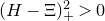 $(H - \Xi)_+^2 \gt 0$
, then [Reference ReidRei97, Theorem 3.8(c)] shows that
$(H - \Xi)_+^2 \gt 0$
, then [Reference ReidRei97, Theorem 3.8(c)] shows that $(H - \Xi)_+$
is big, and [Reference ReidRei97, Theorem 3.8(d)] proves that
$(H - \Xi)_+$
is big, and [Reference ReidRei97, Theorem 3.8(d)] proves that
 \begin{equation*}(H - \Xi)_+ = aE + R_i,\end{equation*}
where $R_i$
is a simple root,
$R_i$
is a simple root, $|E|$
is an elliptic pencil,
$|E|$
is an elliptic pencil, $E \cdot R_i = 1$
, and
$E \cdot R_i = 1$
, and $a \ge 2$
; moreover, computing the square of both sides, we find that
$a \ge 2$
; moreover, computing the square of both sides, we find that $a = s - 1$
, in particular
$a = s - 1$
, in particular $s \ge 3$
. Now let
$s \ge 3$
. Now let $\zeta \mathrel{:=} {\mathcal{O}}_S(E)\vert_C$
. Then
$\zeta \mathrel{:=} {\mathcal{O}}_S(E)\vert_C$
. Then ${\mathcal{O}}_S((H - \Xi)_+\vert_C) \cong \zeta^{(s-1)}$
, and
${\mathcal{O}}_S((H - \Xi)_+\vert_C) \cong \zeta^{(s-1)}$
, and $\zeta$
is a line bundle with
$\zeta$
is a line bundle with $h^0(\zeta) \ge 2$
of degree
$h^0(\zeta) \ge 2$
of degree
 \begin{equation*}\deg(\zeta) = \frac{1}{s-1} (H - \Xi)_+ \cdot H = \frac{1}{s-1}(r + 1)(s - 1) = r + 1.\end{equation*}
Then $\chi(\zeta) = r + 2 - rs$
, hence
$\chi(\zeta) = r + 2 - rs$
, hence $h^1(\zeta) \ge r(s - 1)$
, hence
$h^1(\zeta) \ge r(s - 1)$
, hence $h^0(\zeta)h^1(\zeta) \ge 2r(s-1)$
; since
$h^0(\zeta)h^1(\zeta) \ge 2r(s-1)$
; since $s \ge 3$
, this is larger than the genus
$s \ge 3$
, this is larger than the genus $g = rs$
of C. Thus, we obtain a contradiction with BN-generality of C.
$g = rs$
of C. Thus, we obtain a contradiction with BN-generality of C.
Corollary 2.15. Let $\Xi$
be a special Mukai class of type (r,s) on a BN-general quasipolarized K3 surface (S,H) of genus
$\Xi$
be a special Mukai class of type (r,s) on a BN-general quasipolarized K3 surface (S,H) of genus $g = r \cdot s \ge 4$
. If
$g = r \cdot s \ge 4$
. If $\sigma \colon S \to \bar{S}$
is the contraction of
$\sigma \colon S \to \bar{S}$
is the contraction of ${\mathfrak{R}}(S,H)$
then
${\mathfrak{R}}(S,H)$
then
 \begin{equation*}(\sigma_*{\mathcal{O}}_S(\Xi))^\vee \cong \sigma_*{\mathcal{O}}_S(-\Xi).\end{equation*}
Moreover, $\sigma_*{\mathcal{O}}_S(\Xi)$
and
$\sigma_*{\mathcal{O}}_S(\Xi)$
and $\sigma_*{\mathcal{O}}_S(H - \Xi)$
are globally generated maximal Cohen–Macaulay sheaves on
$\sigma_*{\mathcal{O}}_S(H - \Xi)$
are globally generated maximal Cohen–Macaulay sheaves on $\bar{S}$
with
$\bar{S}$
with $h^0(\sigma_*{\mathcal{O}}_S(\Xi)) = r$
,
$h^0(\sigma_*{\mathcal{O}}_S(\Xi)) = r$
, $h^0(\sigma_*{\mathcal{O}}_S(H - \Xi)) = s$
, and no higher cohomology.
$h^0(\sigma_*{\mathcal{O}}_S(H - \Xi)) = s$
, and no higher cohomology.
3. Mukai bundles on K3 surfaces
The goal of this section is to prove Theorem 3.4, a criterion for stability of Lazarsfeld bundles on K3 surfaces in terms of the existence of special Mukai classes.
Recall from § 1.6 that, for a sheaf ${\mathcal{F}}$
of finite projective dimension on a K3 surface with du Val singularities, we write
${\mathcal{F}}$
of finite projective dimension on a K3 surface with du Val singularities, we write $\upsilon({\mathcal{F}})$
for its Mukai vector. Also recall that the Euler bilinear form
$\upsilon({\mathcal{F}})$
for its Mukai vector. Also recall that the Euler bilinear form $\chi({\mathcal{F}},{\mathcal{F}})$
is even, and that a sheaf
$\chi({\mathcal{F}},{\mathcal{F}})$
is even, and that a sheaf ${\mathcal{F}}$
is called:
${\mathcal{F}}$
is called:
-
– simple, if
$\mathrm{Hom}({\mathcal{F}}, {\mathcal{F}}) = {\Bbbk}$
, hence
$\mathrm{Ext}^2({\mathcal{F}}, {\mathcal{F}}) = {\Bbbk}$
; -
– rigid, if
$\mathrm{Ext}^1({\mathcal{F}},{\mathcal{F}}) = 0$
; and -
– spherical, if it is simple and rigid, that is,
$\mathrm{Ext}^\bullet({\mathcal{F}}, {\mathcal{F}}) = {\Bbbk} \oplus {\Bbbk}[-2]$
.




In particular, if ${\mathcal{F}}$
is rigid then
${\mathcal{F}}$
is rigid then $\chi({\mathcal{F}}, {\mathcal{F}}) \ge 2$
, and a rigid sheaf is spherical if and only if
$\chi({\mathcal{F}}, {\mathcal{F}}) \ge 2$
, and a rigid sheaf is spherical if and only if $\chi({\mathcal{F}}, {\mathcal{F}}) < 4$
. Similarly, if
$\chi({\mathcal{F}}, {\mathcal{F}}) < 4$
. Similarly, if ${\mathcal{F}}$
is simple then
${\mathcal{F}}$
is simple then $\chi({\mathcal{F}}, {\mathcal{F}}) \le 2$
, and a simple sheaf is spherical if and only if
$\chi({\mathcal{F}}, {\mathcal{F}}) \le 2$
, and a simple sheaf is spherical if and only if $\chi({\mathcal{F}}, {\mathcal{F}}) \gt 0$
.
$\chi({\mathcal{F}}, {\mathcal{F}}) \gt 0$
.
Definition 3.1. Let $(\bar{S},\bar{H})$
be a polarized K3 surface of genus
$(\bar{S},\bar{H})$
be a polarized K3 surface of genus $g = r \cdot s$
with du Val singularities. Let
$g = r \cdot s$
with du Val singularities. Let $\sigma \colon S \to \bar{S}$
be the minimal resolution and let
$\sigma \colon S \to \bar{S}$
be the minimal resolution and let $H = \sigma^*(\bar{H})$
be the induced quasipolarization.
$H = \sigma^*(\bar{H})$
be the induced quasipolarization.
-
(i) A vector bundle
$\bar{{\mathcal{U}}}$
on
$(\bar{S},\bar{H})$
with Mukai vector (17)is called a Mukai bundle of type (r,s) if it is
\begin{equation}\upsilon(\bar{{\mathcal{U}}}) = (r, -\bar{H}, s)\end{equation}
$\bar{H}$
-Gieseker stable.
-
(ii) A vector bundle
${\mathcal{U}}$
on (S,H) is called a Mukai bundle of type (r,s) if
${\mathcal{U}} \cong \sigma^*(\bar{{\mathcal{U}}})$
, where
$\bar{{\mathcal{U}}}$
is a Mukai bundle on
$(\bar{S},\bar{H})$
of type (r,s).


Note that (17) is equivalent to the equalities $\mathrm{rk}(\bar{{\mathcal{U}}}) = r$
,
$\mathrm{rk}(\bar{{\mathcal{U}}}) = r$
, ${\mathrm{c}}_1(\bar{{\mathcal{U}}}) = -\bar{H}$
, and
${\mathrm{c}}_1(\bar{{\mathcal{U}}}) = -\bar{H}$
, and $\chi(\bar{{\mathcal{U}}}) = r + s$
, and implies
$\chi(\bar{{\mathcal{U}}}) = r + s$
, and implies $\chi(\bar{{\mathcal{U}}}, \bar{{\mathcal{U}}}) = 2rs - \bar{H}^2 = 2$
. Moreover, if
$\chi(\bar{{\mathcal{U}}}, \bar{{\mathcal{U}}}) = 2rs - \bar{H}^2 = 2$
. Moreover, if ${\mathcal{U}} \cong \sigma^*(\bar{{\mathcal{U}}})$
is a Mukai bundle on (S,H) then
${\mathcal{U}} \cong \sigma^*(\bar{{\mathcal{U}}})$
is a Mukai bundle on (S,H) then
 \begin{equation*}\upsilon({\mathcal{U}}) = (r, -H, s)\end{equation*}
and $\bar{{\mathcal{U}}} \cong \sigma_*({\mathcal{U}})$
by the projection formula.
$\bar{{\mathcal{U}}} \cong \sigma_*({\mathcal{U}})$
by the projection formula.
A standard argument proves the uniqueness of a Mukai bundle.
Lemma 3.2. If a Mukai bundle of type (r,s) on (S,H) or $(\bar{S},\bar{H})$
exists, it is unique.
$(\bar{S},\bar{H})$
exists, it is unique.
Proof. By our definitions, it is enough to prove uniqueness of the latter, which is standard. Indeed, if $\bar{{\mathcal{U}}}_1$
and
$\bar{{\mathcal{U}}}_1$
and $\bar{{\mathcal{U}}}_2$
are two Mukai bundles on
$\bar{{\mathcal{U}}}_2$
are two Mukai bundles on $(\bar{S},\bar{H})$
of type (r,s), we have
$(\bar{S},\bar{H})$
of type (r,s), we have
 \begin{equation*}\chi(\bar{{\mathcal{U}}}_1,\bar{{\mathcal{U}}}_2) = -\langle \upsilon(\bar{{\mathcal{U}}}_1), \upsilon(\bar{{\mathcal{U}}}_2) \rangle = - \langle \upsilon(\bar{{\mathcal{U}}}_1), \upsilon(\bar{{\mathcal{U}}}_1)\rangle = \chi(\bar{{\mathcal{U}}}_1,\bar{{\mathcal{U}}}_1) = 2,\end{equation*}
hence either $\mathrm{Hom}(\bar{{\mathcal{U}}}_1,\bar{{\mathcal{U}}}_2) \ne 0$
or
$\mathrm{Hom}(\bar{{\mathcal{U}}}_1,\bar{{\mathcal{U}}}_2) \ne 0$
or $\mathrm{Hom}(\bar{{\mathcal{U}}}_2,\bar{{\mathcal{U}}}_1) \cong \mathrm{Ext}^2(\bar{{\mathcal{U}}}_1,\bar{{\mathcal{U}}}_2)^\vee \ne 0$
. So we may assume that there is a morphism
$\mathrm{Hom}(\bar{{\mathcal{U}}}_2,\bar{{\mathcal{U}}}_1) \cong \mathrm{Ext}^2(\bar{{\mathcal{U}}}_1,\bar{{\mathcal{U}}}_2)^\vee \ne 0$
. So we may assume that there is a morphism $\bar{{\mathcal{U}}}_1 \to \bar{{\mathcal{U}}}_2$
, and since
$\bar{{\mathcal{U}}}_1 \to \bar{{\mathcal{U}}}_2$
, and since $\bar{{\mathcal{U}}}_1$
and
$\bar{{\mathcal{U}}}_1$
and $\bar{{\mathcal{U}}}_2$
are
$\bar{{\mathcal{U}}}_2$
are $\bar{H}$
-stable, it is an isomorphism.
$\bar{H}$
-stable, it is an isomorphism.
If $\bar{{\mathcal{U}}}$
is a Mukai bundle of type (r,s) and the dual Mukai bundle
$\bar{{\mathcal{U}}}$
is a Mukai bundle of type (r,s) and the dual Mukai bundle $\bar{{\mathcal{U}}}^\vee$
is globally generated and satisfies
$\bar{{\mathcal{U}}}^\vee$
is globally generated and satisfies ${\mathrm{H}}^{\gt 0}(\bar{S},\bar{{\mathcal{U}}}^\vee) = 0$
(which is often the case) then the bundle
${\mathrm{H}}^{\gt 0}(\bar{S},\bar{{\mathcal{U}}}^\vee) = 0$
(which is often the case) then the bundle
 \begin{equation*}\bar{{\mathcal{U}}}^\perp \mathrel{:=} \mathrm{Ker}({\mathrm{H}}^0(\bar{S}, \bar{{\mathcal{U}}}^\vee) \otimes {\mathcal{O}}_{\bar{S}} \twoheadrightarrow \bar{{\mathcal{U}}}^\vee)\end{equation*}
has Mukai vector $(s, -\bar{H},r)$
, so if it is
$(s, -\bar{H},r)$
, so if it is $\bar{H}$
-stable (which is also often the case), it is a Mukai bundle of type (s,r). Thus, the definition is almost symmetric. Moreover, the Mukai bundle of type (1,g) is isomorphic to
$\bar{H}$
-stable (which is also often the case), it is a Mukai bundle of type (s,r). Thus, the definition is almost symmetric. Moreover, the Mukai bundle of type (1,g) is isomorphic to ${\mathcal{O}}_{\bar{S}}(-\bar{H})$
, so from now on we assume
${\mathcal{O}}_{\bar{S}}(-\bar{H})$
, so from now on we assume
 \begin{equation}s \ge r \ge 2.\end{equation}
3.1 The Lazarsfeld bundle
In this section, we explain a construction, due to Lazarsfeld, of a vector bundle on $\bar{S}$
with Mukai vector (17) and state a criterion for stability of this bundle. This will give us a construction of a Mukai bundle.
$\bar{S}$
with Mukai vector (17) and state a criterion for stability of this bundle. This will give us a construction of a Mukai bundle.
Note that if $(\bar{S},\bar{H})$
is a polarized du Val K3 surface, a smooth curve
$(\bar{S},\bar{H})$
is a polarized du Val K3 surface, a smooth curve $C \subset \bar{S}$
in
$C \subset \bar{S}$
in $|\bar{H}|$
is contained in the smooth locus of
$|\bar{H}|$
is contained in the smooth locus of $\bar{S}$
(because it is a Cartier divisor). Similarly, if (S,H) is a quasipolarized smooth K3 surface, a smooth curve
$\bar{S}$
(because it is a Cartier divisor). Similarly, if (S,H) is a quasipolarized smooth K3 surface, a smooth curve $C \subset S$
in
$C \subset S$
in $|H|$
does not intersect the simple roots
$|H|$
does not intersect the simple roots $R_i$
. Thus, if
$R_i$
. Thus, if $\sigma \colon S \to \bar{S}$
is the contraction of
$\sigma \colon S \to \bar{S}$
is the contraction of ${\mathfrak{R}}(S,H)$
and
${\mathfrak{R}}(S,H)$
and $H = \sigma^*(\bar{H})$
we have a bijection between smooth curves on
$H = \sigma^*(\bar{H})$
we have a bijection between smooth curves on $\bar{S}$
in
$\bar{S}$
in $|\bar{H}|$
and smooth curves on S in
$|\bar{H}|$
and smooth curves on S in $|H|$
. Given such a curve C, we will denote its embedding into both S and
$|H|$
. Given such a curve C, we will denote its embedding into both S and $\bar{S}$
by j, hoping that this will not cause any confusion.
$\bar{S}$
by j, hoping that this will not cause any confusion.
Now assume that C is a smooth BNP-general curve. We fix a factorization $g = r \cdot s$
, where r and s are as in (18). By Lemma 2.3 the curve C has a Mukai pair
$g = r \cdot s$
, where r and s are as in (18). By Lemma 2.3 the curve C has a Mukai pair $(\xi,\eta)$
of type (r,s). If
$(\xi,\eta)$
of type (r,s). If $j \colon C \to S$
is an embedding into a smooth or du Val K3 surface, we define, following [Reference LazarsfeldLaz86] the Lazarsfeld bundle
$j \colon C \to S$
is an embedding into a smooth or du Val K3 surface, we define, following [Reference LazarsfeldLaz86] the Lazarsfeld bundle ${\mathbf{L}}_S(\xi)$
by the exact sequence
${\mathbf{L}}_S(\xi)$
by the exact sequence
 \begin{equation}0 \to {\mathbf{L}}_{S}(\xi) \xrightarrow\quad {\mathrm{H}}^0(C,\xi) \otimes {\mathcal{O}}_{S} \xrightarrow{\ \mathrm{ev}\ } j_*\xi \to 0,\end{equation}
where ev is the evaluation morphism (note that $\xi$
is globally generated by Definition 2.2). Note that
$\xi$
is globally generated by Definition 2.2). Note that ${\mathbf{L}}_{S}(\xi) \cong \sigma^*{\mathbf{L}}_{\bar{S}}(\xi)$
.
${\mathbf{L}}_{S}(\xi) \cong \sigma^*{\mathbf{L}}_{\bar{S}}(\xi)$
.
The most important properties of ${\mathbf{L}}_{\bar{S}}(\xi)$
are summarized in the following.
${\mathbf{L}}_{\bar{S}}(\xi)$
are summarized in the following.
Lemma 3.3. Let (S,H) be a smooth quasipolarized or du Val polarized K3 surface of genus $g = r \cdot s$
and let C be a smooth BNP-general curve in
$g = r \cdot s$
and let C be a smooth BNP-general curve in $|H|$
. If
$|H|$
. If $(\xi,\eta)$
is a Mukai pair of type (r,s) on C then the sheaf
$(\xi,\eta)$
is a Mukai pair of type (r,s) on C then the sheaf ${\mathbf{L}}_{S}(\xi)$
defined by (19) is locally free, spherical, has Mukai vector
${\mathbf{L}}_{S}(\xi)$
defined by (19) is locally free, spherical, has Mukai vector $(r, -H, s)$
and satisfies
$(r, -H, s)$
and satisfies
 \begin{equation}h^0({\mathbf{L}}_{S}(\xi)) = h^1({\mathbf{L}}_{S}(\xi)) = 0\quad \text{and}\quad h^2({\mathbf{L}}_{S}(\xi)) = r + s.\end{equation}
The dual Lazarsfeld bundle ${\mathbf{L}}_{S}(\xi)^\vee$
fits into an exact sequence
${\mathbf{L}}_{S}(\xi)^\vee$
fits into an exact sequence
 \begin{equation}0 \to {\mathrm{H}}^0(C,\xi)^\vee \otimes {\mathcal{O}}_{S} \to {\mathbf{L}}_{S}(\xi)^\vee \to j_*\eta \to 0.\end{equation}
It is globally generated and satisfies
 \begin{equation}h^0({\mathbf{L}}_{S}(\xi)^\vee) = r + s\quad \text{and}\quad h^1({\mathbf{L}}_{S}(\xi)^\vee) = h^2({\mathbf{L}}_{S}(\xi)^\vee) = 0.\end{equation}
Proof. The sheaf ${\mathbf{L}}_{S}(\xi)$
is locally free because
${\mathbf{L}}_{S}(\xi)$
is locally free because $j_*\xi$
has projective dimension 1 and the evaluation morphism is surjective. The computation of the Mukai vector of
$j_*\xi$
has projective dimension 1 and the evaluation morphism is surjective. The computation of the Mukai vector of ${\mathbf{L}}_{S}(\xi)$
is obvious.
${\mathbf{L}}_{S}(\xi)$
is obvious.
Equalities (20) follow from the cohomology exact sequence of (19) and (8). Applying Serre duality, we deduce (22). The sequence (21) follows from (19) by dualizing, and the global generation of ${\mathbf{L}}_{S}(\xi)^\vee$
follows from
${\mathbf{L}}_{S}(\xi)^\vee$
follows from ${\mathrm{H}}^1(S, {\mathcal{O}}_S) = 0$
and the global generation of
${\mathrm{H}}^1(S, {\mathcal{O}}_S) = 0$
and the global generation of ${\mathcal{O}}_{S}$
and
${\mathcal{O}}_{S}$
and $\eta$
.
$\eta$
.
To compute $\mathrm{Ext}^\bullet({\mathbf{L}}_{S}(\xi), {\mathbf{L}}_{S}(\xi))$
and check that
$\mathrm{Ext}^\bullet({\mathbf{L}}_{S}(\xi), {\mathbf{L}}_{S}(\xi))$
and check that ${\mathbf{L}}_{S}(\xi)$
is spherical, we use the defining short exact sequence (19). Taking into account the Grothendieck duality isomorphism
${\mathbf{L}}_{S}(\xi)$
is spherical, we use the defining short exact sequence (19). Taking into account the Grothendieck duality isomorphism
 \begin{equation*}\mathrm{Ext}^p(j_*\xi, {\mathcal{O}}_{S}) \cong \mathrm{Ext}^p(\xi, j^!{\mathcal{O}}_{S}) \cong \mathrm{Ext}^p(\xi, {\mathcal{O}}_C(K_C)[-1]) \cong \mathrm{Ext}^{p-1}(\xi, {\mathcal{O}}_C(K_C)),\end{equation*}
we obtain a self-dual spectral sequence with the ${\mathbf{E}}_1$
page
${\mathbf{E}}_1$
page

that converges to $\mathrm{Ext}^\bullet({\mathbf{L}}_{S}(\xi), {\mathbf{L}}_{S}(\xi))$
. Obviously, the arrow of the bottom row induces an isomorphism
$\mathrm{Ext}^\bullet({\mathbf{L}}_{S}(\xi), {\mathbf{L}}_{S}(\xi))$
. Obviously, the arrow of the bottom row induces an isomorphism  . Since $\mathrm{Hom}(j_*\xi, j_*\xi) \cong \mathrm{Hom}(\xi, \xi) \cong {\Bbbk}$
, to check that
$\mathrm{Hom}(j_*\xi, j_*\xi) \cong \mathrm{Hom}(\xi, \xi) \cong {\Bbbk}$
, to check that ${\mathbf{L}}_{S}(\xi)$
is simple, it is enough to show that the first arrow in the middle row is injective. For this, note that we have a natural self-dual exact sequence
${\mathbf{L}}_{S}(\xi)$
is simple, it is enough to show that the first arrow in the middle row is injective. For this, note that we have a natural self-dual exact sequence
 \begin{equation*}0 \to \mathrm{Ext}^1(\xi, \xi) \to \mathrm{Ext}^1(j_*\xi, j_*\xi) \to \mathrm{Hom}(\xi, \xi(K_C)) \to 0\end{equation*}
and the composition
 \begin{equation*}{\mathrm{H}}^0(\xi) \otimes \mathrm{Hom}(\xi, {\mathcal{O}}_C(K_C)) \to \mathrm{Ext}^1(j_*\xi, j_*\xi) \to \mathrm{Hom}(\xi, \xi(K_C))\end{equation*}
of the first arrow in the middle row of the spectral sequence with the second arrow in the exact sequence above is the Petri map of $\xi$
, hence it is an isomorphism by Lemma 2.3. Therefore, the first arrow in the middle row of the spectral sequence is injective, hence
$\xi$
, hence it is an isomorphism by Lemma 2.3. Therefore, the first arrow in the middle row of the spectral sequence is injective, hence $\mathrm{Hom}({\mathbf{L}}_{S}(\xi), {\mathbf{L}}_{S}(\xi)) = {\Bbbk}$
. Finally, by (6) we have
$\mathrm{Hom}({\mathbf{L}}_{S}(\xi), {\mathbf{L}}_{S}(\xi)) = {\Bbbk}$
. Finally, by (6) we have $\chi({\mathbf{L}}_{S}(\xi), {\mathbf{L}}_{S}(\xi)) = 2rs - H^2 = 2$
, hence
$\chi({\mathbf{L}}_{S}(\xi), {\mathbf{L}}_{S}(\xi)) = 2rs - H^2 = 2$
, hence ${\mathbf{L}}_{S}(\xi)$
is spherical.
${\mathbf{L}}_{S}(\xi)$
is spherical.
Lemma 3.3 shows that ${\mathbf{L}}_{\bar{S}}(\xi)$
is a Mukai bundle if and only if it is
${\mathbf{L}}_{\bar{S}}(\xi)$
is a Mukai bundle if and only if it is $\bar{H}$
-Gieseker stable. The main result of this section is a criterion for stability of
$\bar{H}$
-Gieseker stable. The main result of this section is a criterion for stability of ${\mathbf{L}}_{\bar{S}}(\xi)$
in terms of special Mukai classes on the minimal resolution S of
${\mathbf{L}}_{\bar{S}}(\xi)$
in terms of special Mukai classes on the minimal resolution S of $\bar{S}$
defined in § 2.3 (see Definition 2.12).
$\bar{S}$
defined in § 2.3 (see Definition 2.12).
Theorem 3.4. Let $(\bar{S},\bar{H})$
be a polarized du Val K3 surface of genus
$(\bar{S},\bar{H})$
be a polarized du Val K3 surface of genus $g = r \cdot s$
with
$g = r \cdot s$
with
 \begin{equation*}r \in \{2,3\}\quad \text{and}\quad s \ge r.\end{equation*}
Let $\sigma \colon S \to \bar{S}$
be the minimal resolution and let
$\sigma \colon S \to \bar{S}$
be the minimal resolution and let $H \mathrel{:=} \sigma^*(\bar{H})$
. Assume
$H \mathrel{:=} \sigma^*(\bar{H})$
. Assume $|\bar{H}|$
contains a (smooth) BNP-general curve
$|\bar{H}|$
contains a (smooth) BNP-general curve $C \subset \bar{S}$
. Then the following conditions are equivalent.
$C \subset \bar{S}$
. Then the following conditions are equivalent.
-
(a) The Lazarsfeld bundle
${\mathbf{L}}_{\bar{S}}(\xi)$
associated with a Mukai pair
$(\xi,\eta)$
of type (r,s) on C is not
$\bar{H}$
-Gieseker stable. -
(b) The surface (S,H) has a special Mukai class
$\Xi$
of type (r,s) such that
${\mathcal{O}}_S(\Xi)\vert_C \cong \xi$
.


Moreover, if (S,H) does not have special Mukai classes of type (r,s) then ${\mathbf{L}}_{\bar{S}}(\xi)$
does not depend on the choice of the curve C and Mukai pair
${\mathbf{L}}_{\bar{S}}(\xi)$
does not depend on the choice of the curve C and Mukai pair $(\xi,\eta)$
and it is a Mukai bundle of type (r,s) on
$(\xi,\eta)$
and it is a Mukai bundle of type (r,s) on $\bar{S}$
.
$\bar{S}$
.
We will prove this theorem in § 3.4 after some preparation.
Remark 3.5. We expect that Theorem 3.4 holds for any $r,s \ge 2$
.
$r,s \ge 2$
.
3.2 Multispherical filtration
In this and the next subsections we work on a smooth quasipolarized K3 surface S. We start with a few well-known results.
Lemma 3.6. Let $0 \to {\mathcal{F}}_1 \to {\mathcal{F}} \to {\mathcal{F}}_2 \to 0$
be an exact sequence. If
$0 \to {\mathcal{F}}_1 \to {\mathcal{F}} \to {\mathcal{F}}_2 \to 0$
be an exact sequence. If ${\mathcal{F}}$
is a simple sheaf then
${\mathcal{F}}$
is a simple sheaf then $\mathrm{Hom}({\mathcal{F}}_2,{\mathcal{F}}_1) = 0$
.
$\mathrm{Hom}({\mathcal{F}}_2,{\mathcal{F}}_1) = 0$
.
Lemma 3.7. Let S be a smooth projective surface.
-
(a) If
${\mathcal{F}} \hookrightarrow {\mathcal{O}}_S^{\oplus n}$
is a monomorphism from a sheaf
${\mathcal{F}}$
with
${\mathrm{c}}_1({\mathcal{F}}) \ge 0$
then
${\mathcal{F}}^{\vee\vee} \cong {\mathcal{O}}_S^{\oplus m}$
. -
(b) If
${\mathcal{O}}_S^{\oplus n} \twoheadrightarrow {\mathcal{F}}$
is an epimorphism onto a torsion-free sheaf
${\mathcal{F}}$
with
${\mathrm{c}}_1({\mathcal{F}}) \le 0$
then
${\mathcal{F}} \cong {\mathcal{O}}_S^{\oplus m}$
.


Proof. (a) Set $m \mathrel{:=} \mathrm{rk}({\mathcal{F}})$
. The embedding
$m \mathrel{:=} \mathrm{rk}({\mathcal{F}})$
. The embedding ${\mathcal{F}} \hookrightarrow {\mathcal{O}}_S^{\oplus n}$
induces an embedding
${\mathcal{F}} \hookrightarrow {\mathcal{O}}_S^{\oplus n}$
induces an embedding ${\mathcal{F}}^{\vee\vee} \hookrightarrow {\mathcal{O}}_S^{\oplus n}$
. Composing it with a sufficiently general projection
${\mathcal{F}}^{\vee\vee} \hookrightarrow {\mathcal{O}}_S^{\oplus n}$
. Composing it with a sufficiently general projection ${\mathcal{O}}_S^{\oplus n} \twoheadrightarrow {\mathcal{O}}_S^{\oplus m}$
, we obtain an injective morphism
${\mathcal{O}}_S^{\oplus n} \twoheadrightarrow {\mathcal{O}}_S^{\oplus m}$
, we obtain an injective morphism $\varphi \colon {\mathcal{F}}^{\vee\vee} \hookrightarrow {\mathcal{O}}_S^{\oplus m}$
of locally free sheaves of rank m. Its determinant
$\varphi \colon {\mathcal{F}}^{\vee\vee} \hookrightarrow {\mathcal{O}}_S^{\oplus m}$
of locally free sheaves of rank m. Its determinant $\det(\varphi) \colon \det({\mathcal{F}}^{\vee\vee}) \to {\mathcal{O}}_S$
is then also injective, and since
$\det(\varphi) \colon \det({\mathcal{F}}^{\vee\vee}) \to {\mathcal{O}}_S$
is then also injective, and since ${\mathrm{c}}_1({\mathcal{F}}^{\vee\vee}) = {\mathrm{c}}_1({\mathcal{F}}) \ge 0$
, it follows that
${\mathrm{c}}_1({\mathcal{F}}^{\vee\vee}) = {\mathrm{c}}_1({\mathcal{F}}) \ge 0$
, it follows that $\det(\varphi)$
is an isomorphism, hence
$\det(\varphi)$
is an isomorphism, hence $\varphi$
is an isomorphism as well.
$\varphi$
is an isomorphism as well.
(b) Dualizing the epimorphism, we obtain a monomorphism ${\mathcal{F}}^\vee \hookrightarrow {\mathcal{O}}_S^{\oplus n}$
. Since
${\mathcal{F}}^\vee \hookrightarrow {\mathcal{O}}_S^{\oplus n}$
. Since ${\mathcal{F}}$
is torsion-free, we have
${\mathcal{F}}$
is torsion-free, we have ${\mathrm{c}}_1({\mathcal{F}}^\vee) = - {\mathrm{c}}_1({\mathcal{F}}) \ge 0$
. Therefore, (a) implies that
${\mathrm{c}}_1({\mathcal{F}}^\vee) = - {\mathrm{c}}_1({\mathcal{F}}) \ge 0$
. Therefore, (a) implies that ${\mathcal{F}}^\vee \cong {\mathcal{O}}_S^{\oplus m}$
, hence
${\mathcal{F}}^\vee \cong {\mathcal{O}}_S^{\oplus m}$
, hence ${\mathcal{F}}^{\vee\vee} \cong {\mathcal{O}}_S^{\oplus m}$
. The composition
${\mathcal{F}}^{\vee\vee} \cong {\mathcal{O}}_S^{\oplus m}$
. The composition
 \begin{equation*}{\mathcal{O}}_S^{\oplus n} \twoheadrightarrow {\mathcal{F}} \to {\mathcal{F}}^{\vee\vee} \cong {\mathcal{O}}_S^{\oplus m}\end{equation*}
is generically surjective, hence it is surjective everywhere. Finally, the middle map is injective because ${\mathcal{F}}$
is torsion-free, hence it is an isomorphism, and therefore
${\mathcal{F}}$
is torsion-free, hence it is an isomorphism, and therefore ${\mathcal{F}} \cong {\mathcal{O}}_S^{\oplus m}$
.
${\mathcal{F}} \cong {\mathcal{O}}_S^{\oplus m}$
.
Corollary 3.8. Let ${\mathcal{F}}$
be a globally generated sheaf on a smooth K3 surface. If
${\mathcal{F}}$
be a globally generated sheaf on a smooth K3 surface. If ${\mathcal{F}} \to {\mathcal{F}}'$
is an epimorphism of vector bundles, then the line bundle
${\mathcal{F}} \to {\mathcal{F}}'$
is an epimorphism of vector bundles, then the line bundle $\det({\mathcal{F}}')$
is globally generated and
$\det({\mathcal{F}}')$
is globally generated and $h^2(\det({\mathcal{F}}')) = 0$
unless
$h^2(\det({\mathcal{F}}')) = 0$
unless ${\mathcal{F}}' \cong {\mathcal{O}}^{\oplus m}$
and the surjection
${\mathcal{F}}' \cong {\mathcal{O}}^{\oplus m}$
and the surjection ${\mathcal{F}} \twoheadrightarrow {\mathcal{F}}'$
splits.
${\mathcal{F}} \twoheadrightarrow {\mathcal{F}}'$
splits.
Proof. By assumptions we have epimorphisms ${\mathcal{O}}^{\oplus n} \twoheadrightarrow {\mathcal{F}} \twoheadrightarrow {\mathcal{F}}'$
. If
${\mathcal{O}}^{\oplus n} \twoheadrightarrow {\mathcal{F}} \twoheadrightarrow {\mathcal{F}}'$
. If $\mathrm{rk}({\mathcal{F}}') = m$
, taking the mth wedge power of the composition, we conclude that
$\mathrm{rk}({\mathcal{F}}') = m$
, taking the mth wedge power of the composition, we conclude that $\det({\mathcal{F}}')$
is globally generated.
$\det({\mathcal{F}}')$
is globally generated.
Assume $h^2(\det({\mathcal{F}}')) \ne 0$
. By Serre duality there is a generically injective morphism
$h^2(\det({\mathcal{F}}')) \ne 0$
. By Serre duality there is a generically injective morphism $\det({\mathcal{F}}') \to {\mathcal{O}}$
, hence
$\det({\mathcal{F}}') \to {\mathcal{O}}$
, hence ${\mathrm{c}}_1({\mathcal{F}}') \le 0$
. Applying Lemma 3.7(b), we conclude that
${\mathrm{c}}_1({\mathcal{F}}') \le 0$
. Applying Lemma 3.7(b), we conclude that ${\mathcal{F}}' \cong {\mathcal{O}}^{\oplus m}$
. Finally, since the composition
${\mathcal{F}}' \cong {\mathcal{O}}^{\oplus m}$
. Finally, since the composition ${\mathcal{O}}^{\oplus n} \twoheadrightarrow {\mathcal{F}} \twoheadrightarrow {\mathcal{F}}' \cong {\mathcal{O}}^{\oplus m}$
is surjective, there is a splitting
${\mathcal{O}}^{\oplus n} \twoheadrightarrow {\mathcal{F}} \twoheadrightarrow {\mathcal{F}}' \cong {\mathcal{O}}^{\oplus m}$
is surjective, there is a splitting ${\mathcal{O}}^{\oplus m} \hookrightarrow {\mathcal{O}}^{\oplus n}$
of the composition, which induces a splitting
${\mathcal{O}}^{\oplus m} \hookrightarrow {\mathcal{O}}^{\oplus n}$
of the composition, which induces a splitting ${\mathcal{F}}' \hookrightarrow {\mathcal{F}}$
of the epimorphism
${\mathcal{F}}' \hookrightarrow {\mathcal{F}}$
of the epimorphism ${\mathcal{F}} \twoheadrightarrow {\mathcal{F}}'$
.
${\mathcal{F}} \twoheadrightarrow {\mathcal{F}}'$
.
We will also need the following three fundamental results of Mukai.
Proposition 3.9 [Reference MukaiMuk87, Proposition 3.14]. Let S be a smooth K3 surface of Picard rank 1. Then every spherical bundle on S is slope stable, hence also Gieseker stable.
Proposition 3.10 [Reference MukaiMuk87, Proposition 3.3]. Any rigid torsion-free sheaf on a smooth K3 surface is locally free.
Lemma 3.11 [Reference MukaiMuk87, Proposition 2.7 and Corollary 2.8].
Let ${\mathcal{F}}$
be a rigid sheaf on a smooth K3 surface. If
${\mathcal{F}}$
be a rigid sheaf on a smooth K3 surface. If
 \begin{equation*}0 \to {\mathcal{F}}_1 \to {\mathcal{F}} \to {\mathcal{F}}_2 \to 0\end{equation*}
is an exact sequence and $\mathrm{Hom}({\mathcal{F}}_1,{\mathcal{F}}_2) = 0$
then
$\mathrm{Hom}({\mathcal{F}}_1,{\mathcal{F}}_2) = 0$
then ${\mathcal{F}}_1$
and
${\mathcal{F}}_1$
and ${\mathcal{F}}_2$
are both rigid.
${\mathcal{F}}_2$
are both rigid.
Moreover, if $\varepsilon \in \mathrm{Ext}^1({\mathcal{F}}_2,{\mathcal{F}}_1)$
is the extension class of the sequence then
$\varepsilon \in \mathrm{Ext}^1({\mathcal{F}}_2,{\mathcal{F}}_1)$
is the extension class of the sequence then
-
(a) if
${\mathcal{F}}_1$
is simple then the map
$\mathrm{Hom}({\mathcal{F}}_2,{\mathcal{F}}_2) \xrightarrow{\ \varepsilon\ } \mathrm{Ext}({\mathcal{F}}_2,{\mathcal{F}}_1)$
is surjective; and -
(b) if
${\mathcal{F}}_2$
is simple then the map
$\mathrm{Hom}({\mathcal{F}}_1,{\mathcal{F}}_1) \xrightarrow{\ \varepsilon\ } \mathrm{Ext}({\mathcal{F}}_2,{\mathcal{F}}_1)$
is surjective.




The main goal of this subsection is to construct a filtration of any rigid sheaf on a smooth quasipolarized K3 surface (S,H) into stable spherical sheaves. Since Gieseker stability for a quasipolarization is not well defined, we use a notion of stability that is equivalent to Gieseker stability with respect to a small ample perturbation $H + \epsilon A$
of the quasipolarization H. By Riemann–Roch the reduced Hilbert polynomial
$H + \epsilon A$
of the quasipolarization H. By Riemann–Roch the reduced Hilbert polynomial ${\mathbf{p}}_{H + \epsilon A}({\mathcal{F}})(t)$
of a sheaf
${\mathbf{p}}_{H + \epsilon A}({\mathcal{F}})(t)$
of a sheaf ${\mathcal{F}}$
with respect to polarization
${\mathcal{F}}$
with respect to polarization $H + \epsilon A$
can be expressed in terms of the slope and the reduced Euler characteristic of
$H + \epsilon A$
can be expressed in terms of the slope and the reduced Euler characteristic of ${\mathcal{F}}$
defined in (7) as
${\mathcal{F}}$
defined in (7) as
 \begin{equation*}{\mathbf{p}}_{H + \epsilon A}({\mathcal{F}})(t) = \tfrac{1}{2} (H + \epsilon A)^2 t^2 + \mu_H({\mathcal{F}}) t + \epsilon\,\mu_A({\mathcal{F}}) t + \delta({\mathcal{F}}).\end{equation*}
Consequently, $(H + \epsilon A)$
-stability for
$(H + \epsilon A)$
-stability for $0 < \epsilon \ll 1$
can be rephrased in the following terms.
$0 < \epsilon \ll 1$
can be rephrased in the following terms.
Definition 3.12. Let S be a smooth K3 surface, let H be a quasipolarization, let $\sigma \colon S \to \bar{S}$
be the contraction of
$\sigma \colon S \to \bar{S}$
be the contraction of ${\mathfrak{R}}(S,H)$
, and let A be a
${\mathfrak{R}}(S,H)$
, and let A be a $\sigma$
-ample divisor class on S.
$\sigma$
-ample divisor class on S.
Given two sheaves ${\mathcal{F}}_1, {\mathcal{F}}_2$
on S of positive rank, we write
${\mathcal{F}}_1, {\mathcal{F}}_2$
on S of positive rank, we write ${\mathbf{p}}_{H, A}({\mathcal{F}}_1) \prec {\mathbf{p}}_{H, A}({\mathcal{F}}_2)$
if
${\mathbf{p}}_{H, A}({\mathcal{F}}_1) \prec {\mathbf{p}}_{H, A}({\mathcal{F}}_2)$
if
-
–
$\mu_H({\mathcal{F}}_1) < \mu_H({\mathcal{F}}_2)$
, or -
–
$\mu_H({\mathcal{F}}_1) = \mu_H({\mathcal{F}}_2)$
and
$\mu_A({\mathcal{F}}_1) < \mu_A({\mathcal{F}}_2)$
, or -
–
$\mu_H({\mathcal{F}}_1) = \mu_H({\mathcal{F}}_2)$
and
$\mu_A({\mathcal{F}}_1) = \mu_A({\mathcal{F}}_2)$
and
$\delta({\mathcal{F}}_1) < \delta({\mathcal{F}}_2)$
.






Similarly, we write ${\mathbf{p}}_{H, A}({\mathcal{F}}_1) = {\mathbf{p}}_{H, A}({\mathcal{F}}_2)$
if
${\mathbf{p}}_{H, A}({\mathcal{F}}_1) = {\mathbf{p}}_{H, A}({\mathcal{F}}_2)$
if
 \begin{equation*}\mu_H({\mathcal{F}}_1) = \mu_H({\mathcal{F}}_2),\quad \mu_A({\mathcal{F}}_1) = \mu_A({\mathcal{F}}_2),\quad \text{and}\quad \delta({\mathcal{F}}_1) = \delta({\mathcal{F}}_2).\end{equation*}
We say that a torsion-free sheaf ${\mathcal{F}}$
is (H, A)-(semi)stable if
${\mathcal{F}}$
is (H, A)-(semi)stable if ${\mathbf{p}}_{H, A}({\mathcal{F}}') \prec (\preceq)\ {\mathbf{p}}_{H, A}({\mathcal{F}})$
for every subsheaf
${\mathbf{p}}_{H, A}({\mathcal{F}}') \prec (\preceq)\ {\mathbf{p}}_{H, A}({\mathcal{F}})$
for every subsheaf ${\mathcal{F}}' \subset {\mathcal{F}}$
.
${\mathcal{F}}' \subset {\mathcal{F}}$
.
Remark 3.13. If ${\mathcal{F}}_1 \subset {\mathcal{F}}_2$
is a subsheaf of positive rank such that
${\mathcal{F}}_1 \subset {\mathcal{F}}_2$
is a subsheaf of positive rank such that ${\mathcal{F}}_2/{\mathcal{F}}_1$
is torsion and non-zero, then
${\mathcal{F}}_2/{\mathcal{F}}_1$
is torsion and non-zero, then ${\mathbf{p}}_{H, A}({\mathcal{F}}_1) \prec {\mathbf{p}}_{H, A}({\mathcal{F}}_2)$
. Indeed, we have
${\mathbf{p}}_{H, A}({\mathcal{F}}_1) \prec {\mathbf{p}}_{H, A}({\mathcal{F}}_2)$
. Indeed, we have $H \cdot {\mathrm{c}}_1({\mathcal{F}}_2/{\mathcal{F}}_1) \ge 0$
and
$H \cdot {\mathrm{c}}_1({\mathcal{F}}_2/{\mathcal{F}}_1) \ge 0$
and $A \cdot {\mathrm{c}}_1({\mathcal{F}}_2/{\mathcal{F}}_1) \ge 0$
, and if both
$A \cdot {\mathrm{c}}_1({\mathcal{F}}_2/{\mathcal{F}}_1) \ge 0$
, and if both $H \cdot {\mathrm{c}}_1({\mathcal{F}}_2/{\mathcal{F}}_1) = 0$
and
$H \cdot {\mathrm{c}}_1({\mathcal{F}}_2/{\mathcal{F}}_1) = 0$
and $A\cdot {\mathrm{c}}_1({\mathcal{F}}_2/{\mathcal{F}}_1) = 0$
then
$A\cdot {\mathrm{c}}_1({\mathcal{F}}_2/{\mathcal{F}}_1) = 0$
then ${\mathcal{F}}_2/{\mathcal{F}}_1$
has zero-dimensional support, and therefore
${\mathcal{F}}_2/{\mathcal{F}}_1$
has zero-dimensional support, and therefore $\chi({\mathcal{F}}_2/{\mathcal{F}}_1) \gt 0$
. Thus, in the definition of (H,A)-(semi)stability it is enough to assume that the respective inequality holds only for saturated subsheaves of
$\chi({\mathcal{F}}_2/{\mathcal{F}}_1) \gt 0$
. Thus, in the definition of (H,A)-(semi)stability it is enough to assume that the respective inequality holds only for saturated subsheaves of ${\mathcal{F}}$
, that is, subsheaves
${\mathcal{F}}$
, that is, subsheaves ${\mathcal{F}}'$
such that
${\mathcal{F}}'$
such that ${\mathcal{F}}/{\mathcal{F}}'$
is torsion-free.
${\mathcal{F}}/{\mathcal{F}}'$
is torsion-free.
The following proposition is the main result of this section.
Proposition 3.14. Let S be a smooth K3 surface, let H be a quasipolarization, let $\sigma \colon S \to \bar{S}$
be the contraction of
$\sigma \colon S \to \bar{S}$
be the contraction of ${\mathfrak{R}}(S,H)$
, and let A be a
${\mathfrak{R}}(S,H)$
, and let A be a $\sigma$
-ample divisor class on S. Every rigid torsion-free sheaf
$\sigma$
-ample divisor class on S. Every rigid torsion-free sheaf ${\mathcal{F}}$
on S has a filtration such that its factors
${\mathcal{F}}$
on S has a filtration such that its factors ${\mathcal{F}}_1,\dots,{\mathcal{F}}_n$
have the following properties:
${\mathcal{F}}_1,\dots,{\mathcal{F}}_n$
have the following properties:
-
(a) for all i we have
${\mathcal{F}}_i \cong {\mathcal{G}}_i^{\oplus m_i}$
, where
${\mathcal{G}}_i$
is an (H, A)-stable spherical sheaf; and -
(b) for all
$ i \le j$
we have
$\mu_H({\mathcal{F}}_i) \ge \mu_H({\mathcal{F}}_{j})$
and
$\mathrm{Hom}({\mathcal{F}}_i, {\mathcal{F}}_{i+1}) = 0$
.




Moreover, $\sum m_i = 1$
if and only if
$\sum m_i = 1$
if and only if ${\mathcal{F}}$
is (H, A)-stable.
${\mathcal{F}}$
is (H, A)-stable.
We will call a filtration as in Proposition 3.14 a multispherical filtration of ${\mathcal{F}}$
. Note that we do not claim
${\mathcal{F}}$
. Note that we do not claim $\mathrm{Hom}({\mathcal{F}}_i, {\mathcal{F}}_j) = 0$
for
$\mathrm{Hom}({\mathcal{F}}_i, {\mathcal{F}}_j) = 0$
for $j \gt i+1$
; indeed, a priori the same stable factor could appear multiple times in the filtration.
$j \gt i+1$
; indeed, a priori the same stable factor could appear multiple times in the filtration.
Proof. We first treat the case where the sheaf ${\mathcal{F}}$
is (H, A)-semistable. If
${\mathcal{F}}$
is (H, A)-semistable. If ${\mathcal{F}}$
is (H, A)-stable, there is nothing to prove, because
${\mathcal{F}}$
is (H, A)-stable, there is nothing to prove, because ${\mathcal{F}}$
is rigid (by assumption) and simple (by stability), hence spherical. Otherwise, let
${\mathcal{F}}$
is rigid (by assumption) and simple (by stability), hence spherical. Otherwise, let ${\mathcal{G}} \subsetneq {\mathcal{F}}$
be an (H, A)-stable subsheaf such that
${\mathcal{G}} \subsetneq {\mathcal{F}}$
be an (H, A)-stable subsheaf such that ${\mathbf{p}}_{H, A}({\mathcal{G}}) = {\mathbf{p}}_{H, A}({\mathcal{F}})$
.
${\mathbf{p}}_{H, A}({\mathcal{G}}) = {\mathbf{p}}_{H, A}({\mathcal{F}})$
.
Now among all short exact sequences
 \begin{equation*}0 \to {\mathcal{F}}' \to {\mathcal{F}} \to {\mathcal{F}}'' \to 0\end{equation*}
with the property that ${\mathcal{F}}'$
admits a filtration with all associated factors isomorphic to the sheaf
${\mathcal{F}}'$
admits a filtration with all associated factors isomorphic to the sheaf ${\mathcal{G}}$
(hence
${\mathcal{G}}$
(hence ${\mathbf{p}}_{H,A}({\mathcal{F}}') = {\mathbf{p}}_{H,A}({\mathcal{G}}) = {\mathbf{p}}_{H,A}({\mathcal{F}})$
), we consider one where
${\mathbf{p}}_{H,A}({\mathcal{F}}') = {\mathbf{p}}_{H,A}({\mathcal{G}}) = {\mathbf{p}}_{H,A}({\mathcal{F}})$
), we consider one where ${\mathcal{F}}'$
has maximal possible rank.
${\mathcal{F}}'$
has maximal possible rank.
Note that ${\mathcal{F}}''$
is torsion-free: otherwise, by Remark 3.13 the saturation
${\mathcal{F}}''$
is torsion-free: otherwise, by Remark 3.13 the saturation ${\widetilde{\mathcal{F}}}'$
in
${\widetilde{\mathcal{F}}}'$
in ${\mathcal{F}}$
of the subsheaf
${\mathcal{F}}$
of the subsheaf ${\mathcal{F}}'$
has
${\mathcal{F}}'$
has ${\mathbf{p}}_{H, A}({\widetilde{\mathcal{F}}}') \succ {\mathbf{p}}_{H, A}({\mathcal{F}}') = {\mathbf{p}}_{H, A}({\mathcal{F}})$
and destabilizes
${\mathbf{p}}_{H, A}({\widetilde{\mathcal{F}}}') \succ {\mathbf{p}}_{H, A}({\mathcal{F}}') = {\mathbf{p}}_{H, A}({\mathcal{F}})$
and destabilizes ${\mathcal{F}}$
. It is also easy to see that
${\mathcal{F}}$
. It is also easy to see that ${\mathcal{F}}''$
is (H, A)-semistable; otherwise the preimage in
${\mathcal{F}}''$
is (H, A)-semistable; otherwise the preimage in ${\mathcal{F}}$
of a destabilizing subsheaf of
${\mathcal{F}}$
of a destabilizing subsheaf of ${\mathcal{F}}''$
destabilizes
${\mathcal{F}}''$
destabilizes ${\mathcal{F}}$
. We claim that
${\mathcal{F}}$
. We claim that $\mathrm{Hom}({\mathcal{G}}, {\mathcal{F}}'') = 0$
. Indeed, as
$\mathrm{Hom}({\mathcal{G}}, {\mathcal{F}}'') = 0$
. Indeed, as ${\mathcal{G}}$
is (H, A)-stable with
${\mathcal{G}}$
is (H, A)-stable with ${\mathbf{p}}_{H, A}({\mathcal{G}}) = {\mathbf{p}}_{H, A}({\mathcal{F}}'')$
any morphism
${\mathbf{p}}_{H, A}({\mathcal{G}}) = {\mathbf{p}}_{H, A}({\mathcal{F}}'')$
any morphism ${\mathcal{G}} \to {\mathcal{F}}''$
would be injective, hence the preimage of
${\mathcal{G}} \to {\mathcal{F}}''$
would be injective, hence the preimage of ${\mathcal{G}}$
under the surjection
${\mathcal{G}}$
under the surjection $\mathcal{F} \twoheadrightarrow \mathcal{F}''$
would be an extension of
$\mathcal{F} \twoheadrightarrow \mathcal{F}''$
would be an extension of ${\mathcal{G}}$
by
${\mathcal{G}}$
by ${\mathcal{F}}'$
of higher rank than
${\mathcal{F}}'$
of higher rank than ${\mathcal{F}}'$
, in contradiction to our assumption on
${\mathcal{F}}'$
, in contradiction to our assumption on ${\mathcal{F}}'$
.
${\mathcal{F}}'$
.
It follows that $\mathrm{Hom}({\mathcal{F}}', {\mathcal{F}}'') = 0$
, and therefore by Lemma 3.11 both
$\mathrm{Hom}({\mathcal{F}}', {\mathcal{F}}'') = 0$
, and therefore by Lemma 3.11 both ${\mathcal{F}}'$
and
${\mathcal{F}}'$
and ${\mathcal{F}}''$
are rigid. This implies that
${\mathcal{F}}''$
are rigid. This implies that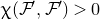 $\chi({\mathcal{F}}', {\mathcal{F}}') \gt 0$
. Since
$\chi({\mathcal{F}}', {\mathcal{F}}') \gt 0$
. Since ${\mathcal{F}}'$
admits a filtration with factors isomorphic to
${\mathcal{F}}'$
admits a filtration with factors isomorphic to ${\mathcal{G}}$
, its Mukai vector
${\mathcal{G}}$
, its Mukai vector $\upsilon({\mathcal{F}}')$
is proportional to
$\upsilon({\mathcal{F}}')$
is proportional to $\upsilon({\mathcal{G}})$
, hence we also have
$\upsilon({\mathcal{G}})$
, hence we also have $\chi({\mathcal{G}}, {\mathcal{G}}) \gt 0$
. Since
$\chi({\mathcal{G}}, {\mathcal{G}}) \gt 0$
. Since ${\mathcal{G}}$
is (H,A)-stable, hence simple, it must be spherical. In particular,
${\mathcal{G}}$
is (H,A)-stable, hence simple, it must be spherical. In particular, $\mathrm{Ext}^1({\mathcal{G}}, {\mathcal{G}}) = 0$
, hence
$\mathrm{Ext}^1({\mathcal{G}}, {\mathcal{G}}) = 0$
, hence ${\mathcal{F}}' \cong {\mathcal{G}}^{\oplus m}$
.
${\mathcal{F}}' \cong {\mathcal{G}}^{\oplus m}$
.
By induction on the rank, this concludes the case where ${\mathcal{F}}$
is (H, A)-semistable.
${\mathcal{F}}$
is (H, A)-semistable.
Now assume that ${\mathcal{F}}$
is not (H, A)-semistable. The same arguments as for Gieseker stability (see, for example, [Reference Huybrechts and LehnHL10, Theorem 1.3.4]) prove the existence of a Harder–Narasimhan filtration for
${\mathcal{F}}$
is not (H, A)-semistable. The same arguments as for Gieseker stability (see, for example, [Reference Huybrechts and LehnHL10, Theorem 1.3.4]) prove the existence of a Harder–Narasimhan filtration for ${\mathcal{F}}$
with respect to (H, A)-stability. Applying Lemma 3.11 again, we see that every Harder–Narasimhan filtration factor of
${\mathcal{F}}$
with respect to (H, A)-stability. Applying Lemma 3.11 again, we see that every Harder–Narasimhan filtration factor of ${\mathcal{F}}$
is rigid. Combined with the filtrations of the semistable factors proven in the previous case, this immediately gives a filtration satisfying (a).
${\mathcal{F}}$
is rigid. Combined with the filtrations of the semistable factors proven in the previous case, this immediately gives a filtration satisfying (a).
For (b), just note that our construction in fact implies ${\mathbf{p}}_{H,A}({\mathcal{F}}_i) \succeq {\mathbf{p}}_{H,A}({\mathcal{F}}_{i+1})$
, hence a fortiori
${\mathbf{p}}_{H,A}({\mathcal{F}}_i) \succeq {\mathbf{p}}_{H,A}({\mathcal{F}}_{i+1})$
, hence a fortiori $\mu_{H}({\mathcal{F}}_i) \ge \mu_{H}({\mathcal{F}}_{i+1})$
, and, moreover,
$\mu_{H}({\mathcal{F}}_i) \ge \mu_{H}({\mathcal{F}}_{i+1})$
, and, moreover, $\mathrm{Hom}({\mathcal{F}}_i,{\mathcal{F}}_{i+1}) = 0$
.
$\mathrm{Hom}({\mathcal{F}}_i,{\mathcal{F}}_{i+1}) = 0$
.
3.3 Brill–Noether inequality
The following proposition is the key result for the proof of Theorem 3.4.
Proposition 3.15. Let (S,H) be a Brill–Noether general quasipolarized smooth K3 surface. Let ${\mathcal{F}}$
be a globally generated spherical bundle on S with
${\mathcal{F}}$
be a globally generated spherical bundle on S with $\upsilon({\mathcal{F}}) = (r, H, s)$
. If
$\upsilon({\mathcal{F}}) = (r, H, s)$
. If
 \begin{equation*}0 \to {\mathcal{F}}_1 \to {\mathcal{F}} \to {\mathcal{F}}_2 \to 0\end{equation*}
is an exact sequence of non-trivial spherical bundles with $\mu_H({\mathcal{F}}_1) \ge \mu_H({\mathcal{F}}) \ge \mu_H({\mathcal{F}}_2)$
then
$\mu_H({\mathcal{F}}_1) \ge \mu_H({\mathcal{F}}) \ge \mu_H({\mathcal{F}}_2)$
then
 \begin{equation*}\mathrm{rk}({\mathcal{F}}_1) = {\mathrm{ch}}_2({\mathcal{F}}_2) + \mathrm{rk}({\mathcal{F}}_2) = 1.\end{equation*}
Moreover, the class $\Xi \mathrel{:=} {\mathrm{c}}_1({\mathcal{F}}_2)$
is a special Mukai class of type (r,s).
$\Xi \mathrel{:=} {\mathrm{c}}_1({\mathcal{F}}_2)$
is a special Mukai class of type (r,s).
Proof. Let $\upsilon({\mathcal{F}}_i) = (r_i, D_i, s_i)$
, so that
$\upsilon({\mathcal{F}}_i) = (r_i, D_i, s_i)$
, so that $\upsilon({\mathcal{F}}) = (r_1 + r_2, D_1 + D_2, s_1 + s_2)$
; in particular,
$\upsilon({\mathcal{F}}) = (r_1 + r_2, D_1 + D_2, s_1 + s_2)$
; in particular, $D_1 + D_2 = H$
. Since
$D_1 + D_2 = H$
. Since ${\mathcal{F}}_1$
,
${\mathcal{F}}_1$
, ${\mathcal{F}}_2$
, and
${\mathcal{F}}_2$
, and ${\mathcal{F}}$
are spherical, (6) implies that
${\mathcal{F}}$
are spherical, (6) implies that
 \begin{equation}D_1^2 = 2r_1s_1 - 2,\quad D_2^2 = 2r_2s_2 - 2,\quad (D_1 + D_2)^2 = 2(r_1 + r_2)(s_1 + s_2) - 2.\end{equation}
Subtracting the sum of the first two equalities from the last one and dividing by 2, we obtain
 \begin{equation*}D_1 \cdot D_2 = r_1s_2 + r_2s_1 + 1.\end{equation*}
This implies $H \cdot D_1 = 2r_1s_1 + r_1s_2 + r_2s_1 - 1$
and
$H \cdot D_1 = 2r_1s_1 + r_1s_2 + r_2s_1 - 1$
and $H \cdot D_2 = 2r_2s_2 + r_1s_2 + r_2s_1 - 1$
, hence
$H \cdot D_2 = 2r_2s_2 + r_1s_2 + r_2s_1 - 1$
, hence
 \begin{equation*}2s_1 + s_2 + \frac{r_2s_1 - 1}{r_1} =\frac1{r_1}H \cdot D_1 =\mu_H({\mathcal{F}}_1) \ge\mu_H({\mathcal{F}}_2) =\frac1{r_2}H \cdot D_2 =s_1 + 2s_2 + \frac{r_1s_2 - 1}{r_2}.\end{equation*}
Equivalently,
 \begin{equation}s_1 - s_2 \ge \frac{r_1s_2 - 1}{r_2} - \frac{r_2s_1 - 1}{r_1}.\end{equation}
This inequality will be used a few times below.
By Corollary 3.8 the line bundle $\det({\mathcal{F}}_2) \cong {\mathcal{O}}_S(D_2)$
is globally generated. Therefore,
$\det({\mathcal{F}}_2) \cong {\mathcal{O}}_S(D_2)$
is globally generated. Therefore, $D_2^2 \ge 0$
, hence
$D_2^2 \ge 0$
, hence $r_2s_2 \ge 1$
by (23), and since
$r_2s_2 \ge 1$
by (23), and since $r_2 \ge 1$
, we have
$r_2 \ge 1$
, we have $s_2 \ge 1$
.
$s_2 \ge 1$
.
Assume $s_1 \le 0$
. Since
$s_1 \le 0$
. Since $r_1$
and
$r_1$
and $r_2$
are positive, we obtain
$r_2$
are positive, we obtain $r_1s_2 - 1 \ge 0$
,
$r_1s_2 - 1 \ge 0$
, $r_2s_1 - 1 < 0$
, hence the right-hand side of (24) is positive, while the left-hand side is negative, which is absurd. Therefore,
$r_2s_1 - 1 < 0$
, hence the right-hand side of (24) is positive, while the left-hand side is negative, which is absurd. Therefore, $s_1 \ge 1$
.
$s_1 \ge 1$
.
Further, $h^2({\mathcal{O}}_S(D_2)) = 0$
by Corollary 3.8. Moreover,
$h^2({\mathcal{O}}_S(D_2)) = 0$
by Corollary 3.8. Moreover, $h^2({\mathcal{O}}_S(D_1)) = 0$
; indeed, otherwise Serre duality shows that
$h^2({\mathcal{O}}_S(D_1)) = 0$
; indeed, otherwise Serre duality shows that $-D_1$
is effective, hence
$-D_1$
is effective, hence $\mu_H({\mathcal{F}}_1) \le 0$
, contradicting the assumption. Therefore,
$\mu_H({\mathcal{F}}_1) \le 0$
, contradicting the assumption. Therefore,
 \begin{equation*}h^0({\mathcal{O}}_S(D_i)) \ge \chi({\mathcal{O}}_S(D_i)) = \tfrac{1}{2}D_i^2 + 2 = r_is_i + 1.\end{equation*}
Since $r_i \ge 1$
and
$r_i \ge 1$
and $s_i \ge 1$
, this is positive, and since
$s_i \ge 1$
, this is positive, and since $D_1 + D_2 = H$
and
$D_1 + D_2 = H$
and $g = (r_1 + r_2)(s_1 + s_2)$
by the last equality in (23), the Brill–Noether property of S implies that
$g = (r_1 + r_2)(s_1 + s_2)$
by the last equality in (23), the Brill–Noether property of S implies that
 \begin{equation*}(r_1s_1 + 1)(r_2s_2 + 1) \le h^0({\mathcal{O}}_S(D_1)) \cdot h^0({\mathcal{O}}_S(D_2)) \le (r_1 + r_2)(s_1 + s_2).\end{equation*}
Expanding the products, we obtain $r_1r_2s_1s_2 + r_1s_1 + r_2s_2 + 1 \le r_1s_1 + r_2s_2 + r_1s_2 + r_2s_1$
, hence
$r_1r_2s_1s_2 + r_1s_1 + r_2s_2 + 1 \le r_1s_1 + r_2s_2 + r_1s_2 + r_2s_1$
, hence
 \begin{equation*}(r_1s_2 - 1)(r_2s_1 - 1) = r_1r_2s_1s_2 - r_1s_2 - r_2s_1 + 1 \le 0.\end{equation*}
But as we have shown above, both factors on the left-hand side are non-negative, therefore one of them is zero. If $r_1s_2 - 1 \ge 1$
, hence
$r_1s_2 - 1 \ge 1$
, hence $r_2s_1 - 1 = 0$
, then
$r_2s_1 - 1 = 0$
, then $r_2 = s_1 = 1$
, the right-hand side of (24) is positive, hence
$r_2 = s_1 = 1$
, the right-hand side of (24) is positive, hence $s_2 < s_1$
, in contradiction to
$s_2 < s_1$
, in contradiction to $s_2 \ge 1$
. Therefore,
$s_2 \ge 1$
. Therefore, $r_1s_2 - 1 = 0$
, hence
$r_1s_2 - 1 = 0$
, hence $r_1 = s_2 = 1$
, that is,
$r_1 = s_2 = 1$
, that is,
 \begin{equation*}\mathrm{rk}({\mathcal{F}}_1) = {\mathrm{ch}}_2({\mathcal{F}}_2) + \mathrm{rk}({\mathcal{F}}_2) = 1.\end{equation*}
Moreover, $h^0({\mathcal{O}}_S(D_1)) \ge r_1s_1 + 1 = s_1 + s_2 = s$
and
$h^0({\mathcal{O}}_S(D_1)) \ge r_1s_1 + 1 = s_1 + s_2 = s$
and $h^0({\mathcal{O}}_S(D_2)) \ge r_2s_2 + 1 = r_2 + r_1 = r$
, so the Brill–Noether property of S implies that these are equalities, hence
$h^0({\mathcal{O}}_S(D_2)) \ge r_2s_2 + 1 = r_2 + r_1 = r$
, so the Brill–Noether property of S implies that these are equalities, hence $h^1({\mathcal{O}}_S(D_2)) = 0$
.
$h^1({\mathcal{O}}_S(D_2)) = 0$
.
Finally, it follows that
 \begin{equation*}D_2 \cdot H = 2r_2s_2 + r_1s_2 + r_2s_1 - 1 =2r_2 + 1 + r_2s_1 - 1 =r_2(s_1 + 2) =(r - 1)(s + 1),\end{equation*}
hence the divisor class $\Xi \mathrel{:=} D_2$
is a special Mukai class of type (r,s).
$\Xi \mathrel{:=} D_2$
is a special Mukai class of type (r,s).
We will also need the following similar result.
Lemma 3.16. Let (S,H) be a Brill–Noether general quasipolarized smooth K3 surface. Let ${\mathcal{F}}$
be a globally generated spherical bundle on S with
${\mathcal{F}}$
be a globally generated spherical bundle on S with $\mathrm{rk}({\mathcal{F}}) = 3$
and
$\mathrm{rk}({\mathcal{F}}) = 3$
and ${\mathrm{c}}_1({\mathcal{F}}) = H$
. Then
${\mathrm{c}}_1({\mathcal{F}}) = H$
. Then ${\mathcal{F}}$
cannot fit into an exact sequence
${\mathcal{F}}$
cannot fit into an exact sequence
 \begin{equation*}0 \to {\mathcal{F}}_1^{\oplus 2} \to {\mathcal{F}} \to {\mathcal{F}}_2 \to 0\quad \text{or}\quad 0 \to {\mathcal{F}}_1 \to {\mathcal{F}} \to {\mathcal{F}}_2^{\oplus 2} \to 0,\end{equation*}
where ${\mathcal{F}}_1$
and
${\mathcal{F}}_1$
and ${\mathcal{F}}_2$
are line bundles and
${\mathcal{F}}_2$
are line bundles and $\mu_H({\mathcal{F}}_1) \ge \mu_H({\mathcal{F}}_2)$
.
$\mu_H({\mathcal{F}}_1) \ge \mu_H({\mathcal{F}}_2)$
.
Proof. Let $\upsilon({\mathcal{F}}_i) = (1, D_i, s_i)$
, so that
$\upsilon({\mathcal{F}}_i) = (1, D_i, s_i)$
, so that $D_i^2 = 2s_i - 2$
.
$D_i^2 = 2s_i - 2$
.
Assume we have the first sequence. Then $\upsilon({\mathcal{F}}) = (3, 2D_1 + D_2, 2s_1 + s_2)$
, and since
$\upsilon({\mathcal{F}}) = (3, 2D_1 + D_2, 2s_1 + s_2)$
, and since ${\mathcal{F}}$
is spherical, we have
${\mathcal{F}}$
is spherical, we have $(2D_1 + D_2)^2 = 12s_1 + 6s_2 - 2$
, which implies
$(2D_1 + D_2)^2 = 12s_1 + 6s_2 - 2$
, which implies
 \begin{equation}D_1 \cdot D_2 = s_1 + s_2 + 2.\end{equation}
Moreover, as in Proposition 3.15 the global generation of ${\mathcal{F}}_2$
implies
${\mathcal{F}}_2$
implies $s_2 \ge 1$
, and since
$s_2 \ge 1$
, and since
 \begin{equation*}2(2s_1 - 2) + (s_1 + s_2 + 2) = \mu_H({\mathcal{F}}_1) \ge \mu_H({\mathcal{F}}_2) = 2(s_1 + s_2 + 2) + (2s_2 - 2),\end{equation*}
we see that $3s_1 \ge 3s_2 + 4$
, hence
$3s_1 \ge 3s_2 + 4$
, hence $s_1 \ge 3$
. Finally, we have
$s_1 \ge 3$
. Finally, we have $h^2({\mathcal{O}}_S(D_1 + D_2)) = h^2({\mathcal{O}}_S(D_1)) = 0$
by the argument of Proposition 3.15, hence
$h^2({\mathcal{O}}_S(D_1 + D_2)) = h^2({\mathcal{O}}_S(D_1)) = 0$
by the argument of Proposition 3.15, hence $h^0({\mathcal{O}}_S(D_1 + D_2)) \ge \chi({\mathcal{O}}_S(D_1 + D_2)) = 2s_1 + 2s_2 + 2$
and
$h^0({\mathcal{O}}_S(D_1 + D_2)) \ge \chi({\mathcal{O}}_S(D_1 + D_2)) = 2s_1 + 2s_2 + 2$
and $h^0({\mathcal{O}}_S(D_1)) \ge \chi({\mathcal{O}}_S(D_1)) = s_1 + 1$
, and the Brill–Noether inequality gives
$h^0({\mathcal{O}}_S(D_1)) \ge \chi({\mathcal{O}}_S(D_1)) = s_1 + 1$
, and the Brill–Noether inequality gives
 \begin{equation*}2(s_1 + s_2 + 1)(s_1 + 1) \le 6s_1 + 3s_2.\end{equation*}
This can be rewritten as $(2s_1 + 2s_2 - 1)(2s_1 - 1) + 3 \le 0$
, contradicting
$(2s_1 + 2s_2 - 1)(2s_1 - 1) + 3 \le 0$
, contradicting $s_1 \ge 3$
and
$s_1 \ge 3$
and $s_2 \ge 1$
.
$s_2 \ge 1$
.
Similarly, assuming the second sequence, we obtain $\upsilon({\mathcal{F}}) = (3, D_1 + 2D_2, s_1 + 2s_2)$
, which again implies (25). Arguing as before, we obtain
$\upsilon({\mathcal{F}}) = (3, D_1 + 2D_2, s_1 + 2s_2)$
, which again implies (25). Arguing as before, we obtain $s_2 \ge 1$
and
$s_2 \ge 1$
and $3s_1 \ge 3s_2 - 4$
, hence
$3s_1 \ge 3s_2 - 4$
, hence $s_1 \ge 0$
, and this time the Brill–Noether inequality gives
$s_1 \ge 0$
, and this time the Brill–Noether inequality gives
 \begin{equation*}2(s_1 + s_2 + 1)(s_2 + 1) \le 3s_1 + 6s_2\end{equation*}
which can be rewritten as $(2s_2 - 1)(2s_1 + 2s_2 - 1) + 3 \le 0$
, contradicting
$(2s_2 - 1)(2s_1 + 2s_2 - 1) + 3 \le 0$
, contradicting $s_1 \ge 0$
and
$s_1 \ge 0$
and $s_2 \ge 1$
.
$s_2 \ge 1$
.
3.4 Proof of the theorem
We can now finally start proving Theorem 3.4, so we return to the setup of § 3.1. We use the notation introduced therein. Also recall Definition 3.12 and notation (7).
Lemma 3.17. If the Lazarsfeld bundle ${\mathbf{L}}_{\bar{S}}(\xi)$
is not
${\mathbf{L}}_{\bar{S}}(\xi)$
is not $\bar{H}$
-stable then there is a
$\bar{H}$
-stable then there is a $\sigma$
-ample divisor class
$\sigma$
-ample divisor class $A \in \mathrm{Pic}(S)$
such that
$A \in \mathrm{Pic}(S)$
such that ${\mathbf{L}}_S(\xi) \cong \sigma^*({\mathbf{L}}_{\bar{S}}(\xi))$
is not (H,A)-stable.
${\mathbf{L}}_S(\xi) \cong \sigma^*({\mathbf{L}}_{\bar{S}}(\xi))$
is not (H,A)-stable.
Proof. Note that the functor $\sigma_*$
defines a bijection between the set of all saturated subsheaves in
$\sigma_*$
defines a bijection between the set of all saturated subsheaves in ${\mathbf{L}}_S(\xi)$
and the set of all saturated subsheaves in
${\mathbf{L}}_S(\xi)$
and the set of all saturated subsheaves in ${\mathbf{L}}_{\bar{S}}(\xi)$
(this can be seen directly; for the general result, see [Reference EsnaultEsn85, Lemma and Definition (2.2)]). Therefore, if
${\mathbf{L}}_{\bar{S}}(\xi)$
(this can be seen directly; for the general result, see [Reference EsnaultEsn85, Lemma and Definition (2.2)]). Therefore, if ${\mathbf{L}}_{\bar{S}}(\xi)$
is not
${\mathbf{L}}_{\bar{S}}(\xi)$
is not $\bar{H}$
-stable there is a saturated subsheaf
$\bar{H}$
-stable there is a saturated subsheaf ${\mathcal{F}} \subset {\mathbf{L}}_S(\xi)$
such that
${\mathcal{F}} \subset {\mathbf{L}}_S(\xi)$
such that $\sigma_*{\mathcal{F}} \subset {\mathbf{L}}_{\bar{S}}(\xi)$
is a destabilizing saturated subsheaf. Let
$\sigma_*{\mathcal{F}} \subset {\mathbf{L}}_{\bar{S}}(\xi)$
is a destabilizing saturated subsheaf. Let $A = \sum a_i R_i$
be a
$A = \sum a_i R_i$
be a $\sigma$
-ample class such that
$\sigma$
-ample class such that $a_i < 0$
for all i. We will show that
$a_i < 0$
for all i. We will show that ${\mathcal{F}}$
destabilizes
${\mathcal{F}}$
destabilizes ${\mathbf{L}}_S(\xi)$
with respect to (H,A)-stability.
${\mathbf{L}}_S(\xi)$
with respect to (H,A)-stability.
First, we have $H = \sigma^*(\bar{H})$
and
$H = \sigma^*(\bar{H})$
and $\sigma_*({\mathrm{c}}_1({\mathcal{F}})) = {\mathrm{c}}_1(\sigma_*{\mathcal{F}})$
, hence the projection formula implies
$\sigma_*({\mathrm{c}}_1({\mathcal{F}})) = {\mathrm{c}}_1(\sigma_*{\mathcal{F}})$
, hence the projection formula implies
 \begin{equation*}\mu_H({\mathcal{F}}) =\frac{1}{\mathrm{rk}({\mathcal{F}})} {\mathrm{c}}_1({\mathcal{F}}) \cdot \sigma^*(\bar{H}) =\frac{1}{\mathrm{rk}(\sigma_*{\mathcal{F}})} {\mathrm{c}}_1(\sigma_*{\mathcal{F}}) \cdot \bar{H} =\mu_{\bar{H}}(\sigma_*{\mathcal{F}}) \ge\mu_{\bar{H}}({\mathbf{L}}_{\bar{S}}(\xi)) =\mu_H({\mathbf{L}}_S(\xi)).\end{equation*}
Moreover, if this is an equality then we must have $\delta(\sigma_*{\mathcal{F}}) \ge \delta({\mathbf{L}}_{\bar{S}}(\xi)) = \delta({\mathbf{L}}_{S}(\xi))$
.
$\delta(\sigma_*{\mathcal{F}}) \ge \delta({\mathbf{L}}_{\bar{S}}(\xi)) = \delta({\mathbf{L}}_{S}(\xi))$
.
Next, for any curve $R_i$
in
$R_i$
in ${\mathfrak{R}}(S,H)$
we have
${\mathfrak{R}}(S,H)$
we have $H \cdot R_i = 0$
, hence
$H \cdot R_i = 0$
, hence ${\mathrm{c}}_1({\mathbf{L}}_S(\xi)) \cdot A = 0$
. Note also that
${\mathrm{c}}_1({\mathbf{L}}_S(\xi)) \cdot A = 0$
. Note also that ${\mathbf{L}}_S(\xi)$
is trivial on
${\mathbf{L}}_S(\xi)$
is trivial on $R_i$
, because it is a pullback along
$R_i$
, because it is a pullback along $\sigma$
. Thus,
$\sigma$
. Thus, ${\mathcal{F}}\vert_{R_i}$
is a subsheaf in a trivial vector bundle, hence we have
${\mathcal{F}}\vert_{R_i}$
is a subsheaf in a trivial vector bundle, hence we have ${\mathrm{c}}_1({\mathcal{F}}) \cdot R_i \le 0$
for all i. Therefore, we have
${\mathrm{c}}_1({\mathcal{F}}) \cdot R_i \le 0$
for all i. Therefore, we have ${\mathrm{c}}_1({\mathcal{F}}) \cdot A \ge 0$
, hence
${\mathrm{c}}_1({\mathcal{F}}) \cdot A \ge 0$
, hence
 \begin{equation}\mu_{A}({\mathcal{F}}) =\frac{1}{\mathrm{rk}({\mathcal{F}})}{{\mathrm{c}}_1({\mathcal{F}})\cdot A} \ge0 =\frac{1}{\mathrm{rk}({\mathbf{L}}_S(\xi))}{{\mathrm{c}}_1({\mathbf{L}}_S(\xi))\cdot A} =\mu_{A}({\mathbf{L}}_S(\xi)).\end{equation}
Finally, if (26) is an equality, we have ${\mathrm{c}}_1({\mathcal{F}}) \cdot R_i = 0$
for each
${\mathrm{c}}_1({\mathcal{F}}) \cdot R_i = 0$
for each $R_i$
, hence
$R_i$
, hence ${\mathcal{F}}$
is trivial on each of these curves, hence
${\mathcal{F}}$
is trivial on each of these curves, hence ${\mathcal{F}} \cong \sigma^*(\sigma_*{\mathcal{F}})$
, hence
${\mathcal{F}} \cong \sigma^*(\sigma_*{\mathcal{F}})$
, hence $\chi({\mathcal{F}}) = \chi(\sigma_*{\mathcal{F}})$
, hence
$\chi({\mathcal{F}}) = \chi(\sigma_*{\mathcal{F}})$
, hence $\delta({\mathcal{F}}) = \delta(\sigma_*{\mathcal{F}})$
, and we conclude that
$\delta({\mathcal{F}}) = \delta(\sigma_*{\mathcal{F}})$
, and we conclude that ${\mathbf{p}}_{H,A}({\mathcal{F}}) \succeq {\mathbf{p}}_{H,A}({\mathbf{L}}_S(\xi))$
, so that
${\mathbf{p}}_{H,A}({\mathcal{F}}) \succeq {\mathbf{p}}_{H,A}({\mathbf{L}}_S(\xi))$
, so that ${\mathbf{L}}_S(\xi)$
is not (H,A)-stable.
${\mathbf{L}}_S(\xi)$
is not (H,A)-stable.
Lemma 3.18. If $r \in \{2,3\}$
and the Lazarsfeld bundle
$r \in \{2,3\}$
and the Lazarsfeld bundle ${\mathbf{L}}_{\bar{S}}(\xi)$
is not
${\mathbf{L}}_{\bar{S}}(\xi)$
is not $\bar{H}$
-Gieseker stable, then its pullback
$\bar{H}$
-Gieseker stable, then its pullback ${\mathbf{L}}_S(\xi) \cong \sigma^*{\mathbf{L}}_{\bar{S}}(\xi)$
fits into an exact sequence
${\mathbf{L}}_S(\xi) \cong \sigma^*{\mathbf{L}}_{\bar{S}}(\xi)$
fits into an exact sequence
 \begin{equation*}0 \to {\mathcal{G}}_1^{\oplus m_1} \to {\mathbf{L}}_S(\xi) \to {\mathcal{G}}_2^{\oplus m_2} \to 0,\end{equation*}
where ${\mathcal{G}}_1$
and
${\mathcal{G}}_1$
and ${\mathcal{G}}_2$
are spherical bundles with
${\mathcal{G}}_2$
are spherical bundles with $\mu_H({\mathcal{G}}_1) \ge \mu_H({\mathcal{G}}_2)$
and
$\mu_H({\mathcal{G}}_1) \ge \mu_H({\mathcal{G}}_2)$
and $(m_1,m_2) \in \{(1,1), (1,2), (2,1)\}$
.
$(m_1,m_2) \in \{(1,1), (1,2), (2,1)\}$
.
Proof. By Lemma 3.17 the sheaf ${\mathbf{L}}_S(\xi)$
is not (H,A)-stable for appropriate A, hence the multispherical filtration of
${\mathbf{L}}_S(\xi)$
is not (H,A)-stable for appropriate A, hence the multispherical filtration of ${\mathbf{L}}_S(\xi)$
provided by Proposition 3.14 is not trivial. In the case
${\mathbf{L}}_S(\xi)$
provided by Proposition 3.14 is not trivial. In the case $r = 2$
, therefore, it has the above form with
$r = 2$
, therefore, it has the above form with $(m_1,m_2) = (1,1)$
.
$(m_1,m_2) = (1,1)$
.
Now assume $r = 3$
. The only case where the conclusion is not immediately obvious is where the multispherical filtration of
$r = 3$
. The only case where the conclusion is not immediately obvious is where the multispherical filtration of ${\mathbf{L}}_S(\xi)$
has three spherical factors
${\mathbf{L}}_S(\xi)$
has three spherical factors ${\mathcal{G}}_1 \not\cong {\mathcal{G}}_2 \not\cong {\mathcal{G}}_3$
, By Proposition 3.10 the sheaves
${\mathcal{G}}_1 \not\cong {\mathcal{G}}_2 \not\cong {\mathcal{G}}_3$
, By Proposition 3.10 the sheaves ${\mathcal{G}}_i$
are locally free, hence they are line bundles. Note also that
${\mathcal{G}}_i$
are locally free, hence they are line bundles. Note also that
 \begin{equation*}\mathrm{Hom}({\mathcal{G}}_1,{\mathcal{G}}_2) = \mathrm{Hom}({\mathcal{G}}_2,{\mathcal{G}}_3) = \mathrm{Hom}({\mathcal{G}}_1,{\mathcal{G}}_3) = 0.\end{equation*}
Indeed, the first two spaces are zero by Proposition 3.14. Moreover, if $\mu_H({\mathcal{G}}_1) \gt \mu_H({\mathcal{G}}_3)$
, the third space is zero by (H,A)-stability of
$\mu_H({\mathcal{G}}_1) \gt \mu_H({\mathcal{G}}_3)$
, the third space is zero by (H,A)-stability of ${\mathcal{G}}_1$
and
${\mathcal{G}}_1$
and ${\mathcal{G}}_3$
, and otherwise we would have
${\mathcal{G}}_3$
, and otherwise we would have $\mu_H({\mathcal{G}}_i) = \mu_H({\mathbf{L}}_S(\xi))$
for all i, hence
$\mu_H({\mathcal{G}}_i) = \mu_H({\mathbf{L}}_S(\xi))$
for all i, hence $\mu_H({\mathbf{L}}_S(\xi))$
would be integral, while in fact
$\mu_H({\mathbf{L}}_S(\xi))$
would be integral, while in fact  .
.
Now consider the sheaves ${\mathcal{G}}_{1,2} \mathrel{:=} \mathrm{Ker}({\mathbf{L}}_S(\xi) \to {\mathcal{G}}_3)$
and
${\mathcal{G}}_{1,2} \mathrel{:=} \mathrm{Ker}({\mathbf{L}}_S(\xi) \to {\mathcal{G}}_3)$
and ${\mathcal{G}}_{2,3} \mathrel{:=} {\mathbf{L}}_S(\xi)/{\mathcal{G}}_1$
. It follows that
${\mathcal{G}}_{2,3} \mathrel{:=} {\mathbf{L}}_S(\xi)/{\mathcal{G}}_1$
. It follows that
 \begin{equation*}\mathrm{Hom}({\mathcal{G}}_{1,2}, {\mathcal{G}}_3) = \mathrm{Hom}({\mathcal{G}}_1, {\mathcal{G}}_{2,3}) = 0,\end{equation*}
hence ${\mathcal{G}}_{1,2}$
and
${\mathcal{G}}_{1,2}$
and ${\mathcal{G}}_{2,3}$
are rigid by Lemma 3.11. Furthermore, Lemma 3.11 implies that the maps
${\mathcal{G}}_{2,3}$
are rigid by Lemma 3.11. Furthermore, Lemma 3.11 implies that the maps
 \begin{equation*}{\Bbbk} = \mathrm{Hom}({\mathcal{G}}_i,{\mathcal{G}}_i) \to \mathrm{Ext}^1({\mathcal{G}}_i,{\mathcal{G}}_{i-1})\quad \text{and}\quad {\Bbbk} = \mathrm{Hom}({\mathcal{G}}_i,{\mathcal{G}}_i) \to \mathrm{Ext}^1({\mathcal{G}}_{i+1},{\mathcal{G}}_i)\end{equation*}
are surjective; in particular, the spaces $\mathrm{Ext}^1({\mathcal{G}}_2,{\mathcal{G}}_1)$
and
$\mathrm{Ext}^1({\mathcal{G}}_2,{\mathcal{G}}_1)$
and $\mathrm{Ext}^1({\mathcal{G}}_3,{\mathcal{G}}_2)$
are at most one-dimensional.
$\mathrm{Ext}^1({\mathcal{G}}_3,{\mathcal{G}}_2)$
are at most one-dimensional.
If $\mathrm{Hom}({\mathcal{G}}_2,{\mathcal{G}}_1) \ne 0$
and
$\mathrm{Hom}({\mathcal{G}}_2,{\mathcal{G}}_1) \ne 0$
and $\mathrm{Hom}({\mathcal{G}}_3,{\mathcal{G}}_2) \ne 0$
, the composition of non-trivial morphisms
$\mathrm{Hom}({\mathcal{G}}_3,{\mathcal{G}}_2) \ne 0$
, the composition of non-trivial morphisms ${\mathcal{G}}_3 \to {\mathcal{G}}_2$
and
${\mathcal{G}}_3 \to {\mathcal{G}}_2$
and ${\mathcal{G}}_2 \to {\mathcal{G}}_1$
is non-trivial, hence
${\mathcal{G}}_2 \to {\mathcal{G}}_1$
is non-trivial, hence $\mathrm{Hom}({\mathcal{G}}_3,{\mathcal{G}}_1) \ne 0$
, which is impossible by Lemma 3.6 because
$\mathrm{Hom}({\mathcal{G}}_3,{\mathcal{G}}_1) \ne 0$
, which is impossible by Lemma 3.6 because ${\mathbf{L}}_S(\xi)$
is spherical. Thus, one of the above spaces must be zero.
${\mathbf{L}}_S(\xi)$
is spherical. Thus, one of the above spaces must be zero.
Assume $\mathrm{Hom}({\mathcal{G}}_2,{\mathcal{G}}_1) = 0$
and
$\mathrm{Hom}({\mathcal{G}}_2,{\mathcal{G}}_1) = 0$
and $\mathrm{Hom}({\mathcal{G}}_3,{\mathcal{G}}_2) \ne 0$
. If
$\mathrm{Hom}({\mathcal{G}}_3,{\mathcal{G}}_2) \ne 0$
. If $\mathrm{Ext}^1({\mathcal{G}}_2,{\mathcal{G}}_1) = 0$
then
$\mathrm{Ext}^1({\mathcal{G}}_2,{\mathcal{G}}_1) = 0$
then ${\mathcal{G}}_{1,2} \cong {\mathcal{G}}_1 \oplus {\mathcal{G}}_2$
, hence we have
${\mathcal{G}}_{1,2} \cong {\mathcal{G}}_1 \oplus {\mathcal{G}}_2$
, hence we have $\mathrm{Hom}({\mathcal{G}}_3, {\mathcal{G}}_{1,2}) \ne 0$
, which is impossible by Lemma 3.6. Therefore,
$\mathrm{Hom}({\mathcal{G}}_3, {\mathcal{G}}_{1,2}) \ne 0$
, which is impossible by Lemma 3.6. Therefore, $\mathrm{Ext}^1({\mathcal{G}}_2,{\mathcal{G}}_1) = {\Bbbk}$
, hence we have
$\mathrm{Ext}^1({\mathcal{G}}_2,{\mathcal{G}}_1) = {\Bbbk}$
, hence we have $\chi({\mathcal{G}}_{1,2},{\mathcal{G}}_{1,2}) = 2$
, and since the sheaf
$\chi({\mathcal{G}}_{1,2},{\mathcal{G}}_{1,2}) = 2$
, and since the sheaf ${\mathcal{G}}_{1,2}$
is rigid, it is spherical. Therefore, the filtration
${\mathcal{G}}_{1,2}$
is rigid, it is spherical. Therefore, the filtration $0 \to {\mathcal{G}}_{1,2} \to {\mathbf{L}}_S(\xi) \to {\mathcal{G}}_3 \to 0$
has the required properties.
$0 \to {\mathcal{G}}_{1,2} \to {\mathbf{L}}_S(\xi) \to {\mathcal{G}}_3 \to 0$
has the required properties.
The case where $\mathrm{Hom}({\mathcal{G}}_2,{\mathcal{G}}_1) \ne 0$
and
$\mathrm{Hom}({\mathcal{G}}_2,{\mathcal{G}}_1) \ne 0$
and $\mathrm{Hom}({\mathcal{G}}_3,{\mathcal{G}}_2) = 0$
is considered analogously; in this case the filtration
$\mathrm{Hom}({\mathcal{G}}_3,{\mathcal{G}}_2) = 0$
is considered analogously; in this case the filtration $0 \to {\mathcal{G}}_1 \to {\mathbf{L}}_S(\xi) \to {\mathcal{G}}_{2,3}\to 0$
has the required properties.
$0 \to {\mathcal{G}}_1 \to {\mathbf{L}}_S(\xi) \to {\mathcal{G}}_{2,3}\to 0$
has the required properties.
Finally, assume $\mathrm{Hom}({\mathcal{G}}_2,{\mathcal{G}}_1) = \mathrm{Hom}({\mathcal{G}}_3,{\mathcal{G}}_2) = 0$
. If also
$\mathrm{Hom}({\mathcal{G}}_2,{\mathcal{G}}_1) = \mathrm{Hom}({\mathcal{G}}_3,{\mathcal{G}}_2) = 0$
. If also $\mathrm{Ext}^1({\mathcal{G}}_2,{\mathcal{G}}_1) = \mathrm{Ext}^1({\mathcal{G}}_3,{\mathcal{G}}_2) = 0$
then it is easy to see that
$\mathrm{Ext}^1({\mathcal{G}}_2,{\mathcal{G}}_1) = \mathrm{Ext}^1({\mathcal{G}}_3,{\mathcal{G}}_2) = 0$
then it is easy to see that ${\mathcal{G}}_2$
is a direct summand of
${\mathcal{G}}_2$
is a direct summand of ${\mathbf{L}}_S(\xi)$
, which is impossible because
${\mathbf{L}}_S(\xi)$
, which is impossible because ${\mathbf{L}}_S(\xi)$
is spherical. Therefore,
${\mathbf{L}}_S(\xi)$
is spherical. Therefore, $\mathrm{Ext}^1({\mathcal{G}}_i,{\mathcal{G}}_{i-1}) = {\Bbbk}$
for
$\mathrm{Ext}^1({\mathcal{G}}_i,{\mathcal{G}}_{i-1}) = {\Bbbk}$
for $i = 2$
or
$i = 2$
or $i = 3$
, hence
$i = 3$
, hence ${\mathcal{G}}_{i-1,i}$
is spherical and as in one of the two previous cases we obtain a filtration of
${\mathcal{G}}_{i-1,i}$
is spherical and as in one of the two previous cases we obtain a filtration of ${\mathbf{L}}_S(\xi)$
with the required properties.
${\mathbf{L}}_S(\xi)$
with the required properties.
Proof of Theorem 3.4. Since the surface S contains a BNP-general curve, it is BN-general (see Theorem 2.10(a)). Assume ${\mathbf{L}}_{\bar{S}}(\xi)$
is not
${\mathbf{L}}_{\bar{S}}(\xi)$
is not $\bar{H}$
-Gieseker stable. Dualizing the sequence produced by Lemma 3.18, we obtain an exact sequence
$\bar{H}$
-Gieseker stable. Dualizing the sequence produced by Lemma 3.18, we obtain an exact sequence
 \begin{equation*}0 \to {\mathcal{F}}_1 \to {\mathbf{L}}_S(\xi)^\vee \to {\mathcal{F}}_2 \to 0\end{equation*}
of multispherical sheaves, and we deduce from Lemma 3.16 that the cases where $(m_1,m_2) = (1,2)$
or
$(m_1,m_2) = (1,2)$
or $(m_1,m_2) = (2,1)$
are impossible, hence both
$(m_1,m_2) = (2,1)$
are impossible, hence both ${\mathcal{F}}_1$
and
${\mathcal{F}}_1$
and ${\mathcal{F}}_2$
must be spherical. Therefore, Proposition 3.15 proves that
${\mathcal{F}}_2$
must be spherical. Therefore, Proposition 3.15 proves that $\Xi \mathrel{:=} {\mathrm{c}}_1({\mathcal{F}}_2)$
is a special Mukai class of type (r,s) on S and
$\Xi \mathrel{:=} {\mathrm{c}}_1({\mathcal{F}}_2)$
is a special Mukai class of type (r,s) on S and ${\mathcal{F}}_1$
is a line bundle, hence
${\mathcal{F}}_1$
is a line bundle, hence ${\mathcal{F}}_1 \cong {\mathcal{O}}_S(H - \Xi)$
. Consider the composition
${\mathcal{F}}_1 \cong {\mathcal{O}}_S(H - \Xi)$
. Consider the composition
 \begin{equation*}{\mathcal{O}}_S(H - \Xi) \cong {\mathcal{F}}_1 \hookrightarrow {\mathbf{L}}_S(\xi)^\vee \to j_*\eta,\end{equation*}
where the last arrow comes from exact sequence (21). If the composition vanishes, sequence (21) implies that the embedding ${\mathcal{O}}_S(H - \Xi) \hookrightarrow {\mathbf{L}}_S(\xi)^\vee$
factors through
${\mathcal{O}}_S(H - \Xi) \hookrightarrow {\mathbf{L}}_S(\xi)^\vee$
factors through ${\mathrm{H}}^0(C,\xi)^\vee \otimes {\mathcal{O}}_{S}$
, which is absurd because
${\mathrm{H}}^0(C,\xi)^\vee \otimes {\mathcal{O}}_{S}$
, which is absurd because $H \cdot (H-\Xi) = (r + 1)(s - 1) \gt 0$
. Therefore, the composition is non-zero, so it factors through a non-zero morphism
$H \cdot (H-\Xi) = (r + 1)(s - 1) \gt 0$
. Therefore, the composition is non-zero, so it factors through a non-zero morphism
 \begin{equation*}{\mathcal{O}}_S(H - \Xi)\vert_C \to \eta.\end{equation*}
The source and target are line bundles of the same degree $(r + 1)(s - 1)$
, hence the above morphism is an isomorphism, and we conclude that
$(r + 1)(s - 1)$
, hence the above morphism is an isomorphism, and we conclude that ${\mathcal{O}}_S(\Xi)\vert_C \cong \eta^{-1}(K_C) \cong \xi$
.
${\mathcal{O}}_S(\Xi)\vert_C \cong \eta^{-1}(K_C) \cong \xi$
.
Conversely, assume $\Xi$
is a special Mukai class of type (r,s) on S. Let
$\Xi$
is a special Mukai class of type (r,s) on S. Let $C \subset S$
be a BNP-general curve in
$C \subset S$
be a BNP-general curve in $|H|$
and let
$|H|$
and let
 \begin{equation*}\xi \mathrel{:=} {\mathcal{O}}_S(\Xi)\vert_C,\quad \eta \mathrel{:=} {\mathcal{O}}_S(H - \Xi)\vert_C.\end{equation*}
We know from Proposition 2.14 that $(\xi,\eta)$
is a Mukai pair of type (r,s) and the restriction induces an isomorphism
$(\xi,\eta)$
is a Mukai pair of type (r,s) and the restriction induces an isomorphism ${\mathrm{H}}^0(S,{\mathcal{O}}_S(\Xi)) \cong {\mathrm{H}}^0(C,\xi)$
. Consider the commutative diagram with exact rows
${\mathrm{H}}^0(S,{\mathcal{O}}_S(\Xi)) \cong {\mathrm{H}}^0(C,\xi)$
. Consider the commutative diagram with exact rows

The middle vertical arrow is surjective, because $\Xi$
is globally generated, and the kernel of the right vertical arrow is
$\Xi$
is globally generated, and the kernel of the right vertical arrow is $\sigma^*{\mathbf{L}}_{S}(\xi)$
. It follows that there is an epimorphism
$\sigma^*{\mathbf{L}}_{S}(\xi)$
. It follows that there is an epimorphism ${\mathbf{L}}_{S}(\xi) \twoheadrightarrow {\mathcal{O}}_S(\Xi-H)$
and
${\mathbf{L}}_{S}(\xi) \twoheadrightarrow {\mathcal{O}}_S(\Xi-H)$
and
 \begin{equation*}\mathrm{Ker}\bigl({\mathbf{L}}_{S}(\xi) \twoheadrightarrow {\mathcal{O}}_S(\Xi-H)\bigr) \cong \mathrm{Ker}\bigl({\mathrm{H}}^0(S,{\mathcal{O}}_S(\Xi)) \otimes {\mathcal{O}}_S \twoheadrightarrow {\mathcal{O}}_S(\Xi)\bigr).\end{equation*}
Moreover, as $\sigma_*{\mathcal{O}}_S(\Xi)$
is globally generated by Corollary 2.15, the first direct image of the right-hand side vanishes, hence the same is true for the first direct image of the left-hand side, hence the induced morphism
$\sigma_*{\mathcal{O}}_S(\Xi)$
is globally generated by Corollary 2.15, the first direct image of the right-hand side vanishes, hence the same is true for the first direct image of the left-hand side, hence the induced morphism ${\mathbf{L}}_{\bar{S}}(\xi) \cong \sigma_*{\mathbf{L}}_{S}(\xi) \to \sigma_*{\mathcal{O}}_S(\Xi-H)$
is surjective, and since
${\mathbf{L}}_{\bar{S}}(\xi) \cong \sigma_*{\mathbf{L}}_{S}(\xi) \to \sigma_*{\mathcal{O}}_S(\Xi-H)$
is surjective, and since
 \begin{equation*}\mu_{\bar{H}}({\mathbf{L}}_{\bar{S}}(\xi)) = \frac{2}{r} - 2s \ge -(r+1)(s-1) = \mu_{\bar{H}}(\sigma_*{\mathcal{O}}_S(\Xi-H)),\end{equation*}
such an epimorphism violates stability of ${\mathbf{L}}_{\bar{S}}(\xi)$
.
${\mathbf{L}}_{\bar{S}}(\xi)$
.
Now assume that (S,H) does not have special Mukai classes of type (r,s). Then for any BNP-general curve C and any Mukai pair $(\xi,\eta)$
on it the bundle
$(\xi,\eta)$
on it the bundle ${\mathbf{L}}_{\bar{S}}(\xi)$
is stable, hence it is a Mukai bundle of type (r,s). Finally, since a Mukai bundle is unique by Lemma 3.2,
${\mathbf{L}}_{\bar{S}}(\xi)$
is stable, hence it is a Mukai bundle of type (r,s). Finally, since a Mukai bundle is unique by Lemma 3.2, ${\mathbf{L}}_{\bar{S}}(\xi)$
does not depend on C or
${\mathbf{L}}_{\bar{S}}(\xi)$
does not depend on C or $\xi$
.
$\xi$
.
4. Mukai extension classes
In this section we define and study Mukai extension classes on curves $C \subset S$
. In particular, when
$C \subset S$
. In particular, when $\mathrm{Pic}(S) = {\mathbf{Z}} \cdot H$
we will show that the defining property of a Mukai extension class (see Definition 4.9) uniquely characterizes the restriction of the (dual of) the Lazarsfeld bundle on S (see Definition 4.6 and Theorem 4.13).
$\mathrm{Pic}(S) = {\mathbf{Z}} \cdot H$
we will show that the defining property of a Mukai extension class (see Definition 4.9) uniquely characterizes the restriction of the (dual of) the Lazarsfeld bundle on S (see Definition 4.6 and Theorem 4.13).
Throughout this section we work on a smooth quasipolarized K3 surface S.
4.1 Restriction of Lazarsfeld bundles
Here we establish some cohomology vanishings for the Lazarsfeld bundles and deduce some corollaries about their restrictions to curves.
The first result is elementary.
Lemma 4.1. Let (S,H) be a quasipolarized K3 surface of genus $g = r \cdot s \ge 4$
and let
$g = r \cdot s \ge 4$
and let $C \subset S$
be a BNP-general curve in
$C \subset S$
be a BNP-general curve in $|H|$
. Assume
$|H|$
. Assume $s \ge r \in \{2,3\}$
. If
$s \ge r \in \{2,3\}$
. If $(\xi,\eta)$
is a Mukai pair of type (r,s) on C then
$(\xi,\eta)$
is a Mukai pair of type (r,s) on C then
 \begin{alignat*}{1}{\mathrm{H}}^2(S,{\mathbf{L}}_S(\xi) \otimes {\mathcal{O}}_S(H)) &={\mathrm{H}}^1(S,{\mathbf{L}}_S(\xi) \otimes {\mathcal{O}}_S(H)) = 0\\{\mathrm{H}}^1(S,{\mathbf{L}}_S(\xi)^\vee \otimes {\mathcal{O}}_S(-H)) &= {\mathrm{H}}^0(S,{\mathbf{L}}_S(\xi)^\vee \otimes {\mathcal{O}}_S(-H)) = 0.\end{alignat*}
Proof. Twisting (19) by ${\mathcal{O}}_S(H)$
, we obtain an exact sequence
${\mathcal{O}}_S(H)$
, we obtain an exact sequence
 \begin{equation*}0 \to {\mathbf{L}}_S(\xi) \otimes {\mathcal{O}}_S(H) \xrightarrow\quad {\mathrm{H}}^0(C,\xi) \otimes {\mathcal{O}}_S(H) \xrightarrow{\ \mathrm{ev}\ } j_*(\xi(K_C)) \to 0.\end{equation*}
Since ${\mathrm{H}}^1(S, {\mathcal{O}}_S(H)) = {\mathrm{H}}^2(S, {\mathcal{O}}_S(H)) = 0$
by (9) and
${\mathrm{H}}^1(S, {\mathcal{O}}_S(H)) = {\mathrm{H}}^2(S, {\mathcal{O}}_S(H)) = 0$
by (9) and ${\mathrm{H}}^1(C, \xi(K_C)) = 0$
because
${\mathrm{H}}^1(C, \xi(K_C)) = 0$
because $\deg(\xi) \gt 0$
, the vanishing of
$\deg(\xi) \gt 0$
, the vanishing of ${\mathrm{H}}^2(S,{\mathbf{L}}_S(\xi) \otimes {\mathcal{O}}_S(H))$
is obvious, and to prove the vanishing of
${\mathrm{H}}^2(S,{\mathbf{L}}_S(\xi) \otimes {\mathcal{O}}_S(H))$
is obvious, and to prove the vanishing of ${\mathrm{H}}^1(S,{\mathbf{L}}_S(\xi) \otimes {\mathcal{O}}_S(H))$
it is enough to check that the morphism
${\mathrm{H}}^1(S,{\mathbf{L}}_S(\xi) \otimes {\mathcal{O}}_S(H))$
it is enough to check that the morphism
 \begin{equation*}{\mathrm{H}}^0(C,\xi) \otimes {\mathrm{H}}^0(C, {\mathcal{O}}_C(K_C)) \to {\mathrm{H}}^0(C, \xi(K_C))\end{equation*}
is surjective, which is proved in Proposition 2.5(a). The remaining two vanishings follow from the first two by Serre duality.
The second vanishing result is more complicated; in particular, it relies on Theorem 3.4.
Proposition 4.2. Let (S,H) be a quasipolarized K3 surface of genus $g = r \cdot s \ge 6$
and let
$g = r \cdot s \ge 6$
and let $C \subset S$
be a BNP-general curve in
$C \subset S$
be a BNP-general curve in $|H|$
. Assume
$|H|$
. Assume $s \ge r \in \{2,3\}$
. If S does not have special Mukai classes of type (r,s), then for any Mukai pair
$s \ge r \in \{2,3\}$
. If S does not have special Mukai classes of type (r,s), then for any Mukai pair $(\xi,\eta)$
of type (r,s) on C we have
$(\xi,\eta)$
of type (r,s) on C we have
 \begin{equation*}{\mathrm{H}}^1(S, {\mathbf{L}}_S(\xi)^\vee \otimes {\mathbf{L}}_S(\xi) \otimes {\mathcal{O}}_S(-H)) ={\mathrm{H}}^1(S, {\mathbf{L}}_S(\xi)^\vee \otimes {\mathbf{L}}_S(\xi) \otimes {\mathcal{O}}_S(H)) = 0.\end{equation*}
Proof. First, tensoring (21) by ${\mathbf{L}}_S(\xi) \otimes {\mathcal{O}}_S(H)$
, we obtain an exact sequence
${\mathbf{L}}_S(\xi) \otimes {\mathcal{O}}_S(H)$
, we obtain an exact sequence
 \begin{equation*}0 \to {\mathrm{H}}^0(C, \xi)^\vee \otimes {\mathbf{L}}_S(\xi) \otimes {\mathcal{O}}_S(H) \to {\mathbf{L}}_S(\xi)^\vee \otimes {\mathbf{L}}_S(\xi) \otimes {\mathcal{O}}_S(H) \to j_*(j^*{\mathbf{L}}_S(\xi) \otimes \eta(K_C)) \to 0.\end{equation*}
Its first term has no first cohomology by Lemma 4.1, so to prove the vanishing of the first cohomology of the middle term, it is enough to check that ${\mathrm{H}}^1(C, j^*{\mathbf{L}}_S(\xi) \otimes \eta(K_C)) = 0$
.
${\mathrm{H}}^1(C, j^*{\mathbf{L}}_S(\xi) \otimes \eta(K_C)) = 0$
.
We now note that the number of Mukai pairs on C of type (r,s) is equal to the degree ${\mathrm{N}}(r,s)$
of
${\mathrm{N}}(r,s)$
of $\mathrm{Gr}(r,r + s)$
(see Remark 2.4). Since
$\mathrm{Gr}(r,r + s)$
(see Remark 2.4). Since $r,s \ge 2$
and
$r,s \ge 2$
and $(r,s) \ne (2,2)$
, this number is greater than 2; in particular, we can choose a Mukai pair
$(r,s) \ne (2,2)$
, this number is greater than 2; in particular, we can choose a Mukai pair $(\xi',\eta')$
of type (r,s) such that
$(\xi',\eta')$
of type (r,s) such that $\xi \not\cong \xi'$
,
$\xi \not\cong \xi'$
, $\eta \not\cong \xi'$
. Applying Theorem 3.4, we obtain an isomorphism
$\eta \not\cong \xi'$
. Applying Theorem 3.4, we obtain an isomorphism
 \begin{equation*}{\mathbf{L}}_S(\xi) \cong {\mathbf{L}}_S(\xi'),\end{equation*}
hence $j^*{\mathbf{L}}_S(\xi) \cong j^*{\mathbf{L}}_S(\xi')$
, so it is enough to check that
$j^*{\mathbf{L}}_S(\xi) \cong j^*{\mathbf{L}}_S(\xi')$
, so it is enough to check that ${\mathrm{H}}^1(C, j^*{\mathbf{L}}_S(\xi') \otimes \eta(K_C)) = 0$
.
${\mathrm{H}}^1(C, j^*{\mathbf{L}}_S(\xi') \otimes \eta(K_C)) = 0$
.
Now consider sequence (19) for the line bundle $\xi'$
and its restriction to C:
$\xi'$
and its restriction to C:
 \begin{equation*}0 \to \xi'(-K_C) \to j^*{\mathbf{L}}_S(\xi') \to {\mathrm{H}}^0(C, \xi') \otimes {\mathcal{O}}_C \to \xi' \to 0.\end{equation*}
Tensoring this by $\eta(K_C)$
, we obtain the exact sequence
$\eta(K_C)$
, we obtain the exact sequence
 \begin{equation*}0 \to \xi' \otimes \eta \to j^*{\mathbf{L}}_S(\xi') \otimes \eta(K_C) \to {\mathrm{H}}^0(C, \xi') \otimes \eta(K_C) \to \xi' \otimes \eta(K_C) \to 0.\end{equation*}
We have ${\mathrm{H}}^1(C, \xi' \otimes \eta) \cong {\mathrm{H}}^1(C, \xi' \otimes \xi^{-1} \otimes {\mathcal{O}}_C(K_C))$
, and since
${\mathrm{H}}^1(C, \xi' \otimes \eta) \cong {\mathrm{H}}^1(C, \xi' \otimes \xi^{-1} \otimes {\mathcal{O}}_C(K_C))$
, and since $\xi' \otimes \xi^{-1}$
is a non-trivial line bundle of degree 0, this space vanishes. Moreover,
$\xi' \otimes \xi^{-1}$
is a non-trivial line bundle of degree 0, this space vanishes. Moreover, ${\mathrm{H}}^1(C, \eta(K_C)) = 0$
because
${\mathrm{H}}^1(C, \eta(K_C)) = 0$
because $\deg(\eta) \gt 0$
. Therefore,
$\deg(\eta) \gt 0$
. Therefore,
 \begin{equation*}{\mathrm{H}}^1(C, j^*{\mathbf{L}}_S(\xi') \otimes \eta(K_C)) \cong \mathrm{Coker}({\mathrm{H}}^0(C, \xi') \otimes {\mathrm{H}}^0(C, \eta(K_C)) \to {\mathrm{H}}^0(C, \xi' \otimes \eta(K_C))),\end{equation*}
and it remains to note that the morphism on the right-hand side is surjective by Proposition 2.5(b). Therefore, ${\mathrm{H}}^1(S, {\mathbf{L}}_S(\xi)^\vee \otimes {\mathbf{L}}_S(\xi) \otimes {\mathcal{O}}_S(H)) = 0$
, and the other vanishing follows by Serre duality.
${\mathrm{H}}^1(S, {\mathbf{L}}_S(\xi)^\vee \otimes {\mathbf{L}}_S(\xi) \otimes {\mathcal{O}}_S(H)) = 0$
, and the other vanishing follows by Serre duality.
4.2 Lazarsfeld extension class
For any globally generated line bundle $\xi$
on a smooth curve C we consider the evaluation morphism
$\xi$
on a smooth curve C we consider the evaluation morphism $\mathrm{ev} \colon {\mathrm{H}}^0(C, \xi) \otimes {\mathcal{O}}_C \twoheadrightarrow \xi$
. Its dual gives an exact sequence
$\mathrm{ev} \colon {\mathrm{H}}^0(C, \xi) \otimes {\mathcal{O}}_C \twoheadrightarrow \xi$
. Its dual gives an exact sequence
 \begin{equation}0 \to \xi^{-1} \xrightarrow{\ \mathrm{ev}^\vee\ } {\mathrm{H}}^0(C,\xi)^\vee \otimes {\mathcal{O}}_C \xrightarrow{\quad } {\mathbf{R}}_C(\xi^{-1}) \to 0,\end{equation}
defining a vector bundle ${\mathbf{R}}_C(\xi^{-1})$
on C.
${\mathbf{R}}_C(\xi^{-1})$
on C.
Lemma 4.3. For any globally generated line bundle $\xi$
on a smooth curve C the bundle
$\xi$
on a smooth curve C the bundle ${\mathbf{R}}_C(\xi^{-1})$
is globally generated,
${\mathbf{R}}_C(\xi^{-1})$
is globally generated, ${\mathrm{H}}^0(C,{\mathbf{R}}_C(\xi^{-1})^\vee) = 0$
, and
${\mathrm{H}}^0(C,{\mathbf{R}}_C(\xi^{-1})^\vee) = 0$
, and ${\mathrm{H}}^1(C,{\mathbf{R}}_C(\xi^{-1}) \otimes {\mathcal{O}}_C(K_C)) = 0$
.
${\mathrm{H}}^1(C,{\mathbf{R}}_C(\xi^{-1}) \otimes {\mathcal{O}}_C(K_C)) = 0$
.
Proof. First, the sheaf ${\mathbf{R}}_C(\xi^{-1})^\vee$
is the kernel of the evaluation morphism
${\mathbf{R}}_C(\xi^{-1})^\vee$
is the kernel of the evaluation morphism ${\mathrm{H}}^0(C,\xi) \otimes {\mathcal{O}}_C \xrightarrow{\ \mathrm{ev}\ } \xi$
, hence
${\mathrm{H}}^0(C,\xi) \otimes {\mathcal{O}}_C \xrightarrow{\ \mathrm{ev}\ } \xi$
, hence ${\mathrm{H}}^0(C, {\mathbf{R}}_C(\xi^{-1})^\vee) = 0$
. Applying Serre duality, we obtain
${\mathrm{H}}^0(C, {\mathbf{R}}_C(\xi^{-1})^\vee) = 0$
. Applying Serre duality, we obtain ${\mathrm{H}}^1(C,{\mathbf{R}}_C(\xi^{-1}) \otimes {\mathcal{O}}_C(K_C)) = 0$
. Global generation of
${\mathrm{H}}^1(C,{\mathbf{R}}_C(\xi^{-1}) \otimes {\mathcal{O}}_C(K_C)) = 0$
. Global generation of ${\mathbf{R}}_C(\xi^{-1})$
is immediate from (27).
${\mathbf{R}}_C(\xi^{-1})$
is immediate from (27).
If $(\xi,\eta)$
is a Mukai pair, the sheaf
$(\xi,\eta)$
is a Mukai pair, the sheaf ${\mathbf{R}}_C(\xi^{-1})$
has stronger properties.
${\mathbf{R}}_C(\xi^{-1})$
has stronger properties.
Lemma 4.4. If $(\xi,\eta)$
is a Mukai pair of type (r,s) with
$(\xi,\eta)$
is a Mukai pair of type (r,s) with $s \ge r \in \{2,3\}$
on a BNP-general curve C of genus
$s \ge r \in \{2,3\}$
on a BNP-general curve C of genus $g = r \cdot s$
, then
$g = r \cdot s$
, then
 \begin{equation*}{\mathrm{H}}^0(C,{\mathbf{R}}_C(\xi^{-1})) \cong {\mathrm{H}}^0(C,\xi)^\vee\quad \text{and}\quad \mathrm{Hom}({\mathbf{R}}_C(\xi^{-1}), \eta) = 0.\end{equation*}
Moreover, the sheaf ${\mathbf{R}}_C(\xi^{-1})$
is simple.
${\mathbf{R}}_C(\xi^{-1})$
is simple.
Proof. Applying the functor $\mathrm{Hom}(-, \eta)$
to (27), we obtain a left-exact sequence
$\mathrm{Hom}(-, \eta)$
to (27), we obtain a left-exact sequence
 \begin{equation*}0 \to \mathrm{Hom}({\mathbf{R}}_C(\xi^{-1}), \eta) \to {\mathrm{H}}^0(C,\xi) \otimes {\mathrm{H}}^0(C, \eta) \to {\mathrm{H}}^0(C, \xi \otimes \eta).\end{equation*}
Its second arrow is induced by the evaluation morphism of $\xi$
, hence it coincides with the Petri map. Since the curve C is BNP-general and
$\xi$
, hence it coincides with the Petri map. Since the curve C is BNP-general and $(\xi,\eta)$
is a Mukai pair, this map is an isomorphism (see Lemma 2.3), hence
$(\xi,\eta)$
is a Mukai pair, this map is an isomorphism (see Lemma 2.3), hence $\mathrm{Hom}({\mathbf{R}}_C(\xi^{-1}), \eta) = 0$
.
$\mathrm{Hom}({\mathbf{R}}_C(\xi^{-1}), \eta) = 0$
.
Furthermore, since ${\mathrm{H}}^0(C,\xi^{-1}) = 0$
, the long exact sequence of cohomology of (27) looks like
${\mathrm{H}}^0(C,\xi^{-1}) = 0$
, the long exact sequence of cohomology of (27) looks like
 \begin{equation*} 0 \to {\mathrm{H}}^0(C,\xi)^\vee \to {\mathrm{H}}^0(C,{\mathbf{R}}_C(\xi^{-1})) \to {\mathrm{H}}^1(C,\xi^{-1}) \to {\mathrm{H}}^0(C,\xi)^\vee \otimes {\mathrm{H}}^1(C,{\mathcal{O}}_C) \to {\mathrm{H}}^1(C,{\mathbf{R}}_C(\xi^{-1})) \to 0.\end{equation*}
We need to check that the connecting map ${\mathrm{H}}^0(C,{\mathbf{R}}_C(\xi^{-1})) \to {\mathrm{H}}^1(C,\xi^{-1})$
is zero, that is, that the map
${\mathrm{H}}^0(C,{\mathbf{R}}_C(\xi^{-1})) \to {\mathrm{H}}^1(C,\xi^{-1})$
is zero, that is, that the map ${\mathrm{H}}^1(C,\xi^{-1}) \to {\mathrm{H}}^0(C,\xi)^\vee \otimes {\mathrm{H}}^1(C,{\mathcal{O}}_C)$
is injective, that is, that its dual map is surjective. But the dual map is nothing more than the map
${\mathrm{H}}^1(C,\xi^{-1}) \to {\mathrm{H}}^0(C,\xi)^\vee \otimes {\mathrm{H}}^1(C,{\mathcal{O}}_C)$
is injective, that is, that its dual map is surjective. But the dual map is nothing more than the map
 \begin{equation*}{\mathrm{H}}^0(C,\xi) \otimes {\mathrm{H}}^0(C, {\mathcal{O}}_C(K_C)) \to {\mathrm{H}}^0(C, \xi(K_C))\end{equation*}
whose surjectivity was established in Proposition 2.5(a). Thus, ${\mathrm{H}}^0(C,{\mathbf{R}}_C(\xi^{-1})) \cong {\mathrm{H}}^0(C,\xi)^\vee$
.
${\mathrm{H}}^0(C,{\mathbf{R}}_C(\xi^{-1})) \cong {\mathrm{H}}^0(C,\xi)^\vee$
.
Finally, since the second arrow in (27) induces an isomorphism of global sections, it is the evaluation morphism for ${\mathbf{R}}_C(\xi^{-1})$
, hence any endomorphism of
${\mathbf{R}}_C(\xi^{-1})$
, hence any endomorphism of ${\mathbf{R}}_C(\xi^{-1})$
extends to an endomorphism of the exact sequence (27). On the other hand, since
${\mathbf{R}}_C(\xi^{-1})$
extends to an endomorphism of the exact sequence (27). On the other hand, since $\mathrm{Hom}({\mathbf{R}}_C(\xi^{-1}), {\mathcal{O}}_C) = 0$
by Lemma 4.3, an endomorphism of the exact sequence (27) is determined uniquely by its endomorphism of
$\mathrm{Hom}({\mathbf{R}}_C(\xi^{-1}), {\mathcal{O}}_C) = 0$
by Lemma 4.3, an endomorphism of the exact sequence (27) is determined uniquely by its endomorphism of $\xi^{-1}$
. As
$\xi^{-1}$
. As $\xi^{-1}$
is simple, the same holds for
$\xi^{-1}$
is simple, the same holds for ${\mathbf{R}}_C(\xi^{-1})$
.
${\mathbf{R}}_C(\xi^{-1})$
.
The sheaf ${\mathbf{R}}_C(\xi^{-1})$
is naturally related to the restriction
${\mathbf{R}}_C(\xi^{-1})$
is naturally related to the restriction $j^*{\mathbf{L}}_S(\xi)$
of the Lazarsfeld bundle.
$j^*{\mathbf{L}}_S(\xi)$
of the Lazarsfeld bundle.
Lemma 4.5. Let $(\xi,\eta)$
be a Mukai pair on a BNP-general curve C which lies on a smooth quasipolarized K3 surface S. If
$(\xi,\eta)$
be a Mukai pair on a BNP-general curve C which lies on a smooth quasipolarized K3 surface S. If $\phi \colon {\mathbf{L}}_S(\xi)^\vee \to j_*\eta$
is the epimorphism from (21) there is a canonical exact sequence
$\phi \colon {\mathbf{L}}_S(\xi)^\vee \to j_*\eta$
is the epimorphism from (21) there is a canonical exact sequence
 \begin{equation}0 \to {\mathbf{R}}_C(\xi^{-1}) \xrightarrow{\qquad} j^*{\mathbf{L}}_S(\xi)^\vee \xrightarrow{\ j^*(\phi)\ } \eta \to 0.\end{equation}
Proof. Pulling back (21) and using an isomorphism $\eta(-K_C) \cong \xi^{-1}$
, we obtain an exact sequence
$\eta(-K_C) \cong \xi^{-1}$
, we obtain an exact sequence
 \begin{equation*}0 \to \xi^{-1} \xrightarrow{\qquad}{\mathrm{H}}^0(C,\xi)^\vee \otimes {\mathcal{O}}_C \xrightarrow{\qquad}j^*{\mathbf{L}}_S(\xi)^\vee \xrightarrow{\ j^*(\phi)\ }\eta \to 0;\end{equation*}
in particular, $j^*(\phi)$
is surjective. Moreover, this sequence is dual to the exact sequence
$j^*(\phi)$
is surjective. Moreover, this sequence is dual to the exact sequence
 \begin{equation*}0 \to \eta^{-1} \xrightarrow{\quad } j^*{\mathbf{L}}_S(\xi) \xrightarrow{\quad } {\mathrm{H}}^0(C,\xi) \otimes {\mathcal{O}}_C \xrightarrow{\ \mathrm{ev}\ } \xi \to 0\end{equation*}
obtained by pulling back (19) (because their middle maps are mutually dual), hence the first map in the first sequence is the dual evaluation morphism $\mathrm{ev}^\vee$
. Therefore, its cokernel is isomorphic to
$\mathrm{ev}^\vee$
. Therefore, its cokernel is isomorphic to ${\mathbf{R}}_C(\xi^{-1})$
, hence
${\mathbf{R}}_C(\xi^{-1})$
, hence $\mathrm{Ker}(j^*(\phi)) \cong {\mathbf{R}}_C(\xi^{-1})$
, and we obtain (28).
$\mathrm{Ker}(j^*(\phi)) \cong {\mathbf{R}}_C(\xi^{-1})$
, and we obtain (28).
Definition 4.6. We call the extension class
 \begin{equation*}\epsilon_{{\mathbf{L}}_S(\xi)} \in \mathrm{Ext}^1(\eta, {\mathbf{R}}_C(\xi^{-1}))\end{equation*}
of the exact sequence (28) the Lazarsfeld extension class.
Remark 4.7. Since the sheaves $\eta$
and
$\eta$
and ${\mathbf{R}}_C(\xi^{-1})$
are both simple, the extension class
${\mathbf{R}}_C(\xi^{-1})$
are both simple, the extension class $\epsilon_{{\mathbf{L}}_S(\xi)}$
of (28) is well defined up to rescaling.
$\epsilon_{{\mathbf{L}}_S(\xi)}$
of (28) is well defined up to rescaling.
The main result of this subsection is the following proposition.
Proposition 4.8. Let (S,H) be a smooth quasipolarized K3 surface of genus $g = r \cdot s \ge 6$
and let
$g = r \cdot s \ge 6$
and let $C \subset S$
be a BNP-general curve in
$C \subset S$
be a BNP-general curve in $|H|$
. Assume
$|H|$
. Assume $s \ge r \in \{2,3\}$
. If S does not have special Mukai classes of type (r,s) then for any Mukai pair
$s \ge r \in \{2,3\}$
. If S does not have special Mukai classes of type (r,s) then for any Mukai pair $(\xi,\eta)$
of type (r,s) on C the restriction
$(\xi,\eta)$
of type (r,s) on C the restriction $j^*{\mathbf{L}}_S(\xi)$
of the Lazarsfeld bundle to C is simple and the Lazarsfeld extension class
$j^*{\mathbf{L}}_S(\xi)$
of the Lazarsfeld bundle to C is simple and the Lazarsfeld extension class $\epsilon_{{\mathbf{L}}_S(\xi)}$
is non-zero, but the connecting morphism
$\epsilon_{{\mathbf{L}}_S(\xi)}$
is non-zero, but the connecting morphism
 \begin{equation*}\epsilon_{{\mathbf{L}}_S(\xi)} \colon {\mathrm{H}}^0(C,\eta) \to {\mathrm{H}}^1(C, {\mathbf{R}}_C(\xi^{-1}))\end{equation*}
of the exact sequence (28) vanishes.
Proof. Consider the exact sequence
 \begin{equation*}0 \to {\mathbf{L}}_S(\xi)^\vee \otimes {\mathbf{L}}_S(\xi) \otimes {\mathcal{O}}_S(-H) \to {\mathbf{L}}_S(\xi)^\vee \otimes {\mathbf{L}}_S(\xi) \to j_*j^*({\mathbf{L}}_S(\xi)^\vee \otimes {\mathbf{L}}_S(\xi)) \to 0.\end{equation*}
We have $h^0({\mathbf{L}}_S(\xi)^\vee \otimes {\mathbf{L}}_S(\xi) \otimes {\mathcal{O}}_S(-H)) = 0$
because
$h^0({\mathbf{L}}_S(\xi)^\vee \otimes {\mathbf{L}}_S(\xi) \otimes {\mathcal{O}}_S(-H)) = 0$
because ${\mathbf{L}}_S(\xi)$
is spherical, and in particular simple, by Lemma 3.3, and
${\mathbf{L}}_S(\xi)$
is spherical, and in particular simple, by Lemma 3.3, and $h^1({\mathbf{L}}_S(\xi)^\vee \otimes {\mathbf{L}}_S(\xi) \otimes {\mathcal{O}}_S(-H)) = 0$
by Proposition 4.2. Therefore,
$h^1({\mathbf{L}}_S(\xi)^\vee \otimes {\mathbf{L}}_S(\xi) \otimes {\mathcal{O}}_S(-H)) = 0$
by Proposition 4.2. Therefore,
 \begin{equation*}\mathrm{End}(j^*{\mathbf{L}}_S(\xi)) ={\mathrm{H}}^0(C, j^*({\mathbf{L}}_S(\xi)^\vee \otimes {\mathbf{L}}_S(\xi))) ={\mathrm{H}}^0(S, {\mathbf{L}}_S(\xi)^\vee \otimes {\mathbf{L}}_S(\xi)) =\mathrm{End}({\mathbf{L}}_S(\xi)).\end{equation*}
Since ${\mathbf{L}}_S(\xi)$
is simple, so is
${\mathbf{L}}_S(\xi)$
is simple, so is $j^*{\mathbf{L}}_S(\xi)$
, and a fortiori
$j^*{\mathbf{L}}_S(\xi)$
, and a fortiori $j^*{\mathbf{L}}_S(\xi)$
is indecomposable. Thus, the exact sequence (28) does not split, hence
$j^*{\mathbf{L}}_S(\xi)$
is indecomposable. Thus, the exact sequence (28) does not split, hence $\epsilon_{{\mathbf{L}}_S(\xi)} \ne 0$
.
$\epsilon_{{\mathbf{L}}_S(\xi)} \ne 0$
.
Furthermore, consider the exact sequence
 \begin{equation*}0 \to {\mathbf{L}}_S(\xi)^\vee \otimes {\mathcal{O}}_S(-H) \to {\mathbf{L}}_S(\xi)^\vee \to j_*j^*({\mathbf{L}}_S(\xi)^\vee) \to 0.\end{equation*}
We have $h^0({\mathbf{L}}_S(\xi)^\vee \otimes {\mathcal{O}}_S(-H)) = h^1({\mathbf{L}}_S(\xi)^\vee \otimes {\mathcal{O}}_S(-H)) = 0$
by Lemma 4.1, hence
$h^0({\mathbf{L}}_S(\xi)^\vee \otimes {\mathcal{O}}_S(-H)) = h^1({\mathbf{L}}_S(\xi)^\vee \otimes {\mathcal{O}}_S(-H)) = 0$
by Lemma 4.1, hence
 \begin{equation*}h^0(j^*{\mathbf{L}}_S(\xi)^\vee) = h^0({\mathbf{L}}_S(\xi)^\vee) = r + s,\end{equation*}
where the second equality uses (22). Finally, consider the cohomology exact sequence of (28):
 \begin{equation*}0 \to {\mathrm{H}}^0(C,{\mathbf{R}}_C(\xi^{-1})) \to {\mathrm{H}}^0(C, j^*{\mathbf{L}}_S(\xi)^\vee) \to {\mathrm{H}}^0(C, \eta) \to {\mathrm{H}}^1(C,{\mathbf{R}}_C(\xi^{-1})).\end{equation*}
Its first three terms have dimension r (by Lemma 4.4), $r+s$
(proved above), and s, respectively, and therefore the last map vanishes.
$r+s$
(proved above), and s, respectively, and therefore the last map vanishes.
4.3 Mukai extension class
In this subsection we show that the properties of the Lazarsfeld extension class established in Proposition 4.8 characterize it uniquely if $\mathrm{Pic}(S) = {\mathbb{Z}} \cdot H$
. We axiomatize these properties in the following definition.
$\mathrm{Pic}(S) = {\mathbb{Z}} \cdot H$
. We axiomatize these properties in the following definition.
Definition 4.9. Let $(\xi,\eta)$
be a Mukai pair on C. A Mukai extension is a non-split exact sequence
$(\xi,\eta)$
be a Mukai pair on C. A Mukai extension is a non-split exact sequence
 \begin{equation}0 \to {\mathbf{R}}_C(\xi^{-1}) \to {\mathcal{G}} \to \eta \to 0\end{equation}
such that the connecting morphism ${\mathrm{H}}^0(C, \eta) \to {\mathrm{H}}^1(C, {\mathbf{R}}_C(\xi^{-1}))$
vanishes. The extension class
${\mathrm{H}}^0(C, \eta) \to {\mathrm{H}}^1(C, {\mathbf{R}}_C(\xi^{-1}))$
vanishes. The extension class
 \begin{equation*}\epsilon \in \mathrm{Ext}^1(\eta,{\mathbf{R}}_C(\xi^{-1}))\end{equation*}
of a Mukai extension is called a Mukai extension class.
To study Mukai extension classes we use the following generalization of the Lazarsfeld construction. In § 3.1 we defined the Lazarsfeld bundle ${\mathbf{L}}_S(\xi)$
of a globally generated line bundle
${\mathbf{L}}_S(\xi)$
of a globally generated line bundle $\xi$
. The same construction can be applied to any globally generated vector bundle
$\xi$
. The same construction can be applied to any globally generated vector bundle ${\mathcal{G}}$
on C; it defines a vector bundle
${\mathcal{G}}$
on C; it defines a vector bundle ${\mathbf{L}}_S({\mathcal{G}})$
that fits into an exact sequence
${\mathbf{L}}_S({\mathcal{G}})$
that fits into an exact sequence
 \begin{equation*}0 \to {\mathbf{L}}_S({\mathcal{G}}) \xrightarrow{\quad } {\mathrm{H}}^0(C, {\mathcal{G}}) \otimes {\mathcal{O}}_S \xrightarrow{\ \mathrm{ev}\ } j_*{\mathcal{G}} \to 0.\end{equation*}
We will apply this construction to all bundles in (29).
Lemma 4.10. If $(\xi,\eta)$
is a Mukai pair of type (r,s) with
$(\xi,\eta)$
is a Mukai pair of type (r,s) with $s \ge r \in \{2,3\}$
on a BNP-general curve
$s \ge r \in \{2,3\}$
on a BNP-general curve $C \subset S$
in a linear system
$C \subset S$
in a linear system $|H|$
then
$|H|$
then
 \begin{equation*}{\mathbf{L}}_S({\mathbf{R}}_C(\xi^{-1})) \cong {\mathbf{L}}_S(\xi)^\vee \otimes {\mathcal{O}}_S(-H).\end{equation*}
Proof. Recall that ${\mathbf{R}}_C(\xi^{-1})$
is globally generated by Lemma 4.3, hence
${\mathbf{R}}_C(\xi^{-1})$
is globally generated by Lemma 4.3, hence ${\mathbf{L}}_S({\mathbf{R}}_C(\xi^{-1}))$
is well defined. Moreover,
${\mathbf{L}}_S({\mathbf{R}}_C(\xi^{-1}))$
is well defined. Moreover, ${\mathrm{H}}^0(C,{\mathbf{R}}_C(\xi^{-1})) \cong {\mathrm{H}}^0(C,\xi)^\vee$
by Lemma 4.4. Therefore, twisting the defining exact sequence of
${\mathrm{H}}^0(C,{\mathbf{R}}_C(\xi^{-1})) \cong {\mathrm{H}}^0(C,\xi)^\vee$
by Lemma 4.4. Therefore, twisting the defining exact sequence of ${\mathbf{L}}_S({\mathbf{R}}_C(\xi^{-1}))$
by
${\mathbf{L}}_S({\mathbf{R}}_C(\xi^{-1}))$
by ${\mathcal{O}}_S(H)$
, we obtain
${\mathcal{O}}_S(H)$
, we obtain
 \begin{equation*}0 \to {\mathbf{L}}_S({\mathbf{R}}_C(\xi^{-1})) \otimes {\mathcal{O}}_S(H) \to {\mathrm{H}}^0(C,\xi)^\vee \otimes {\mathcal{O}}_S(H) \to j_*({\mathbf{R}}_C(\xi^{-1}) \otimes {\mathcal{O}}_C(K_C)) \to 0.\end{equation*}
By (9) we have ${\mathrm{H}}^2(S, {\mathbf{L}}_S({\mathbf{R}}_C(\xi^{-1})) \otimes {\mathcal{O}}_S(H)) = {\mathrm{H}}^1(C, {\mathbf{R}}_C(\xi^{-1}) \otimes {\mathcal{O}}_C(K_C))$
, and by Lemma 4.3 this is zero. Applying Serre duality, we deduce
${\mathrm{H}}^2(S, {\mathbf{L}}_S({\mathbf{R}}_C(\xi^{-1})) \otimes {\mathcal{O}}_S(H)) = {\mathrm{H}}^1(C, {\mathbf{R}}_C(\xi^{-1}) \otimes {\mathcal{O}}_C(K_C))$
, and by Lemma 4.3 this is zero. Applying Serre duality, we deduce ${\mathrm{H}}^0(S, {\mathbf{L}}_S({\mathbf{R}}_C(\xi^{-1}))^\vee \otimes {\mathcal{O}}_S(-H)) = 0$
.
${\mathrm{H}}^0(S, {\mathbf{L}}_S({\mathbf{R}}_C(\xi^{-1}))^\vee \otimes {\mathcal{O}}_S(-H)) = 0$
.
Furthermore, consider the commutative diagram

where the bottom row is the pushforward of (27). The middle vertical arrow is induced by the natural morphism ${\mathcal{O}}_S \to j_*{\mathcal{O}}_C$
, hence it is surjective, therefore the exact sequence of kernels and cokernels takes the form
${\mathcal{O}}_S \to j_*{\mathcal{O}}_C$
, hence it is surjective, therefore the exact sequence of kernels and cokernels takes the form
 \begin{equation*}0 \to {\mathrm{H}}^0(C,\xi)^\vee \otimes {\mathcal{O}}_S(-H) \to {\mathbf{L}}_S({\mathbf{R}}_C(\xi^{-1})) \to j_*(\xi^{-1}) \to 0,\end{equation*}
and since $\mathrm{R}\mathcal{H}\mathit{om}(j_*(\xi^{-1}), {\mathcal{O}}_S) \cong j_*\xi \otimes {\mathcal{O}}_S(H)[-1]$
by Grothendieck duality, its dual sequence twisted by
$\mathrm{R}\mathcal{H}\mathit{om}(j_*(\xi^{-1}), {\mathcal{O}}_S) \cong j_*\xi \otimes {\mathcal{O}}_S(H)[-1]$
by Grothendieck duality, its dual sequence twisted by ${\mathcal{O}}_S(-H)$
takes the form
${\mathcal{O}}_S(-H)$
takes the form
 \begin{equation*}0 \to {\mathbf{L}}_S({\mathbf{R}}_C(\xi^{-1}))^\vee \otimes {\mathcal{O}}_S(-H) \to {\mathrm{H}}^0(C,\xi) \otimes {\mathcal{O}}_S \to j_*\xi \to 0.\end{equation*}
As we checked before, ${\mathrm{H}}^0(S, {\mathbf{L}}_S({\mathbf{R}}_C(\xi^{-1}))^\vee \otimes {\mathcal{O}}_S(-H)) = 0$
, hence the second arrow is the evaluation morphism, hence its kernel is isomorphic to the Lazarsfeld bundle
${\mathrm{H}}^0(S, {\mathbf{L}}_S({\mathbf{R}}_C(\xi^{-1}))^\vee \otimes {\mathcal{O}}_S(-H)) = 0$
, hence the second arrow is the evaluation morphism, hence its kernel is isomorphic to the Lazarsfeld bundle ${\mathbf{L}}_S(\xi)$
and the required isomorphism
${\mathbf{L}}_S(\xi)$
and the required isomorphism ${\mathbf{L}}_S({\mathbf{R}}_C(\xi^{-1})) \cong {\mathbf{L}}_S(\xi)^\vee \otimes {\mathcal{O}}_S(-H)$
follows.
${\mathbf{L}}_S({\mathbf{R}}_C(\xi^{-1})) \cong {\mathbf{L}}_S(\xi)^\vee \otimes {\mathcal{O}}_S(-H)$
follows.
Proposition 4.11. Let (S,H) be a quasipolarized K3 surface of genus $g = r \cdot s \ge 6$
and let
$g = r \cdot s \ge 6$
and let $C \subset S$
be a BNP-general curve in
$C \subset S$
be a BNP-general curve in $|H|$
. Assume
$|H|$
. Assume $s \ge r \in \{2,3\}$
. If S does not have special Mukai classes of type (r,s) then for any Mukai pair
$s \ge r \in \{2,3\}$
. If S does not have special Mukai classes of type (r,s) then for any Mukai pair $(\xi,\eta)$
of type (r,s) on C and any Mukai extension (29) there is an exact sequence
$(\xi,\eta)$
of type (r,s) on C and any Mukai extension (29) there is an exact sequence
 \begin{equation}0 \to {\mathbf{L}}_S(\xi)^\vee \otimes {\mathcal{O}}_S(-H) \to {\mathbf{L}}_S({\mathcal{G}}) \to {\mathbf{L}}_S(\eta) \to 0\end{equation}
of the corresponding Lazarsfeld bundles.
Proof. If (29) is a Mukai extension, we have an exact sequence of global sections
 \begin{equation*}0 \to {\mathrm{H}}^0(C, \xi)^\vee \to {\mathrm{H}}^0(C, {\mathcal{G}}) \to {\mathrm{H}}^0(C, \eta) \to 0\end{equation*}
(where we use Lemma 4.4 to identify the first term and Definition 4.9 to prove exactness on the right). Moreover, since $\eta$
and
$\eta$
and ${\mathbf{R}}_C(\xi^{-1})$
are globally generated (by definition of a Mukai pair and Lemma 4.3, respectively), we conclude that
${\mathbf{R}}_C(\xi^{-1})$
are globally generated (by definition of a Mukai pair and Lemma 4.3, respectively), we conclude that ${\mathcal{G}}$
is also globally generated, hence we have a commutative diagram
${\mathcal{G}}$
is also globally generated, hence we have a commutative diagram

with exact rows and columns, where the first term of the left column is identified in Lemma 4.10. Now the top row of the diagram gives (30).
From now on we work under the assumption that $\mathrm{Pic}(S) = {\mathbb{Z}} \cdot H$
.
$\mathrm{Pic}(S) = {\mathbb{Z}} \cdot H$
.
Lemma 4.12. Assume $\mathrm{Pic}(S) = {\mathbb{Z}} \cdot H$
and
$\mathrm{Pic}(S) = {\mathbb{Z}} \cdot H$
and $g = r \cdot s \ge 6$
with
$g = r \cdot s \ge 6$
with $s \ge r \in \{2,3\}$
. Let
$s \ge r \in \{2,3\}$
. Let $(\xi,\eta)$
be a Mukai pair of type (r,s) on a curve C in
$(\xi,\eta)$
be a Mukai pair of type (r,s) on a curve C in $|H|$
and let
$|H|$
and let
 \begin{equation}0 \to {\mathbf{L}}_S(\xi)^\vee \otimes {\mathcal{O}}_S(-H) \to {\mathcal{F}} \to {\mathbf{L}}_S(\eta) \to 0\end{equation}
be an exact sequence. If the sheaf ${\mathcal{F}}$
is not H-Gieseker stable then the sequence splits.
${\mathcal{F}}$
is not H-Gieseker stable then the sequence splits.
Proof. By Lemma 3.3 and Proposition 3.9, the subbundle ${\mathbf{L}}_S(\xi)^\vee \otimes {\mathcal{O}}_S(-H)$
and quotient bundle
${\mathbf{L}}_S(\xi)^\vee \otimes {\mathcal{O}}_S(-H)$
and quotient bundle ${\mathbf{L}}_S(\eta)$
of
${\mathbf{L}}_S(\eta)$
of ${\mathcal{F}}$
are stable with Mukai vectors
${\mathcal{F}}$
are stable with Mukai vectors

Note that $1/r - 1 \le - 1/2 < - 1/s$
because
$1/r - 1 \le - 1/2 < - 1/s$
because $r \ge 2$
and
$r \ge 2$
and $s \ge 3$
.
$s \ge 3$
.
Assume ${\mathcal{F}}$
is not H-Gieseker stable. Consider the Harder–Narasimhan filtration of a sheaf
${\mathcal{F}}$
is not H-Gieseker stable. Consider the Harder–Narasimhan filtration of a sheaf ${\mathcal{F}}$
and refine it (via a Jordan–Hölder filtration of every semistable factor) to a filtration with H-Gieseker stable factors
${\mathcal{F}}$
and refine it (via a Jordan–Hölder filtration of every semistable factor) to a filtration with H-Gieseker stable factors ${\mathcal{F}}_1,\dots,{\mathcal{F}}_m$
. We will show that
${\mathcal{F}}_1,\dots,{\mathcal{F}}_m$
. We will show that $m = 2$
,
$m = 2$
, ${\mathcal{F}}_1 = {\mathbf{L}}_S(\eta)$
, and
${\mathcal{F}}_1 = {\mathbf{L}}_S(\eta)$
, and ${\mathcal{F}}_2 = {\mathbf{L}}_S(\xi)^\vee \otimes {\mathcal{O}}_S(-H)$
, so that this filtration is opposite to filtration (32).
${\mathcal{F}}_2 = {\mathbf{L}}_S(\xi)^\vee \otimes {\mathcal{O}}_S(-H)$
, so that this filtration is opposite to filtration (32).
First, (32) implies that the slopes of ${\mathcal{F}}_i$
are bounded by the slopes of
${\mathcal{F}}_i$
are bounded by the slopes of ${\mathbf{L}}_S(\xi)^\vee \otimes {\mathcal{O}}_S(-H)$
and
${\mathbf{L}}_S(\xi)^\vee \otimes {\mathcal{O}}_S(-H)$
and ${\mathbf{L}}_S(\eta)$
:
${\mathbf{L}}_S(\eta)$
:
 \begin{equation}-\frac1s \ge \mu_H({\mathcal{F}}_1) \ge \dots \ge \mu_H({\mathcal{F}}_m) \ge \frac1r - 1.\end{equation}
Furthermore, since $\mathrm{Pic}(S) = {\mathbb{Z}} \cdot H$
, we can write
$\mathrm{Pic}(S) = {\mathbb{Z}} \cdot H$
, we can write $\upsilon({\mathcal{F}}_i) = (x_i, - y_iH, z_i)$
. Then
$\upsilon({\mathcal{F}}_i) = (x_i, - y_iH, z_i)$
. Then $\mu_H({\mathcal{F}}_i) \le - 1/s < 0$
implies
$\mu_H({\mathcal{F}}_i) \le - 1/s < 0$
implies $y_i \gt 0$
and
$y_i \gt 0$
and $\mu_H({\mathcal{F}}_1) \ge 1/r - 1 \gt -1$
implies
$\mu_H({\mathcal{F}}_1) \ge 1/r - 1 \gt -1$
implies $x_i \gt y_i$
. Moreover, a combination of (33) and (34) gives the relations
$x_i \gt y_i$
. Moreover, a combination of (33) and (34) gives the relations
 \begin{equation*}\sum x_i = r + s,\quad \sum y_i = r,\quad \sum z_i = (r-1)^2s + 2,\quad x_i \gt y_i{} \ge 1.\end{equation*}
The inequalities $x_i \gt y_i \ge 1$
, with the equality
$x_i \gt y_i \ge 1$
, with the equality $\sum y_i = r$
, imply, in particular, that
$\sum y_i = r$
, imply, in particular, that
 \begin{equation}m \le r\quad \text{and}\quad x_1, \dots, x_m \ge 2.\end{equation}
On the other hand, by Riemann–Roch we have $\chi({\mathcal{F}}_i,{\mathcal{F}}_i) = 2x_iz_i - (2rs - 2)y_i^2$
, and since the sheaves
$\chi({\mathcal{F}}_i,{\mathcal{F}}_i) = 2x_iz_i - (2rs - 2)y_i^2$
, and since the sheaves ${\mathcal{F}}_i$
are stable, they are simple, hence
${\mathcal{F}}_i$
are stable, they are simple, hence $\chi({\mathcal{F}}_i,{\mathcal{F}}_i) \le 2$
, hence
$\chi({\mathcal{F}}_i,{\mathcal{F}}_i) \le 2$
, hence
 \begin{equation*}x_iz_i \le (rs - 1)y_i^2 + 1, 1 \le i \le m.\end{equation*}
Dividing the ith inequality by $x_i$
and summing them, we obtain
$x_i$
and summing them, we obtain
 \begin{equation}(r-1)^2s + 2 = \sum z_i \le \sum \frac{(rs - 1)y_i^2 + 1}{x_i}.\end{equation}
From now on we assume $r \in \{2,3\}$
. If
$r \in \{2,3\}$
. If $m = 3$
then (35) implies
$m = 3$
then (35) implies $r = 3$
and
$r = 3$
and $y_i = 1$
for all i, hence the right-hand side of (36) equals
$y_i = 1$
for all i, hence the right-hand side of (36) equals $3s \sum 1/{x_i}$
, and we obtain
$3s \sum 1/{x_i}$
, and we obtain
 \begin{equation}\sum \frac{1}{x_i} \ge\frac{4s + 2}{3s} =\frac43 + \frac{2}{3s} \gt \frac43.\end{equation}
Since $x_i \ge 2$
by (35), we must have
$x_i \ge 2$
by (35), we must have $x_1 = x_2 = x_3 = 2$
, but then
$x_1 = x_2 = x_3 = 2$
, but then $s = 3$
, and (37) fails. Therefore, we must have
$s = 3$
, and (37) fails. Therefore, we must have $m = 2$
; we assume this from now on.
$m = 2$
; we assume this from now on.
As $m = 2$
, inequality (36) can be rewritten as
$m = 2$
, inequality (36) can be rewritten as
 \begin{equation*}(rs - 1)(y_1^2x_2 + y_2^2x_1) + (x_1 + x_2) \ge ((r-1)^2s + 2)x_1x_2.\end{equation*}
Since $r \in \{2,3\}$
, one of the
$r \in \{2,3\}$
, one of the $y_i$
is 1 and the other is
$y_i$
is 1 and the other is $r - 1$
. If we denote the
$r - 1$
. If we denote the $x_i$
that corresponds to
$x_i$
that corresponds to $y_i = 1$
by x, so that the other is
$y_i = 1$
by x, so that the other is $r + s - x$
, then
$r + s - x$
, then $y_1^2x_2 + y_2^2x_1 = (r-1)^2 x + (r + s - x)$
and the above inequality takes the form
$y_1^2x_2 + y_2^2x_1 = (r-1)^2 x + (r + s - x)$
and the above inequality takes the form
 \begin{equation*}f(x) \mathrel{:=} (rs - 1)((r-1)^2 x + (r + s - x)) + (r + s) - ((r-1)^2s + 2)x(r + s - x) \ge 0.\end{equation*}
Note that
 \begin{align*}f(s) &= (rs - 1)((r - 1)^2 s + r) + (r + s) - ((r-1)^2s + 2)rs = 0,\\f(2) &= (rs - 1)(2(r-1)^2 + (r + s - 2)) + (r + s) - 2((r-1)^2s + 2)(r + s - 2)\\&= -s^2(r - 2)(2r - 1) - 5rs(r -2) - 2(r^2 - 4) \le 0,\end{align*}
and the second inequality is strict unless $r = 2$
. On the other hand, the function f is convex, hence the inequality
$r = 2$
. On the other hand, the function f is convex, hence the inequality $f(x) \ge 0$
implies
$f(x) \ge 0$
implies
 \begin{equation*}x \ge s\quad \text{or}\quad x \le 2\end{equation*}
and the second inequality is strict unless $r = 2$
. Now, if
$r = 2$
. Now, if $x \ge s$
the slope of
$x \ge s$
the slope of ${\mathcal{F}}_i$
is greater than or equal to
${\mathcal{F}}_i$
is greater than or equal to $- 1/s$
, if
$- 1/s$
, if $x \le 1$
then the slope of
$x \le 1$
then the slope of ${\mathcal{F}}_i$
is less than
${\mathcal{F}}_i$
is less than $ 1/r - 1$
, and if
$ 1/r - 1$
, and if $x = 2 = r$
it is equal to
$x = 2 = r$
it is equal to $1/r - 1$
. In either case, (34) implies that the slopes of the
$1/r - 1$
. In either case, (34) implies that the slopes of the ${\mathcal{F}}_i$
are
${\mathcal{F}}_i$
are $-1/s$
and
$-1/s$
and $1/r - 1$
. Since these coincide with the slopes of the stable bundles
$1/r - 1$
. Since these coincide with the slopes of the stable bundles ${\mathbf{L}}_S(\eta)$
and
${\mathbf{L}}_S(\eta)$
and ${\mathbf{L}}_S(\xi)^\vee \otimes {\mathcal{O}}_S(-H)$
, we conclude that
${\mathbf{L}}_S(\xi)^\vee \otimes {\mathcal{O}}_S(-H)$
, we conclude that
 \begin{equation*}{\mathcal{F}}_1 \cong {\mathbf{L}}_S(\eta)\quad \text{and}\quad {\mathcal{F}}_2 \cong {\mathbf{L}}_S(\xi)^\vee \otimes {\mathcal{O}}_S(-H).\end{equation*}
As we noticed above, $\mu_H({\mathcal{F}}_1) = - 1/s \gt 1/r - 1 = \mu_H({\mathcal{F}}_2)$
, and since both
$\mu_H({\mathcal{F}}_1) = - 1/s \gt 1/r - 1 = \mu_H({\mathcal{F}}_2)$
, and since both ${\mathcal{F}}_1$
and
${\mathcal{F}}_1$
and ${\mathcal{F}}_2$
are stable, we have
${\mathcal{F}}_2$
are stable, we have $\mathrm{Hom}({\mathcal{F}}_1,{\mathcal{F}}_2) = 0$
, hence the exact sequence (32) splits.
$\mathrm{Hom}({\mathcal{F}}_1,{\mathcal{F}}_2) = 0$
, hence the exact sequence (32) splits.
Combining the above observations, we obtain the main result of this section.
Theorem 4.13.
Let (S,H) be a polarized K3 surface of genus $g = r \cdot s \ge 6$
with
$g = r \cdot s \ge 6$
with $\mathrm{Pic}(S) = {\mathbb{Z}} \cdot H$
. If
$\mathrm{Pic}(S) = {\mathbb{Z}} \cdot H$
. If $C \in |H|$
is a BNP-general curve,
$C \in |H|$
is a BNP-general curve, $(\xi,\eta)$
is a Mukai pair of type (r,s) on C with
$(\xi,\eta)$
is a Mukai pair of type (r,s) on C with $s \ge r \in \{2,3\}$
, and
$s \ge r \in \{2,3\}$
, and $\epsilon \in \mathrm{Ext}^1(\eta, {\mathbf{R}}_C(\xi^{-1}))$
is a Mukai extension class then
$\epsilon \in \mathrm{Ext}^1(\eta, {\mathbf{R}}_C(\xi^{-1}))$
is a Mukai extension class then $\epsilon = \epsilon_{{\mathbf{L}}_S(\xi)}$
is the Lazarsfeld class. In particular, the Mukai extension class is unique.
$\epsilon = \epsilon_{{\mathbf{L}}_S(\xi)}$
is the Lazarsfeld class. In particular, the Mukai extension class is unique.
Proof. Let $\epsilon \ne 0$
be a Mukai extension class and let (29) be the corresponding extension. By Proposition 4.11 we obtain the exact sequence (30). Now a simple Riemann–Roch computation shows that
$\epsilon \ne 0$
be a Mukai extension class and let (29) be the corresponding extension. By Proposition 4.11 we obtain the exact sequence (30). Now a simple Riemann–Roch computation shows that $\chi({\mathbf{L}}_S({\mathcal{G}}), {\mathbf{L}}_S({\mathcal{G}})) \gt 2$
, hence the bundle
$\chi({\mathbf{L}}_S({\mathcal{G}}), {\mathbf{L}}_S({\mathcal{G}})) \gt 2$
, hence the bundle ${\mathbf{L}}_S({\mathcal{G}})$
is not stable. Applying Lemma 4.12, we conclude that (30) splits, hence
${\mathbf{L}}_S({\mathcal{G}})$
is not stable. Applying Lemma 4.12, we conclude that (30) splits, hence
 \begin{equation*}{\mathbf{L}}_S({\mathcal{G}}) \cong \big({\mathbf{L}}_S(\xi)^\vee \otimes {\mathcal{O}}_S(-H)\big) \oplus {\mathbf{L}}_S(\eta).\end{equation*}
Let $\psi \colon {\mathbf{L}}_S(\eta) \to {\mathbf{L}}_S({\mathcal{G}})$
be a splitting of the projection from (30). Consider the upper right square
$\psi \colon {\mathbf{L}}_S(\eta) \to {\mathbf{L}}_S({\mathcal{G}})$
be a splitting of the projection from (30). Consider the upper right square

of diagram (31), where $\tilde\psi$
is defined as the composition
$\tilde\psi$
is defined as the composition ${\mathbf{L}}_S(\eta) \xrightarrow{\ \psi\ } {\mathbf{L}}_S({\mathcal{G}}) \hookrightarrow {\mathrm{H}}^0(C, {\mathcal{G}}) \otimes {\mathcal{O}}_S$
. Let
${\mathbf{L}}_S(\eta) \xrightarrow{\ \psi\ } {\mathbf{L}}_S({\mathcal{G}}) \hookrightarrow {\mathrm{H}}^0(C, {\mathcal{G}}) \otimes {\mathcal{O}}_S$
. Let ${\mathcal{F}} \mathrel{:=} \mathrm{Coker}(\tilde\psi)$
. It is easy to see that it fits into a commutative diagram with exact rows
${\mathcal{F}} \mathrel{:=} \mathrm{Coker}(\tilde\psi)$
. It is easy to see that it fits into a commutative diagram with exact rows

where the left and right vertical arrows coincide with the arrows in (31). If the bottom row of (38) splits, then the composition $j_*\eta \to {\mathcal{F}} \to j_*{\mathcal{G}}$
provides a splitting of the morphism
$j_*\eta \to {\mathcal{F}} \to j_*{\mathcal{G}}$
provides a splitting of the morphism $j_*{\mathcal{G}} \to j_*\eta$
from the bottom row of (31), hence also a splitting of (29), which contradicts to the assumption
$j_*{\mathcal{G}} \to j_*\eta$
from the bottom row of (31), hence also a splitting of (29), which contradicts to the assumption $\epsilon \ne 0$
; therefore, the bottom row of (38) does not split.
$\epsilon \ne 0$
; therefore, the bottom row of (38) does not split.
Now, pulling back the bottom row of (38) to C, we obtain an exact sequence
 \begin{equation*}0 \to {\mathrm{L}}_1j^*{\mathcal{F}} \to \eta(-K_C) \to {\mathrm{H}}^0(C, \xi)^\vee \otimes {\mathcal{O}}_C \to j^*{\mathcal{F}} \to \eta \to 0.\end{equation*}
The natural isomorphism $\mathrm{Ext}^1(j_*\eta, {\mathrm{H}}^0(C, \xi)^\vee \otimes {\mathcal{O}}_S) \cong \mathrm{Hom}(\eta(-K_C), {\mathrm{H}}^0(C, \xi)^\vee \otimes {\mathcal{O}}_C)$
shows that the morphism
$\mathrm{Ext}^1(j_*\eta, {\mathrm{H}}^0(C, \xi)^\vee \otimes {\mathcal{O}}_S) \cong \mathrm{Hom}(\eta(-K_C), {\mathrm{H}}^0(C, \xi)^\vee \otimes {\mathcal{O}}_C)$
shows that the morphism $\eta(-K_C) \to {\mathrm{H}}^0(C, \xi)^\vee \otimes {\mathcal{O}}_C$
in it is non-trivial, hence it is injective, hence
$\eta(-K_C) \to {\mathrm{H}}^0(C, \xi)^\vee \otimes {\mathcal{O}}_C$
in it is non-trivial, hence it is injective, hence ${\mathrm{L}}_1j^*{\mathcal{F}} = 0$
. Therefore, using the bottom row of (38) to compute the invariants of
${\mathrm{L}}_1j^*{\mathcal{F}} = 0$
. Therefore, using the bottom row of (38) to compute the invariants of $j^*{\mathcal{F}}$
, we obtain
$j^*{\mathcal{F}}$
, we obtain
 \begin{equation*}\mathrm{rk}(j^*{\mathcal{F}}) = \mathrm{rk}({\mathcal{F}}) = r = \mathrm{rk}({\mathcal{G}})\quad \text{and}\quad {\mathrm{c}}_1(j^*{\mathcal{F}}) = {\mathrm{c}}_1({\mathcal{F}})\vert_C = H\vert_C = K_C = {\mathrm{c}}_1({\mathcal{G}}).\end{equation*}
Now, restricting the top row of (38) to C, we obtain
 \begin{equation*}0 \to {\mathcal{G}}(-K_C) \to j^*{\mathbf{L}}_S(\xi)^\vee \otimes {\mathcal{O}}_C(-K_C) \to j^*{\mathcal{F}} \to {\mathcal{G}} \to 0.\end{equation*}
The last arrow in it is an epimorphism of sheaves with the same rank and degree, hence it is an isomorphism. Therefore, the first arrow is also an isomorphism, that is, $j^*{\mathbf{L}}_S(\xi)^\vee \cong {\mathcal{G}}$
.
$j^*{\mathbf{L}}_S(\xi)^\vee \cong {\mathcal{G}}$
.
Finally, since $\mathrm{Hom}({\mathbf{R}}_C(\xi^{-1}), \eta) = 0$
by Lemma 4.4, it follows from (29) that the space
$\mathrm{Hom}({\mathbf{R}}_C(\xi^{-1}), \eta) = 0$
by Lemma 4.4, it follows from (29) that the space
 \begin{equation*}\mathrm{Hom}(j^*{\mathbf{L}}_S(\xi)^\vee, \eta) \cong \mathrm{Hom}({\mathcal{G}}, \eta)\end{equation*}
is one-dimensional, hence the composition $j^*\mathbf{L}_S(\xi)^\vee \xrightarrow{\sim} \mathcal{G} \twoheadrightarrow \eta$
of the constructed isomorphism and the surjection of (29) coincides with the map
$j^*\mathbf{L}_S(\xi)^\vee \xrightarrow{\sim} \mathcal{G} \twoheadrightarrow \eta$
of the constructed isomorphism and the surjection of (29) coincides with the map $j^*(\phi)$
in sequence (28), hence
$j^*(\phi)$
in sequence (28), hence $\epsilon = \epsilon_{{\mathbf{L}}_S(\xi)}$
.
$\epsilon = \epsilon_{{\mathbf{L}}_S(\xi)}$
.
5. Mukai bundles on Fano threefolds
In this section we prove Theorem 1.1. In § 5.1 we consider the more general situation of a prime Fano threefold with factorial terminal singularities, and prove in this case Theorem 5.3, a weaker version of Theorem 1.1, and in § 5.2 we consider the case where X is smooth.
Recall that a normal variety X is factorial if any Weil divisor on X is Cartier; in particular, the canonical divisor is Cartier. Note also that terminal singularities are Cohen–Macaulay, hence any variety with factorial terminal singularities is Gorenstein. Finally, recall that a Fano threefold with factorial terminal singularities is prime if its anticanonical class
 \begin{equation*}H \mathrel{:=} -K_X\end{equation*}
is the ample generator of $\mathrm{Pic}(X)$
. Recall that the genus g of X is defined by the equality
$\mathrm{Pic}(X)$
. Recall that the genus g of X is defined by the equality
 \begin{equation*}H^3 = 2g - 2.\end{equation*}
We assume in this section that $g \ge 4$
.
$g \ge 4$
.
Definition 5.1. Let X be a prime Fano threefold X with factorial terminal singularities of genus $g = r \cdot s$
with
$g = r \cdot s$
with $r,s \ge 2$
. A Mukai sheaf
$r,s \ge 2$
. A Mukai sheaf ${\mathcal{U}}_X$
on X of type (r,s) is a maximal Cohen–Macaulay sheaf such that
${\mathcal{U}}_X$
on X of type (r,s) is a maximal Cohen–Macaulay sheaf such that
-
(a)
$\mathrm{rk}({\mathcal{U}}_X) = r$
,
${\mathrm{c}}_1({\mathcal{U}}_X) = -H$
; -
(b)
${\mathrm{H}}^\bullet(X,{\mathcal{U}}_X) = 0$
; and -
(c) the dual sheaf
${\mathcal{U}}_X^\vee$
is globally generated with
$\dim {\mathrm{H}}^0(X, {\mathcal{U}}_X^\vee)=r+s$
and
${\mathrm{H}}^{\gt 0}(X, {\mathcal{U}}_X^\vee) = 0$
.






Note that a Mukai sheaf satisfies all the properties of the bundle ${\mathcal{U}}_r$
from Theorem 1.1, except for local freeness (which is replaced by the maximal Cohen–Macaulay property) and the equality
${\mathcal{U}}_r$
from Theorem 1.1, except for local freeness (which is replaced by the maximal Cohen–Macaulay property) and the equality $\mathrm{Ext}^\bullet({\mathcal{U}}_X,{\mathcal{U}}_X) = {\Bbbk}$
.
$\mathrm{Ext}^\bullet({\mathcal{U}}_X,{\mathcal{U}}_X) = {\Bbbk}$
.
It is clear that Mukai sheaves with $r = 1$
(hence
$r = 1$
(hence $s = g$
) do not exist; indeed, property (a) implies that
$s = g$
) do not exist; indeed, property (a) implies that ${\mathcal{U}}_X \cong {\mathcal{O}}_X(-H) \cong {\mathcal{O}}_X(K_X)$
, and then property (b) fails. For this reason we exclude the case
${\mathcal{U}}_X \cong {\mathcal{O}}_X(-H) \cong {\mathcal{O}}_X(K_X)$
, and then property (b) fails. For this reason we exclude the case $r = 1$
and the symmetric case
$r = 1$
and the symmetric case $s = 1$
from the definition.
$s = 1$
from the definition.
In contrast to Definition 3.1, we do not include stability in the definition of a Mukai sheaf on X, because it is automatic.
Lemma 5.2. Let X be a prime Fano threefold X with factorial terminal singularities and $g \ge 4$
. The anticanonical linear system
$g \ge 4$
. The anticanonical linear system $|H|$
is very ample,
$|H|$
is very ample, $h^0(X, {\mathcal{O}}_X(H)) = g + 2$
,
$h^0(X, {\mathcal{O}}_X(H)) = g + 2$
, $h^{\gt 0}(X, {\mathcal{O}}_X(H)) = 0$
, and a very general anticanonical divisor in X is a smooth K3 surface S with
$h^{\gt 0}(X, {\mathcal{O}}_X(H)) = 0$
, and a very general anticanonical divisor in X is a smooth K3 surface S with $\mathrm{Pic}(S) = {\mathbb{Z}} \cdot H_S$
, where
$\mathrm{Pic}(S) = {\mathbb{Z}} \cdot H_S$
, where $H_S \mathrel{:=} H\vert_S$
.
$H_S \mathrel{:=} H\vert_S$
.
Moreover, if $g = r \cdot s$
with
$g = r \cdot s$
with $r,s \ge 2$
and
$r,s \ge 2$
and ${\mathcal{U}}_X$
is a Mukai sheaf of type (r,s) on X then
${\mathcal{U}}_X$
is a Mukai sheaf of type (r,s) on X then ${\mathcal{U}}_X$
is H-Gieseker stable and
${\mathcal{U}}_X$
is H-Gieseker stable and ${\mathcal{U}}_X\vert_S$
is a Mukai bundle on S for any smooth
${\mathcal{U}}_X\vert_S$
is a Mukai bundle on S for any smooth $S \subset X$
with
$S \subset X$
with $\mathrm{Pic}(S) = {\mathbb{Z}} \cdot H_S$
.
$\mathrm{Pic}(S) = {\mathbb{Z}} \cdot H_S$
.
Finally, if ${\mathcal{U}}_X$
is a Mukai sheaf of type (r,s) then
${\mathcal{U}}_X$
is a Mukai sheaf of type (r,s) then
 \begin{equation*}{\mathcal{U}}_X^\perp \mathrel{:=} \mathrm{Ker} ({\mathrm{H}}^0(X, {\mathcal{U}}_X^\vee) \otimes {\mathcal{O}}_X \to {\mathcal{U}}_X^\vee)\end{equation*}
is a Mukai sheaf of type (s,r) on X.
Proof. The very ampleness of $|H|$
is established in [Reference ProkhorovPro19, Theorem 4.2] and [Reference Kuznetsov and ProkhorovKP25, Theorem 4.4], the cohomology of
$|H|$
is established in [Reference ProkhorovPro19, Theorem 4.2] and [Reference Kuznetsov and ProkhorovKP25, Theorem 4.4], the cohomology of ${\mathcal{O}}_X(H)$
can be computed by the Kawamata–Viehweg vanishing and Riemann–Roch, and the smoothness of a general anticanonical divisor is proved in [Reference MellaMel99, Theorem 2.9]. The pushforward of
${\mathcal{O}}_X(H)$
can be computed by the Kawamata–Viehweg vanishing and Riemann–Roch, and the smoothness of a general anticanonical divisor is proved in [Reference MellaMel99, Theorem 2.9]. The pushforward of ${\mathcal{O}}_X(K_X) = {\mathcal{O}}_X(-H)$
along the anticanonical embedding
${\mathcal{O}}_X(K_X) = {\mathcal{O}}_X(-H)$
along the anticanonical embedding $X \hookrightarrow {\mathbb{P}}^{g+1}$
is trivial after tensoring with
$X \hookrightarrow {\mathbb{P}}^{g+1}$
is trivial after tensoring with ${\mathcal{O}}(1)$
, and therefore the assumptions of [Reference Ravindra and SrinivasRS09, Theorem 1] are satisfied; this implies that the very general anticanonical divisor S has Picard group generated by
${\mathcal{O}}(1)$
, and therefore the assumptions of [Reference Ravindra and SrinivasRS09, Theorem 1] are satisfied; this implies that the very general anticanonical divisor S has Picard group generated by $H_S$
.
$H_S$
.
Now let $i \colon S \hookrightarrow X$
be a very general anticanonical divisor and
$i \colon S \hookrightarrow X$
be a very general anticanonical divisor and ${\mathcal{U}}_S \mathrel{:=} {\mathcal{U}}_X\vert_S$
. It is a maximal Cohen–Macaulay sheaf on S, and since S is smooth,
${\mathcal{U}}_S \mathrel{:=} {\mathcal{U}}_X\vert_S$
. It is a maximal Cohen–Macaulay sheaf on S, and since S is smooth, ${\mathcal{U}}_S$
is locally free by the Auslander–Buchsbaum formula. The restriction sequence
${\mathcal{U}}_S$
is locally free by the Auslander–Buchsbaum formula. The restriction sequence
 \begin{equation*}0 \to {\mathcal{U}}_X^\vee(-H) \to {\mathcal{U}}_X^\vee \to i_*{\mathcal{U}}_S^\vee \to 0,\end{equation*}
combined with Definition 5.1(b) and (c) and Serre duality on X, implies that $h^0({\mathcal{U}}_S^\vee) = r + s$
,
$h^0({\mathcal{U}}_S^\vee) = r + s$
, ${\mathrm{H}}^{\gt 0}(S, {\mathcal{U}}_S^\vee) = 0$
, and
${\mathrm{H}}^{\gt 0}(S, {\mathcal{U}}_S^\vee) = 0$
, and ${\mathcal{U}}_S^\vee$
is globally generated. Combining this with Definition 5.1(a) and Riemann–Roch, we conclude that
${\mathcal{U}}_S^\vee$
is globally generated. Combining this with Definition 5.1(a) and Riemann–Roch, we conclude that $\upsilon({\mathcal{U}}_S) = (r, -H_S, s)$
. To show that
$\upsilon({\mathcal{U}}_S) = (r, -H_S, s)$
. To show that ${\mathcal{U}}_S$
is a Mukai bundle it remains to check its stability, which is standard. Indeed, since
${\mathcal{U}}_S$
is a Mukai bundle it remains to check its stability, which is standard. Indeed, since $\mathrm{Pic}(S) = {\mathbb{Z}} \cdot H_S$
, the slope of
$\mathrm{Pic}(S) = {\mathbb{Z}} \cdot H_S$
, the slope of ${\mathcal{U}}_S$
is the maximal negative slope for vector bundles of rank at most r, hence a saturated destabilizing subsheaf
${\mathcal{U}}_S$
is the maximal negative slope for vector bundles of rank at most r, hence a saturated destabilizing subsheaf ${\mathcal{F}} \subset {\mathcal{U}}_S$
must have non-negative slope. But global generation of
${\mathcal{F}} \subset {\mathcal{U}}_S$
must have non-negative slope. But global generation of ${\mathcal{U}}_S^\vee$
shows that
${\mathcal{U}}_S^\vee$
shows that ${\mathcal{U}}_S \subset {\mathcal{O}}_S^{\oplus n}$
, hence
${\mathcal{U}}_S \subset {\mathcal{O}}_S^{\oplus n}$
, hence ${\mathcal{F}} \subset {\mathcal{O}}_S^{\oplus n}$
, and Lemma 3.7(a) implies
${\mathcal{F}} \subset {\mathcal{O}}_S^{\oplus n}$
, and Lemma 3.7(a) implies ${\mathcal{F}} \cong {\mathcal{O}}_S^{\oplus m}$
, hence
${\mathcal{F}} \cong {\mathcal{O}}_S^{\oplus m}$
, hence $H^0(S,{\mathcal{U}}_S) \ne 0$
, which contradicts the vanishing of
$H^0(S,{\mathcal{U}}_S) \ne 0$
, which contradicts the vanishing of ${\mathrm{H}}^2(S, {\mathcal{U}}_S^\vee)$
proved above.
${\mathrm{H}}^2(S, {\mathcal{U}}_S^\vee)$
proved above.
Stability of ${\mathcal{U}}_X$
easily follows: if
${\mathcal{U}}_X$
easily follows: if ${\mathcal{F}} \subset {\mathcal{U}}_X$
is a saturated destabilizing subsheaf then
${\mathcal{F}} \subset {\mathcal{U}}_X$
is a saturated destabilizing subsheaf then ${\mathcal{F}}\vert_S \subset {\mathcal{U}}_S$
is a destabilizing subsheaf for
${\mathcal{F}}\vert_S \subset {\mathcal{U}}_S$
is a destabilizing subsheaf for ${\mathcal{U}}_S$
, which is impossible because, as we observed above,
${\mathcal{U}}_S$
, which is impossible because, as we observed above, ${\mathcal{U}}_S$
is stable.
${\mathcal{U}}_S$
is stable.
The last part is obvious from the definition (for the maximal Cohen–Macaulay property of ${\mathcal{U}}_X^\perp$
, see [Reference BuchweitzBuc21, Lemma 4.2.2]).
${\mathcal{U}}_X^\perp$
, see [Reference BuchweitzBuc21, Lemma 4.2.2]).
5.1 Mukai sheaves on singular Fano threefolds
Throughout this subsection we assume that X is a prime Fano threefold with factorial terminal singularities of genus $g \ge 4$
. The main result of this section is the following theorem (which will be used to deduce Theorem 1.1).
$g \ge 4$
. The main result of this section is the following theorem (which will be used to deduce Theorem 1.1).
Theorem 5.3. If X is a prime Fano threefold with factorial terminal singularities of genus $g = r \cdot s$
with
$g = r \cdot s$
with $r,s \ge 2$
then there exists a Mukai sheaf
$r,s \ge 2$
then there exists a Mukai sheaf ${\mathcal{U}}_X$
of type (r,s) on X, which is unique if
${\mathcal{U}}_X$
of type (r,s) on X, which is unique if $g \ge 6$
.
$g \ge 6$
.
To prove this, we will show that in any nice pencil of anticanonical divisors on X there is a du Val K3 surface $S_0$
such that its minimal resolution
$S_0$
such that its minimal resolution ${\widetilde{S}}_0$
carries a special Mukai class (Definition 2.12). In the next lemma we explain what we mean by ‘nice pencils’.
${\widetilde{S}}_0$
carries a special Mukai class (Definition 2.12). In the next lemma we explain what we mean by ‘nice pencils’.
Lemma 5.4. There is a pencil ${\mathcal{S}} \subset |H|$
of anticanonical divisors in X such that:
${\mathcal{S}} \subset |H|$
of anticanonical divisors in X such that:
-
(a) the base locus
$C \mathrel{:=} \mathrm{Bs}({\mathcal{S}})$
is a smooth BNP-general curve; -
(b) a very general member
$S_t$
of
${\mathcal{S}}$
has
$\mathrm{Pic}(S_t) = {\mathbb{Z}} \cdot H_{S_t}$
; -
(c) a general member
$S_t$
of
${\mathcal{S}}$
is smooth; and -
(d) any singular member
$S_t$
of
${\mathcal{S}}$
has at worst du Val singularities.





Proof. By Lemma 5.2 the anticanonical morphism of X is a closed embedding $X \subset {\mathbb{P}}^{g + 1}$
. Consider the dual projective space
$X \subset {\mathbb{P}}^{g + 1}$
. Consider the dual projective space $\check{\mathbb{P}}^{g+1}$
, the projectively dual variety
$\check{\mathbb{P}}^{g+1}$
, the projectively dual variety $X^\vee \subset \check{\mathbb{P}}^{g+1}$
, and the hyperplanes
$X^\vee \subset \check{\mathbb{P}}^{g+1}$
, and the hyperplanes ${\mathcal{P}}_1, \dots, {\mathcal{P}}_n \subset \check{\mathbb{P}}^{g+1}$
that correspond to the singular points
${\mathcal{P}}_1, \dots, {\mathcal{P}}_n \subset \check{\mathbb{P}}^{g+1}$
that correspond to the singular points $p_1,\dots,p_n \in X$
(recall that terminal singularities of threefolds are isolated). Since
$p_1,\dots,p_n \in X$
(recall that terminal singularities of threefolds are isolated). Since $p_i \in X$
is a terminal Gorenstein singularity, it is a compound du Val singularity by [Reference ReidRei83, Main Theorem], and therefore a general hyperplane section of X containing
$p_i \in X$
is a terminal Gorenstein singularity, it is a compound du Val singularity by [Reference ReidRei83, Main Theorem], and therefore a general hyperplane section of X containing $p_i$
is du Val at
$p_i$
is du Val at $p_i$
by [Reference ReidRei80, Corollary 2.10]. Let
$p_i$
by [Reference ReidRei80, Corollary 2.10]. Let ${\mathcal{P}}^{\mathrm{ndV}}_i \subset {\mathcal{P}}_i$
be the closure of the subset that corresponds to hyperplanes
${\mathcal{P}}^{\mathrm{ndV}}_i \subset {\mathcal{P}}_i$
be the closure of the subset that corresponds to hyperplanes ${\mathbb{P}}^g \subset {\mathbb{P}}^{g+1}$
that contain the point
${\mathbb{P}}^g \subset {\mathbb{P}}^{g+1}$
that contain the point $p_i$
and such that the singularity of
$p_i$
and such that the singularity of $X \cap {\mathbb{P}}^g$
at
$X \cap {\mathbb{P}}^g$
at $p_i$
is worse than du Val. Then the subsets
$p_i$
is worse than du Val. Then the subsets
 \begin{equation}\mathrm{Sing}(X^\vee) \subset \check{\mathbb{P}}^{g+1}\quad \text{and}\quad {\mathcal{P}}^{\mathrm{ndV}}_i \subset \check{\mathbb{P}}^{g+1}\end{equation}
all have codimension at least 2 in $\check{\mathbb{P}}^{g+1}$
.
$\check{\mathbb{P}}^{g+1}$
.
On the other hand, let $S \subset X$
be a very general anticanonical divisor. Then S is a smooth K3 surface with
$S \subset X$
be a very general anticanonical divisor. Then S is a smooth K3 surface with $\mathrm{Pic}(S) = {\mathbb{Z}} \cdot H_S$
by Lemma 5.2; in particular every curve in
$\mathrm{Pic}(S) = {\mathbb{Z}} \cdot H_S$
by Lemma 5.2; in particular every curve in $|H_S|$
is reduced and irreducible. Hence, by Theorem 2.10(b) a general curve
$|H_S|$
is reduced and irreducible. Hence, by Theorem 2.10(b) a general curve $C \in |H_S|$
is BNP-general. Now consider a general line in
$C \in |H_S|$
is BNP-general. Now consider a general line in $\check{\mathbb{P}}^{g+1}$
passing through the point that corresponds to S and avoiding all subsets in (39) and let
$\check{\mathbb{P}}^{g+1}$
passing through the point that corresponds to S and avoiding all subsets in (39) and let ${\mathcal{S}} \subset |H|$
be the corresponding pencil. Then it is clear that all the properties of the lemma are satisfied.
${\mathcal{S}} \subset |H|$
be the corresponding pencil. Then it is clear that all the properties of the lemma are satisfied.
Let ${\mathcal{S}}$
be a pencil of hyperplane sections of X as in Lemma 5.4. Consider the blow-up
${\mathcal{S}}$
be a pencil of hyperplane sections of X as in Lemma 5.4. Consider the blow-up
 \begin{equation*}\pi \colon {\widetilde{X}} \mathrel{:=} \mathrm{Bl}_C(X) \to X\end{equation*}
of the base locus $C \subset X$
of
$C \subset X$
of ${\mathcal{S}}$
and denote by
${\mathcal{S}}$
and denote by
 \begin{equation*}p \colon {\widetilde{X}} \to {\mathbb{P}}^1\end{equation*}
the induced morphism. The exceptional divisor E of $\pi$
has the form
$\pi$
has the form
 \begin{equation*}E \cong C \times {\mathbb{P}}^1,\end{equation*}
the restriction of $\pi$
to E is the projection to C, the restriction of p to E is the projection to
$\pi$
to E is the projection to C, the restriction of p to E is the projection to ${\mathbb{P}}^1$
, and the normal bundle of E is
${\mathbb{P}}^1$
, and the normal bundle of E is
 \begin{equation}{\mathcal{O}}_E(E) \cong {\mathcal{O}}_C(K_C) \boxtimes {\mathcal{O}}_{{\mathbb{P}}^1}(-1).\end{equation}
We denote by $\iota \colon E \hookrightarrow {\widetilde{X}}$
the embedding.
$\iota \colon E \hookrightarrow {\widetilde{X}}$
the embedding.
Since C is BNP-general (by Lemma 5.4(a)), Lemma 2.3 shows that C has a Mukai pair $(\xi,\eta)$
of type (r,s). Consider the relative Lazarsfeld bundle
$(\xi,\eta)$
of type (r,s). Consider the relative Lazarsfeld bundle ${\mathbf{L}}_{{\widetilde{X}}/{\mathbb{P}}^1}(\xi)$
on
${\mathbf{L}}_{{\widetilde{X}}/{\mathbb{P}}^1}(\xi)$
on ${\widetilde{X}}$
defined by the exact sequence
${\widetilde{X}}$
defined by the exact sequence
 \begin{equation}0 \to {\mathbf{L}}_{{\widetilde{X}}/{\mathbb{P}}^1}(\xi) \xrightarrow{\quad } {\mathrm{H}}^0(C,\xi) \otimes {\mathcal{O}}_{\widetilde{X}} \xrightarrow{\ \mathrm{ev}\ } \iota_*(\xi \boxtimes {\mathcal{O}}_{{\mathbb{P}}^1}) \to 0.\end{equation}
Below we investigate the pullbacks of ${\mathbf{L}}_{{\widetilde{X}}/{\mathbb{P}}^1}(\xi)$
to the fibres of p and their minimal resolutions.
${\mathbf{L}}_{{\widetilde{X}}/{\mathbb{P}}^1}(\xi)$
to the fibres of p and their minimal resolutions.
Note that the fibre $S_t \mathrel{:=} p^{-1}(t)$
of p over a point
$S_t \mathrel{:=} p^{-1}(t)$
of p over a point $t \in {\mathbb{P}}^1$
is a polarized K3 surface with du Val singularities and its minimal resolution
$t \in {\mathbb{P}}^1$
is a polarized K3 surface with du Val singularities and its minimal resolution $\sigma_t \colon {\widetilde{S}}_t \to S_t$
is a smooth quasipolarized K3 surface (where the quasipolarization
$\sigma_t \colon {\widetilde{S}}_t \to S_t$
is a smooth quasipolarized K3 surface (where the quasipolarization $H_{{\widetilde{S}}_t}$
is the pullback of
$H_{{\widetilde{S}}_t}$
is the pullback of $H_{S_t}$
); sometimes we will think of
$H_{S_t}$
); sometimes we will think of $\sigma_t$
as a map
$\sigma_t$
as a map ${\widetilde{S}}_t \to {\widetilde{X}}$
. Note also that the curve
${\widetilde{S}}_t \to {\widetilde{X}}$
. Note also that the curve $S_t \cap E = C$
is contained in the smooth locus of
$S_t \cap E = C$
is contained in the smooth locus of $S_t$
, hence the embedding
$S_t$
, hence the embedding $C \hookrightarrow S_t$
lifts to an embedding
$C \hookrightarrow S_t$
lifts to an embedding $j_t \colon C \hookrightarrow {\widetilde{S}}_t$
, so that
$j_t \colon C \hookrightarrow {\widetilde{S}}_t$
, so that $\sigma_t(j_t(C)) = S_t \cap E \subset {\widetilde{X}}$
.
$\sigma_t(j_t(C)) = S_t \cap E \subset {\widetilde{X}}$
.
Pulling back the sequence (41) to ${\widetilde{S}}_t$
, we obtain an exact sequence
${\widetilde{S}}_t$
, we obtain an exact sequence
 \begin{equation*} 0 \to \sigma_t^*{\mathbf{L}}_{{\widetilde{X}}/{\mathbb{P}}^1}(\xi) \xrightarrow{\quad } {\mathrm{H}}^0(C,\xi) \otimes {\mathcal{O}}_{{\widetilde{S}}_t} \xrightarrow{\ \mathrm{ev}\ } {j_t}_*\xi \to 0,\end{equation*}
which coincides with the defining sequence of the Lazarsfeld bundle ${\mathbf{L}}_{{\widetilde{S}}_t}(\xi)$
on the surface
${\mathbf{L}}_{{\widetilde{S}}_t}(\xi)$
on the surface ${\widetilde{S}}_t$
associated with the curve
${\widetilde{S}}_t$
associated with the curve $j_t(C)$
and the Mukai pair
$j_t(C)$
and the Mukai pair $(\xi,\eta)$
on it, that is to say, we obtain an isomorphism
$(\xi,\eta)$
on it, that is to say, we obtain an isomorphism
 \begin{equation}\sigma_t^*{\mathbf{L}}_{{\widetilde{X}}/{\mathbb{P}}^1}(\xi) \cong {\mathbf{L}}_{{\widetilde{S}}_t}(\xi).\end{equation}
Recall that special Mukai classes on quasipolarized K3 surfaces were introduced in Definition 2.12. We will use the relative Lazarsfeld bundle to prove the following crucial observation.
Proposition 5.5. Assume $g = r \cdot s$
with
$g = r \cdot s$
with $s \ge r \in \{2,3\}$
. Let
$s \ge r \in \{2,3\}$
. Let ${\mathcal{S}} \in |H|$
be a pencil as in Lemma 5.4. There is a point
${\mathcal{S}} \in |H|$
be a pencil as in Lemma 5.4. There is a point $t_0 \in {\mathbb{P}}^1$
such that the corresponding surface
$t_0 \in {\mathbb{P}}^1$
such that the corresponding surface ${\widetilde{S}}_{t_0}$
is BN-general and has a special Mukai class
${\widetilde{S}}_{t_0}$
is BN-general and has a special Mukai class $\Xi \in \mathrm{Pic}({\widetilde{S}}_{t_0})$
of type (r,s).
$\Xi \in \mathrm{Pic}({\widetilde{S}}_{t_0})$
of type (r,s).
Proof. We restrict the sequence (41) to $E \cong C \times {\mathbb{P}}^1$
. Using (40), we obtain an exact sequence
$E \cong C \times {\mathbb{P}}^1$
. Using (40), we obtain an exact sequence
 \begin{equation*}0 \to \xi(-K_C) \boxtimes {\mathcal{O}}_{{\mathbb{P}}^1}(1) \xrightarrow{\quad }\iota^*{\mathbf{L}}_{{\widetilde{X}}/{\mathbb{P}}^1}(\xi) \xrightarrow{\quad }{\mathrm{H}}^0(C,\xi) \otimes ({\mathcal{O}}_C \boxtimes {\mathcal{O}}_{{\mathbb{P}}^1}) \xrightarrow{\ \mathrm{ev}\ }\xi \boxtimes {\mathcal{O}}_{{\mathbb{P}}^1} \to 0.\end{equation*}
Its last morphism is the pullback of $\mathrm{ev} \colon {\mathrm{H}}^0(C,\xi) \otimes {\mathcal{O}}_C \to \xi$
along p, therefore its kernel is isomorphic to
$\mathrm{ev} \colon {\mathrm{H}}^0(C,\xi) \otimes {\mathcal{O}}_C \to \xi$
along p, therefore its kernel is isomorphic to ${\mathbf{R}}_C(\xi^{-1})^\vee \boxtimes {\mathcal{O}}_{{\mathbb{P}}^1}$
, where
${\mathbf{R}}_C(\xi^{-1})^\vee \boxtimes {\mathcal{O}}_{{\mathbb{P}}^1}$
, where ${\mathbf{R}}_C(\xi^{-1})$
is defined in (27). Thus, we obtain an exact sequence
${\mathbf{R}}_C(\xi^{-1})$
is defined in (27). Thus, we obtain an exact sequence
 \begin{equation*}0 \to \xi(-K_C) \boxtimes {\mathcal{O}}_{{\mathbb{P}}^1}(1) \xrightarrow{\quad }\iota^*{\mathbf{L}}_{{\widetilde{X}}/{\mathbb{P}}^1}(\xi) \xrightarrow{\quad }{\mathbf{R}}_C(\xi^{-1})^\vee \boxtimes {\mathcal{O}}_{{\mathbb{P}}^1} \to 0\end{equation*}
and dualizing it, we obtain an exact sequence
 \begin{equation*}0 \to {\mathbf{R}}_C(\xi^{-1}) \boxtimes {\mathcal{O}}_{{\mathbb{P}}^1} \to \iota^*{\mathbf{L}}_{{\widetilde{X}}/{\mathbb{P}}^1}(\xi)^\vee \to \eta \boxtimes {\mathcal{O}}_{{\mathbb{P}}^1}(-1) \to 0.\end{equation*}
Consider its extension class
 \begin{equation*}\epsilon \in\mathrm{Ext}^1(\eta \boxtimes {\mathcal{O}}_{{\mathbb{P}}^1}(-1), {\mathbf{R}}_C(\xi^{-1}) \boxtimes {\mathcal{O}}_{{\mathbb{P}}^1}) \cong \mathrm{Ext}^1(\eta, {\mathbf{R}}_C(\xi^{-1})) \otimes {\mathrm{H}}^0({\mathbb{P}}^1,{\mathcal{O}}_{{\mathbb{P}}^1}(1)).\end{equation*}
For each $t \in {\mathbb{P}}^1$
we can evaluate
$t \in {\mathbb{P}}^1$
we can evaluate $\epsilon$
at t and obtain an extension class
$\epsilon$
at t and obtain an extension class $\epsilon(t) \in \mathrm{Ext}^1(\eta, {\mathbf{R}}_C(\xi^{-1}))$
. Using (42), we obtain an isomorphism
$\epsilon(t) \in \mathrm{Ext}^1(\eta, {\mathbf{R}}_C(\xi^{-1}))$
. Using (42), we obtain an isomorphism
 \begin{equation*}(\iota^*{\mathbf{L}}_{{\widetilde{X}}/{\mathbb{P}}^1}(\xi))\vert_{C \times \{t\}} \cong j_{t}^*\sigma_{t}^*{\mathbf{L}}_{{\widetilde{X}}/{\mathbb{P}}^1}(\xi) \cong j_{t}^*{\mathbf{L}}_{{\widetilde{S}}_{t}}(\xi).\end{equation*}
It follows that the extension of $\eta$
by
$\eta$
by ${\mathbf{R}}_C(\xi^{-1})$
corresponding to the class
${\mathbf{R}}_C(\xi^{-1})$
corresponding to the class $\epsilon(t)$
is isomorphic to
$\epsilon(t)$
is isomorphic to $j_{t}^*{\mathbf{L}}_{{\widetilde{S}}_{t}}(\xi)$
, which means that
$j_{t}^*{\mathbf{L}}_{{\widetilde{S}}_{t}}(\xi)$
, which means that $\epsilon(t)$
is the Lazarsfeld extension class for all t (see Definition 4.6).
$\epsilon(t)$
is the Lazarsfeld extension class for all t (see Definition 4.6).
We claim that there is a unique point $t_0 \in {\mathbb{P}}^1$
such that
$t_0 \in {\mathbb{P}}^1$
such that $\epsilon(t_0) = 0$
. Indeed, for a very general t we have
$\epsilon(t_0) = 0$
. Indeed, for a very general t we have $\mathrm{Pic}({\widetilde{S}}_t) = \mathrm{Pic}(S_t) = {\mathbb{Z}} \cdot H_{{\widetilde{S}}_t}$
(by Lemma 5.4(b), (c)); in particular,
$\mathrm{Pic}({\widetilde{S}}_t) = \mathrm{Pic}(S_t) = {\mathbb{Z}} \cdot H_{{\widetilde{S}}_t}$
(by Lemma 5.4(b), (c)); in particular, ${\widetilde{S}}_t$
does not have special Mukai classes. Therefore, for such t Proposition 4.8 shows that
${\widetilde{S}}_t$
does not have special Mukai classes. Therefore, for such t Proposition 4.8 shows that $\epsilon(t)$
is a Mukai extension class as in Definition 4.9, and then Theorem 4.13 proves that the classes
$\epsilon(t)$
is a Mukai extension class as in Definition 4.9, and then Theorem 4.13 proves that the classes $\epsilon(t)$
for different very general t are all proportional. Thus, we can write
$\epsilon(t)$
for different very general t are all proportional. Thus, we can write
 \begin{equation*}\epsilon = \epsilon_0 \otimes f_0,\end{equation*}
where $\epsilon_0 \in \mathrm{Ext}^1(\eta, {\mathbf{R}}_C(\xi^{-1}))$
and
$\epsilon_0 \in \mathrm{Ext}^1(\eta, {\mathbf{R}}_C(\xi^{-1}))$
and $f_0 \in {\mathrm{H}}^0({\mathbb{P}}^1,{\mathcal{O}}_{{\mathbb{P}}^1}(1))$
is a linear function on
$f_0 \in {\mathrm{H}}^0({\mathbb{P}}^1,{\mathcal{O}}_{{\mathbb{P}}^1}(1))$
is a linear function on ${\mathbb{P}}^1$
. Hence, there is a unique point
${\mathbb{P}}^1$
. Hence, there is a unique point $t_0 \in {\mathbb{P}}^1$
such that
$t_0 \in {\mathbb{P}}^1$
such that $f_0(t_0) = 0$
, that is, the Lazarsfeld extension class
$f_0(t_0) = 0$
, that is, the Lazarsfeld extension class $\epsilon(t_0)$
vanishes. Applying Proposition 4.8, we conclude that
$\epsilon(t_0)$
vanishes. Applying Proposition 4.8, we conclude that ${\widetilde{S}}_{t_0}$
must have a special Mukai class
${\widetilde{S}}_{t_0}$
must have a special Mukai class $\Xi$
of type (r,s). Finally,
$\Xi$
of type (r,s). Finally, ${\widetilde{S}}_{t_0}$
is BN-general by Theorem 2.10(a) because it contains the BN-general curve C.
${\widetilde{S}}_{t_0}$
is BN-general by Theorem 2.10(a) because it contains the BN-general curve C.
Remark. The existence of the special member $S_{t_0}$
in the pencil may look mysterious, but its existence has a simple a posteriori explanation in terms of the morphism
$S_{t_0}$
in the pencil may look mysterious, but its existence has a simple a posteriori explanation in terms of the morphism $X \to \mathrm{Gr}(r,r+s)$
from Theorem 1.2. The restriction of this morphism to C is induced by the globally generated vector bundle
$X \to \mathrm{Gr}(r,r+s)$
from Theorem 1.2. The restriction of this morphism to C is induced by the globally generated vector bundle ${\mathcal{U}}_X^\vee\vert_C = {\mathbf{L}}_{S_t}(\xi)\vert_C^\vee$
. The exact sequence (28) implies that the composition
${\mathcal{U}}_X^\vee\vert_C = {\mathbf{L}}_{S_t}(\xi)\vert_C^\vee$
. The exact sequence (28) implies that the composition
 \begin{equation*}{\mathrm{H}}^0(C, {\mathbf{R}}_C(\xi^{-1})) \otimes {\mathcal{O}}_C \to {\mathrm{H}}^0(C, {\mathbf{L}}_{S_t}(\xi)\vert_C^\vee) \otimes {\mathcal{O}}_C \to {\mathbf{L}}_{S_t}(\xi)\vert_C^\vee \to \eta\end{equation*}
vanishes, hence the image of the curve C in $\mathrm{Gr}(r, r+s)$
is contained in the Schubert divisor of
$\mathrm{Gr}(r, r+s)$
is contained in the Schubert divisor of $\mathrm{Gr}(r, r+s)$
associated with the subspace
$\mathrm{Gr}(r, r+s)$
associated with the subspace ${\mathrm{H}}^0(C, {\mathbf{R}}_C(\xi^{-1})) \subset {\mathrm{H}}^0(C, {\mathbf{L}}_{S_t}(\xi)\vert_C^\vee)$
of dimension r. Then
${\mathrm{H}}^0(C, {\mathbf{R}}_C(\xi^{-1})) \subset {\mathrm{H}}^0(C, {\mathbf{L}}_{S_t}(\xi)\vert_C^\vee)$
of dimension r. Then $S_{t_0}$
is the intersection of X with the pullback of this Schubert divisor.
$S_{t_0}$
is the intersection of X with the pullback of this Schubert divisor.
Along these lines one can show that there are bijections between the following three sets of cardinality ${\mathrm{N}}(r,s)$
(see Remark 2.4): the set of Mukai pairs on C, the set of Schubert divisors in
${\mathrm{N}}(r,s)$
(see Remark 2.4): the set of Mukai pairs on C, the set of Schubert divisors in $\mathrm{Gr}(r,r+s)$
containing C, and the set of members of the pencil
$\mathrm{Gr}(r,r+s)$
containing C, and the set of members of the pencil ${\mathcal{S}}$
carrying a special Mukai class.
${\mathcal{S}}$
carrying a special Mukai class.
In Proposition 5.5 we constructed an anticanonical divisor $S_0 \subset X$
such that its minimal resolution
$S_0 \subset X$
such that its minimal resolution $\sigma \colon {\widetilde{S}}_0 \to S_0$
is BN-general and has a special Mukai class
$\sigma \colon {\widetilde{S}}_0 \to S_0$
is BN-general and has a special Mukai class $\Xi$
. Recall from Corollary 2.15 that
$\Xi$
. Recall from Corollary 2.15 that $\sigma_*{\mathcal{O}}_{{\widetilde{S}}_0}(\Xi)$
is a maximal Cohen–Macaulay globally generated sheaf on
$\sigma_*{\mathcal{O}}_{{\widetilde{S}}_0}(\Xi)$
is a maximal Cohen–Macaulay globally generated sheaf on $S_0$
.
$S_0$
.
We now define a coherent sheaf ${\mathbf{L}}_X(\Xi)$
on X from the exact sequence
${\mathbf{L}}_X(\Xi)$
on X from the exact sequence
 \begin{equation}0 \to {\mathbf{L}}_X(\Xi) \xrightarrow{\quad } {\mathrm{H}}^0({\widetilde{S}}_0, {\mathcal{O}}_{{\widetilde{S}}_0}(\Xi)) \otimes {\mathcal{O}}_{X} \xrightarrow{\ \mathrm{ev}\ } \sigma_*{\mathcal{O}}_{{\widetilde{S}}_0}(\Xi) \to 0.\end{equation}
This is an incarnation of the Lazarsfeld bundle construction in dimension 3 rather than 2.
Corollary 5.6. If $S_0 \subset X$
is an anticanonical divisor with du Val singularities such that its minimal resolution
$S_0 \subset X$
is an anticanonical divisor with du Val singularities such that its minimal resolution $\sigma \colon {\widetilde{S}}_0 \to S_0$
is BN-general and has a special Mukai class
$\sigma \colon {\widetilde{S}}_0 \to S_0$
is BN-general and has a special Mukai class $\Xi$
of type (r,s), then the sheaf
$\Xi$
of type (r,s), then the sheaf ${\mathbf{L}}_X(\Xi)$
defined in (43) is a Mukai sheaf on X.
${\mathbf{L}}_X(\Xi)$
defined in (43) is a Mukai sheaf on X.
Proof. Since the last term of (43) is a maximal Cohen–Macaulay sheaf on a Cartier divisor in X, it follows that ${\mathbf{L}}_X(\Xi)$
is maximal Cohen–Macaulay on X. Furthermore, properties (a) and (b) of Definition 5.1 follow immediately from the defining exact sequence (43) and Corollary 2.15.
${\mathbf{L}}_X(\Xi)$
is maximal Cohen–Macaulay on X. Furthermore, properties (a) and (b) of Definition 5.1 follow immediately from the defining exact sequence (43) and Corollary 2.15.
To prove property (c) of Definition 5.1, we dualize (43) to obtain an exact sequence
 \begin{equation*}0 \to {\mathrm{H}}^0({\widetilde{S}}_0, {\mathcal{O}}_{{\widetilde{S}}_0}(\Xi))^\vee \otimes {\mathcal{O}}_{X} \to {\mathbf{L}}_X(\Xi)^\vee \to \sigma_*{\mathcal{O}}_{{\widetilde{S}}_0}(H - \Xi) \to 0,\end{equation*}
where the last term is identified in Corollary 2.15. In the same corollary $\sigma_*{\mathcal{O}}_{{\widetilde{S}}_0}(H - \Xi)$
is proved to be globally generated with
$\sigma_*{\mathcal{O}}_{{\widetilde{S}}_0}(H - \Xi)$
is proved to be globally generated with $h^0(\sigma_*{\mathcal{O}}_{{\widetilde{S}}_0}(H - \Xi)) = s$
and
$h^0(\sigma_*{\mathcal{O}}_{{\widetilde{S}}_0}(H - \Xi)) = s$
and $h^{\gt 0}(\sigma_*{\mathcal{O}}_{{\widetilde{S}}_0}(H - \Xi)) = 0$
. Since
$h^{\gt 0}(\sigma_*{\mathcal{O}}_{{\widetilde{S}}_0}(H - \Xi)) = 0$
. Since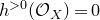 $h^{\gt 0}({\mathcal{O}}_{X}) = 0$
, it follows that
$h^{\gt 0}({\mathcal{O}}_{X}) = 0$
, it follows that ${\mathbf{L}}_X(\Xi)^\vee$
is globally generated,
${\mathbf{L}}_X(\Xi)^\vee$
is globally generated, $h^0({\mathbf{L}}_X(\Xi)^\vee) = r + s$
and
$h^0({\mathbf{L}}_X(\Xi)^\vee) = r + s$
and $h^{\gt 0}({\mathbf{L}}_X(\Xi)^\vee) = 0$
.
$h^{\gt 0}({\mathbf{L}}_X(\Xi)^\vee) = 0$
.
Proof of Theorem 5.3. First, we prove existence. Assume $s \ge r$
. Since Gorenstein Fano threefolds with terminal singularities are smoothable, their genus has the same bound
$s \ge r$
. Since Gorenstein Fano threefolds with terminal singularities are smoothable, their genus has the same bound $g \le 12$
as for smooth prime Fano threefolds, hence
$g \le 12$
as for smooth prime Fano threefolds, hence $r \in \{2,3\}$
. Therefore, Corollary 5.6 (whose hypotheses are satisfied by Proposition 5.5) applies, proving that
$r \in \{2,3\}$
. Therefore, Corollary 5.6 (whose hypotheses are satisfied by Proposition 5.5) applies, proving that ${\mathcal{U}}_X \mathrel{:=} {\mathbf{L}}_X(\Xi)$
is a Mukai sheaf on X.
${\mathcal{U}}_X \mathrel{:=} {\mathbf{L}}_X(\Xi)$
is a Mukai sheaf on X.
Now assume $r \gt s$
. The above argument proves the existence of a Mukai sheaf of type (s,r), and then Lemma 5.2 implies the existence of a Mukai sheaf of type (r,s).
$r \gt s$
. The above argument proves the existence of a Mukai sheaf of type (s,r), and then Lemma 5.2 implies the existence of a Mukai sheaf of type (r,s).
We now prove uniqueness. Assume $g = r \cdot s \ge 6$
and let
$g = r \cdot s \ge 6$
and let ${\mathcal{U}}_1$
,
${\mathcal{U}}_1$
, ${\mathcal{U}}_2$
be two Mukai sheaves of type (r,s) on X. Consider the pencil
${\mathcal{U}}_2$
be two Mukai sheaves of type (r,s) on X. Consider the pencil ${\mathcal{S}} = \{S_t\}_{t \in {\mathbb{P}}^1}$
constructed in Lemma 5.4 with base curve C. By Lemma 5.2 if
${\mathcal{S}} = \{S_t\}_{t \in {\mathbb{P}}^1}$
constructed in Lemma 5.4 with base curve C. By Lemma 5.2 if $t \in {\mathbb{P}}^1$
is very general,
$t \in {\mathbb{P}}^1$
is very general, ${\mathcal{U}}_i\vert_{S_t}$
are Mukai bundles, hence by Lemma 3.2 there is an isomorphism
${\mathcal{U}}_i\vert_{S_t}$
are Mukai bundles, hence by Lemma 3.2 there is an isomorphism  , unique up to rescaling. Restricting any of the isomorphisms $\phi_t$
to C, we obtain an isomorphism
$\phi_t$
to C, we obtain an isomorphism  , and since the bundles ${\mathcal{U}}_i\vert_C \cong ({\mathcal{U}}_i\vert_{S_t})\vert_C$
are simple by Proposition 4.8 (this applies because
${\mathcal{U}}_i\vert_C \cong ({\mathcal{U}}_i\vert_{S_t})\vert_C$
are simple by Proposition 4.8 (this applies because $g \ge 6$
), it is also unique up to rescaling. Therefore, we can fix an isomorphism
$g \ge 6$
), it is also unique up to rescaling. Therefore, we can fix an isomorphism $\phi_C$
and rescale
$\phi_C$
and rescale $\phi_t$
in such a way that
$\phi_t$
in such a way that $\phi_t\vert_C = \phi_C$
for all very general t.
$\phi_t\vert_C = \phi_C$
for all very general t.
On the other hand, Lemmas 5.2 and 4.1 imply that the restriction maps
 \begin{equation*}{\mathrm{H}}^0(X, {\mathcal{U}}_i^\vee) \to {\mathrm{H}}^0(S_t, {\mathcal{U}}_i^\vee\vert_{S_t}) \to {\mathrm{H}}^0(C, {\mathcal{U}}_i^\vee\vert_C)\end{equation*}
are isomorphisms, hence we have the following commutative diagram.

It follows that there is a unique isomorphism  compatible with $\phi_C^\vee$
, and, moreover, the diagram shows that it is compatible with
$\phi_C^\vee$
, and, moreover, the diagram shows that it is compatible with $\phi_t^\vee$
for all very general t.
$\phi_t^\vee$
for all very general t.
Now consider the composition of morphisms

where ${\mathcal{U}}_2^\perp$
is the Mukai sheaf of type (s,r) associated with
${\mathcal{U}}_2^\perp$
is the Mukai sheaf of type (s,r) associated with ${\mathcal{U}}_2$
in Lemma 5.2. For each very general
${\mathcal{U}}_2$
in Lemma 5.2. For each very general $t \in {\mathbb{P}}^1$
, restricting
$t \in {\mathbb{P}}^1$
, restricting $\psi$
to
$\psi$
to $S_t$
, we obtain a chain of maps
$S_t$
, we obtain a chain of maps
 \begin{equation*}{\mathcal{U}}_2^\perp\vert_{S_t} \hookrightarrow{\mathrm{H}}^0(S_t, {\mathcal{U}}_2^\vee) \otimes {\mathcal{O}}_{S_t} \xrightarrow{\ \phi_t^\vee\ }{\mathrm{H}}^0(S_t, {\mathcal{U}}_1^\vee) \otimes {\mathcal{O}}_{S_t} \twoheadrightarrow{\mathcal{U}}_1^\vee\vert_{S_t},\end{equation*}
and by functoriality of the evaluation morphism, its composition is zero. Thus, the morphism $\psi$
vanishes after restriction to
$\psi$
vanishes after restriction to $S_t$
for all very general t, hence it vanishes everywhere. It follows that the composition
$S_t$
for all very general t, hence it vanishes everywhere. It follows that the composition  factors through an epimorphism ${\mathcal{U}}_1^\vee \twoheadrightarrow {\mathcal{U}}_2^\vee$
, and since the sheaves
${\mathcal{U}}_1^\vee \twoheadrightarrow {\mathcal{U}}_2^\vee$
, and since the sheaves ${\mathcal{U}}_1^\vee$
and
${\mathcal{U}}_1^\vee$
and ${\mathcal{U}}_2^\vee$
are torsion-free of the same rank, it is an isomorphism.
${\mathcal{U}}_2^\vee$
are torsion-free of the same rank, it is an isomorphism.
5.2 The Mukai bundle
In this section we show that if ${\mathrm{g}}(X) \ge 6$
and the Mukai sheaf on X is locally free, it is exceptional (see Remark 5.10 for a discussion of the case
${\mathrm{g}}(X) \ge 6$
and the Mukai sheaf on X is locally free, it is exceptional (see Remark 5.10 for a discussion of the case $g = 4$
). In particular, we prove Theorem 1.1.
$g = 4$
). In particular, we prove Theorem 1.1.
We will need the following simple observation.
Lemma 5.7. If ${\mathcal{F}}$
is a vector bundle on X then
${\mathcal{F}}$
is a vector bundle on X then $\chi({\mathcal{F}}, {\mathcal{F}}) = 1/2\chi({\mathcal{F}}\vert_S, {\mathcal{F}}\vert_S)$
. In particular, if
$\chi({\mathcal{F}}, {\mathcal{F}}) = 1/2\chi({\mathcal{F}}\vert_S, {\mathcal{F}}\vert_S)$
. In particular, if ${\mathcal{F}}\vert_S$
is numerically spherical, that is,
${\mathcal{F}}\vert_S$
is numerically spherical, that is, $\chi({\mathcal{F}}\vert_S, {\mathcal{F}}\vert_S) = 2$
, then
$\chi({\mathcal{F}}\vert_S, {\mathcal{F}}\vert_S) = 2$
, then ${\mathcal{F}}$
is numerically exceptional, that is,
${\mathcal{F}}$
is numerically exceptional, that is, $\chi({\mathcal{F}}, {\mathcal{F}}) = 1$
.
$\chi({\mathcal{F}}, {\mathcal{F}}) = 1$
.
Proof. Let $i \colon S \hookrightarrow X$
be the embedding. The short exact sequence
$i \colon S \hookrightarrow X$
be the embedding. The short exact sequence $0 \to {\mathcal{F}}(-H) \to {\mathcal{F}} \to i_* i^* {\mathcal{F}} \to 0$
, combined with Serre duality and adjunction, gives
$0 \to {\mathcal{F}}(-H) \to {\mathcal{F}} \to i_* i^* {\mathcal{F}} \to 0$
, combined with Serre duality and adjunction, gives
 \begin{equation*}\chi({\mathcal{F}}, {\mathcal{F}}) = \chi({\mathcal{F}}, {\mathcal{F}}(-H)) + \chi({\mathcal{F}}, i_* i^* {\mathcal{F}}) = - \chi({\mathcal{F}}, {\mathcal{F}}) + \chi({\mathcal{F}}\vert_S, {\mathcal{F}}\vert_S),\end{equation*}
which shows our claim.
The following lemma reduces verification of some Ext-vanishings on X to Ext-vanishing on S.
Lemma 5.8. Let ${\mathcal{F}}_1,{\mathcal{F}}_2$
be vector bundles on X and let
${\mathcal{F}}_1,{\mathcal{F}}_2$
be vector bundles on X and let $S \subset X$
be a divisor in
$S \subset X$
be a divisor in $|H|$
such that
$|H|$
such that
 \begin{equation*}\mathrm{Hom}({\mathcal{F}}_1\vert_S, {\mathcal{F}}_2\vert_S) = {\Bbbk}\quad \text{and}\quad \mathrm{Ext}^1({\mathcal{F}}_1\vert_S, {\mathcal{F}}_2(-H)\vert_S) = 0.\end{equation*}
Then $\mathrm{Hom}({\mathcal{F}}_1, {\mathcal{F}}_2) = {\Bbbk}$
and
$\mathrm{Hom}({\mathcal{F}}_1, {\mathcal{F}}_2) = {\Bbbk}$
and $\mathrm{Ext}^1({\mathcal{F}}_1, {\mathcal{F}}_2(-kH)) = 0$
for all
$\mathrm{Ext}^1({\mathcal{F}}_1, {\mathcal{F}}_2(-kH)) = 0$
for all $k \ge 1$
.
$k \ge 1$
.
Proof. Consider the Koszul complex for three general global sections of the sheaf ${\mathcal{O}}_S(H_S)$
(which is globally generated by Lemma 5.2):
${\mathcal{O}}_S(H_S)$
(which is globally generated by Lemma 5.2):
 \begin{equation*}0 \to {\mathcal{O}}_S(-3H_S) \to {\mathcal{O}}_S(-2H_S)^{\oplus 3} \to {\mathcal{O}}_S(-H_S)^{\oplus 3} \to {\mathcal{O}}_S \to 0.\end{equation*}
Tensoring this by ${\mathcal{F}}_2(H)\vert_S$
, we obtain an exact sequence
${\mathcal{F}}_2(H)\vert_S$
, we obtain an exact sequence
 \begin{equation*}0 \to {\mathcal{F}}_2(-2H)\vert_S \to {\mathcal{F}}_2(-H)\vert_S^{\oplus 3} \to {\mathcal{F}}_2\vert_S^{\oplus 3} \to {\mathcal{F}}_2(H)\vert_S \to 0.\end{equation*}
Since $\mathrm{Ext}^1({\mathcal{F}}_1\vert_S, {\mathcal{F}}_2(-H)\vert_S) = 0$
, a simple spectral sequence implies that
$\mathrm{Ext}^1({\mathcal{F}}_1\vert_S, {\mathcal{F}}_2(-H)\vert_S) = 0$
, a simple spectral sequence implies that $\mathrm{Ext}^1({\mathcal{F}}_1\vert_S, {\mathcal{F}}_2(-2H)\vert_S)$
is a quotient of the space
$\mathrm{Ext}^1({\mathcal{F}}_1\vert_S, {\mathcal{F}}_2(-2H)\vert_S)$
is a quotient of the space
 \begin{equation*}\mathrm{Ker}(\mathrm{Hom}({\mathcal{F}}_1\vert_S, {\mathcal{F}}_2\vert_S)^{\oplus 3} \to \mathrm{Hom}({\mathcal{F}}_1\vert_S, {\mathcal{F}}_2(H)\vert_S)).\end{equation*}
Since $\mathrm{Hom}({\mathcal{F}}_1\vert_S, {\mathcal{F}}_2\vert_S) = {\Bbbk}$
, the kernel is non-zero only if
$\mathrm{Hom}({\mathcal{F}}_1\vert_S, {\mathcal{F}}_2\vert_S) = {\Bbbk}$
, the kernel is non-zero only if $\mathrm{Hom}({\mathcal{F}}_1\vert_S, {\mathcal{F}}_2\vert_S)$
is annihilated by a section of
$\mathrm{Hom}({\mathcal{F}}_1\vert_S, {\mathcal{F}}_2\vert_S)$
is annihilated by a section of ${\mathcal{O}}_S(H_S)$
, which is impossible because the
${\mathcal{O}}_S(H_S)$
, which is impossible because the ${\mathcal{F}}_i$
are locally free. Thus,
${\mathcal{F}}_i$
are locally free. Thus, $\mathrm{Ext}^1({\mathcal{F}}_1\vert_S, {\mathcal{F}}_2(-2H)\vert_S) = 0$
. Twisting the same Koszul complex by
$\mathrm{Ext}^1({\mathcal{F}}_1\vert_S, {\mathcal{F}}_2(-2H)\vert_S) = 0$
. Twisting the same Koszul complex by $-H$
,
$-H$
, $-2H$
, and so on, and repeating the same argument, we see that
$-2H$
, and so on, and repeating the same argument, we see that $\mathrm{Ext}^1({\mathcal{F}}_1\vert_S, {\mathcal{F}}_2(-kH)\vert_S) = 0$
for all
$\mathrm{Ext}^1({\mathcal{F}}_1\vert_S, {\mathcal{F}}_2(-kH)\vert_S) = 0$
for all $k \ge 1$
.
$k \ge 1$
.
Now consider the restriction exact sequence
 \begin{equation*}\mathrm{Ext}^1({\mathcal{F}}_1, {\mathcal{F}}_2(-(k + 1)H)) \to \mathrm{Ext}^1({\mathcal{F}}_1, {\mathcal{F}}_2(-kH)) \to \mathrm{Ext}^1({\mathcal{F}}_1\vert_S, {\mathcal{F}}_2(-kH)\vert_S).\end{equation*}
Its right term is zero for $k \ge 1$
as we just showed, hence its first arrow must be surjective. Thus, if
$k \ge 1$
as we just showed, hence its first arrow must be surjective. Thus, if $\mathrm{Ext}^1({\mathcal{F}}_1, {\mathcal{F}}_2(-kH)) \ne 0$
for some
$\mathrm{Ext}^1({\mathcal{F}}_1, {\mathcal{F}}_2(-kH)) \ne 0$
for some $k \ge 1$
, the same non-vanishing holds for all sufficiently large k, which contradicts Serre vanishing because the
$k \ge 1$
, the same non-vanishing holds for all sufficiently large k, which contradicts Serre vanishing because the ${\mathcal{F}}_i$
are locally free. This proves the vanishing of
${\mathcal{F}}_i$
are locally free. This proves the vanishing of $\mathrm{Ext}^1$
.
$\mathrm{Ext}^1$
.
Similarly, the restriction exact sequence for $k = 0$
gives
$k = 0$
gives
 \begin{equation*}0 \to \mathrm{Hom}({\mathcal{F}}_1, {\mathcal{F}}_2(-H)) \to \mathrm{Hom}({\mathcal{F}}_1, {\mathcal{F}}_2) \to \mathrm{Hom}({\mathcal{F}}_1\vert_S, {\mathcal{F}}_2\vert_S) \to \mathrm{Ext}^1({\mathcal{F}}_1, {\mathcal{F}}_2(-H)),\end{equation*}
and since the right term vanishes and the term next to it is ${\Bbbk}$
, we have
${\Bbbk}$
, we have $\mathrm{Hom}({\mathcal{F}}_1, {\mathcal{F}}_2) \ne 0$
. Finally, if the dimension of
$\mathrm{Hom}({\mathcal{F}}_1, {\mathcal{F}}_2) \ne 0$
. Finally, if the dimension of $\mathrm{Hom}({\mathcal{F}}_1, {\mathcal{F}}_2)$
is greater than 1, then
$\mathrm{Hom}({\mathcal{F}}_1, {\mathcal{F}}_2)$
is greater than 1, then $\mathrm{Hom}({\mathcal{F}}_1, {\mathcal{F}}_2(-H)) \ne 0$
, and then by induction
$\mathrm{Hom}({\mathcal{F}}_1, {\mathcal{F}}_2(-H)) \ne 0$
, and then by induction $\mathrm{Hom}({\mathcal{F}}_1, {\mathcal{F}}_2(-kH)) \ne 0$
for all
$\mathrm{Hom}({\mathcal{F}}_1, {\mathcal{F}}_2(-kH)) \ne 0$
for all $k \ge 0$
, again contradicting Serre vanishing.
$k \ge 0$
, again contradicting Serre vanishing.
Corollary 5.9. Let X be a prime Fano threefold with factorial terminal singularities of genus g and assume that $g = r \cdot s \ge 6$
with
$g = r \cdot s \ge 6$
with $r,s \ge 2$
. If the Mukai sheaf
$r,s \ge 2$
. If the Mukai sheaf ${\mathcal{U}}_X$
of type (r,s) on X is locally free, it is exceptional.
${\mathcal{U}}_X$
of type (r,s) on X is locally free, it is exceptional.
Proof. First, assume $s \ge r$
. By Lemma 5.2, if
$s \ge r$
. By Lemma 5.2, if $S \subset X$
is a very general anticanonical divisor, then
$S \subset X$
is a very general anticanonical divisor, then $\mathrm{Pic}(S) = {\mathbb{Z}} \cdot H_S$
and
$\mathrm{Pic}(S) = {\mathbb{Z}} \cdot H_S$
and ${\mathcal{U}}_X\vert_S$
is a Mukai bundle on S. Moreover,
${\mathcal{U}}_X\vert_S$
is a Mukai bundle on S. Moreover, ${\mathcal{U}}_X\vert_S \cong {\mathbf{L}}_S(\xi)$
is the Lazarsfeld bundle associated with a general curve C on S and a Mukai pair
${\mathcal{U}}_X\vert_S \cong {\mathbf{L}}_S(\xi)$
is the Lazarsfeld bundle associated with a general curve C on S and a Mukai pair $(\xi,\eta)$
of type (r,s) on C by Theorem 3.4. In particular, by Lemma 3.3 this bundle is spherical and Proposition 4.2 shows that
$(\xi,\eta)$
of type (r,s) on C by Theorem 3.4. In particular, by Lemma 3.3 this bundle is spherical and Proposition 4.2 shows that
 \begin{equation*}\mathrm{Hom}({\mathbf{L}}_S(\xi), {\mathbf{L}}_S(\xi)) = {\Bbbk}\quad \text{and}\quad \mathrm{Ext}^1({\mathbf{L}}_S(\xi), {\mathbf{L}}_S(\xi) \otimes {\mathcal{O}}_S(-H)) = 0.\end{equation*}
As ${\mathcal{U}}_X$
is locally free by assumption, applying Lemma 5.8 to
${\mathcal{U}}_X$
is locally free by assumption, applying Lemma 5.8 to ${\mathcal{F}}_1 = {\mathcal{F}}_2 = {\mathcal{U}}_X$
, we obtain
${\mathcal{F}}_1 = {\mathcal{F}}_2 = {\mathcal{U}}_X$
, we obtain
 \begin{equation*}\mathrm{Hom}({\mathcal{U}}_X, {\mathcal{U}}_X) = {\Bbbk}\quad \text{and}\quad \mathrm{Ext}^1({\mathcal{U}}_X, {\mathcal{U}}_X \otimes {\mathcal{O}}_X(-H)) = 0.\end{equation*}
By Serre duality, the second equality implies that $\mathrm{Ext}^2({\mathcal{U}}_X, {\mathcal{U}}_X) = 0$
. On the other hand, we have
$\mathrm{Ext}^2({\mathcal{U}}_X, {\mathcal{U}}_X) = 0$
. On the other hand, we have $\chi({\mathcal{U}}_X, {\mathcal{U}}_X) = \tfrac12\,\chi({\mathbf{L}}_S(\xi),{\mathbf{L}}_S(\xi)) = 1$
by Lemma 5.7. Therefore,
$\chi({\mathcal{U}}_X, {\mathcal{U}}_X) = \tfrac12\,\chi({\mathbf{L}}_S(\xi),{\mathbf{L}}_S(\xi)) = 1$
by Lemma 5.7. Therefore,
 \begin{equation*}\mathrm{Ext}^1({\mathcal{U}}_X, {\mathcal{U}}_X) = \mathrm{Ext}^3({\mathcal{U}}_X, {\mathcal{U}}_X) = 0,\end{equation*}
hence ${\mathcal{U}}_X$
is exceptional.
${\mathcal{U}}_X$
is exceptional.
Now assume $r \gt s$
. Then the Mukai sheaf
$r \gt s$
. Then the Mukai sheaf ${\mathcal{U}}_X^\perp$
of type (s,r) defined in Lemma 5.2 is also locally free, hence it is exceptional by the above argument. Furthermore, the defining sequence
${\mathcal{U}}_X^\perp$
of type (s,r) defined in Lemma 5.2 is also locally free, hence it is exceptional by the above argument. Furthermore, the defining sequence
 \begin{equation*}0 \to {\mathcal{U}}_X^\perp \to {\mathrm{H}}^0(X, {\mathcal{U}}_X^\vee) \otimes {\mathcal{O}}_X \to {\mathcal{U}}_X^\vee \to 0\end{equation*}
shows that ${\mathcal{U}}_X^\vee$
is the right mutation of
${\mathcal{U}}_X^\vee$
is the right mutation of ${\mathcal{U}}_X^\perp$
through
${\mathcal{U}}_X^\perp$
through ${\mathcal{O}}_X$
, hence
${\mathcal{O}}_X$
, hence ${\mathcal{U}}_X$
is also exceptional.
${\mathcal{U}}_X$
is also exceptional.
Proof of Theorem 1.1. The existence and uniqueness of a Mukai sheaf ${\mathcal{U}}_X$
of type (r,s) follows from Theorem 5.3. Since
${\mathcal{U}}_X$
of type (r,s) follows from Theorem 5.3. Since ${\mathcal{U}}_X$
is maximal Cohen–Macaulay and X is smooth,
${\mathcal{U}}_X$
is maximal Cohen–Macaulay and X is smooth, ${\mathcal{U}}_X$
is locally free by the Auslander–Buchsbaum formula. All that remains is to note that
${\mathcal{U}}_X$
is locally free by the Auslander–Buchsbaum formula. All that remains is to note that ${\mathcal{U}}_X$
is exceptional by Corollary 5.9.
${\mathcal{U}}_X$
is exceptional by Corollary 5.9.
Remark 5.10. If X is a smooth prime Fano threefold of genus $g = 4$
then
$g = 4$
then $X = Q \cap R$
is a complete intersection of a quadric and a cubic hypersurface in
$X = Q \cap R$
is a complete intersection of a quadric and a cubic hypersurface in ${\mathbb{P}}^5$
; moreover, Q is smooth or is a cone over a smooth three-dimensional quadric
${\mathbb{P}}^5$
; moreover, Q is smooth or is a cone over a smooth three-dimensional quadric $\bar{Q}$
, and if Q is a cone then R does not contain its vertex.
$\bar{Q}$
, and if Q is a cone then R does not contain its vertex.
If Q is smooth, [Reference Kuznetsov and ShinderKS25, Proposition 4.2] shows that the restriction to X of either of the two spinor bundles on Q is an exceptional Mukai bundle on X, but they are not isomorphic and thus a Mukai bundle on X exists but is not unique.
If Q is singular, [Reference Kuznetsov and ShinderKS25, Proposition 4.2] shows that the pullback of the unique spinor bundle from $\bar{Q}$
is the unique Mukai sheaf on X; however, the sheaf is not exceptional.
$\bar{Q}$
is the unique Mukai sheaf on X; however, the sheaf is not exceptional.
In both cases our arguments proving the uniqueness or exceptionality do not apply because Proposition 4.2 fails for $g = 4$
.
$g = 4$
.
Furthermore, consider a complete intersection $X = Q \cap R$
of a cone Q over a smooth quadric threefold
$X = Q \cap R$
of a cone Q over a smooth quadric threefold $\bar Q$
and a cubic hypersurface R containing the vertex, where R is very general among such cubics; such X is a factorial one-nodal Fano threefold of genus
$\bar Q$
and a cubic hypersurface R containing the vertex, where R is very general among such cubics; such X is a factorial one-nodal Fano threefold of genus $g = 4$
(see [Reference Kuznetsov and ProkhorovKP25, Theorem 1.6(ii) and the proof of Theorem 1.8, Subcase (4f-b)]). Let
$g = 4$
(see [Reference Kuznetsov and ProkhorovKP25, Theorem 1.6(ii) and the proof of Theorem 1.8, Subcase (4f-b)]). Let ${\mathcal{U}}_X$
be the reflexive extension of the pullback of the spinor sheaf on
${\mathcal{U}}_X$
be the reflexive extension of the pullback of the spinor sheaf on $\bar Q$
to the complement of the node in X. Then
$\bar Q$
to the complement of the node in X. Then ${\mathcal{U}}_X$
is the unique Mukai sheaf on X, but it is neither locally free nor exceptional.
${\mathcal{U}}_X$
is the unique Mukai sheaf on X, but it is neither locally free nor exceptional.
In [Reference Bayer, Kuznetsov and MacrìBKM25] we prove that the Mukai sheaf on any prime Fano threefold X with factorial terminal singularities of genus $g \ge 6$
is locally free, hence it is exceptional.
$g \ge 6$
is locally free, hence it is exceptional.
Acknowledgements
This paper has benefited from many useful discussions with the following people whom we gratefully thank: Asher Auel, Marcello Bernardara, Tzu-Yang Chou, Ciro Ciliberto, Olivier Debarre, Daniele Faenzi, Flaminio Flamini, Andreas Knutsen, Chunyi Li, Shengxuan Liu, Jonathan Ng, Yuri Prokhorov, Claire Voisin, Peter Yi Wei. We also thank Gavril Farkas for helping us put Theorems 1.3 and 1.4 into an appropriate context and the referee for many useful comments and suggestions. We also acknowledge the influence of the work of Shigeru Mukai, which provided and continues to provide a source of inspiration for us.
Conflicts of interest
None.
Financial support
AB was partially supported by the EPSRC grant EP/R034826/1 and the ERC grant ERC-2018-CoG819864-WallCrossAG. AK was partially supported by the HSE University Basic Research Program. EM was partially supported by the ERC grant ERC-2020-SyG-854361-HyperK.
Journal information
Compositio Mathematica is owned by the Foundation Compositio Mathematica and published by the London Mathematical Society in partnership with Cambridge University Press. All surplus income from the publication of Compositio Mathematica is returned to mathematics and higher education through the charitable activities of the Foundation, the London Mathematical Society and Cambridge University Press.

 Open access

