





1. Introduction
Since Derek Parfit published his seminal paper ‘Equality or Priority?’ in 1991, political philosophers have been discussing the merits of prioritarianism and, not least, whether it provides a more plausible distribution-sensitive account of justice than does egalitarianism.Footnote 1 Very roughly, prioritarianism states that in the distribution of advantages, we should give priority to the worse off (I provide a more precise definition in section 2). This discussion has resulted in a large research literature, dealing with the nature of prioritarianism, how it can be justified, and what the objections are.
Two of the types of objections that have been most persistently pushed against prioritarianism pertain to, respectively, competing claims and impersonal value. Both kinds of objection admit of a variety of instantiations and in the present article, I critically assess two recent versions that add to the existing literature in terms of, among other things, scope and specificity. According to the first objection, or rather series of objections, which have been put forward by Michael Otsuka (Reference Otsuka, McMahan, Campbell, Goodich and Ramakrishnan2022), prioritarianism cannot adequately account for the importance of competing claims in distributive justice. More specifically, prioritarianism inadequately caters to large losses, rank-switching and saving large numbers of people. These competing claims-based objections have in common the implication that the value, or choice-worthiness, of an outcome depends on what other outcomes it is compared to, or that may be realized instead of it. Unlike most of the debate on prioritarianism and competing claims, which deals with risky choices, Otsuka makes his points in relation to non-risky, or certain, outcomes.
According to the second objection, which has been raised by Christoph Hanisch (Reference Hanisch2020), prioritarians are committed to a form of impersonal value that casts some doubt on prioritarianism. Prioritarians often take egalitarianism to be implausible because it implies that, in cases of levelling down, a levelled down outcome can be in one respect better even if it is better for no one. Compare, for example, two outcomes, (100, 50) and (50, 50), where each number refers to an individual’s level of advantages. According to egalitarianism, (50, 50) is in one respect better than (100, 50), because more equal, even though no one is better off in (50, 50). That is, what makes (50, 50) in one respect better, according to egalitarians, is an impersonal value. However, Hanisch argues that prioritarianism likewise implies that an outcome can be in one respect better for purely impersonal reasons. While, as stated, others have criticized prioritarians for being committed to impersonal value, Hanisch has a specific analysis of the nature of the impersonal value in question and the kind of objections it gives rise to.
In the following, in section 2, I provide a definition of prioritarianism and further explain the nature of this principle in terms of a number of axioms it satisfies. This also allows me to explain, with greater precision, how it differs from various other distributive views. In section 3, I critically examine Otsuka’s competing claims-based objections to prioritarianism. I argue both that at least one of them suffers from certain formal problems, and that they all involve downplaying the interests of the worse off. In section 4, I critically discuss Hanisch’s objection and argue both that he misconstrues the nature of prioritarianism and that prioritarianism is not really vulnerable to the objection(s) he raises. In section 5, I conclude.
2. Prioritarianism
I need to be more specific about the form of prioritarianism under discussion. I am concerned only with axiological outcome prioritarianism, which is also the form that has been discussed the most in the literature. Like other distributive outcome axiological principles, axiological outcome prioritarianism provides a betterness ranking of outcomes, from best to worst.
To simplify my discussion, I make a number of assumptions. I assume that lifetime welfare is the currency of distributive justice.Footnote 2 I further assume that welfare is appropriately measurable and intra- and interpersonally comparable. Likewise, I assume that the betterness ranking is complete and transitive. I also assume a fixed population, more precisely, that in each set of outcomes compared, these outcomes consist of the same individuals. Finally, I assume that, in the outcomes to be compared, no one is responsible for, or deserves, any particular distribution of welfare. Thus, individuals do not have claims to any distribution over any other distribution on grounds of responsibility or desert.
In what has become the standard welfare axiological interpretation of prioritarianism (henceforth, ‘prioritarianism’), it states that outcome value is an additive function of weighted individual welfare, where the weighting function gives priority to the worse off. Suppose a population of N individuals. Prioritarian outcome value can then be represented by: ${\rm V}(x) = \rm f(w_1({\it x})) + f(w_2({\it x})) + \ldots + f(w_N({\it x})),$
where x is an outcome, wi(x) is the welfare of individual i in x, and f is a transformation function that is strictly increasing and strictly concave (Broome Reference Broome1991: 216; Rabinowicz et al., Reference Rabinowicz, Egonsson, Josefsson, Petersson and Rønnow-Rasmussen2001: 148; Holtug Reference Holtug, Holtug and Lippert-Rasmussen2006: 132–36; Reference Holtug2010: 204–209; Adler Reference Adler2012: 356–67; Hirose Reference Hirose2015a: 86–95; Holtug Reference Holtug, Hirose and Olson2015a: 276–82; Adler and Holtug Reference Adler and Holtug2019: 103–5; Reference Adler, Holtug, Zalta and Nodelman2025). This function secures that a welfare gain that befalls an individual at a lower level of welfare gives rise to a larger increase in moral outcome value than an equal welfare gain that befalls an individual at a higher level of welfare. In other words, it gives priority to the worse off.
Importantly, prioritarianism satisfies a series of axioms, including anonymity, the Pareto principle, the Pigou–Dalton principle of transfer, and separability (Adler and Holtug Reference Adler and Holtug2019: 103–5; Reference Adler, Holtug, Zalta and Nodelman2025). According to anonymity, which is an impartiality requirement, if the welfare levels in outcome x are a permutation of the welfare levels in outcome y, then x and y are equally good. So, for example, (20, 10) and (10, 20) are equally good. According to the Pareto principle, which is an efficiency requirement, if everyone is at least as well off in x as in y, and at least one individual is better off in x, then x is better than y, and if everyone is equally well off in x and y, then x and y are equally good. So, for example, (20, 10) is better than (10, 10). According to the Pigou–Dalton principle, which is an equality-favouring requirement, a pure transfer of welfare from a better off to a worse off individual, which shrinks the gap between their levels and leaves everyone else unaffected, increases the value of an outcome.Footnote 3 So, for example, (50, 30, 20) is better than (60, 20, 20). And according to the separability axiom, the ranking of two outcomes is independent of unaffected individuals. So, for example, if (60, 60, 70, 10) is better than (80, 50, 70, 10), then (60, 60, 90, 80) is better than (80, 50, 90, 80) – note that in each pairwise comparison, the two last individuals are unaffected.
It is instructive to compare prioritarianism to a couple of other distributive principles in terms of these axioms. Like prioritarianism, utilitarianism satisfies anonymity, the Pareto principle, and separability, but unlike prioritarianism, it does not satisfy the Pigou–Dalton principle. Utilitarianism is indifferent to Pigou–Dalton transfers, because it is indifferent to how a fixed sum of welfare is distributed. Furthermore, like prioritarianism, standard versions of egalitarianism satisfy anonymity, the Pigou–Dalton principle, may satisfy the Pareto principle (if the concern for equality is suitably combined with a concern for efficiency), but they do not satisfy separability. This last claim captures the idea that equality is a relation between individuals and so the moral value of individual welfare contributions is not independent of other people’s levels.
3. Competing Claims
It has been argued that prioritarianism is incompatible with a plausible account of competing claims. A significant part of this debate pertains to risky choices and there is now a considerable literature that elucidates it (see, for example, Crisp Reference Crisp2011; Bognar Reference Bognar2012; O’Neill Reference O’Neill2012; Parfit Reference Parfit2012; Porter Reference Porter2012; Williams Reference Williams2012; Hyams Reference Hyams2015; Segall Reference Segall2015; Adler and Holtug Reference Adler and Holtug2019). For an overview of prioritarian responses, see Adler and Holtug (Reference Adler, Holtug, Zalta and Nodelman2025), and for my own specific account of how to defuse the objections, see Holtug (Reference Holtug2019). However, it has recently been argued by Michael Otsuka (Reference Otsuka, McMahan, Campbell, Goodich and Ramakrishnan2022) that prioritarianism faces a series of competing claims objections even as regards non-risky, or certain, outcomes, and it is this argument I consider here. But before I get to Otsuka’s objections, let me briefly point out how prioritarianism can itself be based on an account of competing claims.
Matthew Adler (Reference Adler2012: 321–37) draws a distinction between claim-within-outcome and claim-across-outcome accounts of fairness and argues that prioritarianism can be justified on the basis of the latter. Whereas a claim-within-outcome account assesses outcomes in terms of how individuals fare relative to each other in each, a claim-across-outcome account assesses outcomes on the basis of individual claims vis-à-vis pairs of outcomes, where these claims depend on their levels of welfare in each. More specifically, Adler proposes that an individual has a claim to x over y insofar as she is better off in x, where the strength of that claim increases both with the size of the gap between her welfare in x and y and the lower her welfare level is in y. Prioritarianism can be seen as a principle that aggregates such individual claims. Nevertheless, according to Otsuka, prioritarianism does not fully capture the nature of competing claims.
The objections raised by Otsuka can be made either on the basis of axiology or choice-worthiness. To directly challenge prioritarianism, as it has been construed in this article, the objections would have to be made in terms of axiology. This is because, thus construed, prioritarianism pertains only to the ranking of outcomes. Thus, it is possible to subscribe to a prioritarian ranking but argue that this ranking should be supplemented with other moral concerns when providing an account of which choices we have most reason to make. For example, prioritarianism could be combined with an independent account of competing claims. This would, however, constrain the significance of prioritarianism for distributive justice. Otsuka himself takes his objections to apply both to axiology and, since it tracks axiology, to choice-worthiness.Footnote 4 But, in any case, I shall consider both axiological and choice-based versions of Otsuka’s objections.
3.1. Large Losses
According to Otsuka (Reference Otsuka, McMahan, Campbell, Goodich and Ramakrishnan2022: 543–46), one of the ways in which prioritarianism fails to cater to competing claims pertains to what he calls ‘disproportionally large losses’.Footnote 5 When making this argument, Otsuka (Reference Otsuka, McMahan, Campbell, Goodich and Ramakrishnan2022: 544) appeals to a principle discussed (but rejected) by Parfit (Reference Parfit2011: 206), namely the ‘disproportional view’: the moral importance of lesser benefits and burdens is less than proportional to their size. What the disproportional view states is that, at least in some cases, providing a ‘lesser’ welfare gain, Δw, to each of N individuals holds less moral importance than providing a larger welfare gain of NΔw to a single individual. Presumably, these are cases in which the gap between Δw and NΔw is sufficiently large. Note that one way in which the disproportional view differs from prioritarianism is that it is only concerned with the size of welfare gains and losses to individuals, not with the levels of welfare at which they fall.
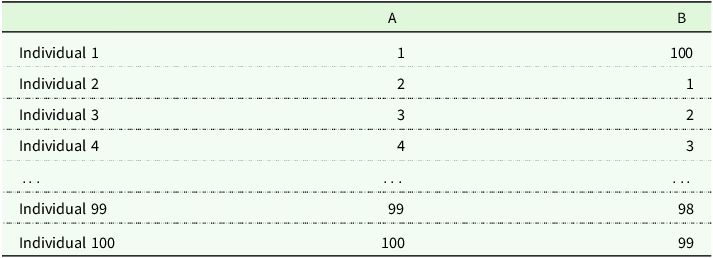
Otsuka (Reference Otsuka, McMahan, Campbell, Goodich and Ramakrishnan2022: 544) provides the example of the escalator case, in which the disproportional view has different implications than prioritarianism, to construct an argument against the latter. Suppose there is a 100-step escalator, with equal distances between the steps.Footnote 6 On each step, there is an individual, where the height of the step over the ground corresponds to that individual’s welfare level. Let us say that Individual 1 holds a welfare level of one, Individual 2 a level of two, and so on. Now compare two possible outcomes, A and B, where in A Individuals 1–100 occupy steps 1–100, whereas in B Individual 1 occupies Step 100 and everyone else occupies one step lower than in A. Their welfare levels are represented in Table 1.
The escalator case

As Otsuka points out, anonymity implies that outcomes A and B are equally good (the welfare levels remain constant across these outcomes, the only change pertains to who holds them). This means that prioritarianism is indifferent between A and B (as, indeed, is utilitarianism, standard versions of egalitarianism, sufficientarianism, leximin, and many other distributive principles, but Otsuka is here concerned only with prioritarianism). However, according to Otsuka, this implies that prioritarianism attaches insufficient significance to the fact that if A comes about, this will imply a large loss for Individual 1 (who will be at a welfare level of 1 rather than 100), whereas no-one will experience more than a slight loss if B comes about (99 individuals will each lose one unit of welfare). Thus, according to Otsuka (Reference Otsuka, McMahan, Campbell, Goodich and Ramakrishnan2022: 545), prioritarianism implies an implausible violation of the disproportional view.
Parfit (Reference Parfit2011: 208) provides an objection to the disproportional view that, in relation to the escalator case, implies that Individual 1 has no right to be at the top and therefore that the greater loss to this individual in A should not morally count for more than the aggregate loss of everyone else in B. However, according to Otsuka, this objection is unpersuasive because the reason to prefer B to A does not hinge on Individual 1 having a right to be at the top. Rather, he suggests that the reason derives from the claim that ‘relatively small gains or losses are not “relevant to” great gains and losses, irrespective of the level from which one gains or loses’ (Otsuka Reference Otsuka, McMahan, Campbell, Goodich and Ramakrishnan2022: 545).
I do not find the disproportional view, and Otsuka’s motivation for it, a persuasive objection to prioritarianism. First, arguably, Otsuka’s claims challenge certain logical requirements for the betterness ranking or, alternatively, rational requirements for choice-worthiness. To illustrate, suppose we can either provide an increase of 99 welfare units to one individual, 49 welfare units to some larger number of individuals, or one welfare unit to some even larger number of individuals. More specifically, we can raise Individual 1 from 1 to 100 (outcome C), or Individuals 2–N from 1 to 50 (outcome D), or Individuals N+1–M (a larger group) from 1 to 2 (outcome E). (‘Individuals N+1–M’ should be read ‘Individuals N+1 to M’.) These different outcomes are represented in Table 2.
Relevant losses

Suppose that, in the comparison between C and D, the difference between the loss of 49 units and the loss of 99 units is small enough for the former to be ‘relevant’ to the latter. In that case, presumably there is some number of individuals who may gain 49 units of welfare in D such that D is better than C. That is, for some N, D > C. Similarly, suppose that, in the comparison between D and E, the difference between the loss of one unit and the loss of 49 units is small enough for the former to be ‘relevant’ to the latter. In that case, presumably there is some number of individuals who may gain one unit in E such that E is better than D. Thus, for N+1–M sufficiently greater than 2–N, E > D. Finally, suppose that in the comparison between C and E, the difference between the loss of one unit and the loss of 99 units is large enough to render the former irrelevant to the latter. Thus, since the loss to Individual 1 is relevant, or counts, where the losses to Individuals N+1–M do not, it is not the case that E is better than C. And so we have a violation of the transitivity of the betterness relation.Footnote 7
However, the disproportional view need not be considered a view about the ranking of outcomes, rather, it may be seen as a view about choice-worthiness. That is, it may be seen as a view about which outcomes we have most reason to bring about, which does not necessarily reflect the outcome ranking perfectly. Even so, it will have some troubling implications. After all, how are we supposed to choose between C, D, and E? If we choose C, we seem to have made the wrong choice, because the losses in C and D are relevant to each other and D is better. If we choose D, we also seem to have made the wrong choice, because the losses in D and E are relevant to each other and E is better. And if we choose E, we also seem to have made the wrong choice, because the losses in C are relevant whereas the losses in E are not, and so C is preferable. Either way, we seem to have made the wrong choice.Footnote 8
Apart from these considerations of logic/rationality, consider again Otsuka’s claim that in the escalator case, prioritarianism attaches insufficient significance to large losses. While it is true that prioritarianism attaches equal importance to the loss of Individual 1 in A and the loss of everyone else in B, it is not the case that prioritarianism fails to register that Individual 1 has by far the strongest individual claim. In part, this is because Individual 1 stands to lose 99 units of welfare in A, whereas everyone else stands to lose only one such unit in B. On top of this, prioritarianism factors in the fact that Individual 1 would be particularly badly off in A. What is needed, to challenge prioritarianism here, is therefore an argument for why the significance attached to the stronger claim of Individual 1 is insufficient. Indeed, the claim-across-outcome account of fairness outlined above provides a perfectly straightforward and, it seems to me, intuitively compelling account of competing claims as regards gains and losses here.
Finally, consider Otsuka’s claim that small losses are not relevant to great losses, irrespective of the levels at which these occur. Assume that, according to Otsuka, the difference between a loss of 99 units and a loss of one unit is indeed so great that, regardless of the levels at which these losses fall, the latter is not relevant to the former. And suppose that, in outcome G, Individual 1 loses 99 units compared to outcome F, whereas 99 other people gain one unit in G, thus rendering the total unaffected. So far, this is equivalent to the comparison between A and B. However, unlike in A and B, Individual 1 is much better off than everyone else in both outcomes compared, as represented in Table 3.
Large loss to the best off, same total of welfare

If small individual losses are irrelevant to (or outbalanced by) large individual losses, we should prefer F to G, but this seems to me obviously mistaken. G is better than F, and this is of course easily explained by prioritarianism, because we can get from F to G through a series of Pigou–Dalton transfers. In other words, how could we reasonably expect Individuals 2–100 to forgo these benefits to bestow a larger benefit on Individual 1, with no gain in total welfare, when Individual 1 is already so much better off than they are, and they are in fact quite badly off in absolute terms?
In fact, on Otsuka’s view and on the assumptions made, it is better to prevent the loss of 99 units for one individual than to prevent, for any number of individuals, the loss of one unit. For example, H is preferable to I, where the welfare levels are represented in Table 4. This is so even if I is much better according to all the standard theories of distributive justice, including utilitarianism, prioritarianism, standard versions of egalitarianism, sufficientarianism, leximin, etc.
Large loss to the best off, different totals of welfare

Now, the disproportional view can of course be combined with prioritarianism (or some other distribution-sensitive principle), such that some significance is also attached to the fact that in G (and I), the lesser benefits accrue to the worse off. This would involve abandoning Otsuka’s claim that at least some small losses are irrelevant to large losses irrespective of the levels at which they fall. Indeed, Alex Voorhoeve (Reference Voorhoeve2014: 66) proposes such a combination of concerns in his account of competing claims, according to which the strength of such claims reflects the size of welfare increases and the levels at which they fall, but where ‘a claim is relevant if and only if it is sufficiently strong relative to the strongest competing claim’. For present purposes, the point is that whether a claim is relevant depends on how well off both the claimant and the individual with the strongest competing claim are (how well off they are independently of these particular claims).
To illustrate, compare Individuals 1 and 2 in outcomes A and B. Individual 1 loses 99 welfare units in A, whereas Individual 2 loses one unit in B. Furthermore, their claims are bolstered by the fact that they will both be badly off, at a level of one, if they do not receive these benefits. Compare this to Individuals 1 and 2 in outcomes F and G. Again, Individual 1 may lose 99 units (in G) and Individual 2 may lose one unit (in F), but whereas Individual 1 will be at 101 if she does not receive the additional 99 units, Individual 2 will be at 1 if he does not receive his additional unit. This suggests that Individual 1 has a stronger claim to A over B than to F over G. Thus, on Voorhoeve’s view, it is at least possible that even if Individuals 2’s claim is irrelevant to Individual 1’s claim in the comparison between A and B, Individual 2’s claim is relevant to individual 1’s claim in the comparison between F and G, even if their potential losses are identical in the two comparisons. Nevertheless, as Voorhoeve (Reference Voorhoeve2014: 85) acknowledges, even his account of competing claims will sometimes involve sacrificing the interests of the worse off and total welfare to secure a smaller maximum individual loss, as presumably will any principle that assigns more than negligible importance to something along the lines of the disproportional view.
3.2. Rank-Switching
A second objection to prioritarianism put forward by Otsuka (Reference Otsuka, McMahan, Campbell, Goodich and Ramakrishnan2022: 546–48), which is likewise based on competing claims, is that prioritarianism is insensitive to whether a distributive change is rank-switching or not. Consider two possible outcomes which include only two people, Individuals 1–2, who will live contemporaneous lives in the near future. Their welfare levels in these two outcomes are represented in Table 5.
No rank-switching

The comparison between J and K is non-rank-switching, because Individual 1 will be better off than Individual 2 whether J or K is realized. However, this is not so in the comparison between J and L, where the welfare levels of Individuals 1–2 are represented in Table 6.
Rank-switching

Here, Individual 1 is better off than Individual 2 in J, whereas Individual 2 is better off than Individual 1 in L. Nevertheless, prioritarianism implies that just as K is better than J, L is to the very same extent better than J. After all, L simply involves a permutation of the welfare levels in K, and so indeed any view that implies that K is better than J and satisfies anonymity implies that L is to the very same extent better than J. Thus, prioritarianism fails to attach any significance to the fact that the comparison between J and L involves rank-switching, whereas the comparison between J and K does not. And this is problematic, according to Otsuka (Reference Otsuka, McMahan, Campbell, Goodich and Ramakrishnan2022: 548), for the following reason: in the comparison between J and K, but not in the comparison between J and L, Individual 2 could object to the insistence of Individual 1 that J should be realized by pointing out that even in the alternative more equal outcome, Individual 1 would be better off than him. So how could Individual 1 reasonably object to this alternative, more equal outcome?
Again, we may either account for the impact of rank-switching in terms of axiology or choice-worthiness. If the former, since the comparison between J and L involves rank-shifting, it shrinks the difference in their value, such that: $\rm V(K)\,{\rm{ - }}\,V(J){\rm{\gt }}V(L)\,{\rm{ - }}\,{V(J)}{\rm{,}}$
where V(x) denotes the value of outcome x. If the latter, we simply have stronger reasons to prefer K to J than to prefer L to J. In both cases, and as in Otsuka’s account of large losses, the challenge to prioritarianism is due to the suggestion that the value or preferability of an outcome depends on the outcome(s) it is compared to, or that are among the available choices.
I now want to argue that the account of rank-switching proposed by Otsuka provides for ‘the privileged’ an unfair advantage, or extra bargaining chip, in resisting equality-increasing transfers, whenever these transfers involve rank-switching. Remember that I have assumed that concerns about responsibility and desert do not apply to the justice of the outcomes under consideration. Suppose, for example, that in J, Individual 1 is born into nobility whereas Individual 2 is born into a family of poor servants (of the nobility), and that the difference in their welfare reflects nothing other than this. In other words, the far greater welfare of Individual 1 reflects only privilege. Suppose also that J reflects current hierarchical social arrangements but that social reforms could be implemented such that L would result. Of course, in L, it is not Individual 1 but Individual 2 that is privileged. But that does not change the fact that, in one of the two outcomes compared, or between which we must choose, namely under current hierarchical social arrangements, Individual 1 has a massive relative privilege, and indeed more so than Individual 2 has in the alternative outcome.
On Otsuka’s account, the relative privilege of Individual 1 in J provides a reason, favouring her, to resist the more equal distribution in L, even if all things considered L is to be preferred. After all, had she not been born into privilege and so not been better off than Individual 2 in J, the comparison would not involve rank-switching. But it seems unfair that privilege acquired through pure luck should have that kind of inequality-preserving impact on the reasons on which outcome rankings (or choices) are based.
Furthermore, and relatedly, if rank-switching is to be of more than marginal importance, presumably it will sometimes work to the detriment of the worse off, even all things considered. Consider two further outcomes, O and P, where the welfare levels of Individuals 1–2 are represented in Table 7.
A concern for rank-switching harms the worse off

By assumption, λ and μ are positive numbers and λ > μ. Note that O and P hold equal totals of welfare (they both hold a total of 100) and that P is more equal (as λ > μ, the difference between the welfare levels is smaller in P). The point is that if rank-switching is to be of more than marginal importance compared to priority to the worse off (or compared to equality, or some other appropriate distribution-sensitive concern), presumably there must be levels of λ and μ such that whatever reason there is to prefer P because it is better for the worse off, this reason is off-set by the fact that it involves rank-shifting. In other words, Individual 1 would be justified in claiming that while P is more equal and better for the worse off, she cannot be expected to accept P because it would involve a rank-switch such that she becomes worse off than Individual 2. Of course, the levels of λ and μ for which that would be true would depend on how weighty rank-switching is compared to priority to the worse off.
Otsuka (Reference Otsuka, McMahan, Campbell, Goodich and Ramakrishnan2022: 547–48) also provides another argument for the distributive significance of rank-switching, which appeals to the Pigou–Dalton principle. More specifically, it appeals to a version of the Pigou–Dalton principle that claims that a pure transfer of welfare from a better off to a worse off individual, which does not reverse their relative positions and leaves everyone else unaffected, increases the value of an outcome. Note that unlike the version of the Pigou–Dalton principle presented in section 2, this principle only has implications for the ranking of outcomes that do not involve rank-switching. To illustrate, while the version presented in section 2 implies that (30, 40) is better than (50, 20), the version to which Otsuka appeals does not rank them.
I shall refer to the version presented in section 2 as the ‘strong Pigou–Dalton principle’ and the version invoked by Otsuka as the ‘weak Pigou–Dalton principle’. According to Otsuka (Reference Otsuka, McMahan, Campbell, Goodich and Ramakrishnan2022: 548), the weak principle violates anonymity. This, by implication, rules out prioritarianism. However, I believe it is a mistake to suggest that the weak version of Pigou–Dalton violates anonymity. It is true that it ranks J and K, but does not rank J and L, even if K and L are anonymously equivalent. However, the Pigou–Dalton principle (in either version) is an axiom that we may believe our distributive theory should satisfy, it is not supposed to provide a complete ranking of outcomes. And so the Pigou–Dalton principle (in either version) is quite compatible with an anonymous ranking. Indeed, both versions are directly implied by prioritarianism.
More importantly, for present purposes, Otsuka (Reference Otsuka, McMahan, Campbell, Goodich and Ramakrishnan2022: 548) argues that the weak Pigou–Dalton principle is less controversial than the strong principle, which suggests that rank-switching holds distributive significance. However, there are at least two reasons why I think this appeal to the weak Pigou–Dalton principle fails to undermine prioritarianism. First, while it is of course true that the weak principle is less controversial, this may simply reflect that some people, including Otsuka, find rank-switching intrinsically morally significant. But this, of course, we already knew, and is hardly a reason to suppose that they are right. Second, the fact that many theorists have invoked the weak rather than the strong version of the principle may at least sometimes reflect that they see a point in adopting weaker rather than stronger axioms, wherever this is compatible with the purpose they have with adopting them. Thus, it is generally considered theoretically advantageous to derive results from weaker rather than stronger axioms. But this, of course, does not by itself indicate that the weaker axioms are more plausible (indeed, our reasons for accepting the weaker axioms may flow from our reasons for accepting the stronger ones).
3.3. Saving the Greater Number
According to Otsuka (Reference Otsuka, McMahan, Campbell, Goodich and Ramakrishnan2022: 549–50), prioritarianism is also ‘embarrassed’ when it comes to certain cases that involve saving a greater rather than lesser number of lives. Consider the following two comparisons of outcomes (Tables 8–9) where, in each comparison, it is possible to save a greater number of lives (the lifetime value of a life is 100 if it is saved and 70 if it is not).
Saving lives, Pareto-superior outcome

Saving lives, no Pareto-superior outcome

Both in the comparison of Q and R, and of Q and S, two individuals can be saved rather than one, and clearly this is what should be done. Indeed, this is also implied by prioritarianism. In fact, according to prioritarianism, S is better than Q to the very same extent that R is better than Q (and again other anonymous distributive principles, including utilitarianism, standard versions of egalitarianism, sufficientarianism, leximin, etc., will concur). To see this, note that S is anonymously equivalent to R. However, according to Otsuka (Reference Otsuka, McMahan, Campbell, Goodich and Ramakrishnan2022: 549), the strength of the reason to save two rather than one varies in the two comparisons. This is because, in the comparison of Q and R, there are no competing claims. R is better for some and worse for none. In other words, R is Pareto-superior to Q. When comparing Q and S, on the other hand, the claim of Individual 1 competes with the claims of Individuals 2–3. Therefore, there is an additional reason to prefer R over Q, which is not a reason to prefer S over Q (although S is nevertheless to be preferred).
Again, this argument can be made on the basis of either axiology or choice-worthiness. If the former, we have: $\rm V(R)\,{\rm{ - }}\,V(Q){\rm{ \gt }}V(S)\,{\rm{ - }}\,V(Q)$
If the latter, the claim is simply that the reason to choose R over Q is stronger than the reason to choose S over Q. Either way, the value/choice-worthiness of a particular outcome will depend on the outcome(s) it is compared to.
Now, as transpires from Tables 8 and 9, Otsuka’s claim about the significance of the Pareto principle for competing claims would seem to apply equally to other cases that involve similar welfare distributions, even if they do not involve saving lives. Thus, the changes in welfare levels in these tables may be due to any number of things, besides people having their lives extended (or not), where the Pareto principle would rank outcomes in some comparisons but not in others. Therefore, there is a question of whether Otsuka’s suggestion about competing claims here generalizes to cover also other kinds of cases and, if not, why that is.
Otsuka’s argument hinges on the claim that the Pareto principle provides a reason to prefer a Pareto-superior outcome over and above the reason provided by an anonymous distributive principle that satisfies the Pareto principle. That is, it requires seeing the Pareto principle not just as an axiom that a distributive principle should satisfy, but as providing independent and additional support for ranking Pareto-superior outcomes as superior, or for choosing them over Pareto-inferior outcomes. But why, it may be asked, should a distributive theory provide such additional support when, insofar as that theory satisfies the Pareto principle, it already guarantees that Pareto-superior outcomes are preferred to Pareto-inferior ones?
Furthermore, like the other proposals concerning competing claims invoked by Otsuka in his criticism of prioritarianism, his appeal to the Pareto principle here seems insufficiently attentive to the interests of the worse off. To see this, consider Tables 10–11, where outcomes vary in how much welfare an individual gains from being saved (and where λ is a positive number ≦15).
Saving lives, better for the worse off

Saving lives, even better for the worse off

Note that while both T and U are better than Q (they hold a higher total of welfare, indeed equally so, and are better for the worse off), only T is Pareto-superior to Q. According to Otsuka, this provides an additional reason, apart from the reason that may flow from an anonymous distributive principle, to prefer T to Q. However, in comparison to Q, there is also something that speaks in favour of U being more preferable than T is, namely that U is better for the worse off than T (indeed, U is better than T according to a number of distribution-sensitive principles, besides prioritarianism, including leximin and standard versions of egalitarianism). Nevertheless, if the additional reason-generating force Otsuka ascribes to the Pareto principle is to have more than marginal moral importance, presumably there are levels of λ such that T is more preferable to Q than U is, despite the fact that U is better for the worse off (and more equal) than T (with no loss of total welfare). The stronger this reason-generating force, and so the greater its moral importance, the higher the levels of λ for which this is true. If these considerations are applied to the betterness ordering, this implies that there are levels of λ for which it is true that: $\rm V(T)\,{\rm{ - }}\,V(Q){\rm{\gt }}V(U)\,{\rm{ - }}\,V(Q)$
By adding V(Q) to both sides, we get: V(T) > V(U). That is, T is better than U, which for appropriate levels of λ is in violation of (both versions of) the Pigou–Dalton principle. Of course, Otsuka may argue that these outcome rankings are contextual in such a way that the betterness relation does not preserve the logical properties usually ascribed to it, and so that it does not follow that T is better than U (we have already seen that his competing claims account is in tension with transitivity). I cannot here go into the formal implications of such a revision. But even just the claim that we have more reason to prefer T to Q than to prefer U to Q seems to me counterintuitive, as U benefits the worse off compared to T at no cost in total welfare.
A further worry about Otsuka’s competing claims objections to prioritarianism, which in fact applies equally to the three such objections discussed in this article, is that they involve the rejection of anonymity. At a minimum, this would require an alternative impartiality axiom to constrain our judgements in distributive justice, and it is not clear what it would be. Admittedly, if Otsuka restricts his objections to concern choice-worthiness rather than axiology, this would allow him to preserve anonymity as a constraint on the outcome ranking. However, as noted, Otsuka takes his objections to apply both to axiology and choice-worthiness.
Note, also, that anonymity can be derived from two-person anonymity and transitivity. Two-person anonymity is the claim that if two individuals in an outcome switch welfare levels, and everyone else is unaffected, then the resulting outcome is equal in value to the original outcome (Adler Reference Adler, Arrhenius, Bykvist, Campbell and Finneron-Burns2022: 324). Otsuka seems prepared to reject two-person anonymity (this seems to follow from his claims about rank-switching),Footnote 9 but others may consider two-person anonymity hard to reject.
Nevertheless, there are a few alternatives to anonymity in the literature. Consider a prominent example, namely what Campbell Brown calls ‘transposition invariance’.Footnote 10 A transposition is a particular type of permutation, which swaps the position of one (or more) pairs of individuals, where a re-iteration of the permutation swaps their positions back again. Transposition invariance then claims that transpositions do not affect the value of an outcome (Brown Reference Brown2020: 39–40). Transpositions leave the size of losses constant but re-arrange them between individuals. This means that, for example, whereas anonymity requires that A and B (Table 1) are of equal value, transposition invariance does not. Nevertheless, transposition invariance does imply that it is irrelevant that it is Individual 1 who suffers a large loss in A compared to B. If losses were simply redistributed between individuals, such that the welfare pairs ascribed to individual positions in the two outcomes remain constant, but the individuals to whom they are ascribed are shifted, this does not impact outcome value. Like anonymity, transposition invariance gives to individuals equal weight in the sense that their identities are irrelevant to the ranking.
Cannot, then, the competing claims critic of anonymity appeal to transposition invariance as an alternative impartiality requirement? Let me briefly voice a few reservations about this proposal. The first is that transposition invariance only offers an alternative to anonymity insofar as transitivity is rejected, because all permutations can be arrived at through a series of transpositions (Brown Reference Brown2020: 39). Second, transposition invariance seems to rule out some of the judgements about competing claims that Otsuka wants to make. Thus, Otsuka invokes the anonymous equivalence of R and S (Tables 8 and 9) to establish that prioritarianism does not attach any significance to rank-switching. However, R and S are also transpositionally equivalent. Thus, even if anonymity were replaced with transposition invariance, this would not allow for the full range of competing claims objections Otsuka levels against prioritarianism. And third, there is a question of whether transposition invariance rules out all the forms of partiality that we want an impartiality requirement to rule out. This last question, however, is too comprehensive to address here.
4. Impersonal Value
Another recent criticism of prioritarianism comes from Christoph Hanisch (Reference Hanisch2020), who argues that it involves an objectionable form of impersonal value. According to Hanisch, this means that, just like egalitarians, prioritarians need to commit to more than one basic value, thus renouncing the theoretical advantage of having a simpler distributive principle. This is contrary to Parfit’s (Reference Parfit, Clayton and Williams2000: 103) seminal expression of prioritarianism, according to which it ‘can be held as a complete moral view’. Actually, I’m not sure that Parfit meant to be arguing for the simplicity of prioritarianism as a comparative theoretical advantage. He may have been simply explaining a structural difference between prioritarianism and egalitarianism. However, for present purposes, this is of no consequence, as I shall be examining Hanisch’s concerns about prioritarian impersonal value as an objection to prioritarianism in its own right.
Before I turn to Hanisch’s objection, let me spell out the sense in which prioritarians are indeed committed to impersonal value (see also Holtug Reference Holtug2010: 213–18). Consider that, because of the prioritarian transformation function, the moral value of a further unit of welfare depends on the level at which it falls. For example, a unit of welfare that falls at a level of 10 has greater moral value than an equal unit that falls at a level of 90. In other words: $\rm f(11)\,{\rm{ - }}\,f(10){\rm{ \gt }}f(91)\,{\rm{ - }}\,f(90)$
If f(91) – f(90) = v, then the value of f(11) – f(10) can be expressed as: v + v*, where v* is the additional value that results because the unit of welfare falls at the lower level of 10. However, this additional value, v*, is not a value for anyone (it does not translate into additional welfare). In this sense, prioritarians are committed to the existence of impersonal value.
Nevertheless, even though prioritarians are committed to the existence of such impersonal value, prioritarianism satisfies the following so-called person-affecting principle: an outcome, x, cannot be in any respect better (worse) than another outcome, y, if there is no one for whom x is better (worse) than y.Footnote 11 As we have seen, this is a principle that egalitarianism violates in cases of levelling down; according to egalitarianism, (50, 50) is in one respect better than (100, 50), although there is no-one for whom the former outcome is better (and someone for whom it is worse). This is so even if (100, 50) is better all things considered (which the egalitarian is entitled to claim if she combines the concern for equality with an appropriate concern for efficiency, for example, in the form of the Pareto principle).
Prioritarianism, on the other hand, satisfies the person-affecting principle because there can only be increases in prioritarian moral value insofar as there are increases in (transformed) welfare. In other words, whereas we can have increases in equality in the absence of increases in welfare, prioritarianism implies that there is a necessary relation between improvements in (prioritarian) moral value and welfare-increases.
The discussion of impersonal value in prioritarianism is not new and indeed, critics of prioritarianism have sometimes argued that the commitment to impersonal value creates problems for prioritarians. This line of criticism was first put forward, I believe, by Ingmar Persson (Reference Persson2001: 28–29; Reference Persson2008: 301), who argued that because of the impersonal value to which prioritarians are committed, they are unable to raise the levelling down objection against egalitarians. This is because levelling down increases prioritarian impersonal value. Thus, according to Persson, prioritarians are committed to the view that levelling down is in one respect better, namely because it involves increasing the average moral weight of welfare units. Larry Temkin (Reference Temkin, Clayton and Williams2000: 151–53) later took up Persson’s criticism,Footnote 12 and Shlomi Segall (Reference Segall2016: 165) has extended the criticism by arguing that when applied to risky choices, prioritarianism violates a person-affecting principle, according to which ‘[o]ne prospect cannot be better than another if there is no one for whom it is expectedly better’. Since prioritarianism violates this principle, Segall argues that prioritarians are in no position to criticize the impersonal element in egalitarianism that leaves them vulnerable to the levelling down objection. I shall say something about Persson’s original objection to prioritarianism in what follows, but for a rejoinder to Segall’s criticism, see Adler and Holtug (Reference Adler and Holtug2019: 126–27).
What is new about Hanisch’s objection is the way in which it specifies prioritarian impersonal value. According to Hanisch, prioritarians are committed to:
-
(1) It is in itself better when the worst-off are benefitted. (Hanisch Reference Hanisch2020: 173)
However, according to prioritarians, and everything else being equal, it is in itself better when any individual (or group) is benefitted, and so presumably Hanisch is implicitly assuming a more specific formulation, such as:
-
(2) It is in itself better if the worst-off individual (or group) is benefitted than if any other individual (or equally-sized group) is benefitted.
And indeed, assuming a benefit of a fixed size, (2) is a logical implication of prioritarianism. This is because, given the prioritarian transformation function and everything else being equal, a benefit of a fixed size will always give rise to the greatest increase in moral value if it goes to the worst-off individual (or group). According to Hanisch (2020: 187), (2) captures both the impersonal element in prioritarianism and what makes prioritarianism specifically prioritarian. Furthermore, although he does not explicitly distinguish them, the impersonal element in prioritarianism is taken to give rise to two objections, namely:
-
(3) Prioritarianism implies that an outcome can be in one respect morally better than another even if this moral betterness is unconnected to increases in welfare. (Hanisch Reference Hanisch2020: 172)
-
(4) Prioritarianism will always consider it in one respect morally better that a benefit goes to a worst-off individual than that a much greater benefit goes to a much larger group of next-worst-off individuals. (Hanisch Reference Hanisch2020: 188)
(3) and (4) are taken to be ‘embarrassing’ implications of prioritarianism (Hanisch Reference Hanisch2020: 183). However, I believe that Hanisch misconstrues both prioritarianism and the objections that can be raised against it. Consider, first, (3). It directly contradicts the person-affecting principle, with which I have said that prioritarianism is compatible. In Hanisch’s (Reference Hanisch2020: 172) words, the impersonal value in prioritarianism is ‘a value that makes a distribution at least in one respect morally better without the improvement having anything to do with how the distributed goods affect anyone’s welfare’. Compare two outcomes, (20, 80) and (19, 81). In the former, the first individual gains a unit of welfare and in the latter, the second individual gains such a unit. And since the unit that befalls the first individual has greater moral value, the first outcome is associated with greater impersonal value.
Nevertheless, the claim that (20, 80) is better than (19, 81) does not violate the person-affecting principle. After all, the former outcome is better for the first individual. This is also why it is misleading when Hanisch suggests that the improvement involved in providing the unit in question for the first rather than the second individual does not have ‘anything to do with how the distributed goods affect anyone’s welfare’. While the additional value realized if the benefit accrues to the first individual is impersonal, this additional value necessarily relies on her receiving the unit of welfare.
Furthermore, we may ask what it is that prioritarians ascribe non-instrumental value to. After all, the person-affecting principle is supposed to constrain judgements about non-instrumental value. As we have seen, Persson and Hanisch provide different accounts of what this non-instrumental value is supposed to consist in. However, I have elsewhere proposed an alternative account of non-instrumental prioritarian value, an account I believe better reflects the value commitments of prioritarians. According to this alternative account, such value is held by compound states of affairs, each consisting of the state that welfare accrues to an individual and the state that this individual is at a particular level of welfare, where this value increases when the size of the benefit increases but decreases when the level of welfare increases (Holtug Reference Holtug2010: 204). As transpires, this means that, qua prioritarian, the prioritarian does not ascribe non-instrumental value to anything impersonal per se, only to compound states of affairs that include personal value (welfare increases), where the size of the value of that compound state depends on impersonal value (more specifically, the level at which the increase in welfare falls).Footnote 13
While Persson suggests that prioritarians ascribe impersonal value to the average weight of units of welfare, it is difficult to see that this reflects the non-instrumental value commitments of prioritarians. Suppose an individual is at a welfare level of 10 and now receives a further unit of one (everyone else is unaffected). There is nothing in prioritarianism, or the justifications that prioritarians employ, that suggests that they believe it is in one respect bad that a further unit accrues to this individual because it lowers the average moral weight of welfare units. Indeed, the welfare unit contributes nothing but positive non-instrumental value (as, indeed, is suggested my own account outlined above). It is true that prioritarianism can be formally represented as a function of the average moral weight of welfare, but not all formal representations are equally informative as regards the non-instrumental value commitments of prioritarians (Holtug Reference Holtug2010: 209–218) – and the same is true, of course, of other distributive principles.
As regards Hanisch’s account of prioritarian impersonal value, consider (2). As stated, Hanisch thinks (2) captures what is specifically prioritarian about prioritarianism. However, it is difficult to see how this could be so. Compare (50, 30, 10) and (60, 20, 10). Here, prioritarians prefer (50, 30, 10), which can be arrived at through a Pigou–Dalton transfer from (60, 20, 10), but this preference is not explained by (2). After all, (2) is only concerned with giving priority to the worst-off individual (or group), and the worst-off individual is unaffected in the comparison of these two outcomes. Furthermore, the reason for preferring (50, 30, 10) to (60, 20, 10) undeniably captures something specifically prioritarian in prioritarianism, namely giving priority to the worse off (the second individual being worse off than the first individual).
Hanisch (Reference Hanisch2020: 174) does, however, provide an explanation of why he thinks (2) could be relevant to the ranking of outcomes that leave the worst-off unaffected, such as (50, 30, 10) and (60, 20, 10). Thus, he suggests that in comparisons such as this, benefiting the second individual does instantiate (2), although to a ‘diminished degree’, because it approximates the ‘ideal’ distribution of providing the units of welfare in question to the third individual, resulting in (50, 20, 20). This explanation, however, has several problems. First, it is not clear why (50, 30, 10) approximates the ideal distribution of these 10 units of welfare, that is, approximates (50, 20, 20), more than does (60, 20, 10). After all, (2) is only concerned with raising the level of the worst-off individual (or group), and neither (50, 30, 10) nor (60, 20, 10) do that.
Second, the prioritarian justification for holding (50, 30, 10) to be better than (60, 20, 10) does not rely on a comparison to a hypothetical third outcome, (50, 20, 20). Rather, (50, 30, 10) is better than (60, 20, 10) because the individual who benefits from the extra 10 units of welfare in the former outcome is at a lower absolute level of welfare than the individual who benefits from them in the latter outcome. This is captured by the Pigou–Dalton principle and does not require comparisons to any third outcome. Nor is any such further comparison reflected in the way that prioritarians actually reason about the ranking of the two outcomes in question.
Of course, as already stated, prioritarianism implies that, if a benefit of a fixed size is to go to an individual, the best possible distribution is for it to accrue to the worst-off individual, everything else being equal. And if, for example, (50, 30, 10) and (60, 20, 10) were the only available outcomes, prioritarians would have reason to regret that (50, 20, 20) – or even more ideally, (30, 30, 30) – were not available. However, this is not a reason to think that the ranking of the former two outcomes somehow requires, or reflects, a comparison to a more ideal outcome.
Now consider the specific objection expressed in (4), namely that prioritarianism implausibly implies that it is in one respect better that a benefit goes to a worst-off individual than that a much greater benefit goes to a much larger group of next-worst-off individuals. For example, according to this line of argument, (20, 30, 30, 30, 30, 100, 100, 100, 100) may be in one respect better than (10, 100, 100, 100, 100, 100, 100, 100, 100). At first sight, it is difficult to see how this is supposed to be an objection. After all, there clearly is a respect in which it is better that a benefit goes to the worst-off individual than that a larger benefit goes to members of some other group: it is better for her.
Nevertheless, Hanisch (Reference Hanisch2020: 188) has another respect in mind, namely what he considers the specifically prioritarian component in prioritarianism, as expressed in (2). Thus, the respect in which it is better to benefit the worst-off individual comes down to the size of the impersonal value associated with that benefit. So what is the sense in which the impersonal value is greater if the worst-off individual is benefited? Presumably, it must be that a benefit of that size gives rise to greater impersonal value if it accrues to the worst-off individual than if it accrues a member of the second-worst-off group. However, as we have seen, prioritarians do not ascribe non-instrumental value to maximizing the impersonal value of a benefit of a given size. On a plausible account of prioritarian value, non-instrumental value should not be ascribed to impersonal value as such, but to compound states of affairs that include personal value. Therefore, the respect in which, on Hanisch’s construal of prioritarianism, it is better to benefit a worst-off individual than to provide much greater benefits for a group of second-worst off individuals is not one that prioritarians actually hold, or should hold, to have the relevant kind of value.
However, perhaps there is another reading of (4), one that pinpoints the respect in question in terms of the account of prioritarian value I have proposed above. The respect in which it is better to provide the benefit to the worst-off individual would then be that it gives rise to a more valuable compound state if it goes to the worst-off individual than if it goes to a member of the second-worst-off group. Would this be an implausible claim to make? I don’t see why. In fact, since the compound state in question includes the benefit to the worst-off individual, this alone would be sufficient to justify that the outcome in which she receives it would be in one respect better than the alternative outcome. But even if we add to this that she is badly off (at a given level), this compound state seems to me to amount to a respect in which it is perfectly reasonable to claim that the former outcome is better.
Let me finally briefly return to Hanisch’s claim that just like egalitarians, prioritarians need to be pluralists about value. This is because, while (2) expresses what is distinctively prioritarian about prioritarianism, it cannot stand alone. Thus, it needs to be combined with another value (presumably, some kind of concern for efficiency) to arrive at a complete expression of prioritarianism. However, I have argued both that (2) does not capture the ‘priority dimension’ of prioritarianism and that prioritarians are not committed to this form of pluralism. However, whether, at the end of the day, this is a point that gives prioritarianism a comparative edge over, for example, egalitarianism, is a different question, and not one I shall try to answer here.
5. Conclusions
I have considered objections to prioritarianism based on, respectively, competing claims and impersonal value. Regarding competing claims, I have argued, among other things, that these objections involve unfairly sacrificing the interests of the worse off and, in the case of at least one of them, violating a logical property of the betterness relation or, alternatively, a rationality requirement for choice-worthiness. Regarding impersonal value, I have argued that these objections both misconstrue the nature of prioritarianism and the kinds of objections that can be mounted against it. This, of course, does not establish that prioritarianism should be accepted as our account of distributive justice. But it does at least suggest that there are fewer barriers to doing so than some have argued.Footnote 14
Acknowledgements
For helpful comments on this article, I would like to thank Matt Adler, Christoph Lumer, Mike Otsuka, Shlomi Segall, Katie Steele, and two anonymous referees for Economics and Philosophy.
Nils Holtug is Professor of Philosophy at the University of Copenhagen. URL: https://comm.ku.dk/staff/?pure=en/persons/108101











 Open access

