


Introduction
Mineral crusts are a widely developed feature at the rock or sediment surface, wherever there is a flux of water. They occur in all climatic zones on Earth, from tropical to polar desert, although their chemistry and morphology vary with surface hydrology, temperature and substrate. Where surface evaporation in the soil zone is an important and regular process, as in semi-arid environments, crusts tend to be well developed. The range of deposits includes duricrusts (calcrete, silcrete, gypcrete, ferricrete-laterite), rock (desert) varnish, crusts above permafrost and salt crusts. This list is much greater if mineral precipitates from flowing fluids are included, such as speleothems, travertine and other hot spring deposits, tufa, sea spray deposits and chemosynthetic deposits. Crusts occur on present-day bedrock surfaces and many types are also evident in the geological record. Even in the Precambrian, crusts have been identified of duricrust (Watanabe et al. Reference Watanabe, Martini and Ohmoto2000; Beukes et al. Reference Beukes, Dorland, Gutzmer, Nedachi and Ohmoto2002) and hot spring (Melezhik & Fallick Reference Melezhik and Fallick2001) origin. This discussion will focus on precipitates associated with surface moisture.
Stromatolites are distinct, as they involve biological trapping of mineral grains rather than inorganic precipitation. However, they are certainly crust-like in nature, have a geological record back to the early Archean and offer a similar prospect of holding a record of life. The close relationship of mineral crusts and biogenic stromatolites is reflected in descriptions of various crust types as stromatolitic, including calcretes (Krumbein & Giele Reference Krumbein and Giele1979), supra-permafrost crusts (Clark et al. Reference Clark, Lauriol, Marschner, Sabourin, Chauret and Desrochers2004) and rock varnish (Perry & Adams Reference Perry and Adams1978). In practice, the distinction would be of secondary consideration during planetary exploration, as any crust-like feature would merit serious investigation. Stromatolites have been repeatedly highlighted as a potential indicator of biogenic activity on Mars (e.g. Westall et al. Reference Westall, Hofmann and Brack2004) and there is a very extensive literature on their biological significance (Riding & Awramik Reference Riding and Awramik2000 and references therein). There is some debate about whether a stromatolite-like morphology (laminar fabric, commonly with concentric domed elements) necessarily represent a biological origin, or could alternatively be abiogenic (Grotzinger & Rothman Reference Grotzinger and Rothman1996). In a broader strategy to analyse mineral crusts, this distinction becomes immaterial, as a crust of biogenic origin may still be a host to ambient microbial life. A range of definitions of stromatolites is in use, variably including laminate algal structures, concentric algal lamination and permineralized algal lamination. Where algal deposits are permineralized, typically with calcite or silica, it is reasonable to regard them as a variety of mineral crust.
Mineral crusts are potentially sources of both extant (living, recently dead) and fossil biomarkers. As most studies of life in mineral crusts have been undertaken on recent material, the evidence involves microbiology or molecular biology. Organic geochemistry is of lesser value when these kinds of evidence are available and is therefore not routinely applied to recent samples, but it becomes of increasing value back into the geological record. However, extant biomarkers can be readily detected in recently formed crusts. In addition to the detailed case study given below, molecular studies have been undertaken in a range of crust types including salt crusts (Ionescu et al. Reference Ionescu, Lipski, Altendorf and Oren2007), rock varnish (Perry et al. Reference Perry, Engel, Botta and Staley2003) and hot spring deposits (Pancost et al. Reference Pancost, Pressley, Coleman, Benning and Mountain2005). Fossil biomarkers are more difficult to determine, as their chance of survival becomes progressively less with age. Nevertheless, in favourable circumstances, where organic matter is sealed within a mineral matrix and dry conditions limit subsequent alteration, they may survive. Examples in the terrestrial fossil record are very few, although this partly reflects limited attempts to find them. The limited data are mostly from the Cenozoic, including determination of archaeal biomarkers in Miocene chemosynthetic carbonates in Italy (Thiel et al. Reference Thiel, Peckmann, Seifert, Wehrung, Reitner and Michaelis1999). A rare pre-Cenozoic example describes biomarkers from Mesozoic chemosynthetic deposits in California (Birgel et al. Reference Birgel, Thiel, Hinrichs, Elvert, Campbell, Reitner, Farmer and Peckmann2006).
Diversity of crusts
The range of crusts discussed is summarized in Table 1, including examples of studies undertaken on evidence for life within them. We address eight types of crust that have been proposed as candidate environments in the search for life on Mars.
Types of mineral crust: predominant mineralogy and case studies of evidence for life

Ca, carbonate; Si, silica; Gyp, gypsum; Fe, iron/manganese minerals; Hal, halite.
Hot spring (hydrothermal) systems commonly precipitate minerals as the waters cool, particularly carbonate- or silica-rich crusts. The springs are usually found in regions of anomalous heat, such as above/around magmatic systems. Many are also nutrient-rich and support a flourishing biota. The mineral precipitates thus can contain organic remains. Modern hydrothermal precipitates yield biomarkers on analysis (Pancost et al. Reference Pancost, Pressley, Coleman, Benning and Mountain2005) and there is some evidence for biomarker preservation in ancient hydrothermal deposits (Bowden & Parnell Reference Bowden and Parnell2007).They have been strongly advocated for astrobiological exploration (Farmer Reference Farmer2000) and the recent identification of possible hydrothermal sites on Mars (Schulze-Makuch et al. Reference Schulze-Makuch, Dohm, Fan, Fairén, Rodriguez, Baker and Fink2007) has renewed interest in their potential for life.
The evaporation of salt-rich waters at the land surface produces salt crusts. Their mineralogy is dominated by relatively soluble minerals such as gypsum, halite and calcite. They can accumulate rapidly, given a continuous flux of water, so may entrap surface-dwelling organisms. Gypsum and halite crusts in particular seal organic remain effectively (Tehei et al. Reference Tehei, Franzetti, Maurel, Vergne, Hountondji and Zaccai2002). The widespread occurrence of sulphates at the Martian surface makes these a target to investigate (Mancinelli et al. Reference Mancinelli, Fahlen, Landheim and Klovstad2004).
Duricrusts are similarly precipitated from evaporating water but are distinctively characterized by precipitation within the surface detritus (‘soil’), to form a crust of mixed mineral precipitate and sediment particles. According to mineralogy, they are described as calcrete, dolocrete, silcrete, gypcrete and ferricrete. In laterites (ferricretes), terrestrial biomass may be essential to the mobilization and concentration of iron under oxidizing atmospheric conditions (Beukes et al. Reference Beukes, Dorland, Gutzmer, Nedachi and Ohmoto2002). They form slowly (hundreds to thousands of years), so organic matter usually decays before entrapment. However, there are exceptions, including organic carbon concentrations in Archean duricrust (Watanabe et al. Reference Watanabe, Martini and Ohmoto2000). Proposed Martian scenarios include duricrust formation on weathered basalts (Knauth Reference Knauth2001).
Rock varnish is a thin (sub-millimetre) coating on exposed bedrock surfaces and clasts in arid/semi-arid environments. It is rich in manganese and silica and appears to have developed by evaporative concentration, gelling and hardening of opaline silica (Perry et al. Reference Perry, Lynne, Sephton, Kolb, Perry and Staley2006). Rock varnish is known to contain amino acids and DNA (Perry et al. Reference Perry, Engel, Botta and Staley2003), although whether these are included incidentally or by active microbial precipitation (Dorn & Oberlander Reference Dorn and Oberlander1981; Nagy et al. Reference Nagy, Nagy, Rigali and Jones1991) is debated. Regardless, rock varnish is proposed as a target in the search for life on Mars (DiGregorio Reference DiGregorio and Hoover2002; Perry & Sephton Reference Perry and Sephton2006).
Crusts may develop above permafrost because the surface water cannot percolate downwards so becomes ponded at the surface and gradually evaporates. Crusts of this origin occur in the Arctic and may involve microbial matter (Lauriol & Clark Reference Lauriol and Clark1999). The low temperatures and evidence of surface fluid seepage (Luo & Howard Reference Luo and Howard2008) make this type of crust a possibility on Mars. The formation of indurated crusts from moisture movement through aeolian dust above ice has been inferred by Farrand & Lane (Reference Farrand and Lane2007) from THEMIS data.
Speleothems are crust-like deposits formed in cave environments, including dripstone structures like stalagmites and stalagtites. Modern speleothems show evidence for incorporation of microbial matter (Barton, Spear & Pace Reference Barton, Spear and Pace2001). Proposals that they should be astrobiological targets (Boston et al. Reference Boston, Spilde, Northup, Melim, Soroka, Kleina, Lavoie, Hose, Mallory, Dahm, Crossey and Schelble2001) have gained new significance with observations of possible cave skylights on Mars (Cushing et al. Reference Cushing, Titus, Wynne and Christensen2007).
Stromatolites are laminated sediments, representing algal (cyanobacterial) mats deposited in shallow water environments, permineralized by carbonate or silica. Modern cyanobacterial mats can be rich in lipid compounds (e.g. Jahnke et al. Reference Jahnke, Embaye, Hope, Turk, van Zuilen, Des Marais, Farmer and Summons2004), but the permineralized equivalents often lack organic matter. Nevertheless, they are sought on Mars as an indicator of microbial life (Westall et al. Reference Westall, Hofmann and Brack2004).
Chemosynthetic deposits are carbonate-rich crusts developed where seeping hydrocarbons, especially methane, emerge at the surface and fuel a localized biota and produce carbonates by oxidation of organic carbon. They are generally sea-floor deposits, but subaerial deposits are feasible. They inherently involve organic matter which can be trapped within the carbonate (Campbell et al. Reference Campbell, Farmer and Des Marais2002). Suggestions that they should be sought on Mars (Komatsu & Ori Reference Komatsu and Ori2000) may be given impetus by the discovery of methane in the Martian atmosphere (Formisano et al. Reference Formisano, Atreya, Encrenaz, Ignatiev and Giuranna2004).
The focus of this paper is on mineral crusts, but it is notable that biological materials may themselves form a firm crust with the admixed mineral matter, known as cryptogamic crusts and variably including lichens, cyanobacteria, algae, mosses and fungi (Stradling et al. Reference Stradling, Thygerson, Walker, Smith, Hansen, Criddle and Pendleton2002). Cryptogamic crusts inherently contain large quantities of labile organic compounds: An example of an organic geochemical study of such material is given by Cockell et al. (Reference Cockell, Kennerley, Lindstrom, Watson, Ragnarsdottir, Sturkell, ott and Tindle2007).
Suitability of mineral crusts for record of life
Mineral crusts are strong candidates in the search for evidence of life, both in terrestrial extreme environments and during planetary exploration. There are several reasons for their suitability:
(1) The growth of any mineral precipitate implies an active flow of water to transport the solutes for mineral growth. Water is also a vector for life, so crust development is a direct indicator of a potential environment for life.
(2) The precipitation of mineral from water also implies that the water has a high load of dissolved ions, which should include nutrients for living matter. Dissolved ions also provide redox-based energy sources that can be exploited by simple life.
(3) As the mineral precipitates, the growing crystals can entrap and thereby preserve, organic matter. This can range from different types of biomolecules to whole cells with morphological form, i.e. the evidence entrapped can be both chemical and physical.
(4) Mineral precipitates can also incorporate an inorganic record of life, including microbially mediated crystal growths and isotopic evidence for microbial metabolism.
(5) In addition to entrapment of ambient life, mineral precipitation may create a new microenvironment (microporosity) for an active biota.
In the particular case of Mars:
(6) The philosophy of searching for evidence of life on Mars has been ‘follow the water’ (Kargel Reference Kargel2004; Tokano Reference Tokano2005). Any surface crusts on Mars are likely to represent the most recent mineral precipitation from water.
(7) We already have evidence of crust formation in Martian soil through precipitation of sulphate salts. Crust-like surfaces were observed by both the Viking missions (Guinness & Arvidson Reference Guinness and Arvidson1989) and at the Mars Pathfinder landing site (Moore et al. Reference Moore, Bickler, Crisp, Eisen, Gensler, Haldemann, Matijevic, Reid and Pavlics1999).
(8) Observations of fog/frost in several contexts on Mars (Kargel Reference Kargel2004) suggest that mineral dissolution and reprecipitation on a micro-scale could be still occurring in some surface crusts.
The impact crater environment, widespread on Mars, is an especially favourable case for crust development, because:
(9) Active circulation of water follows the impact event due to hydrothermal activity. Many terrestrial impact craters show evidence for hydrothermal circulation and in the biggest craters this might last for up to a million years or longer (Abramov & Kring Reference Abramov and Kring2004).
(10) Ponding of water may occur temporarily in the crater depression. Some craters in the geological record have infillings of lacustrine sediments, including the Haughton impact structure(Osinski et al. Reference Osinski, Lee, Spray, Parnell, Lim, Bunch, Cockell and Glass2005; see below). These successions indicate long-term trapping of water.
(11) The impact detritus presents a substantial surface area for mineral dissolution, to create saturated ground waters which can reprecipitate as crusts.
(12) The anomalous heating in a crater allows chemical reactions (including solution, reprecipitation), to proceed at a faster rate than ambient, as well as favouring any organic metabolism.
In terms of sampling, additional advantages are:
(13) Minerals precipitating at the surface tend to be relatively soluble and soft, making them amenable to processing by both chemical and physical methods. Gypsum and halite can be dissolved in water and carbonates in acid. Each of these can be readily cored and crushed to a powder for ease of handling.
(14) Deflation of crusts by the wind, which is likely in dry surface environments, releases abundant crust detritus into the surrounding soil, where it is easy to sample.
Analysis by Raman spectroscopy
A miniaturized Raman spectrometer is part of the payload instrumentation on the ESA ExoMars mission, set to fly in 2020. It is sensitive to most rock-forming minerals including oxides hydroxides, silicates and sulphates, therefore it can be used for petrographic analysis (Haskin et al. Reference Haskin, Wang, Rockow, Jolliff, Korotev and Viskupic1997; Wang et al. Reference Wang, Haskin and Cortez1998). Previous work by Jehlička et al. (Reference Jehlička, Edwards and Oren2014) shows the range of microbial pigments that can be detected by Raman spectroscopy, promoting its use for the analysis of crusts on Mars. Crusts from the Haughton impact crater and other modern crust samples will be analysed by Raman spectroscopy to determine if a biosignature can be identified.
Haughton Crater case study
A case study was undertaken based on samples collected in the Haughton Impact Structure, Devon Island, Canadian High Arctic. The location is especially suitable for research because it is used as a site for analogue studies for Martian exploration (Lee & Osinski Reference Lee and Osinski2005) and consequently the surface environment and microbiology are well documented (e.g. Cockell et al. Reference Cockell, Lee, Schuerger, Hidalgo, Jones and Stokes2001). A preliminary report on the potential of Haughton crusts to yield evidence of life is given by Parnell et al. (Reference Parnell, Bowden, Cockell, Osinski and Lee2006).
The Haughton Impact structure was formed about 39 Ma ago (Sherlock et al. Reference Sherlock, Kelley, Parnell, Green, Lee, Osinski and Cockell2005) in a ~1880 m thick series of Lower Palaeozoic sedimentary rocks dominated by carbonate facies overlying Precambrian crystalline basement (Robertson & Sweeney Reference Robertson and Sweeney1983; Osinski et al. Reference Osinski, Lee, Spray, Parnell, Lim, Bunch, Cockell and Glass2005). The structure's interior contains lithic breccias and impacts melt breccias. Limited Miocene-age lacustrine sediments overlie the melt breccia in places within the crater. Country rocks around the crater are predominantly brown dolomites with a sucrosic, porous texture. Four main formations are exposed within the impact structure, in descending stratigraphic order: the Allen Bay Formation (spanning the Ordovician-Silurian boundary), as well as the Thumb Mountain and Bay Fiord Formations of the Cornwallis Group and the Eleanor River Formation (all of Ordovician age). As the bedrock is predominantly carbonate, the groundwaters are bicarbonate-rich (Lim & Douglas Reference Lim and Douglas2003).
A wide variety of mineral crusts occurs in and around the structure. These include carbonate, gypsiferous and ferruginous crusts. The carbonate crusts (Fig. 1) are varieties of a phenomenon that occurs across the Arctic region from Canada, Greenland and Spitzbergen (Swett Reference Swett1974; Bunting & Christensen Reference Bunting and Christensen1978; Forman & Miller Reference Forman and Miller1984; Clark et al. Reference Clark, Lauriol, Marschner, Sabourin, Chauret and Desrochers2004; Pellerin et al. Reference Pellerin, Lacelle, Fortin, Clark and Lauriol2009), but include crusts that occupy fractures relating to the impact event. For the purposes of this study, we have sought to show:
(i) that the biosignature can be obtained following relatively simple analysis.
(ii) that the organic compounds are in sufficient detail to make inferences about the type of life present.
(a) Typical hand specimen of carbonate crust growing over the top surface of dolomite bedrock. (b) The carbonate crust sits upon an uneven erosion surface above the brown dolomite. (c) Plan view of the crustal structure shows that tubular structures are interconnected, but where they have broken off they are hollow inside. (d) Where a tubular structure has not fully formed a white precipitate covers the dolomite. (Photos courtesy of J. Whelan).

Methodology
Samples
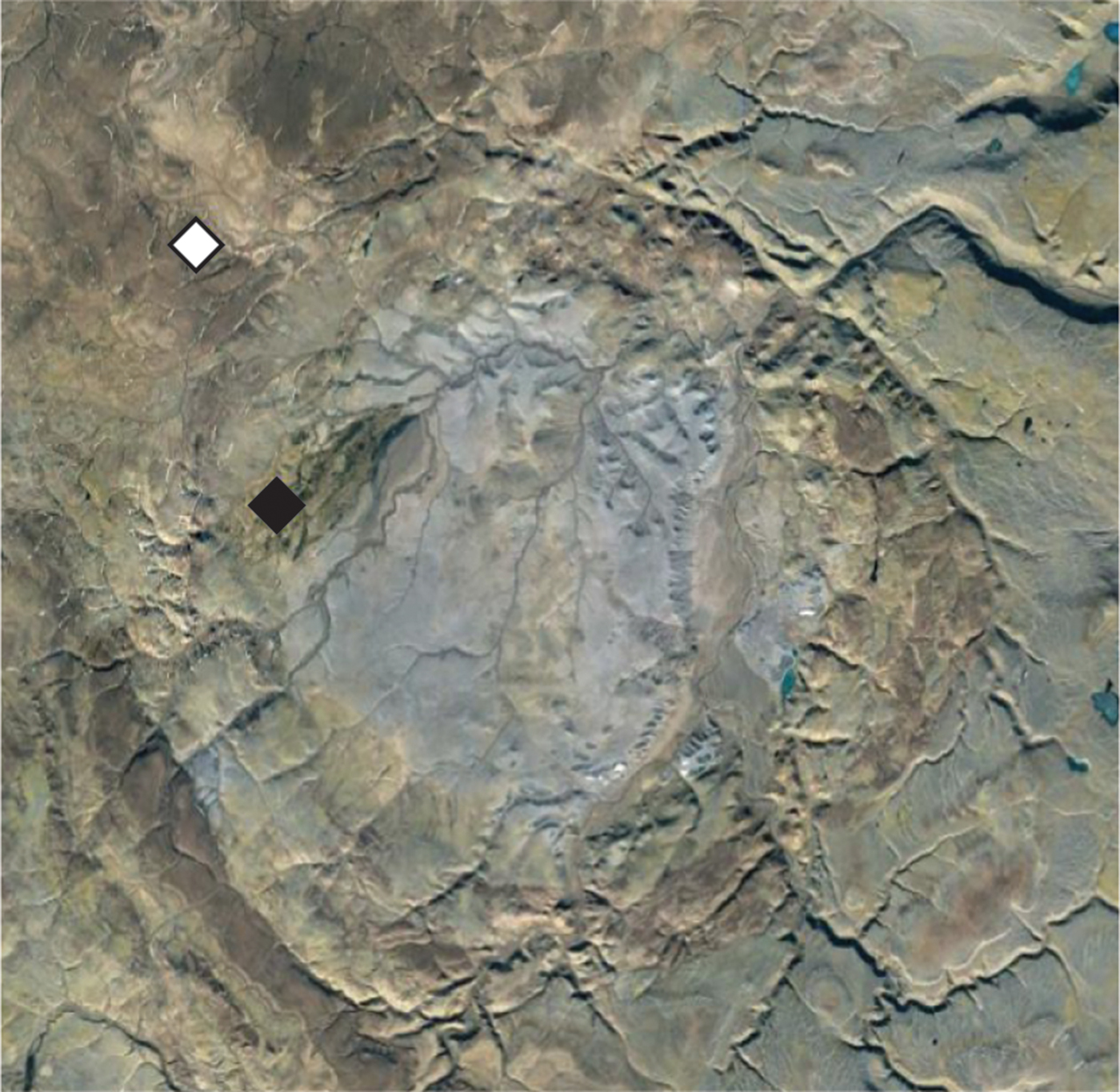
Samples of crust were collected from in situ exposures in the Haughton Impact Structure at Pete Conrad Valley and Lowell Oasis (Fig. 2) and transported to the laboratory wrapped in aluminium foil.
Google Earth image of the Haughton impact crater, Devon Island. Black marker depicts Lowell Oasis sample location (H1). White marker depicts Pete Conrad Valley sample location (H2).
Gas chromatography-mass spectrometry (GC-MS)
As microbiological studies have shown that cyanobacteria are prevalent in rock samples in the Haughton Impact Structure (Cockell et al. Reference Cockell, Lee, Osinski, Horneck and Broady2002; Parnell et al. 2004), we particularly sought compound classes that are present in and have been the subject of numerous previous studies on, cyanobacteria, namely fatty acids. Examples of such studies are described by Bowden & Parnell (Reference Bowden and Parnell2007).
The GC-MS analysis was performed on an Agilent Technologies 5975 inert Mass selective Detector, fitted with a 30 × 250 µm internal diameter film, 0.25 µm in thickness, fused capillary column with helium as the carrier gas.
Raman spectroscopy
Raman spectra were obtained using a Renishaw InVia H36031 confocal Raman microscope operating at a wavelength of 514.5 nm green monochromatic laser light, which is similar to the 2020 ExoMars flight instrument wavelength of 532 nm. 5% power (1.5 mW) was used with 10 accumulation and 2 s exposure time, giving a good signal-to-noise ratio. A 50× objective lens was used giving a laser ‘footprint’ of 1–3 mm, with a static spectral range centered at 1200 cm−1.
Petrography of crusts in High Arctic
In the High Arctic region, there is widespread evidence of the dissolution of carbonate bedrock. The permafrost ensures only limited drainage, so the surface waters become bicarbonate-saturated and a diversity of carbonate precipitates form including above and below pebbles, lining the walls of fractures, speleothems and crusts on the sediment surface. Precipitation on the underside of pebbles and cobbles is particularly widespread (Bunting and Christensen, Reference Bunting and Christensen1978; Forman & Miller, Reference Forman and Miller1984). The underside precipitates are composed of calcite and aragonite, which form pendant growths with an internal laminate structure. The laminae are 10–100 µm thick and reflect variations in crystal size and organic matter content during continuous growth. The crusts develop a microcolumnar structure similar to some stromatolites (Clark et al. Reference Clark, Lauriol, Marschner, Sabourin, Chauret and Desrochers2004; Pellerin et al. Reference Pellerin, Lacelle, Fortin, Clark and Lauriol2009).
Another case study (Swett Reference Swett1974) reports carbonate precipitation particularly on the upper sides of pebbles and cobbles. This suggests local variations in the relative importance of water draining the undersides, or evaporation off the upper sides, which may, in turn, be related to a height above the water table, surface temperature gradient and clast permeability.
Haughton crater crusts
In the Haughton crater, carbonate crusts occur in each of the settings described above, i.e. below pebbles, on the upper surfaces of pebbles and in fractured bedrock. The mineralized fracture systems are related to deformation during the impact event. The carbonate crusts are up to 3 cm thick, developed particularly on the underside of blocks of bedrock, which are most commonly granular dolomites of the Ordovician-Silurian Allen Bay Formation. On a megascopic scale, the crusts are composed of coalesced microdigitate structures. On a microscopic scale, the carbonate exhibits a mixed radial and laminar fabric. There is a predominant radial fabric of outward (downward) growth, on which a laminate fabric is superimposed by variations in crystal size and breaks between successive phases of radial growth. Each column in the microdigitate structure reflects a separate domain of radial outgrowth, but the laminate fabric is common to all columns. The radial crystals also contain scattered dolomite grains, with rhombic form, upon which the radiating crystals are nucleated. There are also small masses and discontinuous layers of micrite between the radial growths, which contribute to the laminate fabric (Fig. 3(a)). Tower-like shrubs on the outer parts of crusts, forming the microdigitate structure, have a high (up to 50%) content of micrite. Some microporosity remains between individual crystal bundles, and between the columns and is partially infilled with dark organic matter (Fig. 3(b)).
(a) Discontinuous layers of micrite create a laminate fabric within the crust. (b) microporosity partially infilled with the dark organic material, highlighted by the black boxes.

Where carbonate precipitated on the upper surfaces of pebbles, it is laminate rather than microdigitate, or may just occur as structureless microcrystalline carbonate. Locally, these deposits have an upper yellow patina. The components of the carbonate crusts probably have mixed inorganic-organic origins. The micritic material and the shrubs in which it is concentrated is comparable with microbial shrubs in hot spring systems (Pentecost, Reference Pentecost1990; Guo and Riding, Reference Guo and Riding1994). The radiating crystals may be inorganic, but the micritic shrubs would provide nucleation sites for precipitation. The scattered dolomite grains are identical to water-borne/air-borne dust grains at the sample site and are assumed to be incorporated into the crusts incidentally.
Gypsum crusts up to 2 cm thick are developed on the lacustrine sediments of the Haughton Formation that infilled the crater and the present-day silty soils derived from them. The gypsum exhibits a fibrous structure normal to the growth surface and is coloured brown due to the incorporation of abundant crystals of iron oxide (Fig. 4).
Fibrous gypsum crust coloured brown due to incorporated iron oxide. From ‘weather station’, Rhino Creek.

The underlying Haughton Formation sediments contain pyrite, oxidation of which explains the mixture of gypsum and iron oxides. The crusts also exhibit localized efflorescences of jarosite, as also recorded by Léveillé (Reference Léveillé2007). The mineral assemblage is therefore comparable with that encountered on Mars at Meridiani Planum (Squyres & Knoll Reference Squyres and Knoll2005). The Meridiani Planum sulphates have been proposed as a potential target for astrobiological investigation (Knoll et al. Reference Knoll, Carr, Clark, Des Marais, Farmer, Fischer, Grotzinger, McLennan, Malin, Schröder, Squyres, Tosca and Wdowiak2005; Aubrey et al. Reference Aubrey, Cleaves, Chalmers, Skelley, Mathies, Grunthaner, Ehrenfreund and Bada2006).
Black cryptogamic crusts were sampled from the slopes around active water courses. Such crusts are widespread on Devon Island (Bliss & Gold Reference Bliss and Gold1999), and are rich in cyanobacteria (Dickson Reference Dickson2000). The cryptogamic crusts are 1–2 mm thick, consisting of the desiccated black microbial mat with an adhering substrate of sand composed of dolomite grains derived from weathering of the local bedrock. Moist, pliable equivalents of the crusts occur at the margins of active streams. The black mats also coat pebbles and cobbles. They occur over regions of thousands of square metres, evident in aerial photographs.
Data
Raman
Figure 5 shows the Raman spectrum of two samples from the Haughton crater, two samples from North Scotland and one sample from Spain. The carbonate band (1085 cm−1) is present in Wick and Pete Conrad valley samples. Bands associated with β-carotene (1006, 1157, 1517 cm−1) are present in Wick and Ebbro Basin samples. Salinixanthin is a major carotenoid pigment produced by Salinibacter (Bacteroidetes) and is present in Wick, Lowell Oasis and Achmelvich. The Raman spectrum of this pigment is characterized by three bands at 1003, 1155 and 1512 cm−1. Parietin is often observed in combination with Salinixanthin displaying bands at 1671, 1575 (1595 shoulder), 1197, 914, 464 cm−1. Scytonemin, a UV protective pigment is surprisingly not present as expected given the dark coloration of the crusts.
Raman spectra of crust samples from Wick, Scotland; Ebbro Basin, Spain; Pete Conrad Valley, Haughton; Lowell Oasis, Haughton; Achmelvich, Scotland. The x-axis is in reciprocal centimeters (cm−1), the y-axis is the relative Raman intensity. Notable Raman bands are depicted with the band position.

GC-MS
The analyses of H1 and H2 samples are shown in Fig. 6, below. Palmitic (16 : 0) and stearic (18 : 0) fatty acids dominate the polar fraction and are the most abundant compound that was extracted from the carbonate crust. The presence of cis-vaccenic acid (18 : 1) in both samples, indicates a biological source derived from bacteria (Volkman et al. Reference Volkman, Barrett, Blackburn, Mansour, Sikes and Gelin1998). The absence of polyunsaturated fatty acids (C18 and above) suggest a prokaryotic source, which is supported by the presence of C15 and C17 methyl-branched fatty acids, which are present in higher proportions in bacteria (Volkman et al. Reference Volkman, Johns, Gilian and Perry1980). Higher plants are not common in the Arctic polar desert of Devon Island, therefore a bacterial origin for the lipid signatures is the most likely. Cyanobacteria are common as communities of Chroococcidiopsis, Aphanothece, Gloeocapsa and Nostoc commune are observed (Cockell et al. Reference Cockell, Lee, Osinski, Horneck and Broady2002; Parnell et al. 2004). It is possible that some of the lipids derive from fungi as the saturated C16 and C18 n-alkanoic acids are also held in fungi (Harwood & Russell Reference Harwood and Russell1984). The chromatograms shown below are comparable with that shown in Fig. 1 from Bowden & Parnell (Reference Bowden and Parnell2007).
GC-MS trace of the m/z 117 ion chromatograms of the polar fractions, derivatized with BSTFA. Expanded sections show m/z 337 339 & 341 ions. The fatty acids are denoted as e.g ‘16 : 0’; the number before the colon specifies the number of carbon atoms, the number after the colon specifies the number of double bonds.

Discussion
Crusts on Mars
Observations by previous Mars missions (Banin et al. Reference Banin, Clark, Waenke, Kieffer, Jakosky, Snyder and Matthews1992) show that the surface has a widely developed salt-rich crust, dominated by sulphates (Cooper & Mustard Reference Cooper and Mustard2002), which have been identified by both Mars Exploration Rovers (MER), Spirit and Opportunity (Gellert et al. Reference Gellert, Rieder, Anderson, Brückner, Clark, Dreibus, Economou, Klingelhöfer, Lugmair, Ming, Squyres, d'Uston, Wänke, Yen and Zipfel2004; Squyres et al. Reference Squyres, Grotzinger, Arvidson, Bell, Calvin, Christensen, Clark, Crisp, Farrand, Herkenhoff, Johnson, Klingelhöfer, Knoll, McLennan, McSween, Morris, Rice, Rieder and Soderblom2004). Spirit encountered ferric sulfate-rich crusts in Gusev crater, which are likely to be associated with the hydrothermal activity (Arvidson et al. Reference Arvidson, Bell, Bellutta, Cabrol, Catalano, Cohen, L Crumpler, Des Marais, Estlin, Farrand, Gellert, Grant, Greenberger, Guinness, Herkenhoff, Herman, Iagnemma, Johnson, Klingelhöfer, Li, Lichtenberg, Maxwell, Ming, Morris, Rice, Ruff, Shaw, Siebach, de Souza, Stroupe, Squyres, Sullivan, Talley, Townsend, Wang, Wright and Yen2010) and are evidently accessible by a rover. On Earth, hydrothermal activity is commonly associated with microbial life (Walter & Des Marais Reference Walter and Des Marais1993).
Sublimation could play a role in crust formation on Mars, but this is restricted to higher latitudes (>60°) and is unlikely to be a major mechanism for crust formation in equatorial regions (Mangold Reference Mangold2011), where the two remaining ExoMars landing sites are located.
Wind erosion could be an important factor for the preservation of crusts, including a range of other exploration targets on Mars. Although wind erosion on Mars is complex, net erosion occurs mainly in lowland regions, such as the northern plains and the southern mid-latitudes and is controlled by topography (Armstrong & Leovy Reference Armstrong and Leovy2005). Chryse is highlighted as an area which could experience net erosion by Armstrong & Leovy (Reference Armstrong and Leovy2005) and given the proximity to Oxia Planum and Mawrth Vallis, these sites could experience similar erosion rates. The formation and preservation of evaporitic crusts on Mars is controlled by wind erosion and water-table fluctuations. For crusts to develop, erosion rates must match the rate of water-table lowering, which would control the preservation of strata including crusts (Grotzinger et al. Reference Grotzinger, Arvidson, Bell, Calvin, Clark, Fike, Golombek, Greeley, Haldemann, Herkenhoff, Jolliff, Knoll, Malin, McLennan, Parker, Soderblom, Sohl-Dickstein, Squyres, Tosca and Watters2005). Given that Spirit and Opportunity rovers both encountered crusts during their missions, crusts are regarded as a valuable exploration target.
Thermal inertia mapping suggests that a significant proportion of the planet surface may be indurated (Mellon et al. Reference Mellon, Jakosky, Kieffer and Christensen2000), including about 50% of the terrain from 0° to 60° N. The ejecta around craters in the Terra Meridiani region is rich in high-thermal inertia indurated material (Hyneck Reference Hyneck2004). At Meridiani Planum, rock surfaces exhibit weathering rinds that are relatively resistant to erosion (Jolliff et al. Reference Jolliff and McLennan2006). If extant life could tolerate the Martian surface, crusts could be a good habitat. Palaeo-crusts may exist within Noachian sedimentary successions, but these are likely difficult to distinguish from other sulphate-rich rocks.
Survivability of biomarkers
A major concern in the search for evidence of life on other planetary surfaces is that molecular evidence could be severely compromised by irradiation (Kminek & Bada Reference Kminek and Bada2006). Living organic matter within crusts should have adequate protection from ultraviolet irradiation, as only a few microns of shielding is required. Although other forms of irradiation (solar energetic particles, galactic cosmic radiation, mineral radiation) penetrate rocks further, living organisms may have developed genetic damage repair systems that can cope with it, however in the shallow subsurface (<2 m depth) the biomolecules in fossil organic matter in crusts would experience progressive degradation (Kminek & Bada Reference Kminek and Bada2006; Dartnell et al. Reference Dartnell, Desorgher, Ward and Coates2007). Fossil organic matter is best sought where shielded from long-term irradiation (recently excavated channels or craters, or sampled by coring).
A further note of caution is appropriate. Despite the extensive evidence for the microbial matter in terrestrial mineral crusts, there is no guarantee that we would be able to detect it during a remote mission, particularly if it is a fossil sample. If any rock looking vaguely similar to a stromatolite was encountered on Mars, it would become a priority target for analysis. But would we make a successful analysis of a similar rock on Earth? If it was recent, probably. If it was a fossil, the successful analysis is by no means certain, as organic matter is progressively oxidized and otherwise altered until it leaves no molecular record. Success is more likely when the organic matter is tightly sealed within the mineral matrix.
Other signatures
Although the focus of this discussion is on molecular evidence, several types of crust do preserve morphological evidence of microbial life. For example, biological structures are evident in case studies of speleothems (Northup et al. Reference Northup, Dahm, Melim, Spilde, Crossey, Lavoie, Mallory, Boston, Cunningham and Barns2000), supra-permafrost crusts (Lauriol & Clark Reference Lauriol and Clark1999) and chemosynthetic deposits (Barbieri et al. Reference Barbieri, Cavalazzi and Westall2002) and in each case would be evident in a field of view of 50 μm. Morphological evidence can also include the microporosity left by microbial degradation.
Surface precipitates have similarly been advocated as a potential source of fossil fluid samples from Mars, whereby the minerals contain fluid inclusions trapping the water from which they precipitated (Parnell & Baron Reference Parnell and Baron2004). Such fluid samples can also be valuable in the recording of terrestrial palaeoenvironments and the mineral precipitates may hold other compositional data (e.g. isotopic) that can be used for the same purpose, for example, inference of an organic contribution to carbonate precipitation. Indeed most of the crust types discussed in this paper yield evidence for a role of organic matter in their formation, through carbon isotope composition (Table 1), in calcrete (Watanabe et al. Reference Watanabe, Martini and Ohmoto2000), supra-permafrost crusts (Clark et al. Reference Clark, Lauriol, Marschner, Sabourin, Chauret and Desrochers2004) and chemosynthetic deposits (Campbell et al. Reference Campbell, Farmer and Des Marais2002). Cyanobacterial mats forming in mineralizing hot springs readily yield lipid biomarkers (Jahnke et al. Reference Jahnke, Embaye, Hope, Turk, van Zuilen, Des Marais, Farmer and Summons2004, and references therein)
Conclusions
Mineral crusts are strong candidates in the search for evidence of life during planetary exploration and should be an important target for examination on Mars. The pilot study in the Haughton Impact Structure shows that they can readily yield a biological signature. In terms of the specific objectives of the analysis, the study showed that:
(i) The biosignature of the crusts can be obtained by normal extraction techniques and spectral analyses.
(ii) The organic compounds can be resolved sufficiently to make deductions about the nature of the life that was trapped in the crusts.
Acknowledgements
The research was under the auspices of the NASA Haughton-Mars Project. J. Whelan is acknowledged for photomicrographs taken from undergraduate laboratory projects. This work was funded by STFC grant ST/L001233/1. The University of Aberdeen Raman facility was funded by the BBSRC grant BBC5125101.


 Open access

