


Introduction
As our global population ages, both the number and percentage of people aged 65 years and older continues to rise (Organisation for Economic Co-operation and Development, 2011; Centers for Disease Control and Prevention and National Center for Health Statistics, 2018). Research on factors that can support older adults’ engagement in meaningful social and community activities, at valued destinations, is critically needed. For the purposes of this paper, meaningful activities are defined as those of significance to the individual, and valued destinations are defined as places that are highly regarded and important (Christiansen and Townsend, Reference Christiansen and Townsend2014; Taylor Reference Taylor2017). Having a driver's licence is one factor that has been linked to both identity and autonomy in older adulthood (Vrkljan and Polgar, Reference Vrkljan and Polgar2007). As many daily occupations, or meaningful activities, occur across a broad spectrum of geographical locations, older adults need community mobility strategies in place to ensure continued access to these activities, which can promote wellness in later life (Dickerson et al., Reference Dickerson, Molnar, Bédard, Eby, Berg-Weger, Choi, Grigg, Horowitz, Meuser, Myers, O'Connor and Silverstein2019; O'Neill et al., Reference O'Neill, Walshe, Romer and Winston2019). While transportation access is vital, O'Neill et al. (Reference O'Neill, Walshe, Romer and Winston2019) assert this social determinant of health is one of the most neglected in both research and policy. Multiple studies demonstrate the strong relationship between community mobility in older adulthood in terms of physical and psychological health, engaging in social activities and quality of life (Metz, Reference Metz2000; Yeom et al., Reference Yeom, Fleury and Keller2008; Choi et al., Reference Choi, Lohman and Mezuk2014; Zeitler and Buys, Reference Zeitler and Buys2015). Many countries have taken active steps to improve community mobility options for older adults such as low or no fares for public transport, dial-a-ride rural bus services and ensuring a combination of travel options are readily available (Lynott et al., Reference Lynott, Haase, Nelson, Taylor, Twaddell, Ulmer, McCann and Stollof2009; Tuller et al., Reference Tuller, Bangsberg, Senkungu, Ware, Emenyonu and Weiser2010; Krishnasamy et al., Reference Krishnasamy, Unsworth and Howie2011; Hagan, Reference Hagan2020). Across this paper, we investigate community mobility in its broadest sense, encompassing transportation by private (car) or public methods (taxi, bus, rail), as well as by walking, and, as such, the terms community mobility and transportation mobility are used interchangeably.
Promoting community mobility is essential to supporting ageing in place. The concept of ageing in place (Golant and LaGreca, Reference Golant and LaGreca1994; Sixsmith and Sixsmith, Reference Sixsmith and Sixsmith2008; Martin et al., Reference Martin, Long and Kessler2019; Ahn et al., Reference Ahn, Kwon and Kang2020) has garnered international attention over the past three decades not only because of economic pragmatics, but because it supports people to remain in environments with established proximity to services and social networks, including family and friends. Active ageing enables older adults to continue to live meaningful and fulfilling lives, and contribute positively to society, which has been linked to health and human service savings (World Health Organization, 2015). Papageorgiou et al. (Reference Papageorgiou, Marquis and Dare2016) explored facilitators and barriers to community participation among older adults and found the desire to maintain or even create new social relationships had a strong influence on community participation. Routines and habits individuals established earlier in life motivated them to maintain engagement in activities as they aged, while a desire to develop new interests also facilitated involvement in the community. However, transportation plays a critical role when it comes to enabling older adults to get to these activities and maintain their community involvement. Chao (Reference Chao2018) described transport planning as one of the pillars of urban planning and further identified public transport and facilitation of private vehicle use in later life as the two key components that enable older adults to remain connected in their communities and to age in their place of choice.
Vrkljan et al. (Reference Vrkljan, Leuty and Law2011) and Wiles et al. (Reference Wiles, Leibing, Guberman, Reeve and Allen2012) both reported that ageing in place was linked to one's sense of identity in terms of their independence and autonomy, and that transportation accessibility, availability and affordability, particularly public transportation, was an enabler for ageing in place. Similarly, Gardner's (Reference Gardner2014) ethnographic study found a complex array of factors can influence community mobility in later life. From this study, key motivators for maintaining community mobility included the preservation of identity and the need for social interaction, and as such, individually tailored solutions are often required to maintain out-of-home mobility. Hagan (Reference Hagan2020) even argued that a rural dial-a-ride bus service was itself a place for informal socialising, coming in as a third place and following ‘home’ and ‘shopping/dutiful visits/appointment’. This accessible form of transport was found to support ageing in one's local community, as older adults could both socialise as well as receive valued transport to address isolation. Conversely, several factors have been identified as negatively associated with community mobility, including traffic congestion and lack of available seating on public transport (Krishnasamy et al., Reference Krishnasamy, Unsworth and Howie2013), recent hospitalisation (Loyd et al., Reference Loyd, Beasley, Miltner, Clark, King and Brown2018), weather (Smith et al., Reference Smith, Porter, Cull, Mazer, Myers, Naglie, Bédard, Tuokko, Vrkljan, Gélinas, Marshall and Rapoport2016), gender (Fristedt et al., Reference Fristedt, Dahl, Wretstrand, Björklund and Falkmer2014; Choi et al., Reference Choi, O'Connor, Mingo and Mezuk2015) and urban versus rural living (Mattson, Reference Mattson2011). When referring to weather, this paper uses the terms ‘good’ and ‘inclement’ where the latter encompasses both extreme heat as well as extreme cold, rainy, icy and/or snowy conditions.
Driving is also crucial for many people to age in place, as it is often the most convenient option for personal transportation and supports community participation. Zeitler and Buys (Reference Zeitler and Buys2015) used GPS and in-depth interviews to track the community mobility of 13 people living in city and suburban environments in Australia – areas not well-served by public transport. Key findings suggested older adults needed to reach a variety of destinations across the city to engage in their daily occupations and preferred the flexibility car travel offered; that driving supported other older adults in the same social circle; and that a significant advantage of car travel was the ability to transport both goods and other people. Much research has focused on medically at-risk older drivers, where driving assessment, driving cessation and transitions to non-driving have been investigated (Choi et al., Reference Choi, Adams and Kahana2012; Liddle et al., Reference Liddle, Gustafsson, Bartlett and McKenna2012; Unsworth et al., Reference Unsworth, Baker, Taitz, Chan, Pallant, Russell, Odell and Coulson2012; Rapoport et al., Reference Rapoport, Naglie, Weegar, Myers, Cameron, Crizzle, Korner-Bitensky, Tukko, Vrkljan, Bédard, Porter, Mazer, Gélinas, Man-Son-Hing and Marshall2013; Stapleton et al., Reference Stapleton, Connolly and O'Neill2015; Dickerson et al., Reference Dickerson, Molnar, Bédard, Eby, Berg-Weger, Choi, Grigg, Horowitz, Meuser, Myers, O'Connor and Silverstein2019). Findings in this area highlight that it is not age per se that may impact continued driving, rather it is the impact of medical conditions and other functional declines that can affect sensory, cognitive and physical abilities needed for safe driving (Levasseur et al., Reference Levasseur, Audet, Gelinas, Bedard, Langlais, Therrien, Renaud, Coallier and D'Amours2015; Mazer et al., Reference Mazer, Laliberté, Hunt, Lemoignan, Gélinas, Vrkljan, Naglie and Marshall2016). Most older adults prefer to retain their ability to drive for as long as possible and their personal automobile remains their primary mode of transport (Turcotte, Reference Turcotte2012; Zeitler and Buys, Reference Zeitler and Buys2015; Mazer et al., Reference Mazer, Laliberté, Hunt, Lemoignan, Gélinas, Vrkljan, Naglie and Marshall2016). As such, many older drivers use self-regulatory strategies, including adjusting where and when they get behind-the-wheel, making fewer and shorter trips in peak traffic, at dusk and at night, and not driving during inclement weather (Unsworth et al., Reference Unsworth, Wells, Browning, Thomas and Kendig2007; Rapoport et al., Reference Rapoport, Naglie, Weegar, Myers, Cameron, Crizzle, Korner-Bitensky, Tukko, Vrkljan, Bédard, Porter, Mazer, Gélinas, Man-Son-Hing and Marshall2013; Levasseur et al., Reference Levasseur, Audet, Gelinas, Bedard, Langlais, Therrien, Renaud, Coallier and D'Amours2015; Koppel et al., Reference Koppel, Charlton, Langford, Di Stefano, MacDonald, Vlahodimitrakou and Eliasz2016; O'Neill et al., Reference O'Neill, Walshe, Romer and Winston2019). Not driving in inclement weather is of particular interest, as there are few studies that have examined if older adults replace driving with other forms of transport due to more challenging weather conditions, or simply do not go out at all. In addition, some of these self-regulation strategies are matched by progressive legislation in certain jurisdictions that allows for temporal and geographically restricted driving options as a method of enabling continued, albeit restricted, driving for as long as possible (Austroads and National Transport Commission, 2016; Road Safety Authority, 2019). Nevertheless, driving cessation is inevitable, with research suggesting that men will have approximately six years and women will have an average of ten years of dependency on alternative modes of transportation beyond their personal automobile (Foley et al., Reference Foley, Heimovitz, Guralnik and Brock2002). Hence, access to and utilisation of public transportation among older adults requires investigation. Older adults who have never driven or who need to stop driving may need to rely on public transport systems, friends and family, or other modes to enable continued social connectedness and being able to age in place in their local communities. These alternative transport options should be safe, affordable and accessible.
Given the ageing of populations globally, research is critically needed to examine how support for transportation options in older adulthood can impact community participation. This study stems from an international collaboration (Vaucher et al., Reference Vaucher, Choi, Gélinas, Harries, Cattin, Mazer, Van Niekerk, Patomella, Stapleton, Swanepoel, Unsworth and Vrkljan2017) investigating the broad relationship between community transportation mobility, out-of-home participation and living well among older adults. The research in this paper examined the mobility patterns of older adults in different countries and differences in out-of-home activities and quality of life between older adults who are still driving and those who are no longer driving or never drove. Specifically, the aims of this research examined (a) demographic factors such as age and gender, health status and driving status among older adults from seven countries, (b) the impact of age, gender, weather, time of day, road type, traffic volume and city versus rural location on driving patterns of older drivers, and avoidance of any particular driving conditions, (c) the types of transportation used by older drivers and non-drivers to access out-of-home places and any differences between these groups in terms of the places accessed, and (d) if there are any differences between drivers and non-drivers on measures of quality of life and satisfaction with life.
Methods
Study design
The study has a cross-sectional cohort design using data collected in seven countries: Australia, Canada, United Kingdom (UK), Ireland, South Africa, Switzerland and the United States of America (USA). The research was conducted according to the World Medical Association Declaration of Helsinki. The lead institution which reviewed the ethics proposal was Brunel University London. Each researcher obtained ethical approval from their academic institution to conduct the study and a data transfer agreement was signed and approved by the ethics committees.
Participants
To participate in the study, individuals were aged 65 years or older, community dwelling (not living in a residential aged-care facility) and able to speak the native language of the interviewers or translator in countries where available. Convenience sampling was used to recruit participants via flyers placed at community facilities, through general medical practitioners and from participants from other research projects who indicated they were agreeable to be contacted about future studies. Interested individuals who met these criteria contacted the local research team and were provided with written information about the study. Those who agreed to participate were asked to sign a written consent form or provide informed verbal consent at the start of the interview.
Measures
A semi-structured interview and four standardised measures were administered in this research. The semi-structured interview recorded the participant's responses to a standard sequence of questions that gathered information such as age, gender, living environment, work status, mobility aid status and current driving status. No personally identifying data were gathered. The EQ-5D-5L (Herdman et al., Reference Herdman, Gudex, Lloyd, Janssen, Kind, Parkin, Bonsel and Badia2011), modified PULSES health profile (Granger et al., Reference Granger, Albrecht and Hamilton1979), modified Transportation Questionnaire (Dahan-Oliel et al., Reference Dahan-Oliel, Mazer, Gélinas, Dobbs and Lefebvre2010) and modified Participation in Activities and Places Outside the Home (ACT-OUT) (Margot-Cattin et al., Reference Margot-Cattin, Kuhne, Kottorp, Cutchin, Öhman and Nygård2019) were all administered.
The EQ-5D-5L is a patient-reported outcome measure of health-related quality of life comprising five dimensions, including mobility, self-care, usual activities, pain/discomfort and anxiety/depression. Each dimension is evaluated on a five-level response scale (level 1 = no problem to level 5 = extreme problem). It also includes a visual analogue scale recording the participants’ current overall health-related quality of life, with 100 representing the best health state while 0 represents the worst.
The modified PULSES profile records functional ability across six categories: physical condition (P), upper limb function (U), lower limb function (L), sensory components (S), excretory functions (E) and support factors (S), and is scored from 1 to 4 with 1 representing the best function and 4 the least. These categories can be summed to obtain an overall score from 6 to 24 that reflects overall functional ability.
The Transportation Questionnaire measures frequency of use and satisfaction for different transport modalities, including driving, public transport (bus, train), taxi and walking. This measure was modified with the authors’ permission to include the frequency of transportation modalities used in both good and inclement weather.
With the permission of the authors, we administered a modified version of the Participation in Activities and Places Outside the Home (ACT-OUT) (Margot-Cattin et al., Reference Margot-Cattin, Kuhne, Kottorp, Cutchin, Öhman and Nygård2019). The transportation components of the original ACT-OUT were relevant to the aims of this study and the originators subsequently asked that this modified version of ACT-OUT be renamed as Transport – Participation in Activities and Places Outside the Home (T-ACT-OUT). The T-ACT-OUT consisted of partial use of two of the three parts of the original ACT-OUT that were relevant to the current study. The T-ACT-OUT identifies 21 places that individuals typically visit, the frequency of participation and the transportation method people use to visit these places. Places are divided into four clusters: (1) administrative and self-care places (e.g. grocery store, hairdresser, bank, post office); (2) places for medical care (e.g. hospital, dentist, day care); (3) social, cultural and spiritual places (e.g. restaurant or cafe, cemetery, entertainment or cultural places); and (4) places for recreational and physical activities (e.g. garden; forest, mountain, lake or seaside; sports facility). Brief questions are also asked in relation to life satisfaction, as well as concerns and perceived risks related to being out in the community.
Procedure
A meeting with each participant was arranged during which the semi-structured interview and standardised questionnaires were administered, taking approximately 60 minutes to complete. The meetings were completed by trained interviewers either face to face or via telephone, depending on the preference of the individual participant. A standard proforma was used where the interviewer recorded the participant's responses to both interview questions and standardised assessments.
Statistical analysis
All anonymised data were analysed using IBM SPSS Statistics version 26. Data were checked for normality and adherence to statistical assumptions. For the first aim, demographic data and information from the standardised measures (EQ-5D-5L, Transportation Questionnaire, PULSES and T-ACT-OUT) were summarised using descriptive statistics (means, standard deviations, frequencies and percentages). Differences between participants across countries were analysed using analyses of variance for variables with continuous data (e.g. age and years since stopped work) and chi-square tests for variables with categorical data (e.g. gender and living environment). In relation to the second aim, the impact of weather, time of day, road type and traffic volume, and city versus rural location on driving patterns of older drivers were reported descriptively. Using chi-squared analyses, we then investigated any differences in the frequency that drivers used each type of transport between rural and city drivers in good weather, between rural and city drivers during inclement weather, and the difference between all drivers, in both good and inclement weather. Differences between city and rural drivers were also investigated for level of avoidance of a range of driving situations (e.g. night driving) also using chi-square tests. To investigate if gender had an impact on avoidance of certain driving situations, a chi-square test was undertaken, and this statistical test was similarly used to investigate differences between participants in three different age groups (⩽73, 74–80 and ⩾81 years). For the third aim, the types of transportation used by older drivers and non-drivers to access out-of-home places as collected on the T-ACT-OUT were presented descriptively, and differences between attendance at these places for drivers and non-drivers were investigated using chi-square tests. For the final aim, differences between drivers and non-drivers in terms of health-related quality of life on the EQ-5D-5L Visual Analogie Scale was investigated using a Student's t-test, and satisfaction with life on the T-ACT-OUT was investigated using a chi-square test.
Results
Characteristics of participants including age, gender, health status and driving status
Data were collected over an 18-month period between March 2018 and September 2019 with a total of 246 participants. To fulfil the first aim, Table 1 describes participant demographics. Most participants had completed tertiary education (67.9%). The mean age ranged across countries from 73.7 years (standard deviation (SD) = 7.26) in Australia to 80.55 (SD = 6.33) years in South Africa and, given this age profile, most participants were not working (89.8%) at the time of data collection. A little more than half of the participants lived in a city/urban centre (58.1%). Overall, participants had a mean score of 77.94 (SD = 15.50) out of 100 on the EQ-5D-5L (with higher scores indicating better health-related quality of life). Generally, participants required no assistance with walking (76.7%) and reported an average health profile of 8.08 (SD = 2.09) out of 24 where lower scores indicate better health. As outlined in Table 1, demographics differed in several areas across countries, except gender, years since stopped work and use of a walking aid. While there were more females than males in the sample (65.4% versus 34.6%), the difference between genders for each country was not statistically significantly different (p = 0.670). Most participants indicated they were still driving (82.1%) with few having stopped driving (12.2%) and very few reporting they had never driven (5.7%).
Characteristics of participants by country

Notes: SD: standard deviation. UK: United Kingdom. USA: United States of America. 1. p-Values of difference between countries generated using analyses of variance for variables with continuous data and chi-square tests for variables with categorical data.
Impact of age, gender, weather and city versus rural living situation on driving patterns of older drivers
Using a car, as a driver or passenger, or walking were the most frequently reported modes of transportation used by drivers. Table 2 indicates the modes of transportation and frequency of use in good and inclement weather, for both rural and city dwellers. Chi-square analyses revealed no differences between rural and city dwellers in good weather in terms of frequency of driving (p = 0.350), nor travelling as a passenger (p = 0.281), nor walking (p = 0.793). Similarly, no differences were found in the frequency of using these modes of transport during inclement weather: driving (p = 0.881), travelling as a passenger (p = 0.618) and walking (p = 0.290). However, when investigating differences in the frequency with which types of transport were used between all drivers (city and rural) in good and inclement weather, it was found that participants drove less frequently (p = 0.001) and walked less frequently (p = 0.001) during inclement weather. However, they had similar patterns of frequency for being a passenger in a car (p = 0.516), and although the sample sizes were too small for analysis, visual inspection of the data also suggests similar patterns of frequency for use of public transport, across good and inclement weather (see Table 2). Most rural and city participants reported they never used public transport options (e.g. bus, train or tram), regardless of the weather conditions, perhaps reflective of the high reliance on use of the personal car among participants.
Use of different transportation methods in good and inclement weather for drivers in rural and city areas (from the modified Transportation Questionnaire)
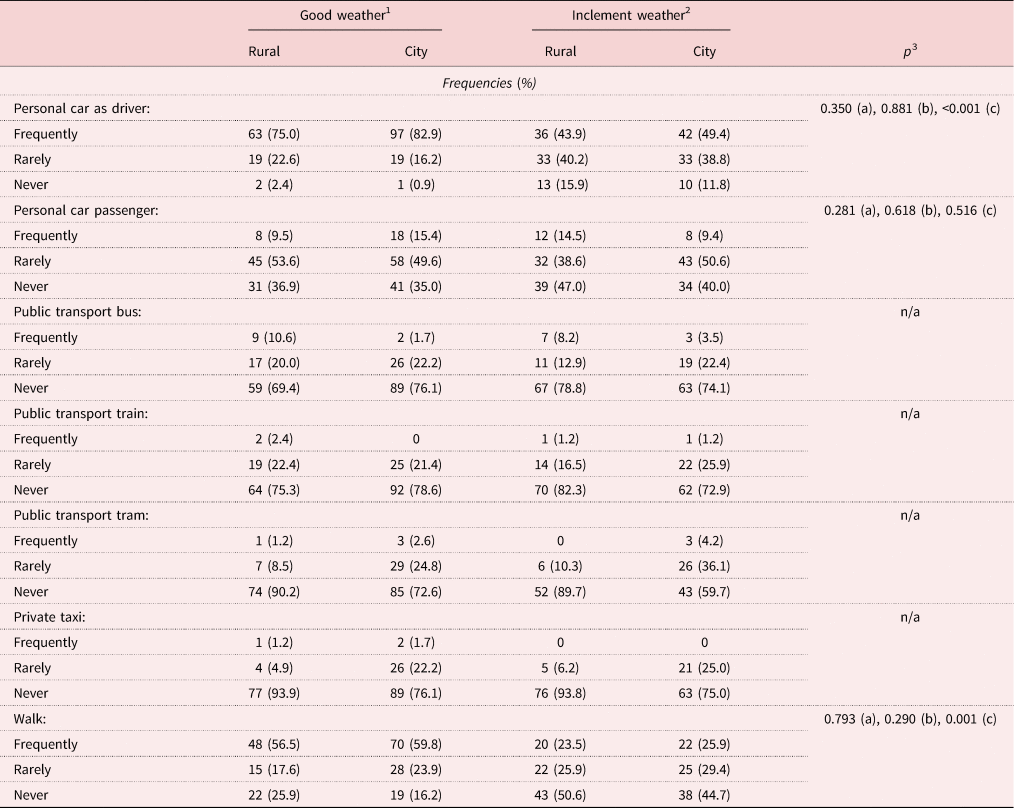
Notes: 1. N ranging from 82 to 117. 2. N ranging from 81 to 85. 3. p-Values generated using chi-square tests: (a) difference between rural and city drivers in good weather; (b) difference between rural and city drivers in inclement weather; (c) difference between all drivers, in good and inclement weather. n/a: not applicable – does not meet minimum expected cell frequency, therefore unable to calculate.
Table 3 outlines the frequency with which drivers avoided certain conditions over the last three months. Drivers were more likely to report avoiding driving at night (28.2%) and driving in inclement weather (25%) than under all other conditions. Chi-square analyses investigated if there were any differences between avoiding a range of driving conditions and issues for city versus rural drivers, but none were found (see Table 3). There was also no difference in driving avoidance between the three age groups: ⩽73 years (38%), 74–80 years (33%) and ⩾81 years (29%) (p = 0.125), nor between male and female participants (36.6 and 63.4%) (p = 0.323).
The frequency of drivers avoiding specific driving conditions over the last three months and differences between city versus rural drivers (from the modified Transportation Questionnaire)

Notes: N = 202. 1. Chi-square test used to generate p-values of difference between city and rural drivers.
Transport used by older drivers and non-drivers to access out-of-home places, and differences in places accessed
Table 4 presents the differences between drivers and non-drivers in terms of the T-ACT-OUT places they identified going to, and the modes of transportation used to access these places. The frequency of using public transport to attend out-of-home places, as recorded on the T-ACT-OUT, was generally low for both drivers and non-drivers. The frequency regarding the type of transportation used to access different locations varied, which may be related to the occupation or activity being completed in the specific location. For example, passenger frequencies were highest for attending a hospital or a transportation hub (depot) and walking frequencies were highest when accessing activities in one's neighbourhood.
Difference in drivers versus non-drivers currently attending places and transport type used to get there (from Transport – Participation in Activities and Places Outside the Home (T-ACT-OUT))

Notes: N = 246. If the N for driver or non-driver was zero, it was deleted for that destination. 1. Chi-square test used to generate p-values of difference between drivers and non-drivers. 2. Transport mode not included when zero for both groups.
Chi-square tests demonstrated significant differences between how many locations drivers, as compared to non-drivers, attended out-of-home activities for eight of 21 locations in the T-ACT-OUT: supermarket, pharmacy, bank/post office, family/friends, entertainment, seaside, neighbourhood and sport facilities. In all cases, more drivers recorded attendance at such locations, suggesting a higher level of participation and engagement in the community among these participants. Differences were seen in three of the four clusters of locations of these activities (consumer, administrative and self-care places; social, cultural and spiritual places; and places for recreational and physical activities). There were no differences between drivers and non-drivers in places associated with the medical care cluster (i.e. doctor, hospital, therapy and day care), suggesting equal participation in these locations.
Quality of life and life satisfaction for drivers and non-drivers
There were significant differences in health-related quality of life among participants, with drivers reporting higher levels on the EQ-5D-5L-VAS (mean = 79.1, SD = 14.9) compared with non-drivers (mean = 72.47, SD = 17.2) (p = 0.011, 95% confidence interval = 1.57–11.71). However, satisfaction with life was not significantly different between drivers and non-drivers, when investigated with the T-ACT-OUT categories for drivers/non-drivers (p = 0.802).
Discussion
This research examined the mobility patterns of older drivers and non-drivers from seven countries and documented their out-of-home activities and quality of life. Initially, the paper examined demographic factors, such as age and gender, health status and driving status, across participants. Although some differences between participants from different countries were identified, this research, as well as the research from others (Choi et al., Reference Choi, Adams and Kahana2012; Gardner, Reference Gardner2014), suggests a complex mosaic of factors combine to impact community mobility. As such, our research team determined investigating associated activity patterns across participants in an international sample as more valuable than examining relationships according to country per se. The second aim related to exploring the impact of age, gender, weather, time of day, road type, traffic volume, and city versus rural location on driving patterns of older drivers, and avoidance of particular driving conditions. Our findings suggested weather was a major factor impacting access to out-of-home activities. All drivers (living in rural and city areas) drove less frequently and walked less frequently in inclement weather but their use of public transport did not increase in this weather. In terms of the types of transportation used by older drivers and non-drivers to access out-of-home places, we found that driving was the most common form of transport, and that drivers were accessing many more out-of-home places and activities than non-drivers. The final aim of the study was to investigate if there were any differences between drivers and non-drivers on two measures of quality of life. The findings showed that quality of life was generally high among all participants, but slightly higher for drivers when compared to non-drivers. However, given that only a small difference between the groups was identified for only one of the measures, this finding requires further investigation.
Characteristics of participants from seven countries
The participants in this research were from seven countries, and although the samples were generally well-educated and self-identified as relatively healthy, there were several notable differences. There was a higher proportion of participants in Canada who were urban dwellers compared to those recruited from the USA, Ireland and UK who were predominantly from rural areas; the proportion of participants in Ireland without a tertiary qualification was higher than in other countries, and the Irish population also reported the lowest quality of life on the EQ-5D-5L. Most of the participants in Ireland were drivers, which may be reflective that a high proportion were rural dwellers, and there were also higher proportions of participants from Canada and the USA who were drivers when compared to the UK and Switzerland. Further investigations comparing non-drivers with drivers from different countries were not possible as sample sizes of non-drivers were not sufficiently large. As noted above, while the findings suggest a need to cross-compare differences in countries in future research, it was valuable to analyse our data for drivers and non-drivers, across the seven countries (Choi et al., Reference Choi, Adams and Kahana2012; Gardner, Reference Gardner2014).
Relationship between mode of transportation on age, gender, weather and location and participation in community activities
Similar to Vrkljan et al. (Reference Vrkljan, Leuty and Law2011) and Hagan (Reference Hagan2020), who all identified the important role of transportation on the ability of older adults to age-in-place, findings from the current study also support the notion of transportation as an enabler of living well in later life. Our analysis indicated 82 per cent of our sample, which was comprised of community-dwelling older adults, were still driving. Passenger frequencies were highest, however, when participants needed to access hospital services, or transport hubs (depots), which was also identified by Vrkljan et al. (Reference Vrkljan, Leuty and Law2011). As raised by Gardner (Reference Gardner2014), the reason a driver might choose to use their own vehicle, public transport or be a passenger, is often complex and for a myriad of purposes. The results from the T-ACT-OUT suggested more drivers, as compared to non-drivers, were accessing a wide variety of places, such as the supermarket, entertainment, pharmacies, bank/post office, municipal offices, therapy, visiting the seaside or forest, their own neighbourhood, sporting facilities, as well as visiting with friends and family. Hence this research indicates that being a driver, across all represented countries, can support greater community participation and engagement in a range of out-of-home activities. This finding resonates with recent evidence, which suggests supporting older drivers to continue to drive for as long as possible to maintain access to their communities is critical (O'Neill et al., Reference O'Neill, Walshe, Romer and Winston2019). In fact, the findings in Table 4 emphasise that driving, followed by walking and being a passenger in a private vehicle, are the most frequently used transportation options for older adults when it came to the 21 places captured in T-ACT-OUT. However, there were a small number of participants who indicated using public transportation, particularly among city dwellers whom it is assumed have greater availability of public transportation, which warrants further investigation with larger samples in the future to understand what may promote and support public transportation use in later life. As such, the question remains as to whether low use of public transportation is linked to a lack of nearby services, or even a reluctance to use existing services, which could be due to fear or other safety-related issues in their neighbourhood (Levasseur et al., Reference Levasseur, Audet, Gelinas, Bedard, Langlais, Therrien, Renaud, Coallier and D'Amours2015), or perhaps an over-reliance and familiarity with using their private car, as the primary source of transport. As pointed out by Foley et al. (Reference Foley, Heimovitz, Guralnik and Brock2002), many older people are likely to outlive their driving years, therefore in order to maintain their level of out-of-home engagements, the findings from our study indicate a need to address this over-reliance on driving. The findings suggest there is a need to enable older adults to prepare to transition from being drivers to non-drivers and engage more effectively with public transportation options if such options are available, to support living well in later life.
The results on the Transportation Questionnaire also indicated drivers reduced or avoided driving in inclement weather, which may indicate good levels of self-awareness and self-regulation regarding driving patterns. However, these participants did not increase their use of public transport in such conditions, which suggests they simply remain at home. A GPS-based analysis conducted by Smith et al. (Reference Smith, Porter, Cull, Mazer, Myers, Naglie, Bédard, Tuokko, Vrkljan, Gélinas, Marshall and Rapoport2016) of older Canadian drivers found they took shorter trips during the winter months. However, unexpectedly, they also reported that these older drivers also took longer trips at night, even when controlling for weather conditions. Similarly, in our study, 71.8 per cent of participants rarely or never reduced their frequency of night driving. All these research findings suggest that a complex myriad of factors is at play regarding the driving patterns and community engagement of older people. Smith et al. (Reference Smith, Porter, Cull, Mazer, Myers, Naglie, Bédard, Tuokko, Vrkljan, Gélinas, Marshall and Rapoport2016) suggested city planners and traffic engineers consider that if older drivers are using roadways at night and during inclement weather, they should improve signage, maintenance including snow clearing and streetlights, and this would support the safety of all road users. Findings from the current study also support the need to increase the accessibility of public transport as an alternative to the private automobile for older people to maintain access to their out-of-home activities, even in poor weather.
Quality of life and life satisfaction for drivers and non-drivers
The final research aim related to exploring differences in quality of life and life satisfaction between study participants who did and did not drive. Our research, as well as other research evidence and commentaries, highlight the critical role of transportation on quality of life and life satisfaction in older adulthood (Rantakokko et al., Reference Rantakokko, Portegijs, Viljanen, Iwarsson and Rantanen2013; Zeitler and Buys, Reference Zeitler and Buys2015; O'Neill et al., Reference O'Neill, Walshe, Romer and Winston2019). However, while our findings on the EQ-5D-5L-VAS showed a statistically significant difference between drivers and non-drivers, the mean difference was only 6.6 points, which on a scale of 100 points is potentially not clinically meaningful. Unfortunately, we could not locate any prior studies reporting EQ-5D-5L-VAS scores for drivers versus non-drivers, necessitating future data collection using this measure. When overall quality of life was measured on the four-level Likert-type scale on the T-ACT-OUT, there were no differences between drivers and non-drivers. This finding, coupled with the small difference between drivers and non-drivers on the EQ-5D-5L-VAS, suggests most older adults in the current study are still able to do what they expect and want to do, but that further investigations regarding any differences in quality of life between older drivers and non-drivers are required.
Limitations
This research presents insights into the patterns of transport use by older people across seven countries, however, several limitations must be acknowledged. The convenience sampling strategy meant participants represented a relatively well and active group of older people, the majority of whom drove. The smaller sample size for non-drivers limited our ability to examine between-country differences between these groups. In addition, research using semi-structured interviews are subject to a range of limitations, including participant responses being affected by the season of data collection. For example, if interviews were conducted in the summer, it may be more difficult for people to report on transport use in the winter. The income status of participants was also not collected in this study given the difficulties associated with capturing accurate, ethical, meaningful, yet non-invasive data on this measure across the seven countries involved. In the future, such data could be used to determine if transportation access and associated activity involvement and life satisfaction is linked to income status, and if further interventions can redress any inequities found. In addition, we did not collect data on whether participants lived with a partner or spouse (and that person's driving status) and acknowledge that future studies could gather more detailed data on the circle of people around the participant and how the number, relationship, transport access and geographical proximity of these people influence transport patterns. Cross-country comparisons were not possible on each variable, as not all locations used all forms of transport (e.g. light rail). In addition, some definitions on the T-ACT-OUT require further refinement regarding language used, as terms such as ‘bad weather’ have particular contextual meaning for some countries. For example, countries with more severe winters (e.g. Canada, Switzerland) may have perceived this terminology differently from those with very hot weather conditions, such as South Africa or Australia, where heat may not have been associated with ‘bad weather’. Finally, while the datasets were complete in most countries, the South African data collection was limited, with only sections of the demographics, Transportation Questionnaire and T-ACT-OUT administered. Future studies should consider adopting more representative sampling techniques and, for certain variables, such as socio-economic status, incorporate strategies using other databases or census data.
Conclusions
This study is first to our knowledge to collect data from community-dwelling older adults from seven countries to examine patterns of transport and out-of-home activities with a focus on differences between drivers and non-drivers. While our analyses found weather was a major factor that impacted out-of-home activities, use of public transportation did not increase under inclement weather conditions, suggesting further attention should be paid to make public transportation more accessible to people when the weather makes it more challenging to go out. Drivers in our study were accessing many more out-of-home places and activities than non-drivers, suggesting higher community participation among those who were driving. This finding is congruent with the findings of other international studies that call for programmes that support older people to drive safely for longer (Sangrar et al., Reference Sangrar, Mun, Cammarata, Griffith, Letts and Vrkljan2019). Finally, this research found that quality of life was generally high among all participants, but slightly higher for drivers when compared to non-drivers. Since many studies have shown that quality of life and life satisfaction are impacted by access to safe transportation, research, policy and practice should focus on developing strategies that assist older people to maintain transport and, in turn, their access to out-of-home activities. Given the complexity of mobility patterns and use of transport, an individualised approach may be necessary to support older adults transition from driving to driving cessation by using modes of transport that keep them connected to their community regardless of their age, ability and where they live.
Acknowledgements
We gratefully acknowledge Professor Paul Vaucher for initial discussions on this topic that led to organising the first think tank and meeting for our group. We also acknowledge the work of the following people who assisted in data collection: Australia: Edward Hill, BSc (Hons), PhD; Canada: Rivi Levkovich, MA and Yu-Ting Chen, PhD; Ireland: Dr Catherine Elliott O'Dare; South Africa: Courtney Hickson, Ermen Venter, Rene’ Potgieter, Samantha Sephton and Talita Stapelberg; Switzerland: Aurélie Sohier, MSc-OT; UK: Carole McCarthy, MSc, DipPT and Holli Singer, MSc, DipCOT, both from Brunel Partners’ Academic Centre for Health Sciences, Uxbridge, UK; USA: Juliette Leonardo, OTS, Eleanor Hodge, OTS and Alyssa Paul, OTS.
Author contributions
All authors contributed to the development of the research questions, design of the study, collecting data and overseeing data collection with research assistants, and reviewing and commenting on drafts of the analyses and then drafts of the paper. PH and CU drafted and led the ethics application, and each author subsequently managed this process at their institution. CU and AT undertook the data analyses and prepared the initial draft of the manuscript. All authors contributed to subsequent drafts of the paper.
Financial support
A grant to hold a scientific meeting from the University of Applied Sciences and Arts of Western Switzerland enabled our international team to gather in 2016 and commence an international collaboration called the International Expert Advisory Panel on Community Health and Transport (I-CHAT) (Vaucher et al., Reference Vaucher, Choi, Gélinas, Harries, Cattin, Mazer, Van Niekerk, Patomella, Stapleton, Swanepoel, Unsworth and Vrkljan2017).
Conflict of interest
The authors declare no potential conflicts of interest with respect to the research, authorship and/or publication of this article.
Ethical standards
The research was initially approved by the Brunel University London Ethics Committee (reference number 11103-LR-Jul/2018-13377-3), and subsequently approved by the Institutional Review Boards or Ethics Committees at the universities or research institutions of all the participating authors.


 Open access

