





Introduction
Bilingual speakers commonly select the appropriate language to use in different contexts, such as using English at work and Chinese at home, or switching between two languages in the same conversation. For a successful code-switching production, bilinguals need to access the appropriate language and resolve the competition from the unwanted (Bonfieni, Branigan, Pickering & Sorace, Reference Bonfieni, Branigan, Pickering and Sorace2019; Green, Reference Green1998; Green & Abutalebi, Reference Green and Abutalebi2013), a process that requires additional demand on general-domain cognitive control mechanisms (e.g., Abutalebi & Green, Reference Abutalebi and Green2007, Reference Abutalebi and Green2008, Reference Abutalebi and Green2016; Calabria, Costa, Green & Abutalebi, Reference Calabria, Costa, Green and Abutalebi2018).
As an essential feature of bilingual language experience, code-switching is suggested to be an important factor in modulating bilinguals’ cognitive control performance. A wealth of previous studies have shown the positive effects of high code-switching frequency on cognitive control performance enhancement (e.g., Barbu, Orban, Gillet & Poncelet, Reference Barbu, Orban, Gillet and Poncelet2018; de Bruin, Samuel & Duñabeitia, Reference de Bruin, Samuel and Duñabeitia2018; Hartanto & Yang, Reference Hartanto and Yang2016; Jylkkä, Soveri, Wahlström, Lehtonen, Rodríguez-Fornellsc & Laine, Reference Jylkkä, Soveri, Wahlström, Lehtonen, Rodríguez-Fornells and Laine2017; Peeters & Dijkstra, Reference Peeters and Dijkstra2018; Yang, Hartanto & Yang, Reference Hartanto and Yang2016); however, not all studies have replicated the modulation effects of code-switching. The specific components of cognitive control that are significantly modulated by code-switching still remain unclear. Some studies have shown enhancement of inhibitory control derived from code-switching practices (e.g., Ooi, Goh, Sorace & Bak, Reference Ooi, Goh, Sorace and Bak2018; Verreyt, Woumans, Vandelanotte, Szmalec & Duyck, Reference Verreyt, Woumans, Vandelanotte, Szmalec and Duyck2016), while several other studies indicate how code-switching facilitates cognitive shifting (e.g., Hartanto & Yang, Reference Hartanto and Yang2016; Soveri, Rodriguez-Fornells & Laine, Reference Soveri, Rodriguez-Fornells and Laine2011). Some studies failed to find any interaction between code-switching and cognitive control at all (e.g., Kang & Lust, Reference Kang and Lust2019; Paap et al., Reference Paap, Myuz, Anders, Bockelman, Mikulinsky and Sawi2017; Yim & Bialystok, Reference Yim and Bialystok2012).
One reason for these inconsistent findings might be the lack of standard measures of bilinguals’ habitual code-switching experience. Self-reported questionnaires, measuring bilingual code-switching frequency in life, are commonly used in the available literature. However, information about sociolinguistic context, such as how languages are switched and used on a daily basis or in various situations, is seldom reported. Furthermore, lab-based experimental paradigms measuring the relationship between code-switching and cognitive control may have a reduced ecological validity (Green & Abutalebi, Reference Green and Abutalebi2013; Green & Li, Reference Green and Li2014; Hofweber, Marinis & Treffers-Daller, Reference Hofweber, Marinis and Treffers-Daller2020; Kheder & Kaan, Reference Kheder and Kaan2021). To measure language use habits ecologically in bilingual speakers, it is crucial to have methods, such as computing language entropy (Gullifer, Kousaie, Gilbert, Grant, Giroud, Coulter, Klein, Baum, Phillips & Titone, Reference Gullifer, Kousaie, Gilbert, Grant, Giroud, Coulter, Klein, Baum, Phillips and Titone2021; Gullifer & Titone, Reference Gullifer and Titone2020), that can assess not only the quantity of bilingual switching but also the traits of switching in naturalistic settings.
Cognitive control processes in bilingual code-switching production
The current study aims to investigate the consequences of habitual code-switching practices on bilinguals’ language and cognitive control within the predictions of the Adaptive Control Hypothesis (ACH; Green & Abutalebi, Reference Green and Abutalebi2013) and the Control Process Model (CPM; Green & Li, Reference Green and Li2014). The models predict that bilinguals’ cognitive control strategies applied in performing nonverbal cognitive tasks may vary substantially based on the language control processes involved in different code-switching practices. Specifically, the frequent use of two languages separately or the use of languages more cooperatively in the same context are expected to have different impacts on cognitive control. The ACH and the CPM propose three different interactional contexts: i) single-language, ii) dual-language, and iii) dense code-switching context, and predicts that the bilinguals’ language control processes and degree of cognitive control vary across the three interactional contexts. The ACH discusses how cognitive control, such as inhibitory control and cognitive flexibility, can dynamically change and adapt to facilitate efficient bilingual production. The CPM further addresses how bilingual speakers draw on available cognitive resources in processing different code-switching utterances. It proposes competitive control and cooperative control modes to describe the diversity of bilingual's language use in communication and mediating the code-switching processing. When bilinguals use their languages separately in distinct contexts, their languages are in a “competitive mode” – that is, bilingual speakers will have to selectively control, or suppress, the untargeted language over the target language. This process requires increased cognitive demands on goal maintenance and interference control. In contrast, bilinguals in dense code-switching processes, where both languages are produced interchangeably within utterances, use their languages more cooperatively and presumably with relatively lighter control of both languages to enable flexible and intensive code-switching production. Bilinguals, in a dual-language context, generally use their languages alternatively to different interlocutors or switch between languages intersententially. That is, two languages are involved in the same context but switched at clauses boundaries. Compared to dense code-switching utterances, processing bilingual language in this context may require a higher cognitive demand on cognitive control components. In particular, it could actively engage salient cue detection, response inhibition and task engagement/disengagement to efficiently ignore distracting language interference, suppress ongoing language production and shift to respond in the other language (Kałamała, Szewczyk, Chuderski, Senderecka & Wodniecka, Reference Kałamała, Szewczyk, Chuderski, Senderecka and Wodniecka2020; Lai & O'Brien, Reference Lai and O'Brien2020). Hence, cognitive control is hypothesised to be intensively exercised in a dual-language context or in a long-term experience of intersentential switching practices. In sum, both models assume that code-switching processing depends on the bilinguals' habitual language control mediated by communicative demands in a specific language environment.
Effects of bilinguals’ code-switching habits and language proficiency
More studies now recognise the diversity of individual difference in bilingual code-switching habits, but its effects on cognitive control remain unclear. Some studies have examined the effects of individual difference in code-switching frequency on cognitive control. For example, Soveri et al. (Reference Soveri, Rodriguez-Fornells and Laine2011) found that a higher frequency of code-switching in daily life contributed to more efficient top-down management of competing tasks (i.e., smaller mixing cost in error rates). Similarly, enhanced inhibitory control was found to be associated with frequent bilingual code-switchers in daily communication compared with those who rarely switch between languages (Prior & Gollan, Reference Prior and Gollan2011). Although the available evidence suggests that code-switching frequency plays a role in facilitating cognitive control performance in bilinguals, the participants in these studies were from different communities and social backgrounds (Hofweber, Marinis & Treffers-Daller, Reference Hofweber, Marinis and Treffers-Daller2016; Kheder & Kaan, Reference Kheder and Kaan2021). Care should be taken when interpreting the results from bilingual participants who belong to different social communities, as bilinguals tend to have a homogeneous language repertoire. As Verreyt et al. (Reference Verreyt, Woumans, Vandelanotte, Szmalec and Duyck2016) mentioned, Hispanics in southern California use Spanish and English more interchangeably and engage in switching compared to Spanish–English bilinguals in other communities in the US, such as San Francisco.
As the ACH and the CPM suggest, bilinguals are able to adapt language control mechanisms, or recruit different strategies, to produce appropriate code-switching utterances for distinct purposes of communication in interactional environments. The contexts in which bilinguals habitually use languages concurrently or produce code-switching are also essential in affecting their cognitive processes in managing verbal and nonverbal related tasks.
With a rigorous measurement of the participants’ habitual language use contexts, Hartanto and Yang (Reference Hartanto and Yang2020) found that bilinguals with higher intensity of dual-language context engagement had lower switching costs in a switching task than those who habitually use language in single-language contexts. Modulation effects have also been reported in levels of interference control. Ooi et al. (Reference Ooi, Goh, Sorace and Bak2018) found that in dual-language context, bilinguals were more engaged in interference control than bilinguals who habitually use language in a single-language context. Similarly, Lai and O'Brien (Reference Lai and O'Brien2020) reported that higher engagement in a dual-language context was associated with more efficient verbal shifting and nonverbal interference control. However, there are studies (e.g., de Bruin, Bak & Della Sala, Reference de Bruin, Bak and Della Sala2015; Hofweber et al., Reference Hofweber, Marinis and Treffers-Daller2016; Kałamała et al., Reference Kałamała, Szewczyk, Chuderski, Senderecka and Wodniecka2020) which have failed to identify the impact of bilinguals’ habitual language use contexts in support of the predictions of the ACH and the CPM.
Another important factor that has been shown to play a role in bilingual language processing and cognitive control is language proficiency (e.g., Declerck & Kormos, Reference Declerck and Kormos2012; Kheder & Kaan, Reference Kheder and Kaan2019; Pivneva, Palmer & Titone, Reference Pivneva, Palmer and Titone2012). In Mishra, Hilchey, Singh and Klein's (Reference Mishra, Hilchey, Singh and Klein2012) study, proficient Hindi–English bilinguals were found to outperform bilingual peers with lower L2 proficiency level in a target detection task, reflecting the modulation effect of L2 proficiency on interference and attentional control. Similarly, Yow and Li (Reference Yow and Li2015) found associations between balanced bilingual proficiency and stronger inhibitory control and cognitive shifting ability. As Gullifer et al. (Reference Gullifer, Kousaie, Gilbert, Grant, Giroud, Coulter, Klein, Baum, Phillips and Titone2021) point out, language proficiency is closely interrelated to language usage and communicative context. Various components, such as length of L2 environment exposure, diversity of social language usage and language dominance in distinct contexts, can affect degrees of language proficiency in bilinguals. For instance, Luk and Bialystok (Reference Luk and Bialystok2013) found a significant correlation between daily language use and language proficiency, emphasising the intercorrelation of these two factors and the multifaceted feature of bilingualism. In fact, bilingual language use is closely linked to language proficiency level, so that code-switching only occurs when proficiency in both languages reaches a certain level (Kheder & Kaan, Reference Kheder and Kaan2021, p. 3). Bilingual speakers, especially highly proficient bilinguals, are able to use their languages actively and produce code-switching on a daily basis, even if they are from different social communities.
In Verreyt et al.'s (Reference Verreyt, Woumans, Vandelanotte, Szmalec and Duyck2016) study, the effects of code-switching frequency on inhibitory control were only found among proficient bilingual speakers. Specifically, they found that frequent Dutch–French code-switchers with balanced language proficiency levels exhibited more efficient interference inhibition as compared to balanced bilingual non-switchers. Hartanto and Yang (Reference Hartanto and Yang2016) tested high proficient bilinguals with different code-switching frequencies in their communication and observed a significant association between a high frequency of code-switching and reduced switching cost in task-set switching performance, reflecting the enhanced cognitive shifting skills of balanced bilinguals who habitually switch frequently between languages. Consistent with this finding, Barbu et al. (Reference Barbu, Orban, Gillet and Poncelet2018) found an association between frequent code-switching and better performance in task-set shifting, suggesting that code-switching frequency among proficient bilinguals is likely to boost cognitive shifting efficiency.
Noticeably, these findings show the interactive effects of bilingual language proficiency and code-switching frequency on cognitive control. The activation levels of both languages are comparable among balanced bilinguals while bilinguals with unbalanced language proficiency usually have their languages activated to different levels (Blumenfeld & Marian, Reference Blumenfeld and Marian2007). Switching between languages frequently requires more effort in conflict monitoring and inhibitory control to avoid the competition deriving from co-activated languages. Hence, highly proficient and frequent code-switchers are able to display higher efficiency in conflict monitoring and inhibitory control due to their extra “training” in cognitive and language control (e.g., Kheder & Kaan, Reference Kheder and Kaan2021).
The present study
The current study aims to understand the effects of habitual code-switching experience on Chinese–English bilingual speakers’ domain-general cognitive shifting and inhibition performance. Three main research questions will be addressed:
1) What are the effects of bilinguals’ code-switching habits and language proficiency on cognitive shifting and response inhibition?
2) Does increasing frequency of code-switching lead to better performance in a cued-language switching task and nonverbal cognitive control tasks?
3) Is the bilinguals’ performance in verbal and nonverbal switching tasks intercorrelated?
It is predicted that:
1) Higher L2 proficiency and code-switching frequency will facilitate bilingual participants’ performance in non-verbal cognitive shifting and response inhibition tasks.
2) Bilinguals with intensive experience of using languages in a single-language context will perform less proficiently in both verbal and nonverbal switching tasks.
3) Bilinguals’ language switching performance correlates with nonverbal task-switching performance.
Methods
The study met the requirements and gained the approval of the Ethics Committee of Institute of Education, University College London (UCL data protection registration number: Z6364106/2019/03/108), concerning empirical studies with human participants. Only individuals residing in English-speaking countries by the time of the study with daily use of Chinese and English are invited to the study. Information sheet and consent form were provided to individuals who expressed interest to this study to decide to participate or not. No data was collected until participants signed the informed consent form. Before the study started, the researcher introduced participants to the procedure of this study and instructions of each task in Chinese to make sure the participants fully understood how to complete the study. After the participants completed the whole study, they would receive debriefing explaining the goals of this study and the aims of each task they had just experienced. Participants were also asked not to share the information related to the study goals to anyone they knew who might be participating in this study.
Participants
Thirty-one (18 females; mean age: 28 years old, SD = 4.53, range 22–42 years old) healthy right-handed Mandarin–English bilinguals living in English-speaking countries (i.e., UK, US, Canada, Australia and Ireland) took part in this study. All participants are Mandarin Chinese L1 speakers and have resided in an English-speaking country for 3.81 years on average at the time of the experiment. All the participants have learned English as a second language (L2) in mainstream school settings in China, on average after the age of 9 (SD = 4.81).
Participants’ habitual code-switching experience was measured through the Bilingual Switching Questionnaire (BSQW, Rodriguez-Fornells et al., Reference Rodriguez-Fornells, Krämer, Lorenzo-Seva, Festman and Münte2012) and the Language Social Background Questionnaire (LSBQ, Anderson et al., Reference Anderson, Mak, Keyvani Chahi and Bialystok2018). A LexTALE test (Lemhöfer & Broersma, Reference Lemhöfer and Broersma2012) was used to measure participants’ English proficiency. Table 1 below shows the participants’ demographic information (age, L2 AoA, L2 proficiency, L2 exposure duration) and habitual code-switching information.
Demographic and linguistic information of the Chinese–English bilingual participants

Materials, design and procedure
Due to the COVID-19 pandemic and subsequent national lockdown and university policies in the UK in 2020–21, face-to-face experiments could not be conducted. Therefore, tasks in this study were created using PsychoPy (Peirce, Gray, Simpson, MacAskill, Höchenberger, Sogo, Kastman & Lindeløv, Reference Peirce, Gray, Simpson, MacAskill, Höchenberger, Sogo, Kastman and Lindeløv2019) and hosted by the online platform Pavlovia (http://pavlovia.org/) and LabVanced (Finger, Goeke, Diekamp, Standvoß & König, Reference Finger, Goeke, Diekamp, Standvoß and König2017).
At the beginning of the session, a semantic verbal fluency test adapted from Woumans, Van Herck and Struys (Reference Woumans, Van Herck and Struys2019) was conducted. This test was used as an objective measure of proficiency in both languages and as a baseline language switching proficiency. In this test, participants were given 60 seconds to name words belonging to a specific semantic category (i.e., animals, vegetables and jobs). The test included English/Chinese single-language and mixed-language conditions. In the single-language condition, participants were asked to produce words belonging to the category in one specific language (Chinese or English), while in the mixed-language condition, participants were required to continuously switch between their two languages when producing words within a given category. Categories and language orders in which the categories were examined were counterbalanced across participants. The mixed-language condition was completed last. The calculation of participants’ baseline switch costs was conducted following Woumans et al. (Reference Woumans, Van Herck and Struys2019) instructions, i.e., calculating differences in the L1 words produced in the L1 single-language condition and the number of L1 words produced in the mixed-language condition.
Before experimental tasks, all participants completed a Chinese–English Bilingual Switching Questionnaire (BSWQ) adapted from Rodriguez-Fornells et al. (Reference Rodriguez-Fornells, Krämer, Lorenzo-Seva, Festman and Münte2012) to assess their habitual code-switching experience. The 12-item questionnaire measured bilingual code-switching habits from four constructs (three items for each construct): L1 switching tendencies, L2 switching tendencies, contextual switch and unintended switch. Two additional questions were added to assess the bilinguals’ habitual code-switching types (see Appendix 1).
At the end of the experimental task session, all participants completed the Chinese-translated Language and Social Background Questionnaire (LSBQ, Anderson et al., Reference Anderson, Mak, Keyvani Chahi and Bialystok2018) to collect information about their bilingual language use experience (see Appendix 2). Participants’ responses to the Likert-scale questions related to language use in different occasions, social activities and to different interlocutors in the questionnaire were summarised into three main dimensions based on this study purposes, calculating their degree of L2 use at home, in non-home situations and in daily activities (see Appendix 3). Participants’ language use in their different life stages was not summarised into the three dimensions of language uses because participants in this study moved to English-speaking countries for working or higher education after their high school stages in China, and they consistently reported that for the majority of time in their different life stages (i.e., from infancy to high school) they have been exposed to a Chinese Mandarin monolingual environment (see Table 1).
Picture-naming task
The picture-naming task in the current study measured the bilingual participants’ verbal response accuracy and response latency to look at both switch and mixing costs for their two languages and how these variables were affected by their language proficiency and habitual language use experience.
In this task, participants were required to name black-and-white line-drawn objects in a specific language (i.e., Chinese or English) based on specific cues as quickly and accurately as possible. Their verbal responses were automatically recorded and their response times (RTs) analysed using Praat software (Boersma & Weenink, Reference Boersma and Weenink2018). Line-drawn objects were selected and adapted from Snodgrass and Vanderwart (Reference Snodgrass and Vanderwart1980) and pictures in the Philadelphia Naming Test (Roach, Schwartz, Martin, Grewal & Brecher, Reference Roach, Schwartz, Martin, Grewal and Brecher1996). Double cues (Logan & Bundesen, Reference Logan and Bundesen2003; Zantout, Reference Zantout2019) were used to instruct participants to name objects in Chinese or English. Participants needed to name an object in English if it was presented surrounded by a blue background together with the British national flag; otherwise, they needed to name the object in Chinese when they saw it presented in a red background with China's national flag. Forty-one different pictures were used in this task and repeated within and between blocks.
This task consisted of one practice session with 10 trials for both Chinese and English naming, two single-language blocks (restricted to the use of the same language) and three mixed-language blocks (choose a specific language according to the cues). Each mixed language block included 57 experimental trials with 28 switching trials (language switch from the previous trial) and 28 repeated trials (same language as in the previous trial) and one practice trial at the beginning. Half of the switch trials were English-to-Chinese in each mixed-language block; 84 trials were evenly allocated to two single-language blocks, with 42 in Chinese and 42 in English. Each picture in this task was presented on the screen for 2500 ms followed by a 500 ms white blank. The whole task lasted for 30 minutes.
In single language blocks, pictures were randomised across participants to avoid consecutive repetition. In mixed language blocks, the sequence of switch and repeated trials was pseudo-randomized by participants, so that the number of trials for each participant and type was the same. Besides, to avoid the possible effect of the sequential order of the repeated and switch trials, no more than four consecutive trials of the same type (repeated or switch) appeared sequentially. In the mixed language blocks, in order to make sure that participants are not able to predict whether the first trial is a switch or repeated trial, a dummy trial at the beginning was designed. Figure 1a below illustrates the task structure and the trial presentation in each session.
Illustration of the picture naming task and two nonverbal cognitive tasks in this study.

Participants’ verbal response accuracy was manually analysed. Reponses were not coded as errors if they used different terms due to their language habits to indicate the same object – for example, “jiandao” and “jianzi” both mean “scissors”. In line with the data pre-processing method in Bonfieni et al.'s (Reference Bonfieni, Branigan, Pickering and Sorace2019) study, responses were coded as errors when participants named an object in the wrong language or did not answer. In this situation, the trial was marked as an error and excluded from analysis of RTs; the following trial was also deleted from the analysis. If participants hesitated, paused or made self-corrections to their answers, the trial was also marked as an error and excluded from further analysis, but its following trial was retained.Footnote 1
Practice trials and RT in error trials were not included in the data analysis. The participants’ reaction times, also reported as voice onset time (VOT), were analysed using Praat phonetic software (Boersma & Weenink, Reference Boersma and Weenink2018; Filippi, Karaminis & Thomas, Reference Filippi, Karaminis and Thomas2014). An internal textgrid (silences) script in the software allows slicing each audio byte into “sound” and “silence” segments. For a segment to be considered “sound”, it had to have a minimum pitch of 100 Hz, to have exceeded a -25 dB threshold and to have lasted for at least 0.1s. “Silence” segments should last for at least 0.2 s. The starting point of the first “sound” segment was regarded as the voice onset time in the picture-naming task. The response time in each trial was also manually checked to discard trials with unclear voice recording and to revise the response times in some trials due to loud noise interference during participants’ utterances (for an example of VOT analysis see Appendix 4).
Nonverbal colour-shape switching task
The colour-shape switching task used in the present study was adapted from Prior and MacWhinney (Reference Prior and MacWhinney2010) to assess the bilinguals’ shifting abilities. In this task, participants were instructed to make colour or shape judgements on visually presented stimuli based on cues by pressing specific buttons on the keyboard. The cue for shape judgements was a black heart icon, while a rainbow icon indicated colour judgements. Visual stimuli were circles and triangles, either blue or yellow. Each stimulus was presented after the cue appeared for 250 ms. Then, the cue remained on the screen and the stimulus was presented in the centre of the screen for 4,000 ms. Participants needed to use both hands to make key-pressing responses during this task. Specifically, two keyboard buttons on the left-hand side, “x” and “c”, and two right-hand side buttons, “n” and “m”, were corresponding keys for colour and shape judgements. Emails with clear instructions of this task were sent to participants before they started the study, asking them to prepare stickers/paper in corresponding colours (i.e., yellow and blue) and shapes (i.e., circle and triangle) to label on the four targeted buttons (i.e., x, c, n, m) on their keyboards (see Figure 1b below). The labelled buttons were counterbalanced across participants.
This task was in a sandwich-design (Prior & Gollan, Reference Prior and Gollan2011). After 16 practice trials, there were two single-task blocks (colour and shape, order counterbalanced across participants) with 34 experimental trials and 2 initial practice trials included. Then, 16 mixed-task practice trials were followed by three mixed-task blocks. Each mixed-task block consisted of 50 trials in total, with 46 experimental trials and 4 practice trials evenly allocated at the beginning and end of the block. The ratio of switching and non-switching trials in each mixed-task block was 50:50. After the mixed-task blocks, participants performed two single-task blocks again, which were presented in the opposite order from that used in the first session. Participants’ reaction time and response accuracy in each trial were automatically recordedFootnote 2.
Go/No-go task: Whack-the-mole task
A whack-the-mole task was used to measure participants’ inhibitory control ability (Filippi, Ceccolini & Bright, Reference Filippi, Ceccolini and Bright2021). Different kinds of moles in this task were the “go” stimuli, requiring participants to give a response (a whack!) by pressing the space bar on the keyboard. Aubergines were “no-go” stimuli, and participants were required to withhold their actions when one of them appeared on the computer screen. Each trial started with a picture of a hole in the meadow for 500 ms, then a mole or an aubergine appeared for 1800 ms (Figure 1c). Participants were instructed to respond as quickly and accurately as possible.
The task included 1 practice block, consisting of 3 no-go and 7 go-signal trials, and 4 formal blocks, including 55 no-go and 185 go-signal trials in total. The no-go withhold percentage is 23%. Participants’ reaction time and response accuracy for go trials were recorded; furthermore, unsuccessful response withholding in no-go trials was also calculated as percentages of false alarm for data analysis.
All participants provided informed consent before taking part in this online study. The study lasted about 90 minutes. Participants were instructed to join this study remotely in their quiet rooms and try to minimise noise distractions around them during the study procedure. Prior to any online tasks, participants were given enough time to test their network and set up the experiment platform. Technical problems or issues related to online task loading were detected and resolved by participants with supports from the research at this stage. Participants who still failed to get access to online experiment platform or tasks were excluded in this study. After completing online BSWQ and L2 proficiency test, participants were invited to a one-to-one online meeting with the researcher in which the verbal fluency test was administered. Afterwards, participants were allocated links for the rest three tasks, picture-naming task, Go/No-go task and the colour-shape switching task. All participants were instructed to complete the picture-naming task first, and the order of the two nonverbal cognitive tasks was counterbalanced across individuals. They were required to complete the LSBQ online at the end of the experiment session.
Statistics
Participants’ reaction time (RTs) and response accuracy in the nonverbal cognitive control tasks and picture-naming task were collected. Only RTs for correct responded trials in these tasks were included into analyses. Both the parametric repeated measures ANOVAs and its corresponding nonparametric method, Friedmann tests, were conducted to explore and compare participants’ RTs and response accuracy in each task.
The study applied both multiple linear regression and Bayesian regression analyses to investigate the associations between participants’ performance in different tasks (i.e., RTs switch/ mixing costs in verbal and nonverbal switching tasks, RTs and response accuracy in the go/No-go task) and their bilingual language experience. Specifically, variables related to participants’ bilingual language experience included in regression analyses as independent variables comprised: L2 proficiency (the LexTALE score), L2 exposure (yrs), L2 use in daily activities, L2 use in non-home situations, L2 use at home, L1 switch tendency, L2 switch tendency, frequency of contextual switches, frequency of unintentional switches, frequencies of intrasentential switching and intersentential switching. Participants’ L1 and L2 verbal fluency as well as their baseline switch costs calculated in the semantic verbal fluency task were also included in the regression analyses. The correlations between variables related to bilinguals’ language experience were also analysed (see Appendix 11).
Given the small percentages of error rates and participants all performed high accurately in language and task switching tasks, their response accuracy in the two tasks were not included in further analyses (Bonfieni et al., Reference Bonfieni, Branigan, Pickering and Sorace2019). Table A2.2 in Appendix 2 showed the predictors and dependent variables pooled together in following regression analyses.
Outliers were detected before data analysis. Participants’ responses in the L2 environment exposure (yrs) were not normally distributed, and there was one extreme item of data (value:17) found. Regression analyses with and without this value were conducted, and removing the extreme value in regression models did not significantly affect the final results. In stepwise regression modelling, after each step in which a variable was added, all candidate variables in the model are checked to see if their significance has been reduced below the specified tolerance level, and R2 was reported in model selection. If a nonsignificant variable is found, it is removed from the model. Therefore, only the most significant variable is finally retained to the model, showing as the best predictor to the dependent variable. The following sections will present the results of the repeated measures ANOVAs and regression analyses sequentially.
Results
Performance in the picture-naming task
Reaction time
A 2×3 repeated-measures ANOVA was used to analyse the main effects of language (English, Chinese) and trial type (Single, Repeated, Switch) on participants’ RTs. Table 2 shows the mean reaction time (RT) and mean response accuracy for naming pictures in Chinese and English.
Mean reaction time (RTs, milliseconds), correct response (ACC, %) for switch and non-switch trials by language. Costs for language switching are shown in both RT and ACC. Standard deviations are shown between parentheses.

The results showed a significant main effect for trial type on participants’ language-switching performance, F (2, 60) = 23.55 p <.001 ηp2 = .44. Specifically, RTs for switch trials were significantly longer than for repeated trials, while RTs for repeated and single-language trials were comparable. Moreover, participants were 30 ms faster in naming pictures in English than in Chinese (L1), F (1, 30) =5.03, p =.03, ηp2 =.14, showing the effect of language on participants’ RTs.
Analysis also revealed a significant language × trial type interaction in affecting participants’ cued-language switching performance, F (2, 60) = 19.92, p < .001, ηp2 = .40. RT asymmetry between switching to English and Chinese, p = .001, was found. Participants’ RT switching costs to Chinese were about 73 ms greater than to English. Although participants’ RT for Chinese and English single-language trials did not differ significantly, they responded faster in English repeated trials as compared to Chinese ones in the mixed language blocks, p = .03. This finding reflected the reversed language dominance effect in bilinguals’ cued-language switching productions (e.g., Christoffels, Firk & Schiller, Reference Christoffels, Firk and Schiller2007; Christoffels, Ganushchak & La Heij, Reference Christoffels, Ganushchak and La Heij2016; Declerck, Reference Declerck2020; Gollan & Ferreira, Reference Gollan and Ferreira2009; Zhang, Li, Ma, Kang & Guo, Reference Zhang, Li, Ma, Kang and Guo2021). That is, bilingual speakers in the mixed language conditions would apply sustained and global inhibition on the dominant language to enable the efficient language production across two languages; and this process could finally result in facilitations on the retrieval time for the less dominant language than the dominant language.
Participants’ RTs for different trials within each language were also compared. Participants’ RTs for non-switch trials did not differ across Chinese repeated and single-language trials (p = 1.00). In contrast, participants responded fastest for English repeated trials (p < .001) in the mixed language blocks; however, their RTs for English switch and single-language trials were comparable (p = .08). Participants’ improved RTs for English repeated trials in the mixed language blocks might be caused by the carry-over inhibition on L1 (Jylkkä et al., Reference Jylkkä, Soveri, Wahlström, Lehtonen, Rodríguez-Fornells and Laine2017). It is possible that the inhibition on L1 carries over to the following L2 repeated trials in the mixed language blocks, facilitating participants’ L2 productions. Besides, the unpredictable trials for language switching and stay in the mixed language blocks increased the attentional demands, requiring participants to keep prepared all the time for accurate responses. Therefore, it is potential to increase participants’ threshold of concentrations and efficiency for naming the pictures in accurate language in the mixed language blocks as compared to the single-language blocks. But, as this study was conducted online with small sample size, both the effects of carry-over reactive inhibition and mixed language condition on participants’ L2 production need further investigations.
Participants’ switch and mixing costs in the picture-naming task were analysed. Switch costs refer to differences in response time or accuracy between switching and repeated trials in the mixed language blocks, representing transit control processes; meanwhile, mixing costs represent the sustained and global control of interference, which compares differences between responses in repeated trials among the mixed language blocks and single-language trials (Barbu et al., Reference Barbu, Orban, Gillet and Poncelet2018; Declerck & Philipp, Reference Declerck and Philipp2015; Ma, Li & Guo, Reference Ma, Li and Guo2016).
Mean RTs (ms) for different trials in English and Chinese

Contrary to expectations, an asymmetrical pattern of RT switch costs was not found in this task, F (1, 30) = 1.60, p =.22, ηp2 = .05. One possible reason for this finding could be that the less dominant language (L2) might be more easily and strongly primed by the language switching cues (Heikoop, Declerck, Los & Koch, Reference Heikoop, Declerck, Los and Koch2016). However, as this study was based on limited sample size, the cue-priming effect on less dominant language on bilingual language switching still remained unclear, and it is a potential direction to explore in future studies.
Besides, participants’ RT mixing costs to Chinese and English differed significantly, F (1, 30) = 21.07, p <.001, ηp2 = .41, showing an asymmetrical pattern across participants’ L1 and L2. Participants’ RT mixing costs to English were about 86 ms smaller than to Chinese. Since participants’ RTs in Chinese and English single-language trials were comparable (shown above), the smaller RTs mixing costs to English reflected their faster responses in L2 repeated trials, suggesting that the stronger global inhibition on L1 in the mixed language block significantly facilitated bilinguals’ L2 production. This finding was consistent with the finding of reversed language dominance effect, i.e., shorter RTs for L2 repeated than L1 repeated trials in the mixed language blocks, and jointly reflected the higher level of proactive inhibition on L1 during bilingual language production in the mixed language blocks.
Response accuracy
Results showed the interactive effects of language context and trial type on participants’ response accuracy, F (2, 60) = 5.06, p = .01, ηp2 = .14. It can find that participants performed more accurately for English repeated trials in the mixed language blocks than for English single-language trials (p = .01). Additionally, significant higher response accuracy was found in English repeated trials as compared to switch trials in the mixed language blocks (p < .01). Furthermore, participants’ accuracy in Chinese single-language trials was significantly higher than in English single-language trials, p = .03. Accuracy did not differ between trials switching to Chinese and those switching to English, p = 1.00.
Switch and mixing costs in response accuracy were also analysed. The results showed that switch costs were at a similar level no matter the different switching directions, F (1, 30) = .54, p = .47, ηp2 =.02, and no asymmetry pattern was found. However, the response accuracy mixing costs in English were significantly smaller than in Chinese, F (1, 30) = 9.90, p = .004, ηp2 = .25.
Performance in the nonverbal shifting task
Participants’ RTs and response accuracy in the colour-shape switching task were analysed. Table 3. shows their performance in different trials of the task.
Mean reaction time (RTs, milliseconds), correct response (ACC, %) for switch and non-switch trials. Standard deviations are shown between parentheses.

Participants’ RTs significantly varied across different trials, F (1.71, 51.41) = 108.28, p < .001, ηp2 =.78. Longer RTs were found in switch trials as compared to non-switch trials (i.e., repeated and single trials), p < .00; furthermore, participants responded fastest in single-task trials, p < .001.
Reaction time (ms) for switch and nonswitch trials in the colour-shape switching task

As participants’ response accuracy was not normally distributed, a nonparametric Friedman test was used, showing that participants performed with comparably high accuracy in switch and non-switch trials, χ2 (2) = 5.31, p = .07.
Performance in the response inhibition task
Participants’ performance in the whack-the-mole task was analysed. Besides RTs and response accuracy for go trials, participants’ unsuccessful rates of withholding responses to no-go stimuli (i.e., percentages of false alarms) were also analysed.
Participants’ performance in Go and No-Go trials of the whack the mole task. Standard deviations are shown between parentheses.

In general, participants responded quickly and accurately in the go trials, though they tended to make more errors in the no-go trials than the go trials, F (1, 30) = 86.87, p < .001, ηp2 = .74.
Regression analyses
How do participants’ habitual code-switching and language proficiency affect their cued-language switching performance?
Variables related to participants’ habitual code-switching and RTs in the picture-naming task were correlated in the multiple linear regression model using the stepwise method and the Bayesian regression model (see Appendix 5).
As Figure 4 shows, participants’ contextual switch frequencyFootnote 3 positively associates with their RT switch costs to Chinese in the picture-naming task, F (1, 28) = 4.66, p = .04, adjusted R2 = .112.
Correlation between bilinguals’ frequency of contextual switching and their English to Chinese switch costs (ms) in the picture-naming task

It showed that bilinguals who habitually use languages separately in different contexts (i.e., single-language users) were more prone to produce greater RT switch costs to Chinese in the cued-language switching task. The result further indicated that the higher degree of single-language bilingualism (Hartanto & Yang, Reference Hartanto and Yang2016) was associated with less-proficient language switching, and possible to exercise bilinguals’ efficiency in language inhibition rather than switching. Consistently, the best-fit Bayesian model also indicated a positive correlation between participants’ frequency of contextual switching and their English to Chinese switching proficiency in the picture-naming task (BF10 = 25.00, R2 = .52). The models, in general, addressed the effects of intensive engagement in using language separately (single-language context) on bilingual speakers’ cued-language switching performance.
Participants’ switch costs to English were also analysed; however, a significant relationship (BF 10 = 135.77, R2 = .59) between participants’ Chinese to English switching proficiency and their habitual code-switching practices was only found in the Bayesian regression model (see Appendix 6). The model described the effects of bilinguals’ habitual code-switching frequency and competence on their cued-language switching performance. Specifically, it indicated that participants with higher frequencies of using two languages concurrently and code-switching would perform smaller switch costs to English in the picture-naming task. As the model further shows, participant's L1 switch tendency negatively correlated with their switch costs to English. Participants’ predominant use of L1 in bilingual communication indicated their high dependence on L1 in habitual language switching and unbalanced language proficiency. The smaller time costs of switching into English reflected that participants were less effortful to reactivate L2 and efficiently inhibit L1 to realize fluent L2 production. In sum, this model explained that proficient bilingual switchers who habituate to use languages concurrently could be more efficient in switching to English and reactively inhibit Chinese in communication even if their language proficiency were unbalanced.
As for participants’ mixing costs to Chinese in the picture-naming task, both the frequentist (F (2, 27) = 5.95, p =.01, adjusted R2 = .25) and Bayesian regression model (BF10 = 7.16, R2 = .31) reflected that participants’ L2 proficiency and their frequency of using L2 in occasions outside home were significant in affecting their mixing costs to Chinese in the language switching task (see Appendix 7). Since participants in this study are Chinese Mandarin native speakers, and Chinese is the predominant language used by the majority of them to communicate with their family members (e.g., parents, cousins, and relatives etc.), the higher frequency of using L2 outside home could indicate their higher frequency of using Chinese and English separately in different occasions (i.e., higher degree of single-language context bilingualism). Together with the variable of L2 proficiency, the models showed that the less proficient bilinguals habituated to use two languages separately in different occasions without frequent switching would perform reduced mixing costs to Chinese in the language switching task. The results revealed that controlling linguistic interferences from bilinguals’ non-proficient language is less cognitively demanding, especially for those single-language context bilinguals who frequently select and control languages to use in distinct settings.
As for mixing costs to English, both regression models consistently found significant effects of participants’ baseline code-switching proficiency on their mixing costs to English (F (1, 28) = 6.91, p = .01, adjusted R2 = .17; BF10 = 34.50, R2 = .44). Greater values of baseline switch costs indicated participants’ less balanced proficiency across two languages and limited proficiency in code-switching. The models (see Appendix 8) showed that bilinguals who are less balanced in two languages and non-proficient in language switching tended to perform greater mixing costs to English, reflecting non-proficient bilingual switchers’ greater cognitive efforts on L2 sustained control in language production. The Bayesian model further suggested that participants’ mixing costs seemed to steadily increase after their age of 30. However, such age effect was not found in the multiple regression model. Therefore, it is hard to confirm whether bilinguals’ age is a significant factor in affecting their language switching production, since the sample size is small and participants involved in this study are not so heterogeneous in age (mean age = 28).
How do participants’ habitual code-switching and language proficiency affect their performance in the colour-shape switching task?
The multiple linear regression model (F (2, 27) = 7.82, p = .002, adjusted R2 = .32) and Bayesian model (BF 10 =33.86, R2 = .44) consistently reported the effects of participants’ frequency of using L2 in occasions outside home and L2 verbal fluency on their RTs switch costs in the nonverbal colour-shape switching task.
The models (see Appendix 9) described a negative correlation between bilinguals’ L2 verbal fluency and their switch costs in the cognitive shifting task, and such correlation was more salient among participants habituated to use two languages separately (i.e., intensive single-language context engagement). Specifically, single-language context bilinguals (higher frequency of using L2 outside home but predominantly use L1 at home) with less L2 verbal fluency could perform less efficiently in cognitive shifting task. The results showed the hindered efficiency of cognitive shifting attributed to the participants’ habitual language use in single-language context and lower proficiency in L2.
Participants’ RT mixing costs were also analysed in regression models; however, no significant effects of their habitual bilingual language use experience on nonverbal mixing costs were found.
How do participants’ habitual code-switching and language proficiency affect their performance in the Go/No-go task?
The percentage of false alarms in the Go/no-go task, calculating participants’ unsuccessful rates of withholding their responses in no-go trials, was analysed in regression models as an indicator of participants’ response inhibition performance. Higher percentages of false alarms indicate poorer response inhibition performance.
Both the Bayesian (BF10 = 106.96, R2 = .66) and multiple linear regression (F (1, 28) = 4.36, p = .046, adjusted R2 = .104) models (see Appendix 10) indicated that unintended switch frequency negatively associated with participants’ percentages false alarm.
The relationship between bilingual's frequency of unintended switch in daily communications and their percentages of false alarm in the response inhibition task

Such finding was inconsistent with what previous studies reported (e.g., Festman & Münte, Reference Festman and Münte2012; Rodriguez-Fornells et al., Reference Rodriguez-Fornells, Krämer, Lorenzo-Seva, Festman and Münte2012; Soveri et al., Reference Soveri, Rodriguez-Fornells and Laine2011), where higher unintended switch frequency was broadly reported to reflect bilinguals’ uncontrolled activation of non-target language during bilingual language production, and correlate with their worse performance in cognitive inhibition and attentional control.
To explore reasons of the finding, a correlation analysis between participants’ unintended switch frequency and frequencies of inter-/intrasentential switching was conducted. It showed that participants’ unintended switch frequency significantly correlated with their frequency of intrasentential switching (Pearson's r = .50, p < .01). That is, participants with intensive experience of intrasentential switching in daily communications are relatively weaker in bilingual language control, and tend to “loosely” control their co-activated languages in communications. Similarly, the Bayesian model further indicated that, besides unintended switch frequency, habitual code-switchers with higher frequency of inter- and intrasentential switching and intensive use of L2 in communications tended to have better response inhibition performance. Both the correlation analysis and Bayesian model reflected the relationship between bilinguals with dense code-switching experience and response inhibition performance.
Given that dense code-switchers cooperatively control their languages to realise efficient bilingual communications, and linguistic items from both languages are in “open control mode” during frequent language switching back and forth (Green & Li, Reference Green and Li2014), they are relatively less cognitively demanding on language control and could be weaker in appropriately inhibition non-intended language in language production. Therefore, the models reflected that dense code-switchers executed relatively looser control on their two co-activated languages (i.e., open control mode) to produce efficient intensive code-switching in communications, and such dense code-switching experience further facilitated their nonverbal response inhibition efficiency.
Even the facilitation effect shown in the Bayesian model became more salient with participants’ age increasing, it is plausible to discuss that age is an important factor affecting bilinguals’ response inhibition efficiency, considering the limited number and relatively consistent age range of these participants in the study.
Discussion
This study aimed to investigate the effects of bilingual language use experience on domain-general cognitive control in a group of 31 Mandarin–English bilingual adults. Results revealed that participants’ efficiency of cognitive shifting and response inhibition was associated with their habitual code-switching frequency. Contrary to previous studies (De Baene, Duyck, Brass & Carreiras, Reference De Baene, Duyck, Brass and Carreiras2015; Declerck, Grainger, Koch & Philipp, Reference Declerck, Grainger, Koch and Philipp2017; Prior & Gollan, Reference Prior and Gollan2011), this study did not find significant associations between bilinguals’ language switching and nonverbal task switching performance (consistent with Branzi, Della Rosa, Canini, Costa & Abutalebi, Reference Branzi, Della Rosa, Canini, Costa and Abutalebi2016; Calabria, Branzi, Marne, Hernández & Costa, Reference Calabria, Branzi, Marne, Hernández and Costa2015; Gollan, Schotter, Gomez, Murillo & Rayner, Reference Gollan, Schotter, Gomez, Murillo and Rayner2014; Prior & Gollan, Reference Prior and Gollan2013). However, the findings showed the facilitations of participants’ intensive practices of code-switching in daily communications on their performance in the cued-language switching task (e.g., Yim & Bialystok, Reference Yim and Bialystok2012).
Cued-language production and relationship with habitual bilingual language experience
Results in the picture-naming task not only showed the significant mixing costs asymmetry between L1 and L2, but also reported the reversed language dominance effects on participants’ language production – that is, their RTs for L1 repeated trials were significantly longer than L2 in the mixed language blocks. Such findings reflected the consequence of the sustained inhibition on L1 in the mixed language condition to lower the proactive activation level of L1 for efficient switching to L2 production (Christoffels et al., Reference Christoffels, Firk and Schiller2007; Declerck, Reference Declerck2020). These findings further indicated that participants administered global and sustained inhibition to their dominant language during bilingual production, even in conditions requiring the use of both languages.
The finding of reversed language dominance effect on Chinese–English bilinguals’ cued-language switching productions was consistent with some previous studies on bilinguals with two closer-distanced languages (e.g., Dutch and German, German and English). For example, Christoffels et al. (Reference Christoffels, Firk and Schiller2007) tested a group of Dutch-German bilinguals’ language switching performance in the mixed language condition based on cues through the picture-naming task, and their results showed that participants in the mixed language block performed longer reaction time naming pictures in Dutch (L1) than in German (L2). The result was also consistent with Heikoop et al.'s (Reference Heikoop, Declerck, Los and Koch2016) study, in which they measured German (L1)–English (L2) bilinguals’ reaction time for language and cue switches as well as cue repetitions conditions in the picture-naming task. They observed that bilinguals’ less dominant language could be more strongly primed by the switching cues, showing shorter L2 RTs as compared to L1 RTs in these three conditions.
The current similar finding observed among Chinese–English bilinguals provided evidence for the facilitations of proactively inhibiting L1 in bilingual contexts on L2 production. Furthermore, it reflected that such reversed language dominance effects in bilingual language production could occur in a broader scenario regardless of bilinguals’ L1 and L2 patterns or distances; besides, it is reasonable to associate such effect with bilinguals’ unbalanced proficiency in L1 and L2, rather than the language distance between them (Declerck, Reference Declerck2020).
The absence of switch costs asymmetry found among current participants with unbalanced proficiency in two languages was inconsistent with previous findings (e.g., Gollan & Ferreira, Reference Gollan and Ferreira2009; Peeters & Dijkstra, Reference Peeters and Dijkstra2018; Slevc, Davey & Linck, Reference Slevc, Davey and Linck2016). Previous studies (e.g., Costa & Santesteban, Reference Costa and Santesteban2004; Costa, Santesteban & Ivanova, Reference Costa, Santesteban and Ivanova2006; Linck, Schwieter & Sunderman, Reference Linck, Schwieter and Sunderman2012; Meuter & Allport, Reference Meuter and Allport1999) have discussed that the asymmetrical pattern of switch costs in L1 and L2 is associated with unbalanced bilinguals’ different extents of transient control of two languages, while switch cost symmetry is assumed to associate with balanced-proficient bilinguals as their transient control of two languages during bilingual language processing is comparably strong.
However, Peeters and Dijkstra (Reference Peeters and Dijkstra2018) indicated that switch cost symmetry in cued-language switching production did not only exist to some extent among well-balanced bilinguals, but among less balanced bilinguals. They further addressed the facilitation of sustained dominant language inhibition on bilinguals’ L2 production in bilingual co-occurrence contexts. Given that participants involved in current study are Chinese–English bilinguals residing in English-speaking countries, and most of them are university students who have intensive experience of using L1 and L2 separately in different contexts (e.g., predominantly use L2 in the classroom and read in L2 English, but speak in Chinese with family members or friends), their intensive experience of using languages in single-language contexts has equipped them relatively stronger capacities of maintaining the targeted language with controlling and inhibiting the interferences of the competing others (Green & Abutalebi, Reference Green and Abutalebi2013). Therefore, they performed efficiently to sustained control their dominant language over competing co-activated linguistic items to facilitate L2 production in the mixed language conditions.
As for the relationship between participants’ habitual and cued language switching performance, the study showed that bilinguals who are more frequently engaged in language switching practices or contexts (dual-language or dense code-switching contexts), rather than single-language contexts, were more efficient in reactive inhibition on linguistic interferences in the cued-language switching task, which was in line with current study's hypothesis and previous findings (e.g., Barbu et al., Reference Barbu, Orban, Gillet and Poncelet2018; Prior & Gollan, Reference Prior and Gollan2011).
In contrast, the smaller mixing costs to L1 were closely related to unbalanced- proficient bilinguals’ intensive engagement in single-language contexts, reflecting their enhanced efficiency of sustained language control during language production in the single-language context. As languages are not co-used in a single-language context, bilinguals’ long-term experience of sustained control of nontargeted language to distinctively use two languages, in turn, brings them advantages in their proactive control mechanism. Therefore, single-language context bilingual speakers could perform proficiently in targeted language maintenance, especially their dominant language, which was driven by their efficiently sustained inhibition mechanism.
However, the modulation of single-language context on the efficiency of non-dominant language sustained inhibition was not observed. Bayesian model showed the interconnection between increasing mixing costs to L2 and participants’ lower proficiency in code-switching. Code-switching proficiency, discussed in this study, indicates bilinguals’ verbal fluency level between L1 and L2, and their familiarity level with code-switching in daily interactions. It seemed that single-language context bilinguals with limited code-switching frequency and proficiency did not show advantages in efficiently controlling their non-dominant language in communication.
Relationship between habitual bilingual language experience and cognitive shifting
Switch costs in the task-set switching task reflected the costs of switching between different tasks driven by participants’ local control mechanisms (Kiesel, Steinhauser, Wendt, Falkenstein, Jost, Philipp & Koch, Reference Kiesel, Steinhauser, Wendt, Falkenstein, Jost, Philipp and Koch2010; Yang et al., Reference Yang, Hartanto and Yang2016). Regression analyses revealed that bilinguals’ higher frequency of engagement in a single-language context was related with greater switch costs in the nonverbal cognitive shifting task, showing that habitually using languages separately hindered bilinguals’ cognitive shifting efficiency. According to the ACH (Green & Abutalebi, Reference Green and Abutalebi2013), bilinguals engaged in a single-language context always keep their languages apart and do not mix them up during communication, leading to further exercising of their abilities in goal maintenance and interference control rather than cognitive shifting. Higher frequency of code-switching (e.g., Barbu et al., Reference Barbu, Orban, Gillet and Poncelet2018; Prior & Gollan, Reference Prior and Gollan2011) and engagement in code-switching contexts (e.g., Green & Abutalebi, Reference Green and Abutalebi2013; Hartanto & Yang, Reference Hartanto and Yang2016; Lai & O'Brien, Reference Lai and O'Brien2020) has been assumed to boost bilinguals’ efficiency in shifting between different mental sets. Besides, the results further indicated that bilinguals’ L2 fluency was also an important factor in affecting their cognitive shifting performance. Therefore, bilinguals who are fluent in L2 and have intensive practices of code-switching are expected to be efficient in cognitive monitoring and shifting.
Although results showed the modulations of bilinguals’ habitual language switching frequency on their cognitive shifting, similar association was not found between their cued-language switching and cognitive shifting performance. This finding was in line with those studies showing little evidence for an overlap between the mechanisms of cued-language switching and cognitive shifting (e.g., Calabria et al., Reference Calabria, Branzi, Marne, Hernández and Costa2015; Klecha, Reference Klecha2013; Prior & Gollan, Reference Prior and Gollan2013). Bilinguals in cued-language switching tasks are guided by language selection cues or pictures, which is a bottom-up cognitive mechanism; however, a top-down cognitive mechanism is assumed to direct bilingual language selection when bilinguals are allowed to switch between languages voluntarily or freely (Declerck & Philipp, Reference Declerck and Philipp2015). The modulation of frequent habitual language switching, rather than cued-language switching, on task-switching efficiency addressed the necessity of discussing the role of bilingual habitual language experience on bilingual cognitive control. Another reason, as Klecha (Reference Klecha2013) mentioned, is that switching between languages is a complex process in nature, involving multifaceted factors related to bilingual language experience as well as executive functions; furthermore, it requires many more cognitive challenges than switching between non-linguistic schemas.
In general, the result reflected ACH's prediction that bilinguals with intensive experience of using language in single-language contexts are less efficient in switching between mental-set tasks. In addition, consistent with this study's hypothesis, the results showed the intercorrelations between improved cognitive shifting efficiency and participants with more balanced bilingual proficiency and higher frequency of using both languages concurrently in communications. Using and switching two languages concurrently requires bilinguals efficiently to distinguish stimuli from a certain abstract category (i.e., either linguistic or non-linguistic categories), which is then able to boost their language-set shifting efficiency in communications. These efficient skills could further extend to advantages in non-linguistic shifting, contributing to behavioural outcomes in cognitive shifting.
Relationship between habitual language switching and response inhibition
In this current study, a fast-paced go/no-go task was administered to examine the association between bilinguals’ frequency of code-switching and their response inhibition efficiency. Results showed that bilinguals highly engaged in dense code-switching tended to perform more successfully in withholding their habitual responses to no-go stimuli, which suggested dense code-switchers’ advantages in both avoiding habitual but erroneous responses and resolving response conflicts (Blackburn, Reference Blackburn2013; Bunge, Dudukovic, Thomason, Vaidya & Gabrieli, Reference Bunge, Dudukovic, Thomason, Vaidya and Gabrieli2002). It could be that global inhibition of untargeted language, at least in the articulatory stage (i.e., the motor level), is also employed to facilitate code-switching production, besides the process of interference suppression (Hofweber et al., Reference Hofweber, Marinis and Treffers-Daller2020). The intensive dense code-switching practices trained bilinguals’ efficiency in response inhibition because they have to constantly control their ongoing language before articulation and switching to appropriate language to produce.
Although the results were not strictly in line with the predictions of ACH, where inhibitory advantages are not supposed to associate with bilinguals’ dense code-switching practices, there are relevant studies showing similar intercorrelations between dense code-switching practices and enhanced performance in response inhibition task (e.g., Hofweber et al., Reference Hofweber, Marinis and Treffers-Daller2016, Reference Hofweber, Marinis and Treffers-Daller2020). It was argued that, besides the inhibitory skills, participants in the Go/No-go task also have to constantly monitor the no-go signals among go-trials, which led to the activations of proactive monitoring. These participants, who are intensively engaged in dense code-switching practices, are relatively proficient in monitoring cross-linguistic competitions, and their feasible control of two languages further modulated their efficiency in monitoring and inhibit conflicting responses. Therefore, the outperformance in response inhibition task among dense code-switchers reflected the proficiency in monitoring, and managing the co-activations of languages during intensive code-switching practices could further contribute benefits to efficient conflict-monitoring and inhibition performance beyond language domains. In sum, the findings provided novel insights into the overlap between code-switching production and response inhibition processes, implying the involvement of motor control of prepotent response to globally inhibit the ongoing predominant language in bilingual code-switching production.
Limitations
There are limitations of this study. The outbreak of COVID-19 had severely affected participants’ recruitment for this study, leading to only 31 participants finally being included in this study. The associations between bilinguals’ habitual language use experience and cognitive control found in this study may only reflect the characters of the limited number of participants involved, and need to be tested with more bilingual participants involved in the future. Besides, participants in this study have great variations in their self-reported L2 AoA (Mean = 10, SD = 4.81). Although these participants shared the similar L2 learning context (that is, learning English from mainstream schools in China), the variations in L2 AoA could lead to different language experiences with regard to length of L2 exposure, language proficiency and cognitive control abilities (Gullifer, Chai, Whitford, Pivneva, Baum, Klein & Titone, Reference Gullifer, Chai, Whitford, Pivneva, Baum, Klein and Titone2018; Gullifer & Titone, Reference Gullifer and Titone2021; Luk, De Sa & Bialystok, Reference Luk, De Sa and Bialystok2011). Participants’ L2 AoA was measured through their self-reported responses to the question, asking participants to indicate at what age they learned English in the LSBQ (Anderson et al., Reference Anderson, Mak, Keyvani Chahi and Bialystok2018). Since this is not an objective measure and participants might have different understandings on “learned from birth”, their self-rated age for L2 acquisition might not perfectly reflect their actual L2 learning experience. Objective measures or calculations to quantify variables related to bilinguals’ language use experience, such as language entropy (Gullifer & Titone, Reference Gullifer and Titone2020), are needed in future research.
In addition, conducting behavioural tasks and collecting data online meant that it was not possible to control individual participants’ experiment equipment and test environment. Participants from different countries completed the tasks on different computers with different qualities of internet connections, and distractions (e.g., noises) during their study participations were hard to control. These factors may affect the study results. However, this is one significant attempt in bilingualism research to conduct behavioural experiments and collect human participants’ data fully online during the pandemic period.
Conclusion and future directions
In conclusion, the study reflects the facilitation of cognitive shifting and inhibition derived from bilinguals’ high frequency of code-switching production in daily life. It provided evidence for the predictions of the ACH and CPM that bilinguals habituated in a single-language context without high frequency of code-switching practices excel in goal maintenance and interference control. However, bilinguals with high frequency of dense code-switching and engaging in cooperative control of their languages are more efficient in cognitive shifting and response inhibition. In addition, this study indicates cooperation between interference control and response inhibition during code-switching production, and points out that the efficiency of response inhibition could be enhanced through intensive experience of code-switching production in life. Although the study used a small sample size, it confirms that bilingual code-switching habits, including switching frequency and context, are crucial in shaping and modulating bilinguals’ skills in cognitive flexibility and inhibition.
The study, in general, is an attempt to conduct bilingualism research and test Chinese–English bilingual participants remotely. As compared to the traditional lab-based studies, running studies online could be a new trend for future research in post-pandemic era, since it offers a more efficient and economic approach to test participants from more diverse cultural and language communities. More studies conducted online are expected in future to help improve the validity and reliability of online data collection platforms; in addition, to contribute more data collected online to make cross-comparisons and evaluations.
Acknowledgments
Many thanks to all participants who took part in the study. Our thanks to Dr. Edith Kaan for her valuable comments.
Appendices
Appendix 1
The two additional questions added in the original BSWQFootnote 4, assessing bilingual's habitual code-switching types.
The additional two questionnaire items added to the original BSWQ

Appendix 2
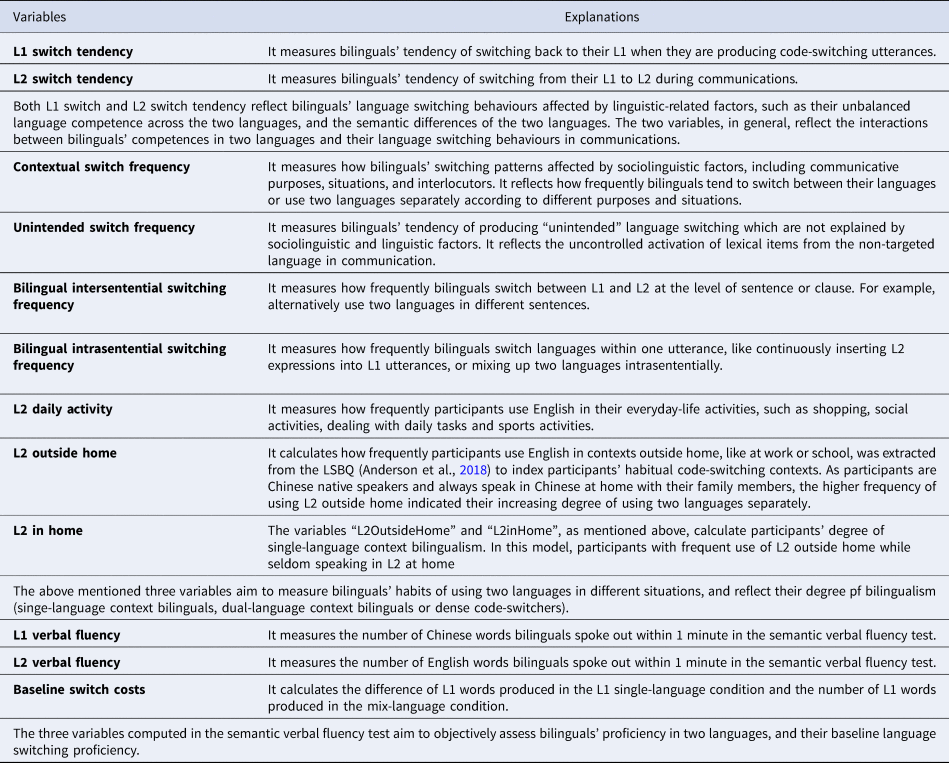
Variables related to bilingual language use experience were extracted from participants’ responses in the questionnaires, which were included as predictors to correlate with participants’ performance in the three tasks in regression models. Table below showed the variables included in regression models.
Summary of variables related to bilingual language experience and task performance in further investigations

Summary of the variables related to bilingual language use experience extracted from questionnaires and verbal fluency test and how each of them matches with participants’ habitual language switching practices
Appendix 3
Adapted from Anderson et al. (Reference Anderson, Mak, Keyvani Chahi and Bialystok2018) study, this study aggregated questions in LSBQ into three main factors, L2 use at home/non-home and social contexts. Besides the factors related to language social and non-home use, this study further aggregated questions and included a factor measuring how participants use L2 at home-related settings.
As majority of participants involved in this study are university students studying in English-speaking countries, their language use settings are relatively homogeneous, specifically, mainly at campus/workplace, home-related settings and other occasions beyond these two. Therefore, classifying questions into the three factors matches participants’ bilingual language use ecology.
In addition, to distinguish the degree that participants use their languages separately in different contexts (e.g., use English at university but Chinese at home), this study summarised the questions asking how participants use English with their family members and in home settings as index of “L2 use at home setting”, while these questions were aggregated together as index of bilinguals'non-L1 proficiency in Anderson et al.'s study (Reference Anderson, Mak, Keyvani Chahi and Bialystok2018). It is noticeable that the questions aggregated into language home use are directly opposite with language non-home use. That is, any questions asked participants to self-rate how they use two languages at campus and in workplaces are marked as indexing their language use in non-home settings. As for questions measuring participants’ language social use, this study generally adopted Anderson et al.'s (Reference Anderson, Mak, Keyvani Chahi and Bialystok2018) clustering, but excluded any questions which have been marked as measuring language home and non-home uses.
In sum, questions for language social use in this study are those asking how bilinguals use their languages in any other settings beyond home and work/study and in any interactions with people beyond the above-mentioned two settings. Below is the summary of questions in LSBQ measuring the extent of L2 uses in the three settings.
A summary of the L2 use settings investigated in the LSBQ

Appendix 4
The example of analysing participants’ VOT in the picture naming task
An example of voice onset time analysis. The yellow part indicates the sound segment and the red line on the left side of the sound segment represents the voice onset time (568 ms in this example).

Appendix 5
Analyses of the effects of habitual code-switching experience on bilinguals’ RT switch costs to Chinese in the picture-naming task.
The frequentist regression model: The role of bilingual's contextual switch frequency in predicting RT switch costs to Chinese

The Best-fit Bayesian regression model: the associations between RT switch costs to Chinese in the picture-naming task and bilingual experience-based variables

Appendix 6
Bayesian regression Analyses of the effects of habitual code-switching experience on bilinguals’ RT switch costs to English in the picture-naming task. The variable “Intrasentential Switching” in the model indicates participants’ frequency of mixing-up both languages within the same utterances in daily communication; besides, “L2dailyActivity” measures how frequently participants use English in their everyday-life activities, such as shopping, social activities and sports activities. Moreover, “L1 switch”, extracted from the BSWQ (Rodriguez-Fornells et al., Reference Rodriguez-Fornells, Krämer, Lorenzo-Seva, Festman and Münte2012), measures participants’ tendency to switch back to their L1 when they are producing code-switching utterances. The higher scores for L1 switch tendency indicate the more predominant use of L1during code-switching practices, which reflects bilinguals’ less balanced switching behaviours related to their unbalanced competence across two languages.
The Best-fit Bayesian regression model: the associations between RT switch costs to English and bilingual experience-based variables

Appendix 7
Analyses of the consequences of bilinguals’ habitual code-switching experience on their mixing costs to Chinese in the picture-naming task.
The frequentist regression model: The associations between bilinguals’ RT mixing costs (ms) to Chinese in the picture-naming task and bilingual experience-based variables.

The Best-fit Bayesian regression model: the associations between RT mixing costs to Chinese and bilingual experience-based variables

Appendix 8
Regression analyses of how bilinguals’ mixing costs to English in the picture-naming task are affected by their habitual code-switching experience.
The Best-fit Bayesian regression model: the associations between RT mixing costs to English and bilingual experience-based variables

The frequentist regression model: the relationship between bilinguals’ RT mixing costs (ms) to English in the picture-naming task and their baseline switch costs

Appendix 9
Regression analyses of the associations between habitual code-switching experience and bilinguals ’nonverbal cognitive shifting performance.
The frequentist Model: the roles of L2 use outside home and L2 verbal fluency in predicting nonverbal RT (ms) switch costs

The Best-fit Model: the associations between nonverbal RT switch costs in reaction time and bilingual experience-based variables

Appendix 10
Regression analyses of the associations habitual code-switching experience and nonverbal response inhibition performance.
The Frequentist regression model: the relationship between unintended bilingual switching frequency and participants’ percentages of false alarm in the go/no-go task

The Best-fit Bayesian regression model: the association between the percentages of false alarm in the go/no-go task and participants’ bilingual experience-related variables

Appendix 11
Correlation analyses were conducted to discuss how variables related to bilingual language experience in this study associate with each other.
Correlations between variables related to bilingual language use experience

The analyses revealed that, firstly, L2AoA is an important factor in characterising bilinguals, and it could lead to significant consequences on bilinguals’ language use and switching behaviours. Specifically, participants L2AoA negatively correlated with their L2 use frequency in different situations and daily activities. Bilinguals with earlier L2 AoA are found to be more prone to use L2 more intensively in their daily lives (including at home, outside home and dealing with daily activities) in general. Besides, bilinguals’ intensive experience of using L2 to deal with daily activities positively correlated with their L2 proficiency and L2 use frequency in different situations (i.e., home vs. outside home). It is reasonable as bilinguals with high proficiency in L2 are able to use more L2 in daily lives; and the more intensive use of L2 could also exercise their L2 proficiency in return. Also, bilinguals with intensive use of L2 in daily activities would be more prone to switch from L1 to L2 (higher L2 switch tendency) in their bilingual communications. This finding further provided evidence on the correlation between high frequency of L2 uses and enhanced proficiency in L2 as well as L2 switching.
The mutually positive correlation between the three variable “L2inHome”, “L2outsideHome” and “L2daily Activity” revealed the continuum of bilingualism and the ambiguity of boundaries across different language situations. Multiple factors (both sociolinguistic and linguistic-related) associated with bilinguals’ language switching and use behaviours need to be characterised in describing their degree of bilingualism.
In addition, the correlation analyses revealed the associations between L2 environment immersion and bilinguals’ language proficiency. The longer time bilinguals immersed in the L2 environment was found to enhance their L2 verbal fluency and lead to reduced L1 switch tendency in their bilingual communications. such results addressed the effects of language exposure on bilingual language experience and language proficiency modulation.


 Open access

