




Introduction
Australia has committed to achieving zero Food Organics and Garden Organics (FOGO) waste to landfill by 2050, with implementation progressing across states and Local Government Areas (LGAs). Yet the rollout remains uneven, as councils employ varying educational and engagement approaches, leading to inconsistent participation rates and ongoing contamination issues (DCCEEW, 2023). These challenges are intensified in multi-unit dwellings (MUDs), where high residential density, cultural and linguistic diversity, and shared waste infrastructure complicate household sorting practices. Although policy design and infrastructure provision have received substantial attention, far less emphasis has been placed on how environmental education can cultivate sustained behavioural change in the everyday spaces where waste decisions are made (Kollmuss & Agyeman, Reference Kollmuss and Agyeman2002; Stern, Reference Stern2000).
Responding to recent debates in environmental education, this study aligns with calls to broaden learning beyond formal schooling and into community environments where sustainability behaviours are embedded in daily routines (Ardoin et al., Reference Ardoin, Bowers and Gaillard2020; Monroe et al., Reference Monroe, Plate, Oxarart, Bowers and Chaves2019; Portus et al., Reference Portus, Aarnio-Linnanvuori, Dillon, Fahy, Gopinath, Mansikka-Aho and McEwen2024). Waste-separation practices represent a form of informal environmental education, requiring residents to acquire practical knowledge, internalise shared norms, and enact collective responsibility in real-life contexts (Krasny & Tidball, Reference Krasny and Tidball2009). In high-density housing, environmental learning emerges through social interaction, observation, and intergenerational exchange, positioning MUDs as important yet understudied sites of sustainability learning (Ballantyne et al., Reference Ballantyne, Fien and Packer2001; Vaughan et al., Reference Vaughan, Gack, Solorazano and Ray2003).
The current political context (Knaus, Reference Knaus2025) further elevates the role of community-based education. With weakening bipartisan consensus on national climate targets and variability in state-level policies, locally embedded sustainability education has become essential for maintaining behavioural momentum and environmental action. Local governments increasingly act not only as waste-service providers but also as facilitators of community learning, shaping how residents interpret, negotiate, and enact sustainability policies at the household level.
In this sense, educational frameworks become crucial tools for translating policy ambitions into everyday practice (Stern, Reference Stern2000).
To address this gap, the present study examines how the Action Competence Framework (ACF) can support more effective community-based FOGO education. Traditionally applied in formal school settings, ACF emphasises learners’ capacity to critically understand environmental issues, reflect on alternatives, and take informed action (Jensen & Schnack, Reference Jensen and Schnack1997; Mogensen & Schnack, Reference Mogensen and Schnack2010). Extending ACF into informal, community-based contexts enables a richer understanding of how residents develop the knowledge, agency, and shared responsibility needed for sustained contamination-reducing behaviour in MUDs.
The study also foregrounds intergenerational learning as a key mechanism influencing household sustainability practices. Rising living costs and housing pressures have increased multi-generational cohabitation in Australian cities, resulting in households where environmental norms are negotiated across age groups with differing cultural backgrounds and levels of environmental literacy. These shared living arrangements create opportunities for reciprocal learning, where younger and older residents influence each other’s practices (Ballantyne et al., Reference Ballantyne, Fien and Packer2001; Vaughan et al., Reference Vaughan, Gack, Solorazano and Ray2003). Understanding how these interactions shape FOGO behaviours is essential for designing culturally responsive and inclusive educational strategies (Stevenson, Reference Stevenson2011).
By analysing FOGO implementation through an environmental education lens, this study contributes to current scholarship on community-based sustainability learning, culturally responsive pedagogy, and action-oriented environmental education (Ardoin et al., Reference Ardoin, Bowers and Gaillard2020; Stevenson et al., Reference Stevenson, Dillon, Wals, Brody, Stevenson, Brody, Dillon and Wals2013). Empirically, it investigates how councils can embed structured educational frameworks within waste programmes to reduce contamination and improve resident participation. Theoretically, it advances environmental education by demonstrating how concepts such as action competence and intergenerational learning operate within informal, high-density urban settings rather than formal educational institutions.
This paper also draws on De Feo’s (Reference De Feo2025) perspective that effective waste management depends not only on technological and policy solutions but also on robust educational and communication processes that shape daily behaviours. This aligns with persistent contamination challenges observed during the rollout of FOGO systems across Greater Western Sydney. By integrating evidence from surveys, bin audits, interviews, and infrastructure assessments, the study explores how community education can move beyond one-way information provision toward fostering sustained environmental action.
Accordingly, the research addresses two key questions:
R1: How can community-based environmental education, informed by the ACF, promote behavioural change and reduce contamination in FOGO systems?
R2: In what ways can intergenerational and culturally responsive learning approaches enhance community engagement and improve long-term sustainability outcomes in multi-unit dwellings?
By addressing these questions, the study extends environmentally oriented learning frameworks beyond formal institutions and into everyday contexts of urban life. It also provides practical insights for local governments seeking to implement scalable, culturally responsive educational strategies to support behavioural change and improve waste outcomes across diverse communities.
The following sections present the conceptual foundation of the study, outlining relevant environmental education theories, the Action Competence Framework, and research on community-based and intergenerational learning. This is followed by an explanation of the research design and methodology, the empirical findings, and a discussion of their implications. The paper concludes by identifying theoretical contributions and practical recommendations for strengthening FOGO education and future sustainability initiatives in urban settings.
Literature review
Pedagogical foundations: Participatory vs knowledge-based learning
Sustainability education encompasses teaching and learning approaches that help individuals and communities grasp the interconnections among environmental, social, and economic systems and act on that understanding in everyday contexts (Sterling, Reference Sterling2001; Wals, Reference Wals2011). In areas such as household waste management, these pedagogies seek to bridge the persistent gap between knowing and doing by linking awareness to meaningful action.
A longstanding critique of environmental education targets knowledge-deficit models, which presume that supplying information directly produces behaviour change. Empirical research consistently shows a weak attitude–behaviour link and a significant “value–action” gap (Kollmuss & Agyeman, Reference Kollmuss and Agyeman2002). Although foundational knowledge is necessary for understanding environmental issues and possible solutions, information alone rarely sustains engagement or transforms practices over time. Behaviourist or compliance-oriented approaches risk reducing environmental education to rule-following, neglecting the social, cultural and political dimensions that condition how sustainability is enacted in everyday life (Wals, Reference Wals2011).
In response, participatory and action-oriented frameworks emphasise empowerment, critical reflection and collective engagement situated in real-world contexts (Jensen & Schnack, Reference Jensen and Schnack1997). Such approaches extend beyond formal classrooms to informal community settings, where cultural norms, language, shared infrastructure and everyday routines shape the adoption of sustainability practices (Akinsemolu & Onyeaka, Reference Akinsemolu and Onyeaka2025; Kollmuss & Agyeman, Reference Kollmuss and Agyeman2002). Direct, lived experiences tend to exert stronger effects on behaviour than abstract instruction, underscoring the importance of dialogic processes that connect information to practice. Yet in dense residential environments, structural constraints – including limited infrastructure, anonymity, and communication barriers – can impede the translation of knowledge into action. These challenges highlight the need to move beyond information campaigns toward strategies that cultivate collective responsibility, agency and capacity to act within context.
Education in informal and high-density urban contexts
Much of the research on environmental education focuses on schools and universities, but sustainability learning also occurs in informal, everyday environments. Residential spaces, particularly in high-density urban areas, serve as socially mediated sites where environmental practices are shaped through shared infrastructure, routine interactions, and collective responsibility. In multi-unit dwellings (MUDs), waste sorting is not merely an individual choice; rather, it is a collective practice influenced by building design, social norms, language diversity, and interdependent living arrangements. These settings act as informal learning contexts in which sustainability behaviours develop through lived experiences rather than formal curricula.
Wals (Reference Wals2011) argues that transformative sustainability learning requires transdisciplinary and pluralistic engagement that goes beyond the classroom. Moving away from simply transmitting information toward collaborative and anticipatory learning allows communities to work together on complex environmental issues. Dialogic and participatory processes resonate with the realities of high-density living, where household behaviours have communal impacts, such as in shared bin rooms and strata regulations. This perspective suggests that groups can develop shared capacities when they learn and act together, rather than as isolated individuals.
Despite extensive work on school-based and organised community programmes, informal residential learning – especially within culturally and linguistically diverse (CALD) and intergenerational communities in dense urban settings – remains underexplored. Understanding how sustainability learning operates collectively in MUDs is an important gap, particularly concerning the design of education for Food Organics and Garden Organics (FOGO) systems, where successful practice relies on coordinated actions at both the household and building levels.
Intergenerational and culturally responsive learning for waste education
The educational complexity of MUDs intensifies in culturally and linguistically diverse, high-density areas. Here, sustainability practices are shaped not only by infrastructure and access to information, but also by food traditions, household norms, and culturally embedded understandings of waste. Residents may enter with differing experiences of recycling systems, varying English proficiency, and distinct generational roles in domestic decision-making. As a result, sustainability behaviours are negotiated within households and across shared spaces, rather than enacted in isolation. Recent international studies (Krasny & Tidball, Reference Krasny and Tidball2009; Wals, Reference Wals2011) also highlight the growing importance of community-based and culturally responsive sustainability education in urban contexts, reinforcing the relevance of this study beyond the Australian setting.
Intergenerational learning – defined as the informal transmission of knowledge, skills and values in multigenerational families as part of daily life – plays a significant role in this negotiation (Fitzpatrick & Halpenny, Reference Fitzpatrick and Marie Halpenny2023). Research indicates that child–adult interactions can reshape environmental values and behaviours across age groups (Ballantyne et al., Reference Ballantyne, Connell and Fien1998). When younger household members adopt new sustainability practices, they may influence the orientations of parents and other adults, generating reciprocal learning within the home. School-based intergenerational programmes demonstrate this potential, though many remain limited in enabling young people to meaningfully affect adult behaviour (Ballantyne et al., Reference Ballantyne, Fien and Packer2001). In diverse, high-density contexts, however, everyday domestic interaction within MUDs may create continual opportunities for reciprocal environmental learning, positioning these dwellings as relational spaces of informal education rather than mere sites of individual compliance.
Although numerous studies address waste behaviour or education separately, few examine how participatory environmental education operates within culturally diverse MUDs. This study addresses that gap by applying the Action Competence Framework (ACF) to community-based FOGO education, with attention to intergenerational and culturally responsive engagement. This study advances the literature by positioning FOGO participation as a form of informal environmental education, extending existing work by explicitly linking participatory learning, cultural responsiveness, and intergenerational dynamics within everyday residential contexts.
Environmental education frameworks: Rationale for the action competence framework
Environmental education scholarship offers several frameworks for understanding behaviour, each with strengths and limitations depending on context. For intergenerational environmental learning in culturally and linguistically diverse (CALD) communities in high-density Australian urban areas – particularly regarding FOGO participation – Social Practice Theory (SPT) and Transformative Learning Theory (TLT) provide useful but partial explanations.
SPT views human action as participation in socially shared practices shaped by materials, competences, and meanings. From this perspective, waste separation is a collective practice influenced by infrastructure (e.g., bin design and access), practical skills (sorting knowledge), and shared norms. In CALD intergenerational households, food waste behaviours are embedded in cultural routines and spatial constraints, making SPT valuable for highlighting the need to align infrastructure, skills, and community norms – not simply provide information.
TLT focuses on shifts in individuals’ frames of reference, arguing that sustainable change requires critical reflection on beliefs about waste, hygiene, responsibility, and collective living. Intergenerational dialogue can prompt these reflections, with younger members introducing new perspectives while older members renegotiate established views. TLT therefore explains deeper attitudinal and identity-level change beyond surface compliance.
While Social Practice Theory (SPT) and TLT offer valuable insights, each provides only a partial explanation for FOGO participation in high-density, culturally diverse contexts. SPT highlights the role of infrastructure, skills, and social norms but gives limited attention to learning processes and agency. TLT explains shifts in beliefs and perspectives but focuses primarily on individual transformation rather than collective action. In contrast, the Action Competence Framework (ACF) integrates knowledge, participation, and agency, making it particularly suited to understanding how residents develop the capacity for informed and collective environmental action in multi-unit dwellings.
Action competence framework: Direction for CALD intergenerational learning and high-density urban communities
The Action Competence Framework (ACF) is designed to empower people to act consciously, intentionally and with courage on environmental issues (Barrett, Reference Barrett2006; Sass et al., Reference Sass, Boeve-de Pauw, Olsson, Gericke, De Maeyer and Van Petegem2020). In the Australian FOGO context, ACF provides a dynamic alternative to transmissive models by integrating critical understanding, participation and agency, thereby linking learning directly to purposeful action. Within CALD intergenerational households, where waste routines are shaped by culturally situated norms, shared domestic authority, and spatial constraints, ACF’s multidimensional structure – cognitive, social, and affective – supports residents not only in understanding FOGO systems but also in seeing themselves as capable contributors to environmental change.
Cognitive dimension: Critical understanding and system awareness
The cognitive dimension, as noted by TLT, promotes a deeper understanding of environmental issues beyond technical rules (Barret, Reference Barrett2006; Jensen & Schnack, Reference Jensen and Schnack1997). In FOGO, this perspective shifts from viewing “rubbish” as isolated waste to connecting organics with broader consumption and recovery cycles. In CALD intergenerational households, cultural and generational influences shape waste practices, which may not align with local policies. ACF encourages reflection and dialogue to highlight these differences and foster shared understanding. In high-density living, this cognitive work helps residents see contamination as a collective issue, linking local practices to wider environmental impacts and encouraging commitment and purposeful engagement (Akinsemolu & Onyeaka, Reference Akinsemolu and Onyeaka2025; Jensen & Schnack, Reference Jensen and Schnack1997).
Social dimension: Collective participation in CALD, intergenerational, high-density contexts
The social dimension emphasises collective participation, dialogue, and civic engagement as vital for sustainable action (Chen & Liu, Reference Chen and Liu2020; Olsson et al., Reference Olsson, Gericke and Boeve-de Pauw2022). In Multi-Unit Dwellings (MUDs), the outcomes of FOGO (Food Organics and Garden Organics) depend on shared efforts, making waste management a collective responsibility. The ACF promotes collaboration across households and cultural groups, while in CALD communities, trust is often built through local networks and leaders, enhancing inclusion and accountability. High-density urban areas require coordination among residents, strata committees, councils, contractors, and community organisations. Sustained action hinges on these relationships and necessary institutional support; without it, collective efforts may falter despite motivation (Xing & Ironsi, Reference Xing and Ironsi2024).
Affective dimension: Building confidence and agency
The affective dimension focuses on developing confidence, motivation and agency to act on environmental issues (Olsson et al., Reference Olsson, Gericke and Chang Rundgren2020). In high-density, CALD settings, participation in FOGO may be shaped by belonging, trust and perceived influence over shared outcomes. Where communities feel disconnected from environmental systems or civic processes, linking FOGO participation to visible community and environmental benefits can strengthen emotional investment and a sense of collective purpose (Xing & Ironsi, Reference Xing and Ironsi2024). Intergenerational participation – shared efforts by young people and adults – can reinforce mutual responsibility, normalise new practices and build confidence across age groups. Nonetheless, affective readiness alone cannot overcome infrastructural or governance constraints; emotional commitment is most effective when paired with structural support.
Limitations and barriers of ACF
Despite its strengths, ACF has limitations. Its emphasis on empowerment and civic engagement can overestimate individuals’ and communities’ capacity to act in structurally constrained environments. In dense urban settings, limited bin access, spatial constraints, and building-level governance may restrict the translation of competence into action. In CALD intergenerational contexts, cultural hierarchies, language barriers and varied trust in institutions shape participation and whose voices are heard. Although ACF promotes critical reflection and collective engagement (Barrett, Reference Barrett2006; Jensen & Scnack, Reference Jensen and Schnack1997), it does not fully resolve power asymmetries, resource inequalities or the complexities of multi-level governance. Its effectiveness is therefore contingent on institutional alignment – clear roles, adequate resourcing, culturally responsive communication and long-term facilitation.
Even so, compared with SPT and TLT in this context, ACF offers a more integrative scaffold by explicitly connecting critical understanding (cognitive), collective participation (social) and empowerment (affective) to civic action and shared environmental responsibility. It is thus well-suited to guide community-based FOGO education in high-density, culturally diverse settings.
Synthesis: Educational implications for FOGO
Although FOGO implementation is often framed as a technical or infrastructure problem, this study argues that contamination and participation challenges are fundamentally educational. Waste-sorting practices are learned behaviours shaped by social interaction, cultural meaning and everyday routines (Barr, Reference Barr2007; Kollmuss & Agyeman, Reference Kollmuss and Agyeman2002). In high-density, culturally diverse MUDs, environmental learning occurs informally through shared spaces, family practices and community engagement rather than through formal instruction alone (Krasny et al., Reference Krasny and Tidball2017; Krasny & Tidball, Reference Krasny and Tidball2009). Effective FOGO outcomes therefore require pedagogical approaches that recognise learning as social, contextual and action-oriented (Jensen & Schnack, Reference Jensen and Schnack1997).
Recent work reinforces the centrality of education and communication to waste systems. De Feo (Reference De Feo2025) underscores the need for sustained, well-designed educational processes, noting that children can act as catalysts for household change and calling for further research on the long-term intergenerational impacts on waste practices. In line with this evidence, the present study positions community education as a critical mechanism for enabling effective adoption of FOGO programmes. Drawing on environmental education perspectives, it investigates how residents develop the knowledge, values and agency necessary for sustainable waste practices. Special emphasis is placed on intergenerational learning and culturally responsive strategies – both of which are vital in diverse urban settings (Ballantyne et al., Reference Ballantyne, Fien and Packer2001).
Guided by the Action Competence Framework, the study underscores that residents require more than instructions: they need opportunities for dialogue, reflection and participation that connect local practices to broader environmental goals, supported by enabling institutions. ACF provides an integrative foundation for examining how knowledge (cognitive), participation (social) and agency (affective) interact within community contexts to support sustained, contamination-reducing behaviour in FOGO systems. In doing so, it offers a robust theoretical basis for designing community-based, multilingual and intergenerational education that aligns with the lived realities of high-density, culturally diverse urban communities.
Research design and method
The research team, in collaboration with the LGA waste management unit, identified 20 multi-unit dwellings (MUDs) for inclusion: ten low-rise buildings (one to three storeys) and ten medium-rise buildings (four to six storeys). Bin infrastructure audits were conducted across all 20 sites. Although requests to conduct a resident survey on FOGO practices were submitted to each strata or management committee, only 10 MUDs granted permission for resident participation. Invitation flyers were then distributed to these participating buildings.
The questionnaire took approximately 10 minutes to complete. To minimise duplicate responses, Qualtrics settings restricted multiple submissions from the same device or IP address and required that surveys be completed in one sitting. Ethical approval was granted by the Western Sydney University Human Research Ethics Committee. Participants had to be at least 18 years old and living in one of the 20 participating MUDs; eligibility was not tied to ownership or length of residence. Recruitment occurred through letterbox drops and notices in stairwells and lifts. A QR code linked residents to the survey introduction and participant information sheet. Participation was anonymous, and progressing through the survey constituted implied consent. The survey remained open from 20 November 2024 to 1 May 2025 and closed after a week with no new responses.
This exploratory mixed-methods study reflects the early stage of knowledge on FOGO education and behaviour in culturally diverse MUDs. Given the emerging nature of FOGO in high-density settings, few models link community education, intergenerational learning, and household sorting practices. Using a small pilot sample, the study sought to identify behavioural patterns, test assumptions, and generate contextual insights to inform future research. Conducted in a Western Sydney council recognised for its FOGO leadership, the study examined early behavioural responses, educational needs, and system-level challenges within CALD communities.
Guided by the Action Competence Framework (ACF), the study aimed to achieve three objectives. First, a co-designed resident survey measured FOGO awareness, waste literacy, sorting confidence, and participation barriers, revealing low knowledge and uncertainty across building types. Second, a bin-infrastructure audit, supported by three interviews with council officers, identified challenges such as inconsistent messaging and inadequate or exposed bin areas. Interview participants were purposively selected from local council waste management and education staff who were directly involved in the design and implementation of FOGO programmes. This ensured that participants had relevant operational knowledge and practical experience with community engagement and waste education in multi-unit dwellings.
This study has several limitations. The sample size is relatively small (N = 33), reflecting the exploratory nature of the research and limiting the generalisability of the findings. Qualitative data were analysed using Leximancer 5.0, and quantitative data using STATA 19. Leximancer 5.0 to identify key themes and relationships among concepts, with iterative interpretation by the research team to ensure consistency and contextual accuracy. Overall, the mixed-method findings show the value of ACF for strengthening intergenerational learning, improving FOGO literacy, and supporting long-term behavioural commitment in local government education strategies.
Results and discussion
The results draw on both quantitative and qualitative data to provide a comprehensive understanding of FOGO education practices across local government areas (LGAs). The quantitative findings identify patterns in awareness, participation, and reported challenges associated with FOGO implementation, while the qualitative analysis offers deeper insights into how councils design and communicate waste education initiatives. Together, the mixed-method findings highlight the Action Competence Framework (ACF) as a useful lens for understanding how awareness, commitment, skill development, and collective action can foster intergenerational behaviour change and strengthen long-term engagement with sustainable waste practices.
Household survey results: Potential for ACF
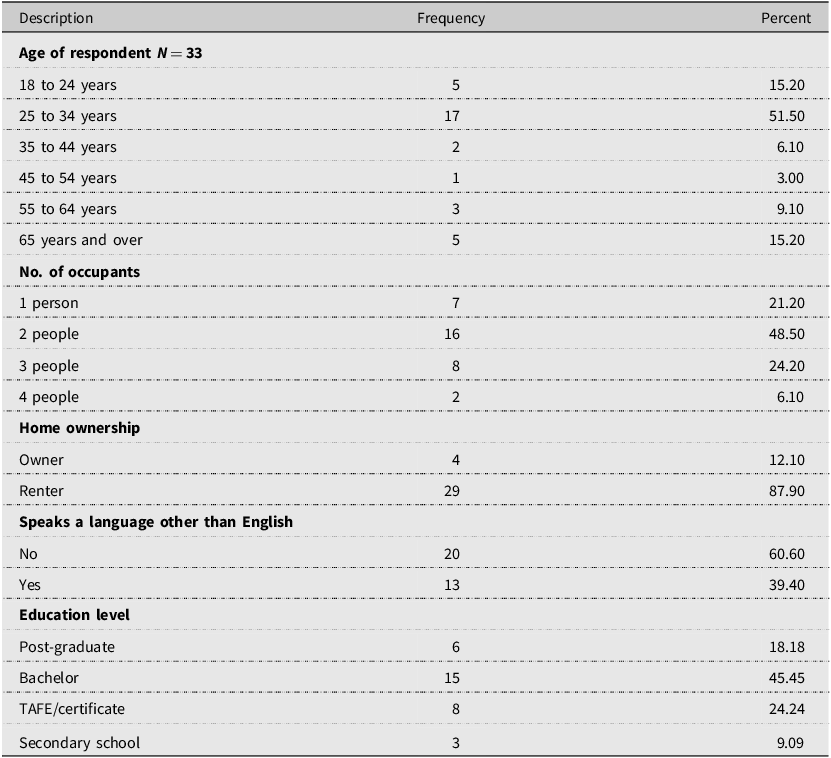
Table 1 summarises the characteristics of MUD residents who completed the survey. The sample (N = 33) is predominantly young, with over half of the respondents aged 25–34 years (51.5%), followed by equal proportions in the 18–24 and 65+ age groups (15.2% each). Most households consist of two occupants (48.5%), while 21.2% live alone and 24.2% live in three-person households. The vast majority are renters (87.9%), with only 12.1% identifying as homeowners. In terms of linguistic background, 39.4% speak a language other than English at home, indicating moderate cultural diversity. Educational attainment is relatively high, with 63.6% holding a Bachelor or Postgraduate qualification, and a further 24.2% possessing TAFE or Certificate-level qualifications, suggesting a generally well-educated respondent group.
Demographic characteristics of respondents

Table 1 Long description
The table summarizes the characteristics of MUD residents who completed the survey. It has 12 rows and 3 columns. The columns are labeled Description, Frequency, and Percent. The table is divided into five sections: Age of respondent, No. of occupants, Home ownership, Speaks a language other than English, and Education level. Row 1: Age of respondent N = 33. Row 2: 18 to 24 years, 5, 15.20. Row 3: 25 to 34 years, 17, 51.50. Row 4: 35 to 44 years, 2, 6.10. Row 5: 45 to 54 years, 1, 3.00. Row 6: 55 to 64 years, 3, 9.10. Row 7: 65 years and over, 5, 15.20. Row 8: No. of occupants. Row 9: 1 person, 7, 21.20. Row 10: 2 people, 16, 48.50. Row 11: 3 people, 8, 24.20. Row 12: 4 people, 2, 6.10. Row 13: Home ownership. Row 14: Owner, 4, 12.10. Row 15: Renter, 29, 87.90. Row 16: Speaks a language other than English. Row 17: No, 20, 60.60. Row 18: Yes, 13, 39.40. Row 19: Education level. Row 20: Post-graduate, 6, 18.18. Row 21: Bachelor, 15, 45.45. Row 22: TAFE/certificate, 8, 24.24. Row 23: Secondary school, 3, 9.09.
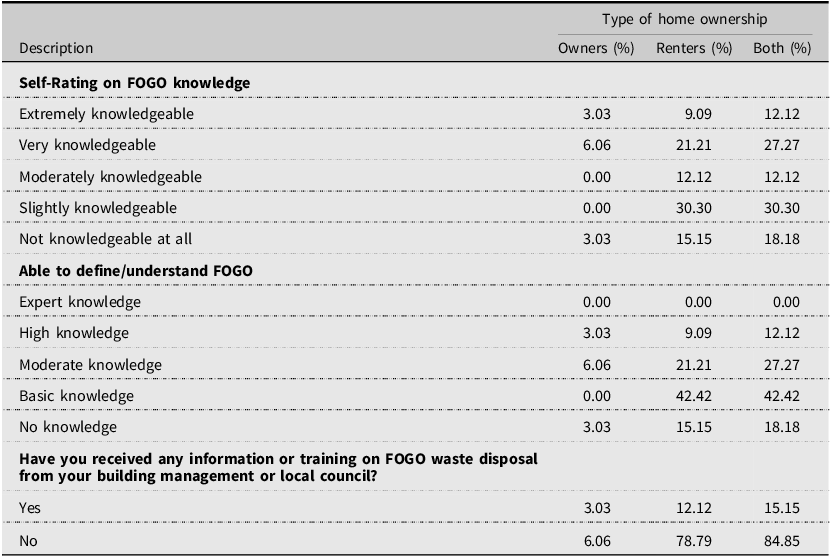
The data in Table 2 show that renters consistently report lower levels of FOGO knowledge than owners, with 30.30% indicating they are only slightly knowledgeable and 15.15% indicating they are not knowledgeable at all. Similarly, when asked to define FOGO, 42.42% of renters report only basic knowledge, 18.18% report no knowledge, and no respondents indicate expert-level knowledge. Within the ACF, knowledge is a foundational component of action competence; without sufficient conceptual understanding, individuals are unlikely to progress from awareness to informed and purposeful action. The predominance of basic and low levels of knowledge among renters surveyed may suggest limited cognitive readiness for meaningful environmental engagement in waste-separation practices.
FOGO knowledge by type of home ownership
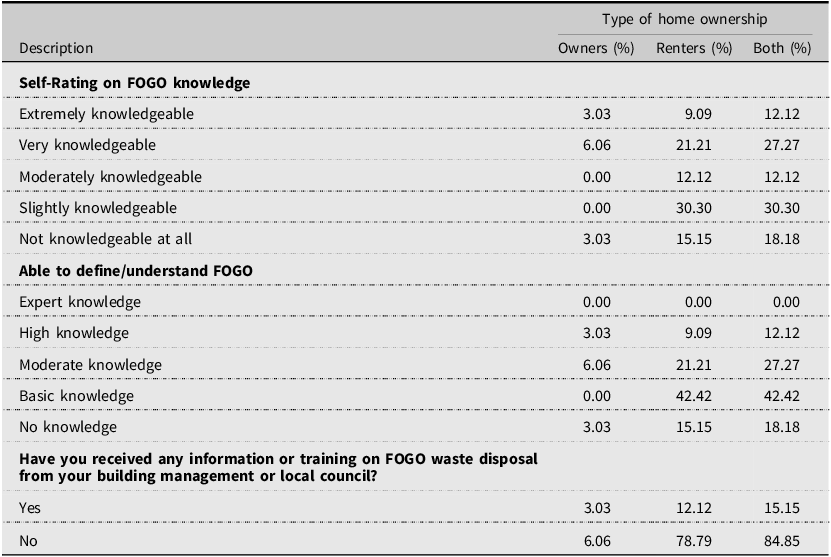
Table 2 Long description
A table comparing FOGO knowledge by type of home ownership. The table has 15 rows and 4 columns. The columns are labeled Description, Owners (%), Renters (%), and Both (%). The rows are grouped under three main categories: Self-Rating on FOGO knowledge, Able to define/understand FOGO, and Have you received any information or training on FOGO waste disposal from your building management or local council? Under Self-Rating on FOGO knowledge, the rows are Extremely knowledgeable, Very knowledgeable, Moderately knowledgeable, Slightly knowledgeable, and Not knowledgeable at all. Under Able to define/understand FOGO, the rows are Expert knowledge, High knowledge, Moderate knowledge, Basic knowledge, and No knowledge. The last category has two rows: Yes and No. Each row contains percentages for owners, renters, and both. Notable data points include 30.30% of renters indicating they are slightly knowledgeable and 42.42% of renters reporting basic knowledge of FOGO.
Further, a significant majority of renters (84.85%) report receiving no information or training from building management or local councils. ACF holds that action competence is not merely an individual attribute but develops within enabling institutional contexts. This lack of informational support points to structural barriers that constrain the development of competence, particularly in rental settings where residents often have limited control over infrastructure and decision-making processes. Even where moderate or high self-rated knowledge exists, the absence of formal guidance limits the translation of understanding into
The result of the survey suggests that for these cohort, home ownership status seems to be linked to unequal opportunities for developing action competence in FOGO participation. While some owners report higher perceived knowledge, renters face informational and structural constraints that may inhibit their capacity for informed environmental action. From an ACF perspective, strengthening participatory education, improving targeted communication in multi-unit dwellings, and increasing institutional support from councils and building managers would be essential to translate existing knowledge into genuine, sustained environmental action.
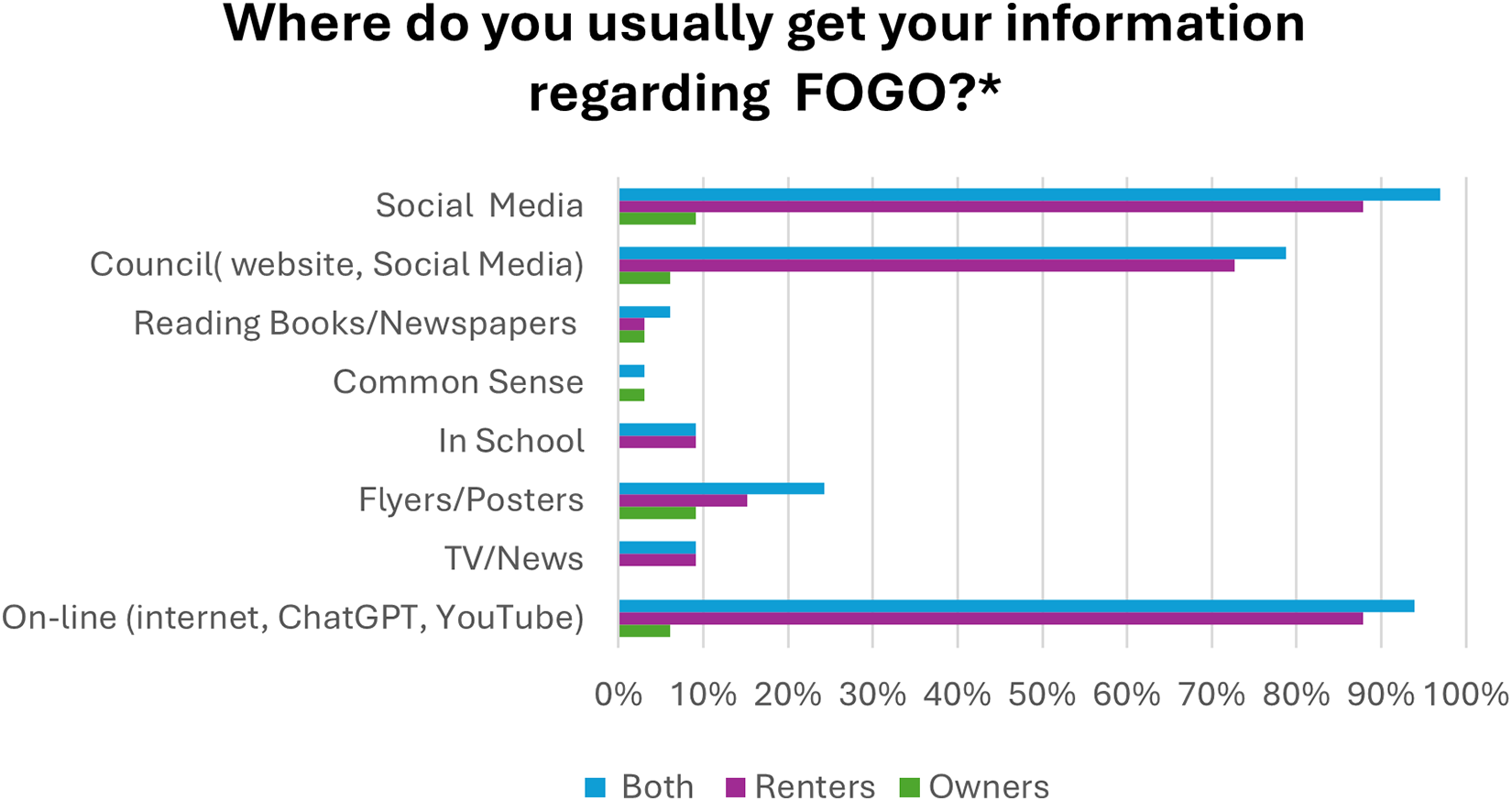
Respondents were also asked to identify at most three sources of FOGO information. Figure 1 reveals that renters rely overwhelmingly on online platforms (87.88%), social media (87.88%), and council websites (72.73%) for FOGO information, whereas owners report markedly lower engagement with these sources. From an ACF perspective, this suggests that knowledge development is largely mediated through informal and digital channels rather than through structured institutional education. While digital access can enhance awareness, ACF emphasises critical and reflective knowledge over passive information consumption. Heavy reliance on social media indicates exposure to information, but not necessarily the deeper structural understanding required for robust action competence.
Sources of information by type of home ownership. *multiple answers.

Figure 1. Long description
The bar graph compares sources of information regarding FOGO by type of home ownership, with horizontal bars representing different categories. The y-axis lists categories: Social Media, Council (website, Social Media), Reading Books/Newspapers, Common Sense, In School, Flyers/Posters, TV/News, and On-line (internet, ChatGPT, YouTube). The x-axis represents percentage values ranging from 0 to 100. The graph includes three data series: Both, Renters, and Owners, each represented by different colors: blue for Both, pink for Renters, and green for Owners. Social Media and On-line (internet, ChatGPT, YouTube) have the highest percentages across all categories, while Reading Books/Newspapers and Common Sense have the lowest. Council (website, Social Media) and TV/News show moderate participation. Flyers/Posters and In School have varying levels of engagement. The data indicates that digital sources are the primary means of information dissemination regarding FOGO. All values are approximated.
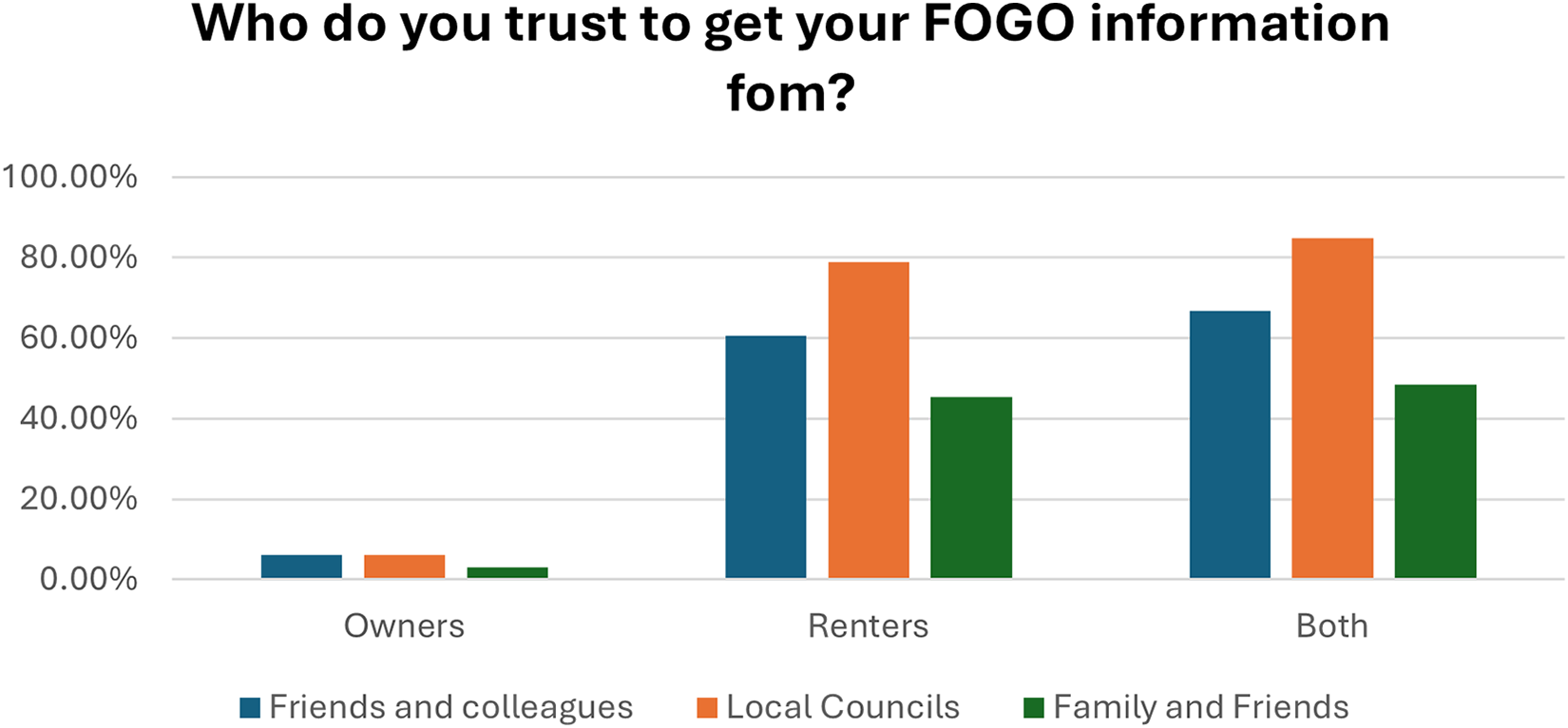
With regards to trust, a high proportion of renters trust local councils (78.79%) and friends or colleagues (60.61%) as information sources (see Figure 2). ACF holds that action competence develops within democratic and relational contexts; trust in institutions such as councils confers legitimacy to environmental action and increases the likelihood that knowledge will translate into practice. Equally, reliance on peer networks reflects the collective dimension of competence, whereby shared norms and social reinforcement support sustainable behaviour.
Trusted FOGO information sources by type of home ownership.

Figure 2. Long description
The bar graph compares trusted sources for FOGO information among owners, renters, and those in both categories. The x-axis lists three groups: Owners, Renters, and Both. The y-axis measures the percentage of trust from 0 to 100 percent. There are three vertical bars for each group, representing Friends and Colleagues, Local Councils, and Family and Friends. Friends and Colleagues are shown in blue, Local Councils in orange, and Family and Friends in green. Owners show minimal trust in all sources, with Friends and Colleagues around 5 percent, Local Councils around 2 percent, and Family and Friends around 1 percent. Renters show higher trust, with Friends and Colleagues around 60 percent, Local Councils around 80 percent, and Family and Friends around 40 percent. Those in Both categories show moderate trust, with Friends and Colleagues around 65 percent, Local Councils around 85 percent, and Family and Friends around 50 percent. All values are approximated.
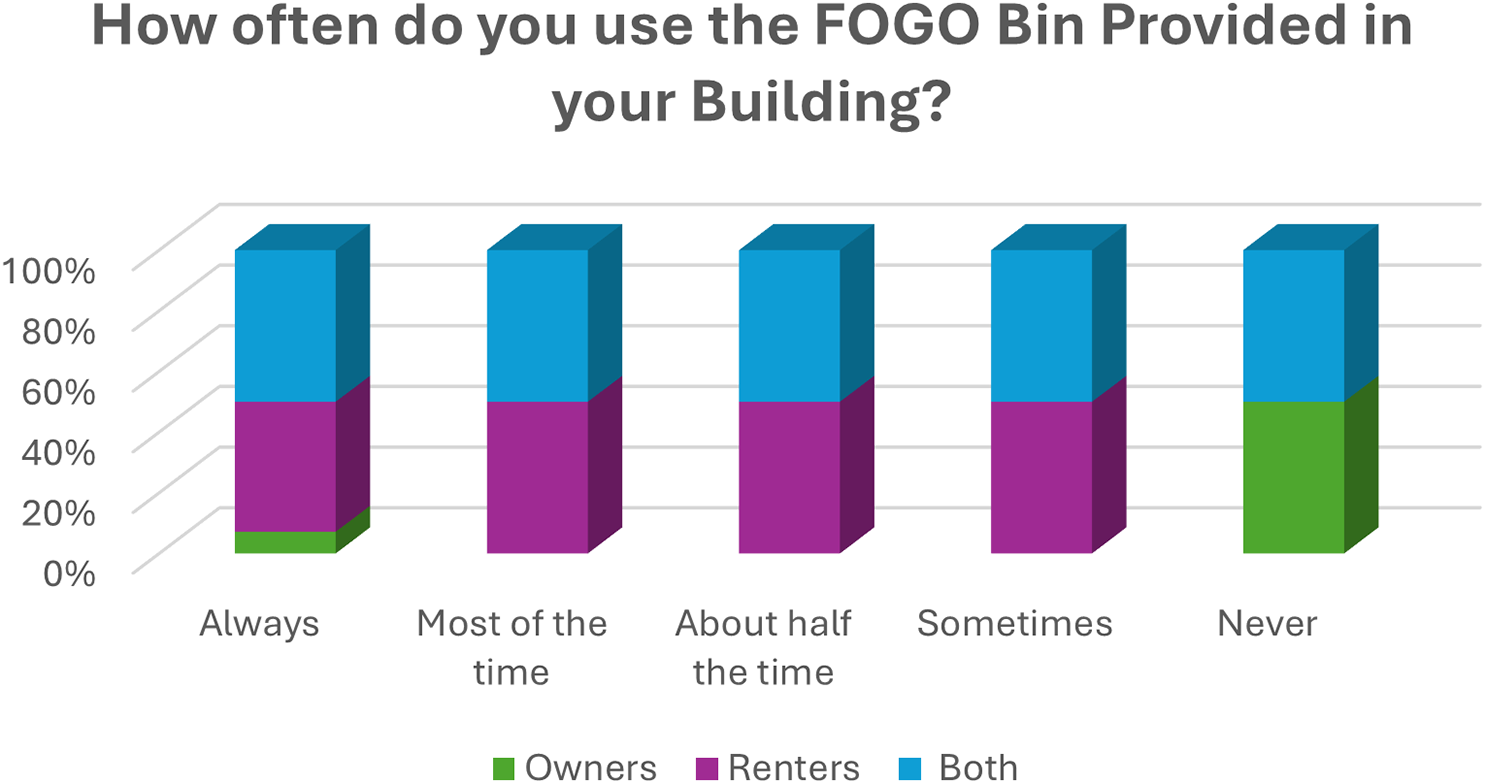
Behavioural data show relatively high reported FOGO usage, with 54.55% of renters indicating they always use the bin and 63.64% overall reporting consistent use. Within the ACF, action competence requires not only knowledge but direct experience of action. Frequent bin usage suggests that experiential learning is occurring, reinforcing habitual behaviour and potentially deepening commitment. However, given earlier evidence of limited formal training, this engagement may be compliance-driven rather than critically informed. From an ACF standpoint, sustained and transformative environmental competence would require deeper structural understanding, participatory engagement, and opportunities for critical reflection – rather than reliance primarily on digital information and informal social trust.
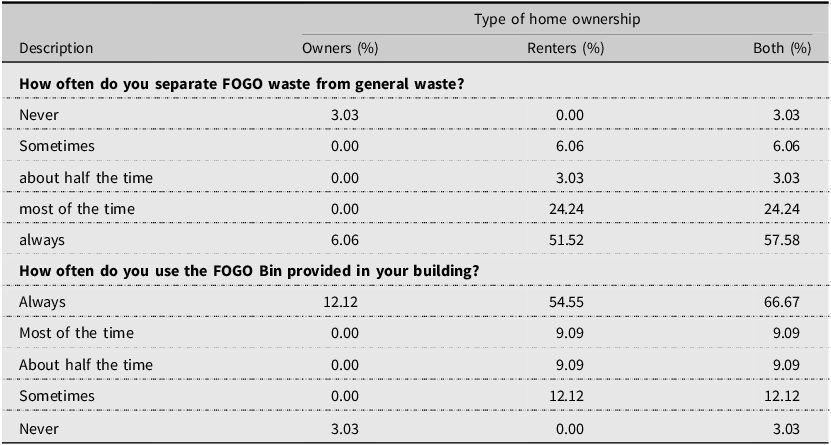
Table 3 reveals that the majority of respondents report consistently separating FOGO waste, with 57.58% indicating they always do so and a further 24.24% doing so most of the time. Renters demonstrate particularly high engagement, with 51.52% reporting that they always separate FOGO waste. Similarly, Figure 3 notes that 66.67% of all respondents report to always use the FOGO bin provided in their building, with renters again forming the largest proportion (54.55%). These findings suggest that repeated behavioural engagement is occurring, which, within the ACF, contributes to the development of practical action competence through experiential learning.
FOGO waste separation practices and disposal challenges by home ownership type

Table 3 Long description
The table has two main sections: FOGO waste separation practices and FOGO bin usage. It compares responses from owners, renters, and both groups combined. The first section, ’How often do you separate FOGO waste from general waste?’, includes rows for Never, Sometimes, about half the time, most of the time, and always. The second section, ’How often do you use the FOGO Bin provided in your building?’, includes rows for Always, Most of the time, About half the time, Sometimes, and Never. Each row lists percentages for owners, renters, and both groups combined. Notable data points include 57.58% of both groups always separating FOGO waste, with renters at 51.52%. For FOGO bin usage, 66.67% of all respondents always use it, with renters at 54.55%.
Frequency use of FOGO bins.

Figure 3. Long description
The bar graph compares the frequency of FOGO bin usage in buildings, categorized by owners, renters, and both. It features five vertical, grouped bars representing different usage frequencies: Always, Most of the time, About half the time, Sometimes, and Never. The x-axis labels these usage frequencies, while the y-axis indicates the percentage of respondents, ranging from 0 to 100 percent. Each bar is divided into three color-coded sections: green for owners, purple for renters, and blue for both. The graph shows that a higher percentage of owners always use the FOGO bin compared to renters and both categories combined. Conversely, a higher percentage of renters never use the FOGO bin. The data suggests varying levels of engagement with FOGO bin usage among different groups. All values are approximated.
Figure 4 show that renters face substantially greater barriers to effective FOGO participation than property owners. Lack of information is the most significant challenge (79% of renters; 91% of respondents overall), suggesting widespread uncertainty about the correct sorting practices. Renters also report higher levels of limited bin access (67%), odour concerns (55%), and inconvenience (45%), whereas issues such as inadequate lighting remain comparatively minor (15%). In contrast, owners consistently report lower rates across all categories, indicating that structural and informational constraints are disproportionately concentrated in rental households and multi-unit dwelling environments.
Challenges faced in disposing FOGO.

Figure 4. Long description
The bar graph compares the challenges faced in disposing FOGO between owners and renters. It features five horizontal bars representing different challenges: lighting concerns, odor/smell concerns, limited access to bins, inconvenience, and lack of information. The x-axis measures the percentage of respondents, ranging from 0 to 100 percent. The y-axis lists the challenges. Owners are represented by green bars, and renters by purple bars. Lighting concerns show a lower percentage for both groups, with owners slightly higher. Odor/smell concerns are higher for renters than owners. Limited access to bins is significantly higher for renters compared to owners. Inconvenience shows a moderate percentage for both, with renters slightly higher. Lack of information is the highest challenge for both groups, with renters showing a much higher percentage than owners. All values are approximated.
However, the Action Competence Framework (ACF) distinguishes between routine compliance and critically informed environmental action. While high levels of reported FOGO usage demonstrate behavioural participation, ACF posits that genuine action competence requires residents to understand the purpose, structural conditions, and wider environmental implications of their actions. Earlier evidence of limited formal training suggests that some reported behaviours may reflect habit formation, convenience, or social norms rather than deeply internalised environmental knowledge. Even so, consistent engagement with the FOGO system provides a valuable experiential foundation for building deeper competence. By combining this existing participation with targeted education, culturally responsive communication, and institutional support, councils can strengthen residents’ capacity for reflective, informed, and democratically engaged action – hallmarks of fully developed action competence.
It should be noted, though, that these results must be interpreted with caution, given the small overall sample size and the considerable imbalance between renter and owner respondents.
Community perspectives on FOGO practices: Qualitative insights
The qualitative data deepened the quantitative findings by revealing how residents and stakeholders interpret and engage with FOGO practices, highlighting the behavioural, social, and contextual mechanisms that shape participation. Five key themes emerged: the importance of simple visual communication, the value of face-to-face engagement, the need for whole-of-building education in MUDs, the role of practical everyday guidance, and the motivational effect of community pride and visible local benefits.
Interviews with waste coordinators and education officers consistently stressed that clear, visual, and supportive communication is essential for improving awareness, particularly in MUDs. Text-heavy signage often discouraged participation; as one officer explained, residents became “too scared to do the wrong thing, so they just decided not to use the bin at all.” When the council replaced these notices with picture-based instructions, “usage went straight back up, and we’ve had no contamination since.” Visual communication was especially important for CALD and low-literacy communities, with officers noting that images made information accessible: “Anyone can interpret that.”
Face-to-face engagement – door knocking, events, ranger visits – was described as significantly more effective than passive methods such as letter drops. This relational approach helped build trust, clarify misunderstandings, and encourage correct sorting.
In MUDs, where shared infrastructure, anonymity, and high tenant turnover complicate accountability, officers emphasised the need for comprehensive, building-wide education. Contamination often stemmed not from resistance but from small misunderstandings, such as residents placing “bread still in the bread bag or strawberries still in the punnet.” Ongoing feedback and simple corrective guidance were found to substantially reduce these issues.
Overall, the qualitative insights suggest that FOGO education must be continuous, visual, and community-centred. Positive reinforcement –such as compost or plant giveaways that allow residents to “see the fruits of their sorting” – helps build community pride and strengthens motivation, enabling strong participation even in complex high-density environments.
Integrated discussion
This study extends the Action Competence Framework (ACF) to informal residential contexts, focusing on multi-unit dwellings (MUDs) and broadening its application beyond formal education. Findings suggest that ACF serves as a practical foundation for enhancing FOGO (Food Organics and Garden Organics) education in MUDs. The research identifies significant gaps in residents’ understanding, particularly among renters, as well as structural barriers like limited bin access, inconsistent messaging, and confusion about proper sorting.
ACF encourages councils to transition from routine compliance to community-driven environmental action, aligning with the complexities of high-density, culturally diverse housing environments. It offers a structured approach to enhancing four interconnected components of environmental learning: awareness, commitment, practical competence, and collective action. Mapping existing council practices to these dimensions reveals areas for improvement. Raising awareness addresses the informational deficits highlighted in surveys and interviews – especially in culturally and linguistically diverse (CALD) communities, where clear, visual, and locally relevant communication proves more effective than dense text. Increasing commitment hinges on participatory and face-to-face engagement, which helps build trust and clarify misconceptions. Practical skill-building is necessary to correct recurring sorting errors, often arising from misunderstandings rather than resistance. Visual aids, demonstrations, and routine feedback can effectively reduce contamination.
Finally, fostering collective action links individual practices to building-wide outcomes. The study shows that community pride, positive reinforcement, and visible circularity, such as compost giveaways, cultivate a shared sense of responsibility and encourage sustained participation.
Embedding ACF into FOGO & intergenerational learning
The study introduces a conceptual model Figure 5 that shows how ACF can be embedded in FOGO education as an iterative cycle of learning, reflection, and action. Engagement begins with awareness of FOGO practices, progresses to critical thinking about environmental implications, and culminates in active participation at the household and community levels. Over time, these practices acquire shared meaning and purpose, enabling behavioural change to become normalised and sustained. Crucially, this cycle is reinforced through intergenerational learning, where knowledge, habits, and values circulate between younger and older residents. This continuous loop aligns with ACF’s cognitive, affective, and social dimensions, allowing FOGO participation to evolve into a stable community norm.
ACF linked FOGO education.

Long description
The flowchart illustrates the process of embedding ACF in FOGO and intergenerational learning. It begins with participation and awareness, leading to critical thinking and commitment. This progresses to participation and practice, followed by embedding shared purpose and meaning. The next step is initial long-term behavior change, which leads to sustained behavioral change. The cycle then loops back to FOGO education and intergenerational learning, reinforcing the process.
Effects of ACF implementation in FOGO education & intergenerational learning
The second conceptual model Figure 6 highlights that ACF’s effectiveness depends not only on its pedagogical design but on systemic conditions such as resourcing, continuity, inclusivity, and stable governance. When well implemented, ACF supports adequate education resourcing, reflective learning, and shared purpose, generating long-term behavioural change, stronger community ownership, and reduced contamination. Conversely, poorly embedded ACF – marked by fragmented delivery or limited support – yields superficial awareness without action, minimal engagement, and erosion of community motivation. The model stresses that cultivating genuine action competence requires not just frameworks but sustained institutional commitment.
FOGO education through ACF.

Figure 6. Long description
The flowchart titled ‘Dual Pathways of ACF Implementation in FOGO Education’ compares well-embedded and poorly embedded practices. On the left side, well-embedded practices include adequate resourcing, critical and reflective learning, embedded shared purpose and action, leading to sustained behavioral change, stronger community purpose, and compliance. On the right side, poorly embedded practices include minimal resourcing and fragmented delivery, knowledge without action and pseudo participation, lack of shared purpose and cultural responsiveness, resulting in short-term compliance, program apathy, and low engagement. Each pathway is marked with checkmarks for well-embedded practices and warning signs for poorly embedded practices.
ACF and its role in intergenerational empowerment
The study emphasises that councils aiming to enhance FOGO outcomes should collaborate with communities to co-design education, tailoring their approaches to local cultural and generational contexts. Research finds that waste initiatives are most effective when accompanied by social learning (Blanchard et al., Reference Blanchard, Harris, Pocock and McCabe2023; Landells et al., Reference Landells, Karunasena, Oakden and Naweed2024). Intergenerational learning plays a pivotal role: younger residents often promote sustainability, while older residents offer practical experience and cultural practices related to food and waste, facilitating the flow of environmental knowledge across households (Ballantyne et al., Reference Ballantyne, Connell and Fien1998; Vaughan et al., Reference Vaughan, Gack, Solorazano and Ray2003).
Educators are vital in linking school-based learning with daily household practices (Andersson et al., Reference Andersson, Augustine and Rampazzo Gambarato2025). Pedagogies such as storytelling, problem-solving, and place-based activities foster collective reflection and shared meaning around sustainability (Birdsall, Reference Birdsall2025; Wals, Reference Wals2011). However, challenges persist, including rigid curricula, siloed institutions, and limited teacher training, which can hinder sustainability pedagogy development (Goller & Rieckmann, Reference Goller and Rieckmann2022; Xing & Ironsi, Reference Xing and Ironsi2024). Strengthening professional learning is essential for meaningfully integrating ACF-aligned methods into community education.
Despite these challenges, ACF serves as a strong foundation for transforming intergenerational interactions into true two-way learning, with adults sharing lived experience and children providing contemporary environmental knowledge. Together, this exchange builds shared responsibility and ethical citizenship, shifting FOGO participation from compliance to a valued community practice (Hargreaves, Reference Hargreaves2011; Wals, Reference Wals2011). The study’s key contribution lies in extending the Action Competence Framework into informal, high-density residential contexts, demonstrating its relevance for understanding community-based environmental learning beyond formal education systems.
Conclusions and future research
This exploratory study demonstrates that although self-reported participation in FOGO systems within multi-unit dwellings (MUDs) is relatively high, achieving sustainable behaviour and reducing contamination requires more than routine compliance. The findings reveal significant gaps in formal waste education, with most residents relying on informal or digital sources rather than structured council-led programmes. This limits the development of action competence as conceptualised in the Action Competence Framework (ACF), which emphasises informed, reflective, and collectively meaningful environmental action. While residents show willingness to separate waste, their understanding often remains superficial and unanchored in the reflective, dialogic, and community-based processes required for long-term change.
The demographic profile – marked by cultural and linguistic diversity, younger renter populations, and high residential turnover – reinforces the need for multilingual, culturally responsive, and intergenerational approaches. Trust networks, social influence, and shared household dynamics emerged as key mechanisms shaping waste behaviours. To strengthen FOGO performance, councils should complement infrastructure with community-centred educational strategies that build environmental literacy, reinforce shared responsibility, and support collaborative learning within households and building communities. Embedding FOGO education within culturally inclusive communication platforms and participatory engagement practices will be essential for creating sustained, collective action in high-density urban settings.
The study makes an important theoretical contribution by extending the Action Competence Framework beyond formal education systems into the informal, everyday learning environments of MUDs. It demonstrates that ACF provides a valuable lens for interpreting how environmental action emerges within culturally diverse, intergenerational households where learning is negotiated and socially mediated. The findings show that ACF not only explains individual behaviour but also offers a robust conceptual framework for understanding collective learning, provides a tool for analysing sustainability learning within complex urban settings, and expands its relevance to community-based waste management programmes.
Future research should examine how ACF-informed interventions can strengthen intergenerational learning, support culturally diverse communities, and produce sustained behavioural change across jurisdictions with differing governance arrangements.
Acknowledgements
We sincerely thank the organisers of this special issue and the anonymous reviewers for their constructive and supportive feedback on earlier versions of this manuscript. We also extend our appreciation to councils and all respondents for generously sharing their time, knowledge, and perspectives. In addition, we gratefully acknowledge the FOGO Waste Team – Dharma Hagare, Neha Deo, Swaminathan Palanisami, Gokul Rajkumar, Kamana Rayamajhi – for their valuable assistance throughout the project.
Ethical statement
Ethics approval for this study was granted by Western Sydney University (Approval No. H14802), supporting a commitment to innovation and community engagement aimed at achieving meaningful social impact.
Financial support
This research was financially supported by the Western Sydney University Business School through the Priority Research Grant Scheme.
Author Biographies
Maria Estela Varua is the Director of Research at the WSU Business School, specialising in environmental and resource economics with a focus on sustainability and governance. Her research advances the Circular Economy, emphasising systemic approaches to resource efficiency and waste minimisation. She actively contributes to FOGO (Food Organics and Garden Organics) initiatives, promoting economic and environmental benefits of organic waste recovery. Maria has extensive experience in research leadership, competitive grant acquisition, and scholarly mentoring. Her work bridges theory and practice, aiming to inform policy and industry strategies that foster resilient, low-carbon systems and sustainable development at regional and global scales.
Dorothea Bowyer is a Senior Lecturer in the Business School at Western Sydney University. She holds a PhD in Management Accounting and is a Certified Practising Accountant. Her academic, research, and consulting experience spans Australia and Europe, with research interests in higher education, gender equity, family business succession, and circular economy innovation. She leads research on FOGO behaviour in multi-unit dwellings, supporting councils in community education design. Passionate about circular economy initiatives globally, she collaborates across Asia, Latin America, and the Pacific and champions project- and research-based learning as a COIL educator, through interdisciplinary partnerships and real-world impact initiatives.
Aemar Sunga is a Research Assistant at Western Sydney University with expertise in both qualitative and quantitative research methods, delivering data-driven insights to support strategic decision-making. His professional skills include Voice of Customer research, competitor analysis, survey design, and executive-level reporting. Aemar holds a Bachelor of Arts in Business, Music, and Marketing from Western Sydney University. Beyond academia, he is actively engaged in arts and culture as a music and choral director. His work bridges analytical rigour and creative practice, reflecting a strong commitment to research.


 Open access

