


As in many other countries, Australian consumers have recently had to accommodate increases in the cost of basic foods such as bread and other cereals, milk, meat, fruit and vegetables. From July 2007 to June 2008 the Consumer Price Index rose by 4·5 % – the largest annual change since 1995, excluding the period associated with the introduction of a consumption tax (GST) in 2001(1). During the financial year 2007–8, overall food prices rose by 3·9 %, while some basic food prices rose more sharply: cheese by 14·2 %, milk by 12·1 %, poultry by 11·0 % and bread by 6·8 %(1).
Food costs entered the political limelight prior to the Australian 2007 federal election, with voters demanding government action to reduce prices. To honour pre-election promises, the newly elected Labour government initiated a national inquiry into grocery pricing soon after taking office. However, following the release of the grocery pricing inquiry report(2) and the consequent launch of the government website to monitor prices(3), critics consider there will be minimal if any impact on prices(4, Reference Irvine5). This is partly because of international trends, where Australia is not immune from the global factors attributed to rising costs of basic foods(Reference Stoeckel6), and partly because the inquiry outcomes did nothing to actually address food costs.
Food cost plays a significant role in mediating food choice among low-income people(Reference Turrell and Kavanagh7, Reference Harrison, Coyne, Lee and Leonard8), who often have to cut back on food spending to make room for other essentials such as housing and utilities(Reference Booth and Smith9–Reference Douglas12), leading to decreased food security. To be food-secure means to have regular access to safe, nutritionally adequate, culturally acceptable food from non-emergency sources. Food insecurity, then, describes limited or uncertain ability to acquire appropriate foods in socially acceptable ways. This is not merely a lack of food; but also when people fear running out of food, or are forced to make significant changes to their usual eating patterns due to economic constraints(Reference Burns13). Diets of food-insecure people have been shown to be of poor quality with lower levels of micronutrients(14–Reference Hamelin, Beaudry and Habicht17).
In Australia food security is defined both by the food supply (accessibility, affordability, availability of healthy food) and whether people have adequate resources and skills to acquire and use that food(Reference Carter and Taylor18, Reference Nolan, Rikard-Bell, Mohsin and Williams19). Food insecurity has not been readily acknowledged publicly in Australia and has been described as ‘hidden’ or ‘silent’ hunger(Reference Wilson20). Considered primarily a problem of the developing world, food security has only slowly appeared on government and civil society agenda in countries such as Australia. With the sharp rise in the proportion of Australians living below the poverty line over the past decade(Reference Saunders and Davidson21), there is increasing concern about growing inequality and food insecurity(Reference Wilson20, Reference Engels22). Research about food security in vulnerable groups in Australia is emerging (e.g. references Reference Nolan, Rikard-Bell, Mohsin and Williams19, Reference Gallegos, Ellies and Wright23 and Reference Bryce, Donoghue, Allen and Stokes24) and health departments(14, 25) as well as some municipalities(26, 27) now have a sharpened focus on food security.
The prevalence of food insecurity in Australia has been variously estimated from 5·2 % for the whole population in the 1995 National Nutrition Survey(Reference Marks, Rutishauser, Webb and Picton28) to 71 % among refugees resident in Australia for less than a year(Reference Gallegos, Ellies and Wright23), with figures ranging between these two numbers for other vulnerable groups(Reference Burns13, Reference Nolan, Rikard-Bell, Mohsin and Williams19, Reference Maddern29). Some Australians have come to accept moderate levels of food security due to low-paid or insecure employment, illness, disability or Centrelink (government welfare agency) sanctions, and although they may be active in developing ways to cope with their situation, the particular vulnerabilities often lead to strategies that compromise the nutritional quality of diets(Reference Douglas12). However, having good access to healthy food is both a human right(30) and an important determinant of health(Reference Vozoris and Tarasuk31–Reference Townsend, Peerson, Love, Achterberg and Murphy34), with one study finding that food insecurity is also associated with compromised psychosocial functioning, such as increased likelihood of schoolchildren fighting with other children and having trouble with their teacher(Reference Olson33). Even the least severe form of food insecurity is associated with higher body mass in adults(Reference Olson33, Reference Townsend, Peerson, Love, Achterberg and Murphy34) as well as with type 2 diabetes(Reference Seligman, Bindman, Vittinghoff and Kushel35). Food insecurity has also been reported to be associated with depression(Reference Kim and Frongillo36, Reference Bronte-Tinkew, Zaslow, Capps, Horowitz and McNamara37). A study conducted in the Lower Mississippi Delta region found that participants who resided in a food-insecure household rated significantly lower on SF-12 (Short Form 12-item Health Survey) scores for both mental and physical health items(Reference Stuff, Casey, Szeto, Gossett, Robbins, Simpson, Connell and Bogle38).
Since compromising diet is a common coping strategy in difficult financial times, particularly for those with the lowest incomes, and food insecurity-related health and social problems are considerable, monitoring food security in populations is an important public health strategy. There are no national or state data about food security published since the 1995 National Nutrition Survey and knowledge of current food security prevalence is therefore limited. The purpose of the current paper is to present recent data collected by the South Australian state health department (SA Health) on the prevalence and determinants of food insecurity in the State.
Methods
The data on which the present paper are based came from the South Australian Monitoring and Surveillance System (SAMSS). The SAMSS is a chronic disease and risk factor surveillance system operated by SA Health, which collects data to monitor key health indicators, including nutrition, from approximately 600 people of all ages each month using computer-assisted telephone interviewing technology. All households in South Australia with a telephone connected and the telephone number listed in the Electronic White Pages are eligible for selection in the sample. A letter introducing the survey is sent to selected households. The randomly selected households are telephoned and the householder with the most recent birthday is interviewed. If that person is less than 16 years of age, a parent or other appropriate adult provides answers on the child’s behalf. There are no replacements for non-respondents. Up to ten call-backs are made to the household to interview the selected person. From July 2002 to December 2007 (the period on which the present paper is based), a total of 37 976 interviews were conducted with an overall response rate of 70 %.
The data are weighted by area (metropolitan/rural), age, gender and probability of selection in the household compared with the most recent South Australian population data, so that the results are representative of the South Australian population. Of particular relevance to the present paper was the question asked in SAMSS to ascertain food security:
In the last twelve months, were there any times that the food you have bought just didn’t last, and you didn’t have money to get more?
This question was asked of respondents monthly from July 2002 until December 2003, from which time it was asked every 3 months for adults but monthly about children (<16 years). There are also other social, economic and demographic questions asked in the SAMSS, which were analysed for the purposes of the present paper.
Data analyses
Data were analysed using the SPSS statistical software package version 15·0 (SPSS Inc., Chicago, IL, USA). Bivariate analyses using logistic regressions were undertaken to analyse the associations between food insecurity during the previous year and a range of sociodemographic and health-related variables (see Table 2). All independent variables that were associated with food insecurity at the 0·25 level in each of the bivariate analyses were then entered into a multiple logistic regression analysis, using the block-enter method(Reference Hosmer and Lemeshow39). The final regression model was checked for collinearity. Overall, the final multiple regression model (Table 3) included only those variables that were statistically significant and added to the fit of the model.
Results
The results presented herein emanate from both the bivariate and multivariate analyses. Although we recognize that the multivariate odds ratios are usually used to provide independent associative factors, we present some of the bivariate associations (Table 2 gives a list of variables included in bivariate and multivariate analyses) because while some variables were significant only at the bivariate level, a number of these highlight particular vulnerabilities to food insecurity and are therefore important for public health nutrition. They also present areas for further research.
Prevalence of food insecurity
Overall, between July 2002 and December 2007, 7·0 % of people surveyed (1342/19 037) reported running out of food during the previous year and not having money to buy more (food insecurity). This has fluctuated slightly, rising to 7·9 % in 2004 and declining to 5·4 % in 2007 (Fig. 1).
Food insecurity prevalence (all ages) in South Australia, 2002 to 2007 (—⧫—, annual prevalence; —▪—, average)

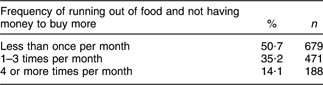
Table 1 shows the frequency of experiencing food insecurity among those people who reported food insecurity. While half reported experiencing food insecurity less than once a month during the previous year, for many other South Australians not having enough money for food was a more frequent occurrence.
Frequency of experiencing food insecurity, South Australia, 2002–7
Variables used in the bivariate logistic regression analysis, South Australian Monitoring and Surveillance System, 2002–7, all ages
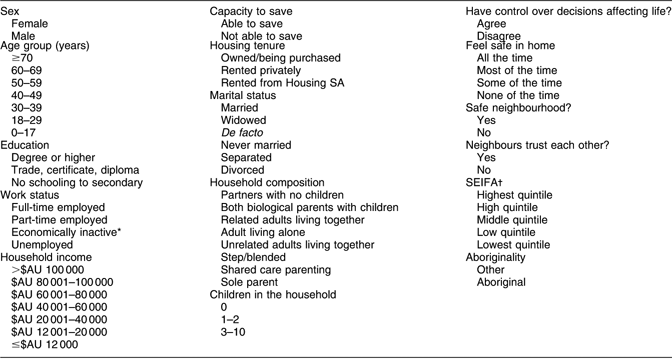
*Home duties, student, retired, unable to work.
†Socio-Economic Indexes for Areas.
Multivariate logistic regression analysis results, South Australian Monitoring and Surveillance System, 2002–7, all ages

ref, referent category.
Indicators of food insecurity
Bivariate logistic regression analysis was undertaken with all of the variables in Table 2 (with the food security variable as the dependent variable in all analyses), which were then all entered into a multiple logistic regression model. We do not provide specific details of each of the bivariate analyses since the multivariate analysis is more robust and useful in a policy context. However, we do provide an overview of the bivariate analyses in order to provide a potentially broader and richer picture for the reader.
Findings from the bivariate analyses revealed a statistically significant socio-economic gradient in the prevalence of food insecurity: those people with lower education, lower income, the unemployed and people living in households with limited capacity to save were more likely to be food-insecure, as were Aboriginal households, families with three or more children and people younger than 18 years of age. The strongest associations with food insecurity found in the bivariate analysis (odds ratio >5) included: young people (0–17 years old), the unemployed, lower household income (less than $AU 60 001), household inability to save, renting from Housing SA and never feeling safe at home.
Table 3 shows the final multiple logistic regression model, which accounted for 31 % of the variance (using the Nagelkerke test). The variables found to be the strongest predictors of food insecurity (odds ratio >5) were age less than 50 years, household income less than $AU 20 001 and household inability to save. Early adulthood (18–39 years) has a particularly high odds ratio (>10). Variables that were entered but excluded from the equation included: marital status; household composition; have control over decisions affecting life; feel safe in home; safe neighbourhood; neighbours trust each other; SEIFA (Socio-Economic Indexes for Areas); and Aboriginality.
Discussion
Prevalence of food insecurity
While SAMSS data are weighted prior to analysis, the food insecurity prevalence of 7·0 % in South Australia over the studied time period is likely to be an underestimate for a number of reasons. The most vulnerable older people(14) and people of lower socio-economic status, who are most likely to be food-insecure, have been found to participate less in surveys than those from higher socio-economic backgrounds(Reference Booth and Smith9, Reference King, Kavanagh, Jolley, Turrell and Crawford40, Reference Turrell, Patterson, Oldenburg, Gould and Roy41). Limited English language skills(Reference Turrell, Patterson, Oldenburg, Gould and Roy41) and homelessness(Reference Booth and Smith9), for example, preclude many people vulnerable to food insecurity from participating in telephone surveys. Moreover, telephone surveys in the USA have found lower prevalence rates of food insecurity than when the same questions were administered in face-to-face interviews(Reference Nord and Hopwood42). The telephone survey methodology used to collect the SAMSS data may similarly influence the food insecurity prevalence reported here. The question used to assess food security in the present research has also been shown to underestimate food insecurity. For example, when researchers compared the prevalence of food insecurity in disadvantaged areas in Sydney, derived from the single question commonly used in Australia, with a sixteen-item questionnaire used in USA(Reference Nolan, Rikard-Bell, Mohsin and Williams19), the American tool yielded a higher prevalence (21·9 %) than the single question (15·8 %). It also provided a more nuanced account of food insecurity in those communities, showing that 14 % were food-insecure without hunger, 6·1 % with moderate hunger and 1·8 % with severe hunger. As the single question used in the present study addresses only one dimension of food insecurity(14), it cannot reflect the duration or severity of food insecurity experienced.
While the research instrument used to assess food insecurity prevalence gives a limited understanding of food insecurity in South Australia, it provides an indicator of food insecurity levels comparable with equivalent Australian studies(Reference Marks, Rutishauser, Webb and Picton28). Higher levels of food insecurity have been found in other developed nations. The 1997 New Zealand national nutrition survey found that 14 % of people often or sometimes ran out of food in their household due to lack of money(Reference Parnell, Reid, Wilson, McKenzie and Russell43). The question asked in the New Zealand survey was similar, though not identical, to that asked in SAMSS. In the USA in 2006, it was found from a series of eighteen food security questions that 10·9 % of a nationally representative sample of households experienced food insecurity at least some time in the last year, with one-third of food-insecure households having very low food security(Reference Nord, Andrews and Carlson44).
Despite uncertainties about exact numbers of food-insecure people and the extent of food insecurity experienced, it is evident that too many South Australians have limited access to healthy food. In terms of actual numbers calculated from the State’s estimated population at December 2007(45), the number of South Australians likely to have experienced food insecurity in the previous year amounts to about 111 500 people using the 7 % average, but about 86 014 using the 5·4 % figure for 2007. It can thus be seen that a decrease in food insecurity prevalence of less than 2 % impacts on a substantial number of people. Such a reduction would be expected to have a positive impact on the health and quality of life of those people.
Social determinants of food insecurity
Although some of the factors significantly associated with food insecurity in the bivariate analysis did not reach significance in the multivariate analysis, many have been shown to be associated with increased vulnerability to food insecurity in Australia. These include: unemployment; being divorced; being a single parent; being Aboriginal; living in the quintile of postcodes with the highest index of relative social disadvantage; not feeling safe at home; living in a neighbourhood perceived as unsafe; and having limited control over one’s life(Reference Booth and Smith9, Reference Burns13, 14, Reference Marks, Rutishauser, Webb and Picton28).
The multivariate analysis presented several significant predictors of food insecurity, although a reduced number compared with the bivariate analyses due to the interaction effects between independent variables entered. Factors most strongly associated with food insecurity (odds ratio >5) include income less than $AU 20 001, lack of capacity of the household to save and age <50 years. However, the odds of having been food-insecure in the previous year were at least twice as high for all age groups <70 years of age, those households with incomes of less than $AU 60 001 and those renting government housing.
The associations between food insecurity and low income or limited capacity to save are obvious. Links between economic disadvantage and food insecurity are well documented(Reference Booth and Smith9, 14) although the associations are complex(Reference Burns13): not all disadvantaged people experience food insecurity and not all people who experience food insecurity are from low socio-economic backgrounds. If people do not have enough money, however, food selection is often compromised before housing and other essential expenses because food is often the sole discretionary item in household budgets for people with low incomes(Reference Booth and Smith9). Low household income has been found to be associated with food insecurity in other Australian studies(Reference Nolan, Rikard-Bell, Mohsin and Williams19, Reference Radimer, Allsopp, Harvey, Firman and Watson46) as well as international studies(Reference Kirkpatrick and Tarasuk11, Reference Parnell, Reid, Wilson, McKenzie and Russell43, Reference Dowler47, Reference Hadley, Zodhiates and Sellena48). Incapacity to save money has also been found to be significantly associated with food insecurity in Sydney households in disadvantaged neighbourhoods(Reference Nolan, Rikard-Bell, Mohsin and Williams19) and among older people(Reference Quine and Morrell49). Indeed, the odds of food insecurity were very similar for households in the present study and households in Sydney that reported they could not manage to save money(Reference Nolan, Rikard-Bell, Mohsin and Williams19). That housing tenure is associated with food security in the present study was to be expected from similar findings in other studies(Reference Douglas12, Reference Nolan, Rikard-Bell, Mohsin and Williams19, Reference Quine and Morrell49) and the fact that people are selected to rent government housing based on their economic circumstances.
Younger people in South Australia reported food insecurity more than did older people. This equates with findings from Sydney(Reference Nolan, Rikard-Bell, Mohsin and Williams19) as well as from the 1997 New Zealand nutrition survey which found a significant increasing linear trend of food security with age(Reference Parnell, Reid, Wilson, McKenzie and Russell43). This is of particular concern as adolescence is an important time for growth where food needs are higher during than other periods. A study of older Australians in New South Wales found that among people 65 years and older, only 2 % reported food insecurity in the previous year(Reference Quine and Morrell49). This finding is very similar to those herein.
The lack of a statistically significant association between food insecurity and unemployment in the multivatiate analysis may be caused by the employment category including those with insecure or low-paying employment, which can limit the capacity to purchase food of sufficiently good quality(Reference Burns13). As a result, low income and limited capacity to save proved to be more effective indicators of food insecurity than unemployment in the present study.
Conclusions
Food is a powerful marker of social inclusion or exclusion(Reference Wood, Swinburn and Burns50) and the extent of food insecurity in the community is indicative of inequality and poverty. The widening inequalities in Australia(Reference Saunders and Davidson21) provide cause for concern about food insecurity among the most socio-economically disadvantaged. It is clear that many people in South Australia face the problem of not being able to access adequate food at some time in their lives and that the burden of food insecurity falls disproportionately on lower socio-economic groups and younger people. Rose delineates the importance of looking at recent economic changes when trying to understand food insecurity(Reference Rose51). With the rapidly increasing costs across a spectrum of competing household needs experienced in Australia in 2008, and the resultant stress on household budgets(1), it is probable that the downward trend in food security prevalence indicated by the SAMSS data may not continue. Disadvantaged sectors of society are likely to experience the greatest hardship.
Food insecurity has its roots in systemic structural inequalities and has a high cost to individuals, families and society(Reference Booth and Smith9). As food insecurity is associated with poor health, and in particular obesity and chronic disease(Reference Robertson, Tirado, Lobstein, Jermini, Knai, Jensen, Ferro-Luzzi and James52) which take a high toll on the health of Australians and also on health expenditure, it is imperative that policies and programmes be developed to improve food security in the population. Comprehensive action is needed to address the complex issues causing food insecurity(Reference Booth and Smith9). Importantly, political will to facilitate an equitable food system and access to food is needed. While typical food security support focuses on individuals (e.g. emergency food handouts), it would be more effective to address food insecurity at its systemic roots, as recommended by the Commission on Social Determinants of Health(32, 53). Indeed, the final report of the Commission(32) cites the lack of access to healthy food as a social determinant of health, recommending the establishment of ‘food security policies’ and government regulation to ‘encourage healthy eating through retail planning to manage the availability of and access to food’ (p. 66). In addition, the fact that many of the predictor variables in our analyses are likely to ‘cluster’ in particular geographical localities makes it even more important to target interventions based on place, rather than just individual risk. Analyses such as ours could be extended in order to produce a ‘social atlas of food security’ which would allow such targeting to take place.
Given these factors, it is important to continue to monitor food insecurity in South Australia. Further, to appropriately address food insecurity, it is important to develop a more nuanced understanding of food insecurity, as Booth and Smith indicated in 2001 when they argued for more information on the degree of food insecurity in the population than can be obtained with the single question used in the present study(Reference Booth and Smith9). Further qualitative and quantitative research is required to really understand and therefore better address food insecurity experienced in South Australia.
Acknowledgements
This research was funded by SA Health under the Strategic Health Research Priorities programme. The authors declare that they have no conflict of interest regarding the study. W.F. contributed to data analysis and writing; P.W. contributed to conception and design of the study, analysis advice and writing; P.C. contributed to writing; J.C. contributed to conception and design of the study and writing; G.T. contributed to analysis advice and writing; A.T. contributed to analysis advice and writing. Data were analysed at the Population Research and Outcome Studies (PROS) Unit, SA Health. Thanks to staff at the PROS Unit for assistance with data analysis, particularly Jodie Avery and Tiffany Gill.



