




1. Introduction
Sound symbolism, as a series of ‘systematic associations between sounds and meanings’ (Kawahara Reference Kawahara2020: 2), encompasses a multiplicity of phenomena ranging from the imitative to the shape-representational to the emotionally evocative. These have a basis in iconicity, that is, in ‘the resemblance-based mapping between aspects of form and meaning’ (Dingemanse et al. Reference Dingemanse, Blasi, Lupyan, Christiansen and Monaghan2015: 604). However, the degree of integration of these iconic elements of speech into the grammatical system varies widely. Indeed, in some languages, sound symbolism is limited to a subset of explicitly imitative or onomatopoetic words or to a skew in the lexical frequency of certain sounds in lexical categories. In other languages, however, sound symbolism may be more deeply integrated into the grammar, being a prominent part of the evaluative morphology (e.g. iconic diminutives and augmentatives in Fungwa, cf. Akinbo Reference Akinbo2021) or constituting larger word categories (e.g. West-African ideophones, cf. Dingemanse Reference Dingemanse and van Lier2023). The nature of these interfaces between iconicity and grammar is, furthermore, of some importance to linguistic theory, as it straddles the fundamental question of limitations on arbitrariness in linguistic forms. It is also an interesting question for historical (and evolutionary) linguists, as it suggests a diachronic pathway from purely iconic sounds into abstract units integrated into grammatical systems (Cuskley & Kirby Reference Cuskley, Kirby, Simner and Hubbard2013).
Here our focus is on Mapudungun (arn, isolate, Chile/Argentina) a language reported to have consonantal alternations that are driven by ‘affective’ or ‘stylistic’ factors, which seem to belie sound-symbolic origins. The most explicit account of the phenomenon relates to alternations among coronal consonants, as described by linguist and native Mapudungun speaker María Catrileo (Reference Catrileo1986, Reference Catrileo2010, Reference Catrileo2022). According to this work, ‘the expression of affective values in Mapudungun takes place via sound alternations, while in other languages, like Spanish, they are predominantly effected through morpho-syntactic resources’ (1986: 12).Footnote 1
In Catrileo’s work (and elsewhere, see Sections 2 and 3), we find that, where a coronal consonant shows an alternant that is palatal, this has a diminutive meaning, most often with a positive or endearing connotation, as in (1a, b). This link between palatals (or high vowels) and diminution/positive affect is well attested cross-linguistically (Sapir Reference Sapir1915, Reference Sapir1929; Nichols Reference Nichols1971; Alderete & Kochetov Reference Alderete and Kochetov2017) and tends to be linked to sound symbolic processes (in particular to Ohala’s [Reference Ohala1984, Reference Ohala1994] so-called ‘Frequency Code’; see Section 5). More typologically unexpected is the opposite trend, where Mapudungun coronal consonants may be dentalised, such that the dental alternant gains an augmentative meaning, which most often carries with it a rude or pejorative connotation, as in (1c, d).Footnote 2

In this paper, I examine the pattern of ‘affective alternations’ found in contemporary Mapudungun as well as its attestation in the 400-year textual record for the language. Throughout, I survey metalinguistic commentary as well as corpus data (see Section 3, for details), taking a ‘shared reading’ approach.Footnote 3 This entails the examination of key material in collaboration with Central Mapudungun speaker and traditional educator (Kimelfe) Fresia Loncon Antileo, who has provided guidance and intuitions throughout. On this basis, I go on to propose a diachronic trajectory for the phenomenon, arguing that the evidence points to the longstanding productivity of the alternations, alongside a pattern of occasional lexicalisation and morphologisation into the present-day language. I further consider the theoretical status of the alternations both in terms of featural geometry and morphological representations. I suggest that the alternation is best characterised as the result of floating evaluative morphemes (cf. Akinbo Reference Akinbo2021, among others) that share the active feature [distributed] and are internally distinguished by the feature [anterior], highlighting their positive or negative polarity. I argue that while the diminutive/affective forms show a clear sound-symbolic pattern (in line with the ‘Frequency Code’), the augmentative/pejorative can only be said to do so in a narrow, highly phonologically and morphologically entrenched sense.
2. Mapudungun ‘stylistic/expressive’ consonant alternations
Mapudungun has a long descriptive tradition highlighting apparently ‘unconditioned’ phonological alternations (see Section 3 for details). Indeed, a number of researchers (Key Reference Key1976, Reference Key and Mahmoudian1979; Key & Clairis Reference Key and Clairis1976; Martinet Reference Martinet1983, Clairis Reference Clairis1991; Salas Reference Salas1992; Zúñiga Reference Zúñiga2006) characterise this as ‘phoneme fluctuation’, that is ‘the possibility of freely alternating two or more phonemes within the same unit of meaning, under the same circumstances, though only in certain lexical items’ (Clairis Reference Clairis1991: 19).Footnote 4 Nevertheless, at least for a subset of the alluded alternations – the coronal consonants – there is now wider consensus that these convey an ‘affective value’ (Salas Reference Salas1992; Zúñiga Reference Zúñiga2006; Hernández, Ramos & Huenchulaf Reference Hernández, Ramos and Huenchulaf2006; Cañumil Reference Cañumil2011), directly contradicting the idea that they are context-independent. Indeed, we will argue that these alternations are semantically and pragmatically governed and may even be modelled as morphological processes (see Section 6.2).
In this subsection, we provide some background on the language and its speakers (Section 2.1) and then move on to survey the system of coronal consonants in the language (Section 2.2). This done, we provide a meta-analysis of the literature on the present-day patterns of dentalisation and palatalisation which are claimed to trigger Mapudungun speakers’ ‘affective’ readings of words and utterances (Section 2.3).
2.1. The language and its speakers
Mapudungun (arn, mapu1245) is the endangered, heritage language of the Mapuche people, with their traditional homeland in the Southern Cone; what is today south-central Chile and Argentina. At the time of first contact with the Spanish Empire (1536), an estimated 1 million people would have spoken the language, mostly to the west of the Andes (Bengoa Reference Bengoa2000: 14). Today, optimistic estimates place the number of speakers at around 200,000 (Zúñiga & Olate Reference Zúñiga, Olate, Aninat, Figueroa and González2017) in Chile and 8,400 in Argentina (INEC 2005), with varying degrees of competence. Transmission, furthermore, is in steep decline (Gundermann et al. Reference Gundermann, Canihuan, Clavería and Faúndez2011) with only weak support available through formal education (Loncon Reference Aninat, Figueroa and González2017).
While database sources like Ethnologue (Eberhard, Simons & Fennig Reference Eberhard, Simons and Fennig2024) and Glottolog (Hammarström et al. Reference Hammarström, Forkel, Haspelmath and Bank2024) tend to treat Mapudungun as part of a small language family (‘Mapudungu’ and ‘Araucanian’, respectively), most specialists regard the language as an isolate (cf. Adelaar & Pache Reference Adelaar, Pache, Chacon, Lee and Silva2023). The proposed sister language for Mapudugnun, Huilliche, may be better conceived of as a moribund dialect, with most differences resulting from advanced attrition (Sadowsky et al. Reference Sadowsky, Aninao, Cayunao, Heggarty, Garay and Regúnaga2015). For the region, the language is well documented, with sources beginning in the colonial period and a number of recent grammars and specialist papers available on various aspects of its linguistic structure. In such works, the language may also be termed Mapuche, Chedungun, or Araucanian, the latter now a rejected exonym.
2.2. Coronal consonants in Mapudungun
The consonantal inventory of Mapudungun displays a wide range of place contrasts among coronals. In Table 1, we see the repertoire for one of the more vital varieties: the Lafkenche dialect of Central Mapudungun.Footnote 5
Central Mapudungun consonant inventory, based on Sadowsky et al. (Reference Sadowsky, Painequeo, Salamanca and Avelino2013)

It is worth noting that the typologically uncommon dental-alveolar contrast of MapudungunFootnote 6 is well established in vital dialects today and in the historical record (Molineaux Reference Molineaux2022). Alveolar and dental places of articulation also have different gestures associated to the active articulator, with the former being apical and the latter, laminal, such that these are often characterised as inter -dental. The contrast can be instantiated, furthermore, in a small number of minimal and near-minimal pairs, as seen in Table 2.Footnote 7
(Near-)minimal dental-alveolar pairs (from Painequeo, Salamanca & Jiménez Reference Painequeo, Salamanca and Jiménez2018 and Augusta Reference Augusta1916)

Overall, the place contrasts among Mapudungun coronals are fairly symmetrical (or ‘economic’ in the sense of Clements Reference Clements2003), with matching manners of articulation for most places. The main exception are retroflexes, where nasal and lateral phones show up only as allophones assimilating to other retroflex consonants (Echeverría Reference Echeverría1964, but see Sadowsky et al. Reference Sadowsky, Painequeo, Salamanca and Avelino2013). Among fricatives, /s/ is a fairly rare. A recent newcomer to the language, it appears mostly in borrowings from Spanish and Quechuan (see Molineaux Reference Molineaux2022 for an overview), often in alternation with /θ/, /ʐ/, /tʃ/ or /ʃ/, as exemplified in (2).

The phonemic status of [ʃ] is also somewhat problematic, since it tends to appear either in place of borrowed /s/ or as a variant of /θ/ or /ʐ/, with a positive affect associated to it. Given that in a number of words speakers perceive /ʃ/ as underived, despite likely having a non- /ʃ/ etymon (see Table 3), we consider it to be part of the phonemic inventory.Footnote 8
Likely etymological sources for lexicalised /ʃ/ words

2.3. Coronal alternations in Mapudungun
Catrileo’s (1986, 2010) key insight regarding ‘stylistic’ variation in Mapudungun is that, by replacing one segment with another, speakers make direct links between their language and the extralinguistic context. These kinds of shifts disrupt expectations, producing clear pragmatic effects: ‘a position of linguistic politeness can be marked as emotional, contemptuous or sarcastic when it is pronounced in a manner that differs from the usually accepted patterns for the occasion’ (2010: 51). Key examples for her Central Mapudungun dialect are provided in Table 4, focusing on words with ‘neutral’ alveolar and retroflex consonants.Footnote 9 Throughout this subsection, our account provides a meta-analysis of Catrileo and other scholars’ published claims and examples, which were checked with our consultant for insights and grammatical intuitions.
Affective alternations in Catrileo (Reference Catrileo1986, Reference Catrileo2010): alveolars and retroflexes

The overall pattern, schematised in Table 5, can be summarised as one where, when alveolars and retroflexes are palatalised, they express tenderness, small size, pleasure, or politeness. The same segments, when dentalised, express rudeness, indifference, sarcasm, or distaste. The process seems to target words from left to right, with initial coronals being consistently affected (cf. [ʈ͡ʂewa] $ \to $
[t͡ʃewa]) and later coronals being more variable (cf. [tunten]
$ \to $
[t͡ʃewa]) and later coronals being more variable (cf. [tunten] $ \to $
[t͡ʃuɲt͡ʃeɲ] ~ [t͡ʃunten]). In the absence of an initial coronal, a later coronal in the root morpheme tends to undergo the affective process (cf. [mɨʐke]
$ \to $
[t͡ʃuɲt͡ʃeɲ] ~ [t͡ʃunten]). In the absence of an initial coronal, a later coronal in the root morpheme tends to undergo the affective process (cf. [mɨʐke] $ \to $
[mɨʃke]; see Section 6 for details).
$ \to $
[mɨʃke]; see Section 6 for details).
Affective alternations based on neutral alveolar and retroflex consonants

Catrileo (Reference Catrileo1986, Reference Catrileo2010) describes the palatalised forms as typical of children or child-directed speech as well as showing up in the speech of the elderly and in elderly-directed speech. This is a well-recognised semantic pattern for diminutives (Dressler & Merlini Barbaresi Reference Dressler and Barbaresi1994, Jurafsky Reference Jurafsky1996, Ponsonnet Reference Ponsonnet2018b). The same pattern, however, does not hold for dentalisation, which does not index any age group. Of particular interest are more extreme forms of the palatalised fricative, which result in the approximant [j], a feature found predominantly in child or child-directed speech. Examples are [jamtun] for ‘wee/nice question’ or [mɨjke] for ‘yummy toasted flour’.
In parallel to the association with child language, the palatalised forms are also frequently linked to referents of a smaller relative size, in what may be termed an iconic or synaesthetic relationship (see Hinton, Nichols & Ohala Reference Hinton, Nichols and Ohala1994: 2, Section 5). The same does not seem to hold for the dentalisation pattern, which is not explicitly linked to large referents, despite this often being a feature of markers of pejoration or negative affect (see Sapir Reference Sapir1911, Silverstein Reference Silverstein, Hinton, Nichols and Ohala1994: 45–46, but see also Ponsonnet Reference Ponsonnet2018b, Section 4).
While Catrileo (Reference Catrileo1986, Reference Catrileo2010) reports that these stylistic alternations are productive in Central Mapudungun dialects and, to an extent, in the Mountain dialects (Pewenche), there are a number of alternants of individual lexical sets which, though identifiable phonologically are less semantically transparent. A few cases of these can be found in (3), as elicited from our consultant, Fresia Loncon.Footnote 10

In other items, no alternation is evident, yet the target root has either a dental with negative connotations or a palatal with positive/diminutive connotations. These are evidenced in Table 6, and, as argued in Section 6.3, likely represent instances of the lexicalisation of erstwhile affective alternations. There are, however, a substantial number of roots that have dentals or palatals without having any obvious affective connotations, past or present, as shown in Table 7.
Non-alternating, affective items

Non–affect-bearing items containing roots with dental and palatal consonants

Crucially, words that have dental or palatal consonants as their base form are also potential targets for the kinds of affective processes described by Catrileo (Reference Catrileo1986, Reference Catrileo2010). On the one hand, palatals can be dentalised and dentals can be palatalised, producing the expected affective outcomes (negative and positive connotations, respectively), as evidenced in Table 8.
Affective palatalisation of dentals and dentalisation of palatals in Catrileo (Reference Catrileo1986, Reference Catrileo2010)

The case of pejorative dentalisation for underlying dentals and positive/diminutive palatalisation for underlying palatals is less straightforward, since the phonological correlate of the semantic/pragmatic shift coincides with the neutral form. For some speakers, the result may be seen as a ‘double making’ of place features (see Table 9). Indeed, Catrileo (Reference Catrileo2010) claims that the pejorative or negative affect form surfaces with an ‘emphatic dental’. Interestingly, this claim is absent from Catrileo (Reference Catrileo1986) and is not reported elsewhere. A more deliberate, hyperarticulated form of the affective form, however, does not seem altogether unlikely, and our consultant, Fresia Loncon Antileo, was able to produce these, which, anecdotally, have a longer closure and greater apical protrusion (marked as ‘half long’ [ˑ] in Table 9).Footnote 11 In the case of palatals, positive affect seems to also rely on a more emphatic form in the affricates. Here, Catrileo (Reference Catrileo1986, Reference Catrileo2010, Reference Catrileo2022) reports that the affricate becomes a full post-alveolar stop (International Phonetic Alphabet [IPA] [c̟], but [t·] in her transcription). The nasal and the lateral are, surprisingly, reported to become alveolar, i.e. [n] and [l] in Catrileo (Reference Catrileo2010) but not in Catrileo (Reference Catrileo1986). For the palatal fricative, no data are provided, probably due to the rarity of this sound outside of the context of affective palatalisation. Again, our consultant was able to produce the alternating palatal forms but considered both cases to be unnatural, which ultimately argues for these alternations being less regular than those where an actual change in place features is predicted. The patterns of affective alternations in palatals and dentals are summarised in Table 10.
‘Emphatic’ affect in dentals and palatals according to Catrileo (Reference Catrileo2010)

Affective alternations based on neutral palatal and dental consonants

Where no coronals are available to undergo these affective processes, speakers use lexical resources to similar ends. In the case of diminution or positive affect the adjective [pit ͡ ʃi] is quite frequent, allowing, according to our consultant, for a sarcastic interpretation when dentalised, as in [pit̪i waka] ‘pesky little cow’. For negative affect, forms of the adjective [weθa] ‘bad’ are often used, as in [weθa paŋi] ‘bad mountain lion’ or attenuated to [weʃa jeku] ‘naughty/silly crow’.Footnote 12
While the most detailed description of these ‘stylistic’ shifts is given in Catrileo’s work, contemporary linguistic descriptions tend to acknowledge the existence of affective changes, with greater or lesser degree of exemplification (cf. Suárez Reference Suárez1959, Erize Reference Erize1960, Moesbach Reference Moesbach1962, Croese Reference Croese1980, Salas Reference Salas1992, Zúñiga Reference Zúñiga2006, Hernández et al. Reference Hernández, Ramos and Huenchulaf2006, Cañumil Reference Cañumil2011). Generally, the palatalising changes are more conspicuous and are the subject of explicit discussion. Dentalisations are often overlooked, which may be the result of their misperception by non-native researchers or the general attrition of the contrasts in some dialects (see Molineaux Reference Molineaux2022). A case of this particular scenario is Smeets’ (Reference Smeets2008: 30–35) grammar, where her main consultant Luis Quinchavil – a Central Mapudungun speaker – was able to recognise all dental-alveolar distinctions but only produced them consistently for fricatives. As a result, Smeets gives extensive exemplification of palatalisation alternations and of dentalisation only in the fricatives, claiming that the obstruents, nasals, and laterals do not show a clear dental-alveolar opposition.
For speakers in the Argentinian province of Chubut, Díaz-Fernández (Reference Díaz-Fernández, Fernández-Garay and Malvestitti2007) observes a similar though more restrictive pattern of alternations than those proposed by Catrileo (Reference Catrileo1986, Reference Catrileo2010). While the palatalisation patterns are almost identical, the dentalisation was observed only for oral obstruents (/ʈ͡ʂ/ →/t̪/ and /ʐ/ →/ð/). Interestingly, here the palatalisation process is claimed to have been expanded beyond coronals to labio-dental /f/, at least in one item ([kofke] ‘bread’ vs. [koʃke] ‘lovely/little bread’) and to velar /ŋ/ in another item ([fanteŋ(e)i] ‘it’s this size’ vs. [fanteɲi] ‘it’s this wee size’).Footnote 13 Díaz-Fernández does comment, however, on the difficulties of eliciting these forms as a non-native researcher, especially considering that she takes these to be ‘weak and unstable structures, such that there are closely related and rather mobile synchronic strata in which diachronic residues and innovative tendencies compete’ (2007: 6).Footnote 14 Given this picture of variation in the contemporary dialects, we turn to the diachronic evidence in order to help elucidate the existing patterns.
3. Reconstructing consonant alternations in the historical record
Following Villena (Reference Villena2017), the textual record for Mapudungun can be split into four major periods, as in Figure 1. In the upcoming subsections, we examine the data for the missionary and ethnographic periods, since the pre-textual data are mostly onomastic and too sparse, and we have already examined much of what would fall under the institutional period. The data in what follows are gathered through searches both in the published, tagged version of the Corpus of Historical Mapudungun (Molineaux & Karaiskos Reference Molineaux and Karaiskos2021) and in the untagged texts available through its source page (Molineaux Reference Molineaux2024; see also Molineaux Reference Molineaux2023).
Mapudungun textual production periods according to Villena Reference Villena2017.

3.1. Coronal alternations in the missionary period
3.1.1. The turn of the seventeenth century (Valdivia Reference Valdivia1606 , Reference Valdivia1621)
The earliest surviving Mapudungun materials are the work of a Spanish Jesuit, Father Luys de Valdivia (1560–1642). His grammar (1606) – based mostly on Northern Mapudungun sources – describes a recognisable coronal inventory (see Table 11).
Consonant inventory for late–sixteenth-century Northern Mapudungun, based on Valdivia (Reference Valdivia1606)

Compared to the present day (see Table 1), the main difference with Valdivia’s inventory are (a) the voicing of fricatives, (b) the apparent absence of the /s/ and /ʃ/ phonemes, and (c) the lack of discernible contrast between dental and alveolar stops.Footnote 15 Difference (a) is expected, since to this day, the voicing of fricatives remains a major isogloss separating northern and mountain dialects from Central Mapudungun (Croese Reference Croese1980, Molineaux Reference Molineaux2022). Regarding (b), the /s/ and /ʃ/ phonemes are still evidently incipient. In both Valdivia’s grammar and sermons (Reference Valdivia1621), all <s> forms we find are transparently of Quechuan (e.g. suysuy ‘collinder’; misky ‘honey/sweet’)Footnote 16 or Spanish (e.g. ispada ‘sword’; Dios ‘God’) origin. As for /ʃ/, or its voiced counterpart, /ʒ/, there is no straightforward spelling to represent it, based on sixteenth-century Spanish (or Latin). There are a couple of instances of <z>, however, that may represent the relevant sound in words of Quechuan origin, such as <pozco> ‘yeast’ and <mizky> ‘honey’.Footnote 17 Interestingly, however, in items where we would expect affective palatalisation of /ʐ/ or /ð/, we find spellings with <y>, particularly for the interjection <cuye> or <cuy>, used as an exhortation by women towards other women. We assume this is a palatalised form of /kuʐe/ ‘wife’,Footnote 18 probably representing the gliding form /j/.
Regarding the stops (difference c), it is worth saying that a distinction between the Mapudungun alveolar and the dental was not observed until the late nineteenth century. This selective ‘deafness’ was likely the result of the overlapping properties of the two Mapuche stops vis-à-vis the Spanish one. Indeed, already at the turn of the seventeenth century, coronal stops in Spanish were probably (post)dentals (Penny Reference Penny2002: Section 2), thus sharing the dentality of the Mapudungun (inter)dental stops and the apicality of the Mapudungun alveolars. To this we add the fact that minimal pairs are rare, and the dental phoneme has a very low lexical incidence overall today (see Molineaux Reference Molineaux2022: 663). The result is that the distinction probably fell under the radar for grammarians. I believe this scenario is far more likely than that of a later split between dental and alveolar stops, given the lack of a unifying environment for such a change.
While Valdivia (Reference Valdivia1606) provides no metalinguistic commentary on coronal alternations, we do note that there is a strong tendency for the use of explicitly palatal spellings (<ñ, ch, ll> for /ɲ, t͡ʃ, ʎ/), in words with inherently positive connotations or which show affective alternation today, and explicitly dental spellings (<d, n’, ld/l’> for /ð, n̪, l̪/) for words with negative connotations or affective alternations today, as can be seen in Table 12.Footnote 19 In particular for the dental nasals and laterals, the spelling evidence shows inconsistency, very often lacking the diacritic or diagraphic marking that distinguishes them from the corresponding alveolar.Footnote 20
Sample items with dental and palatal consonants in Valdivia (Reference Valdivia1606, Reference Valdivia1621)

It is also worth noting a few scattered instances of alternations found by contrasting forms across Valdivia’s grammar and sermons, as in Table 13. These appear to match the expected pattern, despite no explicit treatment in the text and variably transparent semantics.
Sample items with dental and palatal variants in Valdivia (Reference Valdivia1606, Reference Valdivia1621)

Despite the sparsity of the data, it seems that there is good reason to believe that a form of the affectively governed alternations was already present in the earliest records for Mapudungun. Particularly instructive is the alternation of the words for ‘bad’ (Table 13g). Valdiva’s vocabulary (appended to his grammar) lists the word as <huera>, and this is the form that shows up 69 times in the sermons. The alternative, dental form <hueda-> shows up only in two negative forms in the same text (<huedalay> ‘they are not bad’ and <huedalayay> ‘they will not be bad’). Crucially, the inherent root semantics of the item has very obvious negative connotations, so the forms with <d> appear to double mark this negativity. The long-term result, we propose, is that the repeated emphatic marking of negativity of the form led to greater and greater proportions of dentals being used, ultimately replacing the original neutral form. Indeed, today speakers no longer use /weʐa/, but /weθa/ (see Sadowsky et al. Reference Sadowsky, Aninao and Heggarty2019), and even /weʃa/, meaning ‘naughty, mischievous’. Similar cases where we find evidence for a historically neutral consonant replaced today by an ‘affected’ one can be found in Table 14, which we suggest are the lexicalisation of the affect-marked items.Footnote 21
‘Neutral’ consonants in Valdivia (Reference Valdivia1606, Reference Valdivia1621) vs. present-day ‘affected’ consonants

Beyond this pattern of lexicalisation of affective forms, this earliest stage does not seem to suggest a situation that differs radically from what we find in the present-day data. Indeed, palatals and dentals appear to be used in affectively neutral contexts as well,Footnote 22 such as those in Table 15, just as they are today (see Table 7).
Affect-neutral dentals and palatals in Valdivia (Reference Valdivia1606, Reference Valdivia1621) and their twentieth-century reflexes (Augusta Reference Augusta1916)

3.1.2. The eighteenth century (Febrés Reference Febrés1765, Havestadt Reference Havestadt1777)
Two grammars of Mapudungun, with a variety of accompanying texts, were published by Jesuit priests in the eighteenth century. The first, penned in Spanish by Andrés Febrés (1734–1790), a Catalan, is explicit in its metalinguistic commentary on coronal alternations:
the Indians [sic] tend to turn some letters into others… the t [t] and the th [ʈ] into ch [t͡ʃ] primarily to speak lovingly, vochùm, in place of votùm – the son… the n [n] into ñ [ɲ] quite often, as is the case of the l [l] into ll [ʎ], e.g. ñagh, for nagh – below: llamgen for lamgen – the sister: the r [ʐ] into d [ð] and further into the ja, jo, ju of Catalan or gia of Italian or ge, gi of French [ʒ], to speak affectedly, which sounds a bit like s, as in duca, juca, for ruca – the house: cujam, for curam – egg (1765: 6, IPA characters inserted).Footnote 23
The second grammarian was Bernard Havestad (1714–1781), a Westphalian, who produced his description in Latin. Similar to Febrés, he claims a range of affective and stylistic effects of consonant alternations:
The Chilean Tongue takes license to replace one letter for another, to create diminutives, express love, affect and tenderness, because they care about the elegance of words, the veneration of speech and the fame of eloquence, or even at the discretion and choice of each. Therefore the following are synonymous… cal [kal], call [kaʎ]; wool: lamûen [lamɰen], llamûen [ʎamɰen]; sister: Chili [t͡ʃili], Chilli [t͡ʃriʎi]; Chile: colù [kolɨ], collù [koʎɨ]; bright red; moGeli [moŋeli], moGelli [moŋeʎi]; if I live: ruca [ʐuka], duca [ðuka], suca [ʒuka]; house: huera [weʐa], hueda [weða], huesa [weʒa]; bad: carù [kaʐɨ], cadù [kaðɨ], casù [kaʒɨ]; green, raw: anùn [anɨn], añun [aɲɨn]; I sit: ùñm [ɨɲm], ùnm [ɨnm]; bird (1777: 8).Footnote 24
The majority of the alternations described by Febrés and Havestadt regard palatalisation and positive affect or diminution. This is particularly explicit in Havestadt, who claims letters are often replaced by others that are ‘more gentle, soft, tender’ (1777: 135) in order to create diminutives as in <fochum> for <fotum> ‘sonny’; <quisulen> for <quidule> ‘I am alone’; <siu> for <riu> ‘goldfinch’,Footnote 25 very much implying a sound-symbolic association.
Febrés also exemplifies the use of palatalisation as a mitigation strategy, in the transcript of a conversation between two Mapuche chiefs, one is made to say ‘I don’t come here to tell you (little) lies’, where ‘lies’ shows up as <coylla> [kojʎa] (4) instead of present-day [kojl̪a]. The palatalisation, we claim, represents a politeness and mitigation strategy that our present-day consultant recognised as being very productive in her own speech and which is also a cross-linguistically common trait of diminutives (cf. Ponsonnet Reference Ponsonnet2018b for a recent survey).

Only among the fricatives are the dentals represented explicitly by Febrés and Havestadt, always using the grapheme <d>. Indeed, Havestadt mentions that speakers ‘freely’ say <pran>, <psan>, <pdan>, and <pxan> for ‘descend’ (1777: 103).Footnote 27 However, the affective undertones become clear in Havestadt’s word lists, where we are told ‘it displeases older women to be called cude [kuðe]’, while ‘it pleases them to be called cuse [kuʒe]’(635).
As regards other manner segments, Febrés does mention the existence of words where <n> and <l> are pronounced by ‘bringing the tip of the tongue onto the teeth’. However, he concludes that it is not worth transcribing this distinction since ‘they use it in very few words, and their difference in sound is almost imperceptible without listening with particular care’ (1765: 5).Footnote 28
The spelling evidence across both works, however, suggests some use of <ld> in places where we expect the dental lateral, such as <pùldù> for ‘fly (insect)’ and <aldù> for ‘too much’, matching /pɨl̪ɨ/ and /al̪ɨ/ in present dialects. We further find cases of apparent ‘deprecative’ dentalisation using the <ld> digraphs in Febrés’ transcriptions. For instance, <pelde> appears alongside <pele> for ‘mud’ (today /pel̪e/), and <maldùtuuymi> meaning ‘touch yourself’ is used in the Mapudungun Confessionary he includes in the work, implying a moral reproach in that context. No orthographic evidence is recoverable for the dental nasal (or, indeed for stops, which we assume were not described rather than not being present, as argued in Section 3.1.1).
In short, then, the missionary periodFootnote 29 shows some evidence for the ‘stylistic’ alternations of the kind described for present day forms of the language, but the nature of the orthographic systems as well as the narrow focus of the corpus materials makes it difficult to find clearer instances, particularly of the dental-pejoration cases. Furthermore, there is evidence for the lexicalisation of palatalised and dentalised forms in words with inherently diminutive/positive or deprecative semantics.
3.2. Coronal alternations in the ethnographic period (1895–1981)
Influenced by the study of folk traditions in Europe and the emerging field of dialectology, from the late nineteenth century onward, the documentation of Mapudungun took on a more academic approach (see Malvestitti Reference Malvestitti2012: 20–24, Pozo Reference Pozo, Mora and Samaniego2018). Work in the field attempted to represent traditional culture and language and as such gathered a more varied and nuanced corpus. In many of these cases, we know the names of the individuals who provided the exemplars as well as a number of facts about their biographical, cultural, and linguistic background. Advances in linguistic training also allowed for greater precision in the transcription of materials, which were recorded as articulated by speakers rather than as instruments of Christian doctrine. These new materials allow us a closer look at the relationship between affect and pronunciation.
3.2.1. Ethnographic materials in Ngulumapu (western Mapuche territories)
The work of German-born linguist Rudolf Lenz (1863–1938), primarily in his Estudios Araucanos (1895–1897), set the stage for the ethnographic approach to Mapudungun. Having obtained his doctorate in Bonn in 1886, Lenz was trained in the latest phonetic transcription innovations and applied these to eliciting traditional texts from native speakers in an array of locations of the Chilean territories. Despite this, he only came to identify the full range of dentals after his main consultant, a Pewenche (Mountain Mapuche) man called Kallfün, explicitly helped him notice it. ‘Calvún, docile as ever, finally lifted his head at each fen⋅t⋅e [fen̪t̪e], mət⋅e [mət̪e], etc. in order to show me the tip of the tongue peaking between his teeth; he clearly distinguished by ear whether I repeated n⋅ [n̪] or n [n], etc.’ (1897: 130).Footnote 30
Lenz, furthermore, acknowledges the use of consonantal alternations in ‘the language of affect’ and ‘to vary a bit the meaning’ in words such as <wed⋅a–wesa–wera> ([weða–wesa–weʐa]) ‘bad’ and <kure–kuye–kuzhe–kude> ([kuʐe–kuje–kuʒe–kuðe]) ‘wife/old woman’ (131). However, he also states that his published materials are insufficient for the purposes of a full study of the matter, since he has ‘not paid sufficient attention to the matter and perhaps involuntarily made uniform in the transcription what in the mouth of the Mapuche was intentionally distinct’ (Lenz Reference Lenz1897: 130).Footnote 31
Despite these caveats, we see a certain amount of consistency in the use of both palatal and dental forms, given the respective positive and negative connotations of the words they appear in. A sample of such words is given in Tables 16 and 17.Footnote 32
Sample items with dental consonants in Lenz (Reference Lenz1897)

Sample items with palatal consonants in Lenz (Reference Lenz1897)

Similar to Lenz, the Bavarian Franciscan priest Félix de Augusta (1860–1935) only comes to incorporate dental stops in his 1910 Lecturas Araucanas, at the behest of Domingo Wenuñamko, one of his Mapuche collaborators. Despite acknowledging the relevant palatal and dental alternations, Augusta provides no systematic analysis of their context in his trilogy of works on Mapudungun (Reference Augusta1903, Reference Augusta1910, Reference Augusta1916). The main exception to this is the claim, in the second edition of his Lecturas (Reference Augusta1934: 202) that the replacement of <r> by <d> ([ʐ] by [θ]) in the evidential suffix [-ʐke] (see Section 4.2) is a sign of anger, as in <wentrudkelle> ‘it is indeed a man (regretably)’ or <ŋekatudkellelai> ‘it is not this again (regretably)’. An opposite, pleasurable connotation is said to be attached to <shomoshkelle> ‘it is indeed a woman (fortunately)’, where both the initial /θ/ and suffixal /ʐ/ of /θomoʐkeʎe/ ‘it is indeed a woman’ are palatalised.Footnote 33
The work of the first published Mapuche ethnographer, Manuel Manquilef (Reference Manquilef1911, Reference Manquilef1914), brings together extremely authentic materials. However, his orthography is somewhat standardised, insofar as the allophonic variation is stripped away, lacking the explicitness of the non-native observer. This probably results from a standard language ideology modelled on Spanish. Hence, we see that the word for ‘bad’ is always <weda> and not <wera>, as in earlier sources. We also see a clear division between <fücha> meaning ‘old’ and <füta> meaning ‘big’, possibly a partially lexicalised politeness or deference strategy relating to old age. While no immediately identifiable dentalisations can be found in Manquilef’s work, we do find cases of palatalisation, as in the case of <zakiñ> [ʃakiɲ] glossed as ‘love’ or ‘enjoyment’ for what is elsewhere [ʐakiɲ] ‘thought’.
The most emblematic of the ethnographic texts is likely the autobiography of Longko (Chief) Paskual Koña (late 1840s–1927), transcribed by Wilhelm de Moesbach (1930), another Bavarian Franciscan. Although somewhat standardised in its spelling practices, we do see evidence for inherently affect-laden words having dentals and palatals, such as <l $ \cdot $
an> [l
̪an] ‘death’, <mën
$ \cdot $
an> [l
̪an] ‘death’, <mën $ \cdot $
a> [mən̪a] ‘much’, <pod> [poð]; ‘dirty’, <ñañai> [ɲaɲaj] ‘female salutation’, <misha> [miʃa] ‘companion’, <chachai> [t͡ʃat͡ʃaj] ‘daddy’. Occasionally, there are transparent relations between the affective form and other forms, as in the case of [ʐaki] ‘think, calculate’ and [ʃaki] ‘respect, think highly of’, as in (5), where we see palatalisation as a form of deference.
$ \cdot $
a> [mən̪a] ‘much’, <pod> [poð]; ‘dirty’, <ñañai> [ɲaɲaj] ‘female salutation’, <misha> [miʃa] ‘companion’, <chachai> [t͡ʃat͡ʃaj] ‘daddy’. Occasionally, there are transparent relations between the affective form and other forms, as in the case of [ʐaki] ‘think, calculate’ and [ʃaki] ‘respect, think highly of’, as in (5), where we see palatalisation as a form of deference.

A particularly revealing example of the unique status of dental elements in the speech of Paskual Koña is the contrast between the dental and alveolar lateral in the presumably onomatopoetic item <ful·> [ful ̪] ‘thump’ (6a, b) as compared to the related verbal root <ful-> [ful-] ‘dump’ (6c). Interestingly, the dental appears to be used in the transparently imitative form – which represents an abrupt or loud event – while the alveolar shows up in the more conventionalised, lexical form. This pattern, we suggest, may hint at a divide in the sound inventory of the language, such that some segments are more prone to sound-symbolic associations (see also Antivero Reference Antivero, Fernández-Garay, Pessi and Regúnaga2019), a pattern that would fall neatly in with known descriptions of ideophonic lexis (cf. Dingemanse Reference Dingemanse and van Lier2023). In support of this possibility, consultation with Fresia Loncon reveals that this pattern seems to hold, where dental [l̪] is more evocative of abruptness or coldness than [l], at least for some speakers of Mapudungun.


In his grammatical sketch of Mapudungun, Moesbach (Reference Moesbach1962) also makes some interesting observations regarding diminutives and augmentatives. For the first, he harks back to Havestadt (Section 3.1.2) in claiming that, to create words analogue to Spanish ones with -ito (the diminutive), speakers ‘change a hard consonant into a soft one’ (38), which he exemplifies with <fótəm> [fotəm] ‘son’ vs. <fochəm> [fot͡ʃəm] ‘sonny’, <domo> [θomo] ‘woman’ vs. <ʃomo> [ʃomo] ‘little woman’, and <duam> [θuam] ‘business’ vs. <ʃuam> [ʃuam] ‘favour’. More surprising, however, is his suggestion of the suffix <-rke> [-ʐke] as a means to create augmentatives like those with Spanish <-azo>. His examples are <trewa> ‘dog’ vs. <trewarke> ‘big dog’ and <üñəm> ‘bird’ vs. <üñəmərke> ‘big bird’.Footnote 36 The reasons for this are less clear but may relate to the mirativity of the suffix as well as its frequent alternation with the dental form <-dke> [-θke]. We will return to this question in Section 4.2.
3.2.2. Ethnographic materials in Pwelmapu (eastern Mapuche territories)
The historical evidence for Argentinian varieties of Mapudungun is sparser; however, for the turn of the twentieth century some clear data for alternations are available from the work of the German ethnographer Robert Lehmann-Nitsche. Only published by Malvestitti in 2012, his transcriptions of Pwelmapu materials span nearly three decades (1899–1826) and reflect a careful attempt at phonetic transcription. This evidences substantial sub-phonemic alternations, including the kinds of affective phenomena we see to the west of the Andes, as shown in Table 18.
Sample alternating forms in Lehmann-Nietsche’s texts (Malvestitti Reference Malvestitti2012)

The most surprising item here is the case of ‘sister’ where the palatalisation and dentalisation appear to affect the velar nasal, against the more general pattern that is circumscribed to coronals. While we have seen that this alternation is observed – albeit very sporadically – in contemporary eastern varieties (Díaz-Fernández Reference Díaz-Fernández, Fernández-Garay and Malvestitti2007, Section 2.3), we note that Lehmann-Nitsche’s data give no suggestion of the process affecting labials, as in present-day Chubut. We turn to the implications of this in Section 6.3.
Summing up, while the historical record shows affective alternations to be elusive for corpus analysis, due to written-language ideologies, the patterns described for contemporary Mapudungun appear to peak out at different key points, both in the metalinguistic commentary and in sporadic orthographic representation. On the one hand, the categorical differences in the coronal articulations are difficult for non-native speakers to perceive, as evidenced in particular by the case of the late identification of contrast between dental and alveolar stops. On the other hand, standard language ideologies conspire against representing contextual alternations, so the more the language is written – especially by native speakers – the more conventionalised it becomes.Footnote 37 We have seen, however, that some forms appear to lexicalise the affective alternant (recall [ʃakiɲ] ‘respect’ from [ʐakin] ‘think’), while others seem to lose their more evocative or iconic forms as their meanings become more conventionalised ([ful ̪] ‘thump’ vs. [ful-] ‘dump’).
4. Affective alternations in the morphology
Catrileo (Reference Catrileo1986: 12) makes the explicit comparison between the toggling of affective values permitted by Mapudungun coronal alternations and the same semantico-pragmatic effects resulting from the morphology in other languages. The most obvious comparison here is between diminutives and palatalisation, as already suggested starting from the eighteenth century. So we find [fot͡ʃɨm] (elsewhere [fot̪ɨm]) often glossing the Spanish hij-it-o ‘child-dim-m’. In most cases, however, a lexical item is also available, such as [pɨt͡ʃi] ‘small’ in [pɨt͡ʃi ʈ͡ʂewa] ‘little dog’ glossing Spanish perr-ito ‘doggy’. In such cases, furthermore, the target word need not undergo the consonantal alternation (i.e. here [ʈ͡ʂewa] does not palatalise to [t͡ʃewa]).
Since size is the most concrete or explicit meaning of diminutives, it is unsurprising such forms are easier to elicit, and that the written record for Mapudungun reflects them either through lexical resources or palatalisation. The more pragmatic dimensions of diminution, including politeness, epistemic uncertainty, affective proximity, sarcasm, etc. (see Ponsonnet Reference Ponsonnet2018b, Rose Reference Rose2018, Guillaume Reference Guillaume2018), are far less likely to be conveyed by lexical resources. The pragmatic palatalisations, furthermore, may not make it into the written record and they will be less easily elicited out of context.
For dentalisation, there seems to be no transparent link to what in other languages might be explicitly sized-based augmentative morphology (e.g. Spanish: -ote, -ota, -azo, -aza, -ón, -ona). There is some evidence for this potentially being the case etymologically, in words referring to inherently large things or quantities, like [al ̪ɨ] ‘(too) much’, [mɨt̪e] ‘much/many’, or [fen̪t ̪e] ‘so much’; however, the forms seem highly lexicalised (cf. Table 7, Section 6.3). This lack of a synchronically transparent size-based augmentative means that the dentalisation processes are much more subtle overall, encapsulating more pragmatic functions associated to augmentation, such as deference, disapproval, abruptness, distance, or disdain (see Ponsonnet Reference Ponsonnet2018b for a cross-linguistic overview), hence difficult to elicit.
With this in mind, we may turn to ask whether coronal alternations might become fixed not only at the word level but also at the level of the affixal morphology of the language. Indeed, there seem to be a handful of suffixes within the language’s large repertoire (over 100 in Smeets’ Reference Smeets2008 grammar) that have clear connotations akin to those we find in the usage described by Catrileo and evidenced in the corpus data for consonant alternation.
4.1. Diminutive [-ɨʎ]
While not a productive suffix in present-day Mapudungun, word-final [-ɨʎ] – termed appreciative diminutive by Villena, Cabré & Fernández-Silva (Reference Villena, Cabré and Fernández-Silva2019) – is common in words that seem to refer explicitly small-sized referents, especially when compared to their non-suffixed counterparts. These relationships can be seen in Table 19, based on entries from Augusta’s dictionary (1916). Interestingly, the diminutive semantics of the suffix seems to go hand in hand with the presence of a palatal lateral, in line with the more general process in the language, even though it appears to be restricted to the suffix (note the lack of palatalisation of the medial coronal fricative in fodüll ‘pit/stone’).Footnote 38
Words ending in <üll> ([-ɨʎ]) and possible base forms in Augusta (Reference Augusta1916)

4.2. The evidential [-(ɨ)ʐke]/[-(ɨ)θke]
Already in his eighteenth-century grammar, Havestadt notes that the evidential suffix [-ʐke] alternates ad libitum (‘freely’) with [-ðke], [-ske], and [-ʒke] (Reference Havestadt1777: 103). Contemporary grammars and studies (Salas Reference Salas1992; Zúñiga Reference Zúñiga2003, Reference Zúñiga2006; Hasler Reference Hasler2012; Hasler, Olate & Soto Reference Hasler, Olate and Soto2020), referring to the retroflex form [-(ɨ)ʐke], describe the morpheme as an evidential, with two main roles: reportative/inferential (rep) and perceptual/admirative (adm), which I exemplify in (7).Footnote 39


The relationship between the two functions is fairly straightforward in that an element in the discourse which is worth the extra focus of the admirative is also worth highlighting to an interlocutor as something that has been reported to be of import or surprising (DeLancey Reference DeLancey1997). The further link to the augmentative interpretation – given by Moesbach (Reference Moesbach1962) – is also unsurprising, as these forms entail something which elicits an emotional or affective reaction, thus linking to an interpretation of the suffix as a form of evaluative morphology (Grandi & Körtvélyessy Reference Grandi, Körtvélyessy, Grandi and Körtvélyessy2015).
Interestingly, the earliest attestations of the suffix in Valdivia (Reference Valdivia1606, Reference Valdivia1621) show exclusively <dque> ([-ðke]) spellings, while contemporary usage strongly favours <-rke> ([-ʐke]). The early forms, exemplified in (8) appear to be of the admirative type, much as in (7b, c), appearing always in a contrastive context. In Valdivia’s sermons (Reference Valdivia1621), the suffix surfaces in particularly exalted sections, usually speaking to God directly, as in <geuelay ta ca dùgu ta vfchivalu, eymidque> ‘there is no other thing worthy of adoration, you alone’.

While the exact diachronic path that this suffix might have taken is unclear, there seems to be an early tendency for the emphasis – the mirative meaning – to share the phonological marker of pejoration or rudeness, showing perhaps the abruptness of a change in focus (see Yliniemi Reference Yliniemi2021) or, indeed, an original augmentative meaning. In any case, the [-ðke] form certainly aligns with the more general semantico-pragmatic connotations of dentalisation, to wit, the strong affective involvement placed upon the form. The apparent loss of the phonological exponent in more recent corpus attestation may be seen as a mark of the broadening of the meaning of the suffix or simply a case of our data becoming more conventionalised (though see Augusta’s Reference Augusta1934 examples in Section 3.2.1).
4.3. The ineffectual [-pɨʐa]/[-pɨθa]
According to Moesbach (Reference Moesbach1962: 103), this modal suffix has pragmatic implications of futility, excess, or injustice of the action denoted (see also Zúñiga Reference Zúñiga, Fortescue, Mithun and Evans2017: 700–701 and Hernández et al. Reference Hernández, Ramos and Huenchulaf2006: 127), recoverable in (9).Footnote 40 It is also claimed to have a range of forms, including [-pɨθa], [pɨʐa] and [pɨʃa].

As with [-ʐke], the basic meaning of the suffix seems to enclose the idea of a rejection of another state of affairs and perhaps a degree of frustration, which correlates with the use of the dental fricative. Given the forms with [ʐ], we may assume that the retroflex is its neutral realisation, at least etymologically. As a verbal root, [pɨʐa] has the meaning ‘ascend/mount’, which may entail the idea of effort, while the dentalisation entails a displeasure or sarcastic attitude towards these attempts, ultimately morphologising into the frustrative or inefectual semantics of the suffix.
All in all, it seems that the alternations in suffixal forms can be independent from overall alternations in the phonology (i.e. non-palatalised/dentalised coronals appear in the root). However, semantics or pragmatics of the relevant suffixes, appear to be supported by the meaning of the consonantal shift (diminution/pejoration/admiration). The exact diachronic path by which this would have come to pass is unclear. On the one hand, it is possible that the suffixes would have acquired the affective connotations and the concomitant articulations as the result of being attached to words which often underwent these processes. Conversely, the general semantics of the suffixes could have attracted the same processes as roots, independent of the roots themselves, eventually morphologising to varying degrees.
5. Coronal alternations and sound-symbolic behaviour
The spotted hawk swoops by and accuses me,
he complains of my gab and my loitering.
I too am not a bit tamed, I too am untranslatable,
I sound my barbaric yawp over the roofs of the world.
W. Whitman, Song of Myself, Section 52
Sound-symbolism is the general principle by which meaning can be more or less directly mapped on to phonic substance.Footnote 41As such, it subverts the more widespread principle of the arbitrariness of the Saussurean sign, narrowing the gap between signifier and signified (cf. de Saussure 1916/Reference de Saussure and Baskin1957, Joseph Reference Joseph, Fischer, Akita and Perniss2024). While languages and cultures vary in their reliance on them, sound-symbolic items and processes are by no means rare (Dingemanse Reference Dingemanse2018). Sound-symbolic behaviour, furthermore, is on a cline with fully conventionalised (read: arbitrary) spoken-language behaviour and shows substantial contextual variation (i.e. ‘pluripotentiality’ in the sense of Winter et al. Reference Winter, Oh, Hübscher, Idemaru, Brown, Prieto and Grawunder2021). Hence, on one pole are fully involuntary vocal expressions of a speaker’s internal stateFootnote 42 – Whitman’s actual ‘barbaric yawp’ – which Dingemanse (Reference Dingemanse and van Lier2023) and Winter, Woodin & Perlman (Reference Winter, Woodin, Perlman, Fischer, Akita and Pernissin press: 24) point out are reactive and not iconic in nature so may be best treated as outside the realm of ‘symbolism’ proper. On the other pole are items fully dissociated from their referent – words such as roofs or accuses – which are straightforwardly arbitrary. In-between the two poles lie more clearly imitative, onomatopoeic elements – the word yawp – and conventionalised ‘phonaestemes’ such as the /sw/ cluster in swoop, conveying swift movement (compare swing, swish, swat, etc. – see Kwon & Round Reference Kwon and Round2015). While the first of these clearly stand in a resemblance relationship between sound and meaning (iconicity), the latter have a systematic, sub-lexical correspondence to meaning, which, nevertheless, is not as transparently mapped to aspects of their referent (Winter et al. Reference Winter, Woodin, Perlman, Fischer, Akita and Pernissin press).
Key to our later discussion is the category of ‘synaesthetic’ sound-symbolic elements, which Hinton et al. (Reference Hinton, Nichols and Ohala1994: 4) consider to be the ‘acoustic symbolisation of non-acoustic phenomena’. An example of this might be simulating spatial extension by using vowel length, as in a recitation of Whitman’s poem with an elongated form or the word w-o-o-orld. This type of iconicity is fairly transparent and often claimed to be universal, as are the uses of high pitch for small things and low pitch for large ones (cf. Ohala Reference Ohala1994, Winter & Perlman Reference Winter and Perlman2021, Akita et al. Reference Akita, McLean, Park and Thompson2024). However, such sound-symbolic phenomena are prone to become conventional (Hinton et al. Reference Hinton, Nichols and Ohala1994: 4), hence acquire language-specific patterns, which no longer map as directly to the physical properties of the referent, even if they are cognitively real for speakers (as in the /sw/ cases, above).
Another important observation in the field of sound symbolism is that elements that fall in this domain may vary between more direct attempts to represent the sounds associated to the referent – which transgress the structural features of the linguistic system – and attempts to represent those sounds more conventionally, using the resources already available within the language. Rhodes (Reference Rhodes, Hinton, Nichols and Ohala1994) refers to the first group of as ‘wild’ forms and the second as ‘tame’ ones. Among ‘wild’ usage we might count the use of ejectives in non-ejective languages to denote exasperation or disapproval ([stɒp’] ‘stop!’) or the use of snorts to imitate a pig’s vocalisations. Note that while both these options are available to English speakers, they may also use phonologically ‘tame’ forms like stop! [stɒp] or oink [ɔ̃j̃ŋk] to similar ends. In other languages, matters seem to be somewhere in between, with a clear subset of ‘expressive’ phonic elements available as an extended sound inventory for the language (see Silverstein Reference Silverstein, Hinton, Nichols and Ohala1994 and Sapir Reference Sapir1911 for examples of this in Waco-Wishan and see Nuckolls et al. Reference Nuckolls, Stanley, Nielsen and Hopper2016 for Pastanza Quichua).
5.1. Size symbolism and the ‘Frequency Code’
Although it shows different degrees of conventionality, a cross-linguistically well-established synaesthetic tendency is the correlation of vowel height and physical size of the referent: high front vowels relate to small things and back vowels to large ones (Sapir Reference Sapir1929, Ohala Reference Ohala1984, Shinohara & Kawahara Reference Shinohara and Kawahara2010, Akinbo Reference Akinbo2021).Footnote 43 This is seen, in particular, by the presence of high front vowels in the vast majority of diminutive markers found across languages (over 90% for the sample in Ultan Reference Ultan and Greenberg1978). Closely related, the link between palatal consonants and diminution – with concomitant positive affect – has long been recognised as a sound-symbolic one (Nichols Reference Nichols1971, Alderete & Kochetov Reference Alderete and Kochetov2017). As we shall see, however, the opposite associations, related to ‘large’ size have a less predictable segmental correspondence.
A systematisation of these kinds of sound-size relations was proposed by Ohala (Reference Ohala1984, Reference Ohala1994) as the ‘Frequency Code’, which observes that sounds with a higher acoustic frequency correlate to small things and sounds with lower frequency correlate with large things. This pattern may be realised suprasegmentally (via tone) or segmentally (via vowels and consonants), as summarised in Table 20. Crucially, for Ohala these patterns are ethologically based; that is, they result from advantageous evolutionary adaptations. This is visible in other species, where body size correlates to differences in fundamental frequency of the emitter of the sound and becomes linked to aggression and submission. This does not mean that a universal linguistic equivalence is expected but that there is an underlying bias towards these associations. Indeed, in experimental settings, perceptual size-to-frequency correspondences were first identified nearly 100 years ago (Sapir Reference Sapir1929) and continue to be corroborated today (see Lockwood & Dingemanse Reference Lockwood and Dingemanse2015 and Knoeferle et al. Reference Knoeferle, Li, Maggioni and Spence2017 for a review and more recent evidence).
Suprasegmental and segmental predictions of the ‘Frequency Code’ (Ohala Reference Ohala1994: 335). *For consonants, the frequency differential refers to bursts, frication noise, and/or formant transitions

In cases of strict size symbolism, the consonantal pattern seems to hold well, as in the case of Wishram in the description by Sapir (Reference Sapir1911), where fortis consonants (higher F2) represent diminution and lenis consonants (lower F2) represent augmentation. The claimed extension of these frequency-code patterns to domains, such as general affect and politeness, are more problematic. In a recent paper, Winter et al. (Reference Winter, Oh, Hübscher, Idemaru, Brown, Prieto and Grawunder2021) find that these biologically rooted explanations fall apart where there is more cultural embeddedness of the relevant expressive function. Ultimately, frequency (fundamental or otherwise) can be put to a variety of linguistic uses, making the more basic size-based associations opaque, even if retrievable in certain experimental contexts.
5.2. Sound symbolism and the Mapudungun coronal alternation
Given the well-established link between palatalisation and diminution, explaining the Mapudungun phenomena discussed in this paper as cases of straightforward sound symbolism is tempting. While we do indeed see clear evidence for the use of iconic resources more broadly –– and frequency more narrowly – in the expressive alternants of Mapudungun coronals, it is also true that these patterns are highly mediated both by contextual semantics and by phonological structure.
We have seen that although palatalisation is occasionally used to express the literal (small) size of the referent, this is only one of the ranges of its meanings, which include pragmatic operations to do with approval, politeness, or deference. Conversely, dentalisation is rarely used as a means to express (large) size, even though dentals are found in non-alternating words with the meaning ‘much’ or ‘big’ (see Table 7). Far more common are dentals’ broad range of pragmatic implications to do with rudeness, deprecation, pejoration, disgust, and general distancing. Indeed, while there are some cross-linguistic tendencies for morphological diminution and augmentation to have an extended range of meanings of this type, these may be very culturally specific and unpredictable (Ponsonnet Reference Ponsonnet2018b). With this in mind, any direct iconic links that might be proposed between dentals and augmentatives are not particularly transparent regarding ‘largeness’, weakening the explanatory power of size-based sound symbolism, at least for the synchronic grammar of Mapudungun and particularly for dentalisation therein.Footnote 44
As for the sound structure itself, given Ohala’s (Reference Ohala1994) claims that consonants with higher F2 in bursts, frication, or transitions correlate to small size, it is not surprising to see palatals, with the overall highest F2 transitions by place of articulation (cf. e.g. Nirgianaki Reference Nirgianaki2014; Tabain, Kochetov & Beare Reference Tabain, Kochetov and Beare2020), as the prime candidates for diminution (see also Alderete & Kochetov Reference Alderete and Kochetov2017). Following this same metric, we would expect that consonants with the lowest F2 transitions – velars and labials – would make for the ideal loci for representing large size, rather than dentals. Indeed, as Ohala himself claims, the biggest consonantal place opposition we might expect regarding the frequency code would be between coronals and non-coronals (Reference Ohala1994: 335).The fact that this is not the case for Mapudungun aligns with a number of studies where the frequency code does not seem to be clearly borne out in the grammar of individual languages, especially for the ‘large’ end of the scale (cf. Diffloth Reference Diffloth, Hinton, Nichols and Ohala1994; Bauer Reference Bauer1996; Haynie, Bowern & LaPalombara Reference Haynie, Bowern and LaPalombara2014).Footnote 45
Among coronals themselves, however, there does seem to be evidence for dentals being set apart, in particular by their low F2. Indeed, recent phonetic work on the dental-alveolar opposition in Mapudungun (Fasola et al. Reference Fasola, Painequeo, Lee and Perkins2015, Figueroa et al. Reference Figueroa, Painequeo, Márquez, Salamanca and Bertín2019) shows the main parameter distinguishing them is F2 at the onset of adjacent vowels, where dentals cause a greater depression than alveolars.Footnote 46 This is compatible with the kinds of results in Knoeferle et al. (Reference Knoeferle, Li, Maggioni and Spence2017), where lower F2 is statistically associated to the perception of larger size under laboratory conditions. Nonetheless, this fails to explain why non-coronals – with even lower F2 – do not participate in the purported iconic alternation.Footnote 47 In other words, if the frequency code does have any relevance to the ‘large’ end of size symbolism for Mapudungun, this is not fully phonetically transparent but is quite deeply embedded in the phonological system, such that the more transparent, non-coronal, low-frequency forms (labials and velars) are set aside in favour of coronal-internal lowest frequency (dentals). While this highlights the centrality of coronals in Mapudungun, it detracts from the idea of the frequency code as a domain-general size-iconic mechanism.
Summing up, then, while we do see evidence for some general sound-symbolic behaviour in the expressive coronal alternations of Mapudungun, these also show a high degree of conventionalised (Saussurean!) relations, both in their semantics and their phonology. Indeed, while we might conjecture a historical stage where dentalised forms were transparently associated to ‘large’ meanings, this pattern would be long lexicalised or morphologised (see Section 6.3) before the written record. There is, furthermore, no particularly compelling cross-linguistic evidence upon which we could assume that ‘large size’ is the typical meaning of augmentatives (Ponsonnet Reference Ponsonnet2018b) or, indeed, the semantic origin of the dentalised forms. At least as likely is the conjecture that the dentalisations result from the paradigmatic extension of iconic palatalisation to a different laminal articulation, such that they mirror the (size-independant) semantic distinctions between diminutives and augmentatives, i.e. they appear to simply express the contrary of the meanings of the palatalisations.Footnote 48
6. Formalisation
Seeing as how we have shown that the coronal alternations of Mapudungun cannot be simply characterised as iconic, sound-symbolic processes, divorced from broader structural aspects of the language, we now turn to asking exactly what kinds of structures should be at play and where in the grammar these processes should be placed.
6.1. Affective alternations in the phonology: A featural approach
Both the present-day and the historical Mapudungun data show that affective coronal alternations are not only principled in terms of their general meaning but also non-random in their phonological exponence. Structurally, the possibility of phonological computations such as our target alternations implies some kind of representations that facilitate them, grouping segments into natural classes. We therefore need to postulate a plausible set of features for the coronal consonants of Mapudungun and the geometry that supports them.
Excluding the easternmost (Argentinian) varieties, all the relevant expressive process are restricted to coronal place. As a result, it seems uncontroversial to posit that the coronal domain is of some structural relevance to the language. It is clear, furthermore, that there is a split within the coronals that relates to the possibility of carrying expressive meaning. We have shown that the alveolar and retroflex consonants are by and large expressively neutral, while the dentals and palatals are often expressive. We have also noted that alveolars and retroflexes share apical articulations in Mapudungun, while the dentals and palatals share laminal ones, so we assume that apicality/laminality is a key dimension of variation, much in the same way as it is for Arandic and other Pama-Nyungan languages of Australia (Fletcher & Butcher Reference Fletcher, Butcher, Koch and Nordlinger2014). Finally, we know that there is also a distinction within the laminals, such that one group is anterior (the dentals) and associated to augmentational semantics, broadly construed, while the other is non-anterior (the palatals) and is associated to diminutive semantics. Similarly, the apicals show a contrastive difference between anterior alveolars and non-anterior retroflexes, particularly for the stops and fricatives. This leaves us with a series of hierarchically organised distinctions, as shown in Table 21.
Contrast matrix for Mapudungun coronals

Laminal-apical contrasts have long been argued to be fundamentally characterised by the feature [distributed] (Chomsky & Halle Reference Chomsky and Halle1968, Clements Reference Clements, Raimy and Cairns2009, Rice Reference Rice, van Oostendorp, Ewen, Hume and Rice2011), distinguishing dentals from alveolars and palatals from retroflexes. This pattern is surface-true for present-day Mapudungun stops, nasals, and laterals – where the contrast is indeed between laminals and apicals – however, the fricatives ([θ̻] vs. [s̻]) display a different pattern. Here, /s/ is a recent borrowing and patterns with the apico-alveolars while not being phonetically apical itself (Sadowsky et al. Reference Sadowsky, Painequeo, Salamanca and Avelino2013, Molineaux Reference Molineaux2022). Given that there is no other well-established, phonetically grounded feature that might bring together /s,t,n,l/ in opposition to /θ, t̪,n̪,l̪/, we must contemplate the possibility that, while /s/ is phonologically in a natural class with the apical-alveolars, it lacks a clear one-to-one mapping to the phonetics. This suggests that the phonology operates here as an independent symbolic system, giving credence to substance-free approaches to phonology (Hale & Reiss Reference Hale and Reiss2000, Odden Reference Odden2006, Iosad Reference Iosad2017).Footnote 49
Adopting a unary feature analysis ([—] represents lack of specification at the relevant tier), a feature geometry for the Mapudungun coronals is given as Figure 2. Feature labels are provided for familiarity’s sake, rather than for the strong implication that these are mapped on to articulatory or acoustic targets.
Proposed feature tree for Mapudungun coronal consonants.

The hierarchical organisation of [distributed] over [anterior] is justified by the fact that both affective dentalisation and palatalisation must be the result of active processes, requiring a specified feature. The loss of the feature [anterior], in the case of palatalisation, cannot be effected by a feature that is not active itself. However, if the entire [distributed] node is replaced, then the dependent tiers (specified or not) may be inherited (see Section 6.2). This is in line with the more general assumption that, in acquisition, features are postulated by the learner to define a natural class that participates in contrast and alternations (Dresher Reference Dresher2009, Chabot Reference Chabot2022: 437).
6.2. Representation: Affective alternations as evaluative morphology
In our review of the Mapudungun materials, we noted that while amenable to a sound symbolic interpretation at a certain level of analysis, the affective alternations we have described often become lexicalised or morphologised, hence failing to alternate with the same contextual freedom. Here, I take this observation to its logical conclusion, which is that for speakers who have the key alternations active in their grammar, these can be treated as processes of morphological derivation of the evaluative type (typically diminutives, augmentatives, and related morphological elements; see Bauer Reference Bauer1997, Grandi & Körtvélyessy Reference Grandi, Körtvélyessy, Grandi and Körtvélyessy2015, Merlini Barbaresi Reference Merlini Barbaresi, Grandi and Körtvélyessy2015), which have the range of semantic and pragmatic meanings described by Catrileo (Reference Catrileo1986, Reference Catrileo2010).
A number of other phonic resources are known to convey emotion across languages but tend not to be considered a part of the morphological system. These include the modulation of pitch and volume or changes in speech rate and phonation type (see Besnier Reference Besnier1990). Such processes tend not to be circumscribed to individual lexical items or to be regularly productive, as the affective alternations are. They also tend not to have the kind of clear integration with the phonological system, which we see in the affective alternations of Mapudungun. Indeed, the phonology of the affective patterns seem to mirror what we find in concatenative morphological processes. Crucially, the alternations are not phonetically gradual but replace one contrastive segment of the language with another (see Section 2.2). Note, for comparison, that Mapudungun also has purely phonological palatalisation targeting alveolars in the context of preceding high vowels: /kim-fi-n/ $ \to $
[kimfiɲ] know-3obj-ind1s ‘I know them’ (see Molineaux Reference Molineaux, Kotzor, Fikkert and Wetterlinin press).
$ \to $
[kimfiɲ] know-3obj-ind1s ‘I know them’ (see Molineaux Reference Molineaux, Kotzor, Fikkert and Wetterlinin press).
Interestingly, however, the phonological processes involved in the affective alternations must be sub-segmental, consisting simply of the features necessary to convey the relevant affective alternation. This kind of pattern, where sub-segmental phonological alternations are used by speakers to convey affect, have been described for a number of languages, including Japanese (Mester & Itô Reference Mester and Itô1989), Basque (Hualde Reference Hualde1991), Beja (Vanhove & Hamid Ahmed Reference Vanhove and Ahmed2018), and Funguwa (Akinbo Reference Akinbo2021). In such cases, the features themselves may be treated as the only phonological exponents of the relevant morpheme. These floating features behave much in the same way as tone-only morphology does (cf. Clements & Ford Reference Clements and Ford1979, Hyman Reference Hyman, Goldsmith, Riggle and Alan2011), in that they can be analysed as autosegmental in nature, without a pre-ordained segmental slot (see Akinlabi Reference Akinlabi1996 for an overview of tonal and non-tonal floating features). As such, they are computed at the same level of the grammar as other morphological processes, and interface with phonology in a similar manner to fully segmental morphemes. However, in this case, their presence is only perceptible by their effect on segmental material, where there is a suitable target for the feature (a coronal consonant).
Provided with this autosegmental architecture (à la Goldsmith Reference Goldsmith1976) and the feature geometry proposed in the previous subsection, the affective alternations are surprisingly simple in their representation. Positive affect is characterised by the presence of a diminutive floating morpheme with the feature [distributed], while negative affect requires an augmentative morpheme with both the feature [distributed] and the dependent feature [anterior], as in (10).

Note that the featural tier below [distributed] is only specified for the augmentative. Indeed, in this system we assume that spreading of a feature entails spreading of any or no dependent features. Furthermore, given that the overall pattern we observed in Section 2.3 seems to affect coronals from left to right, with earlier coronals consistently affected and later ones less so, we assume that the floating morphemes attach to the left edge and spread rightwards to segments with a coronal node, as exemplified in (11) and (12). The number of affected segments after the first appears to present some speaker variation, hence the dotted lines in the figures, representing weaker links.


While the process we suggest here predominantly affects lexical roots, some of the alternations are also found in affect-laden suffixes (particularly [-ʐke] and [-pɨʐa], see Sections 4.2 and 4.3). It is not inconceivable that the floating morphemes can also attach to a subset of these suffixes, as exemplified in (13). We assume here that the floating feature attaches to the left and spreads rightwards, in line with what we have observed for roots. The possibility of attaching to these suffixes seems to be related to their specifically discourse-level functionality. Indeed, both the evidential ([-ʐke]) and the ineffectual ([-pɨʐa]) seem to emphasise a surprising, noteworthy, or frustrating state of affairs, somewhat independent from the evaluation of root they attach to, hence the evaluative morphology is attached to this particular discourse element.Footnote 50

An interesting potential corollary of this autosegmental analysis is an explanation for the fossilised ‘dental harmony’ that has been proposed for Mapudungun root morphemes (Campbell Reference Campbell2015, Bickel & Zúñiga Reference Bickel, Zúñiga, Fortescue, Mithun and Evans2017: 172). In brief, this proposal stems from the surprisingly common tendency for anterior coronals to share the same position of the active articulator within a lexical root, leading to the assumption of a consonantal harmony process (see Hansson Reference Hansson2010) that spreads dental articulations to alveolars or vice-versa (no attempts at formalisation exist for the Mapudungun data, to my knowledge). This leads to dental-only roots: [t̪ol̪] ‘forehead’, [n̪ewen̪] ‘strength’, and [l̪afken̪] ‘sea’ and alveolar-only ones: [piltan-] ‘tear apart’, [liɰen] ‘silver’, and [sonɨ] ‘wrinkle’. While exceptions do exist – cf. [n̪el-] ‘let loose’ and [l̪uan] ‘guanaco’, in Augusta (Reference Augusta1916) – the generalisation seems to hold and may indeed be stretched further to include all features below the coronal tier, such that, within a root morpheme, coronals will generally have the same specifications: cf. [t͡ʃamaʎ] ‘shawl’, [ʎawfeɲ] ‘shade’, and [koʈ͡ʂuʐ]‘toasted’.Footnote 51 While synchronically this is likely more of a fact about the structure of the lexicon, it is suggestive of the diachronic depth of these kinds of feature spreadings, independent of their current affective implications.
More generally, the patterns we have observed have striking reminiscences with other systems with pervasive laminal-apical distinctions, such as those we find among Australian languages. Within the Arandic sub-family of Pama-Nyungan, we see a direct parallel to the four coronal places of articulation of Mapudungun. In such languages, consonants are often organised as peripheral (labial and velar) vs. laminal (dental and palatal) vs. apical (alveolar and retroflex) (Fletcher & Butcher Reference Fletcher, Butcher, Koch and Nordlinger2014). Still more interesting, we find that such languages are known to have special, socially marked registers where consonantal features are shifted in similar fashion to the affective forms of Mapudungun. For instance, Arandic ‘baby talk’ is a kind of child-directed speech where all coronal consonants are collapsed into laminal articulations (Turpin, Demuth & Campbell Reference Turpin, Demuth, Campbell, Pensalfini, Guillemin and Turpin2014), very much as in the affective forms of Mapudungun.Footnote 52 The patterns in both languages highlight speakers’ ability to actively treat dentals and palatals as a natural category in a system of dense yet symmetrical coronal contrasts.
6.3. Affective alternations and language change
One of the most tantalising findings in our survey of affective alternation across time and space is that there is a tendency for Mapudungun varieties east of the Andes to have a broader application of the processes. Indeed, we see that, both in the materials for Chubut today (Díaz-Fernández Reference Díaz-Fernández, Fernández-Garay and Malvestitti2007, Section 2.3) and from other historical Argentinian varieties registered by Lehmann-Nitsche (Malvestitti Reference Malvestitti2012, Table 19) the processes is not restricted to coronals but may affect velars and even labials. The examples in the early twentieth century data seem to affect velars both in terms of affective/diminutive palatalisation and pejorative dentalisation. While, as we have argued, this is a morpho-phonological process rather than a purely phonological one, the change we see seems akin to what is described as rule simplification (King Reference King1969) or rule generalisation (Kiparsky Reference Kiparsky and Newmeyer1988, Bermúdez-Otero Reference Bermúdez-Otero, Honeybone and Salmons2015) in phonology. In other words, the rule expands the environment for its application, such that the spread of the coronal features is no longer restricted to segments containing the feature coronal, but affects all consonantal place features (assuming the nineteenth-century data where labials and velars are affected). While this kind of process could very well be the result of regular sound change, the fact that the evidence points to more lexically sporadic effects, as well as changes in the domain of application (in Table 19 palatalisation/dentalisation affects only one of the consonants in [lamŋen]→[lamɲen]~[lamn̪en]), it may more broadly be classed as an analogical process, perhaps related to general language attrition and poor transmission of Puelmapu varieties (cf. Fernández-Garay Reference Fernández-Garay2002). In other words, it is more likely a result of the imperfect acquisition of the morphophonological rules suggested in Section 6.2.Footnote 53
More generally, it is worth considering the matter of lexicalisation of the affective alternants in Mapudungun. Terms with strong implicit size or affect seem to display invariant patterns of dentalisation or palatalisation that have long histories. However, there are a number of items in which we have seen change to their affective semantics, at least partially as a result of cultural changes, becoming mostly invariant today. Finally, we have words where there appears to be a semantic split, such that the neutral and affected forms survive with clearly differentiated meanings. These (admittedly fuzzy) categories are exemplified in Table 22.Footnote 54
Lexicalisation of affective alternants

A particularly interesting domain for the early lexicalisation category is that of kinship terms, as well as terms of respect and endearment in Mapudungun. Here, the vast majority of items have coronal consonants that are either dental or palatal, such that their random occurrence would be extremely unlikely. The general connotation of these terms is one of closeness and positive affect, or distance and respect, with a marked gender bias and generational asymmetry, as can be ascertained from Table 23 (based on Augusta Reference Augusta1916, Moesbach Reference Moesbach1962, Zúñiga Reference Zúñiga2006). It seems that the coronal features of these words must have emerged from – or been reinforced by – the kinds of affective processes detailed above, becoming lexicalised at some historical depth long preceding the textual record.Footnote 55
A representative sample of kinship terms and terms of endearment/respect

While the intricacies of the Mapudungun system of affective alternations are certainly unique, there is a long history of such patterns in languages of the Americas. Most significantly, Nichols (Reference Nichols1971) surveys a rich and variegated series of systems of affective consonant shifts across languages of western North America. Given the phonological similarities she uncovers across unrelated languages, she concludes that independent development is unlikely and, while a small subset of the languages may have developed the alternations, borrowing is a more likely source (Reference Nichols1971:839). Where it did develop independently, one reason might be dialect borrowing, where the borrowed form has an alternate consonant and acquires a pejorative connotation. Another option is the existence of morpho-phonological alternations where the conditioning morpheme is lost. Be this as it may, the Mapudungun data do not seem to support any of these scenarios. Borrowing – at least recently – is unlikely, given the deeply entrenched nature of the alternations both in the lexicon and in the morpho-phonology (as argued in Section 3). Although parallels with Quechuan affective palatalisation is intriguing (de Reuse Reference de Reuse1986, Halm Reference Halm2020), dentals are not segments that are commonly found in the immediate linguistic neighbourhood, making the wholesale borrowing of the system less likely. Finally, the left-to-right nature of the spread also makes a vestigial morpheme analysis somewhat implausible, given the absence of prefixes in the language.
7. Conclusions
In this paper, we have attempted to shed some light on a phenomenon that inhabits the liminal spaces between phonology, morphology, pragmatics, and the lexicon of Mapudungun. This ‘stylistic variation’, Catrileo (Reference Catrileo2010) tells us, reflects speakers’ language use within a particular context or frame of reference, and thus ‘the researcher will struggle to obtain an exhaustive dataset if they lack an adequate command of the language they are attempting to describe’ (52). It is therefore important that most of the observations made both for the contemporary and historical materials were the result of a process of shared reading with our native speaker consultant.
Despite the elusive nature of the alternations, our survey found a consistent thread of metalinguistic and corpus evidence for active processes of affect-driven palatalisation and dentalisation spanning from the earliest written records to the present day. Here, the orthographic material is somewhat impeded by lack of consistent representation of dental consonants (in opposition to alveolars) in the early period and then by reduction of alternative root spellings, due to incipient standardisation. Nevertheless, the contexts where we do find the alternations – both extralinguistic and linguistic – are remarkably consistent, rejecting the position that they represent unconditioned ‘phoneme fluctuation’.
Palatalisation in Mapudungun generally conveys a constellation of meanings associated to diminution, including small size, proximity, approval, politeness, and tenderness, while dentalisation is associated to augmentation, including deference, distance, abruptness, disapproval, and harshness, only occasionally tied to explicitly large size. We have shown that, while speakers appear able to actively call upon these associations by effecting segmental changes, there are cases where the lexical meaning of the item is repeatedly aligned with the affective implication of the alternant. In such words, the shifted consonant becomes invariant, thus indistinguishable from its lexical representations. The result is that certain affect-laden areas of the lexicon tend to have substantially larger proportions of palatals and dentals than the rest of the language’s vocabulary. In some cases, the unaffected form remains alongside the lexicalised affective form, creating new, true minimal pairs (see Table 23 and parallels in Nichols Reference Nichols1971: 830).
From a structural perspective, we have argued that the coronal alternations of Mapudungun are best treated as morphological processes, where dentalisation and palatalisation are effected by rightward spreading of sub-phonemic floating morphemes in an autosegmental architecture. Starting at the left edge of the target morpheme, the relevant featural nodes dock on to the coronal consonants therein. In this context, the feature [distributed] was claimed to bring together all the affective processes and as such must be actively specified so that it can participate in the processes. The result of this is the higher ranking of [distributed] over [anterior] in our proposed feature hierarchy.
Finally, our data and analyses raise serious questions for a purely frequency-based sound-symbolic interpretation of Mapudungun consonantal alternations. We have shown that while the palatals conform to Ohala’s (Reference Ohala1984, Reference Ohala1994) predictions for size-based diminution, dentals are neither the ideal low-frequency targets for augmentation nor do they encompass the more canonical size-based semantics expected of such iconic mappings. Nevertheless, it seems very clear that, for native speakers, there is a non-trivial cognitive link between the laminal (dental and palatal) consonants and affect. These associations are both culturally and structurally embedded: They hold language-specific pragmatic readings and appear restricted to coronal places of articulation. The result is that, much in the same way as in Arandic baby talk, consonantal articulations realised with the tongue blade have a special status in Mapudungun, both structurally and semantically. Furthermore, what we have analysed as lexicalised, inherently affective forms doubtless contribute to this percept, since they provide ample evidence for learners of what may synchronically be seen as phonaestemic behaviour (recall /sw/-initial words in English, in Section 5).
The sound symbolic nature of the key Mapudungun processes is patently ‘tame’ in the sense of Rhodes (Reference Rhodes, Hinton, Nichols and Ohala1994), demonstrating a high degree of cultural and structural embeddedness. Yet, as Catrileo points out, when a pronunciation ‘differs from the usually accepted patterns for the occasion’ (Reference Catrileo2010: 51), a stylistic or affective effect is produced. This is evocative of Diffloth’s assertions about ‘expressives’ in Mon-Khmer, namely that ‘the structural elements necessary for prosaic language are deliberately re-arranged and exploited for their iconic properties’ (Reference Diffloth and Thongkum1979: 58). Thus, in Mapudungun, the ‘affective’ shifts do not produce new segments but repurpose the ones at hand just enough to convey their meaning. Indeed, alternants remain by and large within the coronal domain yet manage to ‘differ from accepted patterns’ sufficiently to trigger the evaluative interpretation.
While the diachronic route by which the language came to have affective coronal alternations is unclear, we see that these have left their mark on both the present-day lexicon and morpho-phonology. We can further trace such forms into the past suggesting an early lexicalisation of both size-related forms (recall [pɨt͡ʃi] ‘small’ and [al̪ɨ] ‘much’) and affect-prone domains (e.g. inherently good/bad, kinship and endearment terms, etc.). In the synchronic grammar, it is our claim that the series of behaviours encompassed by affective coronal alternations cannot be purely iconic but may be more parsimoniously subsumed within a robust, internally coherent series of morpho-phonological process where feature spreading conveys diminutive or augmentative semantics and their concomitant, language-specific pragmatic readings.
Acknowledgements
I would like to thank Fresia Loncon Antileo, whose intuitions and guidance made these analyses possible (mañumeyu, Kimelfe!). I’d also like to acknowledge the thorough and helpful comments I received from this journal’s anonymous reviewers. They have much improved, in particular, the papers’ claims (and my understanding) regarding sound symbolism and evaluative morphology.

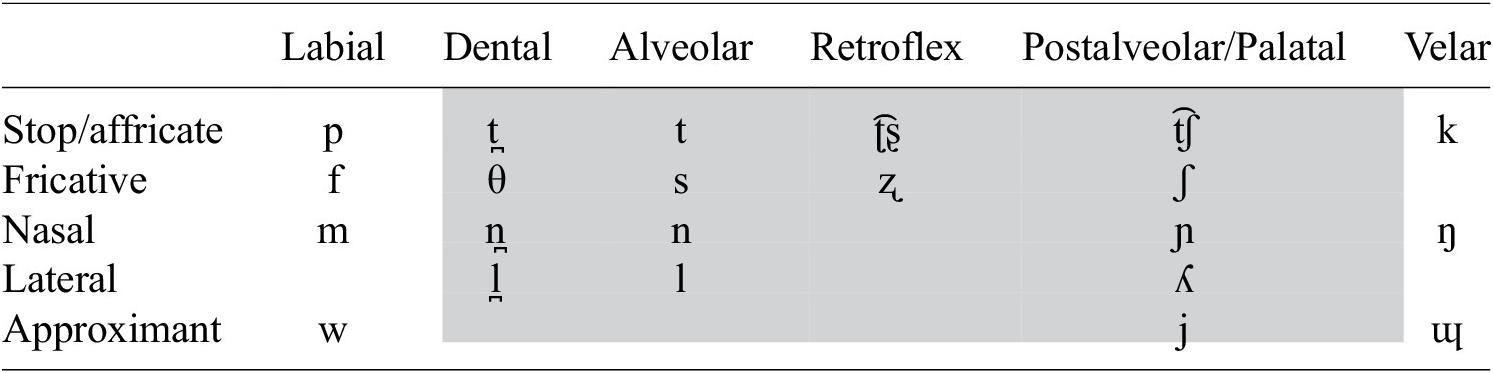

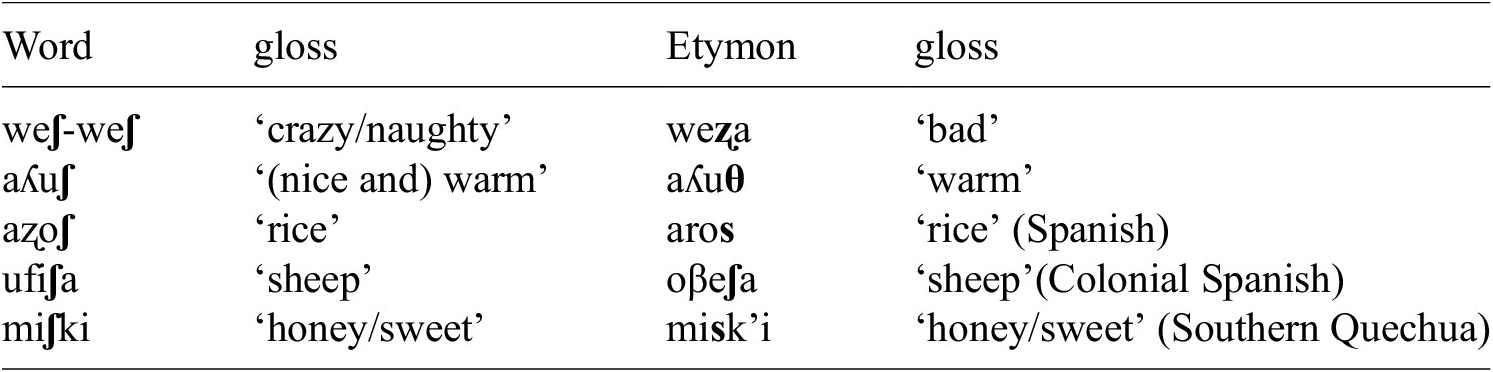

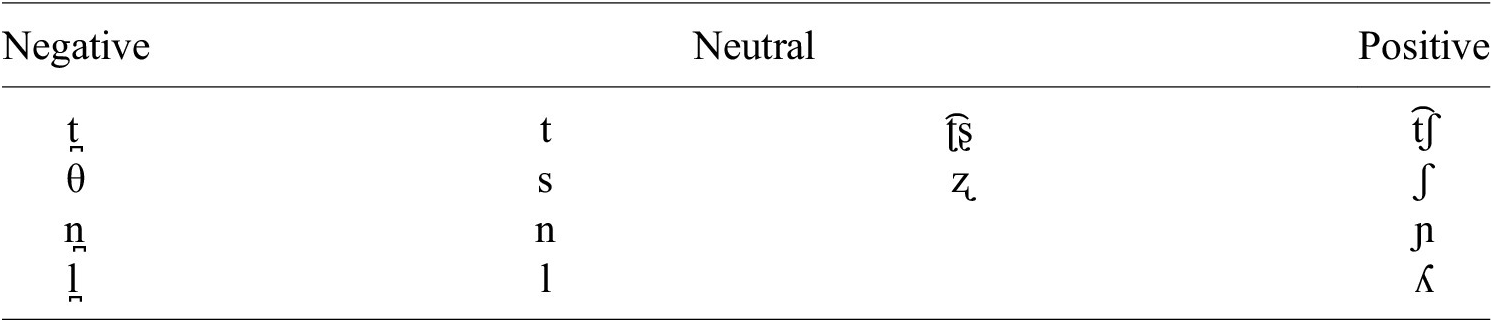
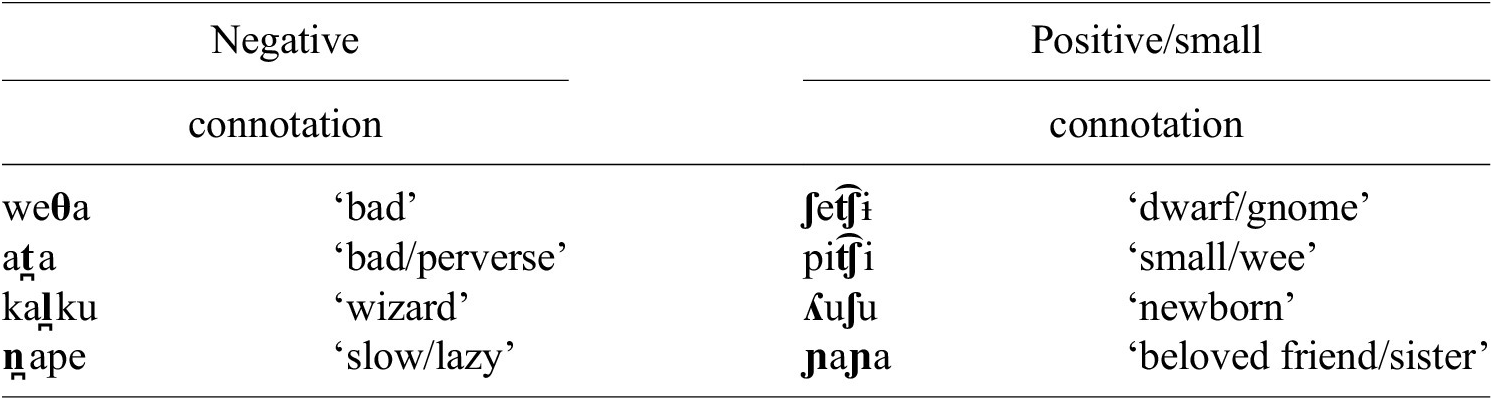
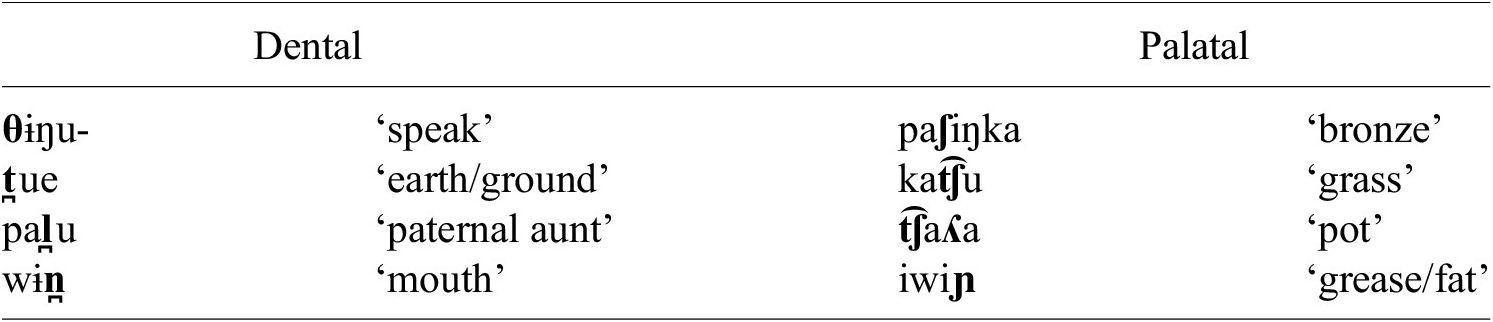
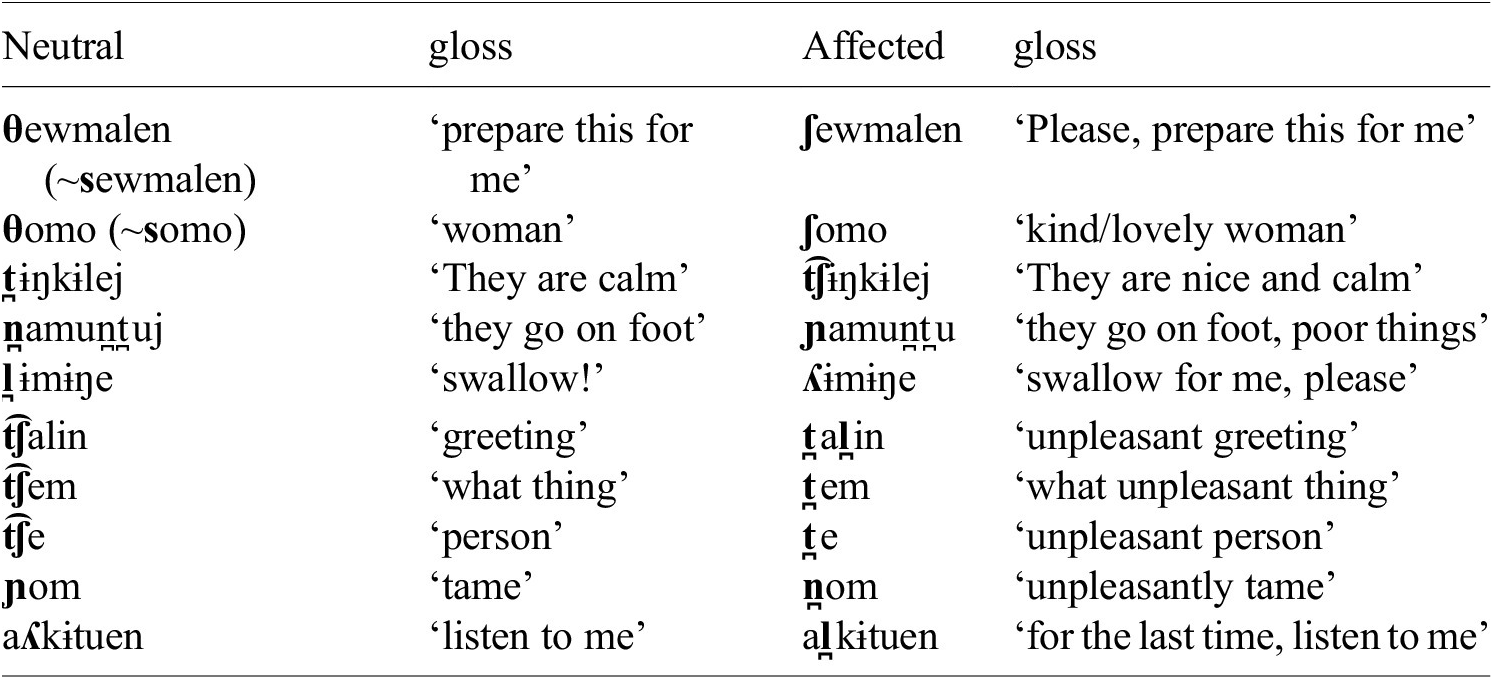
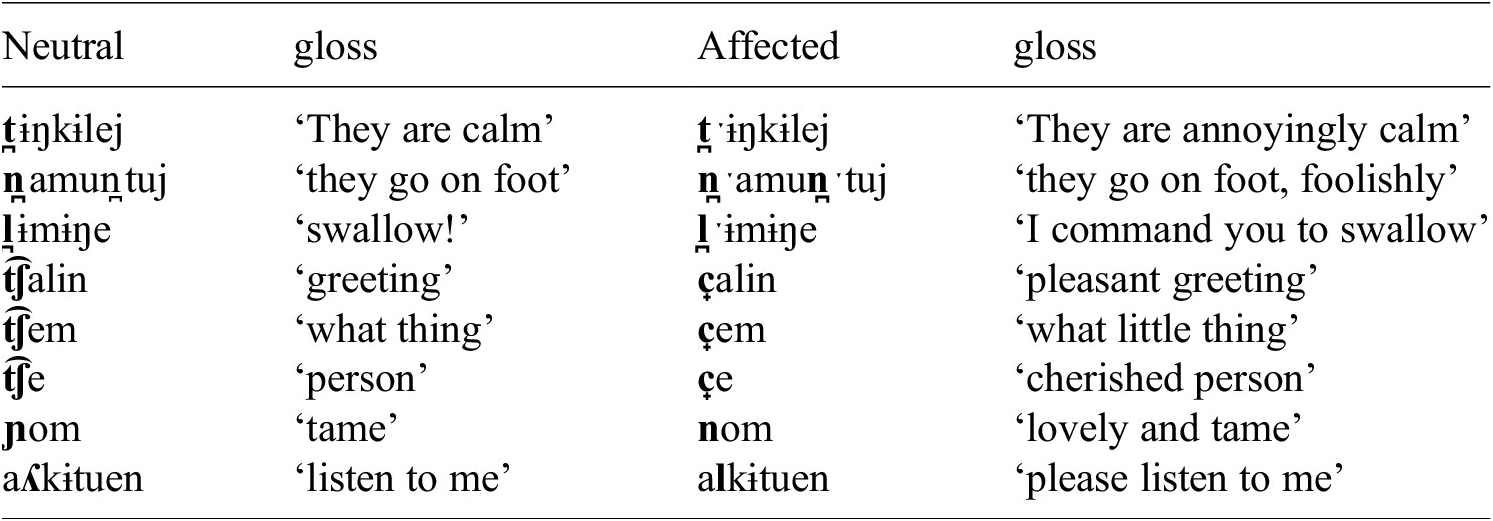
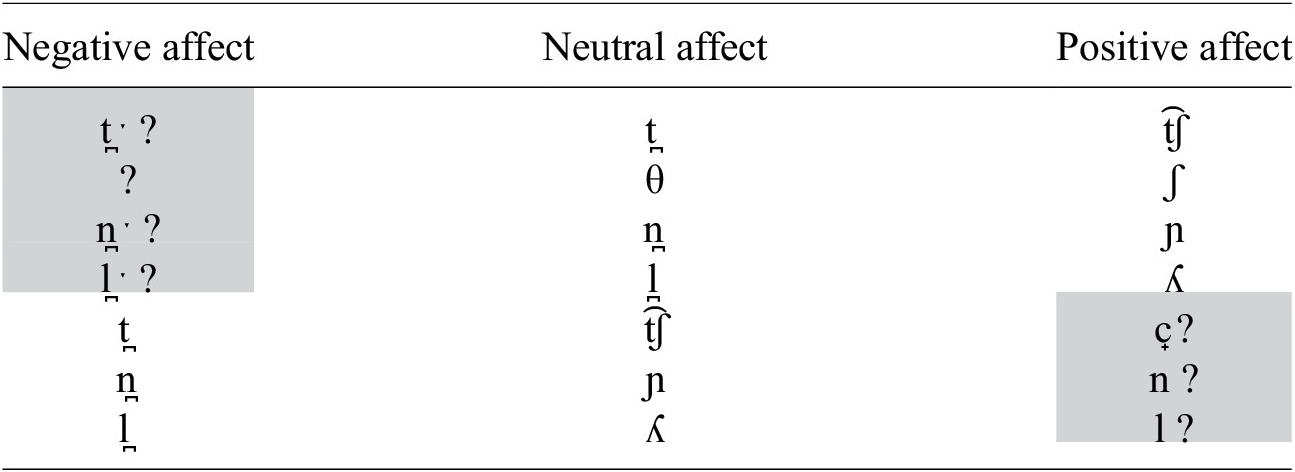
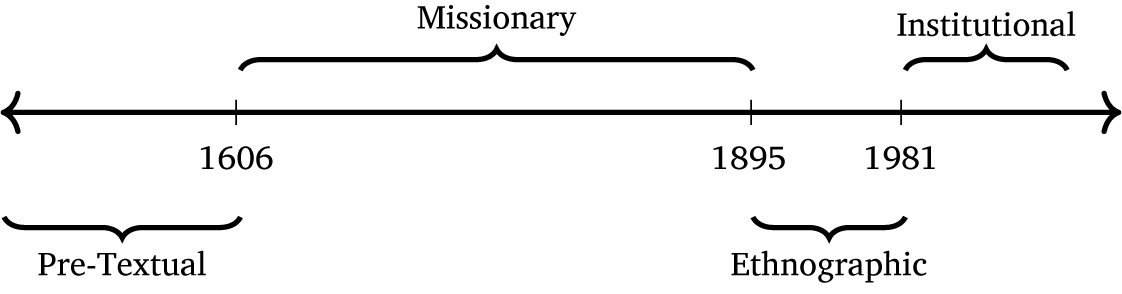
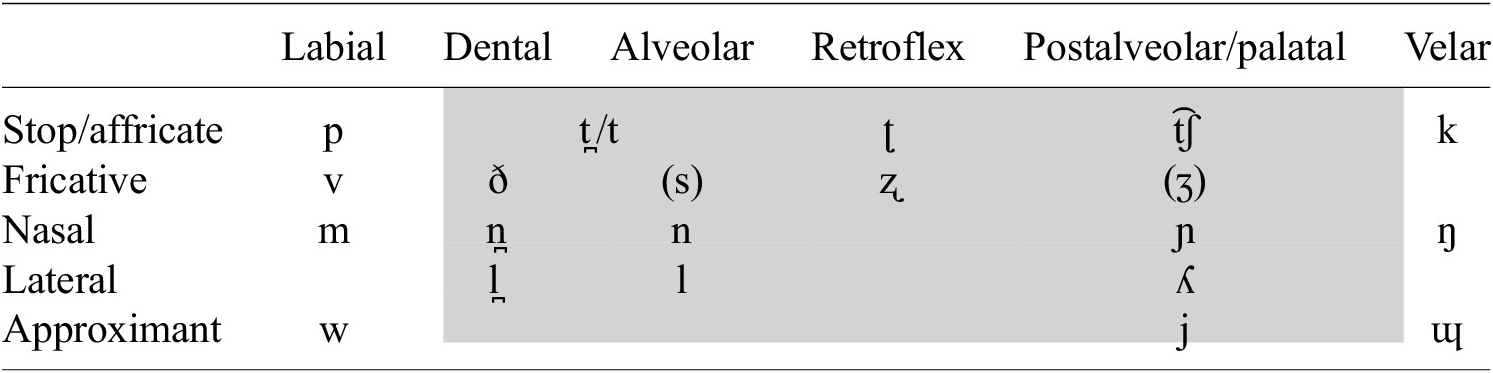
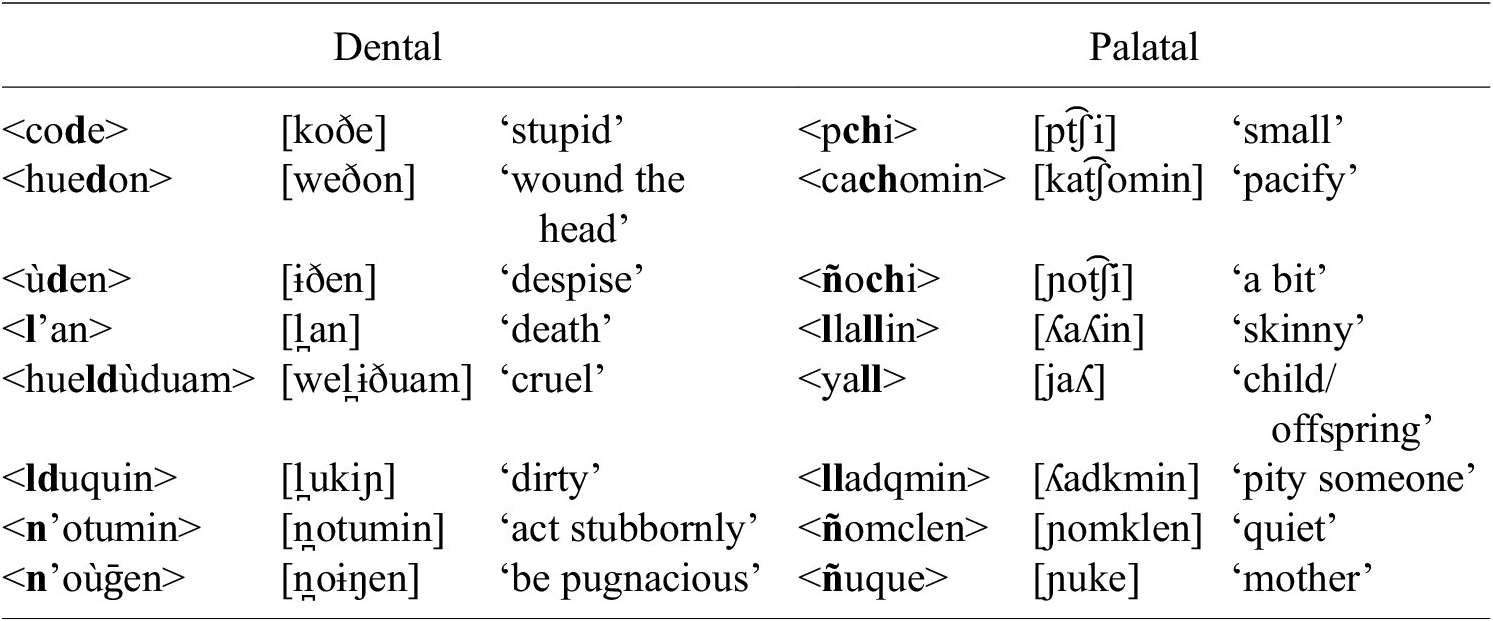
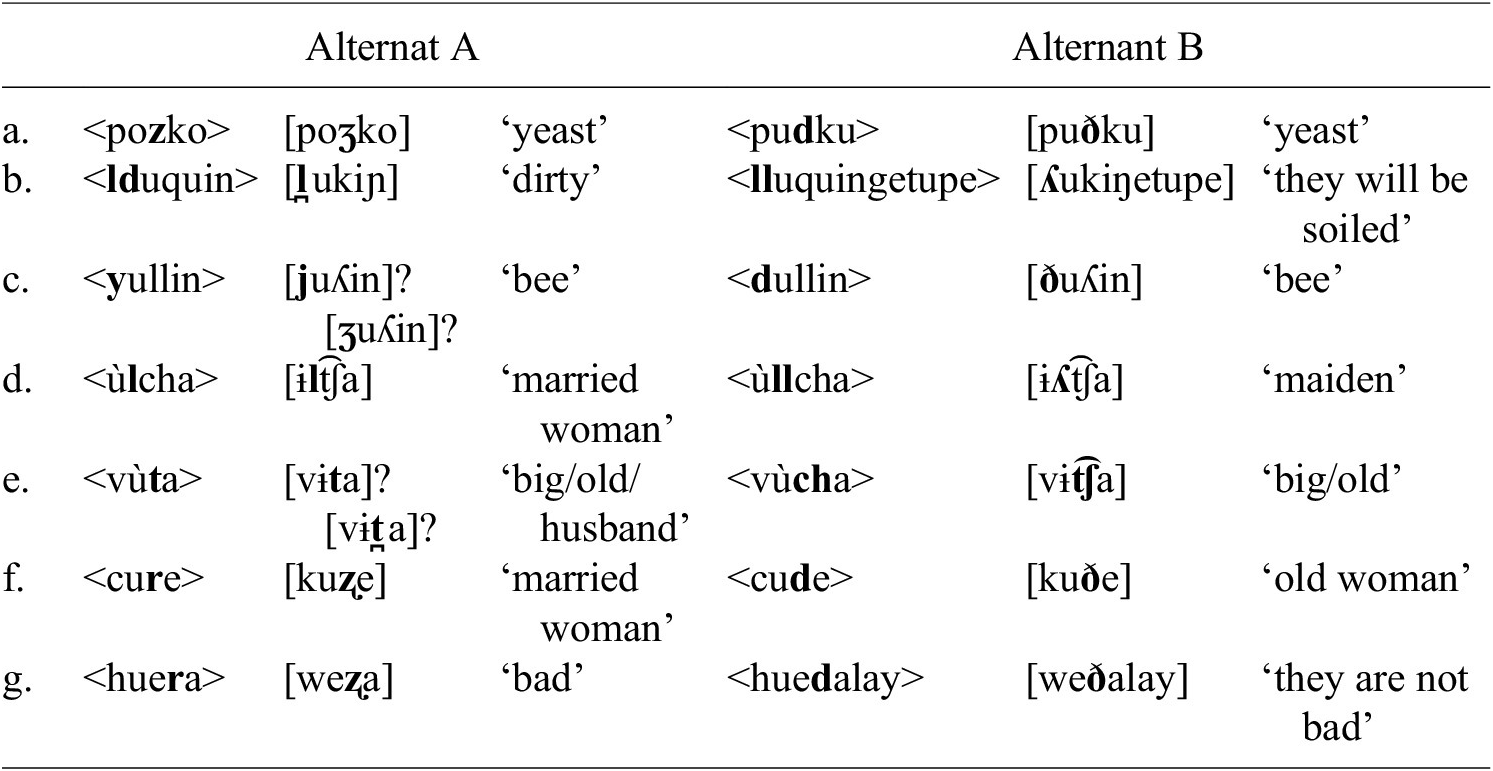

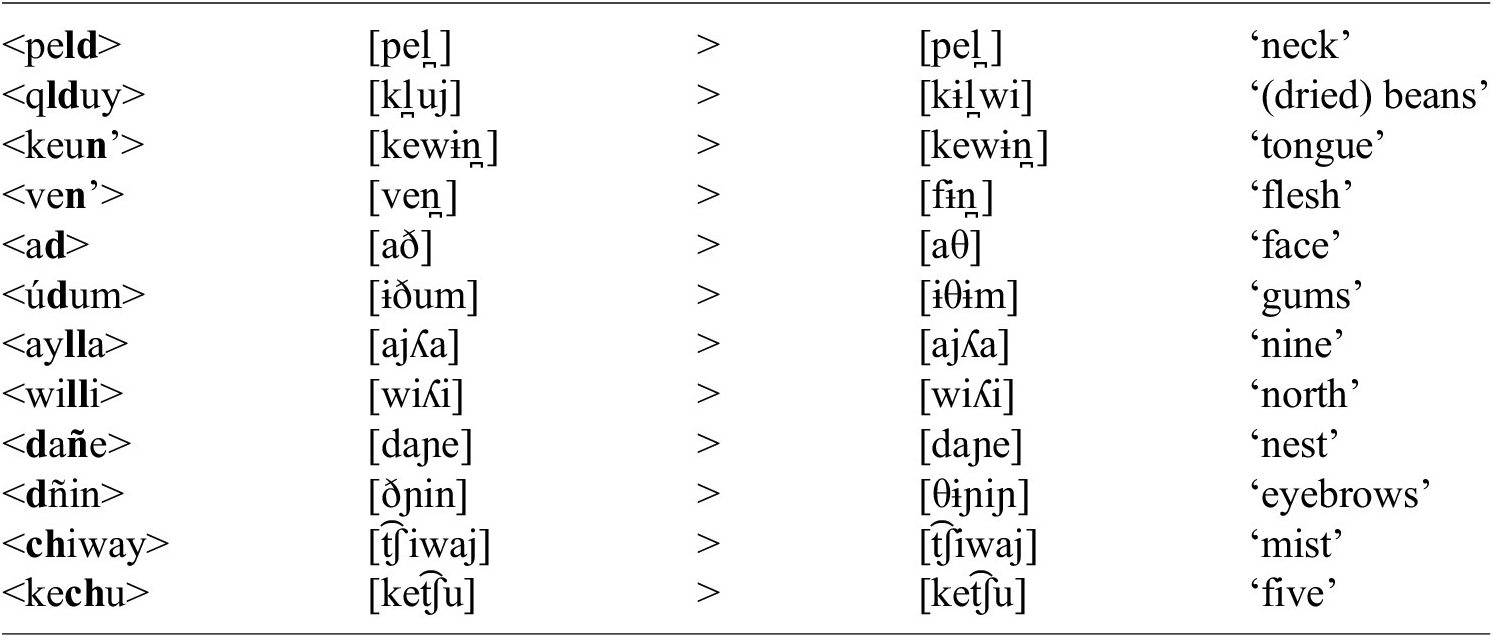
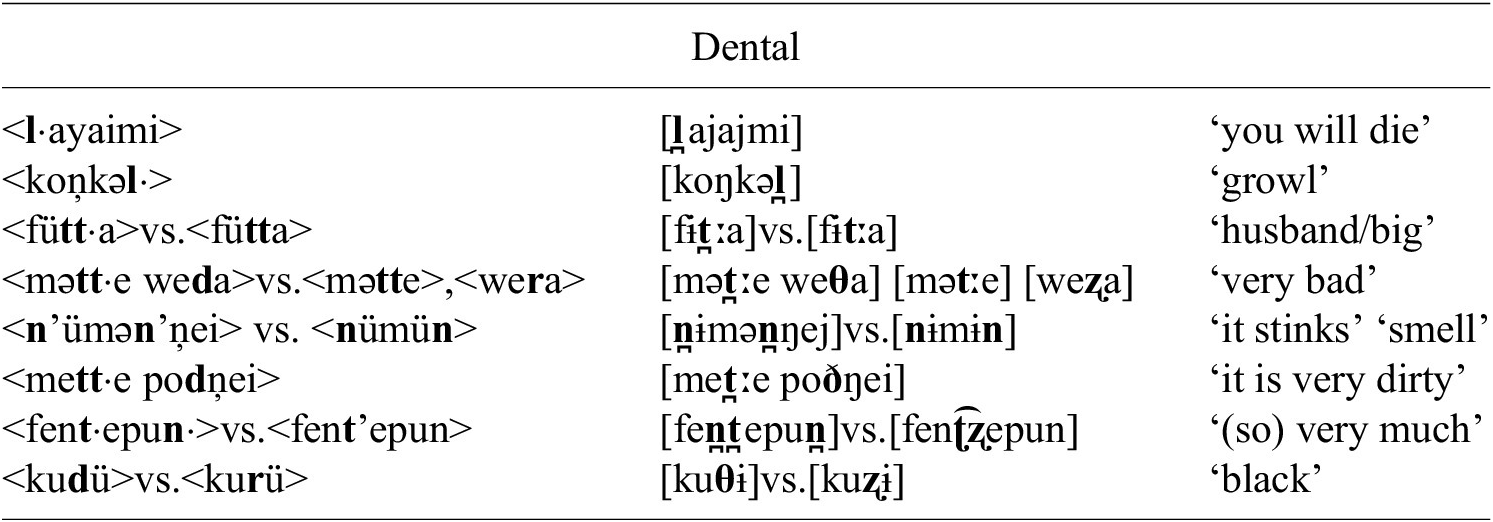
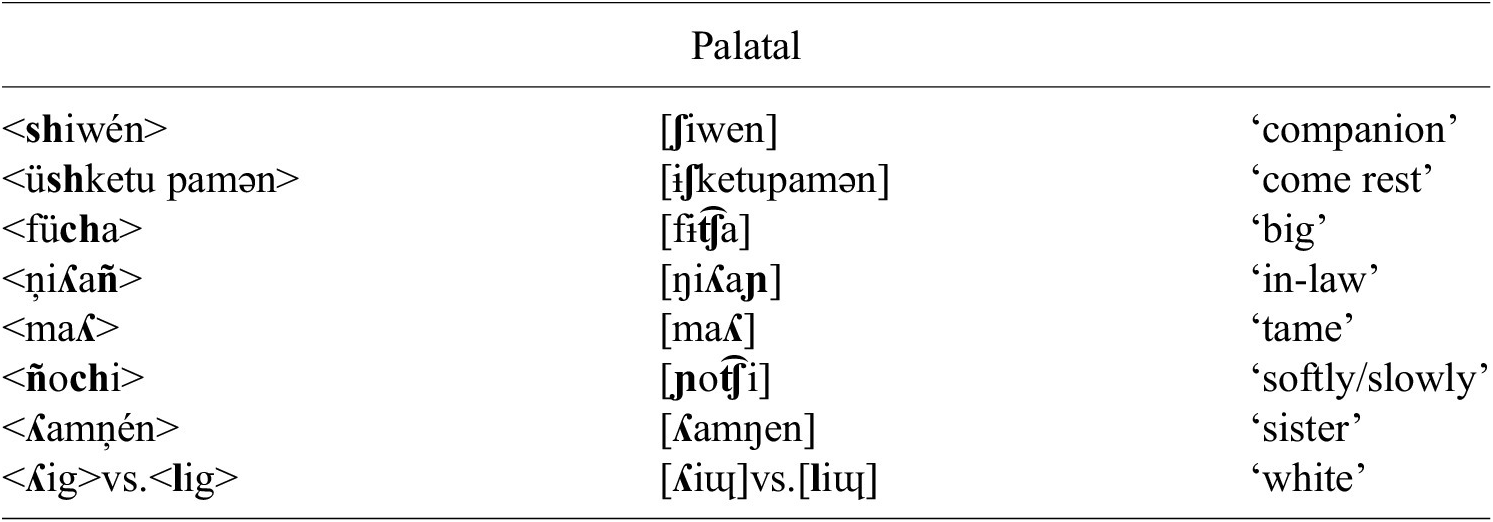
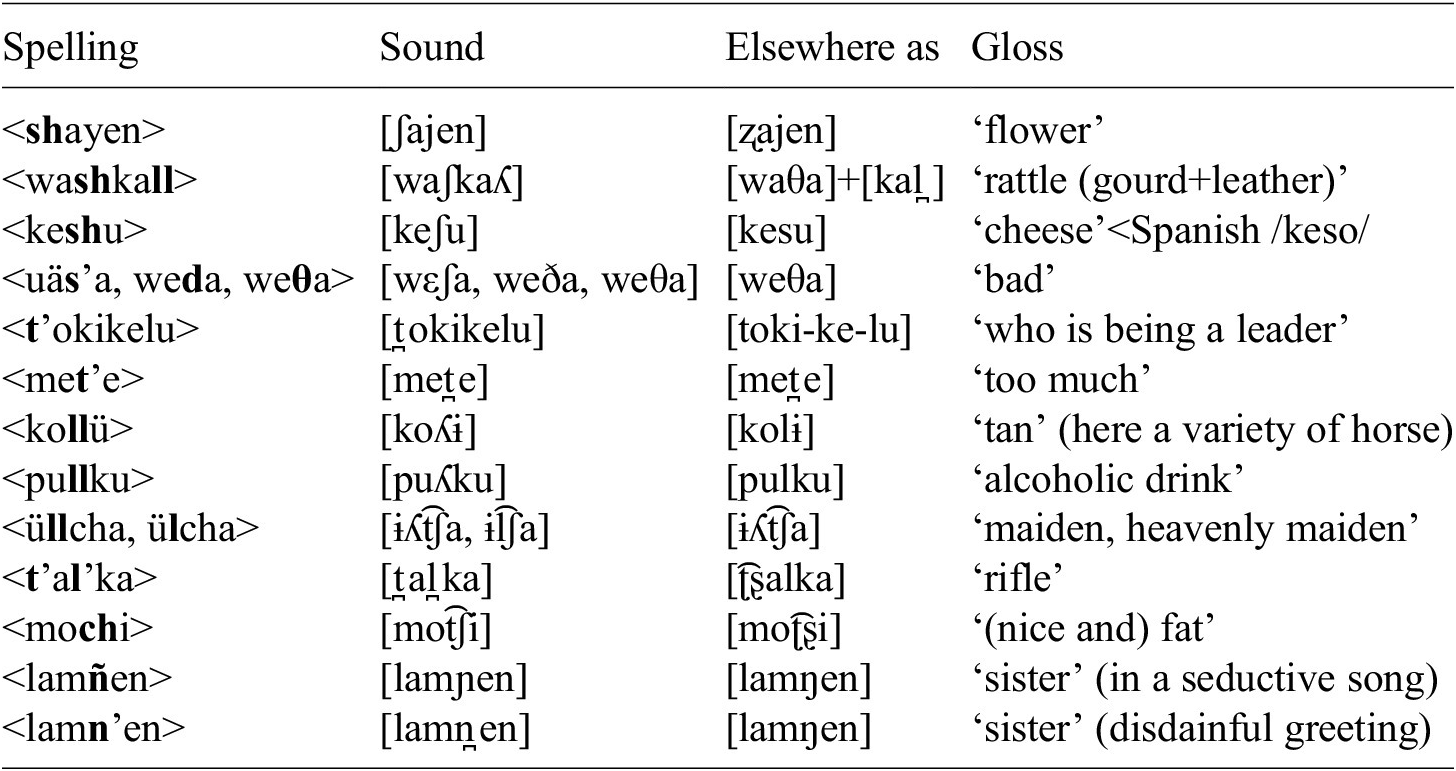


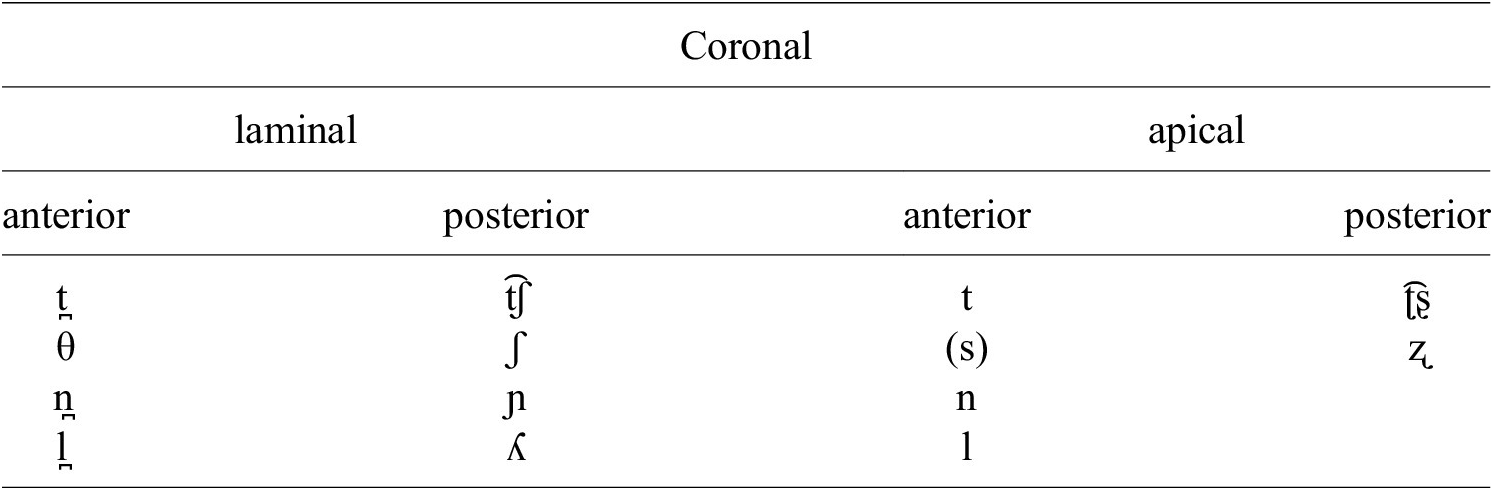
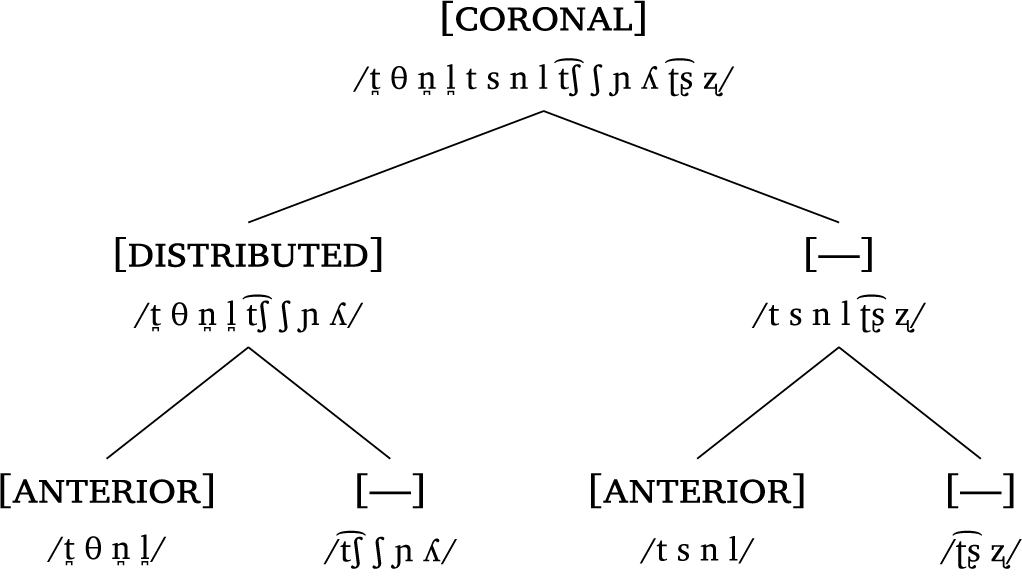
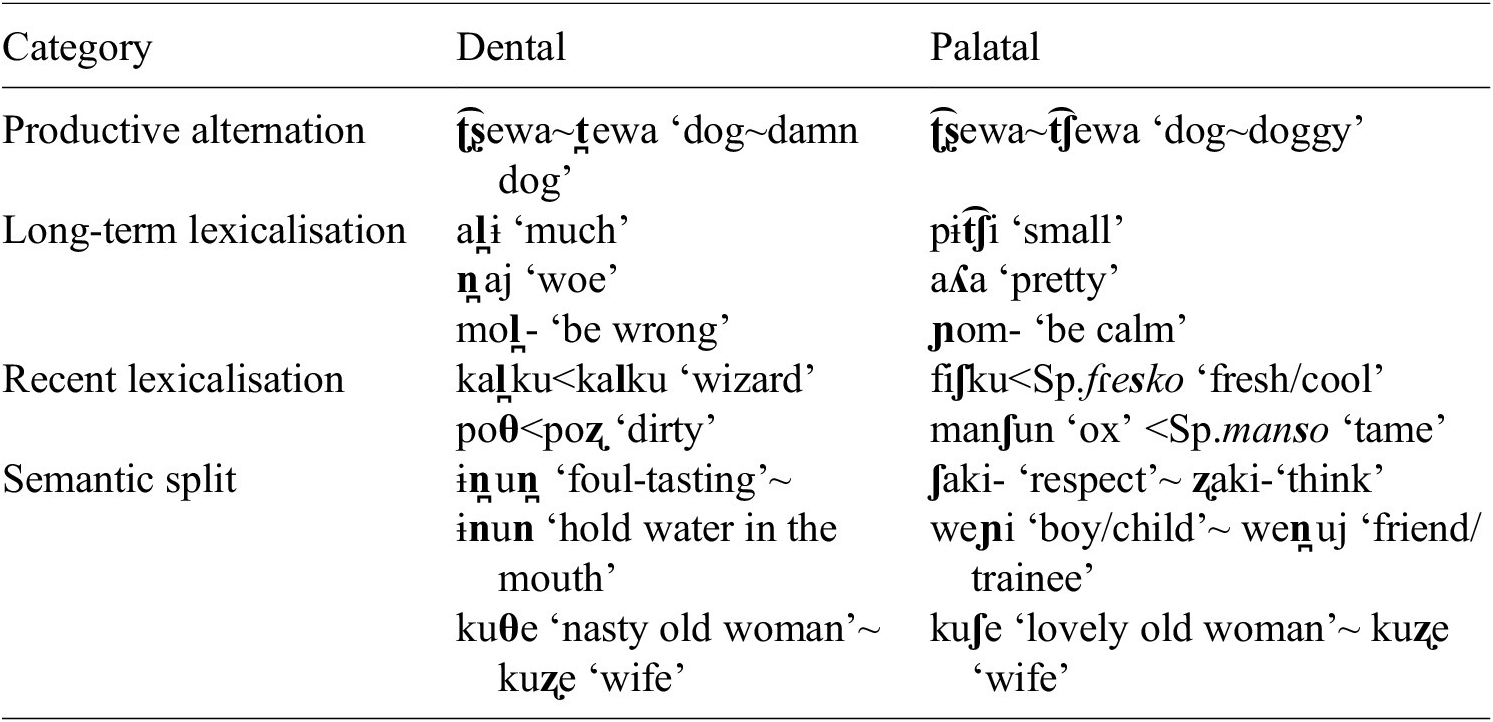


 Open access

