




Introduction
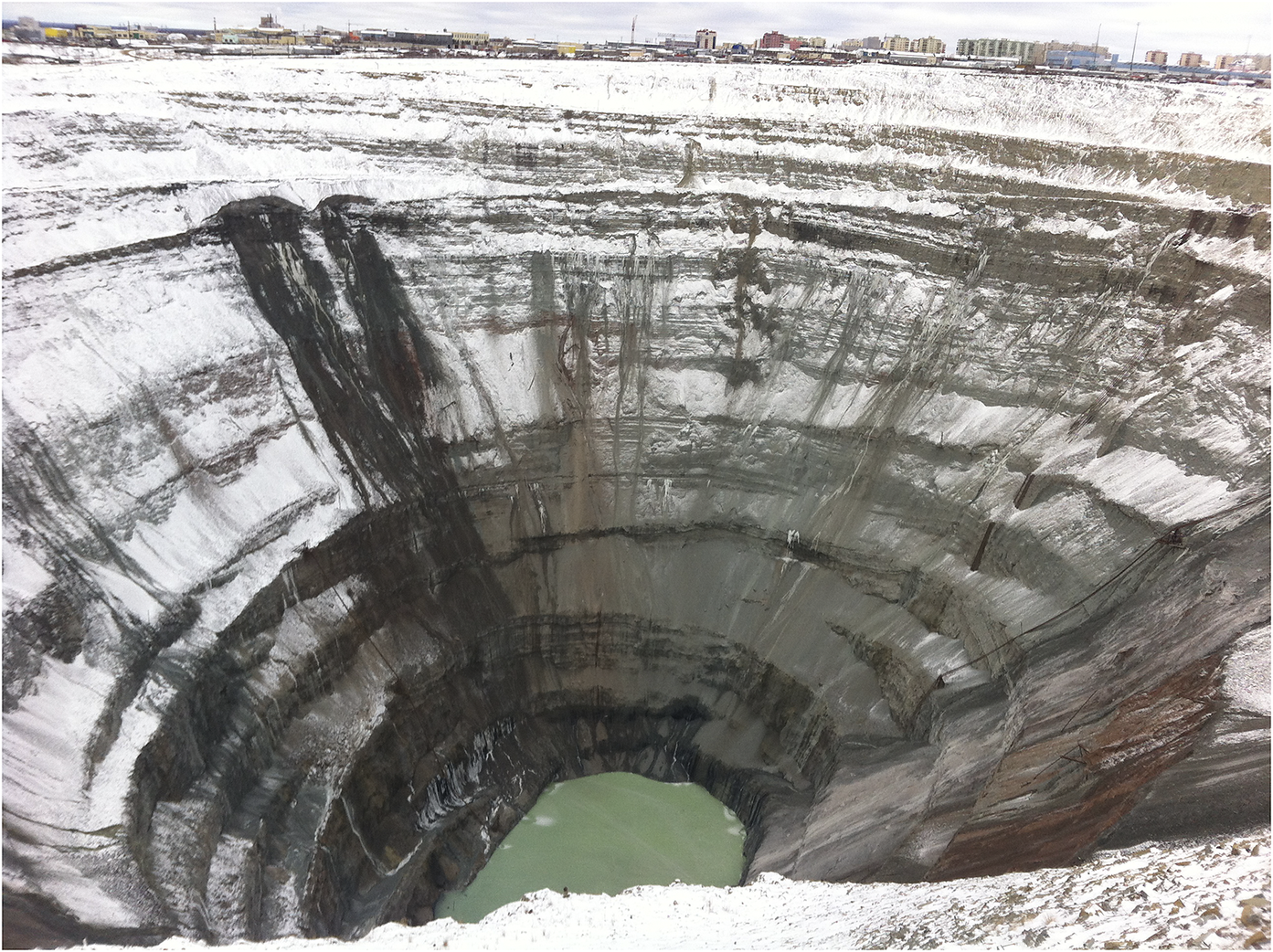
Few people outside its surrounding region are familiar with the city of Mirny – the first Soviet ‘diamond city’, established in 1955 near the biggest diamond deposit in Yakutia, in East Siberia. Yet the city’s unusual appearance is well known and often mentioned in the press: ordinary socialist standardized houses located right on the edge of an enormous pit more than one kilometre in diameterFootnote 1 that is easily traceable by satellites from space (Figure 1). However, the image of one of the biggest holes on Earth is not the only significant fact about that city.
Contemporary view of the diamondiferous pipe and the city of Mirny. Photograph by Ekaterina Kalemeneva (October 2015).
Mirny, like other Soviet industrial cities, was trapped at a complex crossroads from the very beginning. On the one hand, it was seen by the government as a crucial industrial centre for unique and valuable diamond production, expected to embody all the latest achievements of the socialist regime.Footnote 2 The strategic importance of the new diamond industry meant that all management decisions and projects for the city, including its initial urban planning, were originally developed in Moscow, by central scientific and design institutes associated with the Ministry of Non-Ferrous Metallurgy of the USSR. On the other hand, the need to build and populate an entire city from scratch was mostly seen as an expensive and inevitable side-issue to the profitable mine, which in turn influenced the disproportionate allocation of funding for the industrial and urban development of the settlement. The specific location of the city also seriously complicated its construction, as the richest diamond deposits were discovered in the middle of the taiga far from any other large settlement (the regional centre Yakutsk was almost 1,000 kilometres from Mirny; Moscow was more than 4,000 kilometres away), with no developed transport or industrial infrastructure in the surrounding area. Such a location, in the distant and coldest region of northern Siberia, constantly created difficulties in implementing the plans and projects designed thousands of kilometres away.
The city emerged during a pivotal time for the Soviet Union’s policy of industrialization and the development of the North. The first decades of Soviet Arctic industrialization had established models of development with a focus on extensive resource extraction through industrial colonization rather than on the creation of sustainable communities and acceptable living conditions.Footnote 3 Prior to the 1950s, the creation of new industrial centres in the Soviet North had largely relied on the Gulag system.Footnote 4 However, after Stalin’s death, a period of liberalization known as the Thaw gradually brought about reform in the use of forced labour.Footnote 5 By 1955, the Soviet administration no longer possessed such radical instruments to mobilize resources, including labour, for the construction of new industrial facilities in the North. As a result, Mirny became one of the first strategic industrial projects in the Soviet Union that was organized under completely different conditions without Gulag prisoners. However, those changes created a new challenge: that of finding ways to encourage thousands of workers to relocate to undeveloped territories voluntarily and to build a new settlement. Additionally, new administrative methods had to be established to manage a completely new industry. The combination of these factors makes Mirny a remarkable lens through which to analyse the transformation of Soviet models of building and inhabiting industrial cities in the North in the 1950s.
Soviet industrial towns were often described within the framework of a progressive scheme of constant urban growth, from a few tents to multi-storey apartment buildings and the annual increase of industrial production. Mirny was no exception to this trend. By the early 1960s, Soviet media was flooded with numerous romantic letters from young people, all relatively similar in content, celebrating the joy of constructing socialism with one’s own hands. For instance, a newcomer to Mirny described his impressions of the construction site in the following way:
In 1958, according to the Communist Party official call and following my duty as a communist, I made a decision to go to northern Yakutia for the mastering of diamond country. What did I see after arriving in Mirny? There were just two tent settlements and a few wooden houses…and in a very short period the city radically changed and turned into a city with blocks of two-storey apartment houses, new department stores and a school, a workers’ club, and a hospital.Footnote 6
This article complicates such straightforward narratives regarding the emergence of industrial cities and problematizes the notion of a city as represented by the example of Mirny. It asks when, how and by whom exactly this place started to be perceived as a city? What meaning and practices did the administrative concept of a ‘city’ imply for Mirny in the 1960s? What role did specific political and natural conditions play in its formation?
As Thomas Bohn notes, the entire Soviet era can be seen as a history of urbanization.Footnote 7 Rapid industrial development, the creation of a large technological infrastructure and the subsequent urbanization of former underdeveloped territories were the major trends of the Soviet state project.Footnote 8 Alongside pragmatic issues, since the early years of Soviet power, urbanization had an important symbolic dimension. The city as a site of industrial production played an important though controversial role in Marxist theory and in the works of early Soviet theorists.Footnote 9 The perceived importance of the built environment in the formation of a new Soviet citizen led to intense debates in the late 1920s about the nature of a truly ‘socialist city’, ‘socialist’ forms of resettlement and the forms of economic and social organization and planning structure needed to hasten the building of socialism.Footnote 10 Since then, Soviet cities and their planning schemes were seen as important tools in the ideological inculcation of new values, labour mobilization and the spread of state socialism.Footnote 11 Yet there was always a gap between the Soviet state’s drive to transform its citizens and the environment and its actual capacity to do so.
New towns also served as tools for the conquest of distant territories and their incorporation into the national, economic, social and cultural space of the Soviet Union. This tendency assumed its most radical form in the case of the Soviet Arctic – a territory with extreme natural conditions, the richest deposits of natural resources and of high military and strategic importance for the Soviet state.Footnote 12 As a result, the Far North became one of the most rapidly urbanized Soviet areas in the twentieth century: over a few decades, several hundred permanent settlements were built from scratch, often in previously uninhabited territories and consisting mainly of migrants from different regions.Footnote 13 The policy of many northern countries was driven by attempts to create a modern settlement in the Arctic.Footnote 14 Yet, the Soviet Arctic development usually assumed the most radical forms. Early Soviet Arctic urbanization was largely based on industrialization along with the creation of Gulag prison camps and attacks on indigenous livelihoods. The gradual reorganization of the Gulag system led to several shifts in the policy of mastering and domesticating the Arctic. One of them was the pressing need to find new ways to build both industrial and living areas and to organize ‘ordinary Soviet life’ hundreds of kilometres from other urban centres.
The construction of Mirny can be seen as a vivid reflection and symbol of the entire post-Stalin Thaw era in the Soviet Union – from its name, which translates as ‘peaceful’Footnote 15 and was one of the most popular words in the Soviet post-World War II vocabulary, to the new principles of its construction, which mirrored wider changes in Soviet policy during the 1950s.Footnote 16 The most basic description of Mirny is a ‘Soviet northern city of the Thaw period’. The aim of this article is to explore and contextualize all three elements of this description. Firstly, what meaning and practices did the administrative concept of a ‘city’ imply for a distant settlement in the USSR in the 1960s? At what point and for whom did the construction site in the taiga acquire the significance of a city? Secondly, what did it mean to build and settle a northern city in the 1950s? What challenges did it present, and how did the Arctic climate and specific geography influence the formation of the city and its social dynamics? And finally, despite the unique nature of the northern environment, what characteristics unequivocally make Mirny a Soviet city?
The analysis of the first 10 years of construction and settlement in Mirny allows us to examine the principles formulated from the top-down that were intended to organize the new settlement in the Far North right after the Gulag reform. At the same time, it also sheds light on the emergence of various local practices of inhabiting a Soviet northern city in the late 1950s.
The creation of a socialist city in the taiga: Mirny as ‘the youngest city in the country’
Before the 1950s, the leading centres for diamond extraction (around 98 per cent) were in Congo and South Africa. Scatterings of diamond deposits had been found in Russia in the mid-nineteenth century. However, at that time there was no information regarding their location. The search for diamonds intensified in the twentieth century, when the Soviet government discovered the benefits of their industrial exploitation. After a series of geological expeditions in Siberia, the first rich deposit of diamonds was found in 1955 in Yakutia, an autonomous republic of the Russian Soviet Federated Socialist Republic, where indigenous Yakuts were the largest population group. Just a year later, the Soviet government proclaimed the creation of Mirny, the first Soviet diamond town.
Under the Russian Empire, Yakutia was one of the most remote regions of Siberia, a place of penal and political exile. By the mid-twentieth century, the density of population was still very low: there were only 350,000 people living on a territory of more than 3 million square kilometres. In this context, the creation of a new industrial urban centre should be seen as a powerful tool for merging a distant region with the central parts of the USSR. That tendency was visible even on the discursive level: while the old city of Yakutsk remained the administrative centre of Yakutian Autonomous Soviet Socialist Republic, the newly established Mirny was named in the press as ‘the capital of diamond country’, thus embedding the city into the larger national context rather than simply the Yakutian region.
Building a city from scratch in an underdeveloped area meant that in the early years, all residents participated in various non-specialized construction tasks from earthworks or road construction to organizing open-air dance floors.Footnote 17 The harsh conditions of the region only made this work more challenging. For example, during the winter of 1957–58, there was no specialized clothing available for working in freezing temperatures, which sometimes exceeded minus 50ºC.Footnote 18 Construction was further complicated by the need to deliver all construction materials and the difficulties of their transportation to the northern region, which could only be done during a few months of the year. Sometimes this meant that thermal insulation materials or even nails were not delivered on time, and workers had to build houses without them.Footnote 19 As a result, the quality of the construction was very low.
The situation did not improve significantly in the 1960s. The lack of proper transportation chains with more developed regions and the difficulties in obtaining supplies of all materials from food to construction components created challenges, often leading to downtime even for existing but temporarily broken equipment. This meant that work had to be done manually. For example, in 1962, only 3 out of 12 machines were operational because the others had broken down and there were no spare parts available for repairs.Footnote 20 Until 1960, there was no airport or regularly based aircraft in Mirny, so the connections with nearby settlements were very weak.Footnote 21
In contrast to the actual building conditions, in both Union-wide and local documents, Mirny was described from the beginning in celebratory terms as ‘the youngest city in our country’Footnote 22 and ‘the city of youth’.Footnote 23 According to official statistics, Mirny grew very quickly – in 1956 there were only 700 inhabitants,Footnote 24 in 1958 more than 6,500Footnote 25 and in the early 1960s more than 18,000.Footnote 26 But when did a construction site in the taiga become a city, and what meaning did the concept of a ‘city’ imply in the early years of Mirny for different actors? In Komsomol (Communist Youth League) and administrative documents as well as in the local press we can find different explanations for this term.
The most formal notion of a city applied to Mirny appeared in 1959, three years after the erection of the first tents, when the settlement received the official administrative rank of a city. It received official recognition as ‘a city of [Yakutian] republican subordination’,Footnote 27 which was extremely prestigious for a relatively small and new settlement. From this perspective, the ‘urban’ status of a settlement meant the creation of local administration, specific appeals to the residents as urban citizens which led to higher expectations of their urban consciousness and the right to have a local newspaper, which served as an important tool in the construction of both local and Soviet identity.Footnote 28
However, the description of Mirny as a city-in-progress had already appeared in the narratives of the first settlers. In this context, the appearance of the discourse of a city meant the appearance of a city itself. Even in 1957, when there were only a few hundred newcomers living predominantly in tents, the settlement was already referred to as a city in Komsomol documents that were handwritten rather than typed.Footnote 29 In those documents, the description of the city was always framed in terms of its growing (or even just planned) infrastructure, and the ‘urban’ markers for 1957 were simple: a sports ground, open-air dance floor and a tent for amateur artistic activities.Footnote 30 In other words, from the first years of its construction, Mirny was perceived or at least represented as a city on the basis of its having specific elements of ‘urban’ infrastructure.
Almost each issue of the local newspaper Mirny’s Worker (Mirninskii rabochii) contained the ‘promise of a city’ for the residents, which was often reduced to a promise of improving the living environment. Some articles were concerned with the construction of new houses or entire streets, others criticized the low quality of these buildings or discussed further projects of urban development. The first local hospital and school, first cinema and workers’ club were depicted as important steps towards the successful construction of socialism in the taiga.Footnote 31 In 1960, members of the local Komsomol organization called Mirny ‘the city of the future, which would be among the first cities in the USSR to have an electric heating system’.Footnote 32 At the same time, these enthusiastic discussions about the imminent technological future of Mirny co-existed with more pessimistic remarks regarding the unsuccessful attempts to plant trees in the city in 1959, as none of them had survived.Footnote 33 The specific feature of these articles was their orientation towards the future either as a fixation on constant changes, or as promises of these changes. In other words, such articles equated the rhetoric of city construction with the process through which a city was an achieved result. Seen from this perspective, descriptions of Mirny as a city did not simply imply its administrative status, but also its inevitable urban future as an industrial site.
The third way in which ‘urbanity’ was understood during the early years of Mirny can be found in the works of architects, who were professionally responsible for the creation of the city’s masterplan. The actual formation of the urban built environment in Mirny was the weakest element of its fast growth as a successful industrial site. The earliest newcomers expected that stone buildings would replace barracks, temporary wooden houses and tents by 1959.Footnote 34 However, although a newspaper victoriously reported in December 1958 that ‘a tent city is already in the past’,Footnote 35 in reality the number of temporary tents increased annually until the mid-1960s.Footnote 36
The major reason for the constant problems with construction plans was Mirny’s specific administrative dependence upon the centre. The diamond deposits were found right after the Gulag reform, and Mirny was one of the first post-Stalin industrial northern settlements to be constructed that was not a part of the larger Gulag administrative infrastructure. Therefore, the development of both industrial and residential sites in Mirny came under the jurisdiction of the Ministry of Non-Ferrous Metallurgy and its planning institute Tsvetmetproekt, which oversaw the extraction, processing and enrichment of non-ferrous metal ores in the USSR. Initially, Tsvetmetproekt planned to establish a branch in Mirny to simplify communication and to address important issues on site. However, in the first years of Mirny’s existence none of the management wanted to relocate from Moscow to a northern and underdeveloped city.Footnote 37 Therefore, co-ordination between central institutions and local administration in terms of industrial production and residential construction was very slow in the first years of the city’s construction.
Before the 1950s, this Ministry had supervised the development of the gold mining industry in the northern parts of the Soviet Far East, which was also a part of the Gulag structure with forced-labour camps. As this institute had no experience of planning regular northern cities, its initial idea for Mirny was to follow the model of gold mining industrial settlements and to build a town of around 5,000 people near the diamondiferous pipe. But gradually it became evident that the diamond industry had to be organized on a different basis with a more complicated working structure, and the expansion of the city started to become unplanned. By the end of 1958, nearly 200 wooden residential and public buildings had already been constructed.Footnote 38 However, at that time about 500 residents out of 6,500 still lived in tents.Footnote 39 Even in 1966, the average living space per person in Mirny was only 2.8 square metres whereas official Soviet regulations stipulated a minimum of 9 square metres per person.Footnote 40 Thus, the regulation of urban growth by the Ministry of Non-Ferrous Metallurgy was evidently very problematic.
The first official masterplan for Mirny was developed by the Moscow architectural bureau associated with the Soviet Ministry of Non-Ferrous Metallurgy in 1959. According to this plan, the expected population of Mirny was 15,000 people. However, the new industry developed much faster than architects had foreseen, and only five years later the number of residents was almost 18,000.Footnote 41 Such rapid growth required the creation of a new masterplan even before the first one had been fully implemented. The first urban project was radically criticized by the architectural community for the direct transfer of planning principles that had previously been used only in southern regions and for ignoring northern environmental conditions except with regard to the foundations of houses. For example, the plans for some wooden dormitories did not include internal bathrooms, plumbing or sewage systems, and sometimes did not even include stoves.Footnote 42 This can be explained by the fact that none of the specialists from Tsvetmetproekt had previous experience of working in the North. It was also the result of architectural reforms of 1955 which led to the obligatory radical standardization of architecture and building practices across the country. Specific standardized plans for the northern climate were absent even in early 1960s, and construction went ahead with houses originally planned for southern regions. Even Mirny’s chief architect combined optimistic descriptions of the city’s great prospects with references to ‘living in a barn’, due to the difficulties with urban improvement in his letters in 1961.Footnote 43 It was not until 1967 that the chief Soviet architectural institution Gosstroi confirmed the implementation of a new masterplan for 25,000 citizens.Footnote 44
That new plan was also criticized by urban specialists,Footnote 45 but it nevertheless led to a more rational spatial organization of the settlement. And from the perspective of architects and central planning institutions, the implementation of the approved masterplan was seen as a major element of being a Soviet city.Footnote 46 These overlapping but divergent interpretations of the meaning of a ‘city’ by the authorities, local citizens and planners partly reflect the concept of perceived, conceived and lived spaces introduced by Henry Lefebvre.Footnote 47 In the case of Mirny, these different levels in the perception of a city also elucidate different co-existing temporal regimes of urbanity: while for the builders the rhetoric of constructing a city meant the appearance of a city itself, for the architects at the centre, the rationally developed spatial organization of the built environment which took place almost a decade after settlement had been established was the only sign that a construction site had been transformed into an actual Soviet city.
The difficulties with the masterplan demonstrate that the actual development of the city for the first 10 years was implemented with little co-ordination with centrally planned projects. This led to a series of significant mistakes in Mirny’s urban planning, which resembles previous models of Soviet Arctic urbanization from the 1930s. Firstly, the location of the city was based exclusively near the mine. Therefore, the settlement began to grow just 1.5 kilometres from a diamondiferous pipe, and whenever detonation occurred, the windows of the nearest houses shook.Footnote 48 Transferring the city to another site would have been a long and expensive task. So, in the 1960s new stone houses were built on the same badly chosen site. As a result, the city quickly became trapped between the mine, the airport and the road to the port, leaving little room for regulated further growth.
Secondly, there was no source of fresh clean water close to the settlement and even in 1965 fresh water for domestic needs was delivered by cisterns from nearby springs.Footnote 49 Until the construction of the Viluy hydro-electric power plant in the mid-1960s, the citizens experienced regular power outages in their houses, so many tasks had to be done by candlelight.Footnote 50 Nevertheless, Mirny’s major problem resulted from the Soviet logic of industrialization, whereby primary resources and funding were allocated to diamond mining plans, rather than creating a well-planned city for inhabitants. Sometimes, construction workers openly acknowledged that ‘we were forced to…make unfinished houses…because we needed to meet the diamond production targets’.Footnote 51 The fact that such statements during Komsomol meetings were not challenged indicates that it was an accepted reality for the residents of the city.
Due to the complicated logistics, the plans for the city’s construction were delayed by a year or more, and during this time, the influx of new residents to the construction site did not decrease. Therefore, alongside the development and approval of official plans, there was chaotic residential construction and the city grew uncontrollably. Furthermore, the blueprints developed in Moscow could not keep up with the changes happening at the local level nor did they take them into account. The result of the failed plans and the simultaneous increase in the demand for a new workforce were illegally constructed private houses made from construction materials that formally belonged to the construction bureau.Footnote 52 This partially helped to solve the problem of accommodating new workers and creating more comfortable conditions compared to tents. However, this illegal practice of construction made it nearly impossible to control the growth and development of the city’s built environment. As a result, in contrast to various conceptions of what a city ought to be, Mirny’s built environment was extremely variable and hardly regulated, even during the 1960s.
Mirny as a northern city: ‘long ruble’, vodka and social hierarchies
The difficulties of urban construction were common to all Soviet industrial cities. Yet, specific Arctic natural conditions also played an important role in Mirny’s formation. Along with the problems of construction discussed above, the major effect of northern conditions was on the social environment and on the politics of inhabiting the city. After the 1950s, Soviet northern industrial cities became more open to migration flows, and the state had to find new ways to encourage voluntary migration to emerging industrial sites. One way of attracting new workers to the northern industries was to issue ideological calls for the ‘construction of socialism’ in distant territories and a system of ‘Komsomol appeals’: in May 1956, the Central Committee of the Communist Party and the Council of Ministers published an official appeal to all Komsomol organizations and Soviet young men and women to ‘send the best fellows’ to the construction works in the eastern and northern parts of the country in order to ‘fully use the richest mineral resources of the East and the North of the country, to provide for the successful reaching of the goals formulated at the 20th Communist Party Congress’.Footnote 53 In just a few weeks, the first groups of party and Komsomol activists from Moscow, Leningrad and other central cities arrived at various construction sites in the North and Siberia.Footnote 54 As Mirny’s Worker described it in 1960, ‘unpopulated lands called for strong, brave people, who are not afraid of frost, blizzards, and life in a tent’.Footnote 55 The construction of Mirny and other elements of the diamond industrial complex was officially claimed to be ‘the All-Union Komsomol shock-working construction site’, which stimulated the migration of young men and women to the new settlement.Footnote 56
The motivation of the newcomers was also explained with enthusiastic connotations, as ‘in Moscow we lacked the full enjoyment of our work’.Footnote 57 These romantic sentiments of conquering distant lands and the narrative of the everyday heroism overcoming obstacles were not just official rhetoric, but were also embraced by many people themselves.Footnote 58 However, the state-sponsored system of material privileges for newcomers to the northern industry known as ‘northern bonuses’ became an even more powerful tool for the regulation of migration flows. Newcomers received much higher salaries compared to other territories, had longer holidays and a range of other benefits. The list of territories included in the ‘northern bonuses’ programme, as well as the actual list of privileges, changed throughout the decades.Footnote 59 Nevertheless, higher wages and material advantages remained one of the main motivations for moving to the northern industrial cities. Along with the ‘northern bonuses’ system, in 1957 the Soviet of Ministers of the USSR issued a decree for a 20 per cent wage increase for workers in the diamond industry, which stimulated the migration of thousands of new workers to Mirny annually.Footnote 60
As a result of this policy, Soviet Arctic industries provided an opportunity to earn money to purchase a car or other valuable goods, all of which was openly discussed in the press.Footnote 61 Moreover, despite the complicated Soviet migration legislation, when moving to industrial work in the North, individuals were allowed to keep their homes in their region of origin. This measure helped encourage citizens to relocate for work in the harsh and underdeveloped region. However, it also reinforced the ‘temporary’ and fluid nature of the social environment in Mirny.
Narratives about the ‘young and diverse face’ of Mirny were close to reality – archival documents show that 90 per cent of newcomers to the town were under 45 years old.Footnote 62 Since the beginning, Mirny had been a family-based settlement – not only were miners and other workers permitted to bring their families to the settlement, but many single female specialists and unskilled labourers also arrived at the town in the first years of its construction. This distinctive social structure had a great influence on its built environment, as it predetermined the creation of a social infrastructure with kindergartens and schools, buildings with private apartments instead of dormitories, a more elaborate cultural sphere and other elements of an ‘ordinary town’ even in harsh climate conditions.
The impossibility of regulating migration flows, however, led to several social consequences. Firstly, not all newcomers had obtained the expected qualifications. For instance, the local administration noted that sometimes the administrative staff was composed of unqualified individuals, so the plans were created and supervised by incompetent people, and their implementation was chaotic, leading to the failure of the plans or ‘the creation of calculations that did not correspond to reality’.Footnote 63
Secondly, the poorly regulated mobility of the population in search of easy money led to increased social tensions in the first few years of Mirny’s history. Despite romantic descriptions of the builders of a socialist city, local Komsomol records reveal various forms of ‘deviant’ behaviour, such as gambling, unauthorized shooting, hooliganism, excessive drinking, smoking and fighting on the open-air dance floor.Footnote 64 Sometimes in the records, these problems are simply referred to as ‘constant issues of the long rubleFootnote 65 and vodka’.Footnote 66 Just a few years after the establishment of the city, Komsomol members began to appeal to the ‘golden age’ of the first year of Mirny, when supposedly everything in the city was peaceful.Footnote 67 Problems with alcohol aggravated the city’s criminal environment and led to increased incidence of theft or even murders.Footnote 68 Alcoholism not only harmed social relations but also affected work performance, as sometimes entire construction areas would come to a standstill due to the binges of workers or supervisors.Footnote 69 These problems persisted over the years. In 1965, there were over 200 teenagers on record in the police juvenile department, many of whom had run away from home due to their parents’ alcoholism.Footnote 70
However, the most radical effect of the northern conditions was on the enormous level of negative net migration. For example, in 1957–58, more than 1,100 people left Mirny and the majority of them explained their decision with reference to the hard working and living conditions.Footnote 71 Two years after the establishment of the city, only two Komsomol members from the original team remained.Footnote 72 In these conditions, even the promise of one Komsomol member to ‘stay in the city until the end of seven-year plan’ sounded like a positive gesture.Footnote 73 The local administration tried to stop outmigration with moral judgments and public accusations against those who ‘shamelessly ran away from the job’.Footnote 74 Yet it did not work – even in 1962–64 negative net migration was more than 80 per cent of the town’s population.Footnote 75 One obvious reason for such fluidity in the social environment was dissatisfaction with the living conditions. According to a statistical survey in 1967, 86 per cent of the newcomers under the age of 35 considered their living in Mirny as temporary, mostly because of their dissatisfaction with the recreational opportunities, their unwillingness to live in the harsh northern climate for the rest of their lives, or their inability to find a proper job for their spouse.Footnote 76
Another effect of Mirny’s northern location was on social hierarchies in the city. Newspapers exposed only bureaucracy, construction plan failures and poor housing conditions from among possible urban problems, but archival documents reveal two other areas of social tension in the city. First were ethnic differences: the majority of the population in Mirny were migrants from more southern regions of the USSR, but not from Yakutia itself, although Yakuts were the predominant population group in Yakutia. Russians occupied almost all administrative positions in industry and in the city as well.Footnote 77 For instance, among the participants of the first party conference in Mirny in 1959, there were ‘101 Russians, 2 Ukrainians, 4 Yakuts, 2 Tatars, 1 Belarusian, 1 Mordvin, and 1 Georgian’.Footnote 78 This quote is noteworthy not only for the radical difference in the number of party members of different nationalities but also for the order in which they are mentioned. Specifically, the mention of the Yakuts comes not in second place, based on the number of people, but further down the list reflecting the informal perception of the hierarchy of nationalities within the USSR. The situation had not changed by 1965, when just 8 per cent of workers in the extraction industries in Yakutia were Yakuts,Footnote 79 while others came from much more distant, usually European parts of the country. This was partly due to the very low population density in Yakutia, and the specific industrial character of the town: the local administration was interested in recruiting educated specialists for the new diamond industrial complex, therefore they recruited youth from larger education centres. Yet, the general policy of Arctic industrialization in the USSR was usually based on the recruitment of a mostly non-indigenous workforce. During Komsomol meetings in Mirny, this was evasively explained as follows: ‘The local population leaves particularly often, experiencing a stronger desire to work in rural areas rather than toil at urban enterprises.’Footnote 80 This juxtaposition of the urban environment (unambiguously understood as more progressive) and rural areas further established a more critical attitude towards indigenous residents.
Another social hierarchy in Mirny was a common problem for other northern industrial cities: especially in the late 1950s and early 1960s, many people tried to change their workplace on construction sites to any position in the industrial sector. In local documents, it was often explained as the ‘fear of difficulties’.Footnote 81 However, the most probable motivation was much higher wages, as only work in the industrial sector provided the opportunity to be awarded ‘northern bonuses’. For example, in the late 1950s, members of the local administration complained that many newcomers did not want to work in the construction or the service sector and instead tried to find employment in the industrial plant, and that even the wife of a local KGB employee, after arriving in Mirny to join her husband, worked at a school for only one day before transferring to a job in the plants’ administration.Footnote 82 The difference in status between plant workers and city dwellers extended to the younger generation as well. For example, even in winter, city buses were intended only for workers and not for schoolchildren, despite the fact that there were almost 200 children in the lower grades at that time.Footnote 83
The specific natural and geographic conditions of Mirny created various opportunities for the newcomers – from the opportunity to become a part of larger state-driven processes to the more pragmatic expectations of receiving significant financial benefits. However, even 10 years after the establishment of the city, its social environment was still unstable and fluid.
Mirny as a Soviet city of the Thaw
Despite all the specificities of the social and built environment of Mirny in the 1960s, it was still organized according to the principal frameworks of Soviet urban modernity. From the early years of its foundation, general Soviet management practices and models of social organization had been implemented. Komsomol meetings reproduced standard rhetorical formulas from the main newspaper Pravda, such as the importance of ‘cultivating in a person the traits of the communist tomorrow’.Footnote 84 Even when there were no public radio transmitters in the city, it was decided that one Komsomol member should be responsible for listening to the radio in the workplace and subsequently relaying the information during the shift to his colleagues.Footnote 85
Along with specific modes of social organization, the implementation of the wider framework of Soviet modernity during the Thaw period centred around the discourse of a ‘normal life’. The images of Arctic urbanization as an instrument for spreading official culture to formerly underdeveloped territories had already become important elements of Soviet media discourse during the industrialization campaigns of the 1930s.Footnote 86 During the post-Stalin Thaw era, this tendency was reinforced by the housing reforms launched by the new party leader, Nikita Khrushchev.Footnote 87 These reforms not only stimulated the construction of standardized multi-storey apartment houses all around the Soviet Union, but led also to the discussion of expectations of domestic comfort in public discourse.Footnote 88 After the housing reforms, the representation of domestic and urban comfort in numerous newspapers and magazines became an important symbol of Soviet modernity.Footnote 89
In small industrial settlements, the general idea of domestic comfort was transformed into the claim for the ‘normalcy’ of their living environment in comparison to other Soviet cities. Since the beginning, the narratives around Mirny highlighted its similarity to larger cities, which was usually expressed with reference to its technological development and social well-being. An important element of these narratives was the list of specific public spaces and social services available for citizens, which somehow had to prove the idea of urban comfort. For example, in 1961 one inhabitant described a city only through the listing of ordinary objects of Soviet urban life: ‘the centre of the diamond mining industry has grown, blocks of two-storey houses have been built, [there are] schools, clubs, hospitals, kindergartens, canteens, and shops. Here one can find everything for a normal life.’Footnote 90 The conclusion of this description establishes a clear connection between the developed material environment of a place and the ‘normalcy’ of living in it.
The idea of organizing a ‘normal’ Soviet life in a small settlement in the taiga predetermined the importance of establishing places for organized leisure activities in order to develop a specific urban cultural consciousness among its citizens. Even in 1959, while the city still partially comprised tents and wooden barracks, residents were urged to have at least 10 books per person in their home libraries, subscribe to at least 2 periodicals and plant at least 10 trees around their homes.Footnote 91 Mirny’s Worker regularly reported on the creation of the first music school or dance lessons in the city. Despite the fact that Mirny’s major function was the mining of diamonds and that most of the funding, building resources and human effort were therefore directed towards this task, it was also admitted that ‘the goal of every young person is not limited to just work. They [young people] need to go to the canteen to eat, go to the cinema, relax, and attend dance clubs.’Footnote 92 This statement also acknowledged the significance of a cultural urban infrastructure as a sign of a ‘normal’ city.
The rhetoric of a ‘normal life’ very soon became an important tool with which officials could create a collective sense of belonging among citizens in the constantly changing social environment which resulted from the high rate of inflow and outflow of the population. At the official meetings, citizens were regularly reproached for lacking a sense of responsibility towards the city, which resulted in a lack of care for its improvement and daily life. The Komsomol was called upon ‘to educate a young master of the enterprise, dormitory, club, street, city’.Footnote 93 During the same meetings, the residents themselves began to declare their ‘masterful’ position towards the city, which they had built with their own hands, and therefore demanded the creation of ‘normal’ living conditions.Footnote 94 Thus, the thesis of a ‘masterful’ attitude towards urban environment and the notion of ‘normal life’ in the city became an important rhetorical device used by both the city administration and ordinary citizens. However, for the latter it implied different interpretations and led to the radical criticism of living conditions, which, according to them, were far from being ‘normal’.
The administration had already been criticized in 1959 because they only ‘ask from workers the fulfilment of the plan, but have no interest in how the workers live’.Footnote 95 The institutions responsible for the planning and construction of Mirny were blamed for ‘thinking that builders should live in the taiga for three or four years without any social services’ because of the delay or refusal in building recreation clubs or theatres in the first place.Footnote 96
Throughout the 1960s, information about the disruption of construction plans constantly appeared in the local press. The bigger Mirny’s built environment became, the more critical comments it received. For instance, in 1963 a desperate cry was published in Mirny’s Worker saying that ‘construction plans are thwarted from year to year. As a result, tent camps have not yet been liquidated, more than 1,300 people live in tents, backfills, sheds, hundreds of families huddle in barracks…as a result, the city still has no face, it has no roads, no amenities, no normal water supply and sewerage.’Footnote 97 Describing the living conditions in one of the dormitories, the author of a 1964 letter invoked the importance of taking care of ordinary workers, reproaching the leaders of the plant for forgetting ‘that all this was done by the hands of people and, often, [they] do not care about creating a normal everyday life’.Footnote 98 This quote is as remarkable for its appeal to the concept of a ‘normal life’ as for its allusion to a promise by the state that was not kept.
The emotional conclusion of one article demonstrates a peculiar appeal to the official discussions about Mirny’s promised future: ‘Every month, every day of such construction [according to outdated projects] threatens Mirny, forever losing the opportunity to become a modern city, forever remaining what it is – a settlement of the 1930s.’Footnote 99 This fragment shows the symbolic use of the image of an industrial settlement of the 1930s as a negative example and its opposition to the desired modernity (despite the fact that the city itself was founded only in the 1950s).
These examples demonstrate that the notion of a ‘normal life’ by the 1960s had become a valuable rhetorical resource for both citizens and the state. The problem of the creation of a comfortable urban environment in Mirny persisted long after that period. However, by the late 1960s, public attention had already shifted from Mirny to two other diamond settlements nearby – Aikhal and Udachny. It is likely that the difficulties and mistakes in creating a ‘well-planned city of the future’ in Mirny contributed to the development of projects for building the radical high-modernist urban complexes in these areas.Footnote 100
Conclusions
Mirny was one of the first strategic projects in the Soviet Union to be organized in the 1950s without the Gulag administrative structure. This makes it a remarkable lens through which to analyse the transformation of Soviet models of building and inhabiting industrial cities in the North. A close analysis of the first 10 years of the construction of Mirny illuminates the formation of the new conception of a Soviet Arctic industrial city – a city open for migration flows, with a developed public and social sphere, endowed with the rhetoric of being a ‘city of the future’, and yet a city where natural and geographical conditions had a greater influence on the life of its inhabitants than official state directives and regulations.
The goal of the article was to problematize the notion of a city in the case of Mirny and to analyse, when, how and by whom exactly this place became perceived as a city, and what role specific political and natural conditions played in its formation during the Thaw era. Analysis of the discussions regarding the ‘urban’ nature of Mirny demonstrates that there were several co-existing temporal regimes of the notion of a ‘city’: for the builders, the rhetoric of a city construction in 1956–57 meant the appearance of a city itself; for the local administration, the major factor was the award of its administrative status in 1959; and for the central planners of the mid-1960s, the rationally developed spatial organization of the built environment was the only sign of the transformation of a construction site into an actual Soviet city.
The problem of the urban environment was one of the most debated issues in Mirny for over a decade. The difficulties with the urban built environment went hand in hand with the issues of existing social hierarchies and the inability to form a stable social environment by the mid-1960s. During the first 10 years of Mirny’s history, therefore, its built and social environments were in constant change. This fluidity led to at least two consequences. First, the local administration tried to create a sense of belonging among the newcomers, constantly fought against indifference towards various aspects of urban life and encouraged grassroots initiatives in solving urban problems. In this context, the notion of a ‘normal life’ became an important promise and goal set from above. Second, the participation of many residents in the city’s construction led to the rhetoric of ‘creating the city with one’s own hands’ and increased demands from below for the improvement of living conditions. Moreover, the reorientation of official discourse towards the improvement of living conditions as a result of the housing reforms of the 1950s led to changes in public expectations and contributed to an increased public response to the actual state of the living environment, and demands for normal domestic conditions even in a small Arctic city. Therefore, due to the broader political and social changes of the Thaw era, the rhetoric of ‘normalcy’ became a powerful resource for both the citizens and the state in Mirny. Thus, a socialist city in the Soviet Arctic became not only the achievement of the modern state or a symbol of the conquest of nature, but also a space of promises, expectations and negotiations around ‘normal life’.
Acknowledgments
I wish to express my deepest gratitude to the anonymous reviewers of this article for their valuable comments on an earlier version of the article.
Funding statement
This article was written with financial support from the Basic Research Programme at the National Research University Higher School of Economics.


 Open access

