


Introduction
The numismatic history of mainland Southeast Asia, particularly during the first millennium AD, often remains peripheral in discussions of evolving regional trade and economy (Gutman Reference Gutman1978; Wicks Reference Wicks1985, Reference Wicks1992a & Reference Wicksb; Onwimol Reference Onwimol2018). This is despite increasing historical and archaeological evidence for early Southeast Asian polities as key nodes in transregional trade and cultural exchange (Wheatley Reference Wheatley1961; Jaqc-Hergoualc’h Reference Jaqc-Hergoualc’h2002; Miksic Reference Miksic2013a). As early as the fourth century BC (Bellina et al. Reference Bellina, Revire and Murphy2014), a vast network of maritime, portage and overland routes connected ports-of-trade (entrepôts) from the Near East to China via the Persian Gulf, Indian Ocean and South China Sea (Manguin et al. Reference Manguin, Mani and Wade2011). Chinese chronicles recount the significance of Southeast Asian polities within this network as far back as the late Han Dynasty (second century AD), documenting trade routes, ports, goods, tribute and, to a lesser extent, the ancient peoples, customs and ongoing processes of Hindu-Buddhist ‘Indianisation’ (Cœdès Reference Cœdès and Smithies1968). Archaeological evidence corroborates these sources, with systematic excavations since the early twentieth century unearthing numerous imported goods, including Roman glassware, Indian jewellery, Persian, South Asian and Chinese ceramics, and varied ancient coinages at both inland/riverine sites and coastal entrepôts across Southeast Asia (see Miksic Reference Miksic2013a: 32–72).
Often found among artefactual assemblages are silver coins, typically die-struck, first minted in and around the fourth century AD by so-called ‘Pyu-Mon’ polities based both along Myanmar’s Irrawaddy River and its tributaries and around the Gulf of Martaban (Wicks Reference Wicks1992a, Reference Wicks2024; Mahlo Reference Mahlo2012). The most widespread of these coins feature obverse/reverse Rising Sun/Srivatsa images (shown in Figure 1), the Srivatsa being an aniconic early Indic symbol found on the majority of Southeast Asian coinages produced during this period. Archaeological evidence attributes this design combination to Halin in northern Myanmar, c. fifth century AD (Htun Reference Htun2007), but Rising Sun/Srivatsa coins are found at numerous sites across Southeast Asia, from Vietnam to eastern Bangladesh/Bengal (ancient Arakan) (Gutman Reference Gutman1978; Mitchiner Reference Mitchiner1998). The highest concentrations of these coins outside the Irrawaddy River basin have been found in riverine settlements associated with ‘Dvaravati’ culture sites (c. sixth–eleventh centuries AD) in modern Thailand (Onwimol Reference Onwimol2018; FAD n.d.), entrepôts and hypothesised way stations along the Malay Peninsula, and first–seventh centuries AD Funanese sites in the Mekong Delta (Epinal Reference Epinal2014). Rising Sun/Srivatsa coins collectively maintain relatively uniform designs over time, with only slight variations in diameter, weight and iconography, despite ample archaeological evidence for local replication.
Examples of Rising Sun/ Srivatsa coin types minted across Southeast Asia (Type 8a–c, 57 in Mahlo Reference Mahlo2012). See Table S1 for provenance and attribution of these coins based on plate number (figure by authors).

In this article, we present the results of an extensive die study—in this case, an abused terminology incorporating both struck and cast currency—on 245 full-unit Rising Sun/Srivatsa coins of known provenance from Myanmar, Cambodia, Vietnam and Thailand to explore how the dissemination of this coin type across Southeast Asia reveals broader patterns of economic integration and exchange. These coins are primarily sourced from museum collections across Southeast Asia and Europe, yet together they represent only a fraction of the Rising Sun coins currently in circulation. This study excludes a substantial number of coins with questionable provenance from Myanmar, where ongoing conflict and opportunistic looting often obscure the origins of artefacts now listed in private collections and auction houses (Htun Reference Htun2007: 1, 121). Nevertheless, this research represents a major and long overdue advancement in the numismatic study of Southeast Asia (see Wicks Reference Wicks1992a), addressing the limited integration of recent collection assessments with archaeological findings (Epinal Reference Epinal2014: 96; though see Mahlo Reference Mahlo2012).
Background
The pre-modern history of indigenous coinage in mainland Southeast Asian remains unclear due to the paucity of sources documenting its use or production and, until recently, both the undertaking and publication of methodical excavations in areas where coins have been found (Wicks Reference Wicks1992a; Aung Reference Aung2014; Hudson Reference Hudson2024). Moreover, debate persists as to whether coin production was linked to any centralised polity or polities, and discussions on the origins and earliest dates of coin production are ongoing (e.g. Mahlo Reference Mahlo2012: 12–14). Local coinage is thought to have emerged in Southeast Asia around the fourth century AD, but coins from India, Rome, Persia and Central Asia were likely imported as early as the second century BC, often as replicable symbols of value or prestige (Borell et al. Reference Borell, Revire and Murphy2014).
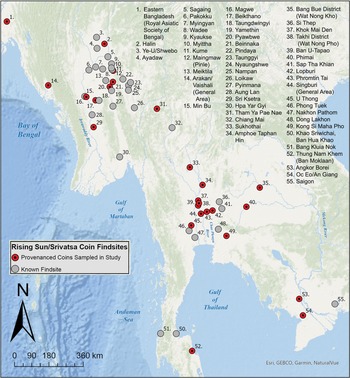
The ninth-century Man Shu (‘Book of the Barbarians’) of the Kingdom of Nanzhao (Yunnan) records that “[Piao] country uses silver coinage” in their transactions (Wicks Reference Wicks1992a: 115). While no definitive minting sites have been identified in Myanmar (Mahlo Reference Mahlo2012: 11–13), numerous find sites have been recorded along the coast of the Gulf of Martaban and the northern Irrawaddy River and its tributaries in the Sagaing region (Figure 2) (Htun Reference Htun2007). In turn, positive comparison of lead isotopes from silver-rich lead slags in the Bawzaing region of western Myanmar’s Shan Hills with isotope readings from coins found in Myanmar and Thailand identifies this region as a primary source of silver for coin production (Di Crocco Reference Di Crocco1992). Chemical analyses reveal a typical silver purity for these coins of 80–90 per cent, in some cases as high as 99.7 per cent (Mitchiner & Pollard Reference Mitchiner and Pollard1990; Wicks Reference Wicks1992a: 114).
Known Rising Sun/Srivatsa coin find sites across Southeast Asia (figure by authors using information from Htun Reference Htun2007; Mahlo Reference Mahlo2012; Epinal Reference Epinal2014; FAD n.d.).

Rising Sun/Srivatsa coins are one of several coin types originating from the area of Myanmar. Gutman (Reference Gutman1978: 8) suggests that each coin developed in this region was conceived similarly to contemporaneous South Asian coins, in that the obverse face was ‘political’, or emblematic of the state, while the reverse face was cosmological; this led early scholars to consider these coins as religious medallions. The earliest Southeast Asian silver coins are thought to have been produced in the Pegu region of the Gulf of Martaban at some point after the fourth century AD and feature an obverse image of a conch shell (sankha)—symbolising royal authority, dhamma (the eternal nature of reality and existence according to Hindu and Buddhist doctrines) and divine protection under various Hindu deities including Vishnu—with a Srivatsa on the reverse (see Goyal Reference Goyal1995: 123; Wicks Reference Wicks2024). Beyond southern Myanmar, conch/Srivatsa coins are found as trade imports and local imitations in Thailand and southern Vietnam (Mitchiner Reference Mitchiner1998).
While other silver coins, such as those struck with bhadrapittha (auspicious seat)/Srivatsa images, also appear in archaeological assemblages from this period (Htun Reference Htun2007: 82–83), no other early Southeast Asian coinage exhibits as widespread a distribution as those bearing Rising Sun/Srivatsa motifs. These coins share a relatively consistent configuration, with the obverse featuring a semi-circular ‘Rising Sun’ with 12 rays encircled by a border of 27 beads, a design inspired by Vedic astrology (Epinal Reference Epinal2014: 98). The reverse Srivatsa, meanwhile, is flanked left by a swastika and right by a smaller bhadrapittha, both below a circular or crescent moon and a four- to eight-rayed sun. It is likely that the image of the Rising Sun refers to a supreme title for a monarch, dynasty or realm (Mahlo Reference Mahlo2012: 15); the AD 1796 Burmese Glass Palace Chronicle notes the presence of a ‘Sun Dynasty’ in early northern Myanmar (Tin & Luce Reference Tin and Luce1923: 6–7), and it is thus possible that this image was conceived as a propagandistic icon of royalty.
Idealised full-unit Rising Sun/Srivatsa coins (‘Type 8a’: Mahlo Reference Mahlo2012: 33; or ‘Class A’: Wicks Reference Wicks1985) typically measure 28–35mm in diameter and weigh 9.2–9.4g, or 80 Ratti—a unit derived from ancient Indian measurements using gunja seeds (Rhodes & Ratnagar Reference Rhodes and Ratnagar1977: 104; Wicks Reference Wicks1992a: 118) (Figure 1, 1 & 2). Later regional and temporal variations (Figure 1, 3–10) are considered technical downgrades or local imitations, often featuring ‘errors’ in the designs (Mahlo Reference Mahlo2012: 33–45). As such, we argue through this study that detailed analyses of coins based on archaeological find sites should complement and refine existing stylistic analyses and typologies, clarifying the economic processes behind the production and distribution of each coin type and subtype (see Wicks Reference Wicks2024). For instance, smaller denominations found alongside full-unit coins, which are comparatively under evaluated, provide valuable insights into regional perceptions of wealth, exchange and power; Wicks (Reference Wicks1992a: 162), for instance, notes a soft divide on either side of the Malay Peninsula between practices of coin fractioning (half-, quarter-, eighth-, 12th- & 16th-cut coins) and minting of smaller denominations (typically 20, 10 & 8 Ratti).
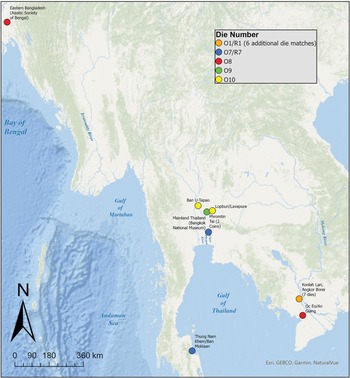
Map of die matched coins discussed in this study, labelled based on their exact find sites when known or relative find areas/current museum locations. See Table 1 for info (figure by authors).

Data collection/die study methods
While Rising Sun/Srivatsa coins are now typically associated with the site of Halin (Htun Reference Htun2007; Mahlo Reference Mahlo2012), contemporary coins of various subtypes, often locally reproduced, have been found across a remarkably broad area in mainland Southeast Asia. The highest concentrations outside Myanmar, however, come from sites on the opposite side of the Thai-Malay Peninsula, connected by river systems or situated directly along the Gulf of Thailand. Mahlo (Reference Mahlo2012: 12–13) notes that historical interpretations of these coins have been fragmented by colonial and post-colonial spheres of influence, and consequently these coins have rarely been analysed as an integrated artefactual dataset, with scholars often associating them with specific cultural-historical groups aligned with modern nation-state boundaries. For example, Rising Sun/Srivatsa coins discovered in Myanmar are often classified as ‘Pyu’/‘Pyu-Mon’, while similar coins in Cambodia and Vietnam are termed ‘Funan’ (Malleret Reference Malleret1959–1963; Vickery Reference Vickery2003). Thai scholarship also previously used ‘Funan’ (Krisadaolarn & Mihailovs Reference Krisadaolarn and Mihailovs2012) but now prefers ‘Dvaravati’, a term that reflects the sixth–eleventh-centuries Indianised Buddhist material culture of central-eastern Thailand where, alongside locally minted coins and inscribed medallions, these coins are typically found (see Murphy Reference Murphy2013; Revire Reference Revire2016). This diverse set of classifications emphasises the need for a more unified approach to studying Rising Sun/Srivatsa coinage as part of a broader, premodern economic and cultural network.
In addressing this shortcoming, our dataset assesses Rising Sun/Srivatsa coins as part of a cohesive artefactual record, comprising obverse and reverse images of full-unit specimens primarily from Myanmar, Cambodia, Vietnam and Thailand. These are either individual finds or derive from buried hoards numbering between three and 2000 coins (Mahlo Reference Mahlo2012; Epinal Reference Epinal2014: 108). Most of these coins are held in museum collections in their respective country of discovery (Malleret Reference Malleret1959–1963; Epinal Reference Epinal2014; Onwimol Reference Onwimol2018; Galloway Reference Galloway2022), while a small number are currently in the collection of the British Museum (see Mitchiner Reference Mitchiner1998: 105–106).
Data collection was undertaken between September 2022 and December 2023, compiling a comprehensive dataset of 1022 Rising Sun/Srivatsa coins of varying sizes, fractions and states of preservation. Coins were photographed, measured and inventoried with an RS number (‘Rising Sun’, e.g. RS0001) that may be cross-referenced with each participating museum’s original identification numbers. Only full-unit coins of secure provenance or museum origin are included in this study (see Table S2 in online supplementary material (OSM)), ensuring consistency with best archaeological practices and reducing our dataset to 245 coins (243 obverse/241 reverse photographs). As the current situation in Myanmar almost entirely restricts access to coins in previously published museum collections (see below), coins from find sites in this region of Southeast Asia are under-represented in the dataset.
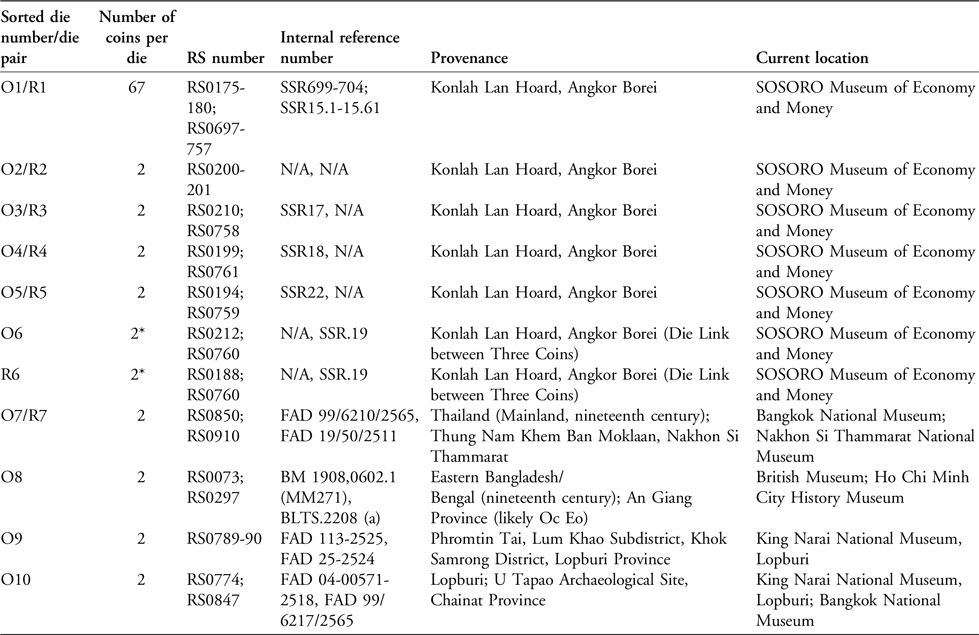
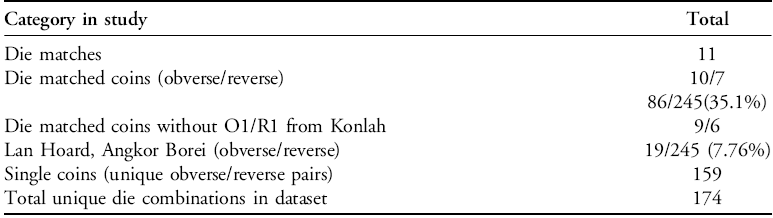
Through macroscopic analysis, we visually identified 10 obverse and seven reverse die matches among the 245-coin dataset. This suggests that reverse dies were exhausted more frequently, as seen in Roman contexts (Natarajan et al. Reference Natarajan2023). These matches account for 86/245 total coins, or 35.1 per cent of all assessed coins. However, 67 coins (27.3%) from the Konlah Lan hoard in Angkor Borei come from a single die pair (O1/R1) (referenced as ‘Die 1’ in Harris et al. Reference Harris, Cremaschi, Lim, De Iorio and Kwa2024), while 19 within the dataset (7.76%), found in diverse locations, originate from other dies, mostly in single pairs (Figure 3). Three struck die links were found between two coins (O6 & R6), also from Angkor Borei (Harris et al. Reference Harris, Cremaschi, Lim, De Iorio and Kwa2024: 1033). Table 1 illustrates the obverse/reverse die matches and provenances.
Table of die matches from study.

Summary of results from dataset.

Discussion
The geographic spread of ancient coinage provides important insights into the scale and complexity of early trade networks, particularly when combined with other archaeological evidence from the study of ceramics, inscriptions and imported goods (Bellina et al. Reference Bellina, Revire and Murphy2014; Borell et al. Reference Borell, Revire and Murphy2014). The dispersal of Rising Sun/Srivatsa coins across archaeological sites, for example, points to interconnected overland and maritime networks, with circulation along the Irrawaddy and Chao Phraya river systems and across the Malay Peninsula (Jaqc-Hergoualc’h Reference Jaqc-Hergoualc’h2002). These routes facilitated the exchange of diverse commodities, with coins most likely functioning both as currency and as stores of bullion value. Although specific transactional values remain unclear aside from evidence of smaller denominations and fractional issues, the distribution of these early silver coinages indicates that polities later identified as ‘Pyu-Mon’, ‘Dvaravati’ and ‘Funan’ were integrated into the broader economic systems of first-millennium AD Southeast Asia. The provenanced data for this study further highlights the diaspora of the Rising Sun/Srivatsa coinage across Southeast Asia, shedding light on the local production and distribution of these coins and their role as symbols of value both within and beyond centralised state apparatuses.
Identifying maritime trade routes
One of the most illuminating discoveries from this study was an obverse die link between coins found at two of the most geographically distant Rising Sun/Srivatsa coin find sites: RS0073, found in eastern Bangladesh/Bengal in the nineteenth century, originally held by the Royal Asiatic Society of Bengal and now in the British Museum (published in Mitchiner Reference Mitchiner1998: 105, no. 271; see Htun Reference Htun2007: 108); and RS0297, from Oc Eo housed at Vietnam’s Ho Chi Minh City History Museum (Figure 4, right (O8)). Both coins, exhibiting differing degrees of wear, share stylistic similarities with Type 8a coins minted in Halin; however, their discovery at opposite ends of Indianised Southeast Asia offers compelling evidence of extensive long-distance circulation, and explicitly demonstrates the eastward and westward movement of Rising Sun coinage from the Irrawaddy River Basin through the Gulf of Martaban.
Coins struck from die pair O7/R7 (FAD n.d.) and obverse die O8 (left: © The Trustees of the British Museum; right: HCMC History Museum) (figure by authors).

This match also provides support for commercial connections between the Andaman Sea and the Gulf of Thailand across the Malay Peninsula, a focus of debate in the history of early transmaritime Southeast Asian trade (Wheatley Reference Wheatley1961; Bellina et al. Reference Bellina, Revire and Murphy2014). Until the rise of the Sumatra-centric Kingdom of Srivijaya in the seventh century, archaeological and historical evidence indicates that trade routes bypassed this region through a series of more northerly transpeninsular portages (Manguin et al. Reference Manguin, Mani and Wade2011; Koad & Deesamatura Reference Koad and Deesamutara2024). This shortcut, guided by knowledge of monsoonal weather patterns, avoided the need to circumnavigate the Malay Peninsula, saving months of travel (Miksic Reference Miksic2013a: 55). Later reproductions of Roman geographer Claudius Ptolemaeus’s second-century AD guide to cartography, Hyphegesis Geographike—which paid special attention to trade routes and entrepôts along the Aureus Chersonneus (Golden Khersonese)—also depict portage routes across the peninsula (Wheatley Reference Wheatley1961: front matter). More recently, digital elevation modelling based on historical texts, known ancient settlements, the prevalence of similar artefact classes such as beads, ceramics and Brahmi script seals (Borell Reference Borell2021), and favourable terrain has attempted to simulate ancient routes across the Malay Peninsula (Koad & Deesamutara Reference Koad and Deesamutara2024).
Sites with Rising Sun/Srivatsa coins on both sides of the Malay Peninsula (Figure 2) are not fully considered within these digital models but may represent key way stations for ancient portage routes between the Andaman Sea and the Gulf of Thailand. These sites represent the southernmost known mainland Southeast Asian silver coinage findspots, with no specimens thus far published from Srivijayan archaeological contexts (see Wicks Reference Wicks1992a: 242–50; Miksic Reference Miksic2013a: 64–65; Reference Miksic2013b). The largest find of Rising Sun/Srivatsa coins in this region, a hoard numbering hundreds of full coins and cut fractions, was found at Thung Nam Khem, Ban Moklaan (modern Nakhon Si Thammarat) in 1976 (Wicks Reference Wicks1992a: 221). A brief stylistic examination of the remaining specimens indicates that most of these coins likely derive from north-central Myanmar rather than from mainland Thailand (see below); however, a crudely designed and heavily damaged coin within the hoard (RS0910) provides an exact obverse/reverse match with another coin found in mainland Thailand in the late nineteenth century (RS0850) currently housed in the Bangkok National Museum (Figure 4, left (O7/R7); FAD n.d.). This match is stylistically unique among the corpus of Rising Sun/Srivatsa coins examined and represents the only confirmed die link between a site on the Malay Peninsula and mainland Thailand. Assessed alongside the other fractioned or cut coinage from Ban Moklaan, this match provides strong evidence for trade along both north–south coastal and transpeninsular routes.
Reassessing regional minting practices in early Southeast Asia
Identification of the first seven die matches in Table 1 (including the 67 coins from pair O1/R1 (Figure 5)) initially derived from an earlier test comprising 90 Rising Sun/Srivatsa coins originating from two areas in the Mekong Delta (see Harris et al. Reference Harris, Cremaschi, Lim, De Iorio and Kwa2024): Oc Eo and the surrounding An Giang Province of Vietnam, and Angkor Borei in Cambodia. This region is traditionally considered the cultural and economic heartland of ancient Funan, whose history, economy and geopolitics are reconstructed from Chinese dynastic histories and temple inscriptions in Cambodia and Vietnam (Vickery Reference Vickery2003). Funan is believed to have established a sphere of influence around the Gulf of Thailand, strategically linking Indian and Chinese coastal trade networks (Coedès Reference Cœdès and Smithies1968; Stark Reference Stark, Bellwood and Glover2004). Consequently, a substantial collection of imported goods, including more than 500 full-unit Rising Sun/Srivatsa coins and cut fractions, survives from both sites.
Select coins cast from pair O1/R1, from the Konlah Lan hoard, Angkor Borei (SOSORO Museum of Economy and Money, see Harris et al. Reference Harris, Cremaschi, Lim, De Iorio and Kwa2024: 1030) (figure by authors).

Although these two areas were connected by an artificial canal (Sanderson et al. Reference Sanderson, Bishop, Stark, Alexander and Penny2007), the contexts in which the coins were found differ substantially. Almost all recorded Rising Sun/Srivatsa coins from Angkor Borei were found among the reportedly 2000-coin Konlah Lan hoard discovered in 2011 near the ancient settlement’s eastern gateway (Epinal Reference Epinal2014: 108). Coins from Oc Eo and surrounding An Giang Province, meanwhile, were collected as surface finds in the 1940s, although surviving documentation does not clarify whether these were found as hoards or single specimens (Malleret Reference Malleret1959–1963).
Coins minted from pair O1/R1, alongside two of the six other matched pairs from the Konlah Lan hoard, were reclassified as cast coins due to their granular textures and the reduced vibrancy of their designs compared to struck examples (Harris et al. Reference Harris, Cremaschi, Lim, De Iorio and Kwa2024: 11–12; Wicks pers. comm.). These findings challenge previous assumptions that early Southeast Asian coins, such as Greco-Roman and Indian coins, were exclusively struck, as seen in coinage from the Irrawaddy River Basin. Surviving ceramic moulds from Thailand—for example, a conch/Srivatsa mould from Lopburi and an unprovenanced Rising Sun mould housed in Bangkok’s Coin Museum (Onwimol Reference Onwimol2018: 72) (Figure 6)—indicate that casting technology was employed within local replication; moulds for replica Roman gilt pendants and coins have been uncovered at peninsular sites such as Khlong Thom, Krabi Province (Borell et al. Reference Borell, Revire and Murphy2014: 109–10) alongside crude cast imitations of gold conch/Srivatsa coins (Borell Reference Borell2021). The presence of moulds, cast coins and die-struck coins in the same region indicates diverse imitation practices within a unified economic sphere, and the casting of O1/R1 coins suggests that the influx of imported coinage from the Oc Eo region was locally replicated for acceptance in inland areas.
First-millennium AD coin moulds; examples from the King Narai Museum (conch/sankha motif), Lopburi (above) (FAD n.d., cited in Onwimol Reference Onwimol2018: 72) and Coin Museum Thailand (Rising Sun) (below) (Treasury Department, Thailand) (figure by authors).

Beyond coastal entrepôts, our study identified two separate obverse die matches from three Dvaravati-labelled within the Chao Phraya River Basin that evince local and inter-regional overland and riverine trade involving Rising Sun/Srivatsa coinage (see Lertrit Reference Lertrit2003): RS0789/RS0790 from Phromtin Tai (Figure 7, O9), and RS0774 (Lopburi) and RS0847 (Ban U-Tapao, Chainat Province) (Figure 7, O10). All four coins are stylistically similar to others found at Dvaravati sites in this region (FAD n.d.), which suggests a limited number of production sites. Archaeological investigations have revealed an extended history of metalworking and associated infrastructure in the region (Wilikaew Reference Wilikaew1991; Lertcharnrit Reference Lertcharnrit, Revire and Murphy2014), including Bronze and Iron Age (750 BC–AD 500) copper production at both Phromtin Tai and Ban U-Tapao, which suggests the possibility that coins may have been locally minted in these areas, likely from imported silver (see Di Crocco Reference Di Crocco1992). The generally narrow stylistic diversity among coin finds surveyed from this region (FAD n.d.) also suggests that sites such as Phromtin Tai and Ban U-Tapao may have benefitted from local or down-the-line trade rather than serving as major commercial hubs, and thus produced or hoarded Rising Sun/Srivatsa coins to engage in broader economic and trade networks through polities such as Lopburi, which features a more regionally diverse assemblage of coins among its archaeological remains (FAD n.d.).
Coins struck from O9 (Ban Phrom Tin, Lopburi Province) and O10 (Lopburi and Ban U-Tapao) (both obverse only) (FAD n.d.) (figure by authors).

Leveraging die studies to combat looting and preserve cultural heritage
In creating the dataset analysed in this article, a preliminary survey of the available corpus of Rising Sun/Srivatsa coin images revealed a large number of die matches among unprovenanced specimens. These coins were primarily found listed in online auction databases (e.g. acsearch.info & numisbids.com) and on informal collector forums such as the Oriental Coins Database (zeno.ru), while others were published in private collections with academic collaboration from local and international experts (Mitchiner Reference Mitchiner1998; Krisadaolarn & Mihailovs Reference Krisadaolarn and Mihailovs2012; Mahlo Reference Mahlo2012). Where provenance is lacking, object biographies (see Gosden & Marshall Reference Gosden and Marshall1999) are often constructed based on stylistic classification and anecdotal narratives rather than verifiable documentation.
The widespread circulation of unprovenanced early Southeast Asian silver coins highlights the broader issue of the illicit antiquities trade. This raises significant ethical concerns, as the loss of contextual and historical data from such artefacts is irreversible and severely undermines both the reliability of future historical reconstructions and the integrity of historical sites (Brodie Reference Brodie and Hoffman2006: 52). In countries such as Myanmar, where conflict has persisted for more than half a century, the opportunistic looting of antiquities serves as a critical source of sustenance amid economic instability; numismatic scholar Than Htun reported Pyu coins are frequently seen melted down by modern silversmiths in Yangon, “turning valuable coins into ingots … bought only as silver scraps” (Htun Reference Htun2007: 1). A similar explanation is provided by Cambodia’s SOSORO Museum for the reason behind the diminishment of the Konlah Lan hoard after its initial discovery (Epinal Reference Epinal2014: 108; see Table S2). Footnotes within published collections and auction records in turn reveal that many coins were acquired from dealers in the 1970s and 1980s, a period postdating the typically cited 1970 UNESCO Convention aimed at curbing the illicit trade of cultural property (Brodie Reference Brodie, Green and Mackenzie2009: 45). In fact, the perpetuation of these unscrupulous sourcing methods to meet the demand of collectors has resulted in “most of the extant coins [from Pyu sites] … [having] been dug up informally and … known only when they appear on the antiquities market” (Hudson Reference Hudson2024: 153). It may be in part for this reason, as Epinal laments (Reference Epinal2014: 96), that “[Southeast Asian] numismatists and archaeologists are not inclined to cross-reference or pool their data”.
In surveying the available coins, we have observed how collection trends fragment numismatic evidence. In particular, the loss of context makes futile any die matches identified between individual, properly excavated coins held in regional museums and unprovenanced market specimens. Such matches could otherwise have served as essential evidence highlighting, for example, overland trade in silver coinage (see Wicks Reference Wicks, MacDowall, Sharma and Garg1992b). Additionally, an abundance of die matches from sources such as online auction databases, informal collector forums, and private collections between later Rising Sun/Srivatsa coins (c. ninth–tenth centuries) cross-referenced with unpublished, excavated finds from Myanmar’s Inle Lake region (see discussions by Mahlo Reference Mahlo2012: 12, and Htun Reference Htun2007), points to a restricted range of later silver coinage. This would provide some evidence for a decline in the transactional use of currency across Southeast Asia after the seventh century, a trend not only coinciding with a southward shift in the focus of maritime trade towards Srivijaya (Miksic Reference Miksic2013a: 65, 73–79) but also with the emergence of more insular, centralised agrarian states in mainland Southeast Asia such as Cambodian Zhenla (c. seventh–ninth centuries) and later Burmese Pagan (c. ninth/tenth–thirteen centuries), which did not produce minted currency (Wicks Reference Wicks1992a: 122–24, 186–93). Finally, almost all known smaller-unit (20, 10, 8 ratti) coins come from unprovenanced private collections, some even noted as being ‘recovered’ from hoards (Mitchiner Reference Mitchiner1998), precluding a proper contextual assessment of smaller minted denominations and their role in the ancient ‘Pyu-Mon’ economy. We anticipate that these trends will be verified over time through proper excavations and documentation.
Given the abundance of identical coins salvaged from the Konlah Lan hoard, the numerous die matches across coins from private collections and auction houses suggest that many of these coins likely originated from at least the same regions, if not the same hoards. The fragile state of antiquity preservation in Myanmar makes it plausible that these coins were looted from known archaeological sites and distributed through interconnected networks of illicit antiquities dealers. Die studies and resulting die matches thus have the potential to become invaluable tools for tracing the origins of coins, as well as identifying forgeries, which are notably prevalent in both Myanmar and Thailand (Raymond Reference Raymond2014; Hudson Reference Hudson2024: 153). Increased scrutiny of coins listed by auction houses and private collections, along with their acquisition practices, could further illuminate these connections and expose unethical procurement. This shift in focus would also help transition the study of ancient coinage from what is often referred to as a ‘hobby of kings’ towards a more rigorous academic discipline and, importantly, help further bridge the gap between numismatics and archaeology (see Holt Reference Holt2021).
Conclusion
Die studies are an important and efficient tool for archaeologists and historians, enabling precise and extensive analysis of ancient coinage and its role in shaping historical trade and cultural connections. This approach is especially valuable in the study of first-millennium AD Southeast Asian coinage, a field still underdeveloped compared to the extensively analysed currency economies of Rome, India and Central Asia (Sutherland & Carson Reference Sutherland and Carson2018; Bracey & Cribb Reference Bracey and Cribb2024). The die study presented here, highlighting 10/7 obverse/reverse die matches across 245 full-unit Rising Sun/Srivatsa coins, has considerable implications for understanding early Southeast Asian trade networks, providing insights into key ports and settlements, further assessing the role of weighted silver in ancient trade, and mapping the expansion and contraction of currency-based economies in mainland Southeast Asia along with the polities that minted them. We expect that future die studies of other contemporaneous Southeast Asian silver currencies, such as conch/Srivatsa coins and even discernible coin fractions (half & quarter), will expand on these insights, and anticipate that die studies will assist in better tracing the provenance of coins from Myanmar once systematic excavations at key sites such as Halin resume, advancing our understanding of historical coin usage and minting practices while helping to curtail the illicit facilitation of antique-coin collection in this region.
Acknowledgements
The authors extend their gratitude to the museum staff and administrators from Cambodia’s SOSORO Museum of Economy and Money (Blaise Kilian), the Ho Chi Minh City History Museum in Vietnam (Dr Hoang Anh Tuan), and the National Research Council and Fine Arts Department of Thailand for granting us access to their collections. Sincere thanks to Dr Robert Wicks for his guidance and advice throughout various stages of this project.
Funding statement
This work was written under National University of Singapore Grant MOE-T2EP40121-0021.
Online supplementary material (OSM)
To view supplementary material for this article, please visit https://doi.org/10.15184/aqy.2025.77 and select the supplementary materials tab.



 Open access

