




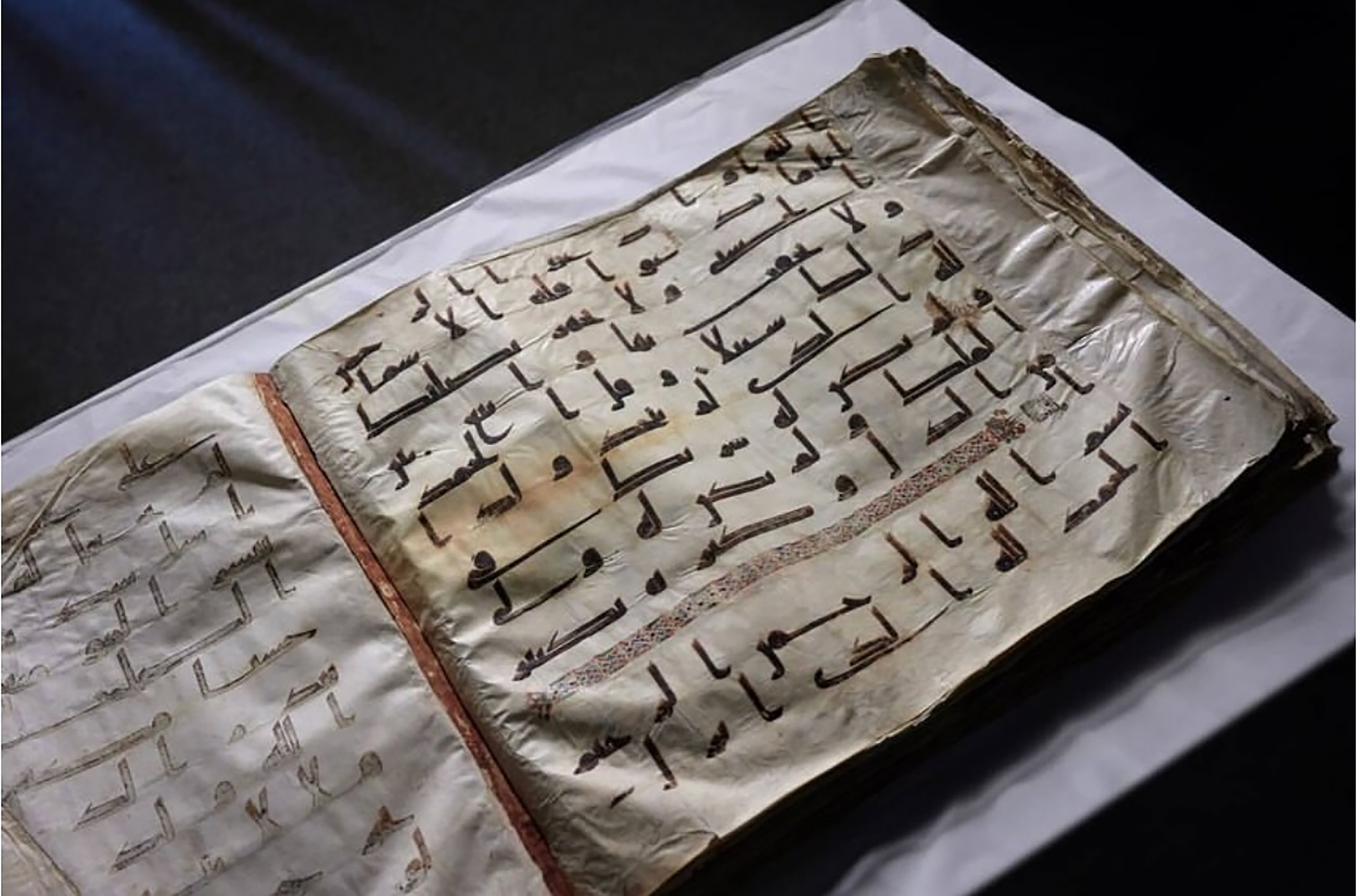
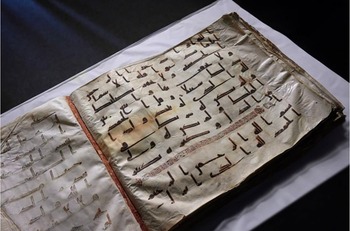
On 9 August 1923, a special train escorted by a guard of honour pulled into Tashkent station, carrying one of the oldest Quran manuscripts in existence.Footnote 1 It was widely believed to be the personal Quran of Uthman ibn Affan (573/6–656 ce)—the third caliph and son-in-law of the Prophet Muhammad—and stained with his blood, as he was martyred while reading it (Figure 1).Footnote 2 According to tradition, Uthman oversaw the compilation of the first canonical version of the Quranic text and distributed copies across the Islamic territories, ordering all divergent manuscripts burned.Footnote 3 The codex that arrived in Tashkent in 1923 is one of several that purport to be the copy that Uthman retained for his personal use and was assassinated upon.Footnote 4 From the station, this holy relic was ceremonially borne to the Khoja Ahrar mosque. Having spent nearly fifty years in St Petersburg, capital of the Russian empire, where it had been taken by Russian forces following the conquest of Samarkand in 1868, this Quran’s return to Central Asia following imperial collapse, communist revolution, and civil war was loaded with political symbolism. Unsurprisingly, this became a much-mythologized event, and later accounts emphasized that people gave speeches expressing ‘gratitude to the Soviet government and the great leader Lenin’ for having restored the Uthman Quran to Turkestan, an act celebrated as a ‘particularly vivid manifestation of the Soviet government’s solicitude for the Muslims’.Footnote 5
The Uthman Quran, primarily known in recent scholarship as the Samarkand or the Tashkent codex. It consists of 338 parchment leaves measuring 68 x 53 cm. Many of the original leaves are missing. Source: Center for Islamic Civilization, Tashkent.
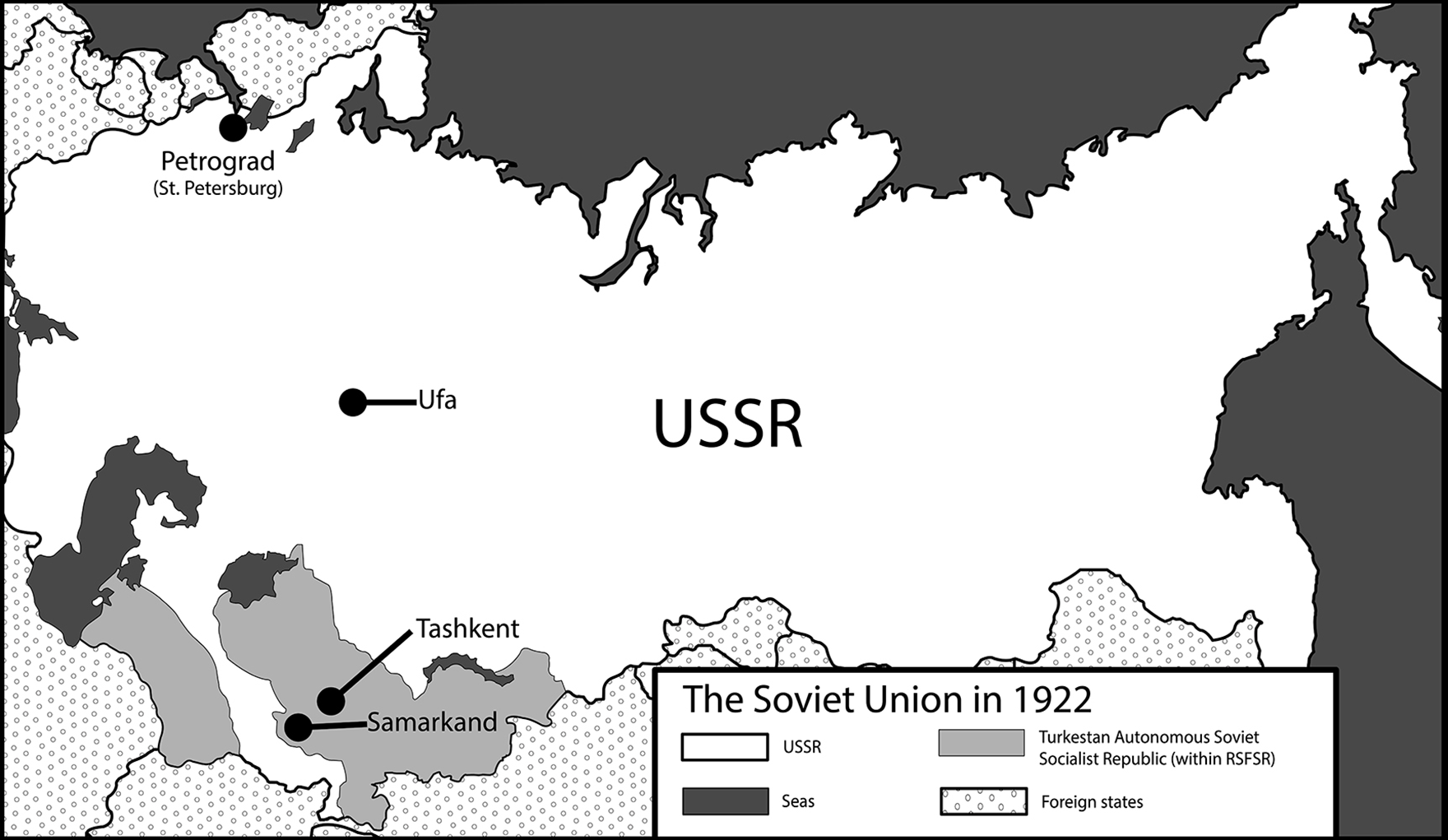
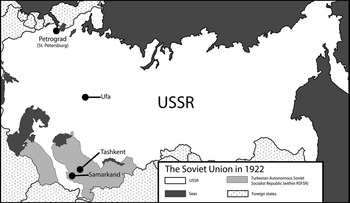
The Soviet government certainly did not orchestrate the Quran’s ‘return’ out of sheer magnanimity, and in fact was largely reacting to events initiated by Muslim authorities and local communists whose aims often conflicted with Moscow’s. Various groups contested the Quran’s ownership, and their debates illustrate how Muslims in the collapsing Russian empire made new claims to political authority after the 1917 revolutions, invoking religious, national-territorial, and ideological reasons to be considered its rightful owners.Footnote 6 This article traces these debates and the Quran’s journeys from St Petersburg to Ufa to Tashkent between 1917 and 1923, and its subsequent life as a museum artefact (Figure 2).Footnote 7 Readers familiar with Bolshevik policy towards religion as characterized by militant hostility and destruction will find it surprising that the Soviet government invested any effort in carefully conveying an ancient Quran to the Muslim groups who asked for it. But the logic of Soviet nationalities policy—which sought to correct imperial injustices and integrate non-Russians into the new order—and the need to co-opt local elites in Muslim regions meant that, in practice, the party line towards Islam fluctuated constantly.Footnote 8 In Central Asia, the first decade after the revolution was characterized by cautious alliances between Muslim and Soviet institutions.Footnote 9 The role of material culture in these negotiations has not yet been explored.Footnote 10
Map of the Soviet Union on its formation in 1922, showing the four cities where the Uthman Quran was successively kept: Samarkand, Petrograd (St Petersburg), Ufa, and Tashkent. The area shaded in light grey is the Turkestan Autonomous Soviet Socialist Republic, a territorial-administrative unit which existed within the Russian Soviet Federative Socialist Republic between April 1918 and October 1924, with its capital at Tashkent. Map courtesy of Jonathan Tenney.
We argue that the Quran’s transfer to Turkestan was an act of decolonization, a symbolic gesture motivated both by realpolitik and ideological principles. The state’s grip on power in Central Asia was extremely tenuous well into the 1920s, beset by resistance and barely extending beyond the urban areas dominated by European settlers. Public demonstration of the Bolsheviks’ supposed allegiance with local Muslims had strategic political value, but this pragmatism existed within the episteme of Leninist anti-imperialism and the revolutionary potential of the ‘East’, making a socialist correction to Russian colonial extraction desirable in ideological as well as political terms. Masha Kirasirova has argued that the ‘East’—the colonized and semi-colonized places where Bolsheviks hoped to stoke anti-imperial revolution as a strike against global capital—was ‘both an abstract object of Marxist thought and a concrete space of Soviet politics’.Footnote 11 The case of the Uthman Quran exemplifies how these two realms intersected.
Decolonization Bolshevik-style was, then, opportunistic, reactive, and politically strategic as well as highly ideologically charged. Split-second decisions made by the party leadership—in the middle of fighting a revolutionary war—in response to the agency of people far more invested in this issue than themselves came to be interpreted as the logic of Soviet anti-imperialism itself. We define decolonization not as an abstract ethical principle but as a thing that people sometimes try to do—an attempt to rid a sphere of activity from the effects of colonization—in specific historical and political conditions. The Bolsheviks themselves described their own politics as ‘anti-imperialism’ or ‘colonial revolution’, and a significant body of scholarship debates whether the Soviet Union was fundamentally colonial or imperial in character.Footnote 12 We argue not that the state itself was (de)colonial, but that strategic decolonization—as an action rather than a political orientation—was part of the Soviet repertoire of power in early 1920s Central Asia. This argument has been made in other contexts, most convincingly by Niccolò Pianciola regarding the expulsion of Slavic settlers from indigenous lands in Semirech′e.Footnote 13 It has not yet been made in relation to another form of decolonization that garners heated debate in the twenty-first century: the return of cultural property from Western institutions back to where it was purloined by imperial forces.
Decolonization, and particularly the repatriation of cultural property, is typically considered a product of the post-Second World War liberal global order.Footnote 14 From the Parthenon Marbles to the Benin bronzes, many high-profile objects have been subject to restitution claims by the descendants and successor states of colonized peoples. Largely through the legal framework established to restore Nazi-looted artworks to their dispossessed Jewish owners, some such claims have been successful. Even within the Soviet Union, manuscripts once looted from the Khans of Khiva were sent from Leningrad to Tashkent in 1962, ‘an initiative which today would smack of processes of decolonisation and post-colonial restitution’.Footnote 15 The Uthman Quran may be the earliest case of this kind globally, and it offers an alternative ideological lineage and timeline to the assumption that decolonization was born of the post-war era. Our argument therefore aligns with others that trace ideas associated with the post-colonial turn of the 1960s–70s back to Soviet-aligned Marxist intellectuals of the 1920s.Footnote 16 It is remarkable how many details of the case of the Uthman Quran foreshadow issues surrounding the politics of repatriation today: contested ownership, especially when groups claim to represent a historical community that no longer exists in the same form; debates over the adequacy of heritage institutions and legislation to keep artefacts physically safe; and the significant role played by diplomacy and transnational power politics in the movement of objects. In its complexity and multipolarity, the case of the Uthman Quran thus helps us to problematize decolonization as an epistemic framework for thinking about imperial and post-imperial contexts and to historicize decolonization as a political act.
Imperial loot: The Quran in St Petersburg, 1869–1917
By the time Russian Major General Aleksandr Konstantinovich Abramov and his army arrived in Samarkand in 1868, it was widely believed locally that the Quran in the madrassa of Khoja Ahrar was the authentic Quran of Uthman.Footnote 17 Multiple hagiographic narratives surrounding the transmission of the Quran to Turkestan circulated locally at that time, which highlighted the role of murids of the Naqshbandi master Khoja Ahrar in its transmission, sanctifying the cities of Tashkent and Samarkand as centres of learning in the religious sciences.Footnote 18 The passage of the Quran, stained by the holy blood of the third Caliph himself, allegedly from Medina to Istanbul and then to Samarkand, constituted a material link between the cities of Central Asia and the landscapes of early Islamic history.
The removal of the Quran to the Imperial Public Library in St Petersburg in 1869 is a quintessential example of the coerced removal of cultural property as an integral part of colonial conquest. Nor was it the only priceless artefact looted from Central Asia: soldiers were instructed to collect antiquities, identified and appraised by scholars accompanying the army, to the extent that ‘Russian officials, in general, were obsessed with Oriental manuscripts’.Footnote 19 Having already decided to take the Quran, Abramov commissioned Lieutenant Colonel Vasilii Rodionovich Serov, commander of Samarkand District, to collect testimony ‘to investigate whether the acquisition by us of that manuscript would in any way violate the religious susceptibilities of the community’.Footnote 20 Conveniently, the depositions provided by the ulama and ‘certain honorable persons of Samarkand’ perfectly aligned with Abramov’s intentions, claiming that the Quran was ‘of no importance either to the Muslim community or to the Mosque’. The interviewees emphasized that while ‘formerly (indeed, very long ago) [the Quran] used to attract many worshippers, lately only the Emirs arriving at Samarkand have worshipped before it’, and no locals were able to decipher its Kufic script. Konstantin Petrovich von Kaufmann, the first governor-general of Turkestan, reported to St Petersburg that the ulama of the Khoja Ahrar mosque handed the Quran over to General Abramov, who ‘in return for it donated from his own money 500 kokans (100 roubles), with which the clergy of Samarkand were completely satisfied’.Footnote 21 However, the Tashkent-based Russian newspaper Turkestanskie vedomosti reported that ‘seeing the value which the Russians set on this relic, some of the fanatical mullahs thought to remove it to Bukhara’ but this was prevented by Abramov, casting doubt on the purely voluntary nature of the exchange.Footnote 22
The assumption of consent was further refuted by Russian orientalist Aleksei Fedorovich Shebunin, who in 1891 began his palaeographic exegesis of the Quran with a damning appraisal of Kaufmann’s narrative. Shebunin was faced with ‘involuntary doubts about the truth of the testimony about the voluntary surrender of such a sacred book into the hands of the infidels, conquerors, and recent enemies’, and suggested that no small degree of coercion played a role in pressuring the ulama to hand over the Quran.Footnote 23 As for the allegation that nobody could read its archaic Kufic script, Shebunin described how he witnessed a Tatar mullah ‘smartly read several lines from the Quran’, adding: ‘given that all Muslims have a system in place for memorizing the Quran by heart, reading the Quran, regardless of the style of Arabic script, obviously can’t present any difficulties’. Most importantly, Shebunin thoroughly dismissed the idea that the Quran currently ‘has no meaning whatsoever for Muslims’, describing how by the 1890s, even ‘in the Public Library of Saint Petersburg, and thus deprived of any semblance of a sacred environment, the Quran still serves as an object of zealous worship for both local and visiting Tatars, Central Asian embassies, and in general many Muslims who pray to the Quran and kiss the stains of the “sacred blood of Uthman” imbrued in it’.Footnote 24
By the 1910s, the Muslim population of St Petersburg reached over 15,000 people, of whom Tatars from Kazan, Penza, and Nizhnii Novgorod were the largest groups.Footnote 25 As Shebunin hints, it was through the Imperial Public Library, totally decontextualized from the cultural and religious environment in which the Quran had been kept for centuries, that the Uthman Quran, previously only a locally recognized Central Asian relic, became known and recognized as authentic by a multi-ethnic audience of Muslims from across the Russian empire.Footnote 26 The formation of a Russian imperial Muslim culture around the Quran is best represented by the All-Russia Muslim Congresses of 1906 and 1914 in St Petersburg, whose delegates visited it in the Public Library.Footnote 27 The imperial state quickly picked up on the cross-cultural prestige of the Quran as a symbol of sovereign power, and moved to use it for both internal and external diplomacy with Muslim leaders and populations.
As well as permitting visits by Muslim delegations to see the original, the Quran was instrumentalized using new techniques in lithography. In March 1902, the library sanctioned the production of fifty full-scale lithographic facsimiles by the St Petersburg merchant and bookseller Semen Ivanovich Pisarev and the academic Vasilii Ivanovich Uspenskii.Footnote 28 Pisarev sold some to collectors, while others became diplomatic gifts. The Minister of Foreign Affairs, Count Vladimir Nikolaevich Lamsdorf, gifted one each to the Ottoman Sultan Abdul Hamid II and the Persian Shah Muzaffar al-Din. Within the empire, one facsimile was sent to the Turkestan Public Library in Tashkent while two were given to the Bukharan Emir Abdul Ahad Khan and his successor Mir Muhammad Alim Khan, then ruling Bukhara as a Russian protectorate. The director of the Turkestan library, Iosif Feliksovich Pliatt, considered it ‘extremely necessary’ that, as a ‘holy relic of the Muslims [sviatynia musul′manstva]’, a facsimile be gifted to his library in honour of its founder, General von Kaufmann himself.Footnote 29 That is, Pliatt suggested that Kaufmann’s original ‘gift’ to St Petersburg merited some ‘thanks’ to colonized Turkestan, but unlike the anti-imperial arguments for the return of the original Quran made after 1917, the Turkestani side was represented not by the Muslim population but a scholarly institution run by European settlers. Finally, one facsimile was presented to Tsar Nikolai II, underscoring the transcendent, trans-confessional nature of his imperium.Footnote 30
The fifty years the Uthman Quran spent as a treasure of the Imperial Public Library are key to understanding how it became a symbol of revolutionary decolonization after 1917. During this time, its political and social meanings as an object were transformed. First, the imperialist justification of its removal from Samarkand was challenged. In a manner typical of European colonists in the nineteenth century, Kaufmann and Serov claimed that the present-day inhabitants of Samarkand did not value the codex nor understand its extreme rarity and antiquity.Footnote 31 These implausible claims were parroted by Russian newspapers, which celebrated the Quran’s removal to St Petersburg as the salvation of a great ‘antiquity, invaluable to science’.Footnote 32 But as Shebunin’s critique shows, even Russian scholars within imperial institutions seriously distrusted the narrative of voluntary surrender and cast doubt on the Imperial Public Library’s claim to legitimate ownership. Secondly, its location in the imperial capital ensured that it was no longer a local relic venerated solely in Turkestan but became known among diverse populations of Muslims across the Russian empire and beyond. Finally, sending facsimiles to foreign Muslim sovereigns, the protectorate of Bukhara, and Turkestan shows how material objects were used to make political overtures on an imperial and trans-imperial stage. The power of a state to remove, transfer, and gift precious objects within or without its borders is always an expression of authority, and often a manifestation of its political ideology and a bargaining chip to win allegiances. Naturally, the potential political value of the original Uthman Quran far exceeded that of its copies, as evidenced by the prominence it gained amidst the upheavals of revolution.
Revolutionary restitution after 1917
The seismic political changes of 1917 had profound implications for Muslims in the former Russian empire. Many greeted imperial collapse with enthusiasm, seeing an opportunity for the formation of new political entities offering greater autonomy or even full self-determination for embryonic Muslim ‘nations’ living under Russian rule. Although the Bolsheviks ultimately established their authority, this was not a foregone conclusion in the chaos of revolution and civil war, and their eventual victory relied on making pragmatic alliances between 1917 and the early 1920s. As avowed anti-imperialists, the Bolsheviks called for the liberation of the colonized peoples of the East for both strategic and ideological reasons. Perhaps taking such slogans at face value, a variety of Muslim groups petitioned the highest levels of Soviet power for greater rights, freedoms, and the return of ‘their’ Uthman Quran. These petitions demonstrate that some Muslims imagined a vastly expanded horizon of political possibilities brought about by revolution, and the ways they characterized their competing claims to the Quran reveal how they imagined new forms of religious-political authority after 1917. The fact that the Bolsheviks accepted some of these claims, and indeed ‘returned’ the Quran, likewise illustrates the scope and limits of their anti-imperial politics.
Two petitions for the return of the Quran were, sequentially, successful: the first made by the Central Spiritual Administration of Muslims in Ufa in December 1917, and the second made on behalf of the Muslims of Turkestan in June–July 1923. The first originated in the wake of the February Revolution, as an All-Russian Muslim Congress gathered in Moscow in May 1917 to debate the future of Muslim life and governance after the fall of the tsar. Unlike many Muslim groups from the borderlands of the Russian empire, such as Caucasians, Central Asians, and Crimean Tatars who advocated for an ethnicity-based conceptualization of national identity supported by national-territorial autonomy, the more geographically dispersed Volga Tatars largely advocated the Austro-Marxist line of national-personal autonomy, under which a unified ‘Muslim parliament [would be] responsible for Muslim affairs across the entire territory of the former Russian Empire’.Footnote 33 The Congress voted for a split model, enshrining the principle of national-territorial autonomy for Muslims living in the ‘borderlands’ and national-cultural autonomy for those in European Russia and Siberia (where the formation of national republics was assumed to be impossible). Following this decision, Tatar Unitarists declared the ‘Turko-Tatar autonomy’ of the National-Cultural Autonomy of the Muslims of Inner Russia and Siberia (Milli Idarä) on 22 July 1917, with a National Assembly (milli mäjles) for political affairs and Spiritual Administration or muftiate (Russian: dukhovnoe upravlenie musul′man; Tatar: diniia näzaräte) for religious affairs in Ufa, the long-standing seat of the Orenburg Muslim Spiritual Assembly.Footnote 34
Milli Idarä’s regional organ in Petrograd held its first congress from 2–6 December 1917, where they unanimously agreed to send a letter to the People’s Commissariat for Nationalities expressing the desire of ‘all the Muslims of Russia’ that the ‘sacred treasure’ of the Public Library, the Uthman Quran, be immediately handed over to the congress.Footnote 35 Having already unsuccessfully petitioned the Provisional Government earlier that year, they hoped for a different answer from the Bolsheviks.Footnote 36 On the first day of the regional congress, before even sending the letter, the local Muslim leader Usman Tokumbetov and Ufa representative Ahmed Tsalikov met Joseph Stalin, who, according to an Izvestiia report, assured them that ‘if the Muslims demand it, their national relic [natsional′naia relikviia] will be solemnly returned’.Footnote 37 Stalin’s framing of the Quran as the ‘national relic’ of a trans-ethnic Russian Muslim nation contradicts his emphatic repudiation of Austro-Marxist Otto Bauer’s characterization of Jewish groups in the Russian empire as a nation, where he decried the idea that the ‘petrified religious rites and fading psychological relics’ of Jewish religious life would be enough of a force to constitute nationhood.Footnote 38 Instead, it mirrors the framing of Vladimir Lenin and Stalin’s famous appeal To All the Labouring Muslims of Russia and the East, issued only five days after the meeting with Tokumbetov and Tsalikov, in which they address the ‘Muslims of Russia’ on separate terms from the ‘Muslims of the East’ (Persians, Turks, Arabs, and Indians), each of which they treated as a distinctive Muslim nation.Footnote 39
Echoing Tsalikov’s own theory of a trans-ethnic Russian Muslim nation united through the Russian language and state, the appeal adopted a culturally bounded demarcation of nationhood for Muslims within what would become the Soviet Union versus an ethnically and territorially bounded delineation for those outside of it. This legitimized, in Marxist-Leninist terms, the predominantly Tatar muftiate’s claim to speak on behalf of all the Muslims of Russia, a status it directly inherited from the pre-revolutionary Orenburg Muslim Spiritual Assembly. According to this logic, the Quran could be ‘returned’ to Ufa, a place it had never been before. Approved by Lenin, Vladimir Dmitrievich Bonch-Bruevich, and later Anatolii Vasil′evich Lunacharskii in December 1917, the Uthman Quran was moved to Ufa in January.Footnote 40
Mere months into the revolution, in a city ravaged by food shortages, the Bolshevik leadership had more pressing concerns than the ownership of a 1,200-year-old manuscript, but embraced the opportunity to win the allegiance of the Tatar national assembly, aware of the value of a symbolic gesture that could bolster their anti-imperial credentials. Still, many Muslims were unaware of the Quran’s ‘return’ and were not at all convinced that the new Soviet government would protect their customs and beliefs. The Russian-trained military general-turned-warlord Mikail Khalilov addressed the people of Dagestan in June 1919:
Disavowing God, disavowing religion, recognizing neither divine nor human laws, this Russian Bolshevism—in a sea of human blood—began ruthlessly destroying everything that had been created through thousands of years of the hardest work inspired through faith in God and human talent. So they destroyed the greatest monuments of art and architecture, defiled mosques and churches, and stole from the main mosque of Petrograd—built from the generous donations of the Emir of Bukhara and all Muslims inhabiting Russia—one of the rarest copies of the Quran, written in the hand of the Caliph Uthman himself, which they abused and tore to shreds.Footnote 41
While the St Petersburg Cathedral Mosque, opened December 1913, had indeed been financed by donations from the Bukharan Emir Abdul Ahad Khan and the Muslim community at large, there remains no indication that the Uthman Quran was ever kept there. Whether or not Khalilov genuinely believed that the Bolsheviks had destroyed it, the fact that he began his speech with this anecdote to incite anti-Bolshevik fervour among Dagestanis demonstrates the geographic breadth of the Uthman Quran’s reputation. As in the case of the Tatar Muslims who encountered it in the Imperial Public Library, in Khalilov’s speech the Uthman Quran is totally decontextualized from its Samarkandi history and instead derives its spiritual authority from Uthman himself.
Others invoked the Quran’s ‘return’ as proof of the new state’s supposedly favourable policies towards Muslims. According to a letter sent from Turkestan to Georgia in November 1919, an unnamed ‘Communized Muslim agitator’, speaking ‘to the rapt attention of an audience of thousands’, contrasted the evils of European imperialism with Bolshevik rule.Footnote 42 ‘A feeling of hatred towards the Muslim people, towards our religion of Islam, even towards the very person of the great prophet Muhammed is common to all Europe … What they, Europeans, call sacred, nationalism, and patriotism at home, what they call national honour at home, here, among Muslims, they call ignorant fanaticism and chauvinism.’ But the Bolsheviks were different: ‘the Soviet government, which is implementing your national independence and promises to leave your lands in your hands—that is where our salvation lies, that is who the whole Muslim world should follow’. As evidence of this claim, the speaker added: ‘the Soviet government has proven its respect for our religion: it has returned to us the sacred Uthman Quran that was taken away by the Tsarist government from Samarkand to St Petersburg’. Supposedly, this speech provoked ‘shouts of approval and even sobs from some elderly listeners’, suggesting that audiences did take the Quran’s ‘return’ as proof that the Bolsheviks were serious about treating Muslims better than European imperial powers did.Footnote 43 Both the warlord Khalilov and this anonymous communist agitator, to opposite ends, rhetorically used the treatment of the Uthman Quran as a litmus test for Bolshevik politics towards Muslims.
This agitator was not Turkestani: his satisfaction with the Quran’s ‘return’ to Ufa may be explained by the fact most Muslim communist agitators in Turkestan in this period were Tatar.Footnote 44 Not all Muslims, however, accepted Ufa as the Quran’s rightful home or the right of the Tatar national assembly to speak on their behalf. A petition made in March 1919 further attests to the codex’s appeal for Muslim groups far removed from Turkestan. By telegram, a self-proclaimed ‘Council of Volga-Bulgarian Muslims of the Workers and Cultivators of the Green Army Väisi Warriors of God’ addressed Lenin ‘with a demand in the name of truth and justice’ to give them the Uthman Quran. The Väisi movement, led by the Kazan merchant Bähavetdin Väisev, emerged in the second half of the nineteenth century and has been compared to the Salafi movement insofar as it proclaimed a return to ‘pure’ Islam. For Väisev, the main enemies of Islam were the Tatar ulama associated with the Russian authorities. After his death, the movement—whose adherents were mainly Tatar peasants, artisans, and small-scale traders—was taken over by his son Gainan Väisev and operated underground until the Civil War, when they supported the Bolsheviks.Footnote 45 Among the Väisis’s demands to Lenin were that he ‘destroy the spiritual congregation and false preachers’ of Ufa, declare a ‘Volga-Bulgarian Revolutionary Republic’, and give them the Uthman Quran.Footnote 46 They were ignored. The Väisis’s claim to the codex was evidently motivated by a deep distrust of the muftiate in Ufa and the belief that they themselves represented a purer, higher spiritual authority sanctioned by God.
Although they possessed vastly differing levels of political and institutional power—which explains why one was successful and the other not—the Spiritual Administration in Ufa and the Väisis both claimed the Uthman Quran on purely religious grounds: they considered themselves the highest representatives of Islam in the territory of the former Russian empire, and, as such, the rightful owners of the codex. But the Muslims of Turkestan had a different stake in its ownership: not a higher spiritual status per se but a moral claim to restitution, since it was from Turkestan that the Quran had been taken in 1868. The staff of the Imperial Public Library agreed, and even attempted to delay the handover of the Quran to Tokumbetov because they opposed the destination of Ufa, releasing it only on the understanding that it would go to Samarkand instead. Footnote 47 Aleksandr Eduardovich Schmidt, one of the library’s scholars, reported that when he suggested that ‘Samarkand possesses the strongest right to this relic’, Tokumbetov replied that ‘as soon as Samarkand asks for it, the Quran will be sent there’.Footnote 48 In 1917, the Tatar national assembly was first to claim the Quran and, having inherited the legitimacy of the pre-revolutionary Spiritual Assembly and professing to represent the multi-ethnic ‘nation’ of all the Muslims of the former Russian empire, appeared to the Bolshevik leadership to be the rightful owners of this ‘national relic’. But their ownership was challenged, successfully, in the early 1920s by representatives of the Muslims of Turkestan. The national-territorial (as opposed to purely religious) claim of Turkestani Muslims would align more closely with the way Bolshevik nationalities policy developed in the early 1920s and trump that of the Spiritual Administration in Ufa.
Sacred relic or historical monument: Contested ownership 1921–23
With virtually no industrial proletariat beyond the European settler population, Central Asia lacked an obvious indigenous constituency for Marxist class-based politics, presenting a problem for the extension of Soviet power. A revolution promising to end exploitation nonetheless appealed greatly to some Muslim reformers in Turkestan, for whom colonial oppression overrode class difference. In the early 1920s, the Bolsheviks sought to co-opt Muslim scholars, jurists, and educators, and many of those associated with the Jadid Islamic enlightenment movement actively participated in Soviet state-building in the name of national liberation and modernization.Footnote 49
Soviet collaboration with this ‘progressive clergy’ entailed integrating Islamic schools, sharia courts, and waqf administration with the new Soviet legislature and establishing mahkama-yi shariʿa, elected boards overseeing the administration of personal law. Having operated unofficially since 1918, mahkama-yi shariʿa were formalized in cities and towns across Turkestan in 1922–23 and mediated between the government and the Muslim population, issuing fatwas and publishing extensively in the local press.Footnote 50 Initial elections returned majorities for reformist ulama who supported the party line on land reform and countering the Basmachi insurgency.Footnote 51 These local boards were totally disconnected from one another, despite the aspiration to create a centralized, unified structure.Footnote 52 Between October 1922 and 1926, the Tashkent mahkama-yi shariʿa was chaired by Zuhriddin A’lam, a well-known member of the city’s progressive ulama and editor of the journal Haqiqat, which ran for just two issues in 1922, under the masthead ‘There is no society without religion nor religion without society’.Footnote 53 Like many Jadids, A’lam sought to claim a place for a reformist vision of Islam within the Soviet order.
In the early 1920s, both the Tashkent mahkama-yi shariʿa and a state-funded heritage body called the Turkestan Committee for the Affairs of Museums and the Preservation of Monuments of Antiquity, Art, and Nature (Turkomstaris) argued in parallel for the transfer of the Uthman Quran from Ufa to Turkestan. (All subsequent uses of mahkama-yi shariʿa refer to the Tashkent board.) Officially, mahkama-yi shariʿa succeeded—on 25 July 1923 the All-Russian Central Executive Committee (VTsIK) ordered the return of the Uthman Quran to ‘the possession of the Muslims of Turkestan represented by mahkama-yi shariʿa in Tashkent’—but the conflict did not end there.Footnote 54 Predictably, mahkama-yi shariʿa and the heritage committee had different conceptions of the cultural, historical, and sacred value of the Uthman Quran and advocated its return on differing grounds. Mahkama-yi shariʿa’s success shows that central Soviet leadership viewed the return of the Quran to the Muslims of Turkestan primarily as an act of decolonization, rather than one of preservation of cultural heritage.
As early as 1917, people had argued publicly that Samarkand was the Quran’s rightful home. A letter in Turkestanskie vedomosti stated: ‘Justice demands that this Quran, this holy relic, which has been entwined with the lives of righteous believers for centuries, should at last be returned to Samarkand. The dream of Muslims to see the Quran again in its own mosque must be realized.’Footnote 55 On 12 July 1921, VTsIK first heard a request brought by the Commissariat for Nationalities about the transfer of the Quran from Ufa ‘to its former location’ in Turkestan.Footnote 56 In July 1922, Turkestanskaia Pravda wrote that repeated requests had been made for ‘the return of the historical copy of the Uthman Quran to the Khoja Ahrar mosque in Samarkand’ and optimistically stated that ‘with a certain amount of energy and persistence, the treasure [tsennost′ ] of Turkestan will undoubtedly be returned to its proper place’.Footnote 57
The two main petitions rested on distinct arguments. To Turkomstaris, the Quran was a ‘monument’ of Turkestani history and as such belonged in the region. Turkomstaris chair Dmitrii Ivanovich Nechkin, a working-class scholar and long-standing socialist, argued in 1922 that ‘objects of scholarly and historical value’ should not be removed to foreign museums or into private hands and ‘irretrievably lost to the peoples of the Turkestan republic, whose achievements these objects are and whose history they illustrate’.Footnote 58 A curator of the Main Central-Asian Museum in Tashkent, Turkomstaris’s flagship institution, similarly argued that the museum’s task was to preserve Turkestani antiquities for the sake of ‘all cultured humanity and for the future populations of Central Asia’.Footnote 59 Turkomstaris’s raison d’être was to preserve the material heritage of Central Asia, and the predominantly Russo-European orientalists and archaeologists who ran it carried certain imperialist assumptions into their work in the Soviet era.Footnote 60 By conceptualizing the Uthman Quran as a monument, Turkomstaris invoked the Eurocentric value system underpinning imperial museology, which prioritizes rarity, authenticity, and aesthetics, inviting the viewer to be moved by an object’s precious character as a unique material specimen of a distant or vanished world, and not an object of active use or worship.
It is not surprising that the overwhelmingly European and non-Muslim scholars at Turkomstaris prioritized the secular heritage value of the Uthman Quran, but unlike their nineteenth-century predecessors at the Imperial Public Library, they argued that the Quran belonged, morally, to the Turkestani people and made concrete efforts to have it returned to Turkestan. They learnt to ‘speak Bolshevik’, arguing for the return of the Quran in terms that would appeal to the Soviet regime by emphasizing the propaganda value of preserving monuments for posterity.Footnote 61 Nechkin argued that Turkomstaris’s work reflected all the ‘delicacies of Eastern politics’ because Central Asians cared so dearly for historical monuments that preserving them was a vital way to win their allegiance.Footnote 62 Heritage stewardship was presented as a remedy for ‘the cautious attitude of the Muslim masses towards Soviet power in general and its representatives in the regions’.Footnote 63 Turkomstaris thus argued that the Quran was a historical monument whose potency the Soviet state could use to its advantage.
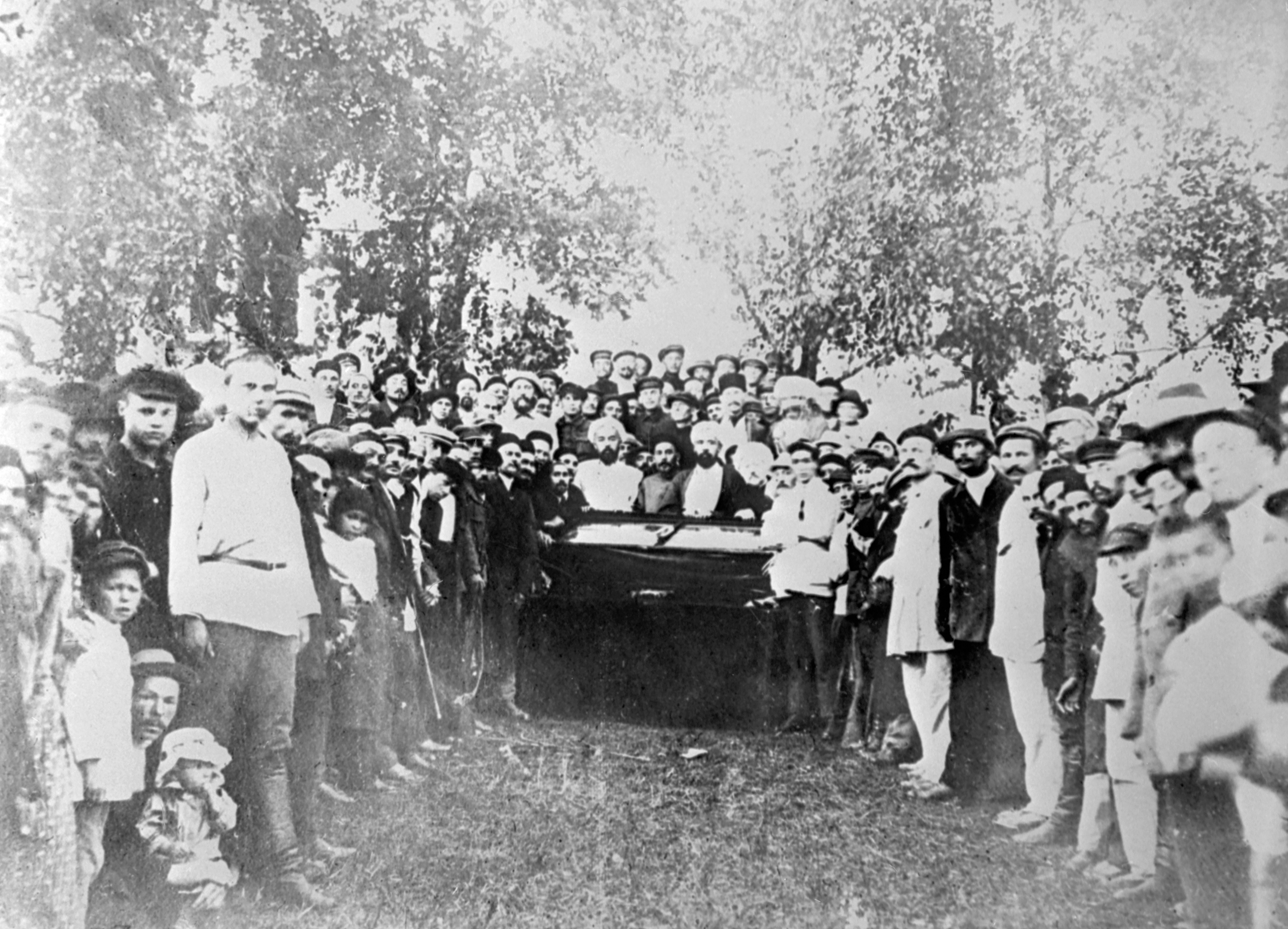
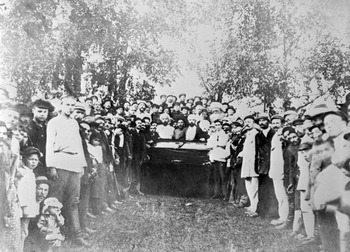
The Tashkent mahkama-yi shariʿa, on the other hand, considered the Quran a sacred relic that must be in the sole possession of Muslims. Also having learnt to speak Bolshevik, they modelled themselves on the successful example of the Spiritual Administration in Ufa—an organization that had proved able to negotiate with the Soviet state—and claimed to speak on behalf of the Muslims of Turkestan: an exaggerated status for what was actually only a Tashkent institution.Footnote 64 They thus represented themselves as the same people from whom the Quran had been unjustly taken in 1868 and emphasized the political value of publicly rectifying that wrong, perhaps aware that the Bolsheviks, seeking allies in the East, were keen to avoid the appearance of Russian chauvinism. As Lenin wrote in December 1922: ‘It would be unpardonable opportunism if, on the eve of debut of the East, just as it is awakening, we undermined our prestige with its peoples, even if only by the slightest crudity or injustice towards our own non-Russian nationalities.’Footnote 65 In July 1923, VTsIK ordered the ‘transfer of the Quran, extracted from Turkestan by the Tsarist government, into the possession of the Muslims of Turkestan’ (Figure 3).Footnote 66
The transfer of the Uthman Quran from Ufa to Tashkent, August 1923. Source: RIA Novosti, image licensed by the Associated Press.
Notably, mahkama-yi shariʿa did not view the transfer in Bolshevik-centric terms. Zuhriddin A’lam, announcing his departure for Ufa in the newspaper Turkiston in June 1923, did not mention Moscow at all, only that the ‘assembly of the Muslim ulama of Russia in the city of Ufa will consider the case of the return of the famous Kufic Quran’.Footnote 67 Other reports presented the assembly’s agreement to release the Quran as a done deal, even before Moscow had signed off on it.Footnote 68 Furthermore, the commission assembled to collect the Quran from Ufa was supposed to include a Turkomstaris representative—the aforementioned Aleksandr Schmidt, who previously worked for the Imperial Public Library—but by Schmidt’s own account, the other members unexpectedly refused to let him join.Footnote 69 The ulama on the commission—Zuhriddin A’lam and Muhammed Xo‘ja from the Tashkent mahkama-yi shariʿa, Gabdrahman Umerov from Astrakhan, Abdullah Hismatiy from Moscow, chaired by the prominent Tatar scholar and mufti of the Spiritual Administration Rizaeddin Fäkhreddin—did not permit a non-Muslim Russian to accompany this sacred object on its symbolic journey to Turkestan.Footnote 70 Ousting Schmidt was a clear rejection of the secularized heritage value of the Uthman Quran posited by Turkomstaris: for mahkama-yi shariʿa, it was unequivocally a sacred Islamic relic. Seemingly having won the argument, however, mahkama-yi shariʿa faced renewed conflict when the Quran arrived.
A rightful home? Debating where to keep the Quran in Turkestan
By mid-1923, all relevant parties agreed the Quran belonged in Turkestan. But beyond that, there was no consensus on which city or institution it should be housed in: remarkably, even by the time the Quran physically arrived in Turkestan in August, no decision had been made. Most people naturally assumed that it would return to Samarkand. In late 1922 a special committee there discussed three options: the Samarkand museum; the eastern wing of Registan’s magnificent seventeenth-century Sher-Dor madrassa; or a new building commissioned specially for the Quran.Footnote 71 If a new building was to be built, it was agreed that it ‘should have a beautiful exterior finish in the Oriental style’, and an architect-engineer named Mauer produced a proposal for this pastiche construction ‘in the style of Samarkand mausoleums’.Footnote 72
Turkomstaris unanimously rejected all these Samarkand-based options in April 1923, insisting that ‘the only place that can serve as the repository of the Uthman Quran is the Main Central-Asian Museum’.Footnote 73 Founded in 1876 as the Turkestan Public Library and Museum—the same institution that requested a facsimile in 1902—it was still run entirely by Russo-European scholars and retained a certain imperial flavour in the 1920s.Footnote 74 Nechkin seems to have considered the Main Central-Asian Museum the rightful home of all the region’s finest treasures, and the Uthman Quran would undoubtedly have been its main attraction. Turkomstaris had always imagined the Quran being returned ‘to the possession of the people of Turkestan’, a criterion that their state-owned public museum in Tashkent fulfilled. They were also extremely concerned about protecting the Quran from theft and physical damage, which could reasonably be achieved if it were housed in their biggest museum. By mid-July, this plan had been approved by the Turkestan Commissariat of Enlightenment and awaited confirmation from the higher levels of the Turkestan government.Footnote 75 The Turkestan Central Executive Committee (TurkTsIK) floated the Samarkand Museum again, evidently agreeing with Turkomstaris that it would be one museum or the other.Footnote 76
It seems never to have occurred to Turkomstaris that local Muslims might feel that ‘their’ Quran had not truly been returned if it were kept not in a place of worship but a secular museum on the European side of town and supervised by non-Muslim scholars, who would undoubtedly not have performed ablutions (wudu) before handling its sacred pages.Footnote 77 Mahkama-yi shariʿa, meanwhile, assumed that as representatives of the Muslim community of Tashkent (but with aspirations to represent all Turkestan), the Quran was rightfully theirs. Legally, they were correct: VTsIK had specifically decreed the Quran be returned to ‘the possession of the Muslims of Turkestan represented by mahkama-yi shariʿa in Tashkent’.Footnote 78 On arrival, the Quran was carried to the Khoja Ahrar mosque by a procession of the city’s ulama.Footnote 79 But TurkTsIK and the Central Asian Bureau of the Communist Party (Sredazbiuro) immediately objected and tried to put it in one of the two museums instead, sparking a flurry of panicked messages between Tashkent and Moscow.
From the point of view of mahkama-yi shariʿa and the Muslim members of the transfer delegation, the idea of putting the Quran in a museum was outrageous. Fäkhreddin reminded VTsIK that his Spiritual Administration had only released the Quran from Ufa on the assurance that it would not be given to a museum. Well aware of the propaganda value motivating Soviet authorities, he highlighted the damaging political fallout if they were to backtrack now: TurkTsIK’s treacherous attempt to put the Quran in the Samarkand Museum, against Moscow’s orders, Fäkhreddin wrote, ‘worries the population of Tashkent and will leave an irreparable impression on the Muslim world’.Footnote 80 On the other side, Sredazbiuro—a Communist Party committee appointed directly by Moscow to oversee Central Asian affairs and distinguished by a hawkish attitude towards local policies deviating from Marxist-Leninist orthodoxy—warned that mahkama-yi shariʿa would use the Quran to ‘extract funds for anti-Soviet work’ and that the central government’s decision to give it to them was a ‘pointless mistake, a handout to the swindler mullahs who have managed to get involved in the transfer of the Quran to trick Soviet authorities into strengthening religiosity among the population’.Footnote 81 The Quran, they wrote, must go to the Main Central-Asian Museum. The Central Committee immediately shot them down, reiterating that the Quran must ‘be given to the Muslims of Turkestan and not a museum’.Footnote 82 TurkTsIK ignored the order.
It is clear from this fractious back and forth that there was a delicate political balance to be struck, and the very highest Soviet authorities were invested in what would now happen to the Uthman Quran. Officials monitoring the situation in Tashkent reported to Commissar for Foreign Affairs Georgii Vasil′evich Chicherin that TurkTsIK would not budge. Chicherin then wrote to the Central Committee summarizing the politics at play. From his perspective, the main reason for returning the Quran was to win over support from Muslims in Turkestan and abroad. As Fäkhreddin had also pointed out, TurkTsIK’s opposition to mahkama-yi shariʿa now risked squandering that opportunity and damaging trust in Soviet authority. Chicherin wrote that cancelling ‘the transfer of this historical monument to the Muslims of Turkestan will make a most unfavourable impression on Muslims’.Footnote 83 Furthermore, it would impede any hopes of mobilizing Central Asian intellectuals for transnational Eastern revolution by making it ‘difficult for us to use the progressive parts of the Muslim clergy to support our politics and to fight against anti-Soviet agitation by the English’.Footnote 84 This foreign-policy orientation is particularly noteworthy considering Chicherin had, since 1922, been pursuing alliances with Arab leaders in the hopes of destabilizing British influence in the ‘Muslim Near East’.Footnote 85 He concluded that ‘the return of such a valuable historical Islamic monument to the Muslim population of Central Asia is dictated to us by political necessity’.Footnote 86 The Central Committee accordingly reiterated its order to hand the Quran over to mahkama-yi shariʿa, though conceded a little to TurkTsIK and Sredazbiuro’s concerns by adding that they should ‘take measures to ensure its preservation’ and forbid ‘the clergy from taking any payment from people wishing to worship at the Uthman Quran’.Footnote 87
This high-level deadlock was only resolved via a very local compromise relying on some legal sleight of hand. The Uthman Quran neither stayed in the Khoja Ahrar mosque nor went to the Main Central-Asian nor the Samarkand Museum. Instead, within two weeks of its arrival in Tashkent, it was formally given into the possession of mahkama-yi shariʿa, whose chair Zuhriddin A’lam was appointed its official ‘keeper’, but physically housed in a compromise venue: the Tashkent Old-Town Museum.Footnote 88 Sredazbiuro claimed this solution fulfilled the Central Committee’s orders (even though those orders said no museums) by ensuring the ‘Quran is accessible to the population as a religious relic and the possibility of extortion has been eliminated’.Footnote 89 By the end of August, Turkomstaris, mahkama-yi shariʿa, and TurkTsIK all agreed on this accommodation.Footnote 90
The Old-Town Museum was a unique institution. Like all museums in the region, it came under the jurisdiction of Turkomstaris, but it had none of the colonial baggage of the Main Central-Asian Museum. It was both Tashkent’s only museum outside of the European colonial district and the only one run by indigenous Central Asians: its director was an Uzbek Muslim intellectual named Majid Qodiriy. It is easy to see why it emerged as an acceptable compromise in a fraught situation: mahkama-yi shariʿa were reassured that this holy object was technically owned by them and physically in Muslim hands; the heritage professionals at Turkomstaris were satisfied that this ‘historical monument’ was under their supervision for conservation purposes; and TurkTsIK and Sredazbiuro accepted that its presence in a state institution would save the Quran from being used for anti-Soviet agitation or to ‘strengthen religiosity’. This local arrangement highlights the hybridity of nominally Soviet institutions far from the political centre. Moscow did not have the last word.
The Uthman Quran as a museum artefact
Qodiriy must have played a large role in negotiating this compromise, thereby elevating his little museum (sniffily described by a Russian archaeologist as ‘a haphazard storeroom of randomly acquired objects’) to become the resting place of one of the most ancient and sacred objects in the Islamic world.Footnote 91 A Tashkent native and part of the Jadid movement, between 1917 and 1919, Qodiriy was director of the Turon new-style school, later headed the Tashkent Department for Public Education, and taught at workers’ faculties at various Tashkent universities in the early 1920s. He joined the Communist Party in 1918, and in March 1923 was awarded the accolade Hero of Labour for his work as an educator.Footnote 92 As such, Qodiriy was already a notable figure in local intellectual circles and a rising star in the educational bureaucracy when, on 20 July 1923, while the Uthman Quran was still in Ufa, he accepted the post of director of the Tashkent Old-Town Museum.Footnote 93
The museum itself was tiny—consisting of just one exhibition room and two side offices—but once it had been chosen to house the Uthman Quran, city authorities set about moving it into better premises. Discussions in September and October 1923 indicate that the museum was being conceptually reimagined and physically formed around the Quran itself: the new building was chosen specifically because it had ‘a convenient and completely separate room for the Uthman Quran’.Footnote 94 A’lam, the representative from mahkama-yi shariʿa, soon disappears from the archival record and Qodiriy took over as the official keeper of the Quran. Even when he was promoted out of the museum in December 1924 to become Nechkin’s deputy at Sredazkomstaris (formerly Turkomstaris), Qodiriy personally retained the keys to the safe and responsibility for the Quran’s safekeeping.Footnote 95
Nominally a secular space—a ‘popular scientific institution’ aiming to ‘serve and facilitate the development and education of the wide masses of the indigenous native population’—the Old-Town Museum in reality looked quite like a shrine.Footnote 96 Notably, the Quran was displayed here in conditions very similar to the building of the Spiritual Administration in Ufa from 1918 to 1923. According to the recollections of Fäkhreddin’s daughter Äsma Shäräf, in Ufa the Quran was kept in a locked vitrine in its own ‘bright, high-ceilinged, light room’ where the temperature was kept steady to preserve the parchment.Footnote 97 Similarly, in the Old-Town museum, the Quran was kept in its own room, which by April 1925 had been freshly renovated and painted green, a symbolic colour strongly associated with Islam.Footnote 98 The original was kept in a safe with a facsimile on display nearby. The Old-Town Museum became a hybrid Muslim–Soviet and sacred–secular space, intentionally oriented towards the Muslim population: offering free entry for women of indigenous nationalities, opening hours adjusted for Ramadan, and signage written exclusively in Uzbek.Footnote 99 It briefly trialled women-only opening hours to encourage attendance by Muslim women, but abandoned the policy upon observing that ‘Uzbek women visit the museum without being put off by men.’Footnote 100 In 1926 it apparently received 300–400 visitors a day.Footnote 101
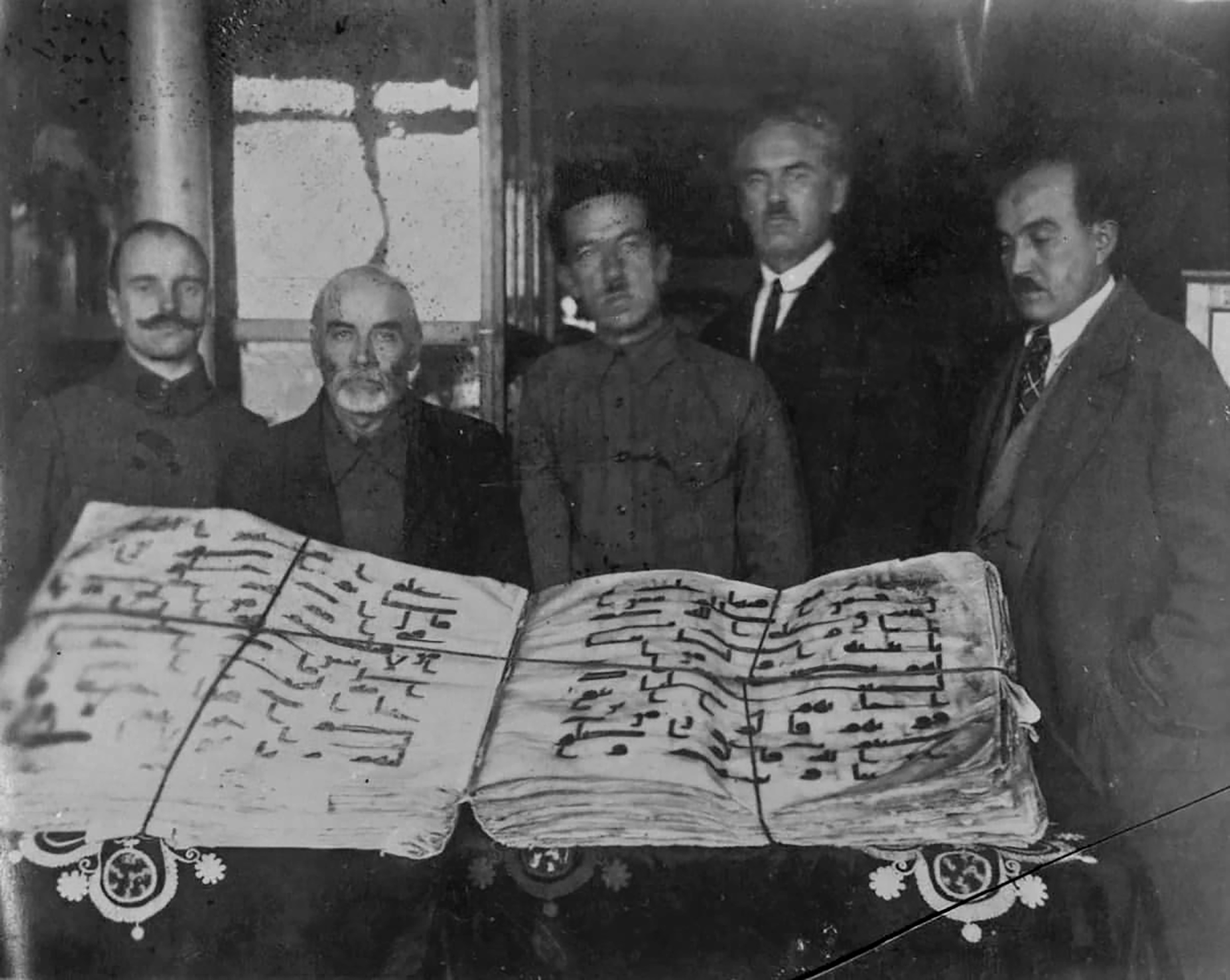
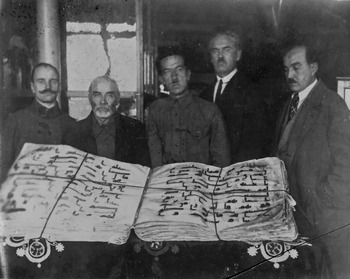
This is not to say that there was no discomfort from Soviet authorities regarding the Quran’s sacrality and its potential impact upon Muslim visitors. The Quran was kept in its safe and neither read nor even taken out.Footnote 102 The museum was closed for renovations in 1925 and ceremonially re-opened—renamed the First Uzbek Museum—on 1 January 1926.Footnote 103 The next day, a group of ‘Muslim-citizens of Tashkent’ petitioned (unsuccessfully) to have the Quran returned to the care of the city’s ulama.Footnote 104 Instead, it was moved to a specially designed display case atop a cement plinth within the museum, which was secured by an iron grille and four locks and had a glass panel through which the Quran could be viewed.Footnote 105 This may have been when a photograph of Sredazkomstaris officials posing with the Quran was taken, in which its pages are bound with rope (Figure 4). This choice, and the obsession with locks, keys, and fireproof safes, was partly intended to ensure the physical preservation of the undoubtedly fragile codex. But, more potently, it speaks of a profound Soviet anxiety regarding the power of religious objects, even in a nominally secular space. If the Soviet state was to harness the symbolic value of the Uthman Quran, the Quran itself as an object also had to be controlled and contained.
Representatives of Sredazkomstaris with the Uthman Quran in the First Uzbek Museum (formerly the Tashkent Old-Town Museum), 1925 or 1926. From left to right: Ivan Ivanovich Umniakov, head of the section for the preservation of antiquities; Professor Aleksei Maksimovich Mironov, head of the museum section; Ibrohim Ismoil o‘g‘li, director of the First Uzbek Museum; Mikhail Artem′evich Krylov, research fellow (nauchnyi sotrudnik) of the First Uzbek Museum; and Majid Qodiriy, deputy chair of Sredazkomstaris and former director of the Tashkent Old-Town Museum. Source: National Archive of Uzbekistan.
The ideological front and Quranic diplomacy
The years 1926–27 were a major turning point for Soviet Central Asia. The more assured Soviet power became, the less tolerant the party-state grew of ideological unorthodoxy, preparing for battle on the ‘ideological front’. As the first generation of Soviet-educated ‘proletarian’ Uzbek cadres was elevated to power, the Bolsheviks violently ended their uneasy collaboration with the older generation of ‘progressive’ intelligentsia. In early 1927, the party launched an assault on ‘religious fanaticism’, rapidly abolishing Islamic schools and courts, confiscating waqf property, closing mosques and shrines, and leading a campaign against veiling, delegitimizing alternative visions of modernity.Footnote 106 Responsibility for ‘work among the clergy’ was shifted to the OGPU (secret police), which declared mahkama-yi shariʿa riddled with ‘opportunists’, condemned them for enabling ‘the clergy to defend their position and strengthen their influence among the masses’, and ultimately eliminated them.Footnote 107
As anti-religious propaganda escalated in Uzbekistan, in March 1927, under the directorship of Qodiriy’s successor, Ibrohim Ismoil o‘g‘li, the First Uzbek Museum undertook to unmask the Uthman Quran by conducting chemical analysis for ‘scientific and historical verification of the bloodstains’.Footnote 108 Across the USSR, so-called ‘cult objects’ were widely confiscated and deposited into anti-religious museums and the League of Militant Godless, the USSR’s premier atheist organization, occasionally ‘unmasked’ supposedly holy or miracle-working artefacts, staging public demonstrations of the objects’ impotence and emphasizing the irrationality of belief in their sacrality. Perhaps testing the bloodstains was a prelude to using the Uthman Quran for anti-religious propaganda. Evidently, the initial hybridity of this museum as a Soviet institution that accommodated Muslim religious feeling was ending.
Then the Uthman Quran simply disappears from the archival record. By 1928, press articles about the (once again renamed) museum no longer mentioned it.Footnote 109 In 1930 there was a massive reorganization of all the museums in Tashkent; the former First Uzbek Museum was dissolved, and all the city’s collections were merged and redistributed. There is very little evidence of where the Quran was located between late 1927 and 1940: one account has it ‘migrating with its museum between various buildings’ during these years.Footnote 110 It surfaced again in 1940 when a Tashkent newspaper announced a new anti-religious museum to feature the ‘clothing of dervishes, sacred stones, a marble Quran stand’, and, as its centrepiece, the Uthman Quran.Footnote 111 Tashkent’s Central Anti-Religious Museum was open for barely a year (from late 1940 to 1941) and its archival record is extremely thin, so it is unclear whether the Quran actually ended up there, though its inventory does mention one ‘large Quran’.Footnote 112 In 1941, the Uthman Quran entered the collection of the Museum of the History of the Peoples of Uzbekistan, the successor to the Main Central-Asian Museum which was avoided in 1923. There, its use for anti-religious propaganda persisted in the late Soviet period: the Quran’s facsimile was displayed with a text claiming that ‘for centuries, the clergy deceived the masses of believers with the “blood of the Caliph Uthman” which was deliberately placed on the pages of the Quran’.Footnote 113 The original Quran was kept in the museum’s storage, where it stayed until 1989.Footnote 114
Ironically, in the late 1920s, as authorities curtailed Islamic practice within Soviet Central Asia and the Uthman Quran literally disappeared from view domestically, the state intensified the use of it to mobilize support among Muslim populations beyond Soviet borders, initially across the Tianshan mountains into Xinjiang. Debates regarding Soviet policy towards Xinjiang often pitted the Comintern against the Ministry of Foreign Affairs, as officials cautiously balanced the desire to support the spread of pro-Soviet, socialist revolution with the necessity of maintaining amicable ties with Nanjing, so as not to prove detrimental to ‘our estimates of Chinese democracy’.Footnote 115 Under these circumstances, when members of the Muslim merchantry and ulama in Urumchi purchased one of Pisarev and Uspenskii’s facsimiles for a local mosque, the Soviet customs at Bakhty reportedly did ‘not allow this Quran into Xinjiang for formal reasons’, perhaps out of concern for the inflammatory nature of such an act in the eyes of the Han-led Jin Shuren warlord regime.Footnote 116 Unrelenting, the local ulama petitioned the Soviet consul-general in Urumchi, who wrote in December 1929 to the Main Customs Department in Bakhty that the decision to block the transmission of the Quran ‘struck us with a great moral blow’ which is ‘interpreted here as a flouting of religious feelings’, and requested that the Quran be allowed into Xinjiang.Footnote 117
The Xinjiang government was indeed concerned about the potential implications of the Soviet Consulate using the Quran for its own propaganda purposes, and not without reason as the Consul celebrated ‘the opportunity to use the import of this Quran among the local Muslim population’ and the fact that ‘the delivery of the Quran by our Consulate to Chuguchak [Tarbagatay] is the subject of many conversations among all layers of the population’.Footnote 118 When members of the local ulama petitioned the Consulate for permission to view the Quran, he approved it. As a result, between 31 January and 3 February 1930, approximately 3,100 pious Muslim devotees made a pilgrimage to the Consulate of the Soviet Union to view the Quran. During these four days of visits, ‘the Consulate did not fail to explain to those citizens arriving the history of the transmission of this Quran to Chuguchak, its future fate, and also about the falseness of those rumours being spread here about the supposed persecution of religion in the USSR, oppression of believers, and so on’, which the Consul claimed ‘made a strong impression on all visitors’.Footnote 119 Mirroring the Tashkent Old-Town Museum during the historical Quran’s tenure there in the mid-1920s, for four days in 1930, the Soviet Consulate in Tarbagatay became a hybrid Muslim–Soviet and sacred–secular space, enabling the consul-general to paint the Soviet project in a more benign light to the Turkic Muslims of Xinjiang.
Though beyond the scope of this article, the use of the Uthman Quran and its facsimiles for propaganda and diplomacy continued until the end of the Soviet era. During the Second World War, besieged by Japanese and Nazi propaganda attacking religious repression in the USSR, the Soviet government released octogenarian Uzbek mufti Ishan Babakhan from the Gulag and dispatched him to mobilize Soviet and foreign Muslims for the war effort. In an appeal to the Muslims of Xinjiang in 1945, Babakhan hailed the Uthman Quran as ‘the pearl of Muslim wisdom’ among the many sacred sites of Central Asia, upon which ‘one can still see spots of [Uthman’s] noble blood’ and which the ‘Muslims of Turkestan have touched their hands to’ during congresses and trade agreements.Footnote 120 Like agitators in the early 1920s, Babakhan used the fate of the Uthman Quran as a barometer of the Soviet state’s supposedly benevolent treatment of Muslims. In the post-war era, as the Russian imperial state had done before, the USSR gifted copies of the Uthman Quran to foreign Muslim dignitaries including Pakistani President Mohammad Ayub Khan, Iraqi President Ahmed Hassan al-Bakr, and Tunisian Prime Minister Hédi Nouira, and further featured its facsimiles at prominent international conferences, seeking to bolster Second–Third World relations during the Cold War.Footnote 121 While religious practice was constrained domestically, the Soviet state thus continued to leverage its power to display, conceal, move, remove, and gift the Uthman Quran and its copies as expressions of political power on a transnational stage. In March 1989, the original Uthman Quran was transferred from the history museum to the Spiritual Administration of Muslims of Central Asia and Kazakhstan and placed in the Hazrati Imom complex in Tashkent, where it remained until November 2025, when it was moved to the new Center for Islamic Civilization, purpose-built next door.
Conclusion
The four phases of the Uthman Quran’s life between 1917 and 1927 reflect the shifting power dynamics of Muslim groups in relation to Bolshevik policy. In the immediate wake of revolution, the Spiritual Administration in Ufa inherited the pre-revolutionary authority of the Orenburg Spiritual Assembly to claim to speak on behalf of a multi-ethnic nation of all Muslims in the former Russian empire. The Quran went to Ufa. Then, in 1922–23, as the Soviet state embarked on a new nationalities policy based on delineating territorial units by ethno-national criteria, the national-territorial claim of the people of Turkestan gained sway. The Tashkent mahkama-yi shariʿa successfully used this shift to leverage their authority both against the Ufa Spiritual Administration and Turkomstaris. The Quran went to Tashkent and nominally into the possession of mahkama-yi shariʿa. Thirdly, the compromise venue of the Old-Town Museum and the role of Qodiriy as an intermediary highlights the hybridity of local institutions and the importance of Jadid-Soviet cooperation in the mid-1920s. Where Soviet control was relatively fragile, realpolitik defined the ideological priorities, and their shared nation-building and anti-imperialism enabled progressive Muslims and anti-religious Soviet authorities to form temporary alliances. Finally, solidifying their control over Central Asia from 1927 onwards, the Bolsheviks grew less tolerant of ideological unorthodoxy, which brought an end to that hybridity and led to scientifically ‘unmasking’ and then removing the Quran from display. The life of the Uthman Quran therefore corroborates recent scholarship on the phases of Soviet policy towards the ‘East’ (domestic and foreign) and the ability of Muslim political groups to negotiate their relationships to the Soviet regime.
Given that many Muslims across the former Russian empire saw communism through the prism of the nation and anti-colonialism, the opening of the ideological front in 1926–27 narrowed the possibilities that the Bolshevik revolution could represent. Soviet decolonization only recognized certain binary categories, defined, above all, by class and the territorially bounded ethno-nation. This shows that thinking about (de)colonization as a binary is reductive: there is never just one homogenous colonized group nor one single colonizing force, and, therefore, attempts to decolonize by upending a binary power imbalance (as the Soviet government sought to do) inevitably founder on the competing moral claims of various groups claiming to represent the colonized. New demands that Central Asian issues be represented in universalist Marxist categories as defined by the party limited what grievances it was possible to voice when ‘speaking Bolshevik’. Bolshevik decolonization was, then, an opportunistic political strategy and an instrument of power which was stripped of much of its democratic content once Soviet state authority in Central Asia was assured. One’s estimation of the sincere idealism versus self-interested cynicism motivating it will likely depend on one’s assessment of the emancipatory possibilities of the Bolshevik revolutionary project more broadly, but our analysis shows that ideological utopianism and pragmatic politics were intertwined. Perhaps this is a salutary reminder that rhetoric of decolonization is never untainted by political circumstances, nor are decolonizing actions capable of simply undoing the effects of colonization: they are productive acts that create new social and political realities. As such, decolonization cannot be treated as a neutral or restorative epistemic framework for grappling with imperial and post-imperial histories.
Acknowledgements
We are grateful to David Brophy who generously shared the archival source that first sparked this project. Mollie presented an early draft of this article at the Ab Imperio workshop at Amherst College and the Russian History Seminar at Georgetown University and we would like to thank the organizers and participants of both those events for their invaluable feedback, as well as the anonymous peer reviewers and Daniel Beben for their expert and constructive comments at a later stage. Harry would further like to thank Eric Schluessel, who supervised the undergraduate thesis that formed the foundation of his contribution to this article.
Financial support
Nazarbayev University funding enabled this article to be published Open Access.
Competing interests
The authors declare none.
Harry Shaheen holds an MA in Regional Studies East Asia from Harvard University and a BA in History and International Affairs from The George Washington University, and is currently conducting research in Uzbekistan under the Fulbright Open Study/Research Scholar programme.
Mollie Arbuthnot is an Assistant Professor of History at Nazarbayev University. She is the author of Poster Propaganda in Soviet Uzbekistan: Picturing a Red East (Oxford University Press, forthcoming) and editor of Soviet Materialities: Socialist Things, Environments, and Affects (Manchester University Press, 2026).

 Open access

