





1. Background: Processing contrastive ellipsis
A broad question in understanding how ellipsis structures are represented and processed is the extent to which linguistic representations are accessed during the comprehension of clauses containing elided material. Contrastive ellipsis (e.g. bare argument ellipsis, gapping, sluicing), or clausal ellipsis that relies on the pairing of a remnant with a contrastive correlate of the same grammatical category in the antecedent clause, has been of particular interest to psycholinguists (e.g. Carlson Reference Carlson2001, Kaan et al. Reference Kaan, Wijnen and Swaab2004, Carlson et al. Reference Carlson, Dickey and Kennedy2005, Hoeks et al. Reference Hoeks, Redeker and Hendriks2009, Harris Reference Harris2016, Harris & Carlson Reference Harris and Carlson2016, Reference Harris and Carlson2018), as its processing reveals a range of linguistic factors relevant to ellipsis resolution.
In order to interpret a clause involving ellipsis (e.g. ‘not Bethi <ti ate chocolate>’ in 1), it is often assumed that the processor must recover the elided material, and that this cannot be done without matching the ellipsis remnant (‘Beth’) with its contrastive correlate (‘Anna’) in the antecedent clause (‘Anna ate chocolate’). The identification of the correlate (‘Anna’) allows the comprehender to determine the part of the antecedent clause that is discourse-given (‘ate chocolate’) and consequently elided in the second clause.

Several forms of linguistic parallelism between the remnant and its correlate have been identified as being relevant to resolving contrastive ellipsis (but see Dickey & Bunger Reference Dickey and Bunger2011, for evidence that violating parallelism leads to processing costs for both sluiced and non-elliptical coordinated structures). It has been argued that remnants must have identical case marking to their correlates, even if multiple case marking options exist in the corresponding non-elliptical construction (e.g. Sag & Nykiel Reference Sag and Nykiel2011, for sluicing). When the antecedent clause contains multiple correlate candidates, making the structure ambiguous, comprehenders have been found to prefer correlates that match the remnant in syntactic and semantic features (e.g. Nykiel Reference Nykiel2013, for sluicing, and Harris & Carlson Reference Harris and Carlson2016, for let alone coordination) as well as morphological markers of definiteness (Rasekhi & Harris Reference Rasekhi and Harris2021, for bare argument ellipsis). The pairing of a remnant and its correlate is also facilitated when both are marked with contrastive prosodic accents (e.g. Carlson et al. Reference Carlson, Dickey, Frazier and Clifton2009, for sluicing) and when a focus particle unambiguously associates with the correlate (Stolterfoht et al. Reference Stolterfoht, Friederici, Alter and Steube2007, for bare argument ellipsis). Jointly, these findings point to the importance of linguistic structure in processing contrastive ellipsis.
At the same time, past experiments have observed what on the surface looks like a non-linguistic effect of recency when it comes to pairing remnants with their correlates – there is a preference to associate remnants with the most recently encountered, grammatically licensed correlate (Clifton & Frazier Reference Clifton and Frazier1998, Carlson et al. Reference Carlson, Dickey, Frazier and Clifton2009, Carlson Reference Carlson2014, Harris Reference Harris2015, Harris & Carlson Reference Harris and Carlson2018). For instance, in the structurally ambiguous Example (2), the object remnant interpretation is typically preferred over the subject remnant interpretation.

This descriptive observation that contrastive ellipsis with object correlates is preferred over or easier to process than contrastive ellipsis with subject correlates has been dubbed the Locality effect (Harris Reference Harris2015, Harris & Carlson Reference Harris and Carlson2016), whereby the remnant is preferentially contrasted with the nearest available constituent in the preceding clause. Locality in contrastive ellipsis, in its different formulations, has long garnered both psycholinguistic and theoretical attention – for instance, Kuno (Reference Kuno1976) discusses the unacceptability of non-local interpretations for string-ambiguous gapping structures with plausible local interpretations (Example 3; presented with the original grammaticality judgments). Interestingly, while theoretical approaches to locality effects in clausal ellipsis explore conditions on locality of movement across clause boundaries (e.g. Fox & Lasnik Reference Fox and Lasnik2003, Bošković Reference Bošković2014), the psycholinguistic Locality effect has also been observed when correlate candidates (e.g. a subject and an object) occur in the same clause (e.g. Harris & Carlson Reference Harris and Carlson2018). The syntactic locality of movement effect cannot account for the Object remnant preference observed in the psycholinguistic literature, suggesting that both syntactic constraints and processing factors play a role in resolving clausal ellipsis.

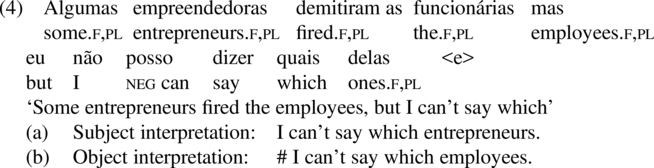
The distinction between syntactic locality of movement effects and the Locality preference is further highlighted by the fact that recent psycholinguistic work shows that the Locality preference in the resolution of ambiguous ellipsis persists even when there is grammatical information biasing the comprehender towards a non-local correlate. For instance, Harris & Carlson (Reference Harris and Carlson2018) found that while placing a contrastive pitch accent on a non-local correlate in focus-sensitive coordination reduced the rate of local interpretations, it did not fully overturn a preference for local correlates. Likewise, Lawn (Reference Lawn2020) found that sluicing structures like Example (4) in Brazilian Portuguese were slightly biased towards the local, object resolution even when the matrix object was definite and thus semantically infelicitous as a correlate for the sluice (Chung et al. Reference Chung, Ladusaw and McCloskey1995).
The source of the Locality effect is not presently well understood. One possibility is that the effect relies on linear order, that is the recency of the correlate to the remnant, with intervening lexical material potentially contributing to the reduced accessibility to the non-local correlate in memory.Footnote 2 Under this view, the pairing of remnants and their correlates mirrors recency advantages demonstrated in the broader dependency resolution literature (Kimball Reference Kimball1973, Frazier Reference Frazier1979, Neath Reference Neath1993, Neath & Knoedler Reference Neath and Knoedler1994, Gibson et al. Reference Gibson, Pearlmutter, Canseco-Gonzalez and Hickok1996, Gibson Reference Gibson1998, Pearlmutter & Gibson Reference Pearlmutter and Gibson2001, Sturt et al. Reference Sturt, Scheepers and Pickering2002). Others (e.g. Harris & Carlson Reference Harris and Carlson2018) argue for the Locality effect being structural in nature. Languages like English confound linear order with default Focus marking – the most recently encountered (object) correlate is also the most deeply syntactically embedded and thus preferentially marked with a pitch accent (Selkirk Reference Selkirk1986, Cinque Reference Cinque1993), feeding contrast assignment (Carlson et al. Reference Carlson, Dickey, Frazier and Clifton2009). The pairing of the contrastive remnant with its contrast-marked correlate in the antecedent clause is facilitated by a condition of information-structural parallelism on clausal ellipsis (see, e.g. Winkler Reference Winkler2005, for a theoretical discussion). Relatedly, in support of the importance of information-structural parallelism in particular, Bîlbîie & De La Fuente (Reference Bîlbiîe and De La Fuente2021) show that parallelism constraints on gapping are stronger at the discourse level than at the syntactic level.
There is some preliminary support for information structure modulating the pairing of remnants and their correlates in sluicing. Carlson et al. (Reference Carlson, Dickey, Frazier and Clifton2009) found that placing the intended correlate in an it-cleft (which structurally marks the DP as focused in English) can be used to counter Locality preferences. In written items like Example (5), they found a strong preference for interpreting the non-local object (‘Lisa’), as opposed to the linearly more recent subject (‘Patty’) as an antecedent to the Wh-phrase.

It is not clear how much the effect observed by Carlson et al. (Reference Carlson, Dickey, Frazier and Clifton2009) is due to contrast-marking. The options for syntactic contrast-marking in English are limited, and structures like Example (5) not only highlight the clefted non-local DP (‘Lisa’) but also potentially make the competing local DP (‘Patty’) less accessible by placing it in an embedded clause. Additionally, the Local interpretation in Example (5b) violates structural parallelism between the two clauses (the antecedent containing an it-cleft and the ellipsis clause not), while the directly copied structure Example (5c) would yield an instance of crossover, resulting in ungrammaticality. All of these factors could be contributing towards a preference against the Local interpretation, independently of focus-marking on the non-local correlate.
Flexible word order languages, like Estonian, allow for information-structural effects to be studied in a more straightforward manner. In particular, clause-initial subjects, which may be information-structurally unmarked or syntactically marked for contrast in Estonian, allow for a direct manipulation of the information structure of a non-local correlate. Word order manipulation is particularly useful for studying the online processing of ellipsis remnants, as previous work in closely-related Finnish (Kaiser & Trueswell Reference Kaiser and Trueswell2004) indicates that comprehenders make use of non-canonical word order to make predictions about the discourse status of upcoming referents. This paper addresses the role of information structure in processing contrastive ellipsis, testing the hypothesis (e.g. Harris & Carlson Reference Harris and Carlson2018) that the Locality effect is in fact underpinned by information structure. The syntactic structure of Estonian, a flexible word order language, allows for the linear distance and lexical material intervening between the remnant and the correlate to be controlled in order to examine the role of information structure in processing contrastive ellipsis, while controlling for recency.
1.1. Overview
Two syntactic facts need to be established in order to set the scene for the experimental manipulation – firstly, that subjects in canonical, subject-initial Verb-second (V2) clauses are information-structurally ambiguous, and secondly, that subjects in subject-initial Verb-third (V3) clauses are naturally interpreted as CTs. The syntactic structure of Estonian CT clauses and bare argument ellipsis is presented in Section 2.
Section 3 reports on an eye-tracking while reading experiment comparing the processing of remnants with neutral and CT-marked subject correlates to the processing of remnants with local object correlates. We will see evidence that while information-structurally neutral or ambiguous non-local correlates are associated with a processing penalty compared to local correlates, this penalty is modulated in some eye-tracking measures when the non-local subject is marked as a CT.
Section 4 presents a discussion of the findings, and Section 5 concludes.
2. Contrast-marking in Estonian
2.1. Information structure of clause-initial subjects
As a flexible word order language, Estonian marks contrast on linguistic constituents by deviating from its canonical (i.e. neutral) word order. Canonical word order is defined here, by its compatibility with the widest range of discourse contexts, including but not limited to out of the blue or wide-scope informational focus contexts (Büring Reference Büring2016). Estonian has been argued to have canonical STOV order (Ehala Reference Ehala2006), where S = subject, T = tensed verb, modal or auxiliary, O = object (both Accusative and Partitive) and V = infinitival verb. Thus, VPs appear to be head-final, while TPs are head-initial. This canonical word order for declarative matrix clauses is compatible with out of the blue contexts, Example (6), but with the help of prosodic marking, also with narrow focus on individual constituents like the object, Example (7; prosodic emphasis shown in bold).Footnote 3
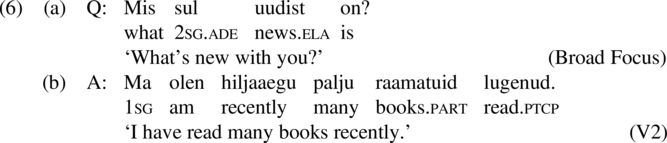

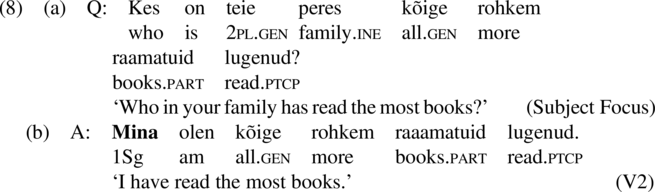
Declarative matrix clauses typically have the tensed verb in the second position, giving rise to V2 word order. Interestingly, corpus work shows that object-initial V2 clauses occur in the language almost as frequently as subject-initial V2 clauses (Lindström Reference Lindström2005). The clause-initial position has been argued to be a Topic position that can also accommodate elements like scene-setting adverbs (Henk Reference Henk2010). Subjects may act as default Topics when no viable Topic candidate is available, and linguists have long noted an overlap between subjecthood and topicality (e.g. Chafe Reference Chafe1976). Interestingly, the canonical status of STOV order in Estonian is not fully explained by the subject topicalisation account – STOV order is available even when the subject is contrastively focused and an explicit non-subject Topic is available, Example (8, again, with prosodic emphasis bolded).Footnote 4
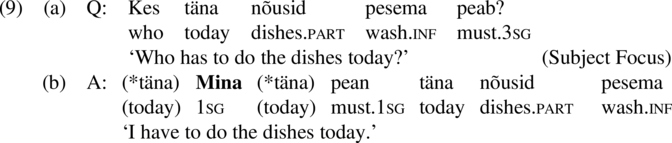
Crucially, when a focused subject occurs preverbally (i.e. before T), other elements (including Topics and scene-setting adverbs) must follow the finite verb or the auxiliary, Example (9b). Thus, it appears that aboutness topics and subjects are competing for the same structural position.
These facts contribute to clause-initial subjects being information-structurally ambiguous. From a sentence processing perspective, a Subject-Verb sequence at the beginning of a clause is underinformative as to whether the subject is discourse-old or new, topical, focal or contrastive.
When a preverbal element is a CT (Büring Reference Büring2003, Lee Reference Lee2003), the language optionally deviates from V2 surface order, with the additional restriction that other preverbal material must be discourse-given. CTs co-occur with Contrastive Foci (CF), as CTs do not express the primary Focus of the clause. Foci can not occur preverbally in the presence of CTs. The utterances in Example (10), where the subject is a CT and the object a CF, show that the verb may occur in the canonical second position or lower down in the clause. The utterances with V2, V3 and V4 order in Example (10) are all acceptable and identical in meaning, provided that the initial subject (‘Mari’) is contextually highlighted as a CT. The CT status of Mari, here, amounts to her belonging to a salient set of individuals (Anna’s friends) and being contrastive with another entity in that set with respect to the relevant property being expressed (what they gave Anna for her birthday). The possible responses in Example (10) share a contrastive accent on the CT subject (‘Mari’) and on the focused object (‘book’), with the rest of the lexical material prosodically deaccented.Footnote 5
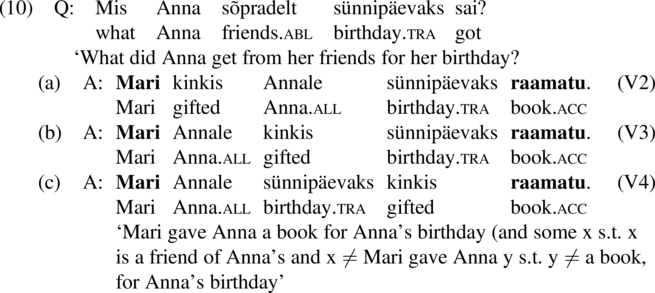
While the exact syntactic position of CTs in the left periphery of Estonian is still a matter of debate (see discussion in Sahkai & Tamm Reference Sahkai and Tamm2018, Holmberg et al. Reference Holmberg, Sahkai and Tamm2020, Kaps Reference Kaps2020, Vihman & Walkden Reference Vihman and Walkden2021), for the sake of simplicity, I assume that there is a clause-initial left-peripheral landing position for CTs, a CT phrase projection (CTopP).Footnote 6 This is schematised in Example (11), where CTopP acts as a landing position for CTs, and GivenP can optionally host discourse-given material in the presence of a CT, such as a subject or non-focused adverb.Footnote 7 The tensed verb or auxiliary raises to FinP, resulting in canonical V2 order when a DP raises to Spec,FinP through EPP movement (see Huhmarniemi Reference Huhmarniemi2019, for an analysis of EPP movement for subjects and objects in closely related Finnish).

2.2. Focused objects
CTs in Estonian precede the tensed verb, that is, occur in CTopP in the left periphery of the clause. I assume that focused elements including Contrastive Focus (CF) are located inside a Focus phrase (FocP).Footnote 8 A CF object may occur in its canonical position (immediately preceding an infinitival verb) when prosodically marked, as shown in Example (12a) or clause-finally, Example (12b). I follow the assumption that the difference between Examples (12a) and (12b) lies in the optional raising of the verb in Example (12b), allowing a focused object to be spelled out in a clause-edge position.Footnote 9 When only a single verb is present in the clause and raised out of the VP, the object is left behind in a clause-final position as well, Example (12c). Clause-final objects can thus always be interpreted as being focused, bearing a resemblance to default focus-marking in English (Selkirk Reference Selkirk1986).
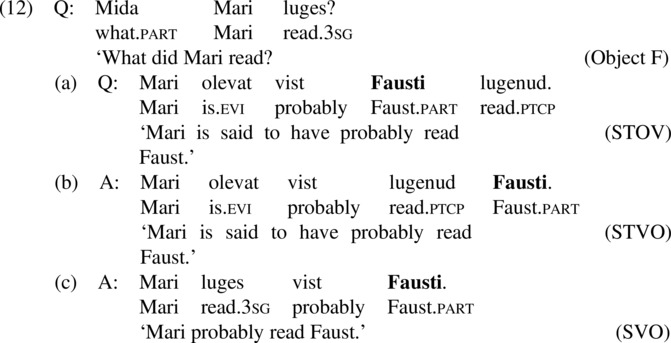
The clause-final placement of Focus in Estonian, and the inability of Focused elements other than subjects to occur before the tensed verb, suggests that FocP is located below the left periphery, potentially adjacent to and immediately dominating VP or vP. A vP-adjacent position for FocP has been argued for cross-linguistically (e.g. Farkas Reference Farkas1986, for Hungarian; Jayaseelan Reference Jayaseelan2001, for Malayalam; Konietzko & Winkler Reference Konietzko and Winkler2010, for German).
2.3. Contrastive ellipsis
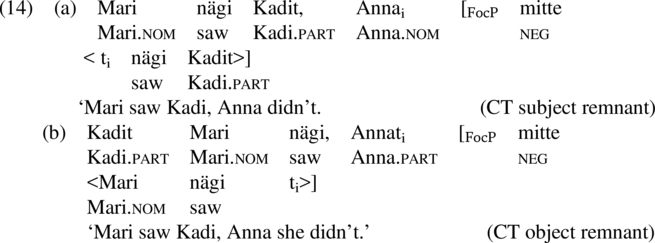
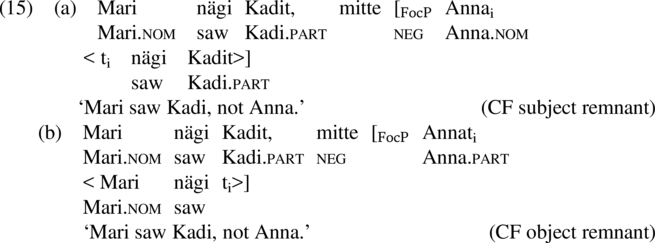
Estonian distinguishes between CT and CF remnant ellipsis, like German (Konietzko & Winkler Reference Konietzko and Winkler2010), Persian (Rasekhi Reference Rasekhi2018) and Romanian (Bîlbîie Reference Bîlbîie2019). I propose the structures shown in Example (13) for contrastive ellipsis in Estonian. The CT occurs in Spec-CTopP and the CF in Spec-FocP. While the raising of contrastive constituents to an information-structurally marked position is similar in CT and CF remnant ellipsis, the polarity particles (abbreviated as ‘Pol’) behave in different ways. In CT remnant ellipsis, the polarity particle receives a Focus interpretation (here, by raising to Spec-FocP). CTs cannot act as the primary Focus in a clause and must thus be accompanied by another constituent carrying focus (see Büring Reference Büring2003). In CF remnant ellipsis, the coordinator status of the particle means that it is base-generated as a head in the coordinator phrase (‘&P’). Under this analysis, both of these structures involve clausal coordination and vP deletion.

Due to the high placement of CTopP and the low placement of FocP in Estonian, we observe differences in the linear order between the remnant and the polarity particle in contrastive bare argument ellipsis. In CT remnants, the noun phrase precedes the polarity particle, as seen for both CT subjects, Example (14a), and CT objects, Example (14b).
In CF remnants, the noun phrase follows the polarity particle, as seen for both CF subjects, Example (15a), and CF objects, Example (15b) below.
Konietzko & Winkler (Reference Konietzko and Winkler2010) use the relative placement of sentential adverbs and remnants to diagnose the discourse status of remnants of stripping in German, with CTs occurring above and Foci below the adverb. Similarly for Estonian using the sentential adverb sugugi ‘(not) at all’, Example (16) confirms the high left-peripheral position of CT remnants, while Example (17) shows that Foci occur in a relatively lower syntactic position.
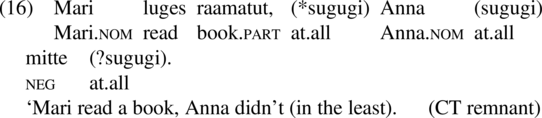
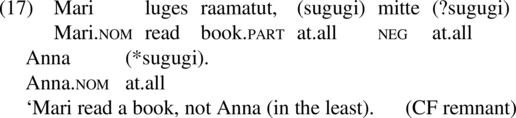
In the following, I assume a principle of information structural parallelism between the matrix and ellipsis clause (Carlson Reference Carlson2013) – the remnant ellipsis (whether it is a CT or CF) must have a correlate of the same information structural category (CT or CF) and preferentially of the same grammatical category (subject or object) in the antecedent clause. As clause-initial subjects can be syntactically marked as CTs and not as CFs (and the CT analysis is not available for clause-final objects), I will be focusing on a subset of the configurations in Examples (14–15), namely, CT subject remnant ellipsis, Example (14a), and CF object remnant ellipsis, Example (15b). Unambiguous remnants are used in order to observe the online processing effects of correlate locality and contrast-marking. Some of the additional structures in Examples (14–15) have been looked at elsewhere (see, e.g. Kaps Reference Kaps2019, for experimental work on CT and CF subject remnant ellipsis).
3. Eye-tracking during reading experiment
3.1. Hypotheses
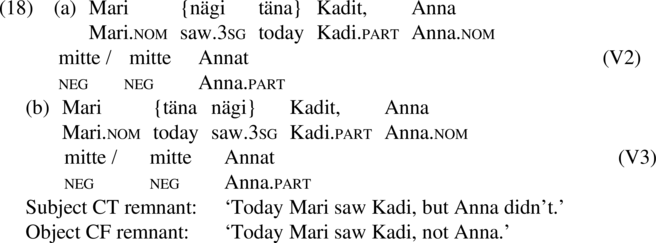
Clause-initial subjects (when immediately followed by a tensed verb) are information-structurally unmarked. If, however, additional lexical material occurs between the subject and the verb, the subject must have a salient CT alternative in the discourse. Thus, by keeping the linear position of the non-local correlate in the matrix clause constant but varying the placement of the tensed verb, we can manipulate information-structural marking on the subject independently of recency. Here, I vary the placement of an adverb to either follow the tensed verb, Example (18a), leaving the information structure of the subject ambiguous, or to precede the tensed verb, Example (18b), thus marking the subject as a CT. Crucially, the placement of the adverb in the first clause does not affect the truth-conditional meaning of the sentence, and the appropriate translations to Examples (18a–18b) are determined by whether the second clause contains a Subject CT remnant (‘Anna mitte’) or an Object CF remnant (‘mitte Annat’).
A comparison with unambiguous object remnants allows us to examine Locality and how information structure bears on this effect. As object correlates occur in the clause-final position (being both recent and Focus-marked by default), they act as a baseline for the following conceptual comparisons:
-
1. Validating that a Locality effect occurs in the processing of contrastive ellipsis in Estonian like it does in English. That is, if Locality applies to contrastive ellipsis in Estonian, we would expect to see a penalty for subject remnants compared to object remnants following canonical V2 clauses.
-
2. Assessing the extent to which information structural marking ameliorates any penalties for non-local correlates. That is, whether the subject remnant penalty is reduced in subject-CT marking V3 clauses compared to canonical V2 clauses.
Whether information structure modulates the Locality effect depends on the stage at which information-structural representations are accessed during the pairing of the remnant and its correlate. Below, I discuss two alternative hypotheses – the Recency view and the Information Structure view. I assume that upon reaching the remnant and realising it is dealing with contrastive ellipsis, the processor initiates a search for a grammatically licensed correlate. For instance, when the remnant is unambiguously case-marked, the correlate will preferentially be of the same grammatical category, if not carry the same case (Sag & Nykiel Reference Sag and Nykiel2011) as the remnant. Additionally, due to information structural parallelism, the information structure of the correlate must match that of the remnant.
One possibility is that correlate candidates are accessed based on linear recency, subsequently checking for whether a contrastive relationship can be felicitously established between the remnant in the correlate. Under this Recency view, Locality is primarily driven by linear order rather than information structure, as long as the syntactic position of the correlate is compatible with it having the same information-structural status (e.g. CT, CF) as the remnant. The Recency hypothesis postulates that the pairing of remnants with their correlates is driven by the salience of the correlate in the antecedent clause, the representation of which decays as subsequent lexical material is encountered (Martin & McElree Reference Martin and McElree2011). For the present purposes, since clause-initial subjects are compatible with being CTs regardless of whether they occur in V2 or V3 clauses, the Recency hypothesis would predict similar penalties for subject remnants over more recent object remnants regardless of whether the antecedent clause syntactically marks the subject correlate as contrastive or not. In experimental terms, the Recency hypothesis would predict significant main effects for Remnant Type, namely, a Subject remnant penalty. The Recency hypothesis would crucially not predict an interaction between Remnant Type and Word Order, if the word order manipulation does not target the linear distance between the remnant and the correlate.
Alternatively, under the Information Structure hypothesis, information structural representations are accessed earlier (perhaps in conjunction with other linguistically relevant properties, such as case and definiteness). Rather than initially attempting to pair the remnant with the most recently encountered candidate for a correlate, the processor accesses the discourse representation in the search of a felicitous correlate. The Locality effect previously observed for languages like English is then explained by objects being marked for Focus by default (Harris & Carlson Reference Harris and Carlson2018). In the case of Estonian, we would similarly expect object correlates to be easily accessible when they occur clause-finally and are therefore interpreted as being Foci. The processing difficulty associated with subject remnants would depend on whether the subject correlate is marked for contrast in the discourse representation. When parsing information-structurally ambiguous SVO clauses, the processor is unlikely to assign contrastive status to the clause-initial subject (see, e.g. Hoeks et al. Reference Hoeks, Vonk and Schriefers2002, for general preferences for simple topic-comment discourse structure in sentence processing). Thus, CT-status would be assigned to the initial subject after ruling out other remnant-correlate pairings, leading to a processing slowdown. In V3 structures, on the other hand, the subject is assumed to already have been marked for CT-status during the parsing of the antecedent clause, making the pairing of a CT subject remnant with the subject correlate as easy as the pairing of the CF object remnant with its object correlate. Thus, under the Information Structure hypothesis, a Locality effect would be expected in V2 clauses but not in V3 clauses, or in experimental terms, we would expect to see an interaction between Remnant Type and Word Order.
A third option is that the pairing of the remnant and the correlate is solely driven by case. Under this view, we would expect not to observe any online processing effects of Remnant Type, as both subject and object remnants are case-disambiguated. In this respect, the present study differs from previous work that has largely looked at disambiguation preferences (e.g. Harris & Carlson Reference Harris and Carlson2016, Reference Harris and Carlson2018) rather than processing difficulties associated with a disambiguated subject or object remnant interpretation. The Recency and Information Structure hypotheses assume that the processor consults case information during the pairing of the remnant and the correlate, but the relative weighting of case parallelism and information-structural parallelism, particularly in incremental processing, is an open question (see Frazier & Clifton Reference Frazier and Clifton2005 and Bîlbîie & De La Fuente Reference Bîlbiîe and De La Fuente2021, for work looking at syntactic and discourse parallelism effects on clausal ellipsis).
Both the Recency and the Information Structure hypotheses address factors determining the salience of the subject and object correlates, as relevant for pairing the remnant with its correlate. If we conceptualise of the processing of clausal ellipsis as involving the pairing of the remnant and correlate followed by the construction of the elided phrase by regenerating a structure at Logical Form (Harris & Carlson Reference Harris and Carlson2018), it is possible that processing asymmetries between subject and object remnant structures persist beyond successful identification of the correlate. While the present experiment is not designed to directly address possible structural effects arising in the processing of the elided material, we will return to this discussion in Section 4.
3.2. Design and Materials
As shown across Tables 1 and 2, the eye-tracking during reading experiment crossed remnant category (CT Subject, CF Object) with the word order of the matrix clause (Canonical V2, Subject-CT marking V3). Each target sentence was preceded by a lead-in sentence, in order to avoid placing the subject correlate at the site of initial eye fixations at the left of the display. The lead-in sentences were judged by the author to be compatible with both Subject and Object contrast. As the main hypothesis involved testing for an interaction between Word Order and Remnant Type, rather than independent processing penalties associated with one or the other Remnant Type, any possible biases towards Subject or Object contrast in the lead-in sentence for a given item were not seen as particularly concerning. The lead-in sentence and the target sentence appeared on the screen simultaneously, on a single line. There were 20 experimental quadrupletsFootnote 10 that were presented in a Latin square design, along with 70 filler items (including items from unrelated experiments and distractor items). The order of items was randomised on a by-participant basis. Half of all items were followed by a forced-choice comprehension question. The comprehension questions pertained to the lead-in sentence or the matrix clause of the target sentence, and never the ellipsis remnant.
Subject remnant conditions of a Sample item, varying in the relative order of the verb and adverb in the matrix clause. Italicised labels correspond to analysis regions.
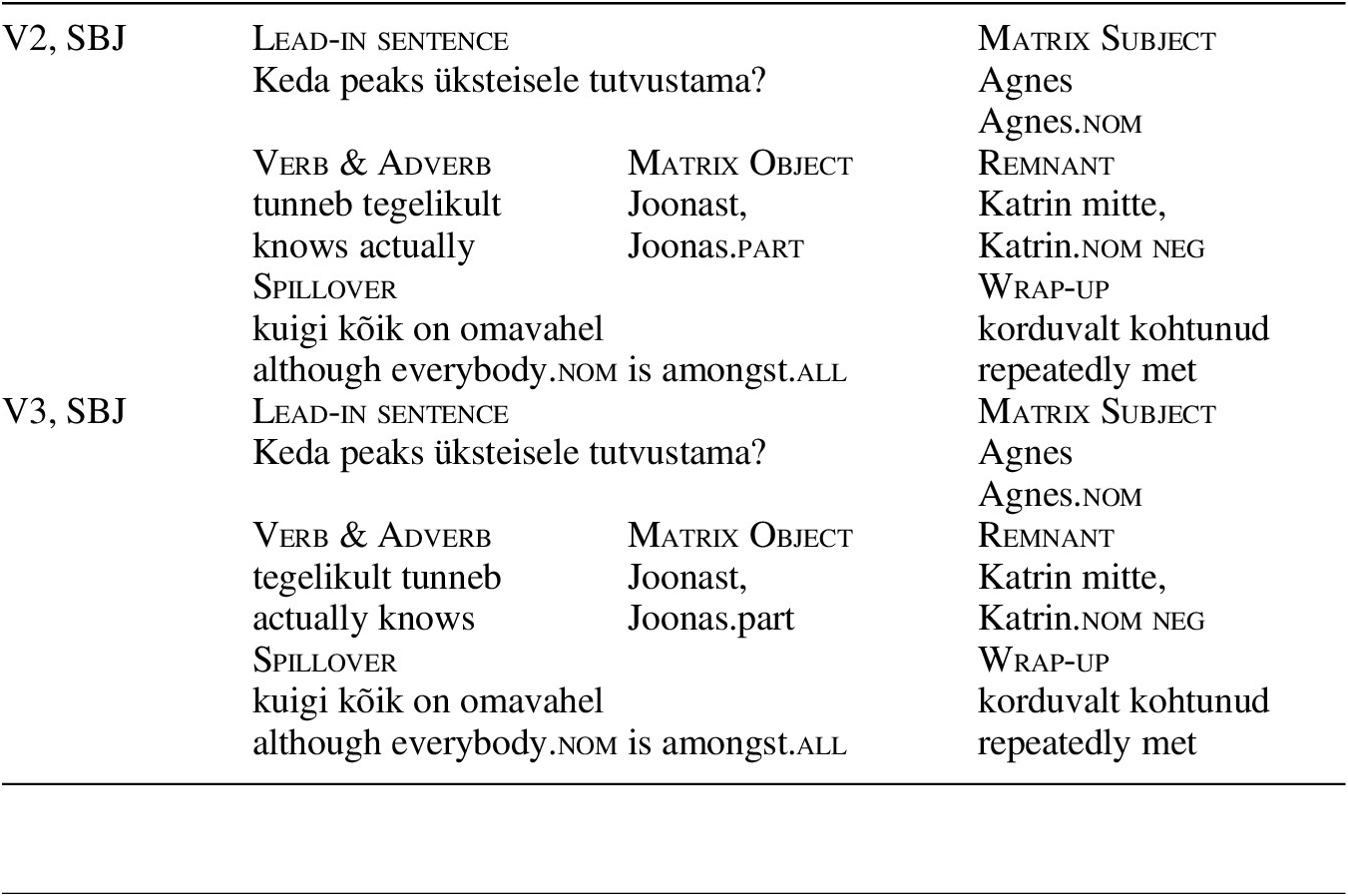
‘Who should be introduced to each other? Agnes actually knows Joonas, but Katrin doesn’t, although everybody has repeatedly met each other.’
Object remnant conditions of a Sample item, varying in the relative order of the verb and adverb in the matrix clause. Italicised labels correspond to analysis regions.
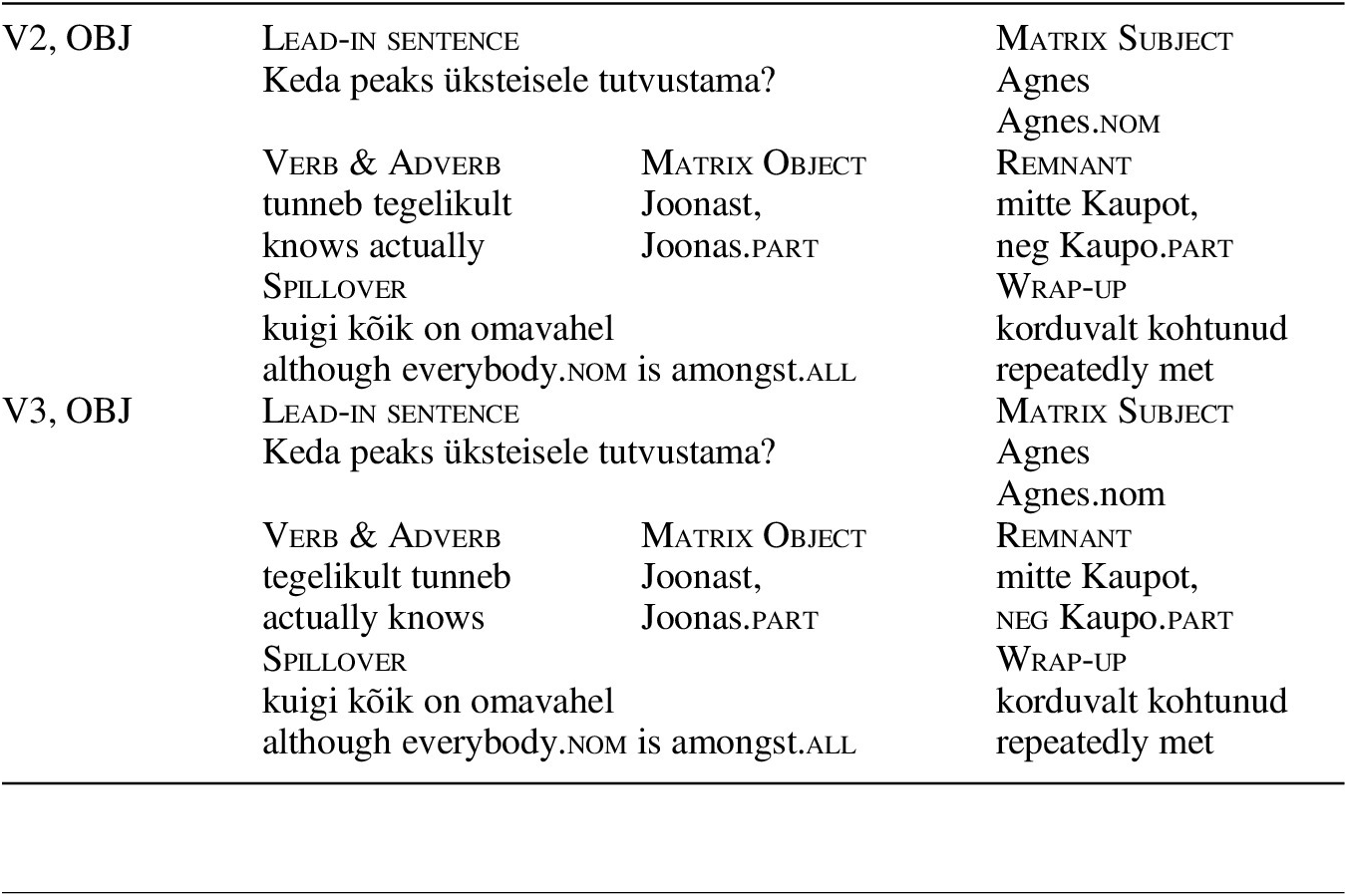
‘Who should be introduced to each other? Agnes actually knows Joonas, but she doesn’t Kaupo, although everybody has repeatedly met each other.’
The linear position of the matrix Subject and Object were kept constant across experimental conditions, in order to observe the expected effect of contrast-marking on the non-local subject correlate independently of the linear distance between the remnant and the correlate. The lexical content of the material intervening between the Subject remnant and its correlate was also kept constant by simply reordering the matrix verb and the adverb to yield the two word orders. Speaker-oriented adverbs were used throughout experimental items, as they contribute non-propositional content and are thus semantically incompatible with raising a set of alternatives and can, therefore, not be marked for contrast or focus (Bellert Reference Bellert1977). Speaker-oriented adverbs were used in order to reduce erroneous contrast-assignment to the adverb, as previous work shows the possibility of assigning CT status to second-position elements in V3 structures in Estonian (Kaps Reference Kaps2020).
Half of the items contained a positive polarity matrix clause (as shown in Tables 1 and 2), and half of the items contained a negative polarity matrix clause. The polarity of the ellipsis remnant always differed from the matrix clause. The remnant regions were matched for length (in number of letters) between Subject CT and Object CF conditions, and always consisted of an unambiguously case-marked proper name and a particle, in the order appropriate to the type of ellipsis (DP + particle for CT remnant ellipsis, particle + DP for CF remnant ellipsis). Due to the grammatical properties of focus particles and polarity particles in Estonian (see Tamm Reference Tamm2015, for examples involving particles and negation in Estonian), negative remnants always included the negative particle mitte ‘not’, while positive remnants contained one of two different particles depending on the type of contrastive ellipsis. Positive CT remnants included the Verum particle küll, while positive CF remnants included the focus particle vaid ‘but, only’. A mixture of affirmative and negative remnants was used in order to add variety to the experimental items and to hide the experimental manipulation, with the intention of capturing naturalistic reading patterns rather than strategic effects arising from familiarity with the manipulation.
The post-remnant segment (e.g. ‘although everybody has repeatedly met each other.’) was included in order to avoid the critical (Remnant) analysis region coinciding with the end of the sentence. On clause-final material, eye movements and the underlying cognitive processes can be highly variable (see Hirotani et al. Reference Hirotani, Frazier and Rayner2006, for a discussion of clause-final ‘wrap-up effects’). To better capture the time course of any effects occurring following the reading of the remnant region, the sentence-final material was divided into two analysis regions (Spill-over and Wrap-up).
3.3. Participants and Procedures
There were 46 native Estonian speakers that were recruited from the University of Tartu, Estonia and the surrounding community using flyers, social media and student mailing lists. Participants were compensated with 5 Euros for the 40-minute experiment. The final analysis includes a set of 36 participants. Five participants’ data were excluded from the analysis due to track losses on the Remnant region on 30% or more of the trials. One participant’s data were excluded due to a below 80% comprehension question accuracy on experimental items. A further four participants’ data were excluded for counterbalancing reasons, optimising for the smallest amount of track losses on the Remnant region.
Participants were seated alone in a sound-attenuated room and instructed to read silently, for comprehension, at their natural pace. They used a gamepad to proceed to the next trial and to answer comprehension questions. A few practice trials familiarised the participants to the procedure. An SR Research EyeLink 1000 Plus eye-tracker was used with a tower-mounted camera, allowing for binocular viewing while the participant’s head was stabilised. Eye movements were sampled at 1,000 Hz, from the right eye only. The 23” LCD monitor used to display the items was at a distance of 50 cm from the participant. The items were presented as a single line in a 14-point monospace font. Each trial was initiated by a fixation at the left edge of the screen in order to prevent participants from viewing the target sentence before reading the lead-in sentence. A 9-point calibration procedure was used to calibrate eye movements at the beginning of the experiment and as needed, with drift correction performed at the start of each trial.
3.4. Results
Below, I report region-by-region findings from the target sentence, using the following eye-tracking measures (see Staub & Rayner Reference Staub and Rayner2007, for an overview of eye-tracking measures in sentence processing):
-
• First pass times – the sum of all fixations on the region until exiting it to the left or right
-
• Go-past times – the sum of all fixations on the region and preceding regions from entering the region to exiting it to the right
-
• Regressions out – the probability of exiting the region to the left during first pass reading
-
• Second pass times – the sum of all fixations on the region following the reading of the critical (Remnant) region, including zero values
-
• Total times – the total sum of all fixations on the region
Fixations with durations under 80 ms were removed from analyses. Reading time data were analysed using linear mixed effects models and regression data using logistic mixed effects models, in the lme4 package (Bates et al. Reference Bates, Maechler, Bolker, Walker, Christensen, Singmann, Dai, Scheipl and Grothendieck2011) in R (R Core Team 2021). All models reported below include Word Order and Remnant Type as interacting fixed effects, with random intercepts for Participants and Items. Models with more complex random effects structures (containing both the random intercepts as well as random slopes for Word Order and Remnant Type by Participants and Items) resulted in a singular fit. Random slopes were therefore omitted from the models in order to avoid overfitting the data. Deviation coding was used throughout, with coefficients –1 for V2 and 1 for V3 order, and –1 for Object and 1 for Subject remnants. Box-Cox transformations were performed on reading time data to most closely approximate a normal distribution, resulting in λ values close to zero (between –0.59 and 0.32). Thus, log transformations were used in linear models (λ = 0; see, e.g. Grant et al. Reference Grant, Sloggett and Dillon2020 for a similar approach to reading data). Effects at p <.05, as obtained using the lmerTest package (Kuznetsova et al. Reference Kuznetsova, Brockhoff and Christensen2017), are reported as statistically significant.
3.4.1. First pass times
Means and standard errors for raw first pass times by analysis region are given in Table 3.
Means (with standard errors in parentheses) for First pass times (ms).
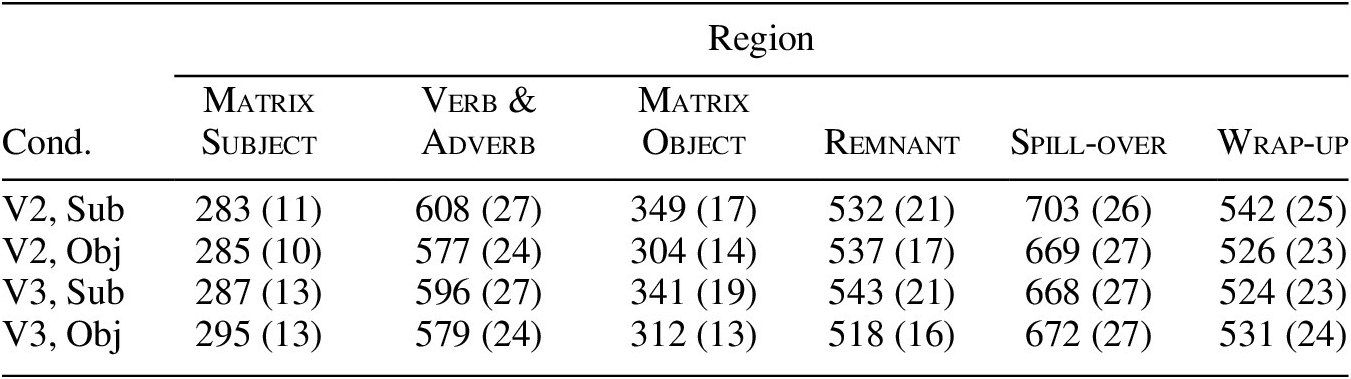
The data were modelled using the formula log(RT) ~ Word Order * Remnant + (1|Participant) + (1|Item), where RT is reading time. There were no significant effects or trends on the Matrix Subject or Verb & Adverb regions. On the Matrix Object region, there was a significant penalty for Subject conditions (M = 345 ms, SE = 13) over Object conditions (M = 308 ms, SE = 9), β = 0.043 (± 0.016), t = 2.685, p <.01, possibly due to an orthographic preview effect arising from the following Remnant region beginning in an uppercase letter in the Subject conditions (see Cutter et al. Reference Cutter, Martin and Sturt2019, for similar preview effects from capitalisation). There were no significant effects or trends in first pass times on the Remnant, Spillover or Wrap-up regions.
3.4.2. Go-past times
Means and standard errors for raw go-past times are given in Table 4.
Means (with standard errors in parentheses) for Go-past times (ms).
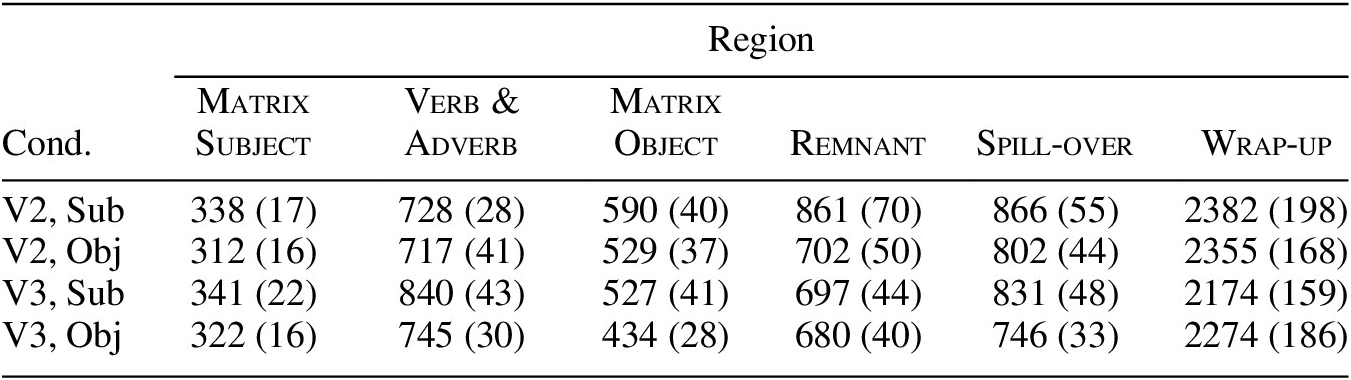
The data were modelled using the formula log(RT) ~ Word Order * Remnant + (1|Participant) + (1|Item), where RT is reading time. There were no significant effects or trends on the Matrix Subject region. On the Verb & Adverb region, there was a penalty for non-canonical V3 word order (M = 792 ms, SE = 26) compared to V2 word order (M = 723 ms, SE = 25), β = 0.049 (± 0.064), t = 2.795, p <.01. There was also a trend towards a Subject remnant penalty (β = 0.030 (± 0.017), t = 1.730, p = .084), which appears to be spurious as the Remnant region is too distant for preview effects to be observed here. Go-past times on the following Matrix Object region showed a reversed pattern for the word order effect, as V3 clauses were now passed faster (M = 481 ms, SE = 25) than V2 clauses (M = 560 ms, SE = 27), β = –0.070 (± 0.023), t = –3.095, p <.01, potentially due to a reduced need to reread V3 clauses, which were previously read more slowly (see also the reduced probability of regressions out of the Matrix Object region in V3 clauses, below). There was a significant penalty for Subject remnants (M = 558 ms, SE = 29) compared to Object remnants (M = 482 ms, SE = 23), β = 0.055 (± 0.023), t = 2.419, p <.05, which as in the case of first pass time effects on this region can be ascribed to orthographic preview. Go-past times on the Remnant region itself only showed a trend towards a Subject remnant penalty, β = 0.036 (± 0.019), t = 1.872, p = .062. The trend towards a penalty for Subject remnants compared to Object remnants persists into the Spillover region, β = 0.034 (± 0.018), t = 1.952, p = .051. No significant effects or trends were observed in go-past times on the Wrap-up region.
3.4.3. Probability of regressions out
Means and standard errors for the probability of regressions out of each analysis region are provided in Table 5.
Means (with standard errors in parentheses) for proportions of regressions out (%).
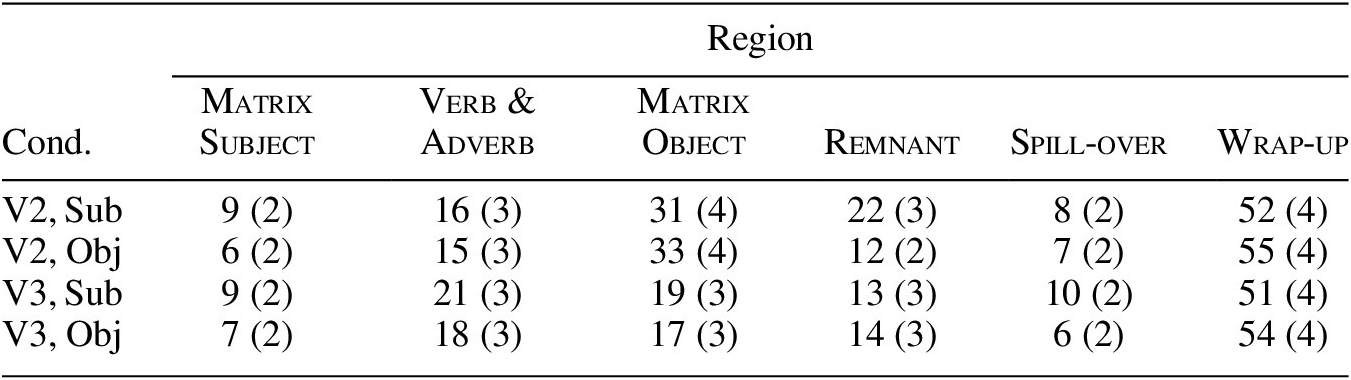
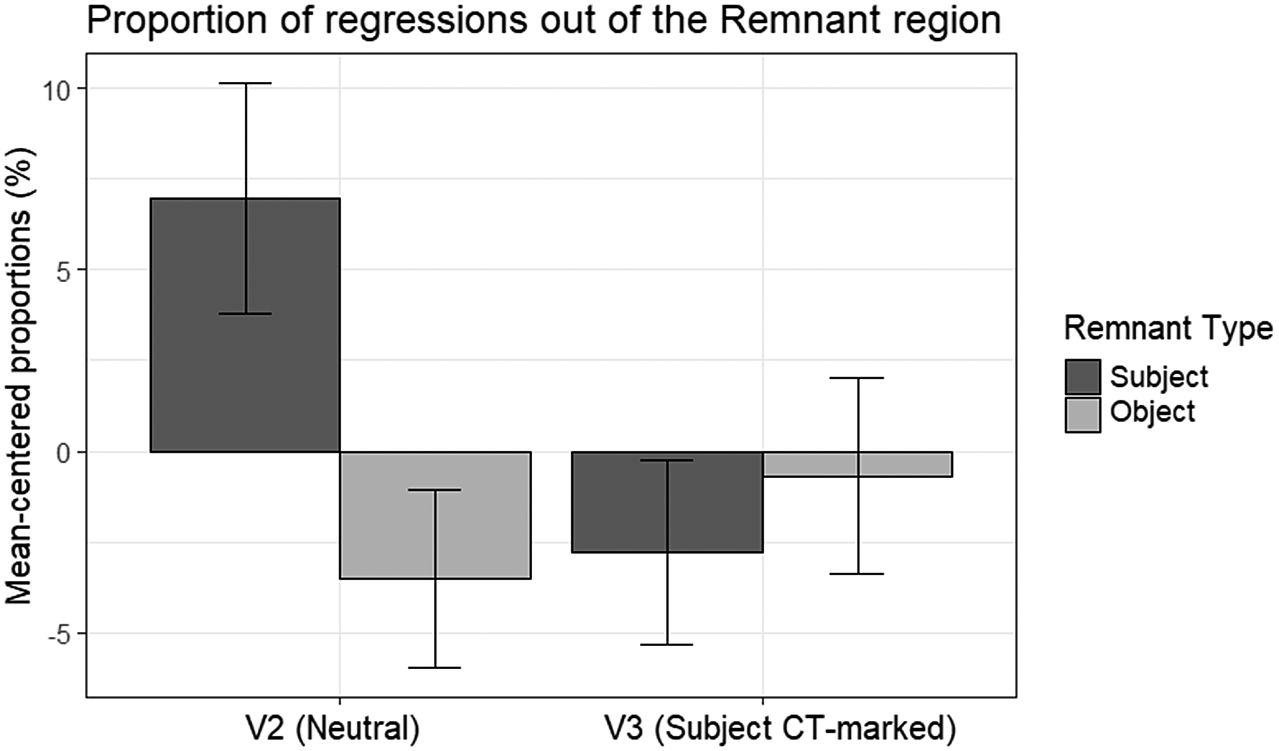
The data were modelled using the formula Regression ~ Word Order * Remnant + (1|Participant) + (1|Item), where Regression is a binary variable indicating the presence or absence of a regressive saccade out of the region during first pass reading. There were no significant effects or trends on the Matrix Subject or Verb & Adverb regions. The Matrix Object region showed a lower percentage of regressions out in V3 clauses (M = 18%, SE = 2) compared to V2 clauses (M = 32%, SE = 3), β = –0.454 (± 0.102), z = –4.455, p <.001. This can be explained by different reading strategies in canonical and non-canonical clauses, in line with what was observed in go-past times). The Remnant region showed no main effects, but a significant interaction between Word Order and Remnant type, β = –0.261 (± 0.114), z = 2.300, p <.05, as the Subject penalty only appeared in V2 clauses (diff = 10%), and not in V3 clauses (diff = –1%). The proportions of regressions out of the Remnant region are shown in Figure 1. No significant effects or trends were observed in the probabilities of regressions out of the Spillover or Wrap-up regions.
Proportions of regressions out (%) of the Remnant region (‘Katrin mitte’ / ‘mitte Kaupot’), by Matrix clause word order (V2, V3) and remnant type (Subject, Object).
3.4.4. Second pass times
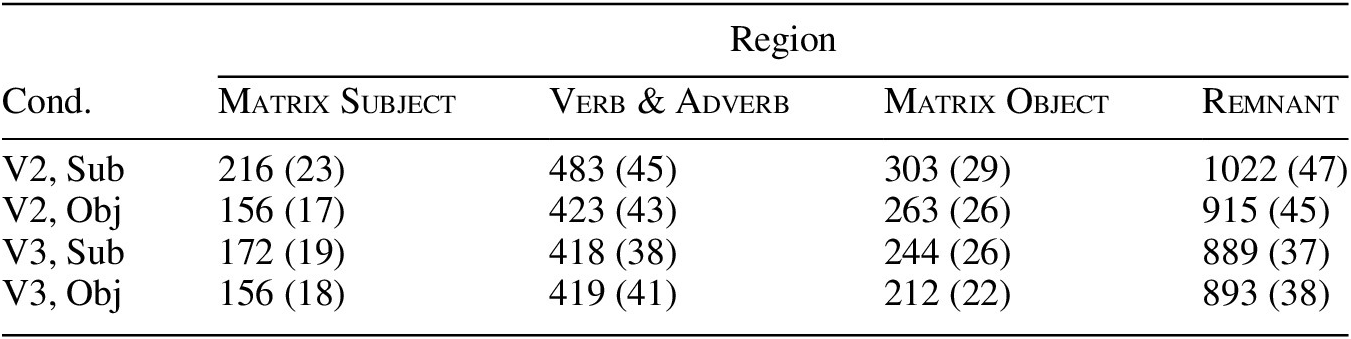
Raw second pass times to show re-reading of regions that precede the critical (Remnant) region are shown in Table 6.
Means (with standard errors in parentheses) for second pass times (ms).
The data were modelled using the formula log(RT) ~ Word Order * Remnant + (1|Participant) + (1|Item), where RT is reading time. The data contained zeros when target regions were not re-read. As a lack of re-reading signals comprehension, the zeros were not excluded from the analyses, but rather replaced by a low value of $ {10}^{-5} $
for the purposes of log transformation. There were no significant effects or trends on the Matrix Subject or Verb & Adverb regions. The Matrix Object region showed a trend towards a word order effect, with lower second pass times for V3 clauses (M = 228 ms, SE = 17) compared to canonical V2 clauses (M = 283 ms, SE = 19), β = –0.490 (± 0.273), t = –1.792, p = .074. The Remnant region showed a penalty for Subject remnants (M = 956 ms, SE = 30) compared to Object remnants (M = 904 ms, SE = 29), β = 0.035 (± 0.017), t = 2.082, p <.05.
$ {10}^{-5} $
for the purposes of log transformation. There were no significant effects or trends on the Matrix Subject or Verb & Adverb regions. The Matrix Object region showed a trend towards a word order effect, with lower second pass times for V3 clauses (M = 228 ms, SE = 17) compared to canonical V2 clauses (M = 283 ms, SE = 19), β = –0.490 (± 0.273), t = –1.792, p = .074. The Remnant region showed a penalty for Subject remnants (M = 956 ms, SE = 30) compared to Object remnants (M = 904 ms, SE = 29), β = 0.035 (± 0.017), t = 2.082, p <.05.
3.4.5. Total times
Means and standard errors for raw total times are given in Table 7.
Means (with standard errors in parentheses) for total times (ms).

The data were modelled using the formula log(RT) ~ Word Order * Remnant + (1|Participant) + (1|Item), where RT is reading time. There was a Subject penalty on the Matrix Subject region, indicating that the Subject correlate was fixated longer in Subject remnant conditions (M = 548 ms, SE = 21) than in Object remnant conditions (M = 481 ms, SE = 17), β = 0.054 (± 0.019), t = 2.773, p <.01. The Verb & Adverb region showed a similar penalty for Subject remnants (M = 1,267 ms, SE = 39) compared to Object remnants (M = 1,175 ms, SE = 36), β = 0.036 (± 0.016), t = 2.251, p <.05. On the Matrix Object region, there were two main effects. Firstly, there was a significant penalty for Subject remnant conditions (M = 657 ms, SE = 24) compared to Object remnant conditions (M = 580 ms, SE = 21), β = 0.060 (± 0.020), t = 3.079, p <.01. Secondly, there was a reading time advantage in V3 clauses (M = 584 ms, SE = 21) over V2 clauses (M = 654 ms, SE = 24), β = –0.047 (± 0.020), t = –2.393, p <.05. On the following Remnant region, there was a significant penalty for Subject remnants (M = 956 ms, SE = 30) compared to Object remnants (M = 904 ms, SE = 29), β = 0.035 (± 0.017), t = 2.082, p <.05. No significant effects or trends were observed in total times on the Spillover or Wrap-up regions.
3.4.6. Summary
To summarise the results, a few notable patterns emerged from the data. Firstly, there are what appear to be time course differences between processing canonical and non-canonical word order. Go-past times and proportions of regressive eye movements pointed to canonical V2 clauses being initially read more quickly than CT-marked V3 clauses, followed by a higher proportion of regressions to the preceding material when a clause-final object is reached.
Secondly, several reading time measures showed evidence for a Locality preference – remnants with non-local correlates are associated with longer reading times on the clause containing the correlate. Curiously, this effect did not simply emerge on the correlate itself, rather, we saw increased total reading times on all matrix clause regions. As discussed below, this effect may signal the recovery of the elided material, rather than the pairing of remnants and correlates.
Thirdly, and most interestingly for the present purposes, we observed an interaction between Word Order and Remnant in the probability of regressions out of the critical Remnant region itself. Here, canonical V2 clauses showed a Subject remnant penalty, while non-canonical, CT-marking V3 clauses did not.
Overall, the data were compatible with the Information Structure hypothesis for the Locality effect. When both the subject and the object occurred in syntactically contrast-marking positions in the antecedent clause, the processing difficulty associated with pairing the remnant with the non-local subject correlate was attenuated, as seen in the proportion of regressions out of the remnant.
4. Discussion
The results indicate that Estonian, like other languages that have been previously experimentally tested, shows a Locality preference in the processing of contrastive ellipsis following canonical antecedent clauses – processing remnants with non-local (Subject) correlates is costlier than processing remnants with local (Object) correlates. Crucially, as evidenced by the regression measure, this effect is modulated by the discourse status of the non-local correlate. When the subject is syntactically marked as a CT, the processing of subject remnant ellipsis is not uniformly penalised compared to the processing of object remnant ellipsis. Thus, we have obtained novel evidence that the Locality effect observed in previous work is likely at least in part due to information structural considerations. Interestingly, the effect observed in the proportion of regressions out of the remnant region appears to be stronger than what has been previously found for English using contrastive prosody on the non-local correlate (e.g. Carlson et al. Reference Carlson, Dickey, Frazier and Clifton2009, Harris & Carlson Reference Harris and Carlson2018). This could be due to syntactic CT-marking offering a more unambiguous cue to discourse structure than contrastive pitch accents, as the latter could also be interpreted as metalinguistic emphasis, rather than as conveying linguistic contrast. It is also worth mentioning that the present manipulation used unambiguous, case-marked remnants, and this could have reduced potential interference between the subject and object correlates (see e.g. Harris Reference Harris2015 and Lawn Reference Lawn2020, for similarity-based interference effects in sluicing ellipsis), perhaps aiding the processing of subject remnants compared to previous work that has used ambiguous remnants.
As discussed in Section 3.1, the Recency hypothesis predicts no interaction between Word Order and Remnant Type, as the experimental manipulation controls for the linear distance between remnants and correlates, as well as the lexical content of the intervening material. Under the Recency hypothesis of the Locality effect, we would expect the remnants following the non-canonical V3 clauses to elicit similar reading patterns to the remnants following the canonical V2 clauses (any main effects of the Word Order manipulation aside), a prediction challenged by the findings from the regression data.
How to then explain an overall penalty for subject remnants in reading time measures, given the interaction between Word Order and Remnant Type seen in the regression measure? Early effects here (such as the preview effects observed in first pass times and go-past times) could be due to orthographic factors – the edge of the remnant clause in the CT remnant conditions contained an initial capital letter, signaling a proper name. In the CF remnant conditions, the edge of the remnant clause contained a function word. It is possible that readers anticipate comprehension difficulty from referential expressions as opposed to function words based on parafoveal information.
There are several mutually compatible possible explanations for a subject penalty in later reading measures, such as total times. These effects are not necessarily due to Recency but could arise from the nature of contrastive ellipsis in Estonian. CTs are not the primary carriers of Focus but rather co-occur with a focused constituent (Büring Reference Büring2003, Lee Reference Lee2003). Due to the clause-final position of the object in the antecedent clause, the matrix object is likely marked for Focus when first reading the antecedent clause. However, the CT remnant ellipsis constructions used in the present study instead involved polarity focus (the DP remnant was followed by a polarity particle, which was the primary carrier of Focus). It is generally accepted that elided material must be discourse-given (Merchant Reference Merchant2009). If the processor by default assigns focus-marking on clause-final objects (see, e.g. Harris & Carlson Reference Harris and Carlson2018) rather than the polarity of the clause, it will encounter a mismatch when reaching the CT remnant. Thus, the antecedent clause may have been re-read longer in the subject remnant conditions due to this information-structural mismatch between the ellipsis clause and the default interpretation of the antecedent clause. Therefore, what looks like a Recency effect may instead have arisen from the use of CT remnant ellipsis (rather than CF remnant ellipsis) in the subject conditions. The latter was, of course, necessary in order to utilise structural CT-marking in Estonian in the experimental manipulation. Looking at the online processing of gapping structures with a CT subject and a CF object remnant could provide further evidence for the Information Structure hypothesis of Locality.
Another explanation for the observed subject penalties in later measures has to do with differences in the structural processing of the elided material. As was proposed by Harris & Carlson (Reference Harris and Carlson2018), the pairing of a remnant with its correlate is followed by the reconstruction of the elided material. While both CT and CF ellipsis in Estonian have here been proposed to involve clausal ellipsis (a vP is elided in both structures), CT ellipsis is assumed to involve additional movement of the CT-marked constituent to the left periphery and of a polarity particle to a Focus position. Recovering this structurally more complex configuration could give rise to processing penalties in reading times. As the present study confounds the grammatical role of the remnant (subject or object) with its information-structural status (and thus, syntactic derivation), future work comparing the processing of CT and CF remnants of varying grammatical roles could help tease apart the online processing signatures of pairing remnants with their correlates and recovering elided structure.
The study also raises questions when it comes to how fine-grained the representation of contrast is during the incremental processing of clausal ellipsis, and whether cross-linguistic differences bear on the representation of contrast. Interestingly, we do not observe a penalty for a local object correlate when the non-local subject is marked as a CT, that is the increased salience of the subject does not take away from the naturalness of the object as a remnant. This is compatible with the processor making fine-grained distinctions between CTs and CFs during comprehension, as CTs are not primary carriers of Focus. A similar effect would be expected to occur in other languages distinguishing between CT and CF remnant ellipsis (Konietzko & Winkler Reference Konietzko and Winkler2010, Rasekhi Reference Rasekhi2018, Bîlbîie Reference Bîlbîie2019). English, however, has not been shown to have this distinction and previous work on contrastive ellipsis explicitly or implicitly assumes that remnants are Foci (see, e.g. the discussion of enduring focus effects in Harris & Carlson Reference Harris and Carlson2018). Even in languages that syntactically mark contrast, rather than just focus, there is variability in whether CTs and CFs are syntactically distinct. For instance, Finnish has been argued to have a left-peripheral contrast position that can house either CT or CF constituents (Kaiser Reference Kaiser2006). Cross-linguistic work on different types of contrastive ellipsis could shed light on the nature of the linguistic representations used in ellipsis resolution.
Further, the present study presents evidence for Locality effects in the processing of bare argument ellipsis with case-disambiguated remnants. Namely, Locality effects in online processing do not disappear when the case of the remnant matches a unique correlate candidate in the antecedent clause, as evidenced by subject penalties following canonical V2 clauses in both reading time and regression measures. The present findings are compatible with information-structural parallelism between the remnant and correlate being weighted more heavily than case parallelism (see also Frazier & Clifton Reference Frazier and Clifton2005 and Bîlbîie & De La Fuente Reference Bîlbiîe and De La Fuente2021), although further work teasing these two factors apart is needed for more direct evidence for this proposal.
More broadly, the present findings add to a growing base of evidence for the importance of information-structural representations during incremental structure-building. Information-structural representations are consulted not only during the reconstruction of elided material when resolving clausal ellipsis but also in resolving other types of syntactic relations. To illustrate, Carlson & Potter’s (Reference Carlson and Potter2021) recent work on attachment ambiguity resolution in English shows that focus-marking a constituent using focus particles like only increases the likelihood of interpreting an ambiguously attached modifier as attaching to that constituent, over and above the effects of focus-marking using contrastive pitch accents. Similarly, they show that focus-marking using preceding wh-questions draws an ambiguously attaching modifier to the focused constituent (Carlson & Potter Reference Carlson and Potter2022). Jointly, these findings suggest that information-structural cues, which may be expressed in language-specific ways as seen in the instance of adverb placement in Estonian, guide synatctic processing decisions. We may well see future research increasingly integrating memory-based accounts of structure-building that appeal to factors like recency (e.g. Gibson et al. Reference Gibson, Pearlmutter, Canseco-Gonzalez and Hickok1996) and perceptual salience (e.g. Lee & Watson Reference Lee and Watson2011) with approaches to structural salience that draw on the theoretical literature and cross-linguistic empirical investigations.
5. Conclusions
The present study provides evidence for information-structural representations being consulted during the processing of contrastive ellipsis, showing that processing difficulties arising from pairing remnants with non-local correlates are not simply due to linear distance. As the present experiment controlled for the linear distance and lexical material intervening between the remnant and its information-structurally marked or unmarked non-local correlate, we obtained supportive evidence for the language processor consulting information-structural representations during ellipsis resolution.
This study sets the stage for further work examining the nature of information-structural representations and their interaction with other grammatical (and psychological) factors in ellipsis resolution.
Appendix: Experimental items
The items below are shown in V2 order, with the CT and CF remnants (in this order) in curly brackets. Comprehension questions are given in capital letters.
-
1. Mis sinu sõprade elus uut on? Ants ei armasta ilmselt Jaanikat, {Margus küll / vaid Hellet}, kuigi keegi ei taha seda endale tunnistada.
KAS ANTS ARMASTAB JAANIKAT? EI / JAH
‘What’s new in your friends’ lives? Ants probably doesn’t love Jaanika, {Margus does / but Helle}, but nobody wants to admit it to themselves.
DOES ANTS LOVE JAANIKA? NO / YES’
-
2. Keda peaks üksteisele tutvustama? Agnes tunneb tegelikult Joonast, {Katrin mitte / mitte Kaupot}, kuigi kõik on omavahel korduvalt kohtunud.
KAS AGNES TUNNEB JOONAST? EI / JAH
‘Who should be introduced to each other? Agnes actually knows Joonas, {Katrin not / not Kaupo}, although everybody has repeatedly met each other.
DOES AGNES KNOW JOONAS? NO / YES’
-
3. Kas kõigil õnnestus peol uue õpilasega kohtuda? Madis ei kohanud tegelikult Brittat, {Gustav küll / vaid Laglet}, nii et peaksime uuesti midagi korraldama.
KAS KÜSIMUSES MAINITI PIDU? JAH / EI
‘Did everybody manage to meet the new students at the party? Madis actually didn’t meet Britta, {Gustav did / but Lagle}, so we should arrange something again soon.
DID THE QUESTION MENTION A PARTY? YES / NO’
-
4. Mis pärast hääletuse tulemuste avaldamist juhtus? Dagmar hoiatas muidugi Tanelit, {Ester mitte / mitte Ahtot}, kuid häältetulemusi ei olnud enam võimalik muuta.
KAS KÕIK OLID HÄÄLETUSTULEMUSTEGA RAHUL? JAH / EI
‘What happened after announcing the results of the vote? Dagmar of course warned Tanel, {Ester not / not Ahto}, but the results of the vote could no longer be changed.
WAS EVERYBODY HAPPY WITH THE RESULTS OF THE VOTE? YES / NO’
-
5. Kuidas seriaali viimane osa lõppes? Robin ei solvanud tõesti Margitit, {Paavel küll / vaid Tuulit}, kuigi see selgus alles hiljem.
MILLE KOHTA KÜSIMUS OLI? SEEBIKA / FILMI
‘How did the last episode of the show end? Robin reallly didn’t offend Margit, {Paavel did / but Tuuli}, but this only became clear later.
WHAT WAS THE QUESTION ABOUT? A SOAP OPERA / A MOVIE’
-
6. Kes eile aktusel kohtusid? Riin nägi vist Indrekut, {Karolin mitte / mitte Meelist}, sest aktusel oli väga palju rahvast.
KUIDAS AKTUS OLI? VAIKNE / RAHVAROHKE
‘Who met at the reception yesterday? Riin probably saw Indrek, {Karolin not / not Meelis}, because there were lots of people at the reception.
HOW WAS THE RECEPTION? QUIET / CROWDED’
-
7. Mis täna lõunapausil välja tuli? Kalev ei kartnud ilmselgelt Annikat, {Maksim küll / vaid Terjet}, või vähemalt nii ma kuulsin.
MILLAL SEDA ARUTATI? LÕUNAPAUSIL / PEALE TÖÖD
‘What was revealed at the lunch break today? Kalev probably wasn’t afraid of Annika, {Maksim was / but Terje}, or at least this is what I heard.
WHEN WAS THIS DISCUSSED? AT LUNCH / AFTER WORK’
-
8. Miks kõik hommikul nii pahas tujus olid? Ines teretas nähtavasti Silverit, {Helerin mitte / mitte Oskarit}, kuigi meil on tavaks, et kõik tervitavad üksteist.
KUIDAS INIMESTE MEELEOLU OLI? RÕÕMUS / KEHVAVÕITU
‘Why was everybody in such a bad mood in the morning? Ines apparently greeted Silver, {Helerin not / not Oskar}, although it is customary for us for everybody to greet each other.
HOW WAS PEOPLE’S MOOD? HAPPY / POOR’
-
9. Mida sa oma sõprade kohta kuulsid? Allar ei emmanud võib-olla Kristit, {Toomas küll / vaid Niinat}, kuigi see on muigugi ainult kuulujutt.
MIDA LAUSES MAINITI? KALLISTAMIST / MUSITAMIST
‘What did you hear about your friends? Allar maybe didn’t hug Kristi, {Toomas did / but Niina}, but this is of course only a rumor.
WHAT WAS MENTIONED IN THE SENTENCE? HUGGING / KISSING’
-
10. Mida naabrinaine eile nii innukalt arutas? Triin vihkab usutavasti Jörgenit, {Kerstin mitte / mitte Vahurit}, kuigi ma ei ole päris kindel, kas see tõsi on.
KES ARUTAS SEDA TEEMAT? JÖRGEN / NAABRINAINE
‘What did the neighbor woman discuss so enthusiastically yesterday? Triin possibly hates Jorgen, {Kerstin not / not Vahur}, but I’m not entirely sure if this is true.
WHO WAS DISCUSSING THIS TOPIC? JORGEN / THE NEIGHBOR WOMAN’
-
11. Mis etenduse esimeses vaatuses juhtus? Marek ei märganud muidugi Emiliat, {Alvar küll / vaid Piiat}, mistõttu arenes sellest väga romantiline armastuslugu.
‘What happened in the first act of the play? Marek of course did not notice Emilia, {Alvar did / but Piia}, which is why it developed into a very romantic love story.’
-
12. Mida eelmisel nädalal korteriühistu koosolekul arutati? Merilin segas väidetavalt Antonit, {Kätlin mitte / mitte Olarit}, aga kõigil paluti vähem lärmi teha.
‘What was discussed at the housing association meeting last week? Merilin apparently bothered Anton, {Katlin not / not Olari}, but everybody was asked to make less noise.’
-
13. Mida sul uue töötaja kohta öelda on? Kristjan ei palganud tõesti Siretit, {Jaanus küll / vaid Juliat}, kuid kellelgi ei olnud selle kohta midagi arvata.
‘What do you have to say about the new employee? Kristjan really didn’t hire Siret {Jaanus did / but Julia}, but nobody had any opinion on this.’
-
14. Miks naabrid nii valjusti omavahel vaidlesid? Susann usaldab vist Kasparit, {Vivian mitte / mitte Raimot}, aga ma ei taha nende eraelu kohta midagi teada.
‘Why were the neighbors arguing so loudly amongst each other? Susann probably trusts Kaspar, {Vivian not / not Raimo}, but I don’t want to know anything about their private life.’
-
15. Kellest eile juttu oli? Hendrik ei maininud ilmselt Katret, {Oliver küll / vaid Dianat}, aga ma ei olnud terve vestluse ajal seal.
‘Who was being talked about yesterday? Hendrik probably didn’t mention Katre, {Oliver did / but Diana}, but I wasn’t there for the whole conversation.’
-
16. Kes on juba omavahel kohtunud? Marleen teab vist Villemit, {Kärt mitte / mitte Ivot}, kuigi iseenesest peaksid kõik omavahel tuttavad olema.
‘Who has already met each other? Marleen probably knows Villem, {Kart not / not Ivo}, but technically everybody should be familiar with each other.’
-
17. Millest teie peres tavaliselt tülid tekivad? Eerik ei kuula ilmselgelt Kerlit, {Marten küll / vaid Lillit}, aga õnneks jääb ema sõna alati peale.
‘What is typically the source of fights in your family? Eerik clearly doesn’t listen to Kerli, {Marten does / but Lilli}, but luckily mom’s word always prevails.’
-
18. Kas uued tiimiliikmed on varem kohtunud? Kristel mäletab nähtavasti Jarmot, {Evelin mitte / mitte Henrit}, sest nende kohtumisest on väga palju aega möödas.
‘Have the new team members met before? Kristel apparently remembers Jarmo, {Evelin not / not Henri}, because it’s been a while since they met.’
-
19. Mis eile kontoris toimus? Mehis ei kiusanud muidugi Annelit, {Robert küll / vaid Lindat}, aga see oli kõik naljaga pooleks.
‘What happened at the office yesterday? Mehis of course did not mock Anneli, {Robert did / but Linda}, but it was all meant as a joke.’
-
20. Mis kuulujutt hetkel liikvel on? Hedvig suudles usutavasti Mattiast, {Lilian mitte / mitte Kustit}, aga ma ei mäleta täpselt, kellelt ma seda kuulsin.
‘What rumor is going around right now? Hedvig possibly kissed Mattias, {Lilian not / not Kusti}, but I don’t remember exactly who I heard it from.’


 Open access

