


Introduction
Islam has always encompassed more than religious belief. Its introduction beyond the boundaries of the Islamic empire and, later, of the Islamicate world (encompassing the areas where Islamic culture became hegemonic regardless of actual religious belief), often resulted in more than the simple religious conversion of local populations (cf. Insoll Reference Insoll2003; Peacock Reference Peacock2017). Islam brought major changes in social norms and behaviours, overlaying rather than erasing pre-existing cultural strata. The trans-regional exchange networks that supplied the Islamicate world helped to spread the religion, and these long-distance connections were, in turn, expanded and intensified as a result. Islam has often been a vector of cosmopolitanism, here defined as a cultural environment resulting from the gathering of people of various backgrounds and their adherence to a common normative system of imperial origin. This is particularly the case for the more remote regions that Islam reached after the Arab conquests of the seventh and eighth centuries AD.
Conversely, the discovery of glazed ceramics or other luxury items imported from the Islamicate world is not itself indicative of an ongoing process of Islamisation (Insoll Reference Insoll2021). Change in beliefs and social behaviour associated with Islam is better evidenced in the accommodation of cultural facilities, such as mosques, and the adoption of funerary rituals complying with Islamic norms. Where conversion did take place, this change implied neither immediate nor definitive repudiation of older practices. Syncretisms could develop, and earlier practices and beliefs could also continue alongside newly introduced ones (e.g. Lombard Reference Lombard1990; DeWeese Reference DeWeese1994; Insoll Reference Insoll2011). As a result, and especially in the absence of additional contextual information, the identification of religious identity solely on the basis of burial practices, for example, can be problematic.
Islam is said to have been introduced to Tigray in northern Ethiopia at an early date. According to Muslim tradition, the Prophet urged his followers to flee persecution in Mecca and seek refuge in the Christian kingdom of Aksum in Ethiopia (Ibn Hisham, Sira I. 349–67; Tadmuri Reference Tadmuri1990). This first hijra, or emigration, would have occurred seven years before the emigration in AD 622 of Muhammad to Medina that marks the beginning of the Hijra calendar. Yet no evidence of such an early Muslim presence has been found so far in Ethiopia. The shrine of Nägash (Tigray), where Muslims worship the putative tombs of Muhammad's companions who died during the emigration, is undocumented before the sixteenth century (Gori Reference Gori and Uhlig2007). The earliest excavated settlement in Ethiopia with evidence for any Muslim community dates to the mid twelfth century and is located far from Tigray in the eastern lowlands of the country (Gaastra & Insoll Reference Gaastra and Insoll2020; Insoll Reference Insoll2021). The possible existence of a medieval Islamic settlement in Tigray was, however, noted in 1937 by Conti Rossini on the basis of funerary stelae bearing Arabic inscriptions brought to him by the inhabitants of Kwiha, 7km east of the modern city of Mekelle (Conti Rossini Reference Conti Rossini1937–1939). Twenty-one stelae have been found around the town between 1937 and 2000, providing indirect evidence for a Muslim settlement established between the late tenth and early twelfth centuries (Pansera Reference Pansera and Rossini1945; Schneider Reference Schneider1967, Reference Schneider2009; Smidt Reference Smidt, Böll, Nosnitsin, Rave, Smidt and Sokolinskaia2004). Its exact location and that of its cemetery, however, remained unknown, as the stelae were discovered out of context in an area known as Bilet.
These clues to Kwiha's/Bilet's Islamic past were sufficiently promising to justify systematic investigation of the area (Hirsch Reference Hirsch2018). With the support of the European-Research-Council-funded project ‘HornEast’, which aims to identify connections between the Christian societies of the Horn of Africa and their Islamic surroundings during the Middle Ages, survey and excavations were undertaken in 2018–2019 (HornEast n.d.). This fieldwork identified and partially excavated a cemetery and also discovered 24 funerary stelae, including one in its archaeological context. This work therefore represented the first excavation of a medieval Muslim cemetery in the Ethiopian Highlands. Moreover, the fieldwork has also identified several other Muslim cemeteries 30km to the south in Arra and the surrounding area, and discovered a further 45 funerary stelae (Table 1). These additional discoveries place the Bilet cemetery within the larger context of medieval Islam in Tigray (Loiseau et al. Reference Loiseau, Dorso, Gleize, Ollivier, Chekroun, Hirsch and Ayenachew2019). Here, we present the first results of this ongoing research.
Arabic Muslim funerary stelae from medieval Tigray.

The Muslim cemetery of Bilet: an overview
The Bilet cemetery is located at an altitude of 1998m asl, on the northern edge of the town of Kwiha, in a shallow valley bordered to the south by low hills (Figure 1). Three soundings were opened in a field where three stelae were observed in situ during the survey phase. The first sounding (one) measured 128m2 and was excavated in its entirety. Recent disturbance was observed in sounding one in the form of a trench dug by a mechanical excavator—probably in search of gold—and later filled with stone blocks. Soundings two and three, each measuring 16m2, were located to the east, and, due to time constraints, were opened for near-surface observation only. Structures in all the soundings appeared beneath 0.15m of ploughed soil—a shallow depth considering the low location of the field and the colluvium that might have been expected to have accumulated over the centuries.
Location map of the Bilet cemetery (eastern Tigray, Ethiopia) and its regional connections (map by S. Dorso).

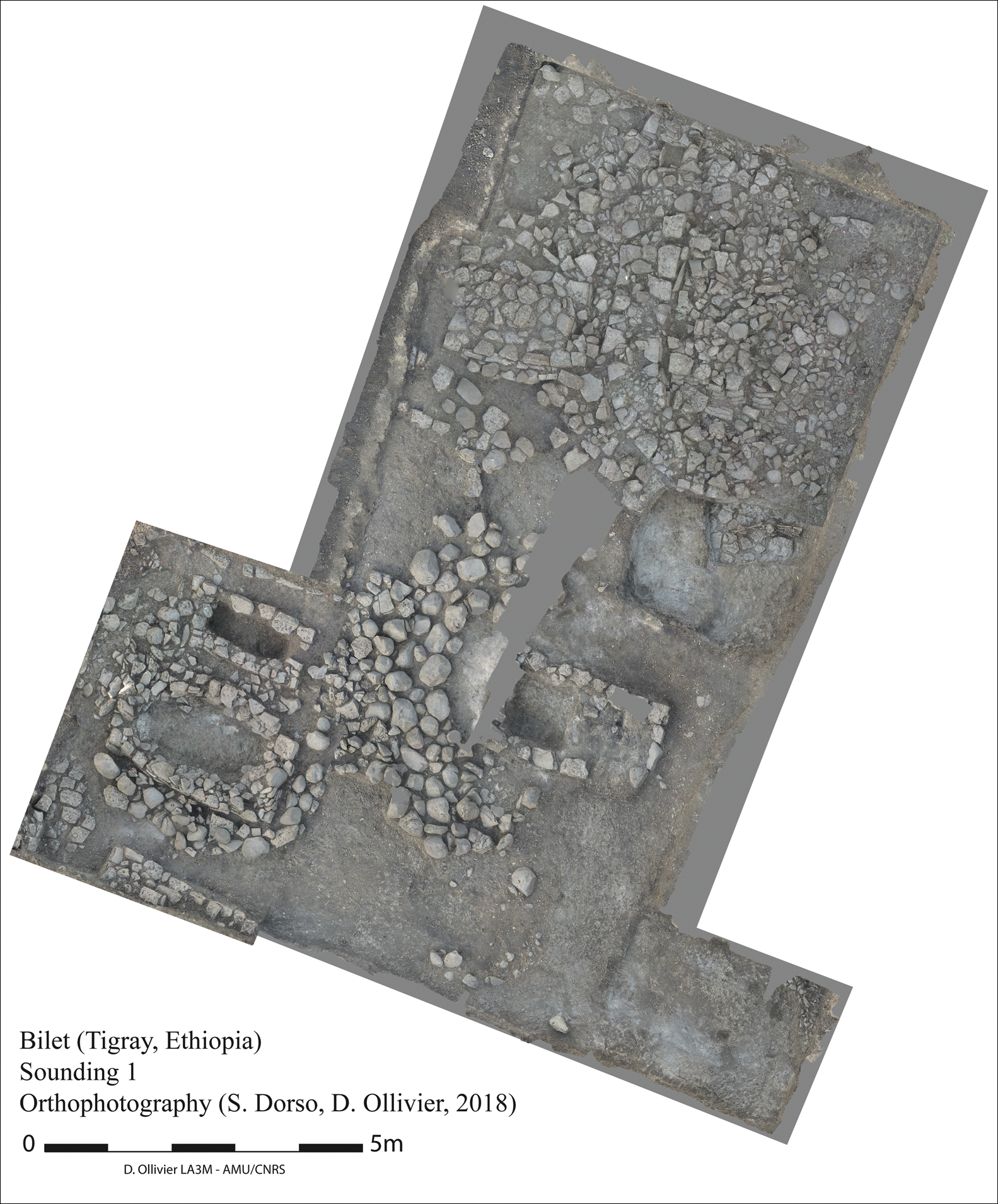
Structures excavated in sounding one fall into two groups (Figures 2–3). The first, to the north, comprises a 5m-long wall (F1028), oriented north–south and turning to the east in its southern part, and separating two partially collapsed rectangular platforms (F1017 & F1080) made of four walls of small slabs. F1017 post-dates wall F1028. Built with limestone slabs and surviving to at least five courses, wall F1028 had a gap in its northern part, possibly representing an entrance. A grave (F1009) was located to the south-east of the wall. Although there is no evidence of a surface marker, the grave was covered by limestone slabs. To the south, the second group of structures comprises five rectangular platforms (F1006, F1051, F1054, F1058, F1060). F1051 featured, on its eastern edge, an inscribed stela, a unique example in Bilet of the excavation of an in situ stela (Figure 4). The discovery of four and six graves in soundings two and three, respectively, indicates that the cemetery extended to the east. Of these graves, two were marked by anepigraphic stones.
Plan of the Bilet cemetery (sounding one) (figure by D. Ollivier & S. Dorso).

Orthophotography of the Bilet cemetery (sounding one) (figure by D. Ollivier & S. Dorso).
Grave F1051 in the Bilet cemetery, showing the surface marker and head stelae (photograph by S. Dorso).

Twenty-three inscribed stelae were recovered from secondary positions within a 300m radius around the soundings. This raises the question of the cemetery's possible extent. Most stelae were found reused in stone alignments delineating paths and fields. Their Arabic inscriptions remained unnoticed by the local population, with the exception of the first stela, which was found thanks to the guidance of Neguse Hagos. Of the 45 inscribed stelae documented since 1937, 42 are unworked basalt blocks engraved with inscriptions on their smooth surfaces. The remaining three are sandstone fragments. Complete stelae measure between 0.31 and 0.67m in height and between 0.16 and 0.60m in width.
Arabic epitaphs on funerary stelae, including Quranic quotations and dates in the Hijra calendar, indicate the Muslim identity of the burial population of the Bilet cemetery (Loiseau Reference Loiseau2020). Legal norms and common practice, observed in medieval times in both Christian and Muslim regions, generally urged a strict separation of graves according to religious faith, although there were a few exceptions, such as communities who retained the use of an existing graveyard following conversion to Islam (Gutiérrez Lloret Reference Gutiérrez Lloret and Valérian2011: 224–27). Another stela from Bilet is preserved in the present-day Cherkos church of Kwiha, located 700m west of the cemetery; the local clergy have long believed the stela to be a remnant of ‘ancient Israel’ on account of the representation of a six-pointed star (Smidt Reference Smidt, Böll, Nosnitsin, Rave, Smidt and Sokolinskaia2004). Rather than denoting the presence of a Jewish community, however, the six-pointed star is associated with the ‘Seal of Solomon’ in Islamic iconography, and is used as a talisman for the deceased's soul. The presence of the stela at Cherkos church suggests that intentional displacement may have increased the dispersal of Bilet's stelae. As the cemetery has probably remained surrounded by Christian settlements for centuries, intentional damage should not be excluded, as suggested by the damage to funerary substructures observed in sounding one.
Bilet's funerary structures and Muslim practices in medieval Tigray
The results from the soundings indicate an uneven density of activity across Bilet's cemetery. Sounding one exposed eight graves within 128m2, while the much smaller soundings two and three (each 16m2) exposed at least four and six graves, respectively. As investigation of soundings two and three was limited to near-surface observation, no conclusions can yet be drawn regarding the types of grave markers, social status, age or sex distribution of the buried individuals.
Sounding one exposed seven rectangular platforms, each comprising four walls built with small slabs, preserved to a height of between one and five courses. The platforms range from 2.06–3.04m in length and from 1.08–1.92m in width. F1051 and F1068 were, in addition, each surrounded by a circle of basalt blocks, with a maximum radius of 2.20m and 3.20m, respectively. On the eastern edge of F1051, a stela was placed in a gap in the masonry, with its epitaph facing eastward, away from the grave. A similar space was observed at platform F1054, but lacked an associated stela. This suggests that one of the stelae previously found on the field's surface belonged to F1054. Two graves with anepigraphic stelae exposed in sounding two suggest that some (or most?) of Bilet's grave markers lacked epitaphs. Such funerary inscriptions were probably reserved for powerful families and wealthy individuals. Thus, the 45 epigraphic stelae found to date do not represent the entire population buried in the cemetery.
The surface markers exposed in sounding one were homogeneous (Figure 5). Such rectangular platforms may also be observed extant in the main Muslim cemetery at Arra (30km south of Bilet) that adjoins the funerary mosque of Faqih Muhammad. Local tradition and systematic survey suggest that Arra's graves do not pre-date the nineteenth century (Loiseau et al. Reference Loiseau, Dorso, Gleize, Ollivier, Chekroun, Hirsch and Ayenachew2019). Similar structures were also noted by the current authors in the present-day Christian cemetery at Arra adjoining Saint Michael's church (Figure 6). Rectangular platforms may have been a vernacular type of funerary structure in eastern Tigray, regardless of religious allegiance, suggesting significant cultural admixture. This cannot, however, be confirmed for the medieval period due to a lack of excavation of Christian cemeteries in the area.
Surface grave markers in the Bilet cemetery (photograph by S. Dorso).

Surface grave markers in the Arra (eastern Tigray, Ethiopia) modern cemeteries (photograph by S. Dorso).

Two other types of funerary monuments—circular substructures and cist-shaped tombs—have been observed in the Muslim cemeteries of Habera, Mayda Zelegat and Tsomar, all of which are located 2km north-east of Arra on the same mountain (Figure 7). These cemeteries have yielded 42 epigraphic stelae, mainly dated to the thirteenth century (Loiseau et al. Reference Loiseau, Dorso, Berhe, Ayenachew, Chekroun, Hirsch, Durand, Marchand, Redon and Schneiderin press). Stelae have been recorded at both types of structure, placed either in the middle of the circle or at the edge of the grave. In the Habera and Tsomar cemeteries, stelae adorning cist-shaped tombs were placed with the epitaphs facing the grave—the opposite of the only example so far excavated at Bilet.
Zenithal view of the Habera (eastern Tigray, Ethiopia) cemetery (figure by N. Baker & S. Dorso).

Although circular and cist-shaped tombs were used in Muslim cemeteries in Tigray, the rectangular platforms excavated at Bilet have so far not been found in any other medieval cemetery in the region. The seemingly isolated grave of Qalqel Rway in Arra provides a fourth type of surface marker: a circular tumulus made of basalt blocks, headed by a twelfth-century epigraphic stela (Loiseau et al. Reference Loiseau, Dorso, Berhe, Ayenachew, Chekroun and Hirschforthcoming). In this case, however, it is uncertain whether the stela was in its original position or if it had been reused. The erection of a stela, or of paired stelae, over certain graves enhanced the social status of the deceased. Moreover, when bearing an epitaph, the stela(e) recalled the individual's memory to the community.
All of the graves exposed in Bilet's sounding one had been previously emptied before being backfilled. It is therefore impossible to determine what they initially contained, and the fact that no human bones were found inside, around or below any of the five excavated substructures suggests the very thorough removal of the human remains. Such emptying, whenever it occurred, resulted in the internal collapse of the substructures’ walls.
Sounding one exposed a single undamaged grave (F1009) that may have remained unnoticed when the other graves were emptied due to the absence of a surface marker above it (Figure 8). The burial pit, which was dug down to the bedrock, was covered by limestone slabs and contained the primary burial of an 18–22-year-old female individual, placed on her right side, with the upper limbs extended in front of the body. Displacement of the bones indicate that the body decayed within an empty space. Despite this displacement, the position of the bones implied that the face was turned to the north or north-east. Several bones from a second individual (an adult of indeterminate sex) were present in the same pit, placed adjacent to the first one. A lack of articulation suggests that this second individual was a secondary burial. Alignments of stones to the east of F1009 may represent the remains of a previous grave that was cut during the digging of F1009; the secondary burial may have come from this disturbed grave.
Excavation of grave F1009 in the Bilet cemetery (photographs by S. Dorso).

Radiocarbon dating of the primary burial has yielded a date of 1000±30 BP (983–1152 cal AD at 88.3%; Lyon-16433(GrM)) and 980±30 BP (993–1155 cal AD at 88.54%; Lyon-16433(GrM)) for the secondary burial. The dates were modelled in OxCal v.3.2 using the IntCal13 atmospheric curve (Reimer et al. Reference Reimer2013; Bronk Ramsey Reference Bronk Ramsey2017). The bones of both the primary and secondary individuals are poorly preserved, exhibiting taphonomic damage (tunnelling, gnawing and perforations) on element extremities and on the pelvic bones. Such lesions may be explained by subterranean termite activity. Indeed, a termite colony was observed during our work on sounding one. Termite damage may also explain the absence of bone fragments in or around the emptied rectangular platforms.
The position of the female's bones in grave F1009 suggests that the body was buried facing towards the north or north-east. According to Muslim legal norms the deceased were to be buried facing the qibla, or direction of the Ka‘ba in Mecca, with the body lying either on the right side (as recommended by most jurists) or on the back (Insoll Reference Insoll1999: 166–200). As the qibla at Bilet is at 4° north, graves should be oriented east to conform with Muslim requirements. Grave F1009, oriented 92° east, complies with this rule. In this regard, the funerary substructures exposed in sounding one fall into two groups: to the north, platforms were oriented 92° east; to the south, they were oriented 110° east. This divergence of 18° does not contradict Muslim requirements. Most jurists considered it valid to pray while facing between 45° to either side of the qibla—that is, with the qibla within the worshipper's field of vision (Wensinck Reference Wensinck, Bearman, Bianquis, Bosworth, van Donzel and Heinrichs1986). Divergence between the two groups at Bilet may be explained by the north–south wall observed within the northern group, which possibly represents a funerary enclosure. Its presence may have constrained grave orientation.
The Muslim cemeteries of Arra and its environs display comparable grave orientations. Cist-shaped tombs were oriented 85° east, but assessment cannot be made for circular graves without excavation. Inscribed stelae, however, sometimes have conflicting positions. At Tsomar, two cist-shaped tombs had epigraphic stelae on their eastern edges, while in Habera, they were sometimes found on the graves’ western edges. It is likely that only head stelae were used or preserved at Tsomar, and foot stelae at Habera. The presence of paired stelae at the head and feet ends of graves is attested at Bilet, as well as in other Muslim cemeteries, such as Dahlak Kabir (Schneider Reference Schneider1983: 79–81).
The funerary platforms exposed in sounding one yielded no cultural material, although concentrations of pottery sherds belonging to the same vessels were identified in different locations around and against the substructures’ bases and close to the original ground-surface level (Figure 9). F1017 and F1051 had such concentrations on their eastern edge, with a small stone plaque also placed against F1051's stela. Radiocarbon dating of charcoal associated with the F1051 potsherd deposit yielded a date of 975±30 BP (1013–1155 cal AD at 88.56%; Lyon-16433(GrM); date modelled in OxCal v.3.2 using the IntCal13 atmospheric curve (Reimer et al. Reference Reimer2013; Bronk Ramsey Reference Bronk Ramsey2017)). This date is consistent with that listed on the epitaph on the stela adorning the same platform: AH 431/AD 1040. Pottery vessels were probably deliberately broken against the funerary structures before they were backfilled as part of mourning and commemorative practices. The provision and sharing of meals to honour the deceased was common in Muslim contexts, even long after the funeral (Halevi Reference Halevi2011). Breaking vessels during mourning, however, might have been a distinctively local practice. The deposition of ceramics around and within graves was also observed for the contemporaneous, albeit ‘pagan’, Shay Culture, in the central Ethiopian Highlands, although the ceramics there were initially left intact (Fauvelle & Poissonnier Reference Fauvelle and Poissonnier2016).
Pottery deposits in the Bilet cemetery (figure by S. Dorso & D. Ollivier).

These initial observations offer the first archaeological evidence for Muslim funerary practices in the Ethiopian Highlands, emphasising the Bilet community's compliance with Muslim burial requirements, as well as vernacular patterns shared with its Christian neighbours. While this suggests cultural admixture in the local context, the Bilet cemetery also provides evidence for connections with other Islamic regions, illustrating the wider cosmopolitanism of medieval Ethiopia.
Bilet and the wider world: Islamic networks in medieval Tigray
Regional connections at Bilet are primarily indicated by the stelae. Other material culture is rare and comprises a single ceramic sherd found in a destruction level in sounding one (Figure 10). According to Véronique François (pers. comm.), the sherd bears several characteristics of eleventh- to twelfth-century Fatimid ceramic production from Egypt or Syria: pink limestone paste, green and brownish glaze on the interior and green, lead-based glaze on the exterior. Although unique, it provides a first hint of long-distance connections between Tigray and the Fatimid Empire, paralleling emerging evidence for similar connections at Harlaa (Insoll Reference Insoll2021). Additional evidence from across Bilet for such connections, however, is limited to the epigraphic stelae.
Fatimid glazed potsherd found in the Bilet cemetery (photograph by S. Dorso).

Despite the disapproval of many Muslim jurists, the practice of carving epitaphs on tomb markers was widespread in the medieval Islamicate world (Diem & Schöller Reference Diem and Schöller2004: II, 270–78). Arabic funerary epigraphy may be regarded as one of the main markers of Islamisation, bearing witness to the flourishing of Muslim communities in the Islamic empire and beyond. Prior to the current research, approximately 50 Arabic inscriptions were known from medieval Ethiopia (excluding the Dahlak Islands)—a figure that includes the 21 stelae previously known from Bilet (Fauvelle-Aymar & Hirsch Reference Fauvelle-Aymar and Hirsch2004–2010: 30–32). Only one of these is a non-funerary inscription: this fragment, preserved in the Cherkos church of Wuqro (eastern Tigray), probably belonged to a text commemorating the foundation of a mosque (Smidt Reference Smidt2010).
Surveys and excavations in 2018 and 2019 discovered 69 inscribed stelae (including fragments): 24 from Bilet and 45 from Arra and its neighbourhood. Thus far, the Muslim cemeteries of Tigray have yielded 75 per cent of the corpus of Arabic inscriptions from inland Ethiopia. Epitaphs from Bilet and Arra contain standardised elements that occur in the same order, although with variable phrasing and length, in the majority of medieval Arabic Muslim funerary inscriptions (Diem & Schöller Reference Diem and Schöller2004: I). This format includes an introductory sentence (basmala), Quranic quotation(s) (sometimes replaced by poetry, one example of which was found at Bilet), the name of the deceased, the date of death and a final eulogy. The use of this format by the Muslim communities of eastern Tigray, along with that of the Hijra calendar, shows the extent to which they were acculturated to the cultural norms of the Islamicate world, suggesting sustained and frequent contact. The diversity and accuracy of quotations from the Quran is another indication.
Funerary stelae from Bilet display plain Kufic script (the oldest form of Arabic script), which is characterised by angular and rectilinear letterforms, with a single instance of transitional script between Kufic and cursive on the most recent stela of the corpus (AH 659/AD 1261). Arabic letters lack diacritical marks, but are sometimes adorned in the form of heart-shaped ʿayn and ghayn, for example. Decoration consists of plain lines or chevrons delimiting epigraphic areas, sometimes headed by a pointed-arch (or ansa), and of six-pointed stars (three instances on stelae from Bilet and three from Arra). As noted above, the latter motif is associated in Islamic iconography with the ‘Seal of Solomon’ and should be distinguished from both the Jewish Star of David and the eight-pointed star of Ethiopian Christian magical scrolls, the latter of which was also used in funerary contexts (Dege & Smidt Reference Dege, Smidt and Uhlig2010). The Islamic six-pointed star is also found at fourteenth-century Ifat, Ethiopia, at tenth- to eleventh-century Khor Nubt, in eastern Sudan and at ninth- to tenth-century Fustat and Aswan, Egypt (Oman et al. Reference Oman, Grassi and Trombetta1998: 175–78; Bauden Reference Bauden2011: 286–93; Redlak Reference Redlak2008). The earliest example (AH 92/AD 710) is from Jordan (Imbert Reference Imbert1995). Although Ethiopian Muslims may have been particularly attracted to the ‘Seal of Solomon’, it belongs to an Islamic iconography shared widely beyond north-eastern Africa.
Epitaphs provide specific data on cemetery chronology. Date of death is given to the day, with the presence of very few errors providing evidence for the accurate use of the Hijra calendar. The date of death is preserved on 27 stelae from Bilet, documenting 25 burials (five belonged to pairs of stelae twice recording the date of death). The earliest inscription is dated AH 361/AD 972, the latest AH 659/AD 1261. Bilet cemetery hence remained in use for at least three centuries—twice as long as previously thought (Schneider Reference Schneider1967: 115). Three stelae belong to the second half of the fourth century AH/tenth century AD, and only one to the seventh century AH/thirteenth century AD. Sixty-eight per cent (17 of 25) date to between AH 428/AD 1037 and AH 474/AD 1081. These 50 years probably mark the apogee of Bilet's Muslim community. As a provisional comparison, most of the stelae found at the cemeteries of Arra and its territory date to the seventh century AH/thirteenth century AD, though the earliest is dated to AH 558/AD 1163 and the latest to AH 758/AD 1357. Muslim communities were therefore deeply rooted in eastern Tigray by the time the Christian Zagwe Dynasty was ruling the region (eleventh to thirteenth centuries; Derat et al. Reference Derat, Bosc-Tiessé, Garric, Mensan, Fauvelle, Gleize and Goujon2021). The stelae from Bilet and Arra enable reconsideration both of the chronology of Islam in the Tigray Highlands and the interplay of Muslim communities with their neighbouring Christian authorities. The latter may have fostered, if not protected, the former, taking advantage of the Muslims’ long-distance connections and of the cosmopolitanism they created in Ethiopia.
The names displayed on the Bilet stelae follow Arabic onomastics. Epitaphs provide the personal name of the deceased (ism), his/her genealogy (nasab) over one to four generations and, in some cases, a relation name (nisba); the latter conveys an origin claim. Most personal names belong to the Muslim Arab repertoire, be they names of first-generation Muslims (e.g. Muhammad, ‘Umar, Nafisa), or Arabic tribal names (e.g. Rabi‘a, Nizar). Some names, however, include too many consonants to be Arabic (e.g. K.s/sh.m.w.a, J.s/sh.m.w.a, M.r/z.?.?.a.w) and probably come from a local repertoire, but, in the absence of diacritical marks, their reading remains uncertain (Schneider Reference Schneider2009: 133–36). The small number of non-Arabic names is insufficient to support an argument that most of Bilet's Muslim community was of foreign origin. Adoption of typical Muslim Arab names could indicate recent local conversion to Islam, as seen in other contexts such as eleventh- to thirteenth-century Sahel (de Moraes Farias Reference de Moraes Farias2003: cci).
Nisbas, when based on place names, offer more reliable clues, even if caution is required before interpreting actual origin from individual claims. Foreign origin, whether actual or claimed, was often a source of prestige in medieval societies: forgery of nisbas cannot be precluded. Moreover, ethnic and geographic nisbas may have been inherited from a distant ancestor and used as a family name. In these cases, it is impossible to know when the family's emigration initially took place. With these reservations, however, nisbas might be indicative of long-distance connections. This is the case at Bilet with the nisba ‘al-Yamami’, which appears on ten stelae belonging to nine graves, representing around 20 per cent of the deceased buried in graves marked by inscribed stelae. The first was Hafs b. ‘Umar al-Yamami (d. AH 361/AD 972), who could be considered the founder of the Bilet Muslim community. He, or his family, claimed to have come from Yamama in the central Arabian Peninsula, an area inhabited by Rabi‘a and Mudar tribal confederations (Schneider Reference Schneider2009: 141). Seven men and one woman of his ancestral line were buried at Bilet, the last being his great-great-grandson named Rabi‘a—probably a reference to the family's tribal membership—who died in AH 474/AD 1081 (Loiseau Reference Loiseau2020: 83–85). The family may have come to Tigray via the mining area of Wadi al-‘Allaqi in Upper Egypt, from which many Rabi‘a clans emigrated in the late ninth century (Schneider Reference Schneider2009: 140–44). There is also clear evidence of a connection with the Dahlak Islands, as a daughter of al-Yamami (d. AD 972) was buried in Dahlak Kabir in AH 369/AD 980 (Schneider Reference Schneider1983: 222–23). Hence, the settlement of al-Yamami in Bilet was probably linked to the trade route between the Red Sea and the Tigray Highlands.
Trade activities probably also explain the AH 448/AD 1056 burial at Bilet of a man named ‘al-Damamili’, whose nisba points to the town of Damamil in Upper Egypt (Loiseau Reference Loiseau2020: 88–90). Damamil was known in the twelfth century for its Maghrebi community (Idrisi, Nuzhat I.128–29; Dozy & de Goeje Reference Dozy and de Goeje1866). Later, thirteenth- to fifteenth-century Karimi merchants from Damamil settled in Alexandria (Vallet Reference Vallet2010: 513–14). It can be assumed that Damamil was already linked to the Red Sea trade by the eleventh century.
A third nisba is documented on the Bilet stelae. The deceased of the (empty) grave F1051, who died in AH 431/AD 1040, was named ‘Abu Muhammad Ja‘far al-Farisi’ (Loiseau Reference Loiseau2020: 86–88). He, or his family, therefore claimed to come from Fars in western Iran. It is unknown what led him to eastern Tigray. Perhaps it was trade, or the da‘wa—the call for (and predication of) Isma‘ilism (a minority branch of Shi‘i Islam), which at this time was being sponsored by the Fatimid Empire in the Red Sea and beyond, up to eastern Tigray (Derat Reference Derat2020). Evidence of sympathies for Isma‘ilism may be provided by the mourning verses ‘Ali, the cousin and son-in-law of Prophet Muhammad, was said to have recited on the grave of the latter's daughter, Fatima, which were engraved on a Bilet stela dated AH 399/AD 1009 (Schneider Reference Schneider2009: 138).
Taking into account the methodological reservations outlined above, the presence at the Bilet cemetery of individuals whose nisbas represent claims for remote foreign ancestry is suggestive of the cosmopolitanism of the Muslim community. Sympathies for Isma‘ilism may have influenced this cosmopolitanism, in addition to Red Sea trade and exchange with the Fatimid Empire.
Conclusions
Bilet is the first medieval Muslim cemetery to be excavated in the Ethiopian Highlands and demonstrates how much information can be gained from the study of both graves and funerary epigraphy. Archaeology, however, must acknowledge the discontinuity between the medieval floruit of Islam and its present, much-reduced situation in Tigray, along with possible memory loss by local communities. Moreover, in the absence of an in situ funerary inscription allowing for the identification of the deceased, caution is needed in asserting religious allegiance on the sole basis of archaeological evidence (Insoll Reference Insoll1999; Reference Gleize, Knüsel, Schotsmans and CastexGleize in press).
Taking into account the heterogeneity of Muslim funerary practices in the Islamicate world (Lauwers & Loiseau Reference Lauwers and Loiseau2018), further research is needed to understand better the diversity of surface markers (e.g. rectangular platforms, circular substructures, cist-shaped tombs and tumuli) observed in the cemeteries at Bilet and Arra. Do they demonstrate successive phases of use, and thus evidence of their chronology, or possible conversion of local communities and associated changes in burial practices? Or, if the markers are contemporaneous, do they relate to the social status, sex and/or origin of the deceased? The lack of knowledge regarding the neighbouring Christian cemeteries—ancient or modern—prevents us from drawing comparisons. Christian burials so far excavated are located in the central highlands and post-date the thirteenth century (Derat & Jouquand Reference Derat and Jouquand2012; Derat & Gleize Reference Derat, Gleize, Delaplace and Valentin2015; Gleize et al. Reference Gleize2015).
The Bilet and Arra cemeteries offer the first opportunity to document the earliest stages of Islamic development in the Ethiopian Highlands from the second half of the tenth century AD. They reveal a picture of large, well-established Muslim communities in the central areas of the Christian kingdom, well connected to the wider Islamicate world. The so-called ‘Dark Ages’ of Ethiopian history (Insoll Reference Insoll2021) may have been characterised by an unexpected cosmopolitanism introduced by Islam to Ethiopia, fostering an environment in which both Muslim and Christian communities interacted.
Acknowledgements
The authors thank: the Authority for Research and Conservation of the Cultural Heritage (Addis Ababa), its Cultural Heritage Research Directorate's director Demerew Dagne and its experts Yared Assefa, Bruk Jifara and Dawit Tibebu; the Tigray Tourism and Culture Bureau (Mekelle), its former director Dawit Hailu, its present director Brekti Gebremedhin, its deputy director Zenebu Halefom and its expert Guesh Tsehaye; the Institute of Ethiopian Studies (Addis Ababa) and its former director Ahmed Hassen Omer; the Centre Français des Études Éthiopiennes (Addis Ababa) and its director Marie Bridonneau; Fesseha Abraham (Addis Ababa University); François-Xavier Fauvelle (Collège de France, Paris); Véronique François (CNRS, Aix-Marseille University); Mathilde Montpetit; Hélène Réveillas (Bordeaux University); Robin Seignobos (Lyon-2 University); Camille Vanhove (Archéodunum); Goitom Besrat, Neguse Hagos and the team of workers from Kwiha; Shaykh ‘Abd al-Rahman ‘Abd al-Qadir, imam of Adigudom, and Muhammad Ali Kahsay, his deputy in Arra.
Funding statement
This research has received funding from the EU's Horizon 2020 research and innovation programme (grant agreement 726206).


 Open access

