


The Asiatic wild ass, or khulan, Equus hemionus, is a nomadic equid native to arid landscapes of Central and East Asia. It is considered to be the most wide-ranging terrestrial mammal (Tucker et al., Reference Tucker, Böhning-Gaese, Fagan, Fryxell, Van Moorter and Alberts2018), enabling it to respond to spatiotemporal variation in resource availability and avoid environmental extremes (Joly et al., Reference Joly, Gurarie, Sorum, Kaczensky, Cameron and Jakes2019). The Mongolian Gobi supports the largest khulan population, with c. 91,000 individuals, representing > 84% of the global total (Buuveibaatar et al., Reference Buuveibaatar, Strindberg, Kaczensky, Payne, Chimeddorj and Naranbaatar2017; Kaczensky et al., Reference Kaczensky, King, Esmaeili and Moehlman2025). However, the population faces ongoing pressures from habitat fragmentation, competition with livestock, poaching and climate change (Buuveibaatar et al., Reference Buuveibaatar, Mueller, Strindberg, Leimgruber, Kaczensky and Fuller2016; Kaczensky et al., Reference Kaczensky, Buuveibaatar and Dejid2024). The species is categorized as Near Threatened on the IUCN Red List and is listed in Appendix I of CITES and Appendix II of the Convention on Migratory Species (Kaczensky et al., Reference Kaczensky, Buuveibaatar, Payne, Strindberg, Walzer and Batsaikhan2020).
Historically, the khulan ranged widely across the Mongolian plains, including the Eastern Steppe. However, construction of the fenced Trans-Mongolian Railway in the mid 20th century along a north-west–south-east axis through Mongolia has played a central role in the regional decline of the species. Although the fencing was intended to reduce collisions between livestock and trains, it now acts as a near-continuous barrier to wildlife movement, fragmenting habitats and contributing to both direct and indirect mortality of nomadic ungulates (Ito et al., Reference Ito, Lhagvasuren, Tsunekawa, Shinoda, Takatsuki and Buuveibaatar2013; Kaczensky et al., Reference Kaczensky, Buuveibaatar, Payne, Strindberg, Walzer and Batsaikhan2020). The last confirmed sighting of khulan east of the railway was in the 1950s, and the species’ current range according to the IUCN no longer includes the Eastern Steppe (Kaczensky et al., Reference Kaczensky, King, Esmaeili and Moehlman2025). Declining numbers in the 1940s (Bannikov, Reference Bannikov1954), together with isolation, human persecution and severe winters, likely resulted in this local extinction.
In 2019, a pilot conservation intervention was implemented by the Wildlife Conservation Society’s Mongolia Program to restore connectivity of wildlife habitats, in collaboration with local government authorities and partners. As part of this effort, a total of 1,500 m of fencing was temporarily removed at three locations in May 2019. These gaps remained open until December 2021 (c. 32 months), after which the fences were reinstated by the railway authority because of safety concerns associated with free-ranging livestock that caused 14 trains stops and three collisions involving horses. No collisions with wildlife were recorded during this period. The fences have remained closed since. Camera traps were deployed to monitor wildlife movement across the area. The monitoring confirmed the use of the corridor by the Mongolian gazelle Procapra gutturosa, goitered gazelle Gazella subgutturosa and argali Ovis ammon. On 16 March 2020, a khulan was photographed crossing the southernmost gap, marking the first confirmed crossing of the Trans-Mongolian Railway by the species in 65 years. Although anecdotal reports suggested additional movements of khulan east of the railway, the distribution and status of the species in this region remained unclear. Here we present recent efforts to confirm the status of the khulan east of the railway.
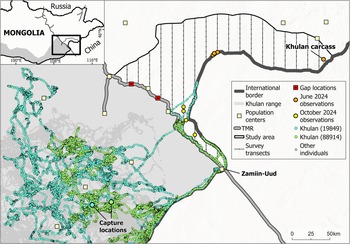
We compiled data from multiple sources to assess the population status and landscape use of khulan east of the Trans-Mongolian Railway: (1) GPS data from 29 individuals (19 females and 10 males) that we collared west of the railway in the South Gobi in September 2022. The collars recorded hourly locations over a 3-year period. (2) Opportunistic sightings from additional sources, including a large-scale ungulate survey conducted in eastern and central Mongolia in June 2024 (Buuveibaatar et al., Reference Buuveibaatar, Strindberg, Ariunbaatar, Batdorj, Batzaya and Dashpurev2024). (3) Distance sampling surveys we conducted in October 2024 across an 18,500 km2 area east of the railway (Fig. 1). Two teams completed 1,231 km of vehicle transects, recording all sightings of khulan, other ungulates, livestock and herder households. For each observation, we recorded group size, perpendicular distance from the transect and detection angle to estimate abundance.
Movement paths of two GPS-collared khulan Equus hemionus in the Southern Gobi (female 19849, male 88914), showing crossing events at the Trans-Mongolian Railway near Zamiin–Uud on the Mongolia–China border, movements of other collared individuals that did not cross the railway, opportunistic sightings from June 2024 east of the railway, and observations of khulan from ground-based line transect surveys east of the railway in October 2024.

During the winter of 2022–2023, GPS tracking data recorded a collared female khulan (collar ID 19849) crossing the Trans-Mongolian Railway near the Zamiin–Uud border, using the no man’s land along the Mongolia–China border, where the railway lacks fencing (Fig. 1). After crossing on 1 January 2023, she ranged across an area of c. 2,000 km² east of the railway, remaining there for 83 days before returning west via a vehicle underpass on 25 March. That same winter, border guards at Zamiin–Uud reported that hundreds of khulan attempted to cross the railway. Some individuals succeeded, but many were actively prevented from crossing and driven back by railway authorities because their presence along adjacent roads and tracks created traffic safety concerns. In early 2024, another crossing was recorded when a GPS-collared male (collar ID 88914) crossed the railway at the same location near Zamiin–Uud, on 5 February. This individual ranged over c. 1,250 km² area east of the railway until 22 April 2024, when data transmission ceased, likely because of battery failure as no mortality signal was received.
In the June 2024 ungulate survey, four groups of khulan, totalling 25 individuals, were observed near the Mongolia–China border, at a mean distance of 85.1 ± SD 2.5 km east of the railway. In addition, a khulan carcass was discovered c. 200 km east of the railway, suggesting that some individuals may disperse farther into the Eastern Steppe (Fig. 1).
During the systematic distance sampling survey conducted east of the Trans-Mongolian Railway in October 2024, we observed 384 khulan in four groups, with a mean group size of 96 individuals (Fig. 1). Because only four groups were detected, distance analysis was not conducted. These counts should therefore be interpreted as a conservative minimum estimate. Although these numbers are small compared to the South Gobi population, they could increase if illegal offtake remains low and connectivity between the Gobi and steppe ecoregions improves. We also detected other ungulate species in this survey. Population estimates included 15,170 goitered gazelles (95% CI 7,585–22,755) and 25,345 Mongolian gazelles (95% CI 9,620–41,070). Additionally, we recorded 32,570 livestock, comprising 77.8% goats and sheep, 13.1% horses, 6.9% cattle and 2.2% camels, and 180 herder households. Combined GPS telemetry and observation data confirm that khulan are currently utilizing at least 4,000 km² of habitat east of the Trans-Mongolian Railway, representing a significant expansion into their historical range.
Recent crossings of the Trans-Mongolian Railway by GPS-collared khulan, together with population counts, provide evidence of recolonization of the species’ historical range, but also highlight ongoing conservation challenges. Collared individuals crossed at informal sites lacking designated wildlife passages, where many more were observed attempting to cross, indicating increasing pressure at these points. Establishing a formal and safe wildlife crossing at Zamiin–Uud, where crossing attempts are concentrated, is an urgent priority. In the longer term, strategically placed fence gaps and dedicated crossing structures will be essential to mitigate the railway’s barrier effect and restore functional connectivity.
In parallel, conservation efforts should focus on improving habitat quality east of the Trans-Mongolian Railway to support khulan settlement and enable further range expansion. Priorities include protecting natural water sources, ensuring access to quality forage and minimizing disturbance in key habitats. As khulan require water every 1–2 days, availability remains a key determinant of habitat use (Payne et al., Reference Payne, Buuveibaatar, Bowler, Olson, Walzer and Kaczensky2020). Collaboration with herder communities will be critical to reduce competition and promote coexistence at shared pastures and water points. Public awareness campaigns and consistent law enforcement would help reduce disturbance and build local support. Continued monitoring through GPS tracking, field surveys and community-based reporting will inform adaptive, evidence-based management.
Collectively, these integrated actions offer a viable path to the establishment of a self-sustaining khulan population east of the Trans-Mongolian Railway and advancing the species’ long-term conservation. Enhancing connectivity and habitat conditions will support seasonal movements, reduce pressure on South Gobi populations, and re-establish ecological linkages between steppe and Gobi ecosystems, severed for decades by the railway. These efforts will also benefit other wide-ranging ungulates, including the Mongolian gazelle, goitered gazelle and argali, by improving resilience to climate change and anthropogenic pressures.
Author contributions
Study design, fieldwork, data analysis, writing: all authors.
Acknowledgements
This research was supported by the Segre Foundation as part of an ongoing initiative to facilitate the re-establishment of khulan in their historical range in eastern Mongolia. Khulan collaring, fence gap creation and population surveys were conducted under the Core Biodiversity Monitoring and Offset Programmes, funded by Oyu Tolgoi LLC, administered through Sustainability East Asia LLC, and implemented by Wildlife Conservation Society Mongolia. We thank the MoreStep project (BMBF, 01LC1820E) for supporting the wildlife survey in eastern Mongolia; and the Dornogobi Province Government, Border Protection Agency and Ministry of Environment and Climate Change for their continued support.
Competing interests
None.
Ethical standards
This research abided by the Oryx ethical guidelines. Khulan capture was conducted with approval from the Ministry of Environment and Tourism of Mongolia.
Data availability
The data supporting the findings of this study are available from the authors upon reasonable request.

 Open access

