





Introduction
Cumulative exposure to childhood adversity (i.e., exposure to four adverse experiences (AEs) or more), or adverse childhood experiences, is a well-documented risk factor for the development of emotional (e.g., depressive symptoms) and behavioral problems (e.g., aggressive behaviors) in adolescence, as demonstrated across various studies (Felliti et al., Reference Felliti, Anda, Nordenberg, Williamson, Spitz, Edwards, Koss and Marks1998; Hughes et al., Reference Hughes, Bellis, Hardcastle, Sethi, Butchart, Mikton, Jones and Dunne2017; Nelson et al., Reference Nelson, Scott, Bhutta, Harris, Danese and Samara2020). Investigating cumulative exposure to childhood adversity has, however, several important shortcomings (Lacey & Minnis, Reference Lacey and Minnis2019). Most importantly, so-called cumulative risk approaches are not well suited for understanding pathways through which AEs are associated with relevant outcomes (e.g., emotional and behavioral problems) both individually and conjunctively with other AEs. Cumulative risk approaches do not consider that different AEs may contribute to risks of emotional and behavioral problems in distinct ways. Moreover, they disregard differential patterning of adversities underlying similar degrees of cumulative exposure (e.g., two children may both be exposed to two AEs, but one child may have experienced parental divorce and poverty, while another may have experienced parental substance abuse and parental mental health problems) (Lacey & Minnis, Reference Lacey and Minnis2019). Lanier et al. (Reference Lanier, Maguire-Jack, Lombardi, Frey and Rose2018) argue that to understand pathways linking childhood adversity to outcomes of interest, we first need to better understand the role of individual AEs, how and which AEs interact or co-occur and the effects of these co-occurrences. To date, studies on childhood adversity and emotional and behavioral problems have largely focussed on either the role of individual AEs (e.g., Bevilaqua et al., Reference Bevilaqua, Kelly, Heilmann, Priest and Lacey2021), or on the co-occurrences of AEs and their effects (e.g., Ho et al., Reference Ho, Chan, Chien, Bressington and Karatzias2019; Witt et al., Reference Witt, Münzer, Ganser, Fegert, Goldbeck and Plener2016), but largely not on both simultaneously. In this study, we apply network analysis, a relatively novel statistical approach in the childhood adversity literature (de Vries et al., Reference de Vries, Arends, Hulvej Rod, Oldehinkel and Bültmann2022), to gain a better understanding of how childhood adversities are, individually and conjunctively, associated with emotional and behavioral problems in early adolescence.
The role of individual AEs in the development of emotional and behavioral problems
To learn more about the role of individual childhood adversities for risks of emotional and behavioral problems, various studies have used so-called single adversity approaches (also known as specificity approaches). Single adversity approaches involve regressing outcomes on individual adversities and comparing their effects (Lacey & Minnis, Reference Lacey and Minnis2019; McLaughlin et al., Reference McLaughlin, Sheridan, Humphreys, Belsky and Ellis2021). In the past decade, several studies using single adversity approaches to compare the effects of different adversities on emotional and behavioral problems have shown that indeed, not all adversities contribute equally to emotional and behavioral problems. For example, Bevilaqua et al. (Reference Bevilaqua, Kelly, Heilmann, Priest and Lacey2021) recently showed that some AEs are associated with emotional problems, but not with behavioral problems and vice-versa. Moreover, these authors showed that associations between any pair of AEs and emotional and behavioral problems may differ in strength. Out of eight included AEs, parental discord and parental depression were the strongest predictors of emotional problems, whereas harsh parenting and physical punishment were the strongest predictors of behavioral problems. Parental alcohol abuse was shown to be associated with behavioral problems but not with emotional problems, whereas parental drug use was associated with both increased emotional and behavioral problems (Bevilaqua et al., Reference Bevilaqua, Kelly, Heilmann, Priest and Lacey2021).
Single adversity approaches suffer from an important methodological shortcoming as associations between AEs are not considered despite high rates of co-occurrence (Lacey & Minnis, Reference Lacey and Minnis2019). As a result, findings from single adversity approaches are prone to confounding (e.g., the association between financial difficulties and behavioral problems might be confounded by parental unemployment) and thus difficult to interpret. Moreover, single adversity approaches ignore the fact that adversities may contribute to the development of emotional and behavioral problems not only directly, but also indirectly, by increasing the risk of occurrence of other adversities. For example, financial difficulties may be brought on by unemployment of a parent, which may subsequently lead to increased parental distress and conflicts between parents and eventually, through decreased parenting capabilities, to offspring mental health problems (Conger et al., Reference Conger, McLoyd, Wallace, Sun, Simons and Brody2002). Similarly, unemployment and poverty may lead to increased parental mental health problems, which may subsequently place the family at increased risk for child abuse (Fabbri et al., Reference Fabbri, Bhatia, Petzold, Jugder, Guedes, Cappa and De Vries2021; Whipple & Webster-Stratton, Reference Whipple and Webster-Stratton1991). In other words, not considering associations between adversities provides an inaccurate picture of how individual adversities increase the risk of emotional and behavioral problems.
To improve our understanding of how different childhood adversities increase risks of emotional and behavioral problems in adolescence, it is vital to model associations between individual AEs and emotional and behavioral problems simultaneously, in a single model. We recently proposed to use network analysis, a statistical approach that allows for estimating complex patterns of relationships between variables (Hevey, Reference Hevey2018), as an alternative approach for modeling childhood adversity (see de Vries et al., Reference de Vries, Arends, Hulvej Rod, Oldehinkel and Bültmann2022 for a detailed discussion on the utility of network analysis for studies on childhood adversity). Network analysis can elucidate how individual AEs are associated with emotional and behavioral problems with the added value that in network analysis, these associations are estimated conditional on other variables included in the model. Network analysis thus overcomes issues of confounding plaguing single adversity approaches, providing more accurate information on the role of individual adversities. In addition, network analysis provides insight into how childhood adversities increase risks of emotional and behavioral problems indirectly, via other AEs. This is the case when there is no association between an AE and emotional and behavioral problems conditional on other AEs (conditional independence), but said AE is associated with other AEs that are associated with emotional or behavioral problems.
Although network analytical studies are scarce in the childhood adversity literature, a handful of studies exist that have applied network analysis to investigate the impact of AEs on general psychopathology, mental disorders, depression and anxiety, and psychosis (Betz et al., Reference Betz, Penzel, Kambeitz-Ilankovic, Rosen, Chisholm, Stainton, Haidl, Wenzel, Bertolino, Borgwardt, Brambilla, Lencer, Meisenzahl, Ruhrmann, Salokangas, Schultze-Lutter, Wood, Upthegrove, Koutsouleris and Kambeitz2020; Breuer et al., Reference Breuer, Greggersen, Kahl, Schweiger and Westermair2020; Carozza et al., Reference Carozza, Holmes and Astle2022; Isvoranu et al., Reference Isvoranu, van Borkulo, Boyette, Wigman, Vinkers and Borsboom2017). Findings by Breuer et al. (Reference Breuer, Greggersen, Kahl, Schweiger and Westermair2020) suggest that sexual abuse is associated with post-traumatic stress disorder, while other types of adversity (e.g., emotional and physical abuse, emotional neglect, violence against the mother) were not associated with any mental disorder. Both Betz et al. (Reference Betz, Penzel, Kambeitz-Ilankovic, Rosen, Chisholm, Stainton, Haidl, Wenzel, Bertolino, Borgwardt, Brambilla, Lencer, Meisenzahl, Ruhrmann, Salokangas, Schultze-Lutter, Wood, Upthegrove, Koutsouleris and Kambeitz2020) and Isvoranu et al. (Reference Isvoranu, van Borkulo, Boyette, Wigman, Vinkers and Borsboom2017) showed that different types of abuse were associated with psychosis through links with general psychopathological symptoms. The results of previous studies show that network analysis provides novel insight into associations between childhood adversities and psychopathology, highlighting the purported benefits of the statistical approach (de Vries et al., Reference de Vries, Arends, Hulvej Rod, Oldehinkel and Bültmann2022). All the aforementioned studies predominantly focused on maltreatment (i.e., abuse and neglect), and most studies were conducted in adult clinical populations (Betz et al., Reference Betz, Penzel, Kambeitz-Ilankovic, Rosen, Chisholm, Stainton, Haidl, Wenzel, Bertolino, Borgwardt, Brambilla, Lencer, Meisenzahl, Ruhrmann, Salokangas, Schultze-Lutter, Wood, Upthegrove, Koutsouleris and Kambeitz2020; Breuer et al., Reference Breuer, Greggersen, Kahl, Schweiger and Westermair2020; Isvoranu et al., Reference Isvoranu, van Borkulo, Boyette, Wigman, Vinkers and Borsboom2017). Carozza et al. (Reference Carozza, Holmes and Astle2022) conducted the only study that used a sample of older adolescents (age 16). They investigated associations between childhood adversity and emotion dysregulation, and found that a variety of adversities (e.g., caregiver change, physical abuse, maternal neglect, emotional domestic violence) were associated with maternal-reported offspring emotional functioning. Similar to previous studies however, Carozza et al. (Reference Carozza, Holmes and Astle2022) mainly included measures of maltreatment. To gain a better understanding of how childhood adversities contribute to the development of emotional and behavioral problems in adolescence it is important to consider the breadth of the ecological systems surrounding the developing adolescent. More specifically, this includes investigating AEs beyond maltreatment in the family context, as well as recognizing the importance of AEs in the peer context (e.g., bullying victimization) (Arseneault, Reference Arseneault2017), which is especially important in adolescence (Lopez et al., Reference Lopez, Ruiz, Rovnaghi, Tam, Hiscox, Gotlib, Barr, Carrion and Anand2021). Given that Carozza et al. (Reference Carozza, Holmes and Astle2022) used caregiver reports, utilizing adolescent self-reported emotional and behavioral problems could additionally provide evidence for the association between AEs and emotional and behavioral problems across multiple informants.
Clustering of childhood adversities and emotional and behavioral problems
Next to investigating the role of individual AEs for emotional and behavioral problems, there has been an increased interest in examining the clustering of AEs and how groups of individuals who have been exposed to similar AEs differ in outcomes of interest (e.g., Bussemakers et al., Reference Bussemakers, Kraaykamp and Tolsma2019; Debowska et al., Reference Debowska, Willmott, Boduszek and Jones2017; Grasso et al., Reference Grasso, Dierkhising, Branson, Ford and Lee2016; Lacey et al., Reference Lacey, Pinto Pereira, Li and Danese2020; Rod et al., Reference Rod, Bengtsson, Budtz-Jørgensen, Clipet-Jensen, Taylor-Robinson, Andersen, Dich and Rieckmann2020, Reference Rod, Bengtsson, Elsenburg, Taylor-Robinson and Rieckmann2021). The findings of these studies have laid important groundwork for several theoretically driven dimensional models of adversity (Lacey & Minnis, Reference Lacey and Minnis2019). In contrast to single adversity approaches, which assume that different AEs contribute to the development of emotional and behavioral problems through unique pathways, dimensional approaches assume that some AEs share similar underlying characteristics, which affect psychopathology through shared developmental pathways (Belsky et al., Reference Belsky, Schlomer and Ellis2012; Ellis et al., Reference Ellis, Figuerola, Brumbach and Schlomer2009; Lacey & Minnis, Reference Lacey and Minnis2019; McLaughlin & Sheridan, Reference McLaughlin and Sheridan2016). Several dimensional models have been proposed in recent years, including the dimensional model of adversity and psychopathology (DMAP) (McLaughlin & Sheridan, Reference McLaughlin and Sheridan2016) and the harshness-unpredictability framework (Ellis et al., Reference Ellis, Figuerola, Brumbach and Schlomer2009). It is worth mentioning that although dimensions of childhood adversity (e.g., dimensions of threat and deprivation as included in the DMAP) are characterized by a high specificity to developmental mechanisms, this is less so the case for associations with psychopathology (e.g., deprivation can be associated with both emotional and behavioral problems) (McGinnis et al., Reference McGinnis, Sheridan and Copeland2022).
A complicating aspect of theoretically driven dimensional models of adversity is how to divide adversities into different groups with similar underlying characteristics that affect psychopathology through similar developmental pathways (Lacey & Minnis, Reference Lacey and Minnis2019). For example, within the DMAP framework, parental separation may have characteristics of both threat and deprivation. Lacey and Minnis (Reference Lacey and Minnis2019) argue that, to reach consensus on logical groupings of AEs, additional investigation on the clustering of AEs (together with outcomes) is needed. To date, studies that have applied clustering techniques have assumed that different AEs within one cluster all directly alter the development of the child; no distinctions are made between direct and indirect associations between AEs, development, and psychopathology. As we discussed previously, it is likely that several AEs do not directly contribute to emotional and behavioral problems. For example, parental unemployment potentially only contributes to emotional and behavioral problems due to interactions with abuse (Fabbri et al., Reference Fabbri, Bhatia, Petzold, Jugder, Guedes, Cappa and De Vries2021). In this example, it would be futile to explore similar characteristics underlying these two AEs, as abuse might be the only AE that directly alters development and subsequently contributes to emotional and behavioral problems.
The recently proposed integrated model of dimensions of environmental experience, which combines elements of the DMAP and the harshness-unpredictability framework, is the only theoretical dimensional model that takes into account that adversity may directly and indirectly influence development (Ellis et al., Reference Ellis, Sheridan, Belsky and McLaughlin2022). In their model, Ellis et al. (Reference Ellis, Sheridan, Belsky and McLaughlin2022) differentiate between proximal and distal sources of adversity. Proximal sources (or immediate experiences) of adversity are experiences that may occur in the childs’ immediate rearing environment, whereas distal sources (or ecological factors) of adversity may occur in the childs’ broader environmental context. The authors propose that these sources of adversity may be deprivation-based or threat-based. Sources of threat include AEs characterized by harm or threat of harm, and include immediate experiences such as physical abuse, and ecological factors such as a premature death in the family. Sources of deprivation include AEs characterized by an absence of environmental input, and include immediate experiences such as neglect and ecological factors such as parental unemployment. Proximal sources are suggested to directly influence the development of the child. Distal sources are suggested to affect development both directly (when they serve as cues that signal the need for adaptation) or indirectly via proximal adversities (when distal adversities lead to proximal adversities) (Ellis et al., Reference Ellis, Sheridan, Belsky and McLaughlin2022). Proximal and distal sources of adversity, and unpredictability in those sources, alter development to the immediate rearing environment in which the child resides as well as to the broader ecological context. Although these changes might be adaptive developmental responses, they may also place the child at increased risk for psychopathology (Ellis et al., Reference Ellis, Sheridan, Belsky and McLaughlin2022).
Two studies have previously investigated the clustering of adversities within networks of childhood adversity (Carozza et al., Reference Carozza, Holmes and Astle2022; Sheridan et al., Reference Sheridan, Feng, Miller, Salhi and McLaughlin2019). Both Sheridan et al. (Reference Sheridan, Feng, Miller, Salhi and McLaughlin2019) and Carozza et al. (Reference Carozza, Holmes and Astle2022) uncovered a network structure that showed a clear delineation between adversities characterized by deprivation and adversities characterized by threat, which is in line with DMAP. However, these studies have two important shortcomings. First, both studies incorporated relatively few AEs; AEs that Ellis et al. (Reference Ellis, Sheridan, Belsky and McLaughlin2022) would consider proximal sources of adversity. As a result, our understanding of the clustering of adversities in network models is limited to clustering of proximal sources of adversity. Second, both studies applied clustering algorithms that do not allow included variables to cluster in several ways (i.e., AEs can only be part of a single cluster). Evidence from numerous studies constructing latent classes of AEs illustrates the likelihood of differential clustering (e.g., parental psychopathology may cluster with poverty for some individuals, but with abuse for other individuals) (e.g., Bussemakers et al., Reference Bussemakers, Kraaykamp and Tolsma2019; Grasso et al., Reference Grasso, Dierkhising, Branson, Ford and Lee2016; Rod et al., Reference Rod, Bengtsson, Budtz-Jørgensen, Clipet-Jensen, Taylor-Robinson, Andersen, Dich and Rieckmann2020). Applying clustering algorithms to network models that allow for single AEs to cluster together with other AEs in more than one way are thus much needed. Further investigating the clustering of AEs and emotional and behavioral problems in a network analytical framework in which shortcomings of these previous studies are addressed may have important ramifications for theoretically driven dimensional models of adversity.
The current study
In this study we apply network analysis to achieve three aims. First, we aimed to investigate how individual AEs in childhood are associated with emotional and behavioral problems at age fourteen, conditional on other AEs. Second, we aimed to investigate to what extent AEs may indirectly contribute to emotional and behavioral problems through associations with other AEs. Third and last, we aimed to investigate whether individual AEs and emotional and behavioral problems cluster together by applying a community detection algorithm that allows for adversities to be part of multiple clusters simultaneously (Lange & Zickfeld, Reference Lange and Zickfeld2021; Lange, Reference Lange2021a). Given the explorative nature of this study, no specific hypotheses were derived; the study should be viewed as hypothesis generating instead. We extend the current literature in several ways. Firstly, and most importantly, the application of network analysis allows us to focus on the role of individual AEs and their co-occurrence simultaneously. Previously applied methods only provide insight into either the role of individual AEs or their co-occurrence (i.e., regression-based approaches for the role of individual adversities, structural equation modeling approaches such as exploratory factor analysis, or latent-class analysis for co-occurrences between adversities; see de Vries et al., Reference de Vries, Arends, Hulvej Rod, Oldehinkel and Bültmann2022 for a more detailed discussion). Secondly, compared to previous studies, we include a wide variety of AEs that may occur in the two most developmentally important ecological systems in which children are embedded during childhood and adolescence: the family and the peer context (Bronfenbrenner, Reference Bronfenbrenner1979; Lopez et al., Reference Lopez, Ruiz, Rovnaghi, Tam, Hiscox, Gotlib, Barr, Carrion and Anand2021). Thirdly, we apply network analysis to data from a large population-based cohort with adolescent-reported emotional and behavioral problems. Previous studies often focused only clinical (adult) populations or used maternal assessments on offspring emotional and behavioral problems. Lastly, we consider the different modeling choices one can make in network analysis to assess the impact of our modeling choices on the findings. Previous studies using network analysis have not examined the impact of different modeling choices on their findings, although doing so provides much insight into the robustness of results. Taken together, this study provides novel insight regarding the contribution of AEs to risks of emotional and behavioral problems in adolescence that may prove beneficial for future development of theoretical models of adversity, as well as provide potential vantage points for interventions aimed at reducing the risks of emotional and behavioral problems associated with childhood adversity.
Methods
Participants and procedure
This study included participants from the TRacking Adolescents’ Individual Lives Survey (TRAILS) study. TRAILS is a prospective cohort of Dutch adolescents born in the northern part of the Netherlands (Huisman et al., Reference Huisman, Oldehinkel, De Winter, Minderaa, De Bildt, Huizink, Verhulst and Ormel2008; Oldehinkel et al., Reference Oldehinkel, Rosmalen, Buitelaar, Hoek, Ormel, Raven, Reijneveld, Veenstra, Verhulst, Vollebergh and Hartman2015). For this study, we used data collected during the first (N = 2229), second (N = 2148, 96.4% of baseline), and fourth (N = 1880, 84.3% of baseline) measurement waves of TRAILS. Participants’ mean ages during these measurement waves were 11.09 years (SD = 0.56), 13.54 years (SD = 0.53), and 19.07 years (SD = 0.60), respectively. Participants who were lost to follow-up (N = 349) were more likely to be male (Z = −3.31, p < .001), have parents with a low educational background (Z = −5.85, p < .001), and have a lower total IQ (approximated) (Z = −8.01, p < .001) as compared to participants not lost to follow-up. In-depth information about the design, sample, procedures, and non-response of TRAILS has been described elsewhere (De Winter et al., Reference De Winter, Oldehinkel, Veenstra, Brunnekreef, Verhulst and Ormel2005; Huisman et al., Reference Huisman, Oldehinkel, De Winter, Minderaa, De Bildt, Huizink, Verhulst and Ormel2008; Oldehinkel et al., Reference Oldehinkel, Rosmalen, Buitelaar, Hoek, Ormel, Raven, Reijneveld, Veenstra, Verhulst, Vollebergh and Hartman2015). TRAILS was approved by the Dutch Central Committee Involving Human Subjects (CCMO; www.ccmo.nl).
Measures
Adverse experiences
We included fourteen childhood AEs in this study, which could have occurred between birth and the age of fourteen years, except for abuse (sexual, emotional, and physical) which could have occurred any time prior to the age of sixteen. The following AEs were included: bullying victimization, peer rejection, familial death, parental divorce, familial conflicts, parental unemployment, financial difficulties, illness of a sibling, physical illness of a parent, parental mental health problems, parental addiction, sexual abuse, physical abuse, and emotional abuse. The selected AEs have all been considered in previous studies on childhood adversity and have been suggested to be associated with psychopathology in studies using other modeling approaches (i.e., specificity approaches, person-driven approaches such as Latent Class Analysis). A detailed description of each included AE can be found in the supplementary materials. All AEs were dichotomized (0 = non-occurrence, 1 = occurrence) for the purpose of this study. Additional information on an ordinal scale was available for several of the included AEs (e.g. the severity of bullying victimization), and could have countered the loss of information associated with dichotomization of AEs (Lacey & Minnis, Reference Lacey and Minnis2019). However, ordinal scales cannot be included in the statistical model used in this study. Table 1 provides, for each AE, information about the assessment waves, the informant, and the age ranges of the measures.
Measurement of adverse experiences

± = Parental informant. * = Respondent.
Emotional and behavioral problems
Emotional and behavioral problems at the age of fourteen were assessed with the Youth Self Report (YSR) questionnaire, during the second measurement wave of TRAILS (Achenbach & Rescorla, Reference Achenbach and Rescorla2001). The YSR scales cover a wide variety of problems, including withdrawn/depressed behavior, somatic complaints and anxious/depressed problems as expressions of emotional problems (internalizing scale), and aggressive and delinquent behavior as expressions of behavioral problems (externalizing scale). The internalizing scale is based on 31 items (Cronbach’s alpha = 0.88), whereas the externalizing scale is based on 32 items (Cronbach’s alpha = 0.85). Response categories for each item were 0 (not true), 1 (somewhat or sometimes true), and 2 (very or often true). Raw scale scores were standardized for the purpose of the analyses conducted in this study. The items on bullying victimization and peer rejection, which were also measured with the YSR, are not part of the emotional and behavioral problems scales.
Covariates
Sex, parental educational level, and intelligence were included in the analyses as these variables are likely to confound our associations of interest following previous literature (Dunn et al., Reference Dunn, Soare, Raffeld, Busso, Crawford, Davis, Fisher, Slopen, Smith, Tiemeier and Susser2018; Hassiotis et al., Reference Hassiotis, Brown, Harris, Helm, Munir, Salvador-Carulla, Bertelli, Baghdadli, Wieland, Novell-Asina, Cid, Vergés, Martínez-Leal, Mutluer, Ismayilov and Emerson2019; Hatton & Emerson, Reference Hatton and Emerson2004; Walsh et al., Reference Walsh, McCartney, Smith and Armour2019). Sex was coded as 0 (male) and 1 (female). Parental educational level was classified into low (primary, lower vocational, and lower secondary education) and moderate/high (intermediate vocational and intermediate secondary education; higher secondary education; higher vocational education and university). The highest educational level of either parent was chosen as indicator for parental educational level. Intelligence (total IQ) was approximated with a deviation quotient based on the vocabulary and block design subtests from the Revised Wechsler Intelligence Scale for Children (Sattler, Reference Sattler1992; Silverstein, Reference Silverstein1975). We refer the reader to the supplementary materials for a more detailed description of how the deviation quotient was obtained. Information on all covariates was collected during the baseline measurement wave of TRAILS.
Demographic characteristics
Information regarding age of the participants and the number of parents in the household at baseline were obtained for the purpose of sample description.
Analytical plan
All statistical analyses were performed with the statistical software R (version 4.1.2) embedded within the Rstudio environment (version 1.4.1106) (R Core Team, 2016; RStudio Team, 2020).
Network estimation
We estimated an undirected mixed graphical model (MGM) with the R-package mgm (version 1.2-12) (Haslbeck & Waldorp, Reference Haslbeck and Waldorp2020). MGMs can be used to estimate a network model when the data comprises a mix of categorical, count, and continuous variables (Haslbeck & Waldorp, Reference Haslbeck and Waldorp2020). Network models contain nodes and edges. Nodes represent the variables included in the model, whereas edges represent the conditional associations between the nodes (i.e., an edge between two nodes indicates that this association cannot be explained by any other node included in the model). Edges in the MGM are parameterized as regression coefficients as in generalized linear regression models (Borsboom et al., Reference Borsboom, Deserno, Rhemtulla, Epskamp, Fried, McNally, Robinaugh, Perugini, Dalege, Constantini, Isvoranu, Wysocki, van Borkulo, van Bork and Waldorp2021). The fourteen AEs, the two scales for emotional- and behavioral problems, and the three covariates (sex, parental education, and intelligence) were included in the MGM. The MGM was estimated in combination with the least absolute shrinkage and selection operator (LASSO) approach for model selection. LASSO shrinks all edge weights towards zero and reduces small edge weights to exactly zero, which leads to fewer false-positive edges. The extent to which LASSO shrinks edge weights is determined by a parameter lambda, which can be selected using the extended Bayesian information criterion (EBIC) or through cross-validation (Haslbeck & Waldorp, Reference Haslbeck and Waldorp2020). Here we used the EBIC approach, which leads to more conservative estimates (Haslbeck, Reference Haslbeck2021). EBIC requires a hyperparameter, gamma, which indicates the extent to which EBIC prefers sparser models (higher gamma values will lead to lambda values that are stricter, and thus lead to sparser models). We set the gamma value to 0.0 (leading to lower lambda values, and thus denser models) to facilitate recovery of edges in the main model (we refer the reader to the sensitivity analyses for different modeling choices), in line with previous research (Fried et al., Reference Fried, Von Stockert, Haslbeck, Lamers, Schoevers and Penninx2019). We used the “OR” rule for the edges in the network, which indicates that an edge is included in the model when either node involved in that edge (e.g., A and B) predicts the other (i.e., A predicts B or B predicts A).
Network visualization
The resulting MGM was visualized with the R-package qgraph (version 1.6.9) (Epskamp et al., Reference Epskamp, Cramer, Waldorp, Schmittmann and Borsboom2012). We used the Fruchterman–Reingold algorithm to determine the layout of the network (Fruchterman & Reingold, Reference Fruchterman and Reingold1991). The algorithm ensures that nodes with less strength and fewer connections are placed further apart, while those with higher strength and more connections are placed closer to each other. We highlighted edges with edge weights above 0.2 to facilitate comparison of edges between different types of variables (i.e., between categorical and categorical, between categorical and continuous, and between continuous and continuous variables) (Liu et al., Reference Liu, Epskamp, Isvoranu, Chen, Liu and Hong2021).
Community detection
To identify communities of AEs and emotional and behavioral problems in the resulting network, we applied the clique percolation algorithm with the R-package CliquePercolation (version 0.3.0) (Lange, Reference Lange2021a). The algorithm involves estimating the optimal number of k-cliques (fully connected subgraphs with k nodes, with a minimum of three nodes per clique), and an intensity measure (defined as the geometric average of the edge weights) at which an aforementioned k-clique should be included (Lange, Reference Lange2021a; Farkas et al., Reference Farkas, Ábel, Palla and Vicsek2007, Lange, Reference Lange2021b). Communities are defined as sets of adjacent k-cliques, which allows some nodes to be either shared between communities or to be isolated (Lange, Reference Lange2021a). We estimated possible solutions over a range of k-cliques (consisting of between three and five nodes, the latter being equal to the maximum number of connections any node in the network had) and intensity parameters (between 0.01 and the strongest edge weight in the network, with increments of 0.01). To determine the optimal solution we used the entropy of community partition, which is preferred for smaller networks (i.e., including 25 nodes or fewer) (Lange, Reference Lange2021b). Each obtained solution comes with an entropy value based on Shannon Information (Shannon, Reference Shannon1948). The entropy value is based on two parameters: the number of communities and the probability of a node being in a community. Higher entropy values are reflective of more surprising community partitions, the latter being defined as a low probability of knowing to which community a randomly picked node belongs (out of all included nodes in the network model) (Lange, Reference Lange2021b). High entropy values are preferred. Permutation tests were used to determine which entropy was higher than to be expected by chance, which resulted in a small number of possible solutions (with varying k-cliques and intensity values) (Lange, Reference Lange2021b). The most optimal solution was based on the intensity of the k-cliques (higher intensity values were preferred because they are more likely to reflect strongly connected nodes than k-cliques of a lower intensity) and number of isolated nodes (i.e., nodes that are not part of any community; fewer isolated nodes are preferred). A more in-depth explanation of the clique percolation algorithm can be found elsewhere (Lange, Reference Lange2021a, Reference Lange2021b).
Network stability
Non-parametric bootstrapping (500 bootstraps) was used to assess the stability of the network (i.e., the edge weights therein). Bootstrapping can be used to obtain information about the uncertainty of edge weights (bootstrapped 95% confidence intervals). The higher the uncertainty of an edge weight (broader 95% CIs reflect larger uncertainty), the less stable the edge weight is. The bootstrapping procedure applied in this study does not provide insight into any potential significant differences between edge weights. The bootstrapping procedure was performed with the R-package Bootnet (version 1.5) (Epskamp, Borsboom & Fried, Reference Epskamp, Borsboom and Fried2017).
Missing data
Several variables included in the network model had missing data (see supplementary materials), which the mgm package cannot handle. We therefore use multiple imputation to impute missing data with the mice package (van Buuren & Groothuis-Oudshoorn, Reference van Buuren and Groothuis-Oudshoorn2011). Following the study by Liu et al. (Reference Liu, Epskamp, Isvoranu, Chen, Liu and Hong2021), we created ten imputed datasets, and only retained edges that were included in the estimated networks in at least nine out of the ten imputed datasets. We included the multiple imputation strategy in the bootstrapping procedure (Liu et al., Reference Liu, Epskamp, Isvoranu, Chen, Liu and Hong2021).
Sensitivity analysis
We conducted two sensitivity analyses. First, we re-estimated three additional (more conservative) network models with varying hyperparameter (gamma) values (0.25, 0.50, and 0.75) to investigate the impact of our modeling choices on the findings. All networks that were estimated underwent the same steps as the model in the main analysis (i.e., visualization and community detection). Second, we re-estimated a network model without emotional abuse, physical abuse, and sexual abuse because these were the only AEs that could have also occurred between the ages of fourteen and sixteen (and thus after the outcome assessment). The goal of this sensitivity analysis was to investigate to what extent the exclusion of the abuse-related AEs influences the associations between other AEs and emotional and behavioral problems.
Results
The final sample consisted of 1880 individuals. The majority (52.2%) of the participants were female and lived with both parents before the age of twelve (85.7%). The majority (78.3%) of the participants had parents with a moderate/high educational background. A detailed description of the sample, including information on the distribution of number of AEs, prevalence rates of individual AEs, and emotional and behavioral problems, can be found in Table 2.
Sample characteristics
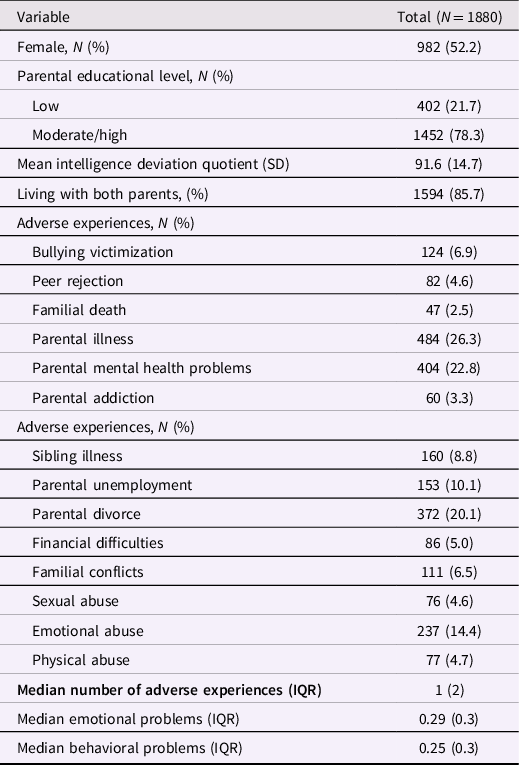
Note. Emotional and behavioral problems descriptives are based on raw scale scores.
Network of AEs and emotional and behavioral problems
Figure 1 shows the resulting network of AEs and emotional and behavioral problems. The network comprised 43 edges, of which six edges represent conditional (direct) associations between AEs and emotional or behavioral problems (see supplementary materials for the bootstrapped 95% confidence intervals). We found that bullying victimization, peer rejection, parental mental health problems, sexual abuse, and emotional abuse were directly associated with emotional problems. Parental divorce and emotional abuse were directly associated with behavioral problems. All other AEs, familial death, familial conflicts, financial difficulties, parental unemployment, illness of a sibling, illness of a parent, parental addiction were conditionally independent from emotional or behavioral problems. It is possible that these AEs contribute to the development of emotional and behavioral problems indirectly, through interactions with other AEs. For example, familial conflicts may lead to parental divorce, the latter being associated with behavioral problems. However, the opposite may also be true. That is, parental divorce may also lead to familial conflicts, which would mean that there is no indirect effect from familial conflicts on behavioral problems via parental divorce. Several other examples of potential indirect effects are suggested by the network (e.g., substance abuse, parental divorce, and behavioral problems; parental illness, parental mental health problems and emotional problems), although similar caveats apply.
Network of adverse experiences and emotional and behavioral problems. Note. Edge thickness represents the strength of the associations between AEs; thicker edges represent stronger associations (depicted by stronger color saturation). Blue edges indicate positive associations, whereas red edges indicate negative associations.

Community detection
Seven potential solutions emerged with varying k-clique and intensity values. The solution with the highest intensity of the cliques, but fewest isolated nodes (K = 3, I = 0.222–0.227, two isolated nodes), was chosen as the final solution because it was reflective of strong associations between nodes while allowing for a variety of different communities. In this solution, five communities of nodes emerged in the network of AEs and emotional and behavioral problems (Figure 2). The first community consisted of intelligence, parental education, financial difficulties, and parental unemployment. The second community consisted of parental education, parental divorce, familial conflicts, parental unemployment, parental illness, parental mental health problems, and parental addiction. The AEs included in this community are associated with each other in several ways (see also Figure 1). The third community consisted of peer rejection, bullying victimization, and emotional problems. The fourth community consisted of physical abuse, emotional abuse, and sexual abuse. The fifth community consisted of emotional problems, behavioral problems, and sex. Familial death and illness of a sibling were the only isolated nodes. The described solution differs from the other solutions (with higher intensity values) only regarding the following: intelligence, parental education, financial difficulties, and parental unemployment did not form their own community (all other solutions). Financial difficulties and parental unemployment were isolated nodes in the solution with the highest intensity threshold (I = 0.297–0.300).
Communities of nodes in the network of adverse experiences and emotional and behavioral problems. Note. Each community of nodes has its own color scheme. Isolated nodes are depicted in white.

Network stability
The stability of the edges between AEs, and between AEs and emotional and behavioral problems varied across the different edges, but are relatively stable (see the supplementary materials for an overview of all potential edges and their bootstrapped 95% confidence intervals, as well as an overview of the number of times a specific edge was zero across bootstrapped models). The majority of the edges that were included in the network model were also included in most bootstrapped models. Edges that were not included in the network model were also largely not included in the bootstrapped models.
Sensitivity analyses
The results of the network models with hyperparameter settings 0.25, 0.50, and 0.75 slightly differed from the main model (see supplementary materials). The three models included 39, 36, and 33 edges, respectively (compared to 43 in the main model). The 0.25 model was nearly identical to the main model but did not include associations between covariates and AEs (i.e., no association between sex with familial conflicts and illness of a parent) and between AEs (i.e., no associations between peer rejection and parental addiction; illness of a parent, and illness of a sibling). Differences with the 0.50 and 0.75 models were more pronounced. In the 0.50 model, we again found that several edges between covariates and AEs (parental education with financial difficulties and parental addiction) and between AEs (sexual abuse and emotional abuse) were removed. In the 0.75 model, several associations between AEs (illness of a parent and parental addiction; physical abuse and sexual abuse) were removed. The edge between emotional abuse and emotional problems was also excluded in the 0.75 model. The edges that were not included in the aforementioned three models were also less stable in the stability analysis of the main network model. This suggests that the edges from the main model which were excluded from the networks in the sensitivity analyses reflect relatively weak associations. Based on these findings, the majority of edges (at least 33 out of 43) in the main model can be interpreted with confidence (see supplementary materials). Regarding community detection, we found communities largely identical to the main model (see supplementary materials). The main differences are that financial difficulties are no longer part of any community in the 0.50 and 0.75 models, and that illness of a parent is no longer part of any community in the 0.75 model. Moreover, the community consisting of sexual abuse, physical abuse, and emotional abuse is non-existent in the 0.50 and 0.75 models. The network model in which the abuse-related AEs were excluded slightly differs from the main model in terms of direct associations between AEs and emotional and behavioral problems. Namely, familial conflicts and financial difficulties are conditionally associated with behavioral problems in this network. This suggests that these associations are likely driven by emotional and physical abuse.
Discussion
This study aimed to investigate how individual AEs in childhood are associated with emotional and behavioral problems at age fourteen through network analysis. Moreover, we investigated to what extent AEs may indirectly contribute to emotional and behavioral problems through associations with other AEs, and whether specific combinations of AEs and emotional and behavioral problems are likely to co-occur through community detection algorithms. In the forthcoming, we will discuss three main findings: first, how AEs differentially contribute to risk of emotional or behavioral problems; second, how AEs may not only directly, but also indirectly contribute to risk of emotional and behavioral problems; third and last, how specific AEs and emotional and behavioral problems are highly interrelated (form communities) in the network model.
The role of individual AEs for risks of emotional and behavioral problems
It becomes clear from our findings that especially those AEs that pertain to psychological or physical victimization in both the family and the peer context (e.g., bullying victimization, emotional abuse) are associated with emotional and behavioral problems at age fourteen. These findings are in line with previous studies (e.g., Arseneault, Reference Arseneault2017; Bevilaqua et al., Reference Bevilaqua, Kelly, Heilmann, Priest and Lacey2021; Muniz et al., Reference Muniz, Fox, Miley, DeLisi, Cigarran and Birnbaum2019). It is not surprising that AEs pertaining to victimization in the peer context seem equally important as AEs pertaining to victimization in the family context, given that we assessed emotional and behavioral problems at a period in time when the peer context is becoming increasingly important (Arseneault, Reference Arseneault2017; Bronfenbrenner, Reference Bronfenbrenner1979; Lopez et al., Reference Lopez, Ruiz, Rovnaghi, Tam, Hiscox, Gotlib, Barr, Carrion and Anand2021). Other AEs are either not conditionally associated with emotional and behavioral problems (see also the next paragraph on indirect effects), or not consistently (based on the network stability analysis). The absence of edges between a variety of AEs and emotional and behavioral problems suggests that findings from single adversity approaches (where more associations between single AEs and emotional or behavioral problems were found) likely arose because of confounding, a well-known issue with single adversity approaches (Lacey & Minnis, Reference Lacey and Minnis2019). Our findings also support the notion that individual AEs contribute differently to risks of emotional and behavioral problems, as has been shown previously (e.g., Bevilaqua et al., Reference Bevilaqua, Kelly, Heilmann, Priest and Lacey2021; Muniz et al., Reference Muniz, Fox, Miley, DeLisi, Cigarran and Birnbaum2019); whereas some AEs directly contribute to the risk of emotional problems (e.g., bullying victimization), others contribute directly to the risk of behavioral problems (e.g., parental divorce). This shows that individual AEs show specificity with regard to emotional and behavioral problems: AEs are either directly associated with emotional problems or behavioral problems, but not both (with the exception of emotional abuse, which was associated with both emotional and behavioral problems, although not consistently in the network stability analysis and across different modeling choices). Our findings do not provide further guidance as to why this is the case. It is possible that indeed, some AEs contribute to risk of emotional and behavioral problems through shared developmental pathways (e.g., threat-based AEs and changes in emotion processing), although unique pathways are plausible as well (Evans et al., Reference Evans, Li and Whipple2013; McLaughlin & Sheridan, Reference McLaughlin and Sheridan2016).
Indirect associations between AEs and emotional and behavioral problems
Although most AEs are not conditionally associated with either emotional or behavioral problems at age fourteen, our findings suggest that these AEs may nevertheless contribute to risks of emotional and behavioral problems through associations with other AEs. For example, parental unemployment may indirectly increase risks of emotional and behavioral problems due to associations with emotional abuse. Most approaches in the childhood adversity literature (i.e., cumulative risk approaches, single adversity approaches, theoretical dimensional models) do not consider such indirect effects. Only the recently integrated model of environmental experience (a theoretical dimensional model) formally includes differences between direct and indirect effects. This model differentiates between so-called proximal variables (immediate experiences, such as abuse) and distal variables (ecological factors, such as poverty), and postulates that distal variables largely exert their effects on development through proximal variables, although direct effects of distal variables on development are also possible (see Ellis et al., Reference Ellis, Sheridan, Belsky and McLaughlin2022 for a more detailed description of the integrated model of environmental experience). Our findings are largely consistent with the model by Ellis et al. (Reference Ellis, Sheridan, Belsky and McLaughlin2022): immediate experiences such as abuse and bullying victimization were directly associated with either emotional or behavioral problems, whereas ecological factors such as parental unemployment were associated with immediate experiences (i.e., abuse). Interestingly, whereas Ellis et al. (Reference Ellis, Sheridan, Belsky and McLaughlin2022) postulated that ecological factors may still directly affect development (and should thus be associated with emotional or behavioral problems in our model), our findings suggest this is largely not the case: most variables that might be considered ecological factors (e.g., financial difficulties, parental unemployment) were not conditionally associated with either emotional or behavioral problems. It is worth mentioning that parental mental health problems, which is by some considered as a more ecological variable (Berman et al., Reference Berman, McLaughlin, Tottenham, Godfrey, Seeman, Loucks, Suomi, Danese and Sheridan2022), was also associated with emotional problems in our model. While this is in line with the model by Ellis et al. (Reference Ellis, Sheridan, Belsky and McLaughlin2022) it is possible that this finding is due to the exclusion of other relevant AEs, specifically neglect. That is, parental mental health problems might be associated with emotional problems via neglect, which we did not assess in this study (see also limitations).
Communities of AEs and emotional and behavioral problems
The community detection algorithm suggested that several communities (highly interconnected nodes) exist within the network model. The findings indicate that bullying victimization, peer rejection, and emotional problems at age fourteen are highly interconnected. This finding suggests that AEs within the peer context are likely to co-occur, not only together, but alongside increased emotional problems. No other communities of AEs and emotional and/or behavioral problems arose in the network structure. We did find however, several communities consisting of AEs which were highly interconnected (e.g., parental divorce, parental illness, parental addiction and parental mental health problems; sexual abuse, physical abuse and emotional abuse; parental unemployment, financial difficulties and parental education), which is in line with previous studies using latent-class analysis and latent trajectory analysis (Bussemakers et al., Reference Bussemakers, Kraaykamp and Tolsma2019; Rod et al., Reference Rod, Bengtsson, Budtz-Jørgensen, Clipet-Jensen, Taylor-Robinson, Andersen, Dich and Rieckmann2020). This suggests that the AEs in these communities are likely to co-occur together during childhood, but not necessarily together with emotional problems or behavioral problems. Interestingly, only a few AEs that are part of a larger community were associated directly with either emotional or behavioral problems. To illustrate: parental mental health problems and parental divorce contribute to risk of emotional and behavioral problems in isolation, but both parental mental health problems and divorce are likely to occur within the presence of each other, parental addiction, and/or parental illness. From these findings it remains unclear whether AEs contribute to risks of emotional and behavioral problems differently (e.g., in a non-linear fashion) in the presence of co-occurring AEs than when they occur in isolation. We deem it likely that non-linear effects exist, however, given the marked variation in stability between pairs of AEs and emotional and behavioral problems. The instability of some edge weights may be reflective of between-individual variation in exposure to AEs (e.g., parental divorce) with or without the presence of other AEs. In other words: it is possible that parental divorce and other AEs characterized by marked variability in edge strength (e.g., parental mental health problems) are more harmful for children when they are accompanied by other AEs (see also Briggs et al., Reference Briggs, Amaya-Jackson, Putnam and Putnam2021).
Strengths and limitations
This study has several strengths. This is the first study to apply network analysis to investigate associations of a broad set of AEs with emotional and behavioral problems at age fourteen. The application of network analysis allowed us to provide first insights into how a broad array of AEs that may occur in two developmentally relevant contexts of the child (the family context and the peer context) are, individually and conjunctively, associated with emotional and behavioral problems in a large sample of Dutch adolescents. This study also has some limitations. First and foremost, several individuals in TRAILS had missing data on the variables of interest in this study. Included participants were more likely to be girls, have a higher intelligence, and have parents with a higher educational background. Handling of missing data in network models is a topic of ongoing investigation. In this study, we applied multiple imputation to account for missing data. Although multiple imputation has been used previously (Carozza et al., Reference Carozza, Holmes and Astle2022; Liu et al., Reference Liu, Epskamp, Isvoranu, Chen, Liu and Hong2021), the approach has not been formally validated in network models specifically. Listwise deletion, a commonly used approach to handle missing data in network models (Borsboom et al., Reference Borsboom, Deserno, Rhemtulla, Epskamp, Fried, McNally, Robinaugh, Perugini, Dalege, Constantini, Isvoranu, Wysocki, van Borkulo, van Bork and Waldorp2021), requires that data is missing completely at random which is unlikely to hold in our data. As such, we deem multiple imputation (which assumes data is missing at random) a more valid approach than listwise deletion, although future research on the validity of multiple imputation in network models is warranted. Second, the exposure to some AEs, for example parental addiction and parental death, was relatively low in this study sample. As a result, it is possible that certain edges between AEs, or between AEs and emotional and behavioral problems, were not uncovered. It is worth mentioning, however, that the model selection approach in this study, LASSO regularization, has been shown to lead to adequate recovery of a network structure, especially in lower sample size settings (Epskamp et al., Reference Epskamp, Borsboom and Fried2017; Van Borkulo et al., Reference Van Borkulo, Borsboom, Epskamp, Blanken, Boschloo, Schoevers and Waldorp2014; Foygel Barber & Drton, Reference Foygel Barber and Drton2015). As such, we are confident that the strongest associations between AEs and elevated emotional and behavioral problems were uncovered in our analysis. A replication of this study, preferably in either larger study samples, or in samples where the occurrence of AEs is more likely (Giano et al., Reference Giano, Wheeler and Hubach2020), could indicate the robustness of our findings. Third, network models are highly influenced by the nodes included in the model, and our network model is no exception. In other words, the direct and indirect associations between AEs and emotional and behavioral problems found in this study are relative. It is possible that if we had included other AEs (neglect in particular, an important aspect of childhood adversity), our findings would have been different (e.g., associations between parental mental health problems might be driven by parental neglect). Nevertheless, even if we included other AEs (e.g., neglect), the implications of our findings remain the same: AEs may contribute to risk of emotional and behavioral problems both directly and indirectly. In a similar vein, we did not include information on genetic predisposition for mental health problems in our network model. The association between parental mental health problems and emotional problems at age fourteen may thus partially reflect shared biological vulnerabilities between parents and their offspring. This may also hold for other adversities (e.g., maltreatment). Because recent findings suggest that parental mental health problems and maltreatment may have an effect on offspring mental health problems after controlling for genetic predisposition (Baldwin et al., Reference Baldwin, Sallis, Schoeler, Taylor, Kwong, Tielbeek, Barkhuizen, Warrier, Howe, Danese, McCrory, Rijksdijk, Larsson, Lundström, Karlsson, Lichtenstein, Munafò and Pingault2022), future studies using network analytical approaches should preferably account for such predisposition, for instance through incorporating polygenic risk scores in network models. Fourth, AEs are characterized by heterogeneity. For instance, sexual abuse in our study included indecent exposure, but also sexual assault. It is likely that sexual assault has a different impact on the developing child than indecent exposure, but such differences were obscured given our operationalization of sexual abuse. It is possible that heterogeneity within AEs also partially explains why the bootstrapped confidence intervals for some associations between AEs and emotional and behavioral problems were relatively broad; the confidence intervals may partially reflect the underlying heterogeneity (e.g., in terms of severity) within AEs. It is worth mentioning that the operationalizations used for the AEs in this study are largely in line with previous studies. Future studies should explore the impact of various operationalizations of AEs (e.g., disentangle sexual abuse into indecent exposure and sexual assault), potentially through a multiverse approach (Steegen et al., Reference Steegen, Tuerlinckx, Gelman and Vanpaemel2016), on associations between childhood adversity and emotional and behavioral problems. Going beyond the occurrence of AEs by including information on their severity and frequency are alternative approaches to capture the inherent heterogeneity within AEs. Fifth, network analysis can be considered a data-driven approach, similar to other approaches commonly applied in the field of childhood adversity (e.g., latent class analysis). An important question that arises with data-driven approaches is to what extent the results generalize to other populations (Lacey & Minnis, Reference Lacey and Minnis2019). Because we only applied network analysis to a single population, we cannot make a clear statement about the generalizability of the findings of our study. It is worth mentioning, however, that we applied several robustness checks of our findings, which included bootstrapping in line with recommendations by Epskamp et al. (Reference Epskamp, Borsboom and Fried2017) and an investigation of the impact of modeling choices when performing network analysis. Given the stability of the findings across these various analyses, we are confident that our findings are robust. However, we do recommend a replication of this study in other study samples to further indicate the robustness of our findings. Sixth and last, not all AEs covered a similar age range in this study. Specifically, parental mental health problems, parental addiction, and bullying victimization and peer rejection could only be observed for a relative short time span. The abuse-related AEs could also be observed between ages fourteen and sixteen, and thus could have occurred after the outcome was measured. Although the sensitivity analysis showed that the majority of the associations in the main model withstood the exclusion of the abuse-related AEs, future studies should preferably use data with similar observation periods for each included AE. Additionally, studies should ideally have data that includes the relative timing of AEs. This will allow researchers to establish the directionality of the direct and indirect effects between AEs, and between AEs and emotional and behavioral problems, found in our study.
Implications
Our findings have several implications for future research, practitioners, and policy makers. We recommend researchers interested in childhood adversity and emotional and behavioral problems to apply statistical approaches that allow to model associations between AEs, and between AEs and emotional and behavioral problems, in future studies. Network analysis provides novel insight into these associations that cannot be obtained using other, more commonly applied statistical approaches in the childhood adversity literature. We also recommend researchers to not only focus on sum scores of childhood adversity when performing studies on associations between childhood adversity and outcomes of interest. Our findings clearly indicate that different AEs are differentially associated with emotional and behavioral problems, both directly and indirectly, which cannot be captured in sum scores. Second, because AEs may contribute to the risk of emotional and behavioral problems in both a direct and potentially indirect manner, it is vital that future theoretical frameworks to childhood adversity take this distinction into account, akin to the recently proposed integrated model of environmental experience (Ellis et al., Reference Ellis, Sheridan, Belsky and McLaughlin2022). Our findings also have several implications for policy makers and practitioners. For both policy makers and practitioners it is important to know that associations between childhood adversity and emotional and behavioral problems in adolescence seem to be largely driven by physical and psychological victimization (immediate experiences of adversity). As such, preventing the occurrence of these adversities is of utmost importance. However, both policy makers and practitioners ought to be aware that using interventions to target more ecological factors (e.g., financial difficulties) may also be beneficial in reducing risks of emotional and behavioral problems; a narrow view considering only immediate experiences may thus be unfavorable. For policy makers, focusing on reducing the occurrence or impact of ecological factors, such as parental unemployment, on a population level may be effective in preventing the occurrence of AEs that contribute to emotional and behavioral problems (e.g., emotional abuse). Practitioners may, for example, support physically ill parents to reduce the probability of parents developing psychopathology or support parents involved in conflicts that may lead to emotional abuse of the child. Such interventions may be useful in reducing the likelihood of offspring emotional or behavioral problems. It is noteworthy that parents who experience the adversities discussed in this study may be able to protect their children against the potential negative effects of these adversities. In other words, not all families and children may be in need of support, and assuming otherwise might be needlessly stigmatizing. Offering support of any kind thus requires close collaboration between practitioners and families they work with. It is also important to note that focus should not only go to adversities in the family context; attention should also go out to the peer context, especially during adolescence where peer influences are particularly important (Arseneault, Reference Arseneault2017; Bronfenbrenner, Reference Bronfenbrenner1979; Lopez et al., Reference Lopez, Ruiz, Rovnaghi, Tam, Hiscox, Gotlib, Barr, Carrion and Anand2021). Third, future studies should further explore interaction effects between individual AEs. Although our findings only shed light on pairwise associations between AEs and emotional and behavioral problems, it is possible that AEs have non-additive (interaction) effects when multiple AEs are present. This may be especially likely for AEs that are likely to co-occur together with other AEs during childhood (e.g., parental mental health problems, substance abuse and parental divorce). Non-additive effects between pairs of AEs in relation to a variety of outcomes (including complex psychopathology) have been demonstrated previously, and warrant further attention (Briggs et al., Reference Briggs, Amaya-Jackson, Putnam and Putnam2021).
Conclusion
The application of network analysis in this study showed that individual AEs may contribute to risks of emotional and behavioral problems at age fourteen both directly, and indirectly through associations with other AEs. Although this study highlights the importance of individual AEs, some AEs are likely to co-occur together, either with or without emotional and behavioral problems. The findings in this study reflect important steps in understanding how childhood adversity contributes to risk of emotional and behavioral problems in adolescents, with implications for both future research and future interventions.
Supplementary material
The supplementary material for this article can be found at https://doi.org/10.1017/S0954579423000287
Acknowledgments
We are grateful to everyone who participated in this research or worked on this project to make it possible.
Funding statement
TRdV and IA were funded through the Netherlands Organi for Scientific Research (NWO) Vici project (‘Today’’s youth is tomorrow’’s workforce: Generation Y at work’; NWO Vici 453-16-007/2735) that was granted to UB. Participating centers of TRAILS include the University Medical Center and University of Groningen, the University of Utrecht, the Radboud Medical Center Nijmegen, and the Parnassia Bavo group, all in the Netherlands. TRAILS has been financially supported by various grants from the Netherlands Organization for Scientific Research NWO (Medical Research Council program grant GB-MW 940-38-011; ZonMW Brainpower grant 100-001-004; ZonMw Risk Behavior and Dependence grant 60-60600-97-118; ZonMw Culture and Health grant 261-98-710; Social Sciences Council medium-sized investment grants GB-MaGW 480-01-006 and GB-MaGW 480-07-001; Social Sciences Council project grants GB-MaGW 452-04-314 and GB-MaGW 452-06-004; NWO large-sized investment grant 175.010.2003.005; NWO Longitudinal Survey and Panel Funding 481-08-013 and 481-11-001; NWO Vici 016.130.002 and 453-16-007/2735; NWO Gravitation 024.001.003, the Dutch Ministry of Justice (WODC), the European Science Foundation (EuroSTRESS project FP-006), the European Research Council (ERC-2017-STG-757364 and ERC-CoG-2015-681466), Biobanking and Biomolecular Resources Research Infrastructure BBMRI-NL (CP 32), the Gratama foundation, the Jan Dekker foundation, the participating universities, and Accare Centre for Child and Adolescent Psychiatry. The funding sources were not directly involved in either the preparation or the conduct of this study.
Conflicts of interest
The authors declare no conflicts of interest.


 Open access

