




Introduction
The biannual corn (Zea mays L.) and soybean (Glycine max [L.] Merr.) rotation has dominated the Midwestern United States since the mid-twentieth century, and today encompasses an approximately 110 million ha area known as the Corn Belt (Green et al., Reference Green, Kipka, David and McMaster2018). This system provides efficiencies in scale and is enabled by a vast infrastructure of agricultural technology and processing, federal policies, and research and development (Iles and Marsh, Reference Iles and Marsh2012; Bowman and Zilberman, Reference Bowman and Zilberman2013). There has been increasing interest in diversifying the Midwestern agricultural landscape beyond these two crop species to help reduce the many negative impacts of the current simplified, high-input model of commodity production (Prokopy et al., Reference Prokopy, Gramig, Bower, Church, Ellison, Gassman, Genskow, Gucker, Hallett, Hill, Hunt, Johnson, Kaplan, Kelleher, Kok, Komp, Lammers, LaRose, Liebman, Margenot, Mulla, O’Donnell, Peimer, Reaves, Salazar, Schelly, Schilling, Secchi, Spaulding, Swenson, Thompson and Ulrich-Schad2020; NSAC, 2023; Sustainable Food Lab, 2023). This system of agricultural production has been shown to cause the degradation of soil, water, air, wildlife habitat, and diversity, and contribute to climate change, widespread evolution of pest resistance, and toxicological harm from pesticides on nontarget organisms, including human populations (Samson and Knopf, Reference Samson and Knopf1994; Alexander et al., Reference Alexander, Smith, Schwarz, Boyer, Nolan and Brakebill2008; Broussard and Turner, Reference Broussard and Turner2009; Rabalais et al., Reference Rabalais, Díaz, Levin, Turner, Gilbert and Zhang2010; Tranel et al., Reference Tranel, Riggins, Bell and Hager2011; Cardinale et al., Reference Cardinale, Duffy, Gonzalez, Hooper, Perrings, Venail, Narwani, Mace, Tilman, Wardle, Kinzig, Daily, Loreau, Grace, Larigauderie, Srivastava and Naeem2012; Davis et al., Reference Davis, Hill, Chase, Johanns and Liebman2012; Heathcote, Filstrup and Downing, Reference Heathcote, Filstrup and Downing2013; USGCRP et al., Reference Wuebbles, Fahey, Hibbard, Dokken, Stewart and Maycock2017; Nowell et al., Reference Nowell, Moran, Schmidt, Norman, Nakagaki, Shoda, Mahler, Van Metre, Stone, Sandstrom and Hladik2018; Hill et al., Reference Hill, Goodkind, Tessum, Thakrar, Tilman, Polasky, Smith, Hunt, Mullins, Clark and Marshall2019). In addition, the chronic over-production and boom-bust price dynamics of specialized commodity production (Cochrane, Reference Cochrane1993) and related dependence on government commodity subsidies can be a source of significant stress for farmers (Gao and Arbuckle, Reference Gao and Arbuckle2024; Morris and Arbuckle, Reference Morris and Arbuckle2024).
Diversification, or the cultivation of a variety of crops and livestock through and across space and time, has been shown to potentially improve farm economics and environmental outcomes compared to monoculture or short rotations (Davis et al., Reference Davis, Hill, Chase, Johanns and Liebman2012; Tamburini et al., Reference Tamburini, Bommarco, Wanger, Kremen, Heijden, Liebman and Hallin2020; Estrada-Carmona et al., Reference Estrada-Carmona, Sánchez, Remans and Jones2022; Guinet et al., Reference Guinet, Adeux, Cordeau, Courson, Nandillon, Zhang and Munier-Jolain2023; Smith et al., Reference Smith, Vico, Costa, Bowles, Gaudin, Hallin, Watson, Alarcón Víllora, Berti, Blecharczyk, Calderon, Culman, Deen, Drury, Garcia y Garcia, García-Díaz, Hernandez Plaza, Jończyk, Jäck and Bommarco2023). Increasing diversity in agricultural landscapes requires changes in farmer behavior; therefore, understanding farmers’ perspectives on context-specific constraints and opportunities for diversification is important for guiding diversification efforts (Blesh and Wolf, Reference Blesh and Wolf2014). A better understanding of farmer perspectives can inform more effective research and outreach strategies that meet farmers’ needs (Wade et al., Reference Wade, Beetstra, Hamilton, Culman and Margenot2021), which is critical to producing tractable approaches to diversification (Jordan et al., Reference Jordan, Liebman, Hunter and Cureton2024).
However, little is known about how farmers in the Midwestern United States think about diversification, and only a few studies have examined farmer perspectives of agricultural diversification in this key agricultural region. Existing research shows that overall, farmers understand the benefits of crop diversification (Corselius, Simmons and Flora, Reference Corselius, Simmons and Flora2003; Weisberger et al., Reference Weisberger, McDaniel, Arbuckle and Liebman2021) and that perceptions and practice of diversification can be influenced by landscape locations. Farmers managing marginal lands tend to view crop diversification more positively than farmers managing prime land (Cutforth et al., Reference Cutforth, Francis, Lynne, Mortensen and Eskridge2001) and agronomic challenges such as crop disease sometimes increase farmer interest in, but not necessarily action on, diversification (Corselius et al., Reference Corselius, Simmons and Flora2003).
Research on the barriers to diversification shows that structural factors embedded in the social and economic system have locked many Midwestern farmers into simplified production. Economic factors, in particular, inform the perception and adoption of diversification practices in the region, including lack of markets and limited infrastructure (Corselius et al., Reference Corselius, Simmons and Flora2003; Roesch-McNally, Arbuckle and Tyndall, Reference Roesch-McNally, Arbuckle and Tyndall2018; Weisberger et al., Reference Weisberger, McDaniel, Arbuckle and Liebman2021; Traldi et al., Reference Traldi, Asprooth, Usher, Floress, Arbuckle, Baskerville, Church, Genskow, Harden, Maynard, Thompson, Torres and Prokopy2024; Asprooth et al., Reference Asprooth, Krome, Hartman, McFarland, Galt and Prokopy2025, employment opportunities for young family members (Valliant et al., Reference Valliant, Farmer, Dickinson, Bruce and Robinson2017), and profitability (Wang et al., 2019; Wang et al., Reference Wang, Jin, Fan, Obembe and Li2021). These studies provide geographically focused insights into farmer perspectives primarily on crop diversification, but there is a need for additional comprehensive, regional evaluations of perspectives on the multiple dimensions of diversification including perceptions of their barriers, entry points, and potential.
This paper seeks to contribute to this limited body of literature using data from a 2023 survey of farmers in the Midwestern states of Iowa, Illinois, and Indiana. Specifically, we set out to provide preliminary data to answer the following research questions:
-
1) What are Corn Belt farmers’ (specifically Illinois, Indiana, and Iowa) perspectives on diversification? Do these differ based on the farmers’ level of diversification?
-
2) What are Corn Belt farmers’ perceived barriers to and opportunities for diversification? Do these differ based on the farmers’ level of diversification?
Below, we describe the methods used to conduct the farmer survey and analyze the resulting data. We then present summary statistics from the primary survey question sets along with results from statistical analyses of differences between responses from diversified and non-diversified farmers. We conclude with a discussion of the implications of these preliminary findings and the next steps for applying these data to improve our understanding of and support for farmers and their efforts to diversify toward more resilient agricultural systems.
Methods
Survey design
We drafted the survey instrument based on (1) an initial cross-disciplinary literature review of agricultural diversification in the Corn Belt, (2) preliminary analysis of farmer focus groups discussing challenges and opportunities for diversification (Traldi et al., 2024), and (3) previous survey instruments focused on similar topics (Usher et al., Reference Usher, Grilly, Samanta and Prokopy2018; Wang et al., Reference Wang, Jin, Fan, Obembe and Li2021; Weisberger et al., Reference Weisberger, McDaniel, Arbuckle and Liebman2021; Asprooth et al., Reference Asprooth, Krome, Hartman, McFarland, Galt and Prokopy2025). The survey incorporated questions on current farm practices, perspectives about diversification in general, perceived barriers and opportunities for diversification, and potential future adoption of diversified practices. The survey instrument was developed by a group of interdisciplinary researchers, including social scientists, agricultural and natural resource economists, soil scientists, agronomists, and University Extension faculty part of a USDA National Institute for Food and Agriculture-funded project called the Diverse Corn Belt (DCB). We conducted five survey pilots with farmers virtually over Zoom and incorporated their feedback.
The definition of diversification used in the survey is based on a framework developed by the DCB project. Following this framework, we define agricultural diversification in the survey as ‘anything beyond corn, soybean, and cover crops’. The project identifies five key farm-level diversified production systems that were of particular focus in the survey. The systems include (1) extended rotations with three or more cash crops over a 3+ year period (e.g., corn, soybean, alfalfa, oat, wheat, barley, and rye); (2) perennial pasture, forage, or perennial biomass crops; (3) horticultural food crops (e.g., fruits and vegetables); (4) grazed livestock; and (5) agroforestry practices (windbreaks, shelterbelts, and hedgerows). Thus, our definition encompasses more than one dimension of diversification by including crop/product diversification as well as diversified landscape management (agroforestry and pasture). We provided a printed handout in the survey packet with definitions and simplified images of these five key diversified practices. In the handout, we also acknowledged that ‘since we are conducting collaborative research with farmers, we recognize that our understanding of diversification may change based on your survey responses’. Indeed, farmers’ definitions of diversification are themselves diverse and the subject of future investigation in our greater study.
Variable measurement
Operator and farm characteristics
Acreage owned and rented from others were measured as open-ended continuous variables. Farm scale is represented by gross farm income using categories from the USDA ERS farm typology found in Whitt et al., Reference Whitt, Lacy and Lim2023. Gross farm income was measured as a single categorical variable with five options that included ‘choose not to answer’. Years as a farmer or landowner on any operation and age were measured as open-ended continuous variables. Race/ethnicity was measured as a single categorical variable with eight options that included ‘other’ and ‘choose not to answer’. Gender was measured as an open-ended question and responses were converted to binary variables based on responses. Respondents were asked about their highest level of education completed, with six categorical response options ranging from ‘some formal schooling’ to ‘graduate degree’ (see Table 1). The use of diversification practices was measured via two survey questions described further below.
Description of variables reported in this paper

Classification as diversified or non-diversified
Respondents were classified as having a diversified production system if they met one of two conditions. The first condition is whether the respondent checked at least one of the five diversification practices described in the Survey Design section above in a set of ‘check all that apply’ responses to the question ‘Do you use any of the following practices on your farm?’ The second condition was whether the respondent indicated, in a separate section of the survey, that they were currently producing or using one of the same five diversified agricultural practices/systems. Respondents were asked ‘How familiar are you with [specific practice]?’ Answer options to this question were not familiar with it, somewhat familiar with it, know how to use it but not using it, currently use it, and previously used but discontinued. We computed a variable that assigned a ‘1’ if a respondent indicated in either question that they were currently using one or more of the five practices and a ‘0’ if they were using none. By using data from both questions, we were able to offset missing data in each of the questions and ensured that respondents did not just miss an option in one of the locations.
Perceived utility of diversified/specialized systems
To determine the extent to which respondents believed diversified or specialized production systems were best equipped to achieve several agronomic, economic, environmental, and social goals, 11 items were included and measured on a 5-point scale ranging from ‘highly diversified’ to ‘highly specialized’, respectively. To facilitate the interpretation of results, we reversed the scale, recoding highly specialized to 1 and highly diversified to 5 (see Table 1).
Diversification supports and barriers
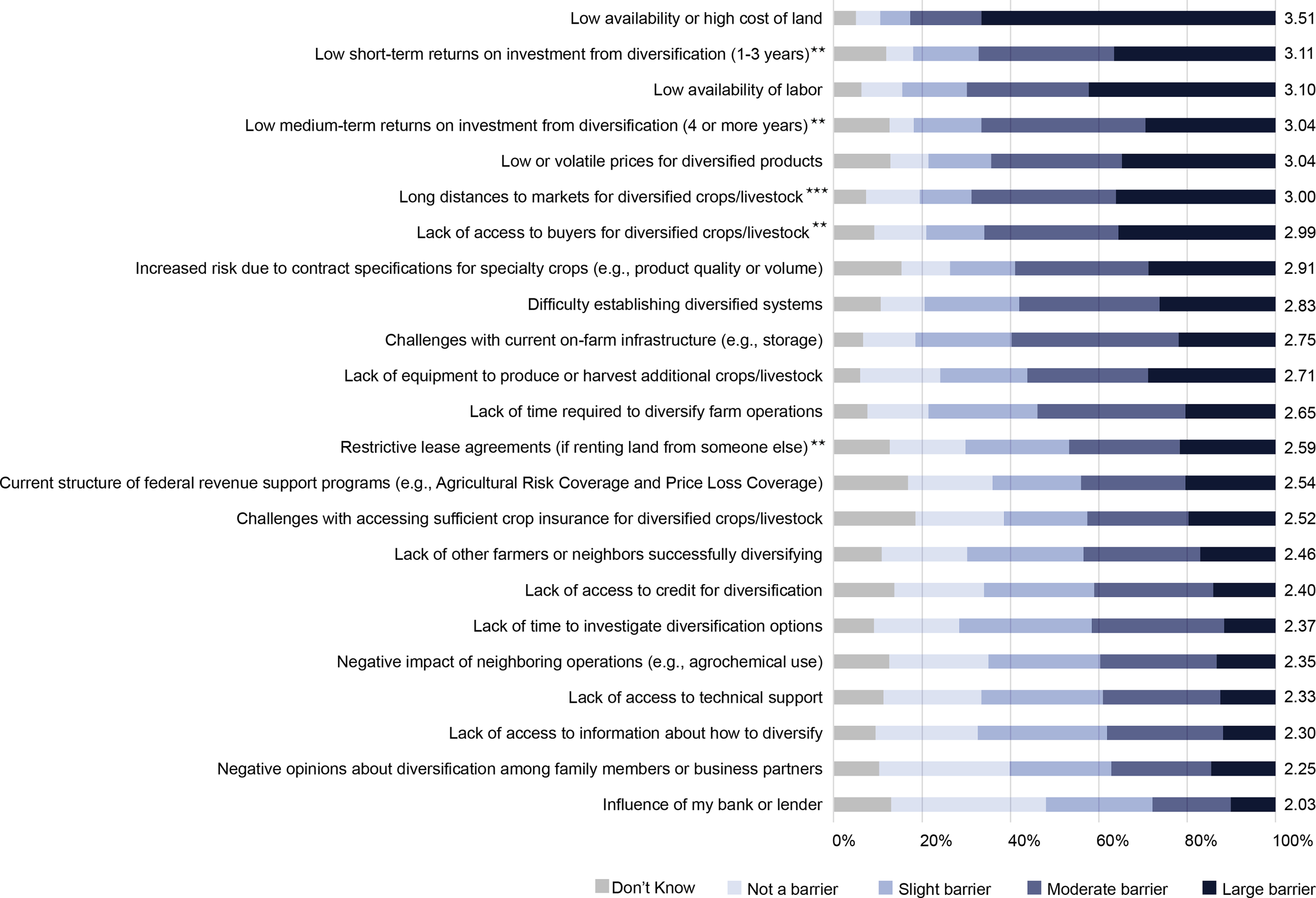
Barriers to diversification were assessed using 23 items measured on a 4-point ordinal scale ranging from 1 = ‘not a barrier’ to 4 = ‘large barrier’. Five topics (markets—seven items; labor and processing—five items; policy—seven items; information and technical assistance—six items; farmer-to-farmer collaboration—four items) related to potential supports of diversification were measured using a 4-point ordinal importance scale ranging from 1 = ‘Not important’ to 4 = ‘Very important’.
Sampling strategy
We worked with the data analytics and technology company DTN to construct a stratified sample frame based on (1) state, (2) diversification level as approximated by the number of crops and production of livestock on the farm, and (3) farm size (see Supplementary Tables 1 and 2). DTN, previously known as FarmMarketID, is a commonly used and relatively reliable source of farmer samples (Ulrich-Schad et al., Reference Ulrich-Schad, Li, Arbuckle, Avemegah, Brasier, Burnham, Kumar Chaudhary, Eaton, Gu, Haigh, Jackson-Smith, Metcalf, Pradhananga, Prokopy, Sanderson, Wade and Wilke2022). We used farmer address data as opposed to email addresses as email addresses were not available for all farmers, and surveys sent via email tend to yield lower response rates (Nulty Reference Nulty2008; Ulrich-Schad et al., Reference Ulrich-Schad, Li, Arbuckle, Avemegah, Brasier, Burnham, Kumar Chaudhary, Eaton, Gu, Haigh, Jackson-Smith, Metcalf, Pradhananga, Prokopy, Sanderson, Wade and Wilke2022). We limited the sample to farmers with a minimum of 40 crop acres or 10 head of livestock. These thresholds were set to focus on larger-scale farms that operate disproportionately more acres (e.g., farms greater than 500 acres operate 70% of acres in Iowa [USDA NASS, 2024]) and therefore have a disproportionately higher impact on the landscape, and to ensure the selection of farmers whose agricultural operations contributed substantially to household income.
For our sampling, we first took a proportional random sample of farms in the DTN database based on the number of farms per state provided in the Census of Agriculture (IA 40%; IL 34%; IN 26%) (USDA NASS, 2019). Next, to attain a proportional representation of diversification, we referenced the USDA Agricultural Resource Management Survey (ARMS) statistics on crop and livestock production on farms with at least 40 acres (USDA ERS, 2021) and grouped farms in the sample frame by diversification level: 35% of farms with three or more crops (45% with livestock, 55% without livestock) and 65% with fewer than three crops (10% with livestock, 90% without livestock). Finally, we took this group of farms and sampled randomly among one-third of farms between 40 and 500 acres, one-third between 501 and 1,000 acres, and one-third with greater than 1,000 acres. We chose to sample across different farm sizes equally to ensure representation from farmers with operations at a variety of scales.
Survey implementation
We conducted a five-wave survey (Dillman et al., Reference Dillman, Smyth and Christian2014) from late January to early April 2023. In the first wave, we mailed an advance notice letter, including an option to complete the survey online via Qualtrics, to 3,300 farmers in Indiana, Illinois, and Iowa. In the second wave, we mailed a packet, including a cover letter, 16-page survey, and a 1-page overview of the project team’s definitions of five key diversified production systems (see Supplementary Figure 1), and included a 2-dollar bill as an incentive, which has been found to improve response rates in other farmer surveys (Glas et al., Reference Glas, Getson, Gao, Singh, Eanes, Esman, Bulla and Prokopy2018). The third wave included a reminder postcard, the fourth wave a replacement survey, and the fifth wave a final survey with a postcard indicating that it was the final mailing. Each wave was sent at 2–3-week intervals, respectively. From the 3,300 surveys mailed, 200 (6%) were returned as undeliverable, and 725 surveys with usable data were received for a response rate of 23%. This sample size exceeds the number needed to generalize to our population of farmers with 95% confidence based on a sample size calculation that showed 384 observations were necessary to achieve a generalizable sample given our population size of 159,728 farm operations. The population size is the total number of farm operations with a minimum of 40 acres or 10 head of livestock in the combined states of Iowa, Illinois, and Indiana based on data from ARMS (USDA ERS, 2021). Data on the number of individual farmers in this group are not available; thus, we use farm operations as a proxy. Because the required sample size does not increase or increases marginally when estimating multiple farmers per operation, we believe that our sample size of 725 is more than sufficient.
Data analysis
We report means, standard deviations, and sample sizes (see the Supplementary Material) for selected variables and compare results between farmers who had highly specialized operations and those who reported at least one diversified practice. Statistical analyses were conducted using SPSS. Because all of the variables analyzed are ordered (e.g., importance scales), we used Wilcoxon Rank Sum (Mann–Whitney) tests, a non-parametric test appropriate for ordered variables (de Winter and Dodou, Reference de Winter and Dodou2019) to assess whether there were significant differences between diversified and non-diversified farmers in terms of their responses to survey questions. Where appropriate, ‘don’t know’ answers were coded to missing data before statistical comparisons were performed.
Results and discussion
The proportional random sample resulted in a sample of farmers representative of the number of farms per state: 37% from Iowa, 34% from Illinois, and 29% from Indiana. Farmers in the sample operated farms with a range of scales: 39% were considered a small farm, 23% midsized, and 17% large-scale according to their gross farm income (Table 2). Respondents owned, on average, 668 acres and rented 616 acres with an average total farm size of 1,284 acres. Ten percent were identified as non-operator landowners, meaning that they rented out all their acreage. The mean number of years respondents had been a farmer or landowner of an operation was 40 years, and the mean age was 65 years. The majority of respondents identified as white (95%) and male (93%). In terms of education, over half (56%) of respondents had a college degree. Overall, 60% of respondents were classified as ‘diversified’ because they reported using at least one of the five key diversification practices. Around a quarter of the sample used grazed livestock (29%), agroforestry practices (28%), perennials (27%), and/or extended rotations (24%). Fewer respondents produced horticultural food crops (3%). The remaining 40% reported using none of the practices and were classified as ‘non-diversified’.
Farm and farmer characteristics
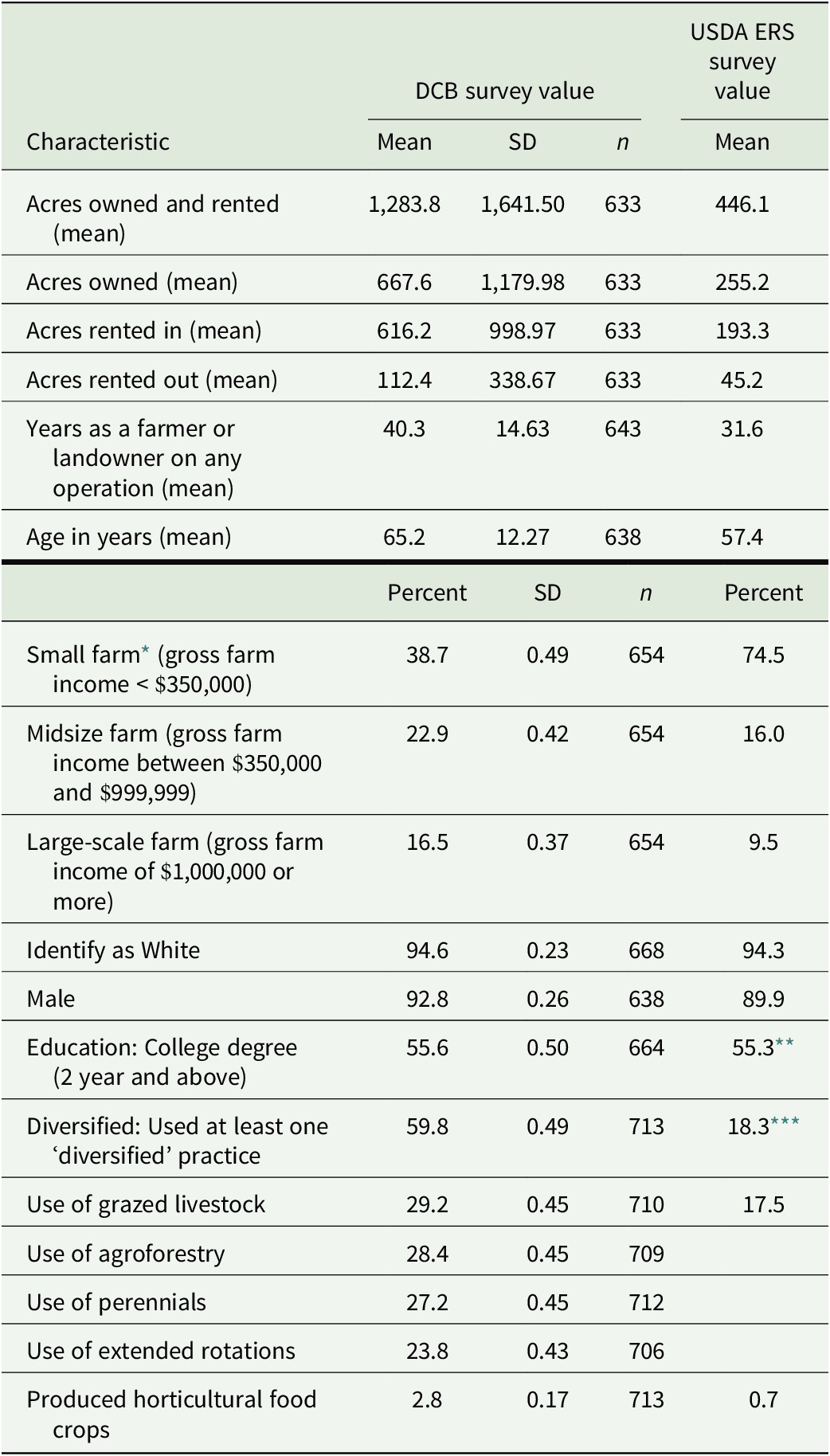
Source: DCB farmer survey (2023); USDA ERS (2021), including farms with a minimum of 40 acres or 10 head of livestock.
Note: n, number of observations; SD, standard deviation.
* Farm size categories reflect the USDA farm typology in Whitt, Lacy and Lim (Reference Whitt, Lacy and Lim2023). These categories do not include respondents that selected ‘choose not to answer’ (21.6% of the sample).
** Includes ‘some college’ and ‘4 years of college or more’.
*** Includes only two of the five diversification practices we measure: horticulture food crops and grazed livestock. Agroforestry, extended rotations, and perennial production cannot be measured using ARMS Phase 3 data. In other words, 18.4% of farms with 40 or more acres have at least one of the diversified practices of horticultural food crops or grazing of livestock.
The sampling design used to reach farmers resulted in a sample with larger and more diversified farms than would be expected through a random sample of all farms. Compared to data from the ARMS, farmers in our sample had larger farms, were older, and had more experience farming. The sample was representative in terms of ethnicity (primarily white) and gender (primarily male). Likewise, our sample likely includes a greater diversity of types of production than average due to our proportional sampling along the lines of crop and livestock diversification. For example, farmers in our sample reported greater use of grazed livestock and horticultural food crops compared to data from ARMS. Thus, although by design our sample cannot be considered representative of all farms, we can generalize to larger-scale farms across the three study states, and we have sufficient numbers of farms with diverse production systems to conduct comparisons between more diverse and less diverse farm operations.
Which are better equipped: diversified or specialized systems?
We sought to measure farmer beliefs about which kind of agricultural system—diverse or specialized—is better able to meet a range of agriculture-related social-ecological goals. Survey respondents were presented with a list of 11 potential goals to which agricultural production systems can be expected to contribute. The question set was preceded by the following introductory statement: ‘Please select the production system that you think is best equipped to achieve the following goals over the next 20 years’. The five-point scale of responses ranged from highly specialized (1) to highly diversified (5) (see Table 1). Here, ‘highly diversified’ refers to the production of many types of crops, livestock, and trees; and ‘highly specialized’ refers to exclusive corn-soybean production. ‘Neither diversified nor specialized systems’ indicates that the respondent does not think that any of the system choices are best equipped to achieve the goals presented.
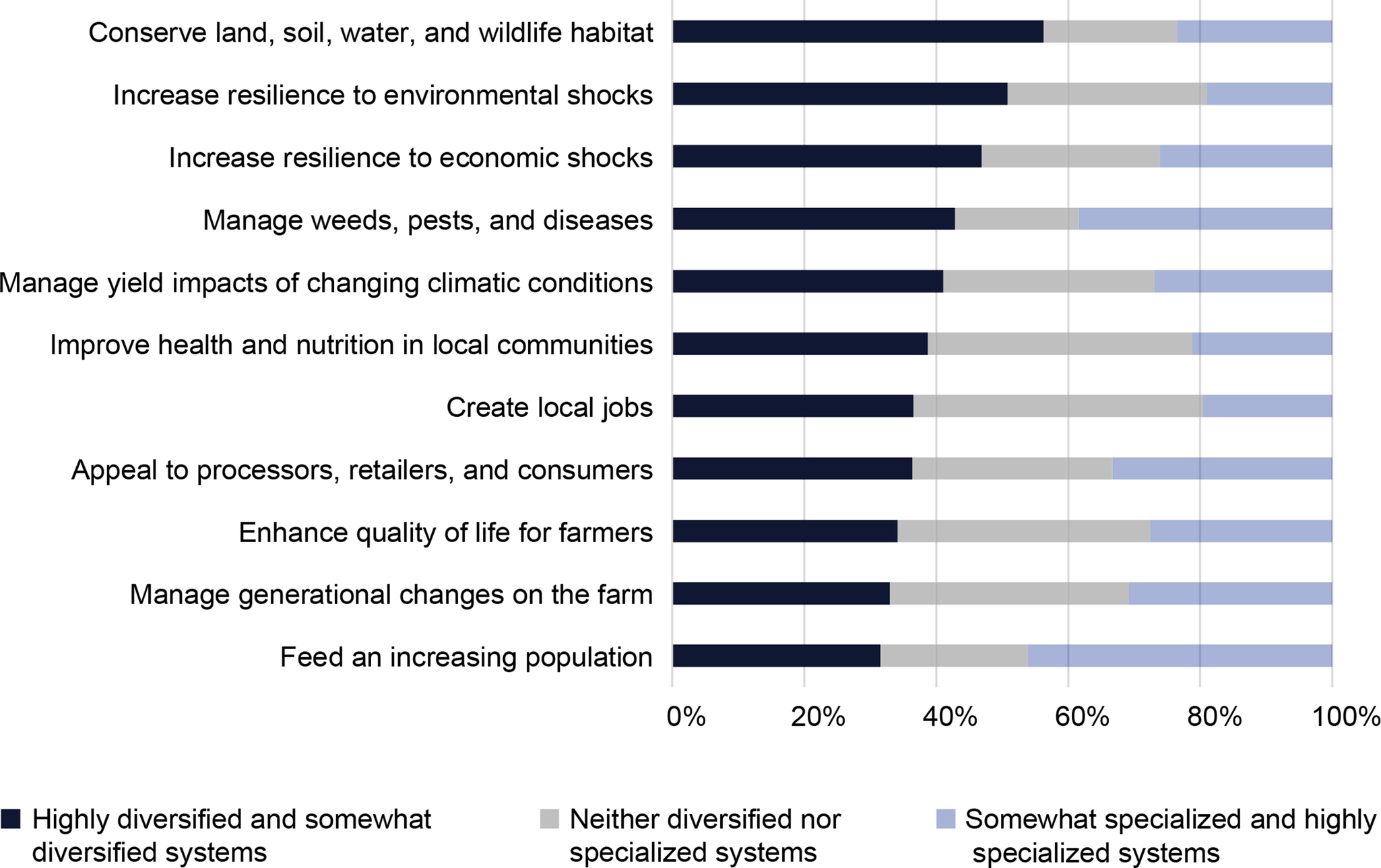
A majority or plurality of farmers believed diversified systems to be superior to non-diversified systems for achieving six of the 11 goals presented (Fig. 1). More than half of respondents indicated that highly or somewhat diversified systems were best equipped to conserve natural resources (56%) and increase resilience to environmental shocks (51%). Pluralities indicated that diversified systems were better able to increase resilience to economic shocks (47%), manage weeds, pests, and diseases (43%), manage the yield impacts of changing climatic conditions (41%), and appeal to processors, retailers, and consumers (36%). The middle category, ‘neither diversified nor specialized’, was selected by a plurality of respondents for capacity to create local jobs (44%), improve health and nutrition in local communities (40%), enhance the quality of life for farmers (38%), and manage generational changes on the farm (36%). Highly or somewhat specialized systems were selected by a plurality of farmers (46%) for just one item: feed an increasing population.
Percentage of farmers indicating whether diversified or specialized systems are better equipped to attain social–ecological goals.
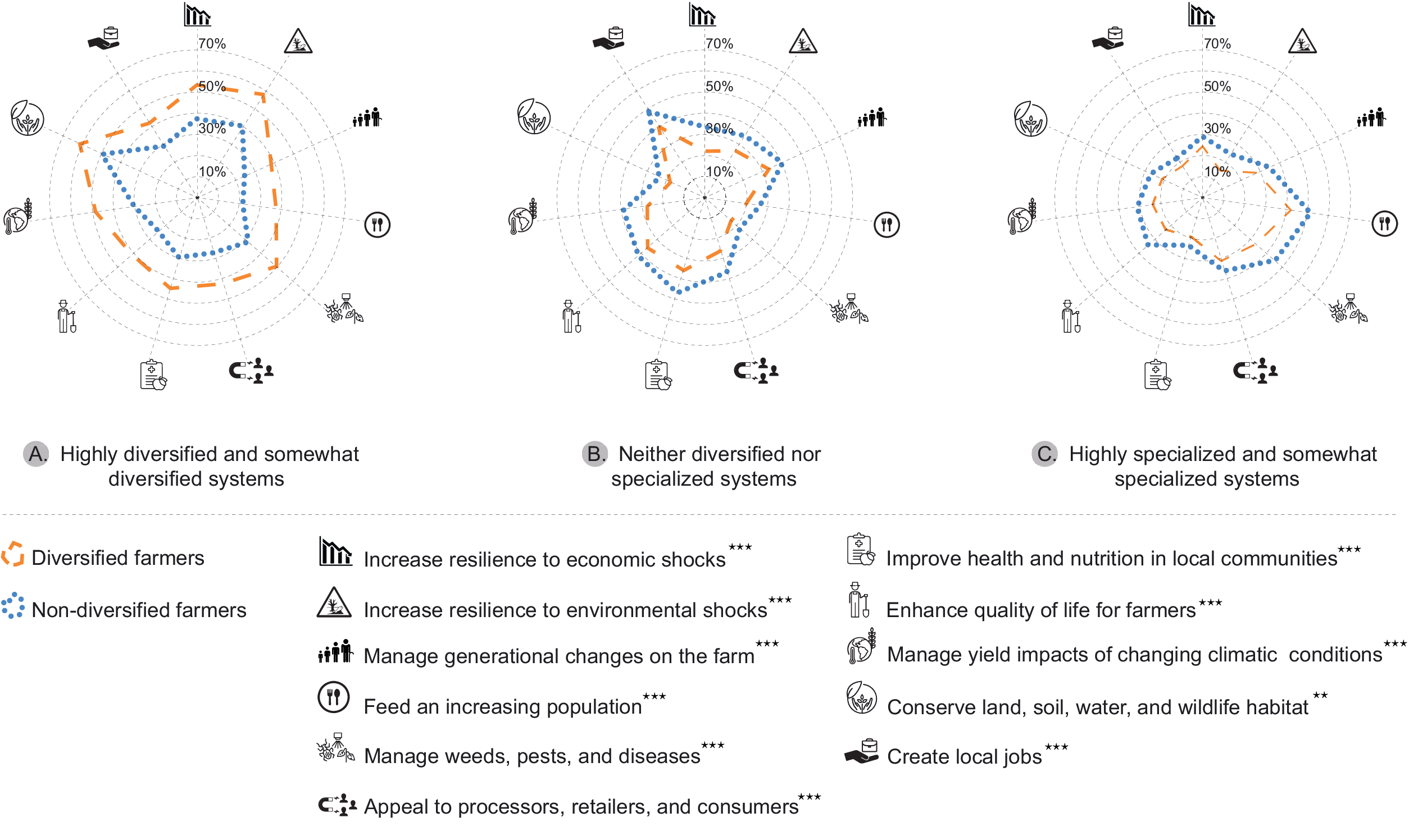
Responses by farmer diversification status are presented in Fig. 2. Greater percentages of diversified compared to non-diversified farmers selected ‘highly or somewhat diversified systems’ as best equipped to achieve all goals listed (Panel A). On the other hand, higher percentages of non-diversified compared to diversified farmers selected ‘neither diversified nor specialized’ and ‘somewhat specialized highly specialized’ systems as best equipped to achieve all of the goals presented (Panels B and C). Wilcoxon Rank Sum tests showed that differences between diversified and non-diversified farmers were statistically significant (p ≤ 0.002) for all goals (Supplementary Table 3). In other words, diversified farmers were significantly more likely than non-diversified farmers to rate diversified systems as superior to non-diversified systems across all goals presented in the survey. That said, among non-diversified farmers, higher percentages selected diversified systems as superior to specialized systems for five of the 11 goals: increase resilience to economic (37% selected diversified vs. 29% selected specialized) and environmental (41% vs. 25%) shocks; improve health and nutrition in local communities (30% vs. 24%); conserve soil, water, and wildlife habitat (49% vs. 27%); and create local jobs (29% vs. 22%) (Panels A and C).
Percentage of diversified and non-diversified farmers choosing systems that are (A) highly and somewhat diversified, (B) neither diversified nor specialized, or (C) somewhat and highly specialized as best equipped to achieve various goals over the next 20 years by non-diversified and diversified farmers. Note: Asterisks indicate statistically significant differences between diversified and non-diversified farmers according to Wilcoxon Rank Sum tests. ⋆⋆p < 0.05; ⋆⋆⋆p < 0.01. See Supplementary Table 3 for more details.
Perspectives on diversification
Respondents were provided a series of statements to gauge perspectives on a variety of topics related to agricultural diversification and asked to rate their agreement on a 5-point scale (Fig. 3). The most common response to all statements was ‘neither disagree nor agree’, with between 37.8% and 53.7% of farmers selecting this category across the eight questions in this section. The statements that received the highest levels of agreement (‘strongly agree’ and ‘agree’ selections) were ‘In the future, I would like to see more types of crops, trees, and/or grazed livestock produced in my community’ (42%); ‘The environmental or physical characteristics of my farm make diversifying challenging’ (43%); and ‘The risk of diversifying my farm outweigh the benefits’ (37%). The statement with the highest level of disagreement (‘strongly disagree’ and ‘disagree’ selections) (29%) was ‘Other farmers in my community support diversified agriculture’.
Level of disagreement or agreement with various statements about agricultural diversification. Note: Statements are sorted according to the mean value on a five-point agreement scale where: 1 = Strongly disagree; 2 = Disagree; 3 = Neither agree nor disagree; 4 = Agree; 5 = Strongly agree. Asterisks indicate statistically significant differences between diversified and non-diversified farmers according to Wilcoxon Rank Sum tests. ⋆p < 0.1; ⋆⋆p < 0.05; ⋆⋆⋆p < 0.01. See Supplementary Table 4 for more details.

When comparing diversified farmers to non-diversified farmers, Wilcoxon Rank Sum tests found statistically significantly higher levels of agreement among diversified farmers for the following statements: ‘In the future, I would like to see more types of crops, trees, and/or grazed livestock produced in my community’ (p < 0.00); ‘Diversifying (or further diversifying) my farm would positively impact my health and well-being’ (p = 0.031); and ‘There are trustworthy people or organizations working on agricultural diversification that I can turn to for information’ (p = 0.040) (Fig. 3 and Supplementary Table 4). Significantly higher levels of agreement were found among non-diversified farmers for the statement ‘The environmental or physical characteristics of my farm make diversifying challenging’ (p = 0.006).
Barriers to agricultural diversification
This 23-item question set posed a range of potential barriers to diversifying agricultural operations and asked respondents to rate their importance on a four-point barrier scale based on personal experience. Data are arranged in Fig. 4 from the highest-rated to lowest-rated barriers. The ‘don’t know’ category (5) was excluded from Wilcoxon Rank Sum tests, but the results for this response category are presented in Fig. 4. The items that were rated highest on the barrier scale were economic factors, including low availability or high cost of land, low short-term returns on investment from diversification, low availability of labor, low or volatile prices, long distances to markets, and lack of access to buyers for diversified products. In the middle were issues related to production, infrastructure and equipment, time, lease agreements, and federal farm programs (e.g., crop insurance and revenue support). The items that were rated lowest as barriers to diversification were ‘influence of my bank or lender’ (also found in Asprooth et al., Reference Asprooth, Krome, Hartman, McFarland, Galt and Prokopy2025), lack of information and technical support about how to diversify (also found in Corselius et al., Reference Corselius, Simmons and Flora2003; Asprooth et al., Reference Asprooth, Krome, Hartman, McFarland, Galt and Prokopy2025), and negative opinions about diversification among family members or business partners.
Importance of potential barriers to diversifying agricultural operations. Note: Statements are sorted according to the mean value on a four-point barrier scale where: 1 = Not a barrier; 2 = Slight barrier; 3 = Moderate barrier; 4 = Large barrier. Asterisks indicate statistically significant differences between diversified and non-diversified farmers according to Wilcoxon Rank Sum tests. ⋆p < 0.1; ⋆⋆p < 0.05; ⋆⋆⋆p < 0.01. See Supplementary Table 5 for more details.
Our results regarding the importance of economic barriers to the adoption of diversification practices parallel the available literature on this topic. Access to markets for diverse products is needed for farmers to take the risk of adopting new crops and livestock (Lancaster and Torres, Reference Lancaster and Torres2019); however, farmers in the United States consistently identify markets as a limiting factor to diversification (Roesch-McNally et al., Reference Roesch-McNally, Arbuckle and Tyndall2018; Stanek, Lovell and Reisner, Reference Stanek, Lovell and Reisner2019; Esquivel et al., Reference Esquivel, Carlisle, Ke, Olimpi, Baur, Ory, Waterhouse, Iles, Karp, Kremen and Bowles2021; Traldi et al., Reference Traldi, Asprooth, Usher, Floress, Arbuckle, Baskerville, Church, Genskow, Harden, Maynard, Thompson, Torres and Prokopy2024; Asprooth et al., Reference Asprooth, Krome, Hartman, McFarland, Galt and Prokopy2025). In addition to market access, the profitability of diversified systems is a concern for farmers in the region (Wang et al., Reference Wang, Jin, Fan, Obembe and Li2021; Weisberger et al., Reference Weisberger, McDaniel, Arbuckle and Liebman2021). Diversified practices, including extending rotations and grazing livestock, are shown to have long-term economic benefits, including higher and more stable yields (Gaudin et al., Reference Gaudin, Tolhurst, Ker, Janovicek, Tortora, Martin and Deen2015; Costa et al., Reference Costa, Bowles, Alarcón Víllora, Berti, Blecharczyk, Culman, Drury, Garciay y Garcia, García-Díaz, Hernandez Plaza, Jończyk, Jäck and Vico2024), reduced input costs (Davis et al., Reference Davis, Hill, Chase, Johanns and Liebman2012; Teague and Kreuter, Reference Teague and Kreuter2020), and increased profitability (Soder and Rotz, Reference Soder and Rotz2001; Janovicek et al., Reference Janovicek, Hooker, Weersink, Vyn and Deen2021). In the short-term, however, farmers face lower prices for non-core commodity crops, such as small grains in row crop rotations (Singh et al., Reference Singh, Wang, Kumar, Xu, Sexton, Davis and Bly2021), and higher upfront costs of implementing diversified practices, including new equipment, facilities, and acquisition of new knowledge (Carlisle et al., Reference Carlisle, Montenegro de Wit, DeLonge, Iles, Calo, Getz, Ory, Munden-Dixon, Galt, Melone, Knox and Press2019; Stanek et al., Reference Stanek, Lovell and Reisner2019).
Land and labor have also been identified as key barriers to the adoption of diversification practices in the Midwest according to existing studies. Land, both in terms of availability and price, influences diversification decisions in several ways. Diversification often necessitates more land for experimentation as farmers may be less willing to convert acres in the production of corn or soybeans with established markets (Traldi et al., Reference Traldi, Asprooth, Usher, Floress, Arbuckle, Baskerville, Church, Genskow, Harden, Maynard, Thompson, Torres and Prokopy2024). High land rental costs can force farmers to strive to maximize short-term profits to afford ‘cash rents’ by growing fewer higher-value cash crops rather than diversifying, which brings longer-term economic benefits (Roesch-McNally et al., Reference Roesch-McNally, Arbuckle and Tyndall2018). Moreover, new and beginning farmers, a group more likely to cultivate smaller-scale, diversified systems (Barbieri, Mahoney and Butler, Reference Barbieri, Mahoney and Butler2008), often struggle to afford and access farmland in order to establish themselves (Carlisle et al., Reference Carlisle, Montenegro de Wit, DeLonge, Iles, Calo, Getz, Ory, Munden-Dixon, Galt, Melone, Knox and Press2019). In terms of labor, diversified systems generally require more labor due either to additional complexity and added management or to the nature of different production systems that do not lend themselves as well to mechanization and industrialization (e.g., horticulture and grazed livestock) (Sánchez et al., Reference Sánchez, Kamau, Grazioli and Jones2022). Low availability of labor in the Midwest is a key barrier to diversification also identified in other studies (Spangler et al., Reference Spangler, Burchfield, Radel, Jackson-Smith and Johnson2022; Traldi et al., Reference Traldi, Asprooth, Usher, Floress, Arbuckle, Baskerville, Church, Genskow, Harden, Maynard, Thompson, Torres and Prokopy2024).
Diversified and non-diversified farmers rated importance differently for 6 of the 23 potential barriers, according to Wilcoxon Rank Sum tests (Supplementary Table 5). Diversified farmers reported significantly higher ratings compared to non-diversified farmers for just one barrier: lack of access to credit for diversification. Non-diversified farmers reported significantly higher importance for five of the barriers: long distances to markets for diversified crops/livestock (p = 0.005); restrictive lease agreements (p = 0.011); lack of access to buyers for diversified crops/livestock (p = 0.023); low short-term returns on investment from diversification (1–3 years) (p = 0.039); and low medium-term returns on investment from diversification (4 or more years) (p = 0.044).
Notably, a substantial percentage of respondents selected the ‘don’t know’ option for many of the items, suggesting a lack of previous consideration or lack of applicability to their situations (Fig. 4). The two items with the highest proportion of ‘don’t know’ responses were focused on government programs: ‘challenges with accessing sufficient crop insurance for diversified crops/livestock’ (19%) and ‘current structure of federal revenue support programs’ (17%). An additional 12 items had ‘don’t know’ responses between 10% and 15%.
Opportunities for supporting agricultural diversification
Respondents were asked a series of questions about the importance, rated on a 4-point scale, of different factors that could support agricultural diversification. Results presented in Fig. 5 are based on the original groupings of factors in the survey (market; labor and processing; policy; and information and technical assistance). These categories were chosen based on identified opportunities for the adoption of diversified farming practices in the limited existing literature, preliminary analysis of focus group data collected through the same research project (Traldi et al., 2024), and the knowledge of the project team. Overall, labor and processing factors (e.g., processing capacity; H2A/H2B visa programs; workforce training) were ranked as the most important to farmers for supporting agricultural diversification, followed by market factors (e.g., demand and marketing support) and information and technical assistance factors (e.g., information about environmental and economic elements of diversification, and technical assistance for farm and business planning). Specifically, the top-ranked opportunities were (1) developiong processing capacity for local meat and specialty crops, (2) increasing demand for diversified products, and (3) more information on diversification’s returns on investment. While few studies have asked farmers about opportunities around labor and diversification, opportunities for increased regional processing capacity, such as local milling for cereal grains (Asprooth et al., Reference Asprooth, Krome, Hartman, McFarland, Galt and Prokopy2025), and local processing for meat (Traldi et al., Reference Traldi, Asprooth, Usher, Floress, Arbuckle, Baskerville, Church, Genskow, Harden, Maynard, Thompson, Torres and Prokopy2024) and fresh produce crops (Neill and Morgan, Reference Neill and Morgan2021), alongside the need for market development for specialty crops (Roesch-McNally et al., Reference Roesch-McNally, Arbuckle and Tyndall2018; Weisberger et al., Reference Weisberger, McDaniel, Arbuckle and Liebman2021; Traldi et al., Reference Traldi, Asprooth, Usher, Floress, Arbuckle, Baskerville, Church, Genskow, Harden, Maynard, Thompson, Torres and Prokopy2024; Asprooth et al., Reference Asprooth, Krome, Hartman, McFarland, Galt and Prokopy2025), are well documented.
Importance of various factors for supporting agricultural diversification. Note: Statements are sorted within categories according to the mean value on a four-point importance scale where: 1 = Not important; 2 = Somewhat important; 3 = Important; 4 = Very important. Asterisks indicate statistically significant differences between diversified and non-diversified farmers according to Wilcoxon Rank Sum tests. ⋆p < 0.1; ⋆⋆p < 0.05; ⋆⋆⋆p < 0.01. See Supplementary Table 6 for more details.

Policy factors (e.g., crop insurance, conservation payments, and regulation) and farmer-to-farmer collaboration factors (e.g., peer networks and programs connecting farmers) were generally ranked as the least important. However, the specific policy factors of better crop insurance options for diversified farmers and increased payments for government conservation programs incorporating diversified practices were each ranked higher than some of the labor and market factors. Substantial percentages of respondents selected the ‘don’t know’ response for several items; more than 20% selected this option for the two items related to H2A/H2B visa programs for seasonal agricultural employees and an item about the use of certification programs.
Fig. 5 also shows that there were few differences in responses between diversified and non-diversified farmers. Only two statistically significant differences were found—diversified farmers rated the following factors more important compared to non-diversified farmers based on Wilcoxon Rank Sum tests: (1) help for landowners to find tenants/operators using diversified practices (p = 0.002) and (2) programs to match new/beginning farmers with established farms to support the development of diversified enterprises (p = 0.045) (see Supplementary Table 6 for more detail).
Implications and next steps
As research on diversification is still emerging, particularly in the social sciences, these initial results provide important insights into Corn Belt farmers’ and landowners’ perspectives on agricultural diversification. We find that a majority or plurality of farmers we surveyed believed that diversified systems are superior to specialized corn–soybean systems at achieving a range of environmental, agronomic, and on-farm economic goals. For goals related to quality of life and local social and economic conditions, a plurality of farmers believed that neither diversified nor specialized systems were best. Somewhat or highly specialized systems were considered better by a plurality of farmers for one goal: feeding an increasing population. This indicates that while our sampled farmers communicated positive perspectives of diversification for some outcomes, diversification was generally not believed to result in better quality of life or local socioeconomic conditions compared to specialized operations. Additionally, specialized operations were perceived to be more effective in generating food for an increasing population, falling in line with common perceptions among farmers in the region on the important role of corn and soybeans in feeding the world (Rissing, Reference Rissing2021).
In terms of the differences between types of farmers, diversified farmers were more likely to rank diverse systems as superior, and non-diversified farmers were more likely to rank specialized systems or neither system as superior. Yet, there was some important nuance in these results. Among non-diversified farmers, more chose diversified systems as superior to specialized systems for several of the social and economic goals. Thus, although non-diversified farmers tended to view specialized systems as better equipped than diversified to attain some outcomes (feed an increasing population; manage generational changes on the farm; manage weeds, pests, and disease; appeal to processors, retailers, and consumers; and enhance quality of life for farmers), they also tended to see diversified systems as better suited for others (increase resilience to economic and environmental shocks; improve health and nutrition in local communities; conserve soil, water; and wildlife habitat; and create local jobs).
Farmers also reported that they would like to see a more diversified landscape in their community but found it difficult to do so given the environmental and physical characteristics of their farms. We note that non-diversified farmers were less likely to want a more diversified landscape, and more likely to think it would be difficult to diversify their own farm, compared to diversified farmers. These results indicate that while farmers may want more diversified agriculture in their communities, perceived biophysical and economic challenges make it difficult.
It is clear that the path to diversification is still uncharted for many and filled with obstacles. Farmers ranked economic factors as the most important factors to both deterring and supporting diversification, The highest ranked barriers included low availability or high cost of land, low short and medium-term returns on investment, and low availability of labor. The highest-ranked supporting factors included developing processing capacity for local meat and specialty crops, increased demand for diversified products, and more information on diversification’s returns on investment. While peer factors were not highly ranked as important barriers or drivers of diversification, over 80% of farmers either disagreed or felt neutral about the statement that other farmers in their community support diversified agriculture.
Together these findings indicate that (1) financial support to farmers to buffer the risk of trying new farming practices and (2) investment in markets and robust supply chains for diversified products could increase diversification in the Corn Belt. Although neither of these interventions specifically addresses the barriers of land and labor, they may be a prerequisite for economically viable diversified systems that could better compete for existing land and labor. Related to (2), participant responses emphasized the need for increased processing capacity for livestock and specialty crop products, as well as increased demand for diversified products from agricultural companies, long-term contracts, and enhanced marketing support.
While diversified and non-diversified farmers generally agreed on the importance of barriers and opportunities, the results illustrate nuances and differences in terms of which barriers and opportunities for diversification are most important for the two categories of farmers. Diversified farmers reported higher importance of access to credit as a barrier, and non-diversified farmers reported higher importance of distance to markets, lease agreements, access to buyers, and returns on investment as barriers. This suggests that different interventions might be needed to support diversified farmers (e.g., facilitating access to credit) than to assist non-diversified farmers to diversify their operations (e.g., building markets for alternative crops).
We also note that many farmers we surveyed have not considered diversification of their operations or did not have well-formed perspectives on the subject. In some cases, around 20% of farmers (both diversified and non-diversified) indicated that they did not know the importance of certain barriers or opportunities around agricultural diversification. When asked about their perspectives on diversification, the most frequent response was ‘neither disagree nor agree’. These findings indicate that opportunities exist for agricultural educators and advocacy groups to expand farmer awareness of diversification options, benefits, and challenges. While access to information and technical assistance were among the lowest-ranked barriers, economic and case study information were highly ranked factors to support diversification, pointing to other opportunities for education. Congruently, as diversified farmers in this study were more likely than non-diversified farmers to believe that diversification would positively impact their health and well-being and that they have trusted sources of information on diversification, it is important to provide trustworthy information on and examples of successful diversified farming operations to specialized corn and soybean farmers, so they can better evaluate its potential benefits. Further research to understand whether the practice of diversification leads to these beliefs, or whether farmers with these beliefs are more likely to diversify, will be helpful in elucidating motivations and conditions supporting diversification for different groups of farmers.
This preliminary report provides an overview of summary statistics and preliminary tests from key questions asked in the farmer survey. We plan to conduct additional analyses of these data in future research papers, including an exploration of how various factors (e.g., education, type of production system, age, and geographic location) are related to views of diversification and adoption of diversification practices. We also note that while we grouped farmers with a small number of non-operating landowners for the purposes of this report, future work will examine any differences in perspectives on diversification between these two groups. Future work will also integrate survey results with other data collected from the DCB project, including qualitative data on farmer perspectives on diversification and survey data focused on consumer preferences for diversified products and barriers and constraints to sourcing diversified products from the buyers’ perspective.
Due to limited work in this research area, there are no common standards for categorizing and quantifying the amount and intensity of agricultural diversity. For simplicity in this preliminary report, we chose to measure whether a farmer was diversified or not based on their use of at least one diversification practice identified by our project framework. This decision limits us to understanding only the range of diversification that we focused on for this study, and we hope to explore diversification as a multifaceted approach to agricultural production in further work using this dataset. For example, we will attempt to classify multiple levels and types of diversification using this data set (e.g., low–medium–high rather than yes/no diversified) based on the number of practices used.
The results of this study and future work using these data can be employed to develop more detailed avenues to support diversification. Given the current focus in much of the literature on the adoption of conservation practices such as cover crops rather than crop or livestock diversification, more work specifically focused on diversification efforts could yield even greater insights for policymakers, the private sector, and agricultural organizations.
Supplementary material
The supplementary material for this article can be found at http://doi.org/10.1017/S1742170525000043.
Disclaimer
The findings and conclusions in this manuscript are those of the authors and should not be construed to represent any official USDA or U.S. Government determination or policy.
Data availability statement
Published survey data used for this analysis can be found in Traldi et al. (Reference Traldi, Arbuckle, Asprooth, Atallah, Church, Doherty, Esman, Floress, Gramig, Maynard, Miller, Spaulding, Aaron, Usher and Prokopy2025).
Acknowledgements
We thank all of the farmers who took the time to respond to our survey.
Funding statement
This research is part of ‘#DiverseCornBelt (#DCB): Enhancing rural resilience through landscape diversity in the Midwest’, and is supported by Agriculture and Food Research Initiative Competitive Grant No. 2021-68012-35896 from the U.S. Department of Agriculture’s National Institute of Food and Agriculture. Project website: www.diversecornbelt.org.
Competing interests
The authors have no relevant financial or non-financial interests to disclose.
Ethical standard
This study was approved by the Purdue University Institutional Review Board under IRB-2022-151, and informed consent was acquired from all study participants.


 Open access

