





Introduction
Industrial hemp is an annual crop produced for fibers and seeds, and is estimated to be grown in more than 30 countries worldwide (Crini et al. Reference Crini, Lichtfouse, Chanet and Morin-Crini2020). China is the largest hemp producer and exporter, whereas Europe and Canada also play an essential role in hemp production (Crini et al. Reference Crini, Lichtfouse, Chanet and Morin-Crini2020). In addition to nine major submarkets, including textiles, agriculture, automotive, food and beverage, paper, furniture, construction, recycling, and personal care, more than 25,000 items are made from industrial hemp (Crini et al. Reference Crini, Lichtfouse, Chanet and Morin-Crini2020; Figueiredo et al. Reference Figueiredo, Ismael, Anjo and Duarte2010; Fike Reference Fike2016; Thomas et al. Reference Thomas, Paul, Pothan, Deepa, Kalia, Kaith and Kaur2011). According to an analysis by Johnson (Reference Johnson2018), the United States accounted for $600 million in sales of hemp-based products in 2017. Texas recently legalized hemp production in 2019, and most farming areas are in West Texas (Moore Reference Moore2020). West Texas has a semi-arid climate; that is, it includes the areas that are not completely dry and receive a little rain. This part of Texas receives 469 mm of annual rainfall compared to potential evapotranspiration of 1,501 mm (Bhattarai et al. Reference Bhattarai, Singh, West, Ritchie and Trostle2020; Dhakal et al. Reference Dhakal, West, Deb, Kharel and Ritchie2019; TAMU 2021). In such a water-limited production system, introducing a new alternative crop, such as industrial hemp, creates challenges and opportunities (Moore Reference Moore2020). Researchers focus on understanding the agronomic practices and environmental conditions favorable for profitable hemp production (Johnson Reference Johnson2018; Sunoj Valiaparambil Sebastian et al. Reference Sunoj Valiaparambil Sebastian, Dong, Trostle, Pham, Josh, Jessup, Burow and Provin2023), and the interest in cultivating the crop is increasing in the semi-arid West Texas (Moore Reference Moore2020).
Weeds are a major problem in agriculture, competing with the primary crop for space, light, water, and nutrients (Sandler and Gibson Reference Sandler and Gibson2019). Therefore, weed control is essential for successful crop production, although labor- and time-intensive. Reports suggest weeds can severely affect hemp germination and plant population (Sandler and Gibson Reference Sandler and Gibson2019). There is a lack of understanding of effective weed control in industrial hemp production, as hemp cultivation is a comparatively new practice for U.S. farmers (Sandler and Gibson Reference Sandler and Gibson2019). It has been observed that once hemp plants are established, they can suppress weeds because of their rapid canopy closure (Cherney and Small Reference Cherney and Small2016). Cultural and mechanical weed control practices could be sustainable in some production systems, but these are time-consuming and do not fit all situations (Byrd Reference Byrd2019; Ortmeier-Clarke et al. Reference Ortmeier-Clarke, Oliveira, Arneson, Conley and Werle2022). Chemical weed control is a more practical and economical method for crops when cultural and mechanical practices are not feasible (Maxwell Reference Maxwell2016). Although hemp has gained popularity as a high-value crop in the United States, leading to a significant increase in farm production (Cherney and Small Reference Cherney and Small2016; Ortmeier-Clarke et al. Reference Ortmeier-Clarke, Oliveira, Arneson, Conley and Werle2022), there are still no herbicides recommended in the United States to control the weeds that complicate hemp production (Sandler and Gibson Reference Sandler and Gibson2019). Because hemp was federally legalized in the United States with the passage of the 2018 farm bill. The U.S. Department of Agriculture and the Environmental Protection Agency have been working to establish hemp production guidelines, including the use of herbicides. Regulatory approval for herbicides involves a thorough evaluation process by government agencies to ensure product safety, efficacy, and environmental impact. Although Canada has registered quizalofop-P-ethyl and ethalfluralin, China has registered S-metolachlor, pendimethalin, and acetochlor for weed control in hemp (Ortmeier-Clarke et al. Reference Ortmeier-Clarke, Oliveira, Arneson, Conley and Werle2022). This allows herbicides with a similar mode of action to receive motivation in legal registration procedures and potential use in hemp cultivation in the United States.
A few researchers provide an understanding of how hemp responds to various herbicides, but there is still no documented research on how different hemp cultivars may react to different soil-residual herbicides in the semi-arid West Texas environment. Evaluation of hemp response to different soil-residual herbicides is essential to provide information on herbicide registration for hemp in the region. Furthermore, no herbicides have been registered to be used in industrial hemp in the United States. Therefore, the objective of this study was to assess the effect of commonly used soil-residual herbicides in cotton (Gossypium hirsutum L.) and corn (Zea mays L.) on industrial hemp phytotoxicity under field conditions of West Texas. It was hypothesized that there would be no significant difference on hemp phytotoxicity and biomass yield when subjected to selected herbicide treatments compared with the nontreated control.
Materials and Methods
Experimental Site
A 2-yr field study was conducted during the summers of 2021 and 2022 at Quaker Research Farm of Texas Tech University, Lubbock, TX (33.58° N, 101.85° W, and 992 m above sea level). The climate of the experimental site is semi-arid, with average annual high and low temperatures of 23.3 C and 7.8 C, respectively (TAMU 2021). The soil of the experimental site comprised Amarillo sandy clay loam with a particle size distribution of 73.21% sand, 10.07% silt, and 16.72% clay in 0–10 cm soil depth (Parkash et al. Reference Parkash, Singh, Singh, Deb, Ritchie and Wallace2021).
Cultivation Practices and Planting
Seedbeds were prepared with a tractor-mounted disc plow. Two hemp cultivars, ‘Yuma’ and ‘Jinma’, which are mainly grown for fiber production, were used for this experiment. Seeds were planted at 1.5 cm depth using a four-row planter at the rate of 28 kg ha–1, maintaining a 100-cm spacing between the rows. Planting occurred on May 10 and April 19 in 2021 and 2022, respectively. The irrigation was supplied through a subsurface drip irrigation system. Pre-season irrigation was applied to moisten the soil before planting. Although hemp plants tolerate water stress, they need 300 mm of water throughout the growing season (Mettler Reference Mettler2021). Crop evapotranspiration (ET c) was calculated based on the Penman-Monteith equation, and irrigation was applied to fully replace the crop water demand to avoid any water stress on the crop. The irrigation event was adjusted according to the rainfall events. Fertilizer was applied through fertigation at 90 kg ha–1 N based on the recommendation of soil nutrient analysis.
Experimental Design
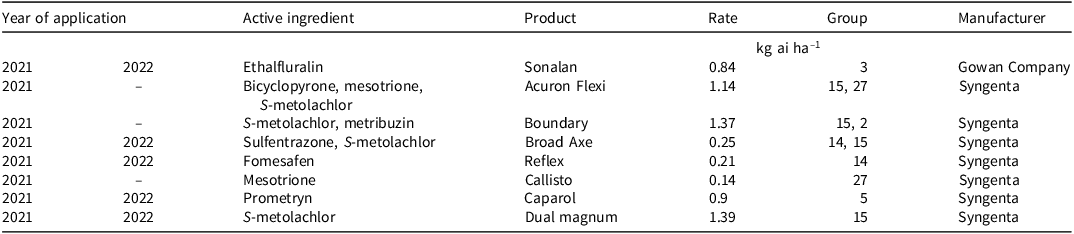
In both years, a split-plot design was set up with two hemp cultivars, ‘Yuma’ and ‘Jinma’, in main plots and soil-residual herbicides in the subplots. Eight soil-residual herbicides with varying modes of action were tested in 2021, and five soil-residual herbicides were tested in 2022 (Table 1). The herbicides tested in this study were widely available and used in previous studies on cotton and corn. The herbicides chosen in 2022 were based on the performance results in 2021. The herbicides that proved highly toxic to hemp plants in 2021 were excluded in 2022. Nontreated control plots were included to make comparisons. The experimental units were replicated three times, accounting for 54 plots in 2021 and 36 in 2022, respectively. The plot size was 6 m in length and 4 m in width; each plot had four rows. An alley space of 1.5 m was maintained to separate plots throughout the row length. Herbicides were applied immediately after planting using a CO2-pressurized handheld sprayer with a no. 4 nozzle (TeeJet XR11002-VS) on 46-cm spacing.
Herbicides tested in industrial hemp in 2021 and 2022 at Quaker Research Farm, Texas Tech University, Lubbock, TX
Data Collection
Hemp germination was recorded 7 d after planting (DAP) in both years based on a scale of 0 (no weed control or hemp injury) to 100 (complete weed control or hemp death). The hemp germination percentage was calculated using the number of germinated seeds over the total number of seeds planted in a plot multiplied by 100. Weed density at 30 and 60 DAP was recorded by counting all the weeds in the 0.50-m2 quadrat in both years. The quadrat was randomly placed at four locations in each plot, and all the weeds were counted.
The hemp stand count was determined at 30 DAP by counting live hemp plants in a 1-m2 area in each plot in both years. Hemp plant height was recorded at 30 DAP and before harvest (100 DAP) in 2021 and at 60 DAP and before harvest (100 DAP) in 2022, respectively, using a marked ruler scale to record the growth progress of the plants. Aboveground dry hemp biomass yield was calculated by harvesting 1 m2 aboveground biomass area per plot using secateurs. The biomass was dried at 60 C for 48 h in an oven and then weighed on a calibrated scale.
Statistical Analysis
The data were analyzed using ANOVA with a split-plot design in R-studio version 3.5.2 using Agricolae package version 1.2-8 (De Mendiburu Reference De Mendiburu2017) Data analysis was done separately for both years because some herbicides were used in 2021 but not in 2022, and the results in the 2-yr study were not similar; hence, data pooling was difficult to conduct. The parameter values in the tables and figures represent the mean values for cultivars and herbicide treatments. The treatment means were compared using the Fisher’s protected LSD test at a significance level of P ≤ 0.05. The mean separation was done only if the treatment had a significant P-value in the ANOVA table. Figures were prepared using OriginPro software version 2018b (Originlab Corp., Northampton, MA).
Results and Discussion
Weather Conditions
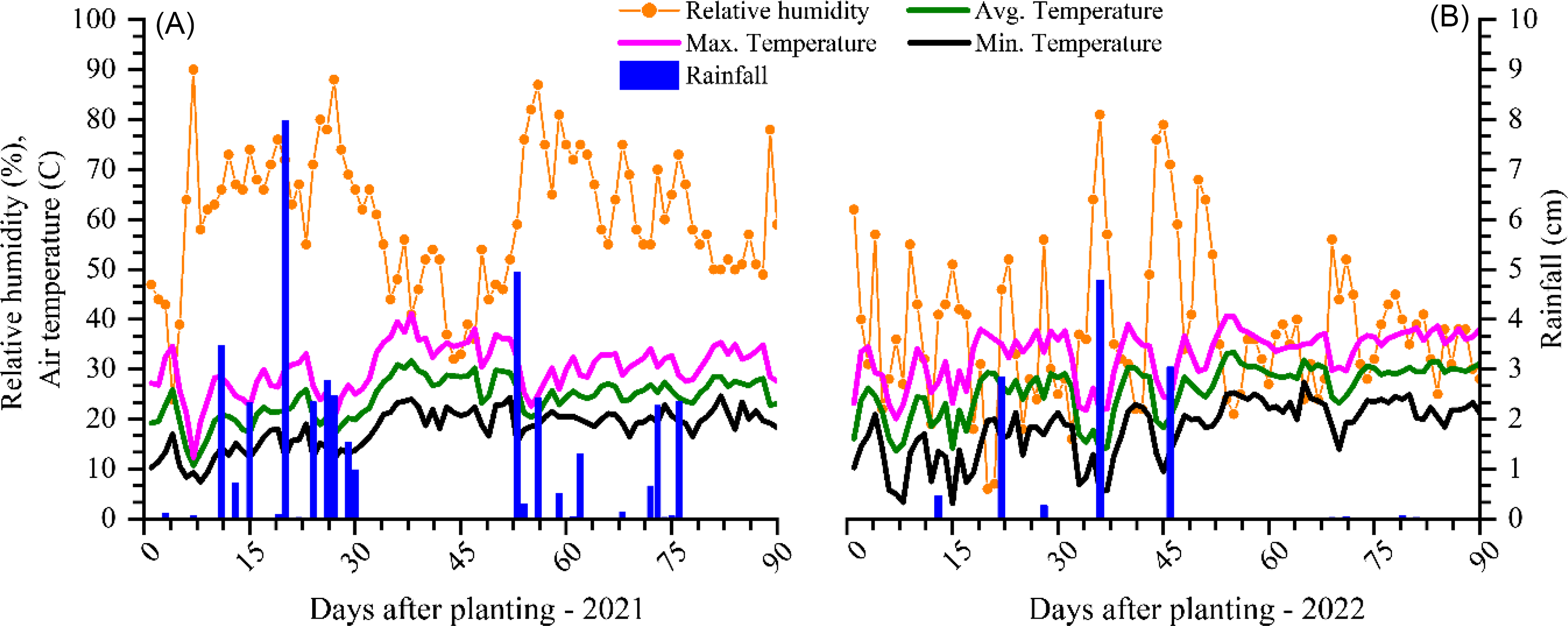
The weather data from on-site weather station included maximum, minimum, and average air temperature, relative humidity, and rainfall events during two growing seasons (Figure 1). The daily average air temperature varied between 10.7 C and 31.8 C in 2021 and between 13.6 C and 33.4 C in 2022. The daily average maximum air temperature ranged between 12.3 C and 41.2 C in 2021 and 20.1 C and 40.7 C in 2022. The daily average minimum air temperature varied between 3.1 C and 27.4 C in 2021 and 7.4 C and 24.6 C in 2022. The daily average relative humidity ranged from 24.2% to 90.3% in 2021 and 6.4% to 81.3% in 2022. The total rainfall received during the 2021 growing season was considerably higher (391 mm) compared to the 2022 growing season (115 mm).
Daily rainfall events, average relative humidity, and minimum, maximum, and average air temperature observed during the growing seasons of 2021 (A) and 2022 (B) at the experimental site in Lubbock, TX.
There was no significant difference between cultivars ‘Yuma’ and ‘Jinma’ on parameters measured in both years. There was no interaction of soil-residual herbicides and cultivars on the parameter measured, and the results are discussed for soil-residual herbicide effects only.
Influence of Soil-Residual Herbicides on Hemp Germination and Stand Count
In 2021, all the soil-residual herbicide treatments had a similar hemp germination percentage compared to the nontreated control (Table 2). However, hemp germination percentage differed significantly for herbicide treatments in 2022. Ethalfluralin had hemp germination (94.2%) success similar to that of the control (92.5%), which was also similar to the mixture of sulfentrazone plus S-metolachlor (85.2%) and S-metolachlor alone (88.3%). However, fomesafen (78.6%) and prometryn (78.3%) herbicides significantly reduced the hemp germination percentage in 2022 relative to the control. A previous greenhouse study on preemergence herbicides also showed a significant reduction in hemp emergence in ethofumesate, acetochlor, and pyroxasulfone treatments compared to nontreated control(Mettler Reference Mettler2021). In another study, S-metolachlor, diuron, linuron, pendimethalin, and acetochlor did not affect hemp emergence and performed similarly to nontreated control (Byrd Reference Byrd2019). All these aforementioned studies were conducted in different environments and soil types. Therefore, it appears that the sensitivity at the germination stage depends on the environment and the soil types to which seeds are exposed (Varga et al. Reference Varga, Iljkić, Tkalec Kojić, Dobreva, Markulj Kulundžić and Antunović2022). Both hemp cultivars had no significant difference in germination in both years. Germination is a complex process that is influenced by various factors, and hence it is difficult to predict the precise impact of herbicides at this stage.
Effect of soil-residual herbicides on hemp germination in 2021 and 2022 at the experimental site in Lubbock, TX a,b
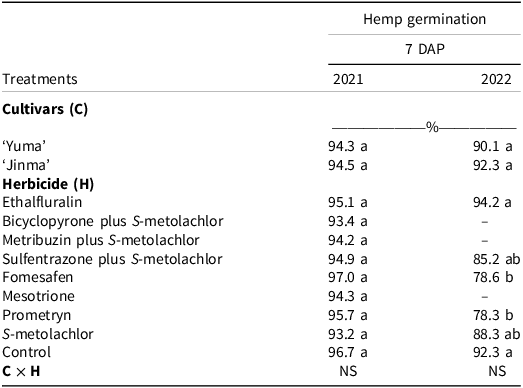
a Mean values followed by different lowercase letters in each column indicate a significant difference in treatments (P ≤ 0.05, Fisher’s protected LSD test).
b Abbreviations: C × H, cultivar and herbicide interactions; NS, nonsignificant.
Similar to germination results, there was no significant difference in hemp stand count for different herbicides and cultivars at 30 DAP in 2021, though three of these herbicide treatments, bicyclopyrone plus S-metolachlor, metribuzin plus S-metolachlor, and mesotrione alone killed hemp plants as a result of toxicity in the early stage, rendering a zero stand count (Table 3). In 2022, there was a significant difference in hemp stand count (Table 3). Ethalfluralin had the highest hemp stand count with 67 plants m–2 and had no toxic effect on hemp plants, and fomesafen’s toxicity to hemp resulted in the lowest stand count, i.e., 46 plants m–2. The nontreated control also had the lowest stand count with 47 plants m–2, possibly due to competition created by weeds left uncontrolled. In 2022, ethalfluralin, sulfentrazone plus S-metolachlor, prometryn, and S-metolachlor alone had 42%, 3.8%, 12.6%, and 11.5% more stand count, respectively, compared to the control. In 2021, a combination of bicyclopyrone plus S-metolachlor, metribuzin plus S-metolachlor, and mesotrione alone killed hemp plants during the early stage, showing their toxic effect on the hemp crop. A previous study by Byrd (Reference Byrd2019) showed that metribuzin significantly reduced the number of hemp plants; however, S-metolachlor did not reduce the number of plants significantly compared to the nontreated check.
Effect of soil-residual herbicides on hemp stand count in 2021 and 2022 at the experimental site in Lubbock, TX a,b
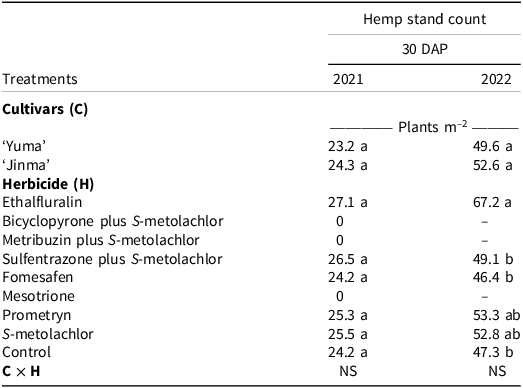
a Mean values followed by different lowercase letters in each column indicate a significant difference in treatments (P ≤ 0.05, Fisher’s protected LSD test).
b Abbreviations: C × H, cultivar and herbicide interactions; NS, nonsignificant. Zeros were excluded during the analysis.
Another study by Mettler (Reference Mettler2021) revealed a complete loss of hemp plants under metribuzin herbicide treatments 25 d after emergence. Mesotrione also significantly reduced the hemp stand by 80%, whereas S-metachlor alone only reduced the stand count by 12% (Mettler Reference Mettler2021). Taking the above references into account, the complete loss of plants in our experiment with the combination of bicyclopyrone plus S-metolachlor and metribuzin plus S-metolachlor was a result of the herbicides’ toxicity on the hemp. This also suggests that S-metolachlor alone did not kill plants, as indicated in Table 3. Most of the herbicides promoted higher stand count compared to the control by reducing crop–weed competition for space, light, moisture, and nutrients during the early stage of the crops. Ethalfluralin, prometryn, and S-metolachlor had the highest plant stand count and exerted no toxicity on hemp plants. Therefore, these herbicides could be used in hemp. In China, Amaducci et al. (2014) suggested the use of 65% metolachlor emulsion (3 L ha–1) or 30% pendimethalin EC (3 L ha–1) as an enclosed treatment for hemp plants in Heilongjiang Province.
Similarly, Liu et al. (Reference Liu, Bai, Cai, Bai and Zhou2010) recommended 96% metolachlor EC at a rate of 1,050 mL ha–1 or 50% acetochlor EC at a rate of 750 mL ha–1 in hemp fields in Hunan Province. These herbicides are comparatively safer for hemp plants because of their formulation and selective reactivity to the weeds rather than the hemp plants.
Effect of Soil-Residual Herbicides on Hemp Plant Height and Biomass
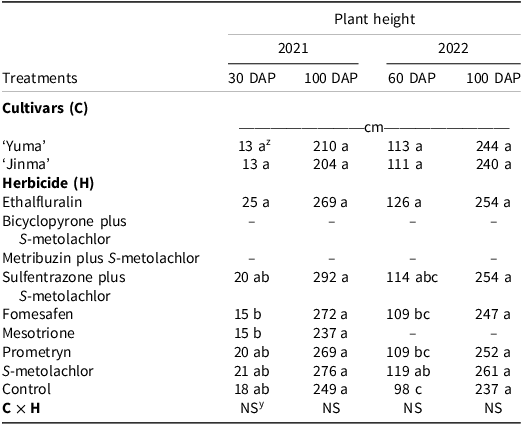
The plant height results in 2021 and 2022 suggest that few soil-residual herbicides reduced plant height during early–mid growth stages (Table 4). However, soil-residual herbicides did not affect the plant height at harvest during both the growing seasons. In 2021, fomesafen and mesotrione herbicides significantly reduced plant height at 30 DAP compared to ethalfluralin. In 2022, the plant height was significantly reduced in the nontreated control compared to soil-residual herbicide treatments such as ethalfluralin and S-metachlor at 60 DAP. Also, fomesafen and prometryn significantly reduced the hemp height at 60 DAP in 2022. However, there was no significant difference in the plant height of hemp among soil-residual herbicides and nontreated control at harvest in both years. Some herbicides had a toxic effect on plants in the early stage, affecting plant height. However, plants recovered later from the herbicide toxicity, and no difference in plant height was observed at harvest. Although the information related to the effect of soil-residual herbicides on plant height of hemp grown under semi-arid conditions is minimal, comparable results have been reported in other preemergence herbicide studies in hemp. Anderson (Reference Anderson2018) applied pendimethalin as a preemergence herbicide with 1.12 kg ai ha–1 and reported no effect on hemp plant height at harvest. Pendimethalin application negatively affected the plant height during early growth stages, but the hemp overcame these effects in the later growth stages.
Effect of soil-residual herbicides on hemp plant height in 2021 and 2022 at the experimental site in Lubbock, TX
z Mean values followed by different lowercase letters in each column indicate a significant difference in treatments (P ≤ 0.05, Fisher’s protected LSD test).
y Abbreviations: C × H, cultivar and herbicide interactions; NS, nonsignificant.
Similarly, pendimethalin resulted in 10% to 20% injury to hemp plants (cv. ‘Finola’) without affecting the plant height and seed yield (Maxwell Reference Maxwell2016). In another field study, Flessner et al. (Reference Flessner, Bryd, Bamber and Fike2020) found that using flumioxazin, sulfentrazone, linuron, acetochlor, diuron, pendimethalin, fomesafen, and dimethenamid-P as preemergence herbicides did not reduce the hemp (cv. ‘Felina 32’) plant height compared to the nontreated control. However, in the same experiment, preemergence herbicides pyroxasulfone, metribuzin, chlorimuron, norflurazon, S-metolachlor, and clomazone reduced hemp plant height by 45% to 82% compared to the nontreated control (Flessner et al. Reference Flessner, Bryd, Bamber and Fike2020). The difference or similarity in herbicide effect on plants depends upon their mode of action belonging to different groups. Pendimethalin and ethalfluralin belong to the same group, whereas acetachlor, dimethenamid, pyroxasulfone, and metolachlor belong to another group. The herbicides sulfentrazone and fomesafen used in our experiment belong to the same group as flumioxazin. Metribuzin and chlorimuron are another group of herbicides with similar modes of action. The average plant height of ‘Yuma’ and ‘Jinma’ was statistically similar after all soil-residual herbicide treatments. However, the ‘Yuma’ plants were taller than the ‘Jinma’ throughout the growing season during both years.
Hemp biomass for both years is presented in Figure 2. In 2021, mesotrione significantly reduced hemp biomass compared to all other herbicidal treatments and produced 19.0% less hemp biomass than the nontreated control. Hemp biomass was 40.3% greater after ethalfluralin treatment than in the nontreated control, but the hemp biomass was statistically similar to the nontreated control. Sulfentrazone plus S-metolachlor, S-metolachlor, prometryn, and fomesafen produced 26.2%, 20.0%, 14.3%, and 7.6%, respectively, greater hemp biomass than the nontreated control; yet no significant difference was observed among these treatments. In year 2022, hemp treated with ethalfluralin, S-metolachlor, sulfentrazone plus S-metolachlor, fomesafen, and prometryn showed 12.1%, 12.6%, 14.8%, 42.3%, and 36.1%, respectively, higher biomass yield than the control; however, no significant difference was observed among these treatments. Minimal phytotoxicity in these treatments likely resulted in greater hemp biomass. In previous studies, Maxwell (Reference Maxwell2016) found that applying preemergence herbicides, including fomesafen and flazasulfuron, resulted in less phototoxicity and greater hemp biomass than mesotrione plus trifloxysulfuron. In a greenhouse experiment, Flessner et al. (Reference Flessner, Bryd, Bamber and Fike2020) reported that metribuzin, clomazone, fomesafen, norflurazon, and pyroxasulfone reduced plant height and stand count and resulted in 70% to 95% hemp biomass reduction compared to nontreated control. Other preemergence herbicides, including pendimethalin, flumioxazin, and sulfentrazone, resulted in 30% to 60% hemp biomass reduction compared to the nontreated control (Flessner et al. Reference Flessner, Bryd, Bamber and Fike2020).
Effect of soil-residual herbicides on hemp biomass in 2021 and 2022 at the experimental site in Lubbock, TX. Bars with different lowercase and uppercase letters indicate a significant difference among treatments in 2021 and 2022, respectively (P ≤ 0.05, Fisher’s protected LSD test).

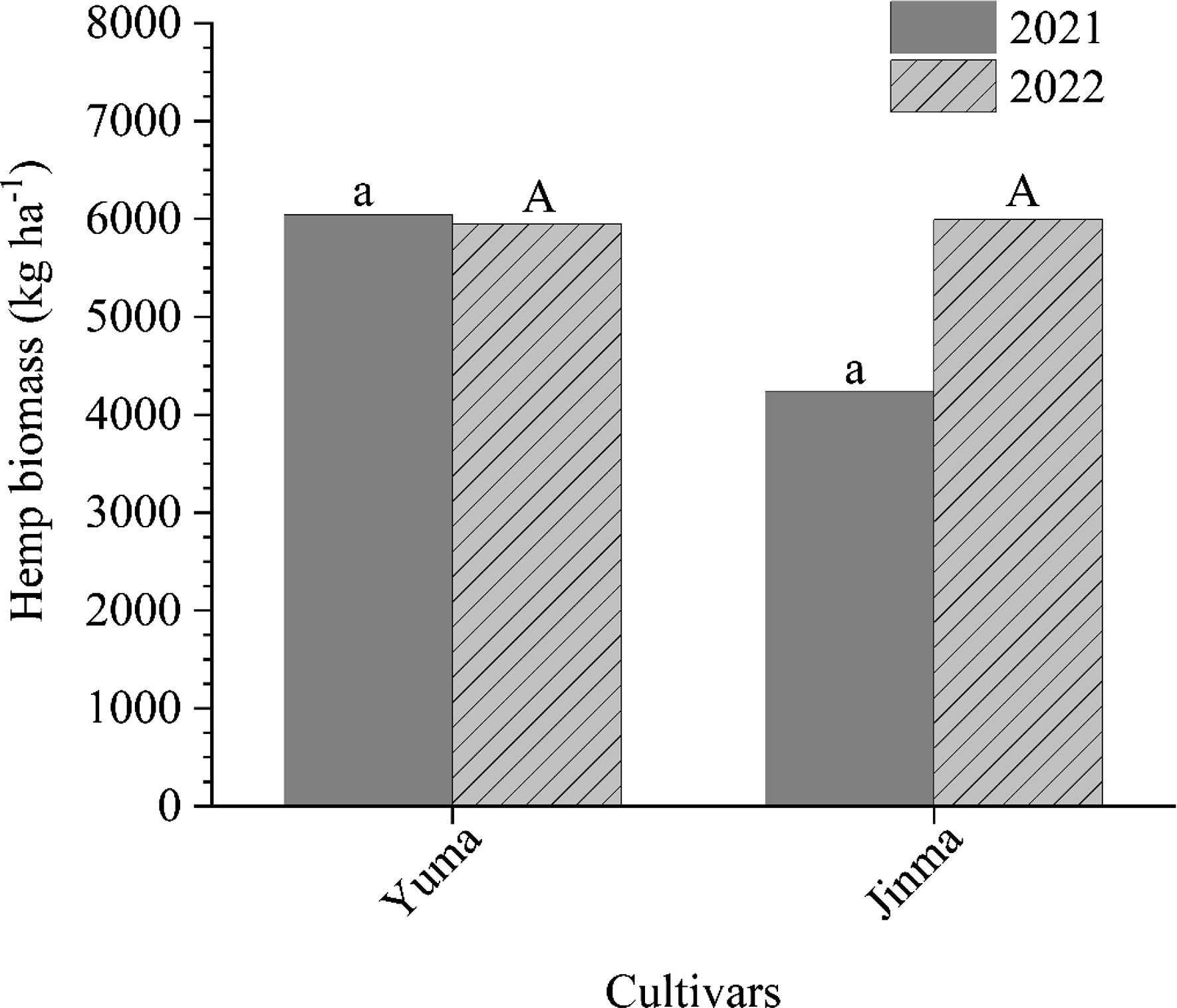
Different hemp cultivars, ‘Yuma’ and ‘Jinma’, showed no significant differences in hemp biomass yield (Figure 3). However, ‘Yuma’ displayed greater biomass yields than ‘Jinma’ in 2021 and 2022. Our results are somewhat in line with previous studies, where Ortmeier-Clarke et al. (Reference Ortmeier-Clarke, Oliveira, Arneson, Conley and Werle2022) did not find any significant difference among cultivars while screening two hemp cultivars for tolerance to 44 different preemergence and postemergence herbicides under controlled conditions. Another preemergence herbicide, pendimethalin, has been used in several hemp cultivars and reported to be a safe preemergence herbicide (Flessner et al. Reference Flessner, Bryd, Bamber and Fike2020; Maxwell Reference Maxwell2016, Ortmeier-Clarke et al. Reference Ortmeier-Clarke, Oliveira, Arneson, Conley and Werle2022), and it has been recommended for hemp weed control in China (Amaducci et al. Reference Amaducci, Scordia, Liu, Zhang, Guo, Testa and Cosentino2015). Depending on the hemp cultivar, clopyralid, 2,4-D, and flumioxazin resulted in biomass reduction of 30% to 60%, 50% to 80%, and 70% to 85%, respectively, compared to untreated control (Ortmeier-Clarke et al. Reference Ortmeier-Clarke, Oliveira, Arneson, Conley and Werle2022).
Effect of soil-residual herbicides on hemp cultivars in 2021 and 2022 at the experimental site in Lubbock, TX. Bars with different lowercase and uppercase letters indicate a significant difference among treatments in 2021 and 2022, respectively (P ≤ 0.05, LSD test).
Efficacy of Soil-Residual Herbicides on Weeds in Hemp
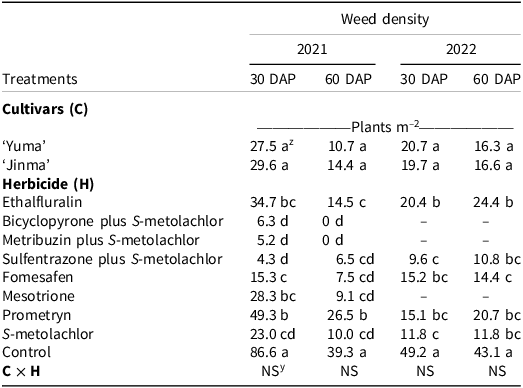
The nontreated control had the highest weed counts compared to other herbicide treatments at 30 DAP and 60 DAP in both years (Table 5). In 2021, bicyclopyrone plus S-metolachlor, metribuzin plus S-metolachlor, and sulfentrazone plus S-metolachlor had the lowest weed counts at 30 DAP, whereas bicyclopyrone plus S-metolachlor and metribuzin plus S-metolachlor recorded the lowest weed counts at 60 DAP. The weed counts were reduced by 60%, 93%, 94%, 95%, 82%, 67%, 43%, and 73% at 30 DAP and by 63%, 100%, 100%, 83%, 81%, 77%, 32%, 74% at 60 DAP with ethalfluralin, bicyclopyrone plus S-metolachlor, metribuzin plus S-metolachlor, sulfentrazone plus S-metolachlor, fomesafen, mesotrione, prometryn, and S-metolachlor, respectively, in the year 2021 as compared to the control. In 2022, the mixture of sulfentrazone plus S-metolachlor, and S-metolachlor alone had the lowest weed counts at 30 DAP, whereas fomesafen had the lowest weed counts at 60 DAP. The weed counts were reduced by 58%, 80%, 69%, 69%, and 76% at 30 DAP, and by 43%, 75%, 67%, 52%, and 73% at 60 DAP with ethalfluralin, sulfentrazone plus S-metolachlor, fomesafen, prometryn, and S-metolachlor, respectively, in the year 2022 as compared to nontreated control. However, the combination of bicyclopyrone plus S-metolachlor, as well as metribuzin plus S-metolachlor provided maximum weed control at 30 DAP. This combination also caused a total loss of hemp plants due to toxicity.
Effect of soil-residual herbicides on hemp weed count in 2021 and 2022 at the experimental site in Lubbock, TX
z Mean values followed by different lowercase letters in each column indicate a significant difference in treatments (P ≤ 0.05, Fisher’s protected LSD test).
y Abbreviations: C × H, cultivar and herbicide interactions; NS, nonsignificant.
In previous studies, Byrd (Reference Byrd2019) and Mettler (Reference Mettler2021) also found a significant loss of hemp plants due to herbicide toxicity. Similarly, in the current study, mesotrione provided reasonable control of weeds (data not shown) but was very toxic to hemp plants and killed 70% of plants (Table 3). Mettler (Reference Mettler2021) also revealed the toxic nature of mesotrione for hemp crop. This indicates that these three herbicides are toxic to hemp plants and unsafe for hemp production. In both years, the mixture of sulfentrazone plus S-metolachlor, S-metolachlor, ethalfluralin, and prometryn, significantly reduced weeds compared to the nontreated control at 30 DAP (Table 5). All these herbicides were also very safe on hemp plants and can be considered one of the safest soil-residual herbicides on hemp. These results align with the recommendation in China (Amaducci et al. Reference Amaducci, Scordia, Liu, Zhang, Guo, Testa and Cosentino2015; Flessner et al. Reference Flessner, Bryd, Bamber and Fike2020). In both years, there was no significant difference in weed count between cultivars at both observation dates (30 DAP and 60 DAP).
Practical Implications
Weed management in industrial hemp faces significant challenges because of a lack of approved herbicides. Weed researchers throughout the United States are actively exploring herbicides that can be used in industrial hemp. Results indicate that some soil-residual herbicides worked very well with hemp, and few other herbicides showed toxicity on hemp plants and should not be used in industrial hemp. Bicyclopyrone plus S-metolachlor, metribuzin plus S-metolachlor, and mesotrione should be avoided in industrial hemp because of significant injury to hemp plants. However, soil-residual herbicides, ethalfluralin, sulfentrazone plus S-metolachlor, prometryn, and S-metolachlor appear suitable for hemp production and should be considered for further investigation.
Furthermore, these herbicides provided reasonable early weed control, and later, hemp canopy suppressed weeds, resulting in higher hemp biomass yield. Future research is needed to find the most promising preemergence and postemergence herbicides that can be used in hemp production under different climatic conditions. Also, the delta-9-tetrahydrocannabinol fiber and seed content following the herbicide application were not included in this study, which could be a viable area for future study that may bring another perspective to the safety of these herbicides in hemp.
Acknowledgments
We would like to acknowledge the necessary support provided by the Department of Plant and Soil Science, Texas Tech University. The authors are thankful to the farm crew at the Quaker farm and graduate student Preetaman Bajwa for their assistance in this study. We also thank Monti Vandiver from Syngenta and Kevin Harris from Gowan Company for providing herbicides for the research trials.
No conflicts of interest have been declared.


 Open access

