

Introduction
As scores of scholarship have examined the relationship between Muslim minorities and the state in Europe following 9/11, growing attention has been paid to the civic and political roles mosques can play in the lives of their attendees (Oskooii and Dana, Reference Oskooii and Dana2018; Westfall, Reference Westfall2019). This political focus has been shown to be well-merited: researchers in both Europe and the United States have demonstrated how mosques can combat radicalization, reduce feelings of alienation, and boost political participation among attendees (Jamal, Reference Jamal2005; Fleischmann et al., Reference Fleischmann, Martinovic and Böhm2016). Conversely, mosques have also been spaces of contention, around which issues of spatial and political conflicts are negotiated (Cesari, Reference Cesari2005; Lundsteen, Reference Lundsteen2020). Yet, even as mosques’ disparate political functions have been well-documented, mosque leadership, the individuals most directly navigating these roles, remain understudied as political actors.
This omission is particularly glaring when one considers that mosque leaders often serve as intermediaries between their communities and the “Janus-face of bureaucratic incorporation” (Sunier, Reference Sunier2022). State authorities now serve as an increasingly unpredictable regulatory partner, particularly at the local level, where officials may selectively implement national mandates based on varying local political pressures. In several cases, for example, federal governments have sought to incorporate mosques into regulatory frameworks by offering material incentives in exchange for cooperation. The implementation of these mandates, however, has varied widely across subnational jurisdictions, with local governments in some cases delaying or diluting these efforts (Laurence, Reference Laurence2012). Furthermore, even when benefits have been offered, reactions to them have been mixed; some Muslim leaders have accepted the purported olive branch and entered into collaborative relationships with the state, while others have shunned state-led efforts and left substantial material benefits on the table.
The purpose of this paper, then, is to answer several key questions on the regulation of mosques at the local level, with Belgium’s regions serving as subnational case studies: first, what explains why subnational governments differ across space and time in their implementation of shared regulatory mandates? Moreover, how and why do Muslim leaders decide whether to formalize relations with local governments? What explains why they reach different decisions across and within subnational territories? In answering these questions, this paper makes two key interventions. First, I propose a theoretical framework that accounts for both the decision-making of local officials and the political behavior of religious elites, without assuming either set of actors remains static in response to the other. Second, I foreground Muslim leaders as political actors, an understudied group in the literature on Islam in Europe, and highlight the various ways they negotiate with state authorities in a fraught political landscape.
I propose a dyadic theory that conceptualizes regulatory outcomes as driven by how local authorities and Muslim leaders seek to “speak” to distinct audiences. In a contentious political environment, I argue that mosque leaders act to protect the reputation of their institutions before the general public, i.e., to minimize the audience costs they face from the non-Muslim majority. The best strategy for doing so, however, depends on the partisanship of the local officials they face and how national policies are implemented subnationally. These practices can be categorized along a spectrum from cooperative to combative, reflecting how state actors enforce regulations to appeal to their core voters. In cooperative contexts, typically led by left-wing officials, mosque leaders engage with regulatory frameworks, viewing the state as a source of legitimacy and reputational protection; under this condition, a mosque’s access to external resources can be put towards facilitating its relations with the state. In combative contexts associated with right-wing partisans, mosque leaders avoid hostile officials in order to protect their institutional autonomy; here, any external resources will be simply put towards bypassing the state altogether. Taken in tandem, local partisanship and mosque leaders’ reputational concerns explain why state-mosque relations diverge across subnational contexts.
I develop and test my theory using Belgium’s regions as subnational cases. Belgium is uniquely well-suited for this analysis due to the degree to which it has atomized its regulatory framework. Each individual Belgian mosque bears the responsibility of initiating “official recognition” proceedings with its regional government, which allows for comparison of mosque behavior across and within regions. Comparing Flanders, Wallonia & the Brussels-Capital region sheds light on how subnational governments can differ in implementing shared federal mandates. Looking within each region further illustrates how Muslim leaders can differ in deciding whether or not to cooperate with government-led initiatives, even when facing the same government unit. Furthermore, Belgian recognition has received very limited scholarly attention, and there exist virtually no studies that compare recognition outcomes across regional territories. This study is an attempt to fill that gap.
The theory generates clear empirical expectations in the Belgian subnational cases. I expect mosque recognition rates to be higher where local governments are led by left-wing parties and lower under right-wing leadership, given the electoral incentives each face. Partisanship differences should also translate into different regulatory practices, which I categorize as ranging from combative to cooperative in nature. I also anticipate that mosque leaders are not simply reacting to the material incentives of recognition, but are acutely attuned to reputational pressures and the political signals their decisions send; therefore, material inputs should not be sufficient to explain mosque behavior. Instead, I hypothesize that diaspora networks—which dictate a mosque’s access to external resources—can either enable collaboration with the state by providing informational support, or substitute the state altogether by offering material alternatives. Which role they play will depend on the partisanship of local officials and the regulatory practices mosque leaders face.
These expectations are tested using a mixed methods approach that offers a granular look at state-mosque relations in Belgium. I combine original mosque-level observational data with 52 semi-structured interviews conducted over a ten-month fieldwork period across Belgium’s three regions. The mosque data allow for a descriptive mapping of recognition outcomes across and within each region, while the interviews shed light on the complex interplay of state officials and religious leadership within a contentious regulatory landscape. By foregrounding voices from both sides of the regulatory relationship, the paper provides a grounded account of how local political dynamics shape religious governance in practice. The findings demonstrate that political partisanship shapes both regulatory practices and mosque leaders’ responses to the state in line with the predictions of the theoretical framework.
This article makes both descriptive and theoretical contributions. Methodologically, I arrive at and propose multiple ways to collect mosque-level data and to code mosque-level variables such as ethnic and religious belonging; this allows for comparisons of Muslim sub-groups across theoretically informed axes. Theoretically, I follow scholars who have written on securitization discourses surrounding Muslims and their institutions in Europe by exploring the ramifications of securitization on the political behavior of religious elites (Cesari, Reference Cesari2009; Fox and Akbaba, Reference Fox and Akbaba2015). Furthermore, I show how regulatory policies, even if nominally bureaucratic in nature, can become a political buffer for religious leaders, a tool to extract concessions for minority groups, and a way to co-opt voters and engage in patronage politics for the state. In so doing, I speak to a growing scholarship on the political behavior of Muslim leadership in Europe (Gould, Reference Gould2009; Koehrsen, Reference Koehrsen2021), and to wider literatures on the incorporation of minority groups (Brubaker, Reference Brubaker1992; Dancygier, Reference Dancygier2017) and local governance (Andrew and Goldsmith, Reference Andrew and Goldsmith1998; Gibson, Reference Gibson2013).
State-Mosque relations at the local level in Western Europe
The literature on the regulation of Islam in Europe has often taken the state as its starting point, developing models of national behavior or typologies of regime types to explain cross-national differences in governance (Rath et al., Reference Rath, Penninx, Groenendijk and Meyer2001; Ferrari, Reference Ferrari2002; Fetzer and Soper, Reference Fetzer and Soper2005; Koenig, Reference Koenig2005; Loobuyck et al., Reference Loobuyck, Debeer and Meier2013). Scholars such as Minkenberg (Reference Minkenberg2008) and Carol and Koopmans (Reference Carol and Koopmans2013) show how church-based governance frameworks are repurposed—sometimes stably, sometimes not—toward Muslim communities, while others point to Europe’s historical entanglements with Muslim populations and states to explain how Islam is governed as a minority issue today (Greble, Reference Greble2021). Yet, as Ireland (Reference Ireland2004) and others note, understanding subnational variation is critical, since the implementation of national mandates often relies on local discretionary power. Subnational actors may conform to or depart from national models, producing local frameworks that deviate markedly from national policy (Aguilar, Reference Aguilar2018). In cities like Lyon and Chicago, for example, local authorities have subverted or evaded national laws in their regulation of mosque communities (Maussen et al., Reference Maussen2009; Schnabel, Reference Schnabel2023), prompting scholars like Müller (Reference Müller2020) to call for conceptualizing state-religion relations across multiple spatial dimensions.
These state-focused approaches to the regulation of mosque-communities, diverse as they are, still remain limited insofar as they treat Muslim communities and their leadership as passive political units; even more problematic is assuming that Muslim groups are simply weary of foreign, “Christian-heritage” regimes, and thus, missing the range of responses they can have to the state. Consequently, a second, smaller line of research, primarily emerging from sociological and anthropological disciplines, has begun to center on Muslim institutions and communities to explain the incorporation of religious organizations (Dwyer and Meyer, Reference Dwyer and Meyer1995; Soysal, Reference Soysal1997; Bowen, Reference Bowen2004; Peach and Vertovec, Reference Peach and Vertovec2016). This shift in focus onto communities has emerged as Muslims, as a minority group, increasingly gain citizenship and become consequential actors in the electoral arena (Dancygier, Reference Dancygier2017; Aktürk and Katliarou, Reference Aktürk and Katliarou2021).
Muslim leadership, however, which plays a significant role in the lives of Europe’s most religiously active sub-group, remains an understudied caste of political agents (Hashas et al., Reference Hashas, de Ruiter and Vinding2018). Scholarship on this group remains nascent, and the studies that do focus on religious leaders often examine their ties to homeland governments or transnational political movements, rather than to the inputs made by their local environments.
Many European mosques don’t exist as stand-alone institutions, but are instead embedded in national and transnational networks that connect them to mosques across Europe or, often controversially, to homeland governments. When religious leadership has been studied in the literature, it is often been in relation to their involvement with diaspora networks and transnational politics (Sunier et al., Reference Sunier, van der Linden and van de Bovenkamp2016; Öztürk and Sözeri, Reference Öztürk and Sözeri2018; Rudolph, Reference Rudolph2018). Turkish networks have received particular attention because they are considered to be more “institutionally robust”, as scholars throughout Europe find “an overall pattern of tighter Turkish community cohesion and its organization around mosques as institutions of community service” (Lesthaeghe, Reference Lesthaeghe1997; Asri and Fadil, Reference Asri, Fadil and Cesari2014). Turkish mosques often have intricate links with Turkish institutions or the Turkish government itself, which provide funding, personnel, and training to diaspora mosques, and these resources have been increasing sharply over the past decade (Sunier and Landman, Reference Sunier and Landman2014; Öztürk and Sözeri, Reference Öztürk and Sözeri2018).
Regarding relations with the state, scholars find mixed results on the effect diaspora networks have on mosque behavior. For instance, Pfaff and Gill (Reference Pfaff and Gill2006) posit that religious leaders may keep a distance from state actors in order to avoid “accusations against sellouts,” while Sunier et al. (Reference Sunier, van der Linden and van de Bovenkamp2016) conclude that diaspora networks “foster processes of disengagement from the state” as religious leaders choose to maintain ties with homeland governments instead. In other contexts, however, diaspora networks have been shown to welcome state overtures; Turkish umbrella organizations have, albeit inconsistently, cooperated with state efforts to build a representative Muslim council in France, and have opted into imam training programs in the Netherlands (Arkilic, Reference Arkilic2015; Sözeri et al., Reference Sözeri, Altinyelken and Volman2019). At times, state bodies themselves have preferred to cooperate with Turkish networks under the assumption that they propagate a more moderate version of Islam (Sunier and Landman, Reference Sunier and Landman2014). This paper’s theoretical framework centers on mosque leaders and their relationship with local partisans; as will become clear, however, the theory also has direct implications for understanding the role of diaspora networks in local contexts, and thus offers a lens through which to make sense of the mixed and divergent findings in the existing literature.
I seek to address both the well-developed literature on subnational state governance as well as the nascent scholarship on the political behavior of religious leadership by examining the recognition of mosque-communities in Belgium. This nominally bureaucratic regulatory framework is, as I will show, an excellent lens through which to examine the contentious politics involved in state-mosque relations at the elite level, both because it necessitates buy-in from state officials and religious leadership, and because it involves a widely visible marker of state approval for mosque-communities.
A dyadic theory of regulatory outcomes
In cases such as Belgium, mosque regulation requires a commitment to collaboration from local officials and religious elites, both of whom respond to several determinants. I thus propose a theoretical framework that conceptualizes regulatory outcomes as the product of iterative interactions between both sets of actors. The explanatory variables at the center of this framework are the partisan preferences of local officials on the one hand, and the reputational considerations of mosque leadership on the other.
In a highly contentious political context, both local officials and religious leaders care about what their decisions signal to particular audiences. For local officials, regulation can be used to communicate the party’s stance towards Muslims as a minority group to its core voters. Religious leaders, on the other hand, often care about how their decisions are perceived by the non-Muslim majority.
Given the discretionary capacity available to local officials, I argue that partisanship and party competition play a determining role in how regulatory policies are implemented. When the party is on the right, the decision to engage with Muslim institutions carries political risks and the possibility of voter disapproval: it signals to the party’s electorate a willingness to accommodate a disliked out-group (Hafez, Reference Hafez2014). This cost is heightened when regulation is highly visible and brings material benefits. Left-leaning parties, however, do not face the same cost, and in many cases, including Belgium, they have instead been shown to court minority votes (Zibouh, Reference Zibouh2012; Dancygier, Reference Dancygier2017; Ciornei et al., Reference Ciornei, Euchner and Yesil2022). Therefore, for these parties, regulation can become a part of a larger electoral strategy aimed at building trust with Muslim elites and, ultimately, gaining access to their communities as potential voters.
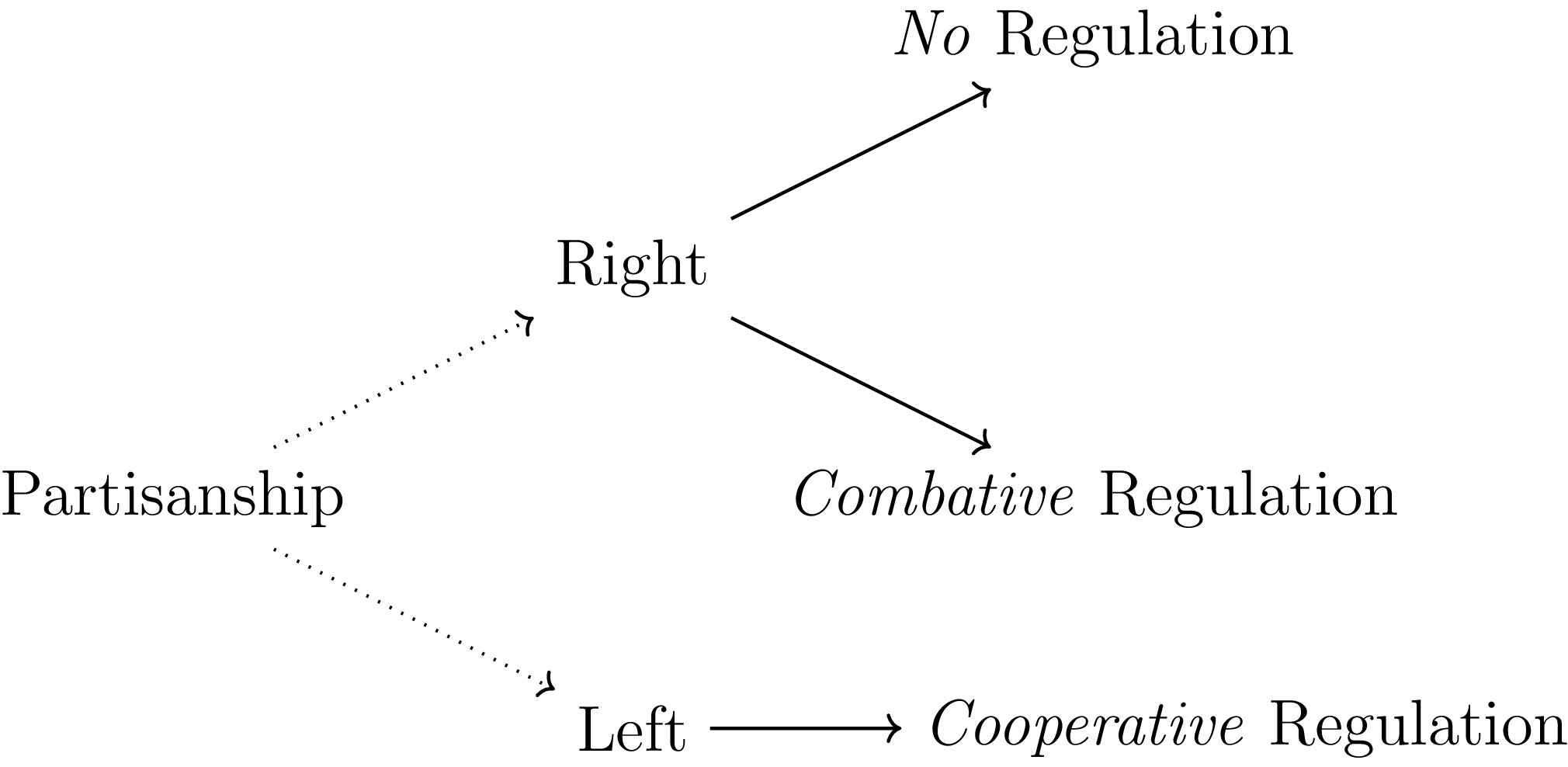
As Figure 1 demonstrates, the effect of this partisanship asymmetry on regulatory practices is twofold: first, it determines whether local officials want to engage with Muslim communities or not. Scholarship on regulation often begins with the assumption that the state wants to bring religious communities into the bureaucratic fold, before speaking to whether or not it successfully does so. However, I find that if the goal is to appeal to a sufficiently right-wing electorate, local officials may benefit from an unregulated model (No regulation) that involves little to no collaboration with mosque-communities; under these conditions, engagement may remain limited due to a lack of political will.
How subnational governments implement regulatory frameworks.

Second, even when states do decide to regulate religious communities, partisan preferences shape the nature of regulation itself. I develop a typology of regulation and argue that right-wing parties are more likely to implement combative regulation policies. Combative regulation involves higher demands on Muslim communities and imposes greater limits on the autonomy of their institutions. Even when material benefits are provided, the focus of combative regulation is on control and constraint. For left-leaning parties, however, regulation can be used as a tool to build trust with local Muslim communities and, ultimately, win over their electoral support. Here, a cooperative regulation emerges, wherein parties dismantle the constraining elements of regulation and instead use regulatory policy to create open channels of dialog with religious elites.
Muslim religious leaders respond accordingly to these state-sided dynamics. When deciding whether or not to collaborate with the state, I argue that religious elites act based on audience costs as a primary motivation. As is well-known to scholars and policymakers alike, many mosques are well-equipped to replace state aid and do not depend on regulatory frameworks for their material benefits (Klausen, Reference Klausen2005; Messner, Reference Messner2016). Instead, religious leaders are motivated by the audience costs of ignoring state aid, and the suspicion they may receive following that decision. In this case, the “audience” in question is state officials and the majority population themselves.
Audience costs are particularly undertheorized by the religion and migration literatures. Instead, the concept is prevalent in international relations as well as conflict and security studies, which consider the various ways in which domestic audiences condition the actions of political actors, and from which I borrow the term (Tomz, Reference Tomz2007; Schultz, Reference Schultz2012; Kertzer and Brutger, Reference Kertzer and Brutger2016). It is precisely because of the securitization of Muslim actors and institutions by state policies, and the heightened mediatization and discrimination facing their communities, that I suggest this concept may be useful in understanding the decision-making of Muslim religious elites (Wæver et al., Reference Wæver1993; Cesari, Reference Cesari2009; Fox and Akbaba, Reference Fox and Akbaba2015; Fadil et al., Reference Fadil, Ragazzi and de Koning2019; Orsini et al., Reference Orsini, Smit, Farcy and Merla2022).
In a fraught political context, the discourse surrounding the regulation of Muslim communities is, as Freeman (Reference Freeman2004) characterized it, “unavoidably value-laden.” Ignoring the state and bucking state aid may signal to the general public that a mosque is opaque and untrustworthy, and thus brings a cascade of criticism from policymakers, news outlets, and even academic researchers. Religious leaders are attuned to such criticism and consider the signaling ramifications of their decision-making accordingly. When facing state regulation, religious leaders balance between concerns over working with the state and the audience costs of ignoring state aid.
Before acting, Muslim leaders consider the type of regulation they face. When facing right-wing parties and combative regulation, leaders may decide that the audience costs of ignoring state aid are not worth limiting their institutional autonomy. Here, mosques that benefit from well-developed transnational networks will simply turn to them for material support that replaces the need to work with the state altogether, as some scholars have previously predicted. Mosques that do not benefit from such networks may be forced to work with the state still, since they cannot afford to ignore the material benefits provided.
However, when regulation is cooperative, i.e., when it brings minimal constraint on mosque behavior and in fact offers the mosque new avenues for claims-making, religious leaders may decide to collaborate with the state. In this case, they both benefit from the material benefits of regulation, as well as the positive audience effects of being seen as collaborating with local government. This latter motivation explains why mosques that do not need state aid still decide to apply for it. Under the cooperative condition, mosques turn to their transnational networks not as a way to replace the state, but instead to facilitate negotiations with local governments and render them easier.
An overlooked function of diaspora networks is their informational resource capacity. Beyond the material resources they offer local mosques, which scholars have well-documented, diaspora networks also offer informational support that can, under the right conditions, be put towards easing the bureaucratic burden of negotiating state aid. These resources may involve documents shared within networks, regular meetings between mosques within the same network, or personnel who work between mosques and the state (such as translators). Information can also be shared as a result of the informal ties that emerge between mosques within the same network. Contingent on state partisanship, well-developed transnational networks may foster engagement with the state by disseminating informational resources to mosque leaders who decide to opt into a regulatory framework.
To sum up and combine these different elements, I argue that institutional regulation can either hurt a mosque if it opts into combative regulation (by constraining its behavior) or help it if it faces collaborative regulation (by signaling that a mosque is in the good graces of the state). After gauging the goals of the state and the type of regulation they face, mosque leaders decide whether collaborating with the state is worthwhile. Transnational networks can, therefore, either substitute or complement relations with the state, contingent on local partisanship and the nature of regulation. Table 1 demonstrates this logic.
Types of state-network relations

In this paper, I focus specifically on the top row of Table 1. In the Left-High square, mosques perceive a reduced threat of state control. Here, I expect mosques to be more likely to accept state-led regulation efforts, and to do so primarily for their reputational advantages. Under such a condition, transnational networks can facilitate state-Islam relations by providing informational resources that ease the bureaucratic burden of negotiating state aid. In the Right-High square, however, mosque leaders perceive state threat to be quite high: rather than use networks for their informational resource capacity, I expect mosques to simply rely on them as an exit option to working with the state.
Observable implications
In the substantive sections that follow, the primary dependent variables under study are two simple, binary outcomes: whether Muslim communities seek formal recognition, and whether the state grants it. Therefore, the most straightforward observable implication that follows from my theoretical framework is higher rates of mosque recognition in cases where left-wing partisans govern than in cases where center and far-right actors dominate local politics.
For state actors, I expect variation in partisanship to translate into different regulatory practices. I categorize these practices as ranging from being combative to cooperative. Right-wing actors will be more likely to use combative regulatory practices, and left-wing partisans will use cooperative practices. In both cases, their decision-making should be motivated by electoral reasoning and the relationship between their parties and Muslim groups.
For mosque leaders, the theory begins with the assertion that these actors primarily seek to minimize audience costs and protect institutional reputation. An important implication of this reasoning is that material inputs for mosque-communities, such as whether or not they have access to external resources and non-state funding, should not be sufficient to explain mosque behavior, since religious leaders are conditioning their responses to the state on reputational considerations.
Finally, the theory bears implications for mosques embedded in well-developed diaspora networks. As explained earlier, transnational networks can either substitute relations with the state by offering material alternatives or foster state relations through informational dissemination that eases state negotiations. Which role they play will, in turn, depend on the partisanship of state officials and the regulatory environment they face. Differences in network belonging can help explain the variation in material and informational resources available to mosque communities, the incentives they encounter, and, consequently, why Muslim leaders may act differently even when facing the same government unit.
The case: recognition in Belgium
Belgium is an ideal case to study questions both on subnational policy implementation and Muslim leaders’ strategic behavior. This is due to two reasons: the institutional set-up of recognition, and the high degree of autonomy afforded to regions in implementing that set-up. On the latter front, Belgium is the “quintessential multi-nation state” comprised of three distinct and highly autonomous “regions”: Flanders is the Flemish region, Wallonia is Francophone, and the Brussels-Capital is officially bilingual. The regions have near total discretion over specifying the policy implementation details of shared federal mandates, and this extends to recognizing mosque-communities as well (Torrekens, Reference Torrekens2015; Husson et al., Reference Husson, Mahieu and Sägesser2017).
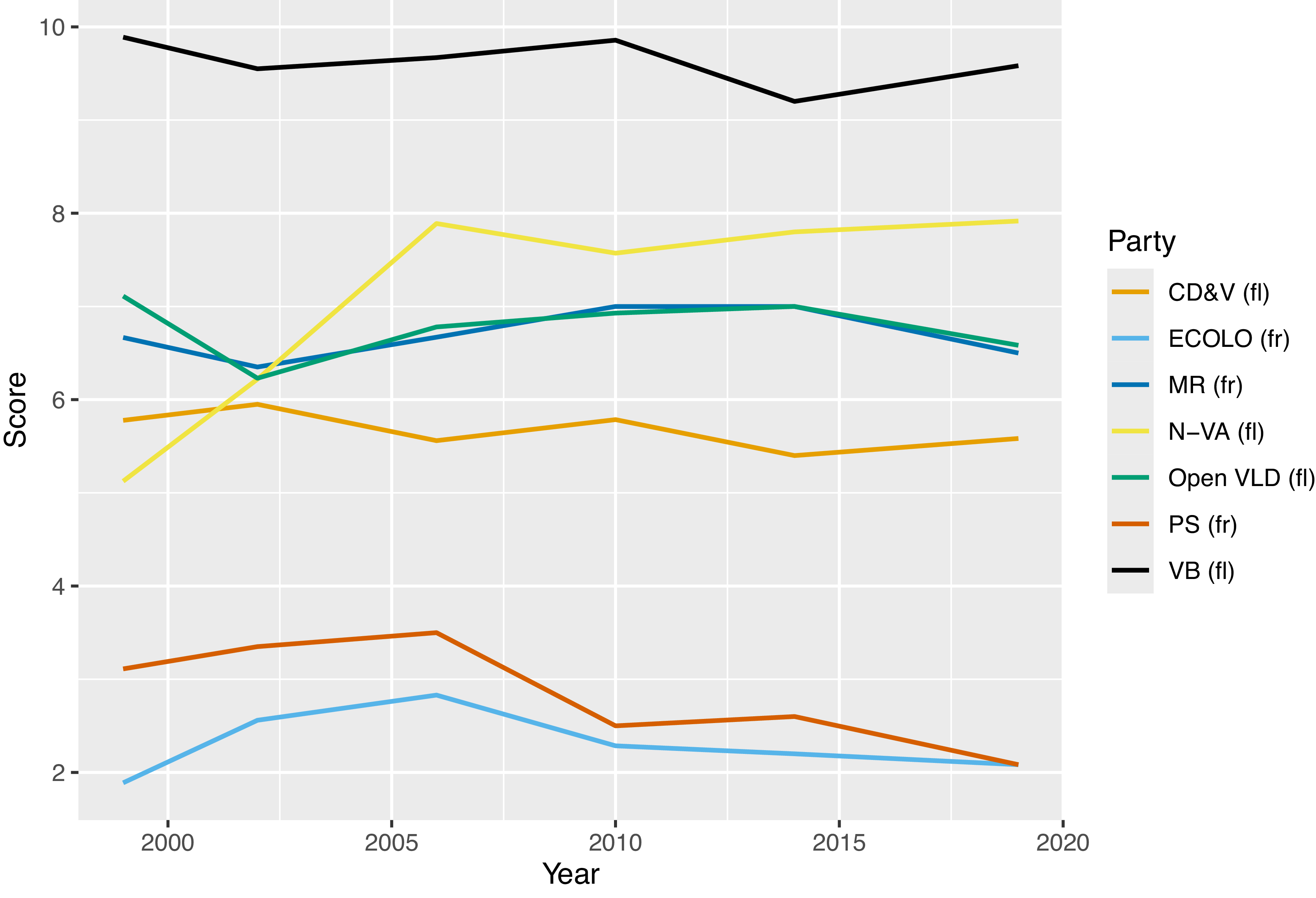
Scholars have long noted the stark and historically persistent divides in partisanship between the Brussels & Walloon regions on the one hand and the Flemish region on the other. Due to a host of structural and contextual factors, right-wing parties have been able to dominate Flemish elections using conservative, separatist, and anti-immigration campaign strategies, whereas Brussels and Walloon seem “immune to such tendencies” (Art, Reference Art2011; de Jonge, Reference de Jonge2021). To capture in more detail the partisan differences between Flemish and Francophone partisans, I present a partisanship score of the major political parties in Belgium in Figure 1. The score is sourced from the widely-cited Chapel Hill Expert Survey (CHES) (Bakker et al., Reference Bakker, De Vries, Edwards, Hooghe, Jolly, Marks, Polk, Rovny, Steenbergen and Vachudova2015).Footnote 1 The survey asks experts to assign a 0–10 score for the ideological position of each party, with 0 being “Extreme Left,” 5 being “Center,” and 10 being “Extreme Right”. Figure 1 shows the mean of expert scores for each party from 1999–2019, with an indicator for whether the party is francophone or flemish between brackets.
There are seven parties listed in Figure 2. The N-VA, CD&V, and the VLD formed the Flemish coalition government from 2019–2024, which included the period of my fieldwork. I also include the far-right VB, which came second in the 2019 regional parliament elections; the N-VA and VB again received the two largest vote shares in the 2024 regional elections. Meanwhile, the PS, MR, and Ecolo parties similarly formed the Walloon coalition government that followed the 2019 elections. They also won the most seats in the Brussels parliament.
CHES partisanship score for major parties in Belgium.

The left-right divide between leading Flemish and Francophone parties is clear. The N-VA and the VB are the furthest to the right, with the VB being among Europe’s most successful far-right populist parties. Two out of the three largest Francophone parties, however, represent the left wing of Belgian politics, with the third being slightly right of center. Furthermore, this difference between regions is not unique to the latest election, but part of a long-term phenomenon: in Flanders, right-wing parties have experienced a “burgeoning growth” that is entirely absent from Walloon and Bruxellois politics (Abts et al., Reference Abts, Dalle Mulle and Laermans2019).
Belgium is also a suitable case study due to the nature of its recognition system and the ways in which mosques can formalize relations with the state. The governance of Islam in Belgium has evolved in the context of “pro-active recognition and state support of religious denominations” (Asri and Fadil, Reference Asri, Fadil and Cesari2014); following the mass influx of Muslim migrants in the 1960’s, Belgium formally recognized Islam as a faith in 1974. In doing so, the state brought Muslim institutions into a national mandate that was already in place to govern six other formally recognized faith groups (Christians et al., Reference Christians and Wattier2015; Maréchal et al., Reference Maréchal and El Asri2017). Belgium’s initial recognition of Islam, however, did not occur in response to the demands of local Muslim communities, but rather arose out of “Belgium’s diplomatic interests,” as state officials used Islam’s recognition status as a bargaining chip with Saudi Arabia following the 1973 oil crisis (Andrea, Reference Andrea2000; Torrekens, Reference Torrekens2014).
Still, recognition meant that mosques could begin opting into the Belgian state’s regulatory framework. Following a bureaucratic process that necessitates a high degree of transparency, religious groups stand to access a wide array of material benefits once they are officially recognized. The salaries and pensions of religious leaders are paid for by the state, and financial support is also provided for the construction of religious buildings (Janssens, Reference Janssens2015). Outside of mosques, religious leaders can also enjoy free housing covered by the state, though this has not yet been extended to Muslim leaders. Recognized religions also have the right to appoint army and prison chaplains, and they are allowed free broadcasting time on radio and television public channels. Finally, public schools permit the education of all recognized religions (Brems, Reference Brems2020).
After Islam was recognized at the federal level, Belgium made recognizing individual mosque-communities the competence of its regional governments. After forming a sufficiently representative body, the Executive for Muslims in Belgium (EMB), mosque leaders could finally access state benefits in 2001, when the regional governments first began to recognize individual mosque-communities (Maréchal et al., Reference Maréchal and El Asri2017; Husson, Reference Husson2022). Each mosque bears the choice of initiating recognition proceedings with its regional government. Though it is the regional governments that recognize local mosques, all recognition applications are filed with the EMB, which aids mosque leaders with the process and communicates the region’s final decision to them.
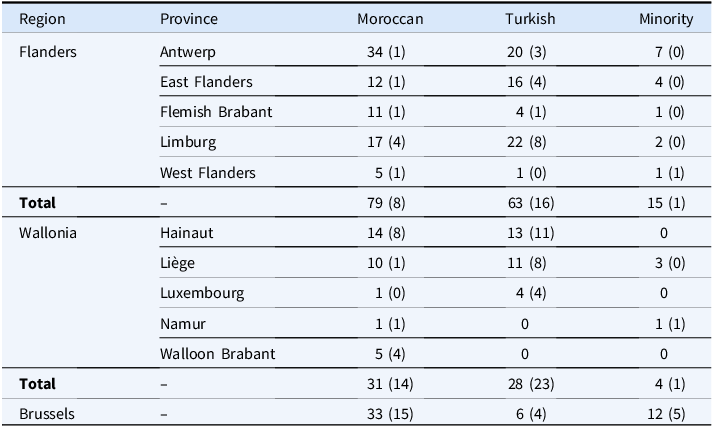
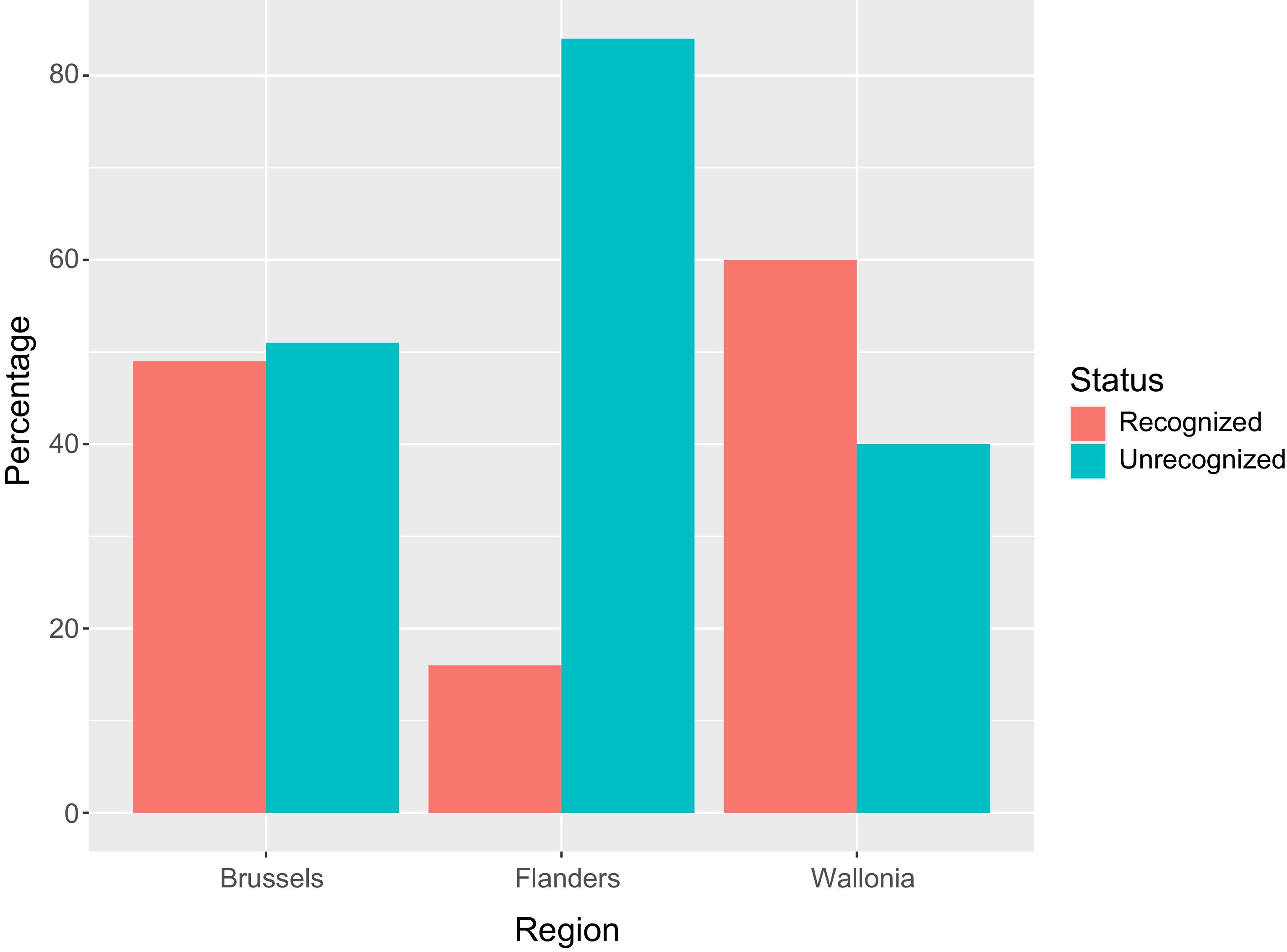
Two decades later, recognition has remained limited. As listed in Table 2, among both Turkish and Moroccan mosque-communities, which combined account for 95% of ethnically identifiable mosques in Belgium, recognized mosques remain a small minority. In fact, out of almost 300 mosques in Belgium, only 87 have been recognized by the state. Furthermore, recognition rates have varied considerably across the Belgian regions. Figure 2 shows the distribution of recognized and unrecognized mosques at the regional level across Flanders, Wallonia, and Brussels. The immediate takeaway is that Flanders has lagged significantly behind in recognizing its mosque communities. The collected data shows that Muslim leaders collaborate with subnational governments much more frequently in Wallonia (60%) and Brussels (49%) than in Flanders (16%). This is, again, despite the fact that all three regional governments operate under the same national mandate of state support for religion.
Mosque ethnicity count by province, recognition count between brackets

Mosque recognition in Belgium has received limited scholarly attention, and studies that have examined it have usually focused on mosque experiences within one particular region (Torrekens, Reference Torrekens2009; Loobuyck and Meier, Reference Loobuyck and Meier2014). Figure 3, however, shows significant cross-regional variation. Specifically, it highlights that mosques in Flanders, where right-wing partisans dominate regional elections, are much less frequently recognized than in Brussels & Wallonia. The question, then, is whether this observed variation is because of the partisan divide between the regions, and in what ways do partisanship and regional belonging condition the behaviors of both state officials and religious leadership.
Mosque recognition by region.

Empirical strategy
To create my dataset on Belgian mosques, I began by gathering data from the yearly annuaire published by the EMB. This yearly report lists all mosques registered with the EMB, and it includes information on the mosque’s name, its location, and the language of its sermons. The EMB lists a total of 270 registered mosques, but observers estimate that there may be closer to 300 mosques in Belgium. It is difficult to speculate on mosques that are not registered with the EMB and nearly impossible to systematically collect data on them, so these mosques remain outside my statistical analysis.
I used two other EMB reports to code the recognition status of each individual mosque. I also sought out data on which mosques had applied for recognition but had not yet received it, since this was a more complete indicator of which mosques had made the decision to opt into the state’s regulatory apparatus. A mosque’s application status is not made publicly available until the state grants recognition, so I gathered data on which mosques had pending applications using freedom of information requests, government reports, and contacts made during fieldwork.
I used a variety of methods to hand-code relevant mosque-level covariates, such as a mosque’s ethnic makeup, denomination, size, and network affiliation. Some of this information was publicly available; for instance, the Turkish “Diyanet” network publishes a full list of its mosques in Belgium, while some Shi’a mosques publicize their status. Other data was obtained remotely, such as by making calls to network offices. Finally, some data was only obtainable through fieldwork, such as getting documents from retired bureaucrats once a relationship was established. An anonymized version of the dataset is available in Mekawi (Reference Mekawi2023).
The regression tables presented in the following section estimate two binary variables as the outcomes of interest: a mosque’s recognition status, and its application status. The former indicates that state-mosque relations have been formalized for an individual mosque, while the latter takes on a positive value simply if a mosque has decided to apply for recognition, regardless of the state’s response; a mosque’s application status is thus a more precise indicator of mosque behavior alone. The covariates examined include binary indicators for whether a mosque is in Flanders or Wallonia, and an ethnicity indicator for whether a mosque is Turkish. Turkish mosques are, as noted, particularly resource-rich, meaning that this variable can serve as a good proxy for whether a mosque has access to non-state resources. I also include a binary indicator for whether a mosque is part of the Diyanet diaspora network. Furthermore, I add an indicator for whether a mosque is part of Belgium’s Muslim ethnic or religious minorities; Turkish and Moroccan mosques account for approximately 90% of all mosques in Belgium, so this variable takes on a positive value if a mosque is neither Turkish nor Moroccan in ethnic makeup, or if it is non-Sunni in sect. Finally, I include the size of a mosque as a control variable.
It is important to note that the purpose of these observational data and the regressions that follow is not to firmly establish causal pathways, but only to demonstrate the broad relationships between mosque-level variables across Belgium. The key takeaways regarding Belgian mosque recognition, and really the heart of this paper, came from my interviews.
I conducted 52 semi-structured interviews with state officials and religious leadership across the three Belgian regions. I selected interview participants using a purposive snowballing strategy. Purposive sampling is, as Julia Lynch describes it, a form of non-random sampling that involves “selecting elements of a population according to specific characteristics deemed relevant to the analysis” (Lynch, Reference Lynch2013). On the side of the state, I selected members from previous and current governments across all three regions and the federal government, so I can compare changes over time and partisanship. For religious leadership, I interviewed Moroccan and Turkish leaders across each region. I spoke to individuals at the mosque, confederation, and network levels. I also conducted interviews with some minority leaders, but one limitation of this paper is that it focuses more on the two major ethnic sub-groups of Belgian Islam. I conducted interviews myself in French, Arabic, and English. In a handful of cases, I worked with a translator to conduct interviews in Turkish.
I worked with two research assistants to transcribe the interviews.Footnote 2 We then developed a codebook to synthesize the major themes pertinent to this project. Besides qualitatively discussing the interviews, I developed our coding method to enable discussion of the interview results in the aggregate and to conduct comparisons across groups of interest. The codebook was used primarily to code interviews with religious leadership.
I adopted a coding method similar to the one used by Campbell et al. (Reference Campbell, Quincy, Osserman and Pedersen2013) and Morell (Reference Morell2023). I began by randomly selecting two transcripts, then randomly selecting 5 pages from each transcript to code. I utilized the text from these sample pages, then the two RAs coded the pre-highlighted transcripts. We then discussed differences in coding between them, and I adjusted the codebook as issues with it became clear. For instance, I merged or deleted overlapping categories and refined unclear ones; these adjustments are typical of the interview coding process (Hruschka et al., Reference Hruschka, Schwartz, St. John, Picone-Decaro, Jenkins and Carey2004). My RAs and I continued with this process, coding a random selection of transcript pages and adjusting the codebook based on areas of confusion or disagreement, until we arrived at a satisfactory level of intercoder reliability. Ultimately, this took three rounds of coding, which meant that the RAs were trained on randomly selected samples from 6 different interviews. Once intercoder reliability was satisfactory (0.701, Krippendorff’s Alpha), the codebook was used to code all subsequent full-length interviews (Hayes and Krippendorff, Reference Hayes and Krippendorff2007).
Results: the politics of recognition in Belgium
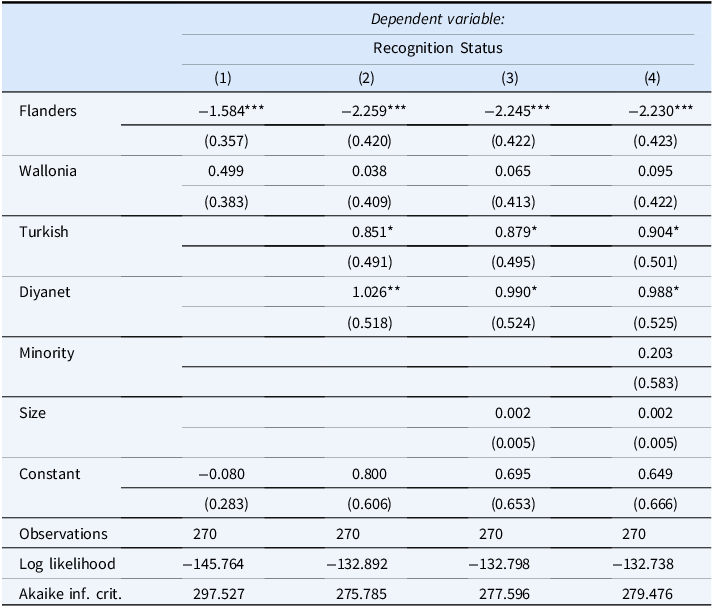
Theoretical expectations dictate that Flanders is less likely to recognize mosque-communities even when controlling for mosque-level covariates, due to the disproportionate influence of right-wing parties in that region. Table 3 estimates a mosque’s recognition status as the outcome of interest against the aforementioned mosque-level variables.
Determinants of Mosque recognition status

Note: *p < 0.1; **p < 0.05; ***p < 0.01.
The results confirm that a Flemish mosque is much less likely to be recognized even when controlling for other variables. The Flemish indicator is negative, large, and statistically significant in explaining recognition variation in all three models, and only becomes more pronounced as more covariates are added. My interviews show that this can be explained by the difference in partisan preferences between the regions, and the core voters different parties seek to speak to through regulation policies.
The data also reveal interesting patterns regarding mosque behavior. In models 2 and 3, Turkish mosques are more likely to be recognized than their Moroccan peers. This also holds true for Diyanet mosques, which have explicit ties to and receive funding from the Turkish state. An observable implication of my argument is that material inputs will not be sufficient to explain recognition outcomes, and the results demonstrate that resource-rich mosques still decide to seek state sponsorship. At a minimum, this suggests that there are non-material considerations for mosque leaders who opt to demand recognition. Model 4 shows that a mosque’s minority makeup has no bearing on its recognition status; while the Executive for Muslims in Belgium has often been criticized by the federal government for over-representing the Moroccan and Turkish Muslim sub-majorities, this accusation might not hold strictly in terms of mosque recognition. Finally, the size control confirms what state officials report in interviews, which is that the size of the mosque bears no consequence on how they process recognition documents.
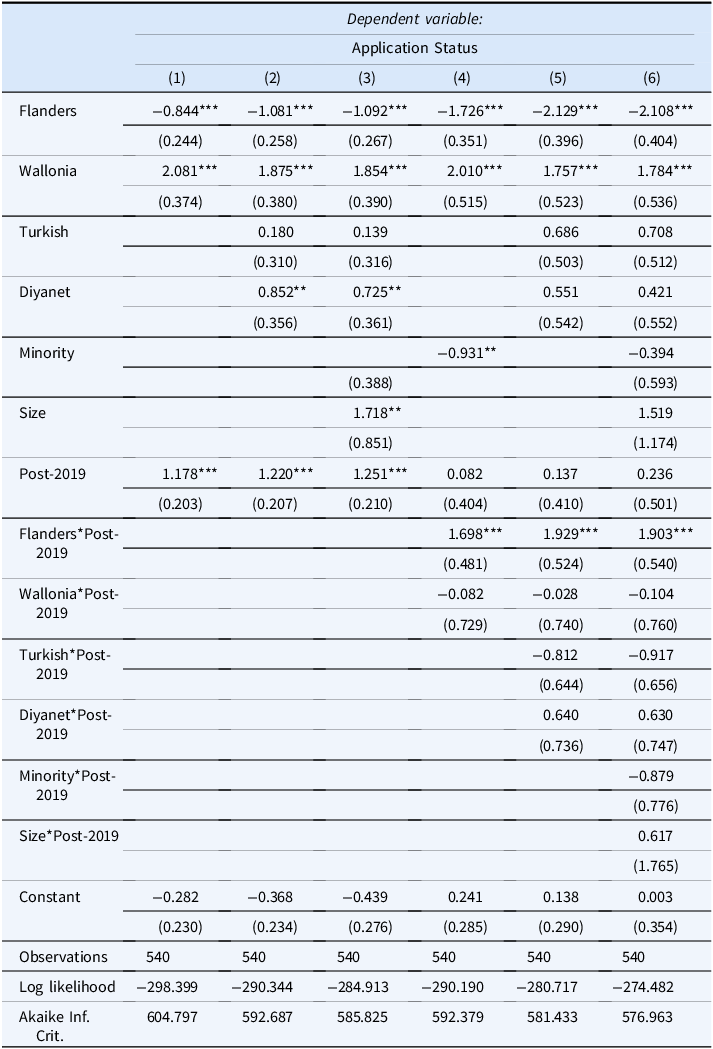
The models listed in Table 3 estimate a mosque’s recognition status as the dependent variable. The results, however, raise two questions: first, is the Flemish government less likely to recognize mosques, or are Flemish mosques less likely to apply for recognition in the first place? And second, are mosques conditioning their behavior on the partisanship of the state actors they face, or might there be other regional differences at play? To answer the first question, Table 4 runs the same models as Table 3 but with a mosque’s application status as the outcome, since this is a more precise measure of a mosque’s position vis-à-vis the state. For the second question, it is especially pertinent to consider mosque behavior in Flanders, since the region itself is a case with some temporal variation that can be leveraged as a within-case test of whether mosque leaders respond to changes in partisanship: in 2019, Bart Somers of the liberal Open VlD party, who previously won the 2016 Best Mayor award for his work with immigrant communities in Mechelen, was elected to the ministerial office tasked with recognizing mosque-communities. He thus became the first minister from outside of the right-wing N-VA to be tasked with recognition since its regionalization in 2001 (Haeck, Reference Haeck2017; Hope, Reference Hope2020). Therefore, if mosques condition their behavior on the partisanship of local officials, as I predict, then they should be more likely to seek recognition following the election of Minister Somers.
Determinants of Mosque application status before and after 2019

Note: *p < 0.1; **p < 0.05; ***p < 0.01.
Table 4, then, estimates a mosque’s application status as an outcome using the same covariates as Table 3. The data is structured in long format, where each mosque appears twice, once for its application status before 2019, once for its status post-2019, the year of Minister Somers’ election. The first three models estimate the main effects of region, ethnicity, network affiliation, and mosque size on the likelihood of applying for recognition. The latter models introduce interaction effects with the post-2019 period to assess whether these relationships changed over time.
The first three models in Table 2 suggest that mosque applications for recognition increased significantly after 2019, while the latter three models reveal that the increase is overwhelmingly explained by mosque application rates in Flanders. On the one hand, the results confirm that Flemish mosques were unlikely to seek recognition when they faced officials from the N-VA, but then sought recognition at a much higher rate following a change in partisanship and the election of a minister from the Open VlD. On the other hand, Wallonia’s high application rate remains stable across time, which is unsurprising given the Parti Socialiste’s (Socialist Party, PS) uninterrupted governance of recognition in the region. Combined with the Turkish and Diyanet indicators, which demonstrate that a mosque’s access to external resources does not predict whether it will seek state funding, the results altogether suggest that mosque leaders hold non-material considerations when seeking recognition and that they condition their decision-making on the partisanship of the officials they face. To ascertain the decision-making processes behind these broad correlations and the interactions of the actors involved, I turn to my interview data.
Across all regions, mosque leaders expressed concern over the scrutiny they receive from remaining unrecognized. The transparency requirements of recognition, and the public marker that comes with it, mean that media outlets and policymakers often characterize recognized mosque-communities as well-integrated. Consequently, not being recognized can bring unwanted attention. As a Moroccan imam in Brussels explains,
“Look, when you don’t apply for recognition you’re putting a question mark on yourself, on your mosque. It’s not so much the intelligence services, but the public will start asking ‘why isn’t the mosque recognized? What do they have to hide?’ Despite the fact that recognition is, legally, your choice… But still, the media will ask, the politicians, the state. You’re putting a question mark over yourself.”
Consequently, the reputational benefits that come from being recognized can explain why well-funded mosques still seek recognition. A Turkish leader explains this reasoning accordingly:
“In truth, we don’t need the money. We existed long before recognition even started. But getting recognized removes any doubt people may have about the mosque. It shows the public that we’re trustworthy… we noticed that unrecognized mosques get a lot of negative attention in the press, so this is a way to show that we’re happy to work with the Belgian government, that we have nothing to hide.”
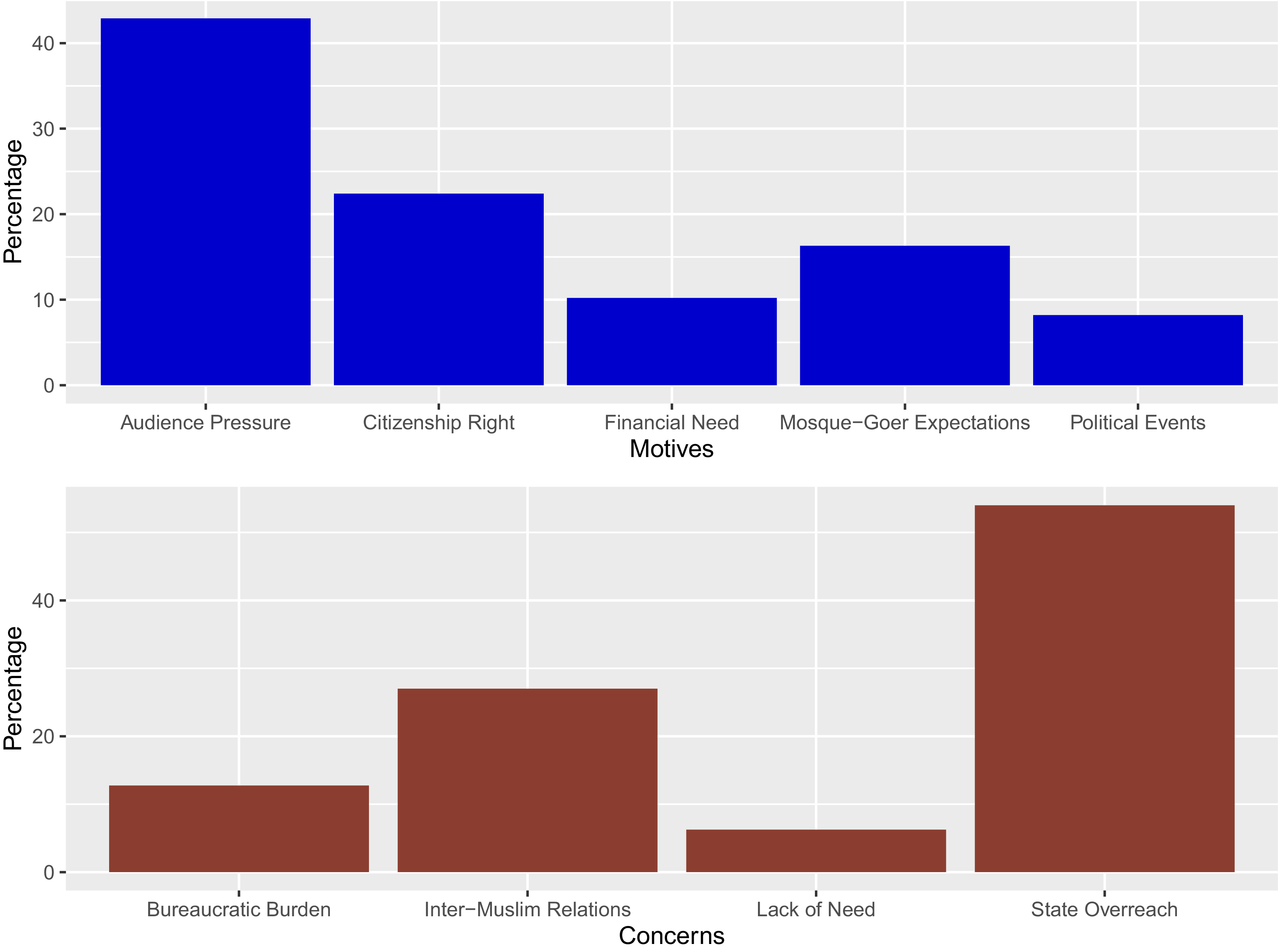
These two quotes reflect the first of five categories that I, along with my RAs, coded as incentives mosque had for recognition. This “Audience Pressure” category captured all mentions of mosques wanting to be recognized in order to alleviate pressure from politicians, news outlets, or the non-Muslim general public. Figure 4 includes the remaining categories used to capture mosque incentives; it also includes the four major categories used to code concerns religious leaders have over the recognition system and the reasons they may not want it.
Religious leadership’s considerations towards recognition.

The “Audience Pressure” category is the largest motive by a significant margin, accounting for 42.9% of all mentions across interviews of incentives for recognition. Notably, only about 16% of mentions reference mosque-goer expectations; for community members, in the words of an imam in Flanders, recognition does not matter in the same way:
“Muslims care about if a mosque is near to their house, if it speaks their language, if it practices their Islam. They don’t make this mistake of thinking that recognition makes us good or bad. [That’s] only the state that does this, the people that don’t know who we are.”
The expectations of community members may matter to a small extent, but the politics of recognition in Belgium seem to be a matter of elite behavior.
It is worth considering this “Audience Pressure” motivation further, and asking the question: who is the “audience” that religious leadership are reacting to? As a previous quote describes, sometimes it is media narratives and public discourse. A mosque leader in the Walloon province of Liège referenced a 2015 article on mosque recognition in Wallonia and Brussels, published in the widely read news website RTBF; in it, a journalist speculates that some mosques may choose to remain unrecognized due to “foreign influences” or as a result of how “particular currents of Islam” may distance mosques from the general public (Hermans, Reference Hermans2015). The interviewee expressed frustration over the fact that, despite recognition being a mosque’s prerogative, this was the rhetoric a mosque opens itself up to if it remains unrecognized. Conversely, an imam and teacher in Brussels recalled receiving an interview request on a popular Belgian radio show shortly after his mosque got recognized, with the host seeking to represent him as an example of, in his words, “the type of Muslims [we] want.” The imam welcomed the opportunity to speak on behalf of his community, even as he was disheartened by the reasoning behind the invitation.
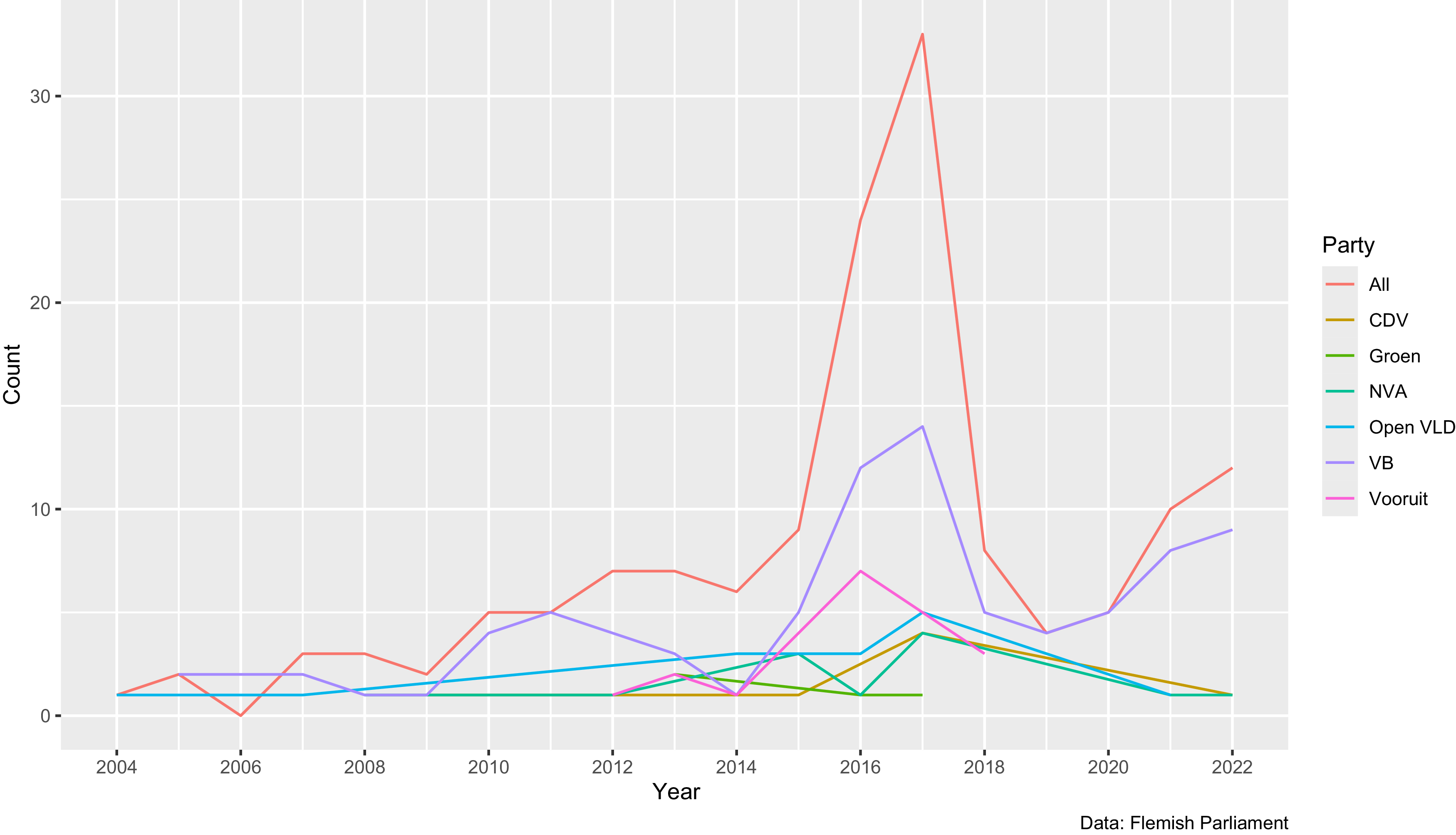
Sometimes, the “audience” is policymakers themselves. As Vanparys et al. (Reference Vanparys, Jacobs and Torrekens2013) describe, the eye of the state often turns towards Muslim communities following “dramatic violent events,” and this was the case in Belgium following the Brussels bombings of 2016. In fact, mosque recognition in Belgium today is often discussed in, and cannot be understood without, reference to the attacks. The official federal parliamentary inquiry into the attacks, published in 2017, dedicated several sections to the recognition of mosque-communities and asked why only a “low proportion” of mosques are currently recognized, despite definitively concluding that there is no relationship between recognition rates and calls to violence (for more on the federal government’s approach to recognition, see Mekawi (Reference Mekawi2025)). The increased focus on mosque recognition post-2016 was also mirrored in the Flemish parliament. Figure 5 below plots unique questions on mosque recognition posed by MP’s in the Flemish parliament to the relevant Minister. It shows that although mosque recognition was always a topic of discussion, it ballooned in regularity and urgency directly following the terrorist attacks in Brussels. The audience costs facing religious elites are thus not static in nature, but increase sharply in the wake of violent, highly visible events.
Flemish questions on mosque recognition.

A member of the Parti Socialiste lamented the criticism that unrecognized mosques receive in public discourse and acknowledged that it may be unfair, but also stated that “if mosques do things in a hidden manner, or make sure to not be under the radar of society, they raise suspicions, frankly.” He posits that this is why mosques with external resources, such as Diyanet mosques, still seek recognition, reaffirming the logic shared by network leaders themselves:
“I think the fact that the communities that are a part of the Diyanet have been able to continue requesting recognition is simply to say: Okay, yes, we are part of the Diyanet, but we belong in Belgian society, and we want to be recognized as part of this society regardless of the funding we receive. I think that the main objective in this case is really to be seen as a public authority… that has completely normalized relations with the state… because [otherwise], the Diyanet does not need the Belgian state to be able to operate.”
Despite the reputational and material benefits of recognition, however, Muslim leaders still held concerns over working with the state. Going back to Figure 3, the majority (54%) of those mentions were what I label “State Overreach.” While the masses may have only a passing knowledge of what recognition dictates, religious elites regularly referenced specific articles in specific decrees during interviews; these were informed political actors. Several of them expressed that they did not find the limits to their institutional autonomy worth the aid recognition promised. As an official with a Muslim confederation in Flanders bluntly put it, “why would we give our freedom away for a few euros?” Religious leaders feared how recognition could, for instance, put an undue responsibility on them to police their community. An Albanian imam worries that,
“Mosques are open places. Anybody can come in here, anybody can walk in. We are not the police. If we are responsible for everyone who comes to pray in the mosque, they will find something against us. I cannot guarantee that in my mosque, nobody comes who has some problem with the Belgian state.”
Muslim elites also worried about state interference with a mosque’s internal affairs, such as the writing of their sermons. However, most interviewees drew a distinction between the regions, claiming that recognition was more invasive in Flanders. Citing a decree passed in 2021, one mosque leader mentioned that “the new Flemish law, it just lets them [the intelligence authorities] come in whenever they want. We are not under investigation.” A leader affiliated with the Diyanet argues that the stringency of Flemish regulations is a response to Flemish attitudes towards Muslims in particular, and arising out of the wider electoral landscape in Flanders:
“The Flemish region just thinks differently, compared to the Wallonia and Brussels regions. More strongly to control everything, they emphasize this. It’s easy to understand why when they prepared the new law, in 2021, it’s so aggressive… this law is obviously targeted at Muslims and it is a good answer to their political atmosphere. Because they have influence, Vlaams Belang [VB] and the N-VA, these are two massive parties in Flanders. And you can’t do anything without both of them. So, I think the Flemish decree [on recognition] reflects the political desires of a majority of the Flemish people”.
Asked why, despite this stringency, many mosques still applied for recognition in Flanders following 2019, the interviewee cited a willingness to work with the Open VlD and Minister Somers in particular; the end of the N-VA’s management of recognition was, as he put it, “our chance to stay in the game.”
In short, the differences in regulatory practices at the regional level were perceived by religious leaders as driven by the core voters that the ruling parties sought to appease. Furthermore, state officials themselves also pointed to electoral reasoning to explain cross-regional differences. Flemish recognition was actually fully suspended from 2016 to 2020; the minister in charge of recognition during that period, Liesbeth Homans of the N-VA, cited unclear criteria and a lack of information as the reason behind the suspension (Belga, 2017). However, another government official explained the halt in recognition as a result of party competition between the right-wing N-VA and the far-right VB:
“It was a political game. At that time, the Flemish Nationalists [N-VA] were still very much the main party in Flanders… and they have always been under pressure from the Vlaams Belang [VB]. So they have to defend their right-wing, and being tough on Muslims just works for them electorally… so Flanders really lagged behind. And [Minister Homans] knew, the moment she recognizes a single mosque she would lose 10,000 votes immediately. The right side of the party would just go to the [VB].”
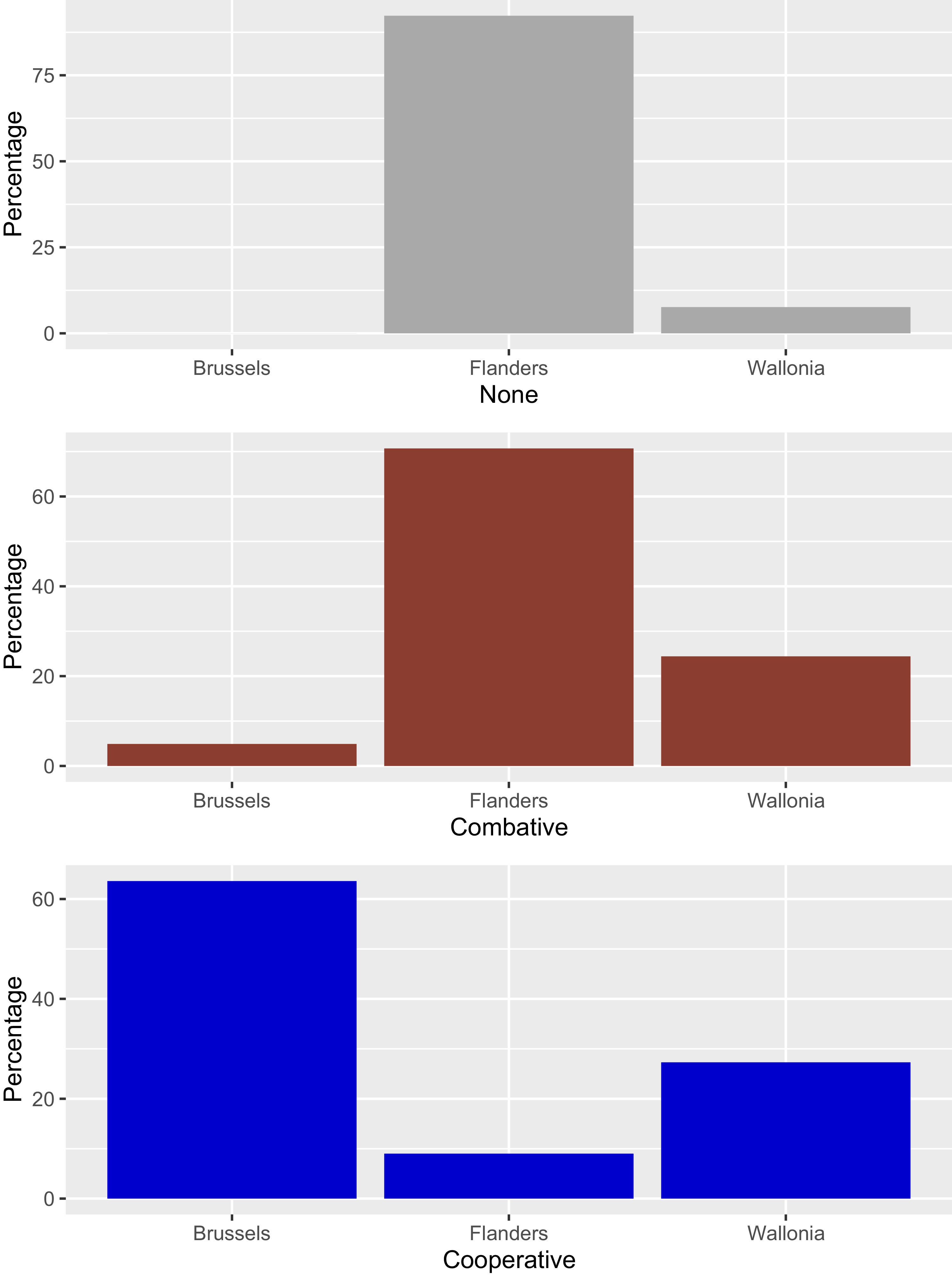
As a result of this electoral reasoning and the influence of right-wing parties, mosque leaders may perceive regulatory policy as hostile, constraining, or discriminatory. I thus coded all such mentions of recognition as being “Combative.” Examples may include the state wanting to use recognition to obtain information on mosque attendants, or to limit what mosques can express. On the other hand, I coded all mentions of government action as being justifiable or as being motivated by aiding mosque-communities as “Cooperative.” Examples include mentions of recognition as enabling increased dialog, or as easing formal or informal relations with the state. Finally, I coded all mentions of the state not wanting to recognize mosque-communities as “None.” This category captures interviewees expressing a lack of political will to recognize mosques. Figure 6 shows how each of these categories is distributed across the regions.
Perceptions of recognition across regions.

Mosque leaders perceive right-wing parties as less likely to recognize them than left-wing parties. In fact, of all mentions of the government not wanting to recognize mosques, nearly all of them (92.3%) were specifically referencing the Flemish government. Furthermore, even when they express that the state does want to recognize, religious leaders perceive right-wing governments as doing so in a more combative way. Interview results show that mosque leaders are more likely to associate combative regulatory practices with the Flemish government (71%) than Wallonia (24%) or Brussels (5%). Conversely, mosques are most likely to consider recognition as a cooperative “olive branch” when it is extended by the Bruxellois government (63%).
These perceptions of subnational governments and how they implement recognition policies shape the decisions made by religious leaders. As the models in Table 4 show, religious leaders are likelier to apply for recognition in the Bruxellois and Walloon regions, which are characterized by party competition between liberals and the far-left, than Flanders, which is dominated by two large right-wing parties; even in Flanders, mosque leaders changed their behavior directly following a change in local partisanship. The interview evidence explains the perceptions guiding religious leadership’s decision-making. The final issue to consider is: how do transnational networks, which determine a mosque’s access to non-state resources and which have been subject to immense political scrutiny, shape state-mosque relations in Belgium?
Here, even some religious leaders themselves assume that resource-rich mosques would not need state support. A Moroccan imam states that,
“Turkish mosques were never interested in recognition. They have their own finances, and those funds are getting bigger every year. They never needed Belgian money, and they don’t need to talk to the local authorities at all.”
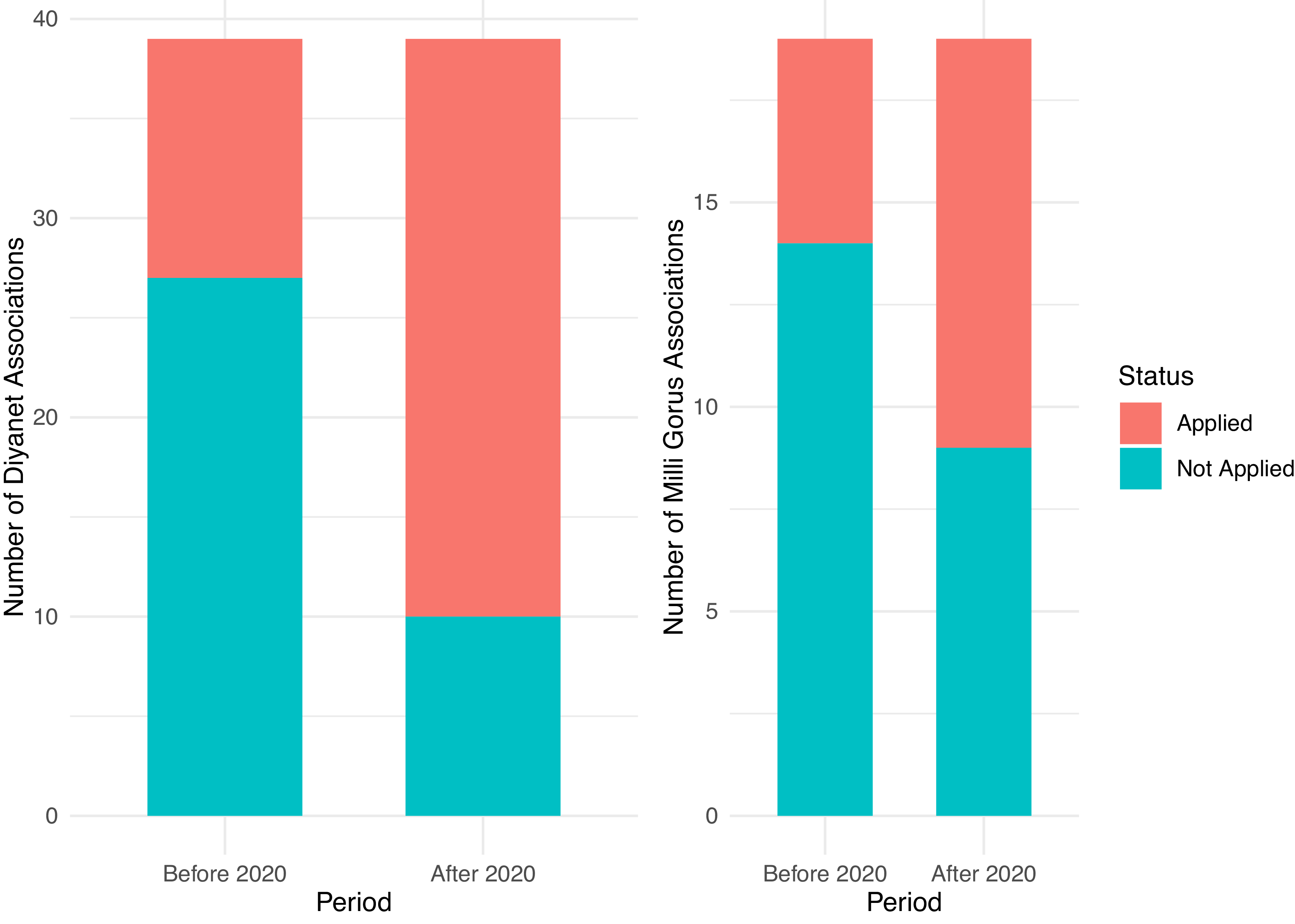
As Tables 3 and 4 show, however, belonging to a diaspora network does not predict disengagement from the state. In some instances, transnational networks are more likely to seek out state recognition, despite not needing its material support. Consider, for instance, how Diyanet and Millî Görüş mosques, the latter a pan-European network of Turkish mosques that often collaborates with the Diyanet, changed their approach to state recognition in Flanders following the election of Minister Somers of the Open VlD, as shown in Figure 7.
Turkish diaspora networks’ recognition applications in flanders.

During the right-wing N-VA’s governance of recognition, which lasted up until 2020, the dominant strategy for resource-rich mosques embedded in diaspora networks was to avoid relations with the state. After the election of Bart Somers, who comes from a party that does not campaign against Muslims and who individually has a positive relationship with Muslim voters in Mechelen, that strategy changed. Upon his election, nearly three-quarters of Diyanet mosques have sought state recognition, whereas only 30% of them had applied beforehand. The difference is less pronounced for Millî Görüş associations, but the number of mosques seeking recognition still goes from a small minority to the majority.
In fact, the focus on the material aid offered by diaspora networks misses a key element: they are networks, and they function as such. Transnational networks create a meeting point between religious leaders, one that can be used to share information, coordinate strategies, and arrive at common positions towards government units. For instance, a member of the Mill Görüs, a network of Turkish mosques, explains that meetings are often centered around political issues that affect mosques in Belgium:
“We meet more often when there are issues that are on the agenda regarding Muslims. For example, the halal slaughter ban, the recognition of mosques. Because there are issues that concern all our mosques, so we put a strategy together or make press statements. There may be lobbying activities, etc. The frequency of meeting can increase, it can be once every two weeks, if it’s something important.”
On the one hand, a Diyanet mosque president explains that mosques turn towards the network for aid with the bureaucratic process of recognition,
“When the mosque is ready to do that, we discuss with each other, and with the center of Diyanet. And we prepare together. [The Diyanet office] helps mosques to prepare their files to introduce their demand for recognition.”
On the other hand, a Turkish imam explains that Moroccan Muslims’ lack of well-developed networks hurts their ability to ask for and receive recognition. Putting the tips of his fingers together as the two sides of a sloped ceiling, he says that,
“Moroccan mosques, they don’t have a house over them. Each one of them is doing their own thing, making their own mistakes. They don’t learn from one another. With us, one mosque goes through something and we all learn from it. We have a house over us.”
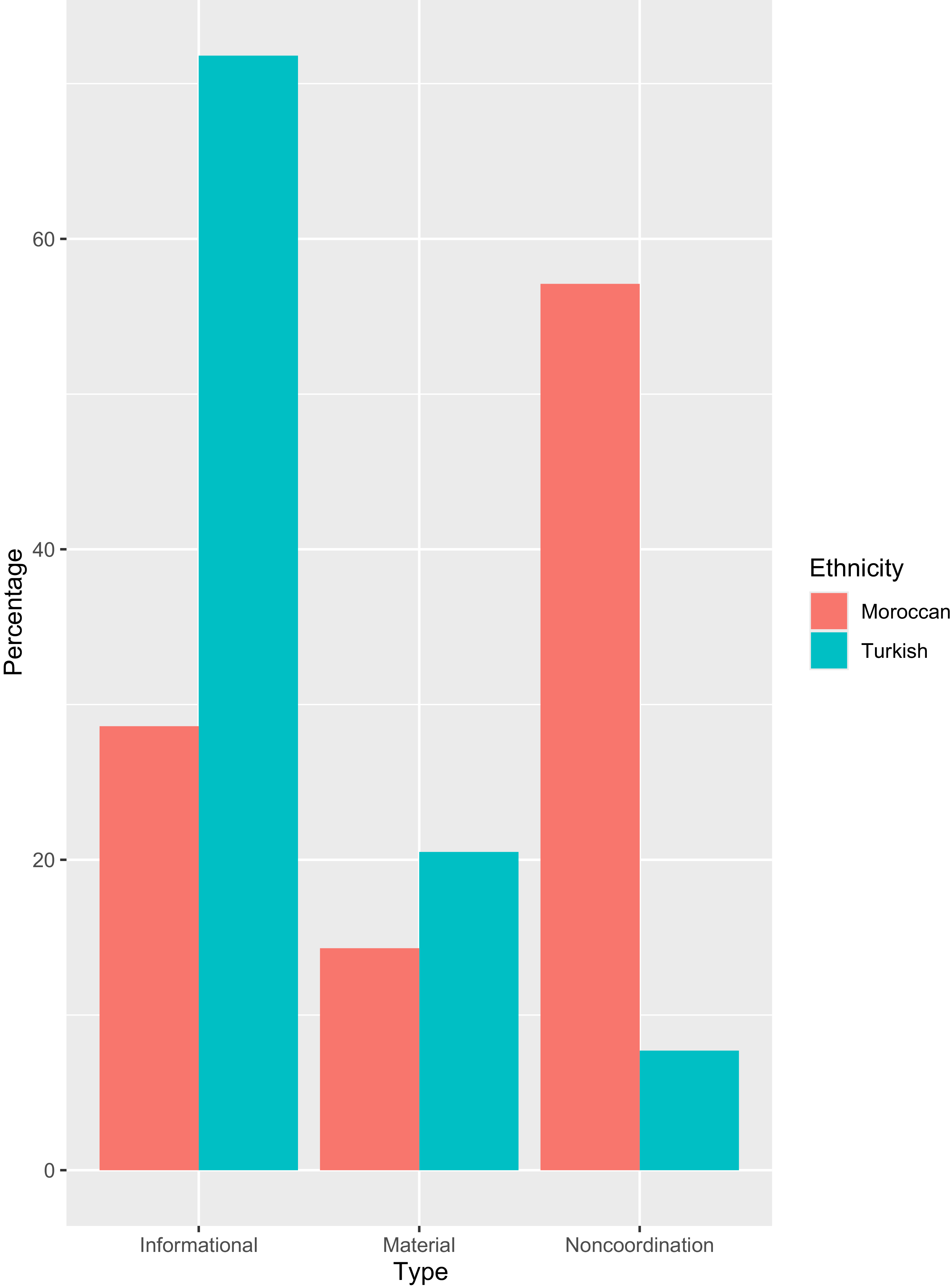
Many interviewees, of course, did mention inter-network coordination only in terms of material support. These included instances of mosques relying on networks for personnel wages, building costs, or any of the resources otherwise available through recognition. I therefore coded mentions of inter-network coordination as either “Material” or “Informational.” I also counted all instances of mosque-NonCoordination. This category included all mentions of a lack of coordination or an active disagreement between co-ethnic mosques on whether or not to seek recognition. Figure 8 shows how Moroccan and Turkish interviewees differ in terms of inter-network coordination.
Types of inter-network coordination.

The takeaway is that religious leaders rely on transnational networks for informational coordination as well as material resources. In fact, both Turkish and Moroccan leaders are more likely to mention diaspora networks in terms of their informational capacity. Unsurprisingly, on the one hand, Turkish leaders are more likely to mention network coordination at all; but for them especially, transnational networks seem to be an informational depository that assists their decision-making. Moroccan leaders, on the other hand, were likelier to mention instances of disagreement or a lack of coordination with co-ethnic mosques. This non-coordination demonstrates Moroccan mosques’ unique position: though each individual mosque may enjoy greater institutional independence, it also does not benefit from the informational dissemination available to its Turkish counterparts.
Discussion and conclusion
Several studies, both recent and foundational, have focused on the regulation of mosque communities in Western Europe. Some have explained national or subnational variation in state-led efforts, and others have asked why Muslim communities may turn towards or away from the state; I speak to both bodies of literature by looking at the interaction between subnational governments, which are often tasked with implementing regulatory mandates, and religious leaders, an understudied caste of political agents. I argue that both of these actors use regulation to “speak” to certain audiences. Who these audiences are, and how the political actors involved relate to them, can explain the variation in recognition outcomes seen in Belgium.
The results bear several implications for the recognition of Belgian mosques, and perhaps for the governance of Muslim minorities more broadly. First, rather than treat the state as a static unit seeking to incorporate immigrant-origin groups, I draw attention to the importance of understanding how state regulation of Muslim institutions can vary in the context of electoral calculations. Especially at the local level, where the politics of immigration can be a more salient issue, state officials may be reluctant to collaborate with local Muslim communities (Golder, Reference Golder2016). While scholars have written on why mosques may hesitate to work with the state, it is equally important to consider why the state may hesitate to work with mosques.
Indeed, regulatory practices towards Muslim communities in Belgium cannot be disentangled from the tectonic political shift following the Brussels bombings of 2016. In the wake of the attacks, seeking recognition becomes a defense mechanism for mosque-communities, one that can be held up against being labeled a threat by either policymakers or members of the general public. Ultimately, this finding reaffirms and extends securitization literature, which points to the ways in which “security as a constructed category” shapes political discourse and policymaking, by showing how religious elites react to and engage with securitization discourses surrounding Islam, Muslims, and mosques in Western Europe (McDonald, Reference McDonald2011).
Beyond securitization, I add to a still-growing scholarship on the political behavior of religious elites by explaining why they differ in their responses to an oft-capricious regulatory partner in the state. This study also suggests a novel way through which diaspora networks can facilitate state relations in European societies: the informational resource capacity these networks provide means that mosques embedded within them are better-suited to deal with the coordination difficulties and bureaucratic burdens involved in negotiating with the state as a regulatory partner. Importantly, the findings do not necessarily contradict previous research that concludes diaspora networks such as Diyanet can serve as foreign policy tools for the Turkish state (Öztürk and Sözeri, Reference Öztürk and Sözeri2018); rather, they suggest that doing so is not mutually exclusive to collaborating with European governments, and that in an increasingly fraught and mediatized context, religious elites may take measures to maintain dual ties.
This study offers an in-depth exploration of mosque recognition in Belgium, a regulatory framework that has received limited scholarly attention. With some caution, I suggest that some of the dynamics discussed here may be applicable to other regulatory issues that require the collaboration of both state officials and religious elites, such as halal slaughter or imam education programs. Certainly, some of the correlations observed in the Belgian case can be seen elsewhere: in Switzerland, for instance, Muslim associations have sought state recognition in Vaud, which “has historically been one of the cantons where coalitions of left-wing parties have been strongest”, while no other cantons have received applications (Piccoli, Reference Piccoli2020; Siengethaler, Reference Siengethaler2020). Diaspora networks in Germany have oscillated between cooperation with and criticism of state policies, while in Denmark, they have moved from being a “natural counterpart to state-sponsored organizations” to engaging in state programs aimed at creating dialog with the Danish majority (Arkilic, Reference Arkilic2015; Mikkelsen, Reference Mikkelsen2019). These cases merit deeper discussion on their own terms, but this study highlights the likely importance of understanding both state officials and religious leaders’ incentives, and the complex intersections of their preferences at the local, national, and transnational levels, in explaining these observations.
Acknowledgments
The author would like to thank Mark Tessler and Charlotte Cavaillé at the University of Michigan, and Corinne Torrekens at the Université Libre de Bruxelles for their feedback on this project.
Competing interests
The author declares none.
Yehia Mekawi is a postdoctoral researcher with the Group for Research on Ethnic Relations, Migration and Equality (GERME) at the Université Libre de Bruxelles (ULB) in Belgium. His work focuses on issues of identity, visibility, and representation among Muslim communities in Western Europe. He received his PhD from the University of Michigan in May of 2025, and his dissertation examined the state recognition of Muslim institutions in Belgium and Switzerland.


 Open access

