




Introduction
The aging of the population has led to a significant increase in the number of older drivers in Canada and across the world (Transport Canada, 2022). Driving is often considered an instrumental activity of daily living, enabling older adults to perform essential activities such as grocery shopping, banking, and attending medical appointments (Wood et al., Reference Wood, Bhojak, Jia, Jacobsen, Snitz, Chang and Ganguli2023). Driving also provides older adults with a sense of autonomy, which, in turn, can improve overall quality of life (Liang et al., Reference Liang, Lau and Antin2022). Moreover, most older adults prefer to live in their own homes as long as possible (i.e., aging in place), which can be facilitated through independent mobility provided by driving (Wiles et al., Reference Wiles, Leibing, Guberman, Reeve and Allen2012).
Although most older adults continue to drive safely, the increased prevalence of medical conditions with older age can result in declines in physical, sensory, and cognitive functioning that may increase the risk of driving related collisions and/or injuries (Ang, Oxley, Chen, et al., Reference Ang, Oxley, Chen and Lee2019; Ang, Oxley, Chen, Yap, et al., Reference Ang, Oxley, Chen, Yap, Song and Lee2019). Older adults are often aware of these risks and as a result, engage in self-regulatory driving behaviour (Devlin & McGillivray, Reference Devlin and McGillivray2016; Rapoport et al., Reference Rapoport, Naglie, Weegar, Myers, Cameron, Crizzle, Korner-Bitensky, Tuokko, Vrkljan, Bédard, Porter, Mazer, Gélinas, Man-Son-Hing and Marshall2013). These self-regulatory behaviours include driving less frequently, driving shorter distances, and restricting driving in challenging situations such as driving at night, in bad weather, and during rush hour. A meta-analysis on self-regulation of driving practices suggests that there are two practices of self-regulation: one is modifying behaviour and another is complete driving cessation (Ang, Oxley, Chen, Yap, et al., Reference Ang, Oxley, Chen, Yap, Song and Lee2019). Beyond self-regulation, many older adults may also be advised to stop driving by others, including, family members, friends, or their health care providers. Driving cessation, however, can have significant adverse effects, as it is associated with greater rates of depression, social isolation, functional decline, and overall poorer health-related outcomes (Ragland et al., Reference Ragland, Satariano and MacLeod2005; Sanford et al., Reference Sanford, Rapoport, Tuokko, Crizzle, Hatzifilalithis, Laberge and Naglie2019).
Driving status and habits of individuals with cognitive impairment
To date, there have been several studies exploring the relationship between driving and how it relates to cognitive status. For example, findings from the longitudinal research on aging drivers (LongROAD) study highlight that objectively measured driving behaviours, such as minutes per trip or hard braking, can be predictive of mild cognitive impairment (MCI) and dementia (Di et al., Reference Di, Shi, DiGuiseppi, Eby, Hill, Mielenz, Molnar, Strogatz, Andrews, Goldberg, Lang, Kim and Li2021). Other studies have found that rates of driving cessation increase as a function of cognitive decline (e.g., Talbot et al., Reference Talbot, Bruce, Cunningham, Coen, Lawlor, Coakley, Walsh and O’Neill2005; Wood et al., Reference Wood, Bhojak, Jia, Jacobsen, Snitz, Chang and Ganguli2023). Specifically, compared to older adults with normal cognition, rates of cessation tend to be higher among individuals with MCI and even more so among people living with dementia (e.g., Talbot et al., Reference Talbot, Bruce, Cunningham, Coen, Lawlor, Coakley, Walsh and O’Neill2005; Wood et al., Reference Wood, Bhojak, Jia, Jacobsen, Snitz, Chang and Ganguli2023). Compared to older adults with normal cognition, many individuals with cognitive decline who do continue to drive, often engage in self-regulatory behaviours (Davis & Owens, Reference Davis and Owens2021; Devlin & McGillivray, Reference Devlin and McGillivray2016; O’Connor et al., Reference O’Connor, Edwards, Wadley and Crowe2010, Reference O’Connor, Edwards and Bannon2013; Stinchcombe et al., Reference Stinchcombe, Hopper, Hammond, Weaver and Bédard2023; see Devlin & McGillivray, Reference Devlin and McGillivray2014, for a review). A recent study using data from the Canadian Longitudinal Study on Aging (CLSA) demonstrated that individuals with worse cognition avoided challenging driving situations (e.g., nighttime driving) to a greater extent than those with better cognition (Stinchcombe et al., Reference Stinchcombe, Hopper, Hammond, Weaver and Bédard2023). Conversely, there is also evidence that individuals with more severe cognitive impairment may be less likely to self-regulate their driving behaviour due to an inability to recognize their limitations (Baldock et al., Reference Baldock, Mathias, McLean and Berndt2006; Herrmann et al., Reference Herrmann, Rapoport, Sambrook, Hébert, McCracken and Robillard2006). Although there has been research on self-regulatory driving behaviour in individuals with MCI and dementia, comparatively less is known about whether driving habits differ in individuals with clinically normal cognition, but who are at increased risk of later cognitive impairment, such as individuals with subjective cognitive impairment (SCI). Individuals with SCI perceive themselves to have a worrisome decline in cognition, despite there being no objective evidence of cognitive impairment (Chertkow et al., Reference Chertkow, Borrie, Whitehead, Black, Feldman, Gauthier, Hogan, Masellis, McGilton, Rockwood, Tierney, Andrew, Hsiung, Camicioli, Smith, Fogarty, Lindsay, Best, Evans and Rylett2019; Epelbaum et al., Reference Epelbaum, Genthon, Cavedo, Habert, Lamari, Gagliardi, Lista, Teichmann, Bakardjian, Hampel and Dubois2017; Jessen et al., Reference Jessen, Amariglio, Van Boxtel, Breteler, Ceccaldi, Chételat, Dubois, Dufouil, Ellis, Van Der Flier, Glodzik, Van Harten, De Leon, McHugh, Mielke, Molinuevo, Mosconi, Osorio and Perrotin2014; Tales et al., Reference Tales, Wilcock, Phillips and Bayer2014). Evidence from neuroimaging studies show that functional and structural connectivity of older adults with SCI are more similar to those with cognitive impairment than cognitively unimpaired individuals (Fogel et al., Reference Fogel, Levy-Lamdan, Zifman, Hiller, Efrati, Suzin, Hack, Dolev and Tanne2021; López-Sanz et al., Reference López-Sanz, Bruña, Garcés, Martín-Buro, Walter, Delgado, Montenegro, López Higes, Marcos and Maestú2017; Perrotin et al., Reference Perrotin, Joie, Sayette, Barré, Mézenge, Mutlu, Guilloteau, Egret, Eustache and Chételat2017; Sánchez-Benavides et al., Reference Sánchez-Benavides, Suárez-Calvet, Milà-Alomà, Arenaza-Urquijo, Grau-Rivera, Operto, Gispert, Vilor-Tejedor, Sala-Vila, Crous-Bou, González-de-Echávarri, Minguillon, Fauria, Simon, Kollmorgen, Zetterberg, Blennow and Molinuevo2021; Wang et al., Reference Wang, Qiao, Chen, Sui, Dong, Wang, Li, Lu, Zuo and Han2019), and older adults with SCI are more likely to later develop dementia than individuals without SCI (Fogel et al., Reference Fogel, Levy-Lamdan, Zifman, Hiller, Efrati, Suzin, Hack, Dolev and Tanne2021; López-Sanz et al., Reference López-Sanz, Bruña, Garcés, Martín-Buro, Walter, Delgado, Montenegro, López Higes, Marcos and Maestú2017; Pike et al., Reference Pike, Cavuoto, Li, Wright and Kinsella2022). To date, there has been limited exploration of the driving habits of individuals with SCI compared to healthy older adults with normal self-perceived cognition, or those with MCI and dementia. Thus, it is not yet clear whether SCI, a possible pre-clinical stage of dementia, may manifest in changes in driving, which is among the most cognitively complex everyday activities.
Self-regulatory driving behaviour and sex and gender
Beyond cognitive abilities, there are other individual characteristics that could affect one’s self-regulatory driving behaviour, including sex and gender. Often in the past literature on driving habits, the terms ‘sex’ and ‘gender’ have not been well defined and have been used interchangeably. Nevertheless, the evidence from this work suggests that driving habits vary as a function of sex and/or gender (e.g., Barrett et al., Reference Barrett, Gumber and Douglas2018; Bauer et al., Reference Bauer, Adler, Kuskowski and Rottunda2003; Bhojak et al., Reference Bhojak, Jia, Jacobsen, Snitz, Chang and Ganguli2021; Gwyther & Holland, Reference Gwyther and Holland2012; Hakamies-Blomqvist & Wahlström, Reference Hakamies-Blomqvist and Wahlström1998; Keay et al., Reference Keay, Coxon, Chevalier, Brown, Rogers, Clarke and Ivers2018). Most studies reveal that women/females tend to engage in more self-regulatory driving behaviours and are more likely to choose to cease driving earlier than men/males (Barrett et al., Reference Barrett, Gumber and Douglas2018; Bauer et al., Reference Bauer, Adler, Kuskowski and Rottunda2003; Bhojak et al., Reference Bhojak, Jia, Jacobsen, Snitz, Chang and Ganguli2021; Keay et al., Reference Keay, Coxon, Chevalier, Brown, Rogers, Clarke and Ivers2018). However, there is little evidence of differences in objective driving measures such as total kilometers driven overall and at night (Keay et al., Reference Keay, Coxon, Chevalier, Brown, Rogers, Clarke and Ivers2018). The effect of gender on driving has often been discussed in terms of the influence of societal gender roles on driving habits. Today’s older adults lived during a time when societal expectations were that men, rather than women, assume the role of primary driver (Ang, Oxley, Chen, Yap, et al., Reference Ang, Oxley, Chen, Yap, Song and Lee2019; Bauer et al., Reference Bauer, Adler, Kuskowski and Rottunda2003; Hakamies-Blomqvist & Wahlström, Reference Hakamies-Blomqvist and Wahlström1998), which may translate into gender-related differences in driving self-regulation and cessation with older age. It has also been shown for individuals with Alzheimer’s disease (AD) specifically that females with AD are more likely to cease driving sooner than males with AD (Baines et al., Reference Baines, Au, Rapoport, Naglie and Tierney2018; Marie Dit Asse et al., Reference Marie Dit Asse, Fabrigoule, Helmer, Laumon, Berr, Rouaud, Auriacombe and Lafont2017). No large-scale population study to date has explored the effects of sex or gender on driving habits across older adults categorized as having no subjective or objective cognitive impairment (cognitively unimpaired), as well as those with SCI, MCI, and dementia.
Present study
The overall goal of this study was to provide an exploratory, yet comprehensive, description of the driving status and habits of older adults with varying levels of cognitive and functional abilities, ranging from cognitively unimpaired (CU) individuals to individuals with SCI, MCI, and dementia. To our knowledge, this is the first study to provide a comprehensive analysis of driving status and habits in a Canadian older adult population categorized into different cognitive groups, including uniquely, those with SCI. This study also aimed to advance our understanding of the role of sex on driving status and habits within a cognitively diverse older Canadian population.
Methods
Participants
The data in this study were obtained from the Comprehensive Assessment of Neurodegeneration and Dementia data set (COMPASS-ND; Chertkow et al., Reference Chertkow, Borrie, Whitehead, Black, Feldman, Gauthier, Hogan, Masellis, McGilton, Rockwood, Tierney, Andrew, Hsiung, Camicioli, Smith, Fogarty, Lindsay, Best, Evans and Rylett2019), Release 8 (March 1, 2024), collected by the Canadian Consortium on Neurodegeneration in Aging (CCNA). This is a large-scale, Canada-wide study of older adults with different cognitive and functional abilities. The study collects clinical, neuropsychological, and magnetic resonance imaging (MRI) data, as well as questionnaires assessing various aspects of everyday life, such as activities of daily living, social networks, and driving habits. This study reports the responses from the driving habits questionnaire, which was administered by trained staff as part of the clinical screening. If deemed necessary by the staff, a care partner was present to help during this session. This study received local approval from the University Health Network Institutional Review Board (REB #18-5434).
Because we were interested in driving habits of individuals with varying cognitive abilities, we selected participants who were categorized into one of the following classifications: (1) cognitively unimpaired (CU), (2) subjective cognitive impairment (SCI), (3) mild cognitive impairment (MCI), and (4) dementia. The Dementia group includes individuals with Lewy body dementia (n = 29), frontotemporal dementia (n = 34), and Alzheimer’s disease (n = 179) based on a clinical diagnosis. We excluded people with Parkinson’s disease and progressive supranuclear palsy, as decline in motor abilities is a required symptom in these types of diagnoses which could also influence driving. Those with a classification of mixed dementia were also excluded (n = 8), as this classification may also include participants with a decline in motor abilities. The earlier cognitive classifications were established by the COMPASS-ND team based on a number of assessments, including questionnaires assessing changes in cognition as well as standardized cognitive tests such as the Montreal Cognitive Assessment (MoCA; Nasreddine et al., Reference Nasreddine, Phillips, Bédirian, Charbonneau, Whitehead, Collin, Cummings and Chertkow2005), and Consortium to Establish a Registry for Alzheimer’s Disease (Fillenbaum et al., Reference Fillenbaum, Belle, Morris, Mohs, Mirra, Davis, Tariot, Silverman, Clark, Welsh-Bohmer and Heyman2008). Additional measures were used for diagnostic confirmation such as MRI of the brain. For information regarding the COMPASS-ND cognitive status classification and the inclusion and exclusion criteria for each group, see Chertkow et al. (Reference Chertkow, Borrie, Whitehead, Black, Feldman, Gauthier, Hogan, Masellis, McGilton, Rockwood, Tierney, Andrew, Hsiung, Camicioli, Smith, Fogarty, Lindsay, Best, Evans and Rylett2019), as well as the COMPASS-ND website (https://ccna-ccnv.ca/compass-nd-study/).
Driving data were available from 955 participants across all four groups, and after excluding participants who had never had a driver’s license (n = 16), a total sample of 939 participants remained. Additional exclusions were applied uniquely for the different driving related outcomes as described in the Data analysis section.
Driving questionnaire
The driving questionnaire included seven questions that inquired about participants’ driving status and habits.
-
1. Age of license acquisition: Participants were asked, ‘How old were you when you passed your examination for your driver’s license?’
-
2. Driving license status: Participants were asked, ‘Which of the following describes your driving status (includes cars, vans, trucks, and motorcycles)?’ Options included one of three responses: (1) ‘I have a driver’s license without restrictions (except eye glasses)’; (2) ‘I have a driver’s license with restrictions on time of driving (daylight only); distance from home, type of road (no highway), or number of passengers’; or (3) ‘I no longer have a driver’s license’.
-
3. Reason for driving cessation: Participants were asked, ‘For those who do not have a valid license or no longer drive, which of the following statements are true? (Please check all that apply)’. Options included ‘I voluntarily stopped driving’; ‘A family member or friend advised me to stop driving’; ‘A physician advised me to stop driving’; ‘A police officer advised me to stop driving’; ‘The Ministry of Transportation suspended my license’; ‘These do not apply’. Participants were allowed to select any number of outcomes that applied to them or none.
-
4. Driving role: The question stated, ‘I would describe my driving role in the family as one of the following’: options included ‘I am the only available driver’; ‘I am the primary driver when I drive with other family members’; ‘I share the driving equally with my spouse or another family member’; or ‘I am typically a passenger when I travel with other family members’.
-
5. Driving frequency: Participants were asked, ‘In the past month, how often did you drive?’ Options included one of six responses: (1) ‘Not at all in the past month’; (2) ‘1–3 days in the past month’; (3) ‘1–3 days per week’; (4) ‘4–5 days per week’; (5) ‘6–7 days per week’; and (6) ‘I no longer drive’.
-
6. Driving distance: Participants were asked, ‘In the past 6 months, approximately how many kilometers did you drive?’ Options included one of six responses, (1) ‘<1,500 km’, (2) ‘1,500–3,000 km’, (3) ‘3,001–4,500 km’, (4) ‘4,501–6,000 km’, (5) ‘6,001–7,500 km’, and (6) ‘>7,500 km’. Because of similarities in selection across the middle set of options, we grouped driving distance into three categories of ‘<1,500 km’, ‘1,500–7,500’, and ‘>7,500’.
-
7. Driving restrictions: Participants were asked, ‘Do you restrict your driving in any of the following ways? (Please check all that apply)’. Options included ‘I never or rarely drive in bad weather conditions, such as heavy rain or snow’; ‘I rarely or never drive on highways’; ‘I rarely or never drive long distances from my home’; ‘I rarely or never drive at night’; ‘I rarely or never drive during rush hour’; ‘I do not restrict my driving in any of the above circumstances’. Participants were allowed to select any number of options that applied to them or none. Additionally, we summed the total number of restrictions each participant had selected, ranging from 0 to 5.
Data analysis
All data were analyzed in R version 4.4.1. Prior to all analyses, the data were cleaned to remove any instances of irrelevant entries (e.g., ‘don’t know’, ‘not answered’). All of our primary analyses of driving habits were compared across four different cognitive groups (CU, SCI, MCI, and dementia). We were also interested in exploring whether driving habits differed between males and females. In this study, participants chose between the options of ‘female’ and ‘male’ to indicate their sex. The data set did not include a measure of gender and, as such, analyses of gender were not possible.
The ‘Reasons for driving cessation’ measure only includes participants who previously had, but no longer have, a license and those who were no longer driving. The ‘Driving frequency’ measure excludes individuals who never had a driver’s license and who no longer had a driver’s license. The ‘Driving role’, ‘Driving distance’, and ‘Driving restrictions’ measures excluded individuals who never had a driver’s license, no longer had a driver’s license, and did not drive at the time of participation.
For our nominal outcome measures, we used a chi-square test of independence with Yates’ correction. We provide separate analyses for factors of Cognitive group and Sex, because there were a limited number of observations in each cell when we included them together in one model, rendering it inadvisable to run the analysis. For our continuous outcome measure (i.e., restriction count), we were able to include Cognitive group and Sex in the same model of analysis of variance.
Given that some of these data were collected during the pandemic period, we also conducted sensitivity analyses excluding the participants who were recruited after March 2020. The pattern of results remained similar and as such the analyses are based on all the data.
Results
Table 1 provides detailed demographic information for all participants (n = 939) excluding those who reported never having a license. A comparison between cognitive groups for the demographic measures can be found in supplementary materials, though discussion of these group differences is beyond the scope of this article.
Demographic information for all drivers separated by cognitive status

Notes: Table 1 provides the demographic information for all drivers (n = 939), excluding individuals who never had a license (n = 16). Years of education is adjusted based on the highest level of education reported. The total percentage may not equal to 100 across levels because of rounding.
Abbreviations: CU = cognitively unimpaired; SCI = subjective cognitive impairment; MCI = mild cognitive impairment; SD = standard deviation.
Driver’s license status
Participants across all cognitive groups responded to the question related to license status (n = 955: CU = 161, SCI = 139, MCI = 414, Dementia = 241). Although most individuals held a license without restrictions, the Dementia group had the greatest percentage of individuals who no longer held a license (41% compared with 1% for CU, 4% for SCI, and 6% for MCI), χ2 (9, n = 955) = 212.01, p < .001.
The separate analysis of sex revealed that females were more likely to have never had a license than males (15 of the 16 participants who reported never having a license were females), χ2 (3, n = 954) = 14.48, p = .002. Sex was more balanced for the other categories of licensure. Participants who never had a license were excluded from further analyses.
Reason for driving cessation
The vast majority of those who responded to the question regarding the reason for driving cessation (i.e., no longer have valid license or no longer drive) were in the Dementia group (n = 172: CU = 5, SCI = 10, MCI = 38, Dementia = 119). Because of the limited data in some cognitive groups and the multiple response options for this question, no analyses were conducted. Thus, the results are only reported descriptively. For the Dementia group, the top reason was a physician advising them to stop driving (n = 60, 39%), followed by voluntarily stopping (n = 51, 33%). For the MCI group, the top reason was reversed, whereby they chose to voluntarily stop (n = 27, 61%), followed by physician advice (n = 9, 20%). Of the 10 SCI participants who were no longer driving, most voluntarily stopped driving (n = 9, 90%), except for one whose physician advised them to stop.
When driving cessation is explored by sex, the most common option (among all options) selected by females was to voluntarily stop (n = 61, 55%). In contrast, the most reported reason to stop driving by males was due to physician’s advice (n = 40, 40%).
Driving role
The results described in this section are based on participants who were current drivers (n = 764: CU = 154, SCI = 126, MCI = 367, Dementia = 117). Participants’ responses regarding their driving role in the family revealed a significant effect between Cognitive groups, χ2 (9, n = 764) = 39.12, p < .001. Specifically, those in the Dementia group were more typically passengers (n = 45, 38%) compared to other groups: CU (n = 31, 20%), SCI (n = 29, 23%), MCI (n = 78, 21%). Those in the Dementia group were also least likely to be considered the only available driver (n = 9, 8%), with the SCI group most likely to be the only available driver (n = 40, 32%) compared to the other groups: CU (n = 33, 21%), MCI (n = 63, 17%). Notably, the percentage of individuals in the Dementia group who were the primary driver (n = 27, 23%) was not different than the SCI group (SCI: n = 28, 22%) in comparison to the other groups (CU: n = 46, 30%, MCI: n = 121, 33%).
We also observed an effect of sex, χ2 (3, n = 764) = 150.37, p < .001, with males most often reporting that they were the primary driver (n = 183, 45%) compared to females (n = 39, 11%), and females most often reporting that they were typically the passenger (n = 132, 37%) compared to males (n = 51, 13%).
Driving frequency
The measure of driving frequency in the past month, revealed a significant effect of Cognitive group, χ2 (15, n = 809) = 80.00, p < .001, with individuals in the Dementia group most likely reporting that they no longer drive, or have not driven at all in the past month (23% total). Moreover, when focusing on the highest driving frequency response options (4–5 and 6–7 days per week; the blue shades in Figure 1), it is evident that individuals in all the other groups drove more frequently than the Dementia group. Notably, the SCI group’s driving frequency more closely approximates the driving frequency of the MCI group than the CU group. We also observed an effect of sex, with approximately twice the number of females (68%) than males (32%) reporting that they did not drive in the past month, or no longer drove at the time of participation, χ2 (5, n = 809) = 15.67, p = .008.
Driving frequency by cognitive group.
Notes: n = 809, CU = 157, SCI = 131, MCI = 382, Dementia = 139.

Driving distance
The measure of driving distance in the past 6 months revealed a significant effect of Cognitive group, χ2 (6, n = 751) = 23.23, p = .001 (Figure 2), with drivers in the Dementia group reporting driving the shortest distance over the past 6 months (<1,500 km) compared to drivers in the other groups. The analysis of sex revealed a significant effect with a majority of participants reporting driving the shortest distances being female (62%), and a majority of those reporting driving the longest distances being male (75%), χ2 (2, n = 751) = 47.12, p < .001.
Driving distance by cognitive group.
Notes: n = 751: CU = 149, SCI = 123, MCI = 363, Dementia = 116.

Driving restrictions
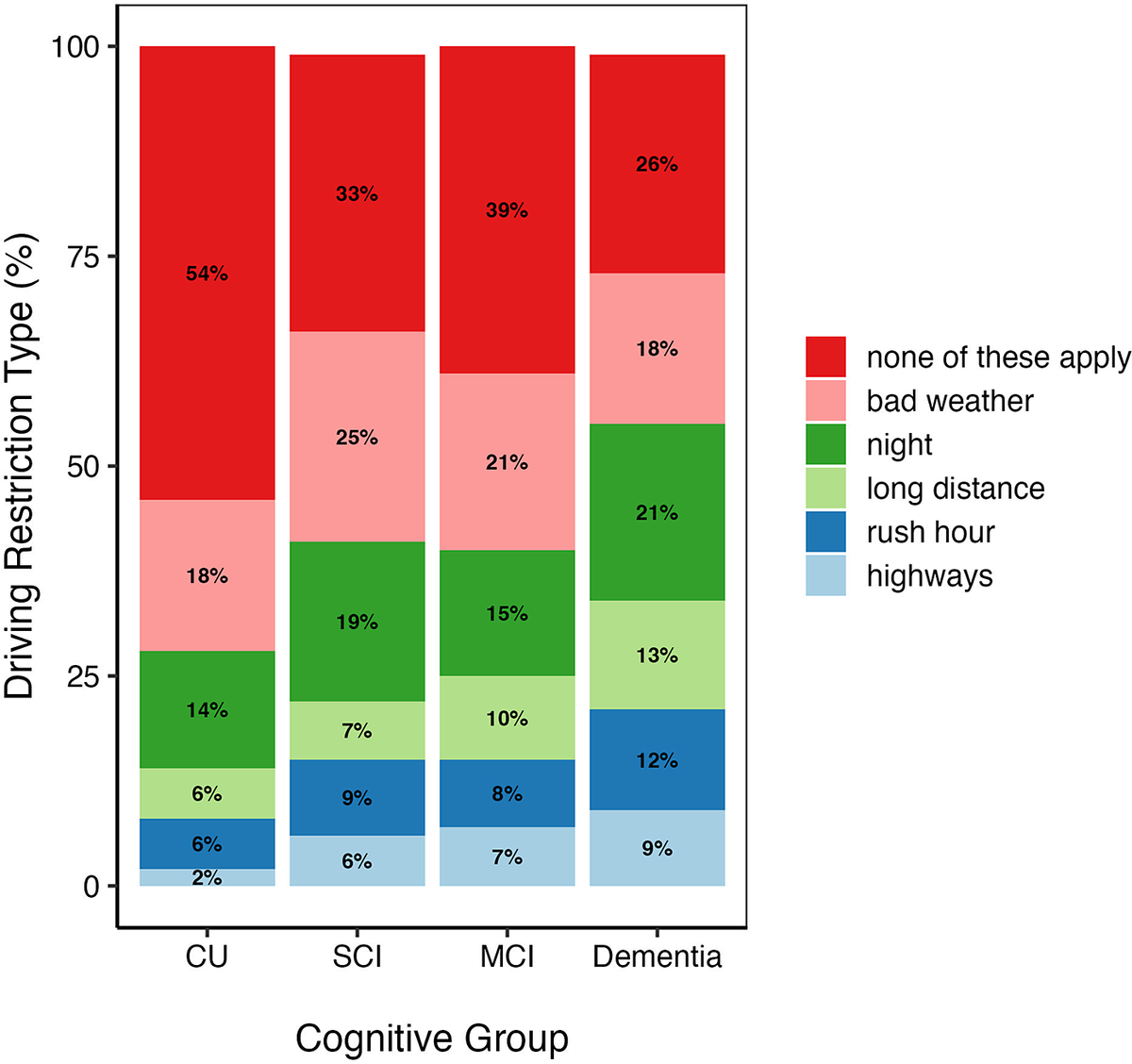
Restriction type: Participants were able to select multiple responses and as such the results are reported in terms of the number of options selected. Results revealed that, with the exception of the option ‘none of these apply’, the most common restriction types were bad weather and night driving across groups (see Figure 3). The SCI group’s restriction types were more similar to the MCI group than the CU group.
Driving restrictions by cognitive group.
Notes: The percentages are based on total number of options selected and not percentage of participants.
Restriction count: Because participants could select all restriction types that applied to them, we counted the total number of restrictions by participant (excluding the option, ‘none of these apply’). Next, we performed a two-way ANOVA including both Cognitive group and Sex as between-group factors, revealing significant effects of Cognitive group, F(3, 755) = 10.06, p < .001, η2G = .04, Sex, F(1, 755) = 25.91, p < .001, η2G = .03, and a Cognitive group × Sex interaction, F(3, 755) = 3.83, p = .010, η2G = .01 (we also conducted a non-parametric test, the aligned rank transformation, which led to similar results). As shown in Figure 4, females reported a greater number of restrictions to their driving with increasing cognitive decline, whereas males only apply restrictions at the most severe level of cognitive decline in the Dementia group. To explore this pattern, we conducted a follow-up post hoc analysis with a Holm correction to compare the different cognitive groups within each sex. For females, we found that the CU group differed significantly from the SCI, MCI, and Dementia group (ps < .007). For males, we found that the CU group differed significantly from the Dementia group (p = .049), and the MCI group differed significantly from the Dementia group (p = .011). No other significant differences were observed.
Driving restriction count by cognitive group and sex.
Notes: n = 763: CU = 153, SCI = 126, MCI = 368, Dementia = 116.

Discussion
Driving habits and cognitive groups
The results indicate that most older Canadians in this cohort, across different cognitive and functional abilities, hold a license without restrictions, including individuals with dementia. As expected, the Dementia group was more likely to differ from the other groups on all measures of driving habits and status. Specifically, the Dementia group was the group with the highest percentage of individuals who no longer held a license, however, approximately half of this group still held a license without any restrictions. This is in line with past studies reporting that a considerable number of individuals living with dementia (ranging from 23% to 77%) hold a license (O’Connor et al., Reference O’Connor, Edwards and Bannon2013; Talbot et al., Reference Talbot, Bruce, Cunningham, Coen, Lawlor, Coakley, Walsh and O’Neill2005). It is important to note that in many provinces a driver’s license is the only type of photo identification other than a passport. Therefore, some people retain an active driver’s license to serve as their primary photo identification without the intention to drive. In this study, the top two reasons to cease driving reported by individuals living with dementia were a physician advising them followed by voluntarily stopping. These were also the top reasons selected by MCI group, however, in the reversed order. Past research suggests that some of the key reasons why individuals with cognitive impairment continue to drive include one’s preference for driving over being driven, driving as a habit, and being the primary driver (Devlin & McGillivray, Reference Devlin and McGillivray2016). In this study, although the Dementia group were more likely to be passengers compared to the other cognitive groups, approximately a third of them still reported that they were the primary or only driver. When the current license holders were asked about the frequency of driving, the Dementia group was also the group that drove the least frequently than all the other groups and were the most likely to report that they were no longer driving or that they had not driven at all in the past month. Thus, these individuals chose not to drive despite having a license. Nonetheless, the majority of the individuals in the Dementia group reported driving in the past month, with approximately a third driving almost every day. That said, the Dementia group also drove the shortest distances overall.
‘Bad weather’ and ‘night driving’ were the two top restrictions reported by drivers across all groups. As expected, the Dementia group reported the highest number of restrictions, whereas the CU group reported the fewest restrictions, consistent with studies conducted in other countries (Devlin & McGillivray, Reference Devlin and McGillivray2014; Mauri et al., Reference Mauri, Sinforiani, Cuzzoni, Bono and Zucchella2014).
Driving habits of individuals with SCI
A unique contribution of this study is that, to our knowledge, it is the first to compare the driving habits and status of a SCI group to a CU, MCI, and Dementia group of participants. On some of our measures, the SCI group was more similar to the cognitively impaired groups (MCI and/or Dementia) than the CU group. In particular, the SCI group’s driving frequency more closely approximated the MCI group than the CU group. Driving frequency has been identified as one of the most common self-regulatory behaviours exhibited by those with MCI (O’Connor et al., Reference O’Connor, Edwards, Wadley and Crowe2010). Moreover, the SCI group’s reported restriction types and number of restrictions were more similar to the cognitively impaired groups (i.e., MCI, Dementia) than the CU group. Here, we show that even in the absence of an objective cognitive impairment, a subjective impairment, which can be a sign of pre-clinical cognitive decline and signals general ‘worry’ about cognition/functional abilities (Hopper et al., Reference Hopper, Hammond, Taler and Stinchcombe2023), may lead to changes in driving habits.
The fact that the driving habits of the SCI group share similarities with those of the cognitively impaired groups could be due to a number of factors, including being potentially indicative of early signs of pre-clinical declines that cannot yet be captured on standard objective measures. These patterns are important, given that previous research has revealed that individuals with SCI who have difficulty with instrumental activities of daily living are at a higher risk of later developing Alzheimer’s disease than individuals with SCI who do not have these difficulties (Roehr et al., Reference Roehr, Riedel-Heller, Kaduszkiewicz, Wagner, Fuchs, van der Leeden and Luck2019). In contrast, it is also possible that the driving habits of those with SCI in this sample may not be due to cognitive differences per se, but other demographic factors that differed across groups (e.g., SCI individuals were more likely to be single, live alone, and live in urban areas than other groups). Further research is required to better understand what contributes to the self-regulatory driving behaviour of individuals with SCI including factors associated directly with driving performance abilities and those related to lifestyle factors and/or personality (Mah et al., Reference Mah, Vandermorris, Verhoeff and Herrmann2021), which may also be further informed through longitudinal data analyses.
Driving habits and sex
We found that most of those who reported never having a license were female, but the sex ratios among the other license status groups were more balanced. We also found sex differences in measures assessing those who hold a license, but no longer drive. Specifically, about double the number of females than males reported that they no longer drive or did not drive at all in the past month. In terms of reasons for driving cessation, females were more likely to voluntarily stop driving, while males were more likely to cease driving when advised by a physician. This highlights the need for physicians to consider potential sex and/or gender differences when assessing factors related to fitness to drive and likelihood of self-regulation.
In terms of driving roles, males were most likely to be the primary driver and females most likely to be passengers. This is in line with societal gender roles for this cohort of older adults, where men were more likely to take on the role of primary driver (Ang, Oxley, Chen, Yap, et al., Reference Ang, Oxley, Chen, Yap, Song and Lee2019; Bauer et al., Reference Bauer, Adler, Kuskowski and Rottunda2003; Hakamies-Blomqvist & Wahlström, Reference Hakamies-Blomqvist and Wahlström1998). Furthermore, we found sex differences in the following driving habits: females drove less often, shorter distances, and reported a higher number of restrictions. Although females in the SCI, MCI, and Dementia groups reported higher numbers of driving restrictions compared to the females in the CU group, only males in the Dementia group had a higher number of restrictions than males in any other group (the SCI and MCI group were no different that the CU group). These results suggest that females may be more likely to regulate their driving habits with earlier signs of subjective/objective cognitive decline, whereas males only showed a greater numbers of driving restrictions with a dementia diagnosis. In general, these patterns of sex-related differences in driving habits are consistent with previous literature. For example, Bhojak et al. (Reference Bhojak, Jia, Jacobsen, Snitz, Chang and Ganguli2021) found that most people who reported never driving or no longer driving were female. Furthermore, meta-analyses by Baines et al. (Reference Baines, Au, Rapoport, Naglie and Tierney2018) and Ang, Oxley, Chen, Yap, et al. (Reference Ang, Oxley, Chen, Yap, Song and Lee2019) revealed that women were more likely than men to stop driving and regulate their driving behaviour. Additionally, the current findings are in line with a recent CLSA study revealing that women avoid complex driving situations more often than men (Stinchcombe et al., Reference Stinchcombe, Hopper, Hammond, Weaver and Bédard2023). In fact, among CLSA participants, ranging in age from 45 to 85 years old, women engaged in more driving avoidance behaviours than men, with the biggest difference being among the oldest age group (Stinchcombe et al., Reference Stinchcombe, Hopper, Hammond, Weaver and Bédard2023).
Limitations and future directions
Although this study was based on a large sample of older Canadians collected nationwide, this sample, especially the Dementia group, may not be representative of the wider population. Specifically, the Dementia group in this study had a larger number of males than females, which differs from the typically reported higher prevalence of dementia in females than males in the general population. In addition, we were unable to explore a cognition by sex interaction for the nominal dependent variables (license status, frequency, distance) given the limited number of observations per cell. Future research with larger and more balanced sex data is recommended to allow for interpretations about the interaction of these variables on driving measures.
Another limitation is that the self-report driving measures may be influenced by factors such as social desirability biases and tendencies to over- or underestimate driving behaviours (Devlin & McGillivray, Reference Devlin and McGillivray2014; Feng et al., Reference Feng, Meuleners, Stevenson, Heyworth, Murray and Maher2020; Paire-Ficout et al., Reference Paire-Ficout, Lafont, Hay, Coquillat, Fabrigoule and Chavoix2021), particularly in individuals with memory difficulties. However, self-reports are commonly employed in studies of driving habits in older adults including those with MCI and Dementia (e.g., Bhojak et al., Reference Bhojak, Jia, Jacobsen, Snitz, Chang and Ganguli2021; Davis & Owens, Reference Davis and Owens2021; O’Connor et al., Reference O’Connor, Edwards and Bannon2013; Stinchcombe et al., Reference Stinchcombe, Hopper, Hammond, Weaver and Bédard2023). Reassurance is also provided by the fact that the pattern of results found in this study is in line with what was predicted, for example, the most self-regulated habits were reported by those living with Dementia compared to the other cognitive groups. Nevertheless, we recommend that future studies use objective driving data to substantiate the present findings.
Moreover, some of the key driving habits such as distance and frequency may be influenced by a variety of factors unrelated to cognition such as hearing and vision impairments, medical co-morbidities, lifestyle, geographical, and social factors (e.g., marital and employment status, social network size, living status). It is also possible that driving habits are influenced by the extent to which individuals or groups of individuals use public transit or ride hailing services. Finally, in this study, we are only able to report data from one point in time, thus we cannot comment on how driving habits change over time in the different groups we studied. Despite these limitations, this study provides the first comprehensive overview of a driving habits of older Canadians with varying cognitive abilities. It is also the first to our knowledge to report the driving habits of those with SCI. Future longitudinal research is recommended to better understand the change in driving habits of those with SCI over time and contributing factors.
Conclusion
In a large sample of older Canadians ranging in cognitive and functional abilities, it was observed that most adults continue to drive into older age including persons living with dementia, but that several driving habits differ across cognitive groups. Specifically, older adults living with dementia were more likely to drive less frequently and shorter distances, as well as report more driving restrictions than the other cognitive groups. A novel finding of our study is that on some measures (e.g., driving frequency, driving restrictions), individuals with SCI were more similar to those with MCI than those who are CU. These findings were also further influenced by sex, with females more likely to have ceased driving and limiting their driving more than males. Together, the outcomes of this study reveal that the driving status and habits of older Canadians differ depending on an individual’s cognitive status and sex.
Supplementary material
The supplementary material for this article can be found at http://doi.org/10.1017/S0714980825100469.
Acknowledgements
The study was not pre-registered. Data from COMPASS-ND are available by request from CCNA. Analyses scripts will be made available by authors upon request.
Financial support
R. Saryazdi, A. E. Pereira, G. Naglie, M. J. Rapoport, E. Stasiulis, and J. Campos are members of Teams 16 and 17 of the Canadian Consortium on Neurodegeneration in Aging (CCNA). The Canadian Consortium on Neurodegeneration in Aging is supported by a grant from the Canadian Institutes of Health Research with funding from several partners.
Competing interests
Authors have no conflict of interest to report.


 Open access

