


A 51-year-old man attended the neurologist with a 2-month history of paresthesias of both thighs and occasional leg weakness. Physical examination revealed the presence of macrocephaly (head circumference of 63 cm), two 6-mm polypoid lesions on the nose and forehead, and a 5-mm rounded fibrous lesion on the dorsum of the tongue. The rest of the physical and neurological examination was normal.
A brain magnetic resonance imaging (MRI) showed a 6-cm T1 hypointense T2 hyperintense non-contrast-enhancing lesion in the right cerebellar hemisphere (Figure 1A and B), non-infiltrating and without peripheral edema, but with a mass effect on the structures of the posterior fossa and effacing the fourth ventricle. It presented a striated or “corduroy” appearance on T2 and Fluid-Attenuated Inversion Recovery (FLAIR) images (Figure 1C and D), with widened and thickened cerebellar folia. There was no associated restricted diffusion signal (Figure 1E and F) nor increased perfusion values within the lesion (Figure 1G and H).
Brain MRI findings in relation to dysplastic cerebellar gangliocytoma or Lhermitte–Duclos disease. The lesion is shown surrounded by a yellow circle. (A) Axial T2WI. Non-infiltrating hyperintense lesion in the right cerebellar hemisphere, without peripheral edema. (B) Axial contrast-enhanced T1WI. The lesion is hypointense, without contrast enhancement, contacting the structures of the posterior fossa and obliterating the fourth ventricle. (C-D) Coronal T2WI and FLAIR images. The lesion shows a striated or “corduroy” appearance. Note also the widening and thickening of the cerebellar folia. (E-F) The lesion does not show restricted diffusion on Diffusion Weighted Imaging (DWI) or Apparent Diffusion Coefficient (ACD) maps, suggesting low cell density within the lesion. DWI hyperintensity in E is due to a subtle T2 shine-through effect. (G-H) A significant increase in perfusion values inside the lesion is not detected either.

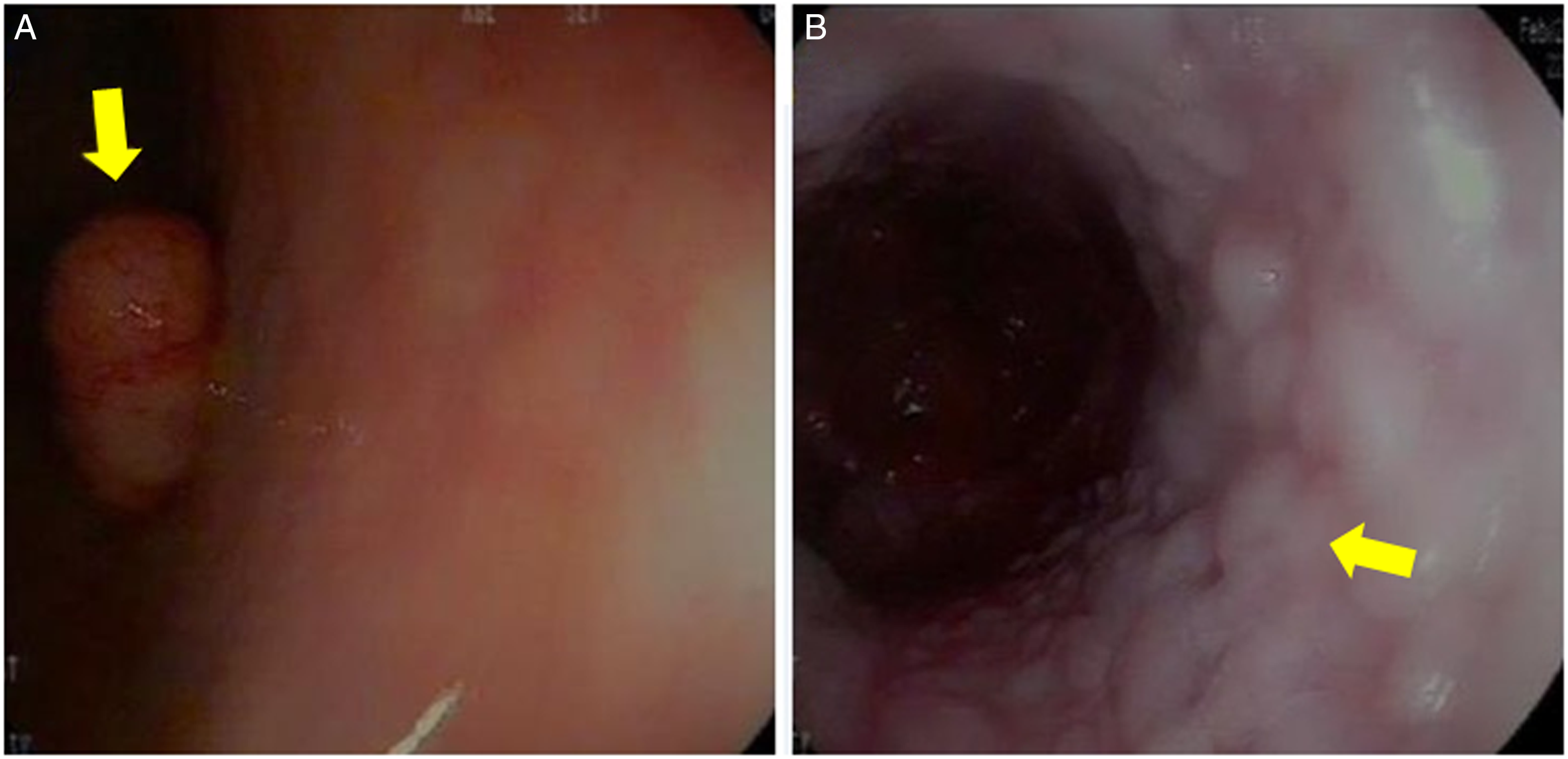
Complementary tests were performed looking for a possible syndromic or paraneoplastic picture: a thoracoabdominopelvic computed tomography, a colonoscopy, and a gastroscopy detected profuse colorectal and gastric polyposis (Figure 2A). The histological analysis of the samples obtained revealed multiple hamartomatous polyps as well as esophageal glycogenic acanthosis (Figure 2B). Ultrasound scans also revealed multiple thyroid nodules and lipomatous testicular infiltration. Finally, a genetic analysis identified the heterozygous presence of a pathogenic variant in the PTEN gene, so the case was classified as Lhermitte–Duclos disease in the context of Cowden syndrome.
(A) Colonoscopy showing profuse colonic and rectal polyposis. Biopsy confirmed the presence of multiple hamartomatous polyps throughout the colon and rectum. (B) Gastroscopy showing esophageal glycogenic acanthosis, confirmed by subsequent hystologic analysis. The existence of a pathogenic variant in the PTEN gene allows the diagnosis of Lhermitte–Duclos disease in the context of Cowden syndrome (COLD syndrome).
Dysplastic gangliocytoma of the cerebellum, or Lhermitte–Duclos disease, is a rare hamartomatous tumor of the cerebellar cortex, generally unilateral, classified within the group of glioneuronal and neuronal tumors according to the WHO classification of Central Nervous System (CNS) tumors. Reference Louis, Perry and Wesseling1 It is more frequent in adults and is related to alterations in the PTEN gene, having been proposed as another manifestation of Cowden disease (COLD syndrome). Reference Abel, Baker and Fraser2,Reference Pilarski, Burt, Kohlman, Pho, Shannon and Swisher3 The appearance on MRI is very characteristic, and there are usually few differential diagnoses (other cerebellar tumors such as medulloblastoma, glioma, or hemangioblastoma are more nodular, contrast-enhancing, have a cystic component, or show diffusion restriction, and infectious or vascular cerebellar involvement requires an appropriate acute clinical context). Reference Zhang, Zhang and Liu4,Reference Huang, Zhang and Zhang5 Association with cortical and gyrus disorders, heterotopias, hamartomatous lesions of the CNS and megaloncephaly has also been found. Reference Zhang, Zhang and Liu4 Small tumors may be asymptomatic or present with subtle signs such as dysmetria, and as they increase in size, they can present with ataxia, paresthesias or limb weakness, increased intracranial pressure and even obstructive hydrocephalus. Reference Zhang, Zhang and Liu4,Reference Ma, Jia, Chen and Jia6 Treatment is usually symptomatic, the very slow growth rate of the lesion meaning that surgical treatment is usually reserved for cases of hydrocephalus or highly symptomatic ones. Reference Ma, Jia, Chen and Jia6 Future treatment options include targeted therapies to repair genetic pathways affected by PTEN gene loss of function. Reference Agarwal, Liebe and Turski7 Currently, our patient undergoes an annual medical checkup due to the higher frequency of appearance of tumors in COLD syndrome, such as breast, endometrial, and thyroid cancer Reference Hendricks, Hoogerbrugge, Schuurs-Hoeijmakers and Vos8 and the possible appearance of new digestive polyps and skin lesions.
Disclosures
None of the authors have any conflicts of interest or disclosures.
Statement of Authorship
The authors have contributed to the conception and design of the work (LIPS and JJGH), drafted the work (LIPS), and revised it critically for important intellectual content (JJGH). Both authors (LIPS and JJGH) have read and approved the final version of the manuscript to be published.



