


Introduction
The design of robust conservation strategies for threatened marine species in contexts where few data are available remains a widespread challenge, particularly where threats have not been quantified and historical population baselines are absent (Bjorndal & Bolten, Reference Bjorndal and Bolten2003; McClenachan et al., Reference McClenachan, Jackson and Newman2006). In the case of marine turtles, the paucity of knowledge about their status in South and South-east Asia has been highlighted (Shanker & Pilcher, Reference Shanker and Pilcher2003), and has continued to hamper management of various subpopulations (Mortimer & Donnelly, Reference Mortimer and Donnelly2008; Tiwari et al., Reference Tiwari, Wallace and Girondot2013). Although the number of marine turtle projects in the region has increased significantly, leading to richer data on populations and conservation, the availability of data in certain areas of the Gulf of Thailand remains low (McNamara et al., Reference McNamara, Mizrahi, Vibol and West2015). This is especially the case in Cambodia, where five marine turtle species have been recorded historically: the hawksbill Eretmochelys imbricata, green Chelonia mydas, leatherback Dermochelys coriacea, loggerhead Caretta caretta and olive ridley Lepidochelys olivacea turtles (Try, Reference Try1999).
The historical literature describes once-abundant marine turtle populations in Cambodia. Tirant (Reference Tirant1885) reported intensive hunting of hawksbill and olive ridley marine turtles for meat and scutes. Le Poulain (Reference Le Poulain and Bourret1941) detailed nesting during December–May and listed Cambodian villages where large numbers of turtles were caught at nesting sites. Intentional in-water fishing of turtles is also mentioned, with descriptions of fishers driving turtles into fixed shallow-water nets. Le Poulain (Reference Le Poulain and Bourret1941) noted that egg removal was reducing turtle numbers rapidly, to the point that the Governor of Cochinchina (a former colonial area in South-east Asia) banned the cooking, eating and selling of turtle eggs in 1923. Similar exploitation of marine turtles has been described in the adjacent Vietnamese regions of Phu Quoc and Ha Tien (Hamann et al., Reference Hamann, Hong, Thuoc and Thu Hien2006).
More recently, greater attention has been given to the Cambodian freshwater environment than to its marine areas (Jensen & Ing, Reference Jensen and Ing2014). However, since 1999 the Cambodian government, in collaboration with NGOs and through regional agreements, has worked to gather information and implement conservation actions for marine turtles (Fisheries Administration, 2017) and the wider marine environment (Teoh et al., Reference Teoh, Sour, Glue and Chea2020). The Ministry of Agriculture, Forestry and Fisheries has jurisdiction over aquatic resources through the Fisheries Administration, including legislation on marine turtles. This legislation includes Anukrat 123, a 2009 sub-decree that identifies 58 aquatic species and genera, including five marine turtle species, as threatened nationally. Protected turtle species are also explicitly referred to in articles of the overarching Fisheries Law, thus affording marine turtles increased legal protection. Furthermore, the Cambodian government has ratified several international conventions (Try et al., Reference Try, Pilcher, Miller and Cox2002), including the Indian Ocean & South-east Asia Marine Turtle Memorandum of Understanding (CMS, 2009), a legally non-binding international agreement aiming to conserve marine turtles and their habitats in the region.
The Fisheries Administration and WWF achieved initial progress towards conservation action for marine turtles through a series of workshops, studies and awareness-raising activities during 1999–2002, which provided training for turtle monitoring and data collection, including the first ever tagging of a marine turtle in Cambodia. Renewed engagement in marine turtle conservation has occurred from 2010, primarily by the Fisheries Administration in collaboration with Fauna & Flora, local NGOs, private-sector representatives and community partners.
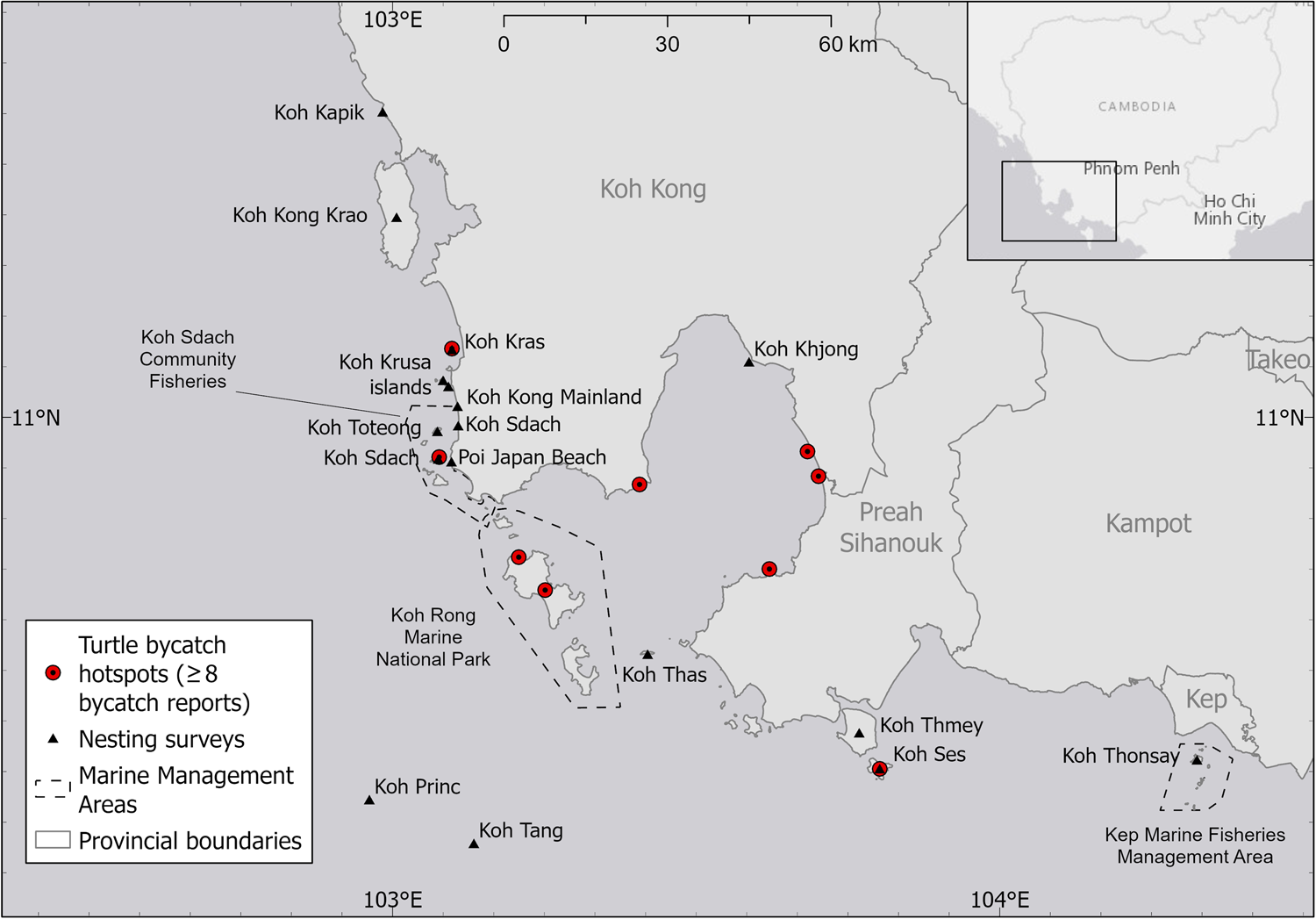
In 2010, Fauna & Flora conducted an initial assessment across Cambodian coastal provinces aiming to verify any remaining marine turtle nesting areas and gather information on turtle distribution, threats and the value of marine turtles to coastal communities (Fauna & Flora International, 2011). Fauna & Flora staff gathered information from consultations with government experts, who reported past green turtle nesting in the Koh Rong Archipelago (Fig. 1) and sporadic hawksbill turtle nesting in remote areas of the wider Koh Rong Archipelago, where discarded hawksbill turtle carapaces had been reported. Interviews with fishers and coastal community members in the Koh Sdach Archipelago indicated periodic in-water sightings of green turtles. During this initial assessment, interviewees in Koh Kong province also reported green turtle nesting on Koh Kong Krao (the largest and least developed Cambodian island), with the species being sighted regularly in surrounding seagrass beds, whereas hawksbill turtles were reportedly rare in this area (Fig. 1).
Hotspots of marine turtle bycatch (≥ 8 reports) mapped based on verbal responses provided by interviewees during a nationwide bycatch survey conducted during 2016–2018, approximate locations of marine turtle nesting beach surveys conducted during 2016–2020, and existing marine management areas in Koh Sdach, Koh Rong and Kep in Cambodia.
An extensive programme of collaborative work by the Fisheries Administration and Fauna & Flora followed the initial assessment, including the development and ongoing implementation of a National Plan of Action (2016–2026) for marine turtles in Cambodia, and this work is continuing into 2023 and beyond (McNamara, Reference McNamara2016; Fisheries Administration, 2017; Vong et al., Reference Vong, Teoh and West2018).
Here we synthesize the available data on marine turtles in Cambodia, drawing information from more than a decade of work conducted by Fauna & Flora, the Cambodian Fisheries Administration and other partners. We triangulate sources, including social surveys, in-water and nesting beach monitoring, stakeholder workshops and interviews with fishers, to provide an up-to-date overview of the current population status of marine turtles in Cambodia, the threats to these species and the progress achieved through conservation efforts. This synthesis fills a critical gap in the published literature on the conservation of marine turtles in South-east Asia.
Methods
Provincial consultations (2015)
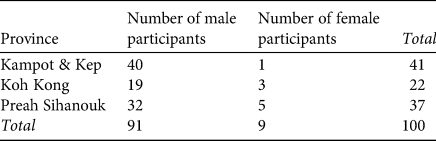
We held three consultation workshops during July 2015 with participants from the four coastal provinces of Kep, Kampot, Koh Kong and Preah Sihanouk (McNamara et al., Reference McNamara, Mizrahi, Vibol and West2015). These workshops aimed to capture information on values associated with turtles, recent turtle sightings, turtle meat and egg consumption, and key threats to turtles. A total of 100 people participated, identified through the local knowledge and connections of Fauna & Flora staff, who ensured the representation of diverse stakeholder groups encompassing the government, communities, NGOs, private sector and research institutions (Table 1).
Number of participants in the provincial consultations in Cambodia, by province and gender. Because of the small size of the attendee group in Kep province, this workshop was combined with that of Kampot.
All participants were given a fixed verbal statement in Khmer, which outlined the conditions of the consultation workshops, sought their consent to participate, and explained the purpose of the scientific investigation. The workshops were facilitated by Fauna & Flora staff alongside government officials responsible for fisheries management and marine turtle conservation. During the workshops, facilitators used a marine turtle guide to clarify species identification and capture variations in local names. We also used fishing gear identification guides to verify the types of gear used. We conducted the consultations in Khmer and English through a combination of large group sessions and smaller breakout groups that discussed five predetermined topics. We used mixed methods to gather information:
Values
We involved participants in a facilitated discussion on the values of marine turtles to each person as an individual (e.g. religious, personal, cultural, economic and intergenerational values). We then asked them to discuss what values were most important for people in their particular province. We compiled the resulting individual statements from the group discussions as shared statements, to identify any broad differences between provinces regarding the perceived value of marine turtles.
Sightings
We divided participants into groups and provided them with a printed map with a grid of 1 × 1 km cells. We then helped them to indicate where they had sighted marine turtles and turtle nests historically. Additional information requested included how long ago turtles were sighted (< 1 year ago (July 2014); 1–5 years ago; > 5 years ago), whether the turtle could be identified to species, whether it was released or kept, whether it was found alive or dead and, if dead, how it had died (e.g. entangled in net/unknown). We then digitized the annotated paper map with a GIS. The purpose of this exercise was to understand broad-scale temporal and spatial changes in turtle abundance and distribution rather than pinpoint exact locations of nesting or feeding grounds.
Turtle product consumption
We asked participants to write down, anonymously, if they had eaten turtle meat or eggs within the past year (July 2014–July 2015) or > 1 year previously. We also asked them to share their perceptions regarding whether other people in their community consumed turtle products. These answers were submitted on a voting card written in Khmer and English that participants were able to submit voluntarily into a sealed box.
Threats
We asked participants to list perceived threats to marine turtles in the fishing area within their community and to score each threat on a scale of 1–5. We then divided participants into groups to collaboratively select 4–5 priority threats relevant to their site and score these threats on a predefined scale of intensity (very high, high, medium and low). Participants then shared their perceptions regarding how they anticipated these threats would change in the ensuing 10 years. The threats included in the ranking exercise were fishing (separated into trawl, hook, purse seine, crab net and other gear), habitat degradation, coastal development, pollution, sand dredging and climate change.
Solutions and conservation actions
We involved participants in a facilitated group discussion that sought to identify the drivers of the identified threats and then to suggest potential solutions for each threat, using a theory of change approach. We also recorded any existing conservation or management activities that participants were aware of.
We summarized the findings from these consultation workshops in a report (McNamara et al., Reference McNamara, Mizrahi, Vibol and West2015). Subsequently, we used this to feed directly into development of a national action plan, and inform subsequent conservation planning, fundraising and management actions by the Fisheries Administration, Fauna & Flora and local partners, including the nesting beach and bycatch surveys described below.
Nesting beach identification and surveys (2011–2020)
Nesting beach identification and surveys have been sporadic and have used a variety of methods. In 2011–2012, Fauna & Flora staff undertook purposive sampling based on local knowledge, conducting key informant interviews with stakeholders on the island of Koh Tang. This process aimed to validate anecdotal reports in the area that identified a historically significant nesting site. This initial interview work was followed by an assessment of current and historic nesting across all four coastal provinces, during November–December 2016, through combined interviews and nesting beach surveys. We conducted semi-structured interviews with members of coastal Community Fisheries and the Fisheries Administration, with a snowball sampling method used to identify individuals with specific knowledge of marine turtle nesting grounds, who could in turn recommend other suitable participants (Bryman, Reference Bryman2012). We read all interviewees a verbal statement prior to their participation that explained the research purpose and asked for their voluntary consent. After the interviews, Fauna & Flora and Fisheries Administration staff surveyed areas identified as potential nesting beaches, either on foot or by driving a boat close to shore, with observers searching for turtle tracks or other nesting signs.
Building on the knowledge of priority nesting beaches obtained from the 2016 assessment, further intermittent nesting surveys were conducted during 2016–2022 by the Fisheries Administration, Fauna & Flora and partners (Fig. 1). These included beach surveys during 2018–2020, which Fauna & Flora, the Fisheries Administration and the NGO Projects Abroad carried out on the offshore islands of Koh Kras, Koh Torteung and Koh Kong Krav (Koh Kong province). The surveys involved walking a predetermined stretch of beach whilst looking for signs of nesting activity. During September–December 2020, five trained volunteers conducted beach surveys in high-priority areas on the islands of Koh Tang, Koh Pring, Koh Thas and Koh Thmei in Preah Sihanouk province. Surveys are ongoing at the time of writing, and they continue to employ boat-based and on-foot methods as appropriate to each site. All nesting beach survey routes are recorded on GPS devices to track survey effort.
Bycatch surveys (2016–2018)
We conducted marine turtle bycatch surveys in 28 ports and fishing villages across all four coastal Cambodian provinces during 2016–2018, again using a snowball sampling method (Bryman, Reference Bryman2012). We asked government officials in each coastal province to recommend places known for significant marine turtle bycatch, and we also interviewed fishers to identify locations with high bycatch over the past 10 years. We asked fishers who reported experience of bycatch in their interview responses to suggest others who could have captured marine turtles accidentally. We then approached these people for additional interviews. To collect standardized information on bycatch gear types and numbers of turtles caught, we disseminated a structured interview questionnaire that included questions on fisher demographics, fishing gear used and fishing grounds, and marine turtle bycatch experience. We read all survey participants a prepared statement that explained their participation was voluntary and confidential.
Results
Provincial consultation workshops (2015)
During the provincial consultation workshops, a total of 233 historical turtle sighting events were reported for 2005–2015, and we digitized these results from participant-drawn maps, although there was potential for double-counting of turtle sightings by participants (Fig. 2). Sightings were collated per 1 × 1 km grid square, to indicate potential spatial hotspots. These maps illustrate where turtles have been seen, but are not indicators of absolute abundance.
Turtle sightings reported in Cambodia during 2005–2015 for all species combined, originally mapped on a 1 × 1 km grid (adapted from McNamara et al., Reference McNamara, Mizrahi, Vibol and West2015).

When asked about the value associated with turtles, statements varied amongst the provinces. In Koh Kong, marine turtles were recognized as being ‘nearly extinct’ and respondents expressed a desire for ‘the next generation to know the species’, whereas in Kampot and Kep their value in generating income from tourism was identified. The results also indicated the value of turtles as a consumptive resource, with responses suggesting their meat was eaten in all provinces, with consumption being most prevalent in Kampot and Kep, where 24% of respondents reported eating turtle meat more than once per year. Eggs were reportedly eaten in both Koh Kong and Preah Sihanouk, but not in Kep and Kampot.
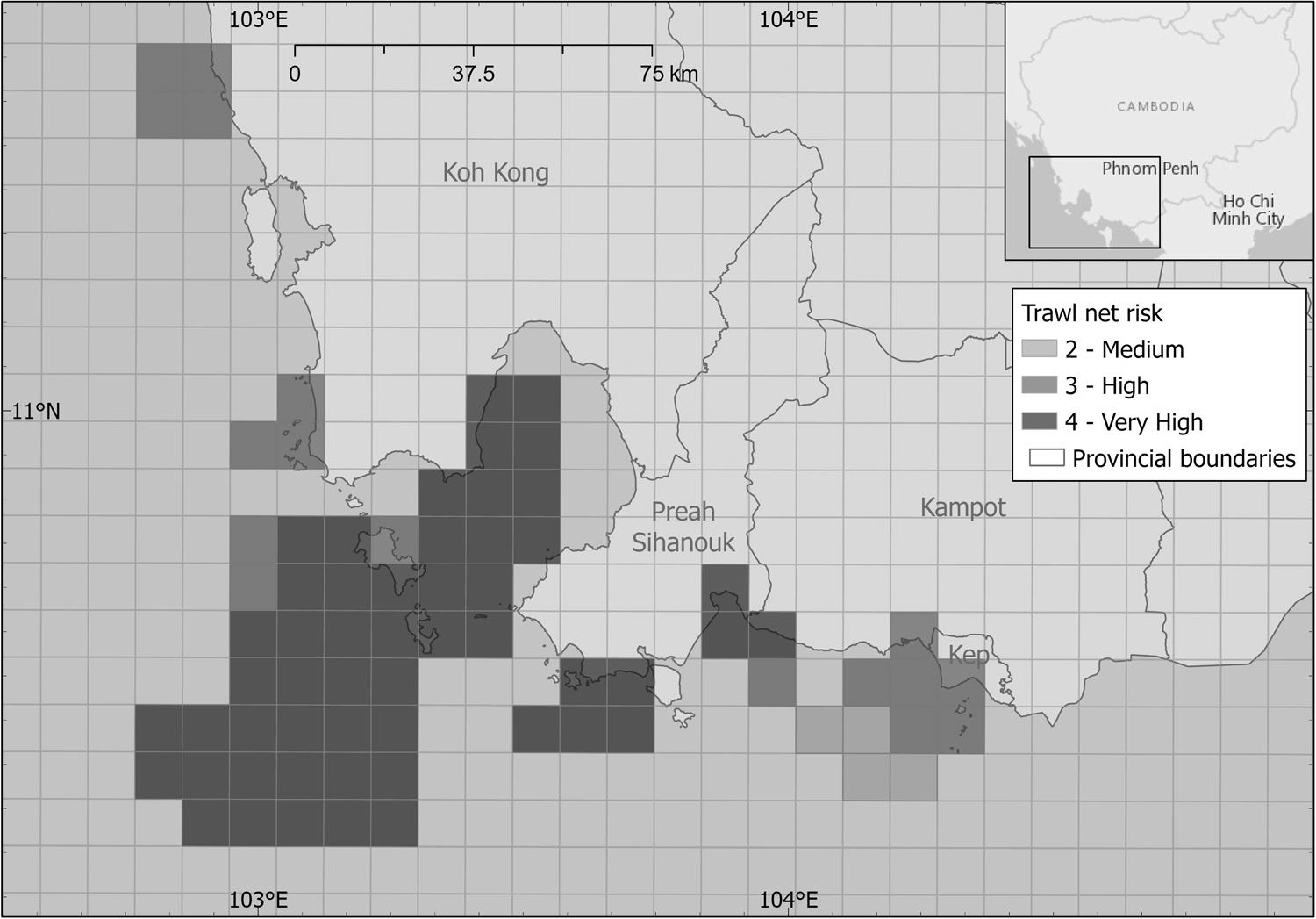
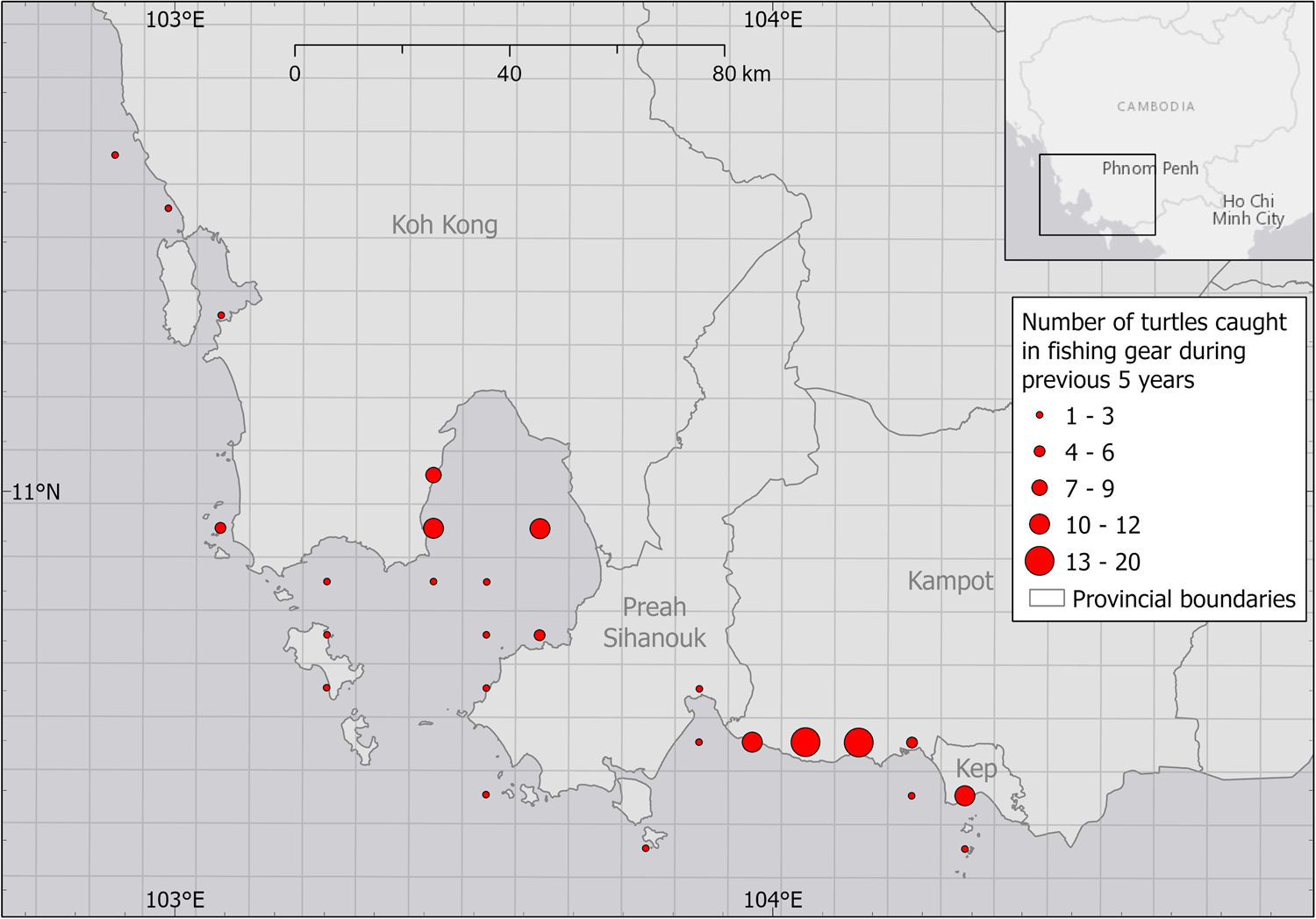
Based on the ranking of threats, to which 100 participants gave their input, trawling was identified as the greatest fishery threat to marine turtles across all coastal provinces, followed by hook-and-line fishing in Koh Kong and Preah Sihanouk (Table 2). In Koh Kong, 80% (n = 17) of participants were concerned about the number of turtles being caught by J-shaped hooks, both deliberately and as bycatch. In contrast, in Kampot and Kep coastal development was the second greatest threat. Spatial hotspots of high trawl fishery intensity and of high levels of turtle bycatch were also identified through this process (Figs 3 & 4).
Perceived intensity of threat (Table 2) to Cambodian marine turtles from bottom-trawling, digitized from provincial consultation participant responses, originally mapped on a 1 × 1 km grid (adapted from McNamara et al., Reference McNamara, Mizrahi, Vibol and West2015).
Numbers of Cambodian marine turtles reported as caught in fishing gear over previous 5 years based on answers from the provincial consultation respondents, originally mapped on a 1 × 1 km grid (n = 100; Table 1; adapted from McNamara et al., Reference McNamara, Mizrahi, Vibol and West2015).
Output from the Cambodian marine turtle threat-ranking exercise conducted as part of the provincial consultations in 2015 (Table 1), focusing on prioritization of the most significant threats to marine turtles.

Participants identified coastal development as the third greatest scoring threat overall, although the ranking of this threat varied by province (Table 2). Coastal development impacts were reported for both turtle nesting and feeding areas, predominantly through construction, dredging and sand mining on beaches, mangroves and seagrass habitats. In addition, participants identified large development companies as the stakeholders having the greatest impacts on marine turtles and the degradation of their habitats, given their perceived role in driving coastal development in Cambodia.
Discussions of solutions focused on addressing fishing impacts, which was generally agreed to be the highest-priority threat. The most frequently proposed solutions were increased compliance with fisheries legislation governing high-risk gear, and increased information sharing between legal authorities and fishing communities (e.g. related to prompt bycatch reporting and the explanation of relevant legislation). Participants were broadly aware of existing legislation related to marine turtles but indicated that low compliance influenced its effectiveness in practice. As the sale of turtle meat is more profitable than the average daily catch of many fishers, participants suggested the implementation of a financial incentive not to catch and sell turtles.
Although an extensive stakeholder analysis was carried out prior to engagement, when considering the results of the provincial assessment it is important to note the significant gender imbalance, with women comprising < 10% of participants. This demonstrates a bias in the purposive sampling used to identify participants, with inadequate efforts having been made to encourage the participation of women, which means that the views of women are unlikely to have been captured sufficiently.
Nesting beach surveys
Interviews in Koh Tang in 2011–2012 confirmed five sightings of hawksbill nesting across two beaches, with both nesting adults and eggs observed. Eggs had been reportedly collected at the site for consumption for a number of years. The surveyors did not collect any data from the sighted nests, so the number of eggs or hatching success rates are unknown.
In the 2016 assessment, the nesting beach surveys did not lead to any nest detections. The interviewees reported heavy harvesting of eggs and turtles in the 1970s and 1980s, with the last significant nesting observed in the 1990s. However, interviews with community members indicated that beaches in Koh Seh and Koh Thmey in Preah Sihanouk province and Koh Smach, Poy Japon and the mainland beaches opposite Koh Krousa in Koh Kong should be future survey priorities, as there were anecdotal reports of recent nesting.
In 2018–2022, further beach surveys in Koh Kras, Koh Tang, Koh Torteung and Koh Kong Krav (Koh Kong province) revealed no evidence of nesting, although the surveyors observed that these beaches appeared to be severely affected by marine plastic pollution. However, in February 2022 a Fauna & Flora visit to a remote Cambodian offshore island opportunistically recorded one green turtle nest with hatchlings in the process of emerging, which was the first nest to be directly observed in Cambodia by Fauna & Flora surveyors for more than a decade.
Bycatch surveys (2016–2018)
Bycatch and/or intentional captures were reported along the entire Cambodian coastline, especially in the Kep–Kampot region close to the Viet Nam border, where transboundary trade in live turtles and turtle meat was also reportedly widespread in both medium- and small-scale fisheries. We note that sampling effort was uneven, with 48% of responses gathered in Preah Sihanouk province, 22% in Koh Kong, 15% in Kampot and 15% in Kep.
The types of gear implicated most often in bycatch were push nets and ray hooks (longlines with J-shaped hooks), corroborating findings from the 2015 consultation workshops regarding the risk posed by such gear). In the case of both push nets and ray hooks, c. 66% of fishers using these reported bycatch incidents. This was followed by trawl nets, with 45% of fishers citing this type of gear as a source of bycatch. Of the fishers interviewed, 86% perceived that marine turtle populations were decreasing.
A total of 244 bycatch incidents were reported in the survey data, with 75 of 221 interviewees reporting turtle bycatch, although there was potential for double-counting given that multiple respondents could have referred to the same bycatch incident and that individual fishers could use multiple types of fishing gear. The majority of bycatch consisted of green turtles (60%, n = 146), followed by hawksbill (28%, n = 67), olive ridley (7%, n = 16), loggerhead (2%, n = 5) and leatherback turtles (0.4%, n = 1), with the remainder being unidentified species. When asked about their response to marine turtle bycatch incidents, 45% of respondents indicated they would release an accidentally caught live turtle, whereas 24% of respondents indicated they would consume it (the remaining 31% gave other responses).
We also identified bycatch hotspots from the data based on the number of bycatch incidents reported. These specific sites were Thmor Reang (n = 13) and Keo Phos (n = 10) in Preah Sihanouk province, Koh Ses (n = 12) in Kampot province and Koh Sdach (n = 11), Thmor Sor (n = 10) and Koh Kras (n = 10) in Koh Kong province (Fig. 1).
Discussion
Evidence from historical sources and provincial consultations
Through a combination of anecdotal historical sources and the research conducted by Fauna & Flora, the University of Cambridge and the Fisheries Administration since 2010, the available evidence points to a significant decline of the marine turtle population in Cambodia, with nesting being severely reduced and intense fishing pressure resulting in both the intentional and accidental catch of marine turtles. Systematic and repeated harvesting of eggs is recognized as a potential driver for population declines through the direct removal of hatchlings (Chan & Liew, Reference Chan and Liew1996). The provincial consultations indicated that eggs were still occasionally harvested and consumed, although not in the same volume as historically. This is probably a result of diminished availability of eggs and nesting sites, rather than any legislative or cultural shifts. These consultations also identified diverse additional threats that were perceived to be contributing to turtle population decline, particularly trawl fisheries, longline fisheries and intensified coastal development.
Nesting beach surveys
Based on the nesting surveys, current nesting numbers appear to be low, with only one nest having been identified by surveys in the last decade, although it should be noted that survey effort has been constrained on many remote beaches and offshore islands because of the limited availability of trained surveyors and the inaccessibility of certain sites. Of concern is the identification of plastic waste build-up on all of the beaches surveyed so far, which would probably hinder the activities of nesting adults and emerging hatchlings (Duncan et al., Reference Duncan, Botterell, Broderick, Galloway, Lindeque, Nuno and Godley2017). Although there are no systematic data on the impacts of plastic on marine turtles in Cambodia, entanglement in nylon ghost fishing gear has been observed in Koh Rong (Mulligan & Longhurst, Reference Mulligan and Longhurst2014). Locating and managing the remaining nesting sites must be a priority to prevent further population declines, including regular monitoring, targeted removal of plastic waste and dedicated site-based protection to prevent further new coastal development. Conservation work continues to focus on identifying active nesting beaches, including through the recruitment and training of locally based volunteers, who are best placed to regularly survey isolated sites. The nesting site observed in February 2022 will become a focal point for further investigation and management, to record any further nesting activity in the area and respond immediately to any local threats. The trialling of aerial drone surveys is planned for 2023, as an approach that could increase the power of our surveys and help us record any turtle nesting signs more efficiently (Schofield et al., Reference Schofield, Esteban, Katselidis and Hays2019; Bogolin et al., Reference Bogolin, Davis, Kline and Rahman2021).
Bycatch surveys
Responses from 2016–2018 suggest that c. 45% of turtle bycatch incidents are likely to result in release, which is consistent broadly with the release rates reported for 2010 (Fauna & Flora International, 2011) and those documented by the ongoing Fauna & Flora marine turtle sighting database up to 2022. However, there is some evidence in the bycatch surveys conducted by Fauna & Flora of a longer-term cultural or attitudinal shift, with retention of captured turtles for sale or consumption potentially becoming more accepted amongst respondents than previously (pre-2000s). The release of captive wild animals, including marine turtles, for spiritual or religious purposes is widespread in South and East Asia (Stuart et al., Reference Stuart, An and van Dijk2002; Chan, Reference Chan2006; Fauna & Flora International, 2011). Cambodians release turtles during Buddhist ceremonies to bring happiness and good luck (Tana, Reference Tana1997; Try, Reference Try1999; Pich, Reference Pich2002), with Buddhism being the religion of the majority of fishers in the country. In the Koh Rong Archipelago, these merit releases appear to have occurred historically, with turtles being adorned with Buddhist offerings and fishers even carving names and dates on the carapaces to identify the individual in the event of recapture elsewhere (Diamond et al., Reference Diamond, Blanco and Duncan2012). However, it has been reported that this practice has waned in coastal communities because of declining marine resources, increasing poverty and rising market demand for turtle products (Pich, Reference Pich2002).
According to fishers, push and trawl nets (operated by large vessels) are associated typically with high marine turtle bycatch in Cambodia, a finding that echoes the wider literature (Gilman et al., Reference Gilman, Gearhart, Price, Eckert and Milliken, H., Wang2010). Push and trawl nets are similar in terms of fishing locations and predominantly used to target shrimp. Push nets are moved along the seabed in shallow coastal waters (< 20 m deep) through either manual operation or by machine, whereas trawl nets are cone-shaped nets that are towed by one or two boats along the seabed or in midwater. Both of these types of gear are used frequently in waters < 20 m deep along the Cambodian coast, in contravention of the Fisheries Law, and also around islands, thus posing a significant risk to turtle foraging grounds. The literature on the impacts of push nets on marine turtles is sparse; however, seabed-contacting fishing gear has been identified as leading to a greater probability of bycatch and mortality than surface-set gear (Tiwari et al., Reference Tiwari, Wallace and Girondot2013). Moreover, trawl nets are recognized as a global threat to marine turtles, and consequently they have become the focus of bycatch reduction efforts since the 1980s, when researchers recognized that Gulf of Mexico shrimp fisheries were driving high marine turtle mortality in the USA (WWF, 2017).
Ray hooks, the other fishing technique associated widely with marine turtle bycatch in Cambodia, are a longline gear with J-shaped hooks. The lines can be up to 10 km in length, with 5,000–6,000 hooks on one longline. They are often used in shallow waters for catching rays and other fish, particularly in seagrass beds and mangroves, which are also favoured foraging grounds of green turtles. Industrial longlining is cited widely as a high turtle bycatch risk, and we suggest that the risk remains significant even in relatively small-scale longline fisheries such as those in Cambodia (Tiwari et al., Reference Tiwari, Wallace and Girondot2013).
The relative numbers of marine turtle species reported in bycatch corroborate findings from earlier consultations, with hawksbill and green turtles being the most commonly sighted species, whereas olive ridley, loggerhead and leatherback turtles are rare and possibly locally extinct (Fauna & Flora International, 2011). The only published record for the latter species occurred c. 2 decades ago (Stuart et al., Reference Stuart, An and van Dijk2002). The high levels of reported bycatch for green and hawksbill turtles during 2016–2018 demonstrate the continued threat to these species. However, without recent nesting records or fisheries-independent data on turtle populations the ability to draw any quantitative inferences regarding current turtle populations is limited.
Recommendations
Under the Cambodian Fisheries Law, trawling in water < 20 m in depth and/or inside designated Marine Protected Areas is banned. Despite this, illegal fishing activities occur frequently, having been documented extensively by marine protected area monitoring led by Fauna & Flora and the Fisheries Administration. Therefore, stronger fisher engagement to improve compliance with this key regulation is critical, especially as Cambodia's marine protected area network expands and encompasses key areas of turtle habitat. If the use of trawl and push nets continues in shallow waters, key foraging habitats such as seagrass and coral reefs will be degraded and incidents of turtle bycatch will continue, with illegal fishing by national and foreign vessels still a key threat to the remaining Cambodian turtles (Riskas et al., Reference Riskas, Tobin, Fuentes and Hamann2018). In addition, even if compliance incentives for the Fisheries Law increase, it could be argued that the 20 m law is impossible for fishers to comply with in practice, as many Cambodian fishing vessels lack depth-sounding technology. Therefore, gear-based or spatial measures could be easier to comply with and implement. In addition, increased compliance with the Endangered Species Sub-decree 123, which prohibits the consumption and trade of marine turtle products, is also required, with evidence suggesting continued localized demand for turtle meat and the presence of shell products in local markets (Sour et al., Reference Sour, Srey Oun and Duffy2021). A further key policy recommendation is to promote the implementation of the National Plan of Action for Marine Turtles (2016–2026), which is beyond the mid-point of its working period (Vong et al., Reference Vong, Teoh and West2018). The plan includes key objectives that respond to the threats identified in this study, including reducing anthropogenic threats that cause mortality of marine turtles and the destruction of their eggs, and protecting and rehabilitating marine turtle foraging and nesting grounds.
Trials of fishing gear modification or replacement techniques have been recommended for Cambodian fisheries, using measures that mitigate the bycatch of marine turtles (McNamara, Reference McNamara2016; Swimmer et al., Reference Swimmer, Gutierrez, Bigelow, Barcelo, Schroeder and Keene2017). For example, ray hook longlines with J-shaped hooks (a commonly used gear in Cambodia) could be replaced by circle hooks, which have been demonstrated to reduce turtle bycatch and mortality in longline fisheries (e.g. in the Eastern Pacific context; Andraka et al., Reference Andraka, Mug, Hall, Pons, Pacheco and Parrales2013). However, this would require pilot trials and consultations to assess the efficacy of such hooks in Cambodia, quantify any negative impacts on fishers and secure government buy-in for scaling up bycatch mitigation. Another gear-focused intervention would be the trial of turtle excluder devices, particularly for commercial fishers using trawl nets. Although there is evidence demonstrating the efficacy of turtle excluder devices for reducing turtle bycatch, significant barriers remain to the effective implementation of such devices in Cambodia, including the absence of government legislation mandating or subsidizing their use, and the challenge of incentivizing fishers to participate (Prakash et al., Reference Prakash, Boopendranath and Vinod2016).
Long-term monitoring of impacts should be conducted not only for bycatch but also for coastal development and marine plastic pollution, the latter two having been highlighted as growing threats to marine turtle populations (Nelms et al., Reference Nelms, Duncan, Broderick, Galloway, Godfrey and Hamann2016). The cumulative impacts of threats should also be considered, as multiple threats (including overlapping fisheries such as longline and trawl fisheries) could occur at the same time and location, creating synergistic impacts on marine turtles (Riskas et al., Reference Riskas, Fuentes and Hamann2016). This is important as marine turtles are long-lived, with dispersed life history requirements, and therefore they are subject to variable threats throughout their lives. In the Cambodian context, the remaining marine turtles face pressures from coastal development and plastic pollution at their nesting sites coupled with intense fisheries activity in their foraging grounds.
There is also a critical need for the gathering of fisheries-independent marine turtle data in Cambodia through both direct observation of bycatch events and regular recording of in-water animals. In the absence of known nesting areas where aggregations of turtles can be monitored and tagged reliably, the assessment of population status is dependent currently on fisheries-derived bycatch reports, social surveys and irregular opportunistic sighting reports. Tagging of turtles prior to their release from bycatch already occurs, and if further nesting is identified (beyond the single nest observed in February 2022), the tagging of adult nesting turtles will become a priority as a step towards addressing these data gaps. If beaches with regular nesting activity are identified, these should be mapped and incorporated into government protected area policy. The urgency of this is illustrated by the nest found in February 2022 on an offshore island that has no current protection or active management.
Although the offshore islands will be a subject of renewed focus considering this recent nesting activity, mainland beach surveys continued in 2022, focusing on beaches in Preah Sihanouk, including Koh Tang and Koh Pring, where some of the last reported nests in Cambodia were recorded in 2010 and 2012, respectively. The 2016–2018 bycatch survey responses by fishers also highlighted other priority beaches that have not been surveyed recently because of low capacity to do so and inaccessibility. The current drive for data collection must be led in the long term by the Cambodian government and national civil society, and capacity-building initiatives co-led by Fauna & Flora are a critical part of realizing this ambition, including through the trialling of new technologies to maximize survey power.
According to our survey results, c. 24% of fishers are still more likely to consume or sell a turtle than release it. Therefore, to ensure that fishers are motivated and able to release marine turtles, more community engagement regarding the importance of marine turtles and the relevant national legislation should be implemented, especially in identified bycatch hotspots. This should be supported with robust behaviour change activities, such as working with fishers to identify socially and economically acceptable bycatch reduction solutions. This process is already underway through the rollout of safe handling and release training for bycatch incidents, led by the Fisheries Administration and Fauna & Flora. There is already evidence that safe release training is beneficial, with fishers reporting 22 turtles released from bycatch in 2019–2020. To maintain this progress and maximize the benefit from this opportunity to reduce turtle bycatch, it is also necessary to understand and address the livelihood implications of changing marine turtle fishing and consumption practices, particularly for those groups identified as ongoing consumers of turtle meat.
Transboundary approaches should also be further pursued in the region, particularly amongst Thailand, Cambodia and Viet Nam as stakeholder nations in the Gulf of Thailand. A regional training workshop in marine turtle biology and conservation, involving representatives of six South-east Asian nations, funded by the U.S. Fish & Wildlife Service, took place in 2018 in Cambodia as a step towards establishing new transboundary relationships and collaborations. This initiative needs to develop into meaningful partnerships for the conservation of migratory marine turtle populations amongst these countries. A further regional marine turtle collaboration event is planned by Fauna & Flora in 2023, after repeated delays because of the travel restrictions imposed during the Covid-19 pandemic.
The continued presence of green and hawksbill turtles in Cambodian coastal waters is cause for optimism, highlighting the persistence of these animals despite intense historical exploitation and ongoing threats. Evidence for surviving turtle populations, including nesting females, gives impetus to development of solutions such as promoting compliance with existing legislative frameworks; evaluation, modification and support of fisheries livelihoods that impact turtles; new fisheries-independent and locally led turtle monitoring initiatives; and the facilitation of positive conservation action by the coastal communities who interact with marine turtles. With these combined approaches there is early evidence to show that Cambodia is establishing a robust conservation programme that could support the recovery of both nesting and in-water marine turtle populations.
Acknowledgements
We thank the Fisheries Administration, Royal Government of Cambodia, for their leadership and support in marine turtle conservation throughout the period covered by this study, particularly Ouk Vibol and Ing Try, and the various NGOs, both in Cambodia and elsewhere, who have collaborated with Fauna & Flora to monitor and protect marine turtles in Cambodian waters; the Darwin Initiative of the UK government, the Arcadia Fund (a charitable initiative of Peter Baldwin and Lisbet Rausing) and the U.S. Fish & Wildlife Service for funding; former Fauna & Flora colleagues who have contributed to this marine turtle conservation work since its inception, particularly Socheata Ke, Toby Eastoe, Rachel Austin and Sann Satya; and the fishers and coastal communities in Cambodia for their participation and action to conserve marine turtles.
Author contributions
Study design and fieldwork: AM, BM, KW, PL, RV, KM, SK, MTi, MTe; data analysis and writing: HD, AM, RV, KM, SK, MTi, MTe.
Conflicts of interest
None.
Ethical standards
This research abided by the Oryx guidelines on ethical standards and complied with the policies and procedures of Fauna & Flora. The informed consent of all interview and workshop participants was sought in advance.
Disclaimer
The scientific results and conclusions, as well as any views or opinions expressed herein, are those of the authors and do not necessarily reflect those of NOAA or the Department of Commerce of the USA.


 Open access

