




Embracing incompletion
As archaeologists, we tend to try to preserve, conserve, close and fix things from the past. Yet this practice stands in stark contrast to the variety and constant change of approaches to engaging with the past. The ‘life’ of objects, built structures and landscapes extends far beyond their initial production and primary use: it encompasses the history of reuse, (multiple) destruction(s), their modern discovery and potential decontextualization in a museum, depot or archive. The life cycle of things thus highlights the entanglement of the social and the material world. It therefore seems reasonable to us to focus not only on the destruction but also on the creation of the material and the built world – especially when considering cultural heritage, a point where the discussion gets particularly critical. After all, cultural heritage is based precisely on the preservation and prevention of destruction of the once created, mostly material heritage (see on ambivalence and reciprocity, Apaydin Reference Apaydin2020). Our intention here is not to trivialize destruction, or the sometimes controversial creation of cultural heritage (e.g. the invention of tradition, for which see Hobsbawm and Ranger Reference Hobsbawm and Ranger1983); neither is it to apply the capitalist process of ‘creative destruction’ (Schumpeter Reference Schumpeter1994; Edensor Reference Edensor, Bille and Sørensen2016, 355–57). Rather, we try to open up a nuanced understanding of their entanglement. Only by highlighting the entanglement of both destruction and creation can it become clear that material things are never truly complete or irrevocably destroyed but always exist in a state of incompletion.
We set out to reimagine the negative notion of incompletion by placing our focus precisely on those gaps, reflecting on the ever fragmentary and patchy condition of the material: gaps that are constructed consciously; gaps in narratives and histories; gaps that make us aware that something is missing. The concept of the incomplete, however, is inherently difficult to approach: after all, fragments can also be charged with a suggestive aura; parts can function as pars pro toto; even unfinished or only partly preserved things can still suffice and be effective. Thus, the question arises how much needs to be preserved for something to exist, and at what point it ceases to be.
At first glance, destruction and creation represent fundamental upheavals, situated at opposite ends of the spectrum in dealing with the material world. While the material world can be created and shaped with a lot of effort on the one hand, destruction on the other hand represents negation by destroying what has been created (or grown). Yet the two aspects are often not far apart at all. If we consider the world not as composed of stable and distinct objects but as an entangled and dynamic context (see Barad Reference Barad2007; Bennett Reference Bennett2010; Bryant Reference Bryant2011; DeLanda Reference DeLanda2006; Latour Reference Latour2005; Morton Reference Morton2007), then destruction and creation no longer differ categorically but only in the quality, direction and aim of the impact on each other.
Rethinking destruction and creation
In rethinking destruction and creation, three aspects seem relevant to us. First, in the understanding of an entangled and dynamic world, destruction and creation are inseparable, essentially being ‘two sides of the same coin’. In order to create something, an intervention in existing structures is always necessary, to destroy something else, to give way or to mobilize resources. This process always leads to new relations being formed or existing ones being transformed.
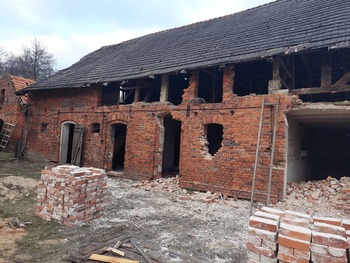
Second, the question arises as to what is actually being destroyed. On the one hand, especially regarding the built world, the boundaries between construction, modification and demolition often blur. That these practices are not clearly distinguishable but are often intertwined can be demonstrated with the example of a house being stripped of selected reusable material. In German, this common practice in the building sector is described as Rückbau, which we would like to call ‘restruction’ here. This practice of obtaining ‘new’/‘old’ bricks from an old building for a new structure illustrates the ambivalence of exactly what is being destroyed (Figure 1). Although the building is demolished and the bricks are taken out of their structural context, they are recreated as bricks in order to be incorporated into new buildings. Their materiality is transformed in the process, especially in their specificity and form. Initially embedded in mortar, they are extracted, sorted and often tumbled or acid-washed to remove debris, thus altering their surface texture. The intention may be to make them look uniform again, while in some instances it is exactly their age and former context that is being appreciated. The bricks carry traces of human labour, a specific era or historical events, with embedded memories of the original structure subtly persisting.
‘Restruction’ of an agricultural building for the extraction of circular building materials. © DolveVita, BauXpert Gebhard GmbH & Co. KG, with friendly permission.

Figure 1 Long description
The image shows a partially demolished agricultural building with exposed brick walls and a damaged roof. Piles of bricks are stacked on the ground, indicating ongoing restoration work. The structure features several arched doorways and windows, some of which are partially intact. The scene suggests efforts to extract and reuse building materials in a circular manner.
This transformation highlights how materiality evolves, yet there is nothing extraordinary about this transformation of matter. Only the rather disruptive character of the transformations in processes of creation and destruction sets them apart from the flow of matter (Ingold Reference Ingold2010). In this regard, science theorist and physicist Karen Barad states:
Matter is a dynamic intra-active becoming that never sits still – an ongoing reconfiguring that exceeds any linear conception of dynamics in which effect follows cause end-on-end […]. Matter’s dynamism is generative not merely in the sense of bringing new things into the world but in the sense of bringing forth new worlds, of engaging in an ongoing reconfiguring of the world (Barad Reference Barad2007, 170).
In this way, not only is the matter of individual things being created and destroyed, but the worlds with which they are entangled have changed. At the same time, creation and destruction are not beginnings and endings but form an ongoing iterative process of reconfiguration. Hence, creation and destruction are only visible as a perceptual phenomenon. Usually, discussions of destruction and creation focus on tangible things, whether they are architecture, landscape or artefacts. If we think relationally, however, it is not individual things but webs of multiple relations that enact what exists as stable entities and what remains ephemeral (Bennett Reference Bennett2010; Fowler and Harris Reference Fowler and Harris2015; Harman Reference Harman2009; Strathern Reference Strathern, de la Cadena and Blaser2018; Watts Reference Watts2013). Creation and destruction can thus be considered interventions in a relational agencement, or assemblage, rather than acts upon fixed entities (for the concept of agencement, see Buchanan Reference Buchanan2021; Nail Reference Nail2017; Schreiber Reference Schreiber2018).
Third, destruction and creation in the common view refer to material aspects, while underestimating symbolic, functional or praxeological dimensions. Moreover, non-artificial things are created and destroyed. If we use the bricks of a destroyed building to recreate a building with the same function and perhaps even the same form in the same place, then we have taken the building apart, replaced the perishable parts and renewed the building. But is the building thus really created anew? We are used to thinking of constructed buildings as new buildings, even if they are partly (or even completely, if that is possible) made of the same components or material. Yet there are other approaches. A noteworthy example is the Ise Jingū, the Shinto Ise Grand Shrine in Japan, which is completely rebuilt every 20 years (Figure 2; Adams Reference Adams1998; Perl Reference Perl2019; Richards Reference Richards2018). From a Western perspective, the shrine has been rebuilt 62 times since the year 690 CE. While the need to renew rotting wood may have been one of the reasons for rebuilding, it developed into a ritual tradition that has survived to the present day, including the use of traditional crafts. Whether the shrine is rebuilt, replicated, imitated, relocated, completely reconstructed, etc. is a matter of cultural interpretation. Archaeologically, such an example would certainly be challenging. Moreover, the question arises of how destruction and creation are represented beyond the building structure from a symbolic and functional perspective. In the case of the Ise shrine, it is precisely the symbolic and functional dimension in addition to the ritual dimension (Urita Reference Urita2015) that is reproduced performatively and thus secured for the long term. Because the shrine is rebuilt, it anchors the religious worldview of a constant cycle of change in the building. In this case, not destroying the building would be destroying its symbolic dimension.
Part of the Ise Jingū, the Ise Grand Shrine in Japan. Photo: ‘Ise Shrine_21’ (https://www.flickr.com/photos/ajari/2561127115/) by ajari (https://www.flickr.com/photos/ajari/) is licensed under CC BY 2.0 (https://creativecommons.org/licenses/by/2.0/).
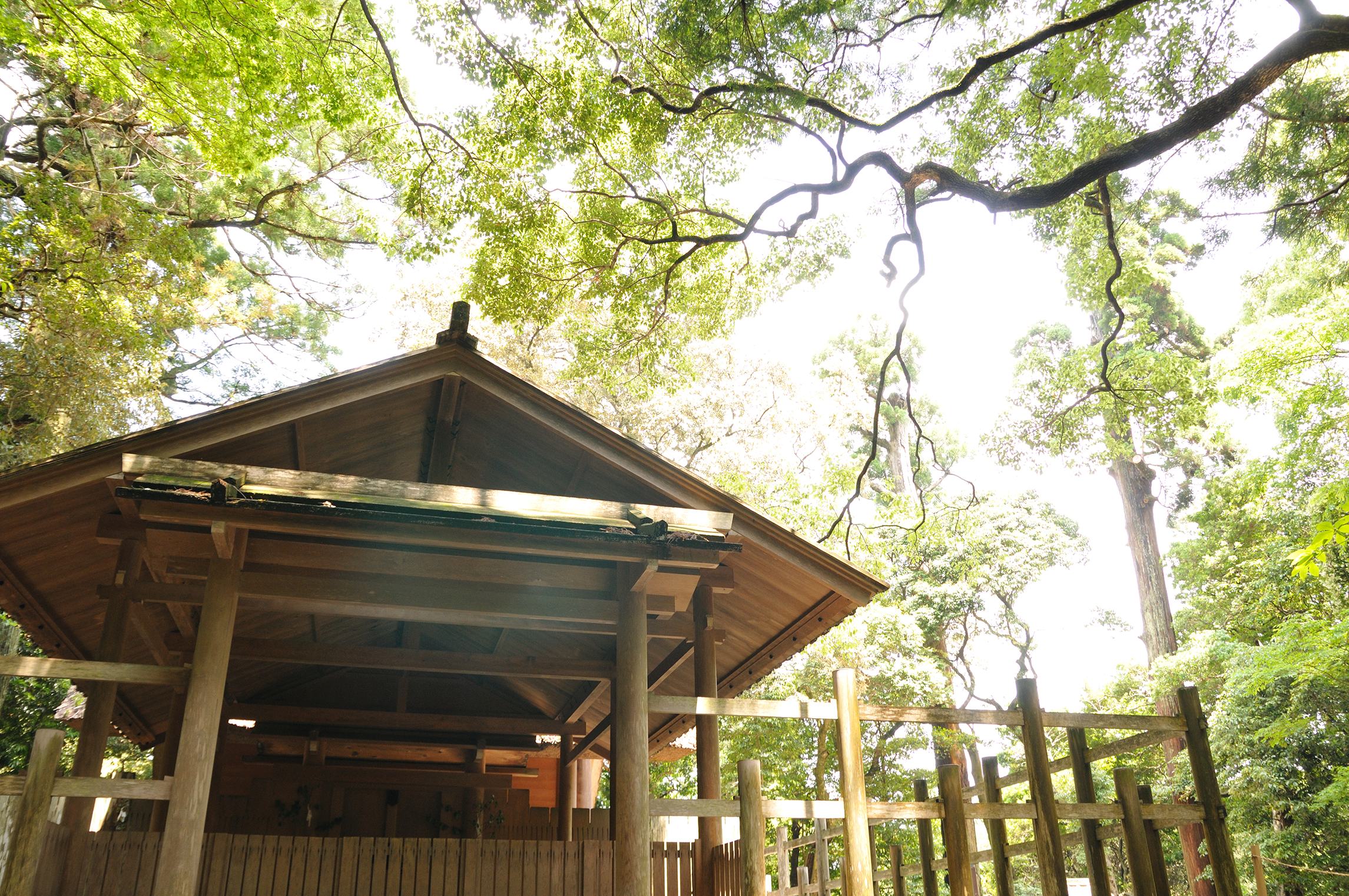
Figure 2 Long description
The image features a traditional wooden structure with a sloped roof, supported by wooden pillars. The structure is partially enclosed by a wooden fence. Above the structure, the branches of large trees with green leaves create a canopy, casting shadows on the roof and the ground. The scene is set in a serene, natural environment, likely a part of the Ise Grand Shrine in Japan.
Remembering and forgetting
Anthropogenic material destruction often targets the symbolic level instead of the material or functional one. The practice of damnatio memoriae in particular points to the complex processes of destruction, reactivation, actualization, disruption, creation, recreation, etc. Nevertheless, both the erection as well as the material destruction of symbolic architecture may potentially be disruptive interventions in the social assemblages. The demolition of favelas in Rio de Janeiro to build infrastructure for the 2016 Olympics, or the eviction of homeless people from the 2024 Olympics in Paris, for instance, are not merely material or symbolic acts of destruction as creation, but a political decision. These interventions frequently perpetuate or intensify social injustices, displacing marginalized communities and destroying the living spaces of subaltern groups. From an archaeological perspective, such politically motivated destructive processes can be recognized as a distinct form of taphonomic transformation processes. Alongside natural and cultural transformations (Schiffer Reference Schiffer1976), we can factor in the political taphonomy (Bernbeck Reference Bernbeck, Pollock and Bernbeck2005, 113) at play.
If we add a transversal level of remembering and forgetting, the process becomes even more complex (Halbwachs Reference Halbwachs1992 [Reference Halbwachs1925]; Erll Reference Erll2017). Remembering does not necessarily go hand in hand with creation, preservation, etc.; forgetting does not necessarily belong to destruction, modification and secondary usage. Remembering can be linked to both the creation and destruction of a building, especially if the construction was accompanied by the destruction of other symbolically significant buildings, or if the destruction left behind ruins with different meanings (Olsen and Pétursdóttir Reference Olsen and Pétursdóttir2014; Schmitz and Habeck Reference Schmitz, Habeck, Habeck and Schmitz2023). Moreover, these are always only possibilities which can occur, but do not have to. Thus, memory can still fade, and forgetting can occur despite constant symbolic and ritual reminders as well as material anchoring in buildings.
Until now, we have tacitly assumed that destruction and creation are human activities that follow human intentions. However, as the devastating earthquake in Turkey and Syria in 2023 has shown, there are also non-human actors involved in destroying and creating, in remembering and forgetting. As in the case of the hurricane Katrina in New Orleans in 2005, the destruction hit low-income neighbourhoods in particular, while the rebuilding created unaffordable housing conditions for them (on the problem of dealing with debris removal, see Dawdy Reference Dawdy2020, 158–59). This raises the question of who the destructive actors actually are: Katrina, the city administration or both. Thus, remembering and forgetting, creating and destroying are in a multilayered, intertwined relationship, which is also constantly changed by the perspective of the human and non-human actors involved (for a more complex analysis of both the natural and social aspects of the event, see Protevi Reference Protevi and Herzogenrath2009). From a posthumanist perspective, remembering and forgetting as well as creating and destroying are not only a question of human intention but also of the actors involved:
Memory is not merely a subjective capacity of the human mind; rather, ‘human’ and ‘mind’ are part of the landtimescape – spacetimemattering – of the world. Memory is written into the worlding of the world in its specificity, the ineliminable trace of the sedimenting historicity of its iterative reconfiguring (Barad Reference Barad2017, 84).
From relating to interrelating
Finally, what does all of this mean for the theoretical framing of destruction as creation? Both destruction and creation are relational modes of interrelating. Archaeology tends to focus on human actors, despite the multiple nature of actors involved, which we would like to call modes of interrelations (Lebek and Schreiber Reference Lebek, Schreiber, Landesmuseum Herne, Leenen, Mentzl and Mölders2023). This concept differs from the more abstract philosophical notion of relation (Fowler and Harris Reference Fowler and Harris2015; Harman Reference Harman2009; Latour Reference Latour2005; Whitehead Reference Whitehead1964 [Reference Whitehead1920]), where relations are defined as any kind of connection between two or more entities, without saying anything about the nature of such a connection. Instead of looking at the inherent properties and characteristics of entities (such as people or things), relations represent a form of de-scripting the world by considering links and relationships and deriving properties and characteristics from them.
Unlike relations, we understand interrelations as specific and powerful relations-in-the-making, always pulling and referring at the same time. Therefore, they are more than just relations, as the orientation to each other is already a quality of the interrelationship (Ahmed Reference Ahmed, Coole and Frost2010). Although the relationship is reciprocal and interdependent, it is not a separating but a connecting one. Interrelationships are social relationships, even if this designation is often used for few types of relationships, such as those between people and perhaps also animals (Seyfert Reference Seyfert2019). We, in contrast, speak of interrelations in general, so as not to limit from the outset who or what is involved in interrelationships.
Moreover, interrelations do not simply exist: they are produced, maintained, interrupted or transformed. As dynamic processes, they are always historically and situationally specific. Yet, as sociologist Robert Seyfert (Reference Seyfert2019) emphasizes, they are not necessarily actively produced; we can distinguish between active and passive modes of their emergence. A broader view of human and non-human interrelationships brings overlooked participants into focus (Bennett Reference Bennett2010; Haraway Reference Haraway2003; Kohn Reference Kohn2013; Puig de la Bellacasa Reference Puig de la Bellacasa2017). Approaches range from the perspective that humans and non-humans can be in meaningful interrelation (Delitz Reference Delitz, Trebsche, Müller-Scheeßel and Reinhold2010) to the view that all assemblages are characterized by their relations and interrelations in the first place – that is, they only exist through their inter/relationships (Schreiber Reference Schreiber2018, 101–03). Nobody and nothing occurs in isolation. This holds for both destructive and creative ties between people and things, which only ever occur in bundles. Thus, they form ensembles of practices, interactions, networks and agencements. Interrelations underscore the embeddedness of all kinds of participants: from animals, plants, bodies, viruses, energy flows and imagined beings to architectural structures (Dovey Reference Dovey, Frichot and Loo2013; see Frichot Reference Frichot2019 on the latter).
From interacting to intra-acting
We further propose perceiving these modes of interrelating not as interaction but as intra-action. In their extensive research design, which they call ‘agential realism’, Barad offers a radical rethinking of the world in its entanglements (Barad Reference Barad2007; Hoppe and Lemke Reference Hoppe and Lemke2015). Barad seeks ways of thinking about causality, origin and change without treating these as fixed or fundamental distinctions. Rather than starting from pre-existing entities (or phenomena) that interact, Barad reverses the causality of relations. This illuminates the complexity of the always pre-entangled processes of continuous or discontinuous becoming that make up what we are used to calling ‘world’.
Becoming, however, is not a goal-orientated process in the sense of progress or teleological development but, rather, a differentiation and reconfiguration of the world (Folkers and Hoppe Reference Folkers, Hoppe, Delitz, Nungesser and Seyfert2018), in which relata gradually emerge through the relations. These intra-actions always ‘behave’ both materially and discursively, enacting and materializing possibilities into actualities: ‘Intra-actions are causal (but nondeterministic) enactments through which matter-in-the-process-of-becoming is sedimented out and enfolded in further materializations’ (Barad Reference Barad2007, 170). This perspective shifts focus from actors engaged in the modes of interrelating to the modes of intra-active becoming that produce and continually transform those actors. ‘Intra-actions enact agential cuts, which do not produce absolute separations, but rather cut together-apart’ (Barad Reference Barad2014, 168; Juelskjaer and Schwennesen Reference Juelskjær and Schwennesen2012; Kleinman Reference Kleinman2012). In this view, what counts as a human actor emerges from material–discursive intra-actions. People and things are not (pre)conditions of relations, but their effects:
Agential realism […] is based on a relational ontology that holds that entities, or relata within phenomena, do not precede their relationships. They arise through relationships. The agential cut is a temporary separation between entanglements. This happens because entities do not preexist their relationships. They arise only through the agential cut. The agential cut enacts a temporary resolution between subject and object. It creates a temporary determinacy within a phenomenon that is inherently indeterminate ontologically and semantically. An agential cut can therefore be seen to be different from a Cartesian cut, which assumes that distinct boundaries are in place, with entities pre-existing relationships. Karen Barad also refer to the agential cut as simultaneously cutting together/apart. This is because it is not an actual cut. The subject and object remain entangled (Bozalek and Fullagar Reference Bozalek, Fullagar and Murris2022, 30).
We would like to illustrate this point with the example of a beaten path (Rees and Schreiber Reference Rees and Schreiber2019, 121): commonly, this phenomenon is seen as people (or animals) subconsciously tending to or actively deciding to take shortcuts, which is how the beaten path gradually emerges. But what does this do to people? In line with Barad, we would describe it this way: walking is orientated towards the agencies involved and forms paths in the intra-active process of becoming. People who use these paths constantly reconfigure them. In intra-active becoming, however, people are also reconfiguring themselves, because they save time, get to places on time, meet other people on the path, break rules, get dirty shoes, etc. These are emerging effects of agential cuts of walking the path, just as the path is an effect of walking the path. Both produce themselves together – they are entangled: ‘[T]he agential cut is not enacted by willful or intentional humans but by the material arrangements of which we are part. The agential cut thus does not have to involve humans’ (Bozalek and Fullagar Reference Bozalek, Fullagar and Murris2022, 30).
To sum up, these modes of interrelation between humans and non-humans demonstrate how we create and shape ourselves alongside the built and created world as entangled actors. We suggest perceiving the different modes of intra-active becoming of the created and built world as a creative moment, rather than merely conceiving destruction as rendering something useless, as iconoclastic actions, material aspects of memory and forgetting or political taphonomy.

 Open access

