




Introduction
Elite politics in North Korea has been a subject of interest to both scholars and policy makers. Kim Il-sung and the political elites of the Manchurian faction are often at the center of histories of early North Korean state building and Kim’s consolidation of power in the 1960s and 1970s (Suh Reference Suh1988; Szalontai Reference Szalontai2005). Social scientists and journalists continued this trend as Kim Il-sung’s son Kim Jong-il rose in power (Breen Reference Breen2004; Martin Reference Martin2007). This focus on personalities in the upper echelons was due in large part to the perception of North Korea as a totalitarian regime wherein all state policies and actions flowed from the top leadership downward.
Recently, the scholarship has been interested in using more granular data on elites to examine changes in elite composition particularly before and after Kim Jong-un’s succession (Haggard, Herman, and Ryu Reference Haggard, Herman and Ryu2014; Ishiyama Reference Ishiyama2014, Goldring and Ward Reference Goldring and Ward2024). Other works have studied patterns in purges, advancing understanding on coup-proofing (Kim Reference Kim2021). These works imply that the use of granular data on elites in North Korea has been not only contributing to understanding political events in North Korea but also shedding insights on politics within a personalist autocracy.
Despite such efforts, there has been no comprehensive dataset on career transitions reflecting ranks within the myriads of institutions in North Korea. Past works have focused on higher-elite dynamics, thus the data reflected a handful of elites in so-called core institutions, such as the National Defense Commission (NDC), the Politburo, and the top military and security organs (Haggard, Herman, and Ryu Reference Haggard, Herman and Ryu2014). Ranks have been dismissed and not coded due to informal power structures—past works have attempted to use other proxies, such as “on-the-spot-guidance” (OSG), or appearances in leadership events, to rank individual-level significance of power (Haggard, Herman, and Ryu Reference Haggard, Herman and Ryu2014; Ishiyama Reference Ishiyama2014, Goldring and Ward Reference Goldring and Ward2024). However, recent works have used elite career data to allude to how personnel management—reshuffles and purges—imply elite management strategies of co-optation and coup-proofing (Sudduth Reference Sudduth2017; Sudduth Reference Sudduth2021; Baturo and Olar Reference Baturo and Olar2023; Goldring and Matthews Reference Goldring and Matthews2023). This approach has been found in studies on North Korea (Kim Reference Kim2021), more extensively in those on China (Shih, Adolph, and Liu Reference Shih, Adolph and Liu2012, Jia, Kudamatsu, and Seim Reference Jia, Kudamatsu and Seim2015), and recently, across autocracies (Baturo and Olar, Reference Baturo and Olar2023).
Motivated by the limitations in the literature, which covers a limited number of elites and lacks information on organization and position ranks within formal institutions, we introduce a dataset that maps career transitions by quantifying career history using the biographies of more than 500 North Korean elites (1948–2021). We make several contributions by creating the dataset. First, as highlighted, there is as yet no structured elite dataset that maps connections both across and within institutions. Previous work has compiled information only on higher ranking elites in core institutions, or only records information on purges. Second, by creating a comprehensive dataset that allows the mapping of both inter-institutional and intra-institutional transitions, we hope to open new avenues of research on leader-elite dynamics in personalist autocracies. The ways in which the regime typology suggested in the authoritarianism literature (Geddes et al., Reference Geddes, Wright and Frantz2014) fails to capture the changing leader–elite dynamics that exist in a personalist autocracy such as North Korea has been discussed in the literature (McEachern, Reference McEachern2010). Shifting focus to personnel management—intra-institutional and inter-institutional transitions, could shed light on the conditions that induce co-optation within a personalist autocracy, in which leader–elite dynamics are often construed as static. We expand on this further in the second section of this article, where we test several testable hypotheses and present preliminary results.
Organization Trees of North Korea’s Political Institutions
We constructed the North Korean Elites Career Transition Dataset by combining information from two sources. Elite career appointments, originally reported in North Korean news media, were first collected and processed by the North Korea Information PortalFootnote 1 and then parsed and coded by our research team. However, as we moved from parsing to coding organizations and positions within North Korea’s political institutions, namely party, military, government, and the parastatal sector,Footnote 2 our team realized that an organizational tree would be necessary for systematic coding and analysis.
We constructed organization trees of North Korea’s political institutions based on documents provided by the North Korea Information Center (NKIC); another information portal managed by South Korea’s Ministry of Unification (MOU). In particular, we relied on the 2022 Personnel Directory of North Korean Institutions and a Supplementary Directory for Non-party/government and Social Organizations.Footnote 3 The Personnel Directory of North Korean Institutions was an invaluable resource for constructing a systematic organization tree.
Within each major institution, organizations are hierarchically nested up to five tiers deep. Organizations within the top two organizational tiers are nearly all represented in our organizational tree; however, from the third tier down, we only include those organizations appearing in the Biographical Database. Organizations which have been renamed, abolished or merged have been aliased or linked to currently active organizations. At present our organization tree includes more than 2,000 organizations.
Finally, we added metadata to the organizational tree which could be used to assist analysis of elite careers. We differentiated elected from non-elected positions. We added indicators of organization and position rank. An organization’s rank was calculated as its tier within the organizational hierarchy of its respective institution. For example, as the Cabinet occupies the top level of its institution’s hierarchy, its organizational rank is coded as 0. The Ministry of Foreign Affairs (MOFA) is immediately under the Cabinet, and so its organizational rank is coded as 1. The First Asia Bureau, which is immediately under MOFA, is coded as 2, and so on.
Position ranks were coded within their respective organizations. The top position in each organization is coded as 1, secondary positions are coded as 2, and all other positions are coded as 3. For example, within the Ministry of Foreign Affairs, the position of Minister is coded as 1, all Vice Minister positions are coded as 2, and all advisor positions are coded as 3. We were careful to differentiate Rank 3 positions in a higher-level organization from Rank 1 positions in a lower-level organization. For example, although the Bureau Chief of the First Asia Bureau answers to the Minister of Foreign Affairs, rather than code this a Rank 3 position in a Rank 1 organization (i.e., Ministry of Foreign Affairs), we code it as a Rank 1 position in a Rank 2 organization (i.e., First Asia Bureau). In many cases, a Rank 3 position in a higher-level organization (e.g., Office Manager or Team Leader) may actually be a Rank 1 position in a minor lower-level organization of which we are not aware.
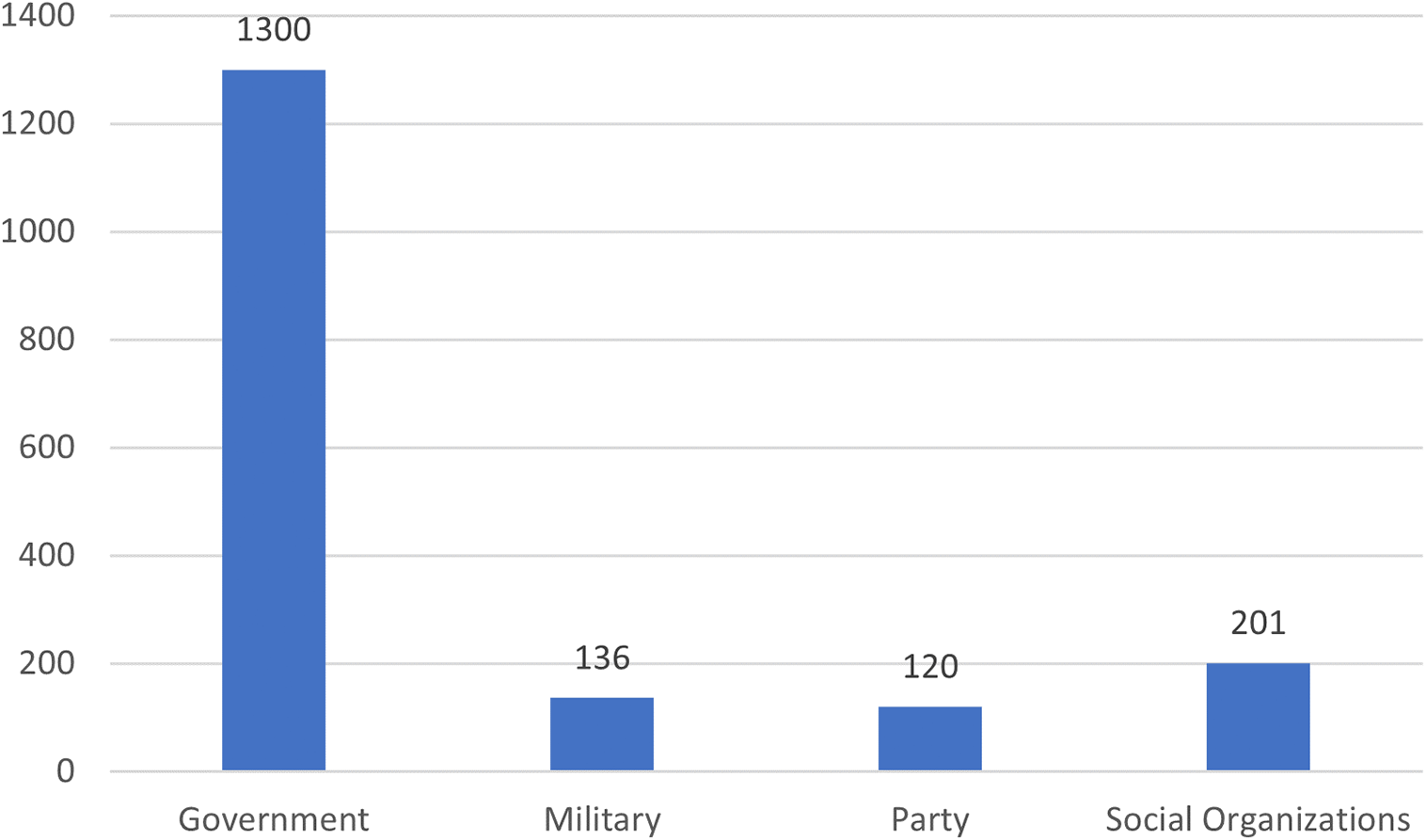
Political appointees within military and government institutions present an additional complication. For example, most non-party organizations are staffed by a party secretary or political officer. We treated political offices as a parallel chain of command alongside non-party administrators and we ranked these positions in a similar fashion. For example, the First Party Secretary attached to a Cabinet ministry was given a position rank 1, secondary Party Secretaries were given position rank 2, and ancillary office staff were given position rank 3. Table 1 illustrates selected organizations from the organization trees of North Korea’s political institutions along with each organization’s respective organization rank and positions. Figure 1 depicts the distribution of organizations within the organization trees of each primary institution.
Selected organizations from the organization tree
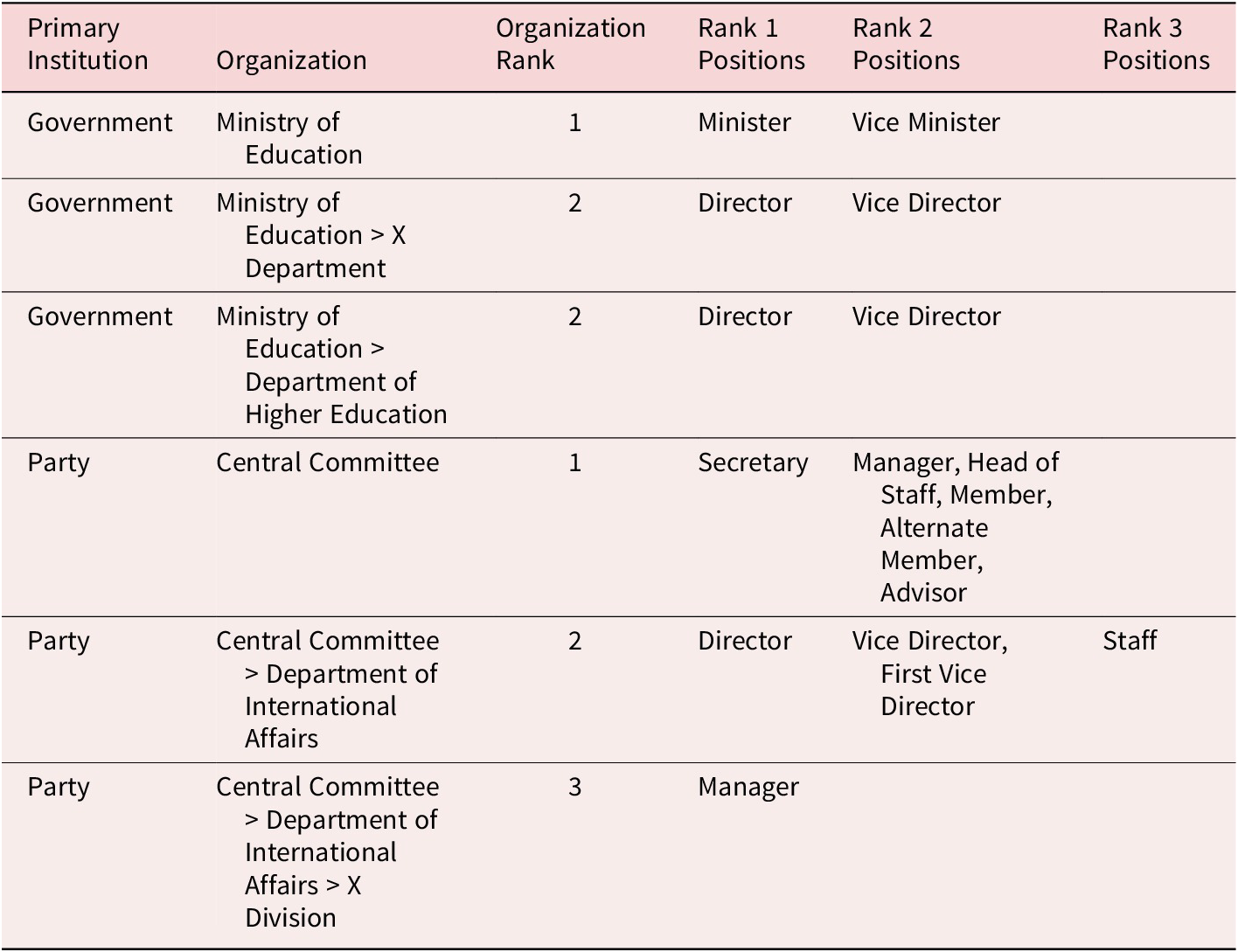
Note: This table depicts three organizations within the government and three organizations within the party. The > symbol indicates hierarchical structure within the organizational tree. In the fifth row, for example, the Department of International Affairs is subordinate to the Central Committee. The second and sixth rows indicate organizations of specified tier and type, but unspecified name, respectively labeled as X Department and X Division. Positions within each organization were either identified in the 2022 Personnel Directory of North Korean Institutions or the career data obtained from North Korea Information Portal, and are not comprehensive.
Number of organizations by primary political institution.
Career Data of North Korean Elites
Having constructed the organization tree, we were then able to properly parse and code the elite career data obtained from the North Korea Information Portal. The North Korea Information Portal is a data repository managed by MOU. The Portal preserves a host of data about North Korea including social and economic statistics, news media, legal regulations, annual reports and expert analysis. Of particular interest to our study is the personnel data presented in the North Korean Biographical DatabaseFootnote 4 which, to the best of our understanding, was extracted from North Korean media by Ministry of Unification researchers.
While the database is well-structured, the data itself is woefully messy and incomplete. Biographical and educational details such as birth year, birthplace, degree and year of graduation are frequently missing. Moreover, education and family data are only present for a small percentage of individuals. Career data, by contrast, is quite robust. Most individuals have two or more items in their career table. However, career data is also far from complete as items often lack position start dates, particularly for retroactively added items predating the Internet. The most problematic aspect of career items is that they lack any systematic structure or coding. The database typically reports career items as sentence fragments summarizing information extracted from media articles. In many cases, a job’s organization or position are not clear. Moreover, many career items refer to multiple jobs attained at the same time. While the education and family tables offer some interesting opportunities for future analysis, this study exclusively draws on career table data. Table 2 shows an example of the career information drawn from The North Korea Information Portal.
Example of Lee Ryong Nam’s career data
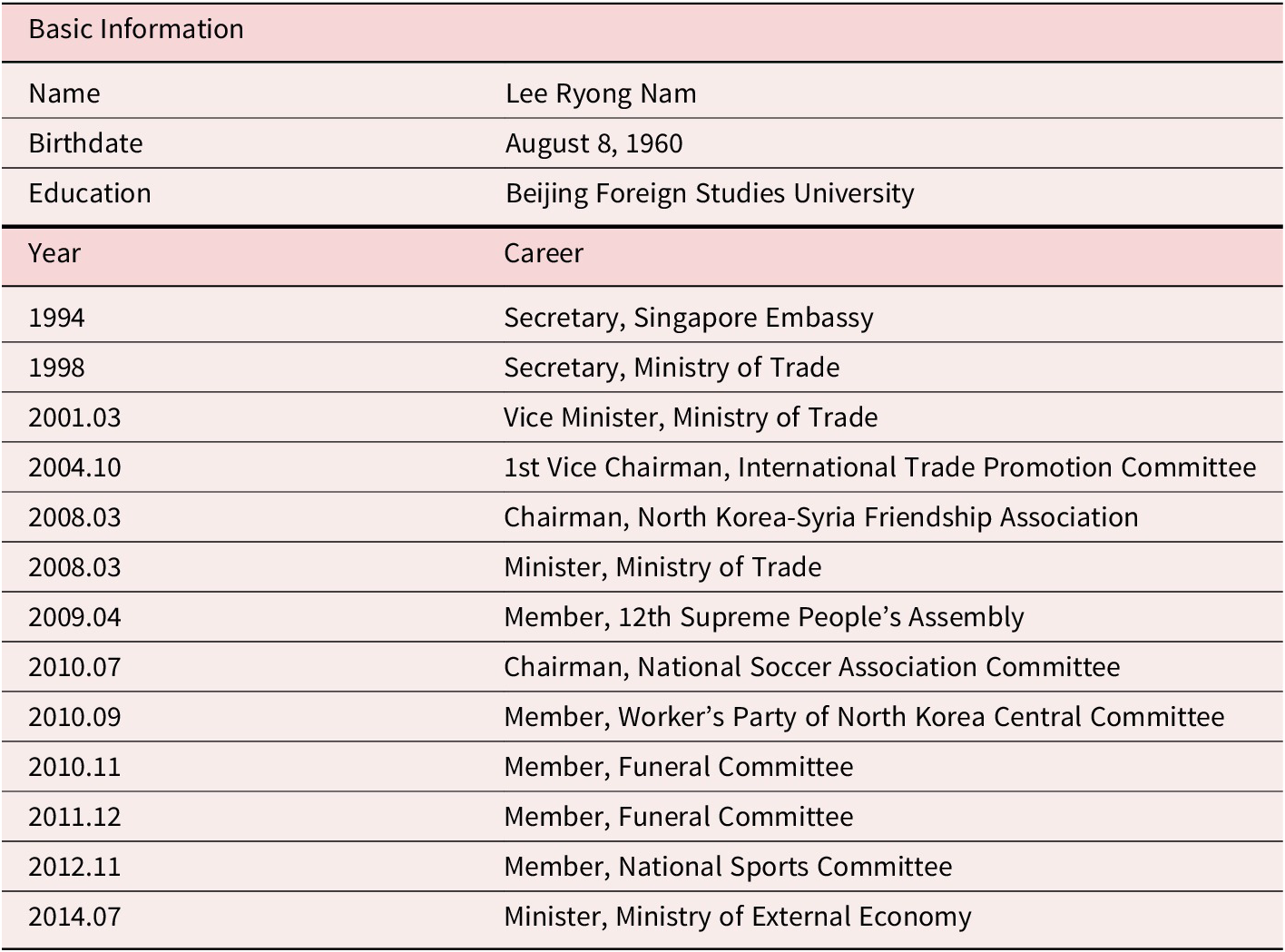
Note: Data obtained from the North Korea Information Portal.
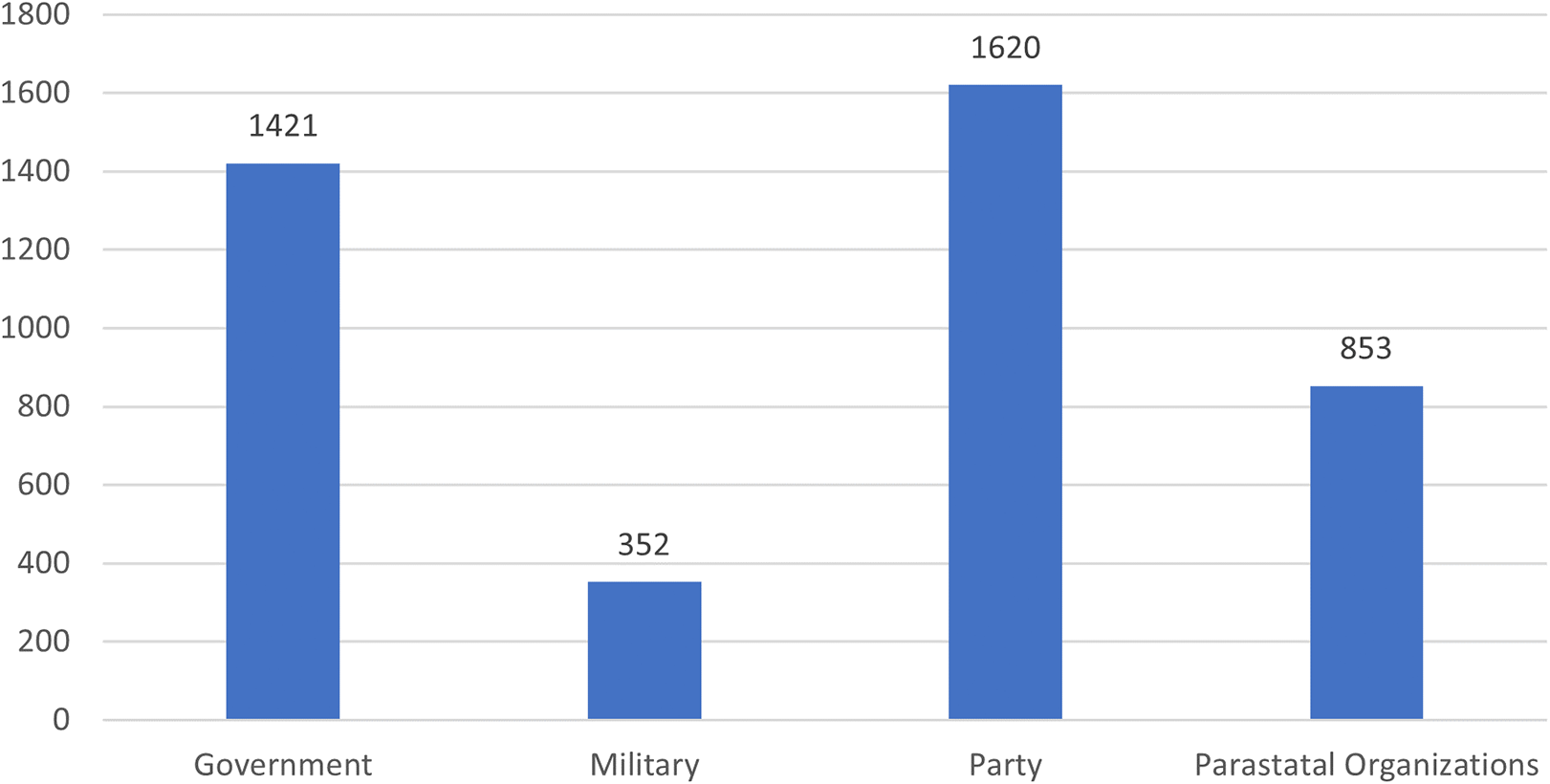
We initially extracted 12,617 jobs, temporary roles, and life events from the career data for 637 elites. Life events included births, deaths, and marriages. Temporary roles included things such as membership in a funeral committee. We also filtered out jobs with uncertain start dates, organizations, or positions. Filtering out temporary roles, life events, and incomplete data left us with 6,116 unique job entries. Next, we parsed the position, organization, starting month, and year for each of these jobs. Career positions and organizations were validated and matched to their corresponding values in the organization tree. When a job’s organization or position was not clear, we-cross checked with the Personnel Directory and secondary sources. Of the 6,116 job entries, 1,870 are elected positions in the Supreme People’s Assembly. For the purpose of this analysis, these were also omitted, leaving 4,246 job entries for 584 elites.Footnote 5 Figure 2 depicts the distribution of these jobs across North Korea’s primary political institutions.
Number of jobs by primary political institution.
Note: Omits life events, temporary roles, and positions in the Supreme People’s Assembly. Life events include births, deaths, and marriages. Temporary roles include items such as being a delegate to a conference or a member of a state funeral committee.
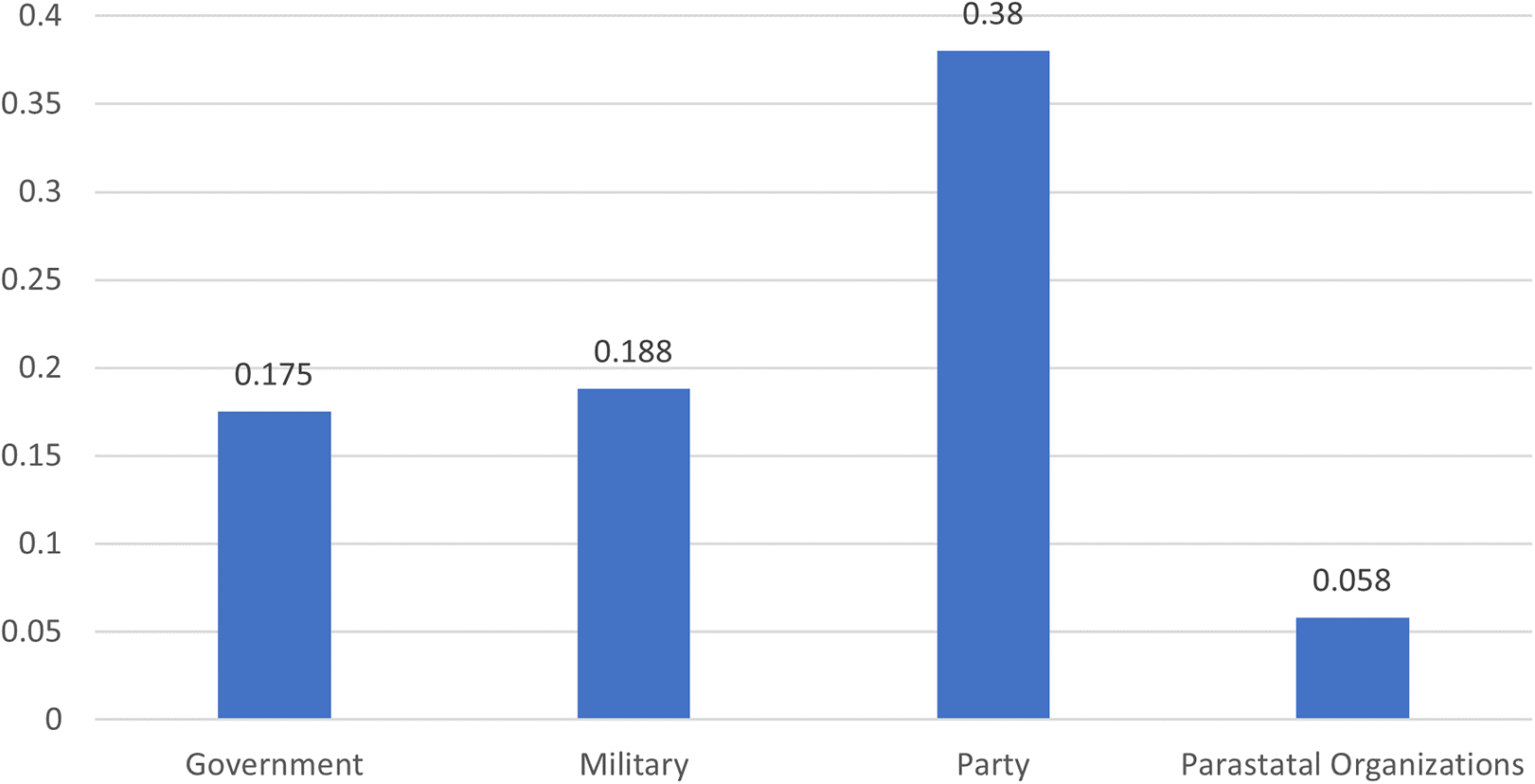
Joint appointments are another notable feature of North Korean career data. Approximately 20 percent of all jobs in the data were announced jointly with anywhere between two and four additional jobs. Table 2 offers an example of this in March 2008, when Lee Ryong Nam was jointly appointed the Chairman of the North Korea-Syria Friendship Association as well as the Minister of Trade. As Figure 3 shows, the rate of joint appointments is particularly high with jobs in the party and low with jobs in the parastatal sector.
Frequency of joint appointments by primary political institution.
Career transitions of North Korean elites
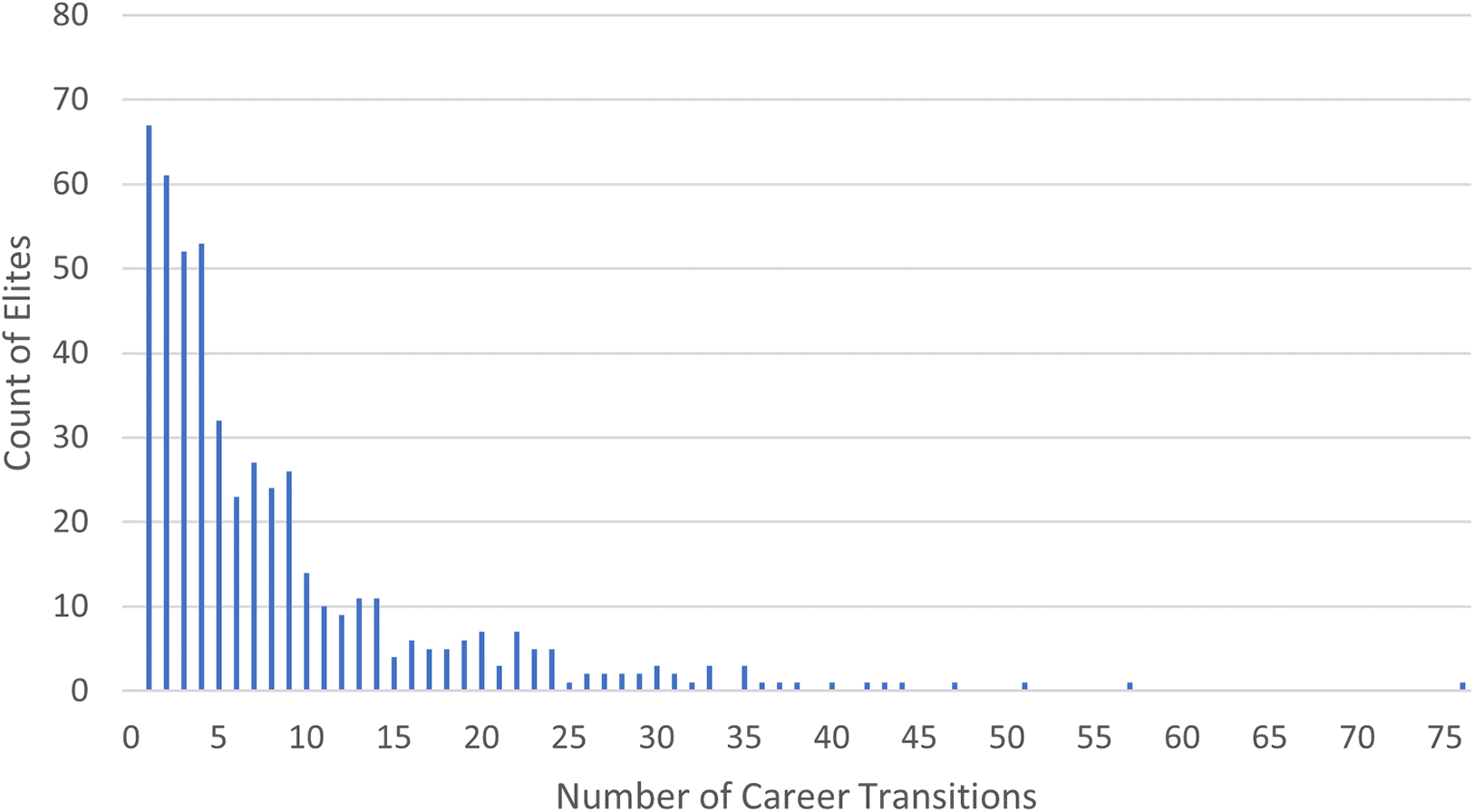
Using each elite’s chronological resume, we were then able to create a new dataset of elite career transitions indicating each pair of jobs held in sequence. Table 3 shows an example of the career transitions derived from the resume of a single elite in Table 2. This transitions dataset utilized all 4,246 items, including government and parastatal jobs, and resulted in 4,222 transitions for 505 elites.Footnote 6 The frequency of elites by the number of job transitions may be seen in Figure 4. The most common number of transitions per resume is 1 however the average number of transitions is 8.53. The reason for the skewed distribution is that a few prominent leaders have prolific resumes (max = 76).
Example of Lee Ryong Nam’s Career Transitions
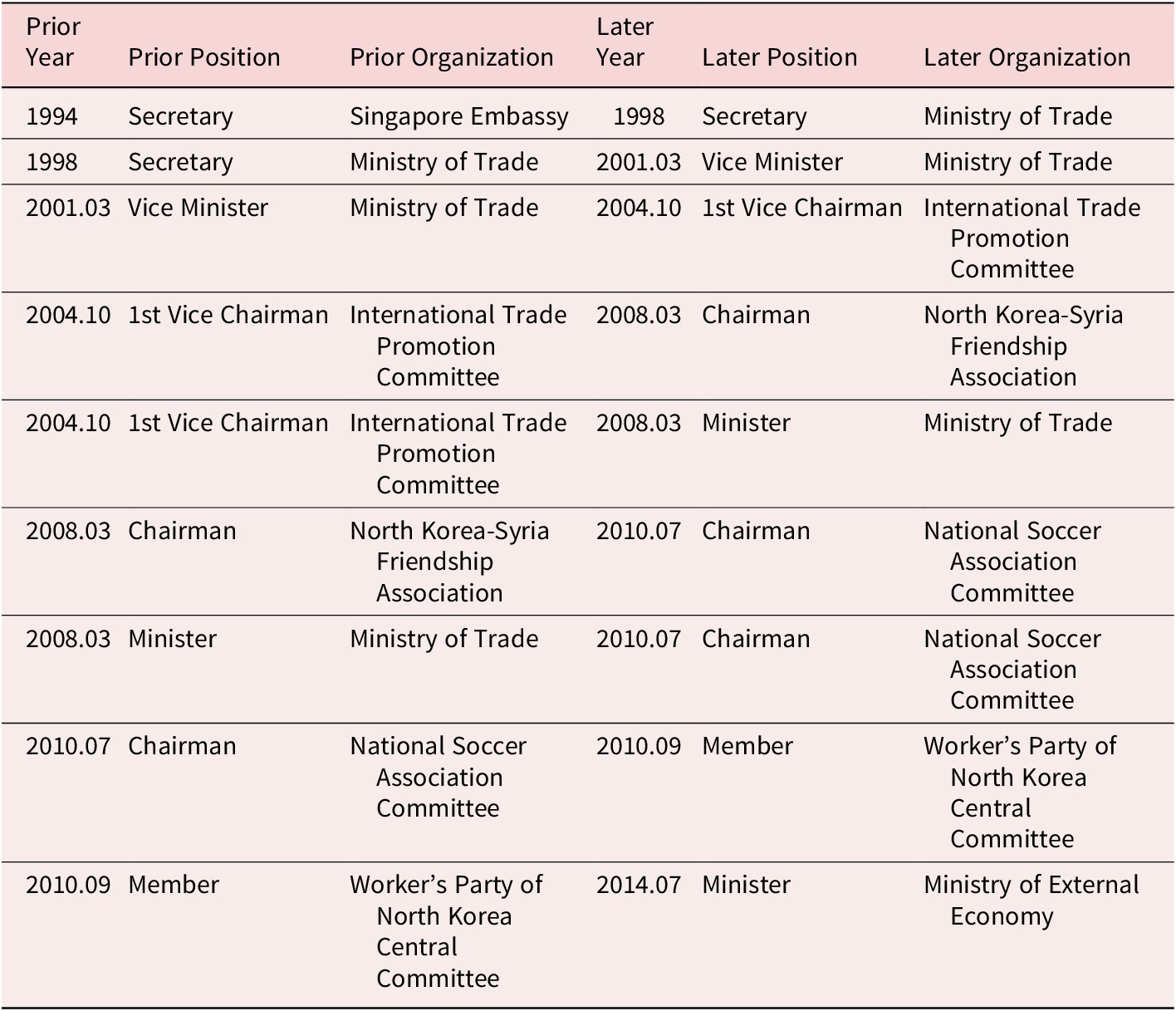
Note: Career transitions are constructed from sequential job pairs of the resume. Joint appointments are each uniquely paired prior and successive jobs.
Frequency of leaders by number of job transitions.
Having structured the transitions dataset, we were able to add covariates reflecting changes in organization and position rank from one job to the next. These changes in rank were used to test hypotheses about elite career transitions within and across institutions. Changes in organization and position rank were simply calculated by subtracting the later rank from the prior rank for each pair of jobs in a given transition. For example, if an elite was promoted from the head of level 3 organization (OrgRank=3, PositionRank=1) to vice-head of level 2 organization (OrgRank=2, PositionRank=2), the change in organization rank for that transition would be coded as 1, while the change in position rank would be coded as -1. Positive changes in rank indicate upward mobility within the organizational hierarchy. It should be noted that organization ranks are relative across institutions. For example, a position in the highest echelon (OrgRank=0) of the parastatal sector may actually confer less power and authority than a position in the middle echelons (OrgRank>2) of a higher-tier institution such as the party. Nonetheless this coding scheme constitutes a first-order attempt to systematically represent and analyze career mobility of North Korean elites.
Examining Leader-Elite Dynamics with Career Transition Patterns
As mentioned above, extant literature has discussed the limits in the authoritarian regime typology in addressing politics of North Korea—despite being categorized as personalist autocracy, the regime has gone through several shifts in leader-elite dynamics. The Kim Il-sung period (1948–1994) has been marred with personalization, consisting of Kim’s complete control over the coercive apparatus and subsequently the Korea Worker’s Party (KWP) (Song and Wright, Reference Song and Wright2018). The period has been coined in the literature as totalitarian (Breen Reference Breen2004; Martin Reference Martin2007; Szalontai Reference Szalontai2005). However, the wave of research during the subsequent Kim Jong-il period has shown that there was inter-institutional competition within the regime, which Kim Jong-il allowed amidst a myriad of crises such as economic deprivation and famine (McEachern Reference McEachern2010; McEachern Reference McEachern2009). This period showed the increase in the influence of the military in policy making as result of the ‘military first’ strategy and increased influence of the technocrats in economic planning. The increased influence of these actors other than the personalist leader and his clique has been described as decreased in the party dominance and personalism, relative to Kim Il-sung period, and often coined as rise of post-totalitarianism (McEachern Reference McEachern2010; McEachern Reference McEachern2009), or systematic dissonance (Kim Reference Kim2012). The tide is shifting backwards when looking at the Kim Jong-un period. Under Kim Jong-un there is an increase in personalism—accompanied with purges of individuals and institutions, institutions lost the power to influence policy making and their roles were limited to policy implementers (McEachern Reference McEachern2019).
The gap then that remains is—why would the leader-elite power balance change over time within a personalist autocracy, and how? As a preparative effort to bridge the gap, we turn attention to personnel management and career transition patterns—which captures changing elite-leader dynamics in a personalist autocracy. Career advancement within a state-party bureaucracy determines elites’ access to rents and patronage networks, which the leader allows at the baseline to credibly commit to power-sharing with the elites. However, when threat to the leader is high, the leader can strengthen the upward intensity of within institution career advancement patterns to increase power-sharing and signal credible commitment while at the same time, checking appointments across institutions to constrain inter-institutional coordination with the military that could be detrimental to leaders’ survival.Footnote 7
To test implications of the theory, we test a hypothesis centered on succession periods. Succession has been considered one of most challenging issues for authoritarian rulers, and therefore establishing a succession rule reduces uncertainty and forestalls power vacuum (Brownlee Reference Brownlee2007). In the study of China, succession rules have been discussed as an institution that allows credible power sharing between the leader and the elites, achieving regime durability (Ma Reference Ma2016). Weak rules on succession, therefore, increases changes of regime instability. Following this logic, we hypothesize that when succession rules are weak, the threat level to the leader is high, resulting in stronger intensity of upward intra-institutional mobility paired with weaker intensity of elites being appointed from and towards the military.
H1. When succession is less institutionalized, there is stronger intensity of upward intra-institutional mobility compared to when succession is more institutionalized.
H2. When succession is less institutionalized, there is weaker intensity of inbound and outbound appointments in the military, compared to when succession is more institutionalized.
To test the hypotheses, we exploit within-regime variation—we compare the first hereditary successor Kim Jong-il’s succession period with the second hereditary successor Kim Jong-un’s succession period. We identify the period before Kim Jong-il’s succession in 1994 as less institutionalized compared to the period before Kim Jong-un’s succession as the prior was the first hereditary succession that took place since the establishment of the country in 1948. These succession preparation periods are identified as the following: the period before Kim Jong-il’s succession 1974–1994 and period before Kim Jong-un’s succession 2009–2011. In 1974, Kim Jong-il was recommended as a successor at the 5th plenary session of the 8th central committee. Kim Jong-un was officially designated as a successor in 2009 (Koh Reference Koh2010; Cho Reference Cho2011).Footnote 8
We applied scope conditions to the data so that the sample used captures the concepts in the hypothesis. As we derive the hypothesis based on the logic of dictator-ruling coalition dynamics, we added two scopes—elites that worked in bureaus geographically located in the capital, Pyongyang; and removed those who had never worked in top two organizational tiers. These scope conditions were made so that the sample captures the concept of ‘ruling coalition’—elites residing in geographical proximity to the leader and working in high-ranking bureaus who wield enough power both necessary and sufficient for the survival of the regime (Svolik Reference Svolik2009).
Due to the precise information on ranks of organizations and positions within each institution in our dataset, we were able to measure rates of upward mobility in intra-institutional position rank while holding organization rank constant. This is a more conservative measurement than upward mobility in organizational rank, which can be accompanied by a drop in position ranks. Rates were calculated for each of the two succession preparation periods, t1: Kim Il-sung to Kim Jong-il (1974–1994) and t2: Kim Jong-il to Kim Jong-un (2009–2011). We compared rates over all institutions collectively. We used a two-sample z-test of proportions to test whether measures of intra-institutional upward mobility were significantly higher in t1 than t2, as predicted by H1.
In order to test H2, we calculated the fraction of outbound appointments from among all appointments originating from the military, as well as the fraction of inbound appointments from all appointments ending in the military. We used a two-sample z-test of proportions to test whether the rate of inbound and outbound appointments in the military was significantly higher in t2 than t1, as predicted by H2. Two-sample z-tests of proportion were deemed the most expedient method for testing the rates of appointment between the two succession-preparation periods. Z-tests are used when the population variance is known, or for sample sizes larger than 30, whereas t-tests are used for sample sizes less than 30 and when population variance is unknown. As our sample sizes exceeded 30, we opted for z-tests over t-tests.Footnote 9
Preliminary findings
As our hypothesis deals with comparisons across two succession periods, t1: Kim Il-sung to Kim Jong-il and t2: Kim Jong-il to Kim Jong-un, we employed a two-sample z-test to test whether the population means of the two periods were the same. As for H1 as our hypothesis is that upward mobility is higher in t1 compared to t2, our null hypothesis indicates that there is no difference in upward mobility between the two periods, $ \mu $
t1=
$ \mu $
t1= $ \mu $
t2. As for H2, our hypothesis is that inbound and outbound appointments in the military occur less in t1 compared to t2, our null hypothesis indicates that there is no difference in the rate of inbound and outbound appointments between the two periods,
$ \mu $
t2. As for H2, our hypothesis is that inbound and outbound appointments in the military occur less in t1 compared to t2, our null hypothesis indicates that there is no difference in the rate of inbound and outbound appointments between the two periods, $ {\mu}_{t1} $
=
$ {\mu}_{t1} $
= $ {\mu}_{t2} $
. As the lack of difference can be positive or negative, we pay particular attention to the direction of the z-statistic and the p-value to interpret statistical significance.
$ {\mu}_{t2} $
. As the lack of difference can be positive or negative, we pay particular attention to the direction of the z-statistic and the p-value to interpret statistical significance.
Our preliminary findings suggest weak support for H1 while confirming H2. The positive z-statistic in Table 4 suggest that there was stronger intensity of upward mobility in Kim Il-sung to Kim Jong-il succession period (t1) compared to Kim Jong-il to Kim Jong-un succession period (t2) overall, however the p-value was statistically insignificant. As for H2, the negative z-statistic in Table 5 suggests that there was weaker intensity of inbound and outbound appointments in the military in Kim Il-sung to Kim Jong-il succession period (t1) when succession was relatively less institutionalized, compared to Kim Jong-il to Kim Jong-un succession period (t2). The difference was statistically significant at 0.05 significance level.
H1: Intra-institutional position advancements, while holding organization ranks constant

Note: *p < 0.10, **p < 0.05, ***p < 0.01
H2: Inbound and outbound appointments, military

***p < 0.10, p < 0.05, ***p < 0.01
Discussion and conclusion
Studies of comparative authoritarianism have viewed elite management—promotions and transfers to purges and demotions—as tools of co-optation and coup-proofing, which are central to authoritarian survival. In the case of North Korea, these aspects have not been fully examined due to lack of granular data on ranks of organizations and positions within institutions. The dataset we have compiled records not only ranks of organizations but positions within the organizations in government, party, military and parastatal sector—which allows empirical examination of career advancements within institutions as well as across institutions. We have shown a preliminary use of the data by testing hypotheses that predict variation in adoption of different elite management strategies, intra-institutional upward mobility and appointments from and towards the military. The results show that when succession rules are less institutionalized, dictators are more likely to use strategy of intra-mobility—signaling credible commitment to access to rents; while refraining from using inbound and outbound appointments in the military to reduce collusion of the military with other institutions.
The data presented here opens avenues for further research that can add value to both studies on North Korea but comparative authoritarianism. First, our tables of organizations, elites and careers can be appended by merging with other data, such as Taekbin Kim’s (Reference Kim2012) dataset on elites, which includes information on personal attributes such as education background and gender. Similarly, the data could be updated with interpersonal connections and shared affiliations such as family ties, school ties, and work ties. With this augmented data, we can empirically test how personal and interpersonal attributes influence elite management. In addition, by coding positions within an organization as either political or technocratic, we might test whether a North Korean version of the classic “Reds vs Experts” distinction affects elite mobility patterns and career paths.
Second, the data can be used to expand comparative knowledge on elite managements across personalist autocracies—a lot of data has been accumulated on China covering Xi period,Footnote 10 which can be used in comparison with our data for comparative analysis of elite management strategies under personalist autocracies, which can increase the external validity of the hypotheses tested here.
Lastly, once we have clearly established some elite management strategies and mobility patterns, we may explore the effects of these patterns on political organization and institutional dynamics. For example, do siloed institutions operate differently than those exposed to high rates of inter-institutional mobility? Does the ratio of political officers to technocrats affect institutional outcomes? Are some organizations more susceptible to nepotistic appointments than others, and does this affect organizational efficiency? Analyses linking organization to outcomes would require additional conceptualization, measurement and collection of data on organizational outcomes. However, once linked to the organization and career data presented above, the combined dataset will hopefully produce even broader insights about the effects of elite management on internal governance and politics in North Korea.
Supplementary material
The supplementary material for this article can be found at http://doi.org/10.1017/jea.2025.2.
Funding
This research was supported in part by the German Institute for Global and Area Studies and the National Chengchi University institutional research grant No. 112KY0121.
Competing interest
There is no potential conflict of interest to report regarding this research.


 Open access

