


Introduction
In east and northeast Asia, the beginning of the Neolithic is usually connected with the emergence of pottery. The Amur—also known as the Heilongjiang—River basin represents one of the main centres of early pottery. Current evidence suggests that ceramics emerged when the Late Glacial hunter-gatherers occupied the middle and lower reaches of the Amur River and were associated with two cultural complexes: the Osipovka and the Gromatukha Cultures (Derevianko et al. Reference Derevianko, Kuzmin, Burr, Jull and Kim2004; Kuzmin Reference Kuzmin2014; Shoda et al. Reference Shoda, Lucquin, Yanshina, Kuzmin, Shevkomud, Medvedev, Derevianko, Lapshina, Craig and Jordan2020).
The Xiaonanshan site is on the west bank of the Ussuri River, a large tributary of the lower Amur River. Based on sporadically found ceramics and lithics, it has long been regarded as the southernmost representative site of the Osipovka Culture (Figure 1; Li Reference Li2021a; Medvedev et al. Reference Medvedev, Filatova and Girchenko2021). However, the date and cultural characteristics of Xiaonanshan remained unclear until new excavations took place from 2015–2021. Here, we report the newly excavated lithic assemblage from the Redianchang locality of Xiaonanshan, which is dated to the Late Glacial and is closely related to the Neolithisation in the Amur River basin.
The location of the Xiaonanshan site and other sites mentioned in the text (figure by authors).

Site description
The Xiaonanshan open-air site (46°47′42.39″ north, 134°1′48.02″ east) is located on the homonymic hill in Raohe County, Heilongjiang Province of northeast China (Figure 2a). The site was discovered in 1958 and underwent several tentative excavations from the 1970s–1990s. Since 2015, there have been systematic archaeological surveys and large-scale excavations. To date, at least five phases of cultural remains spanning from c. 16–2 ka have been identified (Li & Yang Reference Li and Yang2019; Li Reference Li2021b); Phase I is the focus of this study.
The landscape of Xiaonanshan showing dates of excavations (a & b); and excavation squares and stratigraphy of the Redianchang locality in 2021 (c & d) (figure by authors).

Redianchang is situated on the northern slope of the Xiaonanshan hill (Figure 2b). In 2021, 130m2 of the site was exposed, including eight squares (Figure 2c). Four stratigraphic units (labelled Layers 1–4 on Figure 2d) were identified. Each layer was excavated in 50mm increments and the three-dimensional co-ordinates of lithic artefacts longer than 10mm were plotted with a Total Station. All excavated deposits were sieved through a 3mm mesh. In total, 16 484 lithic artefacts were retrieved, with most (> 77%) from Layer 3. A radiocarbon date of 13 710 ± 40 BP (Beta-611604: 16 785–16 390 cal BP at 95.4%) was provided by one piece of charcoal, which was associated with wedge-shaped microblade core, a bifacial point and a partially polished adze from a ditch under Layer 3.
Lithic industry of the Redianchang locality, Xiaonanshan
Lithic artefacts from each layer of the Redianchang excavations have similarities in raw materials and techno-typological characteristics. Tuff from local riverbeds is the predominant raw material. Other raw materials, such as basalt, agate and obsidian, occur in low frequencies.
Techno-typologically, three reduction series, including microblade, blade and core-flake debitage, have been identified. Microblade debitage, represented by 64 microblade cores and a series of debitage products, served as the primary reduction objective (Figures 3 & 4). The microblade cores are wedge shaped, prepared with the Yubetsu method (Figures 3a & 3c–f; Inizan et al. Reference Inizan, Reduron-Ballinger, Roche and Texier1999). Pebbles or flakes were usually selected as a blank and often shaped bifacially. Longitudinal spalls were then removed to create a platform. A few microblade cores show a different pattern of platform preparation, where the platform was formed by successive transverse removals (Figure 3b & 3g). Microblades were detached by pressure knapping in both cases. Simple core-flake and blade reduction are present but in small amounts.
Microblade cores from Xiaonanshan: a & c–f) microblade cores prepared with the Yubetsu method; b & g) microblade cores with platform formed by successive transverse removals (figure by authors).

Crests (a & b), microblades (c–e) and retouched microblades (f–h) from Xiaonanshan (figure by authors).

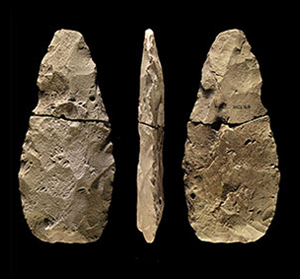
The formal tool inventory (n = 200) contains diversified tool types and presents various operational schemes. Scrapers, endscrapers, points, borers, notches and denticulates, accounting for 58 per cent of the formal tools, usually used flakes as blanks and most lack morphological standardisation. Bifacial points (n = 30, 15%) were also flake based but underwent elaborate bifacial shaping and exhibit a high degree of symmetry (Figure 5). Microblades were also selected as tool blanks. In this case, pressure knapping was applied for the manufacture of a delicate tip at the proximal or distal end of microblades (n = 37, 18.5%; Figure 4f–h). Adzes (n = 16, 8%) were relatively large and usually made on cobbles or thick flakes (Figures 6a & b). Direct percussion and sometimes a grinding technique were used to shape these pieces. One stone sinker has also been identified (Figure 6c).
Bifacial points from Xiaonanshan (figure by authors).

Stone adzes (a & b) and sinker (c) from Xiaonanshan (figure by authors).

Discussion and conclusions
The lithic industry of the Redianchang locality is characterised by microblade debitage derived from the Yubetsu method and by tools such as scrapers, bifacial points, retouched microblades and chipped/polished adzes. During the 2019–2020 excavations, similar lithic assemblages were recovered from other localities of Xiaonanshan and were associated with early ceramics, hearths and dwellings (Li Reference Li2021b). The pottery sherds are fragmentary, low-temperature, and usually with grass imprints on both the inner and outer surfaces. The site also has two semi-subterranean dwellings, one of which was dated to 12 470 ± 50 BP (Beta-574100) using charcoal from its central hearth. Some other 14C dates (Beta-574094: 13 270 ± 40; Beta-574097: 12 120 ± 40 BP; Beta-574095: 11 720 ± 40 BP) were also obtained. All of the above-mentioned remains have a reliable timespan between 16.5 and 13.5 cal kyr BP and can be assigned to the Xiaonanshan Phase 1. The artefacts exhibit clear similarities to those from contemporaneous sites along the middle and lower Amur River, such as the Gromatukha site of the Gromatukha Culture and the Gasya, Khummi and Goncharka-1 sites of the Osipovka Culture (Figure 1; Kuzmin & Orlova Reference Kuzmin and Orlova2000; Derevianko et al. Reference Derevianko, Kuzmin, Burr, Jull and Kim2004).
Overall, the emergence of early pottery, application of stone-grinding technique and the construction of semi-subterranean dwellings demonstrate that the Late Glacial hunter-gatherers were reducing their mobility and developing stone-tool and pottery production for intensified exploitation of local resources (Shoda et al. Reference Shoda, Lucquin, Yanshina, Kuzmin, Shevkomud, Medvedev, Derevianko, Lapshina, Craig and Jordan2020). Such significant transformations in technology, subsistence and mobility patterns during the Late Glacial signal the beginning of a new epoch—the Neolithic in the Amur River basin.
Acknowledgements
We thank Y.X. Zhang and F.X. Huan from the University of Chinese Academy of Sciences for helping to identify lithic raw material and for photographs of the artefacts.
Funding statement
This research is funded by the National Social Science Foundation of China (20CKG003).



