





Classroom emotions have been found to affect the learning process and learning outcomes, with emotions linked to learning success in mathematics (Ahmed et al., Reference Ahmed, Van der Werf, Kuyper and Minnaert2013), science (Tobin & Llena, Reference Tobin, Llena, Tobin and Shady2014), and foreign language (FL) learning (Dewaele & MacIntyre, Reference Dewaele and MacIntyre2014; Botes et al. Reference Botes, Dewaele and Greiff2022a; Dewaele, Botes et al., Reference Botes, van der Westhuizen, Dewaele, MacIntyre and Greiff2022). Within the context of FL learning, three emotions in particular have been scrutinized—the well-established negative emotion of foreign language anxiety (FLA; Horwitz et al., Reference Horwitz, Horwitz and Cope1986), the more recent positive emotion addition of foreign language enjoyment (FLE; Dewaele & MacIntyre, Reference Dewaele and MacIntyre2014), and the even more recently introduced negative emotion of foreign language boredom (FLB; Li et al., Reference Li, Dewaele and Hu2023; Pawlak et al., Reference Pawlak, Zawodniak and Kruk2020).
Most studies have examined these emotions in FL learning as a predictor variable in conjunction with utilitarian outcomes such as achievement in the FL classroom (Shao et al., Reference Shao, Pekrun, Marsh and Loderer2020). The recent introduction of positive psychology into the FL research context (MacIntyre & Mercer, Reference MacIntyre and Mercer2014; Wang et al., Reference Wang, Derakhshan and Zhang2021) has led to an increased interest in the subjective experience of the FL learner in the FL classroom, including the FL learner’s positive emotions and positive interactions (Dewaele et al., Reference Dewaele, Chen, Padilla and Lake2019). In this framework of considering the holistic well-being of the FL learner to be of equal importance to the ultimate goal of acquiring the target language, emotions ought also to be considered as an outcome variable. Indeed, the maximizing of enjoyment and limiting the experience of anxiety and boredom in the FL classroom should also be considered something worth striving for. However, if emotions in the FL classroom are placed center stage as outcome variables, the antecedents and predictors in the larger nomological network of these emotions ought also to be given their due.
A largely unexplored predictor of FL classroom emotions is that of personality. By and large, personality traits—which can be defined as the relatively stable traits of behaviors, thoughts, and feelings of an individual (DeYoung, Reference DeYoung, Mikulincer, Shaver, Cooper and Larsen2015)—have been largely underresearched in applied linguistics. This is not surprising, given the relatively small amounts of variance often explained in foreign language (FL) proficiency by personality traits, especially in comparison with the meatier findings with respect to motivation and ability (Dewaele, Reference Dewaele, Mercer, Ryan and Williams2012). Indeed, a recent meta-analysis focusing on correlational relations between personality traits and FL academic performance found relatively small effect sizes (−.036 < r < .225; k = 137; Chen et al., Reference Chen, He, Swanson, Cai and Fan2022). It is therefore no wonder that Dörnyei (Reference Dörnyei2005) remarked that “the role and impact of personality factors are of less importance than those of some other individual difference variables such as aptitude and motivation” (p. 10). However, if the outcome variable shifts from proficiency or achievement in the FL class toward FL emotions, the possibility of personality as a predictor of import ought to be revisited.
The current study therefore seeks to explore personality traits (on both a global and second-order level) as predictors of anxiety, enjoyment, and boredom in the FL classroom in order to transparently explore the complexities associated with personality as a predictor variable. In doing so, we hope to provide a first initial in-depth exploration of personality as a predictor of FL emotions while critically examining not only statistical significance but also relative effect size.
Personality and emotion
The underlying theory regarding the relationships between personality and emotion rests on the assumption that individuals can experience the same event (i.e., a lesson in a FL classroom) but experience different emotions in response to this same event due to underlying individual differences (Larsen et al., Reference Larsen, Buss, Wismeijer, Song and den Berg2017). This theoretical viewpoint is supported throughout the historical development of personality psychology and emotion psychology theory.
Within personality psychology literature, the notion that trait emotions are inherently linked to personality can be traced to the work of Magda Arnold in her treatise Emotion and Personality (1960). Through integrating the psychological, neurological, and physiological aspects of emotion, she positioned emotion as dispositional traits to a certain extent (Shields & Kappas, Reference Shields and Kappas2006). Furthermore, older theories of emotion often refer to an underlying behavioral instinct as a driver of emotion (McDougall, Reference McDougall1928).
In turn, modern theories such as the five factor model (FFM) of personality have assumed that the tendency to experience positive or negative emotions is inherent to certain personality traits—that is, extraversion may be measured using the Positive Emotion Tendency subscale (Costa & McCrae, Reference Costa and McCrae1992). In addition, negative traits such as neuroticism may imply a predisposition to experience and show negative moods such as anxiety (Watson & Clark, Reference Watson and Clark1984). In terms of FL emotion specifically, personality as a predictor can be substantiated through the control-value theory of academic emotions (Pekrun et al., Reference Pekrun, Frenzel, Goetz, Perry, Schutz and Pekrun2007). The control-value theory postulates that distal individual antecedents, such as temperament, may influence the emotional experiences of learners in an educational setting (Pekrun et al., Reference Pekrun, Frenzel, Goetz, Perry, Schutz and Pekrun2007). Therefore, some learners are predisposed to form a judgement or appraisal regarding certain aspects of learning through for example, their personality, which in turn influences the formation and display of certain emotions (Sorić et al., Reference Sorić, Penezić and Burić2013). Furthermore, research in domain-general and mathematics-specific education has found significant relationships between personality traits and classroom emotions (Sander & de la Fuente, Reference Sander and de la Fuente2022; Wang et al., Reference Wang, Oh, Malanchini and Borriello2020). The global personality traits of Conscientiousness and Neuroticism in particular have been found to have predictive ability with respect to classroom emotions (Sander & de la Fuente, Reference Sander and de la Fuente2022; Sorić et al., Reference Sorić, Penezić and Burić2013). Therefore, the possibility of personality variables predicting classroom emotions is theoretically supported by personality and emotion psychology literature.
Personality theories and FL learning
Personality within the context of FL learning has been captured using myriad personality theories and accompanying measures (see Asmali, Reference Asmali2017; Dewaele, Reference Dewaele2013, Dewaele & Al-Saraj, Reference Dewaele and Al-Saraj2015). Within this study, we conceptualize personality within the arguably most prominent personality theory, the five factor model (FFM)Footnote 1.
The FFM consists of five global personality traits (Openness to Experience, Conscientiousness, Extraversion, Agreeableness, and Neuroticism). Openness to Experience was defined by McCrae (Reference McCrae1987) as an “intellectual curiosity, aesthetic sensitivity, liberal values, and emotional differentiation” (p. 1259). Openness to Experience has also commonly been referred to as Intellect in some studies (DeYoung, Reference DeYoung, Mikulincer, Shaver, Cooper and Larsen2015; DeYoung et al., Reference DeYoung, Peterson and Higgins2005). In turn, Conscientiousness is associated with responsibility, purposefulness, and orderliness, and Extraversion as the tendency to be sociable, outgoing, and assertive (Conrad & Patry, Reference Conrad and Patry2012). In addition, Agreeableness attempts to capture the likelihood of an individual to be kind, sympathetic, and helpful toward others, whereas Neuroticism focuses on the frequency with which the individual experiences negative emotions and states such as anxiety, anger, and vulnerability (Maples-Keller et al., Reference Maples-Keller, Williamson, Sleep, Carter, Campbell and Miller2019). Neuroticism is also frequently captured in studies as its positive counterpart of Emotional Stability (Goldberg, Reference Goldberg1992).
The FFM was developed through a lexical approach, which theorized that the fundamental traits of personality are reflected in language, specifically in the adjectives used to describe individuals (Costa & McCrae, Reference Costa and McCrae1995) From a data-driven approach, the five global personality traits emerged, as well as six underlying traits for each of the global personality traits (see Figure 1; Costa & McCrae, Reference Costa and McCrae1995). These underlying traits provide additional insight, and considerable complexity, in the interpretation of personality as a predictor. It is entirely possible that global factors of personality may be a significant predictor of an outcome variable; however, some underlying secondary factors may be nonsignificant or even be a significant predictor with an opposite slope (i.e., positive global factor regression slope but a negative secondary factor regression slope). For example, in predicting academic performance the global factor of Extraversion has been found to be a statistically significant global predictor; however, the underlying factor associated with this significance was the activity level of the student (De Raad & Schouwenburg, Reference De Raad and Schouwenburg1996; Poropat, Reference Poropat2009). Thus, the other underlying secondary factors of Extraversion, even though they are captured and included in the global factor itself, were not necessarily directly associated with the outcome variable.
Five factor model of personality (Maples-Keller et al., Reference Maples-Keller, Williamson, Sleep, Carter, Campbell and Miller2019)
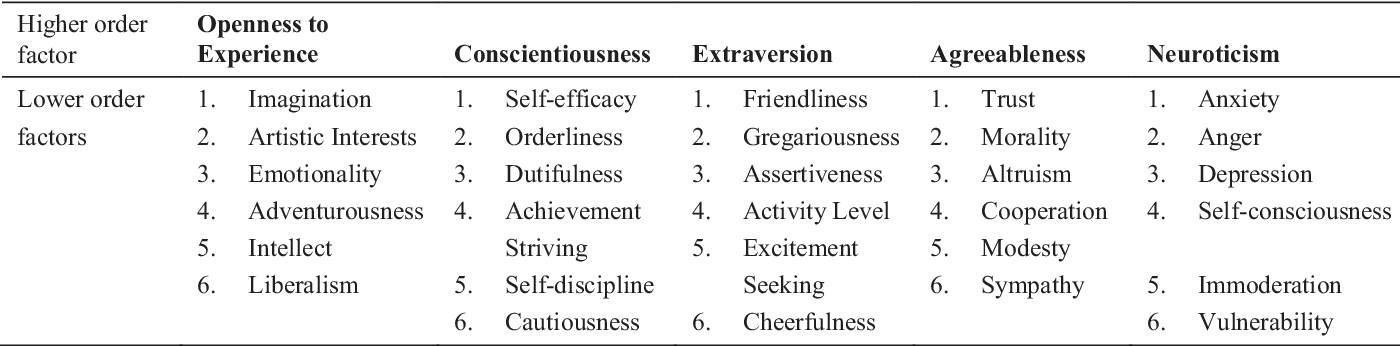
The FFM is therefore a hierarchical representation of personality (Maples-Keller et al., Reference Maples-Keller, Williamson, Sleep, Carter, Campbell and Miller2019). Within this study, we will specifically use the FFM as conceptualized in the IPIP-NEO-60 (Maples-Keller et al., Reference Maples-Keller, Williamson, Sleep, Carter, Campbell and Miller2019), which is an open-source version of the NEO PI-R (Costa & McCrae, Reference Costa and McCrae1992) and was developed using item response theory on personality items sourced from the International Personality Item Pool (IPIP). Both the IPIP-NEO-60 and the NEO PI-R have demonstrated strong validity and reliability evidence (Maples-Keller et al., Reference Maples-Keller, Williamson, Sleep, Carter, Campbell and Miller2019; McCrae & Costa, Reference McCrae and Costa1992).
Each of the five global factors of personality, as detailed by Costa and McCrae (Reference Costa and McCrae1992), have individually been associated with learning and success in academic pursuits, although Conscientiousness is commonly found to be the strongest predictor of domain-general academic success (see the following meta-analyses for review: Poropat, Reference Poropat2009; Stajkovic et al., Reference Stajkovic, Bandura, Locke, Lee and Sergent2018; Vedel, Reference Vedel2014). Interestingly, however, in a recent meta-analysis focusing on the domain of foreign language achievement, Openness to Experience and Conscientiousness were found to be the strongest predictors of foreign language learning success (Chen et al., Reference Chen, He, Swanson, Cai and Fan2022).
However, even though the global personality traits have been associated with academic success, it should also be noted that personality traits may not just predispose an individual to have better grades, but may also affect the learning process and learner experience (Boekaerts, Reference Boekaerts1996; De Raad & Schouwenburg, Reference De Raad and Schouwenburg1996). Personality factors have been associated with learning behaviors such as study engagement (Cilliers et al., Reference Cilliers, Mostert and Nel2018), the use of specific learning strategies (Chamorro-Premuzic & Furnham, Reference Chamorro-Premuzic and Furnham2008), and procrastination (Karatas, Reference Karatas2015). Personality has also been found to be linked to academic motivation (Komarraju et al., Reference Komarraju, Karau and Schmeck2009) and self-beliefs such as self-efficacy (Sanchez-Cardona et al., Reference Sanchez-Cardona, Rodriguez-Montalbán, Acevedo-Soto, Lugo, Torres-Oquendo and Toro-Alfonso2012). Importantly, personality has also been linked to emotional experiences in learning (Sorić et al., Reference Sorić, Penezić and Burić2013). Therefore, the possibility of personality specifically influencing emotions within the foreign language classroom ought to be considered.
Foreign language classroom emotions and personality
Three emotion variables have thus far received considerable research attention in FL learning research: Foreign language anxiety (FLA), foreign language enjoyment (FLE), and foreign language boredom (FLB). FLA is perhaps the most well-established and oft researched affective variable in applied linguistics (MacIntyre, Reference MacIntyre, Gkonou, Daubney and Dewaele2017). First introduced by Horwitz et al. (Reference Horwitz, Horwitz and Cope1986), the variable can be defined as “a distinct complex of self-perceptions, beliefs, feelings, and behaviors related to classroom learning arising from the uniqueness of the language learning process” (p. 128). Horwitz (Reference Horwitz, Gkonou, Daubney and Dewaele2017) argued that FLA has characteristics of both trait and state anxieties: “When individuals experience language anxiety, they have the trait of feeling state anxiety when participating in language learning and/or use. It is also likely that individuals who experience Language Anxiety would feel anxious simply thinking about language learning and/or use” (p. 33). Horwitz (Reference Horwitz, Gkonou, Daubney and Dewaele2017) explained that using an imperfectly mastered FL is ego threatening and thus anxiety provoking. She described FL learners as suffering from “pink dress anxiety” (p. 45)—namely turning up at party where everybody is dressed in black and squirming for standing out. FLA can therefore be seen as a situation-specific trait-like anxiety that has been found to be relatively stable across time (Pan & Zhang, Reference Pan and Zhang2021) and can be differentiated from state anxiety experienced within a specific moment and circumstance (Gregersen et al., Reference Gregersen, MacIntyre and Meza2014).
Overall, an increased FLA is associated with negative outcomes for FL learning (Botes et al., Reference Botes, Dewaele and Greiff2020b; Teimouri et al., Reference Teimouri, Goetze and Plonsky2019). Therefore, the question may be asked whether some people may be more predisposed in terms of their personality traits to experience higher levels of FLA. Previous studies examining global personality factors have found support for the personality trait of Neuroticism/Emotional Stability relating to anxiety in the FL class (see Asmali, Reference Asmali2017; Dewaele & Al-Saraj, Reference Dewaele and Al-Saraj2015; Dewaele & MacIntyre, Reference Dewaele, MacIntyre, Sato and Loewen2019; Vural, Reference Vural2019), with effect sizes in these studies ranging from small to large (.273 < r < .528). Still yet, some studies have found mixed results in different cohorts (Dewaele, Reference Dewaele2013). It should be noted as well that all studies listed above used differing models of personality, with Dewaele and Al-Saraj (Reference Dewaele and Al-Saraj2015) using the Multicultural Personality Questionnaire, Dewaele (Reference Dewaele2013) using the Eysenck Personality Questionnaire, and Vural (Reference Vural2019) using the Big Five Index. Furthermore, inconsistent results have been found with Extraversion as a predictor of FLA, with some studies reporting a significant relationship (Asmali, Reference Asmali2017; MacIntyre & Charos, Reference MacIntyre and Charos1996) and others not (Dewaele, Reference Dewaele2013; Šafranj & Zivlak, Reference Šafranj and Zivlak2019). Similarly, both Agreeableness and Openness to Experience have similar inconsistent result patterns (see Asmali, Reference Asmali2017; Šafranj & Zivlak, Reference Šafranj and Zivlak2019; Vural, Reference Vural2019). Overall, personality as a predictor of FLA therefore seems to be inconclusive.
In turn, FLE is a broad positive emotion experienced by the FL learner when their psychological needs are met in the FL classroom (Dewaele & MacIntyre, Reference Dewaele and MacIntyre2014). FLE was introduced as the positive emotion counterpart of FLA but has since been established as an emotion variable in its own right (Botes et al., Reference Botes, Dewaele and Greiff2021, Dewaele & MacIntyre, Reference Dewaele, MacIntyre, MacIntyre, Gregersen and Mercer2016), with a nomological network of variables unique from FLA (Dewaele & MacIntyre, Reference Dewaele, MacIntyre, Sato and Loewen2019).
In terms of personality as a predictor variable of FLE, studies have been few and far between. Dewaele and MacIntyre (Reference Dewaele, MacIntyre, Sato and Loewen2019) found significant positive associations between FLE and the personality traits of Cultural Empathy (r = .344, p < .01), Social Initiative (r = .311, p < .01), Open-mindedness (r = .316, p < .01), and Emotional Stability (r = .190, p < .01). No other studies could be found that examined the Big Five personality traits or derivations thereof alongside FLE. Beyond the reaches of the FL classroom, enjoyment/joy in other educational settings has been linked to the personality traits. De la Fuente et al. (Reference de la Fuente, Paoloni, Kauffman, Yilmaz Soylu, Sander and Zapata2020) found significant correlations between domain-general academic enjoyment and all five global personality traits, with positive associations between enjoyment and Agreeableness, Conscientiousness, Extraversion, and Openness to Experience (.200 < r < .562) and negative associations between enjoyment and Neuroticism (−.152 < r < −.110). However, on the whole, personality as a predictor of enjoyment specific to the FL classroom is yet to be fully explored.
Last, boredom has been defined as “the aversive experience of wanting, but being unable, to engage in satisfying activity” (Eastwood et al., Reference Eastwood, Frischen, Fenske and Smilek2012, p. 482), with boredom in the language classroom specifically referred to as a “state of disengagement” in the FL classroom (Kruk & Zawodniak, Reference Kruk and Zawodniak2020, p. 16). Most likely due to the recency of its introduction to the applied linguistics research lexicon, no study could be found specifically examining personality in connection to FLBFootnote 2. General education studies have linked learning boredom to personality factors, with Sulea et al. (Reference Sulea, Van Beek, Sarbescu, Virga and Schaufeli2015), finding that learning boredom in university students was associated with Conscientiousness (r = −.18, p < .01), Agreeableness (r = −.21, p < .01), and Neuroticism (r = .22, p < .01). However, the link between boredom and personality traits extends beyond the context of learning, with Barnett and Klitzing (Reference Barnett and Klitzing2006) finding that the experience of boredom during the free-time (nonacademic activities related) of university students was predicted by the personality traits of Extraversion (β = −.14, p < .01) and Openness to Experience (β = .12, p < .01). Furthermore, boredom proneness, which is a trait-like individual difference variable that refers to the general tendency of an individual to experience boredom (Farmer & Sundberg, Reference Farmer and Sundberg1986), has been significantly associated with the personality traits of Extraversion, Agreeableness, Conscientiousness, and Openness to Experience (Culp, Reference Culp2006). Therefore, extrapolated from these findings, the experience of boredom and the expression of boredom in the FL class may be influenced by the presence of specific, or a combination of, personality traits that may be particularly salient in some contexts (extraverts becoming more easily bored in low-arousal activities for example).
Overall, the literature regarding personality and foreign language emotions thus far resembles a murky pond. Some insights have been made regarding personality as a predictor of FL classroom emotions, and some insights may be inferred from domain-general findings, but due to small effect sizes and contradictory findings, these insights may be described as hazy at best. This study therefore seeks to examine the relationship between personality and FL classroom emotions, using increasingly restrictive methods and where personality is examined as global and second-order factors. Thus, the following research questions will be examined:
-
1. To what extent do the global personality traits of Openness to Experience, Conscientiousness, Extraversion, Agreeableness, and Neuroticism, and the foreign language classroom emotions of anxiety, enjoyment, and boredom correlate?
-
2. To what extent can the global personality traits of Openness to Experience, Conscientiousness, Extraversion, Agreeableness, and Neuroticism predict the foreign language classroom emotions of anxiety, enjoyment, and boredom when examined through multiple regression models?
-
3. To what extent can the global personality traits of Openness to Experience, Conscientiousness, Extraversion, Agreeableness, and Neuroticism predict the foreign language classroom emotions of anxiety, enjoyment, and boredom when examined jointly through a path model?
-
4. To what extent can the second-order personality traits, measured as one of 30 underlying traits in the FFM, predict the foreign language classroom emotions of anxiety, enjoyment, and boredom when examined through multiple regression models?
Methods
Participants
Adult foreign language (FL) learners in the United Kingdom were recruited to take part in the study in December 2021. Participants were recruited via Prolific and compensated for their participation. All participants were currently enrolled in FL classes. A total of n = 246 FL learners completed the online questionnaire. The average age of participants was 35.42 years (SD = 12.70). The majority of participants was female (n = 136) and British nationals (n = 207). The majority of the sample was university educated (n = 178), with English as an L1 (n = 205). Thirty participants indicated that they were monolingual, with 93 bilinguals, 75 trilinguals, 33 quadrilinguals, nine pentalinguals, and six participants listing six or more languages in their repertoire. The most popular target language was Spanish (n = 72), followed by French (n = 54), German (n = 27), Italian (n = 17), and Japanese (n = 13). Detailed information regarding the linguistic repertoire of participants is provided in the Supplementary Materials.
Instruments
IPIP-NEO-60
The IPIP-NEO-60 is a 60-item, open-source personality measure developed through applying item response theory to the International Personality Item Pool (Maples-Keller et al., Reference Maples-Keller, Williamson, Sleep, Carter, Campbell and Miller2019). The questionnaire measures the five global personality factors of Openness to Experience, Conscientiousness, Extraversion, Agreeableness, and Neuroticism. Each global personality factor is captured through six subfactors, each measured with two items. All items were measured on a five-point Likert-type scale ranging from “strongly agree” to “strongly disagree.” The five global factors are detailed below:
-
1. Openness to Experience (α = .66; ω = .62)Footnote 3
Openness to Experience examined the general level of open-mindedness and curiosity in participants and consists of the subfactors of Imagination, Artistic Interests, Emotionality, Adventurousness, Intellect, and Liberalism. Items included were “I have a vivid imagination” and “I tend to experience my emotions intensely.”
-
2. Conscientiousness (α = .80; ω = .79)
Conscientiousness captured the general tendency to be responsible, organized and hardworking. The subfactors measured were Self-Efficacy, Orderliness, Dutifulness, Achievement Striving, Self-Discipline, and Cautiousness. Example items were “I set high standards for myself and others” and “I know how to get things done.”
-
3. Extraversion (α = .84; ω = .84)
The tendency to be social and outgoing was measured through the global factor of Extraversion. The subscales of the factor were Friendliness, Gregariousness, Assertiveness, Activity Level, Excitement Seeking, and Cheerfulness. Items such as “I make friends easily” and “I love life” were included.
-
4. Agreeableness (α = .78; ω = .78)
The global factor of Agreeableness measured the tendency to get along with other people. The personality trait was captured through the subfactors of Trust, Morality, Altruism, Cooperation, Modesty, and Sympathy. Items included were “I am concerned about others” and “I trust others.”
-
5. Neuroticism (α = .85; ω = .86)
Neuroticism measured the tendency toward emotional instability and negativity as captured through the subfactors of Anxiety, Anger, Depression, Self-Consciousness, Immoderation, and Vulnerability. Items such as “I dislike myself” and “I get stressed out easily” were included.
Short-form Foreign Language Enjoyment Scale (S-FLES; α = .82; ω = .80)
The nine-item S-FLES developed by Botes et al. (Reference Botes, Dewaele and Greiff2021) was used to measure a general enjoyment of FL learning. The scale is a validated short form adapted from the 21-item Foreign Language Enjoyment Scale (Dewaele & MacIntyre, Reference Dewaele and MacIntyre2014). Items such a “I enjoy the FL class” and “I’ve learned interesting things in the FL class” were measured on a 5-point Likert-type scale from “strongly disagree” to “strongly agree.”
Short-form Foreign Language Classroom Anxiety Scale (S-FLCAS; α = .88; ω = .88)
The eight-item S-FLCAS developed by MacIntyre (Reference MacIntyre1992) and validated by Botes et al. (Reference Botes, Dewaele and Greiff2022b) was used to capture a situation-specific anxiety in the FL class. The scale was adapted from the original 33-item Foreign Language Classroom Anxiety Scale designed by Horwitz et al. (Reference Horwitz, Horwitz and Cope1986). Items such as “I feel other students speak the FL better than I do” and “I get nervous and confused when I am speaking in my FL class” were measured on a 5-point Likert-type scale ranging from “strongly disagree” to “strongly agree.”
Foreign Language Classroom Boredom Scale (FLCBS; α = .92; ω = .92)
The eight-item FLCBS, which is a classroom specific subset of the larger Foreign Language Learning Boredom Scale (Li et al., Reference Li, Dewaele and Hu2023) was used to capture a tendency to become bored in the FL class. Items included were “The FL class bored me” and “My mind begins to wander in the FL class.” Items were measured on a 5-point Likert-type scale from “strongly disagree” to “strongly agree.”
Data analysis
All data were analysed using JASP 0.16.1 (JASP Team, 2022). Descriptive statistics, skewness and kurtosis, and Pearson’s correlation coefficients were calculated for all variables included in the study and were used to examine Research Question 1.
Three multiple regression models were used to explore Research Question 2, with the five global personality factors as predictor variables and the three classroom emotion variables as outcome variables. Multiple regressions with forced entry were conducted, as no particular predictor variable was theoretically assumed to take precedence (Field, Reference Field2013). The regression models were interpreted based on the adjusted R 2 value and labeled as small, moderate, or large based on the recent synthesis of regression results in applied linguistics by Plonsky and Ghanbar (Reference Plonsky and Ghanbar2018): R 2 values < .20 were labeled as small effect sizes, moderate effects were .20 < R 2 < .50, and large effect sizes exceeded .50. The individual predictive power of personality traits on classroom emotions was assessed via standardized beta coefficients (β), which enabled the comparison of individual predictors across multiple models. Standardized beta coefficients were interpreted in line with the recommendation of Alcock et al. (Reference Alcock, Attridge, Kenny and Inglis2014), who advocate for the interpretation of standardized regressions to follow the interpretation of correlation coefficients (and coincidentally the recommendation of R 2 interpretations by Plonsky and Ghanbar (Reference Plonsky and Ghanbar2018), with small effect sizes (β < .20), moderate effect sizes (.20 < β < .50), and large effect sizes (β > .50). Last, in order to reduce the possibility of Type 1 error risk and given the multiple predictor variables used in the regression study, the alpha value of the models was set at p < .01 (Field, Reference Field2013). This allowed for a more stringent analysis and for only predictors of greater magnitude to be included in the fine-depth discussion regarding personality as a possible predictor of FL classroom emotions.
The results of the multiple regression models of the global personality factors were used to inform the construction of a path model and addressed Research Question 3. The path model is a specific form of structural equation modeling (SEM) that uses observed variables as opposed to latent variables. Due to the complexity of the model and the relatively modest sample size (n = 246), path analysis was selected as the method of choice. The path analysis was tested in R Studio using the Lavaan package (Rosseel, Reference Rosseel2012). The path model allowed for the inclusion of all three classroom emotion variables as outcome variables in a single model. The model was estimated through weighted least squares with standard error, as all variables measured in the study were ordinal (Li, Reference Li2016). Close model fit was analyzed through the root mean square error of approximation (RMSEA ≤ .05), standard root mean square residual (SRMR ≤ .08), comparative fit index (CFI ≥ .95), Tucker–Lewis index (TLI ≥ .95), and chi-square (χ2, p > .05; Byrne, Reference Byrne1998; Kenny, Reference Kenny2020). Moderate fit was also considered (RMSEA ≤ .08; SRMR ≤ .12; CFI ≥ .90; TLI ≥ .90; Kenny, Reference Kenny2020).
Last, in order to have a fine-grained understanding of the effect of the subfactors of personality on the classroom emotions and address Research Question 4, a series of multiple regression models was analyzed with the subfactors of each global factors in turn modeled to predict a classroom emotion.
Results
Descriptive statistics
The descriptive statistics for the global personality factors and classroom emotions can be found in Table 1. Additional descriptive statistics of the subfactors of personality are available in the supplementary materials.
Descriptive statistics and t test results

Research Question 1: Global personality trait correlations
The Pearson correlation matrix of the classroom emotions and global personality factors can be found in Table 2. No correlation coefficients were large enough to create multicollinearity concerns (r > .80; Field, Reference Field2013).
Pearson correlation matrix
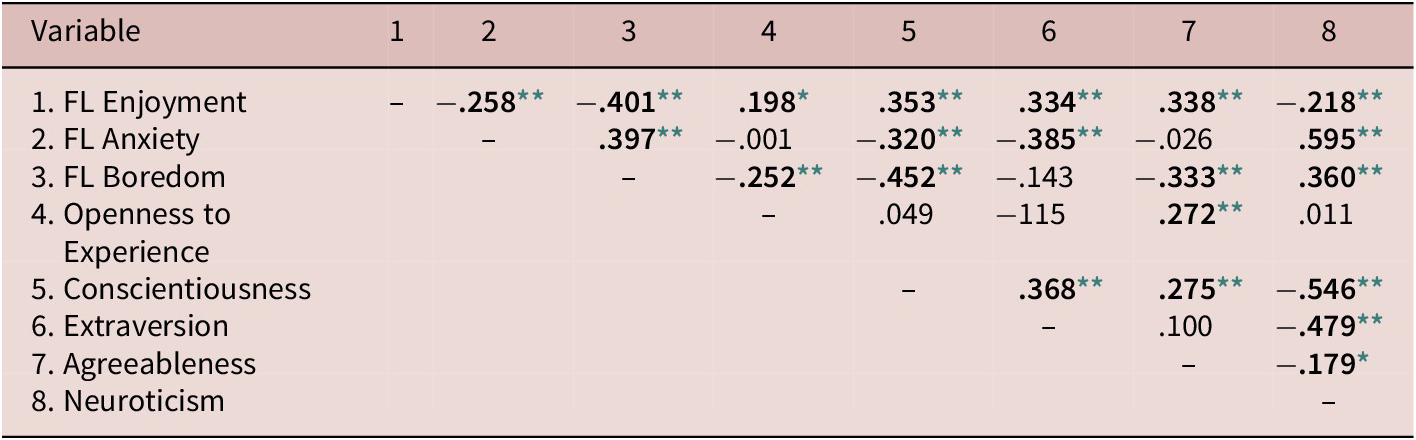
Note. All statistically significant effects are bolded throughout Tables 2–8.
* p < .01;
** p < .001.
Interestingly, both Conscientiousness and Neuroticism had moderate to large statistically significant correlation coefficients with all three emotion variables—namely, FLE (r = .353, p < .001, r = −.218, p < .001), FLA (r = −.320, p < .001, r = .595, p < .001), and FLB (r = −.452, p < .001, r = .360, p < .001). In turn, Openness to Experience and Agreeableness were not associated with anxiety in the FL classroom and only correlated with FLE (r = .198, p < .01, r = .338, p < .001, respectively) and FLB (r = −.252**, p < .001; r = −.333, p < .001). Last, Extraversion was associated with FLE (r = .334, p < .001) and FLA (r = −.385, p < .001). The correlation coefficient matrix therefore provides a first hint at possible significant relationships between personality factors and FL classroom emotions; however, as the matrix only includes the global personality factors, it should be noted that the possibility remains for subfactors of personality traits to be statistically significant predictors of FL emotions even if the global factors do not show significance. Additional correlation matrices of the subfactors of personality traits can be found in the Supplementary Materials.
Research Question 2: Global personality traits as predictors
Three multiple regressions were analyzed with each FL emotion variable as an outcome variable and all five global personality factors as predictor variables (see Table 3).
Standardized regression path results (β) of global personality scores
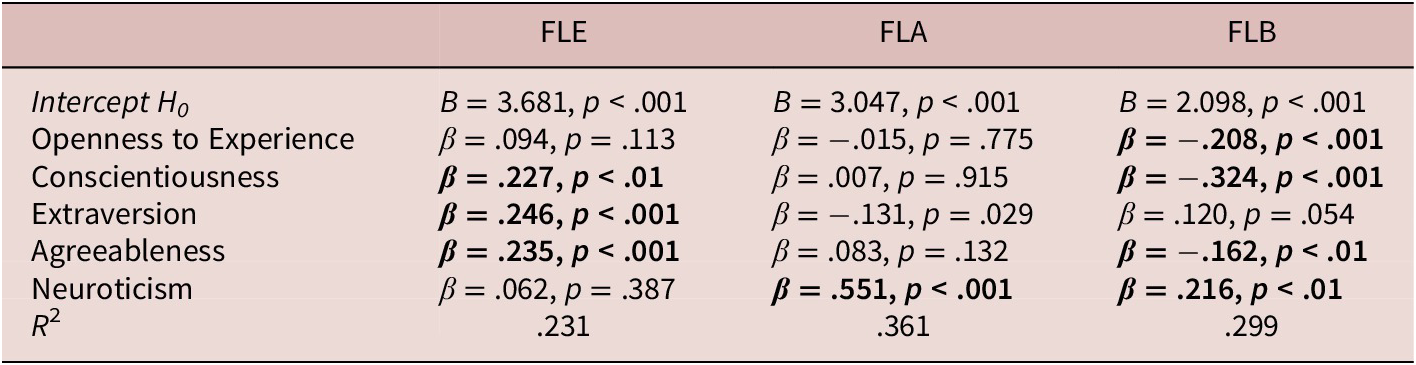
A significant regression equation was found for FLE, F (5, 240) = 15.727, p < .001, with an R 2 of .231. Thus, the five global personality factors explained 24.7% of variance in FLE and the effect size can be interpreted as moderate. In addition, Conscientiousness (β = .227, p < .01), Extraversion (β = .246, p < .001), and Agreeableness (β = .235, p < .001) were found to be moderate statistically significant predictors of FLE. Interestingly, even though Openness to Experience and Neuroticism were both found to be statistically significantly correlated with FLE, these significant bivariate correlations did not translate into significant predictors when all five personality factors were taken into account in one multiple regression model.
Similarly, a significant regression equation was found with the global personality factors predicting FLA (F (5, 240) = 28.646, p < .001). The big five personality factors explained 36.1% of variance in FLA. However, only Neuroticism was found to be a statistically significant predictor of FLA (β = .551, p < .001) when all predictor variables where considered in one model. Neuroticism was found to have a large effect on FLA, which is not surprising given that Anxiety is an underlying factor of the global Neuroticism score and general anxiety has been shown to be moderately associated with language anxiety (Botes, van der Westhuizen, et al., Reference Botes, van der Westhuizen, Dewaele, MacIntyre and Greiff2022).
Last, a statistically significant regression equation was also found for FLB, (F (5, 240) = 21.928, p < .001), with moderate amount of variance explained (R 2 = .299). Four of the global personality factors had a statistically significant effect on FLB. Openness to Experience and Conscientiousness both had a moderate negative effect on boredom in the FL classroom (β = −.208, p < .001, β = −.324, p < .001). In addition, Agreeableness had a small negative effect on FLB (β = −.162, p < .01). Thus, individuals with higher levels of Openness to Experience, Conscientiousness, and Agreeableness where less likely to report boredom in the FL classroom. In contrast, Neuroticism had a moderate positive effect on FLB (β = .216, p < .01).
The multiple regression models therefore indicated that all three FL classroom emotions were predicted by at least one global personality factor, with no single personality factor predicting all FL classroom emotions. The variance explained by the personality factors can be considered modest; however, given that a previous synthesis of the use of multiple regression in applied linguistics studies reported that nonlinguistic predictors commonly have rather small effect sizes (Plonsky & Ghanbar, Reference Plonsky and Ghanbar2018), the modest R 2 values can indeed be optimistically interpreted. In addition, given the more stringent alpha cutoffs used in this study, we have considerable confidence in the findings of the second research question.
Research Question 3: Path analysis of personality and classroom emotions
The statistically significant effects found in multiple regression models were used to develop the path model (see Figure 2). The model allowed for the inclusion of all three FL emotions as outcome variables in a single analysis.
Path analysis model
**p < .001. *p < .01.
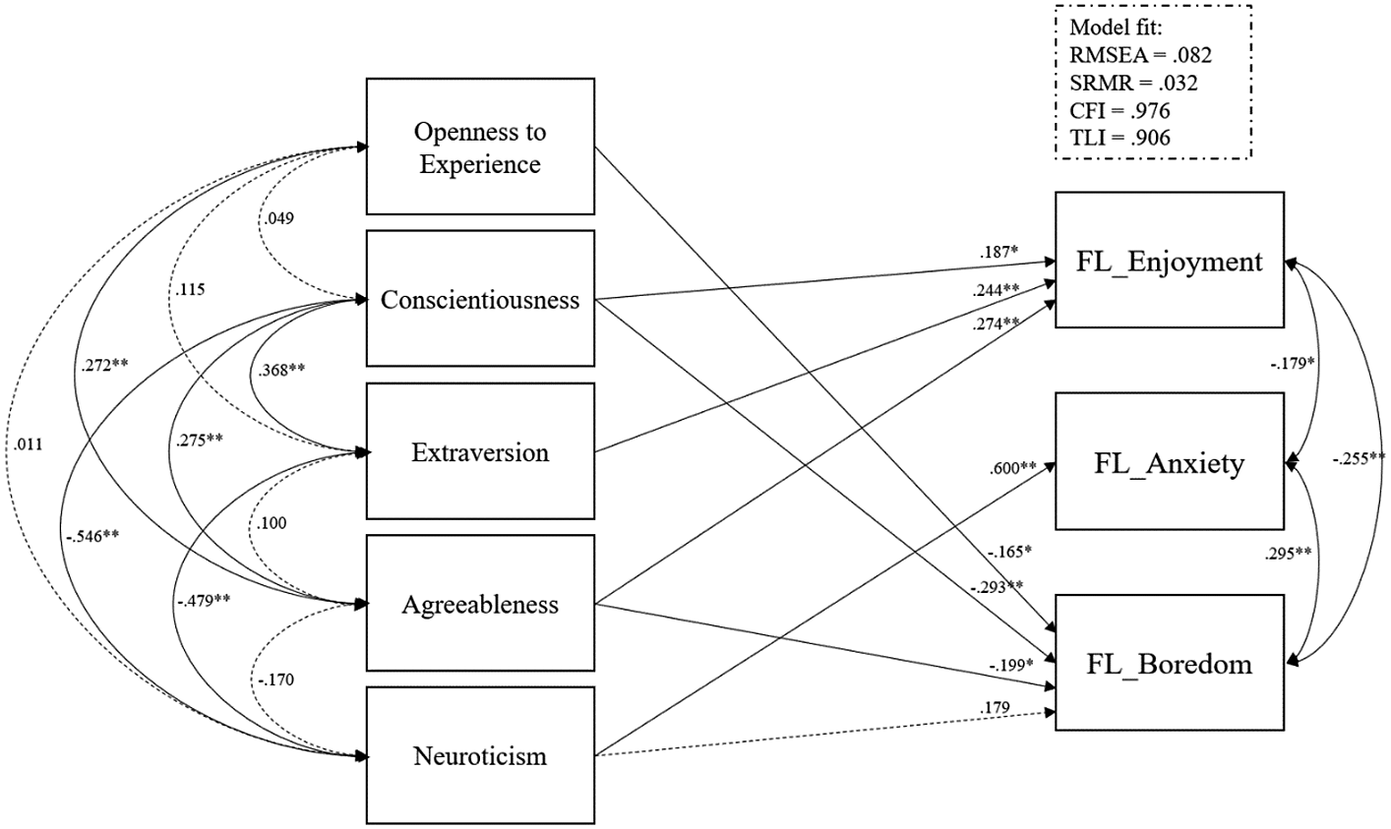
The path model indicated close fit, χ 2 (7) = 18.683, p = .010, with the SRMR and CFI both confirming a close fit (SRMR = .032; CFI = .976). In turn, the TLI indicated reasonable fit (TLI = .949). However, the RMSEA indicated mediocre fit as it was slightly higher than the aimed <.08 to indicate reasonable fit (RMSEA = .082). Given that the RMSEA is particularly prone to Type II error in smaller degrees of freedom models, as well as models with smaller sample sizes (Kenny, Reference Kenny2020; Kenny et al., Reference Kenny, Kaniskan and McCoach2015), the RMSEA of the model was deemed mediocre, but acceptable.
The path coefficients largely reflected the results of the multiple regression, with the exception of the effect of Neuroticism on FLB, which was not found to be statistically significant. Overall, the path model demonstrated the effects of global personality traits on FL classroom emotions, although some effect sizes found could be classified as small (<.20). Indeed, the only effect size found of substantial size, was the effect of Neuroticism on FLA (β = .600, p < .001).
Research Question 4: Subfactors of personality traits as predictors
In order to examine the effect of personality on a more fine-grained level, the specific subfactors of personality were modeled to effect FL classroom emotions in a series of multiple regression models.
Openness to Experience
A significant regression equation was found for the multiple regression model predicting both FLA and FLB (see Table 4); however, the complexity inherent in examining personality and FL classroom emotions is apparent in both regression equation results. Given the more stringent alpha cutoff used in the study, the multiple regression of FLE was found to be nonsignificant (F (6, 239) = 2.760, p = .013; R 2 = .041).
Standardized regression path results (β) of Openness to Experience subscales
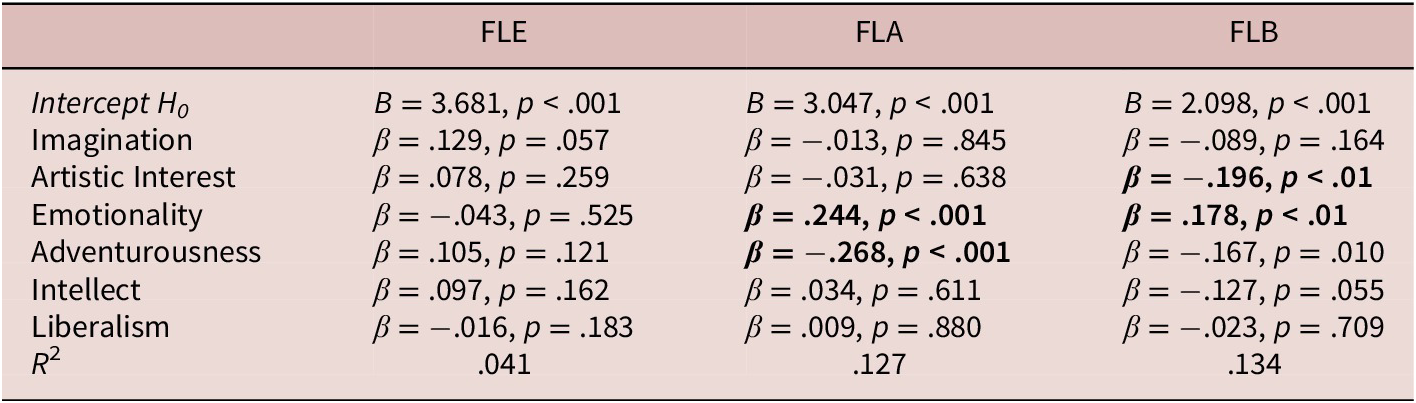
The second-order personality factors underlying Openness to Experience significantly predicted FLA (F (6, 239) = 6.946, p < .001; R 2 = .127), with Emotionality (β = .244, p < .001) and Adventurousness (β = −.268, p < .001) specifically predicting FLA. Interestingly, the two second-order personality factors had opposite effects, with Emotionality being a moderate positive predictor of FLA and Adventurousness being a moderate negative predictor.
A similar result was found with FLB (albeit with small effect sizes), with a significant overall regression equation (F (6, 239) = 7.307, p < .001; R 2 = .134), and Artistic Interest negatively predicting FLB (β = −.196, p < .01) and Emotionality positively predicting FLB (β = .178, p < .01).
Conscientiousness
Significant regression equations, with small to moderate effect sizes, were found for the multiple regression models of all three emotion variables (see Table 5). The subscales of Conscientiousness significantly predicted FLE (F (6, 239) = 6.824, p < .001; R 2 = .125), with Dutifulness in particular positively predicting FLE (β = .185, p < .01). Similarly, the second-order factors of Conscientiousness significantly predicted FLB (F (6, 239) = 12.677, p < .001; R 2 = .222), with Dutifulness, Self-discipline, and Cautiousness all negatively associated with FLB (−.253 < β < −.182, p < .01). The findings regarding the subscales of Conscientiousness therefore reflect and further substantiate the significant associations found between FLE, FLB, and the global factor of Conscientiousness (see Table 3; Figure 2).
Standardized regression path results (β) of Conscientiousness subscales
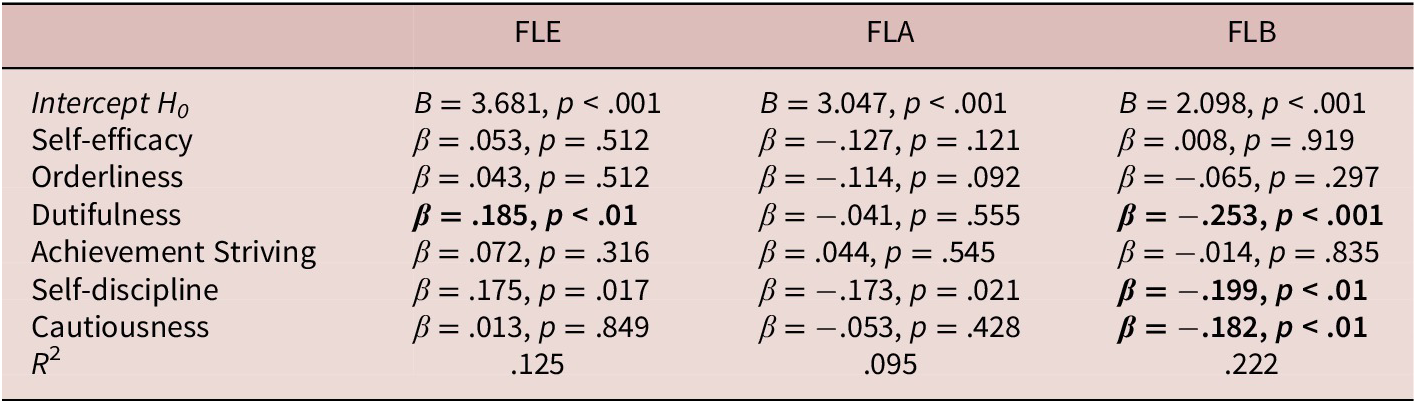
In turn, a significant regression equation was found for the subscales of Conscientiousness as a predictor of FLA, F (6, 239) = 5.304, p < .001; R 2 = .095). However, no single coefficient was statistically significant (p > .01). It is therefore likely that the significant F statistic may be a statistical artifact due to the moderately large correlations between the predictor variables (.187 < r < .527; see Kalnins, Reference Kalnins2018, and Supplementary Materials).
Extraversion
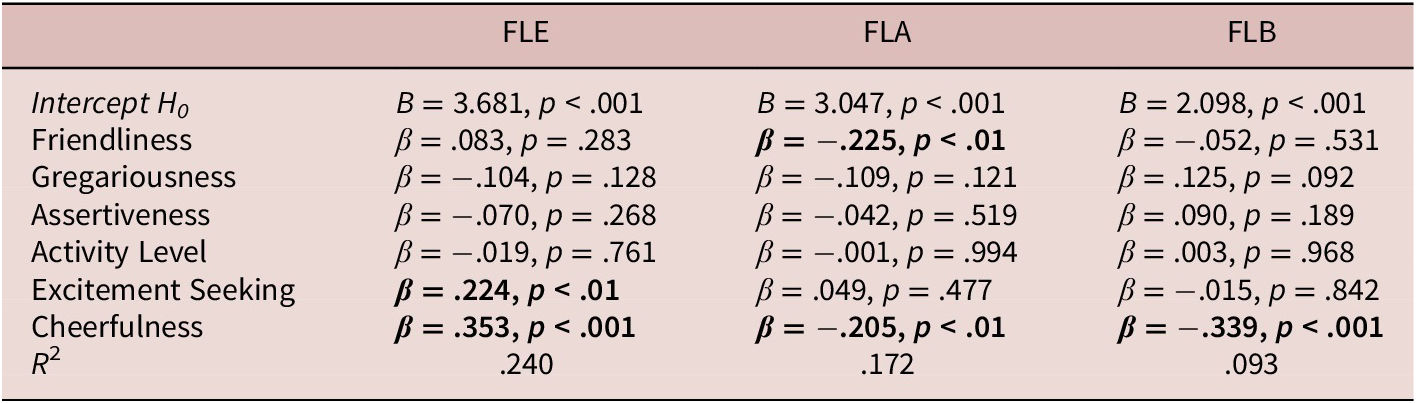
All three multiple regression equations were statistically significant (see Table 6). The subscales of Extraversion significantly predicted FLE (F (6, 239) = 12.607, p < .001; R 2 = .240), with Excitement Seeking (β = .224, p < .01) and Cheerfulness (β = .353, p < .001) both being moderate positive predictors of FLE. In turn, FLA (F (6, 239) = 9.504, p < .001; R 2 = .172), was moderately negatively predicted by both Friendliness (β = −.225, p < .01) and Cheerfulness (β = −.205, p < .01). Last, FLB (F (6, 239) = 5.202, p < .001; R 2 = .093), was also significantly negatively predicted by Cheerfulness (β = −.339, p < .001).
Standardized regression path results (β) of Extraversion subscales
Agreeableness
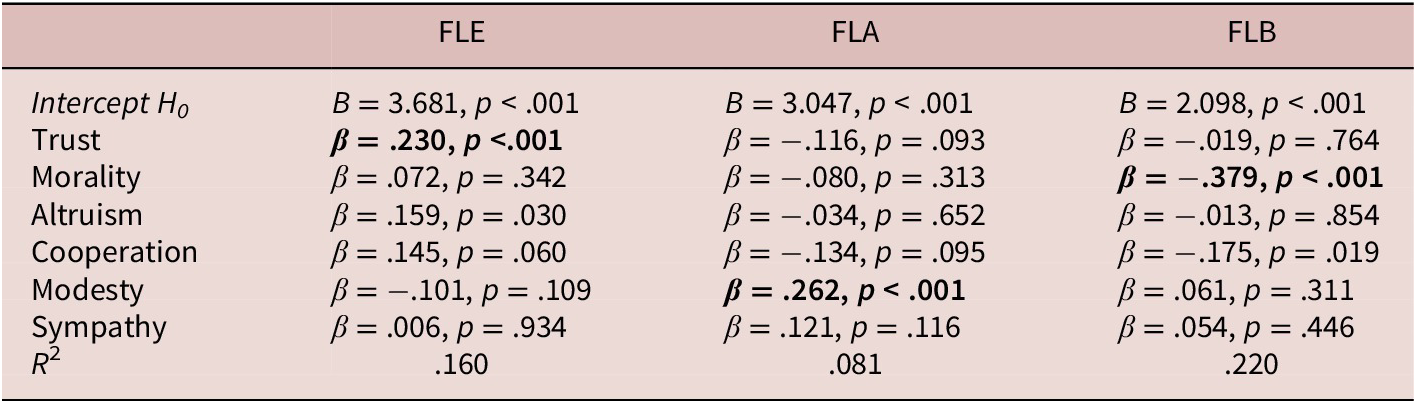
The multiple regression equations of the subscales of Agreeableness were statistically significant for FLE (F (6, 239) = 8.766, p < .001; R 2 = .160), FLA (F (6, 239) = 4.597, p < .001; R 2 = .081), and FLB (F (6, 239) = 12.502, p < .001; R 2 = .220). Each FL classroom emotion had one statistically significant predictor coefficient (see Table 7), with Trust positively predicting FLE (β = .230, p < .001), Modesty positively predicting FLA (β = .262, p < .001), and Morality negatively predicting FLB (β = −.379, p < .001). All significant predictors had moderate effect sizes (.20 < β < .50).
Standardized regression path results (β) of Agreeableness subscales
Neuroticism
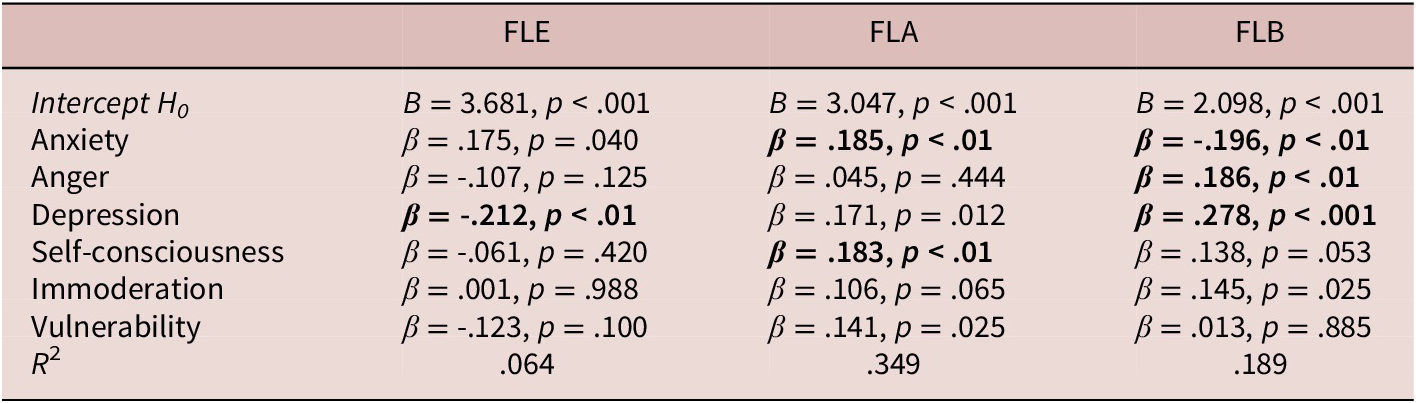
The subscales of Neuroticism significantly predicted all three FL classroom emotions (see Table 8). FLE (F (6, 239) = 3 .807, p < .01; R 2 = .064), was moderately negatively predicted by Depression (β = −.212, p < .01). In turn, FLCA (F (6, 239) = 22.932, p < .001) was positively predicted, with small effect sizes, by both Anxiety (β = .185, p < .01) and Self-Consciousness (β = .183, p < .01). Last, FLB was significantly predicted by the subscales of Neuroticism (F (6, 239) = 9.291, p < .001; R 2 = .189), however, the standardized coefficient results were inconsistent in terms of slope. Anxiety negatively predicted FLB (β = −.196, p < .01), whereas both Anger (β = .186, p < .01) and Depression (β = .278, p < .001) positively predicted FLB.
Standardized regression path results (β) of Neuroticism subscales
Discussion
The study set out to examine personality as a predictor of FL classroom emotions. Specifically, to examine the most widely recognized theory of personality - the FFM - and three FL classroom emotions.
The first research question examined the relationship between the three emotion variables of enjoyment, anxiety, and boredom and the global personality factors (Openness to Experience, Conscientiousness, Extraversion, Agreeableness, and Neuroticism) through simple bivariate correlation coefficients. All personality factors were significantly correlated with at least two emotion variables (see Table 9). In turn, Research Question 2 examined the same global personality traits and predictors of emotions variables in more stringent multiple regression equations. Numerous personality factors that shared significant correlation coefficients with the emotions variables were found to be nonsignificant predictors in the regression equations (see Table 9). For example, Openness to Experience did not significantly predict FLE (β = .094, p = .113), even though a significant correlation coefficient was found (r = .198, p < .01). Overall, four significant correlation coefficients found in examining the first research question were found to be nonsignificant predictors in the multiple regression models.
Statistically significant global personality factors found according to methods used
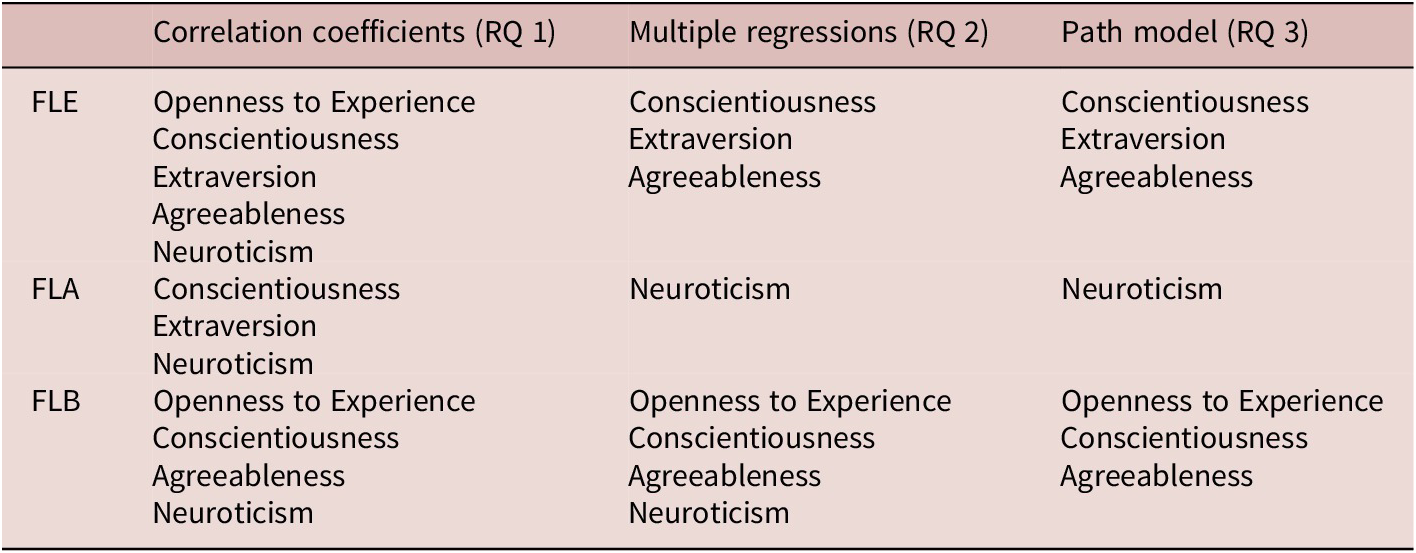
The third research question examined the emotion and personality variables in conjunction in a path analysis model in order to apply a further layer of complexity to interpreting personality as a predictor of FL classroom emotions. Of the regression coefficients found to be statistically significant in the second research question, support for the majority was found in the path model. The only exception was Neuroticism as a predictor of FLB, with a nonsignificant predictor in the path model (p > .01) even though a significant correlation coefficient and regression coefficient were found in the previous analyses.
Overall, Research Questions 1 to 3 demonstrated that increased stringency in the method used to examine the personality variables as predictors of FL emotions will severely affect our interpretations of results. Should only bivariate correlations have been considered, this study might have concluded that most of the global factors play a role in classroom emotions. However, the path model indicated that only a few significant relationships were found between personality factors, with the majority being small to moderate effects sizes (β < .27). Researchers therefore have to consider the method used and the effect size found when examining personality as a predictor in the larger nomological network of affective variables in FL learning, as less stringent methods will result in a wider nomological network of variables.
The fourth research question provided an additional layer of complexity by examining the underlying second-order factors of personality (as opposed to the higher order global factors). Where global factors were found to be significant predictors of emotions, Research Question 4 pinpointed the underlying factor specifically associated with the emotion (see Table 10). For example, Conscientiousness was found to be a significant predictor of FLE in the path model; however, only one subfactor of Conscientiousness—namely, Dutifulness (β = .185, p < .01)—was found to significantly predict FLE. In addition, even though the global factor Neuroticism was found to be a nonsignificant predictor of FLE in the multiple regression model, its subfactor of Depression was found to significantly predict FLE.
Statistically significant second-order personality factors predicting FL emotions
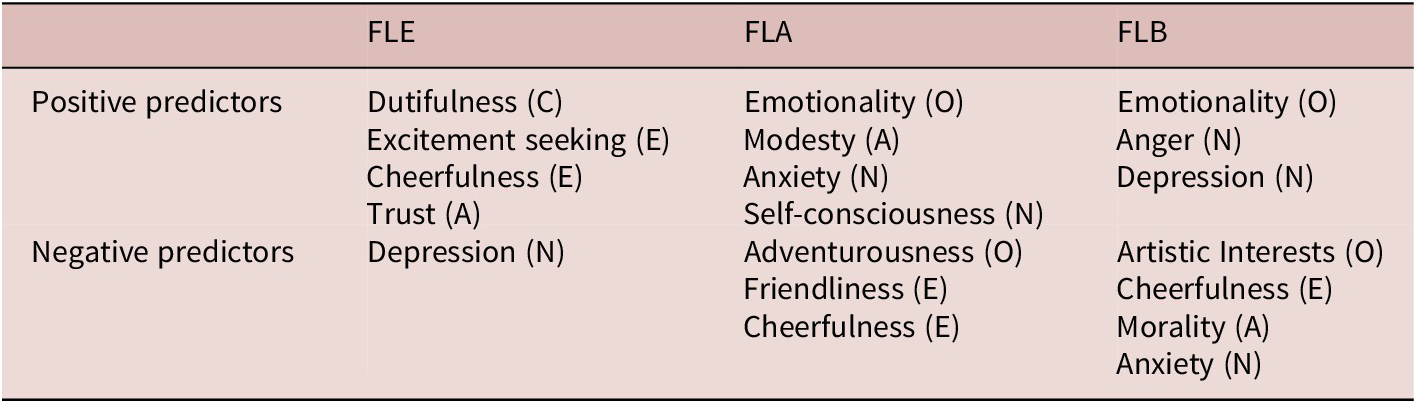
Note. O = Openness to Experience, C = Conscientiousness, E = Extraversion, A = Agreeableness, and N = Neuroticism.
The second-order factors also introduced intriguing contradictory findings. In several instances, lower order factors of the same global factor were significant predictors but with opposite slopes (see Table 10). For example, Emotionality positively predicted FLA and Adventurousness negatively predicted FLA, even though both are subfactors of the same global personality factor—Openness to Experience. This would imply that two second-order personality traits, even though they are assumed to be tapping into the same higher order factor, may have differing nomological associations. Furthermore, this finding raises significant questions regarding the use of the Openness to Experience global factor and may go some way toward explaining the inconsistent results found in the literature regarding Openness to Experience as a predictor of FL classroom emotions (see Asmali, Reference Asmali2017; Šafranj & Zivlak, Reference Šafranj and Zivlak2019; Vural, Reference Vural2019).
The increased stringent methods and the comparison of global and lower order factors have demonstrated that personality as a predictor variable can be highly complex with interpretation of results depending on the method used and the narrowness with which personality is defined as. However, this does not imply that no results can be fruitfully interpreted. The hypothesis that certain character traits may predispose a FL learner to experience certain emotions in the FL classroom was supported. In particular, the negative emotion of FLA was strongly associated with Neuroticism (β = .551, p < .001) and its second-order traits of general Anxiety (β = .185, p < .01) and Self-consciousness (β = .183, p < .01). This finding is in line with previous research, as FLA has been found to be moderately positively associated with general anxiety as well as fear of negative evaluation (Botes, van der Westhuizen, et al., Reference Botes, van der Westhuizen, Dewaele, MacIntyre and Greiff2022). Indeed, Horwitz et al. (Reference Horwitz, Horwitz and Cope1986) conceptualized FLA from the “building blocks” of communication apprehension, test anxiety, and fear of negative evaluation. Therefore, FL learners with higher levels of Neuroticism are likely to experience higher levels of FLA.
In turn, FLE was moderately associated with Conscientiousness (β = .227, p < .01), Extraversion (β = .246, p < .001), and Agreeableness (β = .235, p < .001). In particular, the second order-factors of Dutifulness (β = .185, p < .01), Cheerfulness (β = .353, p < .001), and Trust (β = .230, p < .001) were significant predictors of FLE. The result that FL learners with higher levels of Cheerfulness may experience greater levels of FLE is supported by previous research that found that an absence of joking by the teacher in the FL classroom had little effect at the start of the course but caused an increasing drop in FLE toward the end of the course (Dewaele, Saito, et al., Reference Dewaele, Saito and Halimi2022). Learners with cheerful and enthusiastic teachers have also been found to experience more FLE, less FLB, and higher engagement (Dewaele & Li, Reference Dewaele and Li2021). An additional novel finding is that the personality trait of Trust in particular predicted FLE. As FLE is closely linked to the learner’s attitude toward the teacher (Dewaele & Dewaele, Reference Dewaele and Dewaele2017) and has been found to be influenced by the teacher–student relationship as well as teacher behavior (Dewaele, Botes, et al., Reference Botes, van der Westhuizen, Dewaele, MacIntyre and Greiff2022), it is possible that FL learners who place greater levels of trust in others, in particular the FL teacher, may benefit from resultant FLE. The examination of the influence of trust in the FL classroom may be fruitful to explore in future research.
Lastly, four global personality traits were significantly associated with FLB: Openness to Experience (β = −.208, p < .001), Conscientiousness (β = −.324, p < .001), Agreeableness (β = −.162, p < .01), and Neuroticism (β = .216, p < .01). Specific lower order traits that were the most strongly linked to FLB were Dutifulness (β = −.253, p < .001), Cheerfulness (β = −.379, p < .001), and Morality (β = −.379, p < .001). Cheerfulness is not an oft-studied personality trait in conjunction with learning and education outcomes; however, some studies have linked Cheerfulness to academic achievement (Buju, Reference Buju2013; Rosander et al., Reference Rosander, Bäckström and Stenberg2011), positive self-beliefs and motivational behavior (Stephanou, Reference Stephanou2014). Given that boredom in the FL classroom is often defined as a “state of disengagement” (Kruk & Zawodniak, Reference Kruk and Zawodniak2020, p. 16), the negative link between Cheerfulness and FLB may be explained through these mechanisms of low performance, self-beliefs, and motivation. It is likely that individuals with lower levels of Cheerfulness are therefore more likely to have negative self-beliefs and lower FL performance and be less motivated in FL lessons, which may result in withdrawing from engaging in lessons and experiencing higher levels of FLB. Furthermore, boredom has been examined through the lens of morality in previous empirical and philosophical research (Elpidorou, Reference Elpidorou and Elpidorou2022; Igou & van Tilburg, Reference Igou, van Tilburg and Elpidorou2022), with Bertrand Russell (Reference Russell1930, as cited in Elpidorou, Reference Elpidorou and Elpidorou2022, p. 2) remarking that “boredom is a vital problem for the moralist since half the sins of mankind are caused by it” (p. 38). Boredom may perhaps be seen as wrongful to experience or admit to experiencing by learners in the FL classroom with FL learners with higher levels of Morality as well as Dutifulness therefore being hesitant to indicate that they experience FLB.
Overall, the exploratory study indicated numerous personality traits that show promise as predictors of FL classroom emotions, with Neuroticism linked to FLA, Extraversion linked to FLE, and Conscientiousness in particular linked to FLB. In addition, the lower order personality factors of Cheerfulness and Dutifulness show promise as possible predictors. Personality, on a global or lower order level, can therefore be used as a predictor in FL classroom emotions but ought to be approached with caution. Researchers have to consider the possibility of contradictory second-order loadings, differing results based on whether global or second-order factors are used, and the influence of the method chosen on the research results and conclusions. Based on these findings, it is therefore expected that contradictory results regarding the relationship between personality and FL classroom emotions will abound.
Limitations and implications
The methods used in the study were limited to the modest sample size (n = 246). Latent modeling of the factors was for example not possible due to power constraints (Preacher & Coffman, Reference Preacher and Coffman2006). Future research examining the relationship between personality factors and emotions using latent modeling may provide additional fruitful results. In addition, due to modest sample size and the numerous statistical models considered in this study, we cannot discount the possibility of Type I and II errors. Furthermore, the IPIP-NEO-60 can be considered a short-form measure with only two items per subfactor, limiting the reliability of the second-order personality traits. Future studies using more fine-grained scales such as the IPIP-NEO-120 (Johnson, Reference Johnson2014), may provide considerable insight into the link between second-order factors and emotions in the FL class. In addition, previous research has demonstrated that demographic factors such as average age (Dewaele & Dewaele, Reference Dewaele and Dewaele2017), gender (Park & French, Reference Park and French2013), and level of multilingualism (Dewaele, Reference Dewaele2013) may play a role in the relationships between personality and FL classroom emotions. The influence of sample characteristics on the relationships between personality and FL classroom emotions was not taken into account in this study and should be prioritized in future studies. Last, as a cross-sectional study, the causal implications of the regression equations are limited. This study should be considered exploratory, with considerable additional future research needed to establish the link between personality and FL emotions.
Examining the significant predictors of the FL classroom emotions, especially on lower order level, provides several pedagogical implications. First, Modesty, Self-Consciousness, and lower Adventurousness were all statistically significant predictors of FLA. This would imply that students with high levels of FLA may be more likely to remain hidden in the FL classroom, as these individuals would be less likely to want to draw attention to their “pink dress” (cf. Horwitz, Reference Horwitz, Gkonou, Daubney and Dewaele2017), leading FL teachers not to notice the debilitating anxiety experienced by these students. FL teachers therefore need to be aware that students with higher levels of FLA may be difficult to identify, hindering possible assistance. Teachers could think about ways to strengthen group solidarity, creating safe spaces—or quiet moments during the class—during which the very anxious students could express themselves and where their contribution would be welcomed by the group. Second, the subfactor of Cheerfulness was a significant predictor of all three emotions (FLE: β = .353, p < .001; FLA: β = −.205, p < .01; FLB: β = −.339, p < .001). Individuals who are predisposed to be more cheerful are therefore more likely to enjoy their FL classes, feel less anxious, and feel less bored during lessons. Even though the extent to which personality is malleable is debated (Damian et al., Reference Damian, Spengler, Sutu and Roberts2019; Rantanen et al., Reference Rantanen, Metsäpelto, Feldt, Pulkkinen and Kokko2007), teachers may draw on this finding and emphasize a good social atmosphere in the classroom. Previous studies have found humour in particular to be an important element in creating a sense of camaraderie in the FL classroom, resulting in positive FL classroom emotions (see Neff & Dewaele, Reference Neff and Dewaele2022). FL teachers with high levels of perceived Trait Emotional Intelligence have been found to have more motivated students (Moskowitz & Dewaele, Reference Moskowitz and Dewaele2020). It is likely that these teachers will also show more optimism about their students’ ability to do well, which could further contribute to a positive and cheerful classroom atmosphere.
Conclusion
This study set out to uncover whether personality could be used to predict FL classroom emotions. Some personality traits were found to show particular promise, such as the global traits of Neuroticism, Extraversion, and Conscientiousness, or the lower order traits of Trust, Dutifulness, and Cheerfulness. However, given the complexity of the results, such as contradictory slopes of underlying subscales and relatively small effect sizes, the inclusion of personality in the nomological network of FL classroom emotions needs to be approached with caution. Researchers setting out to include personality traits in larger explanatory models of FL classroom emotions may just find that the devil lurks in the details.
Supplementary material
The supplementary material for this article can be found at http://doi.org/10.1017/S0272263123000153.
Competing interest
The author(s) declare none.


 Open access

