




Introduction
The kind and degree of lability that occurs in an individual’s linguistic repertoire as they traverse adulthood cannot be entirely captured by the sum of their lived years, by the mere passage of time. This is because chronological age alone is a “profoundly incomplete” measure (Bowie & Gerstenberg, Reference Bowie and Gerstenberg2023:2) of how multifaceted biological, psychological, and social processes of aging are intertwined with the (in)stability in a speaker’s language use across the life course. As Pichler, Wagner, and Hesson (Reference Pichler, Wagner and Hesson2018:3) put it, “the ageing process is individualized, accumulative and unequal” and will thus affect individuals—and, by extension, their linguistic behavior—at different times, in different ways, and to different degrees. Because of this, it has been repeatedly lamented (e.g., Cheshire, Reference Cheshire, Ammon, Dittmar, Mattheier and Trudgill2005; Eckert, Reference Eckert and Coulmas1997; Wagner, Reference Wagner2012a, Reference Wagner2012b) that age is too often treated as a “biological variable rather than a social or contextual variable” (Bowie, Reference Bowie, Duszak and Okulska2010:30). This echoes cross-disciplinary calls that the age factor may best be deprived of “its status as a simple physiologically induced variable” (Singleton & Pfenninger, Reference Singleton, Pfenninger, S., Hiver and Papi2022:251) in lieu of being rechristened as a complex, sociocultural one. In sociolinguistics, Eckert (Reference Eckert and Coulmas1997:167) was an early proponent of this perspective, encouraging us not to consider “age” per se as the rationale for changes in patterns of language variation, but rather to disentangle biological and physiological processes of maturation from the “life experiences that give age meaning.” Yet, as Pichler et al. (Reference Pichler, Wagner and Hesson2018) noted, more concrete approaches to teasing apart age and (the processes of and experiences involved in) aging have not actually gained wide application in the field. Specifically, how life experiences and especially different major life events (MLEs) interindividually impact patterns of linguistic change across the adult lifespan has not been adequately empirically tested (e.g., Buchstaller, Reference Buchstaller2015; Wagner, Reference Wagner2012a). Following Luhmann, Hoffman, Eid, and Lucas (Reference Luhmann, Hofmann, Eid and Lucas2012:594), we define MLEs as “time-discrete transitions that mark the beginning or the end of a specific status,” such as a position, rank, or role (see also Bühler, Orth, Bleidorn, Weber, Kretzschmar, Scheling, & Hopwood, Reference Bühler, Orth, Bleidorn, Weber, Kretzschmar, Scheling and Hopwood2024).
We investigate in the current study the systematic effects of different MLEs on retrospective perceptions of linguistic change as concerns (a) the productive use of language varieties and (b) affective-attitudinal factors. Importantly, self-reports cannot replace the measurement of linguistic change over time, but they can serve as a valuable precursor to real-time studies. As will later be detailed, there is a wealth of literature that hypothesizes the impact of different MLEs, but it remains unclear which MLEs are likely to have the most significant impact on the (socio)linguistic repertoire. For instance, Shapp, LaFave, and Singler (Reference Shapp, LaFave and Singler2014) emphasized that many MLEs during adulthood occur in the occupational domain (e.g., career changes) (see also Riverin-Coutlée & Harrington, Reference Riverin-Coutlée and Harrington2022), but analyses comparing the impact of MLEs across, for example, occupational, personal, and educational domains remain outstanding. In part, this is because measuring real-time change across life-course transitions inherently requires relatively intensive longitudinal data, which is a time- and resource-heavy endeavor. Studies such as this one which rely on retrospective perceptions of linguistic change can amass comparatively large sample sizes in order to narrow down (a) which MLEs may have a particularly prominent influence on lifespan linguistic change and (b) the areas in which MLE-related linguistic change may occur (e.g., language use, language attitudes). Findings from studies on retrospective perceptions of linguistic change can thus inform study and task design of future real-time investigations, helping to determine which MLEs are most promising for detailed follow-up longitudinal study.
Additionally, our goal is to propose a methodological toolkit that can better than before capture aging as an experiential variable as opposed to a strictly biological one. As has been argued in related fields such as gerontology and organizational and developmental psychology, treating age as a numerical attribute of a person ignores the multifaceted nature of the aging process and the social utilization of age as an identification device (e.g., Rughiniș & Humă, Reference Rughiniș and Humă2015; Weiss & Weiss, Reference Weiss, Weiss, Zacher and Rudolph2022). Our results thus take on both methodological and theoretical importance, and should speak to one of Eckert’s (Reference Eckert and Coulmas1997:152) early yet unfortunately unresolved questions regarding how changes in the sociolinguistic repertoire are “embedded in life stages and life events.”
Sociolinguistic variation and lifespan development
Sociolinguistic variation in Austria
Austria can broadly be divided into two main dialect areas, namely the Bavarian and Alemannic dialect regions. The Alemannic dialect region is small, comprised of the state of Vorarlberg and a few Tyrolean villages. It is diglossic, which is to say that speakers exhibit context-based code-switching between Alemannic and standard German, maintaining a clear distinction between the two (for a discussion of this, see Ender & Kaiser, Reference Ender and Kaiser2009). In contrast, the rest of the country is Bavarian-speaking and traditionally described in terms of a dialect-standard-continuum (e.g., Ender & Kaiser, Reference Ender and Kaiser2009), meaning one can observe a range of varieties between standard German and dialect. These dialect varieties—Bavarian and Alemannic—play a major role in everyday life in Austria (unlike in northern and central Germany, for example), and survey data illustrate that the majority of Austrians report using dialect at least occasionally on a daily basis (Ender & Kaiser, Reference Ender and Kaiser2009). In line with the tradition of German-speaking sociolinguistics, the term “dialect” is used here to refer to traditional local vernaculars or regional varieties and is not synonymous to “any language variety.”
Concerning language-structural features, Bavarian and Alemannic dialect varieties are distinguishable from standard German varieties at the phonological, morphological, syntactic, and lexical levels (e.g., Ender & Kaiser, Reference Ender and Kaiser2009), and Austrians evince exceptional proficiency in discriminating standard German and dialect varieties (e.g., Kaiser, Ender, & Kasberger, Reference Kaiser, Ender, Kasberger, Bülow, Fischer and Herbert2019). At the social and socio-stylistic level, the use of Bavarian and Alemannic dialects depends on social, situational, and socio-pragmatic factors such as social status of the speaker, age, gender, interlocutor, and the (in)formality of the situation (e.g., Ender & Kaiser, Reference Ender and Kaiser2009). Dialect-standard variation can also be functionalized to express identity (e.g., the projection of meaning via socially indexed, sociolinguistically functional language varieties) (Vergeiner, Reference Vergeiner2019). Additionally, Austrians tend to judge dialect varieties higher in terms of social attractiveness (e.g., Kaiser et al., Reference Kaiser, Ender, Kasberger, Bülow, Fischer and Herbert2019), whereas (Austrian) standard German varieties are perceived—at least by Austro-Bavarian speakers—as indexing intelligence, but also arrogance (Bellamy, Reference Bellamy2012; Soukup, Reference Soukup2009). How susceptible speakers’ use of and attitudes toward these varieties are to change has recently been examined in panel studies (though only in the Bavarian-speaking parts; see Bülow & Vergeiner, Reference Bülow and Vergeiner2021; Bülow, Vergeiner, & Wallner, Reference Bülow, Vergeiner, Wallner, Beaman and Buchstallerin press; Vergeiner, Wallner, Bülow, & Scheutz, Reference Vergeiner, Wallner, Bülow, Scheutz, Christen, Ganswindt, Herrgen and Schmidt2021). These show that, while speakers’ attitudes toward the dialect variety remain remarkably stable, their usage patterns of standard German and dialect variants are subject to lifespan change. Whether changes in speakers’ use of or attitudes toward varieties may be sensitive to MLEs remains to date an open empirical question.
Linguistic change across the lifespan
Linguistic change across the lifespan concerns differences in an individual’s linguistic repertoire at different moments in time (e.g., Sankoff, Reference Sankoff2018), punctuated both by age and community-specific life stages (e.g., Buchstaller, Reference Buchstaller2015). In childhood, the vernacular develops under the influence of family and friends (e.g., Chambers, Reference Chambers2008). Adolescence, what Eckert (Reference Eckert and Coulmas1997:163) described as a “hothouse for the construction of identities,” is a turbulent time in the life course during which an individual experiences physiological, emotional, and social change such as widening social circles and a new orientation to peers as opposed to the home (e.g., Kerswill, Reference Kerswill1996; Tagliamonte, Reference Tagliamonte2016). Adolescent speakers thus tend to “push the envelope of variation” (Eckert, Reference Eckert and Coulmas1997:164) as reflected by their drive to use linguistic features that distinguish them and their language use from that of their parents (e.g., Labov, Reference Labov2001). Consequently, this life stage is considered by many sociolinguists to represent the focal point for linguistic innovation (e.g., Chambers, Reference Chambers2008; Kerswill, Reference Kerswill1996). Emerging adulthood—that is, the intermediary stage between adolescence and settling into the long-term choices and life-paths that make up adulthood (see Arnett, Reference Arnett2000)—has been positioned as a sociolinguistically formative period (Brook, Jankowski, Konnelly, & Tagliamonte, Reference Brook, Jankowski, Konnelly and Tagliamonte2018), for example due to high mobility and engagement with large social networks (Bigham, Reference Bigham2012), and also because speakers during (the later parts of) this life stage are increasingly confronted with normative pressures associated with the workplace and adult responsibilities more generally. Adults, especially those who have settled into long-term careers, have thus regularly been shown (e.g., Buchstaller, Reference Buchstaller2015; Trudgill, Reference Trudgill1974) to be more conservative in their use of innovative variants as compared to adolescent speakers. What is more, it is often assumed that upon adulthood “individuals tend to preserve their speech patterns as they move through their lifespan” (Labov, Reference Labov1994:107), which essentially equates the postadolescent population with linguistic stability.
Recently, the notion that linguistic development stalls during adulthood has been challenged, and a plethora of lifespan sociolinguistic studies provides empirical evidence that argues against postadolescent linguistic fossilization (e.g., Bowie, Reference Bowie, Duszak and Okulska2010; Bülow & Vergeiner, Reference Vergeiner2021; Kwon, Reference Kwon2018; Riverin-Coutlée & Harrington, Reference Riverin-Coutlée and Harrington2022; Sankoff, Reference Sankoff2018; Vergeiner et al., Reference Vergeiner, Wallner, Bülow, Scheutz, Christen, Ganswindt, Herrgen and Schmidt2021). In fact, studies on age grading (individual variation through time, but no resultant community-wide language change) even point toward a curvilinear pattern of sociolinguistic development, in that adolescents and older adults tend to employ nonstandard variants at higher rates than working-age adults (Bowie & Yaeger-Dror, Reference Bowie, Yaeger-Dror, Honeybone and Salmons2015). Very likely then, our linguistic repertoires are subject to some degree of change as we traverse adulthood. Measuring this change solely on the basis of chronological age, however, is not the most effective operational choice (e.g., Bowie, Reference Bowie, Duszak and Okulska2010; Bowie & Gerstenberg, Reference Bowie and Gerstenberg2023; Pichler et al., Reference Pichler, Wagner and Hesson2018), especially because individuals will not change in the same way, at the same age, or to the same extent.
As Buchstaller (Reference Buchstaller2015) maintained, shifts in our linguistic habits across the lifespan are sensitive to a range of different, and often highly individual, life phases and age-relevant junctures. Employing approaches that can capture the individuality inherent to such age-relevant junctures, such as an individual’s lived experiences, may therefore serve as more meaningful measures of the individual time points and rationales for linguistic change across the life course as compared to chronological age alone (e.g., Bowie & Yaeger-Dror, Reference Bowie, Yaeger-Dror, Honeybone and Salmons2015; Buchstaller, Reference Buchstaller2015; Eckert, Reference Eckert and Coulmas1997; Riverin-Coutlée & Harrington, Reference Riverin-Coutlée and Harrington2022). In other words, by examining life events associated with distinct micro-life stages we can gain valuable insights on “intraspeaker variability as (more or less conscious) reactions to the life-stage specific demands regarding demeanor and language use that we encounter as we progress through our life histories” (Buchstaller, Reference Buchstaller2015:485), and also on the when and why of linguistic change across adulthood.
MLEs as change-inducing factors
The idea that MLEs can be change-inducing is by no means a new idea. In psychology, researchers have explored whether and the extent to which MLEs impact, for instance, personality development (e.g., Bleidorn, Hopwood, & Lucas, Reference Bleidorn, Hopwood and Lucas2018; Bühler et al., Reference Bühler, Orth, Bleidorn, Weber, Kretzschmar, Scheling and Hopwood2024; Schwaba, Denissen, Luhmann, Hopwood, & Bleidorn, Reference Schwaba, Denissen, Maike, Hopwood and Bleidorn2023). The hypothesis here is that MLEs “often require individuals to react to the transition with a new repertoire of cognitive, emotional, and behavioral tendencies” (Bühler et al., Reference Bühler, Orth, Bleidorn, Weber, Kretzschmar, Scheling and Hopwood2024:545), a process which is thought to influence individuals’ patterns of thoughts, behaviors, and feelings, and may consequently impact changes in personality (Luhmann et al., Reference Luhmann, Hofmann, Eid and Lucas2012). A similar case can be made for lifespan sociolinguistic development: Maneuvering certain MLEs may place specific demands on speakers regarding language use and conduct, and may thus have measurable consequences for an individual’s linguistic behavior (e.g., Buchstaller, Reference Buchstaller2015; Eckert, Reference Eckert and Coulmas1997). Unfortunately, only a scarce number of studies in (socio)linguistics has actually attempted to empirically address which MLEs relate to how much and which type of change in the linguistic repertoire.
In this line of inquiry, a few investigations (e.g., De Decker, Reference De Decker2006; Prichard & Tamminga, Reference Prichard and Tamminga2012; Wagner, Reference Wagner2008, Reference Wagner2012b) have demonstrated that the transition from high school to college is an important MLE for a speaker’s adherence to or avoidance of local vernacular forms. For example, Wagner’s (Reference Wagner2008) panel study in Philadelphia revealed that higher-status individuals with new college networks significantly reduced their use of nonstandard variants, at least with respect to communally stable variables such as (ing). Relatedly, an individual’s entry into the workforce and the ensuing societal pressures to employ standard language in the workforce (e.g., Sankoff & Laberge, Reference Sankoff, Laberge and Sankoff1978; Wagner, Reference Wagner2012a) have also been linked to a heightened linguistic conservatism during adulthood (e.g., Eckert, Reference Eckert and Coulmas1997; Trudgill, Reference Trudgill1974). These standardization pressures are assumed to subside in later life, specifically as a result of the disengagement from the standard-language-expectant workplace upon the MLE retirement, and this may motivate a revival of vernacular variants speakers had suppressed, or at least used less, throughout their career or earlier in life (e.g., Buchstaller, Reference Buchstaller2006; Cheshire, Reference Cheshire, Ammon, Dittmar, Mattheier and Trudgill2005; Sankoff & Laberge, Reference Sankoff, Laberge and Sankoff1978; Vergeiner et al., Reference Vergeiner, Wallner, Bülow, Scheutz, Christen, Ganswindt, Herrgen and Schmidt2021).
Apart from these relatively age-specific MLEs, there may be additional significant events over the course of an individual’s adult life that incite linguistic variability. For instance, even if the rapid fluctuations in the linguistic repertoire typical of the adolescent years subside to some extent during adulthood, recent evidence suggests that career changes and the resultant shifts in an individual’s job-related communicative necessities as they climb the career ladder may place sufficient pressure on a speaker’s repertoire to outweigh the tendency toward postadolescent linguistic stability (Riverin-Coutlée & Harrington, Reference Riverin-Coutlée and Harrington2022). Bowie (Reference Bowie, Duszak and Okulska2010:29) also underscored that “major life events such as moving to a new region […] might result in instability” in the linguistic repertoire, a statement substantiated by numerous studies investigating the role of geographic mobility on dialect retention and attrition (e.g., Beaman, Reference Beaman, Ziegler, Edler and Oberdorfer2021; Jeszenszky, Steiner, & Leemann, Reference Jeszenszky, Steiner and Leemann2024), and on the acquisition of second-dialect features (i.e., dialect features different from those of an individual’s home region; see Kwon, Reference Kwon2018). Research on child-directed speech has found that mothers in particular reduce the frequency of nonstandard variants when speaking to their children (e.g., Smith & Durham, Reference Smith and Durham2019). If these patterns transfer to their everyday language use, entrance into parenthood may coincide with a reduction in vernacular variants, as Rickford and Price (Reference Rickford and Price2013) hinted. Relatedly, especially older adults’ increased contact with new generations (e.g., transferring to the role of grandparents) may contribute to a revival of vernacular forms, and new and diversified social networks at any age may bring about consequences for an individual’s linguistic behavior.
Taken as a whole, there is sufficient evidence and meaningful theorizing that MLEs can drive change in an individual’s sociolinguistic repertoire, at least to some extent. That said, there are still a number of pervasive research lacunae to be addressed. To start, despite the aforementioned hypotheses and results concerning the impact of life events on linguistic change, in practice no sociolinguistic investigations have set out to systematically examine which MLEs interindividually impact (perceived) changes in the linguistic repertoire. This led Buchstaller (Reference Buchstaller2015:485) to issue the call for (socio)linguists to explore “the linguistic relevance of distinct micro-life stages, including educational and maturational watersheds” (see also Bowie & Yaeger-Dror, Reference Bowie, Yaeger-Dror, Honeybone and Salmons2015; Wagner, Reference Wagner2012a).
What is more, Buchstaller (Reference Buchstaller2015:485) hypothesized that the effects of some MLEs may be ontogenetically relatively stable and thus “have the potential to result in regular cyclical intraspeaker variability,” while others are difficult to attribute to a certain time point during the life course and are therefore more individualistic in nature. While the former may feasibly include, for example, country-specific retirement age or the onset of schooling, and the latter career trajectories or relocation, we are not aware of any empirical investigations actually exploring which linguistically relevant MLEs indeed occur throughout the lifespan, and which are more likely to be specific to a certain life stage.
Finally, it is an open empirical issue concerning how changes in the productive versus affective-attitudinal domain may be (dis)similarly affected by MLEs. For example, the productive use of or proficiency in different varieties is closely intertwined with an individual’s attitudes toward the respective varieties (e.g., Ender, Reference Ender, Hundt, Kleene, Plewnia and Sauer2020). What is more, the aforementioned studies on life-course transitions have focused primarily on changes in language production but, to our knowledge, none have taken a closer look at how MLEs may also affect (perceptions of change in) affective-attitudinal variables. This is a question of particular theoretical importance, especially in light of recent insights that productive and attitudinal trajectories may diverge (Bülow et al., Reference Bülow, Vergeiner, Wallner, Beaman and Buchstallerin press), and also because of the ongoing debate about the stable or dynamic nature of language attitudes throughout a speaker’s life (e.g., Soukup, Reference Soukup2012).
The present study
The data presented in this article are part of an Austria-wide survey study that investigates which MLEs impact perceived individual-level change in the linguistic repertoire. To this end, the following exploratory research questions (RQs) were formulated (note that, given the exploratory nature of this study, we refrain from any a priori hypotheses):
RQ1. Do participants believe that MLEs have changed their linguistic repertoires?
RQ2. Which MLEs perceived as inducing linguistic change are specific to a certain life stage, and which occur throughout the lifespan?
RQ3. To what extent do perceived MLE-related changes in standard German and dialect usage correlate with perceived changes at the affective-attitudinal level?
RQ4. To what extent do individual MLEs predict interindividual patterns of perceived linguistic change?
We focus on retrospective perceptions of change in (a) cross-contextual standard German and dialect use (i.e., varietal use) and (b) affective-attitudinal variables (personal dialect accommodation, dialect identity, attitudes toward standard German). Importantly, we acknowledge that beliefs about linguistic behavior may not necessarily transfer to actual linguistic behavior. For instance, there have been reports that speakers’ introspective judgments of the acceptability of a linguistic variant fail to correlate with production data (e.g., rejecting a variant despite using it in a sociolinguistic interview), as Labov (Reference Labov, McNair, Singer, Dobrin and Aucon1996) demonstrated. Jamieson, Smith, Adger, Heycock, and Thoms (Reference Jamieson, Smith, Adger, Heycock and Thoms2024) moreover argued that the reliability of speaker intuitions is variable-dependent. We attempted to mitigate this issue in our current design: Rather than focusing on perceptions of change in select sociolinguistic variables, we concentrate on participants’ perceptions of their use of and attitudes toward entire language varieties (i.e., standard German and dialect). Specifically, it is the hope that Austrian respondents can make adequate judgments about MLE-related changes in their sociolinguistic repertoire, and thus that these retrospective reports of change in these distinct varieties will, at least roughly, correlate with actual linguistic change, for the following reasons: (a) dialect and standard German varieties in Austria evince clear perceptual differences (e.g., Ender & Kaiser, Reference Ender and Kaiser2009); (b) in their language awareness, speakers make a largely dichotomous distinction between dialect and standard German (e.g., de Cillia Reference De Cillia, Dannerer and Mauser2018:70); (c) Austrians are adept at discriminating between standard German and dialect varieties (e.g., Kaiser et al., Reference Kaiser, Ender, Kasberger, Bülow, Fischer and Herbert2019); and (d) Austrians demonstrate a particularly pronounced (meta)awareness concerning their own personal use of dialect-standard variation (e.g., Vergeiner, Reference Vergeiner2021). Additionally, research in psychology focusing on MLE-related personality development has utilized similar methods to the current study (i.e., retrospective perceptions of change) in combination with longitudinal data, and the results suggested that retrospectively judged change correlates moderately to strongly with measured change (Schwaba et al., Reference Schwaba, Denissen, Maike, Hopwood and Bleidorn2023). While there are no results hitherto attesting a correlation between retrospective judgments of and longitudinally measured MLE-related change, as our results will show, many of the self-perceived changes do align with what the limited number of panel studies analyzing production data have shown.
Participants
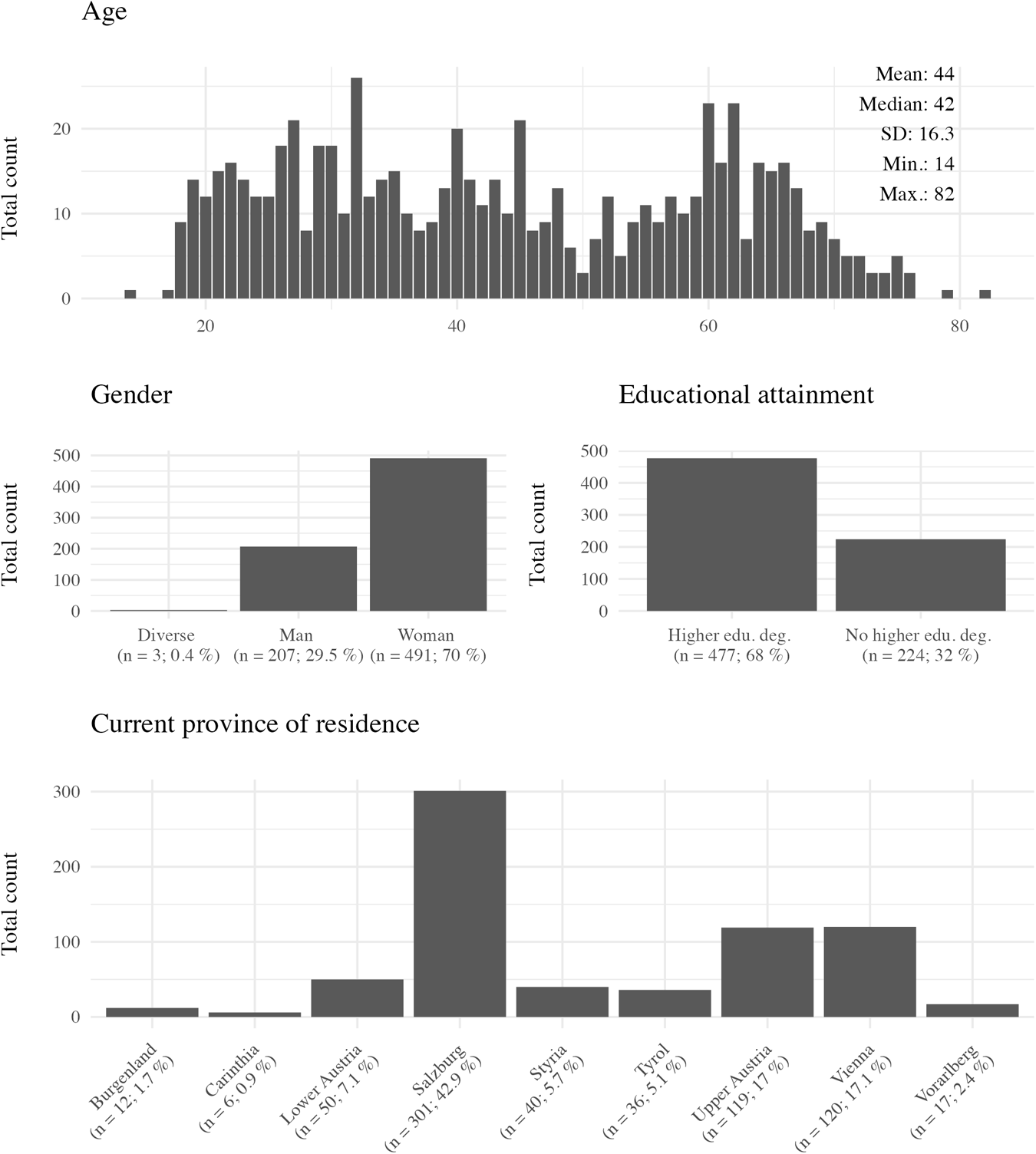
The sample comprised 701 Austrian participants, all of whom reported speaking German as a first language. The questionnaire was advertised through several universities and third-age universities in Austria, and through a regional and a national Austrian news outlet (i.e., Salzburger Nachrichten and Der Standard respectively). Additionally, we reached out to municipalities, clubs (e.g., sport clubs), and associations (e.g., senior citizens’ associations to target individuals in older adulthood) to publicize the questionnaire.
Figure 1 illustrates the relevant sociodemographic information. Our sample is subject to a surplus of individuals with high educational attainment, a drawback typical of crowd-sourcing methods (e.g., Leemann, Derungs, & Elspaß, Reference Leemann, Derungs and Elspaß2019). Relatedly, it was not possible to stratify by sociolinguistic factors such as gender or age as is otherwise typical of variationist-informed studies. This is reflected in the higher ratio of women as opposed to men and gender diverse participants. Finally, there is an unequal distribution of participants across provinces. As outlined previously, the majority of Austrian provinces house speakers of a Bavarian dialect (apart from Vorarlberg and a few villages in Tyrol), and as Figure 1 shows, only approximately 2% of our sample lives in regions where Alemannic dialects are spoken. Which dialect an individual speaks is not relevant to the present study, however. This is because our questionnaire targeted the broad constructs “dialect” and “standard German” (rather than specific features of the varieties), between which speakers tend to make a dichotomous distinction in terms of their (meta)awareness (see the previous section).
Sociodemographic information about the sample (higher education degree refers to individuals with a bachelor’s degree or higher).
Procedure
All quantitative analyses and survey material presented here can be found on the Open Science Framework (OSF; https://osf.io/mf3jh/).
Experiencing an MLE. Participants were first provided with a list of MLEs and asked to indicate if they had experienced one or more of these within the past 10–20 years. Subsequently, they were asked whether they believed any of these events had a significant influence, whether small or large, on their thoughts about, use of, and proficiency in different language varieties. Following Schwaba et al. (Reference Schwaba, Denissen, Maike, Hopwood and Bleidorn2023), participants who responded “No” to either of these questions were informed that they were not eligible participants for the study (they were unaware of this condition when they initially answered the question, we return to this methodological choice in the discussion). Those who answered “Yes” proceeded to complete the rest of the questionnaire. From a list of 16 event categories (adapted from the list in Schwaba et al. [Reference Schwaba, Denissen, Maike, Hopwood and Bleidorn2023]), participants were then prompted to identify an MLE that occurred within the past 10 to 20 years, which, in their opinion, had the most notable impact on their language use. This time frame was chosen to capture the effects of a comparatively recent MLE that contributed to shaping an individual’s current sociolinguistic repertoire. The event categories encompassed occupational MLEs (first job, job changes, unemployment, retirement), educational MLEs (e.g., beginning a degree, graduation), and personal MLEs (e.g., relocation, entering a new romantic relationship, becoming a [grand]parent). A final category labeled Other was included, which was a catch-all for participants who did not believe their MLE fit any of the categories (descriptions of the MLE category Other varied greatly, including MLEs such as chronic illness, divorce of one’s parents, etc.). Responses to this category are not further relevant for the present study. Participants additionally indicated the year in which the identified event occurred.
Varietal use and varietal affective profiles. We employed a modified version of the approach used in the Life Event Study (Schwaba et al., Reference Schwaba, Denissen, Maike, Hopwood and Bleidorn2023) to assess the perceived changes in participants’ sociolinguistic repertoires in relation to the identified event. Participants were presented with a statement (e.g., “In an average week, I often use dialect with my family.”) and asked to determine the extent to which the MLE changed their positioning with respect to the statement in question. Their responses were recorded on a 200-point slider scale with 5-point intervals, ranging from −100 to 100. The scale ranged from “applies less due to the event” to “applies more due to the event,” with 0 indicating no change resulting from the MLE. The scales thus provide measures concerning whether a respective statement (i.e., item) is now more or less true as a result of the event.
The statements regarding perceived changes in cross-contextual varietal use were adopted and adapted from Steiner, Jeszenszky, and Leemann (Reference Steiner, Jeszenszky and Leemann2023a), as well as from Steiner, Jeszenszky, Stebler, and Leemann’s (Reference Steiner, Jeszenszky, Stebler and Leemann2023b) Dialect Standard Profile. These statements were specifically designed to gauge perceived changes in participants’ cross-contextual use of standard German and dialect (e.g., with family, friends, with oneself, during shopping, etc.) resulting from the identified event. Importantly, participants were asked at the beginning of the questionnaire to specify their current status (e.g., employed, student, retired), and their status before and after the MLE (e.g., whether participants were actively employed both before and after the MLE). All participants received items regarding potential changes in their cross-contextual varietal use with family, friends, with oneself, and while shopping. Items from the aforementioned questionnaires pertaining to varietal use with coworkers, university colleagues, and/or schoolmates were only presented if the respective context was plausible as a result of the MLE (for instance, participants who indicated entering the workforce for the first time as their MLE did not answer items concerning changes in their varietal use with coworkers, as no comparisons in this domain could be made to before the event). The items were then averaged to create the two outcome variables “perceived change in cross-contextual standard German use” and “perceived change in cross-contextual dialect use.” Additionally, we assessed perceived changes in affective-attitudinal factors, including personal dialect accommodation (i.e., adjusting one’s own dialect use in relation to the interlocutor), dialect identity (i.e., pride in one’s local dialect), and attitudes toward standard German, using items from Steiner et al. (Reference Steiner, Jeszenszky, Stebler and Leemann2023b). The items for these scales are openly available in the survey material on OSF, and an exploratory factor analysis conducted on the raw data yielded a structure consistent with the aforementioned factors (see the supplementary material on OSF).
In sum, the five measures of perceived linguistic change include:
1) Perceived MLE-related change in cross-contextual standard German usage (between 4 and 10 items, depending on a participant’s individual circumstances, e.g., “In an average week, I often use standard German with my family.”)
2) Perceived MLE-related change in cross-contextual dialect usage (between 4 and 10 items, depending on a participant’s individual circumstances, e.g., “In an average week, I often use dialect with my family.”
3) Perceived MLE-related change in personal dialect accommodation (3 items, e.g., “When I speak to people from a different dialect area, I make sure to avoid certain words or phrases.”)
4) Perceived MLE-related change in dialect identity (4 items, e.g., “I think it’s nice when people from other regions notice which dialect I speak.”)
5) Perceived MLE-related change in attitudes toward standard German (3 items, e.g., “I like speaking High German.”)
Data analysis
To answer the first two RQs concerning perceptions of (non)change as a result of MLEs and the timing of perceived linguistic change during the life course, we present descriptive data. For the third RQ, we computed Spearman’s correlations with one mean score for each linguistic change dimension.
We tackled the final RQ by running a series of Bayesian models using the brms package (version 2.20.4, Bürkner, Reference Bürkner2017) in R (version 4.2.2, R Core Team, 2020). We modeled the five measures of perceived change separately. Due to the slider scale, our response variables were bounded by −100 and 100. We computationally defined the lower and upper bounds as −100 and 100, respectively, to prohibit the model from making predictions outside of these bounds (i.e., the model was truncated). MLE was entered as the fixed effect (no random effects were specified, as the individual measures were modeled separately). Note that we only included MLEs reported in 1% of the cases or more. Given the scope of the present article, and also our aim here to strictly model the interindividual effects of MLEs on linguistic change, we did not consider further potential individual differences such as gender or educational attainment, a limitation to which we return in the discussion.
An important facet of Bayesian modeling is that it generates an entire posterior distribution of plausible values for each parameter value (e.g., for the effect size of the predictor variable), with values closer to the mean of the respective distribution being more probable. Because the model estimates are given in distributions, visualization of the model estimates is the best way to interpret the results (e.g., Garcia, Reference Garcia2021). Given this, the conditional effects are plotted, which illustrate the predicted probability of self-reported change in the linguistic repertoire in relation to the MLEs.
Results
Perceptions of (non)change in the linguistic repertoire
Recall that in the questionnaire, participants were asked (a) whether they had experienced an MLE in general and (b) whether they believed that a certain MLE had change-inducing effects on their linguistic repertoire, either as concerns their active use of or attitudes toward language (varieties). Figure 2 illustrates participants’ responses to these questionnaire items.
Reports of (non)change in the linguistic repertoire.
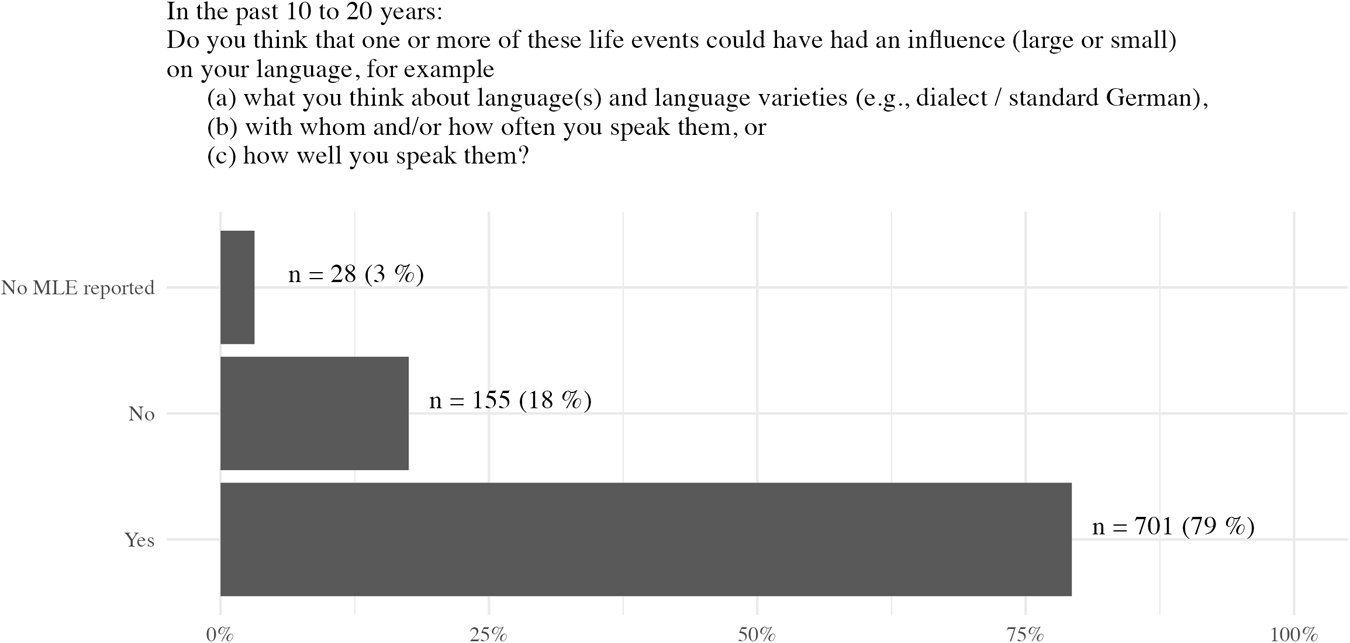
In total, 79% (n = 701) of participants in this sample indicated that an MLE had impacted on their varietal repertoire within the past 10–20 years. Moreover, 18% (n = 155) reported that no MLE had any impact on their language use or attitudes and 3% (n = 28) indicated that they had not experienced any of the listed life events. We also note that, of the participants who reported that an MLE had impacted on their varietal repertoire, nine individuals reported no change in the five outcome measures. This suggests that, while they believed in general that life events had changed their linguistic repertoire, these changes were not captured under the current measures of interest. We revisit this in the discussion.
The timing of reported significant life events
In order to identify the timing surrounding the MLEs participants perceived as change-inducing for their linguistic repertoire, we visualized the chronological age at which they experienced their reported MLE. Figure 3 illustrates this, ordered by the standard deviation (SD) of the age at MLE. Lower SDs indicate more age-specific MLEs, and higher SDs indicate life events that are less straightforward to pin down to a specific point in the life course.
Timing of perceived MLE-related change in the linguistic repertoire across the lifespan.
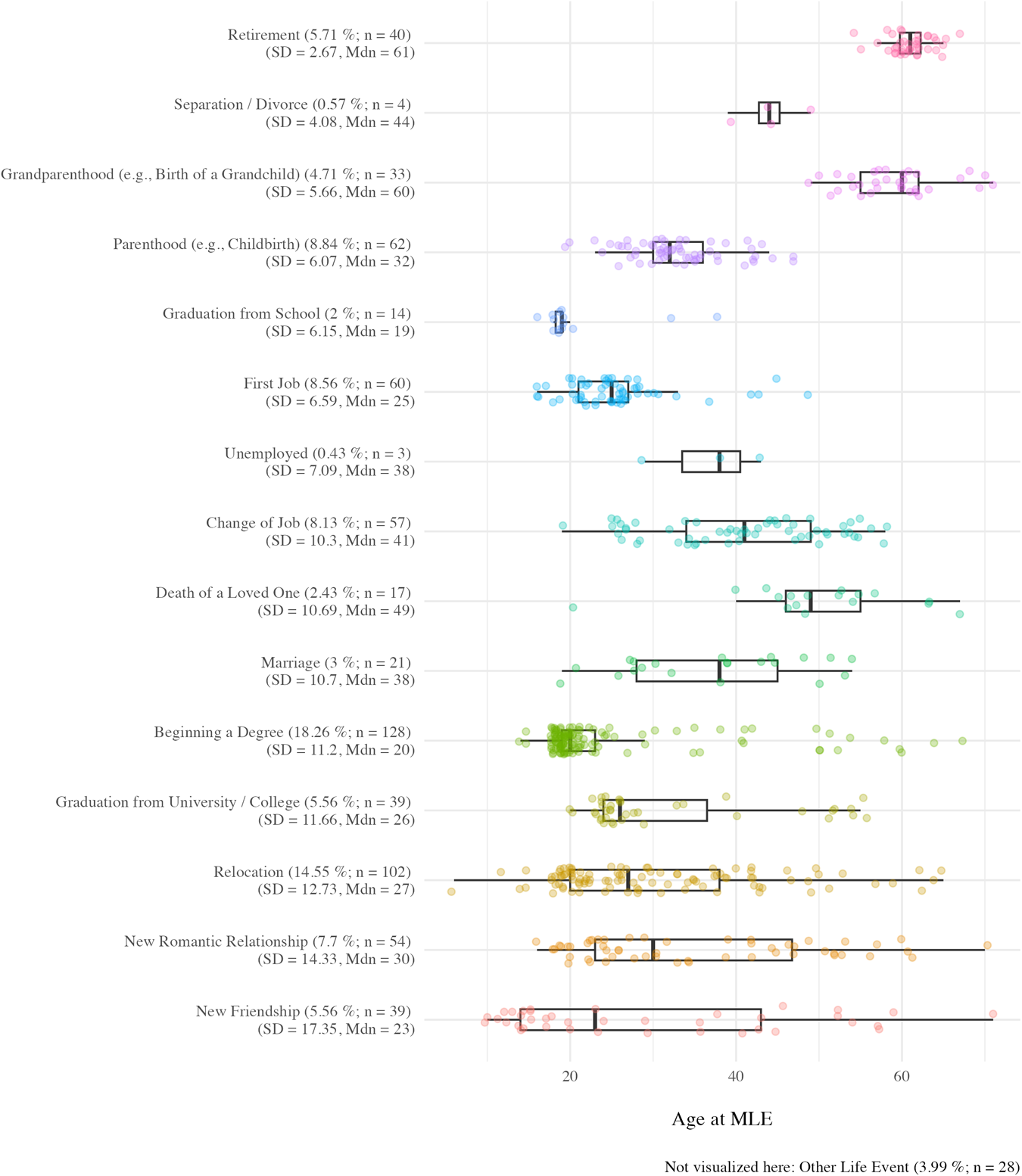
Unsurprisingly, MLEs such as retirement and entrance into the job market appear relatively age-specific, as does graduation from school (the SD for which appears slightly skewed because of two outliers). Other MLEs that at first glance may seem relatively age-specific, such as beginning a tertiary degree or graduation from university, evince a comparatively high SD. This may be a reflection of (also inter)national efforts to promote lifelong education in the form of university programs for post “traditional” age college/university students. MLEs such as geographical relocation, new romantic relationships, and shifts in an individual’s career trajectory may be perceived as bringing about consequences for a speaker’s linguistic behavior throughout (most of) the life course.
Correlation of perceived MLE-related changes in cross-contextual varietal use and affective-attitudinal factors
Figure 4 shows the Spearman’s correlation coefficients and respective p-values for the relationship between the productive and affective-attitudinal dimensions of self-reported MLE-related linguistic change.
Correlations between perceptions of change in cross-contextual varietal use and affective-attitudinal factors.
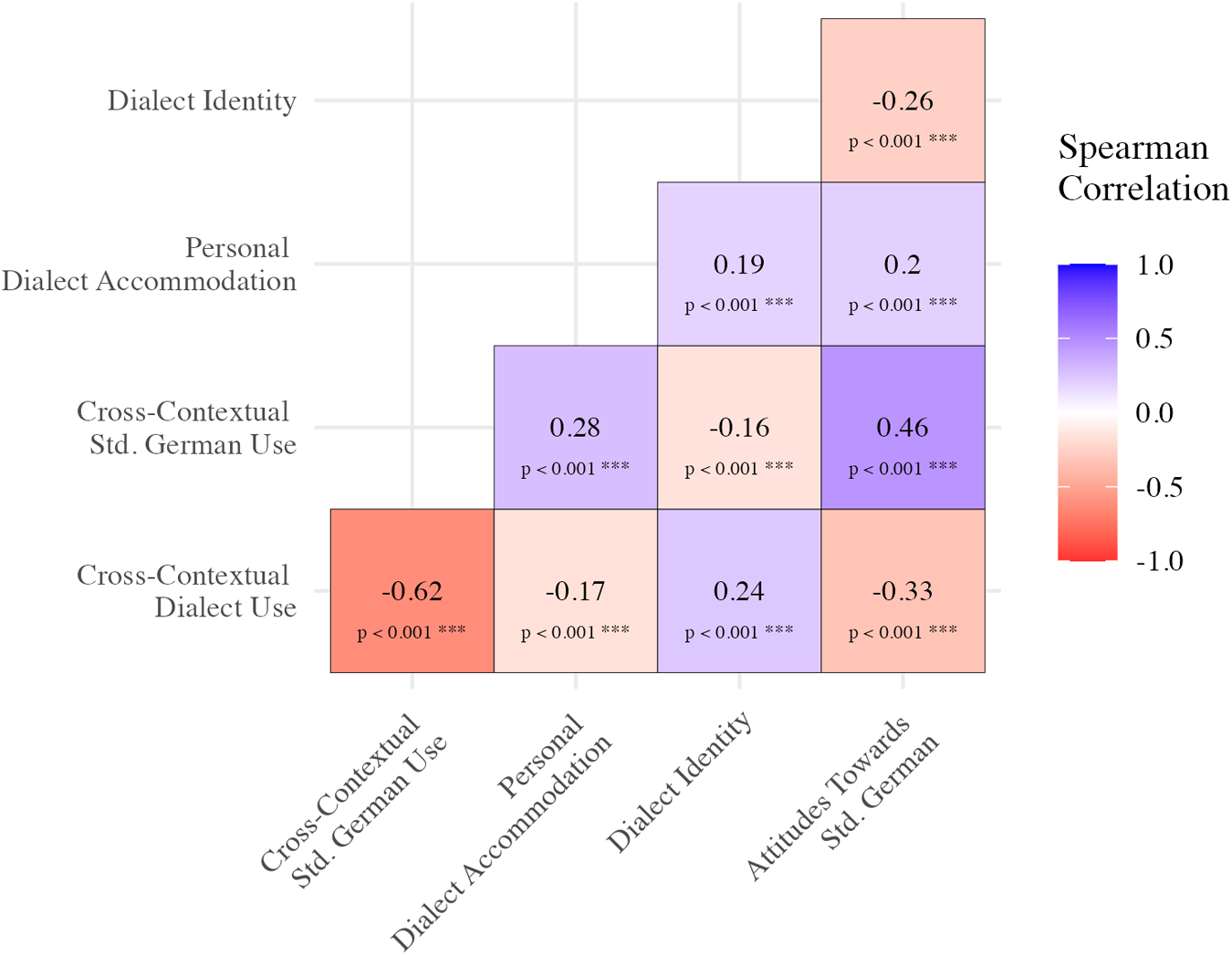
We found positive relationships between perceived MLE-related changes in accommodation, attitudes toward standard German, and cross-contextual standard German use. Perceived change in dialect identity and cross-contextual dialect use were also positively related. These findings suggest that perceived MLE-related change in the productive use of a variety is intertwined with changes in the attitudes toward the respective variety. Finally, perceived MLE-related change in dialect use and dialect identity were negatively related to the standard German measures, indicating that self-reported measures of change concerning standard language and dialect varieties are not influenced in the same way by MLEs.
Interindividual effects of MLEs on perceived linguistic change
Figure 5 presents the descriptive statistics of perceived change in participants’ cross-contextual varietal use and affective-attitudinal factors as a function of the individual MLEs (n = 701). As we can see, regardless of the MLE reported, there is a high degree of variation in how the life events impacted on individuals’ patterns of perceived linguistic change. In order to get a clearer idea of the trends of perceived MLE-related change in participants’ linguistic repertoires, we ran a series of Bayesian models.
Descriptive data for individual MLEs across perceived changes in cross-contextual varietal use and affective-attitudinal factors.
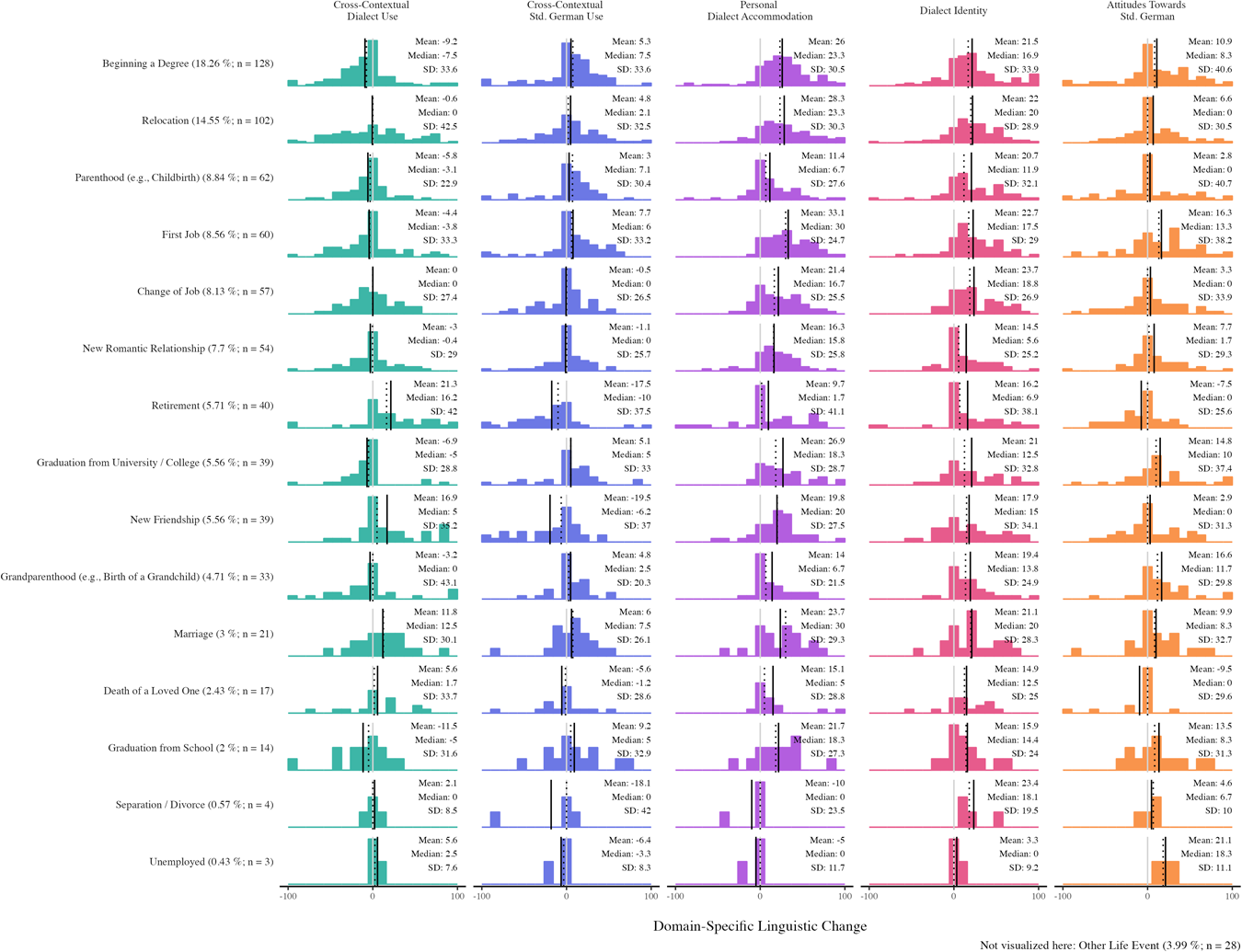
Figure 6 presents the results of the modeling procedure, illustrating the predicted probability of perceived linguistic change across the five measures as a function of the individual MLEs. Green shading (i.e., values on the right side of the dotted line) represents a positive directionality of the perceived change (e.g., perceived higher rates of dialect use, stronger dialect identity, more positive attitudes toward standard language), and red shading (i.e., values on the left side of the dotted line) indicates a negative directionality. The printed values display the mean predicted probability of perceived change and the respective credible interval.
Predicted probabilities of perceived MLE-related change in cross-contextual varietal use and affective-attitudinal factors (n = 666, since the event type “Other” and events with less than 1% of the total responses were not considered).
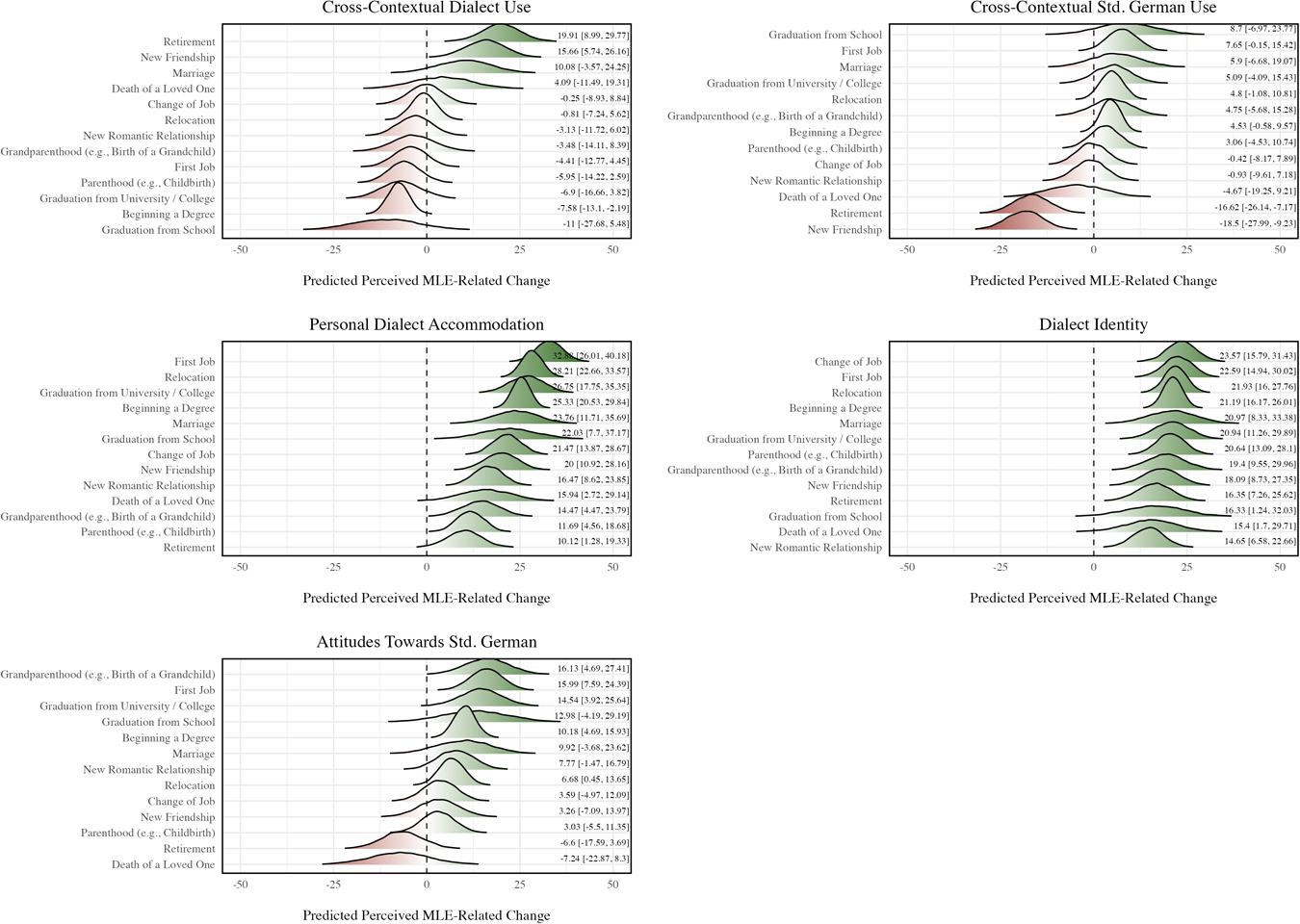
As concerns the measures gauging perceived MLE-related changes in cross-contextual varietal use, we find that retirement and new friendship were associated with a perceived increase in dialect use and a perceived reduction in the use of standard language. Beginning a degree, graduation from university, an individual’s first job, parenthood, and geographical relocation appear to have the opposite effect, in that participants reported an increase in their standard German use and a reduction in their rates of dialect use following the event. It is important to note, however, that most of the perceived changes in the productive measures did not land far from zero, indicating either only a moderate degree of perceived MLE-related change or otherwise a high degree of heterogeneity in terms of the directionality of perceived change, such that the aggregate patterns then trended toward zero (see Figure 5 for the individual responses).
Conversely, across all MLEs, perceived changes in affective-attitudinal measures were quite high. What is more, most of these self-reported changes were positive in directionality, meaning that MLEs were, from participants’ perspective, related to an increase in accommodation tendencies, a stronger dialect identity, and more positive attitudes toward the standard language (though the degree of perceived MLE-related change was weakest here). Only for retirement was the majority of the credible interval negative for attitudes toward standard German (and also for death of a loved one, but given the small sample for this MLE, the credible interval was comparatively large and thus difficult to interpret).
Overall, it would seem that the productive domain (i.e., cross-contextual use of dialect and standard language) is less malleable for perceived MLE-related change compared to affective-attitudinal factors.
Discussion
The aim of the present study was to investigate language users’ beliefs about the effects of MLEs on linguistic change both in cross-contextual varietal use and in affective-attitudinal factors. The majority of participants (79%) reported that they had experienced change in their linguistic repertoire as a result of a significant life event. Regardless of whether an MLE was more specific to young adulthood (e.g., first job), later life (e.g., grandparenthood, retirement), or indeed occurred throughout the entirety of adulthood (e.g., new friendship, relocation), participants reported considerable MLE-related lability in their sociolinguistic repertoires. These findings are in line with previous panel studies in sociolinguistics challenging the assumption of postadolescent linguistic stability and nondevelopment (e.g., Beaman, Reference Beaman, Ziegler, Edler and Oberdorfer2021; Bowie, Reference Bowie, Duszak and Okulska2010; Bülow & Vergeiner, Reference Vergeiner2021; Bülow et al., Reference Bülow, Vergeiner, Wallner, Beaman and Buchstallerin press; Sankoff, Reference Sankoff2018; Vergeiner et al., Reference Vergeiner, Wallner, Bülow, Scheutz, Christen, Ganswindt, Herrgen and Schmidt2021). We thus agree with Labov (Reference Labov2001:447) that “the assumption of stability for young adults […] may have to be revised.”
The correlational analyses of the five measures of perceived linguistic change revealed that individuals who reported change in one domain generally reported change in another, though the relationships between measures varied quite drastically both in strength and directionality. Expectedly, dialect-related measures (perceived changes in dialect use and in dialect identity) correlated negatively with the standard German measures (perceived changes in standard use and in attitudes toward standard language), which broadly suggests that standard language and dialect varieties are not perceived to be influenced in the same way by significant life events. This finding is congruent with previous studies reporting the effects of MLEs on patterns of linguistic change (e.g., Bowie & Yaeger-Dror, Reference Bowie, Yaeger-Dror, Honeybone and Salmons2015; Buchstaller, Reference Buchstaller2015; Eckert, Reference Eckert and Coulmas1997; Wagner, Reference Wagner2012b), in that some life-course transitions may place specific demands on speakers regarding language use and conduct and so catalyze the increased use of one linguistic area (e.g., standard language) at the cost of another (e.g., vernacularity).
Perceived changes in cross-contextual language usage
Standardization pressures in educational environments (for Austria, e.g., Dannerer, Reference Dannerer, Deppermann and Reineke2018; Vergeiner, Reference Vergeiner2021) and in economically active adulthood (e.g., Eckert, Reference Eckert and Coulmas1997; Sankoff & Laberge, Reference Sankoff, Laberge and Sankoff1978; Wagner, Reference Wagner2012a) have been argued to bring about linguistic “retrenchment” (Chambers, Reference Chambers2008:190) toward standard language and, at the same time, cause a retreat from vernacularity. Our results reflect these general trends: Participants believed that the transition into tertiary education coincided with a moderate increase in standard German use and a reduction in the amount of cross-contextual dialect use—a finding which parallels Wagner (Reference Wagner2012b), who showed in her sample of female teenagers in Philadelphia that the transition into higher education is associated with a reduction in vernacular forms. Similarly, individuals reporting on the linguistic relevance of their first job reported an increase in cross-contextual standard German use and a moderate reduction in dialect use, which suggests an interindividual standardizing effect of the entry into the workforce, likely owing to the standardization pressures of the linguistic marketplace (Sankoff & Laberge, Reference Sankoff, Laberge and Sankoff1978). Conversely, the disassociation from these social norms and standardization pressures may give rise to the opposite pattern. The retirement threshold, specifically, is often associated with a revival of vernacular variants speakers had perhaps suppressed during their time in the standard-expectant workplace (e.g., Buchstaller, Reference Buchstaller2006; Cheshire, Reference Cheshire, Ammon, Dittmar, Mattheier and Trudgill2005; Sankoff & Laberge, Reference Sankoff, Laberge and Sankoff1978; Vergeiner et al., Reference Vergeiner, Wallner, Bülow, Scheutz, Christen, Ganswindt, Herrgen and Schmidt2021). Our data reflect this assumption in that retired individuals reported a retreat away from standard language and a radical uptake in the cross-contextual use of dialect varieties.
Given their potential to either induce or reduce standardization pressures, educational and occupational life-course transitions have hitherto stood in the limelight of discussions on linguistically relevant significant life events. However, this study revealed that MLEs in the personal domain were also important predictors of perceived linguistic change. For example, relocation was associated with a self-reported increase in cross-contextual standard language use. This finding is consistent with previous sociolinguistic theorizing and empirical results (e.g., Beaman, Reference Beaman, Ziegler, Edler and Oberdorfer2021) indicating that more mobile individuals may evince a stronger orientation toward standard language, also because this is the variety of supra-regional communication (e.g., Ender & Kaiser, Reference Ender and Kaiser2009). What is more, individuals reporting on the linguistic relevance of parenthood (e.g., birth of a child) perceived an increase in standard language usage, which corresponds to previous insights from the field of first language acquisition underscoring that parental—especially maternal—input when speaking to children is characterized by high rates of standard variants (e.g., Smith & Durham, Reference Smith and Durham2019). Especially since our sample of participants reporting on entrance into parenthood as a linguistically relevant MLE comprised primarily women (women = 54; men = 8), it seems plausible that the effect of increased standard language use toward children may transfer to their linguistic repertoire more generally, though this remains a hypothesis that needs to be subjected to further testing employing intensive longitudinal data. Interestingly, we also found that the MLE of a new friendship—an event reported across every life stage—was one of the strongest predictors for perceived change in cross-contextual varietal use (i.e., a self-reported increase in dialect use and a self-reported reduction in standard use, likely as a result of the contextual informality [see Ender & Kaiser, Reference Ender and Kaiser2009]). This underscores the general assumption that new social networks and peer relationships play a critical role in shaping and shifting patterns of (at least perceived) linguistic change across the whole of life rather than exclusively in the adolescent years. Specifically, new and diversified social networks and the resultant intensive exposure to both the language use and language attitudes of select individuals in the course of, for instance, new friendships, partnerships, etc., may be a critical source for linguistic variability, as highlighted by previous work on social network structures (e.g., Lippi-Green, Reference Lippi-Green1989; Milroy & Milroy, Reference Milroy and Milroy1992).
Perceived changes in affective-attitudinal variables
Until now, most of the previous research on lifespan sociolinguistic development has focused on changes in the productive repertoire, while analyses on changes in affective-attitudinal factors, especially as dependent variables, are still scarce. In this study, we found that personal dialect accommodation, participants’ dialect identity, and, though to a lesser extent, attitudes toward standard German were subject to a higher degree of perceived MLE-related change than were the productive measures.
It is perhaps not all that surprising that participants reported a pronounced increase in accommodation tendencies as a result of all significant life events investigated here. This is because, from a developmental perspective, MLEs “require new behavioral, cognitive, or emotional responses” (Bleidorn et al., Reference Bleidorn, Hopwood and Lucas2018:64) and thus inherently require individuals to accommodate to their new circumstances in some way or another. For example, new and diversifying social networks (e.g., more contact with speakers from other regions) and an increase in contextual variety (e.g., navigating novel or more complex tasks and situations) as a result of an MLE might place demands on speakers regarding linguistic conduct which require them to accommodate more than was previously necessary. Additionally, because MLEs “mark the beginning or the end of a specific status” (Luhmann et al., Reference Luhmann, Hofmann, Eid and Lucas2012:594), such as “a certain position, rank, role, or condition” (Bleidorn et al., Reference Bleidorn, Hopwood and Lucas2018:64) and thus often correlate with a change in an individual’s geographical and/or social environment, self-reported accommodation outcomes may also reflect speakers’ drive to connect with new peer groups and to situate themselves linguistically within them—as has been found, for instance, during the transition into tertiary education (see Prichard & Tamminga, Reference Prichard and Tamminga2012).
The most unexpected result in this study was the general trend that MLEs were, in participants’ view, related to a strengthened dialect identity. This indicates that, in the face of significant change, speakers report strengthened ties to their “dialect roots” regardless of shifts in their productive repertoire. Interestingly, this finding stands in contrast with Bülow et al. (Reference Bülow, Vergeiner, Wallner, Beaman and Buchstallerin press), who found in their panel study of 12 Austro-Bavarian dialect speakers that their attitudes toward the dialect (i.e., the local vernacular) remained stable over the course of 40 years. The discrepancies, however, may be methodological in nature: Our measure was based on questionnaire items specifically targeting the perceived impact of MLEs on dialect identity, whereas Bülow et al. (Reference Bülow, Vergeiner, Wallner, Beaman and Buchstallerin press) derived the degree of dialect identity from interview questions more generally, without a concrete focus on the effects of specific MLEs on changes in identity.
Finally, it is notable that the MLEs which participants believed were related to more positive attitudes toward standard German were also significant life events associated with a perceived increase in cross-contextual standard German use (e.g., graduation from school, beginning a degree, first job). While indeed speculative, these findings may relate to what Bowie (Reference Bowie, Duszak and Okulska2010:47) postulated as “coping linguistically.” That is, individuals faced with social pressures to employ standard language (e.g., when entering the job market) may cope with this by developing more positive attitudes toward standard varieties, likely also owing to increased exposure to standard language and thus an ensuing familiarity effect. A notable outlier here was retirement, such that retired individuals reported more negative attitudes toward standard language. This reminds us of Mechler and Buchstaller’s (Reference Mechler and Buchstaller2019) analysis showing that some speakers may proudly avoid social norms relating to the use of standard language in later life. Our results are consistent with this notion, such that retired individuals are perhaps associating negative attitudes with the standard language as an expression of their newfound avoidance of the prescriptive pressures of the linguistic marketplace which long governed their language use during young adulthood and midlife.Footnote 1
Limitations and future directions
In light of the exploratory nature of the present study, there is quite an extensive list of limitations, methodological drawbacks, and open empirical questions for future research. Possibly the most notable limitation given the scope of this initial exploratory investigation of the interindividual effects of MLEs on linguistic change was our neglect of how potential individual differences may influence perceived MLE-related linguistic change. Given the breadth of MLEs investigated in this study, we were unable to consider MLE-related individual differences, nor could we explore person-related individual differences in gender, socioeconomic status (e.g., occupation), or educational attainment. Future research thus needs to attend to the question concerning how these may modify the directionality or intensity of (perceived) linguistic change.
Methodologically, our five chosen measures are quite specific and gauge only perceived MLE-related changes at the two endpoles of the varietal spectrum: standard German and dialect. As we noted earlier, nine individualsFootnote 2 reported that MLEs indeed impacted their linguistic repertoire, but they indicated no change in the five measures of interest. This finding suggests that, while some individuals may perceive their sociolinguistic behavior to remain stable following a life-course transition, other facets of the linguistic repertoire may be susceptible to (perceived) MLE-related change, such as vocabulary (e.g., work-related terminology) or socio-pragmatic choices. Also in a methodological vein, 18% of individuals reported experiencing no MLE-related change in their linguistic repertoire, and 3% reported experiencing none of the listed MLEs. In order to avoid participant attrition, these individuals were not required to fill out the remainder of the questionnaire (following Schwaba et al., Reference Schwaba, Denissen, Maike, Hopwood and Bleidorn2023). However, it would be interesting for future questionnaires to collect additional sociodemographic data on these participants in order to identify potential predictors for perceived linguistic stability.
Another methodological aspect that deserves attention is the fact that we did not collect any speech data in this questionnaire, but rather relied on participants’ retrospective perceptions of MLE-related change. While our results can provide insights as to which MLEs may be particularly promising for detailed follow-up study, we cannot make any claims about whether these self-reports correlate with actual linguistic behavior. Thus, in addition to more panel studies (ideally with dense measurements) across some of these life-course transitions, studies which compare perceived and longitudinally measured MLE-related linguistic change would be beneficial in order to broaden our methodological toolkit of how we measure MLE-related linguistic change across the lifespan.
The last methodological issue that requires consideration is the MLE selection. Recall that, following Schwaba et al. (Reference Schwaba, Denissen, Maike, Hopwood and Bleidorn2023), participants were asked to identify a life event that they believed had influenced changes in their linguistic repertoire, and in the case of multiple events, to choose the one with the strongest impact. While this gestalt allows us to explore which MLEs generally have a considerable impact on perceived linguistic change, the approach may produce estimates on the more “extreme” end of the actual effect size range. Future research should attend to this issue by investigating how a heterogeneous group of individuals experiences the impact of a select life-course transition, ideally employing intensive longitudinal data to capture real-time linguistic change.
Conclusion
Bowie and Gerstenberg (Reference Bowie and Gerstenberg2023:2) argued that age in the sense of the linear accumulation of years lived is a “profoundly incomplete” measure of how multifaceted biological, psychological, and social processes of aging are intertwined with the (in)stability in a speaker’s sociolinguistic repertoire across the life course. In fact, nearly two and a half decades earlier, Eckert (Reference Eckert and Coulmas1997:167) issued the call for sociolinguists to disentangle biological and physiological processes of maturation from the “life experiences that give age meaning,” and this remains a challenge that has not been adequately tackled hitherto (e.g., Buchstaller, Reference Buchstaller2015; Wagner, Reference Wagner2012a). We attempted to do this call justice by investigating individuals’ lived experiences in the form of significant life events. The hypothesis here is that maneuvering certain MLEs may place specific demands on speakers regarding demeanor and language use and thus have measurable consequences for an individual’s linguistic behavior. To our knowledge, this was the first study to explore the interindividual effects of a range of different MLEs on speakers’ patterns of perceived linguistic change across the adult lifespan.
We found corroborating evidence both for previous empirical investigations and for sociolinguistic hypotheses about the role of significant life-course transitions on linguistic lability across adulthood. For example, the transition into tertiary education and entry into the workforce were associated with a perceived retrenchment toward standard language, likely owing to the standardization pressures encountered in university settings (Dannerer, Reference Dannerer, Deppermann and Reineke2018; Vergeiner, Reference Vergeiner2021) and on the linguistic marketplace (Sankoff & Laberge, Reference Sankoff, Laberge and Sankoff1978; see also Chambers, Reference Chambers2008; Eckert, Reference Eckert and Coulmas1997; Wagner, Reference Wagner2012a). What is more, retirement was associated with a perceived retreat away from standard language and an uptake in dialect use, a trend that has been hypothesized to occur upon disassociation from the standard language-expectant workplace (e.g., Buchstaller, Reference Buchstaller2006; Vergeiner et al., Reference Vergeiner, Wallner, Bülow, Scheutz, Christen, Ganswindt, Herrgen and Schmidt2021). Such findings, given that they match the results of previous observation-based work, provide reasonable evidence that participants’ intuitions about MLE-related change may be relatively reliable (at least, in the Austrian context). Additional significant life events such as relocation and new romantic or platonic relationships are also perceived to have change-inducing effects across the whole of life, both on self-reported changes in cross-contextual varietal use and in affective-attitudinal factors.
Language variation and change across the lifespan have been described as both discontinuous and susceptible to external-environmental influences (e.g., Riverin-Coutlée & Harrington, Reference Riverin-Coutlée and Harrington2022). Significant life events that trigger radical behavioral, cognitive, and affective shifts in an individual (e.g., Bleidorn et al., Reference Bleidorn, Hopwood and Lucas2018) may therefore yield abrupt consequences for the sociolinguistic repertoire (e.g., Buchstaller, Reference Buchstaller2015). Our results illustrate that there is a plethora of linguistically relevant life-course transitions (at least from participants’ perspective), but only a fraction of these has received actual empirical attention hitherto. We thus concur with Wagner (Reference Wagner2012b:197) that “targeted studies of critical turning points in the life course can contribute to the understanding of individual life span change.”
Supplementary material
The supplementary material for this article can be found at https://osf.io/mf3jh/.
Competing interests
The author(s) declare none.


 Open access

