Childhood obesity is rising to epidemic proportions in the developing world, adding a significant public health burden to countries where undernutrition remains common(Reference Popkin and Gordon-Larsen1); therefore the WHO highlights tackling childhood obesity as an urgent priority(2). Child and adolescent overweight and obesity are related to an increase in non-communicable diseases (NCD)(Reference Reilly and Kelly3), while undernutrition is also known to substantially increase morbidity and mortality(Reference Horton4–Reference Sachs and McArthur7).
Paradoxically, obesity is now common even in rural and under-developed areas, including those with a high prevalence of HIV and undernutrition(Reference Kimani-Murage, Kahn and Pettifor8).
In rural South Africa, an estimated 60 % of women aged 25–29 years were overweight (BMI ≥ 25·0 kg/m2) and 30 % were obese (BMI ≥ 30·0 kg/m2) in 2006–2007(Reference Barnighausen, Welz and Hosegood9). This was in an area at the epicentre of the HIV epidemic(Reference Welz, Hosegood and Jaffar10, Reference Barnighausen, Hosegood and Timaeus11), where advanced HIV infection leads to weight loss, but prior to the widespread availability of HIV antiretroviral treatment(Reference Barnighausen, Welz and Hosegood9) which is likely to mitigate weight loss in HIV-infected individuals.
The NCD Alliance and the Lancet NCD Action Group proposed that the UN Summit in 2011 should prioritise several policies for low- and middle-income countries, one of which is population monitoring of NCD(Reference Beaglehole, Bonita and Horton12). Population monitoring of child and adolescent under- and overnutrition is based on simple anthropometric measures and indicators such as BMI-for-age(Reference Must and Anderson13) but has become complicated lately by the plethora of new and more international approaches for defining unhealthy weight status(Reference El-Ghaziri, Boodai and Young14). A further complication is the increasing recognition of the potential value of having body composition measures rather than solely relying on simple proxies for fat and lean mass(Reference Wells and Fewtrell15). In order to assess the prevalence of unhealthy weight status, to allow an improved understanding of the causes and effects of child and adolescent under- and overnutrition in low- and middle-income countries, and to evaluate the impact of public health interventions, it is essential that major methodological questions in population monitoring of under- and overnutrition are resolved, including:
1. the effect of different definitions on the prevalence of unhealthy weight status; and
2. the extent to which a simple field measure of body composition adds value to the assessments of nutritional status provided by simple anthropometry.
The present study therefore examined the extent to which different approaches to defining weight status agreed with each other in rural Zulu children and adolescents, and the extent to which they agreed with assessments based on body fatness.
Methods
Study setting
The study was conducted at the Africa Centre (www.africacentre.com) in rural KwaZulu-Natal, an area with a high prevalence of HIV. In 2004, the overall HIV prevalence in the area among adults aged 15–54 years was 27 % for women and 13·5 % for men; with 51 % of women aged 25–29 years and 44 % of men aged 30–34 years infected(Reference Welz, Hosegood and Jaffar10).
The Africa Centre operates a large household and individual demographic surveillance in an area of 438 km2. Some 92 000 individuals from 11 000 households are surveyed twice annually, and all homesteads, buildings and amenities including schools, water supplies and roads are mapped using a geographic information system (GIS)(Reference Tanser and Le Sueur16, Reference Tanser, Gijsbertsen and Herbst17). In 2006, 77 % of households in the surveillance area had access to piped water and toilet facilities(Reference Tanser, Hosegood and Barnighausen18).
Sample and sampling frame
The present cross-sectional study used random sampling stratified by age, with the aim of recruiting 1500 (500 from three age groups) children and adolescents from within the demographic surveillance area (DSA) between April and December 2010. Children from school grades 1, 5 and 9 (corresponding to approximate ages of 7, 11 and 15 years, respectively) were recruited from local primary and secondary schools.
Schooling in South Africa begins at age 7 years; under the South African Schools Act 1996 schooling is compulsory up to age 15 years or until the completion of grade 9, whichever comes first. School enrolment rates across South Africa are high, with Department of Education figures showing South Africa's gross enrolment rate to be 93 % in the General Education and Training band (grades R–9) in 2009(19). The Statistics South Africa General Household Survey found that 98 % of children aged 7–15 years were in attendance at an education institution in 2009(20).
It can be concluded, therefore, that school enrolment for children aged 7–15 years in South Africa is almost universal and as a result this population is largely accessible by recruitment via schools.
Sampling at school level
Secondary schools
Schools were chosen based on their rural/peri-urban setting determined using data from the Africa Centre GIS on their position within the DSA and further by their allocated school quintile. School quintiles are governmental assigned categories based on rates of income, unemployment and illiteracy within the school catchment area. They are broadly representative of school wealth, determining how much government funding schools receive per learner. Quintile 1 receives the highest funding and quintile 5 the least. Quintiles 1–3 are ‘no fee’ schools and quintiles 4 and 5 are fee-paying schools. There were no quintile 5 schools in this area and all schools included were in quintiles 1–4. This method of school selection, in order to obtain a representative sample, has been used previously in the South Africa Health of the Nation Study(Reference Armstrong, Lambert and Sharwood21). There are fifteen secondary schools in the DSA, six of which were sampled in the present study.
Primary schools
As the majority (over 90 %) of primary schools were in quintile 3, quintiles were not used as a selection factor for younger children. Instead, primary schools were chosen using a randomly ordered list generated in Microsoft® Excel containing all forty-seven primary schools present in the DSA. Children were sampled from schools starting from number 1 on the list until the target number of individuals had been reached; children from twenty-two primary schools were included.
Sampling at individual level
All individuals in the appropriate grades had the study explained to them verbally and informed consent forms were distributed for them to take home. The class was then revisited on a later scheduled day to conduct measurements on individuals providing written consent. Participants were eligible for inclusion if they were enrolled into school grade 1, 5 or 9 in one of the chosen schools; signed informed consent was obtained from their caregiver and assent from themselves; and they were in attendance at school on the day of assessment. The study was conducted according to the guidelines laid down in the Declaration of Helsinki and all procedures involving human subjects were approved by the Biomedical Research Ethics Committee, University of KwaZulu-Natal.
Representativeness of the study sample in relation to the overall DSA population was examined using two indicators of socio-economic status: the presence of piped water in the home and the availability or otherwise of a connection to the electricity grid. Study participants were asked for their DSA household identification number at the time of enrolment. Using this identification number and other unique identifying data (including name, date of birth and parents’ names), about 70 % of the enrolled study sample in each grade was matched to their household data from the DSA, the remaining 30 % was unmatched due to a lack of identifying data. Summary data on the extent to which the sample for the present study matched the general population, as described by DSA data, are given in Table 1.
Representativeness of the study sample compared with the population of the demographic surveillance area (DSA)

*343 matched out of 514 = 66·7 %.
†Significant difference between DSA and present study.
‡377 matched out of 503 = 75·0 %.
§357 matched out of 502 = 71·1 %.
Measurements
Height was measured twice for each child to the nearest 0·1 cm using a SECA stadiometer. If the difference between the two measurements was greater than 5 mm, a third measurement was taken and the two heights within 5 mm were recorded(Reference de Onis, Onyango and Van den Broeck22). Weight and body fat measurements were carried out once using TANITA SC240MA bio-impedance digital scales. Weight and body fat were measured in light indoor clothing (shoes and socks removed). Weight was measured to the nearest 0·1 kg and body fat estimated to the nearest 0·1 %. On the TANITA device, ‘non-athlete’ was chosen as the standard mode and 0·5 kg was entered as the standard deduction for clothes weight. The TANITA device allows for gender, age and height in its measurements.
All measurements were carried out by two Zulu-speaking local research assistants, trained and supervised by one of the authors (E.C.).
Four reference comparisons: reference data and definitions of underweight, thinness, overweight and obesity
1. BMI-for-age using WHO (2007) reference data
WHO AnthroPlus software was used for application of the WHO Reference 2007 for children aged 5–19 years(23, Reference de Onis, Onyango and Borghi24) (hereafter referred to as ‘WHO 2007’). Underweight, overweight and obesity were defined by BMI-for-age as a Z-score of <−2, >+1 and ≤+2 (equivalent to BMI ≥ 25·0 kg/m2 at 18 years) and >+2 (equivalent to BMI ≥ 30·0 kg/m2 at 18 years), respectively.
2. Weight-for-age using the National Center for Health Statistics/WHO growth reference 1977
The WHO 2007 weight-for-age references are only available up to age 10 years; therefore, the National Center for Health Statistics (NCHS)/WHO growth reference 1977 (hereafter referred to as ‘NCHS/WHO’) was used to calculate weight-for-age for the full sample (using the EpiInfo program available from the US Centers for Disease Control and Prevention (CDC))(25, Reference Dibley, Goldsby and Staehling26). The following weight-for-age categories were used to define weight status: Z-score <−2 as underweight, Z-score >+1 and ≤+2 as overweight and Z-score >+2 as obese.
3. BMI-for-age using Cole et al. and International Obesity Taskforce cut-offs
The BMI-for-age cut-offs of Cole et al. and the International Obesity Taskforce (IOTF) were also applied to the data(Reference Cole, Bellizzi and Flegal27–Reference Cole, Flegal and Nicholls29) (hereafter referred to as ‘Cole-IOTF’). The Cole et al.(Reference Cole, Flegal and Nicholls29) approach was used to define thinness, corresponding to a conceptually equivalent BMI at age 18 years of <18·5 kg/m2, and the IOTF approach(Reference Cole, Bellizzi and Flegal27) was used to define overweight and obesity, conceptually equivalent to a BMI at age 18 years of 25·0–29·9 kg/m2 for overweight and ≥30·0 kg/m2 for obesity.
4. Body composition measurement from bio-impedance
Body fat estimates from bio-impedance were categorised into under-fat, healthy, over-fat and obese, by age and sex, using McCarthy et al.'s(Reference McCarthy, Cole and Fry30) body fat reference curves for children (hereafter referred to as ‘McCarthy 2006’). This reference was not ideal given that it was based on Caucasian children and adolescents. However, due to the absence of other applicable body fat references, this was used in the present study.
Statistical analysis
Data were analysed using the STATA statistical software package version 11·0.
To determine the agreement between the different definitions of underweight, thinness, under-fat, overweight, obesity and over-fat, the weighted kappa statistic (κ w) was used. This statistic was calculated with four categories, namely underweight, healthy weight, overweight and obese. Landis and Koch's(Reference Landis and Koch31) categories were used to interpret the output: κ w = 0–0·20 indicates slight agreement; κ w = 0·21–0·40 fair agreement; κ w = 0·41–0·60 moderate agreement; κ w = 0·61–0·80 substantial agreement; and κ w = 0·81–1·00 indicates almost perfect agreement.
Results
Descriptive data of study participants
Table 1 provides summary data on the representativeness of the study sample, by comparison with the DSA population, using information from the Africa Centre Household Surveillance (C Newell, personal communication, September 2011). Only one variable was found to be significantly different in one age group between the present study and the DSA population, suggesting the present sample was broadly socio-economically representative of the wider DSA. The population resident within the DSA is essentially Zulu (governed predominantly by the Zulu land ownership system where the king controls who can build houses); therefore, there was no need to account for differences in ethnicity between participants.
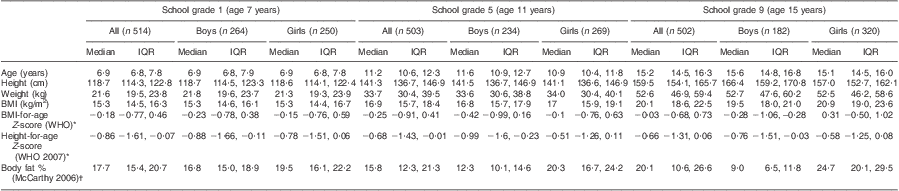
A total of 1519 participants were measured, with an overall consent rate of approximately 70 %. Characteristics of study participants are shown in Table 2. Median BMI-for-age Z-score, using WHO 2007, was negative (i.e. Z-score < 0) at all time points except for girls in grade 9. Body fat percentage in boys was lower in the middle than in the youngest age group and lower still in the oldest age group; however, in girls the opposite was the case, with the highest level in the oldest age group. Median height-for-age Z-score was negative in both sexes and at all three age groups.
Anthropometric and body composition characteristics of study participants: children and adolescents (n 1519), KwaZulu-Natal, South Africa

IQR, interquartile range.
*WHO (2007)(Reference de Onis, Onyango and Borghi24).
†McCarthy et al. (2006)(Reference McCarthy, Cole and Fry30).
Differences in the prevalence of underweight, overweight and obesity using different anthropometric measures (body fat, BMI-for-age, weight-for-age) in boys
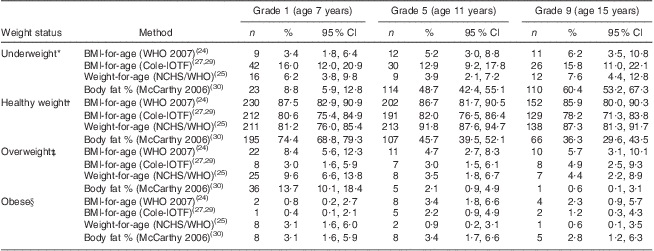
Prevalence of healthy and unhealthy weight status by method and age group in boys is summarised in Table 3. The body fat method produced the lowest estimates of healthy weight status in all age groups when compared with BMI-for-age and weight-for-age methods. Discrepancies between weight status assessments based on weight and BMI were strikingly different from those obtained by body fatness measures; however, this difference was not significant for those in grade 1 (Table 3). Prevalence of healthy weight status in boys by bio-impedance was 74 %, 46 % and 36 % in grades 1, 5 and 9, respectively, compared with 81–92 % using NCHS/WHO, 78–82 % using Cole-IOTF and 86–88 % using WHO 2007 definitions.
Prevalence of four categories of weight status (underweight, healthy, overweight and obesity) using four international references among boys, KwaZulu-Natal, South Africa
IOTF, International Obesity Taskforce; NCHS, National Center for Health Statistics.
*Underweight: WHO 2007 = Z score of <−2; IOTF = equivalent to BMI at age 18 years of <18·5 kg/m2; NCHS/WHO = Z-score of <−2; McCarthy 2006 = body fat % ranging from 0 to 12 % depending on age.
†Healthy weight: WHO 2007 = Z score of ≥−2 and ≤+1; IOTF = equivalent to BMI at age years 18 of 18·5–24·9 kg/m2; NCHS/WHO = Z-score of ≥−2 and ≤+1; McCarthy 2006 = body fat % ranging from 10 to 23 % depending on age.
‡Overweight: WHO 2007 = Z-score of >+1; IOTF = equivalent to BMI at age 18 years of 25·0–29·9 kg/m2; NCHS/WHO = Z-score of >+1 and ≤+2; body fat % = ranging from 20 to 28 %, depending on age.
§Obese: WHO 2007 = Z-score of >+2; IOTF = equivalent to BMI at age 18 years of ≥30·0 kg/m2; NCHS/WHO = Z-score of >+2; McCarthy 2006 = body fat % ranging from 24 % depending on age.
Differences in the prevalence of underweight, overweight and obesity using different anthropometric measures (body fat, BMI-for-age, weight-for-age) in girls
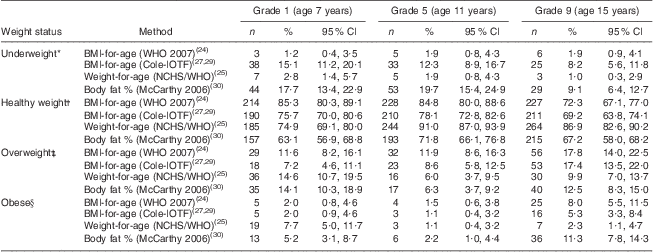
Prevalence of healthy and unhealthy weight status by method and age group in girls is summarised in Table 4. The highest prevalence of underweight and lowest prevalence of healthy weight status were found using the body fat assessment for all three age groups in girls. In grades 1 and 9, there were no significant differences between body fat and Cole-IOTF estimates of underweight prevalence. Also, in grade 9, prevalence of healthy weight status was not significantly lower when using body fat assessment compared with Cole-IOTF or WHO 2007 definitions.
Prevalence of four categories of weight status (underweight, healthy, overweight and obesity) using four international references among girls, KwaZulu-Natal, South Africa
IOTF, International Obesity Taskforce; NCHS, National Center for Health Statistics.
*Underweight: WHO 2007 = Z score of <−2; IOTF = equivalent to BMI at age 18 years of <18·5 kg/m2; NCHS/WHO = Z-score of <−2; McCarthy 2006 = body fat % ranging from 0 to 12 % depending on age.
†Healthy weight: WHO 2007 = Z score of ≥−2 and ≤+1; IOTF = equivalent to BMI at age years 18 of 18·5–24·9 kg/m2; NCHS/WHO = Z-score of ≥−2 and ≤+1; McCarthy 2006 = body fat % ranging from 10 to 23 % depending on age.
‡Overweight: WHO 2007 = Z-score of >+1; IOTF = equivalent to BMI at age 18 years of 25·0–29·9 kg/m2; NCHS/WHO = Z-score of >+1 and ≤+2; McCarthy 2006 = body fat % ranging from 20 to 28 %, depending on age.
§Obese: WHO 2007 = Z-score of >+2; IOTF = equivalent to BMI at age 18 years of ≥30·0 kg/m2; NCHS/WHO = Z-score of >+2; McCarthy 2006 = body fat % ranging from 24 % depending on age.
Discrepancies between the prevalences of unhealthy weight status obtained by body fat assessment v. weight- and BMI-based approaches varied with age, but were generally smaller in girls than boys.
Agreement between different methods of defining weight status as assessed by weighted kappa
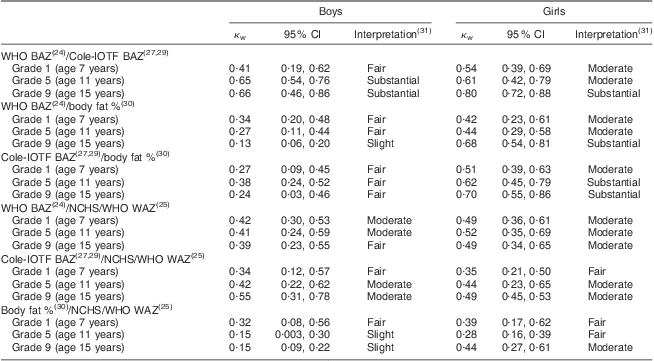
Agreement between the various methods when assessed by κ w analysis was generally low, although worse for boys than girls (Table 5). In boys, the majority of comparisons yielded slight to moderate agreement with the only agreement classified as substantial being the grade 5 and 9 comparisons between WHO 2007 BMI-for-age and Cole-IOTF thinness, overweight and obesity definitions based on BMI-for-age. All three comparisons of weight- or BMI-based assessments with body fat assessment produced agreements which were either slight or fair.
Comparison between methods used to define weight status – weighted kappa (κ w), 95 % confidence interval and interpretation according to Landis and Koch(Reference Landis and Koch31): children and adolescents (n 1519), KwaZulu-Natal, South Africa
BAZ, BMI-for-age Z-score; IOTF, International Obesity Taskforce; NCHS, National Center for Health Statistics; WAZ, weight-for-age Z-score.
In girls, all agreements between methods were either moderate or substantial with the exception of the grade 1 Cole-IOTF BMI-for-age and NCHS/WHO weight-for-age comparison and the grades 1 and 5 body fat v. NCHS/WHO weight-for-age comparisons, which were classified as fair.
Discussion
Main findings and implications
In the present study, the simple anthropometric methods used to define weight status produced estimates of unhealthy weight status that were markedly lower than estimates derived from body fatness measures; this discrepancy was greater in boys. Agreement between definitions based on the simple proxies for body fatness and body fatness assessments was only ‘fair’(Reference Landis and Koch31) in the boys and ‘moderate–substantial’(Reference Landis and Koch31) in the girls. Simple anthropometric definitions of overweight and obesity are known to define high body fat conservatively(Reference Monasta, Lobstein and Cole32), and the IOTF obesity definition is not equivalent in boys and girls(Reference Monasta, Lobstein and Cole32). It is not clear why greater agreement was observed between anthropometric and body composition methods in girls than in boys in the present study, but this difference between the sexes applied to most of the anthropometric methods used, extending beyond the expected sex-related bias associated with the IOTF obesity definition(Reference Monasta, Lobstein and Cole32). This issue merits further research as it would have important implications for future nutritional surveillance. Our study suggests that anthropometric nutritional surveillance might be more accurate in South African girls than boys.
Given the present results it may be possible that body fatness measures are more informative than simple proxies when assessing nutritional status, providing more realistic estimates of the prevalence of unhealthy weight status. Body fatness measures should perhaps be considered as preferred alternatives to simple weight-based measures in clinical settings and in public health applications such as surveillance. Bio-impedance as a field method is already widely used in surveillance of nutritional status throughout the developed world(Reference Haroun, Croker and Viner33–Reference Deurenberg, Kusters and Smit35) and it may be helpful in future surveillance of nutritional status in low- and middle-income countries. Importantly, the results of body fatness measures and simple proxies varied more significantly in the underweight and healthy weight categories than in the overweight and obese categories; the reasons for this difference warrant further research.
Comparisons with other studies
We are unaware of any studies that have compared the same approaches to defining weight status in rural South African children and adolescents. Few studies have considered definitions using a body composition reference or have compared assessments across the range of weight status (including both underweight and overweight/obesity), and even fewer have been able to evaluate the relatively new approach of Cole et al.(Reference Cole, Flegal and Nicholls29) to defining thinness. El-Ghaziri et al.(Reference El-Ghaziri, Boodai and Young14) compared the same anthropometric methods for defining weight status in Kuwaiti adolescents: they found that the international approaches (Cole 2007, IOTF 2000, WHO 2007 and CDC 2000) agreed well with each other; however, in the present study there were noticeable differences between these measures. Other studies have compared local and international references in children and adolescents, but with few studies from low- and middle-income countries and rural areas(Reference Baya Botti, Perez-Cueto and Vasquez Monllor36, Reference Kulaga, Litwin and Tkaczyk37).
A recent systematic review(Reference Reilly, Kelly and Wilson38) found that use of BMI-for-age with the Cole 2007 and IOTF 2000 method was a highly conservative approach to defining obesity, with generally much lower estimates of obesity prevalence when used in school-aged children than when national reference data and definitions based on BMI were used. Monasta et al.(Reference Monasta, Lobstein and Cole32) found large differences in prevalence of overweight between Cole 2007 and IOTF 2000 v. WHO 2007 references, with Cole 2007 and IOTF 2000 providing considerably higher prevalence of overweight compared with WHO 2007 reference data, and called for urgent attention to determine the optimal BMI cut-offs for WHO 2007 reference data.
South Africa currently uses several BMI references as the method of choice in surveillance of underweight, overweight and obesity (WHO 2007, WHO/NCHS 1977, WHO/CDC 1977, IOTF 2000)(Reference Armstrong, Lambert and Sharwood21, Reference Armstrong, Lambert and Lambert39–Reference Reddy, Resnicow and James43).
Recent South African prevalence studies have used anthropometric methods exclusively, the BMI-for-age NCHS/WHO growth reference 1977 data for underweight and the IOTF approach for overweight/obesity(Reference Kimani-Murage, Kahn and Pettifor8, Reference McCarthy, Cole and Fry30, Reference Reddy, Resnicow and James43). These studies all used simple proxy measures for body composition and none has used the new Cole et al. thinness definition(Reference Cole, Flegal and Nicholls29). One of the most recent South African studies, which is similar to the present study, was carried out within the Agincourt DSA among children aged 1–20 years(Reference Kimani-Murage, Kahn and Pettifor8). In addition to BMI, waist circumference was measured, but no assessment of body fat was made. In line with the present study, their results demonstrated highest levels of overweight/obesity in the older female age groups.
Study strengths and weaknesses
The present study was novel as many of the constructs and definitions we used are relatively new (e.g. Cole et al.'s thinness definition(Reference Cole, Flegal and Nicholls29)), with only limited evidence on their use to date. In addition, a great strength of the present study was the use of a measure of body fat as well as anthropometric measures, which are proxies for body fatness. The availability of body fatness data allowed us to deal tentatively with the issue of the validity of the simple anthropometric definitions, whereas previous studies have generally compared between anthropometric definitions of unknown validity. The conclusions in relation to the validity of the various anthropometric methods tested here depend in part on the accuracy of the body composition methodology used though, and this is discussed below. The present study also recruited a relatively high proportion of the total DSA population in each age group (Table 1).
The appropriateness of using all anthropometric measures, and body composition methods in particular, in ethnic groups is in slight doubt(Reference Shaw, Crabtree and Kibirige44). The extent to which reference data for weight or BMI or body fat should be ethnic-specific is not clear currently, but an important issue is that, at present, all recommended methods for children and adolescents are universal. The present study therefore serves to indicate that this approach possibly has limitations in certain ethnic groups. Further, a recent study found ethnic differences to increase with age(Reference Shaw, Crabtree and Kibirige44), and this effect of age on the extent to which body composition methods are ethnic-specific requires further investigation.
It is possible that the bio-impedance estimates of fatness are biased in a sex-specific manner as bio-impedance analysis errors can be very different (magnitude and direction) in boys compared with girls(Reference Reilly, Gerasimidis and Paparacleous45). The use of the McCarthy 2006 references for body fat may have led to an over/underestimation of body fat in the present sample given that the reference was initially developed on Caucasian children and ethnic differences in body fat have previously been reported(Reference Shaw, Crabtree and Kibirige44). These ethnic differences, which show children and adolescents of South Asian and African-Caribbean ethnicity to have a higher body fat percentage than those of white ethnicity, may have an important role when using body fat measures to determine risk of obesity-related diseases such as type 2 diabetes(Reference Shaw, Crabtree and Kibirige44). Cross-validation of the McCarthy 2006 approach to using bio-impedance analysis to estimate body composition against a criterion method of body composition in non-European populations would be useful before the method is adopted more widely.
The tentative recommendation from the present study to use a measure of body composition as opposed to a proxy could be problematic in low- and middle-income countries, especially in rural areas, given limited resources. Bio-impedance is probably the least expensive field option, but is more costly than equipment required for simple proxy measures of body composition which are usually based on weight and height. However, given that measures of body fatness may be more informative than simple anthropometry, and as the burden of NCD grows in low- and middle-income countries, this extra cost may be justified in future population surveillance.
Conclusions
The anthropometric methods we used for defining unhealthy weight status in children and adolescents do not produce equivalent assessments when applied in rural South Africa. Moreover, agreement between proxy measures of unhealthy weight status and measures of body fatness was generally low, with very conservative estimates of unhealthy weight status arising from the weight- and BMI-based measures. There is a substantial body of evidence to suggest that BMI-based assessments of body fatness tend to be conservative compared with body composition methods(Reference Reilly, Kelly and Wilson38) and therefore it is reasonable to assume that this may also be the case in the present study, irrespective of any doubts over the accuracy of the body composition method used here. Bio-impedance measures of body fatness probably produce a more realistic estimate of the prevalence of unhealthy weight status; however, it is important that an ethnic-specific reference is agreed upon before this method is used as a standard surveillance measure.
Acknowledgements
Sources of funding: The Yorkhill Children's Foundation (YCF) provided a PhD studentship to E.C. Fieldwork took place at the Africa Centre for Health and Population Studies, which is funded by the Wellcome Trust (core grant GR065377/Z/01/H). Conflict of interest: None declared. Authors’ contributions: E.C. contributed in study concept/design, implementation of the study, data collection and analysis, interpretation of the data and writing of the manuscript. J.R. contributed in study concept/design, interpretation of the data, reviewing and revising the manuscript for intellectual content and accurate formatting. R.B. contributed in study concept/design, oversight of the fieldwork, interpretation of the data, reviewing and revising the manuscript for intellectual content and accurate formatting. Acknowledgements: The authors thank Busisiwe Masuku and Thembalethu Zulu for their contribution to the fieldwork; Colin Newell for assistance with the database; the Africa Centre Community Advisory Board and the principals, educators and learners of the participating schools; and Marie-Louise Newell for her helpful comments on the manuscript.