

Although commodity cartels should, in principle, be almost ubiquitous given how producers could benefit from them, their actual number is rather small. Elucidating this paradox requires looking beyond the profit maximization logic and examining closely the negotiations and trust-building needed to get a cartel off the ground. By combining the use of archival records in Colombia and Brazil with the application of game-theoretic tools, we present an analysis of the formation of the coffee cartel during the 1930s.
Instead of treating Colombia and Brazil as unitary entities, we analyze the heterogeneous interests within them. Coffee producers within each country differed in their attitudes toward forming a cartel. The extent to which they could benefit from it depended on their size and factor endowments. These splits made for a contentious decision-making process that does not easily fit in traditional models. While standard game-theoretic models of cartels show how they can use rewards and punishments to maintain the trust already built (Levenstein and Suslow Reference Levenstein and Suslow2006), they cannot explain how and when such trust emerges. That type of analysis requires a careful study of the players’ mutual expectations in a context of multiple equilibria, which we offer in this paper. The theoretical foundation of our model was laid by Harsanyi and Selten (Reference Harsanyi and Selten1988), but only later work (Medina Reference Medina2007) spelled out clearly its implications. To our knowledge, this is the first paper that makes use of these results in the context of oligopolistic competition.
The episode under study shows four preconditions that need to come together for a cartel to take off. First, the parties involved in the negotiation need to have the financial and logistical capability to store commodity surpluses. Second, policymakers in each country need to have in-depth knowledge of the operation of the industry and the market. Third, apart from the industry itself, the governments must have the means and will to protect the commodity’s price through monetary, fiscal, and/or foreign policy. Finally, and crucially, there must be a trusted third party, powerful enough to enforce the cartel agreement. As we show in this paper, absent any one of these factors, it was impossible for the parties to reach consensus on the benefits of creating a cartel.
CONTRIBUTIONS TO LITERATURE
There are significant precedents in the combination of archival research and game theory. Previous works on cartels have focused on compliance during price wars (e.g., Ellison Reference Ellison1994; Porter (Reference Porter1983) on U.S. freight transportation in the 1880s), information-sharing (e.g., Genesove and Mullin (Reference Genesove and Mullin2001) on the Sugar Institute), imperfect contracts (e.g., Dye and Sicotte (Reference Dye and Sicotte2006) on the International Sugar Agreement of 1931), threats (e.g., Levenstein (Reference Levenstein1996) on the bromine cartel (1885–1914)), and punishment of deviators (e.g., Grossman (Reference Grossman1996) on railroads in the United States between 1851 and 1913). Our paper shares with these studies the combination of a game-theoretic approach with rigorous archival research to contribute to questions of interest in cartel scholarship. Unlike them, however, our study aims to understand the lead-up to the establishment of a cartel and the requisite coalition-building within each of its members rather than the operation of the cartel as such.
We also contribute to the rich literature on cartels created in the first half of the twentieth century. The 1920s were a period during which the world experienced a wave of cartelization that included both commodities and manufactured goods (Fear Reference Fear, Jones and Zeitlin2008). Although some early initiatives came from private firms, such as the 1928 Achnacarry Agreement (Wilkins Reference Wilkins1974), the tea cartel (Gupta Reference Gupta2001), and the aluminum cartel (Bertilorenzi Reference Bertilorenzi2016; Storli Reference Storli2014), in other cases, governments and international organizations played a critical role (Fellman and Shanahan Reference Fellman, Shanahan, Fellman and Shanahan2022). The coffee cartel studied here is one such example but the list also includes the International Mercury Cartel (1928–1954) between Italy and Spain, driven by concerns over the local economy of producing regions (López Morell and Segreto 2015), or the European Timber Exporters Convention (ETEC), formed by reluctant private producers in response to geopolitically-motivated pressure from the governments of Finland, Sweden, and Britain, concerned about the Soviet Union (Kourelahti Reference Kourelahti2021). A similar case of governments pushing for a cartel over the objections of small producers was the tin cartel created in the late 1920s, which included both Bolivia and Nigeria (Hillman Reference Hillman2010). These studies used archival sources to bring up existing or potential conflicts within the countries joining a cartel, one of the central ideas behind the model we develop in this article. Such a model, we believe, can be useful for developing sharper tests for such findings.
Like us, Fisher (Reference Fisher1972) and Talbot (Reference Talbot2004) were interested in studying the coffee cartel but focused mainly on the 1962 International Coffee Agreement (ICA). As with much of the literature on international cartels, they treat countries as unitary actors. Through that prism, they see Colombia during the 1910s and 1920s as essentially free-riding on Brazil’s stabilization efforts and its eventual collusion with Brazil as an attempt to avoid pushing the international coffee prices further downward. As we will see later, although that account has merit, concerns about prices were not enough by themselves to get the countries to cartelize. Fisher and Talbot, and in a similar vein, Krasner (Reference Krasner1973), argue that the 1962 ICA was a response to the global fall in coffee prices led by the United States, which was concerned about the political instability and possible revolutionary consequences such a price decline could have during the context of the Cold War. However, as we show in this paper, the geopolitical interest of the United States government in supporting a coffee cartel was already apparent in WWII.
Our historiographical reappraisal of the creation of the international coffee cartel challenges some of the conclusions of the most relevant study on the early stages of the coffee cartel to date—the one of Bates (Reference Bates1999). Like us, Bates combined game theory with a study of documents from the main organization in charge of the Colombian coffee export industry—the Federación Nacional de Cafeteros de Colombia (hereafter FNCC). Although the political configurations in Brazil and Colombia are essential in his analysis, Bates argued that the FNCC acted as a unified organization opposing Brazil’s attempts at cartelization and the Colombian government itself. Even though Bates cites some of the FNCC archives, the material we accessed shows a more nuanced picture, full of internal debates within the FNCC. Our model allows us to capture the key aspects of the decision-making process inside the FNCC, thus reassessing Bates’ interpretation.
Both our theoretical analysis and empirical material allow us to conclude that the type of coffee production units acted as a major fault line in determining the degree of support for or opposition to cartelization. The agents in our model are different productive units that can be grouped into two broad categories: family farms and commercial concerns. Apart from their size, the biggest difference between the two was the way they reacted to external shocks such as fluctuations in international prices. Since family farms relied on self-employment, they were able to diversify away from coffee production in lean times so that the amount of labor remained roughly the same throughout the cycle, and the fluctuations in income were significantly attenuated due to the availability of other crops. This was not the case with commercial concerns. They were exposed to more volatility, and their main adjustment mechanism was simply a reduction in output and labor demand (Palacios Reference Palacios1980 pp. 230–1). In addition, coffee from regions where commercial concerns were more prominent had lower price quotations in New York (Brazil, Departamento Nacional do Café (DNC) 1940/41, p. 54) because coffee grown in lowlands with high temperatures and picking methods that did not discriminate good beans from the bad ones, led to the production of coffee of lower quality. Therefore, smallholdings not only had greater flexibility to adjust to price fluctuations and lower production costs but also had the capacity to achieve higher prices for their coffee in the New York market. These circumstances combined made commercial concerns much more interested than family farms in getting a stable and profitable price through a cartel, and therefore, tended to support it more. Smallholdings started to see that option as attractive only when the four factors mentioned previously converged, making the cost of cartelization low.
Our deeper look into the internal dynamics within one of the eventual members of the cartel allows us to reinterpret other points developed by Bates (Reference Bates1999). For instance, while he posits that the FNCC sabotaged the Colombian government’s negotiations with Brazil, we find that, even though some sectors of the FNCC might have been tempted to do so, they would have had to face the internal divisions of the FNCC, the prominence of the government in the FNCC’s board of directors since 1935, and, ultimately, the fact that the FNCC itself did not have enough power to manage Colombia’s foreign policy. Contra Bates, we show that the FNCC’s faction that agreed with the cartelization policy promoted by the liberal governments became increasingly prominent. Finally, Bates ends the story of the negotiations between Brazil and Colombia after the meeting in Havana in 1937. Yet, archival records show that the negotiations continued and only broke after the 1937 coup d’état in Brazil. Even though Bates’ study has set a high bar of rigor, we believe that a richer account is possible once we consider the internal political differences within both countries.
THE MODEL
To represent the decision-making processes behind the formation of the cartel, we use a model of policy making in which the preferences of the key actors differ as a result of both structural conditions and endogenously formed expectations about future scenarios. This requires the use of analytical tools that, although already well-established, are not widely used. The details will be discussed thoroughly in Online Appendix A.
We model the domestic producers as forming one decision-making body in charge of two main decisions: how to allocate its investments according to its members’ preferences and what its international strategy is, especially regarding cartelization.Footnote 1 There are two main types of producers: family farms (F) comprise a share of 𝜙1 of all productive units, and commercial concerns (C) constitute the remaining 1 – 𝜙1. These two types differ in their opportunities to diversify. Family farms are small units of self-employed labor that also grow other foodstuffs. In times of low coffee prices, they can easily switch to the production of other goods (or even subsistence farming). Instead, the commercial concerns employ wage labor and have larger sunk costs in the production and processing of coffee. They cannot divert resources as easily in case of an adverse shock.
Coffee is sold at price p and is produced by capital (k) and labor (l) with output q = 𝛾 f(k,l), where f is a production function that satisfies the usual assumption f k > 0, f l > 0) and 𝛾 is a random exogenous shock. Random variable 𝛾 can take two possible values, 𝛾h > 𝛾j, with probabilities z and 1 – z, respectively. Family farms can invest part of their labor in the production of another good g for internal consumption. The production function of g, denoted as f g , also satisfies the same assumptions as f, but unlike coffee, the final output of g is not subject to random shocks.
Both types maximize profits (𝜋) defined as income (y) net of costs (M): 𝜋 = y – M. If we use E to denote the expected value operator, the expected profit of F, upon optimizing its choice of inputs, is  and, likewise,
  denotes the optimized expected profit of C. To save on notation, the dependence of profit, income, and costs on the different variables will only be made explicit when needed.
If countries 1 and 2 cartelize, they will act as a monopolist to decide the joint profit-maximizing quantity of coffee. Those joint profits will be distributed between the two countries according to a rule that gives a proportion b of the profits to Country 1 and 1 – b to Country 2.
The historical record indicates that the FNCC was faced with a choice regarding how to allocate its investment resources. It could either invest in capital goods for the productive process (e.g., footwear was an oft-mentioned example in an era in which infections were the bane of many barefoot peasants) or in improving its own capabilities to trade in the world market (e.g., warehousing and financial reserves to be used during lean times). At the beginning of every period of the game presented later, the industry body has an exogenous endowment of 𝜴 at its disposal. This endowment can be used either for investment in non-storable or rapid-depreciation inputs, such as tools or fertilizers, or in a storable asset, S, that aids in commercialization, such as warehouses. The decision is made by proportional representation: the proportion of 𝜴 that goes to each type of investment is equal to the proportion of votes it obtains. Since S is storable, it will be of interest to keep track of its stock as it accumulates. Hence, we shall denote as s
t
the investment in S in period t, and  will represent the total stock of S at period t. Since coffee output is uncertain, producers need to make decisions about inventories. Stockpiling is costly, and we use r to denote volumes of output stockpiled. The cost of doing so is represented by the function M(r,S
t
), which is increasing in r and decreasing in S
t
.
will represent the total stock of S at period t. Since coffee output is uncertain, producers need to make decisions about inventories. Stockpiling is costly, and we use r to denote volumes of output stockpiled. The cost of doing so is represented by the function M(r,S
t
), which is increasing in r and decreasing in S
t
.
If the industry of Country 1 decides to enter the cartelization agreement, the parameter b will be the subject of a negotiation with Country 2. For simplicity, we shall assume that it is decided in a Stahl-Rubinstein game of alternating offers, in which both countries have the option of accepting or rejecting each other’s offers, but in which delay in reaching an agreement means that whatever benefits may come from it are discounted at a rate 𝜹.
Consistent with the Stahl-Rubinstein model of bargaining, the final outcome depends on the countries’ “breakdown point,” the payoff they obtain in case negotiations fail. This, in turn, depends on the makeup between F and C types in both countries and a random shock ε that represents unobservable characteristics of the counterpart.
Formally, we can consider 𝜺 as a normally distributed random shock with a mean of 0 that affects Country 2’s payoffs under competition. So, at the time of deciding whether to join the cartel, the units in Country 1 assess the payoffs of units in Country 2 to be:  .
.
The stage game will be discussed in detail in Online Appendix A. Here we will present the gist of the argument. As we introduce further notation, whenever it is not confusing, we shall omit the subindex referring to the individual decision-maker in a given country, whether it is F or C. Under cartelization, both countries act jointly as a monopoly and fix an output level Q
M
that maximizes profits, profits that will be shared according to the rule b. Denote as E(π
M
) the expected profit for the median member under this agreement. Alternatively, Country 1's industry body can decide to attempt a one-off cheat on the agreement by exceeding the prescribed amount b Q
M
. From the point of view of an individual farm, the resulting expected income is denoted as  . If such cheating occurs, the cartel breaks down and, beginning in the next period, everybody reverts to open competition where each firm optimizes output according to its own calculations so that its expected income is E(π*). Thus, the condition for staying within the cartel is:

This is the well-known condition that will guarantee that, once a cartel is formed, it will endure. But this does not answer the question of when a cartel will be formed in the first place because Inequality 1 only describes the problem from the point of view of the potential cheater without considering the situation of the cheated party that would incur a loss in that period because of lower profits (which we shall denote as E(π)).
This analysis implies that  . As a result, forming a cartel becomes, in essence, an “assurance game” in which the two players can obtain the optimal, mutually beneficial outcome, but only if they trust each other. Formally, we can think of both countries as having to choose between two strategies: “Accept” (henceforth A), in which each of them keeps the terms of the agreement, and “Bail” (henceforth B), in which case the country does not stick to the terms and cheats. Then, the payoffs for Country 1 depend on the strategy profile chosen by both countries as follows:

In this game, there is no dominant strategy; the best strategy for Country 1 depends on what it expects Country 2 to do. As a result, there are multiple equilibria. Although we are dealing with a simple 2 × 2 game, this poses a profound theoretical challenge because we cannot continue with the analysis unless we know the actors’ assessment of their expected payoffs, and, in turn, their expected payoffs depend on the relative likelihood of the different equilibria. In Online Appendix A, we shall show how to solve this problem rigorously by means of the notion of stability sets, first introduced by Harsanyi and Selten (Reference Harsanyi and Selten1988) and later extended and applied to this problem by Medina (Reference Medina2007). The idea is to determine, for each equilibrium of the game, the set of mutual expectations that validates the players’ choice of its underlying strategies. These sets, known as the stability sets, vary in size as a function of the payoffs and, as such, constitute a rigorous basis for comparative statics results.
If we denote this subgame as Γ, thanks to the analysis of stability sets, we can calculate functions V 1(Γ) and V 2(Γ) that express the expected value of the game’s equilibria. With this result in hand, the analysis can proceed because now we can determine the optimal strategies of the other subgames.
The key property of these functions, the one that we will use later to analyze the process of consolidation of the cartel, is the following (proven in Online Appendix A):
Lemma 1: The function  is such that:


Proof: See Online Appendix A.
That is, the expected payoff of the game for any unit in Country 1(V
1(Γ)) decreases as the payoffs from deviating  increase, regardless of who is deviating. In a way, this result captures the “Ulysses and the Sirens” effect of Elster (Reference Elster1979), in which players benefit from being able to tie their own hands: by reducing their payoffs from cheating, they increase their own reliability and hence the likelihood that the cartel will remain in place. But the effect is not only confined to each player’s payoff from cheating. Tying the other player’s hands is also beneficial for the same reasons.
When coupled with an analysis of the resource-allocation decisions of individual agents, this result is also useful to characterize the incentives of said agents to support or oppose cartelization.
Define as  the critical point such that for a type-F unit:

That is,  is the agreed-upon share of profits such that a unit F is indifferent between entering negotiations or staying out. (An analogous definition holds for
  regarding type-C units.) Then:
Lemma 2: 
Intuitively, this result implies that, for any given set of parameters, commercial concerns are on average more likely to support the formation of a cartel. In fact, we will see later that this pattern is borne out by the facts: support for the cartel came mostly from commercial concerns.
The key question, then, is how changes in the industry affect the decisions of both commercial concerns and family farms regarding cartelization. Two issues come into play: the trajectory of investment from the industry and the role of an external stabilizer (in this case, the United States). As regards the first issue, because of their different resource allocations in the presence of risk, F and C units have different preferences regarding investment. Commercial concerns prefer to invest in S, while family farms prefer to invest in capital goods. But since S is storable, S t is monotonically increasing so that, over time, the balance of preferences shifts in favor of S. (See Online Appendix A.) So, it is easy to prove that, since S t is monotonically increasing in t, the probability of either country choosing to accept the agreement, henceforth denoted as P(A), is also monotonically increasing in t for both types of productive units. As time goes by, the likelihood that the median voter, regardless of their type, will prefer to join the cartel increases.
As regards changes in the external environment, putting together the previous results, we derive the key proposition of the comparative statics analysis that will be substantiated later:

This is the key result in understanding the effect that the intervention of the United States had on stabilizing the cartel. The quota system operated as a third-party enforcement mechanism. The United States could maintain the quotas without either Brazil or Colombia having to police each other. But, furthermore, the quota system also reduced the benefits each country would have from cheating. In terms of the model, it placed an upper bound on  for both countries because now, were they to deviate from what the cartel had agreed, they could not simply choose the profit-maximizing deviation. Our analysis shows that such limits on off-equilibrium behavior make the cooperation equilibrium more likely because they make both parties more reliable.
THE GENESIS OF THE COFFEE CARTEL
Our model produces four predictions that will guide our analysis of archival sources. First, cartelization divided the coffee industry along size lines, with small farmers opposing it and large producers favoring it (Lemma 2). Second, this division also translated into preferences for investment of the FNCC’s common resources: small farmers preferred investment in productivity, large ones gave priority to warehousing infrastructure and improved financial capabilities for commercialization (S t in our model). Third, over time, the cumulative effect of investments in commercialization decreases the costs of a potential cartel, thus gradually tilting the balance in favor of this approach. Fourth, against this backdrop, the intervention of the United States as a third-party enforcer helps to stabilize expectations, thus mitigating the coordination problem between Colombia and Brazil (Lemma 3). This sets the stage for the successful cartel negotiations of 1940.
The Early Domestic Arrangements of the Coffee Market in Colombia and Brazil
By the early 1930s, Brazil and Colombia provided around 80 percent of the world’s coffee exports. On the demand side, the United States was the world’s largest importer with a share of more than 50 percent (Samper and Radin Reference Samper, Radin, Clarence-Smith and Topik2003; DNC 1935). Any serious restructuring had to come from these three players.
BRAZIL AND COLOMBIA: COFFEE PRODUCTION (SACKS OF 60 KG.) AND PERCENTAGES AS A PORTION OF WORLD’S TOTAL, 1901–1934

Sources: 1928–1934 (DNC 1938); 1935–1944 (DNC 1943/1945).
The political economy of coffee production differed between Brazil and Colombia. Brazil’s coffee industry was based on large estates mostly concentrated in the states of the southeast, notably São Paulo. In contrast, in Colombia, while some traditional, large estates in the departamentos of Cundinamarca, Tolima, Santander, and Norte de Santander had been important exporters, they were now being challenged by the growth of small farms in the “coffee axis” of Antioquia and “Old Caldas,” in the western part of the country.Footnote 2
Institutional arrangements also differed between the two countries. Brazil was (and is) a federal republic that granted its states substantial autonomy in political and economic affairs, including, for instance, the ability to run their own fiscal policy and obtain foreign loans (Hanley Reference Hanley2018). By contrast, in Colombia, given its centralist constitution, coffee policy was negotiated between the central government and an increasingly assertive FNCC, which came into being in 1927 after some previous efforts (Palacios Reference Palacios1995).
In yet another contrast, since 1906, Brazilian coffee growers, in an effort led by São Paulo in cooperation with the foreign coffee merchants, had been launching programs to protect the value of coffee internationally and domestically (Holloway Reference Holloway1975, p. 48). No equivalent effort was made in Colombia (Bates Reference Bates1999). Eventually, Brazil established a “permanent defense of coffee” paired with the creation of the “Instituto do Café de São Paulo” (hereafter ICSP) in 1924. Although the initial interventions had been financially successful, when the valorization program became permanent, it triggered a serious imbalance between supply and demand (Topik Reference Topik1987, p. 87; Holloway Reference Holloway1975). High domestic prices and purchase guarantees encouraged more and more production funded by foreign loans, saddling São Paulo’s government (and increasingly the federal one) with the cost of storing an increasing surplus of coffee (Fausto Reference Fausto2006; Furtado Reference Furtado2006).
In contrast to Brazil’s activism, it was only in 1920 that Colombia held its “First National Congress of Coffee Growers” in Bogotá, which did not produce any practical results. It was only seven years later, in June 1927, that a “Second National Congress of Coffee Growers” met in Medellín, leading to the creation of the FNCC as an industry group that, although with a lobbying arm, at no point considered anything as bold as the Brazilian market interventions (Junguito and Pizano Reference Junguito and Pizano1991).
Political Reactions to the Great Depression and Their Effects on the Coffee Industry
The Great Depression shook the political economy of coffee in both Colombia and Brazil. Brazil’s valorization policy was already showing signs of exhaustion, and the support for the coffee price scheme relied on São Paulo’s ability to raise foreign loans (Furtado Reference Furtado2006). The 1929 crash left São Paulo unable to obtain fresh loans, and international prices sank (de Paiva Abreu Reference Abreu2008). The economic crisis came in tandem with a political one, which materialized with the military coup that put Getúlio Vargas in power in 1930, thus beginning one of the most consequential tenures in office in Brazil’s history.
Vargas belongs to a generation of Latin American politicians skeptical of the then-dominant commodity export-led growth model and who believed in the need for a national industry based on the domestic market (Bértola and Ocampo Reference Bértola and Antonio Ocampo2013). He also wanted to end the extreme federalism of the previous decades and centralize fiscal policy. São Paulo did not take this lying down, and the resulting confrontation escalated into a brief civil war. However, Vargas’s victory in the conflict solidified his grip on power. The coffee industry was not immune to this centralization drive. On 10 February 1933, through Decree 22.442, Vargas created a new federal entity that took over the coffee policy from the Instituto do Café de São Paulo—the Departamento Nacional do Café (DNC), headquartered in Rio de Janeiro.
The political ramifications of the 1929 crash over coffee in Colombia went in the opposite direction. Whereas Paulista coffee growers lost influence in Brazil’s central government, Colombian ones gained it. In 1930, in the midst of the crisis, Colombia elected Liberal candidate Enrique Olaya, thus ending more than four decades of what is known as the “Conservative Hegemony.” In the new turbulent times, which included a forced default on Colombia’s foreign debt in early 1930 (Ocampo Reference Ocampo2015), coffee growers convincingly argued that the country could ill afford a collapse of their industry. Following global trends, the FNCC and other sectors pressured the government to abandon the gold standard in order to manage the exchange rate for the benefit of the coffee industry (Caballero Reference Caballero2016). This is what the government did in 1931, depreciating the currency 10 percent with respect to the dollar, to the FNCC’s jubilation (Bucheli and Sáenz 2014). That same year, the FNCC was assigned a seat at the board of directors of several public banks and the Central Bank itself (Fedesarrollo 1978).
Although, up to this point, there were no visible conflicts within the FNCC, when Brazil proposed the formation of an international cartel, the internal tensions became apparent. Two main figures embodied the discrepancies within the coffee industry and their broader implications: Mariano Ospina Pérez and Alfonso López Pumarejo. Not only both had very close ties to coffee, but they were also very significant political figures; both of them would eventually occupy Colombia’s presidency. Given how they differed in terms of their politics and their regional provenance, they repeatedly locked horns throughout the entire episode of the cartel creation. On the one hand, Ospina was a politician and businessman from Medellín, a critical hub of the small farms of the “coffee axis”—the most dynamic region at this moment. He was a member of the Conservative Party and, at the time, the head director of the FNCC. On the other hand, before making a name for himself in politics, López was better known as the son of a wealthy banker heavily invested in coffee exports. He himself ran a coffee concern in Tolima. The world of coffee he knew best was that of traditional haciendas that employed large numbers of workers and were largely concerned with financial and commercial affairs. As we shall see, these differences brought about intense disputes over the management of coffee policy in Colombia, particularly regarding cartel formation.
THE FIRST ATTEMPT AT A COFFEE AGREEMENT, 1931
The Great Depression led Brazil to propose to Colombia a scheme aimed at maintaining profitable prices. Due to its political context and the institutional experience of the last three decades, it is reasonable to believe that at this point Brazil met all three conditions spelled out in our model to join a cartel, the fourth (the presence of an external enforcer) being beyond its control. In contrast, in Colombia, all three domestic factors were missing: there was an evident lack of financial and physical capacity (factor 1), a lack of specialized knowledge about this sort of operation (factor 2), and the Olaya Administration was uninterested (factor 3).
The major concern of Brazil’s new government was the unbridled overproduction. In 1931, Vargas’ government issued Decree No. 19,688 on 11 February, which aimed to defuse the crisis through taxes on production and exports and a commitment from the Federal government to buy surplus coffee. More importantly for our study, Article 7 established that the Federal government would seek to contact other producing countries to “obtain their cooperation in the defense of coffee and will urgently promote the revision of tariffs in order to achieve the maximum possible reduction in import duties charged by consumer countries.”Footnote 3
Brazilian coffee policymakers did not miss that, in the first decades of the twentieth century, Colombia’s market share had increased in response to Brazil’s expensive efforts to keep coffee prices high. This situation annoyed Brazilian producers, who wanted to put a stop to it by restricting Colombia’s exports.Footnote 4 Thus, in early 1931, the Brazilian government put out feelers to Colombia about a possible pact, inviting the Colombian government to send a representative to the International Coffee Congress to be held in São Paulo in March that year.Footnote 5 But Ospina was determined to resist falling into Brazil’s warm embrace and prevailed upon the government, convincing President Olaya Herrera and the Foreign Minister not to send a governmental delegation, but instead have Ospina himself go as Colombia’s representative. Far from accepting Brazil’s entreaties, Ospina responded with what must have seemed to Brazilians as weak tea: a proposal for a general international agreement on advertising campaigns and the possibility of having other producing countries buy Brazil’s stock if Brazil accepted a quota agreement for itself.Footnote 6
On the Brazilian side, the Federal and the São Paulo governments were at loggerheads and could only agree on postponing the Congress,Footnote 7 something that bought Colombia some time to plan its strategy. Sensing that the sole purpose of Brazil in convening the Congress was to bring about restrictions in coffee production, the FNCC gave clear guidelines to its representatives that “it is not in the interest of Colombia to limit coffee growing activities or to fix artificial prices. Nor is it in the country’s interest to bind through treaties or agreements with any other country in a given international trade policy. Instead, Colombia must keep its freedom to act and follow the best path based on the country’s needs.”Footnote 8 Stark pronouncements aside, the fact remained that while Colombia was selling the totality of its crops, it neither had the institutional and infrastructural capabilities to intervene successfully in the domestic market nor experience in this sort of operation.
With the Congress approaching, the main Brazilian producing states (São Paulo, Minas Gerais, Rio de Janeiro, Espiritu Santo, and Paraná) created the O conselho dos estados cafeeiros (Council of Coffee Producing States).Footnote 9 They all agreed to impose an extra export tax, in addition to existing taxes, that would be, as Clause 4 of the founding agreement stated, “allocated exclusively to purchases aimed to eliminate excess production and current stocks.”Footnote 10 The Council went further, demanding a similar export tax for the whole country, setting off a national Brazilian official policy of coffee destruction. Just in 1944, by the time this policy came to an end, around 78.2 million bags were destroyed: the equivalent of three years of coffee world exports (!) (Fausto Reference Fausto2006). Additionally, in June 1931, the Federal government forbade the export, consumption, and sale of coffees of quality lower than Santos Tipo 8.Footnote 11 In short, even before entering international negotiations, Brazil was not only already following a policy of restricting the global coffee supply, but had achieved an internal consensus around it and had the capability to do so.
With the world’s largest producer engaging in such drastic measures, Ospina reaffirmed his position of not entering into any agreement that could put a crimp on Colombia’s expanding coffee cultivation and informed the Brazilian government that the Colombian delegate to the conference would not discuss any policy related to fixing prices or limiting production.Footnote 12 The President of the Coffee Congress, Henrique Souza Queiroz, eager to keep Colombia engaged no matter its position, renewed the invitation to Ospina without asking him to take any specific stance on the matter in return.Footnote 13 Thus, Ospina left for São Paulo in the last days of May but, predictably, did not budge even as the Brazilian delegates insisted on the benefits of an output control would bring to all producing countries involved.
THE SOURCES OF OPPOSITION TO CARTELIZATION IN COLOMBIA
By 1933, in the depths of the Great Depression, the American government convened the 1933 London Economic Conference to find ways to stabilize the world economy. Although most of the subjects discussed at the conference related to coordination of exchange rate policies, some attendees took the opportunity to discuss commodity market coordination (Eichengreen Reference Eichengreen1995). Such was the case of Brazil with coffee. In Colombia, a faction supporting coordinated interventions in the international markets began to gain influence. As we show in this section, the division between those opposing and supporting cartelization in Colombia coincided with the division between those who were more capable of resisting international price fluctuations and those who were not.
A telegram describing the progress of the Conference in London generated certain panic among the FNCC’s directors, when it reported that “in its session today [June 21st] the economic commission welcomed the proposals of the delegates of Cuba and Brazil so that sugar and coffee, respectively, are included among the commodities whose production shall be regulated by an international agreement.”Footnote 14 Anticipating that Brazil would put pressure at the conference, Ospina instructed the Colombian delegate (none other than Alfonso López Pumarejo) that the delegation should “by no means accept that the regulation of coffee production be entrusted to an international committee.”Footnote 15
By the time of the London Conference, Ospina’s opinion was no longer the consensus position in Colombia. Some members of the FNCC began to believe that Colombia should at least negotiate an agreement with Brazil around depreciation of foreign currencies, common negotiations of import tariffs, and a common defense against substitutes (themes being discussed at the London Conference by other countries). Ospina countered that if Brazil lowered global prices, Colombia could use exchange mechanisms to defend the industry.Footnote 16 López differed and made known his belief that without an agreement, Colombia would be thrown into a fierce and damaging price war.Footnote 17
The next round in the Ospina-López dispute would occur a few months later when, in November 1933, at the Pan-American Conference held in Montevideo, Uruguay, Brazil brought up the subject of an international coffee agreement again. Colombia’s delegate was again López, who had not changed his mind. Still, Ospina used his influence over the country’s president to keep Colombia’s anti-agreement position and succeeded.Footnote 18
However, despite this triumph, Ospina understood it would become more difficult to resist an agreement. López was already at the time of the Montevideo Conference the Liberal candidate for the 1934 presidential election, and his victory was almost certain. In a press statement made in Montevideo, López said that after the Conference, he would travel to Brazil to discuss controls for coffee production with different Brazilian authorities.Footnote 19 Brazilian coffee growers immediately noticed the light coming through that crack, and the ICSP main publication reported: “despite the FNCC opposition, Mr. López considers that the current economic circumstances deserve the joint action between Brazil, Colombia, and other interested nations in order to protect the coffee prices from new drops.”Footnote 20
Ospina felt that the time for discreet, behind-the-scenes action was over and sent an open letter to López, who was still in Montevideo, explaining in detail his position. For our purposes, this letter is a very valuable source since it lays out the disagreements between these two key actors. The letter made 14 points, four of which deserve a closer look. First, it argued that a reduction in production would inevitably create unemployment in the coffee regions (where men, women, and children from small farms worked in the fields). Second, that Colombian coffee was still selling at a premium with respect to Brazil’s. Third, that in a few years, Brazil would take advantage of the space left out by Colombia’s restraint and fill out the market with its coffee. Finally, Ospina simply did not believe that Brazil would dump the market with its own coffee, because it would harm the Brazilian economy (Ospina Pérez Reference Pérez1933).
It is worth going over these points carefully. The first two pertain to the structure of Colombia’s coffee industry, while the third and fourth refer to the international market and Brazil’s role in it. Since much of the debate between Ospina and López turned on counterfactuals, it is at times impossible to settle the question of who was right, especially when it comes to evaluating aggregate effects. Colombia’s coffee industry was highly heterogeneous. Ospina’s concerns about unemployment were more accurate in the case of regions such as Antioquia and Old Caldas, where coffee was produced by small family farms. Such units were well prepared to deal with fluctuations in prices because, in lean times, they could shift resources to subsistence farming or small-scale animal husbandry. As such, they could make do with lower salaries compared to those working in haciendas and remain competitive (Palacios Reference Palacios2009). Instead, limits on output and export taxes would fall more heavily on them. In contrast, large haciendas, such as the ones in Cundinamarca and Tolima, the ones that colored López’s understanding of the coffee industry, did not have the same degree of internal diversification and so were more vulnerable to price changes. Coffee growers in these regions were already facing episodes of labor unrest since the onset of the Great Depression (Sánchez Reference Sánchez1977). For these hacienda producers, limiting production, while not in itself a welcome prospect, at least allowed them to regain some profitability and pacify an increasingly restive labor force.
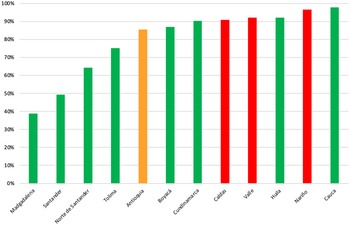
In light of the preceding theoretical discussion, Ospina’s statements fit with the pattern of preferences derived in our model (Lemma 2). There we showed that small farms were less prone to support the cartelization agreement because the costs of implementing it were proportionally higher for them. Figure 1 bears this out. Unsurprisingly, in most departamentos, small farms constitute a large percentage of the total. But there are differences in this regard. What stands out is that all departamentos where that percentage is lower than 90 percent voted for cartelization—except for Antioquia, which had an ambiguous position throughout the decade. Save for Huila and Cauca, all departamentos with a percentage of small farms higher than 90 percent opposed it. Within the entire coffee industry, Huila and Cauca were not key producers. Each of them had only 1 percent of the total production of the country. Their stance, seemingly against what their property pattern would dictate, was largely the move of two members without much clout to join the bandwagon of cartelization.
COLOMBIA. PERCENTAGE OF COFFEE SMALL HOLDERS BY DEPARTAMENTO AND VOTING PATTERN (GREEN: DEPARTAMENTOS IN FAVOR OF CARTELIZATION; RED: DEPARTAMENTOS AGAINST CARTELIZATION)
Notes: The figure considers three different polls (1935, 1937, and 1940 in which cartelization was debated and voted for or against. See the published online version of this paper for colored figures.
Source: See Online Appendix B (Robles-Baez, Medina, and Bucheli Reference Robles-Baez, Medina and Bucheli2025).

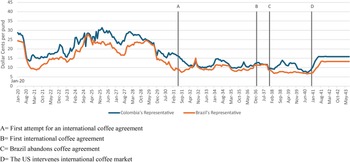
For Ospina, the price premium of Colombia’s coffee in world markets was something of an old hobby horse. As we find in the internal FNCC discussions recorded in the archives, Ospina Pérez and his allies maintained that Brazil and Colombia were simply not selling the same product. Indeed, the New York market had two main classifications for coffee at this time: mild ones and Brazilians, with the mild ones selling at a premium of around 20 percent (Palacios Reference Palacios2009) (see Figure 2 as well). Brazil’s highest-quality coffee (Santos Types 1 to 4) was similar to the Colombian types and were not hard to put on the market, but most of Brazil’s stocks were of a lower quality and very difficult to sell. Indeed, Jesús María López, an ally of Ospina on the FNCC board, stated that Brazil failed even when it had tried to give away some of its coffee stock because, if free, nobody wanted it.Footnote 21 Therefore, according to Ospina, the overproduction of coffee was limited to low-quality varieties, a market in which Colombia did not take part.
COFFEE QUOTATION IN NEW YORK (FOB), 1920–1944
Sources: FNCC (2023), DNC (1935, 1938, 1940–41, 1944–45), and authors’ elaboration.

Once again, the merits of Ospina’s argument depended on the region. Colombia’s “coffee axis” was, indeed, producing high-quality beans (“Medellín” and “Manizales” types), at relatively low production costs. But the same was not true, at least not to the same extent, about the coffee produced in the traditional regions of Santander, Cundinamarca, and Tolima, where the production costs were higher, and whose coffee was quoted at a lower price. Any Colombian coffee grower, regardless of geography, had to consider the possibility that Brazil would use the pact to cheat. Such risk is in the very nature of any cartel. But, given Ospina’s skepticism about the putative benefits of a coffee pact, it is not surprising that its possible downsides weighted more heavily in his analysis, as the third point of his letter makes evident.
Ospina was on firm ground in calling Brazil’s bluff. Brazil had been carrying out policies to restrict coffee production, regardless of whether Colombia joined a cartel or not. Especially after the creation of the DNC, Ministry of Finance Oswaldo Aranha launched aggressive deficit-funded policies aimed at reducing coffee stocks (de Paiva Abreu Reference Abreu2008). Confirming Ospina’s beliefs, Brazil was significantly restricting its supply of coffee, independent of Colombia’s position.
Although, López did not offer a point-by-point response, his views were abundantly clear. Additionally, at that precise moment, there was another extra-economic concern in his mind. Since 1932, a border dispute between Peru and Colombia reached the level of open hostilities at the border. By his own account, given Brazil’s potential role as a diplomatic broker, this was the worst possible time for the FNCC to damage the goodwill between Colombia and Brazil over what he considered were misguided concerns: “We were in the middle of an international conflict”—he remembered a few years later—“in which Brazil had a determinant role; that would be sufficient to explain why I hurriedly approached the Brazilian delegates [… ] I thought then and I still think that it was wiser to think about a policy of collaboration with Brazil from a political perspective and from an economic perspective.”Footnote 22 In light of mounting tensions, for López, coffee diplomacy, apart from making economic sense, was necessary to protect Colombia’s national sovereignty. Although he did not succeed in reaching an agreement with Brazil in 1933, his pro-cartel ideas were gradually gaining support in Colombia. Once he assumed the Presidency in 1934, and even though the war with Peru was over, he used the government’s power to achieve the first international coffee agreement.
THE FIRST COFFEE AGREEMENT, 1936
With the election of López as President of Colombia in 1934, one of the four preconditions for a cartel—state support for cartelization—came into place, and the first coffee agreement of 1936 was signed. The treaty, however, left issues related to the other preconditions of our model: capability to comply, knowledge, and enforcement, unresolved.
López reached the presidency riding a wave of popular mobilization, with a transformative agenda that he dubbed the “Revolution on the March.” The nickname he earned, the “Andean Roosevelt,” accurately reflected his vision of economic policy based on government intervention and coordination with the labor movement (Hylton Reference Hylton2006, p. 33). The coffee industry did not remain untouched by events. The most immediate effect was a change in personnel. First, Ospina, even before López’s inauguration, resigned his position as head of the FNCC but stayed on as president of its board of directors until 1935—the year in which Alejandro López (no relation to López Pumarejo) was elected as the new FNCC head. However, the change in personnel reflected deeper changes. In 1935, President López introduced reforms to the structure of the FNCC so that half of the seats on its board were reserved for government, and Colombia’s president had the final say in choosing its leadership.
The FNCC’s new leadership came with a program that contradicted Ospina’s vision for the coffee industry. Alejandro López was not just any coffee industry grandee. He was an intellectual who, like López Pumarejo, had lived in London and shared his economic views akin to Keynesianism (Mayor Mora Reference Mora2001). The two Lópezs thought that Ospina’s argument—according to which the current model was working well for Colombia because all Colombian coffee was eventually sold—was wrong, for they believed the country could obtain higher revenues with higher prices.Footnote 23 In fact, López Pumarejo explained that gaining 1/12 of a U.S. dollar cent per pound in the New York market was equivalent to the revenue of a tax of 15 Colombian peso cents per sack exported.Footnote 24 It is worth mentioning that the FNCC initially had a budget equivalent to 10 Colombian peso cents per sack exported. Therefore, according to Lopez’s figures, by gaining only a 1/12 of a USD cent, it would be possible to more than double the initial budget of the FNCC.
Those in Colombia arguing for mechanisms to control the coffee market realized soon that Colombia alone, unlike Brazil, did not have the means to do it. An attempt to control coffee prices by purchasing imports in New York without coordination with Brazil quickly failed. Not only did the large companies in the United States have great control of the import market,Footnote 25 the FNCC simply did not have the financial means to intervene at the required scale.
The FNCC’s new approach became apparent in October 1936, when it invited the governments of Latin America’s major coffee-producing countries for a conference in Bogotá to coordinate a response to the still-low international coffee prices (see Figure 1). The countries invited included not only Brazil, but also Mexico, Venezuela, Ecuador, Guatemala, Nicaragua, Costa Rica, and El Salvador, with the Brazilian delegate, Eurico Penteado of the DNC, being named President of the Conference. His detailed exposition was so effective that the different delegates unanimously approved a “solidarity” motion in which they considered “necessary” and “fair” that coffee producers in the Americas joined Brazil in its effort to control international prices—an effort that thus far Brazil had been carrying out alone (Taunay Reference Taunay1939, p. 448).Footnote 26
But, warm feelings aside, there was a thorny issue that would prove intractable: establishing a clear price differential between Brazil’s Santos 4 type and Colombia’s Manizales type. Colombia’s delegates conceded that their mild coffee should have a guaranteed higher price than the Brazilian type. But in the end, they were at cross-purposes with Brazilian producers. A large differential would benefit Brazil by allowing it to gain market share, as consumers would prefer its lower quality but lower price coffee. It could also hurt Colombia because it would encourage other mild coffee producers (mainly Central Americans) to flood the market and maybe even lead consumers to substitute away from its coffee altogether. The stage was set for a protracted conflict.
Penteado suggested a target price differential of 2.5 USD cents per pound between Colombian and Brazilian representative types, while Colombia considered a margin of 1.5 cents to be acceptable.Footnote 27 With a specific margin still to be agreed upon, the delegates of all the countries present at the conference agreed (verbally) to make all possible efforts to defend the prices of their own coffees. Additionally, Brazil and Colombia agreed to sign a more precise pact specifying prices and differentials in the coming weeks or months in the United States.Footnote 28
On 5 November, Alfredo García Cadena traveled to New York as FNCC’s representative. He was authorized to agree to a 2 USD cents differential between the Brazilian and Colombian types, but he convinced DNC’s representative Penteado to establish a differential of only 1.5 cents, with the commitment that, if possible, Colombia would later raise it to 2 cents. Thus, the minimum price fixed for Brazilian coffee was 10.5 cents per pound in the New York market, and the minimum for Colombians was between 12 and 12.5. cents. The final document, signed on 3 December 1936, was the first international agreement to regulate coffee prices.Footnote 29
PROBLEMS OF COMMITMENT: LACK OF CAPABILITY, KNOWLEDGE, AND ENFORCEMENT
The ink was hardly dry on the agreement when it was already facing some very basic problems. First, Brazil and Colombia had a different understanding of what they hoped to achieve with the treaty. While for Colombia the most important issue was to guarantee a “floor” price set by Brazil, for Brazil the main goal was to maintain a price differential. Second, the FNCC and the Colombian government quickly realized that, for all their political will, they lacked the financial capability and knowledge of the industry that would allow them to comply with their part of the treaty. Third, the Brazilians had limited knowledge of the capabilities and characteristics of the Colombian coffee industry. The combination of these elements led to the eventual collapse of the agreement.
The lack of mutual understanding became apparent in January 1937, barely a month after the agreement’s signature. In that month, the Santos 4 price went up to 11 cents per pound, but Colombia did not follow the same increase with its Manizales Type (see Figure 2)—much to the outrage of Brazilian negotiators. Brazil let it be known that it expected that if it managed to raise the price of its Santos 4 coffee above the 10.5 cents per pound, Colombia should do the same with the Manizales Type, so that the differential between the two prices remained constant. Brazil threatened to lower its price to keep the differential they considered optimal.Footnote 30 The crisis led Colombia to propose renegotiations with Brazil in which the Manizales type would have a maximum price of 13 cents per pound.Footnote 31
But Colombia was not just dragging its feet. It really lacked the resources for a production control scheme. Additionally, the country had no experience with a market intervention of this magnitude. Customs, for instance, were not up to the task of enforcing limits on exports, and warehousing was inadequate. Furthermore, the finances were proving to be nightmarish. At first, García Cadena considered that an amount of 500,000 pesos would suffice to stabilize the price of the Manizales type. Thus, the FNCC board of directors approved both the renegotiation with Brazil and a request for a loan of 500,000 pesos from the Central Bank, which was shortly afterward increased to 600,000. In the midst of these discussions, the Minister of Agriculture informed the FNCC that President López was in favor of an increase in the export tax and would present the project to Congress.Footnote 32 In essence, López wanted to use the revenue from the coffee export taxes to back the Central Bank’s loan.Footnote 33
Colombia’s inexperience became even clearer when negotiating the Central Bank’s loan. The members of the Central Bank’s board were worried about its inflationary effects and, much to the dismay of the FNCC’s directors, delayed the approval. If the Central Bank’s board members hoped that the hold-up would impress upon the FNCC the need for prudence, they were wrong. In February, García Cadena and Alejandro Lopez informed the Central Bank that after a re-calculation of the amount needed to stabilize the price of the Manizales type, they came up with a new number of 1.5 to 2 million pesos, four times the amount they had applied for just weeks before (!).Footnote 34 There was worse to come. By April, the FNCC estimated that the actual amount they needed was 6 million pesos, a healthy tenfold increase over the initial request.Footnote 35 With the Manizales type resisting the attempts to increase its price and without the funds still secured, President López stated that, given the circumstances, the goal should be to achieve the 12 cents per pound and not more than that.
The problems for the FNCC continued. In April 1937, the Central Bank approved only a 400,000 peso loan to the FNCC. This amount was considered by García Cadena to be too low (just enough to cover basic April expenses) and too late. Moreover, Alejandro López publicly acknowledged that he had made a mistake regarding the purchase commitments of the FNCC, because he originally had said they were for an amount of 9,000 sacks, when they were actually 28,000 sacks. To make matters even worse, the FNCC representative in New York informed Bogotá that the financial travails of the FNCC to keep its part in the pact had been leaked to speculators who started operating based on potential downward prices. Overwhelmed by all these pressures, Alejandro López offered his resignation.Footnote 36 The chaotic situation in Colombia led some directors of the FNCC to consider the total withdrawal of the FNCC from the market and even its liquidation.Footnote 37
In the Colombian Coffee Congress in June that year, President López continued his support for an agreement despite the growing problems.Footnote 38 However, the perception of Colombia’s incapability to fund and organize the price scheme was frustrating their Brazilian counterparts. García Cadena explained that while Colombia was not able to gather a meager 500,000 pesos, Brazil was burning 1 million sacks monthly.Footnote 39 On the other hand, Ospina and his supporters, notably the delegation from the Department of Caldas, became increasingly vocal in their opposition to an agreement, arguing that the troubling reality proved them right.Footnote 40
In August 1937, Colombia and Brazil met for a new round of negotiations in Havana. The Brazilian representative, Eurico Penteado, expressed his disappointment with Colombia’s non-compliance and emphasized the fact that Brazil had done its part: “Even though nothing remains of the agreement signed in New York, Brazil has not breached any of its commitments” (Taunay Reference Taunay1939, p. 5). Penteado issued a long list of particulars against Colombia. In his view, Colombia had broken the pact in many ways: it had exported low-quality coffee, it had violated the necessary secrecy, and it had failed to comply with its price commitments. In addition, he presented a report showing that the yearly average differential between Colombian and Brazilian types had never been below 1.6 cents in the last 6 years. By his reckoning, this showed that Brazil’s acceptance of a 1.5 differential was nothing but a proof of its “almost infinite good will” and that Colombia was barely moving the needle of the world market, contrary to the spirit of the pact (Taunay Reference Taunay1939, p. 7).
Anticipating an eventual request from Colombia for a smaller gap between prices, Pentreado told the press that “Brazil’s delegation will remain intransigent about the differences with Colombia and has the support of all the other Latin American countries [… ] As for the price differentials, Brazil will not make any concession.”Footnote 41 Brazil’s delegates stated that if the other producing countries, and particularly Colombia, did not voluntarily cut their production, the low prices would eventually force them to do so, concluding ominously: “There are two different paths, but they inevitably lead to the same result” (Taunay Reference Taunay1939, p. 9). This firm position, in stark contrast with the Colombian one, led Brazilians to expect that “Colombia will end up yielding,” as ESP reported.Footnote 42
Penteado was open to renegotiating with Colombia but always on the basis of a 1.5 cent differential. Notably, this had been at first Colombia’s position, and it had to be haggled over. Now, Brazil was adopting it as its own. This change was a reflection of the initial failure. Brazil had resigned itself to the idea that Colombia was either unable or unwilling (things were so bad that it did not matter which) to sustain the price differential of 2 and concluded that getting Colombia to commit to a 1.5 difference was already a good outcome given the circumstances. Clearly, had Brazil had better knowledge of Colombia’s poor infrastructure and experience in meeting the agreement, it would not have signed it.
But Colombia had also drawn its lesson from the episode. The Colombian Coffee Congress—the FNCC’s highest governing body—approved Ospina’s proposal of a target differential of only 0.5 cents and a margin of an extra 0.25 cents to be renegotiated with Brazil—too far from the Brazilian requirements. Colombia’s delegation informed Bogotá that they were in an “illogical and unsustainable position.”Footnote 43 The new offer was so low that it was most likely perfunctory, an empty gesture ultimately meant to torpedo the accord. In a desperate move to save the agreement, Minister of Finance Gonzalo Restrepo managed to approve a secret instruction authorizing the Colombian delegation to negotiate a differential of 0.75 with a 0.25 margin for fluctuations.Footnote 44 It was in vain. When the Colombian delegation presented their proposal, the Brazilian delegation considered it unacceptable and walked away.Footnote 45 After this event, Penteado agreed to continue the negotiations in New York but set a maximum period of 60 days. If no agreement was achieved after that, Brazil could revoke the limitations it had been putting on its exports (Taunay Reference Taunay1939, p. 12). During the following months, López’s government continued its efforts to reach a new agreement. He managed to extend the offer of the differential to one cent, but the trust in Colombia had already been damaged.
Although Ospina was now playing a less prominent role, the entire episode once again reflected the disagreements between him and López. Possibly, Ospina proposed the opening bid of 0.5 for the renegotiations under the correct assumption that it would incense the Brazilian delegation. Simply put, Ospina and López had different priorities. All else equal, they were both content with a scheme that ensured high prices, but they differed in how far they were willing to go to salvage it. In this, they were, once again, consistent with their views on the coffee industry. López was willing to accommodate Brazil’s position, concerned as he was about the prospect of sharp price fluctuations. Instead, from Ospina’s point of view, the effort to please Brazil was not worth it; Colombian coffee could thrive in a low-price environment and, if this meant that the agreement would collapse, so be it.
BRAZIL OPENS THE FLOODGATES
Then the unthinkable happened. For years, Colombia had been benefiting from Brazil’s defense of the price, and although the last months had clearly tested Brazil’s patience, the renegotiations, ill-fated as they were, suggested that Brazil would stay the course. Yet change was already underway. Penteado repeatedly accused the FNCC in the press of breaching the 1936 agreement, called for a “low prices policy” to eliminate Brazil’s competitors, and soon showed little interest in continuing the negotiations.Footnote 46 Penteado’s statements show how the lack of a third-party enforcer added instability to an agreement that was already stillborn due to the absence of financial and physical capability, as well as knowledge about the functioning of the international coffee market on Colombia’s side.
Brazil’s previous political equilibrium had broken down. It used to be that coffee interests dominated, and during his first years in office, Getúlio Vargas had still shown deference to them, not before having domesticated São Paulo in the armed skirmishes of 1932. But things were now different. Presidential elections were scheduled for January 1938, but Vargas, sensing possible defeat, opted for a self-coup that enabled him to stay in power to implement the ambitious Estado Novo (New State) agenda (Bethell Reference Bethell and Bethell2008). Re-election now a moot issue, Vargas no longer needed high coffee prices to conquer votes.
Brazil was now ready to turn on the coffee hose and flood the market, allowing coffee prices to drop. In November 1937, Brazil’s Minister of Finance, Arthur de Souza Costa, declared that after the results of the Havana meeting, Brazil had decided to change its internal coffee policy to one of open competition.Footnote 47 Soon after, the government issued Decree-Law 2131 (one of the first decrees of the Estado Novo), thus lowering export taxes, suspending its interventions in the coffee industry, and revoking the DNC’s authorization to sell government bonds.Footnote 48
The final outcome of this round was not the one either country wanted. The higher differential of prices that Brazil sought was not achieved. On the contrary, the differential was smaller than before the agreement (see Figure 2). Colombia, on the other hand, ended this round financially and politically exhausted; the FNCC was highly indebted, and the Government’s actions were harshly questioned domestically and internationally. Paradoxically, though, Colombian coffee took just one year to recover its price after the initial fall resulting from Brazil’s dumping (Figure 2). This situation did not last long, however, since WWII would lead to a new general fall in international coffee prices. Although this event led many to believe that an agreement was probably the best option, Brazil had lost trust in Colombia.
THE UNITED STATES STEPS IN
WWII drastically changed the landscape. The closure of the European coffee markets resulting from it proved catastrophic. According to Penteado, before the war, Europe was importing 12 million sacks of coffee, and two-thirds of that figure were coming from Latin America.Footnote 49 Naturally, the surplus of coffee formerly shipped to Europe had an impact on prices. In fact, in August 1940, real coffee prices reached one of the lowest points of the whole century, only comparable to those of 1989. The loss of the German market was particularly significant because in 1938, one year before the war started, it was the second-largest coffee market for both Brazil and Colombia (DNC 1940/1941, pp. 112, 376). Concerned about this situation, the diplomatic corps of the Latin American coffee-producing countries in the United States started to discuss mechanisms to avoid prices falling even further, conceivably by reviving the idea of a cartel.
But the failure of the 1937 agreement still cast a shadow. Neither Colombia nor Brazil wanted to push openly for renewed dialogue for fear of signaling weakness. In a presentation at the FNCC National Committee, the Colombian ambassador to Brazil claimed that even though Brazil actually wanted an agreement, “pride” kept it from proposing one.Footnote 50 In Colombia, only a few delegates (mainly from Caldas) continued insisting on the advantages of a free market policy, given their lower production costs and their price premium. However, the extremely low prices and the decreasing costs to form a cartel made this option increasingly attractive to the majority of the coffee growers. By this time, Colombia had created stronger financial institutions to support large-scale market operations, developed bigger physical infrastructure, and, equally important, accumulated valuable knowledge and experience about the functioning of both the domestic and international coffee markets. Additionally, the active participation of the United States in the agreement would make the cartel cheaper because they would bear a significant part of the logistics costs. Since the United States was almost the only existing market for Colombian coffee at this point, members of the FNCC started to fear that it would not even be possible to continue exporting coffee without taking part in the cartel.
The United States had geo-political reasons to consider the cartel option. After an initial reluctance to take sides, in 1941, Vargas openly declared Brazil an ally against the Axis and permitted the United States to open secret military bases in Brazilian territory and sent troops to fight in Europe alongside the Allies (Bethell Reference Bethell and Bethell2008). Just as the United States needed the support of the Latin American nations during the war, the Latin American coffee-producing countries also needed the cooperation of the United States to stabilize the coffee revenue. This means the fourth factor in our model was now present. As virtually the only buyer in the market, the United States was in a position to establish strict regulations on its coffee imports and to fix their prices. Moreover, the establishment of quotas and prices required a strong institutional infrastructure to rigorously control the coffee imports by country of origin. No other country but the United States had it. With the commitment of the United States, producing countries no longer had to worry about each other complying with the agreement. With the problem of mutual trust overcome, on 28 November 1940, the Inter-American Coffee Board signed an agreement, with the United States representative Sumner Welles playing an active role in the negotiations. Both the Brazilian and Colombian delegates celebrated the agreement by which Colombia was assigned a quota of 3,150,000 sacks in the U.S. market (a bit over 80 percent of Colombia’s exports) and Brazil 9,300,000 sacks (or around 50 percent of Brazilian exports) (Jaramillo Reference Jaramillo1940). The agreement did not specify prices, but in late 1941, the U.S. government fixed a price of 13 3/8 cents for the Santos 4 type and 15.88 for Manizales Excelso (see Figure 2). According to Penteado, the success in the negotiations for this new agreement was a direct result of the participation of the United States in it through Welles.Footnote 51
In this new scenario, the Colombian government created new institutions to guarantee the country’s capability to comply with the agreement. The same month the agreement was signed, the government created the National Coffee Fund, an organization funded by a tax of 5 Colombian peso cents per dollar of export revenue, earmarked to purchase surplus coffee from farmers and to finance warehouses (Palacios Reference Palacios2009). Critics of the agreement could no longer raise operational difficulties. The terms of the agreement and the U.S. presence helped overcome other initial objections. By the end of the war, there was a general acceptance in Colombia regarding the benefits of the agreement.
CONCLUSIONS
Although its endurance and success may suggest otherwise, the coffee cartel only came into being after a drawn-out and contentious process that lasted an entire decade. In this paper, we have combined detailed historical research that used unexplored archival files with a game-theoretic analysis to make sense of these difficulties. We show that the heterogeneity of interests within the coffee industry, in both Colombia and Brazil, prevented the two countries from achieving a stable agreement before 1940. It was only when four preconditions were met—(1) a basic level of financial and physical capacity in each country, (2) knowledge of the coffee markets from both parties, (3) full support from the respective governments, and (4) the active participation of a third-party enforcer—that an agreement built on solid ground emerged.
In theory, cartels are straightforward profit-maximization mechanisms for their participants. If things were that simple, cartels would be much more prevalent. Instead, they are relatively rare, even when legal. Cartels cannot be simply wished into existence. Members need to build trust in the face of potential cheating and negotiate differences about how to distribute the possible gains as well as the physical and financial infrastructures that enable them complying with the agreement. The difficulties we have described in the case of coffee crop up in other cases as well. The international sugar cartel formed in 1931 faced similar challenges and ultimately failed since it left important producers and consumers out. An enlarged version set up in 1937, without institutional enforcement instruments, could only generate ephemeral results (Crespo Reference Crespo2006, pp. 234–35). Attempts to form a cartel for the tin industry began in the 1920s but failed, as the United States, mindful of the domestic political implications of higher tin prices, refused to participate. Only in 1931 could producers (British Malaya, Nigeria, and the Dutch East Indies) reach an agreement, and only because of negotiations between their colonial powers (Britain and Holland) plus the Bolivian government in 1931 (Hennart Reference Hennart and Casson1986). When studying the aluminum cartel, Storli (Reference Storli2014) highlights the non-differentiation, non-substitutability, and high technical barriers as factors that encourage cartelization. For the low-technology coffee sector, there were many substitutes and only two main players, but disagreements about how similar or different each participant’s product was played an important role. Similarly, contrary to the aluminum cartel, government support was not enough to succeed in creating the cartel.
Not only are the countries forming a cartel often at cross purposes, but their internal constituencies also may be divided on the key issues. Our formal and archival analysis shows how discrepancies between small and large producers within Colombia made it impossible to agree on cartelization for years. We also show how, even after those difficulties were overcome on paper, political will was not enough. In 1936, Brazil and Colombia agreed to form a cartel; however, the meager resources of Colombia and the lack of knowledge from both sides rendered the agreement ineffective.
Because of the critical role of expectations, a systematic comparative study of cartels—one that can assess rigorously how and when they get off the ground, for which industries, among which players, how long they last, and so on—is a particularly elusive task. It involves thinking about the ex-ante assessments players make in a game with multiple equilibria, assessments that involve even scenarios that, by virtue of being off-equilibrium deviations, remain only hypothetical. Here, we overcome that difficulty by using the method of stability sets, which generates crisp comparative statics results for these settings, something that could be applied to the study of other cartels, both in individual and in cross-industry studies.



 Open access

