


Introduction
The concept of ageing in place—the idea that older adults prefer to remain in their own homes and neighbourhoods rather than relocate to institutional settings—has gained considerable traction in both policy and research (Cutchin and Rowles Reference Cutchin and Rowles2024; Pani-Harreman et al. Reference Pani-Harreman, Bours, Zander, Kempen and van Duren2021; Wiles et al. Reference Wiles, Leibing, Guberman, Reeve and Allen2012). At its core, it affirms the value of autonomy: the ability to decide where and how one lives in later life (Gao et al. Reference Gao, Ho, Chua and Feng2024; Torres Reference Torres2019). While intuitively appealing, this principle risks reinforcing a sedentarist view of ageing, where the local environment is taken as the default site of social life. In practice, however, older adults often age across multiple spaces—travelling to preferred services, amenities, and relationships that extend well beyond their residential neighbourhoods (Matthews and Yang Reference Matthews and Yang2013). Recognising this, scholars have started to engage with relational readings of ageing and place (Cutchin and Rowles Reference Cutchin and Rowles2024), which foregrounds mobility and the dynamic interplay between people and environments. Yet even this expanded view remains conceptually limited, as it continues to frame ageing primarily in spatial terms—focused on where one lives or the places which people frequent through practising mobility, rather than who they meet with and how their social networks shape spatial practices in diverse ways.
In this paper, we propose an alternative and complementary conceptual lens: ageing in networks. We argue that older adults actively sustain webs of care (Fox Reference Fox2011; Ho et al. Reference Ho, Zhou, Liew, Chiu, Huang and Yeoh2021) and personal communities (Ang Reference Ang2022; Ang and Suen Reference Ang and Suen2023; Ho et al. Reference Ho, Chua and Feng2024a) that are socially diverse, geographically dispersed, and digitally mediated (Quan-Haase et al. Reference Quan-Haase, Mo and Wellman2017, Reference Quan-Haase, Williams, Kicevski, Elueze and Wellman2018). Rather than rely solely on co-resident kin or neighbourhood-based ties, many maintain relationships across both social and spatial distances (Ho et al. Reference Ho, Gao and Lim2024b; Shaw and Sui Reference Shaw and Sui2020). These individuals are not simply ageing in place or through place—they are ageing in networks.
To develop this concept empirically, we examine how patterns of mobility among older adults are shaped by the composition of their personal networks. Drawing on survey data from two neighbourhoods in Singapore, we test whether respondents with more socially diverse networks—characterised by a greater number of weak ties and variation in tie strength, race, and education—also report broader spatial engagement. We use the number of distinct addresses where respondents meet network members as a proxy for spatial breadth. Crucially, our interest lies not only in activity space but in the social logic of movement: mobility as a means of sustaining connection (Cagney et al. Reference Cagney, York Cornwell, Goldman and Cai2020).
This distinction lies at the heart of our argument. While ageing in place emphasises where one resides, and ageing and place attends to how and where one moves, ageing in networks shifts the focus to a different but equally vital question: with whom do these practices unfold? It foregrounds the relational foundations of ageing. Movement in later life is not solely about navigating urban environments; it is equally about sustaining ties, fulfilling obligations, and accessing care and support. These three frameworks are not mutually exclusive but complementary. Taken together, they form a relational triad of ageing: where one lives, how one moves across a variety of places, and with whom one remains connected. Of these, the who—the social infrastructure of later life—emerges as foundational to ageing well.
This reframing is important because dominant paradigms often conflate living alone with being alone, portraying solo living in later life as inherently undesirable or isolating. Media representations reinforce this narrative, casting solitude as a social problem rather than a personal preference (Rodriguez et al. Reference Rodriguez, Schertz and Kross2025). Moral panics surrounding older adults ‘dying alone’ (Heng Reference Heng2015; Lee Reference Lee2016) further entrench the view that independence signals abandonment. Within such discourse, place is assumed to be the origin point from which social consequences flow. But must living alone equate to loneliness? And is social connection always grounded in physical proximity?
These assumptions risk obscuring the relational complexity of later life. Ageing in place and ageing in networks are not opposing paradigms but intersecting ones. Place still matters—but not only as a physical setting or household structure. Rather, place must be understood as a relational environment: a site where connections are formed, sustained, and made meaningful (Feng et al. Reference Feng, Chin, Gao, Chua and Ho2024; Ho et al. Reference Ho, Chua and Feng2025; Ho and Huang Reference Ho and Huang2018). From this perspective, living alone is not inherently equivalent to being alone. What matters is how individuals are embedded within broader networks of care, reciprocity, and belonging, whether proximate or distributed. Research shows that older adults’ experiences of solo living vary widely depending on cultural expectations, personal preferences, and the composition of their social networks (Cornwell and Waite Reference Cornwell and Waite2009; Linton et al. Reference Linton, Gubhaju and Chan2018; Rodriguez et al. Reference Rodriguez, Schertz and Kross2025). The crucial distinction lies between structural isolation (being physically alone) and perceived isolation (feeling lonely). Recognising this helps us move beyond simplistic spatial assumptions to better understand the diverse realities of ageing.
Indeed, many older adults who live alone remain deeply connected. As ‘connected seniors’ (Quan-Haase et al. Reference Quan-Haase, Mo and Wellman2017, Reference Quan-Haase, Williams, Kicevski, Elueze and Wellman2018), they sustain relationships across distance through digital media, shared routines, and reciprocal care (Davey Reference Davey2007; Ho et al. Reference Ho, Chua and Feng2025). These connections span both strong ties—such as with family—and weaker ones, such as with neighbours, friends, and former colleagues (Rainie and Wellman Reference Rainie and Wellman2012). Crucially, networks are not static. They are actively assembled, adapted, and maintained over time, particularly in response to life transitions and disruptions (Ang and Suen Reference Ang and Suen2023; Marcus and Saka Reference Marcus and Saka2006; Rainie and Wellman Reference Rainie and Wellman2012). Living alone does not necessarily mean ageing alone. The concept of ageing in networks offers a lens through which to understand this possibility.
Despite this, current policy frameworks remain largely focused on physical infrastructure—such as housing types, insulation, and accessibility—often guided by implicit assumptions that older adults are sedentary, dependent, and technologically disengaged (Hummert et al. Reference Hummert, Garstka, Shaner and Strahm1994; Schwitter Reference Schwitter2022; Swift and Steeden Reference Swift and Steeden2020). Globally, concerns about loneliness have intensified (Moeyersons et al. Reference Moeyersons, De Vliegher, Huyghe, De Groof, Milisen and B2022; Reher and Requena Reference Reher and Requena2018), driven by increasing longevity, smaller household sizes, and the rising number of older adults living alone (Snell Reference Snell2017). These anxieties were heightened during the COVID-19 pandemic, which disrupted everyday routines of care and interaction (Fingerman et al. Reference Fingerman, Ng, Zhang, Britt, Colera, Birditt and Charles2021; Leinonen and Era Reference Leinonen and Era2025). Yet physical separation did not always result in social disconnection. Many older adults remained embedded in resilient—albeit distributed—networks, including those supported through digital means (Perdana and Mokhtar Reference Perdana and Mokhtar2022).
This paper draws on survey data from 1,199 older adults aged 60 to 95 in two Singaporean neighbourhoods—Hougang and Taman Jurong—to explore how personal networks are structured, sustained, and spatially enacted. Using a name-generator method from social network analysis (Cornwell et al. Reference Cornwell, Schumm, Laumann and Graber2009; Marsden Reference Marsden1987), we map the size, diversity, and geographic spread of respondents’ ties. Our findings show that many older adults who live alone maintain meaningful relationships—both strong and weak, proximate and distant, online and offline. These networks buffer against loneliness, enable support and reciprocity, and challenge the assumption that ageing well is solely tied to place. Instead, they point to a broader social reality: many older adults today are ageing in networks—actively constructing and maintaining relationships that span both physical and relational space (Yarker et al. Reference Yarker, Doran and Buffel2024).
From ageing in place to ageing in networks
Ageing in place has become a dominant refrain in policy and academic discourse (Cutchin and Rowles Reference Cutchin and Rowles2024:4). It centres on helping older adults remain in their homes and communities, promoting independence and familiarity as the cornerstones of well-being (Cagney and York Cornwell Reference Cagney and York Cornwell2018). At its heart is the ideal of continuity—staying put in a known environment (Johansson et al. Reference Johansson, Laliberte Rudman, Mondaca, Park, Luborsky, Josephsson and Asaba2013), with home imagined as a stabilising anchor in later life (McFarlane Reference McFarlane2010; Rowles and Bernard Reference Rowles and Bernard2013:11). This aligns with environmental gerontology’s emphasis on ‘person–environment fit’—how well older adults’ needs match their surroundings (Andrews et al. Reference Andrews, Cutchin, McCracken, Phillips and Wiles2007; Cutchin Reference Cutchin2003). The WHO’s ‘ageing-friendly cities’ framework builds on this, stressing infrastructure, social connection, and community resources (Fitzgerald and Caro Reference Fitzgerald and Caro2014). Yet such ideals often falter in disadvantaged neighbourhoods, where poor amenities and weak social ties limit support (Cagney and York Cornwell Reference Cagney and York Cornwell2018). Built form, local policies, and institutional design all shape how ageing unfolds (Wen et al. Reference Wen, Browning and Cagney2007).
Despite its traction, the concept of ageing in place remains conceptually limited. Critics argue it treats place as a static container, downplaying its social and dynamic dimensions (Cutchin and Rowles Reference Cutchin and Rowles2024:4; Matthews and Yang Reference Matthews and Yang2013:4). In response, scholars have advanced relational readings of ageing and place, a broader frame that accounts for mobility and multiplicity (Cutchin and Rowles Reference Cutchin and Rowles2024). Older adults do not only inhabit one place—they move through many places: cafés, parks, churches, libraries, clubs, coffee shops, and hair salons (Finlay et al. Reference Finlay, Cannon, Meltzer, Yeh, Cutchin and Rowles2024; Oldenburg Reference Oldenburg1989). These ‘activity spaces’ shape daily life and social exposure (Cagney et al. Reference Cagney, Browning, Jackson, Soller, In LJ Waite and Plewes2013), stretching attachment across multiple locales (Andrews et al. Reference Andrews, Evans and Wiles2013; Skinner and Winterton Reference Skinner and Winterton2018). Crucially, older adults are mobile. They cross neighbourhoods, even regions, to stay socially and practically engaged (Cagney and York Cornwell Reference Cagney and York Cornwell2018). They ‘let go’ of old places and form new attachments of ‘their own’ (Gustafson Reference Gustafson2001:13; Andrews et al. Reference Andrews, Evans and Wiles2013:1350; Degnen Reference Degnen2016; Andrews and Duff Reference Andrews and Duff2022). This demands a relational view of place—as fluid, dynamic, and shaped by movement.
Relational readings of ageing and place supplement ageing in place by embracing mobility and diversity of exposure. But it still leaves a gap. It focuses on where older adults are and where they go—but not with whom. To fill this gap, we propose ageing in networks. This framework adds a missing dimension: the social infrastructure of ageing (Ho et al. Reference Ho, Chua and Feng2025, Reference Ho, Gao and Lim2024b, Reference Ho, Gao and Lim2024b, Reference Ho, Zhou, Liew, Chiu, Huang and Yeoh2021; Feng et al. Reference Feng, Chin, Gao, Chua and Ho2024; Gao et al. Reference Gao, Ho, Chua and Feng2024). While ageing in place stresses rootedness, ageing in networks focuses on the social ties that motivate older adults to be mobile and venture to different places to meet people and nurture relationships which they value deeply. In this way, ageing in networks extends conceptualisation of the relationship between ageing and place. It asks how relationships shape movement, attachment, and care. What sets ageing in networks apart is its focus on with whom. Social ties guide how people use space. Places are not just backdrops—they are destinations because someone is there. As Urry (Reference Urry2003:155) puts it, ‘meetingness’ is central to social life. Ties come first; places follow. This reverses the usual assumption that place shapes networks—instead networks often shape place. Cagney et al (Cagney et al. Reference Cagney, York Cornwell, Goldman and Cai2020:627) write: ‘few studies have explicitly considered how social networks influence individuals’ activity spaces or how people’s activity spaces are shaped by features of individuals’ social connections’.
Reinforcing this point, Darling (Reference Darling2009) urges us to study how relationships move through space. Networks are not fixed support systems—they are dynamic, adaptive, and spatially embedded (Feng et al. Reference Feng, Chin, Gao, Chua and Ho2024). They include not just close ties, but ‘elastic’ ones—casual, situational connections that still provide vital support (Torres Reference Torres2019). These ties, often overlooked, help older adults cope with bereavement, retirement, and loss of mobility (Shang and Patterson Reference Shang and Patterson2024). They offer autonomy, intimacy, and protection against loneliness. Networks also sustain continuity through mobility. Older adults who relocate may still maintain ties through WhatsApp, phone calls, or regular meetups (Quan-Haase et al. Reference Quan-Haase, Williams, Kicevski, Elueze and Wellman2018). This relational continuity cannot be fully explained by physical or institutional models.
In this light, ageing in networks reorients the unit of analysis—from the individual in place to the individual in relationships that are anchored in diverse places. As Cagney et al. (Cagney et al. Reference Cagney, Browning, Jackson, Soller, In LJ Waite and Plewes2013:160) note, studies rarely integrate networks, neighbourhoods, and institutions. They write: ‘studies that simultaneously incorporate information on networks, neighbourhoods, and institutions are exceedingly rare’. This is the crux: we do not age in places or move between them alone—we age through networks of care, connection, and companionship (Rainie and Wellman Reference Rainie and Wellman2012). Ageing in networks centres these ties. It explains not just where older adults go, but why and with whom—and how these connections sustain meaning, support, and belonging across time and space (Yarker et al. Reference Yarker, Doran and Buffel2024).
The connection to loneliness
The importance of a networks approach becomes especially stark when we consider loneliness. A widely cited meta-analysis of over 300,000 individuals followed across seven and a half years found that loneliness poses a serious health risk—comparable, some argue, to smoking 15 cigarettes a day (Holt-Lunstad et al. Reference Holt-Lunstad, Smith and Layton2010; Levitin Reference Levitin2020:179). The message may be overstated, but it captures a crucial truth: loneliness can be fatal. While social connectedness supports longer and healthier lives (Maier and Klumb Reference Maier and Klumb2005), persistent loneliness is linked to higher blood pressure, poorer sleep, stress-related immune dysregulation, cognitive decline, and depression among older adults (Ó Luanaigh and Lawlor Reference Luanaigh and Lawlor2008).
These risks underline the urgency of moving beyond sedentarist place-based accounts of ageing. What matters is not just where people are, but with whom they are connected—and how those ties function. Despite advances in research on loneliness and social support, key questions remain. As Holt-Lunstad (Reference Holt-Lunstad2022:193) argues, indicators of social connectedness—such as social capital, isolation, and support—are still ‘noticeably absent from the discourse’ on social determinants of health. One gap lies in understanding the precise features of networks: size, strength, spatial proximity, and composition. These elements shape not only how many people older adults know, but whether they feel known.
Another question is how physical solitude relates to social disconnection. While living alone is often cited as a risk factor for loneliness (Courtin and Knapp Reference Courtin and Knapp2017; Joshi et al. Reference Joshi, Finney and Hale2025; Rodriguez et al. Reference Rodriguez, Schertz and Kross2025), the relationship is not deterministic. A person who lives alone may still maintain frequent, meaningful contact with a wide array of people and services. In such cases, ‘social accessibility’ (Hogan Reference Hogan2008) may buffer the effects of limited physical proximity. This reframes our focus: the absence of co-residence does not necessarily equate to the absence of connection.
Older adults today are not merely embedded in static social groups; they actively construct and navigate personalised networks across time and space. These networks may be shaped by circumstance, but they also reflect agency. As recent studies in Singapore show, older adults often describe themselves as capable, responsible, and contributive, even when facing structural constraints (Ang Reference Ang2022; Ang and Malhotra Reference Ang and Malhotra2022; Ang and Suen Reference Ang and Suen2023; Barrenetxea et al. Reference Barrenetxea, Yang, Pan, Feng and Koh2022; Villar et al. Reference Villar, Serrat and Pratt2023). Rather than isolated or dependent, they see themselves as connected—alone, perhaps, but not disconnected.
The trope to loneliness reinforces our argument: ageing is not simply a process of staying put or moving through space—it is a process of staying in touch. Networks are not just supports; they are social infrastructures through which older adults maintain autonomy, meaning, and resilience.
Hypotheses
The first hypothesis (H1) captures the spatial and technological extensiveness of older adults’ networks. Rather than being anchored in local neighbourhoods alone, older adults sustain relationships that cross household and neighbourhood boundaries, connecting with kin and non-kin alike through face-to-face encounters and online platforms (Larsen et al. Reference Larsen, Axhausen and Urry2006; Mok et al. Reference Mok, Wellman and Carrasco2010; Sung et al. Reference Sung, Malhotra, Cheng and Chan2022). Ageing in networks recognises the increasing reach and multiplicity of these interactions.
H1: Older adults maintain a wide range of social ties—including ties to family, friends, neighbours, and former co-workers—across multiple locations, both near and far, and across both digital and in-person modes.
Rather than assuming a uniformly intimate local community, the second hypothesis (H2) reflects the structural complexity of personal networks. Building on the core-periphery distinction (Burt Reference Burt2004; Fuller et al. Reference Fuller, Ajrouch and Antonucci2020; Rainie and Wellman Reference Rainie and Wellman2012; Wellman Reference Wellman2001), it acknowledges that social ties differ in intensity and interconnectedness. While the core features dense, mutual connections, the periphery comprises weaker ties that are less likely to be embedded in the same social circles (Patterson and Margolis Reference Patterson and Margolis2023). Ageing in networks thus accounts for fragmented and multi-layered social worlds beyond the idealised cohesion of place-based communities.
H2: Older adults’ networks are internally differentiated, consisting of a tightly knit core—often composed of immediate family—and a more loosely connected periphery of friends, neighbours, and co-workers who may not know one another.
In the third hypothesis (H3), we posit that social relationships are not only spatially extended but also functionally specialised. This hypothesis reflects the complementary roles of network members, with intimates offering emotional sustenance and more distant acquaintances offering practical assistance or information (Granovetter Reference Granovetter1973; Wellman and Wortley Reference Wellman and Wortley1990). Ageing in networks allows us to see how different types of ties serve different needs, particularly as older adults navigate health, mobility, and social participation challenges.
H3: Older adults draw on different ties for different purposes: strong ties provide socio-emotional support (e.g., combating depression), while weak ties offer access to instrumental resources (e.g., a professional job).
The fourth hypothesis posits that while ageing in place centres on proximity to services, ageing in networks foregrounds social accessibility. Older adults select and travel (e.g., by foot, by car, and/or by transit) to amenities not just based on convenience but on who they expect to meet and connect with in those spaces (Hogan Reference Hogan2008). Critically too, social ties shape the geography of daily life—i.e., older adults move across spaces (e.g., community clubs, religious institutions, food centres) in ways that reflect the breadth and diversity of their social networks.
H4: Older adults are active users of amenities across diverse locations—travelling by foot, car, and transit beyond their immediate neighbourhoods to sustain their social networks—and are more likely to access multiple social spaces (such as community clubs, senior activity centres, coffeeshops, hawker centres, religious institutions) when their networks are more extensive, diverse, and include both strong and weak ties.
This fifth and final hypothesis (H5) underscores the central importance of social connection over co-residence. While ageing in place privileges the home and household as key to combating isolation, ageing in networks shows that it is the presence of meaningful external ties, regardless of physical proximity, that buffers against loneliness. This hypothesis repositions social isolation—not spatial isolation—as the more significant threat to well-being among older adults.
H5: Older adults who live alone but have active ties to people outside their household—whether strong or weak, near or far, online or offline—are less likely to feel lonely.
The current study: Singapore and neighbourhoods as a starting point
Singapore presents a timely and instructive case for examining ageing in networks. The number of older adults aged 65 and above living alone has risen markedly—from 47,000 in 2016 to 58,000 in 2018, reaching 79,000 by 2022. This figure is projected to climb further to 83,000 by 2030 (Ministry of Health 2023). The growth of single-person households, also observed across parts of Asia and elsewhere (Snell Reference Snell2017; Yeung and Cheung Reference Yeung and Cheung2015), raises pressing questions about social isolation and the role of relational support. In this context, Singapore offers a valuable site for investigating how ageing in networks might mitigate the vulnerabilities associated with living alone in later life.
At the same time, Singapore is an unusually well-connected society. Its physical infrastructure—spanning an efficient network of roads, rail lines, and pedestrian pathways—is tightly integrated across a compact urban territory of just 736 square kilometres. High rates of digital connectivity and widespread internet access further enhance the ease with which individuals can stay socially and informationally linked. Although centred around a dense urban core, Singapore extends into suburban heartland neighbourhoods, each with its own distinctive local character, yet closely interlinked with the rest of the city-state. In this sense, Singapore is both a dense, compact city and a polycentric one, with multiple nodes of activity and community life. These qualities make it particularly well-suited for studying how older adults navigate social networks that span beyond immediate households or neighbourhoods.
Singapore’s status is arguably unique, though not necessarily exceptional. It is often regarded as a model city, yet many of its features—such as urban density, demographic ageing, and infrastructural integration—are increasingly shared by other global cities. As such, Singapore provides both a distinctive and generalisable case from which to explore the possibilities and limits of ageing in networks.
This study begins with a focus on two neighbourhoods—Hougang in the East and Taman Jurong in the West—which together reflect Singapore’s broader ethnic and socioeconomic composition. The neighbourhoods (Hougang, n = 647; Taman Jurong, n = 552) serve as initial sites for mapping older adults’ social ties. However, the neighbourhood is not the conceptual endpoint: it functions as a starting node within a wider network. The aim is to trace how these networks evolve and extend across spatial, relational, and digital boundaries—thus shifting attention from ageing in place to ageing in networks. Relatively speaking, as the neighbourhood functions as the initial node in the mapping process, it is conceptually less significant than the broader network, which is the focus of the study.
Data and methods
This study draws on mixed-methods data collected from two Singaporean neighbourhoods—Hougang and Taman Jurong—in year 2020. It comprises two major components. First, a quantitative survey of 1,199 older adults aged between 60 and 92 years, complemented by spatial analysis using geographic information systems (GIS). Second, a qualitative GIS component involving three stages of in-depth interviews and GPS tracking with a purposive subsample of 50 respondents (see Gao et al. Reference Gao, Ho, Chua and Feng2024 for methodological details). This paper focuses only on the survey and GIS analyses from the first component.
In terms of the data collection, the study used representative random sampling in the two neighbourhoods: Hougang in the East and Taman Jurong in the West. The final sample comprised 1,199 older adults aged 60 to 92. The sample size reflects one respondent who withdrew after initial consent (target n = 1,200). Recruitment was conducted through a professional research agency, which provided the sampling frame and supported data collection. All participants were provided with a detailed participant information sheet (PIS) and signed informed consent forms (CF), with the explicit option to withdraw at any point without penalty. Ethical approval was granted by the Institutional Review Board at the National University of Singapore (IRB number: NUS-IRB-419). Participants received a monetary incentive of 50 Singapore dollars (SGD) upon completion of the survey.
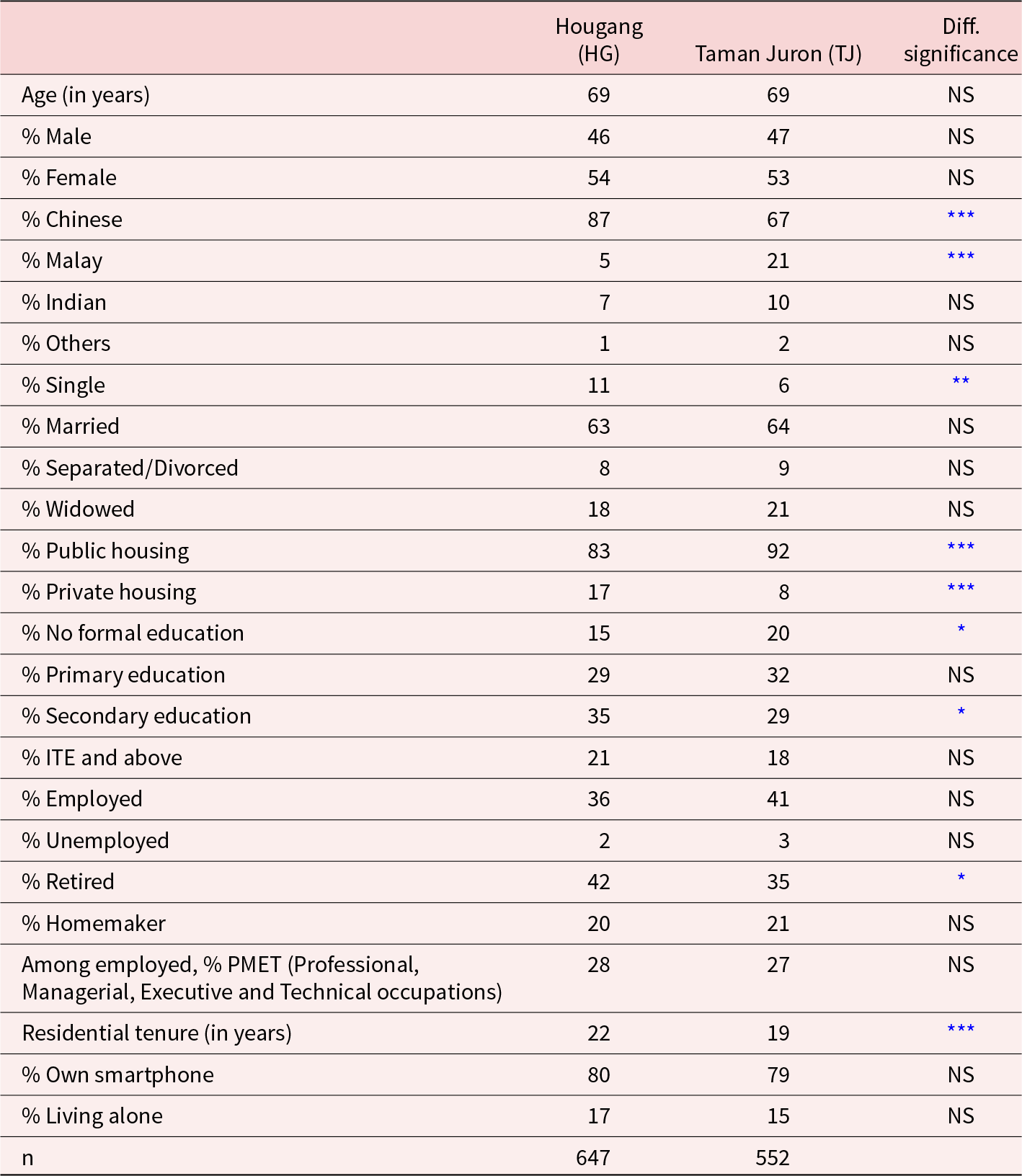
Of the 1,199 survey respondents, 647 lived in Hougang and 552 in Taman Jurong. Table 1 presents descriptive statistics comparing the two neighbourhoods. On average, respondents were 69 years old, and the gender distribution was very similar in both sites (46% male, 54% female). Ethnic composition differed more sharply: Hougang had a significantly higher proportion of Chinese residents (87%) than Taman Jurong (67%), while Taman Jurong had more Malay residents (21%) compared to Hougang (5%). The percentage of singles was also higher in Hougang (11%) than in Taman Jurong (6%).
Sample characteristics
Significance levels:
* P < .05,
** P < .01,
*** P < .001.
Note: Total n = 1,199.
Public housing was more common in Taman Jurong (92%) than in Hougang (83%). Hougang residents had slightly higher levels of formal education, with 35% having completed more than secondary education compared to 29% in Taman Jurong. A larger proportion of Hougang residents were retired (42% versus 35% in Taman Jurong). Among those still working, roughly the same proportion held professional, managerial, executive, and technical (PMET) occupations (28% in Hougang, 27% in Taman Jurong).
Residential tenure was also higher in Hougang (average 22 years) than in Taman Jurong (19 years), and smartphone ownership was near universal in both neighbourhoods (80%). A slightly higher percentage of older adults lived alone in Hougang (17%) than in Taman Jurong (15%), although the difference was not statistically significant.
Measuring personal communities
To map personal social networks, respondents were asked to name up to five individuals in response to the following name generator:
‘From time to time, most people discuss things that are important to them with others. For example, these may include events in your life (good or bad), problems you have had, or important concerns (e.g., COVID-19, health matters and others). Looking back over the last 12 months, who were the people with whom you most often discussed things that were important to you?’
This approach captures key social contacts, particularly those involved in emotional and informational support. Admittedly, it does not account for every kind of social interaction (such as task-specific or routine encounters), nor does it map the full extent of each person’s social world. However, this name generator is widely used in social network studies of older adults and has strong precedents (e.g., Cornwell et al. Reference Cornwell, Laumann and Schumm2008).
Across the 1,199 respondents, 2,581 contacts were named, yielding an average network size of 2.15. For comparison, similar questions in US-based studies have elicited slightly larger networks (e.g., 3.5 in Cornwell et al. Reference Cornwell, Laumann and Schumm2008), pointing to the relatively more constrained networks among older adults in Singapore. Network size varied widely: 10% named no contacts; 30% named one; 25% named two; 20% named three; and 10% named the maximum of five.
For each named contact, we followed up with ‘name interpreters,’ asking about the nature of the relationship (e.g., immediate family, extended kin, neighbour, co-worker, friend), strength of tie, and interaction patterns. Strength of tie was measured by closeness: contacts identified as ‘very close’ were coded as strong ties; all others were treated as weaker ties. We also asked how often respondents met each contact—face-to-face and digitally—with ‘more than once a week’ coded as ‘frequent’ contact.
We included spatial elements by asking whether each contact lived in Singapore, and if so, whether they were located ‘within’ or ‘beyond’ a 20-minute walk of the respondent’s residential address. We also asked where the respondent typically met the contact and for what purpose (e.g., for exercise, meals, religious activity). These locations were geocoded to derive the straight-line distance between respondent and contact. Contacts who shared the same household were assigned a distance of zero.
Key outcome variable: loneliness
Across different hypotheses, our dependent variables vary. However, our focal outcome—especially for Hypothesis 5—is loneliness. We asked respondents how they felt ‘at the present moment,’ with three response options: ‘not at all lonely,’ ‘fairly lonely,’ and ‘very lonely.’ For analysis, this was dichotomised, grouping the latter two categories together as ‘lonely.’ In both neighbourhoods, between 15% and 17% of respondents reported feeling lonely. Because of the binary outcome, logistic regression was used for analysis.
Focal independent variable: living alone
Living alone was measured as a binary variable indicating whether the respondent was the sole occupant of their household. Recognising that living alone does not necessarily mean being socially isolated, we examined how this condition interacted with social network characteristics to shape loneliness. To test Hypothesis 5—that personal networks can buffer the negative effects of living alone—we created six interaction terms between the ‘live alone’ variable and six aspects of social ties: (1) Number of contacts with whom the respondent has high digital contact (at least once a week), (2) Number of contacts with low digital contact (less than once a week), (3) Number of contacts who live near (within a 20-minute walk), (4) Number of contacts who live far (beyond a 20-minute walk), (5) Number of strong ties (very close), and (6) Number of weak ties (less close). These interactions allowed us to examine whether different types of network support—digital, spatial, emotional—offset the effects of living alone.
Control variables
Several socio-demographic and health variables were included as controls. Age was measured in years. Gender was binary, with female as the indicator variable and male as the reference. Race was captured using three dummy variables for Malay, Indian, and Others (Chinese as reference). Education was divided into four categories: no formal education (reference), primary, secondary, and more than secondary. Housing was coded as public versus private. Marital status was captured using four categories: single (reference), married, separated/divorced, and widowed. Functional health was measured using an additive index based on eight self-reported items relating to grooming, bathing, mobility, eating, toileting, dressing, and getting outdoors.
Amenity access and mobility
To test Hypothesis 4, we assessed both access to and use of amenities. Access was defined as the number of amenities—such as clinics, coffeeshops, community clubs, residents’ committees, and senior activity centres—within three transport-time thresholds: a 20-minute walk, a 15-minute transit ride, and a 7-minute drive. These thresholds reflect typical commuting expectations and are aligned with Singapore’s Land Transport Authority (2023) vision of a 20-minute neighbourhood. We geocoded the precise locations of respondents’ homes and nearby amenities and applied the two-step floating catchment area (2SFCA) method to assess this spatial accessibility. For use, we asked whether respondents had actually visited each type of amenity within or beyond a 20-minute walk from their home.
This approach supports Hypothesis 4, which challenges the conventional emphasis in ageing in place on geographical proximity alone. In contrast, the concept of ageing in networks foregrounds the social orientation of mobility (Latham-Mintus et al. Reference Latham-Mintus, Manierre and Miller2022): older adults often decide where to go based on whom they expect to encounter. Their everyday movements—to coffeeshops, community clubs, hawker centres, or places of worship—are frequently motivated by relational ties rather than convenience or physical accessibility alone (Hogan Reference Hogan2008). In this sense, mobility reflects the geography of social life. To test this idea empirically, we examine whether mobility across spaces is patterned by the breadth and diversity of respondents’ personal networks. Specifically, we calculate the number of distinct addresses at which respondents report meeting their contacts and correlate this with several dimensions of network diversity. These include: (1) number of weak ties in the respondent’s network, (2) tie strength diversity, measured by the presence of both strong and weak ties, (3) racial diversity within the network, and (4) educational diversity within the network. The expectation is that respondents with more socially diverse networks will traverse a wider range of spaces in their everyday routines.
Network composition and structure
Hypothesis 3 posits that different kinds of social networks are effective for different kinds of outcomes. To examine this, we compared network characteristics against two outcome domains: socio-emotional well-being and instrumental attainment. Socio-emotional well-being was assessed using a depression index, constructed from nine six-point items capturing how respondents had felt in the past four weeks—for example, whether they felt full of energy, calm and peaceful, or blue. For each item, the values are: (a) All the time, (b) Most of the time, (c) A good bit of the time; (d) Some of the time; (e) A little of the time; (f) None of the time.
Instrumental outcomes were measured by whether respondents were employed in a PMET (professional, managerial, executive, or technical) occupation, as compared to a non-PMET role such as clerical, service, production, or cleaning work. Following social capital literature, access to high-status employment is often treated as a proxy for instrumental outcomes and social mobility (Erickson Reference Erickson, Lin, Cook and Burt2001).
Hypotheses 1 and 2 examined network composition and structure. H1 focused on who made up respondents’ networks—their roles, diversity, and tie strength. H2 examined network density, measured by asking whether each pair of named contacts knew each other. This allowed us to map cohesive networks (where ties are interconnected) versus fragmented ones. These hypotheses provided a foundation for examining how network structure shapes social outcomes.
Findings
Composition of older adults’ networks
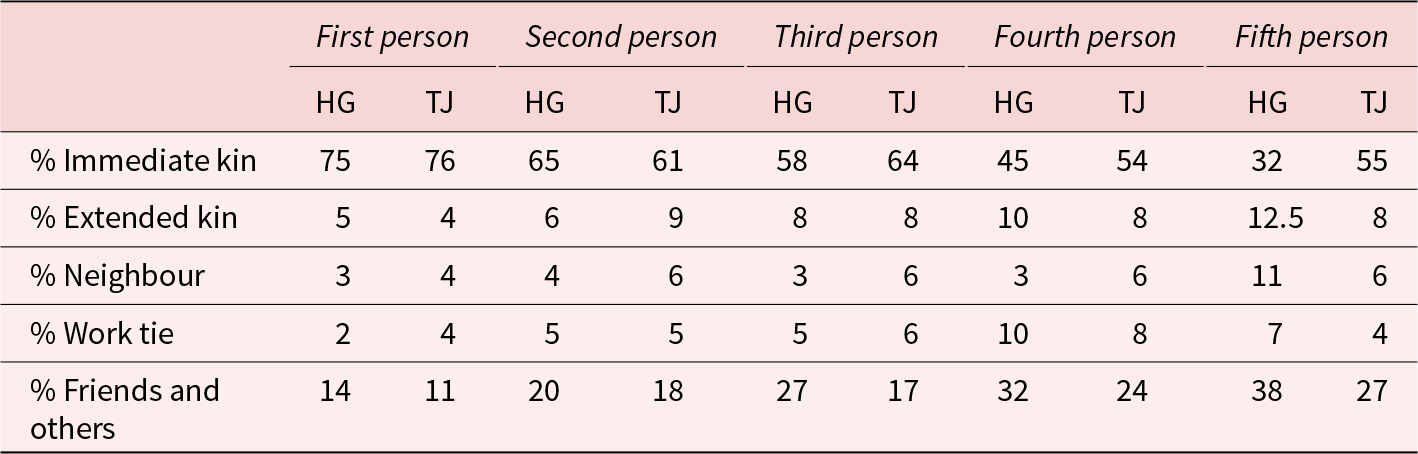
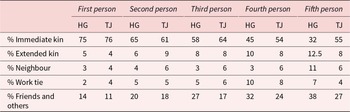
Table 2 summarises who older adults name as part of their social networks and the order in which these individuals are mentioned. Rows indicate categories of people—immediate family (children, parents, spouses, siblings), extended kin, neighbours, co-workers, friends, and others. Columns reflect the order in which they were named (first, second, third, and so on). We present the data separately for Hougang and Taman Jurong to allow each neighbourhood’s patterns to be understood on their own terms—rather than subsuming them into a composite portrait that obscures local distinctions.
Role relationships by person (hougang and taman jurong)
Note: Immediate kin comprise child, parent, spouse, and sibling.
In both neighbourhoods, immediate kin tend to be named early (first to third positions), while friends appear more frequently in the later positions (fourth and fifth). Extended kin, neighbours, and co-workers also feature later in the sequence, especially neighbours who are often named last. These patterns echo Bastani’s (Reference Bastani2007) observation that ‘family comes first,’ while friends and others follow.
However, we avoid over-interpreting the limited mention of neighbours in discussion networks. While neighbours may not often be named as confidants, they may play important roles in daily routines, informal surveillance, or ambient companionship—forms of support not captured by the important matters name generator. Overall, the findings here support Hypothesis 1: older adults’ personal communities are centred on family, with non-kin occupying a more peripheral but still meaningful position.
Nature of ties: strong and weak, online and offline, near and far
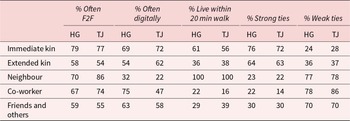
Table 3 examines how different roles (e.g. kin, neighbours, co-workers, friends) correspond with the mode, proximity, and strength of social ties. Across both neighbourhoods, face-to-face contact is more common with immediate kin, neighbours, and co-workers, while digital contact is more prevalent with immediate kin, co-workers, and friends. Ties with neighbours are seldom digital, suggesting that neighbourly relations remain grounded in physical proximity.
Role relationships and their characteristics (hougang and taman jurong)
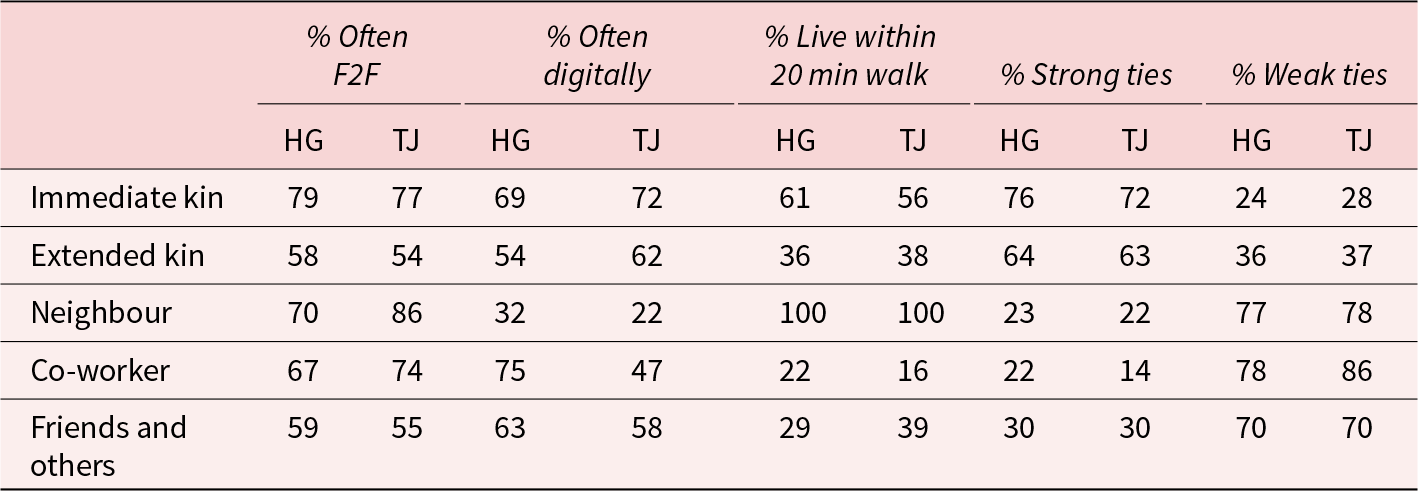
Spatially, immediate kin are more likely to live within a 20-minute walk than extended kin, co-workers, or friends. Unsurprisingly, all neighbours fall within this range. Excluding co-residents, contacts live an average of 4 km away, with maximum distances reaching 21.8 km in Hougang and 26.5 km in Taman Jurong. These patterns illustrate that older adults’ networks extend well beyond the home and neighbourhood. Figure 1 visualises these spatial connections, with lines tracing respondents’ social ties across the island city. Importantly, it shows where these ties are enacted. The most frequented locations include coffeeshops, shopping malls, hawker centres, churches, and workplaces—places reached not because they are simply nearby, but because they are where valued relationships take place. In this way, social capital drives travel mobility: older adults go where their contacts are. Rather than proximity alone shaping their everyday routes, it is the presence of social ties that makes these spaces meaningful and worth the journey.
Spatial spread of social ties from hougang (purple lines) and taman jurong (green lines).

In terms of tie strength, immediate and extended kin are typically strong ties, while neighbours, co-workers, and friends tend to be weaker. These variations, while patterned, are complementary: strong and weak ties provide different forms of social connection. Together, these findings further support Hypothesis 1 by showing how older adults maintain layered networks through varied modes and strengths of connection, spanning both nearby and distant locales.
Core and periphery: the structure of personal networks
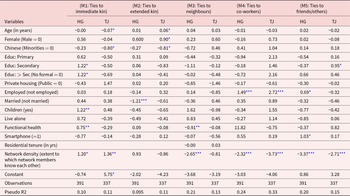
A striking pattern emerges across both neighbourhoods: a dense, tightly connected core of family members is surrounded by a more loosely knit periphery of friends, co-workers, and neighbours. Table 4 presents regression models predicting which roles appear in respondents’ networks, allowing us to understand how individual characteristics shape their relational configurations.
Predictors of ties to immediate kin, extended kin, neighbours, co-workers and friends (hougang and taman jurong)

Standard errors in parentheses. HG: Hougang. TJ: Taman Jurong.
Notes:
*** p < 0.001,
** p < 0.01,
* p < 0.05.
Having children, for instance, is associated with ties to immediate kin; employment is linked to connections with co-workers and friends; better functional health is associated with fewer neighbour ties, suggesting that those who are more mobile form networks beyond their immediate vicinity. Smartphone use correlates with having more friendships, reflecting the role of digital technology in sustaining non-kin ties.
Network density data further support this two-part structure: the familial core tends to be dense, with family members knowing one another, whereas the periphery—comprising non-kin—is more diffuse, with ties less likely to be connected to one another. This structural pattern aligns with Hypothesis 2: older adults’ networks consist of a close-knit familial centre and a more expansive, sparser periphery.
Specialised ties for different needs
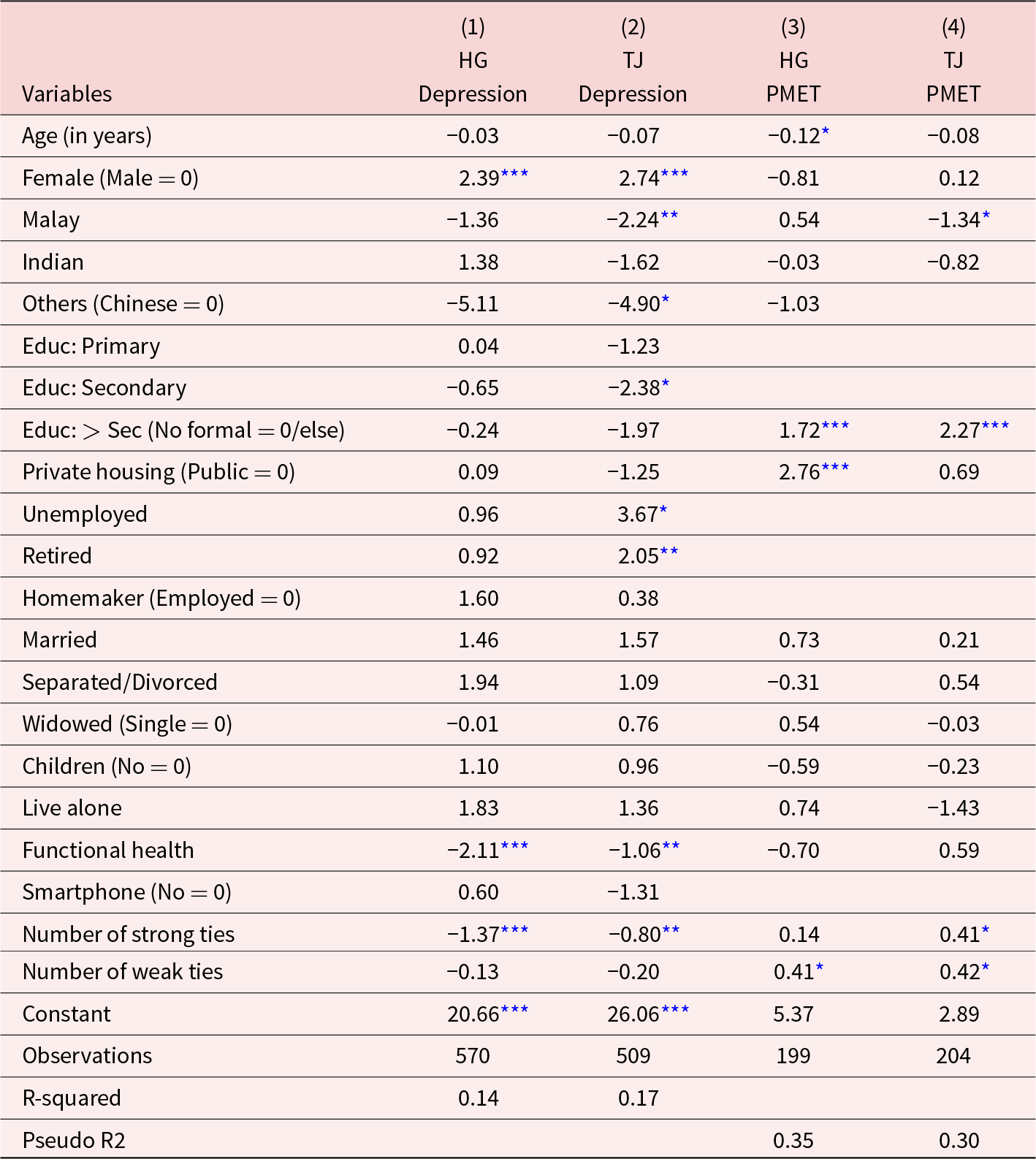
Hypothesis 3 proposes that different kinds of ties serve different purposes. Table 5 examines this by comparing network characteristics against two outcome types: socio-emotional well-being (measured by a depression index) and instrumental outcomes (whether the respondent holds a PMET job, considered a proxy for occupational status).
Predictors of depression and PMET, by neighbourhood

Notes: Standard errors in parentheses. HG: Hougang. TJ: Taman Jurong. PMET: occupations in the professional, managerial, executive, and technical fields.
Significance levels:
*** p < 0.001,
** p < 0.01,
* p < 0.05
Models 1 and 2 show that strong ties significantly reduce the risk of depression in both neighbourhoods. Weak ties, in contrast, are not significantly associated with depression. Conversely, Models 3 and 4 show that having a greater number of weak ties is significantly associated with PMET employment in both neighbourhoods. These findings affirm the dual utility of social networks: strong ties provide emotional support, while weak ties help facilitate instrumental outcomes such as employment. In short, Hypothesis 3 is supported—different ties serve different valuable functions.
Mobility and amenities: networks in motion
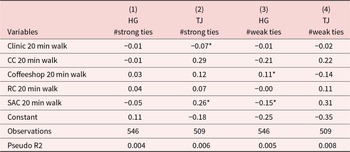
Hypothesis 4 challenges the premise in ageing in place that proximity alone ensures social connection. Instead, it suggests that older adults orient their mobility around social relationships—what we call ageing in networks. Tables 6a to 6c show that the presence of amenities is positively associated with both strong and weak ties. In Hougang, coffeeshops within walking distance are associated with weak ties; in Taman Jurong, nearby senior activity centres and clinics are linked to strong ties.
Association between number of various amenities (within a 20-min walk) and number of strong ties and number of weak ties, by neighbourhood

Association between number of various amenities (within a 15-min transit) and number of strong ties and number of weak ties, by neighbourhood

Association between number of various amenities (within a 7-min drive) and number of strong ties and number of weak ties, by neighbourhood

Notes: CC: Community club. RC: Resident committee. SAC: Senior activity centre. HG: Hougang. TJ: Taman Jurong.
Significance levels:
** p < 0.01,
* p < 0.05.
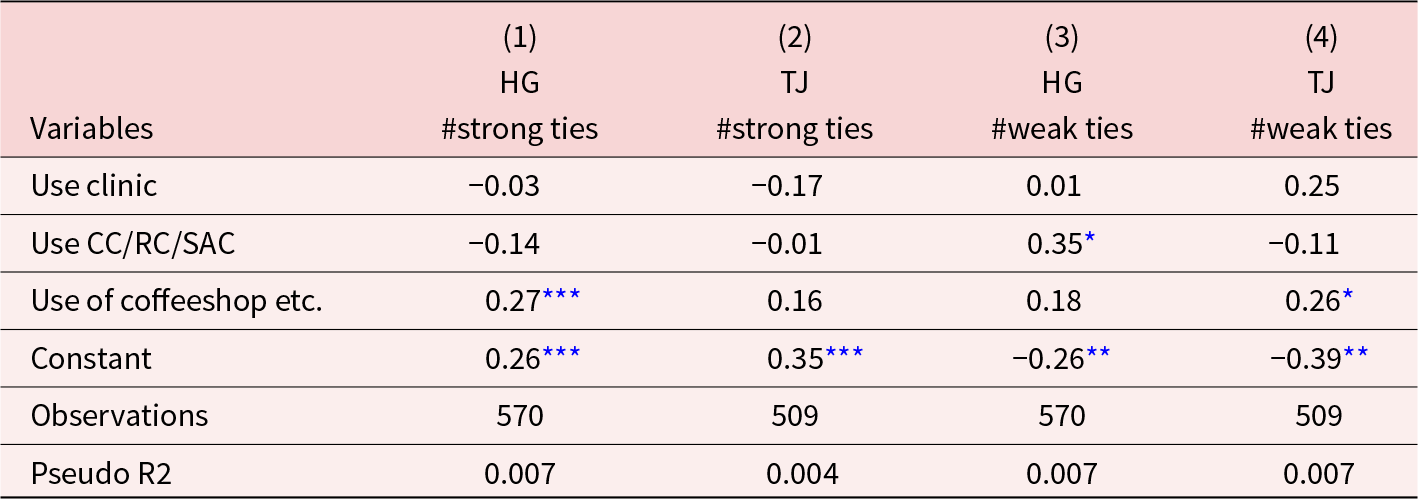
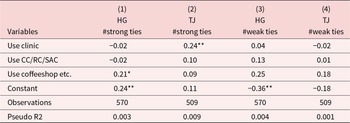
Tables 6d and 6e focus on usage rather than presence. Older adults who frequent coffeeshops, clinics, and community clubs—especially those located beyond a 20-minute walk—tend to have more extensive and diverse networks. Notably, accessing more distant amenities is associated with weak ties in both neighbourhoods. These associations highlight how amenities not only enable the formation of ties, but are also drawn into the orbit of pre-existing relationships.
Association between use of various amenities (within a 20-min walk) and number of strong ties and number of weak ties, by neighbourhood

Association between use of various amenities (beyond a 20-min walk) and number of strong ties and number of weak ties, by neighbourhood
Notes: CC: Community club. RC: Resident committee. SAC: Senior activity centre. HG: Hougang. TJ: Taman Jurong.
Significance levels:
*** p < 0.001,
** p < 0.01,
* p < 0.05.
Further analysis shows that the number of different addresses in a respondent’s network is positively associated with network diversity across several dimensions. It correlates strongly with the number of weak ties (r = .40, p < .001), as well as with tie strength diversity—i.e., networks that include both strong and weak ties (r = .25, p < .001). It is also positively associated with racial diversity (r = .14, p < .01), and educational diversity (r = .21, p < .001). These findings suggest that mobility and social network diversity are closely intertwined: individuals who maintain ties across multiple locations tend also to have more heterogeneous networks. This spatial reach both reflects and reinforces the varied forms of social capital they are able to access through everyday movement and interaction.
Together, the findings affirm Hypothesis 4. Amenities contribute to social capital—but the relationship likely is reciprocal. Social capital also drives the use and reach of amenities. The data would seem to suggest that older adults do not passively rely on what is nearby. Instead, they are active navigators of the urban landscape, moving across neighbourhoods to maintain and extend their social networks, meeting people they want to meet, and with whom they have made a prior arrangement.
Living alone but not necessarily lonely
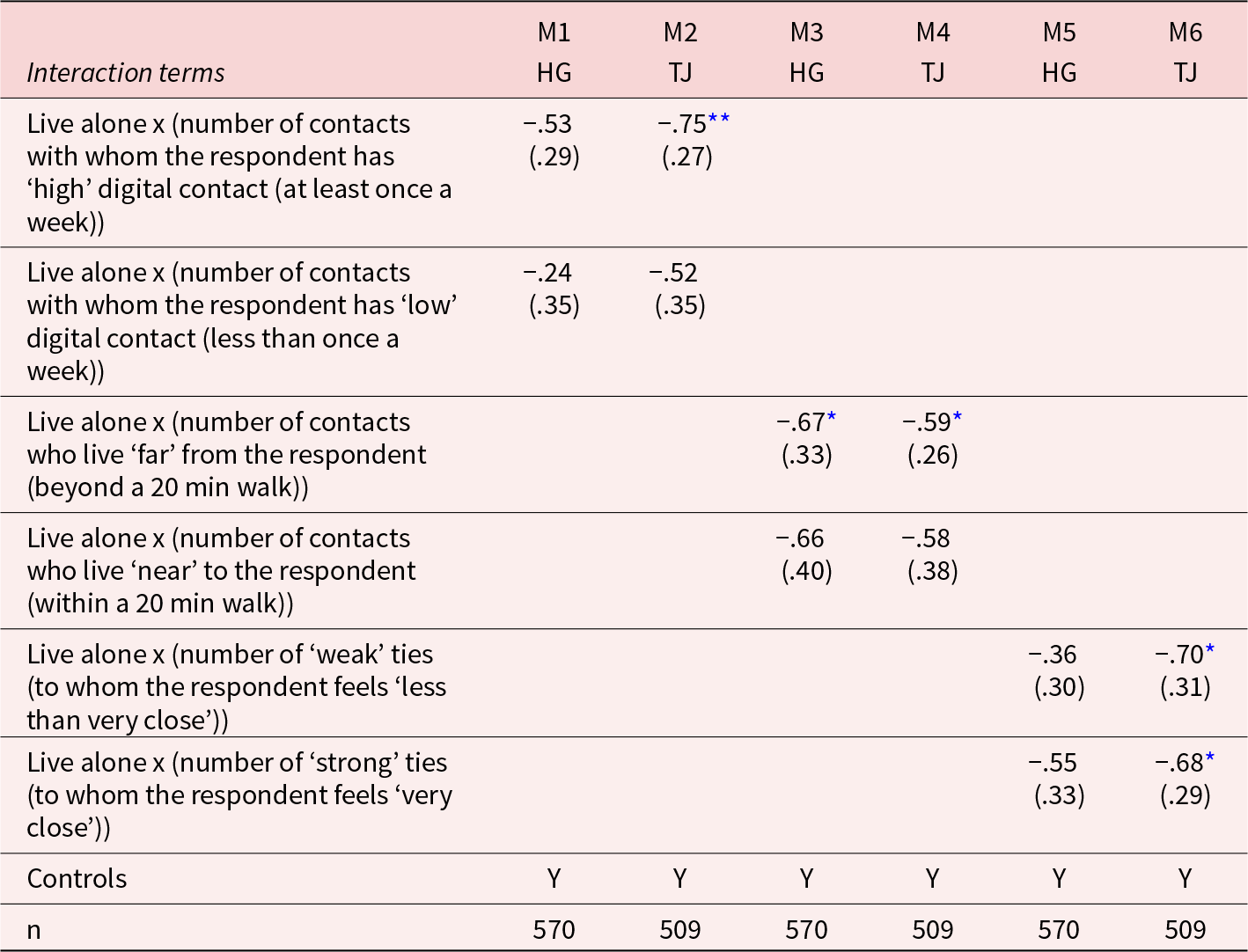
Table 7 explores the networks of older adults who live alone. While these individuals report fewer kin and strong ties, they are no less likely to have weak ties or ties to non-kin. In fact, they are just as likely to maintain frequent digital contact and sustain ties beyond their neighbourhood. This suggests that living alone does not necessarily equate to social isolation—networks can persist and adapt through digital and spatial means. Table 8 investigates whether networks can buffer the effects of living alone on loneliness, as posited in Hypothesis 5. The models provide strong support for this proposition. In Taman Jurong, having frequent online contact significantly reduces the loneliness associated with living alone (b = –0.75, p < .01; Models 1 and 2). Similarly, maintaining ties with geographically distant contacts is associated with a reduction in loneliness among those living alone in both Hougang (b = –0.67, p < .05) and Taman Jurong (b = –0.59, p < .05; Models 3 and 4). Finally, having both strong and weak ties outside the household also mitigates loneliness for older adults living alone, particularly in Taman Jurong (b = –0.70 and b = –0.68, both p < .05; Models 5 and 6). These findings collectively affirm Hypothesis 5: extended social ties—especially those maintained across distance or through digital means—play a crucial role in countering loneliness among older adults who live alone.
Contact types by living alone versus living with someone

Significance levels:
*** P < .001,
** P < .01,
* P < .05.
How contacts modify the impact of living alone on feeling lonely

Notes: Controls include: age, gender, race, education, housing, marital status, functional health (coefficients available on request). Standard errors in parentheses. HJ: Hougang. TJ: Taman Jurong. The subsamples (570 + 509 = 1,079) do not add to the original sample of n = 1,119 because 120 respondents gave no names in response to the name generator question.
* P < .05,
** P < .01.
Discussion and conclusion
This study contributes to the growing body of scholarship that reconsiders the prevailing assumptions underpinning ageing in place—the notion that older adults remain rooted in fixed, often localised settings as they age. While the theory has evolved into frameworks such as relational readings of ageing and place, which recognise some degree of mobility, the emphasis often remains spatially and geographically bounded (Cutchin and Rowles Reference Cutchin and Rowles2024). We do not seek to supplant these well-established paradigms. Rather, we build on them to propose a complementary approach: ageing in networks. While older adults may indeed remain physically anchored, they are simultaneously embedded in expansive social networks that traverse neighbourhoods, cities, and even international borders (Ho et al. Reference Ho, Gao and Lim2024b). This framework foregrounds the relational dimensions of ageing—emphasising not just where people live, but with whom they maintain connections, and how these ties influence their well-being.
To illustrate the significance of ageing in networks, we align with scholars who have re-examined traditional notions of social isolation among older adults (e.g., Djundeva et al. Reference Djundeva, Dykstra and Fokkema2019). Conventional approaches often conflate living alone with loneliness or social disconnection (Rodriguez et al. Reference Rodriguez, Schertz and Kross2025). Our findings challenge this conflation. Living alone does not preclude active social engagement; rather, older adults who maintain a range of strong and weak ties—across both digital and physical realms—are less susceptible to loneliness. This supports Hypothesis 5 and underscores the importance of extra-household ties in mitigating isolation. These ties may be relationally diverse (H1), sparsely knit (H2), and functionally specialised (H3), extending beyond the immediate household and neighbourhood. In this way, networks become a key conduit through which older adults access emotional and instrumental support.
Indeed, the concept of ageing in networks reframes the social infrastructure of later life. Older adults are not passive recipients of care confined to spatial containers, but are networked individuals (Rainie and Wellman Reference Rainie and Wellman2012) who draw on a range of technologies, mobilities, and relationships to construct meaningful lives. While some may experience constraints on mobility, others actively traverse the city-state—meeting friends for meals, worship, shopping, or leisure (Fig. 1). Importantly, this networked autonomy does not negate the value of place; rather, it reveals how places acquire meaning through social relationships. As Hypothesis 4 demonstrates, amenities do not merely produce ties—ties can also drive amenity use. People go to hawker centres, cafés, or malls not simply to encounter others, but to spend time with pre-existing ties (Torres Reference Torres2019). In this sense, relationships shape places just as much as places shape relationships—a form of relational placemaking (Cagney et al. Reference Cagney, York Cornwell, Goldman and Cai2020).
This emphasis on relational placemaking also marks our conceptual contribution. While frameworks such as spatial polygamy (Matthews and Yang Reference Matthews and Yang2013), third places (Finlay et al. Reference Finlay, Cannon, Meltzer, Yeh, Cutchin and Rowles2024; Oldenburg Reference Oldenburg1989), and activity spaces (Cagney et al. Reference Cagney, Browning, Jackson, Soller, In LJ Waite and Plewes2013) have drawn attention to the multiplicity of places in older adults’ lives, they often understate the social dynamics that animate these geographies. Our study invites a shift from geographic proximity to relational connectedness. In our methods, this was reflected in how respondents led us to their important places and people—via open-ended name generators and GPS tracking—without any prior imposition on what counted as ‘local’ or ‘neighbourhood.’ This attention to ‘splatial’ dynamics (Feng et al. Reference Feng, Chin, Gao, Chua and Ho2024; Shaw and Sui Reference Shaw and Sui2020)—combining spatial and relational perspectives—offers a richer account of community.
We argue that ageing should be understood as a process of relational empowerment. Our findings illustrate that older adults actively maintain and mobilise social networks to meet both sociability and instrumental needs. This challenges ageist portrayals that depict them as frail, dependent, or disconnected (Swift and Steeden Reference Swift and Steeden2020). On the contrary, many are mobile, active, digitally connected, and socially engaged. Popular representations often fail to reflect this reality. Stigmatising tropes must be replaced with narratives that highlight agency and connectedness in later life.
To be sure, not all older adults experience ageing in networks equally. Those with constrained mobility may have more localised and physically bounded networks, for whom ageing in place remains an apt description. But for the average respondent in our dataset, networks span across neighbourhoods and city spaces. Places still matter—as sites of care, services, and activity—but they are part of a broader social infrastructure, one that includes digitally mediated and geographically dispersed ties. During the COVID-19 pandemic, many older adults rapidly adapted by shifting social activities online, and resumed in-person interactions as soon as conditions allowed (Ho et al. Reference Ho, Gao and Lim2024b). Their adaptability reveals the capacity of social networks to endure even amid disruption.
A key limitation of this study is its cross-sectional design, which restricts our ability to make strong causal claims. While we argue that ties often drive amenity use (ties → amenities), it is also likely that the reverse relationship holds (amenities → ties). Longitudinal data would help clarify how networks and place-making influence one another over time. Future research should examine how network quality evolves and how different types of ties—strong or weak, online or offline—serve as buffers against loneliness, stress, and decline. Comparative research across cultures and contexts will also be critical. While we believe ageing in networks is a widespread phenomenon, its form and function will differ by infrastructural context, technological access, and cultural norms. A compact and digitally connected society like Singapore provides a unique vantage point—but comparative studies could deepen our understanding of variation and universality.
Beyond academic contribution, our findings have practical implications. Ageing in networks calls for policy approaches that recognise the mobility, connectivity, and social autonomy of older adults. First, while maintaining elder-friendly amenities in residential neighbourhoods remains important, it is equally vital to support older adults’ ability to travel—both within and beyond their neighbourhoods (Gimie et al. Reference Gimie, Melgar Castillo, Mullins and Falvey2022). Transport connectivity, walkability, and affordability—what Harada et al (Reference Harada, Birtchnell and Du2023) term ‘mobility justice’—must be central to planning age-friendly cities. Second, digital literacy must be seen not as a luxury but a necessity. As older adults increasingly rely on technology to maintain ties and schedule meet-ups, policies that promote digital access, skills training, and user-friendly design will become indispensable (Hargittai et al. Reference Hargittai, Piper and Morris2019).
Policy should also support the formation and sustainability of social networks that are not bound by geography. Community programmes should aim to bring together older adults not just by residential proximity, but by shared interests, values, or life experiences—thus creating opportunities for connection beyond the neighbourhood. Traditional service models must evolve to better support dispersed networks, for instance, through telehealth, interest-based virtual communities, or cross-neighbourhood events (Hamilton et al. Reference Hamilton, Johnson, Quinn, Coppola, Sachs, Migliaccio, Phipps, Schwartz, Capasso, Carpenter and Putrino2020).
To conclude, this paper presents ageing in networks not as a radical paradigm shift, but as a needed supplement to existing place-based frameworks. It reminds us that places do not exist in a vacuum; they are animated by relationships. Older adults are not isolated containers—they are embedded in relational landscapes. Some may live alone, but many are not lonely. Their connections extend far beyond the walls of their homes, into the city and into the world (Quan-Haase et al. Reference Quan-Haase, Mo and Wellman2017, Reference Quan-Haase, Williams, Kicevski, Elueze and Wellman2018). Seniors are ‘networked individuals’ (Rainie and Wellman Reference Rainie and Wellman2012). These ties—often overlooked—are the lifeblood of ageing well. We must attend to them, if we are to truly understand what it means to age with dignity, agency, and connection.
Financial support
This research project is supported by the Ministry of Education, Singapore, under its Social Science Research Thematic Grant (Award No: MOE2019-SSRTG-012).
Competing interests
The authors reported no potential conflict of interest associated with this study.
Ethical standards
This research has been approved by the National University of Singapore’s Institutional Review Ethics Board (NUS-IRB-2020-419).







 Open access

